On The War Memorial Trail…..The Christmas Dinner Heist In WWII England

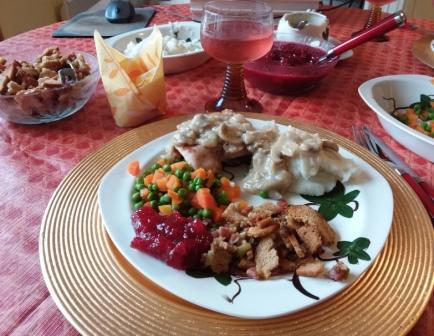
December 13, 2022. If Christmas Day means a special meal in your household, you aren’t alone.  In our household, we follow the traditional meal that I grew up with for Christmas Day – roast turkey with stuffing, vegetables, mushroom gravy, and cranberry sauce.

…Canadian soldier Frank MacEwen met the Pearce family…

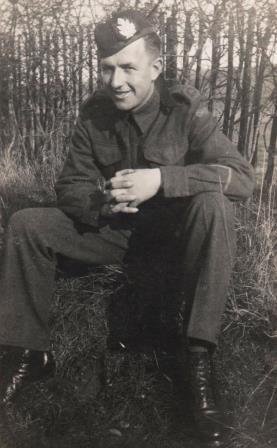
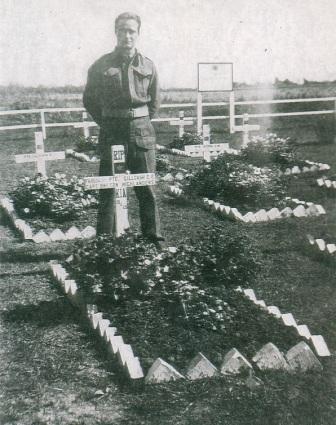
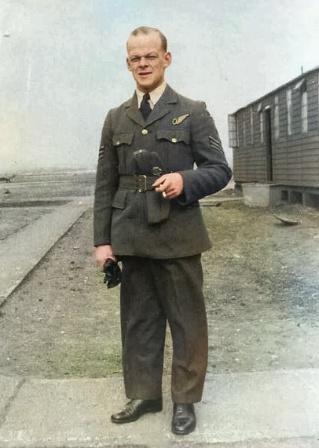
20221024_100956 Frank MacEwen

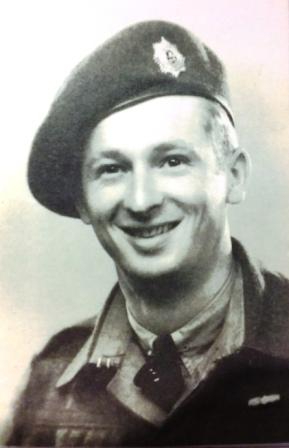
WWII soldier Frank MacEwen.  (Photo courtesy of Duane MacEwen)

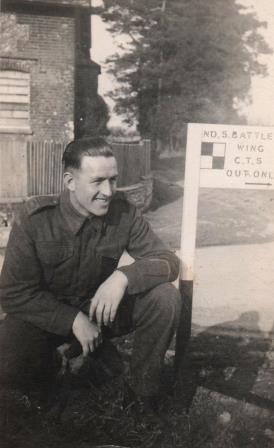
Planning for our traditional Christmas meal was on my mind when Duane MacEwen of New Dominion, Prince Edward Island, mentioned that his father, Frank MACEWEN, served with the Royal Canadian Armoured Service Corps, and was stationed in Woking, Surrey, England during WWII.

Duane explained that his father and “… his army buddies routinely walked down Barrack Path to the local pub…”  Along the way they passed the home of Frank Pearce, who lived with his wife and daughters.  A WWI veteran, Frank Pearce was an air raid warden in London during WWII.

When the oldest daughter, Betty, had her 16th birthday, she “…complained to her mother that she had no male friends to invite to her birthday as they were all on duty or serving abroad.  Mrs Pearce told Betty to go and invite some of the young Canadian soldiers who walked down Barrack Path in front of their house.  Betty did this and welcomed my dad and his close army buddies in for Betty’s birthday. This led to close ties that the family shares to this day…

Duane recalled Mr Pearce telling him that in the weeks before Christmas in 1944, “…my father questioned him quite a few times, asking what their family would have for their Christmas dinner….

…Mock Turkey in place of a traditional turkey dinner during WWII….

It was a reasonable question as in WWII Europe, food supplies were scarce.  Mainland Europe was under occupation.  Great Britain may not have been under occupation, but was regularly attacked and supplies limited.  In 1940, food rationing began.  People were encouraged to grow vegetables in ‘victory gardens’ and to find alternatives to traditional cuts of meat.

By Christmas 1944, Britain was in the 6th year of war and the 5th for rationing.  Duane recalled Mr Pearce telling his dad that “… due to the severe rationing, he hoped to possibly go out to the country to see if he could scrounge up a bit of ham or something for his family…

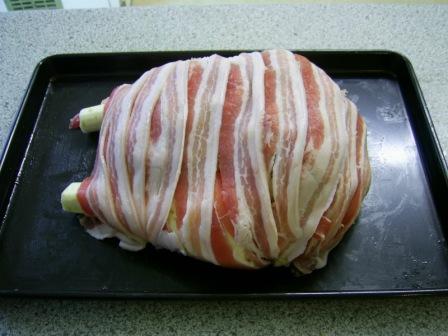
Christmas was the one day in the year that people just wanted to forget there was a war, and as the holiday approached, recipes for making a special meal became creative. While many in rural areas were able to have meals using rabbits or wild birds, ‘Mock Turkey’ out of sausage meat and vegetables was on many dinner tables.

Mock Turkey

A Mock Turkey made from sausage meat, bread crumbs, herbs and seasoning held together with grated onions and apples, arranged into the shape of a turkey, using parsnips for legs, and then covered with bacon. (Photo source: http://calmlycreative.blogspot.com/2012/10/mock-turkey.html)

….Frank MacEwen and his friends brought a Christmas surprise…

The Pearce family soon learned why Frank MacEwen was so interested in the family’s Christmas dinner plans.  In the early morning of December 25, 1944, “…Mr Pearce told me there was an awful pounding on his front door….

Thinking he was being summoned for air raid warden duties, … he rushed downstairs but to his surprise saw my father, who said ‘Let me in quick Frank and close the door behind me’….

Mr Pearce quickly saw that “… my father’s great coat was well extended around his belly. Dad opened his coat to reveal a silver tray resplendent with a huge, cooked turkey complete with some trimmings….

20211011_122555 Xmas meal

Christmas dinner at the Valkenburg house with turkey and the trimmings. (Photo credit: Daria Valkenburg)

The turkey and trimmings were only the beginning of the Christmas surprise for the Pearce family.  “…It wasn’t long before Rollin ‘Roly’ CHAMBERS, of Woodstock, Ontario, was knocking on the door.  He too had more food for this Christmas feast.  A little later, Glen LECKY, of Chipman, New Brunswick, entered with Christmas beverages for all…

A few years ago, Betty Pearce told Duane that “…she remembered the ‘best Christmas ever’ due to Dad and his friends.  It was miraculous as they were so used to rationing and doing without…

….Who stole our turkey dinner?…

After Christmas, the Canadian soldiers disappeared for several weeks, leaving the Pearce family to wonder if they had been deployed elsewhere.  “…It wasn’t normal for them not to drop in for a visit on their way to the pub or for a cup of tea and company….

While British civilians had food supplies rationed, Canadian soldiers were well-fed and nourished.  So it was not a surprise to learn from Duane that “…it soon came to light that a turkey and all the trimmings were stolen from the Sergeants’ Mess and there was a special investigation into this burglary.  The Sergeant Major stated that someone was going to pay dearly for the theft…

Everyone in the company was confined to barracks for two weeks or until the culprits were found.  The theft was never solved.  “….No one in the company told on the boys.  Maybe they didn’t know or else had a great laugh at their generosity with the Sergeants’ Mess dinners….

Frank MacEwen was discharged from the Canadian Army in February 1946.  He married Evelyn Found and lived on the Island until his death in 1990.

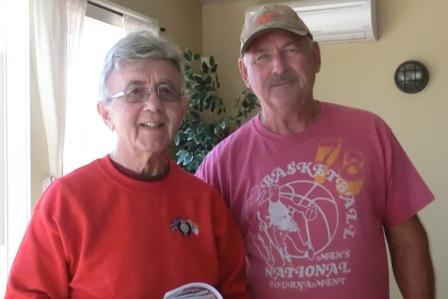
20221024_101604 Oct 24 2022 Ann and Duane MacEwen

Ann and Duane MacEwen.  (Photo credit: Daria Valkenburg)

Thank you to Duane MacEwen for sharing the story about the way his father and friends made Christmas memorable for the Pearce family. Do you have a story to tell?  Email Pieter at memorialtrail@gmail.com, comment on the blog, or send a tweet to @researchmemori1.

© Daria Valkenburg

….Want to know more about Christmas 1944 in Britain?….

To learn more about Christmas 1944 in Britain, you can watch ‘Wartime Farm Christmas Special’ on YouTube:

And here are links to two websites that may be of interest:

…Want to follow our research?….

If you are reading this posting, but aren’t following our research, you are welcome to do so.  Our blog address: https://onthewarmemorialtrail.com/

Front cover OnTheWarMememorialTrailinEurope4 countries, 6 weeks, 7,000 km – an unforgettable war memorial journey in Europe…. Daria’s book ‘No Soldier Buried Overseas Should Ever Be Forgotten‘ is available in print and e-book formats.  Net proceeds of book sales help support research costs and the cost of maintaining this blog. For more information on the book, please see https://nosoldierforgotten.com/

You are also invited to subscribe to our YouTube Channel: On The War Memorial Trail With Pieter Valkenburg: https://www.youtube.com/channel/UCJ591TyjSheOR-Cb_Gs_5Kw.

Never miss a posting!  Subscribe below to have each new story from the war memorial trail delivered to your inbox.

On The War Memorial Trail….. The WWII Soldier From Albion Who Died During The Defence Of The Nijmegen Salient

November 2, 2022. Once you visit a Canadian War Cemetery and place down a flag by the grave of a soldier from the province where you live, it stays with you, and makes you wonder about the young man who is buried there.  Over the years, Pieter has researched several of the soldiers from Prince Edward Island who are buried in The Netherlands, and he continues to do so. 

One of these WWII soldiers was George ‘Ivan’ MACKINNON, who was born September 16, 1917 in Albion, Prince Edward Island, the son of Wilbert and Catherine ‘Kattie’ (nee Acorn) MacKinnon (also spelled McKinnon).  Ivan’s birth record says he was born on September 16, but he recorded September 26 on his attestation form.

…The photo search began with media help….

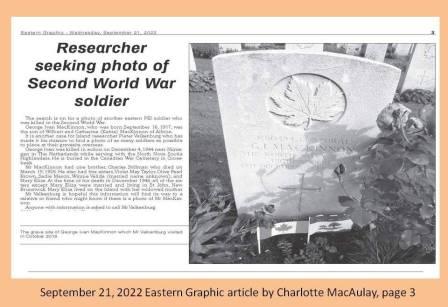
In his quest to find a photo, Pieter contacted Charlotte MacAulay of the Eastern Graphic newspaper for help in publicizing his quest.  The article ran on September 21, 2022 and shortly afterwards, Pieter was contacted by Sandra Stephens, who explained that she had a photo.

EAG-A03-092122-K Eastern Graphic George Ivan MacKinnon with border

20221019_102847 Oct 19 2022 Pieter and Sandra Stephens

Sandra Stephens with Pieter. (Photo credit: Daria Valkenburg)

When we met, Sandra explained that “… Dad’s Aunt Chris married Nathaniel MacKinnon, Ivan’s uncle.  Their place was just up the road and we visited there…

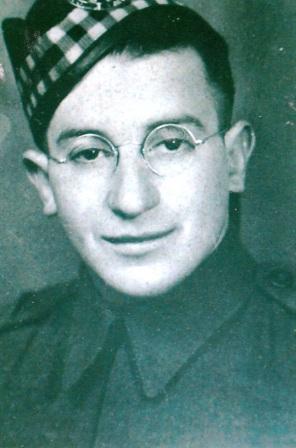
George Ivan MacKinnon

George ‘Ivan’ MacKinnon. (Photo courtesy of Sandra Stephens)

When Ivan enlisted with the North Nova Scotia Highlanders in Charlottetown on August 15, 1940, he was living in Montague, Prince Edward Island, and had worked on his family’s mixed farm operation for the past 10 years.

After completing his basic training, Ivan travelled to the United Kingdom with the Regiment, boarding the ship ‘Orion’ in Halifax, Nova Scotia on July 18, 1941.  The ship left Halifax the next day, arriving in Bristol on July 29, 1941. Intensive training followed, in preparation for the upcoming battles in Normandy in 1944.

…Ivan survived D-Day….

The North Nova Scotia Highlanders left England for Normandy, France on June 6, 1944, after waiting in place in the English Channel on landing craft earlier.   The war diary for Sunday, June 4, 1944 noted that “…We are tied up with two other landing craft tank.   The Padre is on one, so he had a church service at 10:30 hours on the quarter deck of the middle craft…

On June 5, 1944 the war diary recorded that “…At 14:00 hours the flotilla moved out to the open sea and formed up with the other craft taking part in the invasion…

After landing on the beaches of Normandy on June 6, 1944, the war diary noted that the Regiment had 10 casualties – 4 killed, 6 wounded.  Ivan had survived D-Day.

…The Regiment arrived near Nijmegen…

The North Nova Scotia Highlanders fought their way through Normandy.  On July 25, 1944, during ‘Operation Spring’, a battle in Tilly-La-Campagne, France, Ivan was slightly wounded by shell fragments to his face, legs, and neck.  (See https://www.dday-overlord.com/en/battle-of-normandy/cities/tilly-la-campagne)

From France, the Regiment travelled through Belgium, and then to The Netherlands for the Battle of the Scheldt. By November 1944 they had advanced to an area near Nijmegen.

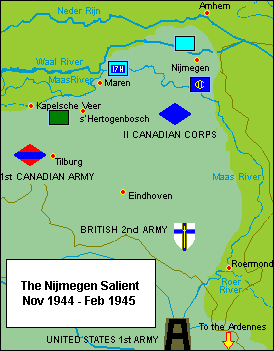
Nijmegensalient

The North Nova Scotia Highlanders were posted near Nijmegen.  (Map source: http://www.canadiansoldiers.com)

In ‘No Retreating Footsteps’ by Will Bird, he noted that on November 19, 1944, the North Novies would “…relieve the 7th Recce Regiment at Nijmegen Bridge…”  This was the bridge across the Waal River, a vital link to the Rhine River and into Germany.

The area known as the Nijmegen Salient had been established in September 1944, and was defended by Allied troops since then.  The First Canadian Army, of which the North Nova Scotia Highlanders were part of, was responsible for its defence between November 1944 and February 1945, when the advance into Germany began.  (See https://www.canadiansoldiers.com/history/campaigns/northwesteurope/nijmegensalient.htm)

Skirmishes with German troops were ongoing, with casualties on both sides.  On December 3, 1944, Will Bird recorded that “…temporary quarters was in the cellar of a smashed house.  Sgt Arnold Piers was in command, and along with him were Sgt Bud Tibbetts, Cpl I MacKinnon, Ptes Bill Smith, Conners, Scott, Campbell and Lantagan as well as four or five others. There was a German village 1000 yards ahead and until dark the carrier men fired at anyone who moved in the village….”  

When the men noticed activity in the nighttime and flares being sent up by the Germans, they reported it to officers at Artillery Headquarters, who ignored their observations.  Bird noted that “… the general feeling was that the carrier men, unused to such duties, were jittery…

…Ivan lost his life during a firefight…

It turned out that the officers were wrong and the men were right to be concerned.  There were several casualties, with two who paid with their lives, in the early hours of December 4, 1944.  “…Sentries were relieved at 2:00 am…” 

Six men were resting when Sgt Piers woke them up.  “…He had sighted a raiding party of the enemy coming toward the post. Pte A. J. Campbell rushed out with a Bren gun, and fell back dead, target for a dozen bullets…” 

In the firefight that followed, the Germans “… threw grenades and overwhelmed the … small garrison as the Brens on the parapet had been left on cock and would not fire.  Daylight came shortly after…

Ivan did not survive the attack. “…Cpl Ivan MacKinnon was seen lying out in front about 50 yards.  Pte Connors crawled out and dragged him back, but he had died, having been shot ….” 

The other casualty was Allan Joseph CAMPBELL, aged 24, son of Alex T. and Annie Campbell, of Centennial, Inverness County, Nova Scotia.

…Ivan is buried in the Canadian War Cemetery in Groesbeek….

Ivan was initially buried in the Jonkers Bosch Temporary Military Cemetery in Nijmegen, before being reburied in the Canadian War Cemetery in Groesbeek, The Netherlands.

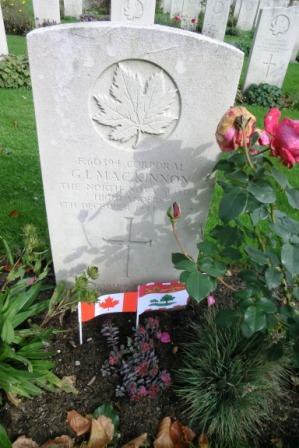
CIMG3317 Oct 5 2019 Groesbeek George MacKinnon

Grave of George ‘Ivan’ MacKinnon in the Canadian War Cemetery in Groesbeek, The Netherlands.  (Photo credit: Daria Valkenburg)

Thank you to Sandra Stephens for providing a photo, and to Charlotte MacAulay and the Eastern Graphic for publicizing the photo search request. If you have a story to tell, please let Pieter know. You can email him at memorialtrail@gmail.com, comment on the blog, or send a tweet to @researchmemori1.  

© Daria Valkenburg

…Want to follow our research?….

If you are reading this posting, but aren’t following our research, you are welcome to do so.  Our blog address: https://onthewarmemorialtrail.com/

Front cover OnTheWarMememorialTrailinEurope4 countries, 6 weeks, 7,000 km – an unforgettable war memorial journey in Europe…. Daria’s book ‘No Soldier Buried Overseas Should Ever Be Forgotten‘ is available in print and e-book formats.  Net proceeds of book sales help support research costs and the cost of maintaining this blog. For more information see https://nosoldierforgotten.com/ 

You are also invited to subscribe to our YouTube Channel: On The War Memorial Trail With Pieter Valkenburg: https://www.youtube.com/channel/UCJ591TyjSheOR-Cb_Gs_5Kw

Never miss a posting!  Subscribe below to have each new story from the war memorial trail delivered to your inbox.

Pieter Receives PEI Senior Islander Of The Year Award

October 23, 2022. On Friday afternoon, October 21, 2022, we were invited to the Loyalist Inn in Summerside for the 2022 PEI Senior Islander of the Year Awards.  Pieter was honoured for his volunteer work, with a particular emphasis on his research to uncover the stories and photos of Islanders who served in WW1 and WW2.  

20221021_142625 Oct 21 2022 Pieter receives award photo by Mike Smith

Left to right: Hon. Matthew Mackay, Pieter, Audrey Morris.  (Photo credit: Mike Smith)

The certificate was presented by the Hon. Matthew Mackay, Minister for the Department of Social Development and Housing, and Audrey Morris, Chairperson, PEI Seniors Secretariat, in a ceremony at the Loyalist Inn in Summerside. 

2022 Sr Islander of Year Certificate 1

The PEI Senior Islanders of the Year Award certificate.

….Excerpts from some of the letters of support for the nomination….

Excerpts from some of the letters in support of his nomination included:

….In 2015 Pieter began researching 46 names listed on the Cenotaph outside the Borden-Carleton Legion, and in the process was involved in adding 2 more names, for a total of 48.  He not only researched the stories, and where possible, found photos and families of the soldiers, he publicly shared these stories through the media. 

In 2017, so much research had been compiled that he and his wife Daria started a dedicated research blog, which continues to this day.  He also undertook, at his own expense, a 6 week, 7,000 km war memorial tour through 4 European countries to visit cemeteries and memorials of those soldiers he had researched that were buried there…. and those stories were shared as well. 

Pieter continues to share stories of Islanders who served, a valued and immeasurable contribution to our Island’s history. His research has led to a renewed interest in our Island soldiers, and has informed many families and communities about the service and bravery of those who served. 

His research now has expanded to include soldiers from other parts of Canada, as requests come in for help from Dutch researchers. Being Dutch Pieter has a deep gratitude towards Canadians for liberating his birth country, which drives his passion to bring to the forefront the sacrifices of those who served….

…Pieter, assisted by his wife Daria, has voluntarily, passionately, and tirelessly worked to research the lives of close to eighty Island soldiers killed overseas in WW1 and WW2.

Pieter’s work has brought to life the personal stories of Island soldiers who gave their lives overseas, and until now were only names on plaques. Descendants of these brave men and women, many now seniors, are greatly appreciative and moved by the commemorative work he has done on behalf of their loved ones.

Whether pouring over documents and photos, meeting families of Island soldiers killed overseas, or boarding a plane for Europe to visit war graves and memorials, Pieter persevered, often tramping through fields in search of a Canadian soldier’s grave….

…Heritage and in particular a passion for the Veterans of this area led Pieter into the Borden-Legion Cenotaph Project, and I emphasize the contribution Pieter made as he undertook to complete a remarkable amount of research documenting information and faces of forty-eight names on the Cenotaph outside the Borden-Carleton legion, and then continuing with stories of other WW1 and WW2 soldiers from the area.  Pieter met with families of these soldiers whenever possible, linking the past with the present, visiting graves and memorials in Canada and in Europe. Pieter continues this research to this present day…

How special is it for people to bring to life the personal histories of these brave men and women from their local communities who died in service. Pieter’s work reveals his community spirit in supporting Veterans families through his continued efforts. 

Even more importantly is the knowledge that family members of these soldiers have someone who has taken the initiative to ensure the families heroes are not forgotten.  Through his thorough research it also communicates to the families many facts that they would not have otherwise known about their war heroes…

….What are the Senior Islanders of the Year Awards?….

The Senior Islanders of the Year Awards have been presented since 2010 to celebrate the work of Island seniors in areas like volunteering, artistic achievement, leadership, mentorship, fundraising, community participation and career achievement. 

These awards are about recognizing and celebrating the significant contributions of Island seniors, through employment, volunteerism and community activities. I cannot think of a more deserving group of Islanders to receive this honour.” – Social Development and Housing Minister Matthew Mackay

Pieter was one of six Island Seniors who were awarded the Senior Islander of the Year for 2022.  (See P.E.I. presents Senior Islanders of the Year awards for 2022 | SaltWire https://www.saltwire.com/prince-edward-island/news/local/pei-presents-senior-islanders-of-the-year-awards-for-2022-100786273/)

…Pieter with his guests….

CIMG5962 Oct 21 2022 Pieter & guests after Sr Islander Of Year award ceremony

Pieter was allowed to invite 5 guests.  From left to right: Mike Smith, the Hon. Matthew Mackay, Daria and Pieter, Annie Lee and Elmer MacDonald.  Missing from the photo: Isabel Smith.  (Photo courtesy of Valkenburg Family Collection)

A huge thank you to those who nominated and supported Pieter for this award, and to the PEI Seniors Secretariat for affirming that seniors continue to play a vital role in our society.

As his very proud wife, I was delighted that Pieter received this recognition.  I’m extremely proud of him for his incredible work in bringing history to life by telling the stories of individuals who served in WW1 and WW2. 

If you have a story to tell, please let Pieter know. Email him at memorialtrail@gmail.com, comment on the blog, or tweet to @researchmemori1

…Want to follow our research?….

If you are reading this posting, but aren’t following the blog, you are welcome to do so.  See https://onthewarmemorialtrail.com/ or email me at dariadv@yahoo.ca and ask for an invitation to the blog. 

Front cover OnTheWarMememorialTrailinEuropeDaria’s book ‘No Soldier Buried Overseas Should Ever Be Forgotten‘ is available in print and e-book formats.  For more information see https://nosoldierforgotten.com/

You are invited to subscribe to our YouTube Channel: On The War Memorial Trail With Pieter Valkenburg: https://www.youtube.com/channel/UCJ591TyjSheOR-Cb_Gs_5Kw

© Daria Valkenburg

On The War Memorial Trail….. The WWII Soldier From Glenwood Killed During The Battle Of The Delfzijl Pocket

October 22, 2022.  In November 2014, Pieter began helping researchers at the Canadian War Cemetery in Holten to find photos of soldiers buried there who were from Prince Edward Island. It wasn’t until a year later that newspaper articles were published with stories related to Pieter’s research, and three years before this blog began.

Back in 2014, Pieter was initially sent a list of 9 names, one of which was Carman Edward GILLCASH, who was born November 6, 1916 in Glenwood.  As Carman’s story has not yet been told on this blog, we thought it was time to do so.

Photo 1 Carman Gillcash in uniform

Carman Edward Gillcash.  (Photo courtesy of Stewart Gillcash)

Stewart Gillcash submitted photos, and explained that he was the son of Carman’s brother Leland.  “…Carman Edward Gillcash, born and raised on a farm in Glenwood, Prince Edward Island in Canada, was the son of Stewart and Mae (nee Boulter) Gillcash. He had two brothers, Elton and Leland. 

Carman went to school in a one room schoolhouse not far from his home, and, as his father died when Carman was a young boy, he later worked with farmers in his community to help out at home. 

Carman and his younger brother Leland joined the army at a young age, when Leland was only 16 or 17 years of age.  Leland returned from the war, but Carman died there…

Carman enlisted with the PEI Highlanders in Charlottetown on July 15, 1940.  In his Occupational History Form, dated April 8, 1941, Carman stated that he had been working as a fisherman for Wilfred Hickey of O’Leary.

Photo 2 Carman Gillcash on right unknown on left

Carman Gillcash, right, with unidentified soldier. (Photo courtesy of Stewart Gillcash)

… Carman was sent to Newfoundland….

NFLD Map shows Botwood

Location of Botwood Military Base in Newfoundland. (Map source: http://postalhistorycorner.blogspot.com/2012/12/wwii-canadian-forces-in-newfoundland.html)

Carman was sent to Halifax with the PEI Highlanders.  In June 1941, he went to Valcartier, Quebec, and then the Regiment went to Newfoundland in July 1941. An RCAF base in Botwood had aircraft patrolling the east coast of the Atlantic. Canadian Army personnel based at Botwood were charged with protection of military facilities that had been installed there, as well as in Gander. (See https://www.heritage.nf.ca/articles/politics/botwood-base.php)

On June 4, 1942 he was sent to Gander, and then in April 1943 he was posted to Saint John, New Brunswick.  While serving in Newfoundland, Carman was promoted twice, first to Lance Corporal, and then to Corporal.

…..Two other soldiers were in Botwood…..

Carman was in Botwood at the same time as two other soldiers whose stories have been told on this blog:

…Carman was sent overseas….

On June 1, 1943, he was transferred to No 1 Transit Camp in Windsor, Nova Scotia. Just over a week later, along with fellow Islander James ‘Frank’ Mossey, he was on his way to the United Kingdom, arriving there on June 18, 1943, part of the Canadian Infantry Reinforcement Unit (CIRU).

On August 13, 1943, at his own request, Carman was demoted to private.  He then transferred to the Cape Breton Highlanders.  On October 24, 1943 the Regiment went to Italy.

On May 14, 1944 Carman was wounded, but returned to service two weeks later.

On February 19, 1945 he left Italy as part of Operation Goldflake, arriving in Marseilles, France two days later.  Operation Goldflake was the codename for moving troops from Italy to North-West Europe.  (See https://en.wikipedia.org/wiki/Operation_Goldflake)

From France, troops were moved up to the Belgian front, into The Netherlands, through the Reichswald Forest in Germany, and then back into The Netherlands.

…The Regiment participated in the Battle of the Delfzijl Pocket….

The Cape Breton Highlanders relieved The Essex Regiment in the area of Nijmegen, before going towards Dokkum. On April 21, 1945, the Regiment relieved the North Nova Scotia Highlanders.

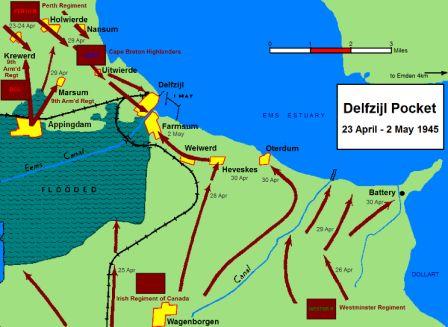
The next objective was to liberate Delfzijl, which was strategically important to the Germans as it and the surrounding area had batteries with cannons to defend the coastline and the German port of Emden against Allied bombers.

The April 28, 1945 war diary entry for the Cape Breton Highlanders recorded that “…We received word from Brigade this morning that the Perth Regiment did not do so well last night on account of mines. We will likely relieve them tonight so we are to move to another concentration area this afternoon…

The Regiment was on the move quickly in preparation to relieve the Perth Regiment.  “…At 13:50 hours the marching personnel were on the move and half an hour later the vehicles moved. Tactical HQ and B Company were set up in the town of Bierum while the remainder of the Battalion are in the area of Spijk...

The war diary went on to report that “….At 20:00 hours the Observation Post reported very dense smoke coming from the town of Delfzijl, which is our objective. This could be caused by either demolitions by the enemy or our artillery which has been firing on that area.

At 23:55 hours ‘A’ Company moved off to relieve ‘A’ Company of the Perth Regiment. They will likely be the only Company moving tonight…

…Carman lost his life in the wee hours of April 29, 1945….

On April 29, 1945 the war diary reported that “….The first report received from ‘A’ Company was at 01:15 hours when they called for the Medical Officer’s carrier. As the Company was going forward it was met by a large group of P.O.Ws. being escorted back by the Perth Regiment, and as they were passing each other one of the enemy stepped on a mine, killing one of our men and wounding two more…

The fatality in the early morning of April 29, 1945 was Carman.

…Carman was temporarily buried in Wirdum…

Carman was initially buried in 15 Divisional Cemetery in Wirdum, The Netherlands.

Photo 4 Leland brother of Carman Gillcash at the gravesite

Carman’s brother Leland visited his grave.  (Photo courtesy of Stewart Gillcash)

.…Carman was reburied in the Canadian War Cemetery in Holten….

After the war ended, Carman was reburied in the Canadian War Cemetery in Holten, The Netherlands.  We visited his grave twice – in 2017 and again in 2019.

CIMG3219 Oct 3 2019 Holten Carmen Gillcash

Pieter (right) at the grave of Carman Gillcash with researchers Edwin van der Wolf (left) and Henk Vincent (centre) in October 2019.  (Photo credit: Daria Valkenburg)

 …A plaque commemorates Canadian soldiers who died during the Battle of the Delfzijl Pocket….

In 1995, the Stefanus Church in Holwierde placed a plaque to commemorate Canadian soldiers who lost their lives during the Battle of the Delfzijl Pocket.

Plaque at Stefanus Church in Holwierde

Plaque at Stefanus Church in Holwierde, The Netherlands.  (Source: https://www.tracesofwar.nl/sights/40531/Herinneringsplaquette-Stefanus-Kerk.htm)

…We had a chance to meet Stewart Gillcash….

CIMG2610 Sep 8 2018 Pieter with Stewart Gillcash at The Catch

Pieter (left) with Stewart Gillcash.  (Photo credit: Daria Valkenburg)

Thank you to Stewart Gillcash for sharing photos and information on his uncle.  We were able to meet him in September 2018.  (See https://onthewarmemorialtrail.com/2018/09/11/on-the-war-memorial-trail-in-prince-county-pei/)

If you know who the unidentified soldier is in the photo, or have a story to tell, please let Pieter know. You can email him at memorialtrail@gmail.com, or comment on the blog.

© Daria Valkenburg

….. Other Soldiers Mentioned On The Plaque In The Church In Holwierde….

…Want to follow our research?….

If you are reading this posting, but aren’t following our research, you are welcome to do so.  Our blog address: https://onthewarmemorialtrail.com/

Front cover OnTheWarMememorialTrailinEurope4 countries, 6 weeks, 7,000 km – an unforgettable war memorial journey in Europe…. Daria’s book ‘No Soldier Buried Overseas Should Ever Be Forgotten‘ is available in print and e-book formats.  Net proceeds of book sales help support research costs and the cost of maintaining this blog. For more information on the book, please see https://nosoldierforgotten.com/

You are also invited to subscribe to our YouTube Channel: On The War Memorial Trail With Pieter Valkenburg: https://www.youtube.com/channel/UCJ591TyjSheOR-Cb_Gs_5Kw.

Never miss a posting!  Subscribe below to have each new story from the war memorial trail delivered to your inbox.

On The War Memorial Trail….. ‘We’ll Never Forget Uncle Bunky’

October 12, 2022. Recently, Douwe Drijver, a researcher at the Stichting Missing Airmen Memorial Foundation, a non-profit volunteer organization based in Leeuwarden, The Netherlands, asked if Pieter could help find family of a WWII airman from Prince Edward Island. (For more information – in Dutch – on the Foundation, see www.luchtoorlogfriesland.nl )

This organization organized the unveiling of a memorial panel in Wons, The Netherlands to honour WWII pilot Elmer Bagnall MUTTART of Cape Traverse, Prince Edward Island, who is buried in Harlingen General Cemetery, and the crew of Halifax L9561.  (See https://onthewarmemorialtrail.com/2019/10/06/unveiling-of-the-memorial-panel-for-downed-ww2-plane-halifax-l9561-in-wons/)

Douwe asked if Pieter could find family of Rowan Charles FITZGERALD….who was born in Charlottetown on July 12, 1915 and has been missing since June 28, 1942….”  The plane he was on, “… Halifax W1175 of the 405th Vancouver Squadron RCAF came down in the Wadden Sea at 03:00 that morning. Only one crew member has a known grave….

Then Douwe surprised us by saying that the crew member with a known grave, Murray Ralph KLEISDORFF of Australia, “…. found his final resting place in Harlingen….” His grave is between 3 unknown graves, one of which may just contain the remains of Rowan Charles FitzGerald.  All four graves are in the row right behind Elmer Muttart!

…We meet family of Rowan Charles ‘Bunky’ FitzGerald….

Shortly after this request came in, retired music teacher Rowan FitzGerald got in contact, explaining that Rowan Charles, known in the family as ‘Bunky’, was his uncle.  Rowan’s sister Janet was visiting from Alberta and the two of them would like to meet to share photos and stories of their uncle.

CIMG5743 Aug 7 2022 Rowan Janet Fitzgerald Pieter

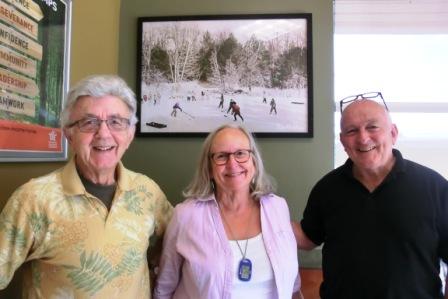
Pieter, left, with Janet FitzGerald and her brother Rowan FitzGerald.  (Photo credit: Daria Valkenburg)

… ‘Bunky’ was born in Charlottetown….

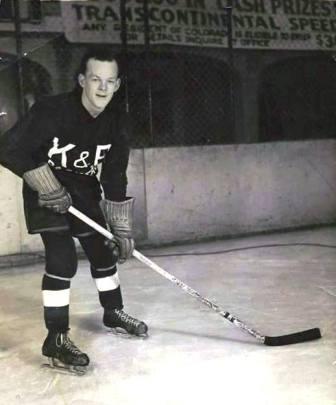
Janet had prepared a summary of her uncle’s life. “Rowan Charles FitzGerald was the middle son of Geoffrey David FitzGerald and Flora Hope Wiggins.  He was born on July 12, 1915 in Charlottetown, Prince Edward Island, where he attended West Kent School and Prince of Wales College.  Rowan was active in sports. He played football, was a competitive speed skater, and played hockey with the Charlottetown Abbies and with a farm team in Colorado…..

Bunky Fitzgerald hockey picture

Bunky played hockey before enlistment.  (Photo courtesy of the FitzGerald Family)

… Bunky’s true character shone through in an anecdote….

In addition to hockey, Bunky was a keen speed skater.  Janet shared an anecdote that showed the true character of her uncle.  “The FitzGerald family loved competitive sports, but winning was never the most important thing.  I remember our father, T. L. ‘Babs’ FitzGerald, illustrating this with a story about his brother Bunky.  He was in a speed skating championship race.  He and one other contender were way out in front of the pack, neck in neck, as they rounded the turn beginning their last lap. 

The other man fell, and instead of skating on to victory, Uncle Bunky stopped, waited for his opponent to get back up on his skates, and then raced him to the finish line, winning by only a few strides.  When asked why he stopped when his opponent fell, he replied that he wanted to win fairly because he was the faster skater, not because his competition had an accident….

… Bunky enlisted with the RCAF in 1940….

From 1934 to 1935, Bunky was a signaller with the 8th Medium Battery Militia in Charlottetown. He later moved to Ontario, where he worked as a prospector for Kirkland Hudson Bay Mining in New Liskeard, an area rich in cobalt.

On July 1, 1940, Bunky enlisted with the Royal Canadian Air Force (RCAF) in Toronto, Ontario.  Janet noted that he “….began training in July 1940 ...

From January 5, 1941 to March 31, 1941 he attended an Air Observers course in Malton, Ontario.

Rowan Charles Fitzgerald in uniform in snow in Malton ON 1941

Bunky beside an Avro Anson plane in Malton, Ontario while attending an Air Observers course in 1941.  (Photo courtesy of the FitzGerald Family)

Once the Air Observers course was completed, Bunky was sent to the No. 1 Bombing and Gunnery School in Jarvis, Ontario where he took the AB Initio Bombing and AB Initio Gunnery courses.  Both were completed on May 12, 1941.

From Jarvis, Bunky went to the No. 1 Air Navigation School in Rivers, Manitoba for an Air Observers Advanced Navigation Course, which he completed on June 9, 1941.

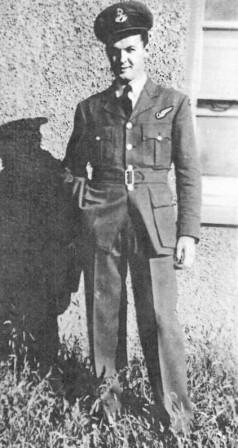
improved_photo Bunky Fitzgerald

Bunky in uniform after receiving his Air Observer wings. (Photo courtesy of the FitzGerald Family.  Photo colourization by Pieter Valkenburg)

… Bunky was sent overseas and joined the RAF pool….

On June 29, 1941 Bunky left for the United Kingdom, and was ‘attached to the RAF from the RCAF’ as of July 28, 1941.  (RAF referred to Royal Air Force.)

Janet recorded that Bunky was “first with the 77th Squadron and in March 1942 was assigned to the 405 Squadron at Pocklington Air Force Base near York, England…

… Bunky’s father and brother also served ….

Among the treasures that Janet shared were letters that Bunky’s mother had saved.  In a May 9, 1942 letter written from Pocklington, Bunky wrote about a reunion with his father and brother Babs, who were both in the army and in England at the time.

… Dear Mother,

As you probably guessed from our telegram the three of us have finally gotten together.  In my last letter I told you about missing them when I was on leave.  Well, they got leave when they came back from their maneuvers and came up to see me.  I parked them in York and got to see them for the last three nights.  They left for London this morning.  We had a lot of fun.  It was sure good to get together again…

Unfortunately, it was the last time they met.

 … The last flight of Halifax W1175 LQ-Q ….

Janet’s account noted that “On June 27, 1942, flight W1175 LQ-Q left RAF Pocklington, piloted by Canadian F/Sgt William Field, at 23:32 hours on a mission to Bremen, Germany. Rowan FitzGerald was the navigator on the flight….

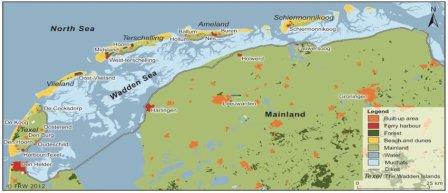
As the plane was returning from Bremen in the morning of June 28, 1942, it was hit by shellfire (flak) and crashed into a sandbank called ‘De Waard’ in the Wadden Sea, off the Dutch coast between the Island of Texel and the mainland, 15.5 km from Harlingen, in the province of Friesland.  There were no survivors.

The-Dutch-Wadden-Sea-Area

The Wadden Sea off the Dutch coast near Harlingen.  (Map source: https://www.researchgate.net/figure/The-Dutch-Wadden-Sea-Area_fig3_309826242)

The crew members were 3 Canadians, 1 Australian, and 3 British:

  • RCAF Flt Sgt W E N FIELD Captain (Pilot) – Canadian
  • RAF Sgt R F ANSELL (Flight Engineer) – British
  • RCAF Rowan Charles FITZGERALD (Navigator) – Canadian
  • RAAF Flt Sgt Murray Ralph KLEISDORFF (Air Bomber) – Australian
  • RAF Sgt E O SMITH (Wireless Air Gunner) – British
  • RCAF Flt Sgt J D AILEY (Air Gunner) – Canadian
  • RAF Sgt A DANBY (Air Gunner) – British

Douwe Drijver had explained in his request that only one crew member had been identified – Murray Ralph Kleisdorff of Australia.  For the next part of the story we had to look at records in the National Archives of Australia.

….Four bodies were buried in Harlingen General Cemetery…

The trail had run out for the information in Bunky’s service file, but reports related to the Australian crew member were available at the National Archives of Australia in Canberra.  The reports were not digitized, but when we asked Phillip Shovk of Sydney for help, he contacted Rod Covell, who lived in Canberra.  Rod and his wife Kaylene agreed to look into the files.

An investigation into the crash, based on German records, verified that a Halifax bomber matching the serial number of the plane used by W1175 crashed into the Wadden Sea on the night of June 27 into June 28, 1942.  “…Two days later, 4 corpses were recovered and as they possessed no identity, they were buried as unknown in Harlingen General Cemetery, Plot E, Row 1, Graves 3, 4, 5, 6...

After the war, the four graves were opened.  A December 29, 1948 report stated that “…only one of these could be identified….The six remaining crew members were therefore either lost at sea or at Harlingen as unidentified airmen in graves 3, 5, and 6….

What about Grave 4?  A June 22, 1948 report noted that “…the presence of RAAF dark blue material in Grave 4 indicates that ….Sgt M. R. Kleisdorff is buried there….”  Murray Kleisdorff’s headstone was amended.  The other 3 burials remain unknown.  Perhaps one holds Bunky’s remains?

Foto`s genomen op de begraafplaats van Harlingen (Harns) Prov Friesland (Fryslân). Door Remko de Jong (7)(1)

Harlingen General Cemetery in Harlingen, The Netherlands.  Murray Ralph Kleisdorff is second from the left in the front row.  The other 3 headstones are unmarked graves of airmen believed to be from the same flight.  (Photo credit: Remco de Jong)

The 6 men with no known grave are listed on the Runnymede Memorial, situated at Englefield Green, near Egham, 32 kms west of London, England. The memorial lists 20,450 members of the Air Forces of the British Commonwealth with no known grave.  (See https://www.veterans.gc.ca/eng/remembrance/memorials/overseas/second-world-war/england/runnymede)

Janet ended her summary about her uncle’s life with “…Rowan Charles FitzGerald died 2 weeks prior to his 27th birthday. His descendants still hope to gain closure by locating his final resting place and ensuring his memory is preserved…

A few weeks after we met, Janet wrote us to say “…Rowan and I are so very grateful for your interest and time spent in piecing together Uncle Bunky’s story.  Thank you for all you are doing for our fallen boys and ensuring they are never forgotten….

Thank you to Rowan FitzGerald and Janet FitzGerald for sharing photos and information on their uncle, Remco de Jong for the photo from Harlingen General Cemetery, Angela Walker for contacting the FitzGerald family, Don Smith for identifying the Avro Anson plane in the photo of Bunky in Malton, Phillip Shovk for contacting Rod Covell, and Rod and Kaylene Covell for researching the crash report in the National Archives in Canberra, Australia.

If you have a story to tell, please let Pieter know. You can email him at memorialtrail@gmail.com, comment on the blog, or send a tweet to @researchmemori1.

© Daria Valkenburg

…Want to follow our research?….

If you are reading this posting, but aren’t following the blog, you are welcome to do so.  Our blog address: https://onthewarmemorialtrail.com/
Front cover OnTheWarMememorialTrailinEurope4 countries, 6 weeks, 7,000 km – an unforgettable war memorial journey in Europe…. Daria’s book ‘No Soldier Buried Overseas Should Ever Be Forgotten‘ is available in print and e-book formats.  Net proceeds of book sales help support research costs and the cost of maintaining this blog. For more information see https://nosoldierforgotten.com/ 

You are also invited to subscribe to our YouTube Channel: On The War Memorial Trail With Pieter Valkenburg: https://www.youtube.com/channel/UCJ591TyjSheOR-Cb_Gs_5Kw.

Never miss a posting!  Subscribe below to have each new story from the war memorial trail delivered to your inbox.

On The War Memorial Trail….. The WWII Soldier From Prince Edward Island Killed During The Battle Of Rha

September 22, 2022. When we did a story on Joseph ‘Joe’ Edmund HENNEBERY, who is buried in the Canadian War Cemetery in Groesbeek, his niece, Teresa Hennebery, mentioned that “My mother Mary and I were in Holland in May 2001 for a commemoration ceremony for her brother (also named Joe) who was killed in Rha a couple of weeks before my other Uncle Joe died.  It was so beautiful and the people of Rha treated us like Royalty….

Exif_JPEG_420

Teresa Hennebery (left) shared information on her uncle, Joe McKenna.  (Photo courtesy Valkenburg Family Collection)

Teresa was referring to her mother’s brother, Michael Joseph ‘Joe’ MCKENNA, who also lost his life during WWII.  In addition to visiting the Canadian War Cemetery in Groesbeek, Teresa and her late mother “… visited Holten Cemetery where Joe McKenna is buried…” (See https://onthewarmemorialtrail.com/2020/05/31/on-the-war-memorial-trail-a-face-for-joseph-hennebery/)

Joe McKenna

Joe McKenna (Photo courtesy Hennebery Family Collection.)

Joe McKenna was born August 22, 1917 in Newton Cross, Prince Edward Island, the son of Patrick Joseph and Laura Josephine McKenna. 

…Joe began basic training in the summer of 1942…

At the time of his enrollment on August 28, 1942 with the #62 Basic Training Centre in Charlottetown, under the National Resources Mobilization Act (NRMA), he had been working on his father’s farm since he left school.  Joe’s mother had died in 1932, and he was the oldest son with two brothers and four sisters.  

The NRMA was a compulsory national registration for military service, originally for home defence, but later for service overseas as WWII continued. (See https://www.thecanadianencyclopedia.ca/en/article/national-resources-mobilization-act)

On October 28, 1942, he was sent for advanced training to A23TC in Halifax, Nova Scotia for a month, then sent to the #22 Anti Aircraft Battery in St. John, New Brunswick. 

Joe remained there until March 1, 1943, when he formally enlisted for active service in Saint John, New Brunswick and was transferred to the 8th Anti Aircraft Battery, Royal Canadian Artillery, which was also in St. John.

… Joe transferred to the Canadian Infantry….

On January 27, 1944, Joe was transferred to the No. 1 Transit Camp in Windsor, Nova Scotia.  Then, a decision was made to ‘reallocate’ Joe to an infantry regiment, and on February 13, 1944 he was transferred to No. 60 Canadian Infantry Basic Training Centre in Yarmouth, Nova Scotia for further training.

After completing basic training, Joe was transferred to the A14 Canadian Infantry Training Centre (CITC) in Aldershot, Nova Scotia on June 11, 1944.

On August 31, 1944 Joe was sent to Debert, Nova Scotia, the final staging and training area for troops going overseas.

… Joe left Canada in October 1944….

Joe’s overseas service began when he boarded a troop ship on October 14, 1944, arriving in the United Kingdom on October 20, 1944.  Upon arrival he was assigned to #4 Canadian Infantry Reinforcement Unit (CIRU).

On November 24, 1944 he went to Northwest Europe as part of a reinforcement unit, then was assigned to the Headquarters of the 8th Canadian Infantry Brigade on January 26, 1945.

Joe had his final transfer on March 14, 1945, when he joined the Queen’s Own Rifles as a rifleman in ‘A’ Company.  The Regiment was in the Reichswald Forest in Germany where Operation Blockbuster had ended.  Reinforcements were needed as preparations began for Operation Plunder

Operation Plunder, which began March 21, 1945 and ended April 1, 1945, involved the crossing of the Rhine River to the north of the Ruhr industrial region in western Germany.  (See https://en.wikipedia.org/wiki/Operation_Plunder)

…Joe’s Regiment left Germany and entered The Netherlands…

After crossing the Rhine River in Germany, the Queen’s Own Rifles entered The Netherlands.  Their new objective was to capture the town of Rha.  The town was near a bridge crossing.  In ‘Battle Diary’ author Charles Cromwell Martin explains its importance. “…The enemy command headquarters for the remaining part of Holland was located at Appeldoorn, and the bridge was the approach that led there…

Martin was the Company Sergeant-Major, ‘A’ Company, in the Queen’s Own Rifles.  He noted there were difficulties due to “…the complete changeover of our men and leaders.  We had received about thirty reinforcements….. But everything was too new, too untried, and this included our new company commander…

…The Regiment prepared to liberate the municipality of Steenderen….

On the afternoon of April 4, 1945, the Queen’s Own Rifles travelled along the IJssel River.  They had already liberated the villages of Steenderen and Toldijk the day before.

The war diary for April 4, 1945 recorded that “… ‘C’ Company was to occupy Rodenburg… and ‘D’ Company to go to Hoefken. ‘A’ Company to Eekhorn and ‘B’ Company to Zwaarte  Schar… The only trouble encountered on the move was by ‘A’ and ‘C’ Companies, who came under fire from an enemy S.P. gun on the other side of the IJssel river and mortar fire from Rha….” S.P refers to self-propelled artillery.

On April 5, 1945 the war diary stated that …plans were laid for an attack that afternoon on the bulge of the east bank of the IJssel…”  Around 3:30 pm, they occupied “…enemy trench systems that had been abandoned…” 

‘A’ Company’s assignment was to occupy Rha. Led by 9 platoon, they “…went into their series of trenches, which were full of water, and followed them around to the outskirts of Rha.  There was quite a lot of sniping and mortaring but the trenches gave them good cover…” 

By 8:00 pm “… the end of the trenches was reached….” and they began their way towards the town.  “….It was getting night time but there was plenty of light from burning buildings…”  They encountered “…furious resistance…” from bazookas.  “…Our own weapons were in very bad shape from the mud encountered in the trenches…

In the midst of counterattacks, two sections of 7 platoon got cut off from the rest. They “…got into a house near the centre of the village…” This was the Berendsen farm. 

By the time the night was over, the war diary reported that “…the final count of casualties was 5 wounded, 5 killed, and 6 missing…”  Four were found killed in the barn on the Berendsen farm.

…The Battle of Rha was deadly….

One of the men killed during the Battle of Rha, and found in the barn, was Joe McKenna. In the 2001 Special Edition of ‘De Zwerfsteen’ (The Boulder), a publication from the Historical Society of Steenderen, a bit more information was provided.  The Berendsen farm was located at 5 Rhabergseweg, and had German troops billeted on the farm.  During the evening of April 5, the family hid in the cellar.

One daughter, Be Helmerhorst-Berendsen, who was 20 years old at the time, gave an eyewitness report.  “…The Germans were not present at the time we came under fire. They must have been in the trenches in the surrounding area….

While they were in the cellar the hatch opened and two Canadians came down the steps.  “…One was injured on the leg and the other one had severe injuries on the head…”  The next morning, the Germans opened the hatch and ordered them to come out.  The Canadians were taken prisoner, the rest allowed to leave.

…As we were leaving the building through the barn, we saw the Canadians lying there, dead.  One lay behind the cows in the gutter.  The second lay in the cows’ trough, still holding the rope of the cow’s neck in his hands, and the third one lay near the back door…

….Joe was initially buried in Rha….

The official death report of the military authorities noted that the helmets of the soldiers had holes in them, likely caused by grenade fragments. They had been killed by Germans who were in trenches about 20 metres in front of the farmhouse. 

The date of deaths on this report was recorded as April 5, 1945 for each soldier.  The date of April 6, 1945 in the service file and on the gravestones was likely due to when the bodies were found and the notice of deaths were received and recorded.

Dutch explanation of deaths

Rha burial

Burial of 4 soldiers in Rha.  (Photo courtesy Hennebery Family Collection, but sent to the family by Henk Dykman.)

One of the organizers of the May 4, 2001 commemoration events in Rha, Reverend Hendrik ‘Henk’ Jan Dykman, wrote to explain that “…Joe died with three comrades in or near the farm of J Berendsen on April 5 1945. He was buried in front of it by German soldiers, with his name carefully put on the grave. The farmer’s daughter took care of the graves till the men were moved to Holten a year later….

The other three soldiers were:

  • James Earl AIKEN, aged 19, son of Basil E. and Alice A. Aiken, of Toronto, Ontario.
  • Thomas ‘Ted’ Edward Cornelius CRAWFORD, aged 31, son of Thomas A. and Nellie Crawford; husband of Marie Edmee Crawford, of Kapuskasing, Ontario. 
  • George Clifford WOODRUFF, aged 23, son of George and Jane Woodruff, of Langstaff, Ontario.

All 4 were reburied in the Canadian War Cemetery in Holten, The Netherlands. 

The 5th casualty mentioned in the war diary was John George KAVANAGH, aged 23, son of Cora Kavanagh and husband of Emily Jean (née Haddleton) of Toronto, Ontario.  He is buried in the Steenderen General Cemetery in Steenderen, The Netherlands.

…Confusion about where Joe McKenna had been originally buried….

20210717_105714 McKenna parents grave in Montague

Grave of Joe McKenna’s parents in Montague, Prince Edward Island. (Photo courtesy Hennebery Family Collection.)

Teresa Hennebery explained that there was confusion about where her uncle was initially buried. “… I was at the graveyard at St. Mary’s church in Montague.  Here is a photo of my grandparents’ gravestone which also recognizes my Uncle Joe McKenna….please note reference to Doesburg. For many years his family thought he was buried in Doesburg….

Screenshot 2022-09-17 at 11-13-37 Doesburg to Rha

Map shows the short distance between Doesburg and Rha.  (Map source: Google)

The confusion wasn’t just on the part of Teresa’s grandparents.  A Field Service Report dated June 7, 1945 recorded that Joe McKenna had died in Germany and been buried in West Bocholt, Germany!  The coordinates of the burial location were recorded as 911850.

… Joe was reburied in the Canadian War Cemetery in Holten….

We asked Henk Vincent from the Canadian War Cemetery in Holten if he could look up where Joe’s body had been before arriving for reburial, as we had a report that he had been buried in Rha. 

A translation of his reply confirmed that Rha was where he was initially buried.  “The East Gelderland area, where Rha is located, is often referred to as West Bocholt in the Canadian War Diaries. If I enter the coordinates QE911850 on the Nord de Guerre map I end up exactly in… Rha, so the report is correct, he was first temporarily buried in Rha….

CIMG3292 Oct 3 2019 Holten Michael McKenna

Grave of Joe McKenna in Holten.  (Photo credit: Daria Valkenburg)

Teresa kindly wrote to say “… Thank you for all you are doing to keep the memory of soldiers buried in Holland alive.  I am so grateful for your work and dedication to this project…” It’s an honour to tell these stories, and we are very appreciative of the effort that families put into remembrance and are willing to share photos and information.

Thank you to Teresa Hennebery for sharing photos and information on her uncle, and to Henk Dykman for sharing a photo and initial burial information.  Thank you also to Henk Vincent for confirming Joe’s original burial location. If you have a story to tell, please let Pieter know. Email him at memorialtrail@gmail.com, or comment on the blog. 

© Daria Valkenburg

…Want to follow our research?….

If you are reading this posting, but aren’t following our research, you are welcome to do so.  Our blog address: https://onthewarmemorialtrail.com/

Front cover OnTheWarMememorialTrailinEurope4 countries, 6 weeks, 7,000 km – an unforgettable war memorial journey in Europe…. Daria’s book ‘No Soldier Buried Overseas Should Ever Be Forgotten‘ is available in print and e-book formats.  Net proceeds of book sales help support research costs and the cost of maintaining this blog. For more information see https://nosoldierforgotten.com/

Subscribe to our YouTube Channel: On The War Memorial Trail With Pieter Valkenburg: https://www.youtube.com/channel/UCJ591TyjSheOR-Cb_Gs_5Kw

Never miss a posting!  Subscribe below to have each new story from the war memorial trail delivered to your inbox.

On The War Memorial Trail….. The WWII Soldier From Souris Killed During The Liberation Of Posterenk

August 9, 2022. In 2017, Pieter and I visited the village of Posterenk in The Netherlands with Edwin van der Wolf, one of the research volunteers at the Canadian War Cemetery in Holten.  At the time, we never expected that we would be doing several stories about soldiers from the Carleton & York Regiment who lost their lives during the liberation of the village in April 1945.

CIMG9295 Sep 25 2017 Posterenk windmill

Windmill in Posterenk, which has a memorial stone inscribed on the wall.  (Photo credit: Daria Valkenburg)

….The Island connection to Posterenk…..

Edwin wanted us to visit the village because it had an Island connection.  Frank GALLANT, son of Anthony and Eleanor Gallant of Mount Carmel, Prince Edward Island, was one of the Carleton & York soldiers who died during there on April 13, 1945 at the age of 32.

CIMG9299 Sep 25 2017 Pieter with the Posterenk list of 6 soldiers

Pieter holds the list of 6 Carleton & York Regiment soldiers temporarily buried in Posterenk in 1945. (Photo credit: Daria Valkenburg)


CIMG9297 Sep 25 2017 Edwin and Pieter with CYR list

Edwin van der Wolf and Pieter in Posterenk in 2017.  Pieter holds up a list of the 6 Carleton & York Regiment soldiers who were temporarily buried in the village.  (Photo credit: Daria Valkenburg)

The village prepared a list of 6 soldiers to commemorate from the Carleton & York Regiment.  Unfortunately, not all soldiers who died are included on this list, but Edwin worked towards making for a more inclusive list.

One soldier not on the original list of 6, Daniel Peter MACKENZIE, who was born in Victoria Cross, Prince Edward Island, son of John and Rachel MacKenzie, also died on April 13, 1945 during the liberation of Posterenk.  Pieter had been able to find a family member and photo in 2015.

That made two soldiers from Prince Edward Island.  In 2021, a soldier from Minto, New Brunswick, who wasn’t on the original list, was identified: Goldwin Marven POLLICK.

In April 2022, 8 names were commemorated in Posterenk. However, photos of two men were missing.  To our surprise, one was from Prince Edward Island, making for a third Island soldier.   (See https://onthewarmemorialtrail.com/2022/04/17/on-the-war-memorial-trail-posterenk-commemorates-its-liberation-by-the-carleton-and-york-regiment/)

…The search began for a photo of James ‘Frank’ Mossey….

Pieter immediately began researching James ‘Frank’ MOSSEY, born on April 20, 1919 in Souris, Prince Edward Island, son of William and Mary (nee McMillan) Mossey.

Article in Eastern Graphic re James Frank Mossey Jun 1 2022

… Frank Mossey’s niece contacts Pieter….

20220616_122329 Jun 16 2022 Pieter with Glynne and Bob Squires

Pieter (left) with Glynne and Bob Squires. (Photo credit: Daria Valkenburg)

A few days after the article was published in the Eastern Graphic, Glynne Squires contacted Pieter, explaining that “My Mother is Margaret (deceased) – a sister of Frank.  The members of Frank’s family are small.  A few cousins, myself, Karen Sereda, and Marilyn Jones – nieces of Frank’s.  Thank you for the work you are doing to keep the memory alive of these brave young men….”  And Glynne had a picture to share…

James Frank Mossey

James ‘Frank’ Mossey.  (Photo courtesy of Glynne Squires and Family)

When he enlisted in Charlottetown on July 10, 1940 with the PEI Highlanders, Frank was working as a meter reader for the Town of Souris.  He had also worked with his father who had been the town electrical inspector.

… Frank was sent to Newfoundland….

NFLD Map shows Botwood

Location of Botwood Military Base in Newfoundland. (Map source: http://postalhistorycorner.blogspot.com/2012/12/wwii-canadian-forces-in-newfoundland.html)

He was sent to Halifax with the PEI Highlanders, and then in 1941 the Regiment went to Newfoundland. An RCAF base in Botwood had aircraft patrolling the east coast of the Atlantic. Canadian Army personnel based at Botwood were charged with protection of military facilities that had been installed there, as well as in Gander. (See https://www.heritage.nf.ca/articles/politics/botwood-base.php)

On November 7, 1941 Frank was attached to the No. 6 District Depot, the default unit for troops in the area that weren’t members of another unit.  Military District 6 comprised Nova Scotia and Prince Edward Island, with headquarters in Halifax.  However, he remained in Newfoundland.

… Frank was anxious to go overseas….

 An April 29, 1943 interviewer recorded in his Personnel Selection Record that Frank was “…now a section commander in ‘A’ company….” and that he “… gets along well with his men…

The report went on to say that Frank “…expresses himself well; has a decisive but attractive manner…”  It also noted that he “… likes the army and is very anxious to get overseas….

Frank was soon to get his wish. He was transferred to the No. 1 Transit Camp in Windsor, Nova Scotia on June 2, 1943, and just over a week later he was on his way to the United Kingdom, arriving there on June 18, 1943, part of the Canadian Infantry Reinforcement Unit (CIRU).

… In December 1943 Frank joined the Carleton & York Regiment in Italy…

On December 12, 1943 he was transferred to the Carleton & York Regiment, joining the Regiment in Ortona, Italy, part of the reinforcement of troops following the battles in Sicily.

On March 19, 1945, he and his Regiment left Italy for North-West Europe as part of Operation Goldflake, arriving in Marseilles, France on March 21, 1945.  Operation Goldflake was the codename for moving troops from Italy to North-West Europe.  (See https://en.wikipedia.org/wiki/Operation_Goldflake)

From France, troops were moved up to the Belgian front, into The Netherlands, through the Reichswald Forest in Germany, and then back into The Netherlands, arriving near Zutphen on April 10, 1945.

…The Liberation of Posterenk…

Map western holland showing Posterenk

According to the April 12, 1945 war diary entry of the Carleton & York Regiment, they “…moved across the Ijssel River at 14:30 hours….” to relieve the Seaforth Highlanders of Canada.

On April 13, 1945, the war diary entry noted that …‘D’ Company’s objective is Posterenk…” The Regiment didn’t expect much opposition, but they “met with stiff resistance just after starting at 11:25 hrs…

With the help of a tank troop, they were able to move forward.  According to the war diary entry, “at 13:37 hrs ‘D’ Company reported that POSTERENK was clear of the enemy, having had one officer killed (Lt. R.B. Savage) and two other ranks wounded but a total of 50 POWs. ‘D’ Company were ordered to push on up the road which they did at once and came under enemy fire…

In the evening ‘B’ Company moved forward and encountered “…considerable enemy resistance…”  Very late into the night and into April 14, 1945, “…during ‘B’ Company’s attack they have eight wounded and one killed, Lt. W.E. Brousseau being one of those wounded…

The war diary entry noted that in the middle of the night – into April 14, 1945 – “‘B’ Company’s patrol met stiff opposition…

It’s not clear exactly what happened to Frank. The service file only notes that he was killed in action on April 14, 1945 near Posterenk.  He was 25 years old.

….Frank was originally buried near Posterenk….

Frank was temporarily buried near the crossing next to the windmill in Posterenk.

20220616_114707 Original grave burial

Frank was originally buried near the windmill in Posterenk. (Photo courtesy of Glynne Squires and Family)

On January 24, 1946 Frank was reburied in the Canadian War Cemetery in Holten, The Netherlands.

Grave of Frank Mossey in Holten

Grave of Frank Mossey in the Canadian War Cemetery in Holten.  (Photo source: Canadian Virtual War Memorial)

After the war ended, Frank’s family was informed that he was twice mentioned in despatches “…in recognition of gallant and distinguished services…” and they subsequently received a certificate from King George VI.

….Mossey Island in northern Canada named in his honour…..

Mossey Lake in NWT

Mossey Island in the Northwest Territories was named in honour of Frank Mossey.  (Map source: https://www.geodata.us/canada_names_maps/maps.php?featureid=LAQCJ&f=316)

A 2010 email from Blair Neatby in Yellowknife to Greg Gallant of the PEI Regimental Museum noted that Mossey Island, located on Faber Lake in the Northwest Territories, in northern Canada, was named in his honour on October 12, 1952. (Location coordinates: Latitude 63.93374° or 63° 56′ 2″ north, Longitude -117.15295° or 117° 9′ 11″ west, Elevation 213 metres or 699 feet.)

Thank you to Glynne and Bob Squires for sharing photos and information about Frank Mossey, and to Charlotte MacAulay of the Eastern Graphic for writing about the photo search. If you have a story to tell, please let Pieter know. You can email him at memorialtrail@gmail.com, or comment on the blog.

© Daria Valkenburg

…Previous stories about soldiers commemorated in Posterenk….

…Want to follow our research?….

If you are reading this posting, but aren’t following our research, you are welcome to do so.  Our blog address: https://onthewarmemorialtrail.com/

4 countries, 6 weeks, 7,000 km – an unforgettable war memorial journey in Europe…. Daria’s book ‘No Soldier Buried Overseas Should Ever Be Forgotten‘ is available in print and e-book formats.  Net proceeds of book sales help support research costs and the cost of maintaining this blog. For more information see https://nosoldierforgotten.com/ 

Front cover OnTheWarMememorialTrailinEuropeUpcoming Author Talk: Thursday, August 11, 2022 – Victoria-By-The-Sea, Prince Edward Island, part of the ‘Our Island Talks’ series, and hosted by Victoria Playhouse and Victoria Historical Association. Time: 2:00 pm.

You are also invited to subscribe to our YouTube Channel: On The War Memorial Trail With Pieter Valkenburg: https://www.youtube.com/channel/UCJ591TyjSheOR-Cb_Gs_5Kw.

Never miss a posting!  Subscribe below to have each new story from the war memorial trail delivered to your inbox.

On The War Memorial Trail….. The WWI Soldier From Pisquid Who Served In The 26th Battalion

CIMG5556 May 7 2022 Pieter and Bloyce

Bloyce McLellan (left) with Pieter Valkenburg.  (Photo credit: Daria Valkenburg)

August 7, 2022. We very much appreciate hearing from families whose relatives served in WWI or WWII.  Recently, Bloyce McLellan of North Tryon, Prince Edward Island, contacted us about his uncle, WWI veteran John David MACDONALD.

colorized photo McDonald

WWI soldier John David MacDonald.  (Photo courtesy of the MacDonald Family.  Photo restoration and colourization by Pieter Valkenburg)

My Mother was Elizabeth (Eliza) Matilda MacDonald from Pisquid, Prince Edward Island. She married my father and moved to Arlington, Grand River, Prince Edward Island. I was the youngest of 11 children and brought up on a mixed farming operation there.

My mother would tell us stories about her brother John David MacDonald. As a young fellow he assisted with the farming and had some schooling.  He did a lot of hunting around the farm and became a very good marksman with a rifle. When the Germans invaded Europe, he signed up with the Canadian Military along with some of his friends….

Born January 13, 1896, John David MacDonald was the son of Allan Joseph and Annie MacDonald.  (The surname was sometimes spelled McDonald.)  When he enlisted with the 105th Overseas Battalion in Charlottetown on June 10, 1916, he stated that he had been a member of the 82nd Regiment Militia, also known as the Abegweit Light Infantry. This Militia had been on active service since August 6, 1914 for local protection. (See https://www.canada.ca/en/department-national-defence/services/military-history/history-heritage/official-military-history-lineages/lineages/armour-regiments/prince-edward-island-regiment.html)

After basic training, John David left Halifax, Nova Scotia aboard the Empress of Britain on July 15, 1916, as part of the 105th Overseas Battalion, and arrived in Liverpool, England on July 25, 1916.  He was sent to various camps in England for training, before leaving for France on August 27, 1917.

On September 8, 1917 he was transferred to the 26th Battalion (New Brunswick Regiment) while they were near Vimy, France.  He was with the Regiment as it moved north to the Ypres Salient for the Battle of Passchendaele.  After Passchendaele, the Regiment returned to the area near Vimy, France before moving towards Lens.

Bloyce recalls his mother explaining that “because he was a highly skilled marksman, John David was chosen to be a sniper. A sniper’s prime task was to go out into No Man’s Land and take out the German Machine Gun nests particularly before the Allies launched their attacks or assaults. If he was not successful there would be a lot of Canadian lives lost as the German Machine Guns would mow down many of the Allied soldiers on their advance…

…. The role of a sniper during WWI….

During WWI, snipers and sharpshooters in World War I not only destroyed enemy positions such as machine gun nests, but also were used for psychological warfare in quieter periods. 

Nothing in John David’s service file specifically indicated he was a sniper, but this was not unusual. Soldiers who were experienced with guns were in high demand.

…John David was wounded twice….

On February 26, 1918 the Regiment was stationed in Lievin in northern France.  The war diary of the 26th Battalion for that day noted that a Working Party “…from ‘C’ Company working in vicinity of Junction AMULET trench and CROCODILE trench suffered some casualties….” John David was in this Working Party and was admitted to No. 6 Field Ambulance Depot for a gunshot wound to his left cheek.

On March 1, 1918 he was transferred to No. 18 General Hospital in Camiers, France for further treatment and discharged on March 14. He was based at a Casualty Clearing Station in Etaples before being sent back to the front on April 20, 1918.  The Regiment was holding the front east of Neuville Vitasse before moving to Amiens in August 1918.

The war diary for the 26th Battalion for September 21, 1918 noted that there was “…shelling during early morning in vicinity of Battalion Headquarters….. Casualties six other ranks wounded...”  John David was among those wounded as he had received bomb wounds on both legs, his face, and hands, and was sent to No. 4 Casualty Clearing Station in Poperinge, Belgium.

On September 30, 1918 he was admitted to No. 16 General Hospital in Orpington, Kent, England for treatment on his legs.  He wasn’t discharged until November 26, 1918.

In January 1919 he returned to Canada and was officially discharged in Charlottetown on April 15, 1919.  Bloyce’s mother told him that her brother returned home to Pisquid after the war “walking up the lane at home with a limp due to his injuries….

…A successful life in spite of post-traumatic stress….

Bloyce continued with his mother’s recollections.  “…John David was never the same after the war. He had been a happy go lucky boy before the war but the war really tore him apart. Not just being wounded in action twice, but mentally he had considerable pain and significant stress.  He relived the horrors of war with nightmares….

John David became a farmer and married Catherine Bernadette McKinnon on February 23, 1927. They brought up a family of 7 girls and 4 boys.

John David died in 1961, and is buried in St. Andrews Roman Catholic Cemetery in Mount Stewart, Prince Edward Island.

176995815_1488691690 grave JD MacDonald

Grave of John David MacDonald. (Photo source: http://www.findagrave.com)

… ‘This man was a hero without a doubt’ – Bloyce McLellan….

Bloyce reflected that “…in reviewing his military file I was quite shocked that John David never received any notable medal – a man that risked his life, health, and his future for his country. This man was a hero without a doubt, wounded in action and will remain in the history of our country an unsung hero.  When I heard my mother’s stories and read John David’s military file that Pieter and Daria Valkenburg were able to research for me, there was no question in my mind. Although he was a little farm boy from Pisquid, he stood tall and risked his life time and again for his countrymen and his country. No country could ask more from any man. He gave it all.…

Thank you to Bloyce McLellan for sharing his mother’s recollections about her brother and obtaining a photo.  If you have a story to share, please let Pieter know. You can email him at memorialtrail@gmail.com, comment on the blog, or send a tweet to @researchmemori1.

© Daria Valkenburg

Upcoming Author Talk: Thursday, August 11, 2022 – Victoria-By-The-Sea, Prince Edward Island, part of the ‘Our Island Talks’ series, and hosted by Victoria Playhouse and Victoria Historical Association. Time: 2:00 pm.

…Previous stories of Islanders who were aboard the ‘Empress of Britain’ with John David MacDonald….

Several Islanders, whose stories have previously been told, also sailed to England on the ‘Empress of Britain’ in July 1916. Among them were:

…Want to follow our research?….

If you are reading this posting, but aren’t following our research, you are welcome to do so.  Our blog address: https://onthewarmemorialtrail.com/

Front cover OnTheWarMememorialTrailinEurope4 countries, 6 weeks, 7,000 km – an unforgettable war memorial journey in Europe…. Daria’s book ‘No Soldier Buried Overseas Should Ever Be Forgotten‘ is available in print and e-book formats.  Net proceeds of book sales help support research costs and the cost of maintaining this blog. For more information see https://nosoldierforgotten.com/ 

You are also invited to subscribe to our YouTube Channel: On The War Memorial Trail With Pieter Valkenburg: https://www.youtube.com/channel/UCJ591TyjSheOR-Cb_Gs_5Kw

Never miss a posting!  Subscribe below to have each new story from the war memorial trail delivered to your inbox.
On The War Memorial Trail….. The WW1 Soldier From Tryon Who Enlisted Twice

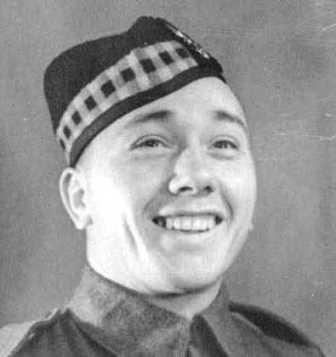
May 29, 2022. Some Prince Edward Island soldiers who served in WW1 seem to disappear into history, in spite of the many inter-relationships between Island families.  Chesley William HOWATT, who is buried in the North Tryon Presbyterian Church Cemetery, appears to be one of these, as up to now no surviving family member has been found.

CIMG4004 Chesley Howatt

Chesley Howatt. (Photo courtesy of South Shore United Church)

Born in Tryon, Prince Edward Island, Chesley was the son of Robert Newton and Elizabeth (nee Wilson) Howatt.  When he enlisted with the Canadian Overseas Expeditionary Force in Calgary, Alberta on June 2, 1915, he said he was born July 24, 1888.  According to his baptismal certificate, he was born in 1886, so it may be that he shaved off a few years in order to be eligible to serve.  At the time of enlistment,   he was a farmer. 

On October 24, 1915 he left Halifax, Nova Scotia aboard H.M.S. Oduna with the 50th Battalion Canadian Expeditionary Force, and arrived in Plymouth, England on November 4, 1915.

…Wounded at Vimy Ridge….

On August 10, 1916 he was sent to France.  Troops were training and preparing for the spring offensive that began on April 9, 1917 that became known as the Battle of Vimy Ridge.  There were many skirmishes before that battle, and the artillery spent a lot of time rehearsing.  Nightly raids helped pinpoint and knock out the location of German batteries. 

On February 3, 1917 Chesley received a gunshot wound to the face at Vimy Ridge, with fine metal particles from the blast entering his eyes. 

According to the report on what happened, “… at 8:45 pm on the night of February 3, 1917….” Chesley was “…going ‘over the top’ and after arriving in the enemies trench a rifle grenade exploded near him and fragments of shrapnel entered his eyes. From then until 30 days later he was not able to use his eyes…

After initial treatment in Etaples, France, he was sent back to England for treatment and recuperation at 3rd London General Hospital.  On May 10, 1917 he was transferred to the West Cliff Canadian Eye and Ear Hospital in Folkestone, from which he was discharged from care on May 14, 1917.

For Chesley, the war in mainland Europe was over.  On May 21, 1917 he was transferred to the 21st Reserve Battalion and posted to Bramshott in England. 

…A medical discharge and reenlistment….

On February 4, 1918 he was transferred to the Canadian Discharge Depot in Buxton and was sent home to Canada via Liverpool a few weeks later. On March 31, 1918 he received his formal discharge in Halifax, Nova Scotia, due to being unfit for service due to defective vision as a result of the gunshot wound.

This wasn’t the end of Chesley’s military service, however!  On September 2, 1918, he reenlisted in Charlottetown, this time stating that he was born in 1887. He did note that he had previously served in the 50th Battalion.

By the time of his second discharge on July 17, 1919, he had married Bessie Anne Falconer on December 3, 1918, and was living in Charlottetown. 

The family moved to Tryon following his second discharge.  Sadly, their only son, Alexander ‘Falconer’ Howatt, who had been born September 4, 1919, died on July 23, 1934 at the age of 14. Chesley died a few years later, on January 22, 1938, in Tryon.

CIMG5626 May 29 2022 Pieter by the grave of Chesley Howatt

Pieter beside the grave of Chesley Howatt at the North Tryon Presbyterian Cemetery in North Tryon, Prince Edward Island.  (Photo credit: Daria Valkenburg)

Do you have photos or information to share? Email Pieter at memorialtrail@gmail.com, comment on the blog, or tweet to @researchmemori1

…Want to follow our research?….

If you are reading this posting, but aren’t following the blog, you are welcome to do so.  See https://onthewarmemorialtrail.com/ or email me at dariadv@yahoo.ca and ask for an invitation to the blog. 

Front cover OnTheWarMememorialTrailinEuropeDaria’s book ‘No Soldier Buried Overseas Should Ever Be Forgotten‘ is available in print and e-book formats.  For more information see https://nosoldierforgotten.com/

You are also invited to subscribe to our YouTube Channel: On The War Memorial Trail With Pieter Valkenburg: https://www.youtube.com/channel/UCJ591TyjSheOR-Cb_Gs_5Kw

© Daria Valkenburg

On The War Memorial Trail….. Staying In Touch During WWI With Field Post Cards

May 5, 2022. Those of us of a certain age…. pre-internet days… may remember the admonition when travelling to ‘send us a postcard’.  This request came particularly from parents and grandparents.  If you were having a good time, writing out cards was the last thing on your mind. 

But there was a solution – pre-filled postcards where all you had to do was check the appropriate boxes and fill in the address the card should be sent to.  It let the receiver know you had safely arrived, and gave a chance to make a few comments or observations by ticking a series of boxes.  During a trip to New Zealand, I remember ticking a box that said ‘there are more sheep here than people’.  At the time there were 3 million people and 9 million sheep!

…A Field Post Card was an easy way to say I’m still alive….

During WWI, soldiers were kept busy trying to stay alive.  Not all had the time or inclination to write extensive letters, and so the Field Post Card came in handy, especially to let loved ones know when a letter or parcel arrived, or to give a brief update on the soldier’s well-being.

The Field Post Card, known as an f.s.p. or a ‘whizz bang’, allowed soldiers to strike out messages that didn’t apply.  No extra notes were allowed, except for dates, or the card would be destroyed.

CIMG4001 Harold Howatt

Harold Keith Howatt.  (Photo courtesy of South Shore United Church)

Even WWI soldier Harold Keith HOWATT of Augustine Cove, an active correspondent, sent these Field Post Cards when he received a letter or parcel while serving with the 8th Canadian Siege Battery.

Field post card back dated Oct 18 1917 from Harold Howatt

Field post card dated October 18, 1917 from Harold Howatt, advising he received a parcel. (Courtesy of the H. Howatt collection)

Field post card front mailed Oct 19 1917 from Harold Howatt

The Field Post Card of October 18, 1917 from Harold Howatt was mailed a day later. (Courtesy of the H. Howatt collection)

Harold Howatt noted in his October 18, 1917 Field Post Card that he had received a parcel that had been sent a month earlier, that a letter would be coming soon, and that he was ‘quite well’.

…What Harold Howatt couldn’t say in his Field Post Card….

What he wasn’t able to say was where his unit was stationed – La Bassée, France, located southwest of Lille and about 16 km (ten miles) from the Belgian border.

La Bassee Google Maps

Map showing La Bassée, where the 8th Siege Battery was located at the time Harold Howatt send his Field Post Card.  (Map source: http://www.google.ca)

In ‘The Secret History Of Soldiers’ historian Tim Cook noted that the Field Post Cards allowed soldiers to communicate at a time when it was difficult to explain the horrors that they were experiencing.  A prewritten card with no information that might help the enemy, such as location, was also quicker than regular mail as it bypassed censors.  “… The cards were a stopgap measure in between letters and they were commonly sent after a battle by exhausted soldiers...

…The phrase ‘I am quite well’ serves as an ironic comment on the difficulty soldiers had in finding the words to describe their unique experiences...

Howatt recorded in his notes what he didn’t include in his Field Post Card….

On Monday, September 24, 1917 he wrote “…Slept in a straw loft last night, did not sleep very well as there was a rat running around through the straw all night…” 

After this sleepless night he wrote that they “…. started to shoot at 2:30 pm.  Ranged in 12 rounds, then we stopped firing until aviator ranged another battery. Started in again and fired pretty steady until 9:50 pm….

On Tuesday, October 2, 1917 he noted that they had been woken up at midnight.  “…All of a sudden, a terrific racket started.  The Germans were pouring H. E. and gas shells into the village in front of the Fosse.  About a thousand shells came in altogether….We did not bother putting our gas masks on as we were so high up.  The bombardment lasted about one hour…”  H.E. referred to high explosives.

On Thursday, October 18, 1917, Howatt recorded that “… we expect to hand over guns, stories, and everything to another battery…..” 

On October 30, 1917 he wrote it was “…the date of leaving for the real war…” Indeed they did.  They set up base in Poperinghe, Belgium, to participate in the latter part of the Third Battle of Ypres – which we know as the Battle of Passchendaele – a battle that ended on November 17, 1917. (See https://en.wikipedia.org/wiki/Battle_of_Passchendaele)

So, if you have WWI postcards in your possession take a look and see if you have any Field Post Cards! Photos or information to share? Email Pieter at memorialtrail@gmail.com, comment on the blog, or tweet to @researchmemori1

© Daria Valkenburg

…Previous stories about Harold Howatt’s WWI observations….

…Want to follow our research?….

If you are reading this posting, but aren’t following our research, you are welcome to do so.  Our blog address: https://onthewarmemorialtrail.com/

Front cover OnTheWarMememorialTrailinEurope4 countries, 6 weeks, 7,000 km – an unforgettable war memorial journey in Europe…. Daria’s book ‘No Soldier Buried Overseas Should Ever Be Forgotten‘ is available in print and e-book formats.  Net proceeds of book sales help support research costs and the cost of maintaining this blog. For more information see https://nosoldierforgotten.com/ 

You are also invited to subscribe to our YouTube Channel: On The War Memorial Trail With Pieter Valkenburg: https://www.youtube.com/channel/UCJ591TyjSheOR-Cb_Gs_5Kw

Never miss a posting!  Subscribe below to have each new story from the war memorial trail delivered to your inbox.