On The War Memorial Trail….. The WWI Letters of Lawrence Ivy Marshall – Part 4: Back At The Front

March 21, 2024. In Part 1 of the WWI letters of Lawrence Ivy MARSHALL, of Covehead, Prince Edward Island, which had been shared by his granddaughter, Connie Birt Paynter, Lawrence was among the first Canadians to volunteer for WWI in 1914.  After his initial training in Valcartier, Quebec, he informed his family that he was about to go overseas. (See https://onthewarmemorialtrail.com/2024/03/02/on-the-war-memorial-trail-the-wwi-letters-of-lawrence-ivy-marshall-part-1-valcartier-camp/)

In Part 2, Lawrence described his experiences aboard one of the first troop ships to England. (See https://onthewarmemorialtrail.com/2024/03/08/on-the-war-memorial-trail-the-wwi-letters-of-lawrence-ivy-marshall-part-2-the-voyage-to-england/)

In Part 3, Lawrence was on the front lines in trenches in Belgium and France, when he dislocated his elbow and was sent back to England for treatment. (See https://onthewarmemorialtrail.com/2024/03/15/on-the-war-memorial-trail-the-wwi-letters-of-lawrence-ivy-marshall-part-3-in-the-trenches/)

Now, in Part 4, Lawrence spent weeks in England recuperating before returning to active service at the front.

….Lawrence was operated on to straighten his elbow….

f11d6ed5bab613c66a4153246aab798d--leicester-hospitals

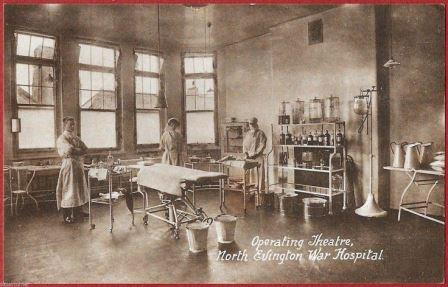
Postcard of the operating theatre at North Evington War Hospital.  Masks were not mandatory.

Lawrence remained at North Evington War Hospital in Leicester for 7 weeks.  On September 26, 1915, he gave an update to his father.  “…I am still in the hospital … and will be for a while, I think.  My arm is not any straighter yet.  I have to go to the operating room this morning.  They are going to try and straighten it. I have been under ether three times now. I am getting tired of it too.  If they can’t straighten it this time I will not go back to the front any more.  It doesn’t bother me.  I can use it as good as ever before and I can bend it….

bearwood_t_harden

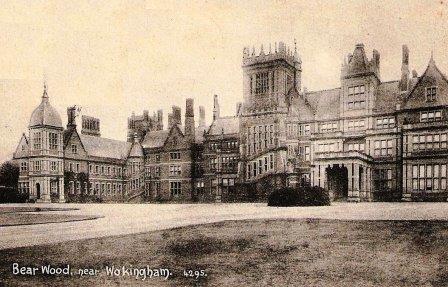
The Canadian Convalescent Hospital in Bear Wood.  (Photo source: http://www.arborfieldhistory.org.uk)

On October 23, 1915, Lawrence was transferred to the Canadian Convalescent Hospital in Monks Horton, then 3 days later to the Canadian Convalescent Hospital in Bear Wood, Wokingham, Berkshire, England. The hospital, which housed 900 Canadian soldiers, had been a private home with 90 bedrooms, belonging to Mrs. Walter, the widow of the Times newspaper owner.

From Bear Wood, Lawrence wrote his mother on October 30, 1915.  “…I am in a convalescent hospital in Berkshire. It is a very good place but awful lonesome.  We are away in the country here on a large estate…..About my arm. It is doing fine now.  It is almost as straight as ever but I cannot do any work with it yet.  There is no strength in it...

….Lawrence returned to duty….

On November 15, 1915, Lawrence was released from hospital and given a short furlough before being assigned to the 48th Highlanders Canada, 43rd Reserve Battalion. 

On November 27, 1915, in a letter to his father, written from East Sandling Kent, he noted that he was “…back with my battalion again… I guess I have to go back to France after Xmas, if not before, but I hope not.  There are a lot of our boys going back there Monday.  I very near got sent too only my arm is not quite right yet.  It still gets sore and stiff… in cold weather...

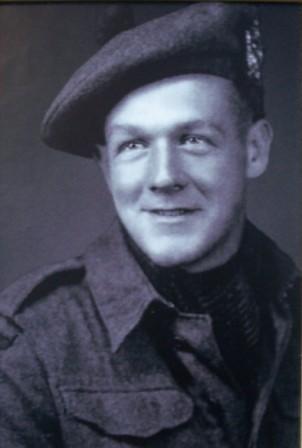
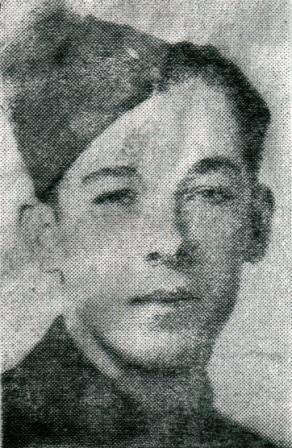
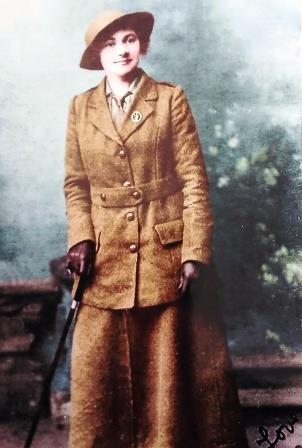
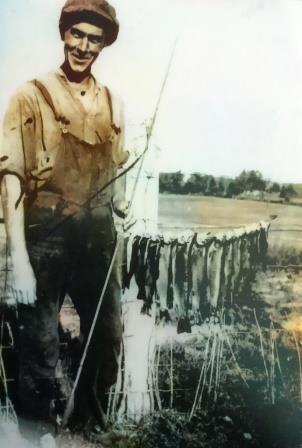
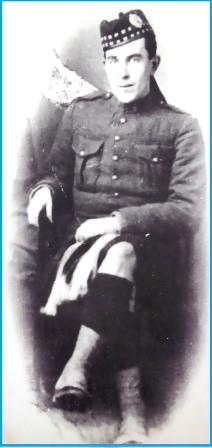
On January 16, 1916, Lawrence left for France, and assigned to the 15th Battalion before rejoining his unit on February 4, 1916.  On February 8, 1916, in a letter to his mother, Lawrence explained that he had taken a photo of himself in a kilt. “So you got the photo I had taken in kilts down in Salisbury, some Scotchman, eh….”  This is the photo of him that has survived for the past century.

20230530_100207 Laurie Marshall from Connie taken in 1916

Lawrence Ivy Marshall. (Photo courtesy of Connie Birt Paynter)

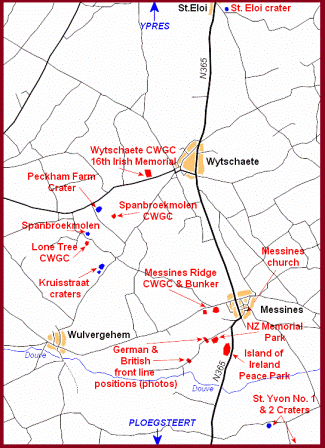
Lawrence kept in contact, explaining in a March 6, 1916 letter to his father, written from ‘somewhere in France’ that “… This is my second trip to the trenches since I came across this time, but am getting used of it again…”  According to the War Diary for the 15th Battalion, ‘somewhere in France’ was on the road between Messines and Wytschaete, along the border with Belgium.

messinesmap

Map showing the location of the road Messines to Wytschaete.  (Map source:  http://www.ww1battlefields.co.uk/flanders/messines/)

In an April 2, 1916 letter from Lawrence to his father, written from ‘somewhere in Belgium’ Lawrence described a near miss. “…I have been more lonesome this last week than I ever have been since I left home…Perhaps it is because I have had two close shaves lately.  I got a bullet right through my hat and stung by a shell bursting over me but am alright again now…. 

‘Somewhere in Belgium’ was near Poperinge, 12.5 km (8 miles) from Ypres, right in the line of fire, as Lawrence briefly mentions.  “And where we are now is awful, the last place was bad enough but this is real hell here…. The Germans tried an attack here the other night but we stopped them.  They were lying on the ground and in the barbed wire as thick as peas… I certainly made my old gun shoot for a while …

….Lawrence was injured in action….

In a June 2, 1916 letter from Lawrence to his father, written from Belgium: “…We are out of the trenches for twelve days rest, have been out for seven now, so expect to go back in again in five days.  Am glad that we are out just now as the Germans are pulling off something up the line this evening.  There are a big bombardment on just where we came out of. We are all standing to here waiting orders to go up if needed.  But none of us are very anxious to go up if we can get out of it.  We are having it pretty hot this summer.  We have a scrap with Fritz every time we are in.  We are only eighteen yards apart where we go in so you can guess what a time we have with each other…

The rest ended the same day that Lawrence wrote his letter, as the June 2, 1916 war diary noted that following an afternoon baseball game, the Battalion had left after 7:30 pm, arriving at “…a position at Zillebeke … at 2 am on June 3…” 

By 2:30 am they were attacked and among the casualties was Lawrence.  He was admitted to a Casualty Clearing Station, where his medical record noted that he had a gunshot wound in his right arm. He was sent to No. 4 General Hospital in Camiers, France. 

….Lawrence was sent to England for treatment….

On June 12, 1916, Lawrence was transferred to the 3rd Northern Hospital in Sheffield, Yorkshire, England, from where he wrote to his father 4 days later.  “…I have got across to England again.  I think I am pretty lucky in this war, don’t you?  I went through some pretty tight places this trip in the trenches and came back safe only for the wound I got.  It is doing fine now…. It was an explosive bullet that I got hit with.  They make a nasty hole where they come out of…

Lawrence explained why he felt lucky. “…We lost all our battalion but two hundred men. We had nine hundred and seventy men so you can see we had a few casualties.  Most of all my pals are gone under in the battle….

He then described how he was injured. “When I got wounded I had to lay for over two hours before I could get a bandage on my arm… It was awful laying on the field right in front of the Germans in daylight and not able to help yourself at all and if you moved the least bit they opened a machine gun on you. There were dead everywhere that you could see and mostly our boys with the kilts on…

Next he briefly mentioned the battle. … We made two charges at the Germans between nine and eleven o’clock in the morning but they drove us back both times. Then I got hit halfway back the second time … My rifle flew out of my hand…

In the letter’s conclusion, Lawrence wrote that he was “…marked for a convalescent hospital so expect to leave here.  It will be a month or more before I will be fit to go back to my base again …” He was correct as not long afterwards he was sent to Arnold Hospital, Doncaster, Yorkshire, England.

….Lawrence did not return to the front….

Lawrence did not go back to the front.  Instead, he spent the remainder of his service working at the Canadian Convalescent Hospital, Wood Cote Park, Epsom, Surrey, England. 

On November 6, 1916, in a letter to his mother, Lawrence explained that he was “…taking the Corporal’s place in the office while he is away on his sick furlough. …I suppose you have heard about poor Parker Crockett being killed.… Poor Parker, him and I came to the dressing station together, he shook hands with me and said that he hoped that I would get to England. He was not wounded enough to make England, so he had to go back and get killed…..” 

Parker Hooper CROCKETT died September 7, 1916 during the Battle of the Somme and is buried in Regina Trench Cemetery, Somme, France. Lawrence knew that had he not been sent to England for treatment, this could have been his fate.

While Lawrence recuperated, the war went on.  In Part 5, Lawrence’s story concludes as he meets with both happiness and tragedy before being one of the lucky Canadian soldiers who returned home after the war ended.

Thank you to Connie Paynter for providing photos and sharing letters written by her grandfather. Do you have photos or information to share? Email Pieter at memorialtrail@gmail.com, comment on the blog, or tweet to @researchmemori1.

© Daria Valkenburg

….Want to follow our research?….

If you are reading this posting, but aren’t following our research, you are welcome to do so.  Our blog address: https://onthewarmemorialtrail.com/
Front cover OnTheWarMememorialTrailinEurope4 countries, 6 weeks, 7,000 km – an unforgettable war memorial journey in Europe…. Daria’s book ‘No Soldier Buried Overseas Should Ever Be Forgotten‘ is available in print and e-book formats.  Net proceeds of book sales help support research costs and the cost of maintaining this blog. For more information see https://nosoldierforgotten.com/ 

You are also invited to subscribe to our YouTube Channel: On The War Memorial Trail With Pieter Valkenburg: https://www.youtube.com/channel/UCJ591TyjSheOR-Cb_Gs_5Kw

Never miss a posting!  Subscribe below to have each new story from the war memorial trail delivered to your inbox.

On The War Memorial Trail….. The WWI Letters of Lawrence Ivy Marshall – Part 3: In The Trenches

20230530_100207 Laurie Marshall from Connie taken in 1916

Lawrence Ivy Marshall. (Photo courtesy of Connie Birt Paynter)

March 15, 2024. In Part 1 of the WWI letters of Lawrence Ivy MARSHALL, of Covehead, Prince Edward Island, which had been shared by his granddaughter, Connie Birt Paynter, Lawrence was among the first Canadians to volunteer for WWI in 1914.  After his initial training in Valcartier, Quebec, he informed his family that he was about to go overseas. (See https://onthewarmemorialtrail.com/2024/03/02/on-the-war-memorial-trail-the-wwi-letters-of-lawrence-ivy-marshall-part-1-valcartier-camp/)

In Part 2, Lawrence described his experiences aboard one of the first troop ships to England. (See https://onthewarmemorialtrail.com/2024/03/08/on-the-war-memorial-trail-the-wwi-letters-of-lawrence-ivy-marshall-part-2-the-voyage-to-england/)

Now, in Part 3, Lawrence spent a cold and wet winter on the Salisbury Plain before being sent into battle in France and Belgium in the spring of 1915.

….A cold and wet winter on the Salisbury Plain….

After arriving in England in late October 1914, the first contingent of Canadian troops received basic training on the Salisbury Plain for the next months – during a cold and wet winter.  Much of the time the soldiers were mired in mud as England experienced one of its wettest winters in decades.

In the article ‘Evolution of Canada’s Shock Troops’, Tim Cook wrote that they “…marched, fired their Canadian-manufactured Ross rifles at targets, and practiced bayonet fighting against straw-filled dummies. And they did it during one of the most miserable winters in British history, when it rained 89 out of 120 days. The parade grounds were reduced to a muddy bog, but the Canadians kept up their spirits with beer, song, and camaraderie…”  (See www.thecanadianencyclopedia.ca/en/article/evolution-of-canadas-shock-troops)

…. “The Germans call us the ‘Women From Hell’…”….

The first Canadians went to France in February 1915, but Lawrence was still in England, waiting to be sent over.  In an April 27, 1915 letter to his father, he writes that “…things have taken a quick change around here in a few days.  They are sending us boys all off to the front in drafts now.  There were two lots went last night.  We are all on the next one.  That is all of the Island boys, but four or five.  We expect to leave any minute now.  We have all our ammunition ready, one hundred and fifty rounds per man. Jim is going on the same draft as I am and Parker Crockett too….”  Jim referred to James Lawrence MARSHALL.  Neither he nor Parker Hooper CROCKETT would return home.

… We are all in great cheer at going away.  You would think we are all going on a picnic to hear us when we got word of it.  We are good and tired of hanging around here now…

Screenshot 2024-02-28 at 16-21-40 Bailleul at DuckDuckGo

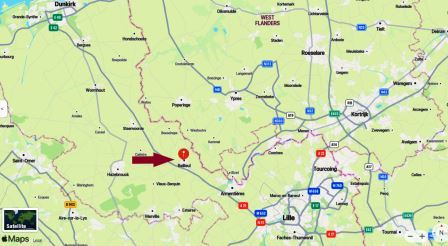
Lawrence joined the 15th Battery in Bailleul, France, just over the border with Belgium.  (Map source: Wikipedia)

A few days later, Lawrence arrived in France, assigned to No. 3 Canadian 15 Battery 3rd Brigade, First Canadian Expeditionary Force.  The Battery had just been moved near Bailleul, France after fighting in the Second Battle of Ypres in Belgium.  (See https://www.thecanadianencyclopedia.ca/en/article/battle-of-ypres)

The War Diary for May 4, 1915 noted that at 6:30 pm the Battalion “…paraded in full marching order and went into billets near Bailleul….”  They experienced heavy rain over the next several days.

On May 15, 1915 the Battalion moved further south to Robecq, France.  Two days later, they moved even further south, this time into trenches near Richebourg, France, in preparation for battle.

Lawrence missed this as he succumbed to dysentery and ended up in a field hospital, as he explained in a May 23, 1915 letter to his father.

 “…I have been in the hospital for over a week now.  It was from the effects of drinking bad water.  The water is awful here….. I expect to go back out of here any day now.  I have had a great rest while I have been in here and have been fed well.  The sisters are awful good to us here too…. The Germans did not get me yet.  I am going back to have another crack at the beggars soon…

After being discharged, Lawrence gave an update in a May 28, 1915 letter to his father.  “…Our Battery has been in action again since I left them, so I missed that.…” Lawrence missed a trench battle in Festubert, France. “…They will be about coming out of the trenches when I get back to them so I will be in with them the next time alright.  The Germans call us ‘The Women From Hell’ – some name ain’t it? …

…. Lawrence was on the front line in the trenches….

By July 1915, Lawrence was in Belgium, with the Battalion settled in a temporary camp called Camp Aldershot.  On July 13, 1915 Lawrence wrote to his mother that he was on guard duty.  “…Here I am in the second line of trenches and having a good time too.  Nothing to do but four hours guard out of twelve.  We were in the firing line four days and in here four days more so I think we are going out today for a while.  Everything is pretty quiet, only for a few shells and bullets that the Germans send over once in a while, but they don’t land very handy to us, and I am glad that they don’t either….

Lawrence gave a lighthearted account of what was happening for his mother’s peace of mind. “… We had a very good time in the front line of trenches.  We could not see the German trenches because there was a field of rye and clover between us but they were only two hundred yards away. We used to send an odd rifle shot over at them for fun to let them know we were there. They used to send a few over at us too but did not hit any of us. …

July 22, 1915 letter from Lawrence to his mother, written from France:  “…We just came out of the trenches last night.  We were in sixteen days.  This time we had quite a spell of it too.  We did not lose many men this time. We were pretty lucky.  We had it pretty wet and muddy for awhile.  ….  I was out one night putting up barbed wire in front of the firing line.  It rained all of the time we were out.  I had my overcoat on.  You could not tell what it was in the morning, an overcoat or mud …

…. Lawrence was injured playing football….

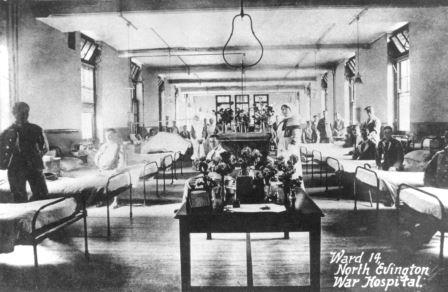
While with his unit in Messines, France, Lawrence was admitted to a field hospital in Etaples, France on August 24, 1915, with a dislocated elbow received while playing football.  On August 31, 1915, he was admitted to No. 3 General Hospital in Camiers, France, where it was decided to send him to England for further treatment.  On September 6, 1915, he was admitted to North Evington War Hospital in Leicester. 

North Evington War Hospital

North Evington War Hospital in Leicester, England. (Photo source: leicestermercury.co.uk)

Lawrence believed he was sent to England thanks to a nurse from Charlottetown, Prince Edward Island, as he explained in a September 7, 1915 letter to his father.  “…I am in the hospital in England and am doing well.  I can’t straighten my arm yet, but I hope to soon now.  It is pretty painful at times.  I dislocated and fractured the bone of my left elbow.  I never expected to get over to England with it, but I guess it was Miss McLeod the nurse who was in the hospital I was in, in France. She must have put a good word in for me…. She belongs to Charlottetown…

…. Lawrence had a ‘close shave’ at the front….

In his letter, Lawrence briefly wrote about his experiences at the front, since his letters were not censored while in England. “The letters don’t have to be censored over here so I suppose you would like to hear a little of what I have seen of this war….Them Germans are sure good shots and about them having no ammunition, that is all lies.  They certainly have lots of it…You should see them send over their big shells when they start. You should see some of the holes that they make when they explode. Some of the holes are forty feet across and ten feet deep….

He acknowledged his luck up to this point. “…  I have lived a charmed life through it so far but I have had some close shaves….  I remember one day …. some of us got out of the trenches to get some platforms for the trenches.  We were no sooner out than … they sent their shells over.  I was just in the act of putting one of the platforms on my back when six shells burst right over my head. The knocked me and the old platform down ….  I was just in the act of crawling away when I heard one of the boys shout God’s sake lay flat and keep still.  He had no sooner said it when the bugger opened their machine guns on us …  We laid there for half an hour with them going about six inches over our heads, some of them hitting the ground alongside of us.… The six of us that went out all managed to get back again.…

…. Lawrence was grateful to be out of the trenches….

In a September 10, 1915 letter to his mother, written while still in hospital, Lawrence shared more observations.  “…It is a treat to get away from the trenches and France.  I have seen all I want to of France. The trenches are getting pretty bad now. The last time we went in the water was above my knees.  When you get wet you have to stay wet until you dry and that is a good while….

Lawrence’s letter continued. “…  We don’t get all we want to eat either of course, when we are there we can’t write anything but that we get plenty to eat or they would not let the letters go home…..The officers don’t care how you do as long as they have plenty for themselves to eat… 

Like many soldiers, Lawrence felt that officers were not concerned about the safety of the men they were responsible for.  “…We are like a lot of prisoners more than soldiers.  It ain’t like a real war, it is more like murder.  Our officers will put us right into danger instead of keeping out of it. I remember one night our officers lined up fifty of us to take an orchard with about five hundred Germans in it.  We started across on the run with bayonets fixed but never got there.  The Germans turned their machine guns on us.  There was only twenty got back alive.  I thought my time had come but I got back alive.  The air was full of bullets…

Lawrence was safe in England, but faced a long recovery period before returning back to the front line.  In Part 4, Lawrence’s story continues as he found himself again on the front line and is wounded.

Thank you to Connie Paynter for providing photos and sharing letters written by her grandfather. Do you have photos or information to share? Email Pieter at memorialtrail@gmail.com, comment on the blog, or tweet to @researchmemori1.

© Daria Valkenburg

….Want to follow our research?….

If you are reading this posting, but aren’t following our research, you are welcome to do so.  Our blog address: https://onthewarmemorialtrail.com/

Front cover OnTheWarMememorialTrailinEurope4 countries, 6 weeks, 7,000 km – an unforgettable war memorial journey in Europe…. Daria’s book ‘No Soldier Buried Overseas Should Ever Be Forgotten‘ is available in print and e-book formats.  Net proceeds of book sales help support research costs and the cost of maintaining this blog. For more information see https://nosoldierforgotten.com/ 

You are also invited to subscribe to our YouTube Channel: On The War Memorial Trail With Pieter Valkenburg: https://www.youtube.com/channel/UCJ591TyjSheOR-Cb_Gs_5Kw

Never miss a posting!  Subscribe below to have each new story from the war memorial trail delivered to your inbox.

On The War Memorial Trail….. The WWI Letters of Lawrence Ivy Marshall – Part 2: The Voyage To England

20230530_102553 Pieter and Connie

Pieter with Connie Paynter. (Photo credit: Daria Valkenburg)

March 8, 2024.  In Part 1 of the WWI letters of Lawrence Ivy MARSHALL, of Covehead, Prince Edward Island, which had been shared by his granddaughter, Connie Birt Paynter, Lawrence was among the first Canadians to volunteer for WWI in 1914.  After his initial training in Valcartier, Quebec, he informed his family that he was about to go overseas.  (See https://onthewarmemorialtrail.com/2024/03/02/on-the-war-memorial-trail-the-wwi-letters-of-lawrence-ivy-marshall-part-1-valcartier-camp/)

Now, in Part 2, Lawrence described his experiences aboard one of the first troop ships that went to England.

20230530_100207 Laurie Marshall from Connie taken in 1916

Lawrence Ivy Marshall. (Photo courtesy of Connie Birt Paynter)

….Troops marched from Valcartier to Quebec City….

On September 26, 1914, Lawrence and the first contingent of around 30,000 Canadian troops began their journey to the United Kingdom. The trip began by marching to Quebec City from Valcartier, where they then waited to board one of 30 ships – former luxury liners that had been painted grey. 

On September 29, 1914, while still in Quebec City, Quebec, Lawrence wrote to his father.  “…We are having not too bad a time at all, but we are not allowed to go into Quebec.  We have to stay here in this building.  They put us here until we go on board the steamer this afternoon.  I will be glad when we do.  There are good accommodations on board… nice bed to sleep in, quite a difference from sleeping on the ground for 6 weeks….” In Valcartier, Lawrence had slept in a tent.

….Lawrence sailed to England aboard HMT Scotian….

HMT_Scotian

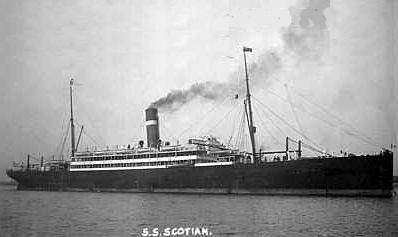
Lawrence travelled to the UK aboard the HMT Scotian.  (Photo source: https://birtwistlewiki.com.au/wiki/HMT_Scotian#Remarks)

Lawrence travelled aboard the HMT Scotian, which had begun as the Holland American Line‘s Statendam, and used for its Rotterdam – New York route. When the Allen Line in 1911 bought the ship in 1911, it was renamed Scotian. In 1914, it became a troop ship.

It wasn’t until October 3, 1914 that the ships left the port in Quebec City for England.  They added a ship of 537 Newfoundlanders to their convoy, and then crossed the Atlantic with a Royal Navy escort that watched for German U-boats.

By the time the Atlantic had been crossed, troops just wanted to get back on land, as Lawrence wrote to his father, while still aboard HMT Scotian: “…Well, we are still on board of this old ship….I am getting pretty tired of it by this time.  This is 18 days on her…We are anchored in an awful pretty place. The grass and trees are as green as summer yet. They stay that way all winter, so they say. When we land we are going to camp outside of London…” The place ‘outside of London’ was the Salisbury Plain, where training would continue.

….Lawrence counted himself lucky not to get seasick….

On October 13, 1914, Lawrence wrote to his mother.  “…We are still on board the boat but expect to land tomorrow night some time.  I tell you we had some trip alright. We are going to land at Southampton, England….. I am good and tired of it by this time…We had a very good trip.  Not so awful rough at all for the time of year.  It is very rough tonight though, the sea is going right over the deck tonight and the wind is blowing a hurricane.  You go out on deck and you would get blown overboard for sure.  Some of the boys were pretty sea sick some times when the old boat began to roll.  I was lucky.  I was never a bit sick, only had a headache one day.  All of the boys are writing home tonight. We just got word that we can mail them in the morning, that there is going to be a mail steamer come up to us and get the mail for us…

On October 17, 1914, while still aboard HMT Scotian, Lawrence wrote to his brother Merrill.  “…We are still on board of this old ship yet.  I can tell you that I am getting good and tired of it.  ….It is no fun, I tell you, to stay on this old ship, day after day, with land only a few yards away, and can’t get to it.  We expect to be on board of her until the last of next week. That is nearly a week yet…

….Troops marched from the train station to the Salisbury Plain….

salisbury

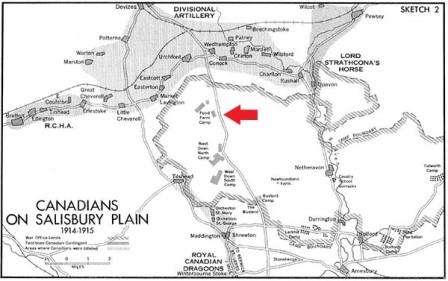
Lawrence wrote from Pond Farm Camp on Salisbury Plain.  (Map source: https://www.parl.ns.ca)

After finally docking, Lawrence and his fellow soldiers disembarked and boarded trains for Salisbury Plain.  Shortly after arrival, Lawrence wrote to his mother, giving his address as 12 Battery, 82 Regiment, E Company 3rd Brigade, Pond Farm Camp, Salisbury Plain, England:  “…. Just three weeks on board of that old ship.  I tell you it was great to get on land once more.  We arrived at camp last night or this morning rather. It was twelve o’clock when we got off the train.  Then we had to walk about six miles.  It seemed more like sixty to me and it was as dark as pitch…

Salisbury was quite different from Covehead, Prince Edward Island “ Well, this is some old fashioned place alright.  The houses are all made of brick and stone.  Little narrow streets with a Public Inn every here and there…” 

Lawrence noted that lice had been an unwelcome infestation aboard ship.  “…We had a great time every night on board of the ship, picking lice out of our clothes. We got good and lousy on board that old ship.  She was great and buggy…”  Lice would turn out to be a challenge faced by troops throughout the war.

Lawrence was on land, and no longer aboard a ship, but he soon would find himself living in cold and wet conditions on the Salisbury Plain as winter set in. 

In Part 3, Lawrence’s story continues as training in England is cut short and he finds himself on the front line in France and Belgium.

Thank you to Connie Paynter for providing photos and sharing letters written by her great-uncle and grandfather. Do you have photos or information to share? Email Pieter at memorialtrail@gmail.com, comment on the blog, or tweet to @researchmemori1.

© Daria Valkenburg

….Want to follow our research?….

If you are reading this posting, but aren’t following our research, you are welcome to do so.  Our blog address: https://onthewarmemorialtrail.com/

Front cover OnTheWarMememorialTrailinEurope4 countries, 6 weeks, 7,000 km – an unforgettable war memorial journey in Europe…. Daria’s book ‘No Soldier Buried Overseas Should Ever Be Forgotten‘ is available in print and e-book formats.  Net proceeds of book sales help support research costs and the cost of maintaining this blog. For more information see https://nosoldierforgotten.com/ 

You are also invited to subscribe to our YouTube Channel: On The War Memorial Trail With Pieter Valkenburg: https://www.youtube.com/channel/UCJ591TyjSheOR-Cb_Gs_5Kw

Never miss a posting!  Subscribe below to have each new story from the war memorial trail delivered to your inbox.

On The War Memorial Trail….. The WWI Letters of Lawrence Ivy Marshall – Part 1: Valcartier Camp

20230530_102553 Pieter and Connie

Pieter with Connie Paynter. (Photo credit: Daria Valkenburg)

March 2, 2024. One of the joys of meeting family members of soldiers who have served is that often we come away with more information than we first expected.  Sometimes it’s more personal information about the soldier, other times we learn that more than one family member in the family served at the same time. 

In one family from Covehead, Prince Edward Island, two brothers served in WWI, and the family not only had photos, but also letters that the brothers had written.

…Two brothers from Covehead enlisted …

But it wasn’t until after Connie Paynter of Summerside, Prince Edward Island, contacted us about her 20 year old great-uncle, who was killed in action at Vimy, that we learned that her grandfather also served in WWI. “…My grandfather and my great-uncle, who lived in Covehead, both served in WWI.  Only my grandfather, Lawrence Ivy Marshall, returned home…” she said.

Connie’s great-uncle, Merrill Augustus MARSHALL, lost his life on Easter Monday, April 9, 1917, during the Battle of Vimy Ridge, killed during the advance on the Ridge.  (See https://onthewarmemorialtrail.com/2023/06/14/on-the-war-memorial-trail-the-wwi-signaller-from-covehead-killed-during-the-battle-of-vimy-ridge/)

Merrill’s older brother, Lawrence Ivy MARSHALL, was born December 22, 1892 in Charlottetown, Prince Edward Island, the son of James Lawrence and Hattie Lillian (nee Carr) Marshall. 

…Lawrence was among the first recruits at Valcartier in 1914 …

Valcartier.8 map

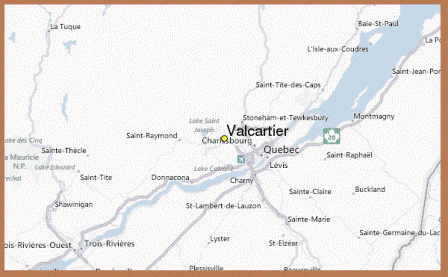
Map shows location of Valcartier, Quebec.  (Map source: http://www.weather-forecast.com)

After completing his initial training, Lawrence officially enlisted in the Canadian Overseas Expeditionary Force on September 23, 1914 at Valcartier Camp, Quebec. He had arrived in Valcartier as part of the 82nd Regiment Abegweit Light Infantry, and had been a carpenter in his civilian life. (See https://en.wikipedia.org/wiki/Prince_Edward_Island_Highlanders)

… Valcartier was the only training camp in 1914 …

A military training camp in Valcartier, not far from Quebec City, began in August 1914 to prepare recruits for the mobilization of the Canadian Expeditionary Force, shortly after World War I was declared.  As men, including Lawrence, enlisted across the country, they arrived at the camp in Valcartier for equipment, training, and preparation for war. In 1914, Valcartier was the ONLY training camp for Canada’s Overseas Expeditionary Force.

Valcartier_-_Section_of_the_Camp

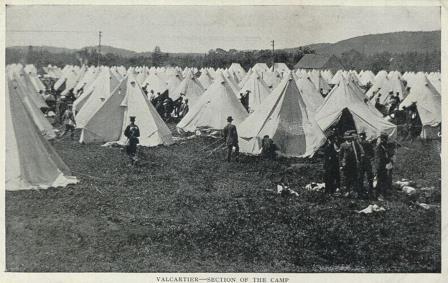
Postcard shows tents at Valcartier for recruits in training. (Photo source: Wikipedia)

Men had to live in tents and conditions were basic.  In a September 16, 1914 letter that Lawrence wrote to his mother, he confirmed he was in 12 Battalion E Company, 82 Regiment, Valcartier, Quebec: “…We are having very good weather up here now. Nice and warm in the day, but awful cold in the evening and mornings.  I don’t know when we will leave here….We cannot stay here much longer or we will freeze to death in bed some night…. 

… A short video on Valcartier camp in 1914 …

A short video, ‘Valcartier – First World War Soldier Factory’, gives an overview of this period.  The video is in French, with English subtitles, and runs 6:35 minutes…..

… Lawrence was soon to go overseas …

20230530_100207 Laurie Marshall from Connie taken in 1916

Lawrence Ivy Marshall. (Photo courtesy of Connie Birt Paynter)

Lawrence knew that he would be leaving soon to travel overseas as his September 16, 1914 letter went on to explain that “We got our new suits last night and boots.  We are some soldiers now. I am glad that we are clear of red coats anyway. I got my hair all clipped off short all over.  I look pretty funny now…” 

Lawrence’s reference to ‘red coats’ refers to the scarlet tunics worn by infantry prior to 1903, when a Canadian uniform of khaki serge tunics and trousers, and peaked caps with maple-leaf badges, replaced the brightly coloured full dress uniforms previously worn.

On September 23, 1914, Lawrence officially enlisted, and then wrote to his brother Merrill on September 25, 1914.  “…This will be my last letter to you for a good while because we leave in the morning.  Have to be up at 3 o’clock in the morning to leave for England…” 

Lawrence and the first Canadian troops were on their way to the United Kingdom on a three week voyage aboard the HMT Scotian.  In Part 2, Lawrence’s story continues with his observations about the voyage.

Thank you to Connie Paynter for providing photos and sharing letters written by her great-uncle and grandfather. Do you have photos or information to share? Email Pieter at memorialtrail@gmail.com, comment on the blog, or tweet to @researchmemori1.

© Daria Valkenburg

….Want to follow our research?….

If you are reading this posting, but aren’t following our research, you are welcome to do so.  Our blog address: https://onthewarmemorialtrail.com/

Front cover OnTheWarMememorialTrailinEurope4 countries, 6 weeks, 7,000 km – an unforgettable war memorial journey in Europe…. Daria’s book ‘No Soldier Buried Overseas Should Ever Be Forgotten‘ is available in print and e-book formats.  Net proceeds of book sales help support research costs and the cost of maintaining this blog. For more information see https://nosoldierforgotten.com/ 

You are also invited to subscribe to our YouTube Channel: On The War Memorial Trail With Pieter Valkenburg: https://www.youtube.com/channel/UCJ591TyjSheOR-Cb_Gs_5Kw

Never miss a posting!  Subscribe below to have each new story from the war memorial trail delivered to your inbox.

On The War Memorial Trail…..Remembrance Week 2023 – We Remember

1200x600-remembrance-day-1-1024x512

November 12, 2023.  After a hectic week of activities, Remembrance Week is over for 2023.  However, in the Valkenburg household, remembrance of those who served continues all year round through Pieter’s research and the documentation of as much of his research as possible.

Here’s a whirlwind tour through some of the activities on Prince Edward Island in which we participated over this past week….

…Flags placed at graves of veterans….

On November 3, 2023, Pieter, along with fellow veteran Mario Henry, and Mario’s son Laurie, placed Canadian flags at the graves of veterans buried in 9 cemeteries, and at 4 cenotaphs, in the area covered by the Royal Canadian Legion’s Borden-Carleton Branch #10.  This has been done annually for over 20 years.

Exif_JPEG_420

Pieter Valkenburg (left) and Mario Henry at Bedeque Cemetery. (Photo credit: Laurie Henry)

 …Remembrance Week presentations at three schools….

Three Island schools were visited on November 6, 2023 – Somerset Elementary and Kinkora Regional High School in Kinkora, plus Amherst Cove Consolidated in Borden-Carleton.  Kinkora Regional High School even provided a delicious lunch! 

CIMG6592 Nov 6 2023 Somerset Elementary in Kinkora

Somerset Elementary School in Kinkora. Left to right:  Arthur Ranahan, Pieter Valkenburg, Kathy Henry, Sea Cadet Makia MacLean, Roger Leboeuf, Air Force Cadet Alessandria Recio, George Palmer, Sea Cadet Olivia Bulman, Mario Henry, Abigail Bulman, Trish Taylor, PEI (17th Recce) Canada Cadet Thomas Palmer, Dawn Gradwell.  (Photo credit: Daria Valkenburg)

CIMG6603 Nov 6 2023 Somerset Elementary in Kinkora children with poppy posters

Children at Somerset Elementary in Kinkora presented poppy posters to the Legion members.  Pieter and Dawn Gradwell hold up two of the posters.  (Photo credit: Daria Valkenburg)

CIMG6601 Nov 6 2023 Somerset Elementary in Kinkora children with poppy posters

Poppy poster presented by one young artist to Pieter.  (Photo credit: Daria Valkenburg)

…Remembrance Day in Borden-Carleton….

November 11 was bitterly cold this year, with intermittent rain throughout the day, and light snow flurries in the afternoon.  Luckily it stayed dry during the two Remembrance Day ceremonies in which Pieter participated.

In the morning we were at the Remembrance Day ceremony in Borden-Carleton.

CIMG6623 Nov 11 2023 Borden Carleton Pieter Valkenburg & Danny Bernard with Canada wreath

Danny Bernard carried the Government of Canada wreath which Pieter placed at the Cenotaph outside the Borden-Carleton Legion.  (Photo credit: Daria Valkenburg)

CIMG6634 Nov 11 2023 Borden Carleton Cenotaph

Cenotaph at Borden-Carleton Legion with the official wreaths.  (Photo credit: Daria Valkenburg)

…Remembrance Day in Kinkora….

It was so cold that we went home to warm up before going on to Kinkora for the Remembrance Day ceremony in the afternoon.

CIMG6636 Nov 11 2023 Kinkora Valkenburg Hall MacDonald Dean

A chance to warm up before the service in Kinkora began. Left to right:  Pieter, RCMP Cst Nicole Hall (ret), The Honourable Heath MacDonald, MP for Malpeque, Rev William Dean of the North Tryon Presbyterian Church.  (Photo credit: Daria Valkenburg)

CIMG6641 Nov 11 2023 Kinkora Heath lays wreath that Pieter carried

The Honourable Heath MacDonald, MP for Malpeque, and Pieter after laying the wreath in Kinkora.  Flag bearers: Roger Leboeuf (left) and Arthur Ranahan (right).  (Photo credit: Daria Valkenburg)

Following the ceremonies we were very happy to return to our warm house and reflect on how lucky we are to live in a country where we could return to a pleasant home, free of war and strife.  May we never forget the sacrifices made by so many, and may we never forget that so many people today live in a war zone and are experiencing death, uncertainty, and insecurity in not knowing what will happen next.  Lest we forget is never more appropriate.

Do you have a story to tell? Email Pieter at memorialtrail@gmail.com, comment on the blog, or send a tweet to @researchmemori1.  

© Daria Valkenburg

….Want to follow our research?….

If you are reading this posting, but aren’t following our research, you are welcome to do so.  Our blog address: https://onthewarmemorialtrail.com/

Front cover OnTheWarMememorialTrailinEurope4 countries, 6 weeks, 7,000 km – an unforgettable war memorial journey in Europe…. Daria’s book ‘No Soldier Buried Overseas Should Ever Be Forgotten‘ is available in print and e-book formats.  Net proceeds of book sales help support research costs and the cost of maintaining this blog. For more information see https://nosoldierforgotten.com/ 

You are also invited to subscribe to our YouTube Channel: On The War Memorial Trail With Pieter Valkenburg: https://www.youtube.com/channel/UCJ591TyjSheOR-Cb_Gs_5Kw

Never miss a posting!  Subscribe below to have each new story from the war memorial trail delivered to your inbox.

On The War Memorial Trail… An Island Airman In Stalag Luft III Part 2: Escape From The POW Camp

October 30, 2023. In Part 1, Pieter’s research revealed how a small postcard-sized letter, written in September 1942 from POW camp Stalag Luft III, impacted two families from Prince Edward Island. (See https://onthewarmemorialtrail.com/2023/10/23/on-the-war-memorial-trail-an-island-airman-in-stalag-luft-iii-part-1-2-families-connected-by-1-letter-from-a-pow-camp/)

The letter was found by Don Coutts, nephew of WWII pilot Elmer Bagnall MUTTART of Cape Traverse, who lost his life on October 12, 1941.  It was written by John ‘Hubert’ HALL of Summerside, the pilot aboard Wellington Z1203, which crashed in The Netherlands near Mijdrecht on the night of March 28/29, 1942. 

The camp was near the town of Sagan, Lower Silesia, in what was then Nazi Germany (but now Żagań, Poland), 160 kilometres (100 miles) south-east of Berlin.  The movie ‘The Great Escape’ was based on an incident that happened in this camp in 1944. (See https://en.wikipedia.org/wiki/Stalag_Luft_III)

CIMG6475 Hubert Hall with mustache cropped and sharpened

John ‘Hubert’ Hall. (Photo courtesy of the Hall Family)

After meeting Hubert’s son, Robert ‘Bob’ Hall, and his wife Joanne Sheen, we came away with a wealth of information about Hubert, who sadly died young, at the age of 39.

CIMG6521 Oct 14 2023 Daria with Joanne Sheen & Bob Hall

Left to right: Joanne Sheen, Bob Hall, Daria Valkenburg (Photo credit: Pieter Valkenburg)

Now, in Part 2, more on Hubert’s story and his long march to freedom after leaving Stalag Luft III…..

Hubert was born January 4, 1915 in Summerside, Prince Edward Island, the son of Franklin and Marion (nee Howatt) Hall.  As a child, he and his brother Paddy went with their parents to Western Canada, and he attended school in Camrose, Alberta. Unfortunately, the family’s hope for a better economic future was disrupted by the Depression, and Mrs Hall returned to the Island with her sons.  Then, after WWII began, both sons enlisted in the RCAF.

Hubert enlisted at the RCAF Recruiting Centre in Moncton on June 26, 1940.  He took his initial flight training at No. 11 Elementary Flying Training School (EFTS) RCAF Station Cap de la Madeleine, in Trois-Rivières, Quebec.  He received primary pilot training, including solo flying of a basic training aircraft, and graduated on December 9, 1940.

In December 1940, he was sent to No. 2 Service Flying Training School (SFTS) RCAF Station Uplands in Ottawa, Ontario for continued pilot training on an advanced single or multi engine training aircraft.

CIMG6471 Print of Wellington bomber

Print of a Wellington bomber displayed in Bob Hall’s home office.  (Photo credit: D Valkenburg)

After receiving his wings, he left Canada for the United Kingdom and by May 1941 was training on a Wellington bomber at No. 12 Operational Training Unit (OTU) at RAF Benson, England.  

On June 19, 1941, Hubert began flying while attached to 142 Squadron of the RAF.  He was second pilot for 10 operations, and then pilot for 7 operations.  Wellington Z1203 turned out to be his 7th and final operation…..

…The air crew aboard the last flight of Wellington Z1203….

  • Pilot – Pilot Officer John ‘Hubert’ HALL, of the RCAF
  • Second Pilot – Flight Sgt Lawrence Hugh HOUGHTON, of the RAF
  • Navigator – Flight Sgt John Edward HARRITT, of the RAF
  • Wireless Operator/Air Gunner – Flight Sgt Arthur Richard TIDDER, of the RAF
  • Front Gunner – Sgt Geoffrey Peter WADSWORTH, of the RAF
  • Rear Gunner – Sgt Ernest Joseph PETTITT, of the RAF

….The last flight of Wellington Z1203….

GrimsbytoLubecktoMidrechtREV

Map shows the plane’s path from England towards Lübeck.  On the return to England, the plane was hit by flak near Kiel and diverted to The Netherlands where it crashed near Mijdrecht.  (Map prepared by Wendy Nattress)

According to the records, Wellington Z1203 departed RAF Grimsby at 21:28 pm on March 28, 1942 on a bombing operation to Lübeck, Germany. During the return to base in the early hours of March 29, the plane was hit by German flak as it crossed the coast near Kiel.  A fuel line was damaged, causing fuel loss. With insufficient fuel to return to England, the pilot – Hubert Hall – diverted the plane, turning inwards towards The Netherlands.

All six crew members were able to bail out and became prisoners of war for the duration of the war. The airplane dove into the ground and crashed in Mijdrecht, near Amsterdam Schiphol Airport.

…The long march to freedom….

According to Hubert’s Liberated Prisoner of War form, following the crash, he was first taken to Frankfurt, Germany, to Dulag Luft Frankfurt, a POW transit camp, for interrogation.  He was there from April 1, 1942 to May 7, 1942.  (See https://en.wikipedia.org/wiki/Dulag_Luft)

Hubert then was sent to POW camp Stalag Luft III in Sagan, Lower Silesia (Żagań, Poland).  He was there from May 9, 1942 until January 27, 1945.

As Russian forces advanced to less than 20 kilometres (12.4 miles) of Stalag Luft III, the POWs felt that liberation was only a matter of days away. Their hopes were dashed as on the evening of January 27, 1945, word came that Hitler had ordered the immediate evacuation of the camp. The POWs in all six compounds were instructed to prepare to march that very night. (See https://www.stalagluft3.com/long-march/)

The march began in the early hours of January 28, 1945, with the POWs trudging through heavy snow, cold weather, and even a blizzard.

march_map from Stalag Luft III

The long march from Stalag Luft III to Tarmstedt in the winter of 1945. (Map source: https://www.stalagluft3.com/long-march/)

Stuart Bruce Keith ‘Brack’ BRACKENBURY, an RCAF pilot from Ontario, was Hubert’s roommate in the Stalag, according to an account his daughter Ana Brickley gave to the Hall family. Brack was the pilot aboard the last flight of Hampden P1165, on an operation to Hüls, Germany, which was shot down and crashed at Winterswijk, Gelderland, The Netherlands on December 28, 1941. He was the only survivor of that crash.

Per her father’s recollection, Ana explained that they “…marched west away from the Russians and walked to a glass factory halfway to Hamburg, and stayed there a few months as they were too weak to walk further….”  This may be Marlag und Milag Nord in Tarmstedt, Germany, as Hubert’s Liberated Prisoner of War form stated he was there from February 4, 1945 until April 10, 1945.

marlag_und_milag_nord

Marlag und Milag Nord in Tarmstedt, Germany.  (Photo source: https://www.stalagluft3.com/long-march/)

Ana’s account noted that the men later “...went into boxcars….” by train “…to Hamburg and then walked to the Baltic Sea…”  They were eventually “…liberated in Lübeck... which is a Baltic port.  Hubert’s Liberated Prisoner of War Form noted that they were liberated on May 2, 1945 in Trenthorst, a small settlement on the estate of German business magnate Philipp F. Reemtsma.

Their ordeal wasn’t quite over as Ana recounted that “…the army was going to drive the liberated men in trucks back to France.  They objected. Winston Churchill heard about it and said ‘they flew in, and they’ll fly out’.  And they did…..

Hubert received his official discharge on July 27, 1945 in Halifax, Nova Scotia.

….Back on Prince Edward Island….

During his time as a POW, Hubert had contracted tuberculosis, and when he returned back to the Island, he …was in the sanatorium in Charlottetown…” Bob explained. 

Once he left the sanatorium, Hubert worked at Hall Manufacturing, and then became the Sheriff of Prince County on July 15, 1947.  In Canada, a sheriff is a law enforcement officer, but not a police officer, as in the USA.  Sheriffs’ offices in Canada are primarily concerned with court services such as security in and around the courts, post-arrest prisoner transfer, serving legal processes, fine collection.

Bob explained that his father met his mother, Audrey ‘Forrona’ England when he became Sheriff.  “…She worked at the Bank of Nova Scotia in Summerside, and most likely that’s where they met…” 

Bob shared a story about his parents’ first date.  “…My father had a gorgeous black Rover with red leather seats.  On their first date, they went for a drive. When they stopped, my mother opened the door, and a heavy wind gust blew the door off!...

Unfortunately, Hubert died in December 1954, leaving behind his wife Forrona and their two sons, Robert and Brenton. He’s buried at the People’s Cemetery in Summerside, Prince Edward Island, alongside his wife Forrona, who died in 2009.

Joanne Sheen wrote us, saying “….thank you so much for your visit. The tireless work and passion you both have for your project is amazing….Bob and I were very touched by the conversation….the visit brought Hubert to life.  Sad that it was a life cut short but Hubert was luckier than many in that he did get to return home and for a time, a happy life with his wife Forrona and two little boys….” 

Thank you to Bob Hall and Joanne Sheen for providing information about Hubert Hall. Thank you to Wendy Nattress, who prepared the map showing the flight path for Wellington Z1203, and to Yannic Wethly for sending Hubert’s Liberated Prisoner Of War Form.

Do you have a story to tell? Email Pieter Valkenburg at memorialtrail@gmail.com, comment on the blog, or send a tweet to @researchmemori1.  

© Daria Valkenburg

…Want to follow our research?….

If you are reading this posting, but aren’t following the blog, you are welcome to do so.  Our blog address: https://onthewarmemorialtrail.com/

Front cover OnTheWarMememorialTrailinEurope4 countries, 6 weeks, 7,000 km – an unforgettable war memorial journey in Europe…. Daria’s book ‘No Soldier Buried Overseas Should Ever Be Forgotten‘ is available in print and e-book formats.  Net proceeds of book sales help support research costs and the cost of maintaining this blog. For more information on the book, please see https://nosoldierforgotten.com/

You are also invited to subscribe to our YouTube Channel: On The War Memorial Trail With Pieter Valkenburg: https://www.youtube.com/channel/UCJ591TyjSheOR-Cb_Gs_5Kw

Never miss a posting!  Subscribe below to have each new story from the war memorial trail delivered to your inbox.

On The War Memorial Trail… An Island Airman In Stalag Luft III Part 1: 2 Families Connected By 1 Letter From A POW Camp

October 23, 2023. If you found a letter, written by someone you didn’t know, about your long-deceased uncle who died during WWII, what would your reaction be?  If you received a message saying that a 1942 letter from your long-deceased father was found, how would you react?   

….2 families…1 letter….

Two families were impacted by one small postcard-sized letter, written in September 1942 from POW camp Stalag Luft III.  The camp was near the town of Sagan, Lower Silesia, in what was then Nazi Germany (but now Żagań, Poland), 160 kilometres (100 miles) south-east of Berlin.  The movie ‘The Great Escape’ was based on an incident that happened in this camp in 1944. (See https://en.wikipedia.org/wiki/Stalag_Luft_III)

The letter was found by Don Coutts, nephew of WWII pilot Elmer Bagnall MUTTART of Cape Traverse, who lost his life on October 12, 1941.  Don found it amongst his mother’s effects after she died a few months ago.  He asked if we could “play detective in deciphering the handwriting and as well which prisoner of war camp it came from….”  Pieter was up for the challenge.

….The letter came from Stalag Luft III….

CIMG6475 Hubert Hall with mustache cropped and sharpened

John ‘Hubert’ Hall. (Photo courtesy of the Hall Family)

The letter was sent to Mrs.  Frank H. Hall in Summerside, and was written by John ‘Hubert’ HALL, the pilot aboard Wellington Z1203, which crashed in The Netherlands near Mijdrecht on the night of March 28/29,1942. Everyone on board that flight survived and spent the remainder of the war years in POW camps. 

Hubert was in Stalag Luft III, as was Geoffrey Douglas LEYLAND of the Royal Air Force, the Squadron Leader mentioned in the letter.  Pieter’s research found that Leyland had flown three times with Elmer Muttart as second pilot! (https://aviation-safety.net/wikibase/52841)  Leyland returned to England after the war and passed away in 1970.

Hubert Hall POW Letter p2

September 6, 1942 letter from Hubert Hall to his mother Marion Hall.

The text of the letter, from Hubert to his mother, reads “…Dear Mother, How are you dear? I’m quite well and managing all right, I hate washing clothes. A few days ago I happened to mention on parade PEI and Squadron Leader overheard me and asked me if I knew Elmer Muttart. At one time Squadron Leader was Elmer’s second pilot and his praise for Elmer’s capabilities as a pilot and the work he did was very high. He says he owes his life to Elmer’s flying one night before Elmer was missing. Mrs. Muttart might like to know of this…Lots of love, Hube…

One can imagine the relief that Mrs Hall felt in knowing that her son was alive and safe, but what she did next was a testament to her empathy for Annie Bagnall Muttart, whose son Elmer had died a year earlier.  She gave this precious letter to the Muttart family, and it was passed down to her daughter, Helen Coutts. (See https://onthewarmemorialtrail.com/2020/01/31/he-died-that-we-might-live-video-is-now-on-youtube/)

Elmer Bagnall Muttart (2)

Elmer Bagnall Muttart (Photo from Canadian Virtual War Memorial at http://www.veterans.gc.ca)

….The letter writer’s son was found….

The letter writer identified, Pieter’s next challenge was finding the family of Hubert and Mrs Frank Hall. The search led him to Robert ‘Bob’ Hall, who soon received a phone message from our intrepid detective! 

Bob was very surprised but called back immediately, confirming that Hubert was his father, and that his grandmother was Marion (nee Howatt) Hall. We met with him and his wife Joanne Sheen to learn more.

CIMG6521 Oct 14 2023 Daria with Joanne Sheen & Bob Hall

Left to right: Joanne Sheen, Bob Hall, Daria Valkenburg (Photo credit: Pieter Valkenburg)

Born January 4, 1915 in Summerside, Hubert enlisted at the RCAF Recruiting Centre in Moncton on June 26, 1940.  After receiving his wings, he left Canada for the United Kingdom and by May 1941 was sent for training on a Wellington bomber.

During his time as a POW, Hubert contracted tuberculosis, and when he returned back to the Island, he “…was in the sanatorium in Charlottetown…” Bob explained. 

Once he left the sanatorium, he worked at Hall Manufacturing, and then became the Sheriff of Prince County.  “…That’s when he met my mother, Forrona England. She worked at the Bank of Nova Scotia in Summerside, and most likely that’s where they met…” 

Bob noted that “…I was only three years old when my father died…” at age 39.  “…My mother was 29 when he died and she never got over it…

Joanne Sheen was excited to learn about the letter.  Bob agreed. “…It’s the only letter that we’ve seen from the POW camp…”  Written on very thin and flimsy paper, it’s not surprising that letters from POW camps might not have survived.  That made the 1942 letter a special remembrance.

Thank you to Don Coutts for sharing the letter from the POW camp, and to Bob Hall and Joanne Sheen for providing information about Hubert Hall. In Part 2: more on Hubert Hall’s story and his long march to freedom that began on January 27, 1945.

Do you have a story to tell? Email Pieter Valkenburg at memorialtrail@gmail.com, comment on the blog, or send a tweet to @researchmemori1.  

© Daria Valkenburg

…Want to follow our research?….

If you are reading this posting, but aren’t following the blog, you are welcome to do so.  Our blog address: https://onthewarmemorialtrail.com/

Front cover OnTheWarMememorialTrailinEurope4 countries, 6 weeks, 7,000 km – an unforgettable war memorial journey in Europe…. Daria’s book ‘No Soldier Buried Overseas Should Ever Be Forgotten‘ is available in print and e-book formats.  Net proceeds of book sales help support research costs and the cost of maintaining this blog. For more information on the book, please see https://nosoldierforgotten.com/

You are also invited to subscribe to our YouTube Channel: On The War Memorial Trail With Pieter Valkenburg: https://www.youtube.com/channel/UCJ591TyjSheOR-Cb_Gs_5Kw

Never miss a posting!  Subscribe below to have each new story from the war memorial trail delivered to your inbox.
On The War Memorial Trail….. The WWII Soldier Who Died While Reading A Dutch-English Dictionary

August 5, 2023.  When we planned a visit to the Canadian War Cemetery in Bergen Op Zoom, The Netherlands in October 2019, Pieter asked for a list of soldiers from Prince Edward Island from Caroline Raaijmakers of the Faces To Graves Bergen Op Zoom Project. (See https://onthewarmemorialtrail.com/2019/12/07/on-the-war-memorial-trail-our-2019-visit-to-the-canadian-war-cemetery-in-bergen-op-zoom/)

One of the soldiers whose grave we visited and placed flags at was that of Milton Evangeline LIVINGSTONE, born August 21, 1918 in Gladstone, Prince Edward Island, the only child of Joseph Henry and Agnes Lettie Livingstone of Murray Harbour, Prince Edward Island. 

Screenshot 2023-08-01 at 11-09-35 Murray River map satellite __ Canada Prince Edward Island

Map shows how close Gladstone, Murray Harbour, and Murray River are in Prince Edward Island. (Map source: https://satellites.pro)

… Milton made three attempts to actively serve…

After leaving school at the age of 17, Milton had various jobs, including on a farm, as a truck driver, and in a wholesale warehouse.  In 1940 he tried to enlist in the Canadian Army but was unsuccessful, as was his application to join the Royal Canadian Air Force.  Therefore, on April 6, 1942 he joined the 17th Armoured Regiment Reserve in Murray Harbour.  In the fall of 1942 he transferred to the Reserve in Charlottetown.

On March 2, 1943, he successfully enlisted with the No. 6 District Depot in Charlottetown.  By this time, he was married – to Mae Isabel Stymeist – and the father of Carol Christine, who had been born two months earlier, on December 31, 1942.

private livingstone Lincolns from Robert Catsburg

Milton Evangeline Livingstone. (Photo courtesy of Robert Catsburg, who had received it from the son of Marie van Elzakker-De Jong)

Milton was in Halifax, Nova Scotia he day after enlistment. The interviewer for his Personnel Selection Record noted that he “…seems to be a friendly and cheerful person….”  He “…plays softball, and reads a bit – mostly newspapers.  In his spare time he tinkers with machines…”  It was recommended that he be assigned to an infantry regiment.

On April 2, 1943, Milton was sent to No. 61 Canadian Army Basic Training Centre (CABTC) in New Glasgow, Nova Scotia.  His Personnel Selection Record was updated after he completed his basic training.  “…His progress was outstanding and he was therefore held over for two months as assistant instructor.  During this period he has done good and conscientious work and is recommended as capable and with NCO indications…”  (NCO refers to Non-Commissioned Officer.)

… Milton qualified as a Driver i/c and Driver Mechanic…

On August 6, 1943, Milton was transferred to No. 14 Infantry Training Centre (ITC) in Aldershot, Nova Scotia, remaining there until December 3, 1943 when he was sent to the S-5 Canadian Driving and Maintenance School (CD & M School) in Woodstock, Ontario, where he successfully completed a 6 week driving course to qualify as a Driver i/c Class III Wheeled Vehicles. (The term ‘Driver i/c’ refers to ‘Driver, internal combustion’.  Class III meant he was qualified to drive heavy trucks and armoured cars.)

After completing the driving course, Milton remained in Woodstock to take a Driver Mechanic I course, which he completed on March 15, 1944.  In addition to being a driver, he would also be responsible for minor vehicle repairs on vehicles in his unit.

… Milton left Canada for overseas service…

Milton returned to No. 14 Infantry Training Centre (ITC) in Aldershot on April 6, 1944 for final training and preparation before going overseas.

On May 1, 1944, he was on his way to the United Kingdom, arriving on May 7, 1944 and assigned to No 4 Canadian Infantry Reinforcement Unit (CIRU).  He was sent for more training, resulting in a reclassification to Driver Mechanic MV ‘C’ on June 8, 1944.

On September 10, 1944 Milton was sent to France with the X-4 reinforcement troops of No. 2 Canadian Base Reinforcement Group (CBRG), part of the 13th Battalion.  On September 23, 1944 he was transferred to ‘C’ Company of the Lincoln & Welland Regiment, joining them while the Regiment was in the area of Maldegem, Belgium. 

… Milton rejoined the Regiment after being released from the field hospital…

Milton was sent to a Field Hospital on September 25, 1944.  There was no record of casualties that day and he was not on the wounded list, so perhaps he had an accident.  On October 14, 1944 he returned to ‘C’ Company of the Lincoln & Welland Regiment, which was in the area of Middeldorp, Belgium.

By the beginning of November, the Regiment had entered The Netherlands, moving from Bergen Op Zoom and towards the capture of Steenbergen.

The Regiment’s war diary for November 4, 1944 reported that “…The Argyll & Sutherland Highlanders of Canada took over Steenbergen and reported the town clear…”  The Regiment was given a chance to take a well-deserved rest.

The last entry in Milton’s service record is on November 6, 1944 with the notation ‘Deceased. Believed Killed In Action’. However, the war diary for that day reported “… everything quiet…”  Similarly, no report of fighting was recorded in ‘History of the Lincoln and Welland Regiment’ by Robert Louis Rogers. 

The mystery of what happened to Milton was finally solved in an account in ‘Five Days In November –The Liberation of Welberg and Steenbergen in WWII’ by Robert Catsburg, and translated from the original Dutch by Ineke Hardy.

… An eyewitness account of what happened on November 6, 1944…

Robert Catsburg explained to us that the account of what happened that day came from Lies de Jong, one of the daughters of the De Jong family.

…On 6 November, a fatal accident took place at the home of the De Jong family on Oudlandsestraat. On their return, the De Jongs had found their house filled with Canadians of the Lincoln and Welland Regiment…  

 …The men were very well-behaved, and most of them slept in a small abandoned house at the back. During the day, they relaxed or carried out maintenance on the large tank parked beside the De Jong residence. A few men shared the house with the De Jongs…

…During the day, the officer slept in Grandpa’s box bed and at night, Grandpa took his place. The older De Jong daughters basked in the attention from the young soldiers. Daughter Marie had formed a friendship with one of them, Private Milton E. Livingstone…

…On 6 November, the two were sitting side by side at the table, looking up words in a dictionary in an effort to learn a little of each other’s language. A soldier of American origin (in the interview, Lies de Jong called him ‘the Texas man’) sat across from Marie and Milton, cleaning his weapon. Without warning, the weapon went off, and Milton Livingstone collapsed with a muffled groan. He was fatally injured….

…Marie watched in horror as her friend’s body was wrapped in a grey blanket, taken outside through the window, and removed by a truck. The chaplain of the regiment tried to counsel the family, but the language barrier defied his efforts. Marie kept the picture Milton Livingstone had given her until the day she died, in 2008…

… Milton’s cause of death was not investigated or recorded…

It’s not difficult to imagine the effect this incident had on Marie and her family. What is difficult to understand is why a soldier would be cleaning a loaded gun in the house of civilians with young daughters, and not outside. Even more difficult to understand is why no court of inquiry was made, or even a reference to what happened in the war diary, regimental history, or Milton’s service file. 

The war diaries for the Regiment recorded soldiers who were absent without leave, who had accidentally hurt themselves while on duty, who disobeyed officers.  Shooting of a soldier?  Nothing.

We have come across other accidental shootings over the years, which have been documented in the war diaries of other Regiments. It appears that the handling of this incident was not standard practice.

A note in the December 1944 war diary for the Lincoln & Welland Regiment suggested that such shootings were not unusual:  “…serious disciplinary action will be taken in the case of personnel who are injured as a result of our own or enemy weapons.  Carelessness in this respect is causing a great wastage of personnel…” 

… Milton is buried in the Canadian War Cemetery in Bergen Op Zoom…

CIMG3398 Oct 7 2019 Bergen Op Zoom Milton Livingstone

Pieter beside the grave of Milton Evangeline Livingstone. (Photo credit: Daria Valkenburg)

Milton was temporarily buried in Bergen Op Zoom before being reburied in the Canadian War Cemetery in Bergen Op Zoom in 1946. 

Thank you to Robert Catsburg for allowing us to quote from his book and for sharing the photo of Milton Livingstone.

Do you have a story to tell? Pieter encourages you to email him at memorialtrail@gmail.com, or comment on the blog.    

© Daria Valkenburg

…Want to follow our research?…

If you are reading this posting, but aren’t following our research, you are welcome to do so.  Our blog address: https://onthewarmemorialtrail.com/

Front cover OnTheWarMememorialTrailinEurope4 countries, 6 weeks, 7,000 km – an unforgettable war memorial journey in Europe…. Daria’s book ‘No Soldier Buried Overseas Should Ever Be Forgotten‘ is available in print and e-book formats.  Net proceeds of book sales help support research costs and the cost of maintaining this blog. For more information see https://nosoldierforgotten.com/

Subscribe to our YouTube Channel: On The War Memorial Trail With Pieter Valkenburg: https://www.youtube.com/channel/UCJ591TyjSheOR-Cb_Gs_5Kw

Never miss a posting!  Subscribe below to have each new story from the war memorial trail delivered to your inbox.

On The War Memorial Trail….. The WWI Soldier From Tryon Who Was Raised By His Grandparents

July 24, 2023.  When Pieter was contacted by Ivan MacDonald about Ivan’s father, we initially thought we would be researching a WWII soldier from Prince Edward Island.  We were wrong. Ivan’s father, Angus Clayton MACDONALD, served in WWI!

CIMG6416 Jul 4 2023 Pieter Ivan & Edna MacDonald

Pieter with Ivan MacDonald and Ivan’s wife Edna. (Photo credit: Daria Valkenburg)

…He was brought up by his grandparents in Mount Tryon” Ivan explained. 

Ivan’s nephew, Philip MacDonald, sent us the Service Regimental Number for Angus, which meant Pieter could easily find the WWI Service File.  “…Angus MacDonald was my grandfather. He was born on May 2, 1896 to a single mom, Alice MacDonald, who later married John Heatly (aka Hately) from Tryon. Grampy was raised by Donald and Christy MacDonald so this is how as a boy he learned to speak Gaelic….

…Angus enlisted in Charlottetown…

colourized Angus Clayton MacDonald

Angus Clayton MacDonald. (Photo courtesy of the MacDonald Family. Photo colourization by Pieter Valkenburg)

On August 29, 1917, the Military Service Act came into effect, stating that all males between 20 and 45 were subject to conscription until the end of the war.  (See https://www.thecanadianencyclopedia.ca/en/article/military-service-act)

The enlistment form for Angus noted that he had been drafted when he enlisted with H Company, 1st Depot Battalion, Nova Scotia Regiment, in Charlottetown, Prince Edward Island, on March 21, 1918.  In the form, he stated that he was born on May 2, 1897 in Tryon, Prince Edward Island, and was a farmer.  (This was a year later than other records stated.)

We asked Ivan if Angus had enlisted at the same time as any relatives or friends, and he said he didn’t know.  We found that Bruce Sutherland MCKAY, who grew up not far from Angus, enlisted on the same day in the same Regiment. (See https://onthewarmemorialtrail.com/2019/04/22/the-ww1-soldier-who-never-made-it-to-the-front/

…Angus sailed to England aboard the SS Scotian…

HMT_Scotian

Angus Clayton MacDonald and Bruce Sutherland McKay travelled to England on the same voyage aboard the troopship Scotian. (Photo source: https://birtwistlewiki.com.au/wiki/HMT_Scotian)

Within a few weeks of enlistment Angus was on his way to the United Kingdom, aboard the troopship SS Scotian, arriving in Liverpool, England on April 28, 1918. 

Upon arrival, Angus was sent to Segregation Camp, Frensham Pond, in Bramshott. This was a prudent measure as the first wave of infectious diseases had already affected men held in crowded conditions.  In April 1918, senior military officials had set up segregation camps to hold arrivals from Canada for 28 days before joining their units.

Bruce Sutherland McKay was on the same voyage, but once they docked in England, their paths diverged as McKay had developed scarlet fever during the journey.

On May 5, 1918, Angus was admitted to the 12th General Hospital in Bramshott with mumps.  It wasn’t until July 10, 1918 that he was discharged, assigned to the 2nd Canadian Convalescent Depot (CCD) and sent to the Nova Scotia Regimental Depot (NSRD), which was at Bramshott.   This was the facility behind the front used to assemble men and to store and administer equipment and materials. 

On August 10, 1918, he was deemed fully recovered and transferred to the 17th Canadian Reserve Battalion in Bramshott for training and preparation for the fighting at the front.

…Angus qualified as a marksman…

Philip had wondered if the crossed rifles on the sleeve of his grandfather’s uniform had any significance.  It meant that he had successfully passed a marksman course, which entitled him to wear crossed rifles on his uniform.  A marksman was not a sniper, which required further training.  (See https://en.wikipedia.org/wiki/Marksman)

On October 26, 1918, Angus was transferred to the 85th Battalion (Nova Scotia Highlanders) and sent to France.  (For more information, see https://en.wikipedia.org/wiki/85th_Battalion_(Nova_Scotia_Highlanders),_CEF)

The war was nearing its end, with much of the German Army in retreat following the Battle of Valenciennes on November 1, 1918.  (See https://en.wikipedia.org/wiki/Battle_of_Valenciennes_(1918))

Allied troops kept up the pressure with a general advance, and on November 4, 1918, the 3rd and 4th Canadian Divisions arrived on both sides of the Valenciennes-Mons road.  The Allied objective?  Cross the French border into Belgium and forge a passage through the parallel rivers of the Grand Honnelle and Petite Honnelle, moving the battlefront towards the line between Mons on the left and Aulnois on the right.

…Angus was wounded in the last week of WWI…

On November 5, 1918, the Passage of the Grande Honnelle Battle began around Honnelles, and lasted until November 7, 1918.  Located in Belgium, Honnelles is a small village near the French border, located near the Petite Honnelle river. (See https://en.wikipedia.org/wiki/Passage_of_the_Grande_Honnelle)

The 85th Battalion was part of the 4th Canadian Division, which initially stayed on the French side of the border before crossing the border into Belgium.  On November 6, 1918 Angus received gunshot wounds to both arms and was sent to the 23rd Casualty Clearing Station. 

On November 10, 1918, Angus was transferred to the No.  22 General Hospital in Camiers, France before being transported back to England on November 27, 1918. He was hospitalized at Clandon Park House until January 30, 1919.  (See https://en.wikipedia.org/wiki/Clandon_Park_House)

From Clandon Park, he was transferred to Woodcote Park Military Convalescent Hospital in Epsom, until he was discharged on February 19, 1919.   (See  https://wartimememoriesproject.com/greatwar/hospitals/hospital.php?pid=18196)

Upon discharge he returned to the 17th Reserve Battalion camp, located in Ripon in North Yorkshire, before being sent on March 19, 1919 to Kinmel Park Camp in Wales, about 48 km from Liverpool, where he and other soldiers waited their turn to board a ship back to Canada.

Competition for shipping among the Allied powers, labour disruption due to strikes by dockworkers, seamen, miners and police, and shortages of food and coal made for miserable conditions. 

Luckily, Angus didn’t have to wait long before he boarded the SS Megantic, returning to Canada and receiving his discharge certificate on April 16, 1919 in Charlottetown, Prince Edward Island.

…Civilian life with a wife and children…

Upon returning to civilian life, Angus worked in fishing for Harry Crossman in Cape Traverse, Prince Edward Island.  He bought a motorcycle, and on a trip to visit his aunt in Lower Bedeque, he met Ruby Frances Rose of nearby Chelton.  They married on October 27, 1921 and raised 3 sons and a daughter.

Angus Ruby and Eldon 1924 photo from Ivan cropped and restored

Ruby and Angus MacDonald with son Eldon in 1922. (Photo courtesy of the MacDonald family)

…Eldon was the oldest, born in 1922.  I was born in 1930.  Herbert, who was Philip’s father, was born in 1933…” Ivan told us.

…In the 1930s he sold Plymouth cars in Summerside, but times were very tough due to the Depression…” Ivan recalled.  “…He was very smart, and could do mechanical work, carpentry, build a flue, just as a few examples. He had a small workshop and made axe handles….” 

…Angus died in 1979 following a stroke…

After suffering a stroke, Angus died a few months later, on April 30, 1979 at Prince County Hospital in Summerside, Prince Edward Island.  He was buried at the Lower Bedque Cemetery.

grave stone Angus C MacDonald Lower Bedeque

Grave of Angus Clayton MacDonald at Lower Bedeque Cemetery. (Photo source: http://www.findagrave.com)

Philip MacDonald wrote Pieter to say “… I very much enjoy the stories of all the veterans you and your wife have written for the County Line Courier.  I feel it is important to recognize that these men had a life and family they left behind because their country asked them to do so.  I’m not sure this is something many of us really consider when we hear the names being read once a year on Remembrance Day…” 

Thank you to Ivan and Edna MacDonald for sharing information about Ivan’s father, and to Philip MacDonald for sharing information and finding his grandfather’s Service Regimental Number.

Do you have a story to tell? Pieter encourages you to email him at memorialtrail@gmail.com, comment on the blog, or tweet to @researchmemori1.    

© Daria Valkenburg

…Want to follow our research?…

Follow our blog

If you are reading this posting, but aren’t following our research, you are welcome to do so.  Our blog address: https://onthewarmemorialtrail.com/

Front cover OnTheWarMememorialTrailinEurope4 countries, 6 weeks, 7,000 km – an unforgettable war memorial journey in Europe…. Daria’s book ‘No Soldier Buried Overseas Should Ever Be Forgotten‘ is available in print and e-book formats.  Net proceeds of book sales help support research costs and the cost of maintaining this blog. For more information see https://nosoldierforgotten.com/

Subscribe to our YouTube Channel: On The War Memorial Trail With Pieter Valkenburg: https://www.youtube.com/channel/UCJ591TyjSheOR-Cb_Gs_5Kw

Never miss a posting!  Subscribe below to have each new story from the war memorial trail delivered to your inbox.

On The War Memorial Trail…..The WWII Soldier From Victoria Cross Fatally Wounded During The Liberation Of Posterenk

June 29, 2023.  In 2017, Pieter and I visited the village of Posterenk in The Netherlands with Edwin van der Wolf, one of the research volunteers at the Canadian War Cemetery in Holten.
CIMG9295 Sep 25 2017 Posterenk windmill

Windmill in Posterenk, which has a memorial stone inscribed on the wall.  (Photo credit: Daria Valkenburg)

….The Island connection to Posterenk…..

Edwin wanted us to visit the village because it had an Island connection.  Frank GALLANT, son of Anthony and Eleanor Gallant of Mount Carmel, Prince Edward Island, who was with the Carleton & York Regiment, died during there on April 13, 1945 at the age of 32.

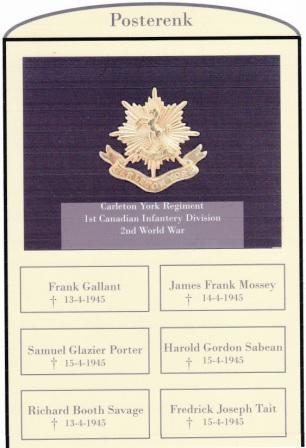
The village had a list of 6 soldiers to commemorate from the Carleton & York Regiment, who had all been buried in the area.  In addition to Frank Gallant, the list named another Islander, James ‘Frank’ MOSSEY, of Souris.

Unfortunately, not all soldiers who died are included on this list, but Edwin worked towards including two more, who were not buried near Posterenk, but “were temporarily buried in Lochem because they had previously died in a Canadian hospital there….

These two additional soldiers were: Goldwin Marven POLLICK of Minto, New Brunswick, and Daniel Peter MACKENZIE of Victoria Cross, Prince Edward Island. 

Born March 22, 1918 in Victoria Cross, Daniel ‘Dan’ Peter MACKENZIE was the son of John and Rachael MacKenzie.  His niece, Carol Burke, provided more information on his life when she contacted Pieter in 2015:  “Dan MacKenzie grew up on a farm in Victoria Cross, Prince Edward Island, and attended Victoria Cross school.  He had 3 brothers Johnny, Billy, and Angus, all deceased, and 3 sisters: Florence Rodgerson, Mabel MacNeill, and Edna Campbell, all living in Prince Edward Island. Dan enjoyed playing hockey and ball with his siblings and working on the farm with his father…” 

….Dan MacKenzie enlisted in 1940…..

Before enlisting with the PEI Highlanders in Charlottetown, Prince Edward Island on May 15, 1940, Dan had served in the militia with the PEI Light Horse Regiment (17th Reserve Armoured Regiment) since 1937.  He had been working as a farm labourer for Gavin Read of Montague, Prince Edward Island, and hoped to have a dairy farm of his own.

MacKenzie-Daniel-P (2)

Daniel ‘Dan’ Peter MacKenzie. (Photo courtesy of Carol Burke)

He went to Dartmouth, Nova Scotia for basic training, and remained there until June 3, 1941, when he was sent to Valcartier, Quebec in preparation for guard duty in Newfoundland. 

… Dan was sent to Newfoundland….

NFLD Map shows Botwood

Location of Botwood Military Base in Newfoundland. (Map source: http://postalhistorycorner.blogspot.com/2012/12/wwii-canadian-forces-in-newfoundland.html)

After France was occupied by the Germans in 1940, Newfoundland’s defensive position became more precarious. That same year, Canada assumed responsibility for the defence of Newfoundland with the establishment of ‘W Force’, a Canadian garrison force responsible for defending Newfoundland against enemy incursions and providing security for existing and proposed defence facilities during WWII. It included infantry, artillery, and anti-aircraft units. (See https://en.wikipedia.org/wiki/Military_history_of_Newfoundland_during_World_War_II)

On July 23, 1941, as part of ‘W Force’, Dan was sent to Botwood, Newfoundland.  In addition to the PEI Highlanders, troops from the Black Watch of Canada, Royal Rifles of Canada, The Algonguin Regiment, Queens Own Rifles, also served at various times. While an RCAF base in Botwood had aircraft patrolling the east coast of the Atlantic, Canadian Army personnel based at Botwood were charged with protection of military facilities that had been installed there, as well as in Gander. (See https://www.heritage.nf.ca/articles/politics/botwood-base.php)

…..Three other soldiers were in Botwood…..

Dan was in Botwood at the same time as three other soldiers whose stories have been told on this blog:

Dan remained in Newfoundland until March 20, 1943, when he was sent to Sussex, New Brunswick.  On June 2, 1943, Dan was transferred to the No. 1 Transit Camp in Debert, Nova Scotia, for final preparation and training before being sent overseas. 

…Dan was in the Italian Campaign….

He left Canada on June 10, 1943, arriving in the United Kingdom on June 18, 1943 and posted to No. 7 Canadian Infantry Reinforcement Unit (CIRU).  On October 25, 1943 he participated in Hot Dog, an exercise to prepare troops who would be part of the Central Mediterranean Force (CMF) and travelled on to mainland Europe with the CMF and the Allied Army in Italy (AAI).  Not long afterwards, he was transferred to the Carleton & York Regiment on December 23, 1943, fighting in the Italian Campaign. (See https://en.m.wikipedia.org/wiki/Italian_campaign_(World_War_II))

Carol Burke had noted that Dan’s “… regiment fought just north of Ortona, Italy…. and was in the forefront of the assaulting Infantry that bitterly fought Gustav, Hitler and Gothic Line battles....”

On December 31, 1944 Dan was attached to Allied Forces Headquarters (AFHQ), which controlled all Allied operational forces in the Mediterranean Theatre of Operations until the end of the war.  AFHQ was based in Caserta, Italy after the capture of Sicily and invasion of Italy.

On March 19, 1945 he left Italy as part of Operation Goldflake, arriving in Marseilles, France two days later.  Operation Goldflake was the codename for moving troops from Italy to North-West Europe.  (See https://en.wikipedia.org/wiki/Operation_Goldflake)

The Carleton & York Regiment was now part of the 21st Army Group. From France, troops were moved up to the Belgian front, into The Netherlands, through the Reichswald Forest in Germany, and then back into The Netherlands.

…The Liberation of Posterenk…

On April 12, 1945 the Regiment was part of Operation Cannonshot, which led to the crossing of the IJssel River between the villages of Gorssel and Wilp in the eastern part of The Netherlands. (See https://www.liberationroute.com/stories/190/operation-cannonshot)

Map western holland showing Posterenk

According to the April 12, 1945 war diary entry of the Carleton & York Regiment, they “…moved across the Ijssel River at 14:30 hours….” to relieve the Seaforth Highlanders of Canada.

On April 13, 1945, the war diary entry noted that …‘D’ Company’s objective is Posterenk…The Regiment didn’t expect much opposition, but they “met with stiff resistance just after starting at 11:25 hrs…

With the help of a tank troop, they were able to move forward.  According to the war diary entry, “at 13:37 hrs ‘D’ Company reported that POSTERENK was clear of the enemy, having had one officer killed (Lt. R.B. Savage) and two other ranks wounded but a total of 50 POWs. ‘D’ Company were ordered to push on up the road which they did at once and came under enemy fire…

Dan was one of those wounded. The medical file stated he received gunshot wounds to his abdomen and left hip.  He was taken to a Canadian hospital in Lochem, where he died at 7:30 pm, despite heroic efforts to save him.  He was 26 years old.

…Dan is buried in the Canadian War Cemetery in Holten…

Dan was initially buried in the Lochem Civil Cemetery, before being reburied on February 1, 1946 in the Canadian War Cemetery in Holten.

We visited his grave in 2017 and 2019.  See: https://onthewarmemorialtrail.com/2018/01/20/on-the-war-memorial-trail-at-holten-canadian-war-cemetery/

CIMG9112 Sep 18 2017 Holten Cemetery Pieter by grave of D MacKenzie

Pieter by the grave of Daniel ‘Dan’ Peter MacKenzie at the Canadian War Cemetery in Holten.  (Photo credit: Daria Valkenburg)

Thank you to Carol Burke for sharing a photo and information. “The fact that Cpl MacKenzie’s death came so close to the end of the war and after such a long period of action only added to the sorrow of his loved ones…” she wrote.

If you have a story to tell, Pieter encourages you to email him at memorialtrail@gmail.com, comment on the blog, or tweet to @researchmemori1.    

© Daria Valkenburg

…Previous stories about soldiers commemorated in Posterenk….

…Want to follow our research?…

Follow our blog

If you are reading this posting, but aren’t following the blog, you are welcome to do so. Our blog address: https://onthewarmemorialtrail.com/

Front cover OnTheWarMememorialTrailinEurope4 countries, 6 weeks, 7,000 km – an unforgettable war memorial journey in Europe…. Daria’s book ‘No Soldier Buried Overseas Should Ever Be Forgotten‘ is available in print and e-book formats.  Net proceeds of book sales help support research costs and the cost of maintaining this blog. For more information see https://nosoldierforgotten.com/

You are also invited to subscribe to our YouTube Channel: On The War Memorial Trail With Pieter Valkenburg: https://www.youtube.com/channel/UCJ591TyjSheOR-Cb_Gs_5Kw

Never miss a posting!  Subscribe below to have each new story from the war memorial trail delivered to your inbox.