On The War Memorial Trail….. The WWII Soldier Born In Samburg Who Lost His Life During The Liberation Of Deventer

Kalyna berries and leaves. (Photo source: Wikipedia, by Lestat (Jan Mehlich) – Own work)

September 8, 2026. Sometimes Pieter asks me to select a soldier for him to research from one of the photo wish lists that he receives from the Canadian War Cemeteries in The Netherlands.  Occasionally a name is picked because of the date of death and the Regiment, other times because of a surname or place of residence.

 …Jim Kosowan was of Ukrainian heritage….

When I came across the name James ‘Jim’ John George KOSOWAN, listed as being from Kalyna, Saskatchewan, I asked Pieter to choose that soldier.  Why him? he asked.  It’s a Ukrainian surname, I replied, and Kalyna, which we know in English as a viburnum shrub (Viburnum opulus, see https://en.wikipedia.org/wiki/Viburnum_opulus) with red berries, is an ethnic and national symbol of Ukraine that symbolizes resilience, strength, and the fight for freedom.
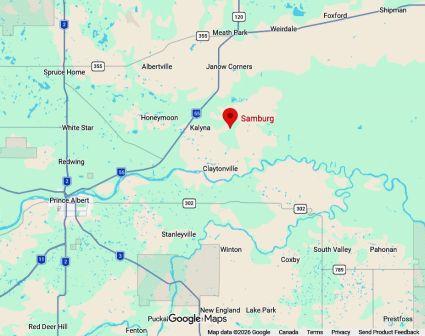
Samburg, Saskatchewan is near the larger town of Prince Albert.  (Map source: Google Maps)

Ok, Pieter said, but when he began his research, he learned that the soldier was born on December 18, 1920 in Samburg, Saskatchewan, near the town of Prince Albert, the son of George and Maria (nee Pusta) Kosowan, who had both immigrated to Canada in the late 1800s from Eastern Europe. The Kalyna reference in his service file came from where his family was living at the time of his enlistment.

…Jim’s nephew contributed a photo…

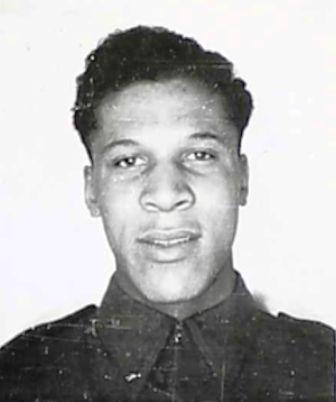
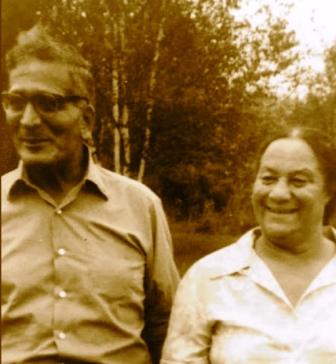
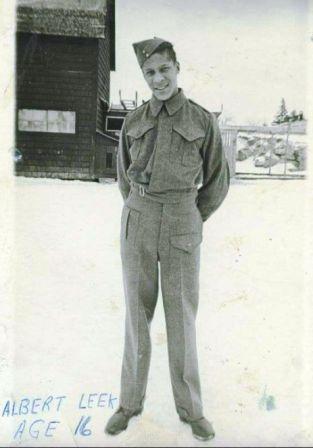
Jim had 4 sisters and 6 brothers, and it was the family of Jim’s sister Rose Sanjenko that Pieter quickly got in contact with once he began his research. When we asked Jim’s nephew, Randy Sanjenko, how the photos he submitted should be attributed, his response was heartfelt.  “….Please just say they are from family who love and miss him….Thank you for keeping the story of all those brave young men alive because l am a believer in never forget….

….Jim enlisted in 1942 under NRMA…

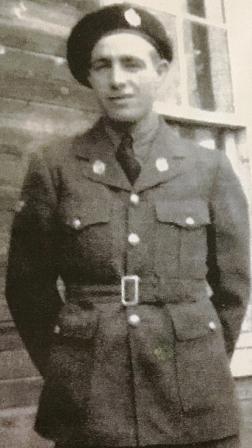
James ‘Jim’ John George Kosowan.  (Photo courtesy of the Kosowan Family)

On March 12, 1942, Jim enlisted under the National Resources Mobilization Act (NRMA) at No. 2 NRMA Clearing Depot in Newmarket, Ontario. (See https://en.wikipedia.org/wiki/National_Resources_Mobilization_Act)

At the time of his enlistment, Jim stated he was an auto mechanic, had experience working on his family’s wheat farm near Kalyna, Saskatchewan, and was working as a packer at O’Keefe Breweries in Toronto for the past 18 months. In addition to English, he could speak Russian and Ukrainian. His brother Johnny was in the Royal Canadian Artillery.

He took his basic training at No. 23 Canadian Army (Basic) Training Centre in Newmarket, and then was sent to the A11 Canadian Infantry Training Centre at Camp Borden, Ontario on May 14, 1942.

On September 15, 1942, Jim was sent to No. 4 Aerodrome Defence Platoon, a specialized mobile defensive unit tasked with safeguarding critical military airports, airfields, and Royal Canadian Air Force (RCAF) installations against ground assaults, sabotage, and enemy paratrooper attacks. A few days later, on September 19, 1942, Jim was temporarily attached to the 1st Battalion, Saint John Fusiliers (Machine Gun) in Sydney, Nova Scotia.

The Battalion was stationed in Canada on home defence duty as part of the 18th Infantry Brigade, 6th Canadian Division.  With the Battle of the Atlantic underway off of the Canadian coast, and German U-boats actively targeting shipping vessels in the Gulf of St. Lawrence and near Cape Breton, the Battalion was tasked with key security duties.  The men were on guard detail to protect vital infrastructure around the strategic industrial hub of Sydney and its heavily used wartime shipping harbour. As well, coastal defence support was provided in assisting nearby coastal batteries to deter potential enemy beach landings or sabotage. (See https://thecanadianencyclopedia.ca/en/article/battle-of-the-atlantic)

Military training also continued for the men.  Jim qualified as a Driver i/c Track Class III on March 3, 1943.  (The term ‘Driver i/c’ refers to ‘Driver, internal combustion’. Track Class III meant he was qualified to drive heavy trucks and armoured cars.)

….Jim enlisted in the Active Army in 1943…
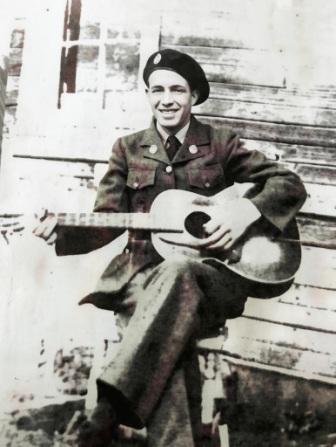
James ‘Jim’ John George Kosowan playing a guitar.  (Photo courtesy of the Kosowan Family.  Photo restoration by Pieter Valkenburg)

On October 1, 1943, Jim transferred to the Active Army, enlisting in Yarmouth, Nova Scotia, but remained with No. 4 Aerodrome Defence Platoon.  He was sent to No. 2 Transit Camp in Debert, Nova Scotia, where his training continued.

He qualified as a Driver i/c Class III (Wheeled) on October 19, 1943.  (The term ‘Driver i/c’ refers to ‘Driver, internal combustion’. Class III (Wheeled) meant he was qualified to drive heavy trucks and armoured cars, but not tanks.)

On July 5, 1944, Jim was given 9 days of special leave, in what turned out to be the last chance he had to see his family.  Upon returning from leave, he was transferred to No. 1 Transit Camp in Windsor, Nova Scotia.  This was a final staging, preparation, and administrative processing area before being sent overseas.

….Jim left Canada for overseas service ……

On September 1, 1944, Jim travelled by train directly from Windsor to the Halifax docks to board a troopship, which left Halifax on September 2, 1944, and arrived in the United Kingdom on September 6, 1944. Upon arrival, he was placed with No. 3 Canadian Infantry Reinforcement Unit (CIRU).

He didn’t remain long in the United Kingdom, as on October 7, 1944, he was transferred to the X-4 Reinforcement List of the 21st Army Group, and sent to France on October 8, 1944, arriving a day later.
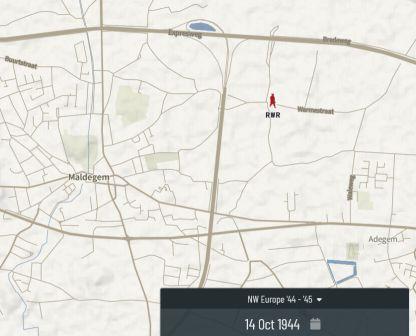
Red coloured soldier marks location of Royal Winnipeg Rifles on October 14, 1944. (Map source: Project 44)

On October 14, 1944, he was transferred to the Royal Winnipeg Rifles, joining them in Maldegem, Belgium, near the border with The Netherlands.  The Royal Winnipeg Rifles War Diary for that day noted that “…a few reinforcements arrived and were immediately posted to their companys….

The reinforcements were needed as on October 6, 1944, Operation Switchback, the second main operation of the Battle of the Scheldt had begun, with the goal of clearing the ‘Breskens Pocket’ – the German defences around Breskens in The Netherlands. (See https://www.canadiansoldiers.com/history/battlehonours/northwesteurope/breskenspocket.htm)

….Jim was wounded during Operation Switchback…
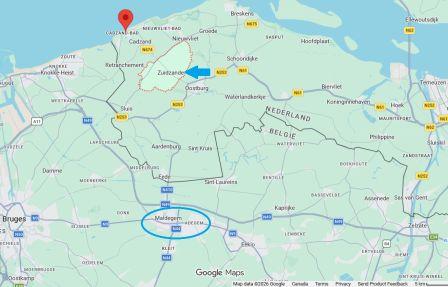
Blue arrow indicates Zuidzande where Jim Kosowan was wounded.  Blue circle shows location of Maldegem, where he joined the Royal Winnipeg Rifles. (Map source: Google Maps)

On October 28, 1944, during the final phase of Operation Switchback, part of the larger Battle of the Scheldt, the Regiment was clearing German strongholds and capturing prisoners of war in the area of Zuidzande, The Netherlands, near the Belgian-Dutch border.  As part of the 7th Canadian Infantry Brigade in the 3rd Canadian Infantry Division, they faced heavy resistance, artillery fire, and minefields, as they tried to clear the Scheldt Estuary and open the shipping route to Antwerp, Belgium.

Jim was wounded by shrapnel from an exploding grenade and spent over a month in hospital. Three members of the Royal Winnipeg Rifles died that day and are buried in the Canadian War Cemetery in Adegem, Belgium….

  • Elmond Joseph CHOQUETTE, born in Mariapolis (Glenora), Manitoba, aged 26
  • Richard Francis GYLES, of Winnipeg, Manitoba, aged 20
  • Leonard Andrew HEEKS, of Edmonton, Alberta, aged 20

…. Jim returned to duty in December 1944….

Jim returned to duty on December 12, 1944, rejoining the Royal Winnipeg Rifles, now stationed in the Nijmegen area of the Netherlands, near the German border, where they remained over the winter.  While based in a relatively safe area, they still were busy, conducting defence operations and sentry duties near the German border, reconnaissance patrols to monitor enemy positions.

They also tackled infrastructure tasks, such as clearing ice on the Waal River and doing road maintenance.  On the day Jim returned to the Regiment, 7 men drowned in a tragic accident when the vehicle they were in lost control on a dike, slid down the embankment and into the water.  The war diary explained that they “were pinned down under the carrier and were drowned….” They were part of a group of 13 men sent to repair a road running from a local railway bridge back to regimental headquarters.

…. Jim was involved in the liberation of North-West Europe….

By January 1945 the Royal Winnipeg Rifles were still in The Netherlands, and spent the New Year in ‘s-Hertogenbosch.

On February 1, 1945, the war diary recorded that the Regiment was informed of the part that the men “…would play in Operation Veritable…” This would take them into Germany. (See https://en.wikipedia.org/wiki/Operation_Veritable)  The Regiment arrived in Millingen, Germany on February 9, 1945.

By February 16, 1945, the Regiment was based in Essen, Germany, as they cleared German positions in flooded areas of the Rhine flood plain and the Reichswald forest, which is close to the Dutch-German border.

On March 11, 1945, the Regiment began moving back towards ‘s-Hertogenbosch, The Netherlands and the greater battle towards liberating the country.

….The Liberation of Deventer involved crossing the Schipbeek ….

Movement of Canadian troops towards Deventer.  Note that all first had to cross the Schipbeek.  (Map provided by Edwin van der Wolf)

On April 7, 1945, the Royal Winnipeg Rifles were ordered to cross the Schipbeek and establish a bridgehead as preparation for an assault on the city of Deventer by the 7th Canadian Infantry Brigade.

Crossing the Schipbeek was vital to the success of the bridge operation, not an easy feat as the Bridge was strongly defended by the Germans, but the Regiment was able to meet its objective.

NOTE: For an account of our visit to Schipbeek and Bathmen during our 2025 European War Memorial Tour, see https://onthewarmemorialtrail.com/2025/10/26/on-the-war-memorial-trail-visit-to-bathmen-and-the-schipbeek-canal/

….Jim lost his life during the Liberation of Deventer…

On April 10, 1945, the Regiment was involved in the liberation of Deventer, a town lying on the right bank of the IJssel River.  With the approaches protected by a maze of waterways, it was necessary to attack from the east. (See https://www.canadiansoldiers.com/history/battlehonours/northwesteurope/deventer.htm)

In ‘Little Black Devils: A History Of The Royal Winnipeg Rifles’ authors Bruce Tascona and Eric Wells noted that Deventer “…was a town of 50,000, which the Germans had fortified with an anti-tank ditch.  The battle began with a night attack at 0100 by the Canadian Scottish on the enemy’s right flank, and the Rifles struck their left flank at 0700.

Over the next 10 hours, the Rifles were continuously engaged, first in pushing back the enemy’s outer positions on the open ground before the big ditch.  Casualties were heavy….

Deventer was liberated by 5 pm, but Jim unfortunately didn’t see this outcome, as he lost his life at some point during the fight.

On our 2017 European War Memorial Tour, we’d visited Deventer and the surrounding area with Edwin van der Wolf, one of the research volunteers at the Canadian War Cemetery in Holten, The Netherlands, so we were familiar with the area where Jim and Clive Elbert Steele GEROW,  whose story was previously told, lost their lives. (See https://onthewarmemorialtrail.com/2023/10/07/on-the-war-memorial-trail-the-wwii-soldier-from-burks-falls-killed-during-the-liberation-of-deventer/)
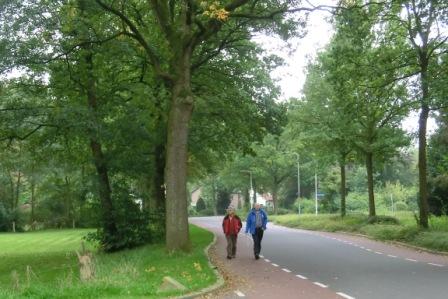
Pieter and Edwin van der Wolf (right) walked along the route near Schalkhaar that Canadian troops took before  they liberated Deventer in April 1945.  (Photo credit: Daria Valkenburg)

….Jim is buried in Holten…

Along with 45 other soldiers, Jim was initially buried beside an estate in Oxe before being reburied in the Canadian War Cemetery in Holten, The Netherlands on December 17, 1945.

Pieter at the entrance to the Canadian War Cemetery in Holten, The Netherlands. (Photo credit: Daria Valkenburg)

During our 2025 European War Memorial Tour, Pieter placed a Canadian flag by his grave.  Unfortunately, on this trip, we did not have any Saskatchewan flags.
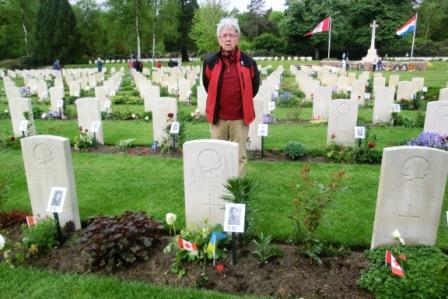
Pieter at the grave of James ‘Jim’ John George Kosowan after placing a Canadian flag. (Photo credit: Daria Valkenburg)

…The Colmschate Memorial commemorates 46 Canadians….

On April 8, 2015, a memorial had been placed in Colmschate to commemorate the 46 Canadians who had been temporarily buried on the Oxe estate.
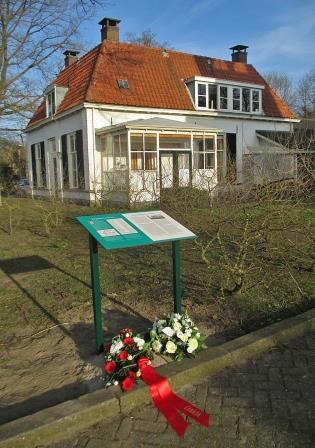
Memorial in Colmschate, commemorating 46 Canadians, including James Kosowan. (Photo courtesy of Edwin van der Wolf)

Text of Memorial in Colmschate, commemorating 46 Canadians, including Philip Laforte.  (Photo courtesy of Edwin van der Wolf)

Translation of the Dutch text was prepared by Pieter Valkenburg:

They Gave Their Lives

The liberation of Colmschate

During their advance from the Achterhoek, the Royal Winnipeg Rifles, the Regina Rifle Regiment, and the Canadian Scottish Regiment, led by Brigadier General T G Gibson reached the neighborhood of Oxe on Friday April 6, 1945. Next to the house on the Oxe estate (Oxerhof), the liberators discovered the bodies of ten Dutchmen who had been murdered in cold blood by the occupiers the day before. The Canadians passed the Schipbeek via a quickly struck bailey bridge, which replaced the destroyed Swormertoren Bridge.

Despite heavy German resistance, they continued north. Many farms went up in flames and houses were badly damaged. Many families sought refuge in the already liberated Oxe. Some residents lost their lives.

On April 8, 1945, the liberators captured (a small part of) the Snippeling, Colmschate, and the Bannink. Via the Vijfhoek they reached the Crödden Bridge over the Overijssels Canal. Schalkhaar and Deventer were then liberated and with the help of the Queen’s Own Rifles the remaining part of the Snippeling.

Many Canadians lost their lives in the battle in this area. In April 1945, the bodies of 46 fallen Canadians were buried in a temporary resting place opposite the Oxerhof house. In January 1946 they were transferred to the Canadian Cemetery in Holten (Plot I and II).

Two other soldiers whose stories were previously told are listed on this monument:

….Kosowan Lake is named after Jim…

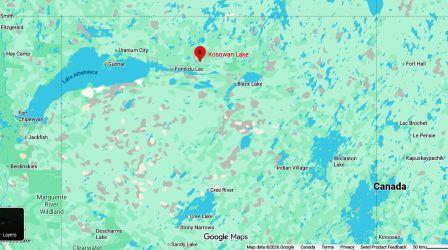
Kosowan Lake is in northern Saskatchewan. (Map source: Google Maps)

In 1952, Kosowan Lake in northern Saskatchewan, near the border with North West Territories, was named after Jim as part of the GeoMemorial Commemorative Naming Program.
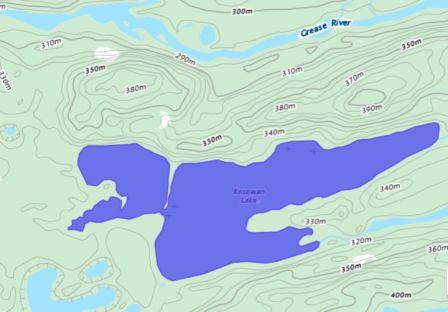
Kosowan Lake is located at the coordinates 59°25′39″N 106°28′17″W.  (Map source: https://geonames.nrcan.gc.ca)

Thank you to Randy Sanjenko, Jim’s nephew, for submitting photos and memories, to Bonnie Sanjenko for contacting her brother-in-law Randy, and to Shawn Rainville for newspaper research.

The Canadian flag placed at Jim’s grave during our 2025 European War Memorial Tour was donated.  Our thanks go to Alan Waddell, Constituent Assistant, on behalf of Heath MacDonald, MP for Malpeque.

While we were at the cemetery placing flags, we met Jane Kondakova, a Ukrainian refugee from the Kyiv region, who was living in the village of Holten with her two young children.  She was placing flags at the graves of soldiers of Ukrainian descent, including James Kosowan, to honour them and her husband, who is in the Ukrainian military.

Pieter’s research efforts to find photos and families of soldiers continue. Do you have a story to tell? Email Pieter at memorialtrail@gmail.com, or comment on the blog.

© Daria Valkenburg

….Want to follow our research?…

If you are reading this posting, but aren’t following our research, you are welcome to do so.  Our blog address: https://onthewarmemorialtrail.com/
4 countries, 6 weeks, 7,000 km – an unforgettable war memorial journey in Europe…. Daria’s book ‘No Soldier Buried Overseas Should Ever Be Forgotten‘ is available in print and e-book formats.  Net proceeds of book sales help support research costs and the cost of maintaining this blog. For more information see https://nosoldierforgotten.com/

Subscribe to our YouTube Channel: On The War Memorial Trail With Pieter Valkenburg: https://www.youtube.com/channel/UCJ591TyjSheOR-Cb_Gs_5Kw.

Never miss a posting!  Subscribe below to have each new story from the war memorial trail delivered to your inbox.
On The War Memorial Trail….The Flight Engineer From Urbainville Aboard The Last Flight Of Lancaster KB914

August 9, 2026. Several months ago, an article sent by Don Coutts, nephew of WWII pilot Elmer Bagnall MUTTART, about Flying Officer Bernard Delbert FORBES, an airman from North Bay, Ontario, who died in a February 1, 1953 plane crash in Newfoundland, led to the discovery that one crew member was Corporal Joseph ‘Donat’ GALLANT of Urbainville, Prince Edward Island.  (See Shared from BayToday.ca: Tragic 1953 crash that killed North Bay airman still remembered: https://www.baytoday.ca/local-news/tragic-1953-crash-that-killed-north-bay-airman-still-remembered-11879654?utm_source=Email_Share&utm_medium=Email_Share&utm_campaign=Email_Share)

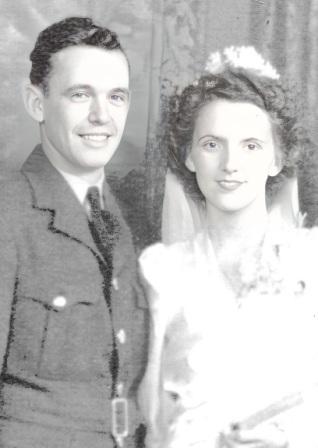
Wedding photo of Donat Gallant and Émilie Gaudet. (Photo courtesy of Ron and Evelyn Gallant. Photo restoration by Pieter Valkenburg)

Born March 17, 1918 in Urbainville, Prince Edward Island, Donat was the son of Cyrus and Edna Gallant.  A WWII veteran, he was living in Wellingon, Prince Edward Island, with his wife Mary Émilie (nee Gaudet) Gallant, who he’d married on October 4, 1943.  They were the parents of three children – Ronald, Sandra, and Gerald.

We were interested in finding a family member, if possible, and thanks to several Gallants who lived in the area where the airman came from, Pieter was soon put in contact with Evelyn Gallant, wife of Donat’s son Ron.

….The leadup to the crash…

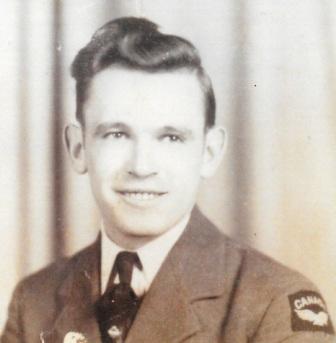
Joseph ‘Donat’ Gallant. (Photo courtesy of Ron and Evelyn Gallant)

Donat had re-enlisted in the RCAF on January 8, 1948 in Summerside, Prince Edward Island. According to an article in the February 20, 1953 edition of the Telegraph-Journal of St. John, New Brunswick, Donat had been “…stationed at the Chatham RCAF base before transfer to Greenwood, where he completed a flight engineer’s course in November

Based in Greenwood, Nova Scotia, he was a member of No. 405 ‘Eagle’ (Maritime Reconnaissance) Squadron, a long-range patrol unit involved in maritime surveillance and Arctic sovereignty. Originally formed on April 3, 1941 in England as the first RCAF bomber squadron overseas, and serving as an elite Pathfinder force unit. Disbanded on September 5, 1945, it was reformed on April 1, 1947 as No. 405 Bomber Reconnaissance Squadron at RCAF Station Greenwood, and was later re-designated No. 405 Maritime Reconnaissance Squadron in 1950, and today is known as No. 405 Maritime Patrol Squadron. (See https://en.wikipedia.org/wiki/405_Long_Range_Patrol_Squadron)

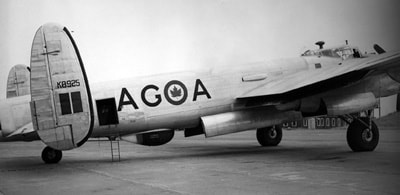
A Lancaster of the type used by No. 405 Squadron.  (Source: Wikipedia)

In January 1953, two Lancaster KB868 and Lancaster KB914 crews, from No. 405 ‘Eagle’ (Maritime Reconnaissance) Squadron, were sent to Keflavik, Iceland, to take part in an anti-submarine warfare (ASW) exercise.

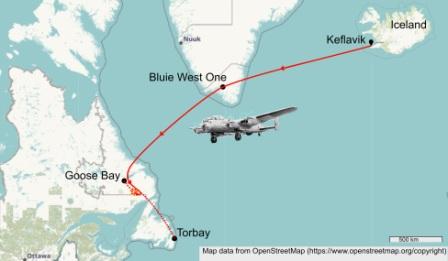
However, on Saturday, January 31, 1953, both crews received orders to proceed to Goose Bay, Labrador, to participate in the search for a missing civilian twin-engine Beechcraft 18 Expeditor. The plan was to fly to the vicinity of Bluie West One (now Narsarsuaq Airport) located near the southern tip of Greenland, and then do a track crawl to Goose Bay, while looking for any signs of the missing aircraft.  (See https://en.wikipedia.org/wiki/Narsarsuaq_Air_Base)

Both Lancasters left Keflavik on Sunday, February 1, 1953. Lancaster KB914 left Keflavik at 7:31 am (1031 Zulu).  Lancaster KB868 arrived safely around 3:30 pm (1826 Zulu) at RCAF Station Goose Bay, landing with the plane coated with heavy snow.  Goose Bay was getting dumped on by heavy snow and the base was ‘socked in’.  (NOTE: Zulu Time is the world standard time used in aviation. Also known as Greenwich Mean Time (GMT), it remains constant, unaffected by Daylight Saving Time changes.)

…. Lancaster KB914 didn’t have a safe arrival….

Map shows the plane’s path from Keflavik to where it crashed near Goose Bay.  (Map prepared by Wendy Nattress)

By the time that Lancaster KB914, which had been directed to the search area, began approaching Goose Bay at 4:26 pm (1926 Zulu), not only was the base ‘socked in’, but the Ground Control Approach (GCA) system was unserviceable, and the aircrew had no visibility.

With the situation preventing the plane from landing at Goose Bay, the pilot, Thomas Claude WAGAR, was ordered to divert to the RCAF Station in Torbay, Newfoundland (now St. John’s International Airport). The plane was at a height of 2,135 metres (7,000 feet) and had five hours of fuel left. The order was acknowledged, a course was plotted to their new destination, and the plane headed in an easterly direction.  The estimated time of arrival at Torbay was 7:09 pm (2209 Zulu), well within safe fuel limits.

At 5:30 pm (2030 Zulu), however, an urgent message was sent to Goose Bay notifying them that the pilot had just feathered two of the four Rolls Royce Merlin engines and they were returning to Goose Bay. Feathering refers to turning the propeller blades so their thin edges point directly into the oncoming air. This stops the blades from spinning in the wind and cuts down heavy drag, helping to keep the plane steady.

Arrival at Goose Bay was estimated at 6:00 pm (2100 Zulu). 16 minutes later the pilot requested a weather update for Goose Bay. This was sent but not acknowledged. Radio contact between ground personnel and the plane suddenly ended. Lancaster KB914 was declared missing.

…. Lancaster KB914 wasn’t found until June….

When a massive air search, hampered by more bad weather and two other missing aircraft that also required attention, was unsuccessful, the search was called off on February 16.  In addition to the missing Lancaster and Beechcraft, a British York transport, carrying troops to Jamaica via Gander, vanished over the Atlantic on February 2, with cold, blowing snow still sweeping the area.

A February 3, 1953 article in the Globe and Mail noted that “…an extensive search from Greenland and Labrador bases found no trace of a Philadelphia-owned Beechcraft which disappeared Friday on a flight between Goose Bay, Labrador, and Greenland.  The Lancaster went down Sunday while searching for the civilian plane, which carried two men…

Months went by, until, on June 15, 1953, the wreckage of the Lancaster KB914 was spotted from the air by D.P. Saunders, a civilian pilot with the Ottawa-based Laurentian Air Services.  An RCAF ground search party flew out to the wreckage site to recover the human remains and to investigate the scene.

Preliminary study of the ground showed that the aircraft had gone in almost vertically. Forest damage was limited due to the impact, although debris had struck trees up to 91 metres (100 yards) distant when the Lancaster exploded. The human remains were recovered on June 21.

….Why did the plane crash?…

According to the crash report, the plane crashed 153 km (95 miles) southeast of Goose Bay at around 5:46 pm (2046 Zulu). The plane’s engines had been covered with ice, and the plane’s de-icer did not work properly.

A summary of the evidence in the crash report indicated that “…from the position of the crash….” the plane was “….62 miles off track….  (62 miles is about 100 km)

….The pilot had reported that he was returning to Goose Bay with two engines feathered….”  No 1 and No 4 engines showed no issues, while the “…propellers of Nos. 2 and 3 engines indicated that they were in the feathered position…” suggesting that the plane “….was flying on the two outboard engines….

With the inboard engines feathered, this meant that “…as some of the pilot’s instruments are operated by vacuum pumps (one on each inboard engine) he would be denied the use of his artificial horizon, turn and bank and directional gyro…

As well, “….the hydraulic system would be inoperative….” as these were also on the inboard engines.  “….As the carburetor air intake shutters are hydraulically operated, the pilot would be unable to change the position of the shutters…” from where they were positioned before the engines had been feathered.

Why were the two engines feathered?  About one hour after the ordered diversion from Goose Bay to Torbay, “the pilot was compelled to feather Engine No. 2 due to severe icing…” but the port de-icer didn’t work.  “….A short time later, the pilot found it necessary to feather No. 3 engine due to overheating…

The pilot couldn’t see where he was flying, his artificial horizon and directional aids were inoperable, as was the hydraulic system.  Then, “…shortly before the accident, No. 1 engine failed or partially failed due to icing, resulting in complete loss of control by the pilot…

Evidence showed that “…as two of the crew members had their parachutes on, it is more than likely that the pilot was attempting to have the crew bail out after he experienced loss of control…

….The crew of Lancaster KB914…

Donat was one of two Flight Engineers aboard the last flight of Lancaster KB914.  The rest of the crew members were:

  • Pilot – Flying Officer (F/O) Thomas Claude WAGAR DFC, from Kingston, Ontario but born in Parham, Ontario, aged 32. (DFC refers to Distinguished Flying Cross)
  • Co-Pilot – Flying Officer (F/O) Charles Bruce SCOTT, from Saint John, New Brunswick, aged 27.
  • Navigator – Flying Officer (F/O) Stephen James DECKER, born in Cooks Harbour, Newfoundland, aged 24.
  • Navigator – Flying Officer (F/O) Douglas David Richard WOOD, from Peterborough, Ontario, aged age 21.
  • Radio Officer – Flying Officer (F/O) Bernard Delbert FORBES, from North Bay, Ontario, aged 23.
  • Radio Officer – Flying Officer (F/O) Frances ‘Frankie’ Steward FOWLOW, from St. John’s, Newfoundland, aged 24.
  • Radio Officer – Flying Officer (F/O) Thurland Mabury TATE, from Grand Manan, New Brunswick, aged 22.
  • Flight Engineer – Corporal Roger David Joseph LALONDE, from Kirkland Lake, Ontario but born in Cobalt, Ontario, aged 30.

….A mass funeral was held for all 9 men in Greenwood…

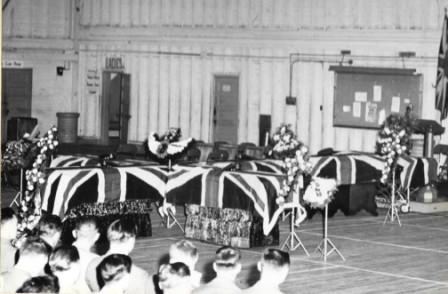
A mass funeral was held in Greenwood for all 9 airmen. (Photo courtesy of Ron and Evelyn Gallant)

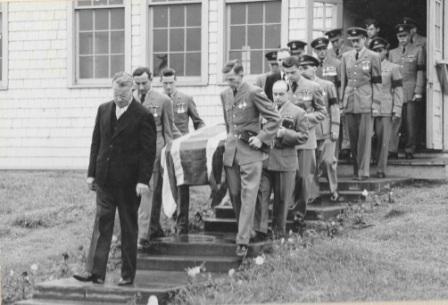
A mass funeral was held on June 26, 1953 in Greenwood, Nova Scotia, for the nine airmen. The ceremonies took place in the Catholic Chapel and in the Station Drill Hall after which the body of each airman was transported to his Canadian hometown for final burial.

A mass funeral was held in Greenwood for all 9 airmen. (Photo courtesy of Ron and Evelyn Gallant)


A procession on the day that the mass funeral was held in Greenwood for all 9 airmen. (Photo courtesy of Ron and Evelyn Gallant)

….Donat is buried at Baie Egmont (St. Jacques) Cemetery…

Map shows location of the church in Egmont Bay, as well as Urbainville and Wellington.  (Map source: Google Maps)

Evelyn Gallant noted that after the mass funeral service in Greenwood, there was another service held  “….in Egmont Bay church….” (St. Philippe et St. Jacques Roman Catholic Church)

Ron Gallant, the oldest of Donat’s children, was 7 when his father died.  He said he “…remembered the soldiers at the church and the guns at the funeral. After the funeral, Father Burke brought us home.  My mother never remarried, and is buried next to my father….

Pieter by the grave of Joseph ‘Donat’ Gallant after placing Canadian, Prince Edward Island, and Acadian flags.  A stone marker in front is that of his wife. (Photo credit: Daria Valkenburg)

Donat was buried in Baie Egmont (St. Jacques) Cemetery in Prince Edward Island.  We visited the cemetery one beautiful, sunny day in June, and Pieter placed Canadian, Prince Edward Island, and Acadian flags by his grave.

….A memorial in Greenwood honours the crew of Lancaster KB914…

On May 27, 2022, a ceremony to honour the crew of Lancaster KB914 was held, with a memorial placed in the Commemorative Garden at the Greenwood Military Aviation Museum at 14 Wing Greenwood.  (The family of Frances ‘Frankie’ Steward FOWLOW did attend the ceremony: https://auroranewspaper.com/wp-content/uploads/pdf/Archive/2022/4322news.pdf)

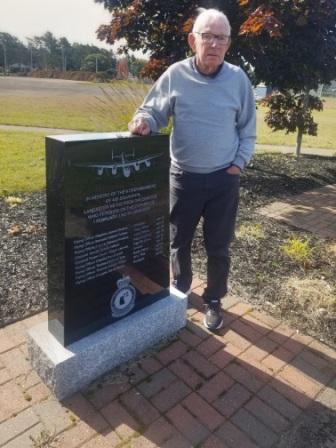
Ron Gallant at the memorial in Greenwood honouring the crew of Lancaster KB914.  (Photo courtesy of Ron and Evelyn Gallant)

Ron said he never met the families of the other crew members, and was unable to attend the 2022 ceremony as he was recovering from an operation.  However, he and Evelyn subsequently visited Greenwood to see the memorial.

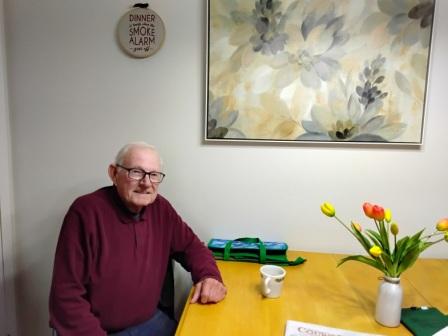
Ron Gallant at his home in Richmond, Prince Edward Island. (Photo credit: Daria Valkenburg)

Thank you to Ron and Evelyn Gallant for providing photos and information, to Shawn Rainville for newspaper research, and to Don Coutts for letting us know about the last flight of Lancaster KB914. Thank you to Wendy Nattress, who prepared the map showing the flight path for Lancaster KB914.

The flags placed at Donat’s grave during our visit were donated.  Our thanks go to:

  • Alan Waddell, Constituent Assistant, on behalf of Heath MacDonald, MP for Malpeque, for the Canadian flag.
  • Matt MacFarlane, MLA (Member of the Legislative Assembly) for District 19, Borden-Kinkora, Prince Edward Island, for the Prince Edward Island flag.
  • La Société acadienne de Clare at the request of Simone Comeau, for the Acadian flag.

Pieter’s research efforts to find photos and families of soldiers continue. Do you have a story to tell? Email Pieter at memorialtrail@gmail.com, or comment on the blog.

© Daria Valkenburg

….Want to follow our research?…

If you are reading this posting, but aren’t following our research, you are welcome to do so.  Our blog address: https://onthewarmemorialtrail.com/

4 countries, 6 weeks, 7,000 km – an unforgettable war memorial journey in Europe…. Daria’s book ‘No Soldier Buried Overseas Should Ever Be Forgotten‘ is available in print and e-book formats.  Net proceeds of book sales help support research costs and the cost of maintaining this blog. For more information see https://nosoldierforgotten.com/

Subscribe to our YouTube Channel: On The War Memorial Trail With Pieter Valkenburg: https://www.youtube.com/channel/UCJ591TyjSheOR-Cb_Gs_5Kw.

Never miss a posting!  Subscribe below to have each new story from the war memorial trail delivered to your inbox.
On The War Memorial Trail….The Canadian National Vimy Memorial Is 90!

Canadian National Vimy Memorial from a distance. (Photo credit: Daria Valkenburg)

July 28, 2026.  On July 26, 1936 the Canadian National Vimy Memorial, designed by Walter Allward, was officially unveiled – 90 years ago. In September 2017, we visited Vimy Ridge during our 6 week, 7,000 km (4,350 miles) war memorial journey in Europe that took us through 4 countries. Pieter placed flags at the known graves of men listed on the Cenotaph outside the Borden-Carleton Legion in Borden-Carleton, Prince Edward Island, and we stopped at many memorials during our visit.

I was reminded of the 90th anniversary as the most anticipated stop in 2017 was Vimy Ridge in France, where two WWI soldiers listed on the Cenotaph are also named on the Canadian National Vimy Memorial: John ‘Lymon’ WOOD and Patrick Raymond ARSENAULT.  (See https://onthewarmemorialtrail.com/2017/07/28/learning-about-the-two-names-on-the-vimy-memorial/)

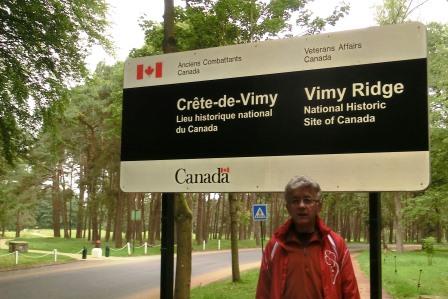
Pieter at the entrance to Vimy Ridge in France. (Photo credit: Daria Valkenburg)

The turn-off to the Vimy Ridge memorial and visitors centre is a tree-lined public road, with jogging and walking paths, that leads to the nearby villages of Givenchy and Vimy.

….The Canadian National Vimy Memorial took 11 years to build….

Although we were familiar with the memorial from seeing it on TV, it’s much larger and beautiful when seen in person.  While we knew that the land around Vimy Ridge was gifted to Canada by the French government in December 1922 as a mark of gratitude for Canada’s involvement in the defence of France during WWI, it wasn’t until we were there in 2017 that we understood why it took so many years to build.

The memorial sits on the highest point of Vimy Ridge, known during WWI as Hill 145.  The ground was littered with unexploded shells and grenades, rusted weapons and wire, and 91,440 metres (100,000 yards) of earth had to be removed by hand to prepare for the monument’s base.

Nearby dugouts and tunnels had to be emptied of explosives that were still stored there, and filled with wet chalk or concrete. Finding underground caverns hidden beneath the monument’s base was crucial, as the memorial weighs more than 50,000 tons.

Work on the monument itself finally began in 1925, took 11 years to build and cost 1.5 million dollars. The white limestone used for the memorial came from an ancient Roman quarry in Seget, Croatia, and didn’t arrive on site until 1927.

The familiar two tall columns represent Canada and France. The pillars together and the horizontal base also form the top half of a cross. The monument includes 20 figures representing honour, justice and peace.

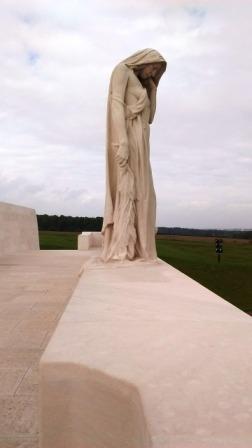
‘Canada Bereft’.  (Photo credit: Pieter Valkenburg)

One female figure, known as ‘Canada Bereft’, stands alone looking out over the slopes of the ridge. The base of the monument is engraved with the 11,285 names of Canadians who have no known grave in France.

….Previous stories about WWI soldiers listed on the Canadian National Vimy Memorial….

In 2017, we were aware of only the two names previously mentioned: John ‘Lymon’ WOOD of North Tryon, Prince Edward Island, and Patrick Raymond ARSENAULT of Bedeque, Prince Edward Island.   Since then, we’ve also told the stories of two more soldiers whose names are engraved on the monument:  Merrill Augustus MARSHALL of Covehead, Prince Edward Island, and Lloyd Clifton SHORTLIFF of Barton, Nova Scotia.  Here below are links to their stories:

….Stories about our 2017 visit to Vimy Ridge….

Missed our stories about our 2017 visit?  You can read them here:

Our visit to Vimy Ridge will never be forgotten.  Meanwhile, Pieter’s research efforts to find photos and families of soldiers continue. Do you have a story to tell? Email Pieter at memorialtrail@gmail.com, or comment on the blog.

© Daria Valkenburg

….Want to follow our research?….

If you are reading this posting, but aren’t following our research, you are welcome to do so.  Our blog address: https://onthewarmemorialtrail.com/

4 countries, 6 weeks, 7,000 km – an unforgettable war memorial journey in Europe…. Daria’s book ‘No Soldier Buried Overseas Should Ever Be Forgotten‘ is available in print and e-book formats.  Net proceeds of book sales help support research costs and the cost of maintaining this blog. For more information see https://nosoldierforgotten.com/

You are also invited to subscribe to our YouTube Channel: On The War Memorial Trail With Pieter Valkenburg: https://www.youtube.com/channel/UCJ591TyjSheOR-Cb_Gs_5Kw.

Never miss a posting!  Subscribe below to have each new story from the war memorial trail delivered to your inbox.
On The War Memorial Trail….. The WWII Soldier From The Pas Who Died When A Flame Thrower Hit A Mine In Germany

June 12, 2026. It’s wonderful when the search for a photo of a soldier takes flight, with many people actively involved in helping in this quest.  That’s what happened when Pieter looked for a photo of WWII soldier Samuel George ENGEN of The Pas, Manitoba. It was a search that took 18 months and involved many family members.

Near the end of December 2024, while we were on our way to a winter vacation, we woke up in our hotel room in Virginia with the wonderful news that a photo of Samuel had been found, and sent to us by Ralph McLean, a researcher that we’d written to earlier in 2024, and Samuel’s nephews Eric and Wilfred Sanderson.

Eric explained that he’d received the photo from Ralph who “…got the picture from Devyn Rusk. … I was so excited to receive the photo. I hope Diane and I can make the journey to see my uncle’s grave site….”  Eric and his wife Diane were the people Pieter first talked to about finding a photo of Samuel.  At the time, Eric explained that the photos were lost when his mother’s house burned down.

But, the search continued amongst family members and eventually a photo was found. Devyn, a teaching assistant at a school in The Pas, Manitoba, is the great-granddaughter of Samuel’s brother Aaron. She explained that the photo had been found “…in an old album.  It had all of Samuel’s Dad’s old post cards….

…A cookbook connection with the Opaskwayak Cree Nation…

Born February 15, 1918 in The Pas, Manitoba, Samuel was the son of Louis Julius, a WWI veteran, and Mary Helen (nee Buck) Engen.  His mother was a member of the Opaskwayak Cree Nation. (See https://en.wikipedia.org/wiki/Opaskwayak_Cree_Nation)

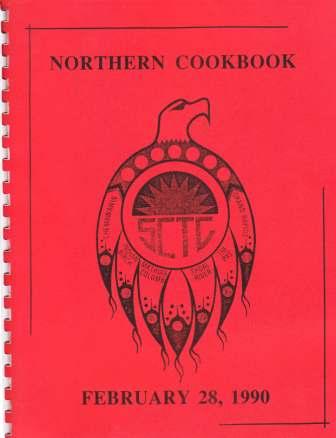
The search for a photo of Samuel had a personal connection.  More years ago than I care to remember, I taught for one semester at Keewatin Community College (now called University College of the North) in The Pas, and one group of community leaders from the Opaskwayak Cree Nation learned basic computer skills that led to a practical outcome with the development of a cookbook.  Eric told us that he was familiar with the names of some of the community leaders listed in the cookbook.

Cover of the Northern Cookbook designed and prepared by students from the Opaskwayak Cree Nation.  (Photo courtesy of Valkenburg Family)

…Samuel enlisted in 1941…

Samuel had married Miriam Susan Pranteau on January 16, 1940, and was working for The Pas Lumber Company in The Pas, Manitoba, and as a trapper, when he enlisted at the No. 10 District Depot Recruiting Office in Dauphin, Manitoba on September 6, 1941.

On September 13, 1941, he was sent to No. 100 Canadian Army (Basic) Training Centre (CABTC) in Portage La Prairie, Manitoba.  After successfully completing basic training, he went on to A15 Infantry Advanced Training Centre (Rifle) at Camp Shilo, Manitoba on December 4, 1941. His training included battle drill tactics, marksmanship, bayonet drill, and field exercises that simulated actual combat environments.

On January 6, 1942, Samuel was hospitalized in Winnipeg, Manitoba for 13 days with mumps, and returned to Camp Shilo upon recovery.  After completing advanced training as a rifleman, he was posted to the A15 Canadian Infantry Training Centre, also located in Camp Shilo, on May 15, 1942.

…Samuel left Canada for overseas service…

In preparation for being sent overseas, Samuel given embarkation leave from May 29, 1942 until June 2, 1942, the last chance he had to see his family.  In the end, Samuel didn’t report back to base until June 15, understandable considering the distance he would have had to travel to go so far up north and then back again.

On July 21, 1942, he left Canada for the United Kingdom, arriving on July 29, 1942, where he was assigned to No. 2 Canadian Divisional Infantry Reinforcement Unit (CDIRU).

A few weeks later, on August 21, 1942, Samuel was transferred to the Queen’s Own Cameron Highlanders of Canada (C of C), joining the regiment in Hassocks, Sussex.  Training continued in anticipation of going into Normandy, France, and to implement lessons learned from other regiments that participated in Operation Jubilee, also known as the Dieppe Raid, on August 19, 1942. (See https://en.wikipedia.org/wiki/Dieppe_Raid)

On December 16, 1942, Samuel was admitted to hospital.  Upon being discharged on January 14, 1943, he was assigned to No. 2 Canadian Divisional Infantry Reinforcement Unit (CDIRU).  He was hospitalized again, from April 23, 1943 until May 27, 1943.

On June 25, 1943, he returned to the Queen’s Own Cameron Highlanders of Canada (C of C), to participate in Exercise ‘Smashex’, part of ongoing intensive amphibious and infantry training to prepare soldiers before being deployed to Normandy the following year.

Unfortunately, Samuel was hospitalized again, from July 30, 1943 until August 14, 1943, when he was discharged.

…Samuel joined the Lake Superior Regiment (Motor)…

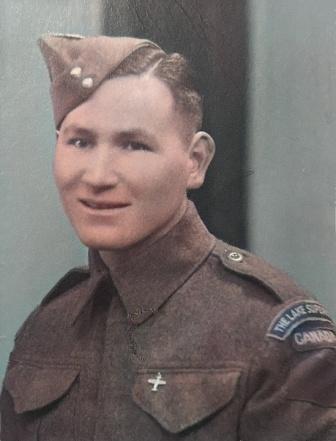
Samuel George Engen. (Photo courtesy of the Engen Family.  Photo restoration and colourization by Pieter Valkenburg)

On August 27, 1943, Samuel was transferred to the Lake Superior Regiment (Motor), the infantry component of an Armoured Brigade serving in an Infantry Division. Canada fielded only two such Motor battalions in WWII – Lake Superior Regiment (Motor) of the 4th Canadian (Armoured) Division was one and the other was the Westminster Regiment (Motor) of the 5th Canadian (Armoured) Division.

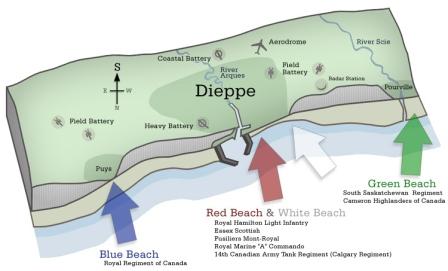
Map showing the Dieppe Raid in 1942, which marks the location of Red Beach. (Map source: https://cbf-fccb.ca/)

Training continued in Britain until July 26, 1944, when Samuel, along with the rest of the Lake Superior Regiment (Motor), left the United Kingdom aboard ‘SS Houston City’ and landed in Normandy, France as part of the 4th Canadian (Armoured) Brigade, 4th Canadian (Armoured) Division. Over the next two days, vehicles disembarked near Graye-sur-Mer on Red Beach, a codename for the heavily fortified Dieppe waterfront during the 1942 Dieppe Raid (Operation Jubilee), while the main battalion went ashore shortly after to join the Normandy campaign, which had begun on June 6, 1944 (D-Day).

They began active service on the front as of July 30, 1944, and over the next two months the Regiment battled its way through Normandy, Falaise, and across northern France into Belgium and The Netherlands. The men did whatever they could to increase the Regiment’s firepower with weapons, including those salvaged from destroyed Sherman tanks and 50 calibre machine guns from downed aircraft.  These were fitted onto their universal carriers and other vehicles.

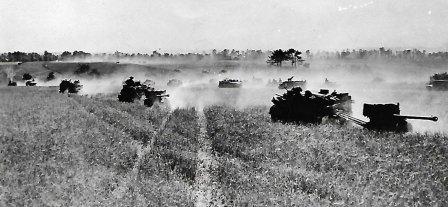
‘The Mad Dash’ on August 14, 1944 through the Falaise Pocket to surround the Germans as part of Operation Tractable fought from August 14-21, 1944.  (Photo source: Posted by George Romick on Facebook page of Canadian Military Photos Lost and Found – Research Group)

…The Lake Superior Regiment (Motor) sank 3 German naval vessels in Zeeland…

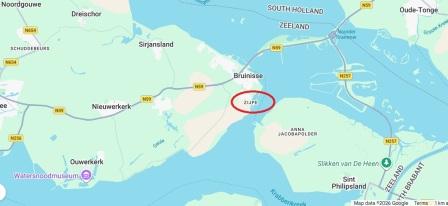
By October 1944, the 4th Canadian (Armoured) Division was in The Netherlands, tasked with clearing the Germans from an area south of the Maas River. When fighting brought the Lake Superior Regiment into the village of Sint Philipsland in the province of Zeeland on November 4, Dutch civilians told troops that there were German naval vessels in the harbour of Zijpe on the island of Schouwen en Duiveland, just across the strait.

The Lake Superior Regiment (Motor) bombed German naval vessels in Zijpe’s harbour.  (Map source: Google Maps)

The next day, with help from the tanks of the British Columbia Regiment, the Regiment bombarded the ships with their 6 pounder antitank guns and mortars. Within 15 minutes the Germans ceased fire. Due to high winds, it wasn’t until a day later that the Regiment’s boarding party later found a corvette burning and 3 other vessels sinking, with 20 fatalities and 80 wounded.

…The Lake Superior Regiment (Motor) advanced into Germany in 1945…

Most of February saw the Regiment based in the ‘s-Hertogenbosch area of The Netherlands as they continued their patrols, but on February 21, 1945, the Regiment began moving towards Germany for the upcoming Operation Blockbuster, which began at dawn on February 26, 1945. (See https://en.wikipedia.org/wiki/Operation_Blockbuster)

By 2:00 am in the early morning of February 23, 1945 the Regiment had arrived at their initial position in the Reichswald Forest, just over the border from The Netherlands.  The next afternoon the Regiment moved to Kleve.

On March 1, 1945, the war diary for the Lake Superior Regiment recorded that instructions had been received for “…the assault on the Hochwald Forest Gap….” This attack was codenamed Operation Churchill.

Clearing the very narrow Hochwald Gap was a difficult task, given that the weather was anything but cooperative. An early thaw meant that the tanks got bogged down in mud, making them ‘sitting ducks’ for German troops who were positioned to pick them off, one by one. Troops had no choice but to press on, as the Battle of Hochwald Gap, part of Operation Blockbuster, was the final push towards the Rhine River.

Miraculously, Samuel survived these difficult battles, and was with the Regiment when it returned to The Netherlands for a short rest, before going again into Germany at the end of March.   The Regiment then fought battles in Meppen, Sögel, and Friesoythe.

The 4th Canadian (Armoured) Division crossed the Twente Canal on April 4, 1945 and reached the Ems River.  However, flooded terrain made it difficult for the tanks to maneuver. On April 17, 1945, the Battle of the Küsten Canal began, with several Regiments involved in trying to capture and cross it.  The Küsten Canal was a 30.5 metre (100 feet) wide obstacle that was a challenge to cross due to the soft ground and German defences.  (See https://www.canadiansoldiers.com/history/battlehonours/northwesteurope/kustencanal.htm)

….Samuel lost his life right after the Battle for the Küsten Canal…

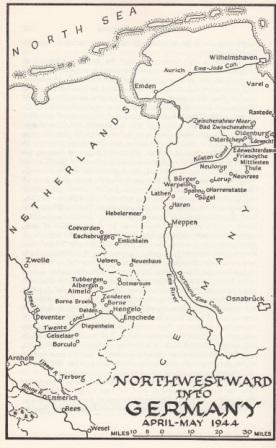
Map showing movement of troops towards Bad Zwischenahn along the Küsten Canal. NOTE: Date on map is incorrect – it should say 1945, not 1944. (Map source: ‘In The Face Of Danger – The History Of The Lake Superior Regiment’)

An account by author Lt-Col George Stanley of ‘In The Face Of Danger – The History Of The Lake Superior Regiment’ told what happened as Allied troops moved beyond the Küsten Canal towards Bad Zwischenahn.  “….Lieutenant-Colonel Keane and several of his officers visited the bridgehead to get a clear idea of the tactical picture; for it was the Lake Sups who were expected to achieve the break out.

With the support of the tanks of the Canadian Grenadier Guards, they were to drive due north astride the road which led from Friesoythe to the little spa on the shores of Zwischenahn lake just ten miles away.

The next day the battalion began to move forward. The road had been badly damaged by gun fire and the holes hastily filled with rubble, thus making it passable for armoured vehicles. The fighting on the perimeter of the bridgehead was, however, very sticky and the Brigade commander decided that, rather than strike hard ahead over the mine strewn, body-littered fields ahead, the Lake Sups should stab eastwards along both sides of the Küsten Canal, in the hope, not only of widening the base of the bridgehead, but also of relieving some of the pressure upon the forward infantry battalions.

Thus it was that “B” Company, as soon as it crossed the Canal, struck immediately to the eastwards in company with a troop of Grenadier tanks and a Wasp flame-thrower. There was a road that ran along the north side of the Canal, but the going here was slow and halting.…

The first streak of daylight on April 23rd was the signal for “A” and “B” Companies to resume their drive eastwards along the Küsten Canal. On both sides the enemy was active …. There was no steady advance; rather the move took the form of a series of short bounds preceded by heavy firing and not inconsiderable battling. There were casualties… One of the Lake Superior flame-throwers was blown high into the air by a mine, both of its crew members being killed….

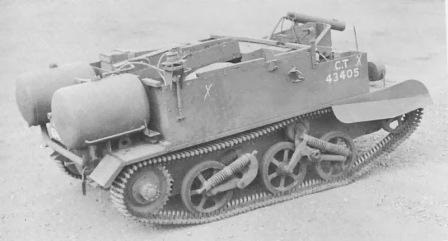
Example of a Wasp flame thrower. (Photo source: http://www.canadiansoldiers.com)

The April 23, 1945 war diary entry for the Lake Superior Regiment verified that Samuel was one of the two crew members who died.  “…At 0700 hours ‘B’ Company prepared to move forward…” of a crater “…to the road junction.  The motor platoons went forward on foot with a Wasp flame thrower in support.  Suddenly the flame thrower struck a mine and both members of the crew were killed, Pte Giving, R.V. and Pte Engen, S.G….”  The other crew member mentioned was Royal Victor GIVING of Kenora, Ontario.

….Samuel is buried in the Canadian War Cemetery in Holten….

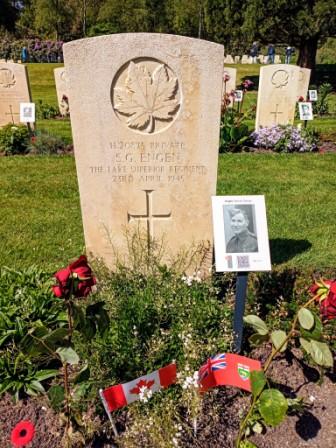
Grave of Samuel Engen with Canadian and Manitoba flags placed by Pieter.  (Photo credit: Pieter Valkenburg)

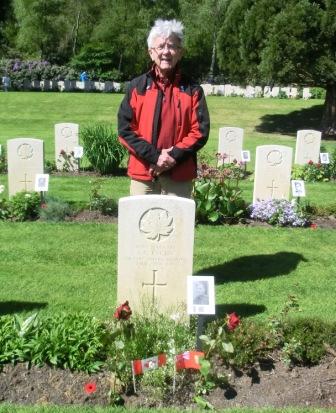
Samuel was temporarily buried in Oldenburg, Germany at the “…right hand side of the road running North near a red brick building…” before being reburied in the Canadian War Cemetery in Holten, The Netherlands on March 23, 1946.  During our 2025 European War Memorial Tour, Pieter placed Canadian and Manitoba flags by his grave.

Pieter at the grave of Samuel Engen after placing Canadian and Manitoba flags. (Photo credit: Daria Valkenburg)

…..Samuel is listed on the National Métis Veterans Memorial Monument….

Samuel is listed on the National Métis Veterans Memorial Monument just outside of Batoche, Saskatchewan.  (See https://www.metismuseum.ca/metisveteransmonument/)

His name can be found on Column 5 on the outside.  Row 40. (See https://www.metismuseum.ca/metisveteransmonument/column.php?v=LWSBNZ)

…..Engen Lake is named in Samuel’s honour….

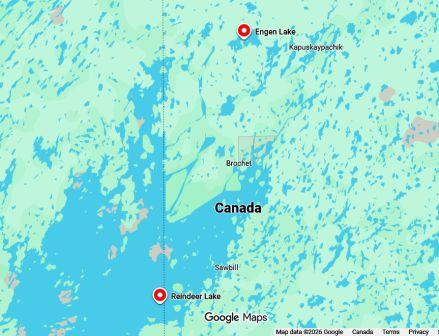
Engen Lake was named in Samuel Engen’s honour in 1961.  (Map source: Google Maps)

Engen Lake in northwestern Manitoba, northeast of Reindeer Lake which straddles the Manitoba-Saskatchewan border, was named after Samuel in 1961.

Devyn Rusk. (Photo courtesy of Devyn Rusk)

Thank you to Ralph McLean, Devyn Rusk, Eric Sanderson, and Wilfred Sanderson for finding and sending a photo.  Thank you to Judie Klassen for family history research.

The flags placed at Samuel’s grave during our 2025 European War Memorial Tour were donated.  Our thanks go to:

  • Alan Waddell, Constituent Assistant, on behalf of Heath MacDonald, MP for Malpeque, for the Canadian flag.
  • Brad Robertson, Chief of Protocol, Government of Manitoba, on behalf of Wab Kinew, Premier of Manitoba, who donated the Manitoba flag.

Pieter’s research efforts to find photos and families of soldiers continue. Do you have a story to tell? Email Pieter at memorialtrail@gmail.com, or comment on the blog.

© Daria Valkenburg

….Want to follow our research?…

If you are reading this posting, but aren’t following our research, you are welcome to do so.  Our blog address: https://onthewarmemorialtrail.com/

4 countries, 6 weeks, 7,000 km – an unforgettable war memorial journey in Europe…. Daria’s book ‘No Soldier Buried Overseas Should Ever Be Forgotten‘ is available in print and e-book formats.  Net proceeds of book sales help support research costs and the cost of maintaining this blog. For more information see https://nosoldierforgotten.com/

Subscribe to our YouTube Channel: On The War Memorial Trail With Pieter Valkenburg: https://www.youtube.com/channel/UCJ591TyjSheOR-Cb_Gs_5Kw.

Never miss a posting!  Subscribe below to have each new story from the war memorial trail delivered to your inbox.
On The War Memorial Trail….The Mystery Of Who Placed Flowers At One Airman’s Grave Was Solved In A Story Spanning Two Continents

April 18, 2026.  When we were in The Netherlands last year on our 2025 European War Memorial Tour, we visited the Canadian War Cemetery in Groesbeek, where Pieter placed 120 flags at the graves of soldiers he’d done research on over the years. (See https://onthewarmemorialtrail.com/2025/06/23/on-the-war-memorial-trail-2025-faces-of-groesbeek-exhibition-part-1-flags-placed-at-120-graves/)

….There was a surprise when we visited the grave of WWII airman Arnold Freeman Hupman…

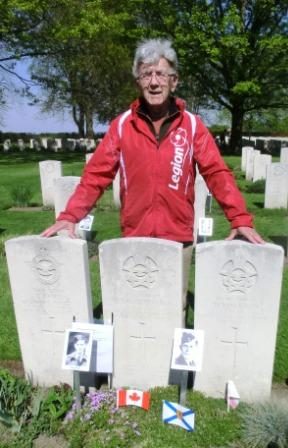
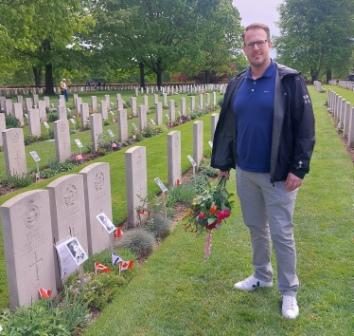
After placing flags of Canada and Nova Scotia, Pieter stands behind the grave of Arnold Freeman Hupman.  (Photo credit: Daria Valkenburg)

One of the graves visited, and where Pieter placed flags of Canada and Nova Scotia, was that of WWII airman Arnold Freeman HUPMAN, of East Side of Ragged Island, Nova Scotia.

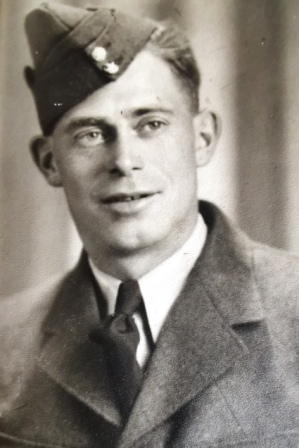
Arnold Freeman Hupman.  (Photo submitted by Marilyn Hupman)

Arnold was serving with 419 Squadron of the Royal Canadian Air Force (RCAF), and lost his lost his life, at the age of 30, when the Lancaster bomber he was in crashed on the outskirts of Arnhem on the night of June 16 to 17, 1944, after being shot down by a German nightfighter. (You can read his story at https://onthewarmemorialtrail.com/2021/02/09/on-the-war-memorial-trail-atlantic-canada-remembers-part-6/)

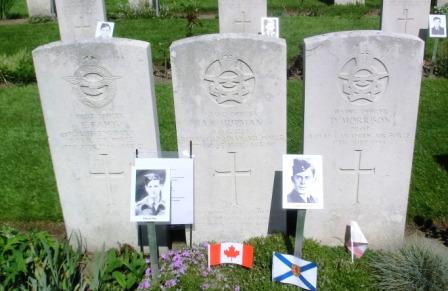
Arnold Hupman’s grave is between two of his crewmates: Donald Morissen and Edward Fahy. (Photo credit: Daria Valkenburg)

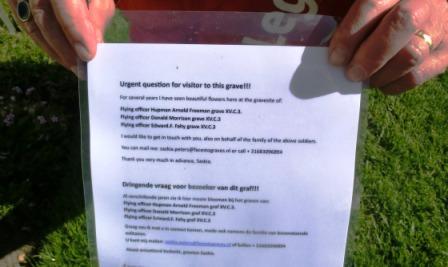
There was a surprise at his grave as we found a note from Saskia Peters, a member of the Faces To Graves Groesbeek Foundation Board, asking if whoever had been annually placing flowers at the grave to get in contact with her.   

Note left by Saskia Peters beside the graves of Hupman, Morissen, and Fahy.  (Photo credit: Daria Valkenburg)

 ….The last flight of Lancaster X KB728

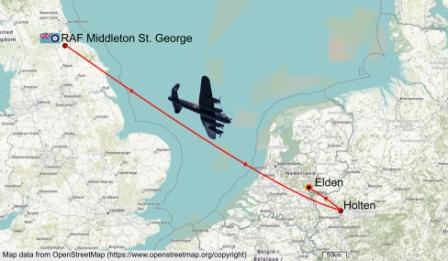
Map shows the plane’s path from Middleton St. George to Holten, Germany and then to where it crashed in Elden, The Netherlands.  (Map prepared by Wendy Nattress)

On the night of June 16, 1944, at 11:08 pm, Lancaster X KB728 took off from RAF Middleton St. George, England for a bombing operation against the synthetic oil plant at Sterkrade/Holten in Germany.  

On its return back to England in the early hours of June 17, 1944, the plane was attacked by a nightfighter and exploded following combat with nightfighter pilot Hans Schadowski of the 3./NJG 3 based at Vechta airfield in Germany, who was flying a Messerschmitt Bf 110 G-4.

The Lancaster crashed close to the Dutch Reformed Church at Elden in the province of Gelderland, 4 km (2.5 miles) southwest of Arnhem.

All seven crew members lost their lives. In addition to Flying Officer Arnold Hupman, the navigator on that flight, the other crew members were:

  • Pilot : RCAF Pilot Officer Donald MORISSEN of Winnipeg, Manitoba
  • Bomb Aimer: RCAF Pilot Officer Gerald Edgar QUINN of Montreal, Quebec
  • Wireless Operator/Air Gunner: RAF Pilot Officer Harold FLETCHER of Bolton, Lancashire, England
  • Air Gunner: RCAF Pilot Officer Clifford JOHNSTON of North Bay, Ontario
  • Air Gunner: RAF Pilot Officer Philip Joseph MCMANUS of Herne Hill, London, England
  • Flight Engineer: RAF Pilot Officer Edward FAHY of Rhyl, Flintshire, Wales

They were temporarily buried in the Netherlands Reformed Church Cemetery in Huissensedijk on June 29, and later reburied in the Canadian War Cemetery in Groesbeek.  (More information can be found in this English translation of an article by the late Willem Tiemans: https://airbornearnhem.nl/WillemTiemens/Elden%20bomber%20crash.htm)

….The mystery of who placed the flowers was solved by Saskia…

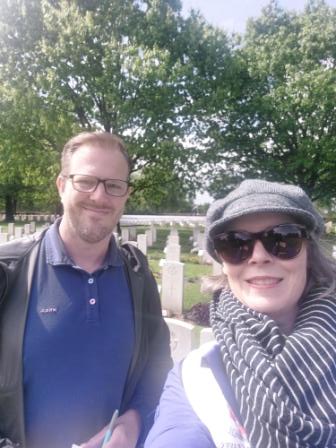
Almost a month later, we met Saskia when we were honoured by the Faces To Graves Groesbeek Foundation at one of their meetings, and asked if she had received any response. (See https://onthewarmemorialtrail.com/2025/05/30/on-the-war-memorial-trail-pieter-and-daria-honoured-by-faces-to-graves-groesbeek-foundation/)

…Yes!…” she replied and said she would follow up with a few photos and emails, which she did.  “….As I told you at our Research meeting, I have indeed found the person on May 4, who put the flowers at Arnold Hupman’s place for the past few years….

She said she’d placed the sign at Arnold’s grave in mid-April. “…I had also asked the gardeners for permission and they were eager to help me keep an eye out if they saw anyone walking by his grave….

To Saskia’s disappointment, however, “….before we had the opening ceremony of The Faces of Groesbeek, there were still no flowers….”  We attended the Opening Ceremony on May 2, 2025 and Saskia was correct – the sign was still there, but no flowers.  (For our story on the Opening Ceremony, see  https://onthewarmemorialtrail.com/2025/07/19/on-the-war-memorial-trailwe-attended-the-ceremony-at-the-canadian-war-cemetery-in-groesbeek/)

 Then, on May 4, 2025, “….it was our National Remembrance Day.   I wasn’t on duty to host The Faces of Groesbeek, but I saw that no one was scheduled so I went anyway. Around noon, my colleagues came to ‘relieve me’ as they were scheduled for the afternoon....” 

Saskia should have gone home to rest at this point as she was scheduled to lay a wreath at the cemetery that evening with Alice van Bekkum, Chair of the Faces To Graves Groesbeek Foundation.  “…. But my heart said, ‘Go to Hupman’s grave one more time and ask for his help’….

Saskia explained that as she “… walked back across the wide grassy area in the middle that runs from the Stone of Remembrance to the Sacrificial Cross.” she noticed “…a man walking into the cemetery with a bouquet of flowers in his hands….

After asking if the man had come to visit a particular grave, he said yes, but couldn’t remember where it was located, but explained that the grave was  “…. different from the others, the stones are closer together….” 

Saskia immediately knew he was looking for Arnold Hupman’s grave from this description.  The headstones of 3 graves were closer together than with other graves as, according to the crash reports, only 5 bodies were ever found – not the 7 that were known to be in the plane. It was surmised that the remains of 2 had burned beyond recognition in the crash.

….Tears sprang to my eyes ….  Saskia wrote.  “… I tell him that I think he is looking for the grave of the flying officer I stood by about a minute ago before, asking for help to find the person who has been putting flowers at his grave for years.  We walk together up the side to Hupman’s grave, the man enthusiastically confirming that this is indeed the grave he was looking for…..

Frans Nijsen with Saskia Peters.  (Photo courtesy of Saskia Peters)

The mystery was solved! The man who had brought the brought the bouquet was Frans Nijsen, a resident of Berg en Dal, which is very close to the cemetery. 

Frans Nijsen beside the grave of Arnold Hupman. The flags of Canada and Nova Scotia had been placed several days earlier by Pieter. (Photo courtesy of Saskia Peters)

….The story of why the flowers were placed spanned two continents…

We were curious to know why a Dutch guy chose Arnold Hupman’s grave to place an annual bouquet. Perhaps Frans had been in the Royal Netherlands Air Force, as Pieter had been?  We wrote to him and asked. To our surprise, the answer circled back to a neighbouring Maritime province, not that far from where we live.

….I work with a company called QPS, in the Netherlands and we have a Canadian office in Fredericton, New Brunswick…..”  Frans wrote.  “…. I’m a hydrographer, and I work for a software company that produces software to map the seabed and to produce maritime charts.  

I used to have a colleague, Graham Nickerson, who lives in Freddy. At some point he came over to our office in the Netherlands for training in our software, and when the weekend was almost there, I asked him what his plans were. He told me that he has a relative who was killed in action, shot down over Arnhem and that he was visiting his grave in Oosterbeek…. I learned that the cemetery in Oosterbeek is a British one and that there is a Canadian cemetery close to where I live now. I started looking on internet and found his grave at the cemetery in Groesbeek, which is 5 minutes from my home town, Berg en Dal.  

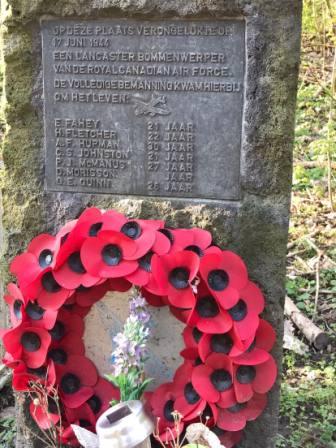
I invited him to come over, so I could bring him to the cemetery. In the meantime I did some more digging around and found that there is a small monument at the crash site….

Memorial plaque for the crew of Lancaster X KB728 in Elden, The Netherlands. (Photo source: Facebook RAF Bomber Command Memorials, photo taken by Chris de Vries)

…So, he came over, we visited the cemetery, which meant a lot to him, it was emotional for him to not have his relative buried close to home, but he was very happy how the cemetery…” cared for the graves.  “...After that I told him about the monument of the crash site and that I’m going to take him there. He was very surprised and interested in it…. He was very glad that the sacrifice was not unnoticed….” 

…Since his visit I made it my personal goal to visit this grave every year around the 4th of May to bring flowers. I have two young kids that I bring with me as well, and we try to explain what happened and why it’s important to honour the men and women who are buried at the cemetery. Every year I send a picture to Graham with fresh flowers at the grave…..This year I was there as well, and I bumped into Saskia. The rest is history….” 

Quite a story, in which serendipity certainly played a big part! As we near the 81st Anniversary of the Liberation of Europe, it’s a poignant reminder that those who gave their lives in war should never be forgotten.

Thank you to Saskia Peters and Frans Nijsen for unlocking the mystery behind the note, and for sharing the story about the flowers placed each May at the grave of Arnold Freeman Hupman.  Thank you to Wendy Nattress, who prepared the map showing the flight path for Lancaster X KB728.

Pieter’s research efforts to find photos and families of soldiers continue. Do you have a story to tell? Email Pieter at memorialtrail@gmail.com, or comment on the blog.    

© Daria Valkenburg

….Want to follow our research?…

If you are reading this posting, but aren’t following our research, you are welcome to do so.  Our blog address: https://onthewarmemorialtrail.com/

4 countries, 6 weeks, 7,000 km – an unforgettable war memorial journey in Europe…. Daria’s book ‘No Soldier Buried Overseas Should Ever Be Forgotten‘ is available in print and e-book formats.  Net proceeds of book sales help support research costs and the cost of maintaining this blog. For more information see https://nosoldierforgotten.com/

Subscribe to our YouTube Channel: On The War Memorial Trail With Pieter Valkenburg: https://www.youtube.com/channel/UCJ591TyjSheOR-Cb_Gs_5Kw

Never miss a posting!  Subscribe below to have each new story from the war memorial trail delivered to your inbox.
On The War Memorial Trail….The Spitfire Pilot Killed In A Training Accident During The Last Flight Of Spitfire L1083

April 13, 2026.  We are always grateful to hear about those who served, so when Annie Lee MacDonald told us about a distant relative who served in the RCAF during WWII, and lost his life, we took a look at what happened.  “Boyce McKie is a relative of mine that Helen MacEwen found in her research….” she explained.  It was determined that he was related to Annie Lee on her father’s maternal side.  (See https://onthewarmemorialtrail.com/2020/07/03/the-ww1-era-course-of-the-rhine-map-of-germany/ for a story about a WWI era Course of the Rhine map that Helen’s father-in-law had saved.)

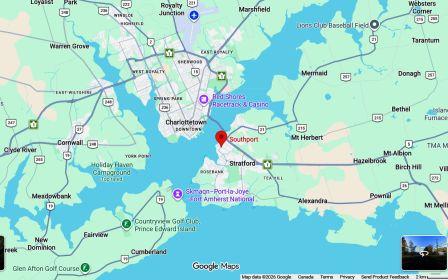
Southport is now part of Stratford, Prince Edward Island. (Map source: Google maps)

Born November 3, 1922 in Southport (now part of Stratford), Queens County, Prince Edward Island, Allison ‘Boyce’ (Buddy) MCKIE was the son of Boyce and Emma (nee McLeod) McKie. When he enlisted with the Royal Canadian Air Force (RCAF) on August 1, 1940, aged 18, he stated that he was interested in pilot training, had been in high school at Prince of Wales College in Charlottetown, and noted that his father was deceased. One of the questions asked if he played sports – a question designed to see if he could be a team player – and he answered yes and listed hockey, baseball, softball, and soccer.

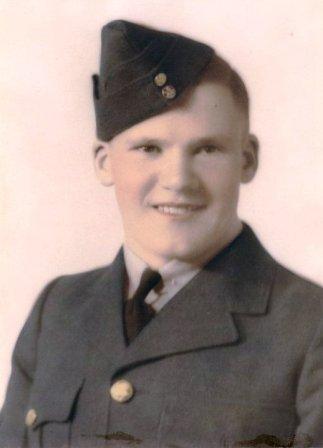
Allison ‘Boyce’ McKie. (Photo source: Canadian Virtual War Memorial)

On November 10, 1940, Boyce was sent to No. 1 Manning Depot in Toronto, Ontario for his basic training.  This facility was located in the Coliseum Building on the Canadian National Exhibition grounds, part of the British Commonwealth Air Training Plan (BCATP) in Canada. The BCATP was a major program for training Allied air crews during World War II that was administered by the Government of Canada, and commanded by the Royal Canadian Air Force with the assistance of a board of representatives from the United Kingdom, Australia, New Zealand and Canada.

Manning Depots were reception and training centres for new RCAF recruits, serving as the initial entry point for the British Commonwealth Air Training Plan (BCATP). Recruits received uniforms, 4–5 weeks of basic military training, drills, and aptitude testing. Upon completion, trainees were designated as ‘aircraftsmen 2’ and moved on to further specialized training schools.

On November 28, 1940, an interviewer for the RCAF described Boyce as quick, accurate, pleasant, and confident, and recorded that he had completed Grade 11.  In a question about any experience or training that would be useful in the RCAF, the interviewer noted that Boyce …was very keen…” and “…had done a considerable amount of target shooting and was a member of Dominship team for Keppoch Club.  Has done a great deal of duck and partridge shooting…

….Boyce trained as a pilot …

On January 8, 1941, Boyce was sent to No. 20 Elementary Flying Training School (EFTS) in Oshawa, Ontario for 50 hours of basic flying instruction, over 8 weeks, on the De Havilland Tiger Moth and Fairchild Cornell, two simple training planes. 

Having successfully passed his training to date, and now a candidate for pilot training, on March 24, 1941, Boyce was sent to No. 3 Initial Training School (ITS), at Sacred Heart College in Victoriaville, Quebec, for a 4 week course of studies and a variety of tests. His course would include studies in navigation, flight theory, meteorology, duties of an officer, air force administration, algebra, and trigonometry. Tests included a psychiatric interview, a physical examination, a session in a decompression chamber, and a simulated ‘test flight’.

On April 21, 1941, now deemed a Leading Aircraft Man (LAC), Boyce was sent to No. 11 Elementary Flying Training School (EFTS) in Cap-de-la-Madeleine, Quebec for additional basic flying instruction, on the Fleet Finch and Fairchild Cornell. 

The next step in Boyce’s training was at No. 6 Service Flying Training School (SFTS) in Dunnville, Ontario on June 10, 1941, where he would have been placed first in an intermediate training squadron, then in an advanced training squadron, and training at a Bombing & Gunnery School.  He earned his pilot flying badge on August 20, 1941, and a promotion to Flight Sgt. 

….Boyce left Canada for overseas service …

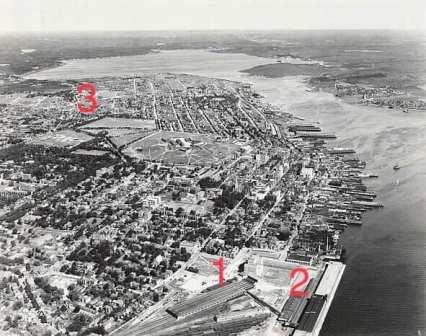
Aerial view of Halifax showing the location of the Canadian National Railroad Station (red # 1) , Pier 21 Ocean Terminals (red # 2) and No. 1 “Y” Embarkation Depot (red # 3). Halifax Harbour is foreground and right with the Bedford Basin in background. (Source: Library and Archives Canada Collections website)

A few days later, on August 22, 1941, he was transferred to No. 1 ‘Y’ Depot in Halifax, Nova Scotia, an embarkation depot for Air Force personnel soon heading overseas.  (See https://rcaf.info/rcaf-stations/nova-scotia-rcaf-stations/rcaf-station-halifax/)

Before reporting to No. 1 ‘Y’ Depot, Boyce had been granted embarkation leave from August 21, 1941 until September 1, 1941, in what turned out to be the last time he would see his family again. 

A few weeks later, on September 14, 1941, Boyce was placed in the Royal Air Force (RAF) Trainee Pool and arrived at No. 3 Personnel Reception Centre (PRC) in Bournemouth, England on October 15, 1941. This was the arrival point for thousands of Commonwealth aircrew after training in Canada.   (See https://www.birtwistlewiki.com.au/wiki/No._3_Personnel_Reception_Centre_RAF)

….Boyce was assigned to No. 58 OTU …

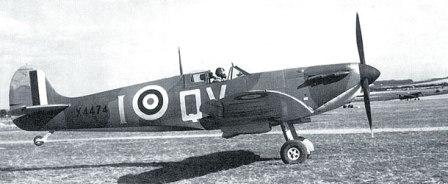
On October 27, 1941, Boyce was assigned to No. 58 Operational Training Unit (OTU) in Grangemouth, Scotland, for training on Spitfire Mk.1s.

Spitfire Mk.1 (Photo source: Wikipedia)

An OTU was the last stage of training for aircrew before being assigned to an operational unit for active operations.  Loss rates in training were high due to inexperience, crowded airspace, often poor weather, and even enemy aircraft operating over the United Kingdom. 

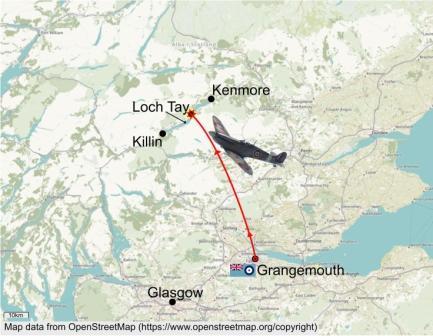
Map shows the plane’s path from Grangemouth to where it crashed near Kenmore by Loch Tay. (Map prepared by Wendy Nattress)

On November 11, 1941, just a week after his 19th birthday, Boyce was one of the training casualties when Spitfire L1083, in which he was the pilot and sole occupant in the plane, was lost in low clouds during a formation exercise flight and went missing around 12:30 pm. 

It wasn’t until December 12, 1941 that the crash site was found. The Spitfire had crashed into high ground near Kenmore by Loch Tay in Scotland, and Boyce had died of “…multiple severe injuries….

….Boyce is buried in Grangemouth (Grandsable) Cemetery …

Boyce was buried on December 19, 1941 in Grangemouth (Grandsable) Cemetery, located south of the town of Grangemouth in Stirlingshire, Scotland. He’s one of 92 casualties from WWI and WWII buried there.

Grave of Allison ‘Boyce’ McKie in Grangemouth (Grandsable) Cemetery in Scotland. (Photo source:  Canadian Virtual War Memorial)

….Boyce is commemorated on a memorial wall at the former RAF Grangemouth…

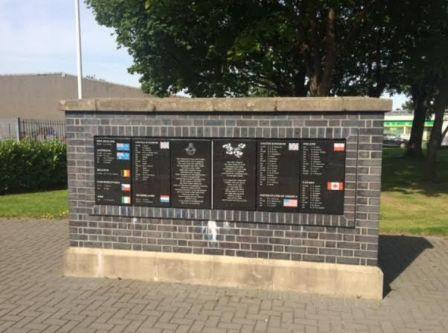
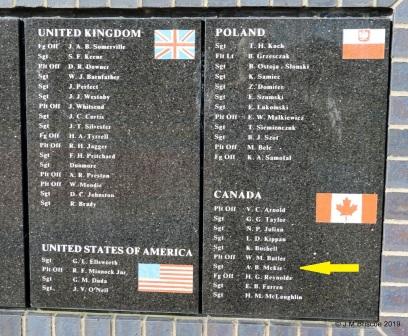
In 2008, a memorial wall was placed at the former RAF Grangemouth site to “…commemorate the trainee Spitfire pilots who had come to RAF Grangemouth from not only Great Britain but also Poland, Czechoslovakia, Holland, Belgium, Canada, the USA, Australia, New Zealand, Ireland, and India, to learn to fly the Spitfire fighter aircraft during the Second World War, and who died at the airfield while serving with 58 Operational Training Unit….

RAF Grangemouth and 58 Operational Training Unit Memorial.  (Photo source: https://vintageaviationnews.com image by Urban Ghosts)

RAF Grangemouth and 58 Operational Training Unit Memorial.  Boyce identified by yellow arrow.  (Photo source: J. M. Briscoe found on Flickr)

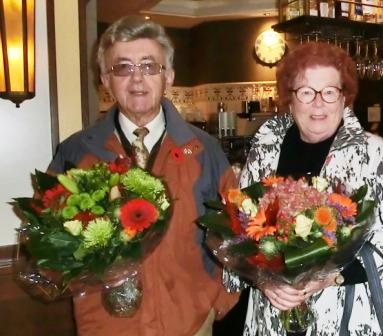
Pieter and Annie Lee MacDonald on their way to a memorial service in The Netherlands.  (Photo credit: Daria Valkenburg)

Thank you to Annie Lee MacDonald for letting us know about Allison ‘Boyce’ McKie.  Thank you to Wendy Nattress, who prepared the map showing the flight path for Spitfire L1083.

Pieter’s research efforts to find photos and families of soldiers continue. Do you have a story to tell? Email Pieter at memorialtrail@gmail.com, or comment on the blog.    

© Daria Valkenburg

….Want to follow our research?…

If you are reading this posting, but aren’t following our research, you are welcome to do so.  Our blog address: https://onthewarmemorialtrail.com/

4 countries, 6 weeks, 7,000 km – an unforgettable war memorial journey in Europe…. Daria’s book ‘No Soldier Buried Overseas Should Ever Be Forgotten‘ is available in print and e-book formats.  Net proceeds of book sales help support research costs and the cost of maintaining this blog. For more information see https://nosoldierforgotten.com/

Subscribe to our YouTube Channel: On The War Memorial Trail With Pieter Valkenburg: https://www.youtube.com/channel/UCJ591TyjSheOR-Cb_Gs_5Kw

Never miss a posting!  Subscribe below to have each new story from the war memorial trail delivered to your inbox.
On The War Memorial Panel…A Memorial Panel Honours The Crew On The Last Flight Of Halifax DT630

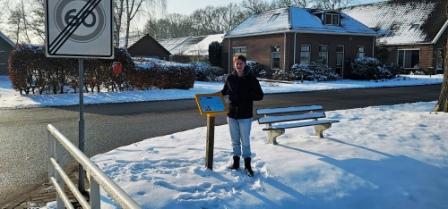
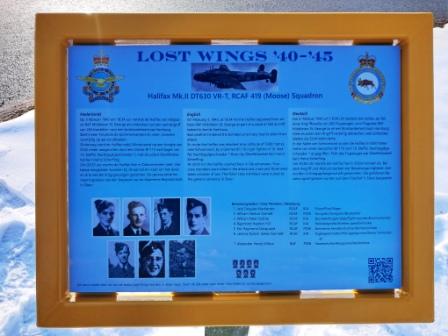
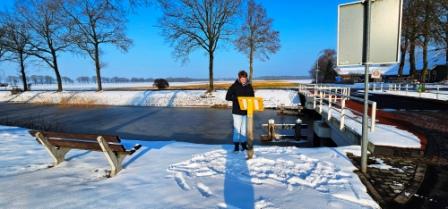
Yannic Wethly by the Halifax DT630 panel in Odoornerveen. (Photo courtesy of Yannic Wethly – Stichting Luchtoorlog Onderzoek Drenthe)

March 18, 2026. Occasionally, one story takes us in unexpected directions.  In February 2023, we posted on this blog the story about Jack ‘Douglas’ MACKENZIE, of Winnipeg, Manitoba, the pilot of Halifax DT630 that was shot down by a night fighter over the province of Drenthe in The Netherlands on February 3, 1943. (See https://onthewarmemorialtrail.com/2023/02/19/on-the-war-memorial-trail-the-wwii-pilot-killed-at-the-controls-of-his-halifax-bomber/)

A few months later, we were contacted by Yannic Wethly, one of the volunteers with Stichting Luchtoorlog Onderzoek Drenthe (Air Research Drenthe Foundation) in The Netherlands. This non-profit organization researches WWII air crashes in the province and places information panels near the crash sites.

Yannic asked for help in finding a photo and family of a crew member, Eric ‘Raymond’ MARQUAND, the bomb aimer on that flight, who was also from Winnipeg.  Raymond survived the crash and spent the remaining war years in prisoner of war camps before being liberated.  We were very happy when his niece, Jamie Nelson-Dixon, got in contact and provided a photo. (Raymond’s story is coming up in a future posting.)

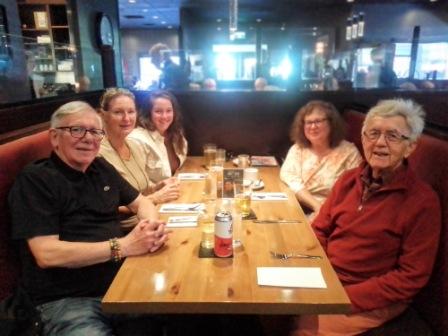
Jamie Nelson-Dixon, Craig MacKenzie, and Daria had a chance to meet in Winnipeg. (Photo courtesy of Valkenburg Family)

In May 2024, when we were in Winnipeg, we met Craig MacKenzie, nephew of Douglas, and his wife Sue, plus Jamie and her husband Don.  (See https://onthewarmemorialtrail.com/2024/11/10/on-the-war-memorial-trail-remembrance-week-2024-reflections-and-updates/)

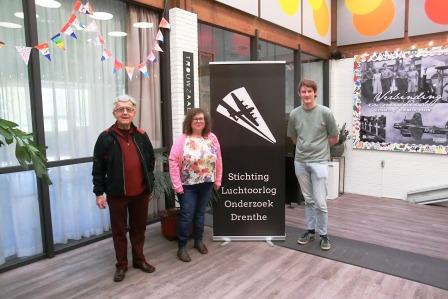
Pieter and Daria with Yannic Wethly of the Air Research Drenthe Foundation.  (Photo courtesy of Valkenburg Family)

And in April 2025, when we were in The Netherlands, we had a chance to meet Yannic.  (See https://onthewarmemorialtrail.com/2025/06/15/on-the-war-memorial-trail-a-visit-to-sleen-general-cemetery/)

On January 30, 2026, Yannic sent photos of an updated memorial panel for Halifax DT630, which now includes photos of all 7 crew members, who wrote us saying “….Thank you for your efforts. They played a key part in getting to this moment, where now all seven crew members have their faces back….

….The last flight of Halifax DT630…

Halifax Mark 3 bomber.  Photo source: http://www.raf.mod.uk Public Domain, https://commons.wikimedia.org/w/index.php?curid=751869)

On February 3, 1943, Douglas was the pilot of Halifax DT630 (call sign VR-T), one of 8 heavy Halifax bombers sent on a night raid to Hamburg, Germany.  They took off at 6:34 pm from the airbase at Middleton St. George, England. (See https://aviation-safety.net/wikibase/52181)

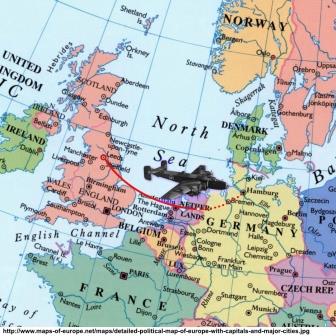
Map showing the plane’s path from England towards Hamburg, but being shot down over The Netherlands.  (Map prepared by Wendy Nattress)

According to the Aviation Safety Network Wikibase report on Occurrence # 52181, the Halifax bomber was shot down by night fighter pilot Oberfeldwebel (Senior Staff Sgt) Karl-Heinz Scherfling of the 10./NJG 1, flying a Bf 110 F-4 from Leeuwarden airfield, in the province of Friesland in The Netherlands.  At 8:55 pm it crashed in Odoornerveen.  (Scherfling died when his plane was shot down in July 1944 near Mol, Belgium by a Mosquito night fighter of No. 169 Squadron. See https://military-history.fandom.com/wiki/Karl-Heinz_Scherfling)

….The crew of Halifax DT630….

4 crew members lost their lives and are buried in Sleen General Cemetery in The Netherlands.  The other 3 crew members spent the remainder of WWII in POW camps before returning home.

  • Pilot P/O Jack ‘Douglas’ MACKENZIE of Winnipeg, Manitoba, RCAF, killed
  • Flight Engineer Sgt. William Peter DUTHIE of Winnipeg, Manitoba, RCAF, killed
  • Navigator Sgt. William Nelson GARNETT, RCAF, survived
  • Bomb Aimer Sgt. Eric ‘Raymond’ MARQUAND, RCAF, survived
  • Air Gunner W/O II Raymond Hepton HILL of Montreal, Quebec, RCAF, killed
  • Rear Air Gunner F/Sgt. Alexander Henry MILTON, RAF, survived
  • Air Gunner W/O II Lennox Alwin GONNETT of Westmount, Quebec, RCAF, killed

….The memorial panel honouring the crew of Halifax DT630…

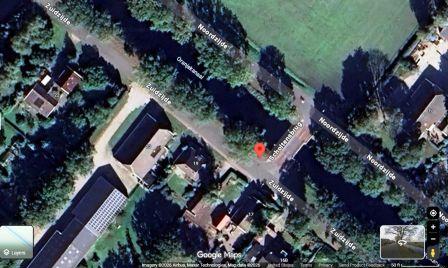
On January 30, 2026, a few days before the 83rd anniversary of the crash on February 3, 1943, Yannic wrote that “we updated the information panel for Halifax DT630 today. The panel stands near the Scholtensbrug on Zuidzijde, Odoornerveen.” (See https://www.facebook.com/slodrenthe/posts/pfbid0a7d47BcHoD5scBZERjEctYj2mmWbuvgrotFqLzG8USnReGYxbVN83wzoATAuTkLil)

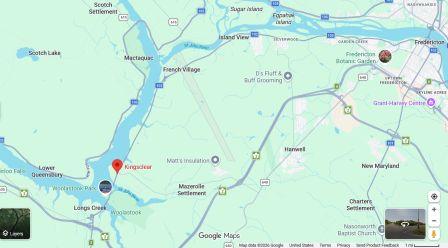
Location of the panel stands near the Scholtensbrug on Zuidzijde in Odoornerveen. (Map source: Google maps)

When we saw the photos, we were astonished to see snow!  It could have been Canada, not The Netherlands!  “Quite exceptional times here….” he explained. “…We had sleet and 10-15cm of snow. Then it all disappeared and now, a week later, it’s back!…

The Halifax DT630 panel summarizes what happened on the night of the crash, and includes photos of all 7 crew members. The 4 who died are shown above the 3 that survived. (Photo courtesy of Yannic Wethly – Stichting Luchtoorlog Onderzoek Drenthe)

The panel is located along a canal, next to the Scholtens bridge, in Odoornerveen, in a residential area. 

Yannic Wethly by the Halifax DT630 panel in Odoornerveen. (Photo courtesy of Yannic Wethly – Stichting Luchtoorlog Onderzoek Drenthe)

….Excerpt from the Foundation’s report on Halifax DT630….

Yannic shared information on the Air Research Drenthe Foundation’s report on Halifax DT630, an excerpt of which is below.  (See https://www.slodrenthe.nl/halifax-mk-ii-dt630-vr-t/ for more information, which is available in Dutch, English, French, or German.)

On February 3, 1943, Halifax DT630 VR-T, “T for Tommy,” of RCAF 419 (Moose) Squadron, departed RAF Middleton St. George at 6:34 p.m. as part of a raid wave of 263 aircraft. The target of this attack was Hamburg. On the outward journey, the bombers were hampered by bad weather, forcing many of them to abort the raid prematurely.

The crew of Halifax DT630 VR-T was five minutes late crossing the Channel on the night of this bombing raid on Hamburg. This delay caused pilot Jack D. MacKenzie to pitch the nose down slightly, increasing speed. The fact that Halifax DT630 VR-T was late and therefore flying behind the formation wasn’t the pilot’s only problem: contact with the tail gunner, Alexander H. Milton, had been lost. The entire intercom system had stopped working. Jack D. MacKenzie had to choose between turning back or continuing on and hoping the intercom would work again soon.

About 25 minutes out from the target, Halifax DT630 VR-T was attacked from behind and below by what they thought was an Fw 190. Only bomb aimer Eric R. Marquand noted in his report that he believed it was a Bf 110.

In reality, Halifax DT630 VR-T was indeed attacked by a Messerschmitt Bf 110. It was a German Bf 110G-4 night fighter of the 10th Staffel, Nachtjagdgeschwader 1, with pilot Oberfeldwebel Karl-Heinz Scherfling on board. He attacked the Halifax and its crew over Schoonoord at an altitude of 5,300 metres.

Tail gunner Alexander H. Milton later testified that an evasive maneuver, a so-called “corkscrew,” had been executed. Somehow, this command from Alexander H. Milton to pilot Jack D. MacKenzie got through, and Jack D. MacKenzie executed the maneuver.

The evasive maneuver was to no avail: the entire fuselage of the aircraft was pierced by the German night fighter’s cannon fire. Jack D. MacKenzie and probably also Lennox A.J. Gonnett, the dorsal turret gunner, were fatally wounded. The cannon fire also ignited the incendiary bombs on board, burning the vital cables and lines leading to the engines and controls.

Flight engineer William P. Duthie attempted to extinguish the fire but was unsuccessful due to the flammable and difficult-to-extinguish nature of the incendiary bombs. Navigator William N. Garnett later reported that he gave the order to abandon the aircraft following a previously arranged sequence of flashes. This implies that the intercom system was still inoperable.

Eric R. Marquand, the bombardier, was the first of the crew to abandon the aircraft. He was followed by William N. Garnett, who was checking on the condition of the rest of the crew. He saw that radio operator Raymond H. Hill was still in his position, as was William P. Duthie. Both, however, were preparing to abandon the out-of-control aircraft. At this point, the German fighter returned and attacked the falling Halifax once more.

Eric R. Marquand was hit in the ear area as he prepared to bail out. Alexander H. Milton continued to fire at the German fighter to drive it off, allowing the other crew members to bail out. He continued firing until he fell from his turret in the dark night. It is unknown what happened to the radio operator and flight engineer or why they did not bail out. The second attack by the German fighter may have prevented them from bailing out.

At 8:55 p.m., Halifax DT630 VR-T crashed in Odoornerveen. Only Eric R. Marquand, William N. Garnett, and Alexander H. Milton managed to evacuate the aircraft. All three were quickly taken prisoner of war and interned at Stalag VIIIB (Lamsdorf). The four remaining crew members perished in the crash….

Thank you to Yannic Wethly for sending photos of the new memorial panel, and to Wendy Nattress for preparing the map showing the flight path for Halifax DT630.  And thank you to Craig MacKenzie and Jamie Nelson-Dixon for providing photos of Douglas MacKenzie and Raymond Marquand.  Thank you also to Judie Klassen for doing the research that led to finding Jamie Nelson-Dixon.

Pieter’s research efforts to find photos and families of soldiers continue, doing his part to ensure that each individual soldier is remembered. If you have photos or information to share about soldiers buried in The Netherlands or Belgium, please email him at memorialtrail@gmail.com, or comment on the blog.    

© Daria Valkenburg

….Want to follow our research?…

If you are reading this posting, but aren’t following our research, you are welcome to do so.  Our blog address: https://onthewarmemorialtrail.com/

4 countries, 6 weeks, 7,000 km – an unforgettable war memorial journey in Europe…. Daria’s book ‘No Soldier Buried Overseas Should Ever Be Forgotten‘ is available in print and e-book formats.  Net proceeds of book sales help support research costs and the cost of maintaining this blog. For more information see https://nosoldierforgotten.com/

Subscribe to our YouTube Channel: On The War Memorial Trail With Pieter Valkenburg: https://www.youtube.com/channel/UCJ591TyjSheOR-Cb_Gs_5Kw

Never miss a posting!  Subscribe below to have each new story from the war memorial trail delivered to your inbox.
On The War Memorial Trail…. The WWII Soldier From Kingsclear Who Lost His Life During Operation Suitcase

Pieter and Daria (right) with Larry Stewart, Uta Stewart, and Manuelle Bibeau.  (Photo courtesy of Valkenburg Family)

March 8, 2026. Sometimes we learn about a soldier in the most unexpected ways.  A few months ago I was at dinner with two audiologists who would be giving an information session on cochlear implants, part of the outreach we do at Hear PEI. Pieter came along with me for dinner, and Larry Stewart came with his wife, audiologist Uta Stewart.  The two men got along like a house on fire, and when Larry mentioned that his friend, psychotherapist Robert Leek, had an uncle who is buried in the Canadian War Cemetery in Bergen Op Zoom, the discussion turned serious about the sacrifices of so many families during WWII.

Kingsclear is near Fredericton, New Brunswick.  (Map source: Google maps)

Larry emailed Robert while we were at the restaurant, and within minutes we saw a photo of his uncle, Albert John LEEK, who was born on April 21, 1925 in Kingsclear, New Brunswick, the son of WWI and WWII veteran Earle McCarthy Leek and his wife Mary Gertrude (nee Howe).   

Albert John Leek.  (Photo source: Identification card in the service file)

Robert said that his 90 year old aunt, Albert’s youngest sister Gertrude, lives in Fredericton, and that Albert’s father Earle served in both WWI and WWII.  Albert was the oldest in the family, with 3 brothers and 4 sisters.  “…My father Mauncell, who served in the RCAF, was the next oldest boy…

Albert’s parents Earle and Mary Gertrude (nee Howe) Leek.  (Photo courtesy of Robert Leek)

 …The Leeks were Loyalists who came to Canada, most likely from the Carolinas…” after the American War of Independence, Robert explained. “…Most of my relatives live in Bangor, Maine, and my father was born there…” He thought that Albert’s mother had “…Indigenous roots through the Maliseet…” (Maliseet are now referred to as the Wolastoqey Nation.) 

Albert’s father “…re-enlisted during WWII at the same time as Albert so he could protect his son, but they ended up in different units…

….Albert first enlisted in December 1940…

Albert John Leek during his first enlistment.  (Photo source: Canadian Virtual War Memorial)

When he enlisted at the No. 7 District Depot in Fredericton, New Brunswick on April 22, 1942, Albert stated he had been born in 1924 (a year earlier than his actual birth year) and had worked as a carpenter for the Department of National Defence.

This was his second time enlisting at the No. 7 District Depot.  He had first enlisted on December 30, 1940, at the age of 15.  After completing his basic training and a 3 month Motor Mechanics Course in Kingston, Ontario, he had finished taking advanced army training when his mother found his name on an overseas draft listing….and notified the authorities that he was underage.  Albert’s initial military career ended when he was discharged on September 8, 1941 due to being underage. 

Albert was tall, at 6 feet 1 inch, so it wasn’t a surprise that he had been able to pass as older.  When his nephew Robert was asked why his uncle would have enlisted so young, he explained that his uncle “…was desperate to leave his home situation and make something of himself…

….Albert was sent for artillery training…

When he enlisted for the second time, Albert stated that he had worked on his parents’ farm after leaving school, and listed his interests as boxing, skating, ice hockey, and softball.

On May 16, 1942, he was sent to No. 70 Canadian Army Basic Training Centre (CABTC) in Fredericton, where he had to undergo basic training again.  After completing this training, he was transferred to the X-A-1 Canadian Artillery Training Centre (CATC) in Petawawa, Ontario.  This was a major training facility for the Royal Canadian Artillery (RCA), where artillery soldiers were trained in gunnery, routines, and military customs.  

A subsequent interview while in Petawawa recommended that he be trained as a Driver i/c but that never happened. (The term ‘Driver i/c’ refers to ‘Driver, internal combustion’.)  Instead, Albert was promoted to Lance Bombardier on May 1, 1943 and received final training in preparation for overseas service.

….Albert left Canada for overseas service ….

On July 24, 1943, Albert left Canada, arriving in the United Kingdom on July 28, 1943, where he was placed with No. 2 Canadian Artillery Reinforcement Unit (CARU).

In an interview with a Captain McCormick on August 9, 1943, he was described as “…a tall, husky, active lad…” with “…pleasant features and a pleasant personality…” The interviewer quoted Albert as saying that he “…used to pick up some extra money boxing in civilian life…” and that he had expressed a wish to “…transfer to the Black Watch Regiment to join a younger adopted brother of his father whom he practically grew up with…” 

Albert stated that he “…likes Infantry Service…” and the interviewer thought that he “…should make a good commando…”  

Training continued. On October 14, 1943, Albert reverted to the rank of Gunner at his own request.  As part of his ongoing training, he was sent to an Army Physical Training Corps (APTC) course from December 3, 1943 until December 24, 1943. Training would have been focused on fitness for specific purposes, and would have included unarmed hand-to-hand combat, bayonet fighting, and specialized assault courses, strength exercises using ammunition boxes, and combat-oriented activities.

On January 9, 1944, Albert was sent on for a Commando Physical Training course.  Unfortunately, while at the Jasper Whitley Centre in Surrey, he fell on January 27, 1944 during physical training, and injured his feet.   In the accident report, he stated that he had “…climbed up a rope and was crossing a beam.  The beam slipped and I fell, landing on my feet….” 

Although he seemed all right initially, he had difficulty walking and was taken to hospital on February 2, 1944, due to suspected fractures of his feet.  He remained in hospital until March 2, 1944, after which he was sent to a convalescent hospital until July 29, 1944. 

On August 12, 1944, Albert was transferred to the Canadian Infantry Corps, exchanging the rank of Gunner for the equivalent rank of Private.  He left England on September 6, 1944 for France, arriving the following day and assigned to the X-4 Reinforcement List of the 11th Battalion, part of the 21st Army Group. Once in northwest Europe, he was with 58 Company, 13th Battalion, 2nd Canadian Base Reinforcement Group (CBRG). 2nd CBRG was responsible for receiving, training, and holding personnel to reinforce combat units in the field.

….Albert lost his life during Operation Suitcase…

Albert was subsequently transferred to the Lincoln & Welland Regiment on September 22, 1944, joining them in Maldegem, Belgium, where he was assigned to ‘A’ Company.  He was one of a large number of reinforcements sent to the Regiment.

Map showing Camp De Brasschaat and Maria-ter-Heide in Belgium.  (Map source: Google maps)

The Regiment moved towards Camp De Brasschaat, just north of Antwerp and near the Dutch border, arriving on October 19, 1944. The war diary entry for October 19, 1944 recorded that the Commanding Officer “…issued information and orders regarding the Lincoln & Welland Regiment’s next attack.  The Battalion objective was to clear the wood north of Camp De Brasschaat and to gain control of the main road leading northwest of the town. Typhoons were to cover the roads and harass enemy defences in the area….” (Typhoons were single-seat fighter-bomber aircraft, heavily used by the RCAF during WWII.)

On October 20, 1944, Operation Suitcase, a Canadian offensive to isolate German forces on Walcheren Island in The Netherlands began. The Lincoln & Welland Regiment was part of this operation, advancing from Maria-ter-Heide and the Brasschaat airfield. (See https://canadianbattlefieldtours.ca/operation-suitcase/)

According to the war diary entry for October 20, 1944, it was “….overcast with heavy rain…” that day.  “…As the troops crossed the start line the Typhoons appeared on the scene.  The carrier recce, which had patrolled the main road, reported it clear, but heavy minefields lined the east side of the road.  The troops advanced in the following order: ‘A’, ‘C’, and ‘B’ Companies, ‘D’ Company remaining in reserve. 

 ‘A’ Company was pinned down by small arms and mortar fire 500 yards from their objective. The tanks supported them across the open stretch to their objective in the area of Groote Heide…

Close to midnight, the war diary recorded that “…our casualties for the day were four killed and twenty-four wounded….”  One of the fatalities was 19 year old Albert.

….Albert is buried in Bergen Op Zoom…

Grave of Albert John Leek in the Canadian War Cemetery in Bergen Op Zoom, The Netherlands with a Christmas Eve candle.  (Photo courtesy of Caroline Raaijmakers)

Albert was temporarily buried on October 31, 1944 in Maria-ter-Heide Civil Cemetery in the municipality of Brasschaat, before being reburied in the Canadian War Cemetery in Bergen Op Zoom, The Netherlands on May 1, 1945. 

….Albert is commemorated on the Fredericton War Memorial…

Fredericton War Memorial. (Photo courtesy of John S. Brehaut)

Albert’s name is listed on a panel on the Fredericton War Memorial in Fredericton, New Brunswick. The Leek family has served Canada – Albert’s father Earle served in WWI and WWII, Albert gave his life during WWII, and his younger brother Mauncell served in the RCAF.  “…I broke the mold…”  Robert said, “…as I became a psychotherapist, rather than a soldier….

Left to right: Robert Leek, Larry Stewart, and Pieter.  (Photo credit: Uta Stewart)

We are always happy to meet family of the soldiers that Pieter researched, and were especially pleased when we met with both Robert Leek and his friends Larry and Uta Stewart. Thank you to Robert Leek for providing photos and information on his uncle, and to Larry and Uta Stewart for telling us about Robert and his uncle Albert.

If you have photos or information to share about soldiers buried in The Netherlands or Belgium, please email him at memorialtrail@gmail.com, or comment on the blog.    

© Daria Valkenburg

….Want to follow our research?…

If you are reading this posting, but aren’t following our research, you are welcome to do so.  Our blog address: https://onthewarmemorialtrail.com/

4 countries, 6 weeks, 7,000 km – an unforgettable war memorial journey in Europe…. Daria’s book ‘No Soldier Buried Overseas Should Ever Be Forgotten‘ is available in print and e-book formats.  Net proceeds of book sales help support research costs and the cost of maintaining this blog. For more information see https://nosoldierforgotten.com/

Subscribe to our YouTube Channel: On The War Memorial Trail With Pieter Valkenburg: https://www.youtube.com/channel/UCJ591TyjSheOR-Cb_Gs_5Kw

Never miss a posting!  Subscribe below to have each new story from the war memorial trail delivered to your inbox.
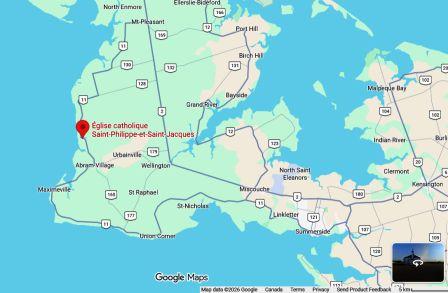
On The War Memorial Trail…..We Follow The Route Taken Into Germany By Canadian Troops In 1945

February 6, 2026. Last spring we were in The Netherlands and Belgium for the 80th Anniversary of Liberation Commemoration events. We placed flags at the graves of 383 soldiers in 14 cemeteries, plus visited a number of memorials, museums related to WWII, and even did a battlefield tour. 

We had one last adventure on our 2025 European War Memorial Tour – a trip to Germany to follow the route taken by Canadian troops during the winter of 1945.

We had been in Mook, near Groesbeek, in The Netherlands, as we’d been invited to attend a Faces To Graves Groesbeek meeting, at which we had been surprised with a Faces To Graves Groesbeek ‘coin’ and a certificate for the work done in researching soldiers, finding families, and sharing photos.  (See https://onthewarmemorialtrail.com/2025/05/30/on-the-war-memorial-trail-pieter-and-daria-honoured-by-faces-to-graves-groesbeek-foundation/

Route taken into Germany from Groesbeek to Kleve, Kalkar, Xanten, Bienen (now part of Rees), and Gendringen. (Map source: Michelin Maps)

Instead of returning to Zaltbommel, where we were staying, Pieter decided to drive into Germany and follow the route taken by Canadian troops in the winter of 1945.  We first travelled to Kleve, then went on to Kalkar, from there to Xanten, and then to Bienen, which is now part of Rees.  From Bienen we returned to The Netherlands and made a very brief stop in Gendringen. 

.…Our first stop was Kleve…

Canadian troops would have travelled along this route into Kleve.  (Photo credit: Daria Valkenburg)

Kleve was bombed heavily before being captured by Allied troops on February 11, 1945 during Operation Veritable, as the 21st Canadian Army Group and British troops fought their way through the difficult terrain of the Reichswald Forest.  The goal of Operation Veritable was to reach the Rhine, part of a pincer movement to allow Allied troops to advance towards Berlin. (See https://en.wikipedia.org/wiki/Operation_Veritable)

The dense wooded area of the Reichswald Forest. (Photo credit: Daria Valkenburg)

When the Allies crossed the border into Germany they entered the Reichswald Forest, a densely wooded area, as we saw from the road. It wasn’t hard to understand how the Germans had turned the forest into a death trap during WWII. The already natural obstacles of a forested area were heavily reinforced by German troops and rigged with trenches, mortar pits, barbed wire, mines, and anti-tank ditches.

Two major roads provided the only means of an Allied approach, while inside the forest there were no surfaced roads. Zig-zagged paths snaked through the woods, making it ideal for preparing ambushes to trap Allied troops.

Canadian and British troops were forced to advance on a narrow front, with their movements further restricted by bad weather and mud….as well as German ambushes.

On this journey through Kleve and the road bordering the Reichswald, we remembered:

…..Kalkar was the scene of brutal battles in February 1945….

Canadian troops continued from Kleve towards Kalkar.  (Photo credit: Daria Valkenburg)

About 10 km (6 miles) south-east of Kleve is Kalkar, scene of two terrible battles that Canadian troops participated in during Operation Veritable

First came the Battle of Moyland Wood, which lasted a brutal six days, from February 16–21, 1945, in which several Canadian Regiments, such as the Regina Rifle Regiment, Canadian Scottish Regiment, and Royal Winnipeg Rifles fought to clear German paratroopers from a key position near Kalkar.  (See https://legionmagazine.com/clearing-moyland-wood/

The goal of the Battle of Keppeln, fought on February 26, 1945, was to break the German Siegfried Line during Operation Blockbuster, the last part of Operation Veritable. (See https://en.wikipedia.org/wiki/Operation_Blockbuster) Troops encountered heavy artillery and mortar fire in intense fighting from German paratroopers, and had to make their way through heavy mud and minefields.

The battle finally ended when Canadian troops used flame-throwing Wasp carriers to clear German-held houses in Keppeln. The village needed to be secured as part of a push towards Uedem. The capture of Keppeln allowed Canadian forces to clear the Kalkar Ridge and proceed towards the Hochwald Forest gap, and later to break through to the Rhine.

As we passed Kalkar on our way towards the Hochwald Forest, we remembered:

….The Hochwald Forest was where the Battle of Hochwald Gap was fought….

The road bordering the Hochwald Forest was bleak and lonely on the rainy day we drove on it.  (Photo credit: Daria Valkenburg)

From Kalkar we turned off the road to go along the Hochwald Forest.  It was perhaps fitting that by this time it was raining, with bleak, grey skies, as so many tears would have been shed here during the winter of 1945.   We were alone on this road, with the Hochwald off in the distance, and the only colour coming from the red poppies growing in the field by the road.

Red poppies grew along the road bordering the Hochwald Forest.  (Photo credit: Pieter Valkenburg)

The Hochwald Forest was a second, separate defensive line located about 10 km (six miles) east/southeast of the Reichswald, stretching toward the Rhine.  It was where the Battle of Hochwald Gap, part of Operation Blockbuster, was fought between February 28 and March 1, 1945, the final push by Canadian troops towards the Rhine River. (For more information, see https://canadianbattlefieldtours.ca/operation-blockbuster/ and https://civilianmilitaryintelligencegroup.com/10742/the-battle-of-hochwald-gap-one-of-the-largest-armor-engagements-you-probably-have-never-heard-of)

On this bleak and lonely road bordering the Hochwald Forest, we remembered:

….Xanten is now the home of an archeological park…

We followed the road from Kleve to Xanten. (Photo credit: Daria Valkenburg)

After detouring onto the road along the Hochwald, we returned to the highway and travelled to Xanten, 26 km (16 miles) from Kleve.  The battle to capture Xanten, near the end of Operation Blockbuster, was the responsibility of Canadian troops of 2nd Canadian Infantry Division, in early March 1945.  (See https://legionmagazine.com/the-taking-of-xanten/)

Beginning on March 8, each brigade was accompanied by two squadrons of flame-throwing tanks, with enemy artillery positions attacked by air support. German troops were desperate to win against the Allies, and fought fiercely, but in the end they evacuated Xanten in the middle of the night on March 10 into March 11.

Poster advertising the upcoming Siegfried Spectacle in Xanten. (Photo credit: Pieter Valkenburg)

Much of Xanten had been destroyed during WWII, but today it’s the site an archeological park, with no reminders of WWII – at least none that we saw. When we drove through the town, we noticed a large poster advertising a medieval festival to honour Siegfried, a hero of Xanten, billed as a reunion with knights, jugglers, and dragons! It was an odd note on this solemn journey we were taking, in which we remembered:

….In Bienen we looked for the memorial plaque honouring North Novies who died during the Battle of Bienen….

We travelled to Bienen from Xanten. (Photo credit: Daria Valkenburg)

From Xanten, we began the journey back into The Netherlands, with a slight detour along the way to Bienen, the scene of the Battle of Bienen on March 25, 1945. In 2023 we’d done a multi-part series on several soldiers from the North Nova Scotia Highlanders Regiment who had died in this battle. We wanted to see a memorial plaque, which was on a wall behind a church in Bienen.

Pieter beside the memorial plaque behind a church in Bienen. (Photo credit: Daria Valkenburg)

Alice van Bekkum, Chair Faces To Graves Foundation Groesbeek, had told us that the memorial plaque by the church in Bienen, Germany, commemorating the lives lost by the North Nova Scotia Highlanders during the Battle of Bienen on March 25, 1945, was the …first German/Canadian (Commonwealth) monument in Germany….

It might have been raining while we were by the memorial plaque, but we made sure to remember:

….The final stop on our journey of remembrance was in Gendringen….

Pieter by the memorial in the cemetery in Gendringen.  (Photo credit: Daria Valkenburg)

From Bienen, we returned to The Netherlands, stopping for a few moments in Gendringen, where 3 soldiers who had been researched by Pieter had lost their lives. Although it was still raining, we wanted to see the memorial, located in a cemetery in Gendringen. 

The text on the memorial means ‘so that we don’t forget’, or, as said more commonly during Remembrance Services in Canada, ‘lest we forget’.  While at the memorial, we remembered:

By now, it was well after 4 pm, with the rain making the skies very grey.  We were tired and still had a long drive back through heavy traffic to our hotel in Zaltbommel.  Luckily, Pieter is a genius at staying calm in traffic, and we arrived safely, in time to enjoy a quiet and relaxing dinner. 

This concludes the stories of the highlights of our 2025 European War Memorial Tour to commemorate the 80th Anniversary of the Liberation of Europe.

Our trip is now long over, but the research work continues for Pieter.  If you have photos or information to share about soldiers buried in The Netherlands or Belgium, please email him at memorialtrail@gmail.com, or comment on the blog.    

© Daria Valkenburg

….Want to follow our research?…

If you are reading this posting, but aren’t following our research, you are welcome to do so.  Our blog address: https://onthewarmemorialtrail.com/

4 countries, 6 weeks, 7,000 km – an unforgettable war memorial journey in Europe…. Daria’s book ‘No Soldier Buried Overseas Should Ever Be Forgotten‘ is available in print and e-book formats.  Net proceeds of book sales help support research costs and the cost of maintaining this blog. For more information see https://nosoldierforgotten.com/

Subscribe to our YouTube Channel: On The War Memorial Trail With Pieter Valkenburg: https://www.youtube.com/channel/UCJ591TyjSheOR-Cb_Gs_5Kw

Never miss a posting!  Subscribe below to have each new story from the war memorial trail delivered to your inbox.
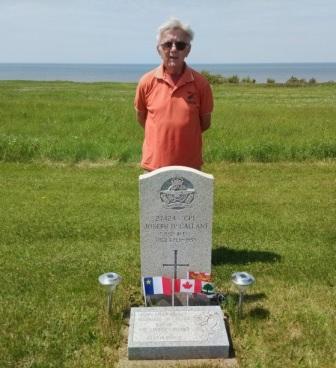
On The War Memorial Trail….Remembrance Week 2025 – Remembrance Day Services At Borden-Carleton Legion And In Kinkora

November 17, 2025. A cool but dry day on Tuesday, November 11, 2025 here on Prince Edward Island was very welcome for those standing outside during Remembrance Day services at Borden-Carleton Legion in Borden-Carleton and in Kinkora.  It seemed as though more people were in attendance than in previous years.
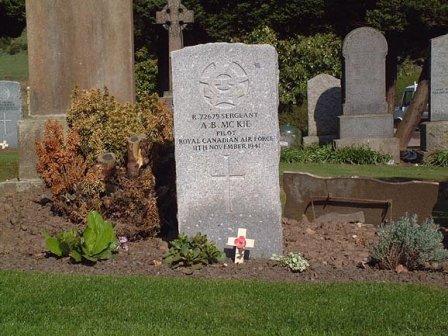
 ….Remembrance Day Service At Borden-Carleton Legion….

Pieter was the guest speaker during the Remembrance Day service at Borden-Carleton Legion. (Photo credit: Matt MacFarlane)

Remembrance Day at the Borden-Carleton Legion began with an inter-faith service, with Reverend Barbara Cairns of the United Church in Bedeque, and Father Babu A. Jesuraj of St. Malachy’s Roman Catholic Church in Kinkora.  Father Jesuraj, who is from the Tamil Nadu province in India, explained that he had only been assigned to the parish in Kinkora for a month.  Trish Taylor spoke about the 80th anniversary of the end of WWII and invited dignitaries from the area to say a few words about remembrance. 

Pieter was the guest speaker, and gave the same presentation he’d given a few days earlier at the Remembrance Service in Crapaud Community Hall.  (See https://onthewarmemorialtrail.com/2025/11/12/on-the-war-memorial-trail-remembrance-week-2025-remembrance-service-at-crapaud-community-hall/)

Flag lowered by Arthur Ranahan during the playing of ‘The Last Post’ by the Cenotaph at the Legion in Borden-Carleton. (Photo credit: Daria Valkenburg)

Wreath laid on behalf of the Government of Canada by the Cenotaph at the Legion in Borden-Carleton was placed by Pieter and carried by Danny Bernard. (Photo credit: Daria Valkenburg)

Following the Remembrance Day Service, everyone was invited inside the Legion for a light lunch and a much needed cup of coffee or tea.  We also had a chance to look at the posters prepared by members of the local 4-H club, which were on display in the Legion hall.

Posters for Remembrance Day from the 4-H club were displayed in the Borden-Carleton Legion.  (Photo credit: Daria Valkenburg)

….Remembrance Day Service by the Memorial in Kinkora….

The Remembrance Day service was over in Borden-Carleton by the end of the morning, but Legion members made their way to the memorial in Kinkora in the afternoon for a service there.

Wreath carried by Pieter Valkenburg and placed by Cenotaph in Kinkora by The Honourable Heath MacDonald, MP for Malpeque, Minister of Agriculture and Agri-Food. (Photo credit: Daria Valkenburg)

Wreath carried by Brian O’Connor and placed by Cenotaph in Kinkora by Matt MacFarlane, MLA for District 19, Borden-Kinkora Leader of the Green Party of PEI. (Photo credit: Daria Valkenburg)

Following the service in Kinkora, Pieter (centre) posed for a photo with Matt MacFarlane (left) and Heath MacDonald (right).  (Photo credit: Daria Valkenburg

Following the Remembrance Day Service, everyone was invited inside the community hall for a bowl of chile or chicken corn chowder and a much needed cup of coffee or tea.

….Statement by Matt MacFarlane in the PEI Legislature….

Matt MacFarlane, MLA for District 19, Borden-Kinkora, Leader of the Green Party of Prince Edward Island, informed us that he’d given a brief statement about us in the legislature on November 4, 2025.  We had no idea he’d done this until he sent us the link! (https://www.facebook.com/share/v/1Ame5ppZio/)

Thank you to the Legion members who participated in the various Remembrance Week events, and to the volunteers at the Borden-Carleton Legion and Kinkora Community Hall for preparing the snacks and hot drinks.

May we never forget all those who served, and continue to serve!  The work of remembrance of those who served continues.  More Remembrance Week stories to come.

If you have a story to tell, please let Pieter know. You can email him at memorialtrail@gmail.com, or comment on the blog.

© Daria Valkenburg

….Want to follow our research?….

If you are reading this posting, but aren’t following our research, you are welcome to do so.  Our blog address: https://onthewarmemorialtrail.com/

4 countries, 6 weeks, 7,000 km – an unforgettable war memorial journey in Europe…. Daria’s book ‘No Soldier Buried Overseas Should Ever Be Forgotten‘ is available in print and e-book formats.  Net proceeds of book sales help support research costs and the cost of maintaining this blog. For more information see https://nosoldierforgotten.com/ 

You are also invited to subscribe to our YouTube Channel: On The War Memorial Trail With Pieter Valkenburg: https://www.youtube.com/channel/UCJ591TyjSheOR-Cb_Gs_5Kw

Never miss a posting!  Subscribe below to have each new story from the war memorial trail delivered to your inbox.