On The War Memorial Trail…. Remembrance Week 2026 -Remembrance Service At Crapaud Community Hall

November 15, 2026. On Sunday, November 8, 2026, the Annual Remembrance Service was held at Crapaud Community Hall in Crapaud, Prince Edward Island.
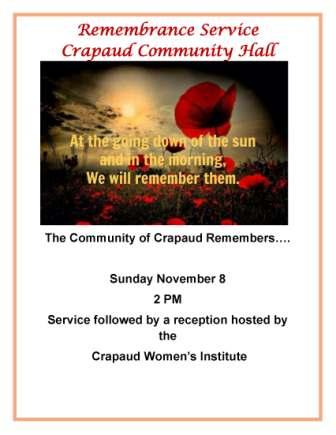
Pieter was invited by Connie MacKinnon, on behalf of the village of Crapaud, to be the guest speaker again this year.  (See the posting about the 2025 Remembrance Service at https://onthewarmemorialtrail.com/2025/11/12/on-the-war-memorial-trail-remembrance-week-2025-remembrance-service-at-crapaud-community-hall/)
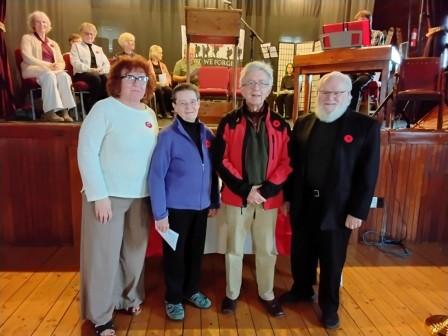
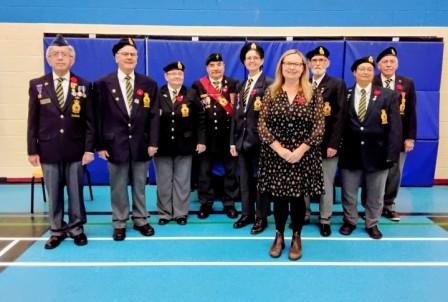
3 of the participants at the November 8, 2026 Remembrance Service at Crapaud Hall with Joanne Harvey, Mayor of Crapaud (far left):  The Rev Margaret Collins (Anglican), guest speaker Pieter Valkenburg, and The Rev Eric Lynk (United Church).  (Photo credit: Daria Valkenburg)

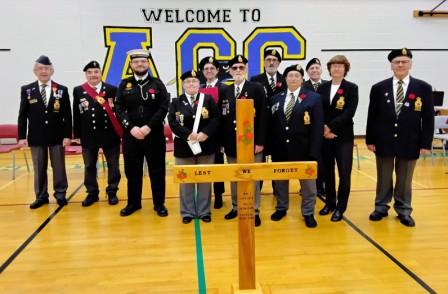
The service, led by Rev. Margaret Collins and Rev. Eric Lynk, included an honour guard from the Kingston Legion Branch No. 30, cadets from the Royal Canadian Sea Cadet Corps No. 85 Summerside and No. 1231 Kensington Army Cadets Corps, and pianist Quixote Froese.  Eva Sabota, student at Bluefield High School, played ‘The Last Post’ and ‘Rouse’ on her trumpet. 
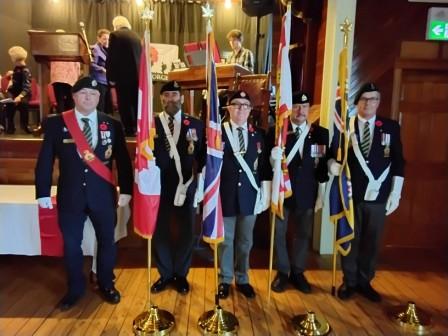
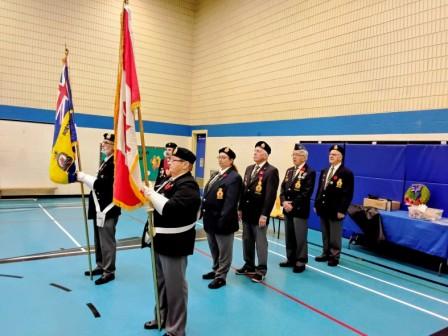
Honour Guard provided by Kingston Legion Branch No. 30. Left to right: Sgt At Arms Wade Campbell, Terence McGauphey, Darren Rea, Greg Gallant, Branch President Alan Crane. (Photo credit: Daria Valkenburg)

….Pieter was introduced by Reverend Eric Lynk….

Pieter was introduced by Reverend Eric Lynk….

“…To introduce our guest speaker for today, we are pleased to welcome someone who’s well known throughout this community, and throughout The Maritimes, and well beyond The Maritimes.… Mr Pieter Valkenburg. 

Born in The Netherlands in 1944, Pieter Valkenburg had a most interesting and varied career.  Pieter served 4 years in the Royal Netherlands Air Force.  Following his military service, he spent  years with the diplomatic service, during which time he had postings, 2 in the US, 2 in South America, in India, several throughout Europe,  and the last in Montreal.  We’re so glad he decided that would be his last and that he’d stay in Canada.

Pieter began his work, which became very much a passion, searching the names of PEI members of the Canadian Forces who had been killed in action, but whose burial places had not yet been graced by their photo….”

Rev Lynk summarized several projects that Pieter has been involved in, before ending his introduction…

“…For his dedication to his efforts on behalf of others, Pieter has been duly honoured with the Veterans Affairs Commendation, the Governor General’s Sovereign Medal for Volunteers, and last year, Pieter was appointed a Knight in the Order of Orange-Nassau for his extensive work identifying and honouring Canadian soldiers buried in The Netherlands. And this of course was the gift of the King of The Netherlands.

So it is that I am pleased to introduce Pieter to all of you and ask you to welcome him here….”

….Pieter’s presentation was built around 4 words…

Pieter’s presentation began by saying “…Today I’d like to talk to you about Remembrance Day …. through four words that seem to have the same meaning but are really different ways in which we remember. 

These four words are Remembrance….Memory…..Recollection… and Commemoration….” 

Here are a few excerpts from his presentation about the four words:

“…Remembrance is the act of keeping someone in mind or honouring them… what we do each year as we take the time to attend a Remembrance service such as today…

Memory is the ability to remember an event or a fact….

Recollection brings a past event back to mind, often with effort….” Most of us present had been born after WWII ended, and our knowledge of the past came from photos and stories. Pieter noted that he was only a year old when The Netherlands was liberated and so, of course, had no recollection of it.  “…It was my parents who explained how   Allied soldiers liberated us from Nazi rule, and saved us from starvation…and told us to never forget.

That brings me to Commemoration….the act of honouring a person or event….and that is what we are doing each Remembrance Day, as we honour those who served….”

Pieter then went on to explain how the work of the Commonwealth War Graves Commission is an ongoing act of commemoration, caring for 1.7 MILLION graves worldwide….

“…Commemoration….that’s such an important part of Remembrance Day, isn’t it? Anyone who visits a War Graves Cemetery managed by the Commonwealth War Graves Commission, such as Daria and I have, sees how well the graves are cared for, with flowers and small shrubs planted in each row of graves….” 

18,900 Canadian casualties from WWI and WWII are buried in Canada, 185 of them buried in Prince Edward Island in 77 cemeteries.  85 of these graves are from WWI and are in 50 cemeteries.  100 are from WWII and are in 44 cemeteries.  Several cemeteries on the Island have both WWI and WWII war graves.

….Pieter briefly mentioned his role as a volunteer….

Pieter then briefly mentioned his role as a volunteer with the Commonwealth War Graves Commission.  “….Since 2025, as one of the volunteers across Canada who are part of the National Volunteer Program, I’m tasked with inspecting the Commonwealth graves in 4 cemeteries in the South Shore area, reporting on their condition, and cleaning where necessary. You might have seen me at one of them, wearing a green vest identifying me as a volunteer….”
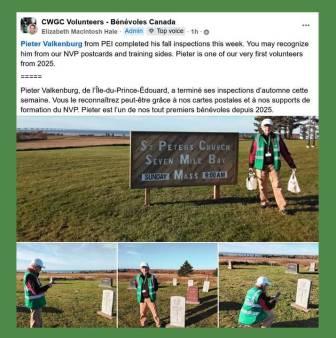
Facebook posting by Elizabeth MacIntosh Hale on the CWGC Volunteers page, with photos by Daria Valkenburg

“….The 4 cemeteries I visit twice a year are:

  • Cape Traverse Community Cemetery
  • Tryon People’s Cemetery
  • St Joseph Parish Cemetery in Kelly’s Cross
  • St Peter’s Roman Catholic Cemetery in Seven Mile Bay…”

 ….Pieter referenced the writer Rudyard Kipling in his closing remarks….

Pieter expressed how important it was to him to know what a soldier looked like when he stood at a grave.  “…Whenever I stand at a grave, and have no idea what that soldier looked like, I’m reminded of the all too many graves of unidentified soldiers whose headstones simply read ‘Known Unto God’, a phrase selected by the writer Rudyard Kipling back in 1917…”
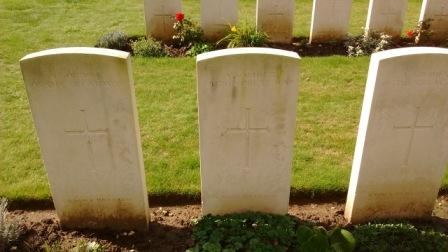
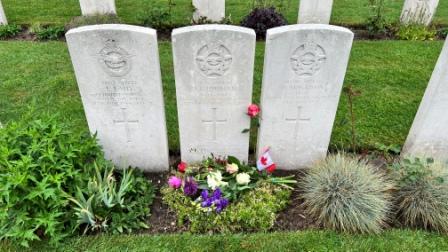
Three of the many graves of unidentified soldiers, with the phrase ‘Known Unto God’ at the bottom of the headstones, in Sanctuary Wood Sanctuary in Belgium, which we visited during our 2017 European War Memorial Tour. (Photo credit: Daria Valkenburg)

“…Kipling’s son John went missing during a battle in France in the fall of 1915….” This was the Battle of Loos.

“…Like so many families, the Kiplings never knew exactly what happened. After the war ended, Kipling would visit the battlefields of France, looking for his son, but never found him….

Ironically, it turned out that John Kipling had been buried in 1919, in a cemetery in Pas de Calais in France, as an unidentified soldier, with his father’s phrase on the headstone. It wasn’t until 1989 that the Commonwealth War Graves Commission was able to verify that this was his grave.

His story is a reminder that remembrance of those who gave their lives for our continued freedom is important to keep in our memories and recollections, and that we must continue to commemorate all those who served. Thank you….”

….The service was followed by a chance to socialize….

Following his speech, Pieter was thanked by Joanne Harvey, Mayor of Crapaud.  The audience was also informed that postcards provided by the Commonwealth War Graves Commission were available for anyone interested in learning more.

After the wreaths were laid, and the closing prayers were said, it was a time to chance to socialize. Among those in attendance were Olivia MacKinnon and Jack Sanders of Summerside.  Olivia is a distant relation of WWII airman Vincent Sanford MACCAUSLAND of Tyne Valley, Prince Edward Island, whose story will be told in the near future.

Vincent had been the bomb aimer aboard the last flight of Lancaster ED887 of RAF 617 Squadron, which was shot down and crashed near Castricum, The Netherlands on the night of May 16-17, 1943, while returning back to England after taking part in Operation Chastise….what we know more commonly as The Dambusters Raid.  Olivia and Jack have been researching Vincent’s life and service, and it was a pleasure to meet them.
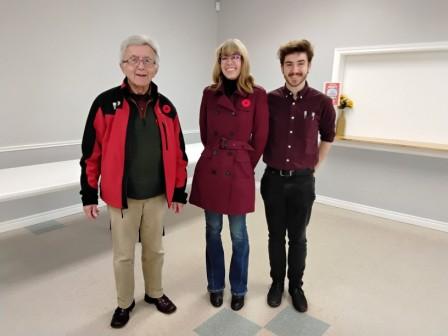
Pieter with Olivia MacKinnon and Jack Sanders. (Photo credit: Daria Valkenburg)

Thank you to Connie MacKinnon for inviting Pieter to speak.  Thank you to Rev. Eric Lynk for his introduction at the Remembrance Service. Thank you to Wendy Nattress for her help with the audio recording of Pieter’s speech.  Thank you also to Katrielle Ethier of the Commonwealth War Graves Commission for sending postcards about the Commission.

The work of remembrance of those who served continues.  More Remembrance Week stories to come.

If you have a story to tell, please let Pieter know. You can email him at memorialtrail@gmail.com, or comment on the blog.

© Daria Valkenburg

….Want to follow our research?….


If you are reading this posting, but aren’t following our research, you are welcome to do so.  Our blog address: https://onthewarmemorialtrail.com/
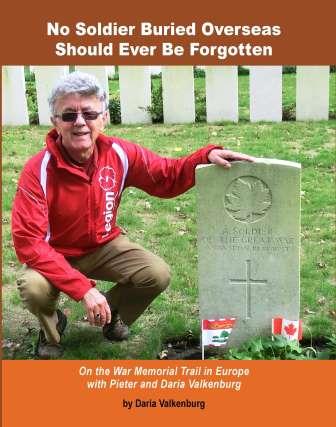
4 countries, 6 weeks, 7,000 km – an unforgettable war memorial journey in Europe…. Daria’s book ‘No Soldier Buried Overseas Should Ever Be Forgotten‘ is available in print and e-book formats.  Net proceeds of book sales help support research costs and the cost of maintaining this blog. For more information see https://nosoldierforgotten.com/

You are also invited to subscribe to our YouTube Channel: On The War Memorial Trail With Pieter Valkenburg: https://www.youtube.com/channel/UCJ591TyjSheOR-Cb_Gs_5Kw.

Never miss a posting!  Subscribe below to have each new story from the war memorial trail delivered to your inbox.
 

On The War Memorial Trail…Remembrance Week 2026 – Visit To Tryon Cenotaph

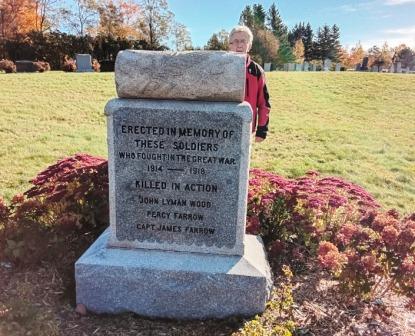
November 11, 2026. Each year we try to visit one or more war memorials in Canada. In this Remembrance Week 2026 posting we feature a visit to the Tryon Cenotaph in Tryon, Prince Edward Island.  Located beside the Tryon Peoples Cemetery, the names of those who lost their lives on this Cenotaph are also listed on the Cenotaph outside the Borden-Carleton Legion in Borden-Carleton.

….3 WWI soldiers KIA are listed on the Tryon Cenotaph…

Pieter beside the panel on the Tryon Cenotaph commemorating those who died during WWI.  (Photo credit: Daria Valkenburg)

One side of the Tryon Cenotaph commemorates 3 WWI soldiers from the area who lost their lives.

WWI soldier John Lymon ‘Ly’ WOOD from North Tryon, Prince Edward Island, was serving with the 39th Battalion when he was killed in action on May 3, 1917 during the Battle of Arras, in the Third Battle of the Scarpe near Fresnoy, France. His body was never recovered and he’s listed on the Canadian National Vimy Memorial in France.

You can read Ly’s story at https://onthewarmemorialtrail.com/2018/06/02/wwi-soldier-john-lyman-woods-connection-with-acadia-university/ and https://onthewarmemorialtrail.com/2017/07/28/learning-about-the-two-names-on-the-vimy-memorial/ and https://onthewarmemorialtrail.com/2019/09/16/the-parallel-ww1-experiences-of-john-lymon-wood-clifford-almon-wells/

WWI soldier Percy FARRAR (FARROW) from North Tryon, Prince Edward Island, died in the vicinity of Mercatel, about 5 km south of Arras, France, on June 23, 1918, during German Spring Offensives on the Western Front, while serving with the 26th New Brunswick Battalion.  He’s buried in Bellacourt Military Cemetery in France.

You can read Percy’s story at https://onthewarmemorialtrail.com/2017/09/27/a-trip-to-bellacourt-military-cemetery/

WWI mariner James Graham FARROW (FARRAR) from Argyle Shore, Prince Edward Island, served as Second Mate in WWI’s Merchant Navy aboard the SS Port Dalhousie, ferrying needed supplies from England to allied soldiers in France, when it was torpedoed in the English Channel on March 19, 1916.  His body was never recovered.

You can read James’ story at https://onthewarmemorialtrail.com/2019/01/20/the-mariner-whose-ship-was-torpedoed-in-the-english-channel/

….2 WWII soldiers lost at sea are also listed on the Tryon Cenotaph…

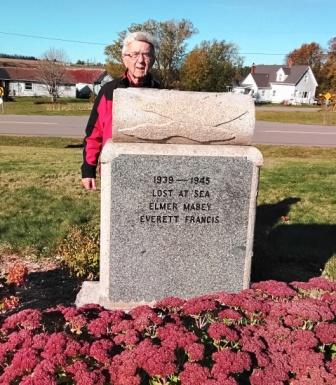
Another side of the Tryon Cenotaph commemorates 2 WWII soldiers who were lost at sea.

Pieter beside the panel on the Tryon Cenotaph commemorating those who died during WWII.  (Photo credit: Daria Valkenburg)

WWII soldier Everett Samuel FRANCIS from Albany, Prince Edward Island, was serving with the PEI Highlanders in Gander, Newfoundland, and after completing a small arms training course in Ontario, he was on his way back to Gander aboard the railway ferry S.S. Caribou when it was torpedoed by a German U-Boat off the coast of Newfoundland on October 14, 1942. He never got to see his newborn daughter Greta. He’s buried in St. Matthew’s Presbyterian Cemetery in Grand Falls, Newfoundland.

You can read Everett’s story at https://onthewarmemorialtrail.com/2018/03/25/the-face-of-everett-samuel-francis/

WWII seaman Elmer Allister MABEY from Tryon, Prince Edward Island, was serving with the Royal Canadian Navy Volunteer Reserve as the telegraphist aboard HMCS Otter, when an explosion and a fire ripped through the vessel just outside the harbour in Halifax, Nova Scotia, on March 26, 1941.  His body was never recovered.

Earlier this year, Richard Woodbury shared how his grandfather had survived the explosion and fire in a CBC article entitled ‘Family lore said my grandfather’s WW II ship was torpedoed. The truth was far more interesting’.  (See https://www.cbc.ca/news/canada/nova-scotia/hmcs-otter-second-world-war-halifax-9.7218305)

You can read Elmer’s story at https://onthewarmemorialtrail.com/2018/06/27/the-wwii-sailor-who-died-in-an-accidental-explosion-and-fire/

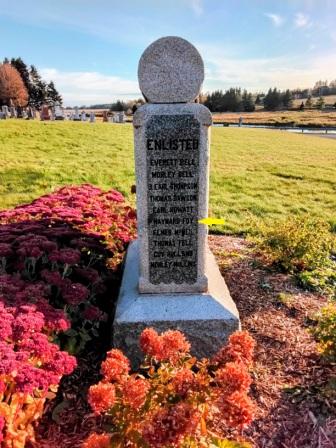
….Soldiers listed on the Tryon Cenotaph that survived…

One side panel on the Tryon Cenotaph commemorates those who enlisted and came home.  Yellow arrow identifies Maynard Foy. (Photo credit: Daria Valkenburg)

WWI soldier Maynard FOY from Tryon, Prince Edward Island, was serving with the 26th New Brunswick Battalion when he was severely injured in France on August 8, 1918 during the Battle of Amiens and was invalided back to Canada.  He died on April 18, 1957, and is buried at the Tryon People’s Cemetery in Tryon, Prince Edward Island.

You can read Maynard’s story at https://onthewarmemorialtrail.com/2021/04/24/on-the-war-memorial-trail-the-ww1-soldier-who-returned-to-tryon/

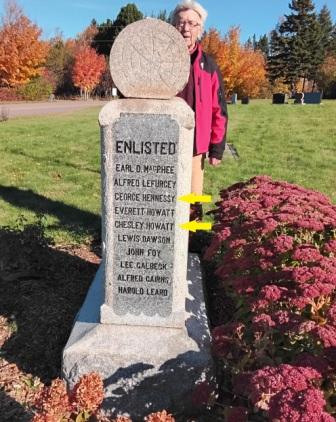
Pieter by another side panel on the Tryon Cenotaph commemorates those who enlisted and came home.  Yellow arrows identify George Stanley Hennessey and Chesley William Howatt. (Photo credit: Daria Valkenburg)

WWI soldier George Stanley HENNESSEY from Cape Traverse, Prince Edward Island, served in France and Belgium with the 1st Canadian Engineers Battalion, and later with the Canadian Engineer Railway Battalion in England until the war ended and he returned home.  He died on October 17, 1946 following a long illness, and is buried in the Tryon People’s Cemetery in Tryon, Prince Edward Island.

You can read George’s story at https://onthewarmemorialtrail.com/2022/02/14/on-the-war-memorial-trail-the-ww1-soldier-who-served-in-the-1st-canadian-engineers-battalion/

WWI soldier Chesley William HOWATT from Tryon, Prince Edward Island, was serving with the 50th Battalion Canadian Expeditionary Force when he received a gunshot wound to the face on February 3, 1917 at Vimy Ridge, France, with fine metal particles from the blast entering his eyes.  On March 31, 1918 he received his formal discharge in Halifax, Nova Scotia, due to being unfit for service due to defective vision as a result of the gunshot wound. A few months later, however, on September 2, 1918, he reenlisted! Chesley died on January 22, 1938, and is buried at the North Tryon Presbyterian Church Cemetery in North Tryon, Prince Edward Island.

You can read Chesley’s story at https://onthewarmemorialtrail.com/2022/05/29/on-the-war-memorial-trail-the-ww1-soldier-from-tryon-who-enlisted-twice/

The work of remembrance of those who served continues. If you have a story to tell, please let Pieter know. You can email him at memorialtrail@gmail.com, or comment on the blog.

© Daria Valkenburg

….Want to follow our research?….

If you are reading this posting, but aren’t following our research, you are welcome to do so.  Our blog address: https://onthewarmemorialtrail.com/

4 countries, 6 weeks, 7,000 km – an unforgettable war memorial journey in Europe…. Daria’s book ‘No Soldier Buried Overseas Should Ever Be Forgotten‘ is available in print and e-book formats.  Net proceeds of book sales help support research costs and the cost of maintaining this blog. For more information see https://nosoldierforgotten.com/

You are also invited to subscribe to our YouTube Channel: On The War Memorial Trail With Pieter Valkenburg: https://www.youtube.com/channel/UCJ591TyjSheOR-Cb_Gs_5Kw.

Never miss a posting!  Subscribe below to have each new story from the war memorial trail delivered to your inbox.
On The War Memorial Trail…Remembrance Week 2026 – Reflections and Updates

November 10, 2026.  When we write a story on the blog, we often receive additional information about the soldiers we’ve written about, and reactions from family members of the soldiers. This Remembrance Week 2026 posting gives an update on eleven soldiers whose stories were previously told.

….The family of WWII soldier Azade Boudreau appreciated the research that went into telling his story…

WWII soldier Azade BOUDREAU from Petit Rocher Nord, New Brunswick, drowned in a canal in Ghent, Belgium on December 15, 1944, aged 22, while serving with the 4th Medium Regiment, Royal Canadian Artillery.

There is usually quite a time lag from when Pieter begins his research, family is contacted and a photo is provided, and a story is written.  Azade’s story took 2 years from the initial start of research until a story was written and published on our blog, just before last Christmas.

It meant a great deal to us when Azade’s niece, Pauline Theriault, who had provided a photo, wrote us to say “….. Words can’t express how grateful the Boudreau family is for all the time and research you have invested in telling Azade’s story.  We knew nothing about it at all.

The fact that you went to Petit Rocher and also visited his gravesite is beyond anything we could have ever hoped for.

We definitely treasure all you have done for us.  You have no way to know how much this means to us. It’s part of our history that we can now pass on to the next generation.

 Thanks very much & Happy Holidays….”

You can read Azade’s story at: https://onthewarmemorialtrail.com/2025/12/15/on-the-war-memorial-trail-the-wwii-soldier-from-petit-rocher-nord-who-accidentally-drowned-in-a-belgian-canal/

….A local Dutch researcher sent a photo of the location where WWII soldier Peter Hydichuk lost his life…

WWII soldier Peter HYDICHUK, from Theodore, Saskatchewan, lost his life in The Netherlands on March 31, 1945, aged 27, while serving with the South Saskatchewan Regiment.

Maarten Koudijs, an amateur researcher in the Gendringen area, and author of ‘Tussen Grens En Hoop’, was quoted in the story we wrote, as he’d stated that Peter was “…killed near Alofs’s house on the Tappenweg in Etten….”  (Translated from the original Dutch)

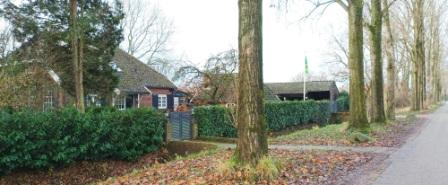
In January 2026 Maarten sent us a photo of the former farm where Peter died.

Former Alofs farm where Peter Hydichuk was killed. (Photo courtesy of Maarten Koudijs)

You can read Peter’s story at https://onthewarmemorialtrail.com/2025/11/15/on-the-war-memorial-trail-remembrance-week-2025-the-wwii-soldier-who-was-never-forgotten-by-his-girlfriend-and-her-family/

 ….The family of WWII soldier Gerald Vincent ‘Vin’ Jorgenson shared his story with relatives…

WWII soldier Gerald Vincent ‘Vin’ JORGENSON, from Kenora, Ontario, was serving with the Fort Garry Horse – 10th Armoured Regiment when he was killed in action during the Battle of the Scheldt in The Netherlands on October 23, 1944.

Terry and Leni Ellwood, who had provided photos and a wealth of information on Leni’s uncle Vin, were very appreciative, and wrote to say that “…we loved your article. It will become a family heirloom documenting the life of Vin Jorgenson. We will share it with all of Vin’s relatives.

Thank you so much for the effort you have taken to do the research and document this very important time in history. Bravo!…”

You can read Vin’s story at https://onthewarmemorialtrail.com/2026/04/04/on-the-war-memorial-trail-the-wwii-sergeant-from-kenora-killed-during-the-battle-of-the-scheldt-near-hoogerheide/

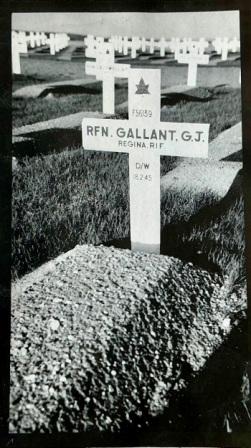
….The great-nephew of WWII soldier Garnet Joseph Gallant shared a photo of his original headstone in Groesbeek…

WWII soldier Garnet Joseph GALLANT, from Amherst, Nova Scotia, lost his life in Germany on February 18, 1945 during the Battle of Moyland Wood, while serving with the Regina Rifles Regiment.

Garnet’s great-nephew, Frank Elliott, got in touch after the story was written, explaining that “…. Garnet Gallant was my great-uncle. You had been talking with my Aunt Janet Lowerison when you wrote that great piece on Garnet. I have a box of old family pictures, which is where I found the one of Garnet that Janet shared with you. I also found this one of his first grave….” 

Original headstone for Garnet Gallant at the Canadian War Cemetery in Groesbeek, The Netherlands. (Photo courtesy of the Gallant Family)

Frank not only provided the photo, but went on to say “…I really enjoyed reading your website. Not just of Garnet but of the others as well. Thanks for doing the Memorial Trail project….”

You can read Garnet’s story at https://onthewarmemorialtrail.com/2025/11/21/on-the-war-memorial-trail-remembrance-week-2025-the-wwii-soldier-from-amherst-whose-photo-was-sent-a-few-days-before-what-would-have-been-his-103rd-birthday/

….Frans Nijsen empathized with a family whose relative was buried far from home…

When we were in The Netherlands on our 2025 European War Memorial Tour we encountered a sign by one grave in the Canadian War Cemetery in Groesbeek, that Pieter placed flags at, asking for whoever had been annually placing flowers at this grave to come forward – a mystery that was soon solved. After speaking with Saskia Peters, who had placed the sign, we learned that she had met Frans Nijsen, the man who had been placing the flowers.

WWII airman Arnold Freeman HUPMAN, from East Side of Ragged Island, Nova Scotia, lost his life during the last flight of Lancaster X KB728, which was shot down in Elden, The Netherlands in the early hours of June 17, 1944 as it was returning to England from a bombing mission in Germany.

You can read about this special story of remembrance at https://onthewarmemorialtrail.com/2026/04/18/on-the-war-memorial-trail-the-mystery-of-who-placed-flowers-at-one-airmans-grave-was-solved-in-a-story-spanning-two-continents/

After we shared the story about solving the mystery of who had been annually placing flowers, we heard back from Frans.  “…The reason I started doing this was as a thank you to Graham’s family. I knew that it was difficult for them that Arnold wasn’t buried close to them and they couldn’t visit it. For me, this was a sign, that if they can’t, I will do it for them and let them know every year that we don’t forget. Reading the article made me emotional, in between the lines I can read the pain that still exists. My family has a similar pain, but I’m also proud of what my family members did with the resistance during the war. I will continue to bring flowers every year and let Graham know that we won’t forget. That’s the least we can do…”

Flowers placed at the grave of Arnold Hupman on May 5, 2026. (Photo courtesy of Frans Nijsen)

In May 2026, Frans contacted us with photos of this year’s visit.  “…Yesterday we visited the grave of Arnold Hupman and laid flowers on the grave together with my family. We transfer our knowledge and history so that this never happens again. I wish more people did that. We do our best to keep the memories and lessons alive….”

….A two part story about 2 brothers from Prince Edward Island brought back family history memories…

Two brothers from Prince Edward Island lost their lives during WWII.  One is buried on the Island, the other in Germany….and a two part series told their stories.

WWII soldier Michael ‘Cecil’ STORDY from Brookvale, Prince Edward Island, drowned on June 14, 1945 during a swimming exercise in Nova Scotia, while training with A14 Canadian Infantry Training Centre (CITC).

WWII airman John ‘Lawrence’ STORDY from Brookvale, Prince Edward Island, was serving with the RCAF’s No. 405 Pathfinder Squadron, when he lost his life on April 27, 1943 while aboard the last flight of Halifax JB-920 when it was shot down by German flak over Germany during the Battle of the Ruhr.

After reading this two part series on the Stordy brothers, Kendra Mellish contacted us.  “….Just wanted to send you a note to say Thank-You for the work you do ’On The War Memorial Trail’.  Very interesting article on the two Stordy brothers in the military and from Brookvale/Kelly’s Cross.  My maiden name was Stordy. My grandfather William Stordy grew up in Crapaud and his father ran Stordy’s Mill also in Crapaud. William Stordy created/owned Crystal Milk Dairy in Summerside.  As a child, my father Eldon Stordy took me to Kelly’s Cross cemetery to work on family tree history….“

You can read Cecil’s story at https://onthewarmemorialtrail.com/2026/02/11/on-the-war-memorial-trailthe-stordy-brothers-part-1-the-wwii-soldier-from-brookvale-who-drowned-during-a-swimming-exercise-in-nova-scotia/

You can read Lawrence’s story at https://onthewarmemorialtrail.com/2026/02/16/on-the-war-memorial-trailthe-stordy-brothers-part-2-the-wwii-airman-from-brookvale-who-lost-his-life-on-the-last-flight-of-halifax-jb-920/

….The family of WWI soldiers Francis Edmund Graves and Charles Stuart was grateful to have their stories told…

WWI soldier Francis Edmund GRAVES, born in England, but from Winnipeg, Manitoba, was serving with the 31st Battalion when he was seriously wounded on May 3, 1917 during the Battle of Fresnoy in France. One leg was amputated and he spent 2 years in various hospitals but was able to return to civilian life in Winnipeg, Manitoba, where he raised a family and worked as a clerk at the Empire Sash and Door Co. Ltd until his death on November 8, 1941.

WWI soldier Charles STUART, born in England, but from Winnipeg, Manitoba, was serving with the 8th Battalion when he was seriously wounded on August 10, 1918 during the Battle of Amiens in France. He received multiple shrapnel wounds in scalp, jaw, larynx, neck, hand, and chest, and he spent almost 2 years in various hospitals, requiring reconstructive surgery on his nose and face, but was able to return to civilian life in Winnipeg, Manitoba, where he raised a family and worked for the CNR (Canadian National Railway) until retirement, before passing away on September 23, 1977 in Winnipeg.

Brenda Graves wrote us after reading Part 2 of the two part series on her husband Stuart’s grandfathers, who both served in WWI and returned home with major injuries.  “….Amazing story! And to think about how we complain about relatively minor aches and pains. Charles and Francis were so critically injured and medical care was slow coming and without antibiotics, it was incredible that they even survived. Another great piece.  Good job seems to be so inadequate on such well researched pieces.  Thanks again. ….”

You can read Francis’ story at https://onthewarmemorialtrail.com/2026/05/18/on-the-war-memorial-trail-duty-sacrifice-resilience-part-1-the-wwi-soldier-whose-war-injuries-didnt-stop-him-from-living-his-life/

You can read Charles’ story at https://onthewarmemorialtrail.com/2026/05/24/on-the-war-memorial-trail-duty-sacrifice-resilience-part-2-the-wwi-soldier-who-was-seriously-wounded-by-an-exploding-grenade-during-the-battle-of-amiens/

….The niece of WWII soldier Albert Ahlwardt shares the same birth day as her uncle…

WWII soldier Albert Donald AHLWARDT, from Olds, Alberta, was serving with the 6th Anti-Tank Regiment, Royal Canadian Artillery, when he was killed on February 26, 1945 during the Battle of Keppeln in Germany, after a shell burst near him, as Pte Harry BIZNAR and Lt Robert Joseph MARKEY were trying to him to safety in a nearby house, after he was wounded.

His niece, Betty Askeland, daughter of Albert’s sister Stella, wrote us, saying “…thank you so much for sending this article, it means so much to me.  I am his sister’s daughter Betty and we shared the same birth day June 2. This means so much to have this information…“

You can read Albert’s story at https://onthewarmemorialtrail.com/2026/07/22/on-the-war-memorial-trail-struck-by-shellfire-part-3-the-wwii-gunner-from-olds-who-lost-his-life-as-he-was-being-moved-to-safety/

….The nephew of WWII soldier James ‘Jim’ Kosowan found his story a reminder of ‘how much honour and respect we owe to so many from so long ago’.…

WWII soldier James ‘Jim’ John George KOSOWAN, born in Samburg, Saskatchewan, was serving with the Royal Winnipeg Rifles when he was killed in action during the Liberation of Deventer in The Netherlands on April 10, 1945.

After reading Jim’s story, his nephew, Randy Sanjenko, wrote us. “…I read the beautiful article you wrote about my uncle Jim it touched the hearts of my wife and children and the tears from me are still falling. It is not with sadness that I read it but with the knowledge that many fallen soldiers are somewhere silently thanking you for the work and sacrifice you make to keep their memories alive and the honour and respect you bring to them.

In a world with so much division and hate remembering those who fought against it is an honourable thing and I thank you from the bottom of my heart…“

You can read Jim’s story at https://onthewarmemorialtrail.com/2026/09/08/on-the-war-memorial-trail-the-wwii-soldier-born-in-samburg-who-lost-his-life-during-the-liberation-of-deventer/

Thank you to Betty Askeland, Brenda Graves, Frank Elliott, Terry and Leni Ellwood, Kendra Mellish, Frans Nijsen, Maarten Koudijs, Randy Sanjenko, and Pauline Theriault. The work of remembrance of those who served continues.

If you have a story to tell, please let Pieter know. You can email him at memorialtrail@gmail.com, or comment on the blog.

© Daria Valkenburg

….Want to follow our research?….

If you are reading this posting, but aren’t following our research, you are welcome to do so.  Our blog address: https://onthewarmemorialtrail.com/

4 countries, 6 weeks, 7,000 km – an unforgettable war memorial journey in Europe…. Daria’s book ‘No Soldier Buried Overseas Should Ever Be Forgotten‘ is available in print and e-book formats.  Net proceeds of book sales help support research costs and the cost of maintaining this blog. For more information see https://nosoldierforgotten.com/

You are also invited to subscribe to our YouTube Channel: On The War Memorial Trail With Pieter Valkenburg: https://www.youtube.com/channel/UCJ591TyjSheOR-Cb_Gs_5Kw.

Never miss a posting!  Subscribe below to have each new story from the war memorial trail delivered to your inbox.
On The War Memorial Trail….Remembrance Week 2026 – Borden-Carleton Legion At 3 Schools For Remembrance Services

November 7, 2026.  On Monday, November 2, 2026, members of the Borden-Carleton Legion in Prince Edward Island were present for Remembrance Services at three schools:  Somerset Consolidated in Kinkora, Kinkora Regional High School in Kinkora, and Amherst Cove Consolidated School in Borden-Carleton.

…. Remembrance Service at Somerset Consolidated School….

The day of school visits began in the morning in Kinkora, at the Somerset Consolidated School.   Each grade participated with a poem or reading and the choir sang Ed McCurdy’s ‘Last Night I Had The Strangest Dream’.

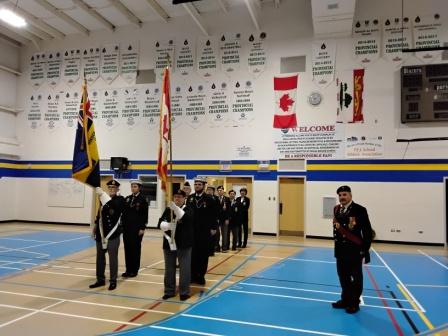
The flag bearers for the colour parade carried the Canadian flag and the Borden-Carleton Branch Legion flag.

This year’s flag bearers were: Arthur Ranahan (left) and Kathy Henry (right). Lining up behind the flag bearers were Dawn Gradwell, George Palmer, Pieter Valkenburg, and Barry Bernard. Sergeant-At-Arms Mario Henry is in the background. (Photo credit: Daria Valkenburg)

Following the service, a group photo was taken with the Legion members and Principal Angela Griffiths.

Somerset Consolidated School: Left to right:  Pieter Valkenburg, Barry Bernard, Kathy Henry, Sgt At Arms Mario Henry, Trish Taylor, Principal Angela Griffiths, Arthur Ranahan, Dawn Gradwell, George Palmer.  (Photo credit: Daria Valkenburg)

 …. Remembrance Service at Kinkora Regional High School….

Following the service at Somerset Consolidated School, the Legion members made their way to Kinkora Regional High School, which is also in Kinkora.

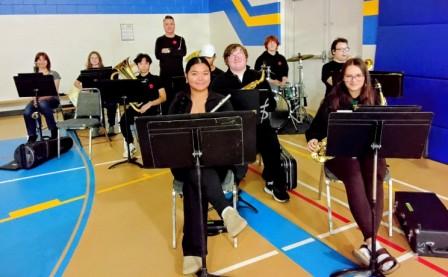
Kinkora Regional High School band, with bandleader Kirk White standing at the back.  (Photo credit: Daria Valkenburg)

Three cadets participated in the Remembrance Service – Oscar Bulman, Maika MacLean, and Lucas Somers – all with the Royal Canadian Sea Cadets, RCSCC 85 Summerside.

Parade Line-up at Kinkora Regional High School: Flag bears Arthur Ranahan and Kathy Henry in front, Sgt At Arms Mario Henry at the right. Behind the flag bearers: Maika MacLean and Lucas Somers, Pieter Valkenburg and Oscar Bulman, George Palmer, Dawn Gradwell, Sharon Noonan. (Photo credit: Daria Valkenburg)

During the service, a short video showed students from the school writing out post-it notes about Remembrance.  The notes were put on 2 large cardboard sheets, covered in plastic, and presented to the Legion for display.

Students at the school annually offer a light lunch to the Legion members after the Remembrance Service is concluded, a gesture that is much appreciated. All the food was prepared by students.

…. Remembrance Service at Amherst Cove Consolidated School….

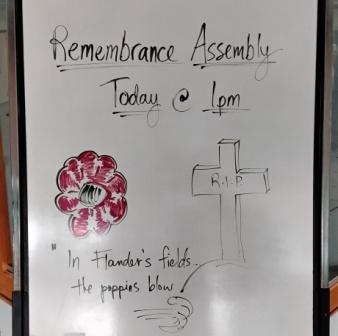
Sign advising of the Remembrance Service at Amherst Cove Consolidated School. (Photo credit: Daria Valkenburg)

In the afternoon, members of the Borden-Carleton Legion were present for a Remembrance Service at Amherst Cove Consolidated School in Borden-Carleton.  At this school one cadet participated in the Remembrance service: Lucas Somers from  the Royal Canadian Sea Cadets, RCSCC 85 Summerside.

Amherst Cove Consolidated School: Left to right:Pieter Valkenburg, Sgt At Arms Mario Henry, Lucas Somers, Kathy Henry, Trish Taylor, Arthur Ranahan, Danny Bernard, Dawn Gradwell, George Palmer, Sharon Noonan, Barry Bernard.  (Photo credit: Daria Valkenburg)

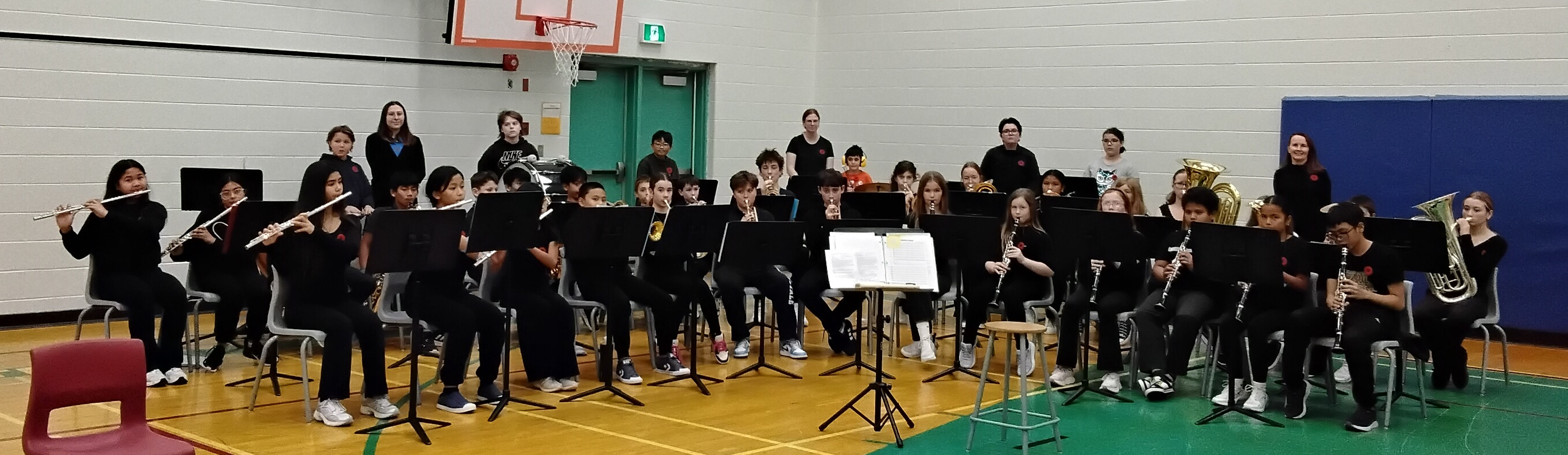
The band at Amherst Cove Consolidated, under the director of Band Director, Gráinne Howman, was a pleasure to listen to!

Amherst Cove School Band, under the direction of Band Director Gráinne Howman standing at right. (Photo credit: Daria Valkenburg)

Thank you to the officials and students at all three schools for the work they put into the Remembrance Services. May we never forget all those who served, and continue to serve!

If you have a story to tell, please let Pieter know. You can email him at memorialtrail@gmail.com, or comment on the blog.

© Daria Valkenburg

….Want to follow our research?….

If you are reading this posting, but aren’t following our research, you are welcome to do so.  Our blog address: https://onthewarmemorialtrail.com/

4 countries, 6 weeks, 7,000 km – an unforgettable war memorial journey in Europe…. Daria’s book ‘No Soldier Buried Overseas Should Ever Be Forgotten‘ is available in print and e-book formats.  Net proceeds of book sales help support research costs and the cost of maintaining this blog. For more information see https://nosoldierforgotten.com/

You are also invited to subscribe to our YouTube Channel: On The War Memorial Trail With Pieter Valkenburg: https://www.youtube.com/channel/UCJ591TyjSheOR-Cb_Gs_5Kw.

Never miss a posting!  Subscribe below to have each new story from the war memorial trail delivered to your inbox.
On The War Memorial Trail…..The Search For A Photo Of WWI Soldier James Lymon Cameron Is Over

October 28, 2026.  Whenever Pieter visits the grave of a soldier he has researched, he always hopes to have a photo that puts a face to a name.  Sometimes, that’s not possible, as was the case when we visited Chester Farm Military Cemetery in 2017, located 5 km (3 miles) south of Ypres in Belgium, where WWI soldier James Lymon CAMERON is buried. (See https://onthewarmemorialtrail.com/2017/10/23/a-visit-to-chester-farm-military-cemetery/ and https://onthewarmemorialtrail.com/2021/02/27/the-search-for-a-photo-of-james-lymon-cameron-moves-to-youtube/)

Pieter by the grave of James Lymon Cameron at Chester Farm Military Cemetery in 2017. (Photo credit: Daria Valkenburg)

One of the undertakings for our On The War Memorial Trail research project began when Pieter first started researching the 48 names on the Cenotaph outside the Borden-Carleton Legion in Prince Edward Island in 2015.  His goal?  To put a face and story to each name.  Over the years we’ve told the story of each one on this blog and in the County Line Courier newspaper, plus shared our visits made to their graves or memorials.

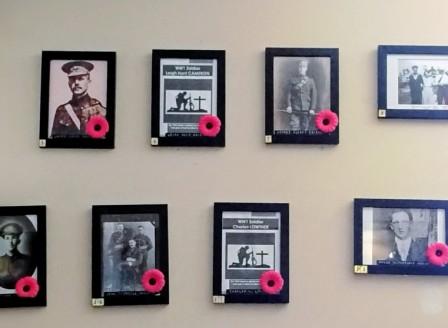
The Cenotaph Wall of Remembrance in the Borden-Carleton Legion displays photos of the men listed on the Cenotaph, with empty frames for those photos still waiting to be found. 

…A photo of James Lymon Cameron found in a Vancouver newspaper…

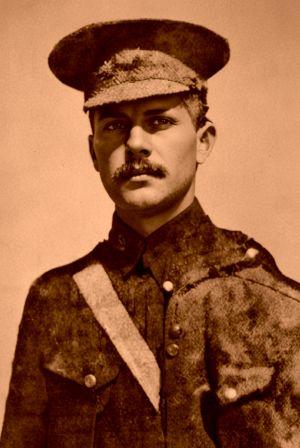
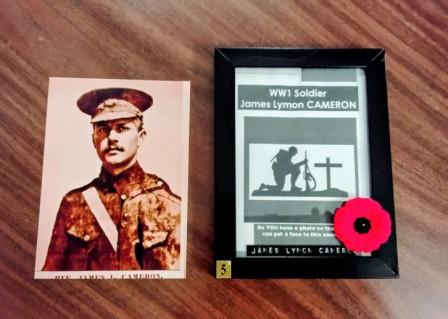
James Lymon Cameron. (Photo source: The Province newspaper. Photo restoration: Pieter Valkenburg)

We’d almost given up on finding a family member for James Lymon Cameron when a photo was found in the Saturday, August 5, 1916 edition of The Province, a newspaper from Vancouver, British Columbia, along with a notification of his death.

Then, in a remarkable serendipitous moment, the following day we were in contact with Robert John Gilbert, a great-nephew whose grandmother was the soldier’s sister, Ethel Laura (Louise) Gilbert!  Robert, who served with the Royal Canadian Engineers for 34 years until his retirement, had the same photo.

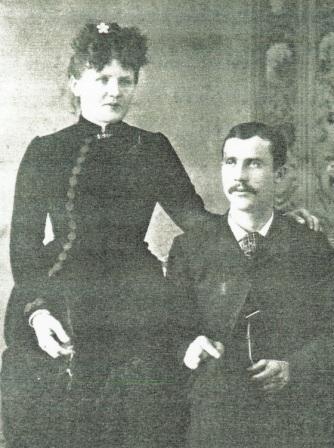
Edward and Susan (nee Harrington) Cameron.  (Photo courtesy of Robert Gilbert)

Born December 30, 1892 in Victoria-By-The-Sea, Prince Edward Island, John Lymon was the son of Edward Holland Cameron, a carpenter, and Susan Estelle (nee Harrington) of Hampton, Prince Edward Island.

…James Lymon left Canada for overseas service…

The family moved around due to Edward’s work as a shipwright, and when James Lymon, known as ‘Jim’ or by the nickname ‘Otto’, enlisted on March 18, 1915, he was living in Vancouver and working as a marine oilman for Puget Sound Machinery Depot in Seattle, Washington.  Robert explained that his great-uncle “…specialized in building heavy large engines for large ships….” and worked there from “…1910 to 1915…”

James Lymon went overseas with the second draft of the 47th Canadian Infantry Battalion, arriving in the United Kingdom on October 10, 1915. On February 3, 1916 he was sent to France with the 7th Canadian Infantry Battalion.

Sadly, while serving with the 7th Canadian Infantry Battalion, he was killed by enemy shell fire on July 24, 1916, aged 24, at ‘The Bluff’ at Ypres Salient during the Battle of The Bluff near St. Eloi.  The Bluff is a mound near St Eloi, south-east of Ypres, which was created from a spoil heap during the digging of the Ypres–Comines Canal before the war.

…A tribute to James Lymon by the editor of The Maple Leaf…

A tribute to James Lymon was made by the editor of The Maple Leaf, a monthly magazine established by former Summerside, Prince Edward Island residents (Mr McInnis and Mr Harrington) who had relocated to Oakland, California. The magazine ran from 1907 to 1941, focusing on the news, genealogies, and lives of the ‘Sons and Daughters of the Maritime Provinces’.

Robert shared a 1916 article, ‘Another Island Boy Killed In Action’ which provided a brief obituary. “…The editor of The Maple Leaf knew ‘Jim’ personally and well, knew him as a brave and fearless young man, with a pure heart and mind, and when we heard of his death in defence of his country’s flag, after seven long months of privation and suffering in the trenches, we were not surprised…”

…The photo of James Lymon is now on the Cenotaph Wall of Remembrance…

The empty frame that awaited a photo of James Lymon Cameron about to be filled! (Photo credit: Daria Valkenburg)

The 11 year photo search has been successfully concluded!  The photo of James Lymon Cameron is now on the Legion’s Cenotaph Wall of Remembrance.

James Lymon Cameron (top left) is now on the Legion’s Cenotaph Wall of Remembrance. (Photo credit: Daria Valkenburg)

…5 photos still being sought for the Cenotaph Wall of Remembrance…

Pieter hopes that more of the empty frames will one day be filled. “…Unfortunately, photos for 4 from WWI and 1 from WWII have yet to be found….” he said.  Can YOU help with this photo wish list?

Names still without faces from WWI

  • Leigh Hunt CAMERON, born in Albany
  • Bazil CORMIER, born in Tignish
  • Charles LOWTHER, born in North Carleton
  • Arthur Clinton ROBINSON, born in Tryon

 Names still without faces from WWII

  • Ernest Ramey GALLANT, born in Borden

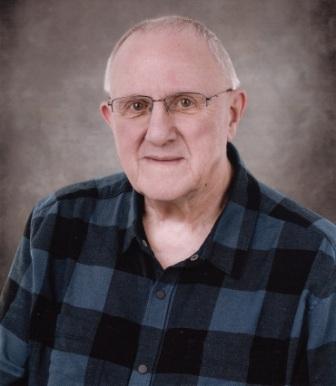
Robert Gilbert, great-nephew of James Lymon Cameron.  (Photo courtesy of Robert Gilbert)

Thank you to Robert Gilbert for sharing information about his great-uncle, to Judie Klassen for extensive research into finding family and a photo, and to Shawn Rainville for newspaper research.

If you can help with the photo search request for the 5 soldiers mentioned above whose photos are still being sought, or have a story to tell, Pieter encourages you to email him at memorialtrail@gmail.com, or comment on the blog.

© Daria Valkenburg

…Want to follow our research?…

If you are reading this posting, but aren’t following the blog, you are welcome to do so.  Our blog address: https://onthewarmemorialtrail.com/.

4 countries, 6 weeks, 7,000 km – an unforgettable war memorial journey in Europe…. Daria’s book ‘No Soldier Buried Overseas Should Ever Be Forgotten‘ is available in print and e-book formats.  Net proceeds of book sales help support research costs and the cost of maintaining this blog. For more information see https://nosoldierforgotten.com/

You are also invited to subscribe to our YouTube Channel: On The War Memorial Trail With Pieter Valkenburg: https://www.youtube.com/channel/UCJ591TyjSheOR-Cb_Gs_5Kw.

Never miss a posting!  Subscribe below to have each new story from the war memorial trail delivered to your inbox.
On The War Memorial Trail….The Canadian National Vimy Memorial Is 90!

Canadian National Vimy Memorial from a distance. (Photo credit: Daria Valkenburg)

July 28, 2026.  On July 26, 1936 the Canadian National Vimy Memorial, designed by Walter Allward, was officially unveiled – 90 years ago. In September 2017, we visited Vimy Ridge during our 6 week, 7,000 km (4,350 miles) war memorial journey in Europe that took us through 4 countries. Pieter placed flags at the known graves of men listed on the Cenotaph outside the Borden-Carleton Legion in Borden-Carleton, Prince Edward Island, and we stopped at many memorials during our visit.

I was reminded of the 90th anniversary as the most anticipated stop in 2017 was Vimy Ridge in France, where two WWI soldiers listed on the Cenotaph are also named on the Canadian National Vimy Memorial: John ‘Lymon’ WOOD and Patrick Raymond ARSENAULT.  (See https://onthewarmemorialtrail.com/2017/07/28/learning-about-the-two-names-on-the-vimy-memorial/)

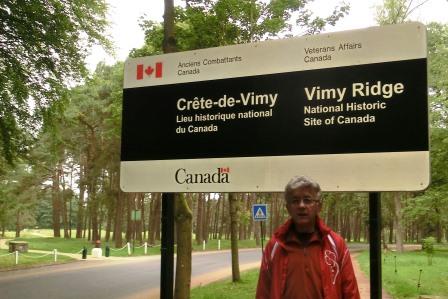
Pieter at the entrance to Vimy Ridge in France. (Photo credit: Daria Valkenburg)

The turn-off to the Vimy Ridge memorial and visitors centre is a tree-lined public road, with jogging and walking paths, that leads to the nearby villages of Givenchy and Vimy.

….The Canadian National Vimy Memorial took 11 years to build….

Although we were familiar with the memorial from seeing it on TV, it’s much larger and beautiful when seen in person.  While we knew that the land around Vimy Ridge was gifted to Canada by the French government in December 1922 as a mark of gratitude for Canada’s involvement in the defence of France during WWI, it wasn’t until we were there in 2017 that we understood why it took so many years to build.

The memorial sits on the highest point of Vimy Ridge, known during WWI as Hill 145.  The ground was littered with unexploded shells and grenades, rusted weapons and wire, and 91,440 metres (100,000 yards) of earth had to be removed by hand to prepare for the monument’s base.

Nearby dugouts and tunnels had to be emptied of explosives that were still stored there, and filled with wet chalk or concrete. Finding underground caverns hidden beneath the monument’s base was crucial, as the memorial weighs more than 50,000 tons.

Work on the monument itself finally began in 1925, took 11 years to build and cost 1.5 million dollars. The white limestone used for the memorial came from an ancient Roman quarry in Seget, Croatia, and didn’t arrive on site until 1927.

The familiar two tall columns represent Canada and France. The pillars together and the horizontal base also form the top half of a cross. The monument includes 20 figures representing honour, justice and peace.

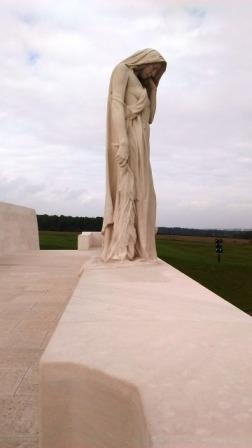
‘Canada Bereft’.  (Photo credit: Pieter Valkenburg)

One female figure, known as ‘Canada Bereft’, stands alone looking out over the slopes of the ridge. The base of the monument is engraved with the 11,285 names of Canadians who have no known grave in France.

….Previous stories about WWI soldiers listed on the Canadian National Vimy Memorial….

In 2017, we were aware of only the two names previously mentioned: John ‘Lymon’ WOOD of North Tryon, Prince Edward Island, and Patrick Raymond ARSENAULT of Bedeque, Prince Edward Island.   Since then, we’ve also told the stories of two more soldiers whose names are engraved on the monument:  Merrill Augustus MARSHALL of Covehead, Prince Edward Island, and Lloyd Clifton SHORTLIFF of Barton, Nova Scotia.  Here below are links to their stories:

….Stories about our 2017 visit to Vimy Ridge….

Missed our stories about our 2017 visit?  You can read them here:

Our visit to Vimy Ridge will never be forgotten.  Meanwhile, Pieter’s research efforts to find photos and families of soldiers continue. Do you have a story to tell? Email Pieter at memorialtrail@gmail.com, or comment on the blog.

© Daria Valkenburg

….Want to follow our research?….

If you are reading this posting, but aren’t following our research, you are welcome to do so.  Our blog address: https://onthewarmemorialtrail.com/

4 countries, 6 weeks, 7,000 km – an unforgettable war memorial journey in Europe…. Daria’s book ‘No Soldier Buried Overseas Should Ever Be Forgotten‘ is available in print and e-book formats.  Net proceeds of book sales help support research costs and the cost of maintaining this blog. For more information see https://nosoldierforgotten.com/

You are also invited to subscribe to our YouTube Channel: On The War Memorial Trail With Pieter Valkenburg: https://www.youtube.com/channel/UCJ591TyjSheOR-Cb_Gs_5Kw.

Never miss a posting!  Subscribe below to have each new story from the war memorial trail delivered to your inbox.
On The War Memorial Trail….. The Soldier From Bedeque Who Served In Both WWI And WWII

Pieter Valkenburg (left) and Mario Henry at Bedeque Cemetery. (Photo credit: Laurie Henry)

July 26, 2026.  Every November, just before Remembrance Day, members of Borden-Carleton Legion Branch #10, in Prince Edward Island, place Canadian flags at the graves of veterans buried in 9 cemeteries, and at 4 cenotaphs.  While flags are placed to honour the veterans, their stories and details of service are often unknown.

One of the cemeteries is Bedeque Cemetery (also known as Lower Bedeque Cemetery) in Lower Bedeque, Prince Edward Island.  One of the veterans buried here, George ‘Stanley’ Clarence JACK, came to Pieter’s attention from Phillip MacDonald.  “…My maternal grandfather, Stanley C Jack, was a veteran of WWI and WWII….” he wrote.  “… He was the youngest boy of John S Jack and Elizabeth MacKinstry of Bedeque, and is buried at the Lower Bedeque Cemetery, just down the road from where I live…”

Born July 17, 1897 in Summerside, Prince Edward Island, Stanley was the youngest son of John Slifton and Elizabeth (nee MacKinstry) Jack.  Phillip explained that his great-grandparents raised “…6 boys who all served in WWI & WWII. They were all born on PEI but my grandfather was the only one to remain on the Island to raise his family….”

Stanley worked as a mail driver until he was conscripted, aged 20, under the Military Service Act and sent for a medical exam in Summerside, Prince Edward Island, on December 5, 1917.  However, he wasn’t drafted until months later.

After relying exclusively on volunteers for the first few years of WWI, the Canadian government passed the Military Service Act in August 1917 to make military service compulsory for male citizens aged 20 to 45.  (See https://www.warmuseum.ca/firstworldwar/history/life-at-home-during-the-war/recruitment-and-conscription/conscription-1917/)

…..Stanley enlisted in the 1st Depot Battalion…..

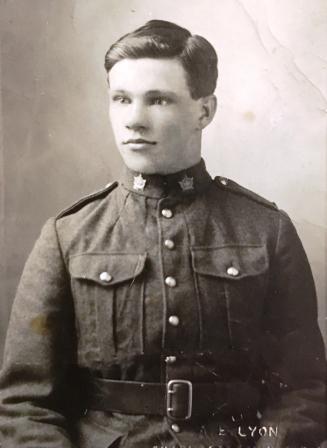
George ‘Stanley’ Clarence Jack in WWI. (Photo courtesy of the Jack Family. Photo restoration by Pieter Valkenburg)

In 1917-1918, when it was difficult to recruit enough men for infantry battalions, depot battalions were organized in Canada to obtain personnel who would then be sent to various Canadian Reserve Battalions in England.

Stanley wasn’t drafted until March 11, 1918, when he enlisted with ‘H’ Company, 1st Depot Battalion, Nova Scotia Regiment, in Charlottetown, Prince Edward Island, and began his basic training.

Per Nova Scotia’s Part In The Great War, compiled and edited by M. S. Hunt, the 1st Depot Battalion had been organized “….on September 25, 1917, for the purpose of looking after the draftees under the Military Service Act…”

However, due to “…destruction of property caused by the Halifax Explosion in December 1917….” quarters for military personnel were in short supply, which is likely the reason why Stanley didn’t have to enlist until months after passing his medical exam.  (See https://en.wikipedia.org/wiki/Halifax_Explosion)

…..Stanley left Canada for England…..

On August 2, 1918, Stanley was transferred to the 102nd Draft Battalion Nova Scotia, one of 1,700 men to be sent overseas.

An account in Nova Scotia’s Part In The Great War noted that the men “…paraded at 8 PM on August 3, 1918; the roll was called, documents checked, etc. The men were then dismissed and ordered to parade and entrain at 4:30 AM on August 4th…”

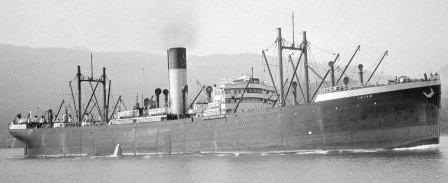
SS Ixion.  (Photo source: http://www.shipspotting.com)

After leaving Halifax, Nova Scotia aboard SS Ixion, the ship arrived safely in Liverpool, England on August 15, 1918, with the men disembarking the following day. Among the men aboard the ship was Cyrus Joseph GALLANT of Piusville, Prince Edward Island, whose story has previously been told. (See https://onthewarmemorialtrail.com/2026/06/20/on-the-war-memorial-trail-the-wwi-soldier-from-piusville-who-enlisted-in-the-veterans-guard-of-canada-in-wwii/)

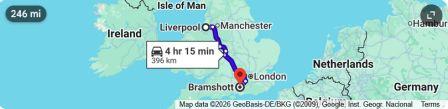
Map showing routing from Liverpool to Bramshott. (Map source: Google Maps)

From Liverpool, the men travelled 396 km (246 miles) towards Bramshott, where they were transferred to the 17th Reserve Battalion of the Canadian Infantry on August 22, 1918.  Bramshott Camp was a massive training facility for the Canadian Army, with thousands of soldiers living there. The camp included hospitals, an open-air theatre, and an extensive network of corrugated iron and wooden huts.

The 17th Reserve Battalion was a training and reinforcement depot based in England. Its primary role was to train newly arriving soldiers, and dispatch them to combat battalions.

By the time Stanley arrived in England, just a few months before WWI ended on November 11, 1918, his time with the 17th Reserve Battalion never went beyond training.  Instead of being sent to a frontline unit he stayed in England until returning home.

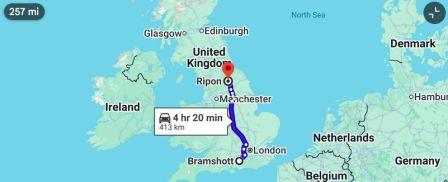
Map showing routing from Bramshott to South Ripon. (Map source: Google Maps)

The Battalion remained in Bramshott until January 12, 1919, when it moved to South Ripon, a distance of 413 km (257 miles), from where soldiers would be demobilized and started returning back home to Canada.

…..Stanley returned back to Canada in 1919…..

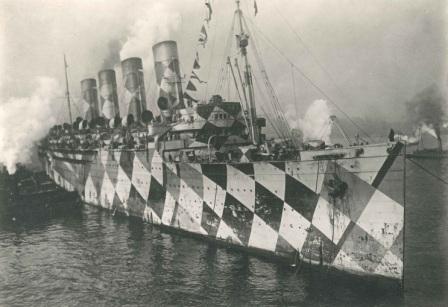
HMT Mauretania with geometric dazzle camouflage scheme designed by Norman Wilkinson (Photo source: New-York Tribune December 8, 1918, Public Domain, https://commons.wikimedia.org/w/index.php?curid=84709365)

On June 28, 1919, Stanley was on his way back to Canada aboard HMT (Hired Military Transport) Mauretania. He was officially discharged on July 13, 1919 in Charlottetown.

…..Stanley enlisted in the Veterans Guard of Canada in WWII…..

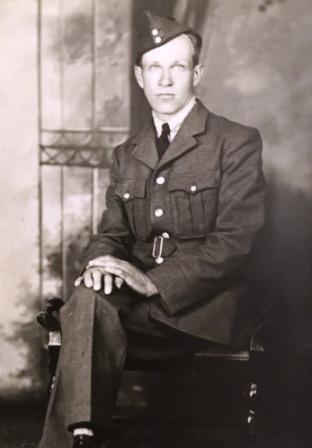
George ‘Stanley’ Clarence Jack in WWII. (Photo courtesy of the Jack Family)

During the inter-war years, Stanley married Stella Beryl Craig, and they had three daughters.  During WWII, Stanley enlisted as a volunteer with the Veterans Guard of Canada.

Volunteers for the Veterans Guard were WWI veterans that had served in Canadian or British forces, were fit, and had been honourably discharged. They received the same pay ($1.30 a day) and allowances as other soldiers. As a local defence force to guard against enemy attacks, and guard duties at internment and prisoner-of-war camps in Canada, Stanley would not have been sent overseas into a war zone.  (See https://en.wikipedia.org/wiki/Veterans_Guard_of_Canada)

Stanley’s brother-in-law, Harrison William CRAIG, the younger brother of his wife Stella, also served in Canada during WWII, but died of an allergic reaction in 1942. Harrison is listed on the Cenotaph outside the Borden-Carleton Legion, and his story was told several years ago.  (See https://onthewarmemorialtrail.com/2019/09/22/the-ww2-soldier-who-had-an-allergic-reaction/)

Phillip was unsure where his grandfather served during WWII, but wrote that he believed “…he was stationed in Glace Bay, Nova Scotia….” because his mother “…lived there with her mother and sisters in the early 1940s when he was in the war….” Glace Bay, located in Cape Breton, was part of the Homeland Defence duties for the Veterans Guards of Canada.  Stanley may have been posted to other locations during WWII as well.

….Stanley is buried in Bedeque Cemetery…

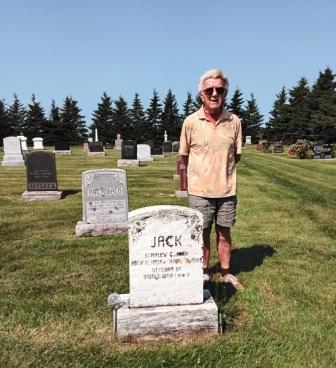
Following the end of WWII, Stanley returned to his life in Bedeque, and worked as a farm labourer and mail courier.  Following Stella’s death on December 30, 1969, Stanley remained a widower until his own death on April 6, 1985 in Charlottetown.  He was buried in Bedeque Cemetery (also known as Lower Bedeque Cemetery) in Lower Bedeque, Prince Edward Island, where we visited his grave one hot sunny day in July.

Pieter by the grave of George ‘Stanley’ Clarence Jack.  (Photo credit: Daria Valkenburg)

Thank you to Phillip MacDonald for providing photos and information on his grandfather.  “… Please keep up the great work…” he wrote.

This November, when a Canadian flag is placed at Stanley’s grave, he’ll be more than just a name on a list.  Pieter noted that “…it means so much more when I’m standing at a grave if I know what the soldier looked like and a bit about him…..“

Pieter’s research efforts to find photos and families of soldiers continue. Do you have a story to tell? Email Pieter at memorialtrail@gmail.com, or comment on the blog.

© Daria Valkenburg

….Want to follow our research?…

If you are reading this posting, but aren’t following our research, you are welcome to do so.  Our blog address: https://onthewarmemorialtrail.com/

4 countries, 6 weeks, 7,000 km – an unforgettable war memorial journey in Europe…. Daria’s book ‘No Soldier Buried Overseas Should Ever Be Forgotten‘ is available in print and e-book formats.  Net proceeds of book sales help support research costs and the cost of maintaining this blog. For more information see https://nosoldierforgotten.com/

Subscribe to our YouTube Channel: On The War Memorial Trail With Pieter Valkenburg: https://www.youtube.com/channel/UCJ591TyjSheOR-Cb_Gs_5Kw.

Never miss a posting!  Subscribe below to have each new story from the war memorial trail delivered to your inbox.
On The War Memorial Trail…..The WWI Soldier From Piusville Who Enlisted In The Veterans Guard Of Canada in WWII

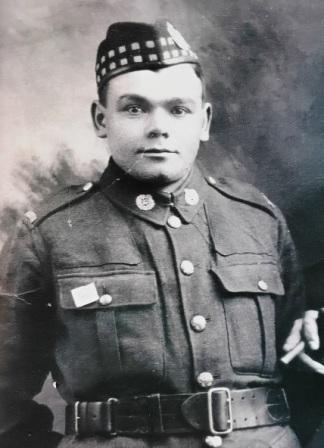
June 20, 2026. Since Pieter began the On The War Memorial Trail research project in 2014, we’ve met many families of those who served in one or more wars.  Brenda Graves of North Tryon, Prince Edward Island, explained that her paternal grandfather served in WWI and then served in the Veterans Guard of Canada until his death during WWII.

Cyrus Joseph GALLANT was born in Piusville, Prince Edward Island on March 21, 1897, the son of Joseph ‘Joe Smoke’ and Marie Marguerite (nee Bernard) Gallant.  He worked on the family farm until he was conscripted under the Military Service Act and sent for a medical exam in Charlottetown, Prince Edward Island, on November 29, 1917.  However, he wasn’t drafted until months later.

After relying exclusively on volunteers for the first few years of WWI, the Canadian government passed the Military Service Act in August 1917 to make military service compulsory for male citizens aged 20 to 45.  (See https://www.warmuseum.ca/firstworldwar/history/life-at-home-during-the-war/recruitment-and-conscription/conscription-1917/)

…..Cyrus enlisted in the 1st Depot Battalion…..

Cyrus Joseph Gallant. (Photo courtesy of Brenda Graves)

In 1917-1918, when it was difficult to recruit enough men for infantry battalions, depot battalions were organized in Canada to obtain personnel who would then be sent to various Canadian Reserve Battalions in England.

Cyrus wasn’t drafted until July 4, 1918, when he enlisted with ‘H’ Company, 1st Depot Battalion, Nova Scotia Regiment, in Charlottetown, and began his basic training.

Per Nova Scotia’s Part In The Great War, compiled and edited by M. S. Hunt, the 1st Depot Battalion had been organized “….on September 25, 1917, for the purpose of looking after the draftees under the Military Service Act…”

However, due to “…destruction of property caused by the Halifax Explosion in December 1917….” quarters for military personnel were in short supply, which is likely the reason why Cyrus didn’t have to enlist until months after passing his medical exam.  (See https://en.wikipedia.org/wiki/Halifax_Explosion)

…..Cyrus left Canada for England…..

On August 2, 1918, Cyrus was transferred to the 102nd Draft Battalion Nova Scotia, one of 1,700 men to be sent overseas.   An account in Nova Scotia’s Part In The Great War noted that the men “…paraded at 8 PM on August 3, 1918; the roll was called, documents checked, etc. The men were then dismissed and ordered to parade and entrain at 4:30 AM on August 4th….”

After leaving Halifax, Nova Scotia aboard SS Ixion, the ship arrived safely in Liverpool, England on August 15, 1918, with the men disembarking the following day.

Map showing routing from Liverpool to Bramshott. (Map source: Google Maps)

From Liverpool, the men travelled 396 km (246 miles) towards Bramshott, where they were transferred to the 17th Reserve Battalion of the Canadian Infantry on August 22, 1918.  Bramshott Camp was a massive training facility for the Canadian Army, with thousands of soldiers living there. The camp included hospitals, an open-air theatre, and an extensive network of corrugated iron and wooden huts.

The 17th Reserve Battalion was a training and reinforcement depot based in England. Its primary role was to train newly arriving soldiers, and dispatch them to combat battalions.

By the time Cyrus arrived in England, just a few months before WWI ended on November 11, 1918, his time with the 17th Reserve Battalion never went beyond training.  Instead of being sent to a frontline unit he stayed in England until returning home.

Map showing routing from Bramshott to South Ripon. (Map source: Google Maps)

The Battalion remained in Bramshott until January 12, 1919, when it moved to South Ripon, a distance of 413 km (257 miles), from where soldiers would be demobilized and started returning back home to Canada.

…..Cyrus returned back to Canada in 1919…..

HMT Mauretania with geometric dazzle camouflage scheme designed by Norman Wilkinson (Photo source: New-York Tribune December 8, 1918, Public Domain, https://commons.wikimedia.org/w/index.php?curid=84709365)

On June 28, 1919, Cyrus was on his way back to Canada aboard HMT (Hired Military Transport) Mauretania. He was officially discharged on July 3, 1919 in Charlottetown.

…..Cyrus raised a family in the inter-war years…..

After his return back to Prince Edward Island, Cyrus married Elizabeth ‘Lizzie’ Marie Gallant on November 22 1922 in Bloomfield, and they became the parents of 9 children.  Cyrus ran a barber shop in Bloomfield and worked as a labourer.

…..Cyrus enlisted in the Veterans Guard of Canada in WWII…..

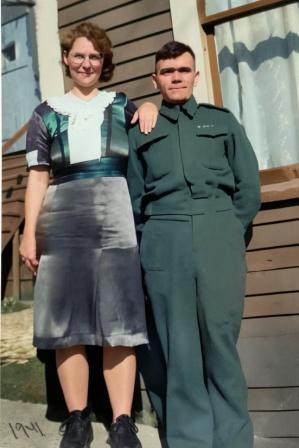
Cyrus Gallant in his Veterans Guard of Canada uniform, with his wife Lizzie, in 1941.  (Photo courtesy of Brenda Graves.  Photo restoration and colourization by Pieter Valkenburg)

On February 1, 1941, when Cyrus enlisted with 6A Company of the Veterans Guard of Canada in Charlottetown, his two youngest children were still toddlers.  Mary Delma had been born in June 1938, and Joseph Walter in August 1939.

With a growing family, the pay that Cyrus received as a member of the Veterans Guard would have been very helpful. Volunteers for the Veterans Guard were WWI veterans that had served in Canadian or British forces, were fit, and had been honourably discharged. They received the same pay ($1.30 a day) and allowances as other soldiers. As a local defence force to guard against enemy attacks, and guard duties at internment and prisoner-of-war camps in Canada, Cyrus wouldn’t have been sent overseas.  (See https://en.wikipedia.org/wiki/Veterans_Guard_of_Canada)

He was posted to Valcartier, Quebec, but in July he ended up in hospital with stomach pains, and spent a month in Saint-Sacrament Hospital in Quebec City.

After his discharge from hospital, he was working at Camp B/70, an internment camp in Fredericton, New Brunswick, when he was hospitalized, again with stomach pains, in January 1942.  (See https://powsincanada.ca/pows-in-canada/internment-camps/camp-70-fredericton/)

On February 21, 1942, he was sent to Camp Hill Hospital in Halifax, Nova Scotia, where he was diagnosed as having pancreatic cancer.

Cyrus was discharged from the Veterans Guard on March 2, 1942 for being medically unfit due to carcinoma.  He remained at Camp Hill Hospital for post-discharged treatment before returning home, where he died on October 31, 1942, aged 45, at Prince County Hospital in Summerside, Prince Edward Island.

….Cyrus is buried in St. Anthony’s Roman Catholic Cemetery in Bloomfield…

Cyrus was buried on November 2, 1942 in St. Anthony’s Roman Catholic Cemetery in Bloomfield, Prince Edward Island.

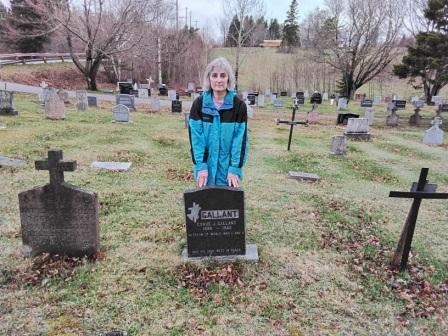
Brenda Graves by the grave of her grandfather, Cyrus Joseph Gallant. (Photo credit: Daria Valkenburg)

One cloudy and wet Thursday in May of this year, Brenda and I travelled to St. Anthony’s Roman Catholic Cemetery, located just outside the church, to find her grandfather’s grave.   Brenda’s father, Edmund Joseph, was one of the children born to Cyrus and Lizzie.

Lizzie remarried in 1954, to Fred Louie Arsenault.  They are both buried in the same cemetery as Cyrus.

NOTE: Various records provide differing birth years for Cyrus. When he enlisted in the Veterans Guard in 1941, he stated that he was born on March 21, 1894. However, the regimental number and information he provided about his WWI service matched his WWI attestation where he stated he was born in 1897. His medical record lists him as aged 44 in 1941, confirming he was born in 1897, not 1894.  Finally, his headstone incorrectly lists him as being born in 1898.

….Another soldier from Prince Edward Island in the 17th Reserve Battalion died of illness…

Also in the 17th Reserve Battalion was Bruce Sutherland MCKAY (MACKAY), who contracted scarlet fever during the voyage to England and died a short while later.  Your can read his story at https://onthewarmemorialtrail.com/2019/04/22/the-ww1-soldier-who-never-made-it-to-the-front/

Thank you to Brenda Graves for providing photos and information on her grandfather. Pieter’s research efforts to find photos and families of soldiers continue. Do you have a story to tell? Email Pieter at memorialtrail@gmail.com, or comment on the blog.

© Daria Valkenburg

….Want to follow our research?…

If you are reading this posting, but aren’t following our research, you are welcome to do so.  Our blog address: https://onthewarmemorialtrail.com/

4 countries, 6 weeks, 7,000 km – an unforgettable war memorial journey in Europe…. Daria’s book ‘No Soldier Buried Overseas Should Ever Be Forgotten‘ is available in print and e-book formats.  Net proceeds of book sales help support research costs and the cost of maintaining this blog. For more information see https://nosoldierforgotten.com/

Subscribe to our YouTube Channel: On The War Memorial Trail With Pieter Valkenburg: https://www.youtube.com/channel/UCJ591TyjSheOR-Cb_Gs_5Kw.

Never miss a posting!  Subscribe below to have each new story from the war memorial trail delivered to your inbox.
On The War Memorial Trail…..Duty Sacrifice Resilience Part 2: The WWI Soldier Who Was Seriously Wounded By An Exploding Grenade During The Battle Of Amiens

May 24, 2026. Since Pieter began the On The War Memorial Trail research project in 2014, we’ve often had a chance to meet families of those who served.  While much of the focus is on those who served our country and lost their lives while in service, most military service personnel in WWI and WWII returned home. We don’t often know much about their time in service, or what happened afterwards.  As families come forward with information, we are trying to tell these stories.

Brenda Graves of North Tryon, Prince Edward Island shared that both of her husband Stuart’s grandfathers served in WWI and returned home with major injuries.  “…Stuart’s paternal grandfather lost a leg in 1917 and his maternal grandfather was grievously injured in the nose, shoulder, and throat by an exploding grenade in 1918…”

Both men had immigrated to Canada from the United Kingdom, overcame difficult challenges as a result of their war injuries, and went on to marry and live productive lives in Winnipeg, Manitoba.

We decided to tell the story of both grandfathers. Part 1 of this series began with Stuart’s paternal grandfather, Francis Edmund GRAVES. (See https://onthewarmemorialtrail.com/2026/05/18/on-the-war-memorial-trail-duty-sacrifice-resilience-part-1-the-wwi-soldier-whose-war-injuries-didnt-stop-him-from-living-his-life/) Now, in Part 2, this series concludes with Stuart’s maternal grandfather, Charles STUART.

Charles Stuart.  (Photo courtesy of Michael Figsby)

….Charles immigrated to Canada as a young child…

Born January 28, 1897 in Sheffield Notts, England, Charles was the son of Charles and Kate Ellen (nee Hulley) Stuart.  He arrived in Montreal, Quebec from Liverpool, England aboard the SS Canada on September 30, 1904, accompanied by his mother and siblings. (See https://en.wikipedia.org/wiki/SS_Canada)

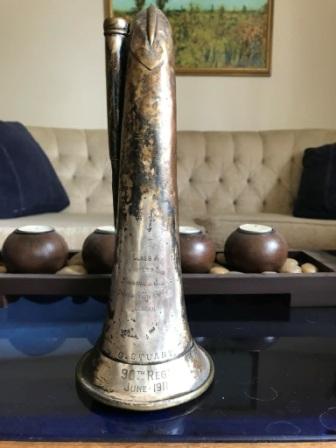
When he enlisted with the 144th Battalion (Winnipeg Rifles), Canadian Expeditionary Force (CEF) in Winnipeg, Manitoba on January 7, 1916, he stated that he had served in the 90th Winnipeg Rifles as a drummer, and was a plumber and steamfitter by trade. He also was a bugler, with his bugle in the possession of grandson Michael Figsby. (See https://en.wikipedia.org/wiki/8th_Battalion_(90th_Winnipeg_Rifles),_CEF)

Charles Stuart’s bugle is from June 1911 and his time with the 90th Winnipeg Rifles.  (Photo courtesy of Michael Figsby)

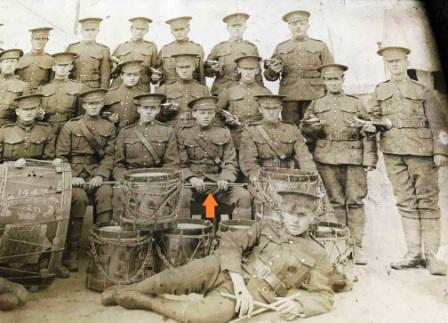
Charles continued being a drummer in the 144th Battalion (Winnipeg Rifles).

The 144th Battalion band. Charles Stuart identified by orange arrow. (Photo courtesy of Brenda and Stuart Graves)

…..Charles left Canada for overseas service…..

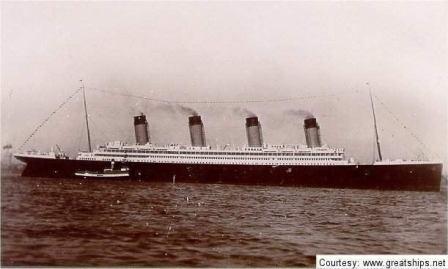
SS Olympic.  (Photo source: http://www.greatships.net)

Charles and his battalion sailed from Halifax aboard SS Olympic on September 18, 1916, arriving in England.  The battalion was absorbed into the 18th Reserve Battalion on January 12, 1917.

…..Charles sent to France AFTER the Battle of Vimy Ridge….

On April 20, 1917, Charles was drafted to the 8th Battalion, the active army of the Winnipeg Rifles, a key unit in the 2nd Infantry Brigade, 1st Canadian Division.  Charles was one of the many reinforcements needed to replace the casualties suffered during the Battle of Vimy Ridge earlier in the month.  The following day he arrived at the Canadian Base Depot (CBD) in France.

On May 7, 1917, he was sent from the CBD to the 8th Battalion, which was still in the trenches in the Vimy Ridge area, responsible for holding and consolidating front-line positions in the Vimy sector, training, and performing trench raids to harass the enemy and gather intelligence.

June 1917 found Charles and the 8th Battalion still in France, holding lines near the Lens-Loos area.  By July 1917 they had moved up to the border between France and Belgium, engaged in intense, ongoing trench warfare.

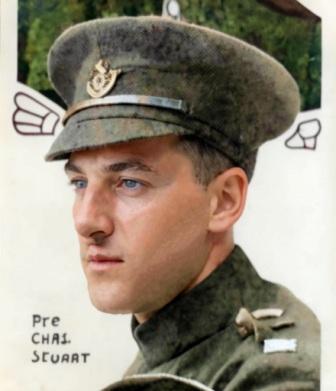
August 17, 1917 Winnipeg Tribune photo of Charles Stuart, restored and colourized by Pieter Valkenburg

As July ended and August began, the 8th Battalion prepared for the offensive against Hill 70, which aimed to draw German reserves away from the Allied offensive in Belgium. The Battle of Hill 70 began on August 15, 1917, but Charles missed this battle, as he’d received a gunshot wound to his right arm on August 5, 1917.

He was taken to No. 1 Casualty Clearing Station, and then sent on August 9, 1917 to No. 22 General Hospital in Camiens.  On August 12, 1917, he was transferred to No. 6 General Hospital in Camiens for a few days before going on August 14, 1917 to No. 2 Convalescent Depot in Rouen.

On September 10, 1917, Charles was discharged and returned to the 8th Battalion as they prepared for the Battle of Passchendaele, enduring harsh conditions as they held their line during late summer.

Early in October 1917, as part of the 2nd Canadian Brigade, they moved from France to the Ypres salient in Belgium to relieve exhausted and battered ANZAC (Australia and New Zealand) forces and take part in the final push to capture Passchendaele during the months of October and November 1917.

Charles survived the Battle of Passchendaele, and, along with the rest of the battalion, returned to the trenches in France for the winter. They were tasked with holding their sectors, as well as training, trench maintenance, and defensive preparations for the German Spring Offensive a series of German attacks along the Western Front that began on March 21, 1918.

…..Charles was seriously wounded during the Battle of Amiens….

WWI on the battlefield ended for Charles on August 10, 1918 during the Battle of Amiens (also known as the Third Battle of Picardy), the opening phase of the Allied offensive which began on August 8, 1918 and lasted 10 days. (For more information, see https://en.wikipedia.org/wiki/Battle_of_Amiens_(1918) and a short video clip at https://finance.yahoo.com/video/battle-amiens-started-century-ago-173913821.html)

During the fighting, Charles received multiple shrapnel wounds in scalp, jaw, larynx, neck, hand, and chest.  He suffered a compound fracture of his lower right jaw as well as a compound fracture of the left clavicle and 1st and 2nd ribs with bone loss.

Brenda explained that Michael Figsby, one of Charles’ grandsons, told her that when Charles “… was grievously injured by an exploding grenade in August 1918 (a terrible repeat), he was ‘left for dead’. Both Stuart’s mother and Michael confirmed that he grabbed at the pant leg or sleeve of one of the guys on death/grave detail. His nose was half blown off and his shoulder and throat were badly torn apart so he was unable to talk and they assumed him to be dead….”

Charles was taken to No. 5 Casualty Clearing Station at Crouy-sur-Somme, where a tracheotomy was done.

…..Charles’ next battle was one of recovery….

Charles was removed from the battlefield, but he now faced a long period of rehabilitation and recovery.  On August 21, 1918 he was taken to No. 10 General Hospital in Rouen, where the tracheotomy tube was removed.

Then, on September 6, 1918, he was evacuated to Queens Sidcup Hospital in Kent, England, where another tracheotomy was done, as well as plastic surgery on his nose.  Charles remained in Kent until May 10, 1919, when he was sent to No. 16 Canadian General Hospital in Orpington, in preparation for returning to Canada.

On May 21, 1919, he was invalided to Canada aboard HMHT Araguaya and arrived in Portland, Maine. He was admitted to Ste Anne de Bellevue Hospital in Montreal, Quebec on June 1, 1919, where it was noted that he had limited movement of left arm, and the tracheotomy tube from August 1918 was still in position.

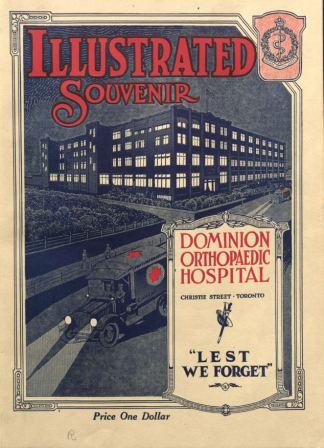
Cover of a souvenir booklet for the Dominion Orthopedic Hospital in Toronto.

Charles remained at the hospital until December 1, 1919 when he was transferred to the Facial Section of Dominion Orthopedic Hospital in Toronto, Ontario (known as Christie Street Hospital), where he underwent reconstructive surgery, and the tracheotomy tube placed in Kent was finally removed.

Brenda recalled that “…Stuart’s mother advised that he marry his sweetheart in hospital because it was uncertain of his survival of his critical injury…”  Charles had been writing to his girlfriend Williamina ‘Nina’ Hood Menzies, a tele-operator, all during his military service.  On April 21, 1920, they were married at the Christie Street Hospital.  The marriage record noted that the witnesses were Robert R. Brown (likely a soldier) and Alice Davis (likely a nurse).

….Charles returned to Winnipeg after being discharged…

After being discharged from the hospital on June 12, 1920, Charles returned to Winnipeg, where he and Nina raised two daughters – Rae and June – and a son Charles. He worked at the CNR (Canadian National Railway) until his retirement at the age of 60.

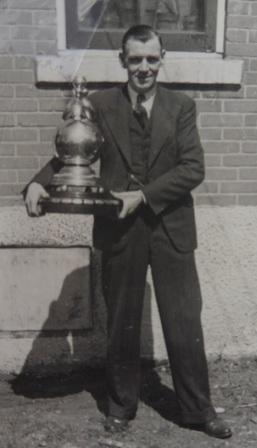
Charles Stuart with a bowling trophy, circa 1940s.  (Photo courtesy of Brenda and Stuart Graves)

Charles lived a full life, even serving with the Armoured Corps Reserve during WWII.  In addition, he was one of the founders of the Winnipeg Sports Club, and a member of the Ten-Pin Bowling Congress.

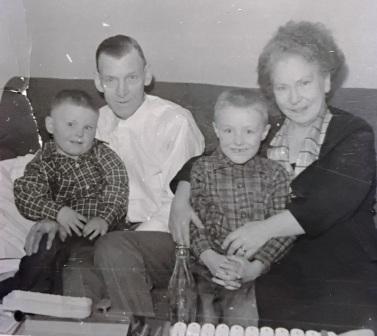
1954 photo of Charles and Nina with grandsons Bill (left) and Stuart (right).  (Photo courtesy of Brenda and Stuart Graves)

….Charles is buried in Elmwood Cemetery in Winnipeg…

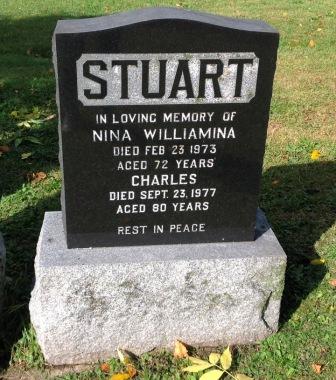
Grave of Charles Stuart and his wife Nina at Elmwood Cemetery in Winnipeg.  (Photo source: Find A Grave)

Charles died on September 23, 1977 in Winnipeg, aged 80, and was buried in Elmwood Cemetery on September 27, 1977.

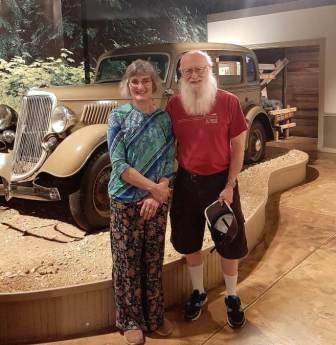
Brenda and Stuart Graves. (Photo courtesy of Brenda Graves)

Thank you to Brenda and Stuart Graves and Michael Figsby for providing information and photos, to Shawn Rainville for newspaper searches, and to Judie Klassen and Kristen den Hartog for help with the post WWI research.

Pieter’s research efforts to find photos and families of soldiers continue. Do you have a story to tell? Email Pieter at memorialtrail@gmail.com, or comment on the blog.

© Daria Valkenburg

….Stories about WWI soldiers who were in the Battle of Amiens…

Over the years, we’ve told several stories of WWI soldiers who were in the Battle of Amiens.  Of the listing below, only Maynard Foy survived the battle and returned home to Canada.

….Want to follow our research?…

If you are reading this posting, but aren’t following our research, you are welcome to do so.  Our blog address: https://onthewarmemorialtrail.com/

4 countries, 6 weeks, 7,000 km – an unforgettable war memorial journey in Europe…. Daria’s book ‘No Soldier Buried Overseas Should Ever Be Forgotten‘ is available in print and e-book formats.  Net proceeds of book sales help support research costs and the cost of maintaining this blog. For more information see https://nosoldierforgotten.com/

Subscribe to our YouTube Channel: On The War Memorial Trail With Pieter Valkenburg: https://www.youtube.com/channel/UCJ591TyjSheOR-Cb_Gs_5Kw.

Never miss a posting!  Subscribe below to have each new story from the war memorial trail delivered to your inbox.
On The War Memorial Trail…..Duty Sacrifice Resilience Part 1: The WWI Soldier Whose War Injuries Didn’t Stop Him From Living His Life

May 18, 2026. Since Pieter began the On The War Memorial Trail research project in 2014, it’s been an honour for us to meet families of those who served.  While much of the focus is on those who served our country and lost their lives while in service, most military service personnel in WWI and WWII returned home. We don’t often know much about their time in service, or what happened afterwards.  As families come forward with information, we are trying to tell these stories.
Brenda Graves of North Tryon, Prince Edward Island shared that both of her husband Stuart’s grandfathers served in WWI and returned home with major injuries.  “…Stuart’s paternal grandfather lost a leg in 1917 and his maternal grandfather was grievously injured in the nose, shoulder, and throat by an exploding grenade in 1918…”

Both men had immigrated to Canada from the United Kingdom, overcame difficult challenges as a result of their war injuries, and went on to marry and live productive lives in Winnipeg, Manitoba.

We decided to tell the story of both grandfathers, and began with Stuart’s paternal grandfather, Francis Edmund GRAVES.

….Francis immigrated to Canada when he was 15 years old…

Born November 5, 1877 in Sheffield, England, Francis was the son of Henry and Mary Ann (nee Lindley) Graves, the second youngest of 6 children, per an 1881 census.

At the young age of 15, he immigrated to Canada, arriving on May 1, 1893 in Quebec City, Quebec aboard the S.S. Sardinian, which had sailed from Liverpool, England on April 20, 1893.  (See https://en.wikipedia.org/wiki/SS_Sardinian) The S.S. Sardinian was an Allan Line steamship that transported British Home Children to Canada, between 1875 and the early 20th century, part of an assisted migration scheme that sent orphaned or underprivileged children for farm work and domestic labour. Francis was listed as a domestic whose destination was Prince Albert, Saskatchewan, so it’s possible that he came to Canada under this program.

It’s unknown if Francis went to Prince Albert, but his obituary noted that he had worked on a farm in Melfort, Saskatchewan.  By the time WWI broke out, he was living in Calgary, Alberta, where he enlisted with the 82nd Battalion on October 6, 1915, a month before he turned 38 years old. His military service file stated that was single, a cook by trade, and worked on the railroad.

…..Francis fell in love…..

On February 17, 1916, Francis married Elizabeth Ellen ‘Helen’ (nee Telfer) Bartram in Calgary. However, it turned out that the marriage was not legal as Helen was married to another man. She was arrested for bigamy on April 12, 1916.  Helen had married Alfred Slous (aka Sloan) after being widowed with 3 children and then had 2 children with Slous.  All 5 children were abandoned with the Childrens’ Aid Society in Toronto before she moved to Calgary.  At a point in his life when he could have walked away, Francis directed that a portion of his pay continue to be paid to her in care of the lawyer assigned to her case.  He never forgot the commitment he had made.

…..Francis left Canada for overseas service…..

Empress of Britain in 1915 as a WWI troop ship.  (Photo source: https://cdn.loc.gov/service/pnp/ggbain/27800/27873v.jpg)

After completing basic training, Francis, as a member of the 82nd Battalion, travelled to Halifax, Nova Scotia, where they went aboard the Empress of Britain on May 20, 1916, and arrived in Liverpool, England on May 29, 1916. The battalion consisted of 34 officers and 1,006 other ranks.

Designated a reserve unit, upon arrival in England, the 82nd Battalion supplied reinforcements to the Canadian Corps in the field, typical of many Canadian Expeditionary Force (CEF) battalions formed in 1915–1916 that were broken up to support front-line units rather than fighting as a distinct unit.

On July 14, 1916, Francis was transferred to the 9th Reserve Battalion, and based in Shorncliffe while training continued for fighting in France. Then, on August 27, 1916, Francis transferred to the 31st Battalion for service in France, arriving at the Canadian Base Depot (CBD) in Le Havre a day later.

…..Francis survived the Battle of the Somme and Battle of Vimy Ridge….

On September 12, 1916, Francis was assigned for a few days to the 2nd Canadian Entrenching Battalion, where he would have been tasked with being part of working parties to help with trench repairs, wiring, road making, and as carrying parties.

He was back with the 31st Battalion on September 15, 1916. As part of the 2nd Canadian Division, the 31st Battalion endured four days fighting for the Regina Trench during the during the Battle of the Somme in late September 1916. Regina Trench was the Canadian name for the longest German trench on the Western Front, and was located along the north-facing slope of a ridge running from north-west of the village of Le Sars, close to the German fortifications at Thiepval. (See https://en.wikipedia.org/wiki/Capture_of_Regina_Trench)

Francis was promoted to Lance Corporal on April 3, 1917, just before he fought ….and survived …the Battle of Vimy Ridge on April 9, 1917. (See https://en.m.wikipedia.org/wiki/Battle_of_Vimy_Ridge)

On April 13, 1917, Francis received another promotion, to be Acting Corporal.

…..Francis was seriously wounded during the Battle of Fresnoy….

We visited Fresnoy-en-Gohelle on our 2017 European War Memorial Tour.  (Photo credit: Daria Valkenburg)

After capturing Vimy Ridge, the Canadian Corps was tasked with continuing to advance through France, specifically attacking the Fresnoy area along with British forces. The Battle of Fresnoy was part of the Third Battle of the Scarpe. Fought from May 3 to 4, 1917, this was the final part of the larger Battle of Arras, which was fought from April 9 to May 16, 1917.

The objective of the Third Battle of the Scarpe was a general offensive to secure better defensive positions along the Scarpe. The focus for the Canadians was the village of Fresnoy-en-Gohelle, which we visited during our 2017 European War Memorial Tour.

Fresnoy-en-Gohelle in the distance. (Photo credit: Daria Valkenburg)

The battle for Fresnoy resulted in high casualties on all sides.  It was the last military battle for Francis, whose luck ran out on May 3, 1917, when he was seriously wounded “….by machine gun bullets in 3 places, which entered his left thigh close to the trunk and fracturing his left thigh bone…”

His medical history case file, written by Captain Young, at Manitoba Medical Hospital in Winnipeg on September 22, 1919, summarized what followed.  “…He lay out on the field for 2 days, then lay in the trench for 2 more days….”

By the time Francis was removed from the battlefield, not only would he have been in great pain, but infection would have set in. In the days before antibiotics, doctors had little chance of saving his leg. On May 8, 1917, the wounds on his leg were cleaned out at a Casualty Clearing Station.

….Francis spent 2 years in various hospitals after being wounded…

Francis was only at the beginning of a long medical ordeal.  From the Casualty Clearing Station he was transferred to No. 8 Stationary Hospital in Wimereaux, France on May 15, 1917.  The hospital was on the south side of Wimereaux, near the coast and the main road to Boulogne, and consisted of approximately 25 hutted barracks and tents.  While in Wimereaux, the doctors did an “…amputation at trunk of left leg on July 6, 1917….”

He was then evacuated to England, to the 2nd Birmingham War Hospital in Birmingham on July 26, 1917.  From there, he was transferred to 3rd Northern General Hospital in Sheffield on August 7, 1917.  He was back in the city of his birth!  His older sister Charlotte, an elementary school teacher, still lived in Sheffield and perhaps was able to visit him while in hospital.

Unfortunately, Francis developed cellulitis at the amputation spot and had a second operation on “…November 25, 1917 for disarticulation of left hip-joint….”

His ordeal was not over as in March 1918, Francis was transferred to Granville Canadian Special Hospital in Buxton for another operation as there was a continuous discharge from the wounded area.

On June 1, 1918, Francis was transferred to 5th Canadian General Hospital Kirkdale in Liverpool, his last stop in England. He was invalided to Canada from Liverpool on June 6, 1918 aboard HMHS Llandovery Castle and arrived in Halifax, Nova Scotia on June 18, 1918, just over two years from the day he left Canada for overseas service.

The next stop for Francis was Whitby Military Hospital in Whitby, Ontario, where he suffered through another operation on July 27, 1918 “….for exploration and scraping.  Wound kept on discharging until November 1918 when it healed and discharged ceased….”

The medical report recorded that Francis “….wore his first artificial limb in January 1919 for one month.  Got new limb in April.  Then got new bucket on this limb on September 10th….”

On September 19, 1919, he was “…transferred to Tuxedo Park Manitoba Military Hospital…” in Winnipeg, Manitoba where the final report on his present condition was noted as “…Wound well healed.  Bucket fits well….”

….Francis lived his post-war life in Winnipeg…

Francis was discharged from the army on December 22, 1919, and remained in Winnipeg, taking a position as a clerk with the Empire Sash and Door Co. Ltd, a position he held until his death.

On June 4, 1921, he married Elizabeth Ross (nee Wilson) Hewitt, widow of WWI soldier John William HEWITT, and mother of two children: George and Irene.

He was a member of the Fragments Amputation Club of the Great War Amputations Association (forerunner of The War Amps – see https://www.waramps.ca/about-us/history/). A photo of the Amputation Club Picnic Committee, of which Francis was a member, was published in the Winnipeg Evening Tribune on August 13, 1923.

Francis (identified by orange arrow) was a member of the Fragments Amputation Club. (Photo source: August 13, 1923 edition of Winnipeg Evening Tribune. Photo restoration and colourization by Pieter Valkenburg.)

On May 8, 1924, Francis and Elizabeth became parents to twin boys – Francis ‘Frank’ Tom and Edmund ‘Ted’ George.

Brenda shared a photo in which Francis and his twin sons were included.  “…. Here is the picture of Stuart’s grandfather, the man wearing the tie and missing a leg. Stuart’s dad (Francis ‘Frank’ Tom) is the young man sitting down. Frank’s twin brother Ted is sitting on Frank’s lap. They are twins but not identical.…”

Front row, Ted Graves, Frank Graves, Francis Edmund Graves.  (Photo courtesy of Brenda and Stuart Graves)

Francis saw his step-daughter married. Irene married RCAF officer Herbert Lines on September 19, 1936.  His step-son George immigrated to Australia and joined the Australian Army.

When Francis passed away on November 8, 1941 in Winnipeg, aged 64, his twin sons were still teenagers, aged 17. Both enlisted in the RCAF at the age of 19.

….Francis is buried in Brookside Cemetery in Winnipeg…

Field of Honour in Brookside Cemetery (Photo source: https://www.winnipeg.ca)

On November 10, 1941, Francis was buried in Brookside Cemetery in Winnipeg, in its Field of Honour section.  He’s one of more than 10,000 veterans buried there since the section opened in 1915, originally as a burial site for Veterans returning from World War I.  The Field of Honour is home to the only Commonwealth War Graves Commission ‘Stone of Remembrance’ in all of the Americas and was installed in 1960.

Stone of Remembrance in Brookside Cemetery (Photo source: https://www.winnipeg.ca)

Grave of Francis Edmund Graves in Brookside Cemetery in Winnipeg.  (Photo source: Find A Grave)

Elizabeth remarried, to William Stewart, and moved to Port Coquitlam, British Columbia.  She died October 11, 1953, aged 60.

Coming up in Part 2, the story of WWI soldier Charles STUART, the maternal grandfather of Stuart Graves.

Brenda and Stuart Graves. (Photo courtesy of Brenda Graves)

Thank you to Brenda and Stuart Graves for providing information and photos, and to Shawn Rainville for extensive newspaper searches.

Shawn noticed a coincidence with his own family history, saying that Francis Graves lived directly across the street from his “…great-uncle Alexander Rainville, who had enlisted in March 1918, and was wounded in the head and knees in August 1918 in France.   My great-uncle was born in 1884 and died in 1937.  So both were relatively close in age and died relatively young. It’s quite conceivable that they knew each other. My great-uncle was buried in Brookside Cemetery as well …”

Living in Prince Edward Island ourselves, we were interested to learn that one of Irene Hewitt Lines’ sons, Hewitt Lines, an officer in the RCAF, married Faye Hardy of West Bloomfield in September 1968!

Pieter’s research efforts to find photos and families of soldiers continue. Do you have a story to tell? Email Pieter at memorialtrail@gmail.com, or comment on the blog.

© Daria Valkenburg

….Story about a WWI soldier who lost his life in the Battle of Fresnoy…

 ….Want to follow our research?…

If you are reading this posting, but aren’t following our research, you are welcome to do so.  Our blog address: https://onthewarmemorialtrail.com/

4 countries, 6 weeks, 7,000 km – an unforgettable war memorial journey in Europe…. Daria’s book ‘No Soldier Buried Overseas Should Ever Be Forgotten‘ is available in print and e-book formats.  Net proceeds of book sales help support research costs and the cost of maintaining this blog. For more information see https://nosoldierforgotten.com/

Subscribe to our YouTube Channel: On The War Memorial Trail With Pieter Valkenburg: https://www.youtube.com/channel/UCJ591TyjSheOR-Cb_Gs_5Kw.

Never miss a posting!  Subscribe below to have each new story from the war memorial trail delivered to your inbox.