On The War Memorial Trail…..Our 2025 Visit To Freedom Museum Zeeland

January 31, 2026. Last spring we were in The Netherlands and Belgium for the 80th Anniversary of Liberation Commemoration events, and placed flags at the graves of 383 soldiers in 14 cemeteries. 

After visiting the Canadian War Cemetery in Bergen Op Zoom (see https://onthewarmemorialtrail.com/2026/01/12/on-the-war-memorial-trail-our-2025-visit-to-the-canadian-war-cemetery-in-bergen-op-zoom/) and the Canadian War Cemetery in Adegem (see https://onthewarmemorialtrail.com/2025/12/08/on-the-war-memorial-trail-a-visit-to-the-canadian-war-cemetery-in-adegem/), we were very interested in learning more about the Battle of the Scheldt, as so many of the men buried in these two cemeteries lost their lives in this battle.  

….Why was the Battle of the Scheldt so important?…

Map shows Battle of the Scheldt in The Netherlands.  (Map source: http://www.canadiansoldiers.com)

The Battle of the Scheldt’s objective was to free up the way to the Port of Antwerp in Belgium for supply purposes. Canadian soldiers suffered almost 8,000 casualties (wounded and dead) in what turned out to be the battle with the most Canadian casualties in The Netherlands. (See https://www.veterans.gc.ca/eng/remembrance/history/second-world-war/scheldt)

….The Freedom Museum Zeeland focuses on the Battle of the Scheldt…

One sunny Saturday in May 2025 we visited the Freedom Museum Zeeland (Bevrijdingsmuseum Zeeland in Dutch) in the very small village of Nieuwdorp.  This is a privately run museum that focuses on the Battle of the Scheldt. We found it very informative, with lots of displays and panels in 4 languages – Dutch, English, French, and German. 

Site map from the Museum’s pamphlet.

The Museum pamphlet stated that the museum “…takes you through the eventful years in the province of Zeeland during World War II.  The ‘Battle of the Scheldt’ is the central thread of this story. The fierce battle fought in the autumn of 1944 between the Allied and German troops for command over the Western Scheldt, the main waterway to the already liberated port of Antwerp.  A battle that is often forgotten, despite its crucial significance for the ensuing liberation of Western Europe….” 

While the battle isn’t forgotten in Canada, as it cost so many Canadian soldiers their lives, we were unaware that the struggle for control of the Scheldt began years earlier, with French forces trying to help protect Zeeland in May 1940. 

A panel explained that “…on 16 May 1940 German SS troops cross the South Beveland Canal, taking the French by surprise. Come evening the Germans have already reached the Sloedam, the only connection with Walcheren island by land.  The defence of the Sloedam is not impossible, so the French entrench themselves to stop the Germans….

Unfortunately, on May 17, the Germans prevailed. “…Despite fierce resistance, the Germans succeed in crossing the Sloedam, thanks to heavy air support” 

The Mayor of Middelburg had “…anticipated the military violence and already advised citizens to leave town on 14 May.  He was proved right because on 17 May a large part of the old town centre of Middelburg goes up in flames….

The French retreated to Vlissingen, and boarded ships to leave.  “…Dutch capitulation is reported to the Germans, who then invade Middelburg…”  Zeeland was the last province of The Netherlands to be occupied, and remained under German occupation until November 1944. 

The harrowing story of the effect of German occupation on Dutch citizens, and the struggle to liberate Zeeland in the fall of 1944 is vividly told through displays and information panels.

….We saw military equipment that had been featured in many of our stories…

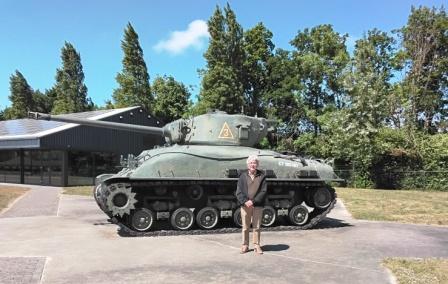
Pieter stands in front of a Sherman tank.  (Photo credit: Daria Valkenburg)

After completing the circuit of information panels and displays indoors, we went outside to look at more displays and military equipment, including a Sherman tank.

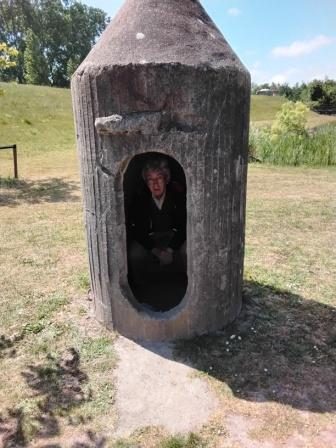
Pieter inside a German one-man bunker. (Photo credit: Daria Valkenburg)

One object that intrigued us was a German one-man bunker, made of reinforced concrete.  An information panel explained that this “…Splitterschutzzelle (splinter protection cell) offered protection against shelling, air raids, and bombardments.  They were often placed in residential districts, near factories or military installations….”  While it offered some protection, the one-man bunker was not able to withstand a direct hit.

….We were able to drive across a Bailey bridge…

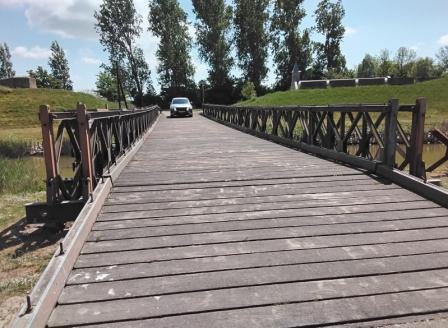
We were delighted to see a Bailey bridge, which we’d never seen in real life before.  Pieter of course went across it, but it was a bit too far away for me to tackle.  The bridge was in an area that was only for pedestrian traffic, and not for vehicles.

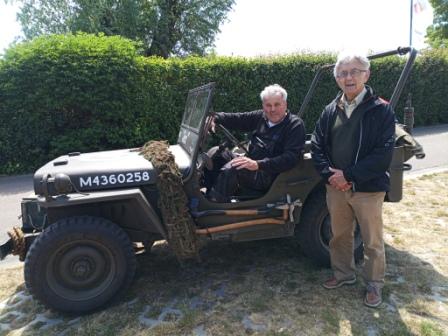
After seeing all of the exhibits and the military equipment, we returned to the parking lot.  Just as we reached our vehicle, a man in a jeep pulled up and asked if we were the Canadians. When we’d paid the entrance fee for the museum, we’d mentioned that we were from Canada.  The man in the jeep was Kees Traas, who owns the museum, and wanted to meet us.  

Pieter with Kees Traas in his WWII era jeep.  (Photo credit: Daria Valkenburg)

Kees was very happy that Pieter spoke Dutch and the two of them became very engaged in conversation about the museum and how it began.  Kees became my hero when he told Pieter to take the car and drive it across the Bailey bridge so that I could see it, and to make sure we stopped in at the church, which had a story about a Canadian soldier. 

Pieter asked if the bridge could hold the car.  “…Oh yes…” said Kees, “…it can hold 3 tons….”  So an overjoyed Pieter got to experience travelling over a ‘temporary’ bridge that we’d only read about in war diaries.

A Bailey bridge, named after it’s British inventor, was “…an emergency bridge to replace bridges that were destroyed, or as an alternative next to bridges that did not have enough bearing capacity….” 

Pieter drove our vehicle across the Bailey bridge. The building seen on the right is a chapel.  (Photo credit: Daria Valkenburg)

We went back and forth across the bridge, so that I could experience it, and then once more with just Pieter in the car, while I took photos of the crossing.

….The chapel featured the story of Jean-Maurice Dicaire….

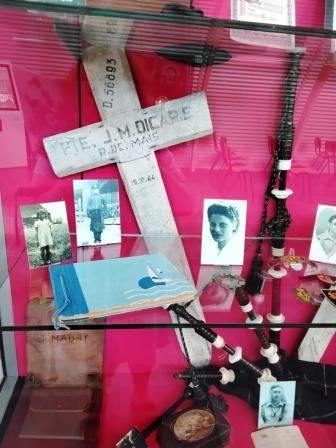
Display case in the chapel featured Pte Jean-Maurice Dicaire. (Photo credit: Daria Valkenburg)

We also visited the chapel that Kees had mentioned to us, which had a display case featuring the story of Jean-Maurice DICAIRE, born in Hawkesbury, Ontario, who was serving with Le Régiment de Maisonneuve, when he lost his life on October 29, 1944, aged 23.

Jean-Maurice Dicaire was featured on an information panel in the chapel.

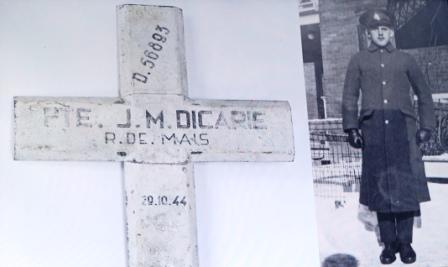
An information panel explained that the original grave marker had been found near a garbage container and given to the museum.  Unlike many Canadian soldiers who were reburied in the Canadian War Cemetery in Bergen Op Zoom, Jean-Maurice’s body was never removed from the Kloetinge General Cemetery. 

The original grave marker was likely discarded as his surname was incorrectly spelled.  The wooden marker was replaced with a stone at his grave that has his correct surname.  Today the grave marker with the incorrect spelling is in the chapel at the Freedom Museum Zeeland, as part of the memorabilia that features this young soldier. 

Thank you to Kees Traas, Chair of the Freedom Museum Zeeland Foundation, for allowing us to drive over the Bailey bridge. 

After arriving back at our hotel, we enjoyed a delicious and relaxing dinner.  After visiting 383 graves in 14 cemeteries, in 2 countries, plus the Halifax L9561 memorial panel in Wons, we wanted to celebrate the completion of our goal. 

But we still weren’t finished! More adventures awaited as we continued with our 2025 European War Memorial Tour to visit a special Indigenous Exhibit at the Freedom Museum in Groesbeek. 

The research work continues for Pieter.  If you have photos or information to share about soldiers buried in The Netherlands or Belgium, please email him at memorialtrail@gmail.com, or comment on the blog.    

© Daria Valkenburg

….Want to follow our research?…

If you are reading this posting, but aren’t following our research, you are welcome to do so.  Our blog address: https://onthewarmemorialtrail.com/

4 countries, 6 weeks, 7,000 km – an unforgettable war memorial journey in Europe…. Daria’s book ‘No Soldier Buried Overseas Should Ever Be Forgotten‘ is available in print and e-book formats.  Net proceeds of book sales help support research costs and the cost of maintaining this blog. For more information see https://nosoldierforgotten.com/

Subscribe to our YouTube Channel: On The War Memorial Trail With Pieter Valkenburg: https://www.youtube.com/channel/UCJ591TyjSheOR-Cb_Gs_5Kw

Never miss a posting!  Subscribe below to have each new story from the war memorial trail delivered to your inbox.

On The War Memorial Trail….The WWII Soldier From Winnipeg Who Was Recognized For His Heroism During The Dieppe Raid But Died During The Battle Of The Scheldt

January 21, 2026. For the past several years, in the week before Remembrance Day, the Winnipeg Free Press newspaper features a soldier on one of the photo search lists that Pieter gets from the Canadian War Cemeteries in The Netherlands.  For the November 2025 feature, journalist Kevin Rollason asked if Pieter had a soldier on his list from Winnipeg, my home town.

Pieter said yes, and asked if Kevin would feature a soldier, buried in the Canadian War Cemetery in Bergen Op Zoom, The Netherlands, who overcame a traumatic childhood and was recognized for ‘gallant and distinguished service’ during the Dieppe Raid (Operation Jubilee) on August 19, 1942, before losing his life on October 27, 1944, aged 22, during the Battle of the Scheldt. The search for a photo of the soldier was still active when Kevin’s story ‘Searching For A Hero’ was published on November 10, 2025.  (See Searching for a hero by Kevin Rollason)

Charles ‘Gordon’ ERICKSON was born July 27, 1922 in Winnipeg, Manitoba, the son of Frank and Helen (Ellen) Gordon (nee Grant) Erickson. According to their marriage record, Frank was born in USA, and Helen in Scotland. Gordon was the middle child, with an older sister, Hazel Francis, and a younger sister, Barbara ‘Nancy’.

….Gordon and his sister Nancy ended up in the care of the Children’s Aid Society…

It’s unclear exactly what happened, but before Gordon turned 5, the family had fractured.  A  Free Press Evening Bulletin notice from July 5, 1927 stated that Gordon and Nancy would be put into care of the Children’s Aid Society as of July 27, 1927.  The two children had been adopted by two different families. Unfortunately, both adoptions failed, putting them into care.

In the end, the two were separated from each other and didn’t reconnect until both were in service during WWII. The fate of their older sister Hazel was unknown to them.

Shortly after the Winnipeg Free Press article was published, Nancy’s son, Gordon Barker, contacted Pieter.  He explained that Frank “….worked on railroad and abandoned his wife and children, and it was believed that he returned to the USA.  Helen travelled to Minneapolis to look for him, had a nervous breakdown, and ended up in a mental institution, where she is thought to have died, circa 1966…. 

…. Gordon lied about his age upon enlistment…

Life was not easy for Gordon during his childhood.  When he enlisted on January 2, 1940 with the No. 5 General Hospital, Royal Canadian Army Medical Corps (RCAMC), Canadian Active Service Force (CASF), he wrote that he was born in 1918.  This was later changed to 1919, which was still incorrect as he was born in 1922.

His next of kin was originally listed as his father, but this was then changed to his Children’s Aid Society Guardian, Joseph Dumas. When asked if he had ever worked before enlistment, he stated that, from 1932 up to the date of enlistment, he had worked as a farmhand at the Smallicombe farm in Holland, Manitoba, receiving a weekly wage of $6 and his ‘keep’ (food and a place to sleep).  He had finished Grade 8 and listed soccer, swimming, and softball as sports he enjoyed.

….Gordon left Canada for overseas service…

Gordon worked as a medical orderly at No. 5 General Hospital in Winnipeg for almost the entire month of January.  On January 29, 1940, he boarded a ship in Halifax, Nova Scotia, and with other members of his unit, left Canada for the United Kingdom on January 30, 1940, sailing from Halifax, and disembarking in Gourock, Scotland on February 9, 1940. 
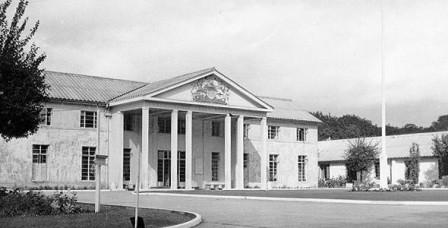
No. 5 Canadian General Hospital in Taplow.  (Photo source: Eton Wick History)

Once in Great Britain, Gordon continued as a medical orderly, at the 600 bed No. 5 Canadian General Hospital in Taplow, Buckinghamshire, until March 28, 1941. This wartime hospital, which looked after wounded soldiers, was established by the Canadian Red Cross in 1940 and had been built on land donated by the Astor family at their Cliveden Estate.

….Gordon was transferred to the Queen’s Own Cameron Highlanders of Canada…

On March 28, 1941, Gordon was transferred to the Queen’s Own Cameron Highlanders of Canada and sent for advanced infantry training. Then, on January 15, 1942, he was assigned to No. 2 Division Infantry Reinforcement Unit (DIRU) for additional training in preparation for the upcoming Dieppe Raid.  On May 1, 1942, he returned to the Queen’s Own Cameron Highlanders of Canada. 

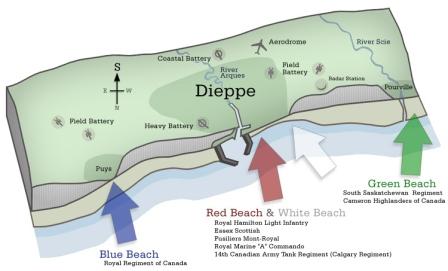
Map showing the Dieppe Raid. (Map source: https://cbf-fccb.ca/)

On August 18, 1942, Gordon travelled to France with the Regiment, and was part of the combined attack for the Dieppe Raid, known as Operation Jubilee, on August 19, 1942.  This was a disastrous Allied amphibious attack on the German-occupied port of Dieppe in northern France. (See https://www.veterans.gc.ca/en/remembrance/military-history/second-world-war/dieppe-raid and https://thecanadianencyclopedia.ca/en/article/dieppe-raid)

In the battle plan, the South Saskatchewan Regiment was to land in the first wave of the attack on Green Beach to secure the beach at Pourville, the right flank of the operation. The Queen’s Own Cameron Highlanders of Canada would then land in the second wave and move inland along the eastern bank of the Scie River to meet up with the tanks of the Calgary Regiment coming from Dieppe and capture the airfield at Saint-Aubin-sur-Scie. They would then clear the Hitler Battery and attack the suspected German divisional headquarters.

Things didn’t go as planned.  While the attack began on time (at 04:50 am) the South Saskatchewan Regiment landed west of the river, instead of in front of it. This didn’t pose a problem for the force aiming to clear the village and attack the cliffs to the west, but for the other force it meant they had to move through the village, cross the exposed bridge over the river before attempting to get on the high ground to the east.

The resulting delay gave the Germans had time to react and deploy, just as the Queen’s Own Cameron Highlanders of Canada came along in their landing craft as the second wave to attack on Green Beach.  As they reached 910 metres (1000 yards) off Green Beach, German shore batteries, machine guns, and mortars opened fire.  

….Gordon was wounded during the Dieppe Raid…

The main landing at Dieppe had been unsuccessful, and the failure of tanks to arrive made it impossible for the Regiment to gain its objectives. With increased German opposition and no communication with headquarters, the Regiment, which had advanced once reaching the beach, began to fight back to Pourville, carrying their wounded. They made it back and re-established contact with the South Saskatchewan Regiment, only to learn that there was an hour’s wait for the landing craft to return for re-embarkation.

Both the Queen’s Own Cameron Highlanders of Canada and the South Saskatchewan Regiment fought desperately during the wait, but there were too many casualties. At 11:00 am the landing craft began to arrive, taking grievous losses on the approach into the beach. More men were killed and wounded as they tried to board the landing craft under enemy fire. Five landing craft and one tank landing craft managed to rescue men from the shallows and cleared the beach with full loads, but within half an hour, no further rescues were possible.

Of 503 Queen’s Own Cameron Highlanders of Canada who participated in the raid, 346 were casualties: 60 were killed in action, 8 died of wounds after evacuation, and 167 became prisoners of war (with 8 POWs dying from their wounds). 268 returned to England, 103 of them wounded.
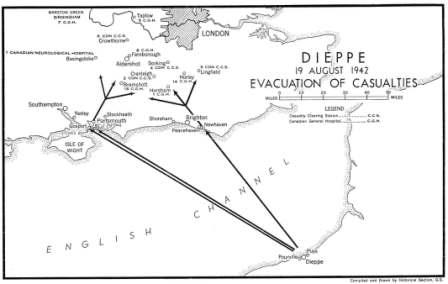
Evacuation of casualties from Dieppe to England on August 19, 1942.  (Map source: ‘Official History Of The Canadian Medical Services 1939-1945’)

Gordon was one of the men wounded during re-embarkation.  He was evacuated to No. 15 Canadian General Hospital in Bramshott, United Kingdom, with a shrapnel wound to his left ear. According to his hospital file the “….wound penetrated to the bone….” with “…some slight retraction of eardrum… Probably slight concussion as result of artillery fire….”  He remained in hospital until August 31, 1942, when the wound healed, and he was able to return to duty.

For his actions during the Dieppe Raid, King George VI was “…graciously pleased to approve that ….”  Gordon “…be mentioned in recognition of gallant and distinguished services in the combined attack on Dieppe…”  On December 8, 1942, Gordon was promoted to Lance Corporal, remaining in the United Kingdom for further training.

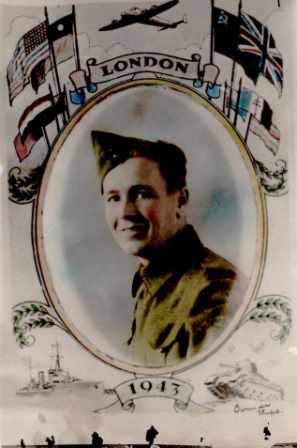
…. Nancy’s son Gordon had a photo of his uncle…
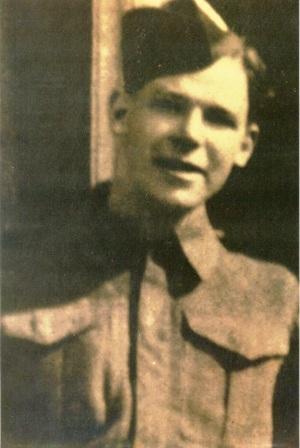
Charles ‘Gordon’ Erickson.  (Photo courtesy of Gordon Barker)

Gordon and his sister Nancy were reunited while both were serving in England.  Her son Gordon explained that his mother had joined the Royal Canadian Air Force (RCAF) on August 14, 1942, and served as a secretary for the military in London, England during the war, working on soldiers’ duty assignments and other administrative tasks. He had photos of both his mother and his uncle, who he was named after.
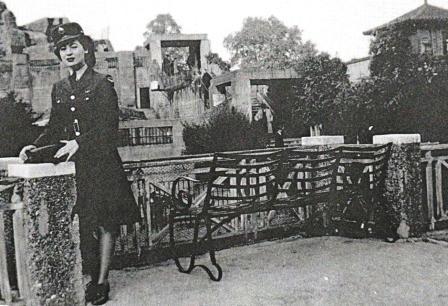
Nancy Erickson in England in 1942.  (Photo courtesy of Gordon Barker)

….Gordon was very highly regarded…

Gordon quickly received another promotion, to Corporal, on January 31, 1943.  In June 1943, he was sent to No. 5 (Battle) Wing Canadian Training School at Rowland’s Castle, Hampshire, England, for a 4 week Battle Drill course which trained Canadian soldiers in how to react when coming under enemy fire. (See https://www.southdowns.gov.uk/wp-content/uploads/2017/01/The-Canadian-Army-Battle-Drill-School-Stansted-Park-1942.pdf)

The course tried to mimic combat conditions, using obstacle courses and simulated battlefields, live rounds fired over the heads of students, controlled explosions, target practice, and dummies to bayonet.

One of Gordon’s instructors may have been Ralph Schurman BOULTER, whose story was previously told on this blog. (See https://onthewarmemorialtrail.com/2023/03/07/on-the-war-memorial-trail-the-battle-of-bienen-part-2-the-wwii-battle-drill-instructor-from-oleary/)

A September 21, 1943 interviewer wrote in Gordon’s service file that he had “….very high learning ability, a good appearance, and a pleasant personality….”  It further noted that Gordon requested “…any courses on supporting infantry weapons…

….Gordon and the Queen’s Own Cameron Highlanders of Canada arrived in France in July 1944….
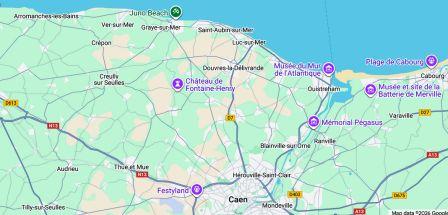
The Queen’s Own Cameron Highlanders of Canada Regiment disembarked in Graye-sur-Mer and made their way towards Caen.  (Map source: Google maps)

Gordon and the Queen’s Own Cameron Highlanders of Canada Regiment continued training while in the United Kingdom, but on July 5, 1944, a month after D-Day, they left aboard USOS ‘Will Rogers’ from Newhaven, Sussex for Normandy, as part of the as part of the 6th Canadian Infantry Brigade, 2nd Canadian Infantry Division, arriving in Graye-sur-Mer, Calvados, France 2 days later. 

By July 12, 1944, Battalion headquarters was based in an orchard near Rots, France, and the troops were dispersed outside of Caen, with the Queen’s Own Cameron Highlanders of Canada sent to Carpiquet. The war diary for that day noted that “…the town was completely demolished. Battalion takes up defence position…

The Queen’s Own Cameron Highlanders of Canada Regiment were west of Caen in Carpiquet.  (Map source: Google maps)

….Gordon was injured during the Battle of Saint André-sur-Orne….

The Battalion was ordered to capture the village of Saint André-sur-Orne, located south-west of Caen. They reached it on July 20, 1944, with rain hindering operations. The Allies faced stiff resistance as they began Operation Spring, a major bombardment that took place on the night of July 24-25, to capture the heights of Verrières Ridge, which overlooks the area between Caen and Falaise. (See https://www.canadiansoldiers.com/history/battlehonours/northwesteurope/verrieresridge.htm)

Part of Operation Spring was the Battle of Saint André-sur-Orne, a village on the starting line of the offensive.  It was captured by the Queen’s Own Cameron Highlanders of Canada (6th Infantry Brigade, 2nd Infantry Division) Canadians to the north.

At some point during the battle, Gordon was wounded and evacuated to the United Kingdom for treatment.  He remained in the United Kingdom from July 26 to September 23, 1944, after which he returned to his Regiment on September 24, 1944.  By now, the Regiment had left France and was in the vicinity of Sint-Job-in-‘t-Goor, in the province of Antwerp, Belgium.

Gordon arrived just after a failed offensive, where Canadian and British troops had tried to secure an undamaged bridge over the Turnhout-Schoten Canal on September 23, 1944. Due to fierce German resistance Allied troops were unable to prevent the enemy from blowing up the bridge.

….The Queen’s Own Cameron Highlanders of Canada were involved in the Battle of the Scheldt….

The Regiment next began preparing to participate in the upcoming Battle of the Scheldt, which began officially on October 2 and lasted until November 8, 1944.  The Battle of the Scheldt’s objective was to free up the way to the Port of Antwerp in Belgium for supply purposes. Canadians suffered almost 8,000 casualties (wounded and dead) in what turned out to be the battle with the most Canadian casualties in The Netherlands. (See https://www.veterans.gc.ca/eng/remembrance/history/second-world-war/scheldt)

Map shows location of South Beveland and Walcheren Island  in The Netherlands.  (Map source: http://www.canadiansoldiers.com)

The War Diary for October 25, 1944 stated that at 9 pm they were ordered to move the next day to an area “…in the Beveland Causeway…” 

The Beveland Causeway, also known as the Sloedam, was a narrow land link between South Beveland and Walcheren Island in The Netherlands, crucial for gaining access to the port of Antwerp, and the site of brutal, costly battles in 1944 as Canadian forces fought to secure it against German defenders. This narrow strip, bracketed by marshes, was a heavily defended bottleneck, becoming the focus of fierce assaults. 

The War Diary for October 26, 1944 described the challenges faced as they moved into position and were attacked by 88 mm German guns.  “…Enemy 88 mm lays direct fire on crossroads as Battalion embusses…..”  There were no casualties at this point, but one vehicle was damaged.  However, as they moved along the road onto the Beveland Causeway, the convoy was “…mortared as it proceeded…” resulting in a few non-fatal casualties.  At 3 pm they were ordered to reverse direction towards the village of Yerseke.

….Gordon lost his life during the Battle of the Scheldt….
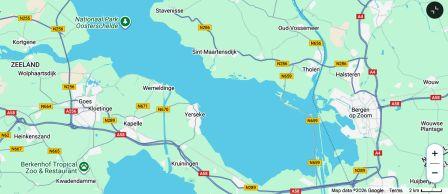
The Queen’s Own Cameron Highlanders of Canada moved back from the Beveland Causeway towards Yerseke. (Map source: Google maps)

The War Diary for October 27, 1944 continued to document the struggles faced by the Battalion as they entered Yerseke and took up positions north of the village.  The day was “…overcast, visibility poor, light mist, light rain….Battalion enters Yerseke at first light…”  They were ordered to cross the canal at a “…small footbridge one company at a time…” The plan was for “…two companies to form bridgehead while two companies push out to take Wemeldinge…

Things didn’t go according to plan.  “…It was found impossible to cross footbridge due to mortars and one 88 mm gun….”  At 6:30 pm, Plan B called for “…companies to take up positions along canal bank.  Battalion will try crossing by assault boat at 2100 hours…

While waiting for the assault boats, the men were hit by “…enemy mortars and shells….6 wounded, 2 killed…”  The crossing by assault boats didn’t go well, as the 10:30 pm report in the War Diary recorded. “…Battalion attack across canal repulsed by enemy mortar and heavy machine gun fire.  Two companies landed on island … All boats but one sunk, that one boat retired two companies to East bank under heavy fire…

22 year old Gordon was among the fatalities that day, likely one of the two men killed while waiting for the assault boats to arrive.  

….Gordon is buried in Bergen Op Zoom…
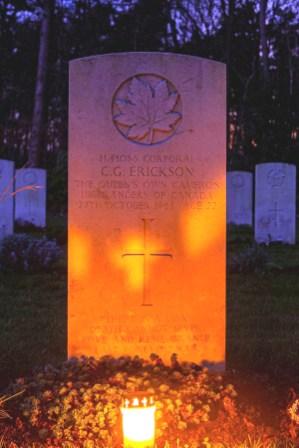
Grave of Charles ‘Gordon’ Erickson in the Canadian War Cemetery in Bergen Op Zoom, The Netherlands with a Christmas Eve candle.  (Photo courtesy of Caroline Raaijmakers)

Gordon was temporarily buried on October 31, 1944 in the cemetery in Sint-Maartensdijk, before being reburied in the Canadian War Cemetery in Bergen Op Zoom, The Netherlands on September 5, 1945. 

Gordon’s younger sister, Nancy Erickson Vincent, survived the war, had two sons, and lived in Espanola, Ontario until her death in 2014.  His older sister, Hazel Francis Erickson Kerr, lived in St Thomas, Ontario, but had died by the time she was found by Nancy’s son Gordon Barker in 2006.

By then, Nancy had fallen ill with dementia. “….I didn’t tell her that I found her sister because her sister had already passed away by that time….” he said. “…With the dementia and everything going on, I didn’t want to cause her any more pain…” 

Thank you to Shawn Rainville for newspaper searches, and to Judy Noon of the Royal Canadian Legion Branch 39 in Espanola, Ontario for contacting Gordon Barker.  A big thank you goes to Gordon Barker for providing photos and information, and to Kevin Rollason for writing a newspaper article highlighting the search for a photo. 
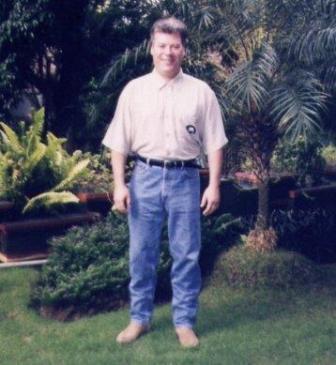
Gordon Barker in Bogor, Indonesia. (Photo courtesy of Gordon Barker)

If you have photos or information to share about soldiers buried in The Netherlands or Belgium, please email him at memorialtrail@gmail.com, or comment on the blog.    

© Daria Valkenburg

….Want to follow our research?…

If you are reading this posting, but aren’t following our research, you are welcome to do so.  Our blog address: https://onthewarmemorialtrail.com/
4 countries, 6 weeks, 7,000 km – an unforgettable war memorial journey in Europe…. Daria’s book ‘No Soldier Buried Overseas Should Ever Be Forgotten‘ is available in print and e-book formats.  Net proceeds of book sales help support research costs and the cost of maintaining this blog. For more information see https://nosoldierforgotten.com/

Subscribe to our YouTube Channel: On The War Memorial Trail With Pieter Valkenburg: https://www.youtube.com/channel/UCJ591TyjSheOR-Cb_Gs_5Kw

Never miss a posting!  Subscribe below to have each new story from the war memorial trail delivered to your inbox.

On The War Memorial Trail…..Our 2025 Visit To The Canadian War Cemetery In Bergen Op Zoom

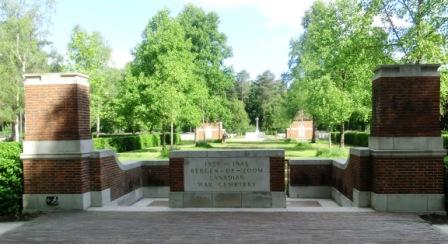
Entrance to the Canadian War Cemetery in Bergen Op Zoom.  Pieter can be seen in the distance carrying the bag of flags!  (Photo credit: Daria Valkenburg)

January 12, 2026. Readers of this blog are aware that Pieter has been involved in finding photos of Canadians who are buried in The Netherlands since 2014.  Last spring we were in The Netherlands and Belgium for the 80th Anniversary of Liberation Commemoration events, and placed flags at the graves of 383 soldiers in 14 cemeteries. 

….Flags placed at the graves of soldiers from 5 provinces…

After visiting a number of cemeteries in The Netherlands and Belgium during our 2025 European War Memorial Tour, we travelled back to The Netherlands to visit the last cemetery on our list – the Canadian War Cemetery in Bergen Op Zoom. 

Many Canadians who are buried here lost their lives during the Battle of the Scheldt. Others were reburied here from other cemeteries, while some, mostly airmen, had drowned and their bodies washed up.

There are 1,119 WWII Commonwealth burials, 968 of them Canadian. There are also 109 casualties from the United Kingdom, 6 from New Zealand, 5 from Australia, and 31 that are unidentified. Flags were placed by Pieter at 51 graves at this cemetery:

  • 14 were from Nova Scotia
  • 21 from New Brunswick
  • 7 from Prince Edward Island
  • 1 from Saskatchewan
  • 8 from Ontario

9 of the graves also received an Acadian flag.  All of the graves received a Canadian flag.  Provincial flags were placed at all graves, with the exception of the soldier from Saskatchewan, for which, unfortunately, we did not receive flags.

.…This was our second visit to Bergen Op Zoom…

We’d first been to the cemetery in 2019. (See https://onthewarmemorialtrail.com/2019/12/07/on-the-war-memorial-trail-our-2019-visit-to-the-canadian-war-cemetery-in-bergen-op-zoom/)

The cemetery was an hour’s drive from our hotel in Tilburg.  In The Netherlands, no one talks kms, it’s all about the time it takes to get to a destination….and that varies depending on the time of day, if it’s a weekend or holiday, or a normal weekday.  Distances aren’t far by North American standards, but traffic is so congested – and drivers so impatient and aggressive – that it can take an hour or longer to travel a distance that would take 10 or 15 minutes back home.

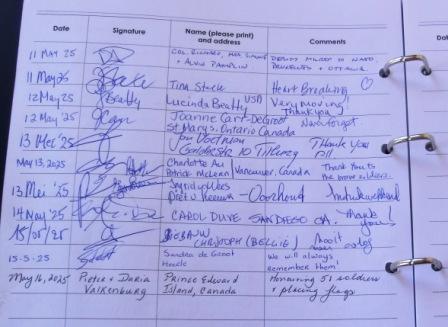
As always, when we are in a war cemetery, we write an entry in the visitors’ book.  (Photo credit: Daria Valkenburg)

Whenever we visit a war cemetery, we always make time to write in the visitors’ book, and this time I wrote that we were here to place flags at 51 graves.

….A surprise encounter led to one more grave receiving a Canadian flag…

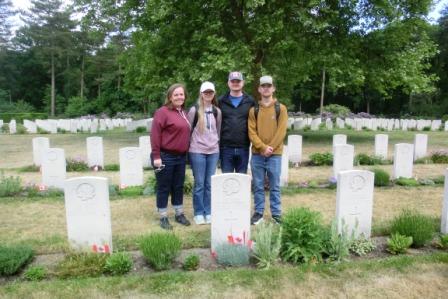
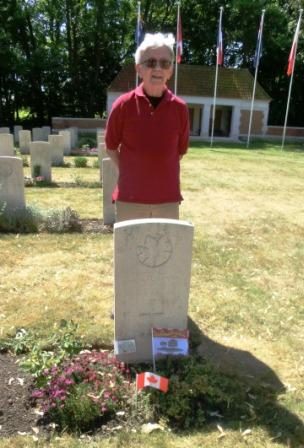
While in the cemetery, we met a family from Calgary, Fred and Tasha Best, and their two children, who’d come to visit Fred’s great-uncle, Hans Karl GRAFFUNDER, a soldier from British Columbia who died on October 1, 1944, aged 23, while serving with the Calgary Highlanders.

Standing behind the grave of Hans Karl Graffunder, from left to right: Tasha, Samantha, Fred (the soldier’s great-nephew), and Nate Best of Calgary, Alberta. (Photo credit: Daria Valkenburg)

Pieter contributed a Canadian flag to be placed by the grave. After Pieter explained about the search for photos of soldiers, they immediately emailed a photo of Hans Karl to us, which was then shared with Caroline Raaijmakers, Chair of Faces To Graves Bergen Op Zoom. If only it was that easy to get all the photos on the wish lists!

Fred Best explained that originally it was thought that his great-uncle was a German soldier, due to his surname, blond hair, and blue eyes, but once he was identified as Canadian, he was buried in Bergen Op Zoom.

….It took us 2 hours to place flags…

It was not as hot and humid as in previous days, and as the cemetery is smaller than the other two Canadian War Cemeteries in The Netherlands, we were finished in 2 hours, an amazing feat.

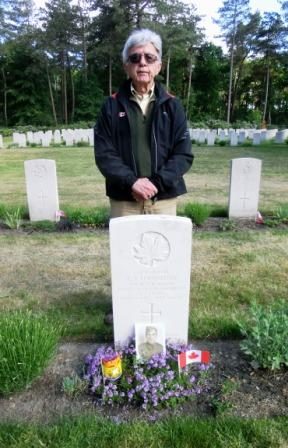
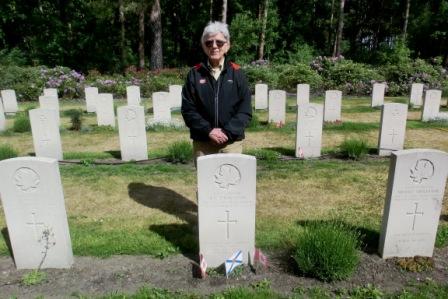
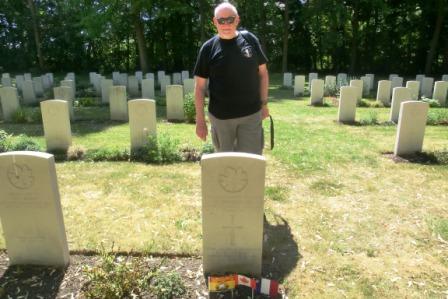
Pieter stands behind the grave of Albert James Lounsbury.  (Photo credit: Daria Valkenburg)

When we visited the grave of WWII soldier Albert James LOUNSBURY, of Petitcodiac, New Brunswick, we brought a photo of him with us.  Pieter placed the photo at the grave along with flags of Canada and New Brunswick.  The photo was later given to Caroline Raaijmakers.  While serving with the Black Watch of Canada, Albert lost his life on October 13, 1944, aged 36.  His story will be coming up in a future posting.

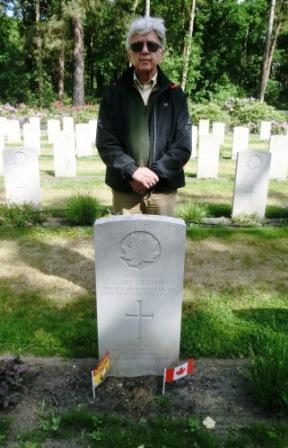
Pieter stands behind the grave of Gregory Philip Anthony McCarthy. (Photo credit: Daria Valkenburg)

WWII soldier Gregory Philip Anthony MCCARTHY, born in Grand Falls, New Brunswick, was serving with the 10th Independent Machine Gun Company, New Brunswick Rangers when he killed in The Netherlands, aged 22, on January 19, 1945, when the company’s own mortar misfired and exploded. (See https://onthewarmemorialtrail.com/2021/03/16/on-the-war-memorial-trail-atlantic-canada-remembers-part-8/)

Pieter stands behind the grave of Arnold Ernest ‘Ernie’ Thornton. (Photo credit: Daria Valkenburg)

WWII soldier Arnold Ernest ‘Ernie’ THORNTON, born in Amherst, Nova Scotia, was serving with the Calgary Highlanders when he killed in Belgium, eight days before his 23rd birthday, on September 22, 1944, during the Battle of the Scheldt. (See https://onthewarmemorialtrail.com/2021/01/16/on-the-war-memorial-trail-atlantic-canada-remembers-part-3/)

….An invitation to lunch…

We finished placing flags a few minutes before we were scheduled to meet Caroline Raaijmakers and her husband Han.  They invited us to their home for lunch, where we enjoyed a delicious bowl of white asparagus soup and sandwiches.

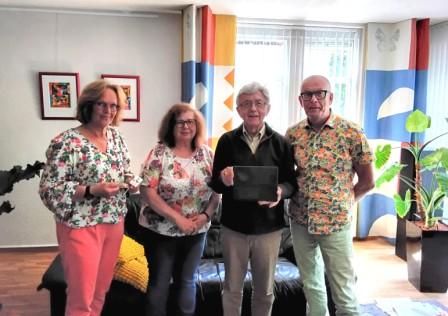
Caroline Raaijmakers, Daria, Pieter, and Han Raaijmakers. Pieter holds a plaque from the family of Alvah Leard, a soldier from Prince Edward Island. (Photo credit: Dorus Raaijmakers)

Caroline showed us some of the material left at graves by Canadian students visiting the cemetery a few weeks before us. They saved everything as otherwise it would have been discarded or ruined by rain.  It was amazing!  Some students had painted pictures to be placed by graves. Plaques, photos, letters to the deceased soldiers, pins, and little ceramic animals were also left. 

All of the material will be saved for the upcoming Visitors Centre, located between the Canadian and British War Cemeteries, and which is scheduled to open in May 2026.

….All of the flags placed at graves were donated…

All of the flags placed at graves were donated.  Our thanks go to:

  • Alan Waddell, Constituent Assistant, on behalf of Heath MacDonald, MP for Malpeque, for the Canadian flags.
  • Matt MacFarlane, MLA for District 19, Borden-Kinkora, for the flags from Prince Edward Island.
  • Kyle Graham, Research Officer, Military Relations, Nova Scotia Intergovernmental Affairs, on behalf of Premier Tim Houston, Province of Nova Scotia, for the Nova Scotia flags.
  • Don Coutts on behalf of the Muttart and Coutts families in memory of Flight Sergeant Elmer Bagnall Muttart for the Ontario flags.
  • Jean-Claude D’Amours, MLA for Edmundston-Madawaska Centre, Minister responsible for Military Affairs, with the help of Cécile LePage, Province of New Brunswick, for the New Brunswick flags.
  • La Société acadienne de Clare at the request of Simone Comeau for the Acadian flags.

Thank you to Caroline and Han Raaijmakers for inviting us for lunch, and letting us see what the Canadian students had left at the graves they visited.  Thank you also to the Best family for sending a photo of Hans Karl Graffunder. 

We arrived back at our hotel after 4:30 pm, and enjoyed an early dinner and relaxing evening.  More adventures awaited this droopy but dynamic duo as we continued with our 2025 European War Memorial Tour. 

Meanwhile, long after our return home, the research work continues for Pieter.  If you have photos or information to share about soldiers buried in The Netherlands or Belgium, please email him at memorialtrail@gmail.com, or comment on the blog.    

© Daria Valkenburg

….Want to follow our research?…

If you are reading this posting, but aren’t following our research, you are welcome to do so.  Our blog address: https://onthewarmemorialtrail.com/

4 countries, 6 weeks, 7,000 km – an unforgettable war memorial journey in Europe…. Daria’s book ‘No Soldier Buried Overseas Should Ever Be Forgotten‘ is available in print and e-book formats.  Net proceeds of book sales help support research costs and the cost of maintaining this blog. For more information see https://nosoldierforgotten.com/

Subscribe to our YouTube Channel: On The War Memorial Trail With Pieter Valkenburg: https://www.youtube.com/channel/UCJ591TyjSheOR-Cb_Gs_5Kw

Never miss a posting!  Subscribe below to have each new story from the war memorial trail delivered to your inbox.

2025 Christmas Eve Candle Lighting At The Canadian War Cemetery In Bergen Op Zoom

January 10, 2026.  For decades, it’s been a Christmas Eve tradition in Europe to light candles by the graves of Allied soldiers who are buried in War Cemeteries or in municipal cemeteries.

These candles are funded by various non-profit groups at each cemetery participating in the candle-lighting ceremony.  In many of the cemeteries, children are active participants, placing candles at each grave.

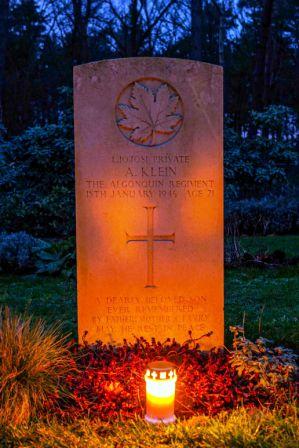
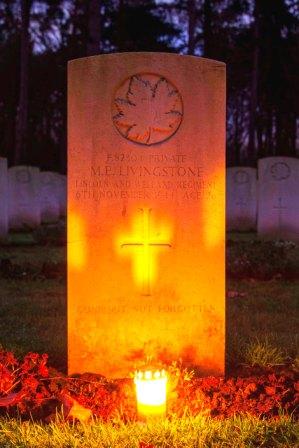
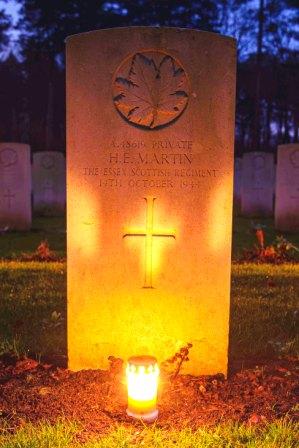
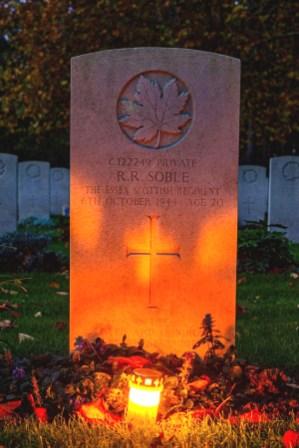
This year, we include photos of the candlelit graves for 8 soldiers – that Pieter has researched and whose stories have been previously told – who are buried in the Canadian War Cemetery in Bergen Op Zoom, The Netherlands.  This cemetery began the tradition of lighting candles on Christmas Eve in 1991, with candles placed by many volunteers.

The photos are courtesy of Faces To Graves Bergen Op Zoom Chair Caroline Raaijmakers, who arranged to send us photos of the graves of the soldiers we wanted to feature this year.

…8 graves from Bergen Op Zoom are featured….

Candles were placed at all 1,119 graves at the Canadian War Cemetery in Bergen Op Zoom.  8 of them are featured in this posting….

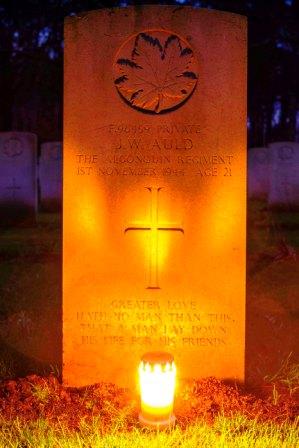
Candle placed at the grave of James ‘Walter’ Auld.  (Photo Courtesy of Caroline Raaijmakers)

WWII soldier James ‘Walter’ AULD, born in Glenwood, Prince Edward Island, was serving with the Algonquin Regiment when he killed in The Netherlands, aged 21, on November 1, 1944 during Operation Suitcase, one of the actions during the Battle of the Scheldt. (See https://onthewarmemorialtrail.com/2020/07/07/on-the-war-memorial-trail-a-face-for-james-walter-auld/)

Candle placed at the grave of Edward ‘Ed’ Dalton Chisholm.  (Photo Courtesy of Caroline Raaijmakers)

WWII soldier Edward ‘Ed’ Dalton CHISHOLM, from Hallowell Grant, Nova Scotia, was serving with the Algonquin Regiment when he was killed in action during the Battle for the North Shore of the Scheldt in Belgium on October 20, 1944. He was 19 years old, only two weeks away from his 20th birthday. (See https://onthewarmemorialtrail.com/2024/07/24/on-the-war-memorial-trail-the-wwii-soldier-from-hallowel-grant-who-lost-his-life-during-the-battle-for-the-north-shore-of-the-scheldt/)

We were pleased to see a photo of Ed and a few mementos at his grave, placed by his family during a visit.  Last summer, Ed’s nephew Martin Sullivan wrote about an upcoming visit he and his wife Claire planned to make.  “….I was very touched to see you have been awarded the Knight of the Order of the Orange Nassau. You both have given so much to so many families who lost loved ones overseas. Edward is now a part of our family conversations to all the Chisholms and Sullivans. I look forward to completing the second leg of our journey in late October to see where Edward gave his life fighting near Kruisstraat along with the Dutch Orange Brigade and the Belgian White Brigade. We will be thinking of you both as we travel along his route with the Algonquins from Antwerp to Bergen op Zoom….

Candle placed at the grave of Adam Klein.  (Photo Courtesy of Caroline Raaijmakers)

WWII soldier Adam KLEIN, from Disley, Saskatchewan, was serving with the Algonquin Regiment, when he died in The Netherlands while crossing the Maas River on January 18, 1945, aged 21. (See https://onthewarmemorialtrail.com/2023/07/20/on-the-war-memorial-trail-the-wwii-soldier-from-disley-who-lost-his-life-while-swimming-across-the-maas-river/)

Candle placed at the grave of Milton Evangeline Livingtone.  (Photo Courtesy of Caroline Raaijmakers)

WWII soldier Milton Evangeline LIVINGSTONE, born in Gladstone, Prince Edward Island, was serving with the Lincoln & Welland Regiment when he was accidentally killed, aged 26, on November 6, 1944 when a fellow soldier’s gun was fired in a house in Steenbergen, The Netherlands.  Milton was sitting at a kitchen table reading a Dutch-English dictionary when he was fatally shot.  (See https://onthewarmemorialtrail.com/2023/08/05/on-the-war-memorial-trail-the-wwii-soldier-who-died-while-reading-a-dutch-english-dictionary/)

Candle placed at the grave of Harold Edward Roy Martin.  (Photo Courtesy of Caroline Raaijmakers)

WWII soldier Harold Edward Roy MARTIN, born in Caradoc, Ontario, was serving with the Essex Scottish Regiment when he was killed in The Netherlands during the Battle of the Scheldt on October 14, 1944, aged 32. (See https://onthewarmemorialtrail.com/2023/02/11/on-the-war-memorial-trail-the-wwii-soldier-remembered-by-his-daughters-friend/)

Candle placed at the grave of Leonard William Porter.  (Photo Courtesy of Caroline Raaijmakers)

WWII soldier Leonard William PORTER from Moncton, New Brunswick, was serving with the Calgary Highlanders when he was killed in action during the Battle of Walcheren Causeway in The Netherlands on November 1, 1944, aged 26.  (See https://onthewarmemorialtrail.com/2023/11/20/on-the-war-memorial-trail-the-wwii-soldier-from-moncton-who-lost-his-life-during-the-battle-of-walcheren-causeway/)

Candle placed at the grave of Russell Richard Soble.  (Photo Courtesy of Caroline Raaijmakers)

WWII soldier Russell Richard SOBLE, born in Ameliasburg, Ontario, was serving with the Essex Scottish Regiment when he died on October 6, 1944, aged 20, one of 12 members of the regiment killed in action in Putte, a town on the Dutch-Belgian border, in a fight on October 5, 1944 that marked the beginning of the Battle of the Scheldt.  (See https://onthewarmemorialtrail.com/2021/01/13/on-the-war-memorial-trail-atlantic-canada-remembers-part-2/)

Candle placed at the grave of William Ernest Stone.  (Photo Courtesy of Caroline Raaijmakers)

WWII soldier William Ernest STONE, from Clyde River, Prince Edward Island, was serving with the Black Watch of Canada, when he was killed during a fierce battle during the Attack On Hoogerheide in The Netherlands on October 10, 1944, at the age of 25. (See https://onthewarmemorialtrail.com/2024/10/12/on-the-war-memorial-trail-the-wwii-soldier-from-clyde-river-who-lost-his-life-during-the-attack-on-hoogerheide/)

Thank you to Caroline Raaijmakers for arranging to send us these photos from the Canadian War Cemetery in Bergen Op Zoom, The Netherlands.

If you have a story or photo to share about Canadian military personnel buried in The Netherlands or Belgium, please contact Pieter at memorialtrail@gmail.com or comment on the blog. 

© Daria Valkenburg

…Previous postings about Christmas Eve Candle Lighting…

…Want to follow our research?….

If you are reading this posting, but aren’t following our research, you are welcome to do so.  Our blog address: https://onthewarmemorialtrail.com/

4 countries, 6 weeks, 7,000 km – an unforgettable war memorial journey in Europe…. Daria’s book ‘No Soldier Buried Overseas Should Ever Be Forgotten‘ is available in print and e-book formats.  Net proceeds of book sales help support research costs and the cost of maintaining this blog. For more information see https://nosoldierforgotten.com/

You are also invited to subscribe to our YouTube Channel: On The War Memorial Trail With Pieter Valkenburg: https://www.youtube.com/channel/UCJ591TyjSheOR-Cb_Gs_5Kw

Never miss a posting!  Subscribe below to have each new story from the war memorial trail delivered to your inbox.

On The War Memorial Trail….The WWI Architect Shot By A Sniper While Sketching Trenches

Daria outside the pavilion at Berks Community Cemetery in Belgium.  The Extension is to the left. (Photo credit: Pieter Valkenburg)

December 31, 2025.  While in Belgium during our 2025 European War Memorial Tour, we were joined by Pieter’s cousin François Breugelmans and his wife Mieke de Bie. 

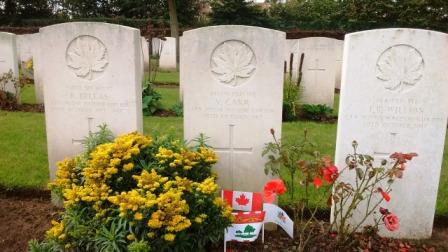
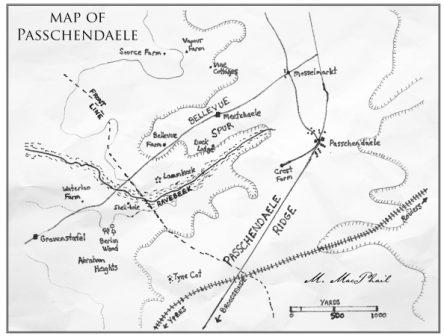
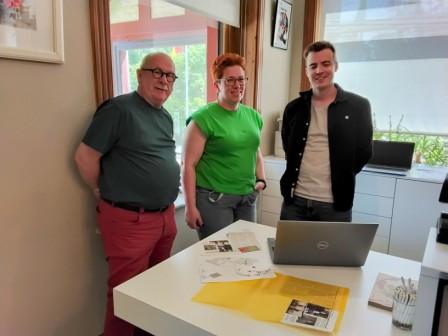
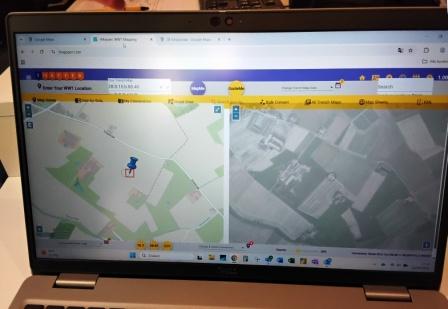
We visited Zonnebeke and were successful in finding the location of the original burial of WWI soldier Vincent Earl CARR of Prince Edward Island who was killed during the Battle of Passchendaele in October 1917.  (See https://onthewarmemorialtrail.com/2025/12/22/on-the-war-memorial-trail-the-search-for-the-trench-where-wwi-soldier-vincent-carr-was-originally-buried/

We also visited Ostende New Communal Cemetery to lay flags at the grave of Manitoba-born WWII soldier Donald David MacKenzie TAYLOR, who drowned when the Landing Ship Tank LST- 420, carrying members of No. 1 Base Signals and Radar Unit (BSRU), sank after it hit a mine near the harbour in Ostend, Belgium. (See https://onthewarmemorialtrail.com/2025/12/27/on-the-war-memorial-trail-the-wwii-soldier-born-in-manitoba-who-lost-his-life-when-lst-420-hit-a-mine-in-the-harbour-outside-ostend/)

The final stop on the Belgian portion of our trip was to visit Berks Cemetery Extension in Ploegsteert not far from Ypres, and almost at the French border.  Our goal was to place flags at the graves of two WWI soldiers….

….Request from a Belgian researcher…

On April 4, 2025, just as we were preparing for our 2025 European War Memorial Tour, Belgian researcher Patrick Michiels had written us, asking for help in “….finding photos for two WWI soldiers buried in Berks Cemetery Extension in Komen-Waasten (near Ploegsteert). We’ve in total about 20 adopted soldiers in this Cemetery with our group of Friends”  

He went on to explain that the two soldiers were Captain George Pigrum BOWIE, a well-known architect in Vancouver, British Columbia, who had been born in England, and Private Warren GILLANDER of Athelstan, Quebec.  “…Berks Cemetery Extension has only WWI casualties .

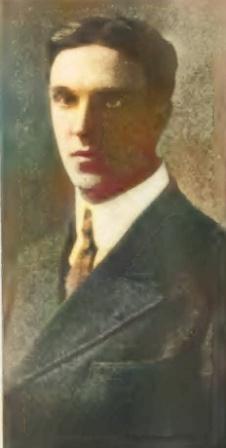
We agreed to help once we returned from Europe.  In the meantime, with help from Judie Klassen and Shawn Rainville, initial research began on George Pigrum Bowie. We thought that it might be easier to find a photo of him, since he was an architect, and we hoped to have a photo before we visited the cemetery.  In the end, we didn’t find a photo of either soldier while we were in Europe.

….A photo of George was found…

Months after our trip, we learned of a photo of George in the Journal of the Royal Institute of British Architects in the July 31, 1915, Volume 22, Issue 17, and with the help of the Prince Edward Island Library Service, a copy of the journal was found.

George Pigrum Bowie. (Photo source: July 31, 1915 issue of the Journal of the Royal Institute of British Architects.  Photo colourization by Pieter Valkenburg)

….George Bowie was a true Renaissance man …

Born on March 29, 1881 in Upper Holloway, London, England, George was the eldest son of Alfred Henry and Elizabeth Bowie.  He became a draftsman with Holloway Brothers, a building firm in London, staying with the firm from 1896 until 1901, gaining a good knowledge of construction, which would be very useful as an architect. George studied at the City of London College and trained under architect Edward Prioleau Warren. (See https://en.wikipedia.org/wiki/Edward_Prioleau_Warren)

In 1904, he worked for a short period in Boston, Massachusetts, USA, for Russell Sturgis and for C.A. Cummings, before returning to England in early 1905 as an assistant to Charles Harrison Townsend. (See https://en.wikipedia.org/wiki/Charles_Harrison_Townsend)

After immigrating to Canada in 1906, George was employed as chief assistant at Parr & Fee in Vancouver, British Columbia, working there until 1910 when he opened his own firm. 

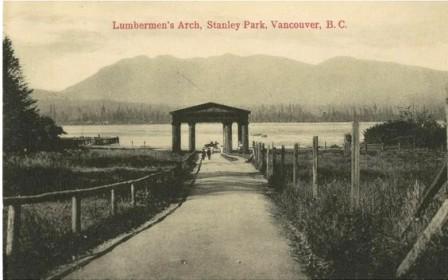
Postcard of Lumberman’s Arch, designed by George Pigrum Bowie, circa 1913.

In 1912 he designed the Lumberman’s Arch of Welcome in Vancouver for the Lumbermen and Shinglemen of Vancouver in honour of the visit of the Duke of Connaught, the Governor General of Canada at the time.  Envisioned as a temporary structure to be placed downtown at Pender Street and Hamilton Street, it was a massive timber structure constructed entirely of fir, held together only by its own weight as no nails, bolts or fasteners were used. 

After the Governor General’s visit, however, the arch was not destroyed.  Instead, it was taken down, floated across Coal Harbour, and relocated in Stanley Park in March, 1913.   After George’s death in 1915 it was renamed Bowie’s Arch and remained until 1947 when, due to rotting timbers, it was replaced by a simpler structure which still stands in Stanley Park. Over the years, I’ve been in Stanley Park many times, and likely saw Bowie’s Arch – and never realized it’s significance! (See https://vancouversun.com/news/local-news/this-week-in-history-1947-lumbermens-arch-is-demolished)

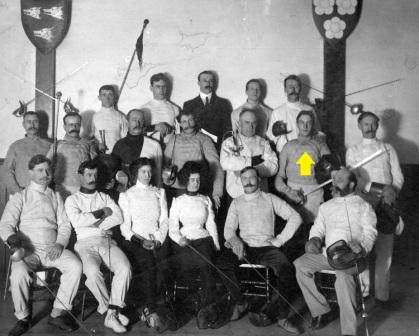
In 1907, George joined the Freemasons.  Judie Klassen, who tracked all the activities he was involved in, wrote to say “…I didn’t realize the breadth of information that I would find when I started looking into newspaper articles for this soldier…” He was well known, not only professionally, but also “… in charitable, church and social circles. He belonged to the Vancouver Riding Club, the YMCA, the Vancouver Rowing Club, a fencing club, the Vancouver Automobile Club. He also belonged to Christ Church and taught bible classes or Sunday school…

George was engaged to Alice Margaret Scott, who had grown up in Saint John, New Brunswick, giving this west coast story a Maritime twist!

After we returned from Europe, an undated and unattributed photo from the fencing club was found by Judie.

Left to right (back row): W. Walken, B.F. Wood, H.J. Cave, W. Pumphrey and G.H. Henderson; (middle row): A. Rowan, G. Sheldon, W. McC. Hutchison, W. McNaught, E. Cook, G. Bowie (identified by yellow arrow) and J. Johnstone; (front row): M. Alpen, P.R. West, Olive Trew, Mrs. C.F. Cotton, F. Cowens and J.E. Parr. (Photo source unknown)

….George enlisted in 1914 …

Canada entered WWI on August 4, 1914, the same day that the United Kingdom declared war on Germany. A month later, George enlisted. At the time of his enlistment with the Canadian Overseas Expeditionary Force on September 23, 1914 in Valcartier, Quebec, George was assigned to the 5th Canadian Infantry Battalion as a Sergeant.  He had already served for three years with the 20th Middlesex Rifles, and was an active member of the 31st British Columbia Horse, a militia regiment. (See https://en.wikipedia.org/wiki/British_Columbia_Hussars)

On October 20, 1914, George arrived in the United Kingdom from Canada.  The 5th Canadian Infantry Battalion War Diary for that day noted that “…the Battalion disembarked at full strength at Devonport….” and began making its way to Salisbury Plain. 

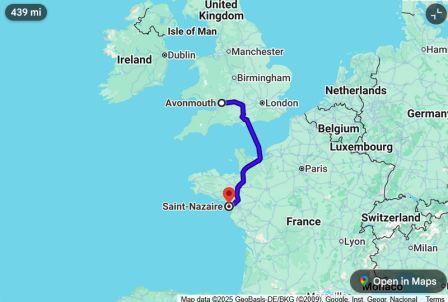
Map showing the 706.5 km route across the English Channel from Avonmouth to Saint-Nazaire. (Map source: Google maps)

Training continued in England until February 11, 1915, when the Battalion boarded the HMT Lake Michigan in Avonmouth on February 11, 1915, arriving in St. Nazaire, France 2 days later.  By February 23, 1915, they were digging trenches in Armentieres, and encountering German snipers.

April 1915 found the Battalion had moved into Belgium, near Ypres, and were under heavy fire, with many casualties, during the Second Battle of Ypres, which was fought from April 22 to May 15, 1915.  By April 24, 1915 the Germans attacked with poison gas, as well as artillery.  (See (https://en.wikipedia.org/wiki/Second_Battle_of_Ypres)

On May 15, 1915 George, who was a Sergeant with ‘A’ Company of the 5th Canadian Infantry Battalion, was promoted to Lieutenant, but given a temporary commission to Captain.  His bravery and leadership skills didn’t go unnoticed.

….George wrote about the Battle of Festubert….

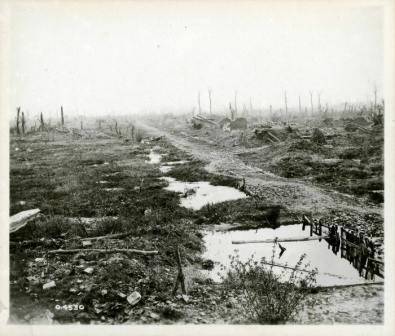
1919 photo of the ruined landscape near Festubert, 4 years after the May 1915 battle.  (Photo source: Canadian War Museum)

In the latter part of May 1915, the Battalion was engaged in the Battle of Festubert, and suffered devastating losses. George was in this battle and wrote a letter to the Daily News Advertiser newspaper on May 26, 1915, describing how he crawled through an open gap between trenches to find whether a certain trench was held by Canadians or Germans, and then had to make a new connecting trench through the gap by piling dead Germans along either side.  The letter was published on June 20, 1915, just a few short weeks before George lost his life. (See https://www.canadiansoldiers.com/history/battlehonours/westernfront/festubert.htm)

…At about five a.m. the general sent for me and gave me orders to take up my men and, as I had taken the precaution to have them sleep fully equipped, they were soon ready.  It was now broad daylight, and we had to be very careful to avoid observation from aeroplanes and the enemy’s lookout.     

I had to report to a certain officer but he was wounded and so were several others in order of seniority, so I finally decided I would report to one of our own company officers, but no one could tell me when or where our men were.

There were vague rumours that the Germans had cut them off, surrounded them, were driving them back away from us, etc, but I could get no definite information, so I put my men to work to improve the trenches where they were.  It was a bad place and filled with dead and wounded men….and I wanted to take my men’s minds off their troubles by getting them to dig in and get cover from the very severe shell fire, which was killing and wounding men all the time.

After moving around in various positions I found a trench at the other end of which were supposed to be our own men with Germans in between.  I went along and discovered a big portion of a trench had been blown up by the Germans as soon as our men occupied it, and on the far side of the gap were men who were variously reported to be Germans or Canadians.

I did the caterpillar act, and crawled across the opening….and eventually reached the position our men were holding. I found all the officers dead or wounded, and a lot of the men were also hurt, but the survivors were happy as clams at high tide and ready to hold the place against anything.

I told them we had lots of reinforcements and food and ammunition and would connect up with them….  It was funny to see me diving head first into shell holes and crawling along like a cat after a sparrow…

I found by this time that I was the only Canadian officer of our battalion alive and unwounded in our trenches….” which were “…in a terrible state.…

With so many wounded, and no officer in charge, George took over, writing that “…we moved down one of the trenches towards the gap … and began work by piling dead Germans, their kits and their sandbags into the open spaces made in the sides of the trench by shells, so that the enemy would not see us moving along the trench. Then we began digging a foxy little trench toward our friends, but in such a manner that the enemy could not see. Also we passed up all the German food and comforts in the old German trenches, so that we should be able to give our lads some food….

George found that, contrary to reports they’d received, German troops were well fed, based on what they found in the trenches.  “….We found rye bread, German sausage, cold bacon, candy, chocolates, cigars, cigarettes, very rich cake, jam and a sort of lard, while all the water bottles were filled with coffee…

We got back to our billets about 4 a.m. yesterday.  An officer was asked to take out a burial party to bring in our dead officers and what men we could get, so I went.  It was an unpleasant job, but we got them without losing one of our party.  Of course, there are many left.  We are going out again tonight to try and get some more.  We have made a graveyard near here and put up wooden crosses over the graves….

The War Diary for May 25, 1915 confirmed that George had led a burial party.  A “…volunteer party under Lt G. P. Bowie went out at 9 pm, returning at 4:30 am, to bury dead and recover sentimental effects…”  This was repeated the following evening into early morning.  By now, the Battalion had moved back across the border into France and was based in Essars.

….George was killed by a sniper’s bullet…

On June 25, 1915, the Battalion moved back across the border into Belgium, near Ploegsteert.  Soldiers were busy deepening and improving trenches, refurbishing the wire in No-Mans-Land, and dealing with enemy snipers and ongoing rifle fire. 

On July 7, 1915, at the age of 34, George lost his life, killed by a German sniper’s bullet while sketching trenches, part of his duties. Pte H. KELLY was wounded.  An April 28, 1919 article in Vancouver Daily World quoted Mr. S. Lucas who said that “…before he was shot he realized his danger and sent back to safety the men with him… 

….George was buried in Chateau Rosenberg Military Cemetery …

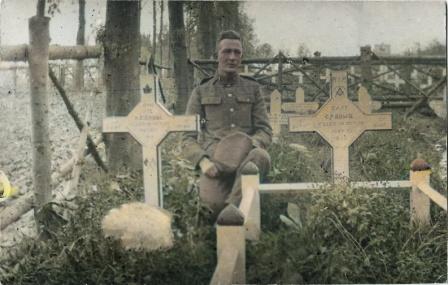
Temporary burial place of George Pigrum Bowie (to the right of the soldier) in Chateau Rosenberg Military Cemetery. (Photo Courtesy of Brett Payne)

George was initially buried in Chateau Rosenberg Military Cemetery, about 1 km north-west of Berks Extension Cemetery, and his headstone included a freemason’s mark (square and dividers/compasses).  A photo was found of his grave, with a soldier standing between his grave and that of Pte Albert Eber Gustav GABBE, on a site written by Brett Payne of Tauranga, New Zealand.  (See https://photo-sleuth.blogspot.com/2008/09/canadian-war-graves-ed-pye-and-5th.html)

When I contacted him, he explained that he believed the man in the photo was his “… grandfather’s friend Ed Pye. Arthur Edwin Pye (1893-1960) originally enlisted in the 60th Rifles at Moose Jaw, Saskatchewan on 12 August 1914, and five weeks later was attested into the 11th Battalion at Valcartier….” 

Based on Ed Pye’s service record, Brett thought that the photo dates to “…the spring or summer of 1916….” and that the photo was “…taken next to these particular graves because they were of men that he had served with the previous year….

….George was reburied in Berks  Cemetery Extension…

In March 1930, 475 graves were moved from Chateau Rosenberg Military Cemetery when the land for Berks Cemetery Extension was granted in perpetuity. The land at Chateau Rosenberg did not have this guarantee.  The cemetery grounds at Berks were assigned to the United Kingdom in perpetuity by King Albert I of Belgium in recognition of the sacrifices made in the defence and liberation of Belgium during the war.

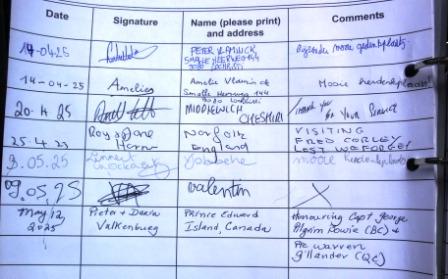
95 years later, we visited the cemetery to honour George Pigrum Bowie and Warren Gillander.  As usual, we wrote in the visitors’ book.

Entry in the visitors’ book.  (Photo credit: Daria Valkenburg)

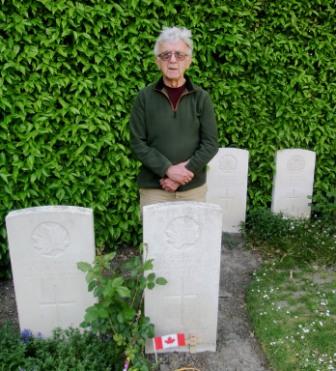
Pieter placed a Canadian flag at George’s grave.

Pieter behind the grave of George Pigrum Bowie. (Photo credit: Daria Valkenburg)

….A photo of Warren Gillander has yet to be found…

At the grave of Warren Gillander, whose photo has yet to be found, Pieter placed flags of Canada and Quebec. 

Pieter at the grave of Warren Gillander. (Photo credit: Daria Valkenburg)

Pieter stands behind the grave of Warren Gillander.  (Photo credit: Daria Valkenburg)

The flags placed these two graves were donated.  Our thanks go to: 

  • Alan Waddell, Constituent Assistant, on behalf of Heath MacDonald, MP for Malpeque, for the Canadian flags.
  • Mario Henry and his brother Etienne Henry, who donated the Quebec flag.

Thank you to Judie Klassen and Shawn Rainville for the extensive research and newspaper searches.  Thank you to the Prince Edward Island Library system for helping to access the journal in which a photo of George Pigrum Bowie was found. Thank you to Brett Payne for the photo from Chateau Rosenberg Cemetery.  Thank you also to François Breugelmans and Mieke de Bie for joining us on the Belgian portion of our visit.

Our adventures continue as we return to The Netherlands for the next portion of our 2025 European War Memorial Tour. 

If you have a story or photo to share, please contact Pieter at memorialtrail@gmail.com or comment on the blog. 

© Daria Valkenburg

….Want to follow our research?…

If you are reading this posting, but aren’t following our research, you are welcome to do so.  Our blog address: https://onthewarmemorialtrail.com/

4 countries, 6 weeks, 7,000 km – an unforgettable war memorial journey in Europe…. Daria’s book ‘No Soldier Buried Overseas Should Ever Be Forgotten‘ is available in print and e-book formats.  Net proceeds of book sales help support research costs and the cost of maintaining this blog. For more information see https://nosoldierforgotten.com/

Subscribe to our YouTube Channel: On The War Memorial Trail With Pieter Valkenburg: https://www.youtube.com/channel/UCJ591TyjSheOR-Cb_Gs_5Kw

Never miss a posting!  Subscribe below to have each new story from the war memorial trail delivered to your inbox.

On The War Memorial Trail…..The WWII Soldier Born In Manitoba Who Lost His Life When LST-420 Hit A Mine In The Harbour Outside Ostend

Pieter with François Breugelmans and Mieke de Bie on the boardwalk in Westeinde, Belgium, by the North Sea. (Photo credit: Daria Valkenburg)

December 27, 2025.  While in Belgium during our 2025 European War Memorial Tour, we were joined by Pieter’s cousin François Breugelmans and his wife Mieke de Bie.  We visited Zonnebeke and were successful in finding the location of the original burial of WWI soldier Vincent Earl CARR of Prince Edward Island who was killed during the Battle of Passchendaele in October 1917.  (See https://onthewarmemorialtrail.com/2025/12/22/on-the-war-memorial-trail-the-search-for-the-trench-where-wwi-soldier-vincent-carr-was-originally-buried/)

Our fearless foursome continued on the Belgian portion of our trip, this time to honour a Manitoba-born WWII soldier…..

….Request from a Belgian researcher…

In September 2024, Belgian researcher Patrick Michiels had written us, asking for help in finding a photo of Donald David MacKenzie TAYLOR. Patrick explained that “…Corporal Taylor, of the Royal Canadian Air Force, died on 7th November 1944 whilst the ship he was on, LST-420, hit a mine near the harbour of Ostend (Belgium).  Donald is buried in the Ostende New Communal Cemetery and was 26 when he died….”  LST refers to Landing Ship, Tank. (See https://en.m.wikipedia.org/wiki/Landing_Ship,_Tank)  

….I’m taking care of the adoption in the Ostende New Communal Cemetery of the graves of WWI and WWII…” soldiers, and he explained that, in addition to Taylor, there were 9 more Canadians buried in this cemetery.   

Pieter agreed to try and find a family member who might have a photo.  The research began….

….A photo was found through a nephew and great-niece…

Born February 4, 1918 in Winnipeg, Manitoba, Donald was the son of James and Mary (nee MacKenzie) Taylor, who were both born in Scotland.  Donald’s father was an RCMP officer and the family moved to Saskatchewan five months after his birth.

Donald had a brother James, and a sister Mary Christina, who married Harold Emerson Reesor.  It was through Mary’s son Ronald and Ronald’s daughter Alyna that a photo of Donald was provided.

Donald David MacKenzie Taylor.  (Photo courtesy of the Reesor Family)

….Donald trained as a radio mechanic with the RCAF…

At the time of his enlistment on September 30, 1941 with the Royal Canadian Air Force (RCAF) in Regina, Saskatchewan, Donald had already been serving in the militia, as a rifleman with the Regina Rifles Reserve since July 1940.  He was a high school graduate and was employed as a statistician with the Provincial Government of Saskatchewan.  Donald noted that he enjoyed swimming, and occasionally played baseball and tennis. He stated that he had tried to enlist in the Royal Canadian Navy Volunteer Reserve (RCNVR), but had been considered medically unfit due to ‘defective vision’. 

A trades test during his initial interview with the RCAF found him suitable for a Radio Mechanic.  As an Air Craftsman 2nd Class, he was sent to No. 3 Manning Depot in Edmonton, Alberta for his initial training. 

On December 29, 1941, Donald was next sent to the RCAF Detachment of the University of Saskatchewan in Saskatoon, Saskatchewan, for courses in Fundamental Radio Theory and Applied Radio Theory, which he successfully completed on April 15, 1942.

Promoted to Leading Air Craftsman (LAC), Donald next was sent to No. 1 Toronto Manning Depot in Toronto, Ontario for a few days before being posted to No. 31 Radio School, Royal Air Force, in Clinton, Ontario for further training. 

….Donald continued his training in Clinton …

On April 27, 1942, Donald began several written and practical courses in Radio Mechanics in Clinton.  The innocuous sounding Radio School was also called the RDF School, and was a secret high-tech school. RDF was the acronym for Radio Direction Finding, but in reality Clinton was training its students in the new technology of Radar (RAdio Direction And Ranging).  Radar had already been used in the United Kingdom to track German aircraft during the London Blitz in the winter of 1941‑42.  Students at Clinton learned the principles of radar and were given hands‑on training.

After successfully completing his courses on June 5, 1942, it was recommended that Donald be “…retained to take a further course of Radio Mechanic Training with a view to being Commissioned, if technically suitable…”  He remained in Clinton until August 9, 1942.

….Donald left Canada for overseas service….

Donald was scheduled to take another course in Clinton, which was to begin on August 6, 1942, but a note in his service file stated that this was cancelled.  Instead he was given embarkation leave, the last time he would see his family before going overseas.

After his leave ended on August 26, 1942, he was posted to No. 31 Personnel Depot (PD) Moncton, a holding station just outside Moncton, New Brunswick, for personnel who were being posted elsewhere. The RCAF Moncton site is now the Greater Moncton Romeo LeBlanc International Airport, which we have flown out of several times over the years! 

Donald left Moncton on September 23, 1942 for the journey to United Kingdom, where he arrived on October 7, 1942.  He was immediately posted to No. 3 Personnel Reception Centre (PRC) in Bournemouth, the main transit hub for incoming Royal Canadian Air Force (RCAF) crew.

….Donald received intensive training in radar….

Once he had a chance to get oriented in England, his training continued.  He was first sent to No 75 Signals Wing at Biggin Hill on August 28, 1942, a Royal Air Force (RAF) unit that focused on radar and signals intelligence. It was part of No. 60 Group, which specialized in airborne interception (AI) radar and signals for night fighters. 

On March 3, 1943, Donald was posted to White Waltham Airfield in Berkshire, the headquarters for the Air Transport Auxiliary (ATA), a civilian organization that ferried thousands of RAF warplanes between factories and front lines.

A few weeks later, he was sent on a short detachment to Renscombe Down, near Swanage in Dorset, a site that provided radar training and operations. It was a training ground for the mobile radar units that would play a critical role in the D-Day landings and later in Northwest Europe.

Donald received another promotion on April 1, 1943, to Technical Corporal (T/Cpl). 

On April 12, 1943, Donald was posted to RAF Chigwell in Essex, which was used in testing and training of communication equipment.  While at Chigwell, he was sent to No. 9 Radio School at the Royal Air Force Yatesbury for additional radar training.  His training continued at several more bases, including the radar station in Ventnor on the Isle of Wight, and Great Malvern which specialized in radar research.

….A decision was made to move No. 1 BSRU from England to Belgium….

On April 24, 1944, Donald was transferred to No. 1 Base Signals and Radar Unit (BSRU), a unit responsible for the maintenance and repair of the vital radar installations used for air defence and operations. With personnel that had been extensively trained, No. 1 BSRU remained in Essex, England as Allied forces advanced through France and into Belgium, until a more permanent base of operations could be established closer to the front lines in North West Europe.  Instead, smaller Mobile Signals Servicing Units (MSSU) handled maintenance after the D-Day landings. 

After Ghent, Belgium was liberated on September 6, 1944, a decision was made to move No. 1 BSRU from Essex to Ghent and to set up workshops for repairing radar equipment in the field. It proved to be a fatal decision.

….An ill-fated crossing on November 7, 1944 turned into a disaster….

On November 7, 1944, a small convoy of landing ship tanks (LSTs) carrying No.1 BSRU personnel, vehicles, and equipment crossed the English Channel during terrible weather conditions.  However, when the convoy reached the Belgian coast along the North Sea, authorities refused permission to enter the port at Ostend due to a rising storm and fears of blocking the crucial supply line.

The convoy altered course back towards England, planning to shelter overnight in the Thames Estuary before returning to Ostend on the following day.  However, the bow section of LST-420, which Donald was on, struck a German mine near the harbour.  It tore a large hole in the ship’s hull, causing it to break into two pieces. The ship’s galley fires were lit at the time due to the evening meal being prepared and petrol from damaged fuel tanks of the vehicles being transported caught fire, enveloping the stern section of the ship in flames.

The ship sank rapidly, and rescue efforts were hampered as, due to heavy seas, only larger vessels were able to attempt to rescue survivors in the water. This resulted in a massive loss of life, with over 200 men from the RAF and RCAF attached to No. 1 BSRU lost, many of whose bodies were never recovered.  Just over 30 were rescued. (See https://en.wikipedia.org/wiki/HM_LST-420)

…. Donald was buried at Ostende New Communal Cemetery ….

Donald was one of the men who drowned on November 7, 1944, aged 26. Unlike so many of the casualties, Donald’s body was found.  A November 25, 1944 letter to his father from Wing Commander G. W. EMEERY explained that “…the greater part of the company, including the Commanding Officer, was lost. Your son’s body was washed ashore on the Continent, where it was taken to Ostend and buried with military honours in the Communal Cemetery, Rue Dernier, Ostend…

…. We visited Ostende New Communal Cemetery….

A small portion of Ostende New Communal Cemetery.  (Photo credit: Daria Valkenburg)

During our 2025 European War Memorial Tour, we visited Donald’s grave at Ostende New Communal Cemetery, and Pieter placed flags of Canada and Manitoba at his grave.

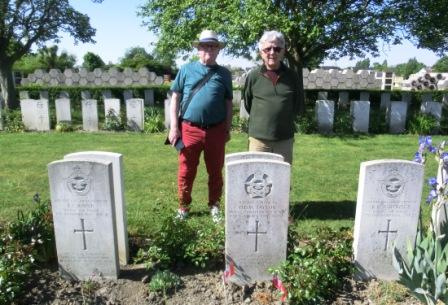
François Breugelmans and Pieter behind the grave of Donald David MacKenzie Taylor.  (Photo credit: Daria Valkenburg)

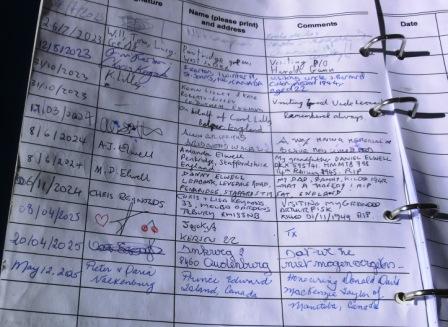
As always, we wrote a message in the visitors book. (Photo credit: Daria Valkenburg)

 …. We visited the North Sea coastline near Ostend….

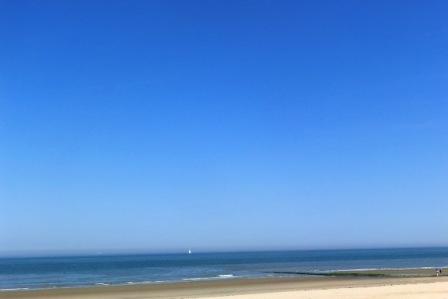
From the cemetery we drove towards the coast to take a photo of the North Sea.  The beaches in Ostend weren’t accessible so we went a bit further to Westeinde where there was a pedestrian walking area on the Koning Ridderdijk boardwalk, as well as rows of beach huts.  It was very built up and not at all like it would have looked on November 7, 1944, but the North Sea still looks the same.  It was a calm day, unlike what Donald and the No. 1 BSRU convoy would have faced on that fatal day.

The North Sea, as seen from Westeinde, Belgium.  (Photo credit: Daria Valkenburg)

….Other Canadian soldiers buried in Ostende New Communal Cemetery…

Also buried in Ostende New Communal Cemetery are 7 WWII soldiers and 2 WWI Canadian soldiers…

  • John Clarence BRUSH, son of John A. L. and Ethel Brush, of Windsor, Ontario, died February 14, 1945, age 18, while serving with the Royal Canadian Naval Volunteer Reserve as an Ordinary Telegraphist aboard HM Canadian Motor Torpedo Boat 465 (WWII)
  • Albert James CROSS, son of Minnie Cross, of Yorkton, Saskatchewan, died February 14, 1945, age 19,  while serving with the Royal Canadian Naval Volunteer Reserve as an Able Seaman aboard HM Canadian Motor Torpedo Boat 465 (WWII)
  • George Walter DOVE, son of George and Gladys E. Dove, husband of Orma M. Dove, of Toronto, Ontario, died April 5, 1945, while serving with the Royal Canadian Naval Volunteer Reserve as a Stoker 1st Class aboard H.M.C.S. Niobe (WWII)
  • Gordon Leroy ELLSWORTH, son of Roy Mac. Ellsworth and Marietta Ellsworth, of Port Colborne, Ontario, died September 10, 1942, age 22, while serving as Flight Sergeant in 158 (R.A.F.) Squadron with the Royal Canadian Air Force (WWII)
  • Ralph Reginald MACRAE, son of Major Herbert Hudson and Sarah Maria MacRae, of Campbellton, New Brunswick, died February 14, 1945, age 21, while serving with the Royal Canadian Naval Volunteer Reserve as a Leading Seaman aboard HM Canadian Motor Torpedo Boat 461 (WWII)
  • William James MARSHALL, son of Thomas and Catherine (nee Fraser) Marshall, aged 21, of Vancouver, British Columbia, died November 7, 1944, while serving as Sergeant with the Royal Canadian Air Force (WWII)
  • Eldon Sydney STEWARDSON, son of Gordon and Margaret T. Stewardson, of Prince Albert, Saskatchewan, died November 1, 1944, age 22, while serving as Sergeant with the Royal Canadian Armoured Corps (WWII)
  • Curtis Matthew DE ROCHIE, son of Mr Curtis and Mrs De Rochie, of Cornwall, Ontario, died July 14, 1917, age 31, while serving as 2nd Lieutenant with the Royal Flying Corps 27th Squadron (WWI)
  • George Gordon MACLENNAN, son of Reverend Alexander and Catherine MacLennan of Owen Sound, Ontario, died July 21, 1917, age 30, while serving as Flight Commodore with the Royal Naval Air Service (WWI)

Thank you to Ron Reesor and Alyna Reesor for submitting a photo of their uncle and grand-uncle, to Shawn Rainville for helping to find family members through newspaper searches, and to James Reesor for providing family history information. Thank you also to François Breugelmans and Mieke de Bie for joining us on the Belgian portion of our visit.

The flags placed at Donald’s grave were donated.  Our thanks go to:  

  • Alan Waddell, Constituent Assistant, on behalf of Heath MacDonald, MP for Malpeque, for the Canadian flag.
  • Wayne Ewasko, MLA for Lac Du Bonnet, Manitoba, Interim Leader of the Official Opposition, Province of Manitoba, who donated the Manitoba flag.

Our adventures continue as we share the highlights of our 2025 European War Memorial Tour. 

If you have a story or photo to share, please contact Pieter at memorialtrail@gmail.com or comment on the blog. 

© Daria Valkenburg

….Want to follow our research?…

If you are reading this posting, but aren’t following our research, you are welcome to do so.  Our blog address: https://onthewarmemorialtrail.com/

4 countries, 6 weeks, 7,000 km – an unforgettable war memorial journey in Europe…. Daria’s book ‘No Soldier Buried Overseas Should Ever Be Forgotten‘ is available in print and e-book formats.  Net proceeds of book sales help support research costs and the cost of maintaining this blog. For more information see https://nosoldierforgotten.com/

Subscribe to our YouTube Channel: On The War Memorial Trail With Pieter Valkenburg: https://www.youtube.com/channel/UCJ591TyjSheOR-Cb_Gs_5Kw

Never miss a posting!  Subscribe below to have each new story from the war memorial trail delivered to your inbox.

Happy Holidays From The Valkenburgs – And Our Year In Review!

December 24, 2025.  2025 was another busy year for us, and we remain committed to the On The War Memorial Trail research project.  As of today, since this project began, Pieter has been able to cross 359 photo search requests from the three Canadian War Cemeteries in The Netherlands off of their photo search lists. 

In addition, he has found photos for an additional 111 soldiers – for WWI and WWII soldiers buried in Belgium, listed on a memorial wall in the United Kingdom, airmen buried in municipal cemeteries in The Netherlands, and soldiers from Prince Edward Island who are buried in Canada. I have written stories for many of these soldiers, with many more stories still to come. 

While several long-standing searches for photos were successful, allowing Pieter to complete his files for those soldiers, many files still remain open.  In most cases, family members were found, but no photo was available for one reason or another. 

The files in which Pieter has had zero luck in finding photos continue to be placed on the Cold Case Files page on the On The War Memorial Trail website.  We started this page in 2023 and have been lucky to have several names cleared off of the list. Perhaps 2026 will see more names removed!  (See https://onthewarmemorialtrail.com/our-cold-cases/)

New research files were added, and Pieter was able to finish his research for many files.  As always, there is a lag between him completing his work and me documenting his research, but that is on my very optimistic ‘to do’ list for this winter.

This spring we were in Europe for 5 weeks on our 2025 European War Memorial Tour.  Among the highlights of our trip, Pieter placed flags at 383 graves in 14 cemeteries in The Netherlands and Belgium. We attended the commemoration service for the 80th Anniversary of the Liberation of The Netherlands at the Canadian War Cemetery in Groesbeek. 

As well, we visited several memorials in The Netherlands and Germany, attended the grave re-dedication ceremony of a WWII soldier from Ontario, and, with the help of GPS coordinates on a trench map, we found the location of the original burial of a WWI soldier from Prince Edward Island who was killed during the Battle of Passchendaele in October 1917. 

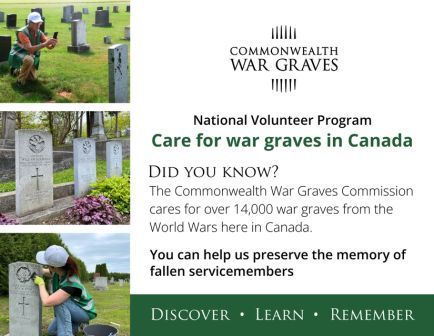
Pieter became a volunteer under the National Volunteer Program for the Commonwealth War Graves Commission (CWGC), and was assigned four local cemeteries which have CWGC gravestones.  A photo of him was even featured on a postcard promoting volunteers! 

The project to upload photos to the Canadian Virtual War Memorial website, which began in the fall of 2023, continues.  Pieter advises that he plans to continue this project into 2026.

This year, we were able to meet several families, which we very much appreciated – this year in New Brunswick, Nova Scotia, and Prince Edward Island.  We are grateful that so many families have come forward to share photos and information, and are thankful for help from the media in helping to find photos.  What follows in the rest of this posting is a summary of what happened in 2025 with this research project.

Statement about Pieter in the Senate of Canada….

On October 8, 2025 a statement about Pieter was made by Senator Mary Robinson in the Senate of Canada: See https://publications.gc.ca/collections/collection_2025/sen/Y3-451-23-eng.pdf page 763

Statement about us in the PEI Legislature….

Matthew B. MacFarlane, MLA for District 19, Borden-Kinkora, Leader of the Green Party of Prince Edward Island, informed us that he’d given a brief statement about us in the legislature on November 4, 2025.  We had no idea he’d done this until he sent us the link!  (https://www.facebook.com/share/v/1Ame5ppZio/)

Daria Honoured With PEI Senior Islander of the Year Award….

Left to right: Honourable Barb Ramsay, Daria, Peter Holman. (Photo credit: Matthew B. MacFarlane)

PEI Seniors Secretariat slide shown during the readout of Daria’s biography

On October 1, 2025, Daria received the PEI Senior Islander of the Year Award from the Seniors Secretariat of Prince Edward Island, for her involvement with Hear PEI, a volunteer organization that works to build awareness of hearing loss issues, and in the ongoing research and writing of stories connected to the On The War Memorial Trail Research Project, sharing the untold stories of brave Canadians who served in the two World Wars, all based on her husband Pieter’s research. 

The plaque was presented by the Honourable Barb Ramsay, Minister for the Department of Social Development and Seniors, and Peter Holman, Chairperson, PEI Seniors Secretariat, in a ceremony at the Rodd Charlottetown Hotel in Charlottetown.   (See https://www.princeedwardisland.ca/en/news/older-islanders-celebrated-with-senior-islander-of-the-year-award and https://onthewarmemorialtrail.com/2025/10/23/daria-honoured-with-pei-senior-islander-of-the-year-award/)

…. Pieter Appointed Knight of the Order of Orange-Nassau….

On July 2, 2025, by Royal Decree of His Majesty Willem-Alexander, King of The Netherlands, Pieter was appointed Knight of the Order of Orange-Nassau.  The decoration was presented to Pieter by Her Excellency Margriet Vonno, Ambassador of The Netherlands to Canada, in a beautiful ceremony hosted by His Honour, Dr Wassim Salamoun, Lt Governor of Prince Edward Island.

Pieter received his knighthood in recognition of the military research he’s done (and continues to do) to help ensure that Canadian soldiers buried in The Netherlands are not forgotten, and that their stories are told.  (See https://onthewarmemorialtrail.com/2025/08/11/pieter-valkenburg-appointed-knight-of-the-order-of-orange-nassau/ and https://www.saltwire.com/prince-edward-island/pieter-valkenburg-of-p-e-i-appointed-knight-of-the-order-of-orange-nassau and https://www.cbc.ca/listen/live-radio/1-30-island-morning/clip/16162199-islander-knighted-king-netherlands)

His Honour Dr Wassim Salamoun, Lt Governor of Prince Edward Island, Pieter Valkenburg, Her Excellency Margriet Vonno, Ambassador of The Netherlands to Canada. (Photo credit: Matthew B. MacFarlane)

Order of Orange-Nassau. (Photo credit: Daria Valkenburg)

….Pieter and Daria Honoured With Faces To Graves Groesbeek Foundation Certificate and ‘Coin’….

On May 24, 2025, Pieter and Daria were presented with a Certificate and a Faces To Graves ‘coin’ by Alice van Bekkum, Chair of Faces To Graves Groesbeek Foundation, for their research into Canadian soldiers buried in the Canadian War Cemetery in Groesbeek, The Netherlands, finding families and sharing photos of over 100 of the soldiers.  (See https://onthewarmemorialtrail.com/2025/05/30/on-the-war-memorial-trail-pieter-and-daria-honoured-by-faces-to-graves-groesbeek-foundation/)

Daria and Pieter Valkenburg hold the Faces To Graves Coin and Certificate that was presented to them by Alice van Bekkum, Chair of Faces To Graves Groesbeek Foundation.  (Photo credit: Kim Huvenaars)

….‘Holten Heroes: Stories from a Canadian Field of Honour’ Added To PEI Library Catalogue….

Crapaud Public Library and Kinkora Public Library Branch Library Technician Elsie Hovey holds the book ‘Holten Heroes’, with translators Daria and Pieter Valkenburg on either side of her.  (Photo credit: Brenda Graves)

Holten Heroes: Stories from a Canadian Field of Honour by Dutch journalist Jan Braakman was translated by Pieter and Daria Valkenburg from the original Dutch language book Holtense Canadezen’. A compilation of stories about many of the 1,394 Canadians buried in the Canadian War Cemetery in Holten, The Netherlands, the book was added to the Prince Edward Island Library Catalogue this fall.  For more information on the book, see https://onthewarmemorialtrail.com/2023/11/01/new-book-about-soldiers-buried-in-the-canadian-war-cemetery-in-holten-the-netherlands/

‘Holten Heroes’ displayed on a bookshelf in the Crapaud Public Library.  (Photo credit: Elsie Hovey)

.....Pieter now a volunteer under CWGC’s National Volunteer Program….

Postcard promoting CWGC’s National Volunteer Program included a photo of Pieter (top left) that Daria took at Cape Traverse Community Cemetery.

When the Commonwealth CWGC asked for volunteers across Canada to be part of the National Volunteer Program to visit local cemeteries and gather information about the condition of CWGC war graves, Pieter applied and was accepted as a volunteer.  After receiving training on how to inspect headstones, how to report a grave in need of repair, and how to safely clean headstones where required, he was assigned 4 cemeteries in the South Shore area on Prince Edward Island.   The 4 cemeteries are:

  • Cape Traverse Community Cemetery (3 CWGC graves)
  • Tryon People’s Cemetery (2 CWGC graves)
  • Kelly’s Cross (St Joseph) Parish Cemetery (1 CWGC grave)
  • Seven Mile Bay (St Peter’s) Cemetery  (4 CWGC graves)

Shortly after Pieter began his inspection of the cemeteries, a photo that I took of him at Cape Traverse Community Cemetery was chosen to be used on a postcard promoting the National Volunteer Program.

Presentation At The Annual  Remembrance Service At Crapaud Community Hall….

Pieter needed a few seconds to regain his composure following the heartfelt introduction by Senator Robinson. (Photo credit: Matthew B. MacFarlane)

On November 9, 2025, Pieter was the guest speaker at the Annual Remembrance Service at Crapaud Community Hall in Crapaud, Prince Edward Island.  After being introduced by The Honourable Mary Robinson, Senator, Pieter spoke about what Remembrance Day means to him, and based his speech around 5 words: GratitudeSorrow ….Thankfulness…. Respect….. and Admiration… (See https://onthewarmemorialtrail.com/2025/11/12/on-the-war-memorial-trail-remembrance-week-2025-remembrance-service-at-crapaud-community-hall/)

Presentation At The Annual  Remembrance Service At Borden-Carleton Legion….

Pieter was the guest speaker during the Remembrance Day service at Borden-Carleton Legion. (Photo credit: Matthew B. MacFarlane)

On November 11, 2025, Pieter was the guest speaker at the Annual Remembrance Service at the Borden-Carleton Legion in Borden-Carleton, Prince Edward Island.  Similar to his presentation a few days earlier at Crapaud Community Hall, Pieter spoke about what Remembrance Day means to him, and based his speech around 5 words: GratitudeSorrow ….Thankfulness…. Respect….. and Admiration…

…. Uploading photos to the Canadian Virtual War Memorial website ……

Pieter continued the project he began in the fall of 2023, to upload photos to the Canadian Virtual War Memorial website. For more information on this excellent resource, see https://www.veterans.gc.ca/eng/remembrance/memorials/canadian-virtual-war-memorial/

In 2023, he began with uploading photos of 3 WWII soldiers. As of the end of 2024, Pieter uploaded photos for 20 WWI soldiers and 195 WWII, for a total of 218 soldiers. This year, he uploaded photos of:

  • 1 WWI soldiers
  • 9 WWII soldiers and airmen

This resulted in a total contribution of 228 soldiers.

…. Soldiers Listed On The Cenotaph Outside Borden-Carleton Legion …….

This year we added more information on soldiers whose stories had previously been told:

  • While in Belgium this spring, we found the location of the original burial of WWI soldier Vincent Earl CARR of Prince Edward Island who was killed during the Battle of Passchendaele in October 1917.
  • After a 10 year search we received a photo for WWI soldier Harry ROBINSON of Augustine Cove, Prince Edward Island, who died on June 27, 1916 after contracting blood poisoning from a cellulitis infection.

 … WWII Related Stories….

  • We shared a story about the 2024 candle lighting at graves of Canadian soldiers at the Canadian War Cemetery in Adegem, Belgium.
  • We shared the story about the successful search for a photo of WWII soldier Peter HYDICHUK, from Saskatchewan, who lost his life in The Netherlands on March 31, 1945, while serving with the South Saskatchewan Regiment.
  • We shared the story about the successful search for a photo of WWII soldier Garnet Joseph GALLANT, from Nova Scotia, who lost his life in Germany on February 18, 1945 during the Battle of Moyland Wood, while serving with the Regina Rifles Regiment.

…. Stories About Servicemen From The Maritimes…

We also featured stories about servicemen from The Maritimes:

  • WWII soldier Azade BOUDREAU from New Brunswick, who drowned in a canal in Ghent, Belgium on December 15, 1944.
  • WWII soldier George Allan BUCHANAN from Nova Scotia, who was severely wounded on April 10, 1945 in Sögel, Germany and died of his wounds upon arriving at a military hospital in The Netherlands.
  • WWI soldier John Joseph FOY from Prince Edward Island, who survived WWI and moved to New Brunswick, where he became a rural mailman until his death on July 1, 1964.
  • WWII soldier Joseph Stephen GALLANT from Prince Edward Island, who was serving with the Royal Winnipeg Rifles when he lost his life on October 11, 1944 during the Battle of the Leopold Canal.
  • WWII soldier Arthur GAUDET from Prince Edward Island, who was killed in action during Operation Blockbuster in Germany on February 26, 1945.
  • WWII soldier Merle Vincent HAMILTON from Nova Scotia, one of 5 men killed on April 19, 1945 when the armoured car they were in hit a mine in Germany during the Battle for the Küsten Canal.
  • WWII soldier David ‘Lloyd’ George HOPE from New Brunswick, one of 7 men from the 23rd Field Company of the Royal Canadian Engineers who lost their lives during the crossing of the Lower Rhine River in The Netherlands on September 25-26, 1944 while participating in Operation Berlin – the attempt to save survivors of the British 1st Airborne after the disastrous Operation Market Garden and at the end of the Battle of Arnhem/Oosterbeek.
  • WWII Knights of Columbus Auxiliary Services Supervisor Joseph Augustine MACKENNA from Prince Edward Island, who drowned in a canal in Ghent, Belgium. Although he was last seen on the evening of June 12, 1945, his death was ‘arbitrarily determined’ to be June 20, 1945, and his death ‘confirmed’ on June 21, 1945.
  • WWII soldier Francis ‘Frank’ Eugene MUNROE from Nova Scotia, one of 19 men from his Regiment who drowned during the crossing of the Ems River in Germany on April 28, 1945 while participating in Operation Duck.
  • WWII soldier James Edward SULLIVAN from New Brunswick, one of 19 men from his Regiment who drowned during the crossing of the Ems River in Germany on April 28, 1945 while participating in Operation Duck.
  • WWII soldier John Peter ‘JP’ WHITE from Prince Edward Island, who died in Charlottetown, Prince Edward Island, following an operation on December 15, 1945.

…. Stories About Servicemen From Outside The Maritimes…

  • WWII soldier Stewart Lyon ANDERSON from Manitoba, one of 5 men killed on April 19, 1945 when the armoured car they were in hit a mine in Germany during the Battle for the Küsten Canal.
  • WWII soldier John Lewis HUGHES from Manitoba, who was killed at a beach dressing station during Operation Infatuate on Walcheren Island in The Netherlands on November 2, 1944, when 3 Allied tracked vehicles exploded after being hit by German shellfire.
  • WWII soldier Joseph ‘Albert Noel’ LAMONTAGNE from Quebec, who was killed in action during the advance towards Xanten in Germany on March 3, 1945.
  • WWII soldier Omer VINCENT from Manitoba, who was slain in a barn in the municipality of Bronkhurst in The Netherlands, during a patrol on April 13, 1945.

…In Conversation And Features…

  • We featured the 3-part story of Croatian-born WWI and WWII veteran Nikola ‘Nick’ OSTOJIC, who spent 4 years as a POW in Germany after the Royal Yugoslav Army surrendered, then 3 years in a Displaced Persons camp in Austria, before finally finding freedom before finally finding freedom and a new life in Prince Edward Island, where he raised horses, and later Ontario, in Canada.
  • We featured the 2-part story of Nova Scotia born Dr. James ‘Alton’ ROSS, based on his WWII diary while serving as a doctor aboard the hospital ship HMHS Lady Nelson.
  • We featured multiple stories about our 5 week 2025 European War Memorial Tour, during which Pieter placed flags at 383 graves at 14 cemeteries in The Netherlands and Belgium. We attended the commemoration service for the 80th Anniversary of the Liberation of The Netherlands at the Canadian War Cemetery in Groesbeek. As well, we visited several memorials in The Netherlands and Germany, attended the grave re-dedication ceremony of Arthur VANANCE – a WWII soldier from Ontario – and, with the help of GPS coordinates on a trench map, we found the location of the original burial of a WWI soldier from Prince Edward Island who was killed during the Battle of Passchendaele in October 1917.
  • We were asked to find family of WWII soldier John Graham MUSTARD of Saskatchewan, who died February 20, 1945, aged 24, while serving with the Fort Garry Horse and is buried in the Canadian War Cemetery in Groesbeek, The Netherlands.  The Cemetery had been asked to find family by a man whose parents had adopted the soldier’s grave back in 1946, and which he has kept up with visiting. He had letters that the soldier’s family wrote to the family in The Netherlands and wanted to repatriate them. With the help of Judie Klassen, a nephew was found, and the two men were put in contact with each other.
  • We featured the May 24, 2025 ceremony in The Netherlands, where we were presented with a Certificate and a Faces To Graves ‘coin’ by the Faces To Graves Groesbeek Foundation, for research into Canadian soldiers buried in the Canadian War Cemetery in Groesbeek, The Netherlands.
  • We reported on Pieter’s new role as a volunteer with the Commonwealth War Graves Commission (CWGC) National Volunteer Program, and his assignment to monitor and clean CWGC graves at 4 cemeteries in Prince Edward Island, beginning with Cape Traverse Community Cemetery.
  • We featured the July 2, 2025 ceremony in Charlottetown, where, by Royal Decree of His Majesty Willem-Alexander, King of The Netherlands, Pieter was appointed Knight of the Order of Orange-Nassau.
  • We featured the October 1, 2025 ceremony in Charlottetown, where Daria received the PEI Senior Islander of the Year Award.
  • We expressed our sadness at the passing of Dr. Tim Cook, Chief Historian at the Canadian War Museum in Ottawa.
  • We reported on how volunteers at the Borden-Carleton Legion in Prince Edward Island honour deceased veterans by placing flags at the graves and monuments in the area served by the Legion.
  • As part of our Remembrance Week 2025 feature, we wrote about the visits that members of the Borden-Carleton Branch of the Royal Canadian Legion made to three schools on Prince Edward Island for Remembrance Services.
  • As part of our Remembrance Week 2025 feature, we shared updates on previous stories of WWII soldiers, a visit to the Commonwealth War Graves Commission in Ottawa, a visit to the Memramcook Veterans Park in Memramcook, and a visit to the Beach Grove Memorial Forest in Charlottetown.
  • As part of our Remembrance Week 2025 feature, we wrote about the Remembrance Service at Crapaud Community Hall, where Pieter was the guest speaker.
  • As part of our Remembrance Week 2025 feature, we wrote about the Remembrance Day ceremonies we attended at the Legion in Borden-Carleton, and at the memorial in Kinkora, Prince Edward Island.

…. Interviews To Highlight Search For Photos and More….

Pieter did the following interviews:

  • Pieter was interviewed by Maryssa McFadden of Portage Online, about the photo search for WWII soldier Walter MUNRO. The article ‘Researcher searches for photo of Manitoba soldier buried overseas’ ran online on November 17, 2025. See https://portageonline.com/articles/researcher-searches-for-photo-of-manitoba-soldier-buried-overseas Up to now, this search has been unsuccessful.
  • Pieter was interviewed by Kevin Rollason of the Winnipeg Free Press, about the successful search for a photo of WWII soldier John Lewis HUGHES, and the new photo search for WWII soldier Charles ‘Gordon’ ERICKSON. The article ‘Searching for a hero: Faces to Graves project hunts for photo of Winnipeg soldier who died in the Netherlands’ ran online on November 10, 2025. This search was successful.
  • Pieter was interviewed by Taylor O’Brien for CBC PEI Radio’s Island Morning With Mitch Cormier The 7 minute interview ran on August 7, 2025. ‘Pieter Valkenburg of North Tryon has spent more than a decade researching Canadian soldiers buried in the Netherlands. Now, he’s being honoured by the King of the Netherlands for his dedication to preserving their stories.’ (You can listen here: https://www.cbc.ca/listen/live-radio/1-30-island-morning/clip/16162199-islander-knighted-king-netherlands)
  • Pieter was interviewed by Josh Lewis of the Eastern Graphic about receiving a knighthood of the Order of Orange-Nassau by royal decree of His Majesty Willem-Alexander, King of The Netherlands. The article, ‘Valkenburg knighted for preserving stories of fallen soldiers’, ran in the newspaper on July 16, 2025.

.... Letters To The Editor For Photo Searches….

Letters to the editor in various newspapers were written in the quest for a photo for:

  • WWII soldier Lorne Mart COLFORD of Nova Scotia, who is buried in The Netherlands. On October 29, 2025, a letter to the editor was published online in the Chronicle Herald, ‘May We Never Forget’. (See https://letterstoeditor.com/index.php/chronicle-herald/) Up to now, this search has been unsuccessful.
  • WWII soldier Valmont PERRY of Prince Edward Island, who is buried in Belgium. On October 15, 2025, a letter to the editor was published in the West Prince Graphic, ‘Searching For Soldier’s Photo’. Up to now, this search has been unsuccessful.
  • WWII soldier Harry BIZNAR of Ontario, who is buried in The Netherlands. On July 5, 2025 a letter to the editor was published in The Windsor Star.  (See Reader asks: Anyone in Windsor know family of WW2 vet Harry Biznar? Windsor Star https://share.google/MruypoLEAt5LwRfqG) This search was successful.

… Successful Search For Photos …..

Many WWII soldiers are buried in cemeteries in Europe.  Pieter continues to work with photo wish lists from Canadian War Cemeteries for WWII soldiers buried in The Netherlands.  This year we also received photos and information on soldiers buried in Belgium, Canada, and on a memorial wall at Runnymede in the United Kingdom. 

Photos of soldiers buried in Dutch cemeteries were forwarded to researchers there for their digital archive. Whenever possible, stories are featured on the blog but there is such a backlog due to the success of Pieter’s research that I can’t keep up! This year, photos were found for:

Buried in Holten Canadian War Cemetery in The Netherlands:

  1. Stewart Lyon ANDERSON
  2. Thomas William BOUCHER
  3. Bramwell Ernest CHURCHILL
  4. Samuel George ENGEN
  5. John ‘Jack’ Lewis HUGHES
  6. Edward Alexander MUNRO

Buried in Groesbeek Canadian War Cemetery in The Netherlands:

  1. Albert Donald AHLWARDT
  2. Georges Joseph ARSENAULT
  3. Lionel Beaudoin
  4. Harry BIznar
  5. Leslie Alban ‘Les’ Cross
  6. Alfred Edward Stanley FORD
  7. Garnet Joseph GALLANT
  8. Harry Griffin
  9. Peter HYDICHUK 
  10. Merrill Perez LLOYD
  11. Donald MONTGOMERY
  12. George Austin NORDVALL
  13. Joseph Renaud Thomas OUELLETTE
  14. William VERASKY

 Buried in Bergen Op Zoom Canadian War Cemetery in The Netherlands:

  1. Edward Walter BAIRD 
  2. George Edwin John CLACY 
  3. Wilfred Earl CLEMENTS
  4. Howard Ralph DRAKE 
  5. Francis John DUFFY 
  6. Charles ‘Gordon’ ERICKSON 
  7. Stephen Joseph FEDAK 
  8. Joseph Henry FRASER
  9. John Arthur GALLERY
  10. Gerald Vincent JORGENSEN 
  11. Hans Karl GRAFFUNDER 
  12. Melvin Robert James GRAHAM 
  13. Robert Francis HAYMAN 
  14. Dave HIEBERT 
  15. Kenneth George HUGHES 
  16. Con Nicholas HUTZCAL 
  17. Norman Hubert JAMES 
  18. Lloyd JOHNSON 
  19. Gerald Vincent ‘Vin’ JORGENSON 
  20. Joseph ‘Joe’ Julius Augustus LAWRENCE 
  21. David LIVINGSTON 
  22. James Hawthorne LOVE
  23. Frank Arnold LOWE 
  24. William Murray MAJURY
  25. Roy Stanley MARTIN
  26. Clifford Lloyd MILLER 
  27. William Gerald NAYLEN 
  28. Alexander NODRICK 
  29. Marion PODBOROCHINSKI 
  30. Edward James REID 
  31. Joseph Frederick STANLEY 
  32. John Harold Francis STEEDS 
  33. Norman Lawrence STEELE
  34. Basil STILLMAN 
  35. Arthur Percival THOMPSON 
  36. Ray Camille WATERMAN

Buried in Rhenen General Cemetery in The Netherlands:

  • David Lloyd George HOPE

 Buried in Adegem Canadian War Cemetery in Belgium:

  • Charles John ACORN
  • Joseph Stephen ‘Steve’ GALLANT
  • Joseph Augustine MCKENNA

 Buried in Berks Cemetery Extension in Belgium:

  • George Pigrum BOWIE

Buried in Tryon People’s Cemetery in Canada:

  • Harry ROBINSON

Buried in Kelly’s Cross (St Joseph) Parish Cemetery in Canada:

  • Michael Cecil STORDY

Buried in Seven Mile Bay (St Peter’s) Cemetery in Canada:

  • John Peter ‘JP’ WHITE

Listed on Runnymede Memorial in United Kingdom:

  • Richard Albert John BENNETT

Photo Search For Airmen For Air Research Drenthe Foundation in The Netherlands:

One of the projects of the Air Research Drenthe Foundation in The Netherlands is to install information panels near WWII air crash sites. While many of the airmen lost their lives and are buried in The Netherlands or just across the border in Germany, other airmen survived the crash and were in prisoner of war camps until the war ended.  It can be difficult to find photos and families of airmen that survived, but Pieter took up the challenge.  Family was found for:

  • Flight Lt Owen Horace MORGAN, of Rosedale, Alberta, navigator aboard Special Duties Hudson T9405 MA-K that was shot down on February 22, 1945 near Meppen, Germany. He survived the crash and became a POW in Stalag VIC in Linden, Germany until the camp was liberated on April 7, 1945.

The Cold Case Files …..

Not all searches have been successful, for one reason or another.  Below is a list of outstanding files for which research has been done, but no photo has been found. If you can help with a photo, please let us know.  (See https://onthewarmemorialtrail.com/our-cold-cases/ for the complete list)

  1. Clifford Alexander BLAKE of Toronto, Ontario, son of William C. and Sarah L. Blake, husband of Ferne E. Blake, died February 16, 1945, aged 23, while serving with the Royal Winnipeg Rifles. 
  2. John BROWN of London, Ontario, son of Mary T. Brown, died April 14, 1945, aged 26, while serving with the Argyll & Sutherland Highlanders. 
  3. James Lyman CAMERON, born in Victoria-By-The-Sea, Prince Edward Island, son of Edward H. and Susan (Harrington) Cameron, died July 24, 1916, aged 23, while serving with the 7th Canadian Infantry Battalion (1st British Columbia). (Listed on the Borden-Carleton Cenotaph) 
  4. Leigh Hunt CAMERON, born in Albany, Prince Edward Island, son of Alexander Walter Cameron and Phoebe Ann (nee Murray) Cameron, died May 5, 1916, aged 17, shortly after enlisting with the 105th Battalion, C Company. (Listed on the Borden-Carleton Cenotaph) 
  5. William Galen CAMPBELL, born in Wellington, Prince Edward Island, son of John G. and Grace Emma Campbell, died April 24, 1953, aged 55, many years after being discharged from the 8th Siege Battery of the 3rd Brigade Canadian Garrison Artillery. (Listed on the Borden-Carleton Cenotaph) 
  6. Karl CHRISTENSEN, from Alberta, but born in Starheim, Nordfjord, Norway, son of Kristian Kristiansen Hafsas and Marie K. Hafsas, died April 10, 1945, aged 41, while serving with the 8th Field Squadron, Royal Canadian Engineers. 
  7. Richard Alfred CLINE, from Saint John, New Brunswick, son of Emma J. Cline, died October 5, 1944, aged 21, while serving with the Essex Scottish Regiment. NEW!
  8. Roy Henri COATES, of Morris, Manitoba, but born in Winnipeg, son of James Henry and Lydia Jane Coates, died May 2, 1945, aged 23, while serving with Royal Canadian Army Service Corps – – 3rd Casualty Clearing Station. NEW! 
  9. Lorne Mart COLFORD of Dartmouth, Nova Scotia, but born in Chezzetcook, Nova Scotia, son of Howard and Jeanette Colford, died April 14, 1945, aged 22, while serving with the Royal Hamilton Light Infantry. 
  10. Bazil CORMIER, born in Tignish, Prince Edward Island, son of Joseph Cormier and Mary Arsenault, died August 12, 1918, aged 20, while serving with the 26th (New Brunswick) Battalion. (Listed on the Borden-Carleton Cenotaph) 
  11. Eric John CRUE of Moncton, New Brunswick, son of John and Margaret Crue, died April 6, 1945, aged 23, while serving with the Algonquin Regiment. 
  12. James Frank DOLMAN of Flatlands, New Brunswick, son of Frank Dolman and Lydia Thompson, husband of Henriette Gertrude Lyons, died April 14, 1945, aged 32, while serving with the New Brunswick Rangers -10th Independent Machine Gun Company. 
  13. Douglas Bernard FARROW of Amherst, Nova Scotia, died April 26, 1945, aged 27, while serving with the Algonquin Regiment. 
  14. Clifford Glen FORSYTH, born in Brandon, Manitoba, son of Alexander ‘Sandy’ Forsyth and Margaret McDougall, died April 11, 1945, aged 20, while serving with the Lake Superior Regiment. 
  15. Ernest Ramey GALLANT, born in Borden (now Borden-Carleton), Prince Edward Island, son of John P. and Mary Blanche Gallant, died May 20, 1943, aged 27, while serving with the North Nova Scotia Highlanders Regiment. (Listed on the Borden-Carleton Cenotaph) 
  16. Robert Cecil HARVEY of Centre Burlington, Nova Scotia, son of Douglas and Myrtle B. Harvey, died April 22, 1945, aged 23, while serving with the British Columbia Regiment – 28th Armoured Regiment. 
  17. William James ‘Jimmy’ Sutherland HOLE, born in Carman, Manitoba, grandson of William and Eva Alise Hole, son of Daisy Hole, died April 22, 1945, aged 20, while serving with the Royal Winnipeg Rifles. 
  18. Gordon John HOPPER of London, Ontario, son of Gordon and Vera Mae Hopper, died April 16, 1945, aged 19, while serving with the Lincoln and Welland Regiment. 
  19. George Mcdonald JOHNSTON of Toronto, Ontario, son of William and Annie Johnston, died April 2, 1945, aged 27, while serving with the Lake Superior Regiment. 
  20. Wesley Robert JOHNSTON of Red Bank, New Brunswick, son of Robert A. and Janette ‘Jennie’ (nee Simpson) Johnston, died March 3, 1945, aged 24, while serving with the Royal Regiment of Canada. NEW!
  21. Wallace Herbert LARLEE of Perth, New Brunswick, died April 24, 1945, aged 19, while serving with the North Shore (New Brunswick) Regiment. 
  22. Albert George LE RUE of Halifax, Nova Scotia, son of William and Catherine Le Rue, died March 7, 1945, aged 24, while serving with the Algonquin Regiment.
  23. Logan Elwood LESLIE, born in Oxford, Nova Scotia, died April 9, 1945, son of John J. and Georgie Mary Leslie of Moncton, New Brunswick, while serving with the Royal Hamilton Light Infantry. 
  24. Charles W. LOWTHER, born in North Carleton, Prince Edward Island, son of Bessie Lowther, died September 25, 1918, aged 21, while serving with the 25th Battalion, Canadian Infantry. (Listed on the Borden-Carleton Cenotaph) 
  25. Harry Donald MACPHERSON, from Vancouver, British Columbia, son of Alex Mann Macpherson and Jane Bell Macpherson, husband of Gwendolyn Eva Macpherson, died April 29, 1945, aged 33, while serving with the Canadian Scottish Regiment. 
  26. John Redmond MAHONEY, born in Port Elgin, New Brunswick, son of John J. and Gertrude C. Mahoney, died April 12, 1945, aged 30, while serving with the New Brunswick Rangers-10th Independent Machine Gun Company. 
  27. Wilbert Harold MOORE, born in Fredericton, New Brunswick, son of Jessie Louise and Hugh Irving Moore, died June 16, 1945, aged 28, while serving with the 3rd Division Works Transport Company, Royal Canadian Army Service Corps. 
  28. Walter MUNRO, born in Kelwood, Manitoba, son of John Alexander and Lavina (nee McLaughlin, widow of Robert Jamieson) Munro, husband of Hazel Mary Bird, died December 31, 1944, aged 31, while serving with the Royal Canadian Army Service Corps. NEW!
  29. Archibald Henry NELSON, born in Charlottetown, Prince Edward Island, son of William Henry and Winnifred Frances Nelson, died April 18, 1945, aged 34, while serving with the North Nova Scotia Highlanders Regiment. 
  30. Valmont PERRY, of St. Louis, Prince Edward Island, son of Peter M. and Mary Ann Perry, and husband of Rose Doucette, died October 21, aged 26, while serving with the Stormont, Dundas and Glengarry Highlanders. NEW!
  31. Arthur Clinton ROBINSON, born in Tryon, Prince Edward Island, son of Albert J. and Flora P. Scruton Robinson, died March 27, 1916, aged 19, while serving with the 26th (New Brunswick) Battalion. (Listed on the Borden-Carleton Cenotaph) 
  32. Wilfred ROY, of Robertville, Gloucester County, New Brunswick, son of Camille and Catherine Roy, died October 28, 1945, aged 38, while serving with the Royal Canadian Army Service Corps. 
  33. Charles Patrick SHEFFIELD of Sundridge, Ontario, son of Charles and Mrs Sheffield, husband of Bessie Alice Butler from Botwood, Newfoundland, and father of Patrick William Wallace Sheffield, died May 4, 1945, aged 24, while serving with the Algonquin Regiment. 
  34. Charles Bernard STAFFORD of Halifax, Nova Scotia, son of Charles Bernard and Blanche Stafford, husband of Winifred Leitha Stafford of Intake, Sheffield, England, died April 18, 1945, aged 28, while serving with the Royal Canadian Army Medical Corps – 9th Field Ambulance. 
  35. Frank Peter VARDIG of St. John, New Brunswick, son of Charles and Lily Vardig, died June 12, 1945, aged 23, while serving with the Carleton & York Regiment. 
  36. Charles Joseph YOUNES, born in Halifax, Nova Scotia, son of Albert Charles and Susan Younes, died March 30, 1945, aged 24, while serving with the Queens Own Cameron Highlanders of Canada. NEW!

….Case Closed!….

The following files were completed and removed from the Cold Case List in 2025:

  1. Harry BIZNAR of Windsor, Ontario, but born in Montreal, Quebec, son of Fred and Katherine Biznar, died March 26, 1945, aged 28, while serving with the Lincoln and Welland Regiment.  Action: After a Letter to the Editor ran in The Windsor Star on July 5, 2025, a photo was provided by Biznar’s niece, Carol Cox. Thank you Carol!
  2. Douglas Gordon BLACK of Amherst, Nova Scotia, son of Sherman and Alice Black, died March 3, 1945, while serving with the Algonquin Regiment. – Action: Photo found by his grave at the Canadian War Cemetery in Groesbeek, The Netherlands, when we were at the cemetery to lay flags.
  3. Bramwell Ernest CHURCHILL, of London, Ontario, son of David and Agnes C. Churchill, husband of Eva Blanche Churchill, died May 1, 1945, aged 40, while serving with the 5th Anti-Tank Regiment of the Royal Canadian Artillery. – Action: Newspaper photo found by Alan Campbell, newsletter editor for the Lambton County Branch of the Ontario Genealogical Society.  Thank you Alan!
  4. Leslie Alban CROSS, of Newcastle, New Brunswick, son of Archibald and Laura Cross, died April 19, 1945, aged 30, while serving with the Royal Canadian Army Service Corps. Action: Photo sent by the Crocker family.
  5. Samuel George ENGEN of The Pas, Manitoba, son of Louis Julius Engen and Mary Helen (nee Buck) Engen, husband of Miriam Susan Pranteau, died April 23, 1945, aged 27, while serving with the Lake Superior Regiment. – Action: After a 3 year search by various family members, a photo was found by Clover Rusk in an album that had belonged to her great-grandfather Aaron, the older brother of Samuel. Thank you Clover!
  6. Garnet Joseph GALLANT of Amherst, Nova Scotia, son of Charles and Mary (nee Gautreau) Gallant, died February 18, 1945, aged 22, while serving with the Regina Rifles Regiment. – Action: Photo sent by niece Janet Lowerison, on behalf of the Gallant Family.  Thank you Janet!
  7. John Arthur GALLERY of Saint John, New Brunswick, son of William and Grace Gallery, died October 13, 1944, aged 22, while serving with the Black Watch (Royal Highland Regiment) of Canada. – Action: Newspaper photo found by Etienne Gaudet. Thank you Etienne!
  8. Peter HYDICHUK of Theodore, Saskatchewan, son of Alex and Ann Hydichuk, died March 31, 1945, aged 27, while serving with the South Saskatchewan Regiment. – Action: Photo sent by Garry Bodnaryk, whose mother had been the soldier’s girlfriend….and who had kept the photo as a remembrance all her life. Thank you Garry!
  9. John Lewis HUGHES, born in Eriksdale, Manitoba, son of Ebenezer George and Ellen (nee Rogan) Hughes, husband of Irene (nee Goodwin) Hughes of Winnipeg, Manitoba, died November 2, 1944, aged 28, while serving with the Royal Canadian Army Medical Corp – 10th Field Dressing Station.  – Action: Photo of soldier sent by Judy Gleich from the collection of Jim and Kay Forsyth. Thank you Judy!
  10. Francis Leslie MULCAHY of Halifax, Nova Scotia, son of Daniel and Mary Mulcahy, died April 24, 1945, aged 21, while serving with the North Shore (New Brunswick) Regiment. – Action: Photo and newspaper obit of soldier sent by Henk Vincent of the Canadian War Cemetery in Holten. Thank you Henk!
  11. Edward Alexander MUNRO of Birch River, Manitoba, son of Thomas Henry and Margaret ‘Maggie’ (nee Moore) Munro, died October 6, 1945, aged 27, while serving with the Royal Canadian Army Service Corps, 219 Infantry Brigade Company. – Action: Photo sent by Glenda Foster of the Swan Valley Legion Branch #39 in Manitoba.  Thank you Glenda!
  12. George Austin NORDVALL of Birch River, Manitoba, died February 21, 1945, while serving with the Royal Winnipeg Rifles. – Action: Photo sent by nephew Ed Nordvall after Pieter got in contact with Ed’s sister, Donna McIsaac, and Donna’s brother-in-law, Don McIsaac.  Sometimes it takes a village!  Thank you Ed, Donna, and Don! 
  13. Harry ROBINSON, born in Augustine Cove, Prince Edward Island, son of Thomas and Sarah Robinson, husband of Clara J. Robinson, died June 27, 1916, aged 34, while serving with the 105th Battalion, C Company. (Listed on the Borden-Carleton Cenotaph) – Action: After a 10 year search, a photo was sent by Elaine McCormick, who said she and her brother, Carl Robinson, found the photo of their great-uncle, brother of their grandfather John Joseph Robinson, in a photo album belonging to their late aunt Beulah Robinson Thomson. Thank you Elaine and Carl!
  14. Harry WHITE of Halifax, Nova Scotia, son of Wilfred and Mary White, died May 19, 1945, aged 27, while serving with the West Nova Scotia Regiment. – Action: Photo found by his grave at the Canadian War Cemetery in Groesbeek, The Netherlands, when we were at the cemetery to lay flags.

Thank you for your support and encouragement of this research project!

As 2025 comes to an end, we would like to thank all who helped with researching these stories and contributed photos. We also thank readers of this blog, and the On The War Memorial Trail column in the County Line Courier newspaper, who suggested some of the stories you’ve read.  A big thank you goes to Mike and Isabel Smith, owners of the County Line Courier

Thank you to all the families that contributed photos and stories. Thank you to Judie Klassen, Judy Gleich, and Shawn Rainville who volunteered their time to help find families of soldiers through newspaper and online searches. Thank you to Etienne Gaudet for helping to find photos of New Brunswick soldiers on our behalf. 

Thank you to the media who helped publicize the search for photos and information – CBC PEI Radio, Chronicle Herald, Eastern Graphic, Portage Online, West Prince Graphic, Winnipeg Free Press, and The Windsor Star.

Last, but not least, the YouTube channel and videos would not be possible without the invaluable support of post-production editor Wendy Nattress.  Wendy also designed and manages the book website: https://nosoldierforgotten.com/

….Happy Holidays…

Pieter and I wish you all the best for the holidays and in 2026. May we never forget those who gave their lives for our freedom.

Pieter’s research work continues. If you have photos or information to share, please email Pieter at memorialtrail@gmail.com or comment on the blog.  

© Daria Valkenburg

…Want to follow our research?…

If you are reading this posting, but aren’t following our research, you are welcome to do so.  Our blog address: https://onthewarmemorialtrail.com/

4 countries, 6 weeks, 7,000 km – an unforgettable war memorial journey in Europe…. Daria’s book ‘No Soldier Buried Overseas Should Ever Be Forgotten‘ is available in print and e-book formats.  Net proceeds of book sales help support research costs and the cost of maintaining this blog. For more information see https://nosoldierforgotten.com/

Subscribe to our YouTube Channel: On The War Memorial Trail With Pieter Valkenburg: https://www.youtube.com/channel/UCJ591TyjSheOR-Cb_Gs_5Kw

Never miss a posting!  Subscribe below to have each new story from the war memorial trail delivered to your inbox.

On The War Memorial Trail….The Search For The Trench Where WWI Soldier Vincent Carr Was Originally Buried

December 22, 2025.  The very first story uncovered by Pieter, when he began researching the names on the Cenotaph outside the Borden-Carleton Legion, was that of WWI soldier Vincent Earl CARR, who lost his life on October 30, 1917 during the Battle of Passchendaele in Belgium.  Born May 3, 1894 in North Tryon, Prince Edward Island, Vincent was the son of Robert and Catherine (nee McLeod) Carr, and the husband of Bessie Carr (who died exactly a year later!) 

Photo: Vincent Carr in 1915, in the uniform of the 55th Battalion. (Photo courtesy of Delbert Carr collection. Photo colourization: Pieter Valkenburg)

….Why were 3 WWI Canadian Soldiers were buried side by side?…

Vincent is buried in Cement House Cemetery in Langemark, Belgium, which we visited in 2017.  During that visit, Pieter noticed that the graves on either side of him were Canadians from the same unit as Vincent, and that they had died on the same day. 

Photo at Cement House Cemetery of Bellas, Carr, and Willson.  (Photo credit: Pieter Valkenburg)

While in Passchendaele, a brochure ‘Did Your Granddad Fight in Passchendaele 1917?’ from the Memorial Museum Passchendaele 1917 invited people to submit names and photos. In return, museum staff would send a trench map with the approximate place where the person was killed. 

You can see Abraham Heights towards the bottom left corner of the map. (Map: courtesy http://www.darrellduthie.com/maps/)

….A trench map showed that Vincent Carr and 4 other soldiers were buried in Abraham Heights…

It took almost 2 years before we received the trench map in October 2019, along with more information on what happened on October 30, 1917.  On that fateful day, Vincent Carr, and two soldiers from Ontario, Jack Bingham WILLSON and Robert BELLAS, were all killed by the same high explosive shell on Abraham Heights.  They had been buried in the same grave on Abraham Heights, where they lost their lives, along with 2 British soldiers. 

In 1939, when all 5 bodies were exhumed and reburied in Cement House Cemetery, all three Canadians were still identifiable.  The British Army’s cardboard identity ‘tags’ had disintegrated, leaving the two British soldiers as unidentified.   (See https://onthewarmemorialtrail.com/2019/09/01/the-three-ww1-soldiers-who-were-buried-together-at-passchendaele/ )

The Memorial Museum Passchendaele 1917 wrote us that: “…According to the War Diary of the 1st Canadian Motor Machine Gun Brigade, three machine gun companies were in the field around October 30. ‘A’-Battery from the 28th till the 31st of October, ‘B’-Battery from the 29th till the 31st of October and the ‘Eaton’-Battery from the 30th October till the 1st of November. Although the positions on Abraham Heights (28.D.15.b.7.4.) were abandoned on the 29th to take up new positions just north of Tyne Cot Cemetery (28.D.16.b.6.9.), many runners were sent to the supply stores behind the front to resupply the machine guns on the front line. It’s likely that the men were killed by shellfire while hauling equipment between the gun positions and the back areas….”  (Note: The numbers and letters in brackets beside Abraham Heights and Tyne Cot Cemetery are the GPS coordinates.)

Trench map showing the coordinates where Carr, Willson, and Bellas were originally buried on Abraham Heights. (Map: courtesy of Memorial Museum Passchendaele 1917)

….Where EXACTLY had the men been buried?…

While in Belgium, Pieter’s cousin François Breugelmans and his wife Mieke de Bie joined us for this portion of our 2025 European War Memorial Tour. We drove to Zonnebeke, home of the Memorial Museum Passchendaele 1917, hoping that someone would be able to decipher the coordinates on the trench map sent to us in 2019…which of course we’d brought with us, along with articles from the County Line Courier newspaper about Vincent’s story to date.  Could we find the exact location?

François and I were excited to figure out the trench map coordinates.  Pieter thought it was a fool’s errand after over 100 years, and pointed out that since I’m directionally challenged (ie get lost everywhere), it would be a miracle if we found out where it was.  He and Mieke decided to sit on a couch and wait for the results of the discussion with the museum receptionist.

Mieke and Pieter left the trench map discussion to François and Daria. (Photo credit: Daria Valkenburg)

The museum receptionist was astonished by the question posed, but was so interested she said to wait while she made a phone call.  One of the archivists was called in to help.  “…I remember this map!…” he exclaimed.

François Breugelmans (left) with the Museum receptionist, and the young archivist (right) who figured out the coordinates on the trench map.  (Photo credit: Daria Valkenburg)

The archivist overlaid the trench map with a Google map, found the location, and then showed us a street view of how it looks today…..in a farm field near Beecham Farm. 

Side by side view – the trench map (left) and Google map (right) was shown to us on the archivist’s laptop.  (Photo credit: Daria Valkenburg)

A red circled arrow marked the location of where the trench was on Google Street View Maps.  (Photo credit: Daria Valkenburg)

….We searched for the location that was on the map…

We thanked the museum personnel and immediately went to the location marked on the map, finding out it was just outside Zonnebeke.  We got excited when we saw a sign indicating that we were beside Beecham Farm. It still existed!

Beecham Farm was still in existence!  (Photo credit: Daria Valkenburg)

Across the road from Beecham Farm we could see Tyne Cot Cemetery, which we’d visited in 2017.  (See https://onthewarmemorialtrail.com/2017/11/12/a-visit-to-tyne-cot-cemetery/)

We could see Tyne Cot Cemetery (see yellow arrow) across the road from Beecham Farm.  (Photo credit: Daria Valkenburg)

Tyne Cot was listed on the original trench map, so we knew were in the right location!  A field belonging to Beecham Farm was the location of the trench where Vincent Carr was originally buried.

The trench where Vincent Carr was originally buried was in this field on Beecham Farm. (Photo credit: Daria Valkenburg)

I felt like a detective who’d solved a mystery, while standing beside the field at Beecham Farm where Vincent Carr was originally buried! (Photo credit: François Breugelmans)

….We celebrated our success in Ypres…

Flush with the victory of finding the original trench location….not bad for 4 seniors… we decided to celebrate with a well-earned snack and rest in Ypres before continuing on with our 2025 European War Memorial Tour in Belgium.  It was over 30oC and very humid, and we needed a break!

We enjoyed a drink and bitterballen in Ypres.  (Photo credit: Daria Valkenburg)

Of course, no trip to Ypres was complete without a stop at the Peter de Groote chocolate shop!  I never pass up their delicious ginger chocolates!

Daria, Mieke, and Pieter at the chocolate shop in Ypres.  (Photo credit: François Breugelmans)

Thank you to the staff at Memorial Museum Passchendaele 1917 in Zonnebeke for helping us in our quest to find the trench location. Thank you also to François Breugelmans and Mieke de Bie for joining us on our Belgian adventures.

Our adventures continue as we share the highlights of our 2025 European War Memorial Tour. 

If you have a story or photo to share, please contact Pieter at memorialtrail@gmail.com or comment on the blog. 

© Daria Valkenburg

….Want to follow our research?…

If you are reading this posting, but aren’t following our research, you are welcome to do so.  Our blog address: https://onthewarmemorialtrail.com/

4 countries, 6 weeks, 7,000 km – an unforgettable war memorial journey in Europe…. Daria’s book ‘No Soldier Buried Overseas Should Ever Be Forgotten‘ is available in print and e-book formats.  Net proceeds of book sales help support research costs and the cost of maintaining this blog. For more information see https://nosoldierforgotten.com/

Subscribe to our YouTube Channel: On The War Memorial Trail With Pieter Valkenburg: https://www.youtube.com/channel/UCJ591TyjSheOR-Cb_Gs_5Kw

Never miss a posting! Subscribe below to have each new story from the war memorial trail delivered to your inbox.
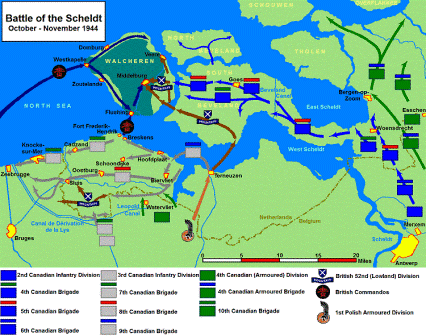
On The War Memorial Trail…..The Knights of Columbus Auxiliary Services Supervisor Who Drowned In A Belgian Canal

December 21, 2025. Pieter’s research results are faster than I can keep up with, and so several of the graves we visited during our 2025 European War Memorial Tour were for soldiers whose stories have yet to be told. One of the cemeteries we visited was the Canadian War Cemetery in Adegem, Belgium. (See https://onthewarmemorialtrail.com/2025/12/08/on-the-war-memorial-trail-a-visit-to-the-canadian-war-cemetery-in-adegem/

Before we left for Europe this past spring, we looked at the names of 12 soldiers from Prince Edward Island are buried in this cemetery. One surname was familiar as we had researched a soldier who was born in the same village and had the same surname,  Michael Joseph ‘Joe’ MACKENNA. (See https://onthewarmemorialtrail.com/2022/09/22/on-the-war-memorial-trail-the-wwii-soldier-from-prince-edward-island-killed-during-the-battle-of-rha/) We contacted Joe MacKenna’s niece, Teresa Hennebery, and asked if there was a family connection.

 ….The search for a photo of Joseph began…

Teresa was certain the families were distantly related and began a search into family records.  In the meantime, Pieter began his own research.    

Joseph Augustine MACKENNA, born June 28, 1903 in Newton Cross, Prince Edward Island, was the son of James and Georgina (nee MacMillan) MacKenna of Newtown, Prince Edward Island, and the husband of Mary (nee Hanrahan) MacKenna, of Antigonish, Nova Scotia.

When he enlisted with the 13th Company of the Canadian Army Forestry Corps (CAFC) in Halifax, Nova Scotia on September 2, 1940, he had been a bank manager with the Royal Bank of Canada, and had over 20 years of banking experience.  It was also noted that he had graduated from high school, was married, and was the father of three daughters:  Mary Eileen, Alice Clare, and Enid Gertrude.

His daughter Mary Eileen later married Cliff Gorman, and it was their son Mike Gorman who first provided a photo of his grandfather. Not long afterwards, Mary McPherson, daughter of Joseph’s brother Francis, also provided photos of her uncle.

Joseph Augustine MacKenna, likely taken in the United Kingdom.  (Photo courtesy of Mike Gorman)

 ….Joseph underwent basic training in Valcartier…

Joseph was sent to A13 Canadian Infantry Training Centre in Valcartier, Quebec for basic training, as were all members of the Canadian Army Forestry Corps, whose role was to cut down and process trees for wood and lumber in the United Kingdom. 

As stated in an article on http://www.canadiansoldiers.com/corpsbranches/forestrycorps.htm  “…wood was needed for living quarters, messes, and recreation facilities, as well as crates for vital supplies such as food, ammunition and even vehicles, and for the creation of explosives, stocks for weapons, the construction of ships, aircraft and factory facilities….

Although members of the CAFC were not expected to be in combat, very rudimentary basic training in using firearms was considered essential due to the threat to the United Kingdom of invasion by German forces.  As a result, members of CAFC “…received five to seven months of training…” at Valcartier.

On January 15, 1941, while still in Valcartier, Joseph was promoted to Acting Lance Corporal.  A few months later, on April 10, 1941, he was confirmed as Lance Corporal, and at the same time transferred to a Royal Canadian Army Medical Corps (RCAMC) unit that was attached to the Canadian Forestry Corps Headquarters.  He was a few months short of his 38th birthday, and while he likely was seen as finding active logging work a challenge, his extensive banking and administrative experience was considered a valuable asset.  

Joseph remained in Valcartier, assigned temporarily to No. 12, No. 14, and No. 19 Companies as needed. 

He was granted embarkation leave from May 23 to June 5, 1941, the last chance he had to see his family again.

….Joseph left Canada for overseas service….

Joseph left Canada for the United Kingdom on June 18, 1941, sailing from Halifax, Nova Scotia, disembarking in Gourock, Scotland on July 2, 1941, before moving on to Canadian Army Forestry Corps Headquarters in Beauly, Scotland. 

August 1941 photo of staff at CAFC HQ in Beauly, Scotland.  Joseph Augustine MacKenna is identified by yellow arrows.  (Photo courtesy of Mary McPherson)

While in Scotland, Joseph received a number of promotions.  On September 2, 1941 he was made Acting Sergeant, and classified as a Clerk Class III, Group C.  He was confirmed in the rank of Sergeant on December 2, 1941.

On July 1, 1942, Joseph was promoted to Staff Sergeant, and a month later promoted again to Acting Quarter Master Sergeant.  On November 1, 1942 he was confirmed in the rank of Quarter Master Sergeant.

Part of an August 1943 photo of staff at CAFC HQ in Beauly, Scotland.  Joseph Augustine MacKenna is identified by red arrow.  (Photo courtesy of Mary McPherson)

Joseph was transferred to the Canadian Army Forestry Corps Headquarters in London, England on September 28, 1943, and requested a demotion to Sergeant on October 15, 1943.  Over the next months, he was posted back and forth ‘On Command’ between London and Camp Whitley in Surrey, England, as Acting Staff Sergeant.

 ….Joseph was appointed Auxiliary Services Supervisor…

On July 18, 1944, Joseph was officially discharged from the Canadian Army and transferred to the Canadian Army Auxiliary Services (CAAS) upon receiving an appointment as Auxiliary Services Supervisor with the Canadian Military Headquarters in London.

What did Auxiliary Services do?  Members organized sports and dances, provided movies and concerts, reading and writing and recreation rooms, libraries, mobile canteens, and established leave hostels and information bureaus for troops on leave.

The Auxiliary Services section included four national volunteer service organizations: Canadian Legion War Services, Knights of Columbus, Salvation Army Canadian War Services, and Canadian Young Men’s Christian Association (YMCA) Overseas.  Joseph was with the Knights of Columbus.

Now a civilian employee of the government, as were all members of Auxiliary Services, Joseph was considered an officer, with equivalent rank of captain, and addressed as Supervisor. As an Auxiliary Services officer he wore a modified service uniform.

 ….Joseph waited for an assignment in Continental Europe…

Example of a dual drive truck.  (Photo courtesy of The Royal Canadian Artillery Museum)

As Allied troops moved through France following D-Day on June 6, 1944 and then into Belgium, The Netherlands, and Germany, Auxiliary Services needed to plan for the support services needed as troops advanced. 

Joseph’s first task was to learn how to operate a Dual Drive truck with front wheel drive, an essential vehicle for the services that the Knights of Columbus would provide in France, Belgium, and The Netherlands, receiving his qualification in early August 1944.

On August 8, 1944, as a member of No. 11 Canadian Army Auxiliary Section (CAAS) Joseph was attached to No. 24 Canadian General Hospital in Horley, Surrey. It was a busy environment with wounded soldiers coming for treatment from the French front. He was there almost 8 months before being transferred to No. 1 Canadian General Reinforcement Unit (CGRU) on March 6, 1945, in preparation for a posting in North West Europe.

 ….Joseph was posted to Belgium…

On March 10, 1945, Joseph was transferred to the X4 General Reinforcement List of the 9th Battalion, leaving England and arriving in Belgium the following day. On March 13, 1945, he was assigned to the 14th Canadian Army Auxiliary Section (CAAS), which was attached to the 13th Canadian Base Reinforcement (CBR) Battalion.  This Battalion was part of the 13th Canadian Infantry Training Brigade, whose main role was administration and training for infantry reinforcements rather than a combat role in the field.

Joseph Augustine MacKenna, likely taken in Belgium. (Photo courtesy of Mary McPherson.  Photo restoration and colourization by Pieter Valkenburg.)

By the time Joseph arrived in Belgium, the country had been liberated since February 4, 1945.  At the time that Joseph arrived, the 14th CAAS, and 13th CBR Battalion, were based in Ghent, which had been liberated months earlier, on September 6, 1944. Among its’ other duties, the 13th CBR Battalion provided 14th CAAS with the supplies it required.

The Knights of Columbus recreation huts stated ‘Everybody Welcome, Everything Free’, providing services to soldiers regardless of race or religion. Travelling by truck to Knights of Columbus huts in Belgium and The Netherlands, Joseph transported supplies such as cigarettes, chocolates, and magazines, as well as equipment such as movie projectors and films. 

One of the many items provided to soldiers was stationery to allow them to write home to their family and friends.

Stationery provided to soldiers by the Knights of Columbus, with the logo showing Canadian symbols of the beaver and the maple leaf and the royal coat of arms at the top. (Photos source: Tales From The Supply Depot)

While Joseph was qualified to drive a truck, as an officer he was entitled to a driver who drove the vehicle in which they travelled to deliver supplies and equipment, before returning to Ghent for more supplies before the next journey.

 ….Mystery of what happened on June 12, 1945…

All went well with Joseph’s assignment with 14th CAAS until the evening of June 12, 1945, when he disappeared after arriving back in Ghent from a trip.  According to testimony by his driver, Private A. J. FONTAINE, after arriving at 14th CAAS in Ghent, “…we unloaded a movie projector and cigarettes and turned them in there.…” Joseph told him that he …had other business to do here.  He told me to go and park the vehicle and to meet him at the Marguerite Café later.  On the way to Marguerite Café I stopped in at the American Café for a drink….

Joseph met him at the American Café and they had a drink before going on to Marguerite Café, located at 230 Groendreef, at 7:30 pm. 

At the Marguerite Café Pte Fontaine stated that Joseph told the proprietor, Marguerite Cador, that “…I would occupy his room for the night there for that night and he would occupy another room across the canal he had already arranged for….

They left the café together at 8 pm and crossed to the other side of the canal. Joseph then “…told me to return to the Marguerite Café to my room and to meet him the next morning at 14 Canadian Auxiliary Services Section at 1000 hours. I returned to the Marguerite Café, bought myself another drink and went to my room….”  It was the last time he saw Joseph.

Marguerite Cador, proprietor of Marguerite Café, testified that Pte Fontaine returned to the café “…15 or 20 minutes…” after they had left.  When she asked where Joseph was, he replied that “…I took him over the bridge to the other side of the canal and left him.  I gave him his bag before I left…

When Joseph didn’t report for work the following day, Pte Fontaine returned to Marguerite Café “….at different times during the day and the same for the next two days. He always asked if I had seen Mr. MacKenna…” Where had Joseph gone?

 ….A body was found in a canal in Ghent…

On the morning of June 21, 1945, Sgt Alexander MATTHEW, special investigator for the Canadian Provost Corps (Military Police), 3rd Canadian Base Reinforcement Group, was informed by the Ghent Civil Police that “….the body of a soldier was in the canal at Ketelplein Bridge….” Sgt Matthew proceeded to the bridge.  “…I looked down from the bank of the canal and saw the body.  I could see that the uniform on it bore ‘Canada’ flashes

The local fire department retrieved the body and transported it to No. 2 Canadian General Hospital’s morgue, and the body was turned over to Quartermaster Sgt G. H. MACMILLAN, chief ward master at the hospital.  With Quartermaster Sgt MacMillan, Sgt Matthew stated that they “… searched his battle dress and obtained a wallet enclosing the identity card of Joseph Augustine MacKenna. There was also a sum of Dutch money…”   

Quartermaster Sgt MacMillan noted that the body was “…badly decomposed…

Major J. D. DUFFIN, Royal Canadian Army Medical Corps, Pathologist at No. 2 Canadian General Hospital, performed an autopsy. His report noted that “…There were no marks of injury either on the clothes or on the skin….” The lungs “…were heavy, voluminous, and filled with dirty water…” leading Major Duffin to surmise that “…death was apparently due to drowning….” The only oddity was that the drowning appeared to have occurred “…an estimated 5 to 7 weeks previously…” and not the 9 days since Joseph had last been seen.

On June 29, 1945, a Court of Inquiry concluded that Joseph died an accidental death by drowning in a canal in Ghent, Belgium.  Although Joseph was last seen on the evening of June 12, 1945, his death was ‘arbitrarily determined’ to be June 20, 1945, and his death ‘confirmed’ on June 21, 1945.

 ….Joseph is buried in the Canadian War Cemetery in Adegem…

Pieter stands behind the grave of Joseph Augustine MacKenna.  (Photo credit: Daria Valkenburg)

Joseph was buried at the Canadian War Cemetery in Adegem, Belgium on June 24, 1945.  We visited his grave during our 2025 European War Memorial Tour, and Pieter placed flags of Canada and Prince Edward Island at his grave. 

This was the second story written about a canal drowning in Ghent!  New Brunswick soldier Azade BOUDREAU also drowned in a canal in Ghent in 1945. See https://onthewarmemorialtrail.com/2025/12/15/on-the-war-memorial-trail-the-wwii-soldier-from-petit-rocher-nord-who-accidentally-drowned-in-a-belgian-canal/

….A surprise encounter in the Canadian War Cemetery in Holten….

Amy Meunier (left) with Daria and Pieter at the Canadian War Cemetery in Holten.  (Photo credit: Ben Miller)

When Mike Gorman had learned that we would be in Europe for the 80th Anniversary of Liberation Commemoration events, he mentioned that we might meet up with Amy Meunier, who works for Veterans Affairs.  “Amy is my 1st cousin’s (Duane Gorman) ex…

We didn’t think anything about it, but then, when we were at the Canadian War Cemetery in Holten, The Netherlands for the grave re-dedication ceremony for WWII soldier Arthur VANANCE of Kenora, Ontario, Paul Ledwell, Deputy Minister of Veterans Affairs, was in attendance with several people from Veterans Affairs.  One of them was Amy!  (See https://onthewarmemorialtrail.com/2025/08/22/on-the-war-memorial-trail-the-wwii-soldier-from-kenora-who-lay-in-an-unknown-grave-for-80-years-part-2-the-grave-re-dedication-ceremony/)

Paul called Amy over and once she realized that we were the people that Mike had told her about, she said “…OMG, my son Levi will love this…”  This surprise encounter helped bridge the past with the present, helping to ensure that those buried overseas will not be forgotten.

The flags placed at Joseph’s grave were donated.  Our thanks go to: 

  • Alan Waddell, Constituent Assistant, on behalf of Heath MacDonald, MP for Malpeque, for the Canadian flag.
  • Matt MacFarlane, MLA for District 19, Borden-Kinkora, for the flag from Prince Edward Island.

Thank you to Joseph’s grandson Mike Gorman and Joseph’s niece Mary McKenna MacPherson for sharing photos and information. Thank you also to Teresa Hennebery. We’ll continue to share the highlights of our adventures on the 2025 European War Memorial Tour. 

The research work continues for Pieter.  If you have photos or information to share about soldiers buried in The Netherlands or Belgium, please email him at memorialtrail@gmail.com, or comment on the blog.    

© Daria Valkenburg

….Another Canadian Army Forestry Corps story….

This was the second story written on this blog about the CAFC.  Edgar M. GUITARD of New Brunswick also served in the Canadian Army Forestry Corps.  You can read his story at https://onthewarmemorialtrail.com/2024/06/24/on-the-war-memorial-trail-the-wwii-lumberjack-from-belledune-killed-by-stray-mortar-fire-in-the-nijmegen-salient/

….Want to follow our research?…

If you are reading this posting, but aren’t following our research, you are welcome to do so.  Our blog address: https://onthewarmemorialtrail.com/

4 countries, 6 weeks, 7,000 km – an unforgettable war memorial journey in Europe…. Daria’s book ‘No Soldier Buried Overseas Should Ever Be Forgotten‘ is available in print and e-book formats.  Net proceeds of book sales help support research costs and the cost of maintaining this blog. For more information see https://nosoldierforgotten.com/

Subscribe to our YouTube Channel: On The War Memorial Trail With Pieter Valkenburg: https://www.youtube.com/channel/UCJ591TyjSheOR-Cb_Gs_5Kw

Never miss a posting!  Subscribe below to have each new story from the war memorial trail delivered to your inbox.
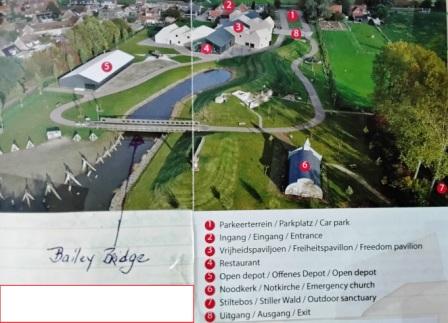
On The War Memorial Trail….. The WWII Soldier From Petit Rocher Nord Who Accidentally Drowned In A Belgian Canal
Pieter beside the sign welcoming us to Petit Rocher, New Brunswick. (Photo credit: Daria Valkenburg)

December 15, 2025. Pieter’s research results are faster than I can keep up with, and so several of the graves we visited during our 2025 European War Memorial Tour were for soldiers whose stories have yet to be told. One of the cemeteries we visited was the Canadian War Cemetery in Adegem, Belgium. (See https://onthewarmemorialtrail.com/2025/12/08/on-the-war-memorial-trail-a-visit-to-the-canadian-war-cemetery-in-adegem/

Azade BOUDREAU, a soldier from New Brunswick, who is buried in this cemetery, became the focus of Pieter’s research after receiving a request from Belgian researcher Patrick Michiels.  The son of a former colleague of his had adopted the grave and wanted to know what he looked like.

….The search for a photo of Azade was successful….

The search for a photo of Azade led us to my hometown of Winnipeg, where Pauline Theriault, the daughter of his sister Alice May, lives. “….Here is a photo of my uncle Azade Boudreau….”  Pauline explained. “…I had reached out to my cousin in Montreal and she had the same photo. She also confirmed that her mother had always told her that Azade had drowned at war….

Azade Boudreau, taken in 1943 in the United Kingdom.  (Photo Courtesy of the Boudreau Family)

….Azade was born in Petit Rocher Nord…

Petit Rocher Nord is located along the shore of Chaleur Bay.  (Map source: Google maps)

Born January 31, 1923 in Petit Rocher Nord, New Brunswick, Azade was the son of Frank J. and Marguerite (nee Doucet) Boudreau.  He was one of 9 children, with 4 brothers and 4 sisters.  We’d visited this beautiful part of New Brunswick in 2024. 

….Azade enlisted shortly after his 19th birthday…

At the time of his enlistment on March 9, 1942 with the 58th Field Battery, Royal Canadian Artillery, in Quebec City, Quebec, Azade, now aged 19, had worked a number of odd jobs as a store clerk and cook’s helper.  He was noted he was fluent in both French and English, and enjoyed skating, as well as playing hockey and baseball. When asked by an interviewer why he joined the army, he stated his reason was ‘adventure’….not an uncommon answer by so many young men.

Working as a waiter in the Officers Mess, he was attached to No. 5 District Depot in Quebec City until May 14, 1942, when he was sent to the No. 53 Canadian Army (Basic) Training Centre (CABTC) in Lauzon, Quebec. 

After successfully completing his basic training, Azade returned to No. 5 District Depot in Quebec City on June 20, 1942.  He was there for a few weeks before being transferred to the 4th Medium Regiment, Royal Canadian Artillery, in Petawawa, Ontario on July 14, 1942 for final training before going overseas. 

….Azade left Canada for overseas service….

On August 8, 1942, Azade left Canada with the 4th Medium Regiment.  Upon arriving in the United Kingdom, the Regiment came under the command of HQ Canadian Corps Medium Artillery.  

Azade, who was identified as being very deft mechanically, was a gun layer, responsible for aiming and firing large guns, using either manual controls or emerging radar/fire-control systems, and working with optical rangefinders.  It was a responsibility that required high skill and tactical awareness.

An October 1942 army interviewer noted that he was neat in appearance, had a cheerful disposition, and liked the army and what he was doing.

The Regiment transferred to 2nd Canadian Army Group Royal Artillery (AGRA) on October 15, 1943.

….The Regiment arrived in France in July 1944….

Azade and the 4th Medium Regiment continued training while in the United Kingdom, but on July 5, 1944, a month after D-Day, they left for Normandy, as part of the 21st Army Group, arriving in Normandy 2 days later. 

Over the next months, they made their way through France and into Belgium as part of the North-West Europe Campaign.  On September 5, 1944, Azade received a promotion to Lance Bombadier. 

 ….Azade accidentally drowned in Belgium…

On December 15, 1944, while the Regiment was in Belgium, Azade, accompanied by Private W. T. SHORTT, was in Ghent.  According to an account by Pte Shortt, they “…went visiting the various cafes in Ghent.  On our way home we dropped into the ice cream parlour near the bridge. After eating our ice cream….” Azade “…said he was going to the toilet.  We went out the door, which presumably led to the toilet, but it was the balcony along the canal. He went to the rail….” and the next thing that Pte Shortt knew was that Azade had fallen into the canal of the Lower Scheldt River.

…I shone my torch on him and yelled ‘man in the canal’.  A light on the bridge seemed to pick him up and I put my torch out and went through the ice cream parlour to the bridge. When I arrived there, there was no sign of anyone with a torch…”  Azade “…had also disappeared… 

 ….Azade’s body was found 5 months later…

5 months after he fell into the canal, Azade’s body was found on May 18, 1945 in a sluice in the Lower Scheldt, near Laurent Place in Ghent. His body was taken to the morgue at No. 2 Canadian General Hospital. An examination to verify his identity determined it was the body of a Canadian soldier.  A letter and photograph in one of the pockets of his clothing had disintegrated from being in the water for so long, leaving no clues to follow up.   However, the location of where the body was found, and with the height of the body, and a dental plate matching Azade, it was determined that it was him.

 ….Azade is buried in the Canadian War Cemetery in Adegem…

Azade was temporarily buried on May 21, 1945 at the Ghent West Cemetery in Belgium before being reburied on August 28, 1945 at the Canadian War Cemetery in Adegem, Belgium.

Pieter stands behind the grave of Azade Boudreau.  (Photo credit: Daria Valkenburg)

We visited his grave during our 2025 European War Memorial Tour, and Pieter placed Acadian, Canadian, and New Brunswick flags at his grave. 

Patrick Michiels at the grave of Azade Boudreau.  (Photo credit: Daria Valkenburg)

Patrick Michiels, who had requested the photo search on behalf of his former colleague’s son, was with us in the cemetery to pay his respects to a young man who drowned, just one month before his 22nd birthday.

The flags placed at Azade’s grave were donated.  Our thanks go to: 

  • Alan Waddell, Constituent Assistant, on behalf of Heath MacDonald, MP for Malpeque, for the Canadian flag.
  • Jean-Claude D’Amours, MLA for Edmundston-Madawaska Centre, Minister responsible for Military Affairs, with the help of Cécile LePage, Province of New Brunswick, for the New Brunswick flag.
  • La Société acadienne de Clare at the request of Simone Comeau for the Acadian flags.

Thank you to Pauline Theriault for sharing a photo of her uncle. Thank you also to Patrick Michiels for joining us during our visit to Adegem. We’ll continue to share the highlights of our adventures on the 2025 European War Memorial Tour. 

The research work continues for Pieter.  If you have photos or information to share about soldiers buried in The Netherlands or Belgium, please email him at memorialtrail@gmail.com, or comment on the blog.    

© Daria Valkenburg

….Want to follow our research?…

If you are reading this posting, but aren’t following our research, you are welcome to do so.  Our blog address: https://onthewarmemorialtrail.com/

4 countries, 6 weeks, 7,000 km – an unforgettable war memorial journey in Europe…. Daria’s book ‘No Soldier Buried Overseas Should Ever Be Forgotten‘ is available in print and e-book formats.  Net proceeds of book sales help support research costs and the cost of maintaining this blog. For more information see https://nosoldierforgotten.com/

Subscribe to our YouTube Channel: On The War Memorial Trail With Pieter Valkenburg: https://www.youtube.com/channel/UCJ591TyjSheOR-Cb_Gs_5Kw

Never miss a posting!  Subscribe below to have each new story from the war memorial trail delivered to your inbox.