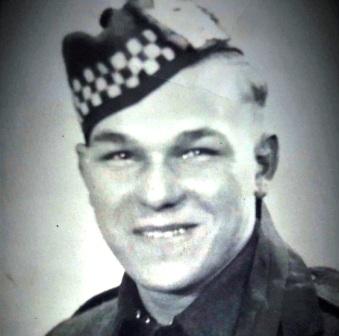
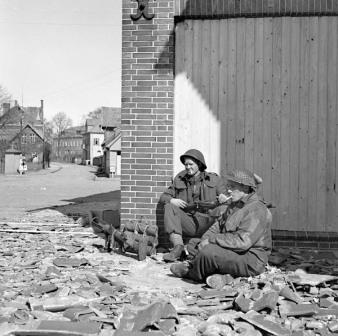
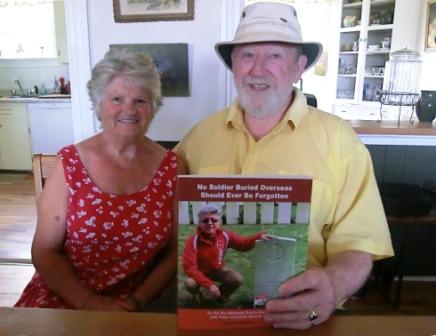
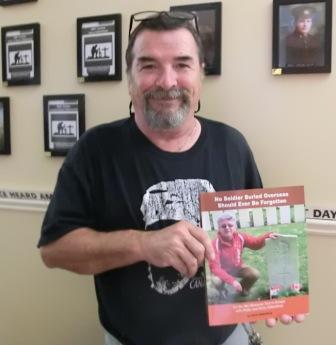
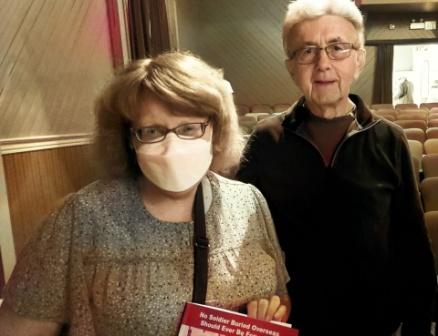
July 28, 2022. We very much appreciate the feedback from ‘No Soldier Buried Overseas Should Ever Be Forgotten’. We love seeing the photos that you send, and where possible, having the opportunity to meet you.
…Legal deposit of book to Library and Archives Canada made in person…
To fulfill the Legal Deposit requirements, we personally delivered a copy of the book at the Library and Archives Canada facility in Gatineau, Quebec. Gatineau is near Ottawa, Ontario, where we were in May. Delivering the book in person gave us a chance to revisit places we hadn’t seen since we moved from Ottawa to Prince Edward Island.
Mélanie Legault (left) accepts book from Daria on behalf of Library and Archives Canada Legal Deposit. (Photo credit: Daria Valkenburg)
…Some additional feedback we’ve received….
Phillip Shovk with his copy of the book. (Photo courtesy of P. Shovk)
Phillip Shovk wrote us to say “… I’ve finally finished your book and I must say that I enjoyed it very much! I like the way it touched on many themes – the courage of the soldiers, the tragedy and futility of war, the respect that the liberated show to the liberators and, of course, the respect that you’ve shown to these young men and the pride you must feel for them as your compatriots! It also reads as a travelogue which makes it lots of fun – maps, getting around, different cultures and of course food! So well done and best wishes to you both …”
Marie Sever wrote us that: “…I am enjoying reading your book. You and Pieter certainly had some adventures and incidents on the way. I particularly love the ‘Fresh’ eggs incident. I would have been confused too. I love the flags you put on the graves you found. A thoughtful gesture and touching for other visitors passing by or looking for that particular grave. The photos are wonderful….”
Glynne Squires with her book. (Photo credit: Daria Valkenburg)
….An interview in the North Bay Nugget….
PJ Wilson (left) with Pieter at the North Bay Public Library in North Bay, Ontario. (Photo credit: Daria Valkenburg)
When we were in North Bay, Ontario, we were interviewed by Peter J. Wilson of the North Bay Nugget, about Pieter’s research into soldiers buried in The Netherlands. The article Couple devoted to telling fallen soldiers’ stories| North Bay Nugget ran in the online version on May 19, 2022 and in the print version on May 20, 2022. See https://www.nugget.ca/news/couple-devoted-to-telling-fallen-soldiers-stories
Thank you to Marie Sever, Phillip Shovk, and Glynne Squires for taking the time to send in comments and photos about the book. Photos or information to share? Email Pieter at memorialtrail@gmail.com, comment on the blog, or tweet to @researchmemori1.
Daria outside the Victoria Playhouse where she will give an Author Talk on August 11, 2022. (Photo credit: Pieter Valkenburg)
Thursday, August 11, 2022 – Victoria-By-The-Sea, Prince Edward Island, part of the ‘Our Island Talks’ series, and hosted by Victoria Playhouse and Victoria Historical Association. Time: 2:00 pm.
…Want to follow our research?….
If you are reading this posting, but aren’t following our research, you are welcome to do so. Our blog address: https://onthewarmemorialtrail.com/
4 countries, 6 weeks, 7,000 km – an unforgettable war memorial journey in Europe…. Daria’s book ‘No Soldier Buried Overseas Should Ever Be Forgotten‘ is now available in print and e-book formats. For more information seehttps://nosoldierforgotten.com/
July 27, 2022. Before we travelled to North Bay, Ontario in May for an Author Talk at the North Bay Public Library, Pieter and Don Coutts prepared a letter to the editor for the local newspapers to see if photos could be found for two North Bay soldiers buried in the Canadian War Cemetery in Holten, The Netherlands: Albert Joseph COTE and John ‘Jack’ Langford WALKER.
The letter ran in the North Bay Nugget on April 19, 2022, and resulted in family of Jack Walker submitting a photo. No family of Albert Joseph Cote came forward, but we soon uncovered enough information and references in other sources to determine that his story needed to be told.
The letter to the editor incorrectly lists Flora’s maiden name as Larose. It was McGinnis. When she remarried, her surname changed from Cote to Larose.
Albert Joseph Cote. (Photo source: October 3, 1944 edition of North Bay Nugget newspaper)
Albert Joseph COTE was born in Quebec on July 12, 1920, the son of Augustin and Flora (nee McGinnis) Cote. His father died in 1922 in Hull (now Gatineau), Quebec and his mother remarried to Xavier Larose. When Albert was 5 years old the family moved to North Bay.
…Albert was an active participant at the North Bay Vocational School…
Albert attended the North Bay Collegiate Institute and Vocational School (in 1958 the name changed to North Bay Algonquin Composite School) in North Bay. Judie Klassen contacted archivist Edward Drieger of the Harris Library at the University of Nipissing, who wrote that Albert was “…a member of Form II B Vocational with Mr. K.E. Thomson in 1938. It also appears that Albert was a member of the Junior Literary Society and a Form representative to the Northland Echo Staff….” He also sent her two photos that included Albert.
Photo from the 1938 Algonquin Composite School yearbook. (Source: Harris Library at the University of Nipissing)
…Albert enlisted shortly after his 20th birthday…
Before he enlisted on July 27, 1940 with ‘B’ Company of The Algonquin Regiment, Albert worked as a messenger boy for a newspaper, a call boy for the Canadian Pacific Railway, and as a clerk in Ligget’s Drugstore. According to his service record he spoke French as well as English.
His Personnel Selection Record with the Canadian Army noted that he “… takes part in most sports…” and“…reads anything – mostly fiction….” The report also stated that he was taking the “…Legion course – music group ‘C’…” and it was recommended that he “…continue as present bandsman…” Unfortunately, no mention was made of which instrument he played!
Albert went to Port Arthur (now Thunder Bay), Ontario for training, and then was sent to Botwood, Newfoundland in July 1942. Why Botwood? An RCAF base in Botwood had aircraft patrolling the east coast of the Atlantic. Canadian Army personnel, including members of The Algonquin Regiment, based at Botwood were charged with protection of military facilities that had been installed there. (See https://www.heritage.nf.ca/articles/politics/botwood-base.php)
… Albert and his Regiment were sent to Normandy, France…
In January 1943 he left Newfoundland for #2 Transit Camp in Debert, Nova Scotia in preparation for going overseas.
On June 11, 1943, Albert and The Algonquin Regiment left for England, arriving on June 19, 1943.
A year later, he and his Regiment landed in Normandy, France on July 25, 1944, as part of the 10th Infantry Brigade, 4th Canadian Armoured Division. They were part of the contingent to capture Falaise as Allied troops moved through France following D-Day on June 6, 1944.
…Albert was mentioned for his heroism during Operation Tractable…
On August 14, Operation Tractable began north of Falaise, with Canadian and Polish troops, supported by a British tank brigade. The aim of this battle was to capture Falaise and then the smaller towns of Trun and Chambois. (See https://en.wikipedia.org/wiki/Operation_Tractable)
Mark Zuehlke mentioned Albert in Chapter 27 of his book ‘Breakout From Juno’. On August 17, 1944, the Algonquin Regiment was in the area of Damblainville. “….The Algonquins were the lead element in a long column of 10th Infantry Brigade and other 4th Armoured Division formations expecting to push across the Ante River bridge and advance on Trun…”
After crossing the Ante River, Captain Clark Robertson’s platoon tried to seize a small railway bridge west of Point 77, where they were headed next. As one section of troops crossed the railroad, they were attacked by gunfire. Robertson was ordered to pull back.
Zuehlke explains what happened next. “…Extracting the section across the tracks proved no easy matter, but the men escaped under covering fire from the rest of the company. When it was discovered that a seriously wounded man had been left behind, ‘A’ Company’s stretcher-bearer, Private A.J. Cote went to get him.
As everyone else threw out fire, Cote dashed forward, found the man, quickly tended to his wounds, and carried him to safety. ‘Quite the bravest act I saw during the entire war’ Robertson said later, even though Cote’s gallantry went officially unrecognized…”
…Albert was in Belgium during the Battle of the Leopold Canal…
By September The Algonquin Regiment had moved up through northwest Europe into Belgium to be part of the preparations for the upcoming Battle of the Scheldt and the liberation of The Netherlands.
The Leopold Canal in peacetime. (Source:Wikipedia)
The Algonquin Regiment was tasked with establishing a bridgehead across the Leopold Canal. This was unsuccessful for many reasons, and resulted in the Battle of the Leopold Canalon September 13-14, 1944. They failed because “…a diversion failed to draw the German forces away, the boat launch was late and the artillery support ended too quickly. Many of the paddlers from other regiments assigned to assist The Algonquin Regiment never arrived, forcing the Algonquin troops to move the heavy assault boats across the canal and over the island where many German soldiers fired at them from hidden slit trenches….” (Source: https://www.canada.ca/en/department-national-defence/services/military-history/history-heritage/casualty-identification-military/battle-leopold-canal-september-13-14-1944.html)
…Albert’s heroism continued during the Battle of the Leopold Canal…
On September 14, 1944, in the midst of heavy casualties, Allied troops were ordered to withdraw, with gunners firing all their ammunition in an attempt to provide cover for the retreating men.
Mark Zuehlke mentions Albert Cote again in ‘Terrible Victory’: “….The firing had the desired result, holding the Germans sufficiently at bay to enable most of the Algonquins to escape….”
“…Not all the Canadians managed to get out, despite men attempting to drag or carry the wounded while others protected them with covering fire. A number of the more badly injured had to be left. Stretcher-bearer Private Albert Joseph Coté volunteered to remain with three tourniquet cases. Soon after the other Algonquins headed off, shellfire wrecked the building where he and the wounded men sheltered. Coté was fatally wounded….”
This wasn’t the end of the story, however! Albert was mentioned in ‘Finding Bill’ by Henrietta T. O’Neill, published in 2009. She records the recollection of Cpl Bill O’Neill in one excerpt: “…Back at headquarters, a request for air re-supply was denied due to lack of aircraft, and by 12:00 that afternoon a withdrawal order was issued, accompanied by a heavy artillery barrage and smoke screen. Realizing they were being surrounded in the barn, Private A. J. Coté, a young stretcher-bearer, volunteered to stay with three soldiers who were too wounded to move. Later, the building was shelled by the Germans and Coté fatally wounded…”
Albert didn’t die in the barn, but was badly wounded with a gunshot wound to his right thigh. He was taken prisoner of war.
…Albert’s untreated wounds cost him his life…
A badly wounded Albert Cote was transported from the Leopold Canal in Belgium, to a field hospital in Fallingbostel, Germany. After his death, he was initially buried in a prisoner of war cemetery in Orbke. (Map source: Google)
Albert ended up in Kriegs Lagerlazarett (Field Hospital) Stalag 11B near Fallingbostel, Germany. Most likely, he would have been transported there by train along with other prisoners of war. International Red Cross reports from November 1944 indicate that conditions were dire there, with limited medical care, limited medical supplies such as dressings, and the supply of drugs was exhausted. (See https://www.pegasusarchive.org/pow/cSt_11B_History1.htm)
According to the German records, Albert died on October 5, 1944 and was initially buried in the Prisoner of War Cemetery in Orbke, 800 km northeast of Fallingbostel.
…..Albert is buried in the Canadian War Cemetery in Holten….
In March 1948, Albert was reburied in the Canadian War Cemetery in Holten.
Albert Joseph Cote is buried in the Canadian War Cemetery in Holten, The Netherlands. (Photo courtesy of the Information Centre Canadian Cemetery Holten)
…..Albert Cote is listed on the North Bay Cenotaph in Memorial Park….
Pieter and Don Coutts by a section of the Wall of Honour in Memorial Park in North Bay, Ontario. (Photo credit: Daria Valkenburg)
Albert Joseph Cote, buried in the Canadian War Cemetery in Holten. (Photo credit: Don Coutts)
Although he never received official recognition for his heroism, Albert Cote was remembered by several of the men he served with, and he is recognized on the Wall of Honour in Memorial Park in North Bay, Ontario where he grew up.
Researching this story took on a life of its own, as so many people volunteered their help. Thank you to Shawn Rainville and Judie Klassen for researching the newspaper archives. Judie also found the book references in which Albert Cote was mentioned and researched the Cote family. Thank you to archivist Edward Drieger of the Harris Library at the University of Nipissing for the information about Albert Cote’s school activities.
Staff at the North Bay Public Library, the Nipissing District Branch of the Ontario Genealogical Society, and Captain Tim Feick and Cpl Brayton of The Algonquin Regiment independently dug into the archival material. Special thanks go to the North Bay Nugget newspaper for its extensive coverage of WWII soldiers from the time period.
Both Mark Zuehlke and Henrietta T. O’Neill were contacted in case they had additional information on Albert Cote other than what was in their books. Both responded, but nothing more could be added.
As our North Bay adventures conclude, we thank Don Coutts for guiding us around North Bay and arranging for the events we were able to participate in, and the North Bay Public Library for the invitation to do an Author Talk.
If you know of any soldiers that are buried in The Netherlands please let Pieter know. You can email him at memorialtrail@gmail.com, comment on the blog, or send a tweet to @researchmemori1.
…Missed the previous postings about our North Bay Memorial Trail visit?…
Daria’s book ‘No Soldier Buried Overseas Should Ever Be Forgotten‘ is available in print and e-book formats. For more information seehttps://nosoldierforgotten.com/
Upcoming Author Talk:Thursday, August 11, 2022 – Victoria-By-The-Sea, Prince Edward Island, part of the ‘Our Island Talks’ series, and hosted by Victoria Playhouse and Victoria Historical Association. Time: 2:00 pm.
July 17, 2022. Before we travelled to North Bay, Ontario in May for an Author Talk at the North Bay Public Library we were given the name of a WWII soldier buried in the Canadian War Cemetery in Groesbeek, The Netherlands, who was listed as being from North Bay: John ‘Jack’ Richard MARACLE.
When Pieter began researching his story, he quickly saw that Jack Maracle was not from North Bay and had never lived there. What was the connection? It turned out that his maternal grandfather, Thomas Marshall, lived in North Bay, and his mother had grown up there. Mystery solved!
John ‘Jack’ Richard Maracle. (Photo courtesy of the Jack Maracle Family)
Brenda Baughman submitted a photo on behalf of the Maracle Family, explaining that it was “…a photo of my cousin John Richard Maracle. Jack, as he was called by the family, is in his WWII uniform. My grandmother Florence was the sister of Jack’s father, who was always called Elmer….”
Jack Maracle with Brenda Baughman’s mother Freda Maracle in Toronto, circa 1942. (Photo courtesy of the Jack Maracle Family)
…Jack Maracle had deep Mohawk roots….
Jack was born March 29, 1925 in Midland, Ontario, the son of Henry ‘Elmer’ and Irene Mildred (nee Marshall) Maracle. He had deep Mohawk roots on his paternal side through Elmer’s parents.
Jack’s father Elmer was a professional hockey player, playing in six leagues across North America over the course of his 20 year career. He was one of the first Indigenous players in the National Hockey League (NHL) when he was with the New York Rangers in the early 1930s.
Elmer Maracle with the North Bay Trappers, circa 1925. (Photo courtesy of the Jack Maracle Family)
Because of his father’s career, Jack and his sister Betty lived in several places throughout North America, returning to Ontario with their mother only once their parents’ marriage broke up.
…Jack had an aptitude for motor mechanics….
Jack worked in several jobs as a teenager, including bicycle delivery with a printing company, telegram delivery, press operator helper with lithography, and a shop man with the Canadian Pacific Railway.
Before Jack enlisted with the #2 District Depot in Toronto, Ontario on March 29, 1943 – his 18th birthday – he was an elevator operator with the Robert Simpson Company, a department store that later became known as Sears. (See https://en.wikipedia.org/wiki/Simpsons_(department_store))
The self-operated automatic elevators we know today replaced manually operated elevators, which required an operator to be able to regulate speed and have a good sense of timing to ensure the elevator stopped level with a floor. (See https://en.wikipedia.org/wiki/Elevator_operator) These skills were a good preparation for Jack’s army career.
His Personnel Selection Record with the Canadian Army recorded that Jack was “… a neat, well-dressed young man of slim build… who is keen to get into the army… In each of his frequent job changes he has bettered himself…..” It went on to note that he had “….well above average learning ability...” His aptitude and interest in motor mechanics was noted, including that he “…prefers the ‘Tank’ corps….”
The Personnel Selection Record noted that Jack’s “… only sporting interest is roller-skating...” (not hockey!) and that he liked “…social events, and, for a hobby, collects photographs of locomotives…”
…Jack’s army career began with armoured tank training ….
Jack’s medical exam noted that he had a hernia and a heart murmur, so he was placed in Category ‘D’ (temporarily unfit for service) and sent first to the Camp Petawawa Military Hospital (CPMH), then to Toronto Convalescent Hospital (TCH) for a hernia operation.
On August 20, 1943 he was transferred to #26 Canadian Army Basic Training Centre (CABTC) in Orillia, Ontario, where he stayed until October 18, 1943. From Orillia he was sent to Borden, Ontario to the Canadian Armoured Corps Training Centre (CACTC) for advanced training in tanks, becoming a Qualified Driver i/c Class III Wheeled on November 25, 1943. It was noted that he could not proceed overseas before his 19th birthday on March 29, 1944.
On April 30, 1944, he sailed to the United Kingdom, arriving on May 7, 1944, where he was transferred to the Canadian Armoured Corps Reinforcement Unit (CACRU). He was sent for further training, and qualified as Gunner Operator ‘C’ on August 1, 1944.
…Jack arrived in northwest Europe and joined the 6th Canadian Armoured Regiment ….
On September 25, 1944 he arrived in France as part of the Canadian Armoured Corps reinforcement. On October 31, 1944 he was transferred to the 6th Canadian Armoured Regiment (1st Hussars), which was in Breda, The Netherlands.
The November 1, 1944 War Diary entry for the 6th Canadian Armoured Regiment noted that “…This section of the country has received us exceptionally well but they are almost destitute for food as is evidenced by the number of civilians around our cook lorry…”
On November 9, 1944 the Regiment moved towards the northeast to Groesbeek, near the German border, in preparation for upcoming operations in the Rhineland.
…Armoured tanks helped win the war…..
If you wondered what an armoured tank regiment did and the difficulties and dangers that were faced, you can take a look at this 47 minute documentary: ‘How Canada’s Blockbuster Tank Operation Won The Allies WW2’
…Jack’s Regiment prepared for the upcoming battles in Germany…..
Christmas found the Regiment still in The Netherlands. The December 25, 1944 War Diary entry for the 6th Canadian Armoured Regiment noted that “…To-day the regiment, less one squadron, came under command of 3rd Canadian Infantry Division….”
On February 7, 1945, War Diary entry for the 6th Canadian Armoured Regiment noted that “…Morale is at a high peak as it is evident by the flow of equipment on the roads that we are soon to witness our first real thrust into Germany….”
The February 11, 1945 War Diary entry for the 6th Canadian Armoured Regiment noted that “…Now that Operation Veritable is in full swing traffic has been resumed to normal….” (See https://en.wikipedia.org/wiki/Operation_Veritable)
On February 19, 1945, the Regiment was informed that they would be going into Germany. The War Diary entry for the 6th Canadian Armoured Regiment noted that “…This morning we were warned that the Regiment would be moving very shortly to the CLEVE area. The prisoners taken on operation Veritable have now risen to nine thousand one hundred…” Kleve, Germany is just a few short kms from Groesbeek, The Netherlands.
On February 25, 1945, the War Diary entry for the 6th Canadian Armoured Regiment noted that “…. The crews are checking on all equipment and making minor repairs to make the tanks battle worthy as we have learned of a coming operation…” This was for the Battle of Keppeln, fought between February 26 and March 3, 1945. This was the start of Operation Blockbuster. (See https://en.wikipedia.org/wiki/Operation_Blockbuster)
After Keppeln came the Battle of Balberger Wald, the southern section of the Hochwald Forest, southeast of Keppeln and part of the Schlieffen Line that protected the approach to the Rhine River. It took “…two more days to complete clearing … after Le Régiment de la Chaudière had secured the Tüschen Wald on 2 March. As they probed southward and then eastward through the woods, the Queen’s Own Rifles and the North Shore Regiment encountered persistent resistance by small enemy bands…. Every advance was counter-attacked…. and the 1st Hussars, held up by numerous anti-tank mines, could only give supporting fire through the trees from stationary positions….” (See https://www.ibiblio.org/hyperwar/UN/Canada/CA/Victory/Victory-19.html, page 513)
…The final phase of Operation Blockbuster began on March 5, 1945 ….
In ‘A History of the First Hussars Regiment 1856-1980’ by Brandon Conron, published in 1981, explained that “… The final part of ‘Blockbuster’, in which the Regiment took an active part, was on March 5th… the plan was to attack east from the Hochwald and seize the high ground between Xanten and Sonsbeck...”
The March 5, 1945 War Diary entry for the 6th Canadian Armoured Regiment noted that it was “…Cloudy with sleet and rain...”
Conron’s Regimental history provides a bit more information. “…Although first light was at 0645 hours, zero hour was set for 0615 hours. Despite the darkness the tanks moved forward with the infantry… By daylight it became quite evident that the buildings in the rear where not clear, for a continuous stream of German machine gun fire from that direction harassed everyone…”
Jack was hit in the abdomen by a bullet from machine gun fire and quickly taken to a Casualty Clearing Post by the 23rd Canadian Field Ambulance, reaching it shortly after 7 am. By noon he had been admitted to #3 Canadian Casualty Clearing Station in Bedburg, Germany. Despite efforts to save him, he unfortunately died on March 12, 1945.
…Jack is buried in the Canadian War Cemetery in Groesbeek…
Grave of John ‘Jack’ Richard Maracle at the Canadian War Cemetery in Groesbeek. (Photo source: http://www.findagrave.com)
Jack was temporarily buried at the Bedburg Canadian Military Cemetery before being reburied in the Canadian War Cemetery in Groesbeek, The Netherlands.
Brenda Baughman with her sister and brother. Left to right: Brenda Baughman, Lynda Wink, Gordon Cooper. (Photo courtesy of Brenda Baughman)
Thank you to Brenda Baughman for sending photos and sharing information on her cousin, Jack Maracle. Our North Bay adventure concludes in the next posting. If you know of any soldiers from the North Bay area that are buried in The Netherlands please let Pieter know. You can email him at memorialtrail@gmail.com, comment on the blog, or send a tweet to @researchmemori1.
If you are reading this posting, but aren’t following our research, you are welcome to do so. Our blog address: https://onthewarmemorialtrail.com/
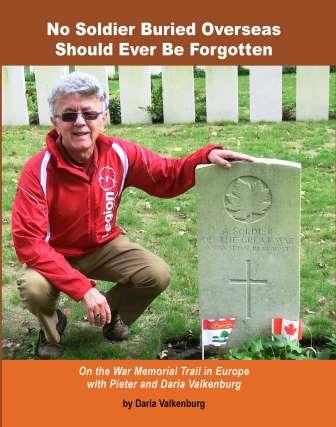
4 countries, 6 weeks, 7,000 km – an unforgettable war memorial journey in Europe…. Daria’s book ‘No Soldier Buried Overseas Should Ever Be Forgotten‘ is available in print and e-book formats. Net proceeds of book sales help support research costs and the cost of maintaining this blog. For more information seehttps://nosoldierforgotten.com/
Upcoming Author Talk: Thursday, August 11, 2022 – Victoria-By-The-Sea, Prince Edward Island, part of the ‘Our Island Talks’ series, and hosted by Victoria Playhouse and Victoria Historical Association. Time: 2:00 pm.
July 13, 2022. Before we travelled to North Bay, Ontario in May for an Author Talk at the North Bay Public Library, Pieter and Don Coutts prepared a letter to the editor for the local newspapers to see if photos could be found for two North Bay soldiers buried in the Canadian War Cemetery in Holten, The Netherlands.
The two soldiers were: John ‘Jack’ Langford WALKER and Albert Joseph COTE. The letter ran in the North Bay Nugget on April 19, 2022….
…Family of Jack Walker contributes a photo…
While waiting for the letter to be published, Pieter continued his research and found an obituary of Jack Walker’s brother, William Joseph Walker, which referred to several family members living in North Bay. Don Coutts took it from there and was able to get in contact with Sue Love, who said that her brother had a photo.
John ‘Jack’ Langford Walker. (Photo courtesy of the Walker Family)
John ‘Jack’ Langford Walker was born April 3, 1924 in North Bay, Ontario, the son of John Edmund and Angel (nee Gauthier) Walker. Before enlisting on January 6, 1943 in North Bay with the #2 District Depot, he worked for a local plumber, J. M. MacPherson.
On January 28, 1943 he was transferred to #26 Canadian Army Basic Training Centre (CABTC) in Orillia, Ontario, where he stayed until March 31, 1943. From Orillia he was sent to Borden, Ontario to the Canadian Armoured Corps Training Centre (CACTC) for advanced training in tanks.
On May 21, 1943 he was transferred to #1 Canadian Armoured Corps Training Regiment (CACTR) and then on August 13, 1943 he left Borden for #2 Transit Camp in Debert, Nova Scotia in preparation for going overseas.
On September 13, 1943, he left for England, arriving on September 19, 1943, where he was transferred to the Canadian Armoured Corps Reinforcement Unit (CACRU). At the end of November 1943 he was sent for a month long wireless course.
… Jack Walker is sent to northwest Europe…
On January 7, 1944 he was transferred to the 21st Canadian Armoured Regiment (The Governor General’s Foot Guards) and sent for further training, before leaving the United Kingdom for Normandy, France with the Regiment, arriving there on July 22, 1944.
In France, the Regiment was part of the 4th Armoured Brigade, 4th Canadian Armoured Division. The Regiment’s first battle was in Falaise in August, and it continued on to fight in northwest Europe, taking part in the Battle of Normandy, the Battle of the Scheldt, and then on to the Rhineland in Germany for the final phase of the war. (See https://en.wikipedia.org/wiki/Governor_General%27s_Foot_Guards#The_Second_World_War)
…The Battle of Bad Zwischenahn took place in the last days of the war…
On April 20, 1945, the 4th Canadian Armoured Division was ordered to advance on Oldenburg, Germany. Jack’s Regiment, along with the Canadian Grenadier Guards and the Lake Superior Regiment, were ordered north to the German spa town of Bad Zwischenahn. During the war, the largest Luftwaffe airbase in northern Germany was in Bad Zwischenahn.
This advance north of the Küsten Canal was difficult. Only a single road went across the Küsten swamps to Bad Zwischenahn, and in places the road disappeared. Tanks got bogged down and constant road maintenance was a priority to keep the road open.
Note the position of the Governor General’s Foot Guards at the bottom on the map. (Map source: http://www.canadiansoldiers.com)
On April 30, 1945, Bad Zwischenahn was surrounded by Allied troops, and the burgomaster (mayor) was offered a choice of ‘unconditional surrender’ or ‘annihilation’. No formal surrender by the German military commander was made, but he did evacuate Bad Zwischenahn, and well into the night, heavy equipment was withdrawn by the Germans on the 4th Armoured Brigade front. (See https://www.canadiansoldiers.com/history/battlehonours/northwesteurope/badzwischenahn.htm)
…Booby traps in Bad Zwischenahn ended in death…
In ‘Steady the buttons two by two: Governor General’s Foot Guards regimental history, 125th anniversary, 1872-1997’, by Robert M. Foster and Tim Richter, it was noted that although the enemy garrison withdrew from Bad Zwischenahn and the town was taken without a fight, on May 1, 1945 “… booby traps in the vicinity killed Guardsmen V. P. Hanney and J. L. Walker, the Regiment’s last two battle casualties…”
Jack was 20 years old. Vivian Playster HANNEY, age 32, was the son of Jonathon and Mary Hanney, of Merthyr Tydfil, Glamorgan, Wales. Like Jack, he is buried in the Canadian War Cemetery in Holten, The Netherlands.
Ironically, this is the same day that Germany announced the death of Adolph Hitler, who had died on April 30, 1945. This announcement led to the end of the war in Europe a few days later. On May 5, 1945, in Bad Zwischenahn, Lt.-Gen. Guy Simonds received the unconditional surrender of those German forces facing the Corps in northern Germany.
…Jack Walker is buried in the Canadian War Cemetery in Holten…
Jack was temporarily buried in Germany before being reburied on March 8, 1946 in the Canadian War Cemetery in Holten, The Netherlands.
Grave of John ‘Jack’ Langford Walker at the Canadian War Cemetery in Holten. (Photo source: Canadian Virtual War Memorial)
Thank you to Don Coutts and Sue Love for arranging for a photo of Jack Walker. Thank you also to Shawn Rainville and Norma Wall for researching the newspaper archives, and to Vincent Lafond of the Military History Research Centre of the Canadian War Museum for help in researching what happened to the Regiment on May 1, 1945. Kudos to the North Bay Nugget newspaper for its extensive coverage of WWII soldiers from the time period and for digitizing the newspapers.
Our North Bay adventures continue in upcoming postings. If you know of any soldiers from the North Bay area that are buried in The Netherlands please let Pieter know. You can mail him at memorialtrail@gmail.com, or comment on the blog.
If you are reading this posting, but aren’t following our research, you are welcome to do so. Our blog address: https://onthewarmemorialtrail.com/
4 countries, 6 weeks, 7,000 km – an unforgettable war memorial journey in Europe…. Daria’s book ‘No Soldier Buried Overseas Should Ever Be Forgotten‘ is available in print and e-book formats. Net proceeds of book sales help support research costs and the cost of maintaining this blog. For more information see https://nosoldierforgotten.com/
June 29, 2022. When we knew we would be travelling to North Bay, Ontario in May for an Author Talk at the North Bay Public Library, Pieter also wanted to help the Canadian War Cemeteries in The Netherlands fulfill their photo wish lists of six soldiers from the North Bay area.
Little did we know that a chance meeting with retired history teacher John Hetherington, organized by Don Coutts, to bring together like minded individuals interested in military research, would be the key to receiving one of these photos.
…A meeting that led to a photo of a WWII soldier….
John Hetherington with Daria and Pieter at the North Bay Public Library. (Photo credit: Don Coutts)
John Hetherington takes groups to visit war memorials and cemeteries in Europe, and we were delighted to meet him one evening during our visit to North Bay. After he and Pieter discussed the soldiers on the photo wish lists from the Canadian War Cemeteries in The Netherlands, John recalled that two nephews of Anthony PETTA, one of the soldiers on the list, had been on one of his tours, and had visited their uncle’s grave.
Leave it with me, he said. He’d look up the contact information and call them. He did, and within a few days, a photo was sent to Pieter by Anthony Repa, which was in turn sent to The Netherlands.
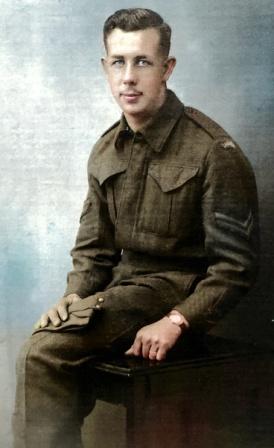
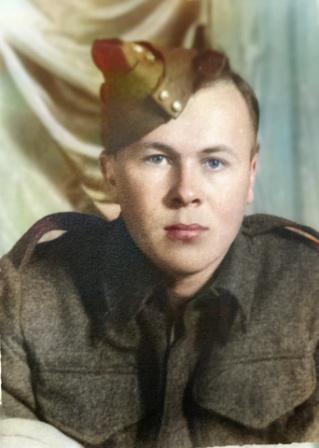
Anthony Petta. (Photo courtesy of Anthony Petta Family. Photo submitted by Anthony Repa. Photo restoration and colourization by Pieter Valkenburg)
Antonio ‘Anthony’ PETTA was born November 8, 1915 in North Bay, Ontario, the son of Michael and Raffaela (nee Rota) Petta. Before enlisting with the Algonquin Regiment in North Bay on May 12, 1941, he was employed as a freight handler with the Temeskaming and Northern Ontario Railroad.
Anthony’s Occupational History Form indicated that he spoke English and Italian fluently, not surprising as both his parents had been born in Italy. He also indicated that after the war he hoped to take a Commercial Agriculture Course and become a chicken farmer.
On July 12, 1941, he was sent for training at Camp Shilo in Manitoba, followed by a promotion to Acting Corporal and a transfer to Newfoundland on August 8, 1942.
On February 16, 1943, he requested a demotion to Private and was sent to Debert, Nova Scotia, a camp that prepared soldiers for overseas service. The demotion lasted one day, and he was reappointed Acting Corporal. On April 6, he was confirmed as Corporal, and the following day, received another promotion, to Lance Sergeant.
By July 2, 1943 he was in the United Kingdom. While in the United Kingdom, he was promoted to Acting Sergeant on February 28, 1944, and then promoted again, this time to Sergeant, on May 28, 1944.
His stay in the United Kingdom ended when he left for Normandy, France with the Algonquin Regiment on July 20, 1944. On July 25, 1944, all four companies of the Algonquin Regiment landed on Juno Beach where, in the following days, they supported the 4th Canadian Armoured Division in closing the Falaise Gap. From there they fought to secure many bridgeheads over canals in The Netherlands and into Germany.
From November 5 to 8, 1944 the Algonquin Regiment had a rest period in the area around Steenbergen, in preparation for Operation Blockbuster, which began in February 1945, part of the final push towards the Rhine. (See https://en.wikipedia.org/wiki/Operation_Blockbuster)
According to his service record, while in Europe Anthony was appointed Acting Company Sergeant Major (CSM) with the rank of Acting Warrant Officer 2. (See https://en.wikipedia.org/wiki/Company_sergeant_major)
….The Battle of Hochwald Gap was fierce and under wet and muddy conditions….
The war diary for the Algonquin Regiment for February 27, 1945 noted that they were huddled beside the tanks which had brought them forward. Unfortunately, one company and part of another were missing, as the tanks carrying them had bogged down.
The objective for the Algonquin Regiment was a rounded hill which filled the western end of the gap between the Hochwald and the Balberger Wald.
The war diary for the Algonquin Regiment for March 2, 1945 explained that “… ‘D’ Company managed to mount two platoons on the available tanks, and with one platoon on foot, started for their objective. The two platoons on tanks managed to get as far forward as the Lake Superior Regiment position, but by this time 5 of the 8 tanks had been knocked out. The infantry therefore debussed and the tanks returned to the protective cover of the hill….
The third platoon of ‘D’ Company joined the small force of Lake Superior Regiment holding the furthest position forward. ‘A’ Company then tried to get forward to join ‘D’ Company, but they were pinned down by murderous fire from both flanks and were being shelled at every moment. It was decided to abandon this effort as casualties had been very heavy. A/CSM Petta was killed in this action….
Lt Hamilton, taking part in his first action, was also killed. Captain T. P. Richardson, Acting Commander ‘A’ Company, who was with CSM Petta, was missing, believed killed….”
It was later confirmed that Captain Richardson had died. Although the official records state that Anthony Petta died on March 3, 1945, the war diary indicates that he had died a day earlier. His brother Alexander ‘Leslie’ was also in the Algonquin Regiment and survived the war.
…Tanks helped protect infantry regiments…
A 46 minute YouTube video on the Battle of Hochwald Gap explained the fierce battle that took place. While this video depicts the tank battle, it shows the horrifying conditions troops were up against. Infantry units like the Algonquin Regiment depended on the tank regiments for protection.
…The photo at the Canadian War Cemetery in Groesbeek that triggered John’s memory…
Anthony Repa, left, and Maurice Petta, right, by the grave of Anthony Petta at the Canadian War Cemetery in Groesbeek in April 2010. (Photo courtesy of John Hetherington)
After meeting us, John did look for the photo of the two nephews, and sent it to us. When Anthony Repa sent us the photo of his uncle, he also gave permission to include the 2010 photo taken of himself and his cousin in Groesbeek.
Anthony went on to share that he has visited the cemetery in Groesbeek “…three times. The first, I was 23, in 1968 and backpacked around England, Belgium and Holland for 2 weeks. The second trip, I was with my wife and young son in 1987. The third was on John’s tour in 2010.
On the second trip, my wife and son and I were taking a Rhine River cruise which originated in Nijmegen. We booked into a hotel in Nijmegen and after I asked the desk clerk if there was a bus to Groesbeek, he directed us to a bus stop. As we waited at the stop, a bus came from the direction of the cemetery and stopped.
The female driver said something to us in Dutch. I told her we were Canadian and she then said in English that this was the last bus and that she was finished her shift. She then asked where we wanted to go. I said the Groesbeek Cemetery as my uncle was buried there. She told us to get on the bus, turned the bus around and drove us to the cemetery. I offered to pay the fare but she declined.
When we arrived she told us to take as long as we wanted to, that she would wait. After we paid our respects she drove us back to the hotel.
I have told countless people about this experience. I have many wonderful memories of my travels, one of my fondest, is the kindness she showed us on that day….”
…The Memorial Plaque from St. Rita Roman Catholic Church…
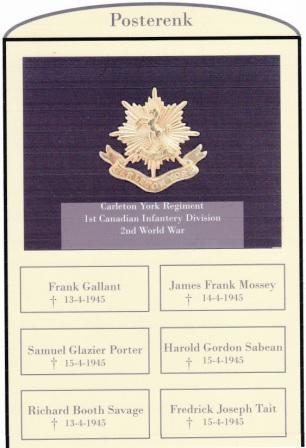
Part of the memorial plaque originally placed by St. Rita Roman Catholic Church. (Photo courtesy of Karen Steel)
We thought we had reached the end of the research for Anthony Petta when we were contacted by 92 year old Don Unger, who said he grew up in the neighbourhood around St. Rita’s Roman Catholic Church and remembered seeing a memorial in the church yard. The memorial “….mentions Anthony Petta and other Italian boys who served…” he told Pieter.
The church was closed in 2010, but we asked Don Coutts, who lives in North Bay, if he could see if the memorial was still in the yard. It wasn’t.
Don then went to the Pro-Cathedral of the Assumption and asked Karen Steel if she had any information. Karen explained that “…the plaques were donated to the North Bay Museum…” but she sent us “…a copy of the plaque information that I took for historical purposes before the plaques were taken to the museum. I always knew someday someone would be looking for this information!…”
The July 23, 1946 edition of the North Bay Nugget newspaper had a picture of the war memorial when it was dedicated. The text under the picture said “…His Excellency R. H. Dignan, assisted by Rev R. F. Venti, officiated at the unveiling of a splendid war memorial at St. Rita’s Park on Sunday. Dedicated to the memory of four members of the parish who gave their lives in the Second World War, the memorial is also in honour of those who served during the war.
The four corners are dedicated to Sgt Joe Demarco of the RCAF, Sgt A. Petta, Pte Gordon Hogan, and Cpl William Lafontaine, all of whom gave their lives during the recent conflict. The honour roll is also inscribed on the memorial. The dedication ceremony was an impressive one…”
Thank you to Don Coutts, John Hetherington, and Anthony Repa. Thank you also to Judie Klassen and Shawn Rainville for researching the newspaper and genealogy archives. Thank you to Karen Steel and Don Unger for the information on the memorial from St. Rita’s Church. Thanks also go to the North Bay Nugget newspaper as it had extensive coverage of WWII soldiers from the time period and the newspaper archive is digitized.
Our North Bay adventures continue in upcoming postings. If you know of any soldiers from the North Bay area that are buried in The Netherlands please let Pieter know. You can mail him at memorialtrail@gmail.com, or comment on the blog.
….Previous stories told about soldiers who lost their lives during the Battle of Hochwald Gap ….
Two previous stories were told about soldiers who lost their lives during the Battle of Hochwald Gap. Clarence Wilfred Wakegijig was in a tank regiment that supported the infantry. Gerald Coolen, like Anthony Petta, was in an infantry regiment. To read the stories about Clarence and Gerald, see:
If you are reading this posting, but aren’t following our research, you are welcome to do so. Our blog address: https://onthewarmemorialtrail.com/
4 countries, 6 weeks, 7,000 km – an unforgettable war memorial journey in Europe…. Daria’s book ‘No Soldier Buried Overseas Should Ever Be Forgotten‘ is available in print and e-book formats. Net proceeds of book sales help support research costs and the cost of maintaining this blog. For more information see https://nosoldierforgotten.com/
June 17, 2022. Some families span generations of military service, as we discovered when researching the life of WWII soldier Cecil Edward GOODREAU of North Bay, Ontario. Not only did Cecil serve during WWII, but two of his brothers did as well:
Murrel Robert, who worked at National Grocers in North Bay before enlisting in 1942
William (Bill) Joseph, who worked at Rankin’s Grocery in North Bay before enlisting
Both Murrel and Bill returned home from the war. Cecil didn’t.
The three brothers followed in the footsteps of their father Henry (Harry) Goodreau, who enlisted in WWI and served in France. While in England he met and married Margaret Daisy. They had 2 boys born there before returning to Canada in March 1919 on a ship full of troops and their wives and children.
Cecil Edward Goodreau. (Photo courtesy of the Goudreau family. Photo colourization by Pieter Valkenburg)
Cecil was born July 9, 1924 in Cache Bay, Ontario, the son of Harry Joseph and Margaret Daisy Goodreau. He attended St Joseph’s Separate School in Sturgeon Falls, Ontario, and after the family moved to North Bay when he was 12, he was a student at St Mary’s School in North Bay.
Before enlisting in Sudbury, Ontario on March 15, 1943, Cecil worked at the International Nickel Company (Inco) in Copper Cliff, Ontario. He was sent for training as a gunner at Camp Borden, Ontario before going overseas. He left Canada on November 25, 1943 and arrived in the United Kingdom on December 1, where he became part of the Canadian Armoured Corps Reinforcement Unit (CACRU).
While in the United Kingdom, he attended Gunnery and Wireless courses in preparation for the D-Day landings on June 4, 1944 in Normandy. Remarkably, he survived D-Day and on June 9, 1944 was transferred to the 27th Armoured Regiment (Sherbrooke Fusiliers).
… Cecil lost his life during Operation Blockbuster in Germany….
On November 1, 1944, while still in France, he was wounded when he sustained shell fragment wounds to his head and face, as well as his knee and shin, in an infantry accident. At the time of his death he was still carrying scars of the face and head shell wounds received in November.
Unfortunately, a few months later, Cecil was killed in action in Germany in the Battle of Keppeln on February 26, 1945 during Operation Blockbuster, the last part of Operation Veritable. He had been transferred to the 25th Armoured Delivery Regiment (Elgin Regiment) just the day before.
Nancy Gribbons, daughter of Cecil’s niece Marie, wrote that “…My grandfather, Harry Goudreau, and Uncle Cecil were brothers. My mother talked of Uncle Cecil staying with them all the time and that they all loved him.
When he was 18, Uncle Cecil moved from North Bay to stay with Harry and Grandma Helene at their home in Copper Cliff, Ontario. Uncle Cecil worked at Inco mines before signing up in Sudbury to join the war.
My grandparents helped many persons by letting them stay at their home while working at the Inco mines. Inco was a large employer and people could make money to save.
In 1940 there was not a lot of work, especially in Northern Ontario, and men flocked to Sudbury to work in the mines. It was a mining town, and still is.
Grandpa Harry never got over losing his brother Cecil. He and Grandma Helen named their next child, a girl, Cecilla after him, and then the next and last was a boy and his name is Cecil Goudreau too.
Uncle Cecil was so loved and was saving to buy a farm in Verner, a farming community between North Bay and Sudbury, near Sturgeon Falls and Cache Bay, where he was born….”
…Memorial Plaque at Pro-Cathedral Of The Assumption Church in North Bay….
Pro-Cathedral of the Assumption Catholic Church in North Bay, Ontario.
After Nancy told us that Cecil’s name was listed on a memorial plaque at the Pro-Cathedral of the Assumption Catholic Church in North Bay, we asked Don Coutts if he could arrange a visit there to see it.
Don contacted Karen Steel, Parish Administrator, who was present when we came to view the plaque.
Pieter with Karen Steel and Don Coutts beside the memorial plaque at the Pro-Cathedral of the Assumption Catholic Church. Pieter is pointing to Cecil’s name. (Photo credit: Daria Valkenburg)
Memorial plaque at the Pro-Cathedral of the Assumption Catholic Church. Cecil’s name is second from the bottom in the far left column. (Photo credit: Daria Valkenburg)
…Cecil’s nephew had a photo….
Nancy Gribbons contacted her uncle Johnny Goudreau, a retired veteran, who wrote “…Thank you for your work on this project….” Johnny and his wife Beverley contributed the photo of Cecil, noting that there was a “…difference in the spelling for our last name. Goudreau is how this branch of the family spells the last name….”
Cecil was initially buried near Kalkar, Germany, before being reburied in the Canadian War Cemetery in Groesbeek, The Netherlands.
Cecil Edward Goodreau is buried at the Canadian War Cemetery in Groesbeek, The Netherlands. (Photo source: http://www.findagrave.com)
Thank you to Johnny and Beverley Goudreau and Nancy Gribbons for sharing anecdotes about Cecil Goodreau and his photo. Heartfelt thanks to Don Coutts and Karen Steel for arranging the visit to the Pro-Cathedral of the Assumption Catholic Church to view the memorial plaque. Thank you also to Judie Klassen and Shawn Rainville for researching the newspaper and genealogy archives.
Our North Bay adventures continue in upcoming postings. If you know of any soldiers from the North Bay area that are buried in The Netherlands please let Pieter know. You can mail him at memorialtrail@gmail.com, or comment on the blog.
If you are reading this posting, but aren’t following the blog, you are welcome to do so. Our blog address: https://onthewarmemorialtrail.com/
4 countries, 6 weeks, 7,000 km – an unforgettable war memorial journey in Europe…. Daria’s book ‘No Soldier Buried Overseas Should Ever Be Forgotten‘ is available in print and e-book formats. Net proceeds of book sales help support research costs and the cost of maintaining this blog. For more information see https://nosoldierforgotten.com/
Outside the North Bay Public Library. (Photo credit: Daria Valkenburg)
June 11, 2022. The main reason for coming to North Bay was an invitation from the North Bay Public Library to do an Author Talk about my book ‘No Soldier Buried Overseas Should Ever Be Forgotten’.
The library had two copies of the book, and it was heartening to hear from some of those who attended the talk that they had already read the book.
A photo op before the Author Talk! Left to right: Don Coutts, Nora Elliott-Coutts, Daria and Pieter Valkenburg. (Photo credit: Bethany Brownlee)
…Pre-preparation ensured no technical glitches…
A presentation requires technical support, and this was provided by Rebecca Larocque, Manager IT and Information Services, and Bethany Brownlee, Program Coordinator. Researcher Norma Wall took an interest into the soldiers from the North Bay area that had been identified by researchers at the Canadian War Cemeteries in The Netherlands. (See https://onthewarmemorialtrail.com/2022/05/15/on-the-war-memorial-trail-author-talks-in-north-bay/)
The North Bay Public Library staff ensured the event ran smoothly and without technical difficulties! Left to right: Rebecca Larocque, Norma Wall, Nora Elliott-Coutts, and Bethany Brownlee. (Photo credit: Daria Valkenburg)
…The Author Talk allowed us to meet and greet people interested in the subject…
A diverse group attended the Author Talk. One couple had a family member who had participated in the liberation of The Netherlands during WWII. Several had made war memorial journeys of their own. A few were members of various military heritage groups, while others had Dutch heritage. We very much enjoyed the evening and everyone that we met.
Pieter participated in the Q and A session! (Photo credit; Beth Brownlee)
Book purchaser Dorothy Leitch is writing a memoir of her own. (Photo credit: Daria Valkenburg)
Book purchaser Anne Thomas has Dutch roots. She had attended the shorter Rotary Club presentation earlier in the day. (Photo credit: Daria Valkenburg)
Thank you to Don Coutts and North Bay Public Library Head of Children’s Services and Deputy CEO Nora Elliott-Coutts for arranging our visit. Kudos to the excellent staff at the North Bay Public Library for ensuring we had a glitch-free presentation. Plus… thank you to all who took the time to come out for the Author Talk. More North Bay adventures are coming up in the next posting.
If you know of any soldiers from the North Bay area that are buried in The Netherlands please let Pieter know. You can mail him at memorialtrail@gmail.com, comment on the blog, or send a tweet to @researchmemori1.
…..Upcoming Author Talk….
Thursday, August 11, 2022 – Victoria-By-The-Sea, Prince Edward Island, part of the ‘Our Island Talks’ series, and hosted by Victoria Playhouse and Victoria Historical Association. Time: 2:00 pm.
Daria’s book ‘No Soldier Buried Overseas Should Ever Be Forgotten‘ is available in print and e-book formats. For more information seehttps://nosoldierforgotten.com/
Pieter and Don Coutts by a section of the Wall of Honour in Memorial Park in North Bay, Ontario. (Photo credit: Daria Valkenburg)
June 8, 2022. Whenever we visit a place, the local Cenotaph or monuments are always on the ‘must see’ list. North Bay, Ontario has the largest municipal war memorial in Canada. The 2000 installation of the Honour Wall listed the names of 636 men and women from the area that lost their lives.
Cenotaph in Memorial Park in North Bay, Ontario. You can see the Wall of Honour in the background. (Photo credit: Pieter Valkenburg)
…Soldiers buried in The Netherlands on the photo wish lists by Dutch researchers…
The names of 6 WWII soldiers from the North Bay area who are buried in The Netherlands were on photo wish lists from Dutch researchers, and four of these were on the Cenotaph:
Albert Joseph COTE
Cecil Edward GOODREAU
Anthony PETTA
John Langford ‘Jack’ WALKER
Albert Joseph Cote, buried in the Canadian War Cemetery in Holten. (Photo credit: Don Coutts)
Cecil Edward Goodreau, buried in the Canadian War Cemetery in Groesbeek. (Photo credit: Daria Valkenburg)
Anthony Petta, buried in the Canadian War Cemetery in Groesbeek. (Photo credit: Daria Valkenburg)
John Langford ‘Jack’ Walker, buried in the Canadian War Cemetery in Holten. (Photo credit: Don Coutts)
‘End Polio Now’ Tulips by the Cenotaph in Memorial Park in North Bay, Ontario. (Photo credit: Don Coutts)
While at the Cenotaph, we were surprised to learn that the tulips gracing the monument were ‘End Polio Now’ tulips. Pieter grows several varieties of tulips in our yard, but this is one we had never heard of, so we asked Don Coutts for more information.
“… In the Fall of 2020, I had seen an article in The Guardian of how the Rotary Clubs on Prince Edward Island and Atlantic Canada had raised funds for Rotary International’s project to eradicate Polio in the world by selling the End Polio Now Tulip Bulb Boxes.
Around 1985 Rotary International took on a project to eradicate Polio throughout the world. My wife Nora’s uncle, Tom Elliott, was quite involved with the Rotary International in getting the project started. Tom was a senior manager with the North Bay Public District Health Unit at the time. At the present time, there are only a handful of Polio cases in the world.
In 2020, proceeds of $43,192 were made by Rotary Clubs on PEI and in the Atlantic Provinces, plus sales of the bulbs that had been made to the public separately. With matching grants, including the Melinda and Bill Gates’ Foundation for the Polio Eradication Programme, the total amount of money raised was $154,715.00 US Dollars.
In 2021, members of our Rotary District 7010 Rotary Clubs in Ontario bought 665 Tulip Bulb Boxes. The proceeds were $10,267.60 and with matching grants the amount became $30,802.00 Canadian Dollars.
The three (3) Rotary Clubs in North Bay bought 132 Tulip Bulb Boxes and donated many. Other Rotary Clubs in the District bought the Tulip Bulbs and donated them to various organizations as well.
There is only one supplier of the Tulip Bulbs in the world—–they come from Holland(this was music to Pieter’s ears!)Veseys Seed Company was involved and is the sole Canadian Distributor. There are twenty-five (25) Tulip Bulbs in each box. (For more information, see https://www.veseys.com/ca/end-polio-now-tulip-76289.html)
Once Polio has been eradicated, the supplier of the Tulip Bulbs in Holland will no longer produce them….”
I wouldn’t be surprised to learn that the ‘End Polio Now’ Tulips will be on Pieter’s bulb purchase list for this fall!
Thank you to Don Coutts for taking us to the Cenotaph. More North Bay adventures are coming up in the next posting.
If you know of any soldiers from the North Bay area that are buried in The Netherlands please let Pieter know. You can mail him at memorialtrail@gmail.com, comment on the blog, or send a tweet to @researchmemori1.
We arrive in North Bay, Ontario! (Photo credit: Don Coutts)
June 7, 2022. When we accepted an invitation from the North Bay Public Library in North Bay, Ontario to do an Author Talk, we never expected it to be such a thoroughly engaging and interesting few days. The next few postings will highlight the events, but first here are a few adventures from our travels.
Don Coutts and Pieter outside the North Bay Museum. (Photo credit: Daria Valkenburg)
…Author Talk At North Bay-Nipissing Rotary Club….
Pieter and I were invited to the North Bay-Nipissing Rotary Club meeting in North Bay, where I gave a brief Author Talk, a prelude to the main event at the North Bay Public Library. It was interesting that after I shared our challenges in finding St Sever Cemetery in Rouen, France, in spite of (or maybe because of?) GPS, one of the Rotary Club members came up and shared his own travel challenges in getting around Rouen. It wasn’t just us!
Jonathan Jolkowski, Daria, Pieter, Kevin Smith, Don Coutts. (Photo credit: Shona Camirand)
…The North Bay Heritage Carousel….
For me, however, a stop on MY Must See list was the North Bay Heritage Carousel. Fans of Hallmark Movies will find this carousel familiar if they saw ‘A Christmas Carousel’. I was overjoyed when Don said we could not only see the carousel, but go for a ride. My reluctant Hallmark hero gamely went along, but couldn’t understand what the fuss was all about!
A ride on the North Bay Heritage Carousel made me feel like a Hallmark heroine! (Photo credit: Don Coutts)
In this very short clip from the movie preview, you can see the carousel:
Thank you to Don Coutts for guiding us around North Bay and arranging for the events we were able to participate in. More North Bay adventures are coming up in the next posting….
If you know of soldiers from the North Bay area that are buried in The Netherlands please let Pieter know. You can mail him at memorialtrail@gmail.com, comment on the blog, or send a tweet to @researchmemori1.
Daria’s book ‘No Soldier Buried Overseas Should Ever Be Forgotten‘ is available in print and e-book formats. For more information seehttps://nosoldierforgotten.com/
June 5, 2022. After seeing Pieter on the news during Remembrance Week 2021, Sylvia Churchill of Nova Scotia contacted us. “… My husband’s father, Bruce W. Churchill, was killed in Hulst, The Netherlands, buried there, and later exhumed after the war was over and buried in the Adegem Canadian War Cemetery. He was killed in a garden near a Monastery while their Regiment was cleaning their Bren guns. He died instantly, on September 29, 1944. My husband was born January 1945 and named after his father, Bruce W. Churchill (Jr). …” (See https://onthewarmemorialtrail.com/2021/11/15/on-the-war-memorial-trail-ctvs-atlantic-live-at-5-update-on-the-photo-search-for-soldiers-buried-in-the-netherlands/)
Bruce Wilbur Churchill in a September 21, 1942 photo. (Photo courtesy of Bruce (Jr) and Sylvia Churchill)
Bruce Wilbur CHURCHILL was born April 17, 1921 in Sandford, Yarmouth County, Nova Scotia, the son of Ralph Lloyd and Ethel Mae Churchill. He had 5 brothers and 6 sisters, and worked as a farm labourer and fisherman after leaving school at the age of 16.
…Bruce was not the only family member who served in the military…
When he enlisted in Yarmouth, Nova Scotia on October 10, 1939 with the 6th Anti-Aircraft Battery, not only were 4 of his brothers in the Army, but also his father, who was a gunner.
Bruce’s service file noted that he played volleyball and swam, and liked to read popular magazines and novels.
On November 1, 1941, Bruce was transferred to the 1st Anti-Aircraft Search Light Battery as a member of the search light crew, all the time remaining in Canada, understandable given that 5 members of his family were already serving. He had been a cook since April 11, 1940 and held the rank of Gunner.
He married Dora Mae Goodwin on February 14, 1942, and they became the parents of a daughter, Donna Fay, born in Argyle Sound, Nova Scotia on September 3, 1942.
…Bruce was anxious to serve overseas…
In an August 4, 1943 interview with the Personnel Selection Board of the Army, it was noted that Bruce was “…anxious to see action in an active theatre of war. For this purpose he has volunteered for the parachute battalion…”
Bruce didn’t meet the requirements for the parachute battalion, but was considered suitable for the artillery.
On February 14, 1944, Bruce and Dora Mae’s son Eric Bruce was born in Argyle Sound, but sadly he passed away on May 28, 1944. May 28 is the same day that Bruce’s desire for overseas service was about to be granted, as he was transferred to the Canadian Infantry Training Centre (CITC) in Aldershot, Nova Scotia.
He was on his way to England as of August 3, 1944, arriving on August 10, and at his request, he changed from cook to general duty as of August 21, 1944. He became part of the Canadian Infantry Reinforcement Unit (CIRU) and sent to France on September 4, 1944.
…Bruce lost his life when a gun ricocheted…
On September 15, 1944 he was transferred to the Algonquin Regiment. On September 29, 1944, he lost his life in Hulst, The Netherlands, accidentally killed when a Bren gun ricocheted.
Soldier’s Service Book showing the bullet hole. (Image courtesy of Bruce (Jr) and Sylvia Churchill)
Among the documents that Sylvia shared was “…the first page of Bruce Churchill Sr.’s Soldier’s Service Book. I want to point out the bullet hole in that book (which is on all the other pages) ….he obviously was wearing that when he died. How sad to see that….”
When Bruce died, his wife Dora Mae was pregnant with their son Bruce, who was born in January 1945.
…Account of the accident by George Spittael…
An account of the incident was recorded by George E. Spittael of Belgium in his book ‘Librera Me’, published in 1989 in Flemish. By September 27, 1944, several companies were given a rest period in Hulst while others patrolled the shoreline of the Scheldt.
A translated excerpt from September 29, 1944 explained what happened to Bruce. “…Although there was no enemy activity in Hulst, there were two casualties when a Bren gun ricocheted. Pte. Poole was wounded and Pte. Bruce Wilbur Churchill, F/7185, killed. The 27-year-old Canadian from Yarmouth, Nova Scotia, was temporarily buried in Hulst General Cemetery, but after the hostilities his remains were transferred to Adegem…”
According to the Graves Registration Card, however, Bruce was buried on the Monastery grounds, not in the Hulst General Cemetery. A letter from the Protestant Chaplain to Bruce’s family noted that Bruce had been buried on the Monastery grounds.
…. A letter from the Chaplain….
In a November 19, 1944 letter from Canadian Army Chaplain, Honorary Captain A. Phillips Silcox to Bruce’s parents, he described what happened on the day Bruce lost his life:
“…a small group of soldiers were sitting in a garden, cleaning weapons, or taking them apart and reassembling them, when in some way a single shot was most unexpectedly fired from a Bren Gun close to Bruce. He was instantly killed as the bullet passed through his body. It then continued through a hedge and lodged in another soldier’s leg – though fortunately he was not seriously wounded…..
Our location at the time was in a small town in Holland not far from the border of Belgium, but well away from the enemy and we felt fairly secure for a few days rest. The garden was the most unlikely place to expect death – a lovely spot, across from a Roman Catholic monastery….
The Father Superior of the Monastery (where I was staying) offered a pleasant corner of their garden for the grave, so there we laid him to rest while his Company stood ground, a few of the priests and a civilian woman looking on, for the brief military service. Afterward the soldiers who completed the grave laid a lovely spray of flowers and I know that the priests will care for it until the day that our government agents transfer all graves to certain central cemeteries….”
…Sylvia and Bruce Churchill visited the grave of his father…
Sylvia explained that “…in 2019, Bruce and I were fortunate to have visited Belgium and The Netherlands for two weeks, and we were able to visit his father’s gravesite for the first time….”
Bruce Churchill at his father’s grave in the Canadian War Cemetery in Adegem in 2019. (Photo courtesy of Bruce (Jr) and Sylvia Churchill)
…Sylvia and Bruce Churchill also visited Hulst…
In addition to the visit to the Canadian War Cemetery in Adegem, Belgium, Sylvia explained that “…when we went to Belgium/Netherlands, in particular to the town of Hulst, we went to the Town Hall and spoke to a historian. Prior to our visit to Europe, we had mailed him everything we had as far as finding the grounds where Bruce’s father had originally been buried, and they gave us a location where an old Monastery used to be. It is a school now. …”
The former Monastery in Hulst, The Netherlands, and the tree that jogged a memory. (Photo courtesy of Bruce (Jr) and Sylvia Churchill)
The visit to Hulst brought back a memory of an old photo Bruce remembered seeing. “…There was a huge tree that jogged Bruce’s memory of his Mother showing him a picture of his dad sitting on a tree (which was small then but low lying). That particular photo is lost. I’ve attached a picture I took of that tree when we were in Hulst….”
A view of Hulst. (Photo courtesy of Bruce (Jr) and Sylvia Churchill)
Sylvia noted that “…Bruce felt a connection with Hulst, perhaps because he knew that is where his Father died. It was so peaceful and beautiful. …”
Thank you to Sylvia and Bruce Churchill for sharing photos and information on Bruce’s father, and their own memorial journey. Do you have more information to share? Email Pieter at memorialtrail@gmail.com, or comment on the blog.
If you are reading this posting, but aren’t following our research, you are welcome to do so. Our blog address: https://onthewarmemorialtrail.com/
4 countries, 6 weeks, 7,000 km – an unforgettable war memorial journey in Europe…. Daria’s book ‘No Soldier Buried Overseas Should Ever Be Forgotten‘ is available in print and e-book formats. Net proceeds of book sales help support research costs and the cost of maintaining this blog. For more information see https://nosoldierforgotten.com/