On The War Memorial Trail……The WWII Carpenter Buried In Seven Mile Bay Who Does Not Have A CWGC Headstone

Postcard promoting CWGC’s National Volunteer Program included a photo of Pieter (top left) that Daria took at Cape Traverse Community Cemetery.

September 28, 2025. One of the cemeteries that Pieter was assigned when he became a volunteer under the National Volunteer Program for the Commonwealth War Graves Commission (CWGC) was Seven Mile Bay (St Peter’s) Cemetery in Seven Mile Bay, Prince Edward Island.  There are 4 CWGC war graves at this cemetery. 

…3 soldiers buried in Seven Mile Bay are listed on the Cenotaph outside the Borden-Carleton Legion…
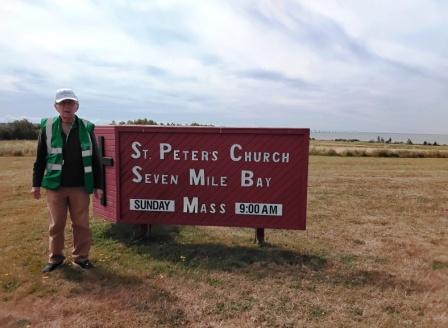
Pieter at Seven Mile Bay (St Peter’s) Cemetery.  Can you spot the Confederation Bridge in the background?  (Photo credit: Daria Valkenburg)

Three of the WWII soldiers buried in this cemetery are listed on the Cenotaph outside the Borden-Carleton Legion in Borden-Carleton, Prince Edward Island.  Their stories have been previously told on this blog….

Frank Lewis ARSENAULT of Kinkora, Prince Edward Island, was serving in the Royal Canadian Army Medical Corps, Home War Establishment Unit, and based at the Petawawa Military Hospital in Ontario, when he drowned accidentally in the Ottawa River on September 30, 1942, aged 29.  His body wasn’t found until a month later.  He left behind a wife and 4 children.  (See https://onthewarmemorialtrail.com/2019/12/14/on-the-war-memorial-trail-the-ww2-soldier-who-drowned-in-quebec/)

Leonard Stephen AVERY of Bedeque, Prince Edward Island, died accidentally in Ontario while on guard duty at the Chippewa Power Canal in Welland County on the evening of August 23, 1943, aged 19, when he was accidentally shot through the head while examining a rifle.  He was serving with the 1st Garrison Battalion of the Canadian Army, and stationed in Niagara-on-the-Lake, Ontario. (See https://onthewarmemorialtrail.com/2019/11/26/on-the-war-memorial-trail-the-ww2-soldier-who-was-accidentally-shot/  and https://onthewarmemorialtrail.com/2022/12/17/on-the-war-memorial-trail-a-photo-for-wwii-soldier-leonard-stephen-avery/)

John Daniel ‘Jack’ FERGUSON of Borden (now Borden-Carleton), Prince Edward Island, was serving in the Royal Canadian Navy Reserve, and on patrol duty out of Halifax, Nova Scotia.  After becoming ill while serving aboard the patrol ship ‘Ross Norman’, he was sent to Camp Hill Hospital in Halifax on August 19, 1942.  On August 30, 1942 he went into shock from peritonitis. Despite treatment, he died on September 6, 1942, aged 19. (See https://onthewarmemorialtrail.com/2020/03/04/the-ww2-able-seaman-who-died-of-peritonitis/)

…1 soldier buried in Seven Mile Bay did not have a CWGC headstone…

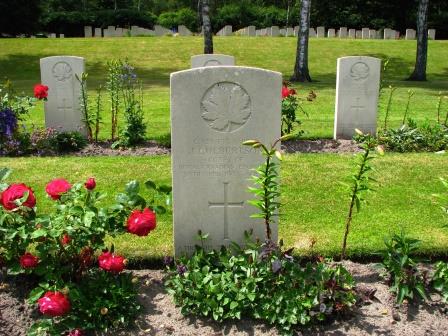
Grave of John Peter ‘JP’ White.  (Photo credit: Pieter Valkenburg)

The fourth grave, that of John Peter ‘JP’ WHITE, was listed as a CWGC grave, but did not have the distinctive CWGC headstone, and the name of the soldier was unfamiliar to Pieter.  Instead, the headstone listed the soldier, and his wife, Frances (nee Smith), who had died 3 years earlier.

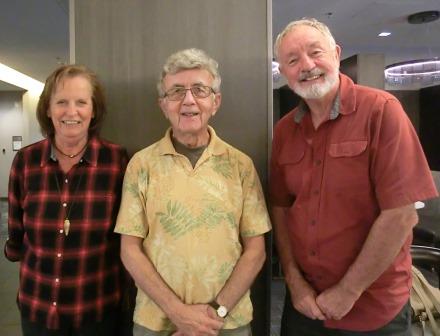
His curiosity aroused, Pieter decided to research the soldier and look for a family member.  It wasn’t long before he came in contact with JP’s niece, Alice Cash Blakeney, and we had a chance to meet her in Summerside.  “….My mother was his sister Martina, and she always referred to him as JP…”  Alice explained.

Pieter with Alice Cash Blakeney, who is holding a photo of her uncle, JP White. (Photo credit: Daria Valkenburg)

…JP grew up in Emerald Junction.…
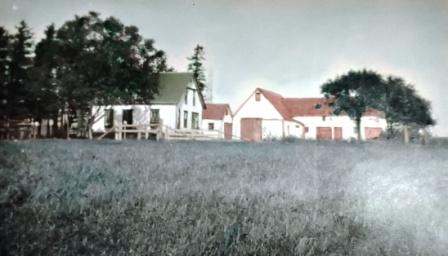
The family homestead where JP White grew up.  (Photo courtesy of Alice Cash Blakeney and Estate of Bernadette White Adler)

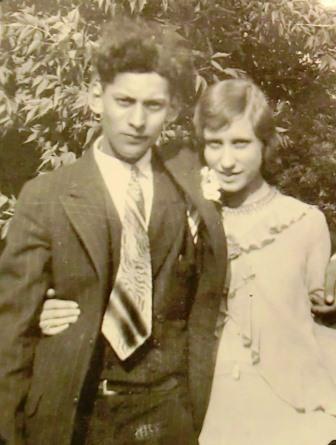
Born in Emerald Junction, Prince Edward Island, on June 2, 1912, JP was the son of John Thomas and Janie Josephine (nee Cameron) White.  JP had 2 brothers and 4 sisters, and although their father was a carpenter, the family also ran a small farm.
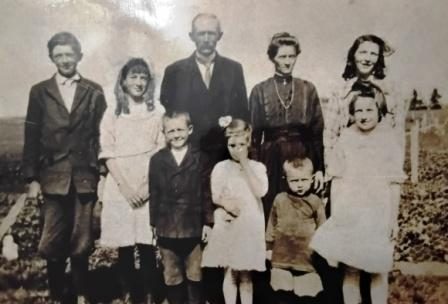
Front row, left to right:  JP, Martina, Dave, Bernadette.  Back row, left to right: Matthew, Agnes, John Thomas, Janie Josephine, Mary Catherine. (Photo courtesy of Alice Cash Blakeney and Estate of Bernadette White Adler)

….JP enlisted in 1942…

After completing Grade 8, JP began working as a carpenter.  On February 4, 1942, he married Frances Teresa Smith in Charlottetown.   “…The Whites were noted as being great dancers, so it’s likely that JP met his wife Frances Smith at a dance….”  Alice reflected.

JP originally enlisted under the National Resources Mobilization Act (NRMA) at the No. 6a NRMA Clearing Depot in Charlottetown, Prince Edward Island on August 27, 1942 and began basic training at No. 62 Canadian Army Basic Training Centre in Charlottetown. At the time, he stated he had been a carpenter for the past 10 or 12 years, having learned the trade from his father. (See https://en.wikipedia.org/wiki/National_Resources_Mobilization_Act)

Just as JP was completing his basic training, tragedy struck on October 1, 1942. Alice said that “…JP’s wife died in childbirth….

On October 30, 1942, JP was sent to A1 Canadian Artillery Training Centre (CATC) in Petawawa, Ontario for infantry training as a gunner. 

While in Petawawa, JP tried to enlist as ‘Active’, but was “…advised to remain…” under the NRMA, as he was considered “…unsuitable for operational duty…” due to bad knees.  

In January 1943, he was granted a 2 week furlough, allowing him to return home to Prince Edward Island. The furlough was then extended by another 11 days, after which he returned to Petawawa.
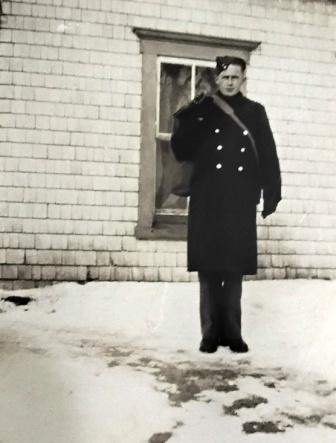
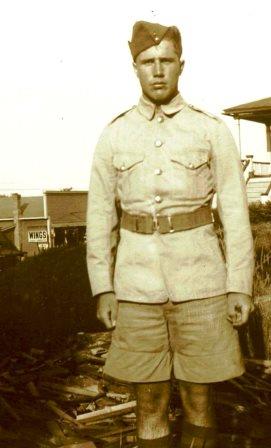
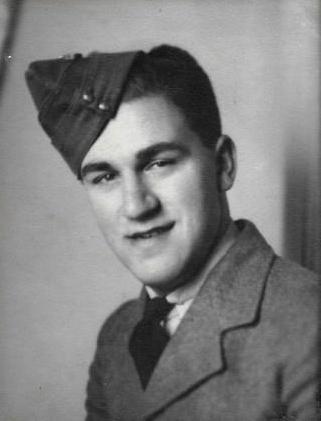
John Peter ‘JP’ White in January 1943 during his return to Prince Edward Island while on furlough. (Photo courtesy of Alice Cash Blakeney and Estate of Bernadette White Adler)

….JP was transferred to the 10th LAA for a short period in June 1943…

After qualifying as a Carpenter Group ‘B’ on April 26, 1943, JP was transferred to the 10th Light Anti-Aircraft (LAA) Regiment of the Royal Canadian Artillery (RCA) on June 15, 1943, and sent to Tracadie, New Brunswick. The 10th LAA was part of the 7th (Home Defence) Division and JP was posted to the 8th Light Anti-Aircraft Battery RCA in Saint John, New Brunswick.

He spent the next months working as a carpenter, but starting in August 1943, he had medical issues, resulting in brief hospitalizations.  Health issues ended his assignment with the 10th LAA and on October 28, 1943 he was transferred to No. 6 District Depot in Halifax, Nova Scotia.

In a November 30, 1943 interview that was recorded in his Personnel Selection Record, he was described as “…a mature serious-minded soldier of steady judgement….”  It went on to state that JP “…wished to remain in the service and would prefer duty in his trade…” and that his knee condition “…should not impair his efficiency as a tradesman…”  It was recommended that he be transferred to a suitable Home War Establishment (HWE) for duty as a carpenter.

….JP was assigned to the Royal Canadian Engineers as a carpenter…

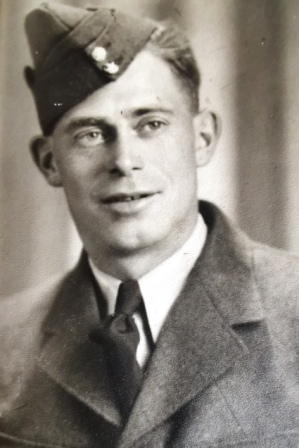
John Peter ‘JP’ White. (Photo courtesy of Alice Cash Blakeney and Estate of Bernadette White Adler)

On January 19, 1944, JP was transferred to No. 6 Field Company of the Royal Canadian Engineers in Debert, Nova Scotia.  He remained there until May 24, 1944 when he was granted 6 weeks of spring farm leave in order to return to Prince Edward Island and work on the family farm.  His father had died in 1936, meaning that JP and his brothers had to help out his mother.

Upon his return back to duty on July 29, 1944, he was assigned to No. 6 Engineer Survey and Works (ES&W) Company of the Royal Canadian Engineers in Halifax, Nova Scotia, and continued to work as a carpenter. 

Unfortunately, he had another medical issue on November 28, 1944, when he was hospitalized for 3 weeks in the Military Hospital in Debert, Nova Scotia with appendicitis.

He was discharged from hospital on December 19, 1944 and sent to No. 5 Casualty Retraining Centre (CRC) in Sussex, New Brunswick for 71 days for further recovery.  On January 19, 1945, he was hospitalized again, this time at the Sussex Military Hospital.

On March 8, 1945, he was deemed ‘fit for duty’.  A report on his condition in the Supplement To Personnel Selection Record stated that JP was “…pleasant and straightforward….” and had “cooperated well and followed the training in all grades at this Centre making satisfactory recovery…”  He was assessed as remaining “…suitable for employment in RCE for base duties…” as a carpenter.

….JP enlisted in the Active Army in April 1945…

On March 21, 1945, JP was again sent to No. 6 District Depot in Halifax, Nova Scotia, in preparation for his change in status when he was deemed fit enough to enlist in the Active Army on April 5, 1945.   He returned to No. 6 Field Company of the Royal Canadian Engineers in Halifax on April 29, 1945, where it was noted that JP requested to return to No. 6 Engineer Survey and Works (ES&W) Company of the Royal Canadian Engineers.

No sooner had JP been assigned to No. 6 Engineer Survey and Works (ES&W) Company than he requested a 3 month leave of absence without pay for compassionate farm leave.  This was granted from June 28, 1945 until September 27, 1945.

When he returned back to duty, however, it was to No. 6 District Depot in Halifax.  On October 2, 1945, a few days after returning to duty, he applied again for farm leave without pay, which was granted until April 1946.

….JP died following an operation in December 1945…

JP never returned to his army duties.  While back on Prince Edward Island for the farm leave that had been granted to him, he was hospitalized in Charlottetown, and died following an operation on December 15, 1945, aged 33.

JP was buried alongside his wife Frances in Seven Mile Bay (St Peter’s) Cemetery in Seven Mile Bay, Prince Edward Island. 

A note on his death record noted that he would not receive a separate Commonwealth War Graves Commission headstone unless the family applied for it.  It further stated that ‘next of kin does not answer correspondence’. 

JP’s family was overwhelmed, not only by his death, but by the death of his mother in March 1946, leaving his brother Matthew, who lived in Charlottetown and had a family of his own, in addition to managing the farm, as the next-of-kin.

Pieter now knew what happened to JP, and resolved to ensure that his service is acknowledged when the Legion in Borden-Carleton places flags by graves of veterans during Remembrance Week 2025. No flag had been placed by his grave in previous years as no one at the Legion was aware that JP had served during WWII.  (See https://onthewarmemorialtrail.com/2024/11/03/on-the-war-memorial-trail-borden-carleton-legion-honours-veterans-by-placing-flags-at-their-graves/)

Thank you to Alice Cash Blakeney for providing the photos and information on her uncle. Do you have a story to tell? Email Pieter at memorialtrail@gmail.com or comment on the blog. 

© Daria Valkenburg

….Want to follow our research?…

If you are reading this posting, but aren’t following our research, you are welcome to do so.  Our blog address: https://onthewarmemorialtrail.com/
4 countries, 6 weeks, 7,000 km – an unforgettable war memorial journey in Europe…. Daria’s book ‘No Soldier Buried Overseas Should Ever Be Forgotten‘ is available in print and e-book formats.  Net proceeds of book sales help support research costs and the cost of maintaining this blog. For more information see https://nosoldierforgotten.com/

Subscribe to our YouTube Channel: On The War Memorial Trail With Pieter Valkenburg: https://www.youtube.com/channel/UCJ591TyjSheOR-Cb_Gs_5Kw

Never miss a posting!  Subscribe below to have each new story from the war memorial trail delivered to your inbox.
On The War Memorial Trail….2025 Faces of Holten Exhibition Part 5: Indigenous Soldiers

September 10, 2025.  Pieter Valkenburg has been involved in finding photos of Canadians who are buried in all three Canadian War Cemeteries in The Netherlands since 2014, with stories of many soldiers told on this blog. 

While in The Netherlands and Belgium for the 80th Anniversary of Liberation Commemoration events, he placed flags at the graves of 383 soldiers in 14 cemeteries. At the Canadian War Cemetery in Holten, The Netherlands, flags were placed at 156 graves. Our visit coincided with The 2025 Faces Of Holten Exhibition, which ran for three weeks in May.

—-Recap…..

In Part 1, the graves and photos of soldiers who were killed near Posterenk in April 1945 were featured. (See https://onthewarmemorialtrail.com/2025/08/24/on-the-war-memorial-trail-2025-faces-of-holten-exhibition-part-1-soldiers-killed-near-posterenk/)

In Part 2, the graves and photos of two soldiers whose names are listed on the Cenotaph outside the Borden-Carleton Legion were featured. (See https://onthewarmemorialtrail.com/2025/08/29/on-the-war-memorial-trail-2025-faces-of-holten-exhibition-part-2-the-soldiers-listed-on-the-cenotaph-in-borden-carleton/)

In Part 3, the graves and photos of soldiers killed in vehicle accidents were featured. (See https://onthewarmemorialtrail.com/2025/09/01/on-the-war-memorial-trail-2025-faces-of-holten-exhibition-part-3-soldiers-killed-while-travelling-in-vehicles/)

In Part 4, the graves and photos of soldiers who lost their lives in the Battle of Leer during Operation Duck were featured. (See https://onthewarmemorialtrail.com/2025/09/04/on-the-war-memorial-trail-2025-faces-of-holten-exhibition-part-4-soldiers-who-drowned-during-operation-duck/)

…8 Indigenous soldiers are commemorated…

Now, in Part 5, the graves and photos of 8 Indigenous soldiers, whose stories have previously been told on this blog, are featured.

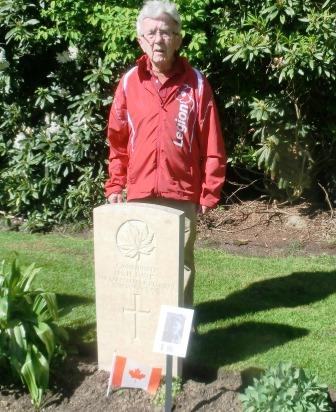
Grave of John Culbertson. (Photo credit: Daria Valkenburg)

John CULBERTSON was born in Oshawa, Ontario, and grew up on the Tyendinaga Mohawk Territory near Belleville, Ontario. While serving with the Royal Canadian Engineers, he was killed in Germany on April 30, 1944 during the Battle of Edewecht, aged 33. You can read his story at https://onthewarmemorialtrail.com/2023/02/04/on-the-war-memorial-trail-remembering-ww2-sapper-john-culbertson/

Grave of William ‘Willie’ Daniels.  (Photo credit: Daria Valkenburg)

William ‘Willie’ DANIELS, from the Big River Reserve in Depton, Saskatchewan, was serving with the Royal Winnipeg Rifles when he was killed, aged 20, on April 22, 1945 as troops moved through Appingedam in The Netherlands at the very beginning of the Battle of the Delfzijl Pocket. You can read his story at https://onthewarmemorialtrail.com/2021/07/23/on-the-war-memorial-trail-remembering-ww2-soldier-william-willie-daniels/

Pieter by the grave of Harry Henry Davis. (Photo credit: Daria Valkenburg)

Harry Henry DAVIS, from Selkirk, Yukon Territory, was serving with the Lake Superior Regiment (Motor) when he died in The Netherlands, aged 23, on January 15, 1945 from wounds received the day before after being shot while on patrol east of Kerkdriel.  You can read his story at https://onthewarmemorialtrail.com/2023/09/30/on-the-war-memorial-trail-the-only-yukon-territory-soldier-buried-in-holten/

Grave of Stanley Owen Jones. (Photo credit: Daria Valkenburg)

Stanley Owen JONES, from Massett, British Columbia, drowned on September 8, 1945 in Germany when the carrier he was in overturned in a ditch, while serving with the Canadian Scottish Regiment, aged 20. You can read his story at https://onthewarmemorialtrail.com/2022/09/05/on-the-war-memorial-trail-remembering-wwii-soldier-stanley-owen-jones/

Grave of Philip Laforte. (Photo credit: Daria Valkenburg)

Philip LAFORTE, born in Lac du Bonnet, Manitoba, was serving with the Royal Winnipeg Rifles when he was killed on April 7, 1945 in The Netherlands, aged 33, as the Regiment crossed the Schipbeek, in order to establish a bridgehead as preparation for an assault on the city of Deventer by the 7th Canadian Brigade. You can read his story at https://onthewarmemorialtrail.com/2022/03/22/on-the-war-memorial-trail-remembering-ww2-soldier-philip-laforte/

Grave of Sanford Steven Saulis.  (Photo credit: Pieter Valkenburg)

Sanford Steven SAULIS, from Maliseet, New Brunswick, died of a brain hemorrhage in The Netherlands on August 10, 1945, aged 30, while serving with the 16th Field Company of the Royal Canadian Engineers. You can read his story at https://onthewarmemorialtrail.com/2023/02/27/on-the-war-memorial-trail-remembering-sanford-steven-saulis/

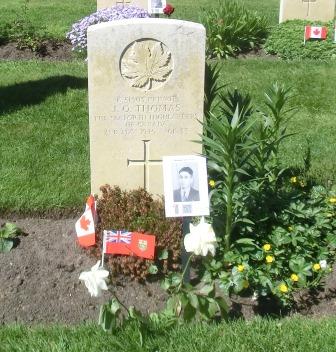
Grave of James ‘Jimmy’ Oliver Thomas. (Photo credit: Daria Valkenburg)

James ‘Jimmy’ Oliver THOMAS, born in St. Peters, Manitoba, died in Germany on May 2, 1945, aged 33, a few days after being liberated from the Stalag VII-A POW Camp in Moosburg, Germany. He had been taken prisoner of war on May 22, 1943, while serving with the Seaforth Highlanders of Canada, during the breaking of the Hitler Line. You can read his story at https://onthewarmemorialtrail.com/2024/02/18/on-the-war-memorial-trail-the-wwii-soldier-from-manitoba-who-died-shortly-after-being-liberated-from-stalag-vii-a/

After sending photos of the grave to Rodd Cooper, great-nephew of Jimmy Thomas, he wrote us to say “  I just wanted to express my infinite gratitude to you and your family on behalf of myself and my family for the work and the time you have invested in gathering the information not only for my resting family member but for the numerous others as well. 

The honour and respect you have brought and given to these men cannot be measured.  The gift that you have given my family and I is profound and we truly can’t thank you enough.  

Because of your work and dedication, my family and the future generations of my family, will be able to pay the respect to my Great Uncle Jimmy for his service and sacrifice by remembering him and telling his story.  

The gift you have given us is immeasurable.

On behalf of myself and the Thomas Family, Thank You….” 

We were immeasurably touched by his kind words. Pieter replied, saying that “…it’s important that we never forget the soldiers….and the families… who sacrificed so much for our ongoing freedom.  I’m grateful that the country of my birth continues to remember and honour their Allied liberators….” 

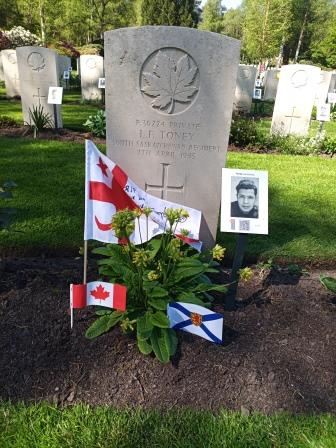
Grave of Leo Francis Toney. (Photo credit: Pieter Valkenburg)

Leo Francis TONEY, born in Wolfville, Nova Scotia, was serving with the South Saskatchewan Regiment, when he was killed on Saturday, April 7, 1945, aged 21, while trying to cross the Schipbeek in The Netherlands at  a bridgehead that had been formed at a weir on the border of the municipalities of Bathmen and Holten. You can read his story at https://onthewarmemorialtrail.com/2021/05/22/on-the-war-memorial-trail-remembering-ww2-soldier-leo-francis-toney/

After sending a photo of the grave to Della Maguire, niece of Leo Toney, she wrote to say “…thank you so much, I looked at that picture all day. I am so grateful…

Pieter holds onto the personalized Lnu flag from the Toney family at the grave of Leo Francis Toney. (Photo credit: Daria Valkenburg)

….All of the flags placed at graves were donated…

All of the flags placed at graves were donated.  Our thanks go to: 

  • Alan Waddell, Constituent Assistant, on behalf of Heath MacDonald, MP for Malpeque, for the Canadian flags.
  • Armel ‘Mel’ Lanteigne, President of the Caraquet Legion in New Brunswick for the New Brunswick flag.
  • Kyle Graham, Research Officer, Military Relations, Nova Scotia Intergovernmental Affairs, on behalf of Premier Tim Houston, Province of Nova Scotia, for the Nova Scotia flag.
  • Don Coutts on behalf of the Muttart and Coutts families in memory of Flight Sergeant Elmer Bagnall Muttart for the Ontario flag.
  • Wayne Ewasko, MLA for Lac Du Bonnet, Manitoba, Interim Leader of the Official Opposition, Province of Manitoba, for the Manitoba flag.
  • Della Maguire on behalf of the Toney/Smith Family in memory of Pte Leo Toney for the Lnu (Mi’kmaw) flag.
  • Conrad Saulis in memory of Sapper Sanford Steven Saulis, courtesy of Grand Chief Ron Tremblay, for the Wolastoqey Nation flag

Thank you to Rodd Cooper and Della Maguire for their heartfelt and kind words.  The comments we’ve received from families as we’ve shared photos showing how their loved ones were honoured during the commemoration events made all the hard work of visiting the cemeteries and placing flags worthwhile.

The 2025 Faces of Holten Exhibition concludes with Part 6, where the graves of a few of the many soldiers killed in The Netherlands and Germany will be featured as we continue with our 2025 European War Memorial Tour.

Pieter encourages readers with photos to come forward so that eventually all the known graves of Canadians buried in Holten will have a photo displayed by their grave. Email him at memorialtrail@gmail.com.

© Daria Valkenburg

….Want to follow our research?…

If you are reading this posting, but aren’t following our research, you are welcome to do so.  Our blog address: https://onthewarmemorialtrail.com/

4 countries, 6 weeks, 7,000 km – an unforgettable war memorial journey in Europe…. Daria’s book ‘No Soldier Buried Overseas Should Ever Be Forgotten‘ is available in print and e-book formats.  Net proceeds of book sales help support research costs and the cost of maintaining this blog. For more information see https://nosoldierforgotten.com/

Subscribe to our YouTube Channel: On The War Memorial Trail With Pieter Valkenburg: https://www.youtube.com/channel/UCJ591TyjSheOR-Cb_Gs_5Kw

Never miss a posting!  Subscribe below to have each new story from the war memorial trail delivered to your inbox.

On The War Memorial Trail….. “Archie Was A Good Guy”

September 12, 2023.  When Pieter begins researching a soldier whose name is on a photo wish list from one of the Canadian War Cemeteries in The Netherlands, he quite often finds current family members in various parts of Canada or the USA. 

A zigzag virtual search is not uncommon, but it’s rare that a search from one part of the country leads him right back to our own province of Prince Edward Island! But that’s what happened in the search for a photo of Archibald Phillip ‘Archie’ MCLEAN of Edmundston, New Brunswick!

The son of Allan John and Mary Rose ‘Minnie’ (nee Comfort) McLean, Archie was born August 5, 1920 in Edmundston.  When he enlisted in Edmundston on May 14, 1941 at the No. 7A District Field Office, he listed his occupation as paper maker with the Fraser Pulp Company in Edmundston, a pulp mill. (See https://en.wikipedia.org/wiki/Fraser_Papers – the Edmundston mill is still in operation, owned by Twin Rivers Paper Company.)

His enlistment form recorded that he had been serving in the 2nd Battalion Carleton & York Militia since July 1940.  It also noted that he enjoyed skating, and playing hockey and baseball.

Three of his brothers were also serving – and survived the war: Lawrence and Wilfred were in the Canadian Army.  Allan was in the Canadian Navy.  He also had five  sisters: Mae, Patricia, Emma, Theresa, and Hilda.

…The search for a photo of Archie led to two nephews….

The key to finding family came from two of the sisters.  Mae married Bertrand Clarence Michaud, and Pieter contacted her son Michael, who lives in Brunswick, Maine.   Michael didn’t have a photo but said his cousin, Donald Moore, who lives in Summerside, Prince Edward Island, and is himself a veteran, likely would.  Donald’s mother Theresa was another sister of Archie’s.

Pieter then contacted George Dalton, a veteran who lives in Summerside. Did he know him?  “…Yes…” George said.  “…He’s not been well, but someone from our group will contact him…

In the mysterious way that the Island works, it turned out that Pieter had previously met Donald Moore’s daughter, Tina Mundy!  It wasn’t very long before Tina’s daughter, Erin Mundy Montgomery, sent photos and information.  And a few days later, we met with Donald.

CIMG6452 Aug 29 2023 Pieter Don Moore Tina Mundy

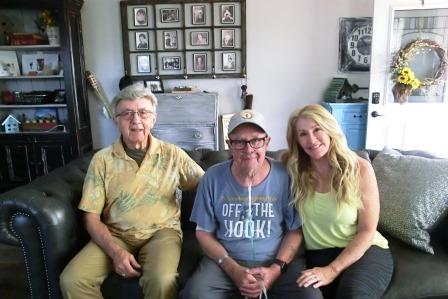
Pieter with Donald Moore and Tina Mundy.  (Photo credit: Daria Valkenburg)

…Archie was a good guy…” Donald said.  “… I became 84 years old on July 23, and am the oldest of the cousins.  I spent 38 years in the military, with the RCAF, including a 4 year posting in France.  I made about 20 trips to Holland, but I never knew where Archie was buried…”  A planned trip to visit his grave in 2020 got cancelled due to Covid.

… Archie joined the Royal Canadian Engineers as a sapper….

On May 21, 1941, Archie was assigned to No. 71 Basic Training Centre in Edmundston.  After completing basic training, he was sent to the A5 Royal Canadian Engineers Training Centre in Petawawa, Ontario for training as a sapper on July 25, 1941. 

Archie McLean slightly corrected

Archibald Phillip ‘Archie’ McLean. (Photo courtesy of Donald Moore)

Life moved quickly for Archie, as on September 27, 1941 he was transferred to the 1st Field Squadron of the Royal Canadian Engineers.  On October 1, 1941, he passed the Standard Army Trade Test for Pioneer Class ‘C’.   This classification took into account a soldier’s civilian trade skills and experience and meant formal training might not be needed. 

…Archie left Canada for overseas service….

Shortly afterwards, on October 6, 1941, he left Canada, arriving in the United Kingdom on October 19, 1941.

On March 9, 1942, he was reassigned to the Engineer Reinforcement Unit (ERU) for a short period, then was transferred to No. 2 Canadian Construction Company of the Royal Canadian Engineers.  Archie was sent for a number of courses.  He completed a firefighting course on April 6, 1942, a Steel Square course on May 23, 1942, and received a qualification as a Carpenter ‘B’ on June 5, 1942. Around this period, No. 2 Construction Company was designated as No. 6 Canadian Construction Company.

Among the tasks that Archie would have participated in was the building of an RCAF bomber airport in Dunsfold, a task that was completed in a record-breaking 6 months. (See https://en.wikipedia.org/wiki/Dunsfold_Aerodrome)

Following the completion of the airport, the Company underwent training in bridge construction.  In January 1943, according to the Company’s Regimental history, ‘The Story of 2 Battalion R.C.E. 1940-1945’  “…we moved briefly into the Worthing area to construct pillboxes to a German design, for a tank outfit to shoot at…

After that they were tasked with renovations to an airport in Cornwall, in what was not a happy experience. “…After a battalion movement by train, we arrived at scintillating St Eval in the most fearfully depressing rain storm imaginable.  Day after day it lasted…”  Their assignment was “…to construct extensions to the existing standings and runways of the airport….” 

However, “… as soon as the cement had been poured, the rain would drum down, ignore tarpaulins and matting placed over the cement to protect it, and rot it, before it had a chance to set. Yard after yard of it had to be torn up and re-laid…”   (See https://en.wikipedia.org/wiki/RAF_St_Mawgan)

Renovations of the airport finally completed, the Company went to “…Bedford, for another spell of bridging…” so that heavy artillery could cross gaps in fields.

On June 1, 1944, Archie was transferred to No 1 Canadian Engineer Reinforcement Unit (CERU).  He briefly entered the world of show business between September 18, 1944 and October 10, 1944, when he was attached to ICA Shows when the Canadian Army Show came to England to perform for troops. He would have been involved in preparing stages and sets. (See https://www.silverhawkauthor.com/post/canadian-army-show-first-canadian-army-in-the-north-west-europe-campaign-of-1944-1945)

On November 18, 1944, Archie was transferred to the Canadian Infantry Corps (CIC) and assigned to No. 3 Canadian Infantry Training Regiment (CITR).

…Archie joined the Carleton & York Regiment in Italy….

Screenshot 2023-09-04 at 16-28-14 Map of Russi Italy

The Carleton & York Regiment was north of Rossi on February 13, 1945.  (Map source: http://www.gosur.com)

On January 4, 1945 Archie left the United Kingdom for Italy.  Then, on February 13, 1945 he was transferred to the Carleton & York Regiment, and reclassified from Pioneer ‘C’ to General Duty.   He joined them as the Regiment was north of Rossi, part of a group of reinforcements, at the tail end of the Italian Campaign. (See https://en.m.wikipedia.org/wiki/Italian_campaign_(World_War_II))

On March 16, 1945, he left Italy as part of Operation Goldflake, arriving in Marseilles, France two days later.  Operation Goldflake was the codename for moving troops from Italy to North-West Europe.  (See https://en.wikipedia.org/wiki/Operation_Goldflake)

The Carleton & York Regiment was now part of the 21st Army Group. From France, troops were moved up to the Belgian front, into The Netherlands, through the Reichswald Forest in Germany, and then back into The Netherlands.

On April 12, 1945 the Regiment was part of Operation Cannonshot, which led to the crossing of the IJssel River between the villages of Gorssel and Wilp in the eastern part of The Netherlands. (See https://www.liberationroute.com/stories/190/operation-cannonshot)

According to the April 12, 1945 war diary entry of the Carleton & York Regiment, they “…moved across the Ijssel River at 14:30 hours….” to relieve the Seaforth Highlanders of Canada.

Map western holland showing Posterenk

On April 13, 1945, the war diary of the Carleton & York Regiment noted that troops were south of Deventer. “Weather – morning, dull and foggy, sunny in the afternoon, cold at night….

The objective was to clear Posterenk and move further up. Four Companies of the Carleton & York Regiment were engaged.  ‘D’ Company was to clear Posterenk, while the rest followed in support.  After Posterenk was cleared in the early afternoon, “…At 1538 hrs ‘B’ Company began to move up in carriers with one platoon of tanks in support…”  ‘D’ Company was then held up due to enemy fire.

… ‘B’ Company pushed through ‘D’ Company but were held up … by small arms and mortar fire…. At 1723 hrs ‘B’ Company moved forward again under heavy mortar fire, these mortars were engaged, also an enemy SP firing on ‘B’ Company from their left…” SP refers to self-propelled weapons.

It got worse. “… ‘B’ Company met with stiff enemy resistance….”  However, “…at 1925 hrs ‘B’ Company had cleared enemy and were moving forward slowly…” Then came a report of more problems. “… ‘B’ Company ….are now … meeting considerable enemy resistance…

…So far during B Company’s attack they have eight wounded and one killed, Lt. W.E. Brousseau being one of those wounded…

Both ‘B’ and ‘D’ Companies came under attack from high explosives. ‘D’ Company reported two wounded during the liberation of Posterenk.  One of these was Daniel ‘Dan’ Peter MACKENZIE. (See https://onthewarmemorialtrail.com/2023/06/29/on-the-war-memorial-trail-the-wwii-soldier-from-victoria-cross-fatally-wounded-during-the-liberation-of-posterenk/

Archie was among those wounded on April 13, 1945. While it’s possible that he was one of the two wounded from ‘D’ Company, he has never been mentioned as one of the soldiers that liberated Posterenk.  Therefore, we believe that he was one of the 8 soldiers wounded from ‘B’ Company.

The medical file stated that Archie received shrapnel wounds from a high explosive that penetrated his left chest.  He was taken to No 3. Casualty Clearing Centre, a Canadian military field hospital in Lochem, where he died in the very early hours of April 17, 1945.  He was 25 years old.

The records of his death go back and forth between April 16 and 17, but an ‘Amendment As To Date Of Casualty’ finally determined it was April 17, 1945.  That was the date that he was ‘struck off strength’ for his final pay, for the Estates Department, and on his New Brunswick Death Certificate.

…Archie is buried in the Canadian War Cemetery in Holten….

On April 17, 1945, Archie was temporarily buried in the Lochem Civil Cemetery, before being reburied in 1946 in the Canadian War Cemetery in Holten.   

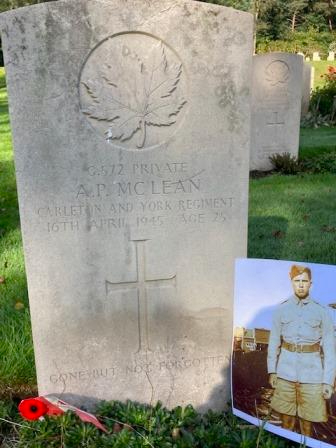
IMG_1003 Sep 4 2023 Grave of Archie McLean with photo

Grave of Archibald Phillip ‘Archie’ McLean in Holten, The Netherlands.  (Photo credit: Henk Vincent)

Thank you to Erin Mundy Montgomery, Don Moore, and Tina Mundy for sharing photos and information on Archie McLean.  Thank you to George Dalton and Michael Michaud for help in finding family. Thank you to Barry Miller for helping with information on troop movements on April 13, 1945.  Thank you to Edwin van der Wolf and Henk Vincent, volunteer researchers for the Canadian War Cemetery in Holten and at the Information Centre Canadian Cemetery Holten, for placing Archie’s picture beside his grave and taking a photo for us.

If you have a story to tell, please let Pieter know. You can email him at memorialtrail@gmail.com, or comment on the blog.  

© Daria Valkenburg

…Want to follow our research?….

If you are reading this posting, but aren’t following the blog, you are welcome to do so.  Our blog address: https://onthewarmemorialtrail.com/

Front cover OnTheWarMememorialTrailinEurope4 countries, 6 weeks, 7,000 km – an unforgettable war memorial journey in Europe…. Daria’s book ‘No Soldier Buried Overseas Should Ever Be Forgotten‘ is available in print and e-book formats.  Net proceeds of book sales help support research costs and the cost of maintaining this blog. For more information see https://nosoldierforgotten.com/

Subscribe to our YouTube Channel: On The War Memorial Trail With Pieter Valkenburg: https://www.youtube.com/channel/UCJ591TyjSheOR-Cb_Gs_5Kw

Never miss a posting!  Subscribe below to have each new story from the war memorial trail delivered to your inbox.

On The War Memorial Trail….. Remembering Sanford Steven Saulis

February 27, 2023.  After an interview about the photo quest for soldiers buried in the Canadian War Cemeteries in The Netherlands ran on APTN in 2021, Pieter was contacted by Patricia Saulis about Sanford Steven SAULIS of Maliseet, New Brunswick, who is buried in the Canadian War Cemetery in Holten, The Netherlands.  (To read the APTN article, see https://www.aptnnews.ca/national-news/dutch-born-p-e-i-man-on-a-mission-to-find-photos-of-first-nations-soldiers-killed-overseas-in-wwii/)

My Uncle Sanford Saulis died on August 10, 1945 and is buried in Holten Cemetery….   Thank you for doing your work on this Project….” Patricia wrote.

…Sanford Saulis was on the photo wish list for the Canadian War Cemetery in Holten….

Sanford was on the photo wish list for the cemetery.  Unfortunately, Patricia did not have a photo of her uncle.   Then, a few months ago, Conrad Saulis wrote us.  “I was recently forwarded an email you sent to my sister Patty last year regarding our Uncle Sanford S Saulis, who is buried in the Holten Canadian War Cemetery in The Netherlands….

Rest assured that we have not forgotten him or the sacrifice he made to protect our Wolastoqey Nation traditional Ancestral lands from fascism. ….I too am on a quest to find a picture of him…

Conrad explained that ….Sanford was my dad’s half-brother – he was born of a different mother before my dad was born…” After Sanford’s mother Suzan died in 1918, his father remarried.

Luckily, Conrad photo quest was successful.  “….Woliwon. I am attaching a pic my niece got from a co-worker in Fredericton of Sanford …

Uncle Sanford 2

Sanford Steven Saulis.  (Photo courtesy of the Saulis Family)

…Sanford was a member of the Wolostoqey First Nation….

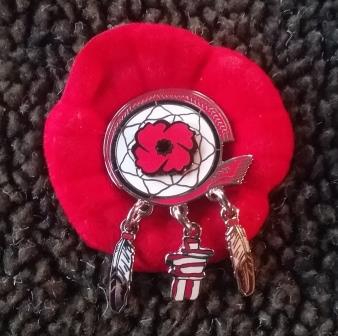
20221108_070012 poppy with indigenous pinBorn September 19, 1914, Sanford Steven SAULIS was the son of William and Suzan (nee Paul) Saulis, members of the Wolostoqey First Nation (formerly known as Maliseet First Nation).   Maliseet is the Mi’kmaq word for the Wolastoqey, members of the Wabanaki Confederacy, a group of Algonquian-speaking nations (See https://www.thecanadianencyclopedia.ca/en/article/maliseet and https://en.wikipedia.org/wiki/Madawaska_Maliseet_First_Nation)

Before enlisting with the No. 7 District Depot of the Canadian Army in Perth, New Brunswick on May 22, 1941, Sanford worked as a hand stitcher at the Philco Shoe Company in Bangor, Maine, USA, and as a general construction labourer for various companies in New Brunswick and Maine.  He also could drive a motorcycle.

In an interview for his Personnel Selection Card, he stated that he enjoyed swimming, skating, hunting, and canoeing.  He also played team sports such as baseball and hockey.

On June 6, 1941, Sanford transferred to the 3rd Battalion (later converted to 4th Battalion) of the Royal Canadian Engineers and sent to Petawawa, Ontario for basic and advanced training.

9 Firth of Clyde

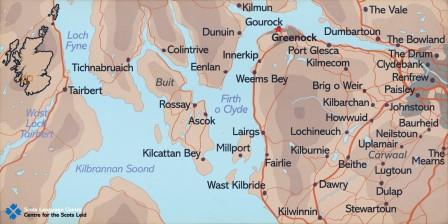
Map shows location of Gourock, Scotland in the Firth of Clyde.  (Map source: scotslanguage.com)

Sanford was soon on his way overseas with the 4th Battalion.  They left Halifax, Nova Scotia on September 18, 1941, arriving in Gourock, Scotland on September 27, 1941.  The Regiment was based at Guillemont Barracks in Hampshire, England. (See https://en.wikipedia.org/wiki/Guillemont_Barracks)

Sanford undertook general engineering duties in the Regiment, and attended a heavy bridge course in 1942. Likely this concerned learning about armoured vehicle-launched bridge vehicles, designed to lay down a bridge in combat.

On May 7, 1943 he was transferred to the 29th Field Company of the Royal Canadian Engineers. In March 1944 he was sent for a series of courses in driving Class ‘B’ vehicles, such as heavy armoured trucks, motorcycles, light reconnaissance vehicles, and tractors.

…Sanford went overseas with his Regiment after D-Day….

On July 5, 1944 he left the United Kingdom for France.  By July 1945 he was in northwest Europe. On August 8, 1945, following a short hospital stay for treatment of dermatitis, Sanford was transferred to the 16th Field Company of the Royal Canadian Engineers.

Screenshot 2023-02-26 at 12-04-24 MICHELIN Breukelen map - ViaMichelin

Map shows Breukelen and Hilversum. (Map source: https://www.viamichelin.com)

The 16th Field Company was based at a camp near Breukelen, The Netherlands.  The war diary for August 9, 1945 reported “…Heavy rain and 21oC…..” and that they were working towards getting the moat at Nyenrode Castle cleared of weeds.  “…Some wood blocks linked together as a chain and towed by a row-boat does a fair job…” This was an example of the variety of tasks undertaken by the Royal Canadian Engineers in the aftermath of war.  (See https://www.spottinghistory.com/view/3618/nyenrode-castle/)

nijenrode_castle

Nyenrode Castle, with the moat surrounding it.   (Photo source: https://www.castlesworld.com)

…Sanford lost his life due to a brain hemorrhage….

Unfortunately, that night, after Sanford went to sleep, a tragedy occurred.   The war diary for August 10, 1945 recorded that there was “…a fatal accident in the camp; this morning the body of Lance Corporal SS SAULIS was discovered lying on the ground under the window of his room. He was dead but there were no signs of how he met his death; only a small abrasion on his face, and no broken bones….The window was only 15 feet above the ground…

On August 12, 1945 the war diary noted the results of a post-mortem.  Sanford “…died of a hemorrhage of the brain.  This probably caused, and was not caused by, the fall, which explains the lack of signs of any effort …. to save himself…

The post-mortem report concluded that Sanford had died 3-4 hours before his body was found at 8:00 am on August 10, 1945.  Most likely he had gotten up in the night, suffered a brain hemorrhage, and tumbled out the open window.

Sanford was initially buried in the Canadian Section at Hilversum Civil Cemetery.  According to the war diary, his funeral was held on August 13, 1945 at 10:00 am, “…with Honorary Captain BUTLER officiating.  Major MAIN and CARSON (former OC of the deceased) also attended. Lt E. BRACCI was also on hand to pay last respects…

…Sanford was reburied in the Canadian War Cemetery in Holten….

saulis, sanford s. gravestone

Grave of Sanford Steven Saulis in Holten, The Netherlands.  (Photo courtesy of the Information Centre Canadian Cemetery Holten)

Sanford was later reburied in the Canadian War Cemetery in Holten, The Netherlands. Conrad Saulis wrote that “…My dad (Herman) – also a veteran of WWII -once was able to visit his brother’s grave in Holland and on his return from a Canadian celebration over there was very glad that he had found the grave. My dad is deceased and like many other vets told very few stories of his war experiences….

It’s important to recognize that Indigenous soldiers were all volunteers, a point that Conrad noted.  “…As First Nation (Indian) people they did not have to enlist and could not be conscripted to join the army – it was all on a voluntary basis. When my dad and his brother volunteered they did not lose their ‘status’ and neither did my Grandfather William for WWI…

Thank you to Patricia Saulis for initially contacting us about her uncle, and to Conrad Saulis for sharing his photo.  Conrad wrote “I am encouraged by your work to remember all of the veterans buried overseas….” It is an honour for us to research and tell the stories you read on this blog.

No soldier buried overseas should be forgotten

Conrad went on to say that “… I have a ‘bucket list’ task of visiting my Uncle’s grave in the Holten cemetery and to honour his spirit, grave site and headstone with a traditional prayer and blessing (smudge) of our sacred First Nation herbs gathered from Mother Earth. It is never too late for this to happen as he continues his Spirit Life and Walk the traditional blessing is to support his ongoing safety in the Spirit World…” We hope that Conrad is able to make this visit and will share it with us.

If you have a story to tell, please let Pieter know. Email him at memorialtrail@gmail.com, or comment on the blog.

© Daria Valkenburg

…Want to follow our research?….

If you are reading this posting, but aren’t following the blog, you are welcome to do so. Our blog address: https://onthewarmemorialtrail.com/.

Front cover OnTheWarMememorialTrailinEurope4 countries, 6 weeks, 7,000 km – an unforgettable war memorial journey in Europe…. Daria’s book ‘No Soldier Buried Overseas Should Ever Be Forgotten‘ is available in print and e-book formats.  Net proceeds of book sales help support research costs and the cost of maintaining this blog. For more information see https://nosoldierforgotten.com/

You are also invited to subscribe to our YouTube Channel: On The War Memorial Trail With Pieter Valkenburg: https://www.youtube.com/channel/UCJ591TyjSheOR-Cb_Gs_5Kw.

Never miss a posting!  Subscribe below to have each new story from the war memorial trail delivered to your inbox.
On The War Memorial Trail….. The WWII Soldier Remembered By His Daughter’s Friend

February 11, 2023.  Burnie Reynaert’s uncle, Lewis Wilkieson MARSH, of Sydney Mines, Nova Scotia, was one of 5 soldiers from the North Nova Scotia Highlanders Regiment who drowned in a tragic accident on the Leda River during the Battle of Leer in Germany on April 28, 1945. (See https://onthewarmemorialtrail.com/2021/05/18/on-the-war-memorial-trail-a-tragic-drowning-on-the-leda-river-in-germany-part-4/)

Recently, Burnie wrote to let us know that “my best friend’s father, Pte. Harold Edward Martin, served in the army with the Essex Scottish Regiment, and is buried in The Netherlands…

Burnie explained further, saying “I have known June Anne Martin most of my life – in public school, high school. I was her maid of honour when she married Jack Andrews. She was my confidant and best friend. June Anne died November 25, 2002. She was so young….

June Anne and Jack had three sons.  ….Harold’s grandchildren do not have any information on his service…” Burnie said.  Would Pieter add Harold to his research list?

Pieter’s initial investigation determined that Harold died on October 14, 1944 and is buried in the Canadian War Cemetery in Bergen op Zoom, The Netherlands.  The search was on!

The son of Herbert Edward and Harriet Jane (nee Leavesley) Martin, Harold Edward Roy MARTIN was born November 13, 1912 in Caradoc, Ontario, a rural area about 35 kms (21.75 miles) west of London, Ontario.

On April 15, 1939 he married Tilly Frances Dolney in Leamington, Ontario.  Tilly had been born in Yorkton, Saskatchewan.

…Harold enlisted in 1940….

When he enlisted on July 28, 1940 with the No. 1 District Depot in London, Ontario, he stated in his Soldiers Qualification Card that he had been employed as a truck driver with Longfield Lumber Company in Mount Bridges, Ontario, and that his family owned the Martin’s Fruit Company in Leamington, Ontario.  He expected to have his own fruit business after his military service.  He also noted that he played hockey, in the position of goalie.

On August 21, 1940 he was transferred from No. 1 District Depot to join his unit of the Royal Canadian Engineers at the Thames Valley Camp in London, Ontario.  At the beginning of 1941 he was assigned to the 9th Field Company.

On April 30, 1941 he was entitled to draw additional Trades Pay as a Carpenter Class ‘B’, and then on May 2, 1941 was transferred to #1 Canadian Base Units Construction Company (CBUCC) of the Royal Canadian Engineers in Petawawa, Ontario.

…Harold and Tilly welcome the birth of their daughter in 1941….

Tilly and Harold’s daughter June Anne was born July 3, 1941.  Burnie submitted a photo of the new family unit, explaining that June Anne’s “son Brad and his brother Jack found this amazing picture of her and her parents….

IMG-0945 Harold and Tillie with baby

Harold and Tilly Martin with new born daughter June Anne.  (Photo courtesy of the Andrews family)

 …Harold was sent overseas shortly after his daughter’s birth….

Harold didn’t have much time with his daughter, as he was on his way overseas with the No. 1 Canadian Base Units Construction Company, Royal Canadian Engineers, arriving in the United Kingdom on July 19, 1941.  He was stationed in Bramshott, as a Carpenter and Joiner Class ‘B’.

On May 1, 1942 the name of his unit was changed to 5 CCC (Canadian Construction Company), Royal Canadian Engineers.  Important work was done by units such as 5 CCC, such as building defences that included beach obstacles, pill-boxes, anti-tank ditches, and minefields. They also improved British roadways to improve the movement of military traffic, constructed military and air bases, and even built the Canadian wing of the Queen Elizabeth Hospital in East Grinstead.

On July 28, 1942, Harold was awarded a Good Conduct Badge, and then on August 21, 1942, he received a permanent grade of Sapper.

On May 1, 1944, Harold was transferred to #1 Canadian Engineer Reinforcement Unit (CERU).  Then on August 25, 1944 he was assigned to the Winnipeg Grenadiers for a few weeks, before leaving for France on September 28, 1944, and being reassigned to the Canadian Infantry Corps the next day.

…Harold’s Regiment fought in the Battle of the Scheldt….

On October 10, 1944 Harold was transferred to the Essex Scottish Regiment, which had moved steadily from Antwerp, Belgium at the beginning of October into The Netherlands.  The Regiment had positions on both sides of the border for the Battle of the Scheldt. (See https://www.thecanadianencyclopedia.ca/en/article/canada-and-the-battle-of-the-scheldt and https://www.holland.com/global/tourism/holland-stories/liberation-route/the-battle-of-the-scheldt.htm)

To have an idea of what was faced by Canadian troops, you can watch a short, but excellent, YouTube video explaining about the Battle of the Scheldt (just under 13 minutes):

According to the war diary for the Essex Scottish Regiment for October 14, 1944, the Battalion was in position at Hoogerheide. “…The enemy continued to be fairly aggressive and some of the positions reported heavy mortaring…”  At some point during the day, Harold Martin lost his life.

Harold Martin Scheldt Estuary

…Harold is buried in the Canadian War Cemetery in Bergen Op Zoom….

Harold was initially buried at the Ossendrecht Roman Catholic Civil Cemetery in Ossendrecht, before being reburied in the Canadian War Cemetery in Bergen Op Zoom in March 1946.

12724585_137285083670 Grave of Harold Martin

Grave of Harold Edward Martin at the Canadian War Cemetery in Bergen Op Zoom, The Netherlands. (Photo source http://www.findagrave.com)

Thank you to Burnie Reynaert for telling us about Harold Edward Martin and to the sons of June Anne Andrews for sharing a family photo.  If you have a story to tell, please let Pieter know. Email him at memorialtrail@gmail.com, comment on the blog, or tweet to @researchmemori1.

© Daria Valkenburg

…Want to follow our research?….

If you are reading this posting, but aren’t following the blog, you are welcome to do so. Our blog address: https://onthewarmemorialtrail.com/

Front cover OnTheWarMememorialTrailinEurope4 countries, 6 weeks, 7,000 km – an unforgettable war memorial journey in Europe…. Daria’s book ‘No Soldier Buried Overseas Should Ever Be Forgotten‘ is available in print and e-book formats.  For more information see https://nosoldierforgotten.com/

You are also invited to subscribe to our YouTube Channel: On The War Memorial Trail With Pieter Valkenburg: https://www.youtube.com/channel/UCJ591TyjSheOR-Cb_Gs_5Kw.

Never miss a posting!  Subscribe below to have each new story from the war memorial trail delivered to your inbox.

On The War Memorial Trail….. Remembering WWII Sapper John Culbertson

February 4, 2023.  After reading ‘Forgotten Soldiers’ by Fred Gaffen, Pieter came across the name John CULBERTSON, listed as a Sapper with the Royal Canadian Engineers, who lost his life on April 30, 1945.

The date of death triggered Pieter’s interest and he wondered if he had been killed in or near The Netherlands. When he learned that John Culbertson was buried in the Canadian War Cemetery in Holten, The Netherlands, he decided to research the service file and see if a family member could be found.

He was soon directed to John’s granddaughter, Diane McQueston (Culbertson).  …My grandmother kept his memory alive…” Diane explained.  We were delighted to have the chance to meet Diane and her husband Rob.

CIMG5792 Sep 11 2022 Diane and Rob McQueston with Pieter

Pieter with Diane and Rob McQueston in Dartmouth. (Photo credit: Daria Valkenburg)

…John was raised on the Tyendinaga Mohawk Territory …..

20221108_070012 poppy with indigenous pinBorn on November 21, 1911 in Oshawa, Ontario, John was the son of George Albert and Mary Ann (nee Smoke) Culbertson.  His parents were from the Tyendinaga Mohawk Territory near Belleville, Ontario, and this is where John lived as a child.  (See https://en.wikipedia.org/wiki/Tyendinaga_Mohawk_Territory)

…Mary Ann Smoke passed away at age 26 when John was 5 years old and his brother Gilbert was 3….” Diane noted.  John’s father remarried.  “…Mary Ann Pelling was George’s second wife and they had 4 children… John looked at Mary Ann Pelling as his Mom….

CIMG5786 Wedding photo John and Mabel Culbertson

June 14, 1930 wedding photo of John and Mabel Culbertson, married in Belleville, Ontario.  (Photo courtesy of the Culbertson Family)

After leaving school, John worked as a brass moulder at Corbin Lock in Belleville, Ontario for 10 years before enlisting.

Diane told us that “…my grandparents met at a dance in Belleville and married in 1930, when my grandfather was 19, and my grandmother was 18.  My grandmother, Mabel Florence Brown, was from Middlesex, England.  She never remarried.  My father was their only child….”  Diane’s father, John Harry, was born January 29, 1932.

…John enlisted with the Royal Canadian Engineers…

improved_photo co;ourized4

John Culbertson. (Photo courtesy of the Culbertson Family. Photo colourization by Pieter Valkenburg)

John enlisted with the Royal Canadian Engineers at No. 3-A District Depot in Kingston, Ontario on June 14, 1944, and was sent to the Canadian Engineer Training Centre (CETC) in Petawawa, Ontario. He qualified as a Moulder Group B on October 27, 1944 and was entitled to draw an additional Trades Pay.

CIMG5783 4 generations Culbertsons

John with his son, grandmother, and father in 1944. Left to right:  John Harry Culbertson, Margaret Culbertson, John Culbertson, George Albert Culbertson.  (Photo courtesy of the Culbertson Family.)

On November 29, 1944, John left Canada for the United Kingdom, arriving on December 9, 1944, where he was assigned to the Canadian Engineer Reinforcement Unit (CERU).  After undertaking further training, he qualified as a Driver Class III on March 24, 1945. This meant he was qualified to drive heavy trucks and armoured cars.

On April 11, 1945, John was sent to North West Europe, and then transferred to the 8th Canadian Field Squadron on April 18, 1845.

…John lost his life during the Battle of Edewecht…

Map showing Edewecht, Germany where John Culbertson

On April 30, 1945, the 8th Canadian Field Squadron was in Edewecht, Germany, the scene of severe fighting during the last weeks of the Second World War. During the Battle of Edewecht, Canadian troops experienced fierce house-by-house fighting against fanatic German paratroopers and other soldiers.

In A Souvenir War History – 8th Canadian Field Squadron Royal Canadian Engineers 1941-1945 by Cpl John Kerr, the author noted that …While maintaining a diversion, Spr Culbertson was killed….”  Ironically, April 30, 1945 was the same day that Hitler committed suicide in Berlin.

…John was buried in the Canadian War Cemetery in Holten…

grave of John Culbertson

Grave of John Culbertson at the Canadian War Cemetery, Holten.  (Photo courtesy Information Centre, Canadian Cemetery Holten)

John was temporarily buried in Ostercheps, Germany before being reburied on March 7, 1946 in the Canadian War Cemetery in Holten, The Netherlands.

In March 1948, Tini Veldman of Ommen, The Netherlands sent a letter to the Department of Veterans Affairs, asking that it be forwarded to the next of kin.  She wanted the family to know that she had adopted the grave, a volunteer program that was organized by the Netherlands War Graves Committee. A note in the file advised that her letter was forwarded to John’s widow on March 31, 1948.

This was not an unusual occurrence. Many family members of soldiers that we have met over the years have been in contact with Dutch citizens whose families adopted a grave in the early post-war years.

John’s son, John Harry, followed in his father’s footsteps in serving his country, enlisting in the Royal Canadian Navy in 1954, retiring as an aviation technician 25 years later.

Thank you to Diane McQueston (Culbertson) for sharing photos and information about her grandfather, and to Shawn Rainville for searching through newspapers to help Pieter find family members.  If you have a story to tell, please let Pieter know. Email him at memorialtrail@gmail.com, or comment on the blog.

© Daria Valkenburg

…Want to follow our research?….

If you are reading this posting, but aren’t following the blog, you are welcome to do so. Our blog address: https://onthewarmemorialtrail.com/

Front cover OnTheWarMememorialTrailinEurope4 countries, 6 weeks, 7,000 km – an unforgettable war memorial journey in Europe…. Daria’s book ‘No Soldier Buried Overseas Should Ever Be Forgotten‘ is available in print and e-book formats.  Net proceeds of book sales help support research costs and the cost of maintaining this blog. For more information see https://nosoldierforgotten.com/

You are also invited to subscribe to our YouTube Channel: On The War Memorial Trail With Pieter Valkenburg: https://www.youtube.com/channel/UCJ591TyjSheOR-Cb_Gs_5Kw.

Never miss a posting!  Subscribe below to have each new story from the war memorial trail delivered to your inbox.

On The War Memorial Trail…..A Tragic Drowning On The Leda River in Germany – Part 1

May 15, 2021.  When we visited the Canadian War Cemetery in Holten in October 2019, we laid flags down at the graves of five Canadian soldiers who drowned in a tragic accident in the Battle of Leer in Germany on April 28, 1945, one of the final actions to end WWII in Europe.

(See https://onthewarmemorialtrail.com/2019/10/08/on-the-war-memorial-trail-our-2019-visit-to-the-canadian-war-cemetery-in-holten/)

…5 North Nova Scotia Highlanders Drowned….

These 5 soldiers, all from the North Nova Scotia Highlanders Regiment, were:

  • Joseph ‘Ambroise’ COMEAU, age 22, of Saulnierville, Nova Scotia
  • Lewis Wilkieson MARSH, age 19, of Sydney Mines, Nova Scotia
  • Ruel Kitchener MATHESON, age 29, of Charlottetown, Prince Edward Island
  • Lloyd William MURRAY, age 28, of Tatamagouche, Nova Scotia
  • Howard Milo NICHOLLS, age 21, of Mattawa, Ontario

This tragedy became known to us when the people at the Holten Canadian Cemetery Information Centre asked for help in finding family of these soldiers as part of their project to put a face to every name on each gravestone.

Two families immediately came forward – the Comeau family in Nova Scotia shared information about Joseph ‘Ambroise’ COMEAU, as did the nephew of Lloyd William MURRAY.

Joseph ‘Ambroise’ Comeau.  (Photo courtesy of niece Simone Comeau)

Lloyd William Murray.  (Photo courtesy of Murray Baillie)

…Operation Duck…

Putting faces to names made us want to know more about what happened in this event with the aptly named codename Operation Duck (See https://codenames.info/operation/duck-iii/).

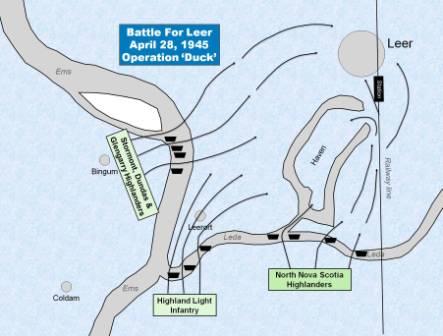
The plan? The North Nova Scotia Highlanders would cross the Leda River in assault boats and secure the northern bank of the river in preparation for the attack to capture Leer. The Highland Light Infantry of Canada would cross the Leda River, where the Ems and Leda rivers meet. The Stormont, Dundas and Glengarry Highlanders would go across the Ems River towards the western edge of Leer.

These three Regiments were part of the 9th Canadian Infantry Brigade.  (See https://www.canadiansoldiers.com/history/battlehonours/northwesteurope/leer.htm)

Map showing the Ems and Leda Rivers, and position of Regiments during the Battle for Leer.  (Map courtesy of and ©Jan Braakman)

In a translated excerpt from the recently published book ‘Holtense Canadezen’ (The Faces Of Holten) by Jan Braakman, we learned that the North Novies were not the only Regiment to have had casualties.  The men from the Highland Light Infantry all crossed safely, but 19 men from the Stormont, Dundas & Glengarry Highlanders didn’t.

…Why Operation Duck Was Important…

Jan Braakman’s account explained why Operation Duck was important. “…At the end of April 1945, Canadian troops stood just across the Dutch-German border in Ostfriesland (East Frisia in Germany) in front of the river Ems. The town of Leer was on the other side of the river on the route to Emden. Surrounded by inaccessible lowlands in the north and with rivers (Ems and Leda) in the west and south, Leer was a well defensible and therefore difficult to capture port city. All access bridges over the Ems and Leda were blown up by the Germans. For the Canadians there was no other option than to reach the city by water….

River crossings can be tricky due to currents and tides, and in wartime, there is always the risk of enemy fire.  “….The Ems River has an open connection with the Wadden Sea, which means that tides influence water levels and currents in the river. Tides made the currents unpredictable, and the Canadian Army didn’t have accurate information about the tides. What was clear: high tide was the best time to make the crossing. Aerial photographs showed that German troops had fortified themselves well behind the dikes that surrounded the city…. 

A decision was made on how to cross the two rivers – the Leda and the Ems.. “ Only under the protection of a smoke screen and solid artillery support would it be possible to successfully complete the attack on Leer, using boats … General Simonds ordered that on April 28, 1945, before darkness fell, there had to be a solid bridgehead, from which the capture of Leer could be initiated. That meant that the attack had to be launched during the middle of the day, around three o’clock, when the water level was at its highest… 

The Highland Light Infantry crossed safely, but the other two regiments ran into trouble.  “…The crossing was made at three different places. At the same time, artillery fire and attacks from the air put the German defence line to the test. The North Nova Scotia Highlanders would cross the Leda from the south bank and take the harbour of Leer, which abutted the city on a peninsula...

 ….Panic Led To Tragedy….

Things didn’t go as planned.  3 sets of assault boats used by the North Nova Scotia Highlanders set off at 15:45 hours on April 28.  In ‘No Retreating Footsteps… the story of the North Novas’ by Will Bird, he explained that “…9 men were allotted to a boat at the river crossing.  Two men in each were operating these boats which used outboard motors….

In each boat were 7 North Novies and two boat operators from the Royal Canadian Engineers.  “…. C Company, commanded by Major Winhold, had moved off from Driever …. with Thirteen Platoon leading, then…. Fourteen Platoon under Lt S Laskin and Fifteen under Lt McGlashen…

Unfortunately for the men in the boat from Fifteen Platoon, one of the Engineers didn’t have nerves of steel.  “…Just as the craft were launched some shelling began and the young Engineer at the motor of the boat ….. became very excited.  His mate shouted at him not to turn on full power as the heavy load would sink when the motor dipped, but a shell landed quite near and the nervous man gave the motor the gun, sinking the boat at once…

Five of the North Novies drowned.  Lt McGlashen managed to save himself and another man.  Men were not the only casualties.  “…Fifteen Platoon had been chosen to lead the attack, but most of its weapons were lost…

What a tragic accident!  To see what an assault boat looks like, take a look at this short YouTube video, which shows troops preparing to cross the Ems:

…. to be continued…..

In Part 2 the aftermath of the accident is discussed and we’ll learn about the men who drowned.

Thank you to Jan Braakman for permission to quote from his book and use of the map showing the position of the Regiments, and to Simone Comeau and Murray Baillie for sharing photos.

If you have information to share about these or any Canadian soldiers buried in The Netherlands, please contact Pieter at memorialtrail@gmail.com or comment on the blog. 

© Daria Valkenburg

…Want to follow our research?…

If you are reading this posting, but aren’t following our research, you are welcome to do so.  Our blog address: https://onthewarmemorialtrail.com/

Front cover OnTheWarMememorialTrailinEurope4 countries, 6 weeks, 7,000 km – an unforgettable war memorial journey in Europe…. Daria’s book ‘No Soldier Buried Overseas Should Ever Be Forgotten‘ is available in print and e-book formats.  Net proceeds of book sales help support research costs and the cost of maintaining this blog. For more information see https://nosoldierforgotten.com/

You are also invited to subscribe to our YouTube Channel: On The War Memorial Trail With Pieter Valkenburg: https://www.youtube.com/channel/UCJ591TyjSheOR-Cb_Gs_5Kw.

Never miss a posting!  Subscribe below to have each new story from the war memorial trail delivered to your inbox.

On The War Memorial Trail….. Atlantic Canada Remembers – Part 6

February 9, 2021. We continue to feature more of the photos submitted by Atlantic Canadians of soldiers buried overseas. Pieter is ensuring that every email is acknowledged, and that the photos of soldiers buried in The Netherlands will be forwarded to the appropriate cemetery for their digital archives. 

Currently, only the volunteers at the Canadian War Cemeteries in Holten and Groesbeek are active.  Submissions for Bergen Op Zoom and for any soldiers buried in municipal cemeteries are being held until Pieter gets the go-ahead that volunteers are active again.

Soldiers buried at the Canadian War Cemetery in Holten, The Netherlands

Howard Armstong

Howard W. Armstrong. (Photo submitted by Marion Fryday-Cook)

Marion Fryday-Cook, President of The Royal Canadian Legion, Nova Scotia/Nunavat Command, submitted a photo of Howard W. ARMSTRONG of Chester, Lunenburg County, Nova Scotia, explaining that “…This is the information gathered by Branch 44 in Chester, NS for our Command’s Veterans Recognition Service Book. Howard’s family still reside in Chester…” 

Howard was with the Fort Garry Horse – 10th Armoured Regiment, and lost his life on September 5, 1945 due to an accidental death after a misstep on a dark and unlit street in Amsterdam led to him falling into a canal and drowning.

Douglas Jury1

Douglas Jury. (Photo courtesy of the Jury Family)

On behalf of the Jury family, Dara Legere of Branch 4 of The Royal Canadian Legion in Joggins, Nova Scotia, submitted a photo of Douglas JURY, writing “…I have attached a photo of Sapper Douglas Jury of Joggins, NS who is buried in Holten Cemetery, Holland. Douglas Jury was related to my family. My mom’s sister Mary was married to Douglas’s brother Roy. There were three Jury brothers who served in WW2, Douglas, Roy, and William. William was taken prisoner by the Germans shortly after D-Day and was forced to work in the coal mines in Germany…

Douglas was with the Royal Canadian Engineers, 18th Field Company, and lost his life on August 17, 1945. Dara explained that “…Douglas remained in Holland after the war ended, repairing dykes and bridges, etc with the Canadian Engineers. The vehicle he was travelling in rolled off one of the dykes and he was trapped under it and drowned. Such a sad story….

Soldiers buried at the Canadian War Cemetery in Groesbeek, The Netherlands

Harry William Doucette

Harry William Doucette.  (Photo courtesy of the Doucette Family)

On behalf of the Doucette family, Cyrille LeBlanc and Andre Boudreau of Legion Branch 155 in Wedgeport, Nova Scotia submitted a photo of Harry William DOUCETTE. Cyrille wrote that he “….was a private in the North Nova Scotia Highlanders, Royal Canadian Infantry Corps. He was born May 25, 1925 in Bell Neck, Sainte-Anne Catholic Parish, Yarmouth County, Nova Scotia.

Private Doucette was the son of John and Celina Mary Doucette. He had eight brothers and one sister. Two brothers served in the RCAF during World War II.  He completed Grade 8 at the age of fourteen and left school to work as a lumber-man in the woods. He enjoyed reading western and veteran stories.  

 He enlisted in Halifax at age 18 October 6, 1943, and served in Canada from October 4, 1943 to October 13, 1944; in the United Kingdom from October 14, 1944 to November 23, 1944 and in France, Belgium, Netherlands, and Germany from November 24, 1944 to March 25, 1945.  He was killed in action against the enemy in Germany March 25, 1945 at age 19….

Harry William lost his life during the Battle of Bienen in Germany, in which  44 members of the North Nova Scotia Highlanders lost their lives and 68 were wounded.  In 2000 a memorial plaque was placed in Bienen to honour those who lost their lives in this battle.  (See http://wikimapia.org/17003812/Commemorative-plaque-of-Battle-of-Bienen)

Cyrille went on to explain that “…Private Doucette was remembered and honoured May 5, 2020, September 12, 2020 and November 11, 2020 – the 75th anniversary year of the liberation of The Netherlands….”  He also was kind enough to include a link to a YouTube video: https://www.youtube.com/watch?v=GR3SowfKA_E

Arnold Hupman

Arnold F Hupman.  (Photo submitted by Marilyn Hupman)

Marilyn Hupman sent a photo and information on her grandfather, Flying Officer Arnold F. HUPMAN, writing that “… He was the only boy of 7 children, born and raised in East Side of Ragged Island, Shelburne County, Nova Scotia. 

Margaret Nickerson and he married and had 3 sons, Arnold, Robert and Arthur.  Arthur is the only surviving child.  My father, Arthur, was 7 years old when he last saw his father, just before he went overseas. 

From the stories I heard as a child he was asked to stay in Canada and teach pilots, but being a true Canadian he said no that he signed up to fight and he was going over.

Our family is very proud of our Grandfather and the rest of the family that fought. The only loss was F.O. A.F. Hupman….

Arnold lost his life when the Lancaster bomber he was in crashed on the outskirts of Arnhem on the night of June 16 to 17, 1944, after being shot down by a German nightfighter. All 7 members of the crew of Lancaster VR-V lost their lives.  They were temporarily buried in the Netherlands Reformed Church Cemetery in Huissensedijk on June 29, and later reburied in the Canadian War Cemetery in Groesbeek.   

In addition to Arnold Hupman, the other crew members were: Donald MORISSEN, Gerald QUINN, Harold FLETCHER, Clifford JOHNSTON, Philip MCMANUS, and Edward FAHY. (More information can be found in this English translation of an article by the late Willem Tiemans: https://airbornearnhem.nl/WillemTiemens/Elden%20bomber%20crash.htm)

Soldiers buried at the Canadian War Cemetery in Bergen Op Zoom, The Netherlands

Austin Boutilier photo from Judy MacKenzie

Austin Ephraim Boutilier. (Photo submitted by Judy MacKenzie)

Judy MacKenzie submitted a photo of her great-uncle, Austin Ephraim BOUTILIER, who was killed in action in Belgium during the Battle of the Scheldt on September 29, 1944, aged 26, while serving with the Black Watch Regiment.  (See https://www.veterans.gc.ca/eng/remembrance/history/second-world-war/scheldt)

Judy MacKenzie explained that “…He was gone long before I was born. His father was Ansil Boutilier. He was married to Hannah Hershman. They lived in Tantallon, Nova Scotia. They would have been my great grandparents. I remember stories that he joined the military before he was old enough.  However, if he was 26 when he died, that would appear to be untrue. All of Austin’s siblings are gone. Several of Austin’s siblings fought in the war, including my grandfather, who married Austin’s sister. Everyone else made it home, some with shrapnel in them….

Judy’s uncle, Ernest ‘Ernie’ MacKenzie, wrote that “…our Uncle Austin is buried at Bergen op Zoom Canadian War Cemetery. We did visit Austin’s grave in 2011….” 

According to the Field Service record, Austin was initially buried in Belgium on September 30, 1944 “…on the south side of the road between Ryckevorsel towards St. Leonard...” before being reburied in Bergen Op Zoom in The Netherlands.

Thank you to André Boudreau, Marion Fryday-Cook, the Doucette family, Marilym Hupman, Cyrille LeBlanc, Dara Legere, Ernie MacKenzie, and Judy MacKenzie for sharing photos and anecdotes.  Atlantic Canadians remember their loved ones who are buried overseas.

More photos and stories in Atlantic Canada Remembers – Part 7! If you have photos or information to share, please email Pieter at memorialtrail@gmail.com, comment on the blog, or tweet to @researchmemori1

© Daria Valkenburg

…..Previous postings in the Atlantic Canada Remembers series….

Missed the previous postings in this series? See:

…..Want to follow our research?….

If you are reading this posting, but aren’t following the blog, you are welcome to do so.  Our blog address: https://onthewarmemorialtrail.com/

Front cover OnTheWarMememorialTrailinEurope4 countries, 6 weeks, 7,000 km – an unforgettable war memorial journey in Europe…. Daria’s book ‘No Soldier Buried Overseas Should Ever Be Forgotten‘ is available in print and e-book formats.  Net proceeds of book sales help support research costs and the cost of maintaining this blog. For more information see https://nosoldierforgotten.com/ 

You are also invited to subscribe to our YouTube Channel: On The War Memorial Trail With Pieter Valkenburg: https://www.youtube.com/channel/UCJ591TyjSheOR-Cb_Gs_5Kw

Never miss a posting!  Subscribe below to have each new story from the war memorial trail delivered to your inbox.