On The War Memorial Trail….The WWII Soldier From Piusville Killed During The Battle Of The Leopold Canal

December 10, 2025. In the course of his research into WWII soldiers buried in The Netherlands, Pieter soon learned that many Canadians who lost their lives during the Battle of the Scheldt are not only buried in the Canadian War Cemetery in Bergen Op Zoom in The Netherlands, but are also buried at the Canadian War Cemetery in Adegem, Belgium.

While most of the men buried in Adegem died during the operations for the clearance of the south bank of the Scheldt, many Canadians who lost their lives elsewhere in Belgium were also brought here for burial. Out of 848 Canadians buried here, 12 are from Prince Edward Island, and this spring an appeal went out in the local media for photos and information on the soldiers.

Pieter’s research results are faster than I can keep up with, and so several of the graves we visited during our 2025 European War Memorial Tour were for soldiers whose stories have yet to be told.  One of these is the subject of this posting….

….Steve Gallant’s niece had a photo of her uncle….

After reading about the appeal for photos in the County Line Courier newspaper, Pauline Stewart of New Annan, Prince Edward Island contacted us, writing that “we follow your memorial trail column.  In the last edition my uncle was mentioned….  Her uncle was Joseph Stephen ‘Steve’ GALLANT, of Piusville, who was serving with the Royal Winnipeg Rifles when he lost his life on October 11, 1944 at the age of 29.

At the time of Pauline’s email, we were still in Europe.  We sent her a photo taken of her uncle’s grave, and explained that Pieter would give her a call once we were home again.  She replied with a surprise. By the way the Two Bulger Boys from Foxley River are my husband’s uncles…” 

Last year, a two-part series on Harold ‘Hal’ Gabriel BULGER, who is buried in Adegem, and his brother Lawrence William BULGER, who is buried in the Canadian War Cemetery in Groesbeek, was published. (You can read Lawrence’s story at https://onthewarmemorialtrail.com/2024/08/19/on-the-war-memorial-trail-the-bulger-brothers-part-2-the-wwii-stretcher-bearer-from-foxley-river-killed-during-the-battle-of-bienen/ and Hal’s at https://onthewarmemorialtrail.com/2024/08/05/on-the-war-memorial-trail-the-bulger-brothers-part-i-the-wwii-soldier-from-foxley-river-killed-during-the-battle-of-moerbrugge/)

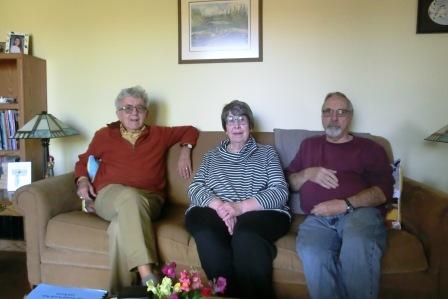
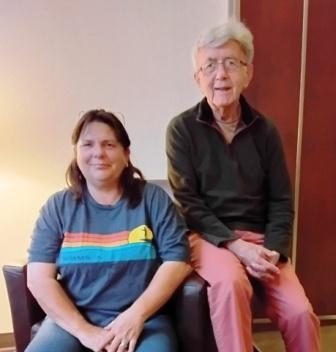
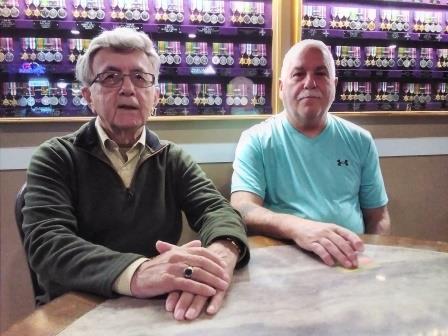
Pauline and Charles Stewart with Pieter. (Photo credit: Daria Valkenburg)

A few months later, we had a chance to meet with Pauline and her husband Charles.  Pauline explained that her father, John P. Gallant, was Steve’s brother. Another brother, Vincent, also served during WWII, but survived. “…Steve was the groomsman at the marriage of my parents….

She recalled that “….Steve was on leave right after I was born in August 1944, and he died a few months later….

Born in Piusville, Prince Edward Island on July 31, 1915, Joseph Stephen ‘Steve’ GALLANT was the son of Archie and Jannie Gallant.  He had 5 brothers and 1 sister.

….Steve enlisted in 1942…

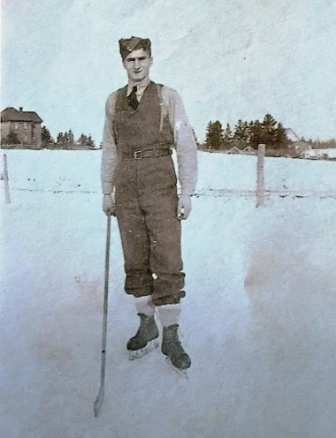
Joseph Stephen ‘Steve’ Gallant.  (Photo Courtesy of Pauline and Charles Stewart On Behalf Of The Gallant Family)

Steve originally enlisted under the National Resources Mobilization Act (NRMA) at the No. 6a NRMA Clearing Depot in Charlottetown, Prince Edward Island on May 15, 1942 and began basic training at No. 62 Canadian Army Basic Training Centre in Charlottetown. At the time, he stated that he’d left school at the age of 12 after completing Grade 5, that he was working on his father’s farm in Piusville, and that he was fluent in both French and English.   (See https://en.wikipedia.org/wiki/National_Resources_Mobilization_Act)

….Steve transferred to the 5th SMAA S/L Troop…

After completing basic training on July 11, 1942, Steve was transferred to the 5th Special Mobile Anti-Aircraft Search Light Troop (5th SMAA S/L Troop) and was stationed at various airports, beginning with Ives Point, Nova Scotia, near Halifax. As explained in a Government of Canada history of the Royal Canadian Air Force during WWII, the main task of this unit was “…to provide realistic training to aircrews – the terrifying experience of being ‘coned’ by enemy anti-Aircraft battery searchlights….” (See https://www.canada.ca/en/air-force/corporate/wings/14-wing/history.html)

On October 5, 1942, Steve enlisted in the Active Army in Halifax, Nova Scotia, and remained with the 5th SMAA S/L Troop.  A few days later, on October 8, 1942, he was attached to No. 6 Detachment, Royal Canadian Ordnance Corps (RCOC) in Debert, Nova Scotia, for a month.

He was next attached to No. 34 Operational Training Unit (OTU) of the Royal Air Force in Pennfield, New Brunswick.  An airport had been built in 1940 to train Air Observers as part of the British Commonwealth Air Training Plan (BCATP). The Operational Training Unit at the airport was used to train four crew members for World War II action: Pilot, Navigator, Wireless Air Gunner and Air Gunner. (See https://en.wikipedia.org/wiki/British_Commonwealth_Air_Training_Plan)

A month later, Steve was attached to No. 36 Operational Training Unit (OTU) of the Royal Air Force in Greenwood, Nova Scotia.  The site for RAF Station Greenwood, which opened in 1942, had been chosen by the Royal Canadian Air Force (RCAF) and Royal Air Force for an airfield as part of the British Commonwealth Air Training Plan (BCATP) due to the area having a relatively fog-free climate.

On February 2, 1943, Steve was again attached to No. 6 Detachment, Royal Canadian Ordnance Corps (RCOC) in Debert, Nova Scotia, for a few months.  Then, on May 8, 1943, he was again attached to No. 36 Operational Training Unit (OTU) in Greenwood, Nova Scotia.

A month later, he was attached again to No. 34 Operational Training Unit (OTU) in Pennfield, New Brunswick for 2 months before returning to No. 36 Operational Training Unit (OTU) in Greenwood, Nova Scotia. While in Greenwood, Steve was sent ‘On Command’ to Winnipeg, Manitoba, on October 10, 1943.

….Steve left Canada for overseas service….

On March 27, 1944, Steve was transferred to the 21st Anti-Aircraft Regiment of the Royal Canadian Artillery, and posted to 1st Anti-Aircraft Searchlight (AA S/L) Battery in Halifax, Nova Scotia, for additional training as a gunner. A few weeks later, on April 22, 1944, he was sent to No. 1 Transit Camp in Windsor, Nova Scotia in preparation for overseas duty.

Steve was granted embarkation leave from May 5 to 9, 1944. It must have been a bittersweet time as he didn’t return back until May 12, 1944, resulting in the forfeiture of 3 days pay and allowance and being confined to barracks for 4 days. 

On May 20, 1944, Steve was sent to the No. 1 Training Battalion of the Canadian Infantry Corps in Debert, Nova Scotia for final training and preparation for overseas service.  On July 21, 1944, he was transferred to the Training Brigade Group in Debert.  He was granted another leave from August 3 to 15, 1944, in what turned out to be the last time he would ever see his family again.

On August 29, 1944, Steve left Canada for the United Kingdom.  Upon arriving on September 4, 1944 he was assigned to No. 4 Canadian Infantry Reinforcement Unit (CIRU). 

He wasn’t in the United Kingdom even a month when he was transferred to the X4 Reinforcement List for the Canadian Base Reinforcement Group (CBRG), part of the 13th Battalion, 21st Army Group, on October 1, 1944 and sent to Northwest Europe, arriving a day later.

….Steve lost his life during the Battle of the Leopold Canal….

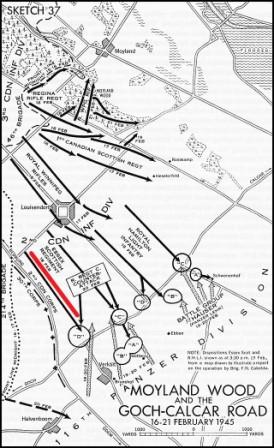
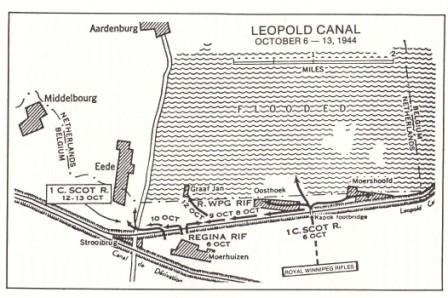
Map showing the Battle for the Leopold Canal.  (Map source: Little Black Devils: A History of the Royal Winnipeg Rifles)

On October 10, 1944, Steve was transferred to the Royal Winnipeg Rifles, joining the Regiment in the vicinity of the dike by Graaf Jan, The Netherlands, where they were engaged in fierce fighting during the Battle of the Leopold Canal on the border between The Netherlands and Belgium.   

The War Diary for October 10, 1944 for the Royal Winnipeg Rifles stated that the Commanding Officer had “… received orders to occupy the Southern approaches to the village of GRAAF JAN. With A Company giving covering fire, B Company succeeded in reaching the objectives at 1500 hrs. Superior enemy forces in the village forced the company to withdraw when ammunition was getting low….

The War Diary for October 11, 1944 noted numerous casualties.  “…Cloudy and cool with slight rain in the afternoon. Visibility poor. During the morning A Company assisted the Regina Rifles in destroying an enemy held pill box. Another C Company patrol to GRAAF JAN failed to contact the enemy…. Enemy shelling was slightly less intense than during the first three days. Small Arms fire continued to make it extremely difficult and dangerous to move about. Supplies and casualties were still ferried across the Canal. Capt H.C. Chadderton of C Company and Lt L. Mendels of B Company were among the numerous casualties for the day….” 

Unfortunately, Steve was one of the ‘numerous casualties’ referred to in the war diary.  He was 29 years old.

….Steve is buried in the Canadian War Cemetery in Adegem….

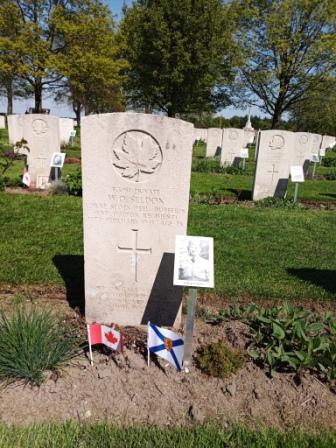
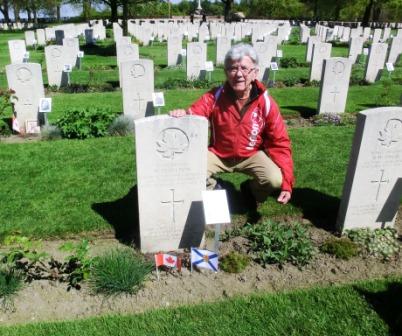
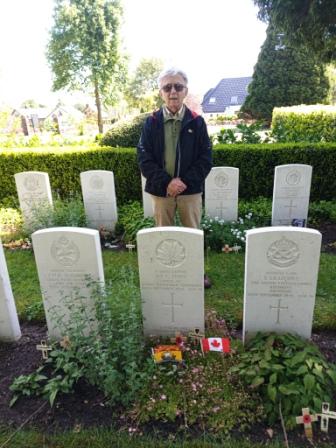
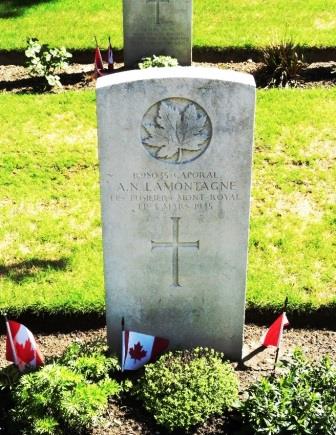
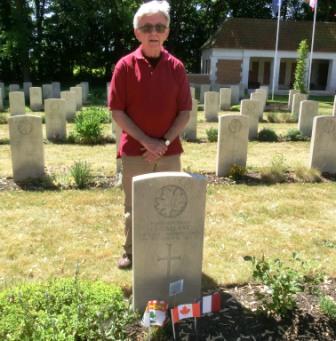
Steve is buried in the Canadian War Cemetery in Adegem, Belgium. We visited his grave on a very hot Sunday this past May, where Pieter placed Acadian, Prince Edward Island, and Canadian flags in remembrance.

Pieter by the grave of Joseph Stephen ‘Steve’ Gallant. (Photo credit: Daria Valkenburg)

….Steve’s mother wanted answers….

On November 13, 1944, a distraught and upset Jannie Gallant – Steve’s mother – wrote to the Department of National Defence, asking questions that so many mothers of soldiers must have had.  “….I received a telegram on October 20 stating that …” Steve had been killed on October 11. “…We haven’t received any more news since.  It makes a very sad house. My husband has been in ill health since 1933. It was a great shock to him and also to me...

She explained that they had received two letters from him once he left Canada.  “…We received a letter from him on the 29th of September and he was still in England, and we received one that was written on October the 7th and he was already in Belgium…” 

Then came the hard question and a query as to whether he was really dead.  “…I want to know how much training that boy had to be sent that soon to Belgium as a rifleman with no training as a rifleman.  I hope that the boy is still living as he was a great help to his father and also to myself….” 

She ended by saying that “…I want to know the particulars of him if he is dead or living….

Mrs Gallant did receive a reply from Lt Cameron, Military Secretary, on November 18, 1944, offering sympathies and explaining that Steve had “…received careful training during the period he was in England and that he would not have been permitted to proceed until he was declared trained…

The reality was that training couldn’t fully prepare a soldier for actual combat. To make things worse, Steve had been sent to the Royal Winnipeg Rifles in the midst of a battle, with not even the chance to get to know the men in the Company he was assigned to.

Thank you to Pauline and Charles Stewart for providing photos and information on Pauline’s uncle. If you have a story to tell, or can provide a photo of one of the soldiers from Prince Edward Island buried in Adegem, please email Pieter at memorialtrail@gmail.com or comment on the blog. 

© Daria Valkenburg

….The 12 soldiers from Prince Edward Island who are buried in Adegem….

  1. Harold ‘Hal’ Gabriel BULGER of Foxley River was serving with the Algonquin Regiment when he was killed during the Battle of Moerbrugge in Belgium on September 10, 1944, at the age of 26.  
  2. Charles John ACORN of Peters Road was serving with the North Nova Scotia Highlanders when he lost his life on October 15, 1944 at the age of 22. A poor quality newspaper photo was found.
  3. William Henry DEVEAUX of Dundee was serving with the North Nova Scotia Highlanders when he lost his life on October 16, 1944 at the age of 23.
  4. Joseph Stephen GALLANT of Piusville was serving with the Royal Winnipeg Rifles when he lost his life on October 11, 1944 at the age of 29.
  5. Cecil Aneas MACDONALD of Glencoe was serving with the North Shore (New Brunswick) Regiment when he lost his life on October 15, 1944 at the age of 23. NOTE: The Belgian family that adopted his grave would like to be in contact with a family member.
  6. Joseph ‘Joe’ Augustine MACKENNA of Newton Cross was serving with Auxiliary Service as a member of the Knights of Columbus when he drowned in Belgium on June 21, 1945 at the age of 41. 
  7. Adolphus Peter MCCORMACK of New Zealand was serving with the Regina Rifle Regiment when he lost his life on October 30, 1944 at the age of 25.
  8. James Hector MUNN of New Zealand was serving with the Regina Rifle Regiment, 1st Battalion, when he lost his life on October 30, 1944 at the age of 28.
  9. Valmont PERRY of St. Louis was serving with the Stormont, Dundas and Glengarry Highlanders when he lost his life on October 21, 1944 at the age of 26. No photo has been found of him to date.
  10. Allan Rattenbury READ of Read’s Corner was serving with the Regina Rifle Regiment when he lost his life on October 27, 1944 at the age of 21. A poor quality newspaper photo was found.
  11. John James SAUNDERS of Bloomfield was serving with the South Saskatchewan Regiment when he lost his life on September 22, 1944 at the age of 27. No photo has been found of him to date.
  12. Joseph Roy SILLIPHANT of Summerside was serving with the North Nova Scotia Highlanders when he lost his life on October 27, 1944 at the age of 28. A poor quality newspaper photo was found.

….Want to follow our research?…

If you are reading this posting, but aren’t following our research, you are welcome to do so.  Our blog address: https://onthewarmemorialtrail.com/
4 countries, 6 weeks, 7,000 km – an unforgettable war memorial journey in Europe…. Daria’s book ‘No Soldier Buried Overseas Should Ever Be Forgotten‘ is available in print and e-book formats.  Net proceeds of book sales help support research costs and the cost of maintaining this blog. For more information see https://nosoldierforgotten.com/

Subscribe to our YouTube Channel: On The War Memorial Trail With Pieter Valkenburg: https://www.youtube.com/channel/UCJ591TyjSheOR-Cb_Gs_5Kw

Never miss a posting!  Subscribe below to have each new story from the war memorial trail delivered to your inbox.

On The War Memorial Trail…..The WWII Sapper From Moncton Who Lost His Life During Operation Berlin

Headline of an October 1945 article from ‘The Times Transcript’

November 6, 2025.  While searching for a photo of WWII soldier Eric John CRUE of Moncton, New Brunswick, who lost his life on April 6, 1945 while serving with the Algonquin Regiment, Pieter found an October 1945 newspaper article from ‘The Times Transcript’ about a memorial service in the First United Baptist Church in Moncton to honour the memories of Crue, John Edward COLEMAN of the Royal Canadian Electrical and Mechanical Engineers, George Temple DOYLE of the RCAF, and David ‘Lloyd’ George HOPE of the Royal Canadian Engineers…. all from Moncton.

Pieter knew that Coleman was on a photo wish list from the Canadian War Cemetery in Groesbeek, but Doyle and Hope were unknown to him.  He began an investigation and quickly found that no photo was available for Hope, who is buried in Rhenen General Cemetery in Rhenen, The Netherlands.  There was a photo available for Doyle, and a newspaper photo was found for Coleman by Etienne Gaudet.  No photo was ever found for Crue, who is now on our Cold Case List. (See https://onthewarmemorialtrail.com/our-cold-cases/)

Pieter began the search for a photo of Hope….

….A family member got in contact…

Pieter made contact with Susan ‘Sue’ Hope through Ancestry and she explained that the soldier, who went by ‘Lloyd’, was one of three brothers who served during WWII.  “….Russell, Douglas, and DLG Hope were my grandfather’s cousins. My grandfather was Wesley William Hope.   David Lloyd, Douglas, and Russell Hope were brothers.  They were all from Moncton, their parents were Frank D. Hope and Lottie F Jones…”  Both of Lloyd’s parents died in the early 1930s.  In addition to his brothers, he also had three sisters: Kay, Mildred Greta, and Marguerite.

Born June 30, 1919 in Moncton, New Brunswick, Lloyd worked as an iron moulder at an iron foundry, Record Stove and Furnace Company prior to enlisting in the militia on October 9, 1940 under the National Resources Mobilization Act (NRMA) and began basic infantry training at No. 70 Non-Permanent Active Militia (NPAM) Centre in Fredericton, New Brunswick.  After completing that course on November 7, 1940, he was assigned to the New Brunswick Regiment. (See https://en.wikipedia.org/wiki/National_Resources_Mobilization_Act)

….Lloyd enlisted in the Active Army in August 1941…

He enlisted in the Active Army on August 8, 1941 at No. 7 District Depot in Moncton, stating in an interview that his reason for joining the army was for “….adventure…” He expressed an interest in taking a blacksmiths course. He was described as “…cheerful, neat, with good conduct and military efficiency….” While his mechanical knowledge was listed as “…below average….” it was remarked that his skill on the rifle range was “…above average…” He had written that he enjoyed hunting, fishing, and swimming, so skill with a gun would not have been a surprise.     

Lloyd returned to No. 70 Canadian Army (Basic) Training Centre in Fredericton for his basic training, which was completed on October 2, 1941.  He was transferred to No. 7 District Depot in Moncton on October 20, 1941, and began a Fitters Course the following day, returning to No. 70 Canadian Army (Basic) Training Centre on February 6, 1942. 

On April 8, 1942, Lloyd was transferred to A5 Canadian Engineer Training Centre (CETC) in Camp Petawawa, Ontario for Engineer Training.  After completing his training on May 13, 1942, he was given embarkation leave, for what turned out to be the last chance he would have to see his family.

….Lloyd left Canada for overseas service….

David ‘Lloyd’ George Hope. (Photo courtesy of Susan Hope)

On June 3, 1942, Lloyd sailed from Halifax, Nova Scotia to the United Kingdom, arriving in Liverpool, England on June, 1942. Upon arrival, he was assigned to No. 1 Canadian Engineers Reinforcement Unit (CERU). 

While in the United Kingdom, Lloyd’s training continued.  On September 29, 1942, he was transferred to No. 1 Canadian Ordnance Reinforcement Unit (CORU), qualifying as a Pioneer ‘C’ on October 19, 1942. 

On December 4, 1942, Lloyd was transferred to the Royal Canadian Engineers, 18th Field Company.  While remaining with the 18th Field Company, he was attached, for all purposes, to the Headquarters of the Royal Canadian Engineers, 3rd Canadian Division, from February 19, 1943 until August 13, 1943.

Then, on December 14, 1943, he was transferred to the Royal Canadian Engineers, 23rd Field Company.  In ‘The Twenty-Third Story’ by Major Michael Lovett TUCKER, the entry for December 19, 1943 explained that training was ongoing.  “…We are doing considerable practice in night convoy work…” using old trucks. …We are still working on Bailey Bridge training on Headley Common….” and “….today we start work on a 110 foot T.T. bridge with one storey underslung….”  T.T. refers to Tracked-Transport.  Bridge load effects and capacity ratings needed to be evaluated to determine appropriate load factors for military vehicles crossing various bridges.

….Lloyd and the 23rd Field Company left the UK for France…..

On July 6, 1944, Lloyd and the 23rd Field Company boarded a ship that was to leave the United Kingdom for France, part of the 21st Army Group.  The July 7, 1944 entry in ‘The Twenty-Third Story’ recorded that “…we sail from Tilbury at six-thirty in the morning and anchor off Southend, where we lie for the balance of the day.  Then at ten o’clock the following evening we fall in with the other thirty-three ships in our convoy, and head down the Thames Estuary to the English Channel…

Map showing the location of Graye-sur-Mer and Juno Beach.  (Map source: Google maps)

The entry for July 9, 1944 noted their arrival off the coast of France. “…Late in the afternoon we come in sight of the Normandy coast, and shortly before midnight come to anchor off Juno Beach, off Graye-sur-Mer.  There are so many ships that it is difficult to find a suitable anchorage…

….Lloyd and his brother Douglas help to clear up debris in Caen…..

Troops left the ship the following day, and by July 13, 1944 had moved to their new bivouac area in a orchard near Cairon. Their immediate task was to “…clear debris and open streets in Caen…” as stated in the July 14, 1944 entry.  “…In the centre of town, every street is choked with rubble, and in many places it’s impossible to tell where streets have been. The Germans are mortaring and shelling steadily….”  

Work continued, in spite of German activity, and by July 25, 1944, an entry recorded that “… an entirely new street is run from Boulevard des Allies to the river through the ruins of demolished buildings.  It is named ‘Andy’s Alley’….” 

Opening of Andy’s Alley in Caen, July 1944. Lloyd Hope identified by red arrow. His brother Douglas Hope is identified by blue arrow.  The purple arrow identifies Major M. L. Tucker, author of ‘The Twenty-Third Story’. (Photo courtesy of Alice van Bekkum Collection)

The opening of Andy’s Alley was captured in a photo, with the caption noting that the road was ‘a half-mile long’ (.8 km), and that the proud Canadian engineers posed by the steamroller breaking the tape for supplies to move forward.  The source of the photo and the magazine in which it was published is unknown, and was provided by Alice van Bekkum, Chair of the Faces To Graves Foundation.  Both Lloyd and his brother Douglas are in this iconic photo!

….The 23rd Field Company made its way into The Netherlands….

After painstakingly working their way through France and Belgium to clear roads and build bridges, the 23rd Field Company received new orders. The September 16, 1944 entry in ‘The Twenty-Third Story’ recorded that “…something is in the air!  Our advance is moving very fast through Belgium up into Holland…

Operation Market Garden was an Allied military operation, from September 17-25, 1944 that succeeded in liberating Nijmegen and Eindhoven, but failed in liberating the last bridge held in Arnhem, which would enable troops to the Rhine into Germany.  If you’ve seen the movie ‘A Bridge Too Far’ (See https://en.wikipedia.org/wiki/A_Bridge_Too_Far_(film)), then you may be familiar with what happened.  (For an idea of the gliders used, see https://onthewarmemorialtrail.com/2018/01/06/on-the-war-memorial-trail-the-liberation-route/)

There was excitement in the September 18, 1944 entry.  “…We hear that Airborne troops have landed in Northern Holland and have captured the bridges at Grave, Nijmegen and Arnhem over the Maas, Waal and Neder Rijn rivers, respectively….We are the only Canadian troops taking part in the push into Holland….but our ground troops are having difficulty getting beyond Nijmegen and so are unable to join up with the Airborne troops in Arnhem…”  This description was about Operation Market Garden, which failed to capture the bridge at Arnhem, as was noted two days later in the September 20, 1944 entry.

While British troops got across the river at Nijmegen and were able to hold the bridge, they had “…difficulty in getting on to Arnhem, and 1st British Airborne is having a very sticky time there. The Germans have retaken the bridge….

….The 23 Field Company was tasked with rescuing the 1st British Airborne during Operation Berlin….

The 23rd Field Company was “….ordered forward to Nijmegen...”  On September 24, 1944, the entry recorded that they were to help rescue the 1st British Airborne, using storm boats to ferry survivors from the German held side of the Neder Rijn River (Lower Rhine River in English) to Allied safety. Operation Berlin was the rescue attempt to save survivors of the British 1st Airborne after the disastrous Operation Market Garden and at the end of the Battle of Arnhem/Oosterbeek

Example of a storm boat: Storm boats manned by the 34th Field Company, R.C.E., carry Regina Rifles Regiment’s 7th Brigade over the Seine River in 1944.  (Photo Credit: Donald I. Grant/Canada. Dept. of National Defence/Library and Archives Canada/PA-136016)

The following day “…at six o’clock we learn that we are to operate from a site on the river, just east of Driel.  We are to have fourteen boats, and these will be off-loaded in an orchard which comes up to the back of the winter dyke...

The first storm boat was launched at 9:30 pm, but as it had been damaged while being pushed down the bank into the water, it started to leak and had to be abandoned.  A second boat was readied. “….Corporal Ryan, W.D., and Sappers Magnusson, H.C., and Roherty, L.J., are the crew…It is pitch dark and pouring rain….Lt Martin asks to go with this boat so that he may contact our friends and lend a hand in organizing the loading of boats for them…..” 

 It set off at 9:45 pm, closely followed by “…another, which has Corporal Smith, S. F., and Sappers Hope, D.L.G., and Thompson, N.A. as crew.  Neither of these boats returns.  One is seen to receive a direct mortar hit. There is a direct flash from the explosion, and then nothing can be seen in the darkness …” 

The boat with Ryan, Magnusson, Roherty, and Martin was hit by mortar fire. None of the men survived.

….Lloyd was in the storm boat that capsized during Operation Berlin….

The boat with Smith, Hope, and Thompson was on its way back after picking up survivors, but was “…heavily overloaded with Airborne survivors…” The boat “….went under when a mortar fell close beside it and everyone instinctively threw himself to the other side of the boat and capsized it...” 

Of the crew, only Corporal Smith survived.  He recorded in a report on the incident that he was riding in the bow to help land the boat.  While heading for the south (home) shore, the boat was swamped and sank about 46 metres (50 yards) from the north shore.  As his “…greatcoat was open it helped me to float, and although I am not a swimmer I reached shore on the north side of the river along with four of the British Airborne men. I was taken back to the home side of the river in an assault boat…

….Lloyd is buried in Rhenen General Cemetery…

Pieter by the grave of David ‘Lloyd’ George Hope. (Photo credit: Daria Valkenburg)

25 year old Lloyd lost his life due to drowning on September 26, 1944, when the storm boat he was in capsized.  He was buried in Rhenen General Cemetery, which we visited this past May.  Pieter placed a Canadian and New Brunswick flag at Lloyd’s grave. (See https://onthewarmemorialtrail.com/2025/11/03/on-the-war-memorial-trail-a-visit-to-rhenen-general-cemetery/)

Although 7 men from the 23rd Field Company lost their lives during Operation Berlin, it was a success. The Royal Canadian Engineers rescued most of the 2,400 evacuees in one night, using storm boats propelled by 50 horse power outboard motors! (See https://www.strijdbewijs.nl/donald/operation.htm)

….A visit with Sue Hope…

Susan ‘Sue’ Hope and Pieter.  (Photo credit: Daria Valkenburg)

We were delighted to have a chance to meet Sue Hope in Moncton after we returned from our 2025 European War Memorial Tour.  “….Thank you for the project you are doing to preserve history of all these young men!…” she wrote.

The flags placed at the graves for David ‘Lloyd’ George Hope were donated.  Our thanks go to: 

  • Alan Waddell, Constituent Assistant, on behalf of Heath MacDonald, MP for Malpeque, for the Canadian flags.
  • Jean-Claude D’Amours, MLA for Edmundston-Madawaska Centre, Minister responsible for Military Affairs, with the help of Cécile LePage, Province of New Brunswick, for the New Brunswick flag. 

Thank you to Sue Hope for providing photos and information about her grandfather’s cousin, and to Alice van Bekkum for providing information on the 23rd Field Company and Major Tucker’s book, as well as the photograph taken at Andy’s Alley.  Thank you to John Sliz, author of ‘Storm Boat Kings’, for sharing the storm boat photo.

Our adventures continue as we share the highlights of our adventures on the 2025 European War Memorial Tour.

If you have a story or photo to share, please contact Pieter at memorialtrail@gmail.com or comment on the blog. 

© Daria Valkenburg

….Want to follow our research?…

If you are reading this posting, but aren’t following our research, you are welcome to do so.  Our blog address: https://onthewarmemorialtrail.com/

4 countries, 6 weeks, 7,000 km – an unforgettable war memorial journey in Europe…. Daria’s book ‘No Soldier Buried Overseas Should Ever Be Forgotten‘ is available in print and e-book formats.  Net proceeds of book sales help support research costs and the cost of maintaining this blog. For more information see https://nosoldierforgotten.com/

Subscribe to our YouTube Channel: On The War Memorial Trail With Pieter Valkenburg: https://www.youtube.com/channel/UCJ591TyjSheOR-Cb_Gs_5Kw

Never miss a posting!  Subscribe below to have each new story from the war memorial trail delivered to your inbox.

On The War Memorial Trail……The WWII Carpenter Buried In Seven Mile Bay Who Does Not Have A CWGC Headstone

Postcard promoting CWGC’s National Volunteer Program included a photo of Pieter (top left) that Daria took at Cape Traverse Community Cemetery.

September 28, 2025. One of the cemeteries that Pieter was assigned when he became a volunteer under the National Volunteer Program for the Commonwealth War Graves Commission (CWGC) was Seven Mile Bay (St Peter’s) Cemetery in Seven Mile Bay, Prince Edward Island.  There are 4 CWGC war graves at this cemetery. 

…3 soldiers buried in Seven Mile Bay are listed on the Cenotaph outside the Borden-Carleton Legion…

Pieter at Seven Mile Bay (St Peter’s) Cemetery.  Can you spot the Confederation Bridge in the background?  (Photo credit: Daria Valkenburg)

Three of the WWII soldiers buried in this cemetery are listed on the Cenotaph outside the Borden-Carleton Legion in Borden-Carleton, Prince Edward Island.  Their stories have been previously told on this blog….

Frank Lewis ARSENAULT of Kinkora, Prince Edward Island, was serving in the Royal Canadian Army Medical Corps, Home War Establishment Unit, and based at the Petawawa Military Hospital in Ontario, when he drowned accidentally in the Ottawa River on September 30, 1942, aged 29.  His body wasn’t found until a month later.  He left behind a wife and 4 children.  (See https://onthewarmemorialtrail.com/2019/12/14/on-the-war-memorial-trail-the-ww2-soldier-who-drowned-in-quebec/)

Leonard Stephen AVERY of Bedeque, Prince Edward Island, died accidentally in Ontario while on guard duty at the Chippewa Power Canal in Welland County on the evening of August 23, 1943, aged 19, when he was accidentally shot through the head while examining a rifle.  He was serving with the 1st Garrison Battalion of the Canadian Army, and stationed in Niagara-on-the-Lake, Ontario. (See https://onthewarmemorialtrail.com/2019/11/26/on-the-war-memorial-trail-the-ww2-soldier-who-was-accidentally-shot/  and https://onthewarmemorialtrail.com/2022/12/17/on-the-war-memorial-trail-a-photo-for-wwii-soldier-leonard-stephen-avery/)

John Daniel ‘Jack’ FERGUSON of Borden (now Borden-Carleton), Prince Edward Island, was serving in the Royal Canadian Navy Reserve, and on patrol duty out of Halifax, Nova Scotia.  After becoming ill while serving aboard the patrol ship ‘Ross Norman’, he was sent to Camp Hill Hospital in Halifax on August 19, 1942.  On August 30, 1942 he went into shock from peritonitis. Despite treatment, he died on September 6, 1942, aged 19. (See https://onthewarmemorialtrail.com/2020/03/04/the-ww2-able-seaman-who-died-of-peritonitis/)

…1 soldier buried in Seven Mile Bay did not have a CWGC headstone…

Grave of John Peter ‘JP’ White.  (Photo credit: Pieter Valkenburg)

The fourth grave, that of John Peter ‘JP’ WHITE, was listed as a CWGC grave, but did not have the distinctive CWGC headstone, and the name of the soldier was unfamiliar to Pieter.  Instead, the headstone listed the soldier, and his wife, Frances (nee Smith), who had died 3 years earlier.

His curiosity aroused, Pieter decided to research the soldier and look for a family member.  It wasn’t long before he came in contact with JP’s niece, Alice Cash Blakeney, and we had a chance to meet her in Summerside.  “….My mother was his sister Martina, and she always referred to him as JP…”  Alice explained.

Pieter with Alice Cash Blakeney, who is holding a photo of her uncle, JP White. (Photo credit: Daria Valkenburg)

…JP grew up in Emerald Junction.…

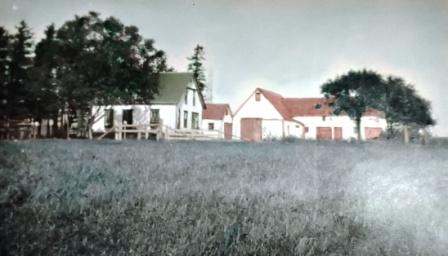
The family homestead where JP White grew up.  (Photo courtesy of Alice Cash Blakeney and Estate of Bernadette White Adler)

Born in Emerald Junction, Prince Edward Island, on June 2, 1912, JP was the son of John Thomas and Janie Josephine (nee Cameron) White.  JP had 2 brothers and 4 sisters, and although their father was a carpenter, the family also ran a small farm.

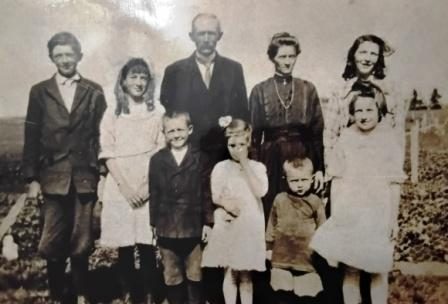
Front row, left to right:  JP, Martina, Dave, Bernadette.  Back row, left to right: Matthew, Agnes, John Thomas, Janie Josephine, Mary Catherine. (Photo courtesy of Alice Cash Blakeney and Estate of Bernadette White Adler)

….JP enlisted in 1942…

After completing Grade 8, JP began working as a carpenter.  On February 4, 1942, he married Frances Teresa Smith in Charlottetown.   “…The Whites were noted as being great dancers, so it’s likely that JP met his wife Frances Smith at a dance….”  Alice reflected.

JP originally enlisted under the National Resources Mobilization Act (NRMA) at the No. 6a NRMA Clearing Depot in Charlottetown, Prince Edward Island on August 27, 1942 and began basic training at No. 62 Canadian Army Basic Training Centre in Charlottetown. At the time, he stated he had been a carpenter for the past 10 or 12 years, having learned the trade from his father. (See https://en.wikipedia.org/wiki/National_Resources_Mobilization_Act)

Just as JP was completing his basic training, tragedy struck on October 1, 1942. Alice said that “…JP’s wife died in childbirth….

On October 30, 1942, JP was sent to A1 Canadian Artillery Training Centre (CATC) in Petawawa, Ontario for infantry training as a gunner. 

While in Petawawa, JP tried to enlist as ‘Active’, but was “…advised to remain…” under the NRMA, as he was considered “…unsuitable for operational duty…” due to bad knees.  

In January 1943, he was granted a 2 week furlough, allowing him to return home to Prince Edward Island. The furlough was then extended by another 11 days, after which he returned to Petawawa.

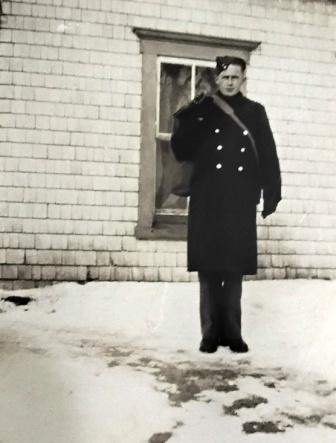
John Peter ‘JP’ White in January 1943 during his return to Prince Edward Island while on furlough. (Photo courtesy of Alice Cash Blakeney and Estate of Bernadette White Adler)

….JP was transferred to the 10th LAA for a short period in June 1943…

After qualifying as a Carpenter Group ‘B’ on April 26, 1943, JP was transferred to the 10th Light Anti-Aircraft (LAA) Regiment of the Royal Canadian Artillery (RCA) on June 15, 1943, and sent to Tracadie, New Brunswick. The 10th LAA was part of the 7th (Home Defence) Division and JP was posted to the 8th Light Anti-Aircraft Battery RCA in Saint John, New Brunswick.

He spent the next months working as a carpenter, but starting in August 1943, he had medical issues, resulting in brief hospitalizations.  Health issues ended his assignment with the 10th LAA and on October 28, 1943 he was transferred to No. 6 District Depot in Halifax, Nova Scotia.

In a November 30, 1943 interview that was recorded in his Personnel Selection Record, he was described as “…a mature serious-minded soldier of steady judgement….”  It went on to state that JP “…wished to remain in the service and would prefer duty in his trade…” and that his knee condition “…should not impair his efficiency as a tradesman…”  It was recommended that he be transferred to a suitable Home War Establishment (HWE) for duty as a carpenter.

….JP was assigned to the Royal Canadian Engineers as a carpenter…

John Peter ‘JP’ White. (Photo courtesy of Alice Cash Blakeney and Estate of Bernadette White Adler)

On January 19, 1944, JP was transferred to No. 6 Field Company of the Royal Canadian Engineers in Debert, Nova Scotia.  He remained there until May 24, 1944 when he was granted 6 weeks of spring farm leave in order to return to Prince Edward Island and work on the family farm.  His father had died in 1936, meaning that JP and his brothers had to help out his mother.

Upon his return back to duty on July 29, 1944, he was assigned to No. 6 Engineer Survey and Works (ES&W) Company of the Royal Canadian Engineers in Halifax, Nova Scotia, and continued to work as a carpenter. 

Unfortunately, he had another medical issue on November 28, 1944, when he was hospitalized for 3 weeks in the Military Hospital in Debert, Nova Scotia with appendicitis.

He was discharged from hospital on December 19, 1944 and sent to No. 5 Casualty Retraining Centre (CRC) in Sussex, New Brunswick for 71 days for further recovery.  On January 19, 1945, he was hospitalized again, this time at the Sussex Military Hospital.

On March 8, 1945, he was deemed ‘fit for duty’.  A report on his condition in the Supplement To Personnel Selection Record stated that JP was “…pleasant and straightforward….” and had “cooperated well and followed the training in all grades at this Centre making satisfactory recovery…”  He was assessed as remaining “…suitable for employment in RCE for base duties…” as a carpenter.

….JP enlisted in the Active Army in April 1945…

On March 21, 1945, JP was again sent to No. 6 District Depot in Halifax, Nova Scotia, in preparation for his change in status when he was deemed fit enough to enlist in the Active Army on April 5, 1945.   He returned to No. 6 Field Company of the Royal Canadian Engineers in Halifax on April 29, 1945, where it was noted that JP requested to return to No. 6 Engineer Survey and Works (ES&W) Company of the Royal Canadian Engineers.

No sooner had JP been assigned to No. 6 Engineer Survey and Works (ES&W) Company than he requested a 3 month leave of absence without pay for compassionate farm leave.  This was granted from June 28, 1945 until September 27, 1945.

When he returned back to duty, however, it was to No. 6 District Depot in Halifax.  On October 2, 1945, a few days after returning to duty, he applied again for farm leave without pay, which was granted until April 1946.

….JP died following an operation in December 1945…

JP never returned to his army duties.  While back on Prince Edward Island for the farm leave that had been granted to him, he was hospitalized in Charlottetown, and died following an operation on December 15, 1945, aged 33.

JP was buried alongside his wife Frances in Seven Mile Bay (St Peter’s) Cemetery in Seven Mile Bay, Prince Edward Island. 

A note on his death record noted that he would not receive a separate Commonwealth War Graves Commission headstone unless the family applied for it.  It further stated that ‘next of kin does not answer correspondence’. 

JP’s family was overwhelmed, not only by his death, but by the death of his mother in March 1946, leaving his brother Matthew, who lived in Charlottetown and had a family of his own, in addition to managing the farm, as the next-of-kin.

Pieter now knew what happened to JP, and resolved to ensure that his service is acknowledged when the Legion in Borden-Carleton places flags by graves of veterans during Remembrance Week 2025. No flag had been placed by his grave in previous years as no one at the Legion was aware that JP had served during WWII.  (See https://onthewarmemorialtrail.com/2024/11/03/on-the-war-memorial-trail-borden-carleton-legion-honours-veterans-by-placing-flags-at-their-graves/)

Thank you to Alice Cash Blakeney for providing the photos and information on her uncle. Do you have a story to tell? Email Pieter at memorialtrail@gmail.com or comment on the blog. 

© Daria Valkenburg

….Want to follow our research?…

If you are reading this posting, but aren’t following our research, you are welcome to do so.  Our blog address: https://onthewarmemorialtrail.com/

4 countries, 6 weeks, 7,000 km – an unforgettable war memorial journey in Europe…. Daria’s book ‘No Soldier Buried Overseas Should Ever Be Forgotten‘ is available in print and e-book formats.  Net proceeds of book sales help support research costs and the cost of maintaining this blog. For more information see https://nosoldierforgotten.com/

Subscribe to our YouTube Channel: On The War Memorial Trail With Pieter Valkenburg: https://www.youtube.com/channel/UCJ591TyjSheOR-Cb_Gs_5Kw

Never miss a posting!  Subscribe below to have each new story from the war memorial trail delivered to your inbox.
On The War Memorial Trail….. Staghound Fatality Part 1: The WWII Trooper From Bagot Killed By A Mine During The Battle For The Küsten Canal

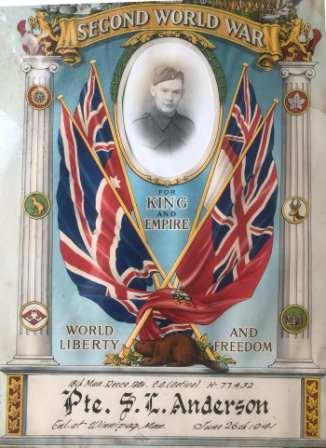
Commemoration for Stewart Lyon Anderson. (Courtesy of the William Anderson family)

September 23, 2025.  While in Europe for the 80th Anniversary of Liberation Commemoration events, Pieter placed flags at the graves of 383 soldiers he’s researched over the years, which took us to 14 cemeteries in The Netherlands and Belgium. Out of this total, 156 flags were placed at the Canadian War Cemetery in Holten, The Netherlands.  

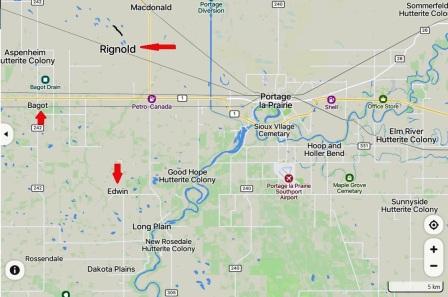
Pieter’s research results are faster than I can keep up with, and so several of the graves we visited were for soldiers whose stories have yet to be told.  One of these is the subject of this posting:  Stewart Lyon ANDERSON, who was born in Rignold, Manitoba on November 22, 1919, the son of William and Isabella (nee Lyall) Anderson.

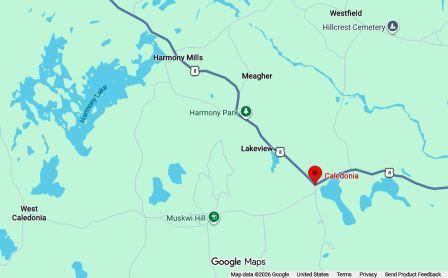
Map showing Rignold, Bagot, and Edwin.  (Map source: http://www.mapcarta.com)

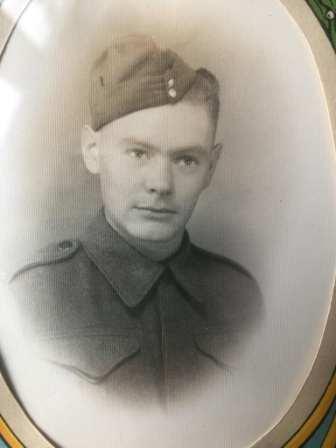
Pieter’s search for a photo of Stewart ended when he got in contact with Lindsay Edmunds–Judson and her mother, Lana McCleary Edmunds, daughter of Stewart’s sister Agnes ‘Isabelle’.  “Mum is so excited to be part of this!…” Lindsay wrote. “How wonderful that your birth and upbringing has undoubtedly fostered your interest in this project which will be bringing joy to so many….

Lana explained that “two of Mum’s brothers and one sister served.  Stewart was killed.  Willie came home a broken man and died because of that.  Elizabeth showed us how to be the most wonderful aunt.  In Mum’s last days, she called for Stewart in her sleep- he had been the favourite I think….” Stewart’s brother William served with the Princess Patricia Light Infantry and was wounded in Italy.  His sister Elizabeth served at the First Base Post Office in London, England.

….Stewart enlisted in April 1941…

Stewart Lyon Anderson. (Courtesy of the William Anderson family)

Stewart grew up in Bagot, Manitoba, attended school in Edwin, and worked on his parents’ farm before enlisting under the National Resources Mobilization Act (NRMA) at the No. 10 NRMA Clearing Depot in Portage La Prairie, Manitoba on April 17, 1941 and began basic training at No. 100 Canadian Army (Basic) Training Centre (CABTC) in Portage La Prairie. (See https://en.wikipedia.org/wiki/National_Resources_Mobilization_Act)

He was described as having red hair and blue eyes, that he was cheerful and neat, robust in appearance, and that he enjoyed swimming and playing softball.

A little over a month later, on June 25, 1941, Stewart enlisted in the Active Army at No. 10 District Depot in Winnipeg, Manitoba, and was immediately attached to A15 Canadian Infantry Advanced Training Centre (Rifle) at Camp Shilo in Shilo, Manitoba.

He remained there until September 4, 1941, when he returned to No. 10 District Depot in Winnipeg, and attached to the Tradesman Training Wing of the 18th (Manitoba) Reconnaissance Battalion, ‘D’ Company, for basic training.

From December 19, 1941 until January 7, 1942, Stewart was granted a furlough, for what turned out to be the last time he saw his family.

….Stewart was assigned to the 18th (Manitoba) Reconnaissance Battalion…

Stewart was transferred to 18th (Manitoba) Reconnaissance Battalion’s ‘D’ Squadron on February 2, 1942, and sent to Work Point Camp in Esquimalt, British Columbia. While Work Point Barracks served as the headquarters for Military District 11, which oversaw Canadian military operations in British Columbia, Stewart was there for a driver operator course. 

On February 5, 1942, the 18th (Manitoba) Reconnaissance Battalion was re-designated as the 18th (Manitoba) Armoured Car Regiment and was part of the Canadian Armoured Corps.

Stewart remained at Work Point Camp until May 4, 1942, when he returned to his unit at Otter Point in Sooke, British Columbia.   

….Stewart qualified as a driver operator…

On July 13, 1942, after qualifying as a Driver Operator Class III, Stewart and the rest of the  18th (Manitoba) Armoured Car Regiment moved to Debert, Nova Scotia, for final training and preparation before going overseas.

While at Debert, Stewart qualified as a Driver i/c Class III Wheeled on July 21, 1942. (The term ‘Driver i/c’ refers to ‘Driver, internal combustion’.  Class III meant he was qualified to drive heavy trucks and armoured cars, but not tanks.)

….Stewart left Canada for overseas service….

On August 22, 1942, Stewart was aboard the ‘Letitia’ with the 18th (Manitoba) Armoured Car Regiment when they sailed from Halifax, Nova Scotia for the United Kingdom, as part of the Scotland bound convoy T-20. Upon arriving in Glasgow, Scotland on August 31, 1942, they remained on board until September 2.

While in the United Kingdom, the 18th (Manitoba) Armoured Car Regiment trained for their role as a reconnaissance unit for the II Canadian Corps. As a reconnaissance unit, its purpose would be to gather tactical information for its parent infantry division, scouting ahead and screening flanks.

Initially based in Aldershot, England, the Regiment trained in Bramley, Surrey, and other locations, from November 1942 to June 1943.  

On December 16, 1942, the regiment was re-designated the 18th Armoured Car Regiment (12th Manitoba Dragoons).

….Stewart landed in Normandy a month after D-Day…

On July 8, 1944, Stewart and his Regiment left England, landing the next day at Juno Beach in Normandy, France. They were reported to have brought 72 Staghounds with them, an armoured vehicle that could also be used as a scout car. 

T-17E1 Staghound armoured cars of “A” Squadron, 12th Manitoba Dragoons, in the Hochwald, Germany, March 2, 1945. The first car has tire chains on all four wheels. (Photo courtesy of Library and Archives Canada, taken by Jack H. Smith)

As a self-contained unit attached directly to II Canadian Corps, they had long range reconnaissance regiment, equipped with a wireless transmitting and receiving set, for their role as scouts in finding the best roads for the troops.  Providing route information over the radio was of great importance to the troops that followed in their path, often 50 or more kms behind.

In an entry on the ‘Flames of War’ website (see https://www.flamesofwar.com), John (Jock) Buckmaster wrote that as they reached Belgium, “….Nieuwport, Ostend and Bruges were all liberated by the Dragoons, with Bruges and Ostend naming roads and squares after the regiment…

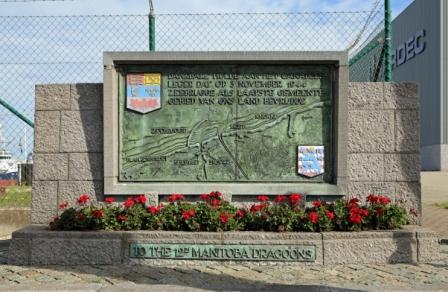
After the war ended, a memorial in Zeebrugge, Belgium was placed to honour the 18th Armoured Car Regiment (12th Manitoba Dragoons), who liberated the city on November 3, 1944.

Memorial of the liberation of Zeebrugge (Belgium) on November 3, 1944 by the 12th Manitoba Dragoons. (Photo courtesy of Wikipedia, taken by Marc Ryckaert)

The ‘Flames Of War’ entry went on to note that by late 1944, “the front-line between German and Canadian troops was now the Maas River, and for three months the Dragoons patrolled the river in one of the coldest, wettest, winters to hit the region. The regiment ….. liberated multiple cities, including Lichtenvoorde, Leeuwarden, and Almelo…” in The Netherlands “…before heading into Germany….

The Regiment experienced difficulties in Germany. “….Heading into the Hochwald forest proved difficult for the regiment, as the armoured cars did not fare well in the restricted terrain. The weight of the Staghounds proved to be a problem when recovering bogged-down vehicles…”  At one point, horses from a German village were needed “….to pull two 14-ton Staghounds from the mud…” The Regiment continued “…through Bad Zwischenahn, and further into the Hochwald forest…

….Stewart lost his life during the Battle for the Küsten Canal…

Map showing location of Küsten Canal, and Esterwegen where Stewart Anderson was initially buried. (Map source: Google maps)

The next objective for Allied troops was the clearing of the 70 km (43 mi) long, 100-metre (330 ft) wide, Küsten Canal, a significant obstacle to Allied forces advancing from the Ems estuary into Germany.

In the ‘Regimental History of the 18th Armoured Car Regiment (12th Manitoba Dragoons)’, published in 1945, author Charles Eric Henry writes that “…the Regiment was detailed to take over a sector of the Küsten Canal 14 April 1945….The enemy did not seem to be overactive but did send over quite a few shells.  The main task seemed to be to remain on the southwest side of the canal until the friendly troops on the other side had worked their way along it to a point opposite our positions…

Unfortunately, casualties still occurred, and on April 19, 1945, Stewart was one of 5 men who lost their lives during the Battle for the Küsten Canal.  The War Diary for that day recorded that “…17 Troop lost their Sgt’s Stag and all his crew on a mine today.  It took place at 14:33 hours…The mine completely destroyed the Stag and caused a crater 20 feet by 20 feet.  It must have been one of these marine mines containing some 500 pounds of explosives…

In addition to Stewart, the rest of the crew that died were:

  • Sgt Alexander James BALFOUR of Lindsay, Ontario, aged 25
  • Trooper Patrick James DEVINE of North Bay, Ontario, aged 22
  • Trooper Merle Vincent HAMILTON of Brookfield, Colchester County, Nova Scotia, aged 26
  • Trooper Willard James MORRIS of St. James (now part of Winnipeg), Manitoba, aged 23

Another Manitoba soldier who lost his life on April 19, 1945 was Andrew KERELCHUK of Zbaraz, Manitoba, who was serving with the Argyll and Sutherland Highlanders of Canada.  You can read his story at https://onthewarmemorialtrail.com/2022/08/24/the-wwii-soldier-born-in-zbaraz-who-lost-his-life-during-the-battle-of-the-kusten-canal/

….Stewart is buried in the Canadian War Cemetery in Holten….

Stewart was temporarily buried in Esterwegen, Germany, before being reburied in the Canadian War Cemetery in Holten, The Netherlands.

Pieter beside the grave of Stewart Lyon Anderson, after he’d placed flags of Canada and Manitoba. (Photo credit: Daria Valkenburg)

…To visit his grave has been something I’ve always wanted to do….” Lana explained to Pieter. “…Thank you so much for your work with this project.  I hope you know how much it meant to Stewart’s three sisters to know his grave was tended. My imagination has me enjoying a flask of tea while I soak in the peace and beauty that resulted from the pain and loss of war….

Stewart Lyon Anderson is remembered on the grave of his parents at Hillside Cemetery in Portage La Prairie, Manitoba. (Photo source: Find A Grave)

Thank you to Lana McCleary Edmunds and Lindsay Edmunds–Judson for providing photos and information on Stewart. 

The flags placed at Stewart’s grave were donated.  Our thanks go to: 

  • Alan Waddell, Constituent Assistant, on behalf of Heath MacDonald, MP for Malpeque, for the Canadian flag.
  • Brad Robertson, Chief of Protocol, Government of Manitoba, on behalf of Wab Kinew, Premier of Manitoba, for the Manitoba flag.

Staghound Fatality Part 2 will be about Merle Vincent HAMILTON of Brookfield, Nova Scotia.

Pieter encourages readers with photos to come forward so that eventually all the known graves of Canadians buried in Holten will have a photo displayed by their grave. Email him at memorialtrail@gmail.com

© Daria Valkenburg

….Want to follow our research?…

If you are reading this posting, but aren’t following our research, you are welcome to do so.  Our blog address: https://onthewarmemorialtrail.com/

4 countries, 6 weeks, 7,000 km – an unforgettable war memorial journey in Europe…. Daria’s book ‘No Soldier Buried Overseas Should Ever Be Forgotten‘ is available in print and e-book formats.  Net proceeds of book sales help support research costs and the cost of maintaining this blog. For more information see https://nosoldierforgotten.com/

Subscribe to our YouTube Channel: On The War Memorial Trail With Pieter Valkenburg: https://www.youtube.com/channel/UCJ591TyjSheOR-Cb_Gs_5Kw

Never miss a posting!  Subscribe below to have each new story from the war memorial trail delivered to your inbox.
On The War Memorial Trail…..Tragedy On The Ems Part 1: The WWII Soldier From Rexton Who Drowned During Operation Duck

March 5, 2025. In 2021, during a period when we were all at home due to Covid, we translated, into English, ‘Holtense Canadezen’, Jan Braakman’s book about some of the soldiers buried in the Canadian War Cemetery in Holten, The Netherlands.  In October 2023, this was published in English as ‘Holten Heroes: Stories from a Canadian Field of Honour’.  (See https://onthewarmemorialtrail.com/2023/11/01/new-book-about-soldiers-buried-in-the-canadian-war-cemetery-in-holten-the-netherlands/)

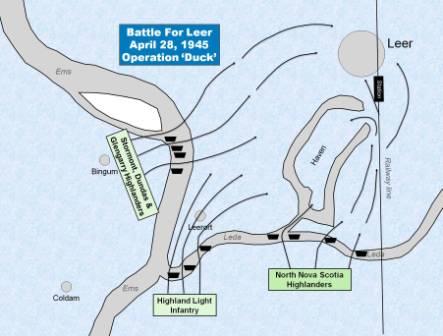
The chapter ‘Drama On The Ems’ was about a tragic incident during the Battle of Leer in Germany on April 28, 1945, one of the final actions to end WWII in Europe. Operation Duck, which involved the crossing of the Ems and Leda rivers in northern Germany in order to take the port of Leer, turned out very badly for 19 men of the Stormont, Dundas and Glengarry Highlanders Regiment. 

Two Maritime soldiers mentioned in the chapter, one from Nova Scotia, and one from New Brunswick, were on the photo wish list from the Canadian War Cemetery in Holten, The Netherlands.  Pieter was successful in finding family and a photo of these men, who were both with the Stormont, Dundas and Glengarry Highlanders. 

…..James is remembered on a plaque in the United Church in Rexton….

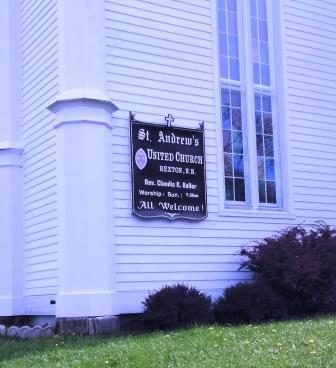
St. Andrew’s United Church in Rexton, New Brunswick.  (Photo credit: Daria Valkenburg)

James Edward SULLIVAN, from Rexton, New Brunswick, was one of the Maritimers. In a serendipitous coincidence, we’d visited Rexton to meet the family of another soldier – Janice Little and Gayle McBeath, nieces of WWII trooper Stanley Leigh MCBEATH. They took us to St. Andrew’s United Church, where Stanley’s name was listed on a plaque on the church organ. Then we noticed that James was also listed on the plaque! (See https://onthewarmemorialtrail.com/2024/02/03/on-the-war-memorial-trail-the-wwii-trooper-from-rexton-who-lost-his-life-three-days-before-his-birthday/)

James Sullivan and Stanley McBeath are listed on a memorial plaque on the organ in St Andrew’s United Church in Rexton.  (Photo credit: Daria Valkenburg)

….James’s niece had a photo!….

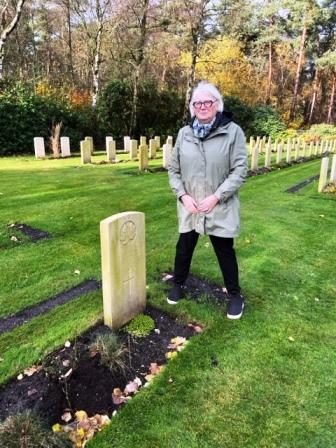
Barbara Sullivan at the grave of her uncle, James Sullivan, buried in the Canadian War Cemetery in Holten, The Netherlands.   (Photo courtesy of Barbara Sullivan)

Born July 7, 1919 in Main River, New Brunswick, James was the son of Edward and Augusta Sullivan. James had a younger brother, Kenneth, and it was through Kenneth’s daughter, Barbara Sullivan, that a photo was found, after she’d been contacted by Janice Little.  “I’m the niece of L/Corporal James Edward Sullivan of The Stormont, Dundas and Glengarry Highlanders.  I never knew him, he died a long while before I was born. His brother Kenneth is my dad.  Both of my parents passed away in 2001….”  Barbara wrote.

…..James enlisted under the NRMA in 1941….

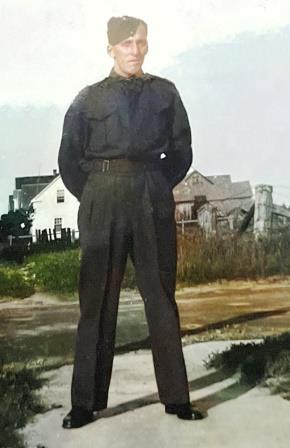
James Edward Sullivan. (Photo courtesy of the Sullivan Family.  Photo colourization by Pieter Valkenburg)

James originally enlisted under the National Resources Mobilization Act (NRMA) at the No. 7 NRMA Clearing Depot in Fredericton, New Brunswick on March 20, 1941 and began basic training at No. 70 Canadian Army Basic Training Centre in Fredericton. At the time, he stated he was employed as a truck driver and sawyer for a lumber company. (See https://en.wikipedia.org/wiki/National_Resources_Mobilization_Act)

On May 20, 1941, he was transferred to A1 Canadian Artillery Training Centre (CATC) at Camp Petawawa, Ontario for further training.  On July 26, 1941, he was sent to A23 Coast Defence and Anti-Aircraft Artillery Advanced Training Centre (C&AAATC) in Halifax, Nova Scotia for a few weeks.  The centre trained coast and anti-aircraft gunners. 

Next, James was attached to 1st (Halifax) Coast Brigade of the Royal Canadian Artillery in Halifax on August 21, 1941, which was responsible for providing coastal artillery support as part of the defences of Halifax, Nova Scotia.  

Devil’s Battery.  (Photo source: https://hmhps.ca)

On September 26, 1941, he was attached as a gunner to the 53rd Coast Battery of the 1st (Halifax) Coast Brigade, part of the defence of Devil’s Battery, and remaining there even after joining the active army in Halifax on February 1, 1942. 

James was sent back to A23 Coast Defence and Anti-Aircraft Artillery Advanced Training Centre (C&AAATC) in Halifax on August 31, 1942 for further training. After completing Range Takers Course No. 5 on October 10, 1942, he returned to the 53rd Coast Battery.

….James served in Newfoundland….

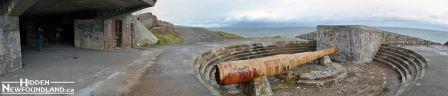
Cape Spear Battery.  (Photo source: https://www.hiddennewfoundland.ca)

On February 12, 1943, James was transferred to the 103rd Coast Battery of the Royal Canadian Artillery and sent to St. John’s, Newfoundland. Based at Cape Spear, the most eastern point in North America, the Battery was responsible for maintaining the 10″ guns.

Cape Spear’s close proximity to convoy routes and the entrance to St. Johns Harbour was an essential place to have a coastal defense battery, post-war signal station, and searchlight emplacement during World War II. (NOTE: Newfoundland and Labrador joined Canada on March 31, 1949.)

On November 18, 1943, James left Newfoundland for Shelburne, Nova Scotia and was transferred to the 104th Coast Battery of the Royal Canadian Artillery (RCA).

….James was transferred to the infantry….

On January 14, 1944, James was assigned to No. 1 Transit Camp in Windsor, Nova Scotia for preparation before being sent overseas.  However, instead of going overseas immediately, he was transferred to No. 60 Canadian Infantry (Basic) Training Centre (CIBTC) in Yarmouth, Nova Scotia for additional training.

Then, on April 9, 1944, he was sent to A14 Canadian Infantry Training Centre at Camp Aldershot, Nova Scotia for final preparations before going overseas. 

James was granted embarkation leave from June 2 to June 15, 1944, the last chance he had to see his family again.

….James left Canada for overseas service….

On June 25, 1944, James left Canada for the United Kingdom. Upon arriving on July 3, 1944 he was assigned to No. 4 Canadian Infantry Reinforcement Unit (CIRU). 

He continued his training for a few weeks before being transferred to the X-4 reinforcement list of the Canadian Infantry Corps (CIC), on July 26, 1944.  Three days later he was on his way to France, disembarking on July 30, 1944.

On July 31, 1944 he was assigned to the Stormont, Dundas and Glengarry Highlanders, part of the 21st Army Group, joining the Regiment in the vicinity of Le Vey, France, 23 km (14 miles) northwest of Falaise.  The Regiment needed downtime to get reorganized and to give the men a chance to train and have a rest following heavy fighting since landing in Normandy on D-Day.

He received a promotion to Lance Corporal a few weeks later, on August 19, 1944.  James remained with the Regiment as it fought across France, and into The Netherlands.  It was in Nijmegen to relieve the airborne troops, and helped guard the bridge while the Rhine crossing was prepared. The Regiment then fought through the Hochwald in Germany, and then north as it prepared to cross the Ems River and take the city of Leer on April 28, 1945, in what became known as Operation Duck.

… Operation Duck…

In the plan for Operation Duck, the Stormont, Dundas and Glengarry Highlanders would go across the Ems River towards the western edge of Leer. At the same time, the North Nova Scotia Highlanders would cross the Leda River in assault boats and secure the northern bank of the river in preparation for the attack to capture Leer. The Highland Light Infantry of Canada would cross the Leda River, where the Ems and Leda rivers meet.

These three Regiments were part of the 9th Canadian Infantry Brigade.  (See https://www.canadiansoldiers.com/history/battlehonours/northwesteurope/leer.htm)

While the men from the Highland Light Infantry all crossed safely, the North Nova Scotia Highlanders lost 5 men, and the Stormont, Dundas & Glengarry Highlanders lost 19.

Map showing the Ems and Leda Rivers, and position of Regiments during the Battle for Leer.  (Map courtesy of and ©Jan Braakman)

…Why Operation Duck Was Important…

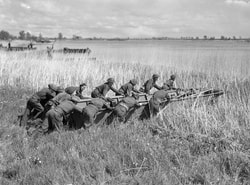
A Storm boat is moved into the water during Operation Duck on April 28, 1945. (Photo source: Library and Archives Canada)

A translated excerpt from Jan Braakman’s ‘Holten Heroes: Stories from a Canadian Field of Honour’ explained why Operation Duck was important. “…At the end of April 1945, Canadian troops stood just across the Dutch-German border in Ostfriesland (East Frisia) in front of the river Ems….” (See https://en.wikipedia.org/wiki/East_Frisia)

Leer was a challenge to capture. “…The town of Leer was on the other side of the river on the route to Emden. Surrounded by inaccessible lowlands in the north and with rivers (Ems and Leda) in the west and south, Leer was a well defensible and therefore difficult to capture port city. All access bridges over the Ems and Leda were blown up by the Germans. For the Canadians there was no other option than to reach the city by water….

River crossings can be tricky due to currents and tides, and in wartime, there is always the risk of enemy fire.  “….The Ems River has an open connection with the Wadden Sea, which means that tides influence water levels and currents in the river. Tides made the currents unpredictable, and the Canadian Army didn’t have accurate information about the tides. What was clear: high tide was the best time to make the crossing. Aerial photographs showed that German troops had fortified themselves well behind the dikes that surrounded the city…. 

A decision was made on how to cross the two rivers – the Leda and the Ems.. “ Only under the protection of a smoke screen and solid artillery support would it be possible to successfully complete the attack on Leer, using boats … General Simonds ordered that on April 28, 1945, before darkness fell, there had to be a solid bridgehead, from which the capture of Leer could be initiated. That meant that the attack had to be launched during the middle of the day, around three o’clock, when the water level was at its highest…” 

The Highland Light Infantry crossed safely “ at the point where the Leda flows into the Ems, about three kilometres south of the city centre…

The other two regiments ran into trouble.  “…The crossing was made at three different places. At the same time, artillery fire and attacks from the air put the German defence line to the test. The North Nova Scotia Highlanders would cross the Leda from the south bank and take the harbour of Leer, which abutted the city on a peninsula…

…The Stormont, Dundas & Glengarry Highlanders Regiment ran into trouble…

The Stormont, Dundas & Glengarry Highlanders Regiment was to cross the Ems River “…from the west bank of the Ems at Bingum to attack the city from the west.…” 

All three Regiments launched their attacks at the same time.  “….It began at half past two with fierce shelling, during which the positions of the German defence forces were fired upon. The attack from the south was spectacular and successful, with relatively few losses…. 

This wasn’t the case for the attack from the west. “….A number of boats….” from the Stormont, Dundas & Glengarry Highlanders Regiment “…showed motor defects or capsized. Some of the drowning men were rescued, but at the end of the day at least nineteen men from the Regiment were dead, drowned, or missing….

….James was one of the fatalities….

After WWII ended “a team from the Stormont, Dundas & Glengarry Highlanders returned to the Ems. They dragged the river, looking for the bodies of the missing men. Some of them were found with their full kit still attached to their bodies….

Sergeant G.W. McGill, who survived the crossing, had reported that at “….approximately 15:30 hours, 28-April-1945, I was crossing the river Ems in an assault craft during the attack on Leer. Suddenly, the nose of our craft dipped and the craft overturned and we were all thrown into the water. I came to the surface and was picked up by another assault craft, along with Cpl W.M.J. Wood. We cruised around for approximately ten minutes, but we could not see Sullivan anywhere. A check on the shore by the platoon commander indicated that Sullivan, Brough, and Oslund were missing….

James was not found until almost the end of May 1945.  “….25 year-old James E. Sullivan was …. initially reported missing. On May 28, his family was informed by telegram that ….” his body had been found.

….James is buried in the Canadian War Cemetery in Holten….

James was originally buried in Oldenburg, Germany, before being reburied in 1946 in the Canadian War Cemetery in Holten, The Netherlands.

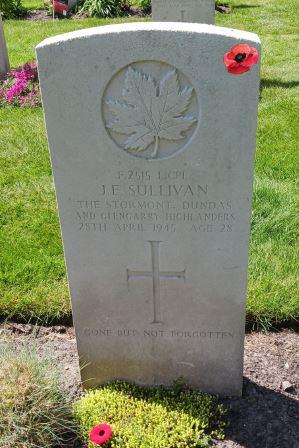
Grave of James Edward Sullivan in the Canadian War Cemetery in Holten, The Netherlands.  (Photo courtesy of Canadian Virtual War Memorial)

….Other soldiers from the Stormont Dundas Glengarry Highlanders who lost their lives that day…

In addition to James Edward Sullivan, 18 more soldiers from the Stormont, Dundas and Glengarry Highlanders lost their lives on April 28, 1945, and are listed below.  If there are asterisks beside the name (****) it means there is a brief anecdote in the ‘Drama On the Ems’ chapter in ‘Holten Heroes: Stories from a Canadian Field of Honour’. 

  • A/Cpl John SAWATSKY of Petaigan, Saskatchewan, aged 20
  • L/Cpl Merle Coleman MOORE of Breckenridge Station, Quebec, aged 22
  • Pte Frank Joseph BIERNASKI of Barry’s Bay, Ontario, aged 32 ****
  • Pte Walter James BROOKS of Toronto, Ontario, aged 28
  • Pte Leonard Gordon BROUGH of Sudbury, Ontario, aged 21**** 
  • Pte Steven John GRAVELLE of Peterborough, Ontario, aged 23
  • Pte Joseph Gerard HINDS of Orillia, Ontario, aged 20
  • Pte Earl Harcourt JOSLIN of Kingston, Ontario, aged 34****
  • Pte Ira Charles LANGILLE of Milton, Nova Scotia, aged 32 ****
  • Pte Cecil Albert LAWES of Frankford, Ontario, aged 28
  • Pte Frank Eugene MUNROE of Halifax, Nova Scotia, aged 22  
  • Pte Sidney Alexander OSLUND of Haileybury, Ontario, aged 29 ****
  • Pte Samuel Donald POWELL of Newcastle, Ontario, aged 22
  • Pte Edgar Douglas SMITH of Parrsboro, Nova Scotia, aged 28 ****
  • Pte Francis Wilber SPENCER of Stonecliffe, Ontario, aged 35 ****
  • Pte Jack Allan STEWARD of Belleville, Ontario, aged 24 ****
  • Pte Roy Ivenson THACKERAY of Peterborough, Ontario, aged 20 ****
  • Pte George Sidney WAKELY of Port Hope, Ontario, aged 31****

….A Tragic Drowning On The Leda River….

As mentioned in the ‘Holten Heroes’ excerpt, the crossing of the rivers to reach Leer involved three Regiments – Stormont Dundas and Glengarry Highlanders, North Nova Scotia Highlanders, and the Highland Light Infantry. 

The North Nova Scotia Highlanders were tasked with crossing the Leda River from the south bank and to then take the harbour of Leer.  5 soldiers from this Regiment lost their lives when the storm boat they were in capsized. Their stories were told in previous blog postings as a 4 part series:

….Blog posting about another soldier mentioned in the book Holten Heroes…

Tragedy On The Ems Part 2 will be about the other Maritimer on the photo wish list:  Frank Eugene MUNROE of Halifax, Nova Scotia.

Thank you to Jan Braakman for permission to quote from his book and use of the map showing the position of the Regiments, with translation into English by Pieter and Daria Valkenburg, and to Barbara Sullivan for sharing a photo of her uncle. If you have a story or photo to share, please contact Pieter at memorialtrail@gmail.com or comment on the blog. 

© Daria Valkenburg

….Want to follow our research?….

If you are reading this posting, but aren’t following our research, you are welcome to do so.  Our blog address: https://onthewarmemorialtrail.com/

4 countries, 6 weeks, 7,000 km – an unforgettable war memorial journey in Europe…. Daria’s book ‘No Soldier Buried Overseas Should Ever Be Forgotten‘ is available in print and e-book formats.  Net proceeds of book sales help support research costs and the cost of maintaining this blog. For more information see https://nosoldierforgotten.com/

You are also invited to subscribe to our YouTube Channel: On The War Memorial Trail With Pieter Valkenburg: https://www.youtube.com/channel/UCJ591TyjSheOR-Cb_Gs_5Kw

Never miss a posting!  Subscribe below to have each new story from the war memorial trail delivered to your inbox.

On The War Memorial Trail….. The WWII Soldier From Saint-Basile Who Lost His Life During The Advance Towards Xanten

February 5, 2025. We never know what a photo search might lead to once Pieter begins researching a soldier. In the case of a WWII soldier listed as being from New Brunswick, the search led to his birth in the province of Quebec, to his enlistment in Ontario, to the widow of his nephew, and finally to a Legion in New Brunswick where a shadow box with photos had been donated.

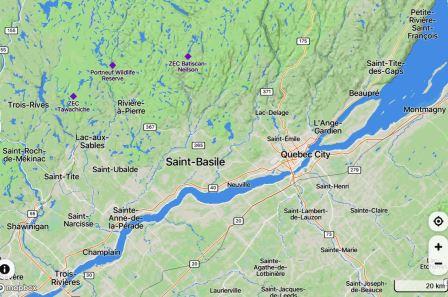
Joseph ‘Albert Noel’ LAMONTAGNE was born on December 25, 1918 in Saint-Basile, Quebec, the son of Joseph Lamontagne and Marie ‘Alexina’ Jacques. Saint-Basile is in Portneuf Regional County Municipality in Quebec, past Quebec City.  To our surprise, we realized we’d driven past the turn-off to Saint-Basile every time we travelled between our home in Prince Edward Island and Ottawa, Ontario!

Albert Noel Lamontagne was born in Saint-Basile, Quebec.  (Map source: Mapcarta)

…..Albert Noel enlisted under the NRMA in 1942….

Albert Noel originally enlisted under the National Resources Mobilization Act (NRMA) in North Bay, Ontario on January 8, 1942 and began basic training at No. 2 NRMA Clearing Depot, before joining the active army on January 20, 1942.   He took his basic training at No. 22 Canadian Army Basic Training Centre in North Bay. (See https://en.wikipedia.org/wiki/National_Resources_Mobilization_Act)

Albert Noel Lamontagne in training.  (Photo courtesy of the Albert Joseph Chevarie Family)

At the time of his enlistment, he had been working as a labourer, having left school after completing Grade 3 in Quebec City.  He spoke French and had a basic knowledge of English. His father had died in 1920, and his mother had remarried, in 1928, to Emilien Chevarie.  His brother, Paul-Emile, was also in the Canadian Army. As well, he had a sister Rose-Aimée, a half-brother George, and a half-sister Juliette.

  ….George Chevarie’s son was the key to finding a photo of Albert Noel….

It was through Albert Noel’s half-brother, George Chevarie, that a photo of Albert Noel was found.  George’s son, Albert Joseph, had died in 2020. However, after Pieter spoke to Joyce Chevarie, the widow of Albert Joseph Chevarie, she told him that her husband had donated a shadow box with a photo of Albert Noel, a letter, and his medals to the Royal Canadian Legion branch in Richibucto, New Brunswick.

Pieter then got in contact with the Legion in Richibucto.  Legion Branch president Malcolm John took everything out of the shadow box donated by the family of Albert Chevarie, photographed each item, and emailed the photos to Pieter!  The next time we were in New Brunswick, we visited the Legion and met Malcolm.

Pieter with Malcolm John (right), President of the Richibucto Legion in New Brunswick.  (Photo credit: Daria Valkenburg)

….Albert Noel served in Newfoundland….

On March 12, 1942, Albert Noel was sent to A23 Coast Defence and Anti-Aircraft Artillery Advanced Training Centre (CD & AA) in Halifax, Nova Scotia.  A23 was a Coast and Anti-Aircraft Artillery Training Centre established to train coast and anti-aircraft gunners.

Upon completing his training, Albert Noel was given embarkation leave on May 5, 1942, prior to being posted to Newfoundland with the 106th Coast Battery of the Royal Canadian Artillery (RCA) on June 1, 1942.  The Battery was part of Atlantic Command, tasked with strengthening and administering home defence facilities on Canada’s Atlantic Coast. 

Albert Noel was in Botwood, at a Royal Canadian Air Force (RCAF) base, which had aircraft patrolling the east coast of the Atlantic. Canadian Army personnel based at Botwood were charged with protection of military facilities that had been installed there. (See https://www.heritage.nf.ca/articles/politics/botwood-base.php)

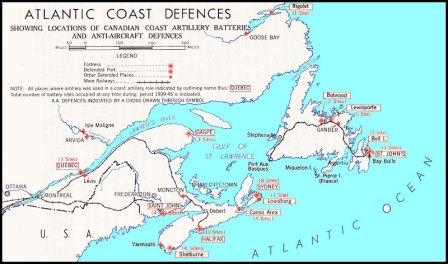
Location of Botwood Military Base in Newfoundland. (Map source: http://postalhistorycorner.blogspot.com/2012/12/wwii-canadian-forces-in-newfoundland.html)

Albert Noel was in Newfoundland at the same time as two other soldiers whose stories have been told on this blog:

….Albert Noel volunteered for paratroop training….

In an interview for his Personnel Selection Record on September 30, 1943, while at Botwood, Albert Noel volunteered for Paratroop Training.  The interviewer recorded that Albert Noel “….has a good training record and seems a very dependable, reliable type, although badly handicapped by lack of education. Not suitable for Paratroops under present regulations which require Grade VI education…”  Albert Noel had only completed Grade 3.

On February 14, 1944, Albert Noel left Newfoundland for Shelburne, Nova Scotia and was transferred to the 104th Coast Battery of the Royal Canadian Artillery (RCA).

On May 1, 1944, Albert Noel was assigned to No. 1 Transit Camp in Windsor, Nova Scotia for final training and preparation before being sent overseas.  He then was transferred to No. 1 Infantry Training Battalion in Camp Debert, Nova Scotia on June 8, 1944.

While at No. 1 Infantry Training Battalion, he was re-interviewed on June 28, 1944 and again volunteered for Paratroop Training.  The response was the same: “…not suitable for Paratroops.  His education is lacking…

On July 21, 1944, Albert Noel was sent to the Training Brigade Group in Debert, and granted 2 weeks embarkation leave, the last chance he had to see his family again.

Albert Noel Lamontagne in dress uniform.  (Photo courtesy of the Albert Joseph Chevarie Family)

….Albert Noel’s mother tried to have him released….

The embarkation leave in July must have been bittersweet, as after the death of Albert Noel’s stepfather in April 1944, his mother, who was living in St. Charles, New Brunswick, had contacted the Military Authorities in June 1944, asking that her son be returned home. 

She was interviewed on June 21, 1944 and explained that “….I am left alone with two children, one boy George Chevarie, 14 years of age, and one girl Julia Chevarie, 11 years of age…..The reason I want my son to come home is because I am sick, suffering from liver trouble…

Although Mrs Chevarie had acute hepatitis and was unable to work, the military did not consider this grounds to release Albert Noel.  The report stated that her doctor was consulted, and in his opinion her son “…could not help her much, insofar as her sickness goes…” 

Therefore, the report concluded that “…if her son was home he could not help her very much, other than financial circumstances… It was further pointed out that Mrs Chevarie was already was receiving a Dependents’ Allowance. Albert Noel remained in the Canadian Army.

….Albert Noel left Canada for overseas service….

On September 2, 1944, Albert Noel left Canada for the United Kingdom. Upon arriving on September 6, 1944 he was assigned to No. 3 Canadian Infantry Reinforcement Unit (CIRU). 

He continued his training for a few weeks before being transferred to the X-4 reinforcement list of the Canadian Infantry Corps (CIC), part of the 10th Battalion, on October 7, 1944.  The next day he was on his way to Northwest Europe, disembarking on October 9, 1944.

….Albert Noel was transferred to Les Fusiliers Mont-Royal….

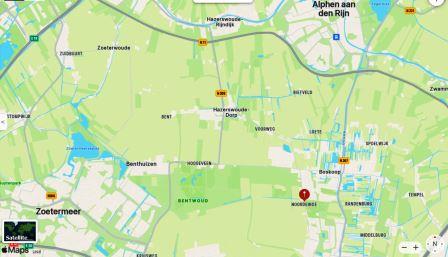
Albert Noel joined Les Fusiliers Mont-Royal in Noordeinde, The Netherlands. (Map source: DuckDuckGo)

On October 18, 1944, Albert Noel was transferred to ‘C’ Company of Les Fusiliers Mont-Royal, joining them in Noordeinde, The Netherlands.

Then, on December 14, 1944, Albert Noel received a promotion, from Private to Lance Corporal. On February 15, 1945, he was promoted again, to Acting Corporal.

.….The battle to clear Xanten began in early March 1945 ….

By February 17, 1945, the Regiment was in Germany, in place for the Battle of Hochwald Gap, part of Operation Blockbuster, as part of the 6th Canadian Infantry Brigade, along with several other Canadian Regiments.  This offensive began on February 28, 1945 to clear the Germans from the Reichswald, a heavily forested area between the Maas and the Rhine Rivers, driving them back over the Rhine, taking the fight well into German territory.

On March 1, 1945 the war diary for the 6th Canadian Infantry Brigade stated that “…the task of clearing the high ground south of Calcar was completed…..Relief of 10 Canadian Infantry Brigade commenced at 0400 hours. Some mortaring and shelling reported during the takeover but relief completed by first light…

This account matched the March 1, 1945 entry in the war diary for Les Fusiliers Mont-Royal. “….Battalion moves to a concentration …” near “….ESSEN to relieve 10 Cdn Inf Bde at first light 2 March 45…

An update in the March 2 1945 war diary explained that “6 Cdn Inf Bde relieves the Argyle and Sutherland Regiment which has been taking a severe beating by both small arms and gun fire which continue as we get in position with our companies…Enemy resistance is very stubborn and a screen of TIGERS and Self Propelled guns is reported….

Sharon Adams wrote in the March 2022 Legion Magazine’s articleThe Taking Of Xantenthat  “In early March, the Canadians were assigned to take Xanten, established by the Romans in about 15 B.C. and the place from which the German 256th Infantry Division launched its 1940 invasion of the Netherlands.

It began with opening approaches to the town by Les Fusiliers Mont-Royal. Resistance was stiff. On March 3, a direct hit took out the wireless radio set and operator in the lead company…

.….Albert Noel lost his life on March 3, 1945 ….

The war diary for March 3, 1945 for the 6th Canadian Infantry Brigade reported that it was raining as troops moved into position.  “…Going was very hard due to the rise in ground, heavy growth of trees, and the well dug in positions of the enemy.  The enemy within the forest is not strong in numbers but equipped with many automatic weapons….

The Fusiliers Mont-Royal started on their way at 1400 hours.  Going was very hard with the advance being hampered by heavy shelling and mortaring from the south east….

The March 3, 1945 war diary entry for Les Fusiliers Mont-Royal confirmed the challenges they faced. “….Enemy, although offering stubborn resistance in the gap, is reported to be withdrawing over the RHINE. Tac R reports the road Geldern – Wesel jammed with traffic moving north east and ferries at Wesel and Xanten very active. Enemy must hold line in front of Xanten until last possible moment to protect escape routes.

Muddy condition of country renders support task of tanks very difficult. Evacuation of wounded and transportation of rations to forward troops is a problem….

At some point during March 3, 1945, Albert Noel lost his life during the battle, aged 26, one of 8 fatal casualties of the Regiment.  The other 7 men who died that day were:

  • Lionel BEAUDOIN of Magog, Quebec, aged 20
  • Wilbert FIOLA of Verdun, Quebec, aged 19
  • Henry Edward LACELLE of Massey, Ontario, aged 27
  • Lucien Joseph MASSON of Callender, Ontario, aged 25
  • Gerard PAQUETTE of Montreal, Quebec, aged 22
  • Roger TAILLEFER of Montreal, Quebec, aged 18
  • Philias ZASTE of Rose du Lac, Manitoba, aged 21

.….Albert Noel is buried in Groesbeek….

Albert Noel was initially buried in the Canadian Military Cemetery in Bedburg, Germany, before being reburied in the Canadian War Cemetery in Groesbeek, The Netherlands. 

The original grave for Albert Noel Lamontagne at the Canadian War Cemetery in Groesbeek. (Photo courtesy of the Albert Joseph Chevarie Family)

Grave of Albert Noel Lamontagne in the Canadian War Cemetery in Groesbeek, The Netherlands.  (Photo source: Find A Grave)

Thank you to Joyce Chevarie for letting us know where to find a photo, to Malcolm John, President of RCL 30 in Richibuto for sharing the photos of Albert Noel Lamontagne, and to Shawn Rainville for newspaper research. If you have a story or photo to share, please contact Pieter at memorialtrail@gmail.com or comment on the blog. 

© Daria Valkenburg

….Want to follow our research?….

If you are reading this posting, but aren’t following our research, you are welcome to do so.  Our blog address: https://onthewarmemorialtrail.com/

4 countries, 6 weeks, 7,000 km – an unforgettable war memorial journey in Europe…. Daria’s book ‘No Soldier Buried Overseas Should Ever Be Forgotten‘ is available in print and e-book formats.  Net proceeds of book sales help support research costs and the cost of maintaining this blog. For more information see https://nosoldierforgotten.com/

You are also invited to subscribe to our YouTube Channel: On The War Memorial Trail With Pieter Valkenburg: https://www.youtube.com/channel/UCJ591TyjSheOR-Cb_Gs_5Kw

Never miss a posting!  Subscribe below to have each new story from the war memorial trail delivered to your inbox.
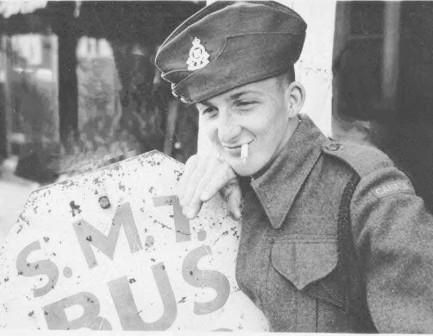
On The War Memorial Trail…..The WWII Acadian Soldier Serving With Le Régiment de Maisonneuve Who Made The Ultimate Sacrifice In The Hochwald Forest

Balmoral and Shannonvale Google Maps

We travelled to Balmoral, New Brunswick, to meet the sister of a WWII soldier. (Map source: Google Maps)

November 27, 2024. After completing our tour along the Acadian Coastal Drive, visiting Acadian Memorials, we went to Balmoral, New Brunswick, to meet with Léa LeClair, the youngest sister of WWII soldier Ange Aimé LECLAIR. (See https://onthewarmemorialtrail.com/2024/11/22/on-the-war-memorial-trail-remembrance-week-2024-visiting-acadian-memorials-in-new-brunswick/)

CIMG7020 Aug 27 2024 Visit to Balmoral Romeo Le Page & Lea Le Clair

Pieter (centre) with Léa LeClair and her brother-in-law, Romeo LePage. (Photo credit: Daria Valkenburg)

When Pieter had begun his research to find family of Ange Aimé, he found an obituary for the soldier’s sister Viola, who was married to Romeo LePage.  Then he found a phone number for Mr. LePage and, with great trepidation given that he isn’t fluent in French, he dialed the number.  After a few minutes, Mr. LePage’s sister-in-law, retired teacher Léa LeClair, came on the line, and listened patiently.  “…Oui…” she had a photo of Ange Aimé, and then, happily, switched to English.  She explained that she was the youngest sister of the soldier, only 10 years old when he died on March 2, 1945.

Pieter let her know that we were planning a trip to New Brunswick, and asked if she would like to meet in person.  This was agreeable, and so, when we went to Balmoral, we were only expecting to get a photo of the soldier.  Boy, were we wrong! The family’s historian, Léa had several photos and letters written by her brother, and more.  Ange Aimé was clearly loved and remembered by his family!

Born in Shannonvale (now part of Eel River Crossing), Restigouche County, New Brunswick on March 14, 1925, Ange Aimé was the son of Thomas and Marguerite Anne (nee Basque) LeClair.  He came from a large family, and had 5 sisters, 3 brothers, 4 half-brothers, and 2 half-sisters.

…..Ange Aimé enlisted under the NRMA in 1944….

Léa recalled that “My brother Albénie was called up in the Spring. He did not pass the physical as he was sick. Ange-Aimé asked Papa if he should stay and wait for a call to join. They chose for him to go to work in the Kedgwick area. Later in the summer, the Army came looking for him in Dundee. Papa did not know exactly where he was cutting wood and said so to the Army. After a while, the Army did find him, in the Kedgwick area…. He was registered and then was sent for training…

Ange Aimé originally enlisted under the National Resources Mobilization Act (NRMA) at the No. 7 District Depot in Fredericton, New Brunswick on May 31, 1944 and underwent basic training at No. 71 Canadian Army Basic Training Centre (CABTC) in Edmundston, New Brunswick. (See https://en.wikipedia.org/wiki/National_Resources_Mobilization_Act)

ange aime le clair as a student colourized

Ange Aimé LeClair as a student.  (Photo courtesy of the LeClair family. Photo colourization by Pieter Valkenburg)

At the time of his enlistment, Ange Aimé had been working for 2 years as a woodsman for Raymond LeBlanc of Darlington, New Brunswick.  Léa recalled that he had studied at a seminary, with his family expecting him to be a priest, but he preferred working outdoors. While his Occupational History Form does not mention studying at a seminary, he most likely had his post-elementary education at a seminary. The form stated that Ange Aimé was fluent in both French and English, which was unusual for a young man who grew up in a rural area and in a French speaking household.

AA Leclair photo from memorial card colourized

Ange Aimé LeClair in uniform.  (Photo courtesy of the LeClair family. Photo colourization by Pieter Valkenburg)

On July 25, 1944, Ange Aimé enlisted for active duty while in Edmundston, and remained there until September 1, 1944, when he was transferred to the A-30 Canadian Infantry Training Centre (CITC) at Camp Utopia in Pennfield Ridge, New Brunswick.  On September 14, 1944, he received a promotion to Lance Corporal.

….Ange Aimé received embarkation leave….

After completing his training at Camp Utopia, Ange Aimé received embarkation leave, prior to being sent overseas, from November 21 to December 7, 1944.  He returned home to the family farm in Dundee, New Brunswick, where a photo was taken of him playing hockey.

20240827_140114 AA Le Clair playing hockey in Dundee during embarkation leave

Ange Aimé LeClair on skates with a hockey stick during his embarkation leave.  (Photo courtesy of the LeClair family)

While on leave, Ange Aimé helped out at home, and spent time in the woods.  Time went by very quickly, and unfortunately he didn’t immediately return to Camp Utopia when his leave was up. Military police came to look for him, thinking he had deserted.  Léa recalled that her …father was in the garden and told them that Ange Aimé was in the woods.  After he returned, he was arrested and taken back to Camp Utopia, where he spent a night in the stockade...

The repercussions were harsh, given that he was only late returning by a few days.  On December 10, 1944, he was transferred to the No. 1 Training Brigade in Debert, Nova Scotia for final preparations and training before being posted overseas.  But, on December 17, 1944, he was demoted in rank and reverted to Private. 

 ….We had help in translating letters from French into English….

CIMG7053 Sep 10 2024 Daria & Etienne Gaudet translating AA LeClair letters in Moncton NB

Daria and Etienne Gaudet worked diligently to translate all the letters from French into English. (Photo credit: Pieter Valkenburg)

Because Léa had saved letters written by her brother, we were able to hear his thoughts during this period.  We were grateful for the help of Etienne Gaudet, who kindly translated all of the letters written by Ange Aimé from the original French into English.

In a December 20, 1944 letter to his sister Delphine, written from Debert, it’s clear that there was illness in the family. “…. Are you better after your flu? … Please give my regards to the others and please tell me if mother is better, and tell her not to worry about me.  It’s not worth it.  Nothing has happened to me yet.  There’s a higher power above us and his wishes must be respected.

I wouldn’t be worse off there (ie heaven) than here. Besides that, I’m lucky that I’m the only one in the army instead of all of us.  I’m not scared and I’m taking things as they come….

On the same day, he also wrote to his brother Ovila, mentioning his demotion.  “I thought I’d be able to have a pass for Christmas or New Year’s, but I won’t now.  I no longer have my stripe and I don’t know if I’ll have one later, or if I’m here for a long time.

….Ange Aimé left Canada for overseas service….

Ange Aimé didn’t have long to wonder how long he’d be in Debert.  On December 24, 1944 he left Canada, arriving in the United Kingdom on December 31, 1944, where he was assigned to No. 4 Canadian Infantry Training Regiment (CITR).

He shared his impressions with his brother Ovila in a January 3, 1945 letter.  “.I am now in England and it’s pretty good and a funny country. Their language is nearly impossible to understand. They do not pronounce their words like we do.

I’m anxious to get to the front and see what it’s like.  If it can be warm, I’ll be happy as here it’s humid and we’re freezing.  The humidity is going through us and we have to ration the coal.  I have had a cold since I arrived here, as have the others….

In a January 4, 1945 letter to his sister Delphine, he wrote about the climate, and shared that he saw his cousin, René LEBLANC.  “I have a cold.  It’s humid as hell here.  My nose is always running.  It takes time to get used to the climate….. René is here....” 

Then, in a January 29, 1945 letter to Delphine, he again mentions the weather, and spending Christmas while on his overseas voyage. “The climate here is humid and a bit cold.  There are 4 inches of snow…. It’s not as beautiful as I had thought and holidays on the water are not fun...

Ange Aimé was aware that he would soon be sent to Northwest Europe. In a February 8, 1945 letter to his brother Ovila, he wrote that “I am preparing for the draft. I have to face the front, see what it looks like, but I would not want to take a bullet or shrapnel….”  

….Ange Aimé was flown to Northwest Europe from the United Kingdom….

The day after he wrote to his brother Ovila, Ange Aimé was transferred to the X-4 Reinforcement List of the 10th Battalion of the Canadian Infantry Corps, and flown to Northwest Europe on February 10, 1945. 

By February 12, 1945 he was at No. 2 Canadian Base Reinforcement Group (CBRG) and wrote to his sister Delphine that he was “now in Belgium.  It’s really beautiful here.

I am not yet at the front.  Those that go come back, at least most of them.  I have as good a chance as them.  I might never go since it looks really bad for the Germans.

People are really nice to us ‘Canadians’ here.  Yesterday I went to supper with a man who brought us to his home.  He has three small children.  They were really nice to us.  I was with two of my friends.  Like he said, it reminded us of home to have a family supper and it took away some of the longing for home….

On the same day, he wrote to his parents about the dinner.  “….Yesterday I went to town with two others, and an older man invited us to his place for supper with him.  We were served like princes.  They are really nice. There were three little boys and they all shook our hands....” This was the last letter the family received from Ange Aimé. 

…. Ange Aimé’s transfer to Le Régiment de Maisonneuve was his last….

On February 15, 1945, Ange Aimé was transferred to Le Régiment de Maisonneuve, joining them near Nijmegen, The Netherlands, as the Regiment prepared to move into Germany. 

The February 18, 1945 war diary entry for the Regiment stated that “…the whole Battalion left Nijmegen at 19:30 hours to proceed via Cleve, Germany and had penetrated in Germany by 20:40 hours...

By the end of February, the Regiment was involved in the Battle of Hochwald Gap, part of Operation Blockbuster, the final push towards the Rhine River, along with several other Canadian Regiments.  This offensive began on February 28, 1945 to clear the Germans from the Reichswald, a heavily forested area between the Maas and the Rhine Rivers, driving them back over the Rhine, taking the fight well into German territory.  (For more information, see https://canadianbattlefieldtours.ca/operation-blockbuster/ and https://civilianmilitaryintelligencegroup.com/10742/the-battle-of-hochwald-gap-one-of-the-largest-armor-engagements-you-probably-have-never-heard-of)

Each day the war diary reported heavy shelling of the troops, with several casualties.  On March 1, 1945, the war diary reflected that because shelling was heavy “…the morale of the troops was quite low as nothing could be done but wait…

On March 2, 1945, the war diary recorded that “…Captain Provost is back with us.  The rifle companies are in position in the Hochwald Gap at 03:40.  ‘C’ Company sent out patrols to feel enemy’s disposition. ….Heavy shelling all day…” Sadly, one of the casualties on March 2 was Ange Aimé. 

….Letter from Captain Provost described how Ange Aimé lost his life….

On March 3, 1945, Captain Paul-Marcel Provost wrote a letter of condolence to Ange Aimé’s mother. “….I have the terrible duty to inform you of the death of your son, Pte LeClair.  He was killed in action on March 2, 1945….. He was an excellent soldier and brave, who made the ultimate sacrifice.

In the name of the commander and all his officers, I ask you, Madame, to accept our deepest condolences for the loss that has struck you. May the legitimate pride you feel for the departed ease your pain. This pride is shared by all in Le Régiment de Maisonneuve…..

This was followed by an April 6, 1945 letter, explaining how Ange Aimé lost his life.  “….Please know that you have all my sincere sympathies in the sorrow with which you have been struck.  I also have a bit of sorrow, as your son was one of ours and I was his commander…..

Your son died a few days after we finished the offensive that brought us to the side of the Rhine and decided the German defeat – two days after an attack that had been especially challenging for our company.  The Regiment was called to take up defensive positions along the Hochwald Forest – a forest situated a few miles from Kleve and Xanten.

Our first hours in these positions were quiet.  Near 6 pm, supper was brought, and Ange Aimé was designated, with a few others, to transport it from our Command Post to his platoon.  It’s when he was on his way back that the German artillery began to fire at us, and your son fell, along with a few other unlucky men.

He was killed instantly and buried the next day in one of our Canadian cemeteries. I include here memorial cards, printed in memory of our friends killed during this period of the offensive in Germany….

Ange Aimé’s cousin, Rene LeBlanc, was injured in this attack, but survived the war to return home.

As with Ange Aimé’s letters, Etienne Gaudet kindly translated the letters written by Captain Provost from the original French into English. I was especially grateful for Etienne’s help with the letters from Captain Provost as it was extremely difficult to read his handwriting.

The memorial card that Captain Provost referred to had been prepared for a March 16, 1945 prayer service at Sint-Bartholomaeuskerk, a Roman Catholic Church in Beek (now Berg en Dal), The Netherlands. The memorial card lists 37 names of those who died between February 8 and March 13, 1945. (See https://rijksmonumenten.nl/monument/35784/grote-stbartholomeus/beek/ and  https://nl.wikipedia.org/w/index.php?title=Sint-Bartholomaeuskerk_(Beek_(Berg_en_Dal))

20240827_143311 Mar 16 1945 Memorial service in Holland for Regt de Maisonneuve KIA in Germany

Memorial card sent to Ange Aimé LeClair’s mother.  (Photo of card courtesy of the LeClair family)

….Ange Aimé is buried in Groesbeek….

20240827_144251 Aug 27 2024 Groesbeek postcard sent by Ton in 1950

A 1950 postcard, sent by Ton Bersen to the LeClair family, shows how the Canadian War Cemetery in Groesbeek looked in that time period. (Photo courtesy of the LeClair family)

Ange Aimé was temporarily buried on land owned by a Catholic farmer named Augenendt, 3.2 km (two miles) west of Udem in Germany, before being reburied the following year in the Canadian War Cemetery in Groesbeek, The Netherlands.

20240827_144334 Aug 27 2024 Original Groesbeek grave AA Le Clair

The original gravestone for Ange Aimé LeClair in the Canadian War Cemetery in Groesbeek.  (Photo courtesy of the LeClair family)

Grave of AA LeClair from find a grave

Grave of Ange Aimé LeClair in the Canadian War Cemetery in Groesbeek, The Netherlands. (Photo courtesy of FindAGrave)

….Ange Aimé’s grave was adopted by Ton Bersen ….

After his reburial in the Canadian War Cemetery in Groesbeek, Ange Aimé’s grave was adopted by a young scout, Ton Bersen, and his family.  Ton remained in contact with the LeClair family until his death in 2020!

20240827_140515 Ton Bersen & mother by grave of AA Le Clair

Ange Aimé LeClair’s grave was adopted by Ton Bersen, seen in this photo with his mother. (Photo courtesy of the LeClair family)

….Ange Aimé is remembered on his parents’ gravestone ….

Ange Aimé’s sister Léa told us that after her parents’ original gravestone in Dundee, New Brunswick crumbled, she replaced it with a new headstone and commemorated her brother as well. 

20240827_144026 Aug 27 2024 Le Clair gravestone in Dundee

Gravestone of the LeClair family in Dundee, New Brunswick.  (Photo courtesy of the LeClair family)

Thank you to Léa LeClair for providing photos and information on her brother, and to Etienne Gaudet for help in translating letters from French into English.  Do you have photos or information to share? Email Pieter at memorialtrail@gmail.com, comment on the blog, or tweet to @researchmemori1.

© Daria Valkenburg

….Previous postings about soldiers who died during the Battle of Hochwald Gap….

….Want to follow our research?….

If you are reading this posting, but aren’t following our research, you are welcome to do so.  Our blog address: https://onthewarmemorialtrail.com/

Front cover OnTheWarMememorialTrailinEurope4 countries, 6 weeks, 7,000 km – an unforgettable war memorial journey in Europe…. Daria’s book ‘No Soldier Buried Overseas Should Ever Be Forgotten‘ is available in print and e-book formats.  Net proceeds of book sales help support research costs and the cost of maintaining this blog. For more information see https://nosoldierforgotten.com/ 

You are also invited to subscribe to our YouTube Channel: On The War Memorial Trail With Pieter Valkenburg: https://www.youtube.com/channel/UCJ591TyjSheOR-Cb_Gs_5Kw

Never miss a posting!  Subscribe below to have each new story from the war memorial trail delivered to your inbox.
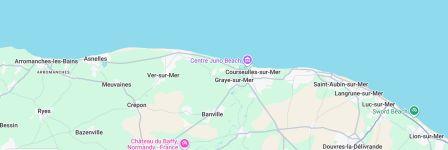
On The War Memorial Trail…..The WWII Soldier From Clyde River Who Lost His Life During The Attack On Hoogerheide

CIMG6927 Jul 31 2024 Cornwall Cenotaph Pieter by WWII & WW1 memorial

The Cenotaph site in Cornwall, Prince Edward Island. The WWI cenotaph is on the right, and the WWII cenotaph on the left. (Photo credit: Daria Valkenburg)

October 12, 2024. When Pieter was asked to give a presentation on September 22, 2024 at the 105th Annual Remembrance Service in Cornwall, Prince Edward Island, one of the names on the WWII Cenotaph was that of Private William Ernest STONE, who was serving with the Black Watch of Canada, when he was killed during a fierce battle in Hoogerheide, The Netherlands on October 10, 1944, at the age of 25.  (See https://onthewarmemorialtrail.com/2024/09/26/on-the-war-memorial-trail105th-annual-remembrance-service-at-cornwall-cenotaph/)

CIMG6928 Jul 31 2024 Cornwall Cenotaph WWII memorial

William Ernest Stone was one of 4 casualties listed on the WWII Cenotaph in Cornwall, Prince Edward Island.  (Photo credit: Daria Valkenburg).

William is buried in the Canadian War Cemetery in Bergen Op Zoom, The Netherlands, located near the Belgian border.  2024 is an important anniversary for this area as 80 years ago, in October 1944, Belgium and the southern part of The Netherlands were liberated, following tremendous casualties during the Battle of the Scheldt. (See https://en.wikipedia.org/wiki/Battle_of_the_Scheldt and https://www.thecanadianencyclopedia.ca/en/article/canada-and-the-battle-of-the-scheldt)

It seems only fitting that 80 years after his death, William’s story is told.  He was born August 19, 1919, in Clyde River, Prince Edward Island, the son of Edward Earnest and Sadie Stone.  

William had two brothers and two sisters.  With the help of Brenda Graves and Arlene Roberts, a photo was soon provided by Faye MacNutt, the daughter of William’s sister Ruth.

…..William enlisted under the NRMA in 1941….

William originally enlisted under the National Resources Mobilization Act (NRMA) in Charlottetown, Prince Edward Island on April 17, 1941 and underwent basic training at No. 62 Canadian Army Basic Training Centre (CABTC) in Charlottetown. (See https://en.wikipedia.org/wiki/National_Resources_Mobilization_Act)

At the time of his enlistment he had been working for two years as a stoker at Storms Construction Company Ltd in Charlottetown. Among his tasks he also worked at Charlottetown Airport for several months in 1940, tasked with running a cement mixer and doing odd jobs, when the airport was transferred to the Royal Canadian Air Force (RCAF) and the airport and runways were enlarged in preparation for using the airport to train pilots and aircrew. 

William also noted that he also had six years of farming experience from helping on his family’s farm.  He had an interest in mechanics, played tennis, volleyball, and baseball, and enjoyed singing. 

…..William received training in both Canada and the USA….

William Ernest Stone colourized

William Ernest Stone. (Photo courtesy of Faye MacNutt.  Photo colourization by Pieter Valkenburg)

On June 6, 1941, he transferred to active service at No. 62 CABTC in Charlottetown, and was immediately sent to No. 6 District Depot in Halifax, Nova Scotia for trades training in motor mechanics and welding at the Halifax Technical School.

After successfully completing the two month course in Halifax, William was attached to No. 14 Infantry Training Centre in Aldershot, Nova Scotia as of August 2, 1941.  A few days later, he was sent ‘on command’ to Automatic Course in Motor Mechanics at the Quartermaster Motor Transport School at Fort Holabird in Baltimore, Maryland, USA.  He successfully completed the course on October 15, 1941.

Next, he was sent to the Canadian Army Trade School (CATS) in Hamilton, Ontario for more training in motor mechanics.  His time there was from October 28, 1941 until June 6, 1942, when he was transferred to the A9 Canadian Armoured Corps (Advanced) Training Centre (CACATC) at Camp Borden in Ontario for wireless training.

William received a furlough from May 20 to June 2, 1942, during which time he returned to Prince Edward Island to marry Eileen Younker in Winsloe on May 27, 1942.  The couple only had a few days together before he had to return and continue his training.

On July 26, 1942, he was assigned to the 28th Armoured Regiment in Debert, Nova Scotia for final training before going overseas.  On August 4, 1942, William received embarkation leave until August 7, the last chance he had to see his family. 

….William left Canada for overseas service….

William left Canada with the 28th Armoured Regiment on August 22, 1942, arriving in the United Kingdom on September 1, 1942. He was sent for more training, and qualified as a Driver i/c Class III (Wheeled) on December 6, 1942.  (The term ‘Driver i/c’ refers to ‘Driver, internal combustion’.  Class III meant he was qualified to drive heavy trucks and armoured cars, but not tanks.)

On May 15, 1943 he was sent to 21 Canadian Armoured Regiment (CAR) for a few weeks and then on to receive training as a Driver Mechanic (Tank) Class ‘C’.  He successfully completed this training on December 3, 1943.

William was transferred to No. 3 Canadian Armoured Corps Reinforcement Unit (CACRU) on January 29, 1944.  Then, on July 25, 1944, he was transferred again, this time to No. 1 Canadian Armoured Corps Reinforcement Unit (CACRU), and re-mustered from the Canadian Armoured Corps (CAC) to the Royal Canadian Artillery (RCA).

On August 13, 1944 William was temporarily assigned to the Canadian Fusiliers (City of London Regiment) before being placed on the X-4 Canadian Infantry Corps Reinforcement List, part of the 10th Battalion, on September 21, 1944 and sent to France.

On September 28, 1944, William was transferred to the Black Watch (Royal Highland Regiment) of Canada, and joined them in Rijkevorsel, Belgium.  The war diary for that day noted that “….in the last two days, 42 reinforcements have joined us, 11 for general duty, the remainder being for the most part signallers and drivers...

The Regiment had surged through France and into Belgium, where William joined the Regiment.  From Belgium, the Regiment made its way into The Netherlands on October 7, 1944.  While the main goal was helping to clear the Scheldt Estuary, necessary to liberate the vital port of Antwerp, their first task was to attack the town of Hoogerheide.

….Attack On Hoogerheide….

Screenshot 2024-10-11 at 10-41-57 Google Maps

Map shows location of Calfven, Hoogerheide, and Ossendrecht in The Netherlands, just over the Belgian border. (Map source: Google maps)

The War Diary for October 7, 1944 noted that the Regiment had begun their journey into The Netherlands “…at 0930 hours and shortly thereafter crossed the frontier into Holland at the town of Putte…and went on to our area at a farm….In the afternoon we moved forward again into the Calfven area….

On October 8, 1944, as the troops moved up to the attack on Hoogerheide in the early morning, they found that the Start Line hadn’t been secured.  When the attack did begin, at 10:30 am, troops came under machine gun and mortar fire.

The War Diary entry for October 8, 1944 stated that “…very heavy fighting ensued and it was over two hours before the enemy decided that he had had enough….”  The respite didn’t last.

The following day, the War Diary recorded that “…during the night, mortaring and shelling continued on a heavy scale….It is apparent that there has been heavy reinforcement of this area, and that the enemy is determined to make a stand. The troops we are now meeting are definitely the cream of the crop.  They belong to paratroop battalions, with a sprinkling of glider troops and Luftwaffe personnel…..

The war diarist noted that the German troops were young and in good physical condition, …keen to fight and with excellent morale.  All day long there was heavy fire from artillery and mortar on our positions, and his snipers are very busy.  At 1600 hours the Germans opened an artillery barrage which lasted for two hours, then came in on a counter attack…

On October 10, 1944, the War Diary continued the account of the attack.  “…Weather – Misty and rain.  The heavy mortaring and shelling to which we have been subjected continues without respite”  The attack continued for the Black Watch until 3:00 pm, when they were relieved by the Royal Hamilton Light Infantry.

The Black Watch casualties for the Hoogerheide attack were counted, and totalled 81, with 12 fatalities.  Among those who were recorded as having died on October 10, 1944 was William Ernest Stone.

….William is buried in Bergen Op Zoom….

William was initially buried in the village cemetery in Ossendrecht, before being reburied in the Canadian War Cemetery in Bergen Op Zoom, The Netherlands.

William Ernest Stone from find a grave

Grave of William Ernest Stone in the Canadian War Cemetery in Bergen Op Zoom, The Netherlands.  (Photo courtesy of the Canadian Virtual War Memorial)

Later this month, the cemetery in Bergen Op Zoom is holding its 80th Anniversary of Liberation Commemorations.  Private William Ernest Stone will be one of the 968 Canadians buried there who will be remembered.

CIMG3382 Oct 7 2019 Bergen Op Zoom Pieter at Cdn War Cemetery

Pieter at the entrance to the Canadian War Cemetery in Bergen Op Zoom.  (Photo credit: Daria Valkenburg)

Thank you to Brenda Graves and Arlene Roberts for their help in finding a photo. Thank you to Faye MacNutt for submitting a photo of her uncle.

If you have photos or information to share, please email Pieter at memorialtrail@gmail.com, comment on the blog, or tweet to @researchmemori1.

© Daria Valkenburg

….Want to follow our research?….

If you are reading this posting, but aren’t following our research, you are welcome to do so.  Our blog address: https://onthewarmemorialtrail.com/

Front cover OnTheWarMememorialTrailinEurope4 countries, 6 weeks, 7,000 km – an unforgettable war memorial journey in Europe…. Daria’s book ‘No Soldier Buried Overseas Should Ever Be Forgotten‘ is available in print and e-book formats.  Net proceeds of book sales help support research costs and the cost of maintaining this blog. For more information see https://nosoldierforgotten.com/ 

You are also invited to subscribe to our YouTube Channel: On The War Memorial Trail With Pieter Valkenburg: https://www.youtube.com/channel/UCJ591TyjSheOR-Cb_Gs_5Kw

Never miss a posting!  Subscribe below to have each new story from the war memorial trail delivered to your inbox.
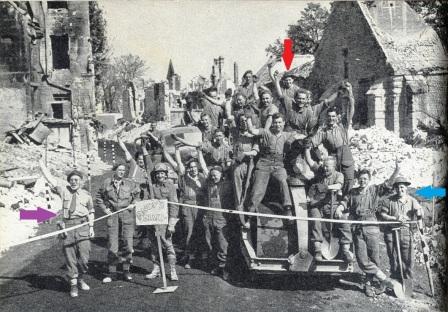
On The War Memorial Trail…..The WWII Soldier From Mount Carmel Killed During The Liberation Of Posterenk

June 30, 2024.  In 2017, Pieter and I visited the village of Posterenk in The Netherlands with Edwin van der Wolf, one of the research volunteers at the Canadian War Cemetery in Holten.

CIMG9302 Sep 25 2017 Posterenk Windmill

Windmill in Posterenk, which has a memorial stone inscribed on the wall.  (Photo credit: Daria Valkenburg)

CIMG9300 Sep 25 2017 Sign Posterenk freed by CYR Apr 13 1945

Translation of memorial stone on the windmill: Posterenk freed by the Carleton & York Regiment of Canada on April 13, 1945. (Photo credit: Daria Valkenburg)

….The Island connection to Posterenk…..

Edwin wanted us to visit the village because it had an Island connection.  François ‘Frank’ GALLANT, son of Antoine and Eleanor (nee Poirier) Gallant of Mount Carmel, Prince Edward Island,  died there on April 13, 1945, while serving with the Carleton & York Regiment.

CIMG9296 Sep 25 2017 Edwin and Pieter by Posterenk windmill

Edwin van der Wolf (left) and Pieter in Posterenk.  (Photo credit: Daria Valkenburg)

The village had a list of 6 soldiers to commemorate from the Carleton & York Regiment, who had all been buried in the area.  Unfortunately, not all soldiers who died are included on this list, but Edwin worked towards including two more, who were not buried near Posterenk, but “were temporarily buried in Lochem because they had previously died in a Canadian hospital there…” 

In total, out of the 8 soldiers, three were from Prince Edward Island!  The stories of Daniel Peter MACKENZIE and James ‘Frank’ MOSSEY were previously told.  In this posting, we feature the story of Frank GALLANT, the reason we were in Posterenk back in 2017!

Gallant Frank

François ‘Frank’ Gallant.  (Photo courtesy of the Information Centre Canadian Cemetery Holten)

….Three Gallant brothers served…..

Born November 24, 1914, Frank originally enlisted under the National Resources Mobilization Act (NRMA) in Charlottetown, Prince Edward Island on August 13, 1942 and underwent basic training at No. 62 Canadian Army Basic Training Centre (CABTC), which he completed on October 12, 1942. (See https://en.wikipedia.org/wiki/National_Resources_Mobilization_Act)

His Personnel Information Record noted that he could speak both French and English, and came from a rural farming background, which likely accounted for him having only a Grade 4 education.  In addition to farming, Frank had experience in carpentry work, and had worked in a lumber mill.  He could drive a vehicle, and played baseball and hockey. Two of his brothers, Georges and Simon, were also in the army. 

With his basic training successfully completed, Frank was transferred to A5 Canadian Engineer Training Camp (CETC) in Petawawa, Ontario for advanced training on October 13, 1942.  Upon completion of that training, he remained in Petawawa for an additional two months, doing general repair work. 

On January 28, 1943, Frank was transferred to No. 2 Engineer Services and Works Company (ES&W Company) of the Royal Canadian Engineers, where his task was to fire and repair boilers at No. 2 District Depot in Toronto, Ontario. He was with ‘D’ Wing, a ‘supernumerary to establishment’ reserve unit, while a decision about the direction his army career was to take was made.

Frank had expressed interest in being considered in the Tradesman category as a fireman or maintenance man, but it was determined that since his occupation background was “… erratic….” with no “…special training…” and he was considered very fit, in the “…A-1 category…”, he should be reallocated to “…Infantry (Non-Tradesman)” and receive infantry training. 

Frank received special leave to return home to Prince Edward Island to help with the family’s farm operation on August 29, 1943, after which he returned to Toronto on November 1, 1943.

….Frank transferred to the Infantry…..

As a result of the assessment that he be assigned to an Infantry Unit, Frank was transferred to the 1st Battalion Victoria Rifles of Canada on November 10, 1943 and sent the following day to Stratford, Ontario to be re-mustered as a rifleman.

Frank remained in Stratford for training until February 18, 1944, when he was sent to Niagara-on-the-Lake, Ontario. 

On August 24, 1944, Frank transferred from the non-active militia to active service in the Canadian Army, remaining with the 1st Battalion Victoria Rifles of Canada in Niagara-on-the-Lake.

….Frank left Canada for overseas service…..

On November 21, 1944, Frank left for Great Britain with the 1st Battalion, to provide reinforcements to the Canadian Army in the field.  Upon arrival on November 28, 1944, he was assigned to No. 3 Canadian Infantry Training Regiment (CITR).

He continued receiving further training until January 23, 1945, when he left the United Kingdom for Italy, as part of the X-4 Reinforcements, arriving on February 7, 1945.  On February 13, 1945 he was transferred to the Carleton & York Regiment, joining them north of Rossi (Russi), part of a group of reinforcements, at the tail end of the Italian Campaign. (See https://en.m.wikipedia.org/wiki/Italian_campaign_(World_War_II))

He joined the Carleton & York Regiment at the same time as Archibald Phillip ‘Archie’ MCLEAN of Edmundston, New Brunswick.  Archie’s story was previously told on this blog.  (See https://onthewarmemorialtrail.com/2023/09/13/on-the-war-memorial-trail-archie-was-a-good-guy/)

Screenshot 2023-09-04 at 16-28-14 Map of Russi Italy

The Carleton & York Regiment was north of Russi on February 13, 1945.  (Map source: http://www.gosur.com)

On March 17, 1945, he left Italy as part of Operation Goldflake, arriving in Marseilles, France three days later.  Operation Goldflake was the codename for moving troops from Italy to North-West Europe.  (See https://en.wikipedia.org/wiki/Operation_Goldflake)

The Carleton & York Regiment was now part of the 21st Army Group. From France, troops were moved up to the Belgian front, into The Netherlands, through the Reichswald Forest in Germany, and then back into The Netherlands.

The Liberation of Posterenk…

On April 12, 1945 the Regiment was part of Operation Cannonshot, which led to the crossing of the IJssel River between the villages of Gorssel and Wilp in the eastern part of The Netherlands. (See https://www.liberationroute.com/stories/190/operation-cannonshot)

Map western holland showing Posterenk

According to the April 12, 1945 war diary entry of the Carleton & York Regiment, they “…moved across the Ijssel River at 14:30 hours….” to relieve the Seaforth Highlanders of Canada.

On April 13, 1945, the war diary entry noted that “…‘D’ Company’s objective is Posterenk…The Regiment didn’t expect much opposition, but they “met with stiff resistance just after starting at 11:25 hrs…

In ‘Invicta – The Carleton and York Regiment in the Second World War’ author Robert Tooley explained that “…on the CYR front D Company was to lead off towards its first objective, the village of Posterenk: the opposition was expected to be light, and the company was instructed to continue to move forward until strong opposition was encountered.  The battalion now had in support a troop of M10 SP anti-tank guns, a troop of tanks, a platoon of medium machine guns, and a platoon of 4.2 inch mortars. D Company pushed off at 10:50 am….. Contrary to expectations, D Company met stiff resistance and suffered several casualties from small arms fire….”   

At some point during that day, Frank lost his life. 

…Frank is buried in Holten…

Frank was one of 6 soldiers initially buried along the main road to Posterenk, a village near Zutphen, before being reburied in the Canadian War Cemetery in Holten.

Posterenk list of 6 CYR members

The 6 soldiers buried near Posterenk.

CIMG3198 Oct 3 2019 Holten Frank Gallant

Grave of François ‘Frank’ Gallant at the Canadian War Cemetery in Holten.  (Photo credit: Daria Valkenburg)

…Frank is remembered on the war memorial in Wellington…

In May 2024, we visited the war memorial in Wellington, Prince Edward Island, where Frank’s name is listed.

CIMG6840 May 27 2024 Wellington Monument - Francis Gallant - photo by Pieter

François ‘Frank’ Gallant is remembered on the war memorial in Wellington, Prince Edward Island.  (Photo credit: Pieter Valkenburg)

…Previous stories about soldiers commemorated in Posterenk….

Do you have photos or information to share? Email Pieter at memorialtrail@gmail.com, comment on the blog, or tweet to @researchmemori1.

© Daria Valkenburg

….Want to follow our research?….

If you are reading this posting, but aren’t following our research, you are welcome to do so.  Our blog address: https://onthewarmemorialtrail.com/

Front cover OnTheWarMememorialTrailinEurope4 countries, 6 weeks, 7,000 km – an unforgettable war memorial journey in Europe…. Daria’s book ‘No Soldier Buried Overseas Should Ever Be Forgotten‘ is available in print and e-book formats.  Net proceeds of book sales help support research costs and the cost of maintaining this blog. For more information see https://nosoldierforgotten.com/ 

You are also invited to subscribe to our YouTube Channel: On The War Memorial Trail With Pieter Valkenburg: https://www.youtube.com/channel/UCJ591TyjSheOR-Cb_Gs_5Kw

Never miss a posting!  Subscribe below to have each new story from the war memorial trail delivered to your inbox.

On The War Memorial Trail….. The WWII Soldier From Trail Who Played The Cornet
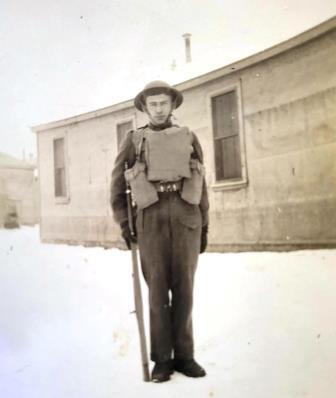
August 14, 2023.  When Pieter begins his research into a soldier, and then contacts possible family members, he never knows what to expect.  Sometimes, his outreach surprises family members as they might not know a lot about the soldier he inquires about. 

During the search for a photo of Theodor ‘Ted’ HENSCHEL, who was born in Winnipeg, Manitoba on September 19, 1914,  Pieter learned that Ted was living in Trail, British Columbia at the time of his enlistment on June 21, 1944 at the No. XI District Depot in Vancouver, British Columbia.

When Pieter was contacted Joy Roberts, daughter of Ted’s brother Emil, she wrote that “My father didn’t talk about his brother.  So I am a little confused.  Ted Henschel is listed on the Trail, BC war dead. My father and their father lived in Trail…”  But – the family did have photos of Ted!

Theodor Henschel

Theodor ‘Ted’ Henschel (Photo courtesy of the Henschel Family)

Ted’s parents had immigrated to Canada from Eastern Europe.  They lived in Winnipeg until Ted was a year old, then in Saskatchewan for 12 years, before moving to British Columbia. “…One brother, Fred, lived and passed away in Vancouver.  He changed his name at some point during the war, because of Henschel sounding German.  He changed it to Hansel and was the only child that immigrated with the parents (though I believe one other son died on the ship while crossing to America).  Fred was about twenty years older than my dad, Emil…” explained Joy.

Besides Fred and Emil, Ted had a brother Rudolf and a sister Annie. When Ted enlisted after being called up for service under the National Resources Mobilization Act (NRMA), he had been working for a decade as a machine operator for the Consolidated Mining and Smelting Company in Trail, British Columbia. In addition to English, it was recorded that he could speak German, and that he wore corrective lenses. (See https://en.wikipedia.org/wiki/National_Resources_Mobilization_Act)

…Ted began his basic training in Camrose….

Ted was sent to No. 131 Canadian Infantry Basic Training Centre (CIBTC) in Camrose, Alberta.

Ted identified A Company Sep 1944 Camrose

September 1944 group photo of No 131 CIBTC , taken at the Military Headquarters  in Camrose, Alberta.  Ted Henschel is in the middle row, second from right.  (Photo courtesy of the Henschel Family)

Ted was a cornet player and played in the platoon band.

Musicians Ted 3rd from right with arrow

Ted Henschel, third from right.  (Photo courtesy of the Henschel Family)

On September 16, 1944, having completed his basic training, Ted was transferred to the A-16 Advanced Canadian Infantry Training Centre (CITC) in Calgary, Alberta.

Ted remained in Calgary until December 9, 1944, when he was transferred to the No.1 Training Brigade in Debert, Nova Scotia for final training and preparation for overseas service.

…Ted left Canada for overseas service…

On Christmas Eve – December 24, 1944 – Ted left Canada for the United Kingdom.  Upon arrival in the United Kingdom on the last day of the year, he was assigned to No. 1 Canadian Infantry Training Regiment (CITR) for further training.

…Ted was sent to The Netherlands…

finalphasecanscottish

Ted Henschel joined the Canadian Scottish Regiment near Zwolle. (Map source: http://www.canadiansoldiers.com)

On March 23, 1945 he was in North West Europe with the X-4 reinforcement troops of the 21st Army Group. Then, on April 18, 1945, he was transferred to the Canadian Scottish Regiment, joining the unit in the area around Zwolle, The Netherlands.  The Regiment had established patrols around Zwolle over an area of 161 square kms (100 square miles), rounding up German stragglers.

…The Battle for Wagenborgen was fierce…

wagenborgen

The Canadian Scottish Regiment’s movements during the Battle for Wagenborgen.  (Map source: http://www.canadiansoldiers.com)

On April 19, 1945, the Regiment moved to a concentration area at Hoogezand, near Groningen. Allied troops next worked to clear the area around Groningen of enemy troops. Patrols reported that Wagenborgen was still held by Germans. 

…Roads leading in and out of Wagenborgen had been blocked, and covered by machine guns and anti-aircraft guns…. The terrain surrounding Wagenborgen was flat, unobstructed by dense foliage, and criss-crossed by numerous canals and drainage ditches which limited the avenues of approach for the attackers….”  (Excerpt from https://www.canadiansoldiers.com/history/battlehonours/northwesteurope/wagenborgen.htm)

On April 21, 1945,  an attack on Wagenborgen, located south of Delfzijl, began, in what turned out to be a terrible fight.  This was the preliminary battle before the Battle of Delfzijl Pocket. The Canadian Scottish Regiment began the attack with only ‘D’ Company, but very quickly realized that this was insufficient. There were many casualties.

However, a subsequent attack with three companies was successful and troops were able to repel counter-attacks. By the time it was over, Canadian Scottish casualties at Wagenborgen were 23 killed and 41 wounded.

…Ted lost his life during the Battle for Wagenborgen …

The war diary for the Canadian Scottish for Sunday, April 22, 1945 recorded that “… ‘A’, ‘B’, and ‘C’ Companies patrolled extensively to their fronts:  ‘A’ Company met small arms fire from the town of Wagenborgen…’B’ Company patrolled…also meeting small arms fire…. ‘C’ Company established 4 strong-points to their front on the dyke running southwest to northeast….

Ted was in ‘A’ Company, which late in the evening “pushed east towards the northern part of WAGENBORGEN with the 4.2’s firing on the Company’s left flank. ‘C’ Company sent one Platoon to secure the dyke…with the other two Platoons pushing towards the dyke ….

The after-action report for ‘A’ Company summarized what happened: “…At 2200 hours on the night of 22 April 45 A Company began their advance on the northern end of the village of WAGENBORGEN. Supporting fire commenced at 2230 and continued until 2245 during which time the Company advanced unmolested. At 2245 the assault commenced and for the first time enemy fire was apparent. The Company advanced through considerable shell –fire which caused several casualties…

By 11 pm, the war diary reported that “… ‘B’ Company’s attack was started on the southern part of WAGENBORGEN. …. ‘A’ Company secured the northern part of the village…

Sadly, at some point during the Battle for Wagenborgen on April 22, 1945, Ted lost his life. He likely hadn’t even had time to get to know the soldiers he was with, since he had only joined the Regiment a few days earlier.

…Ted is buried in the Canadian War Cemetery in Holten …

Ted was temporarily buried in Siddeburen before being reburied on February 15, 1946 in the Canadian War Cemetery in Holten, The Netherlands.

Foto graf Theodor Henschel, 21-1-013

Grave of Theodor ‘Ted’ Henschel in Holten, The Netherlands.  (Photo courtesy of the Information Centre Canadian Cemetery Holten)

…Ted is remembered on memorials in Trail and Wagenborgen …

As Joy wrote in her initial email, Ted is listed on the war memorial in Trail, British Columbia: see https://www.waymarking.com/waymarks/WMN9QE_Trail_Cenotaph_Trail_BC

He is also listed on the war memorial in Wagenborgen, which commemorates the residents of Wagenborgen who died in the Second World War, and 27 fallen Canadian soldiers – 23 of them from the Canadian Scottish Regiment.  See https://www.tracesofwar.com/sights/24193/War-Memorial-Wagenborgen.htm

Thank you to Joy Roberts, who wrote “Thank you very much for your work. Joy, Gail, and Dennis – Nieces and Nephew of Ted Henschel…” A big thank you to Judie Klassen, whose genealogy research helped to find family members of Ted Henschel.

If you have a story to tell, please let Pieter know. You can email him at memorialtrail@gmail.com, or comment on the blog.  

© Daria Valkenburg

…Want to follow our research?….

If you are reading this posting, but aren’t following our research, you are welcome to do so.  Our blog address: https://onthewarmemorialtrail.com/

Front cover OnTheWarMememorialTrailinEurope4 countries, 6 weeks, 7,000 km – an unforgettable war memorial journey in Europe…. Daria’s book ‘No Soldier Buried Overseas Should Ever Be Forgotten‘ is available in print and e-book formats.  Net proceeds of book sales help support research costs and the cost of maintaining this blog. For more information on the book, please see https://nosoldierforgotten.com/

Subscribe to our YouTube Channel: On The War Memorial Trail With Pieter Valkenburg: https://www.youtube.com/channel/UCJ591TyjSheOR-Cb_Gs_5Kw

Never miss a posting!  Subscribe below to have each new story from the war memorial trail delivered to your inbox.