On The War Memorial Trail…..The WWII Soldier From Guysborough Whose Nieces Ensured His Photo Reached Pieter

July 15, 2023. The route to finding family and a photo of a soldier has many twists and turns. Sometimes a family member contacts us about a relative, usually after a media interview, but most of the time it’s sheer detective work to find a living family member. If no family connection can be found, then an appeal is made through the media.

In the majority of cases, possible family connections are found. Then Pieter has the challenge of making contact – through genealogy sites such as Ancestry, Facebook accounts, Legion branches, and by email if an address is found.

Quite often, though, an initial inquiry is made by phone. If you’ve ever had to cold call a stranger and explain the purpose of your call, you know it’s a daunting prospect. With a few exceptions, people are generally very polite, listen carefully to Pieter, and are good enough to let him know if he’s reached the right person (a relative) or not.

Over the years, he’s had very engaging calls and met delightful people. That was the case when he was looking for a photo of WWII soldier Lawrence Edward LUCAS of Guysborough, Nova Scotia.

Lawrence was born December 9, 1925, the son of Charles and Amelia Hattie Lucas. He had a brother Charles, and three sisters: Caroline, Mildred, and Vivian.

…The photo search was successful thanks to two nieces…

…It’s usually the women who have the photos…” Pieter told me, “…so I’m starting with the sisters….” It was a wise decision.

Lawrence’s sister, Mildred O’Connor, had been president of the Ladies Auxiliary in the Royal Canadian Legion in Guysborough. Pieter spoke with her daughter, Marie Ehler, who told him that her mother “….had placed a photo in the Legion….

Unfortunately, the Legion never seemed to be open, and there was no response to inquiries made by phone and social media.

Pieter then contacted Mildred McLeod, whose mother Caroline ‘Carrie’ Tovey, was another sister of Lawrence. When Mildred heard that the Legion had not responded, she got involved.  Within a few days, a photo was emailed to Pieter from Lorne MacDonald.

…Lawrence enlisted at the age of 18…

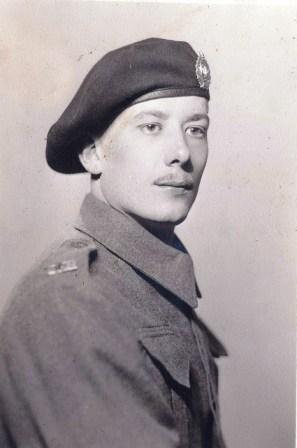
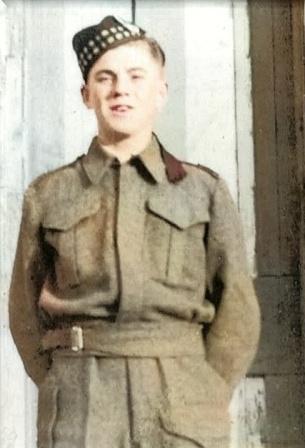
Lawrence Edward Lucas

Lawrence Edward Lucas. (Photo courtesy of the Lucas Family. Photo colourization by Pieter Valkenburg)

When Lawrence enlisted with the No. 6 District Depot in Halifax, Nova Scotia, on June 23, 1944, he had been working as a carpenter at Eastern Wood Works in New Glasgow, Nova Scotia.  He also noted that he had served with the 2nd Reserve Battalion Pictou Highlanders from September 1941 to May 1942.  As a teenager during that period, he would not have been eligible for active service.

On July 6, 1944, he was sent to No. 60 Canadian Infantry Basic Training Centre (CIBTC) in Yarmouth, Nova Scotia. Then, on September 3, 1944 he was transferred to the A14 Canadian Infantry Training Centre (CITC) in Aldershot, Nova Scotia.

…Lawrence completed an anti-tank course…

Among the training that Lawrence completed was a 6 Pounder Anti-Tank Gun course, for which he received his qualification on October 16, 1944.  This was a relatively small gun that could be pushed by its crew when necessary. Towed by a Universal Carrier, it could be brought into action quickly. (For more information, see https://www.canadiansoldiers.com/weapons/ordnance/6pounder.htm)

You can get an idea of how this gun works at this short re-enactment video on YouTube:

On December 12, 1944, Lawrence was transferred to the Training Brigade Group in Debert, Nova Scotia, for final training and preparations for going overseas.

…Lawrence arrived in the UK on Christmas Day 1944…

Lawrence left Canada on December 19, 1944, and after arriving in the United Kingdom on Christmas Day, he was assigned to No. 3 Canadian Infantry Training Regiment (CITR) for further training.

On February 10, 1945 he was in North West Europe with the X-4 reinforcement troops of 10th Battalion. Then, on April 6, 1945, he was transferred to the Algonquin Regiment, which was in the vicinity of Almelo, The Netherlands.

…Lawrence joined The Algonquin Regiment in The Netherlands…

The Algonquin Regiment was part of the 1st Canadian Army, which had two tasks: liberate the western Netherlands, and advance to the North Sea while protecting the left flank of the British 2nd Army as they advanced into northern Germany.

Algonquin Regt map to Apr 16 1945

Green arrows mark the movement of The Algonquin Regiment through The Netherlands and Germany. (Map source: http://www.canadiansoldiers.com)

By April 17, 1945 the Regiment had passed Friesoythe, Germany and was engaged in clearing a bridgehead over the Küsten Canal.  The war diary for April 20, 1945 recorded that “…in four days of steady fighting, the bridgehead has been slowly but steadily enlarged, both in depth and width, always against fanatical opposition and over terrain that is definitely in favour of the enemy….

kustencanal from Cdn Soldiers

Clearing of the Küsten Canal in Germany. (Map source: http://www.canadiansoldiers.com)

By April 22, 1945 more reinforcements had arrived, and the various companies of The Algonquin Regiment had been moved.  Lawrence was in ‘D’ Company, which, per ‘D’ Company’s war diary entry, stated that “…at 0230 we got orders to move so we packed up and moved …. and bedded down in a barn to await orders. We came under cover of the Argylls today…

…Lawrence lost his life due to artillery fire in Germany…

On April 23, 1945, ‘D’ Company recorded that just after midnight they “…moved up the road 600 yards as far as ‘C’ Company of the Argylls….”  After a two hour wait for further orders, they were “… to infiltrate a platoon across the water obstacle to determine the strength of the opposition. Things went OK, not a shot was fired and at first light we found ourselves dug in with the Jerries almost in the same trenches…

Then things weren’t so rosy as the day unfolded as “…16 Platoon hung on to the east side of the river all day and we took a lot of shelling.  Our casualties were one killed and three wounded. At 1900 hours we received orders to move onto the railway and take up positions at the road and rail crossing. We teed off at 2145 and 17 Platoon came under our own artillery fire and lost 14 men in killed and wounded…

At some point during that fateful day, Lawrence lost his life.  It’s unknown if he was the casualty killed by German shelling or one of the casualties from the Regiment’s own artillery fire.

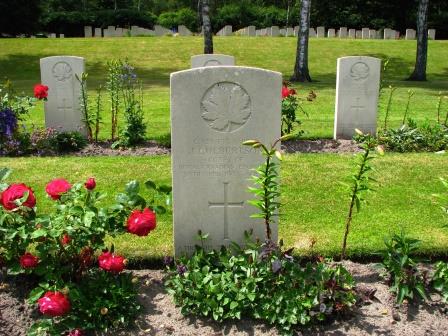
…Lawrence is buried in the Canadian War Cemetery in Holten…

He was temporarily buried in Edewecht, Germany before being reburied in the Canadian War Cemetery in Holten, The Netherlands a year later.

lucas, lawrence edward grave from Holten

Grave of Lawrence Edward Lucas in Holten, The Netherlands.  (Photo courtesy of the Information Centre Canadian Cemetery Holten)

Thank you to Mildred McLeod and Marie Ehler for ensuring that Pieter received a photo of their uncle. Do you have a story to tell? Pieter encourages you to email him at memorialtrail@gmail.com, comment on the blog, or tweet to @researchmemori1.

© Daria Valkenburg

…Want to follow our research?…

Follow our blog

If you are reading this posting, but aren’t following the blog, you are welcome to do so. Our blog address: https://onthewarmemorialtrail.com/.

Front cover OnTheWarMememorialTrailinEurope4 countries, 6 weeks, 7,000 km – an unforgettable war memorial journey in Europe…. Daria’s book ‘No Soldier Buried Overseas Should Ever Be Forgotten‘ is available in print and e-book formats.  Net proceeds of book sales help support research costs and the cost of maintaining this blog. For more information see https://nosoldierforgotten.com/

You are also invited to subscribe to our YouTube Channel: On The War Memorial Trail With Pieter Valkenburg: https://www.youtube.com/channel/UCJ591TyjSheOR-Cb_Gs_5Kw.

Never miss a posting!  Subscribe below to have each new story from the war memorial trail delivered to your inbox.

On The War Memorial Trail…..The WWII Soldier From Victoria Cross Fatally Wounded During The Liberation Of Posterenk

June 29, 2023.  In 2017, Pieter and I visited the village of Posterenk in The Netherlands with Edwin van der Wolf, one of the research volunteers at the Canadian War Cemetery in Holten.

CIMG9295 Sep 25 2017 Posterenk windmill

Windmill in Posterenk, which has a memorial stone inscribed on the wall.  (Photo credit: Daria Valkenburg)

….The Island connection to Posterenk…..

Edwin wanted us to visit the village because it had an Island connection.  Frank GALLANT, son of Anthony and Eleanor Gallant of Mount Carmel, Prince Edward Island, who was with the Carleton & York Regiment, died during there on April 13, 1945 at the age of 32.

The village had a list of 6 soldiers to commemorate from the Carleton & York Regiment, who had all been buried in the area.  In addition to Frank Gallant, the list named another Islander, James ‘Frank’ MOSSEY, of Souris.

Unfortunately, not all soldiers who died are included on this list, but Edwin worked towards including two more, who were not buried near Posterenk, but “were temporarily buried in Lochem because they had previously died in a Canadian hospital there….

These two additional soldiers were: Goldwin Marven POLLICK of Minto, New Brunswick, and Daniel Peter MACKENZIE of Victoria Cross, Prince Edward Island. 

Born March 22, 1918 in Victoria Cross, Daniel ‘Dan’ Peter MACKENZIE was the son of John and Rachael MacKenzie.  His niece, Carol Burke, provided more information on his life when she contacted Pieter in 2015:  “Dan MacKenzie grew up on a farm in Victoria Cross, Prince Edward Island, and attended Victoria Cross school.  He had 3 brothers Johnny, Billy, and Angus, all deceased, and 3 sisters: Florence Rodgerson, Mabel MacNeill, and Edna Campbell, all living in Prince Edward Island. Dan enjoyed playing hockey and ball with his siblings and working on the farm with his father…” 

….Dan MacKenzie enlisted in 1940…..

Before enlisting with the PEI Highlanders in Charlottetown, Prince Edward Island on May 15, 1940, Dan had served in the militia with the PEI Light Horse Regiment (17th Reserve Armoured Regiment) since 1937.  He had been working as a farm labourer for Gavin Read of Montague, Prince Edward Island, and hoped to have a dairy farm of his own.

MacKenzie-Daniel-P (2)

Daniel ‘Dan’ Peter MacKenzie. (Photo courtesy of Carol Burke)

He went to Dartmouth, Nova Scotia for basic training, and remained there until June 3, 1941, when he was sent to Valcartier, Quebec in preparation for guard duty in Newfoundland. 

… Dan was sent to Newfoundland….

NFLD Map shows Botwood

Location of Botwood Military Base in Newfoundland. (Map source: http://postalhistorycorner.blogspot.com/2012/12/wwii-canadian-forces-in-newfoundland.html)

After France was occupied by the Germans in 1940, Newfoundland’s defensive position became more precarious. That same year, Canada assumed responsibility for the defence of Newfoundland with the establishment of ‘W Force’, a Canadian garrison force responsible for defending Newfoundland against enemy incursions and providing security for existing and proposed defence facilities during WWII. It included infantry, artillery, and anti-aircraft units. (See https://en.wikipedia.org/wiki/Military_history_of_Newfoundland_during_World_War_II)

On July 23, 1941, as part of ‘W Force’, Dan was sent to Botwood, Newfoundland.  In addition to the PEI Highlanders, troops from the Black Watch of Canada, Royal Rifles of Canada, The Algonguin Regiment, Queens Own Rifles, also served at various times. While an RCAF base in Botwood had aircraft patrolling the east coast of the Atlantic, Canadian Army personnel based at Botwood were charged with protection of military facilities that had been installed there, as well as in Gander. (See https://www.heritage.nf.ca/articles/politics/botwood-base.php)

…..Three other soldiers were in Botwood…..

Dan was in Botwood at the same time as three other soldiers whose stories have been told on this blog:

Dan remained in Newfoundland until March 20, 1943, when he was sent to Sussex, New Brunswick.  On June 2, 1943, Dan was transferred to the No. 1 Transit Camp in Debert, Nova Scotia, for final preparation and training before being sent overseas. 

…Dan was in the Italian Campaign….

He left Canada on June 10, 1943, arriving in the United Kingdom on June 18, 1943 and posted to No. 7 Canadian Infantry Reinforcement Unit (CIRU).  On October 25, 1943 he participated in Hot Dog, an exercise to prepare troops who would be part of the Central Mediterranean Force (CMF) and travelled on to mainland Europe with the CMF and the Allied Army in Italy (AAI).  Not long afterwards, he was transferred to the Carleton & York Regiment on December 23, 1943, fighting in the Italian Campaign. (See https://en.m.wikipedia.org/wiki/Italian_campaign_(World_War_II))

Carol Burke had noted that Dan’s “… regiment fought just north of Ortona, Italy…. and was in the forefront of the assaulting Infantry that bitterly fought Gustav, Hitler and Gothic Line battles....”

On December 31, 1944 Dan was attached to Allied Forces Headquarters (AFHQ), which controlled all Allied operational forces in the Mediterranean Theatre of Operations until the end of the war.  AFHQ was based in Caserta, Italy after the capture of Sicily and invasion of Italy.

On March 19, 1945 he left Italy as part of Operation Goldflake, arriving in Marseilles, France two days later.  Operation Goldflake was the codename for moving troops from Italy to North-West Europe.  (See https://en.wikipedia.org/wiki/Operation_Goldflake)

The Carleton & York Regiment was now part of the 21st Army Group. From France, troops were moved up to the Belgian front, into The Netherlands, through the Reichswald Forest in Germany, and then back into The Netherlands.

…The Liberation of Posterenk…

On April 12, 1945 the Regiment was part of Operation Cannonshot, which led to the crossing of the IJssel River between the villages of Gorssel and Wilp in the eastern part of The Netherlands. (See https://www.liberationroute.com/stories/190/operation-cannonshot)

Map western holland showing Posterenk

According to the April 12, 1945 war diary entry of the Carleton & York Regiment, they “…moved across the Ijssel River at 14:30 hours….” to relieve the Seaforth Highlanders of Canada.

On April 13, 1945, the war diary entry noted that …‘D’ Company’s objective is Posterenk…The Regiment didn’t expect much opposition, but they “met with stiff resistance just after starting at 11:25 hrs…

With the help of a tank troop, they were able to move forward.  According to the war diary entry, “at 13:37 hrs ‘D’ Company reported that POSTERENK was clear of the enemy, having had one officer killed (Lt. R.B. Savage) and two other ranks wounded but a total of 50 POWs. ‘D’ Company were ordered to push on up the road which they did at once and came under enemy fire…

Dan was one of those wounded. The medical file stated he received gunshot wounds to his abdomen and left hip.  He was taken to a Canadian hospital in Lochem, where he died at 7:30 pm, despite heroic efforts to save him.  He was 26 years old.

…Dan is buried in the Canadian War Cemetery in Holten…

Dan was initially buried in the Lochem Civil Cemetery, before being reburied on February 1, 1946 in the Canadian War Cemetery in Holten.

We visited his grave in 2017 and 2019.  See: https://onthewarmemorialtrail.com/2018/01/20/on-the-war-memorial-trail-at-holten-canadian-war-cemetery/

CIMG9112 Sep 18 2017 Holten Cemetery Pieter by grave of D MacKenzie

Pieter by the grave of Daniel ‘Dan’ Peter MacKenzie at the Canadian War Cemetery in Holten.  (Photo credit: Daria Valkenburg)

Thank you to Carol Burke for sharing a photo and information. “The fact that Cpl MacKenzie’s death came so close to the end of the war and after such a long period of action only added to the sorrow of his loved ones…” she wrote.

If you have a story to tell, Pieter encourages you to email him at memorialtrail@gmail.com, comment on the blog, or tweet to @researchmemori1.    

© Daria Valkenburg

…Previous stories about soldiers commemorated in Posterenk….

…Want to follow our research?…

Follow our blog

If you are reading this posting, but aren’t following the blog, you are welcome to do so. Our blog address: https://onthewarmemorialtrail.com/
Front cover OnTheWarMememorialTrailinEurope4 countries, 6 weeks, 7,000 km – an unforgettable war memorial journey in Europe…. Daria’s book ‘No Soldier Buried Overseas Should Ever Be Forgotten‘ is available in print and e-book formats.  Net proceeds of book sales help support research costs and the cost of maintaining this blog. For more information see https://nosoldierforgotten.com/

You are also invited to subscribe to our YouTube Channel: On The War Memorial Trail With Pieter Valkenburg: https://www.youtube.com/channel/UCJ591TyjSheOR-Cb_Gs_5Kw

Never miss a posting!  Subscribe below to have each new story from the war memorial trail delivered to your inbox.

We Receive A 2023 PEI Heritage Recognition Award

May 15, 2023.  In February 2023, we received a letter saying that the Board of Governors of the Prince Edward Island Museum and Heritage Foundation had selected us – Pieter and Daria Valkenburg – for a Heritage Recognition Award for our ‘powerful’ research project ‘On The War Memorial Trail’ .   (See https://www.peimuseum.ca/pieter-and-daria-valkenburg-heritage-recognition-award)

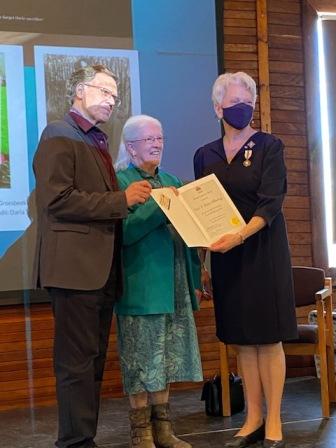
The Awards Ceremony was held on March 12, 2023 at Beaconsfield Carriage House in Charlottetown, with Lt Governor of PEI Antoinette Perry presenting the awards.

…The Awards Ceremony was attended by members of the Tryon & Area Historical Association….

Unfortunately, we were unable to attend the ceremony.  Accepting the Award on our behalf were Arlene and Jack Sorensen (Chair) of the Tryon & Area Historical Society Inc., accompanied by Fran (Secretary) and Tom Albrecht also of Tryon.

Dr Matthew McRae, Executive Director of the PEI Museum and Heritage Foundation was the Master of Ceremonies.

IMG_7914 Mar 12 2023 PEI Heritage Awards

Dr Matthew McRae announcing our award. (Photo credit: Fran Albrecht)

Slide18

Image Courtesy of the PEI Museum and Heritage Foundation

Slide19

Image Courtesy of the PEI Museum and Heritage Foundation

IMG_7919 Mar 12 2023 PEI Heritage Awards

Jack and Arlene Sorensen accepted the award on our behalf, presented by PEI Lt Governor Antoinette Perry.  (Photo credit: Fran Albrecht)

…We thanked the PEI Museum and Heritage Foundation for the Heritage Recognition Award….

While we weren’t able to attend the ceremony, we thanked the PEI Museum and Heritage Foundation and provided the following statement….

…We thank the PEI Museum and Heritage Foundation for the Heritage Recognition Award.  We feel it honours each person whose story we have told in the ‘On The War Memorial Trail’ research project. 

Pieter began this research as his thanks to Canadian soldiers. He was born in The Netherlands during WWII, and has always said that ‘Allied soldiers not only liberated my birth country from a brutal occupation, but saved the Dutch people from starvation’.  Over 7,600 Canadian soldiers and airmen are buried in The Netherlands alone, a vivid reminder of the sacrifices made by so many. 

Over the years, as we’ve visited war cemeteries in other countries, and told the stories of many WWI and WWII service personnel, we are continually humbled by those who came before us….

Thank you to Jack and Arlene Sorensen for accepting the Heritage Recognition Award on our behalf, and to Fran Albrecht for taking the photos during the ceremony.

A huge thank you to those who nominated and supported us for this award, and to the PEI Museum and Heritage Foundation for their championship of the history and heritage of Prince Edward Island.

We will continue to research and tell the stories of those who served.  If you have a story to tell, please let Pieter know. Email him at memorialtrail@gmail.com, comment on the blog, or tweet to @researchmemori1.

© Daria Valkenburg

…Want to follow our research?….

Follow our blog

If you are reading this posting, but aren’t following the blog, you are welcome to do so. Our blog address: https://onthewarmemorialtrail.com/

Front cover OnTheWarMememorialTrailinEurope4 countries, 6 weeks, 7,000 km – an unforgettable war memorial journey in Europe…. Daria’s book ‘No Soldier Buried Overseas Should Ever Be Forgotten‘ is available in print and e-book formats.  Net proceeds of book sales help support research costs and the cost of maintaining this blog. For more information see https://nosoldierforgotten.com/

You are also invited to subscribe to our YouTube Channel: On The War Memorial Trail With Pieter Valkenburg: https://www.youtube.com/channel/UCJ591TyjSheOR-Cb_Gs_5Kw.

Never miss a posting!  Subscribe below to have each new story from the war memorial trail delivered to your inbox.

On The War Memorial Trail….. Remembering Sanford Steven Saulis

February 27, 2023.  After an interview about the photo quest for soldiers buried in the Canadian War Cemeteries in The Netherlands ran on APTN in 2021, Pieter was contacted by Patricia Saulis about Sanford Steven SAULIS of Maliseet, New Brunswick, who is buried in the Canadian War Cemetery in Holten, The Netherlands.  (To read the APTN article, see https://www.aptnnews.ca/national-news/dutch-born-p-e-i-man-on-a-mission-to-find-photos-of-first-nations-soldiers-killed-overseas-in-wwii/)

My Uncle Sanford Saulis died on August 10, 1945 and is buried in Holten Cemetery….   Thank you for doing your work on this Project….” Patricia wrote.

…Sanford Saulis was on the photo wish list for the Canadian War Cemetery in Holten….

Sanford was on the photo wish list for the cemetery.  Unfortunately, Patricia did not have a photo of her uncle.   Then, a few months ago, Conrad Saulis wrote us.  “I was recently forwarded an email you sent to my sister Patty last year regarding our Uncle Sanford S Saulis, who is buried in the Holten Canadian War Cemetery in The Netherlands….

Rest assured that we have not forgotten him or the sacrifice he made to protect our Wolastoqey Nation traditional Ancestral lands from fascism. ….I too am on a quest to find a picture of him…

Conrad explained that ….Sanford was my dad’s half-brother – he was born of a different mother before my dad was born…” After Sanford’s mother Suzan died in 1918, his father remarried.

Luckily, Conrad photo quest was successful.  “….Woliwon. I am attaching a pic my niece got from a co-worker in Fredericton of Sanford …

Uncle Sanford 2

Sanford Steven Saulis.  (Photo courtesy of the Saulis Family)

…Sanford was a member of the Wolostoqey First Nation….

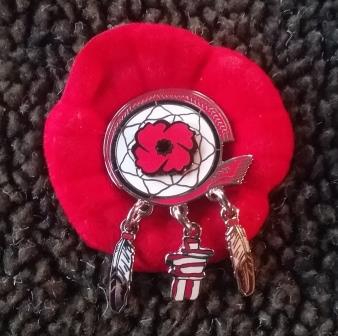
20221108_070012 poppy with indigenous pinBorn September 19, 1914, Sanford Steven SAULIS was the son of William and Suzan (nee Paul) Saulis, members of the Wolostoqey First Nation (formerly known as Maliseet First Nation).   Maliseet is the Mi’kmaq word for the Wolastoqey, members of the Wabanaki Confederacy, a group of Algonquian-speaking nations (See https://www.thecanadianencyclopedia.ca/en/article/maliseet and https://en.wikipedia.org/wiki/Madawaska_Maliseet_First_Nation)
Before enlisting with the No. 7 District Depot of the Canadian Army in Perth, New Brunswick on May 22, 1941, Sanford worked as a hand stitcher at the Philco Shoe Company in Bangor, Maine, USA, and as a general construction labourer for various companies in New Brunswick and Maine.  He also could drive a motorcycle.

In an interview for his Personnel Selection Card, he stated that he enjoyed swimming, skating, hunting, and canoeing.  He also played team sports such as baseball and hockey.

On June 6, 1941, Sanford transferred to the 3rd Battalion (later converted to 4th Battalion) of the Royal Canadian Engineers and sent to Petawawa, Ontario for basic and advanced training.

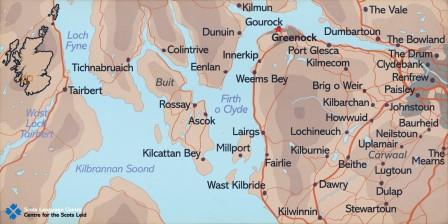
9 Firth of Clyde

Map shows location of Gourock, Scotland in the Firth of Clyde.  (Map source: scotslanguage.com)

Sanford was soon on his way overseas with the 4th Battalion.  They left Halifax, Nova Scotia on September 18, 1941, arriving in Gourock, Scotland on September 27, 1941.  The Regiment was based at Guillemont Barracks in Hampshire, England. (See https://en.wikipedia.org/wiki/Guillemont_Barracks)

Sanford undertook general engineering duties in the Regiment, and attended a heavy bridge course in 1942. Likely this concerned learning about armoured vehicle-launched bridge vehicles, designed to lay down a bridge in combat.

On May 7, 1943 he was transferred to the 29th Field Company of the Royal Canadian Engineers. In March 1944 he was sent for a series of courses in driving Class ‘B’ vehicles, such as heavy armoured trucks, motorcycles, light reconnaissance vehicles, and tractors.

…Sanford went overseas with his Regiment after D-Day….

On July 5, 1944 he left the United Kingdom for France.  By July 1945 he was in northwest Europe. On August 8, 1945, following a short hospital stay for treatment of dermatitis, Sanford was transferred to the 16th Field Company of the Royal Canadian Engineers.

Screenshot 2023-02-26 at 12-04-24 MICHELIN Breukelen map - ViaMichelin

Map shows Breukelen and Hilversum. (Map source: https://www.viamichelin.com)

The 16th Field Company was based at a camp near Breukelen, The Netherlands.  The war diary for August 9, 1945 reported “…Heavy rain and 21oC…..” and that they were working towards getting the moat at Nyenrode Castle cleared of weeds.  “…Some wood blocks linked together as a chain and towed by a row-boat does a fair job…” This was an example of the variety of tasks undertaken by the Royal Canadian Engineers in the aftermath of war.  (See https://www.spottinghistory.com/view/3618/nyenrode-castle/)

nijenrode_castle

Nyenrode Castle, with the moat surrounding it.   (Photo source: https://www.castlesworld.com)

…Sanford lost his life due to a brain hemorrhage….

Unfortunately, that night, after Sanford went to sleep, a tragedy occurred.   The war diary for August 10, 1945 recorded that there was “…a fatal accident in the camp; this morning the body of Lance Corporal SS SAULIS was discovered lying on the ground under the window of his room. He was dead but there were no signs of how he met his death; only a small abrasion on his face, and no broken bones….The window was only 15 feet above the ground…

On August 12, 1945 the war diary noted the results of a post-mortem.  Sanford “…died of a hemorrhage of the brain.  This probably caused, and was not caused by, the fall, which explains the lack of signs of any effort …. to save himself…

The post-mortem report concluded that Sanford had died 3-4 hours before his body was found at 8:00 am on August 10, 1945.  Most likely he had gotten up in the night, suffered a brain hemorrhage, and tumbled out the open window.

Sanford was initially buried in the Canadian Section at Hilversum Civil Cemetery.  According to the war diary, his funeral was held on August 13, 1945 at 10:00 am, “…with Honorary Captain BUTLER officiating.  Major MAIN and CARSON (former OC of the deceased) also attended. Lt E. BRACCI was also on hand to pay last respects…

…Sanford was reburied in the Canadian War Cemetery in Holten….

saulis, sanford s. gravestone

Grave of Sanford Steven Saulis in Holten, The Netherlands.  (Photo courtesy of the Information Centre Canadian Cemetery Holten)

Sanford was later reburied in the Canadian War Cemetery in Holten, The Netherlands. Conrad Saulis wrote that “…My dad (Herman) – also a veteran of WWII -once was able to visit his brother’s grave in Holland and on his return from a Canadian celebration over there was very glad that he had found the grave. My dad is deceased and like many other vets told very few stories of his war experiences….

It’s important to recognize that Indigenous soldiers were all volunteers, a point that Conrad noted.  “…As First Nation (Indian) people they did not have to enlist and could not be conscripted to join the army – it was all on a voluntary basis. When my dad and his brother volunteered they did not lose their ‘status’ and neither did my Grandfather William for WWI…

Thank you to Patricia Saulis for initially contacting us about her uncle, and to Conrad Saulis for sharing his photo.  Conrad wrote “I am encouraged by your work to remember all of the veterans buried overseas….” It is an honour for us to research and tell the stories you read on this blog.

No soldier buried overseas should be forgotten

Conrad went on to say that “… I have a ‘bucket list’ task of visiting my Uncle’s grave in the Holten cemetery and to honour his spirit, grave site and headstone with a traditional prayer and blessing (smudge) of our sacred First Nation herbs gathered from Mother Earth. It is never too late for this to happen as he continues his Spirit Life and Walk the traditional blessing is to support his ongoing safety in the Spirit World…” We hope that Conrad is able to make this visit and will share it with us.

If you have a story to tell, please let Pieter know. Email him at memorialtrail@gmail.com, or comment on the blog.

© Daria Valkenburg

…Want to follow our research?….

If you are reading this posting, but aren’t following the blog, you are welcome to do so. Our blog address: https://onthewarmemorialtrail.com/.

Front cover OnTheWarMememorialTrailinEurope4 countries, 6 weeks, 7,000 km – an unforgettable war memorial journey in Europe…. Daria’s book ‘No Soldier Buried Overseas Should Ever Be Forgotten‘ is available in print and e-book formats.  Net proceeds of book sales help support research costs and the cost of maintaining this blog. For more information see https://nosoldierforgotten.com/

You are also invited to subscribe to our YouTube Channel: On The War Memorial Trail With Pieter Valkenburg: https://www.youtube.com/channel/UCJ591TyjSheOR-Cb_Gs_5Kw.

Never miss a posting!  Subscribe below to have each new story from the war memorial trail delivered to your inbox.

On The War Memorial Trail….. Remembering WWII Sapper John Culbertson

February 4, 2023.  After reading ‘Forgotten Soldiers’ by Fred Gaffen, Pieter came across the name John CULBERTSON, listed as a Sapper with the Royal Canadian Engineers, who lost his life on April 30, 1945.

The date of death triggered Pieter’s interest and he wondered if he had been killed in or near The Netherlands. When he learned that John Culbertson was buried in the Canadian War Cemetery in Holten, The Netherlands, he decided to research the service file and see if a family member could be found.

He was soon directed to John’s granddaughter, Diane McQueston (Culbertson).  …My grandmother kept his memory alive…” Diane explained.  We were delighted to have the chance to meet Diane and her husband Rob.

CIMG5792 Sep 11 2022 Diane and Rob McQueston with Pieter

Pieter with Diane and Rob McQueston in Dartmouth. (Photo credit: Daria Valkenburg)

…John was raised on the Tyendinaga Mohawk Territory …..

20221108_070012 poppy with indigenous pinBorn on November 21, 1911 in Oshawa, Ontario, John was the son of George Albert and Mary Ann (nee Smoke) Culbertson.  His parents were from the Tyendinaga Mohawk Territory near Belleville, Ontario, and this is where John lived as a child.  (See https://en.wikipedia.org/wiki/Tyendinaga_Mohawk_Territory)

…Mary Ann Smoke passed away at age 26 when John was 5 years old and his brother Gilbert was 3….” Diane noted.  John’s father remarried.  “…Mary Ann Pelling was George’s second wife and they had 4 children… John looked at Mary Ann Pelling as his Mom….

CIMG5786 Wedding photo John and Mabel Culbertson

June 14, 1930 wedding photo of John and Mabel Culbertson, married in Belleville, Ontario.  (Photo courtesy of the Culbertson Family)

After leaving school, John worked as a brass moulder at Corbin Lock in Belleville, Ontario for 10 years before enlisting.

Diane told us that “…my grandparents met at a dance in Belleville and married in 1930, when my grandfather was 19, and my grandmother was 18.  My grandmother, Mabel Florence Brown, was from Middlesex, England.  She never remarried.  My father was their only child….”  Diane’s father, John Harry, was born January 29, 1932.

…John enlisted with the Royal Canadian Engineers…

improved_photo co;ourized4

John Culbertson. (Photo courtesy of the Culbertson Family. Photo colourization by Pieter Valkenburg)

John enlisted with the Royal Canadian Engineers at No. 3-A District Depot in Kingston, Ontario on June 14, 1944, and was sent to the Canadian Engineer Training Centre (CETC) in Petawawa, Ontario. He qualified as a Moulder Group B on October 27, 1944 and was entitled to draw an additional Trades Pay.

CIMG5783 4 generations Culbertsons

John with his son, grandmother, and father in 1944. Left to right:  John Harry Culbertson, Margaret Culbertson, John Culbertson, George Albert Culbertson.  (Photo courtesy of the Culbertson Family.)

On November 29, 1944, John left Canada for the United Kingdom, arriving on December 9, 1944, where he was assigned to the Canadian Engineer Reinforcement Unit (CERU).  After undertaking further training, he qualified as a Driver Class III on March 24, 1945. This meant he was qualified to drive heavy trucks and armoured cars.

On April 11, 1945, John was sent to North West Europe, and then transferred to the 8th Canadian Field Squadron on April 18, 1845.

…John lost his life during the Battle of Edewecht…

Map showing Edewecht, Germany where John Culbertson

On April 30, 1945, the 8th Canadian Field Squadron was in Edewecht, Germany, the scene of severe fighting during the last weeks of the Second World War. During the Battle of Edewecht, Canadian troops experienced fierce house-by-house fighting against fanatic German paratroopers and other soldiers.

In A Souvenir War History – 8th Canadian Field Squadron Royal Canadian Engineers 1941-1945 by Cpl John Kerr, the author noted that …While maintaining a diversion, Spr Culbertson was killed….”  Ironically, April 30, 1945 was the same day that Hitler committed suicide in Berlin.

…John was buried in the Canadian War Cemetery in Holten…

grave of John Culbertson

Grave of John Culbertson at the Canadian War Cemetery, Holten.  (Photo courtesy Information Centre, Canadian Cemetery Holten)

John was temporarily buried in Ostercheps, Germany before being reburied on March 7, 1946 in the Canadian War Cemetery in Holten, The Netherlands.

In March 1948, Tini Veldman of Ommen, The Netherlands sent a letter to the Department of Veterans Affairs, asking that it be forwarded to the next of kin.  She wanted the family to know that she had adopted the grave, a volunteer program that was organized by the Netherlands War Graves Committee. A note in the file advised that her letter was forwarded to John’s widow on March 31, 1948.

This was not an unusual occurrence. Many family members of soldiers that we have met over the years have been in contact with Dutch citizens whose families adopted a grave in the early post-war years.

John’s son, John Harry, followed in his father’s footsteps in serving his country, enlisting in the Royal Canadian Navy in 1954, retiring as an aviation technician 25 years later.

Thank you to Diane McQueston (Culbertson) for sharing photos and information about her grandfather, and to Shawn Rainville for searching through newspapers to help Pieter find family members.  If you have a story to tell, please let Pieter know. Email him at memorialtrail@gmail.com, or comment on the blog.

© Daria Valkenburg

…Want to follow our research?….

If you are reading this posting, but aren’t following the blog, you are welcome to do so. Our blog address: https://onthewarmemorialtrail.com/

Front cover OnTheWarMememorialTrailinEurope4 countries, 6 weeks, 7,000 km – an unforgettable war memorial journey in Europe…. Daria’s book ‘No Soldier Buried Overseas Should Ever Be Forgotten‘ is available in print and e-book formats.  Net proceeds of book sales help support research costs and the cost of maintaining this blog. For more information see https://nosoldierforgotten.com/

You are also invited to subscribe to our YouTube Channel: On The War Memorial Trail With Pieter Valkenburg: https://www.youtube.com/channel/UCJ591TyjSheOR-Cb_Gs_5Kw.

Never miss a posting!  Subscribe below to have each new story from the war memorial trail delivered to your inbox.

Happy Holidays From The Valkenburgs – And Our Year In Review!

header

December 24, 2022.  It’s hard to believe how quickly 2022 has raced by.  It seems like only yesterday that Pieter was preparing his research plan for the year, and I was working on the final chapters of a book.

It’s been a busy year.  Several long-standing searches for photos were successful, meaning Pieter could complete his files for those soldiers.  New research files were added, such as the request to find photos and family for 4 soldiers of Ukrainian descent, and Pieter was able to finish his research for many of the unfinished files from 2021.  There is a lag between him completing his work and me getting a chance to document his research, but that is on my ‘to do’ list for this winter.

While we didn’t get to travel as much as we had hoped, we were able to meet several families, which we very much appreciated.  We were able to able much with the help of media, and the many families that came forward to share photos and information.  What follows in the rest of this posting is a summary of what happened in 2022 with this research project.

…Book ‘No Soldier Buried Overseas Should Ever Be Forgotten’….

In February 2022 a book Daria wrote about our 2017 war memorial tour in Europe through 4 countries was published, and is available in print and e-book formats.  See www.nosoldierforgotten.com for more information.

OnTheWarMememorialTrailinEurope_Barcode

…Pieter Honoured With PEI Senior Islander of the Year Award….

On October 21, 2022, Pieter Valkenburg received the PEI Senior Islander of the Year Award, for his ongoing research to uncover the stories and photos of those who served in WWI and WWII, and sharing his research findings with the public.

The certificate was presented by the Hon. Matthew Mackay, Minister for the Department of Social Development and Housing, and Audrey Morris, Chairperson, PEI Seniors Secretariat, in a ceremony at the Loyalist Inn in Summerside.   (See https://onthewarmemorialtrail.com/2022/10/23/pieter-receives-pei-senior-islander-of-the-year-award/)

…. Soldiers Listed On The Cenotaph Outside Borden-Carleton Legion …….

This year we added more information on soldiers whose stories had previously been told:

  • After a 7 year search we received a photo for WWI soldier James CAIRNS of Kinkora, Prince Edward Island, who died during the Battle of Amiens and is buried in France.
  • After another 7 year search we received a photo for WWII soldier Leonard Stephen AVERY of Bedeque, Prince Edward Island, who died after he was accidentally shot through the head while examining a rifle. He’s buried on Prince Edward Island.

 … WWI Related Stories….

  • We explained what a Field Post Card was and shared more observations from WWI soldier Harold Keith HOWATT, giving a comparison of what went into the Field Post Card and what he actually experienced that didn’t go into the card.
  • We shared the story of how a photo of WWI soldier Lloyd Clifton SHORTLIFF of Barton, Nova Scotia, whose named is inscribed on the Vimy Memorial in France, was saved when a Legion member bought it at an auction. A Legion in Nova Scotia will be taking possession of this picture.

 … WWII Related Stories….

  • We shared a story about the 2021 candle lighting at graves of Canadian soldiers in The Netherlands.
  • We shared on update on a 2020 posting about Ralph Gordon MCCUTCHEON, a WWII flight student at the No. 9 Service Flying Training School RCAF in Summerside, Prince Edward Island, who died in a plane crash in North Tryon, Prince Edward Island.
  • We shared a visit that Pieter made to Coffeen Nature Preserve in Santa Rosa Beach, Florida, site of a WWII era JB-2 missile launching test site. The JB-2 flying robot bombs were the American version of the German V1 flying bombs.
  • We shared a story about the 2022 commemoration of 8 Carleton and York Regiment soldiers who lost their lives during the liberation of the village of Posterenk in The Netherlands on April 13, 1945.
  • We shared a story about the May 6, 2022 unveiling of the Monument in Gendringen, The Netherlands to commemorate those who lost their lives, including 41 Canadian soldiers and airmen.
  • We shared the story of the successful outcome of a photo search for WWII soldier Allan ‘Gordon’ COUTTS of the North Nova Scotia Highlanders, who is buried in the Canadian War Cemetery in Holten, The Netherlands.
  • We shared a story of the tribute to 27 Ukrainian-Canadian soldiers at the Canadian War Cemetery in Holten, The Netherlands.
  • We shared a story about the search for WWII soldier Wilfred GIROUX who was in Gilze Rijen, The Netherlands in December 1944 and befriended a Dutch couple, and whose daughter wished to repatriate a photo and two Christmas cards to the Giroux family.
  • We shared the heart-warming story about how WWII soldier Frank MACEWEN and his friends made Christmas 1944 in England memorable for the Pearce family.

…Indigenous Soldiers….

We were able to tell the stories of the service by these WWII Indigenous soldiers:

  • WWII Indigenous soldier Philip LAFORTE from Manitoba, who was killed in The Netherlands.
  • WWII Indigenous soldier John ‘Jack’ Richard MARACLE from Ontario, who was killed in Germany.
  • WWII Indigenous soldier Stanley Owen JONES from British Columbia, who drowned on September 8, 1945 in Germany when the carrier he was in overturned in a ditch.

…. Stories About Servicemen From The Maritimes…

We also featured stories about servicemen from The Maritimes:

  • WWI soldier Theodore (Ted) Francis ARSENAULT from Prince Edward Island, who lost his life during the Battle of Amiens in France.
  • WWII soldier Bruce Wilbur CHURCHILL from Nova Scotia, who was accidentally killed in The Netherlands when a bullet from a Bren Gun ricocheted and hit him.
  • WWII airman Rowan Charles ‘Bunky’ FITZGERALD from Prince Edward Island, who was on the last flight of Halifax W1175 of the 405th Squadron when it was hit by shellfire and crashed onto a sandbank in the Wadden Sea off the Dutch coast.
  • WWII soldier Carman Edward GILLCASH from Prince Edward Island, who lost his life during the Battle of the Delfzijl Pocket in The Netherlands.
  • WWI soldier George Stanley HENNESSEY from Prince Edward Island, who was in the 1st Canadian Engineers Battalion and survived the war.
  • WWI soldier Chesley William HOWATT from Prince Edward Island, who was in the 50th Battalion Canadian Expeditionary Force, and survived the war.
  • WWII soldier Richard Lea HOWATT from Prince Edward Island, who was a despatch rider and scout and survived the war.
  • WWI soldier John David MACDONALD from Prince Edward Island, who was in the 26th Battalion (New Brunswick Regiment) and survived the war.
  • WWII soldier Donald Charles MACKENZIE, from Nova Scotia, who was killed in The Netherlands.
  • WWII soldier George ‘Ivan’ MACKINNON, from Prince Edward Island, who was killed in The Netherlands during the defence of the Nijmegen Salient.
  • WWII soldier Michael Joseph ‘Joe’ MCKENNA, from Prince Edward Island, who was killed in The Netherlands during the Battle of Rha.
  • WWII soldier James ‘Frank’ MOSSEY, from Prince Edward Island, who was killed in The Netherlands while serving in the Carleton & York Regiment.
  • WWII soldier Harold Gordon SABEAN, from Nova Scotia, who was killed in The Netherlands while serving in the Carleton & York Regiment.
  • WWI soldier William ‘James’ SEAMAN from Prince Edward Island, who was in the 105th Overseas Battalion and survived the war.

…. Stories About Servicemen From Outside The Maritimes…

  • WWII soldier Elie ANTONYSZYN, from Manitoba, who died on July 15, 1945 in The Netherlands.
  • WWII soldier Albert Joseph COTE, born in Quebec but grew up in Ontario, who died on October 5, 1944, of wounds received during the Battle of the Leopold Canal in a prisoner of war field hospital in Germany,
  • WWII soldier Cecil Edward GOODREAU, from Ontario, who was killed in Germany during the Battle of Keppeln on February 26, 1945.
  • WWII soldier Andrew KERELCHUK, born in Manitoba but who moved to Ontario, and who was killed in Germany on April 19, 1945, during the Battle of the Küsten Canal.
  • WWII soldier Sam MATVICHUK, born in Saskatchewan but lived in Alberta, who was killed in The Netherlands on April 14, 1945 during the Battle of Groningen.
  • WWII soldier Neville William NESBIT, from Manitoba, who was killed in Germany on May 2, 1945 following the Battle for Bad Zwischenahn.
  • WWII soldier Anthony PETTA, from Ontario, who was killed in Germany during the Battle of Hochwald Gap on March 2, 1945, but whose death is recorded as March 3, 1945.
  • WWII soldier John RUSNAK, from Manitoba, who died in Germany on November 22, 1945 following a collision between his despatch motorcycle and a farm wagon.
  • WWII soldier John ‘Jack’ Langford WALKER, from Ontario, who was killed in Bad Zwischenahn, Germany on May 1, 1945.

…In Conversation And More….

  • We shared a few adventures that we had in North Bay in May, including people we met, a visit to the North Bay Cenotaph, and an Author Talk at the North Bay Public Library.
  • We wrote about the Author Talk at the Victoria Playhouse in Victoria-By-The-Sea in August.
  • We wrote about the Remembrance Day ceremonies we attended in Borden-Carleton and Kinkora, two Prince Edward Island communities.

…. Interviews To Highlight Search For Photos….

Pieter did several interviews:

  • On Friday, November 11, 2022, Pieter was interviewed by Todd van der Heyden of CTV news in a feature entitled Military researcher identifies 200 fallen soldiers | CTV News.
  • Charlotte MacAulay of the Eastern Graphic wrote about the successful photo search for WWII soldier George ‘Ivan’ MACKINNON, who is buried in The Netherlands. The article, ‘Sturgeon soldier’s photo discovered in church’, ran in the newspaper on November 9, 2022.
  • On Monday, November 7, 2022, Pieter was interviewed by Ceilidh Millar of CTV Atlantic News At 5 about the search for 4 soldiers of the North Nova Scotia Highlanders Regiment who died during the Battle of Bienen on March 25, 1945. You can read the article and watch the video.  See P.E.I. man identifying Canadian soldiers in the Netherlands | CTV News https://www.ctvnews.ca/atlantic/article/maritime-man-appeals-to-public-for-help-in-identifying-lost-canadian-soldiers-overseas/
  • Kevin Rollason of the Winnipeg Free Press wrote about Pieter’s search for photos and featured the story of WWII Indigenous soldier Thomas CHASKE, then listed the names of several other soldiers from Manitoba who are buried in The Netherlands.  The article, ‘A name without a face’, ran online on November 4, 2022 and in the print edition on November 5, 2022.  See https://www.winnipegfreepress.com/local/2022/11/04/a-name-without-a-face
  • Charlotte MacAulay of the Eastern Graphic wrote about the photo search for WWII soldier George ‘Ivan’ MACKINNON, who is buried in The Netherlands. The article, Researcher seeking photo of Second World War soldier, ran in the newspaper on September 21, 2022.  This search was successful.
  • Pieter was interviewed by Charlotte MacAulay of the Eastern Graphic, about the photo search for WWII soldier James Frank MOSSEY, who is buried in The Netherlands.  The article, Researcher seeks photo of Souris soldier from Second World War, ran in the newspaper on June 1, 2022.  This search was successful.
  • Pieter and Daria were interviewed by Peter J. Wilson of the North Bay Nugget, about their research into soldiers buried in The Netherlands.  The article Couple devoted to telling fallen soldiers’ stories | North Bay Nugget ran in the online version on May 19, 2022 and in the print version on May 20, 2022.  See https://www.nugget.ca/news/couple-devoted-to-telling-fallen-soldiers-stories
  • Pieter was interviewed by Marcel Vink of De Telegraaf, a newspaper in The Netherlands, about his research into Canadian soldiers buried in The Netherlands.  The article Zoektocht naar gezichten (Quest For Faces) ran in the newspaper on May 4, 2022 – Remembrance Day in The Netherlands. See https://onthewarmemorialtrail.com/2022/05/04/article-in-de-telegraaf-quest-for-faces-zoektocht-naar-gezichten/
  • Pieter was interviewed by Charlotte MacAulay of the Eastern Graphic, about the successful photo search for WWII soldier Barney McGuigan, who is buried in The Netherlands.  The article Search for teen soldier’s photo is successful, ran in the newspaper on January 13, 2022.  See https://www.peicanada.com/eastern_graphic/search-for-teen-soldier-s-photo-is-successful/article_eaee52fa-72e6-11ec-b539-d33f425bb7c3.html

…. Letters To The Editor For Photo Searches….

Letters to the editor in various newspapers were written in the quest for a photo for:

… Successful Search For Photos …..

Many WWII soldiers are buried in cemeteries in Europe.  Pieter continues to work with photo wish lists from Canadian War Cemeteries for WWII soldiers buried in The Netherlands.  This year we also received photos and information on soldiers buried in Belgium.

Photos of soldiers buried in Dutch cemeteries were forwarded to researchers there for their digital archive. Whenever possible, stories are featured on the blog but there is a backlog due to the success of Pieter’s research.  I can’t keep up! This year, photos were found for:

Buried in Holten Canadian War Cemetery in The Netherlands:

  1. Elie ANTONYSZYN
  2. William Eben BROWN
  3. Albert Joseph COTE
  4. John CULBERTSON
  5. Theodor ‘Ted’ HENSCHEL
  6. Andrew KERELCHUK
  7. Amil Adolph LARSON
  8. Donald Charles MACKENZIE
  9. Sam MATVICHUK
  10. Neville William NISBET
  11. Joseph Edmond ROBICHEAU
  12. John RUSNAK
  13. Harold Gordon SABEAN
  14. John Langford ‘Jack’ WALKER
  15. William Henry ‘Barney’ WEBB

 Buried in Groesbeek Canadian War Cemetery in The Netherlands:

  1. Clifford BATEMAN
  2. John Joseph BOHON (BOHONKO)
  3. Charles ‘Marshall’ CARSON
  4. James Edward DUFFY
  5. Cecil Edward GOODREAU
  6. James Edward ‘Eddy’ DUFFY
  7. Marven Glenroy HARVEY
  8. Kitchener ‘Kitty’ LANGILLE
  9. John Richard ‘Jack’ MARACLE
  10. George ‘Ivan’ MACKINNON
  11. Marvin William MCGREGOR
  12. Laurie Douglas PAGE
  13. Wilfred Joseph ‘Willy’ POWER
  14. Anthony PETTA
  15. Louis Allan SEXTON

 Buried in Bergen Op Zoom Canadian War Cemetery in The Netherlands:

  1. Milton Evangeline LIVINGSTONE
  2. Robert K. VIDITTO

 Buried in an unmarked grave in The Netherlands following an aircrash:

  1. Rowan Charles ‘Bunky’ FITZGERALD

 Buried in Adegem Canadian War Cemetery in Belgium:

  1. David ‘Dave’ Stinson HENDERSON
  2. Ronald ‘Ronnie’ Sidney HOOLE

The YouTube Channel….

In 2022 the following videos were posted on the YouTube channel:  On The War Memorial Trail With Pieter Valkenburg: https://www.youtube.com/channel/UCJ591TyjSheOR-Cb_Gs_5Kw

  • S3E1 Book Trailer for ‘No Soldier Buried Overseas Should Ever Be Forgotten’
  • S3E2 Photo Search-WW2 Soldier Austin Havelock Munroe

…Thank you for your support and encouragement of this research project!…

As 2022 comes to an end, we would like to thank all who helped with researching these stories and contributed photos. We also thank readers of this blog, and the On The War Memorial Trail column in The County Line Courier, who suggested some of stories you’ve read.  A big thank you goes to Mike and Isabel Smith, owners of The County Line Courier.

Thank you to all the families that contributed photos and stories. Thank you to Judie Klassen and Shawn Rainville who volunteered their time to help find families of soldiers through newspaper and online searches. Thank you to Don Smith for answering any aircraft and military flight questions we’ve had.

Thank you to the media who helped publicize the search for photos and information – Bay Today, CBC Radio’s Mainstreet PEI, CTV News, CTV Atlantic News, Dauphin Herald, De Telegraaf, Eastern Graphic, North Bay Nugget, The Guardian, and the Winnipeg Free Press.

Last, but not least, the YouTube channel and videos would not be possible without the invaluable support of post-production editor Wendy Nattress.  Wendy also designed and manages the book website.

….Happy Holidays

Pieter and I wish you all the best for the holidays and in 2023. May we never forget those who gave their lives for our freedom.

Xmas 2022 photo

Pieter’s research work continues. If you have photos or information to share, please email Pieter at memorialtrail@gmail.com, comment on the blog, or send a tweet to @researchmemori1.

© Daria Valkenburg

…Want to follow our research?….

If you are reading this posting, but aren’t following the blog, you are welcome to do so.  Our blog address: https://onthewarmemorialtrail.com/

Front cover OnTheWarMememorialTrailinEurope4 countries, 6 weeks, 7,000 km – an unforgettable war memorial journey in Europe…. Daria’s book ‘No Soldier Buried Overseas Should Ever Be Forgotten‘ is available in print and e-book formats.  Net proceeds of book sales help support research costs and the cost of maintaining this blog. For more information see https://nosoldierforgotten.com/

You are also invited to subscribe to our YouTube Channel: On The War Memorial Trail With Pieter Valkenburg: https://www.youtube.com/channel/UCJ591TyjSheOR-Cb_Gs_5Kw

Never miss a posting!  Subscribe below to have each new story from the war memorial trail delivered to your inbox.

On The War Memorial Trail….. The WWII Soldier From Glenwood Killed During The Battle Of The Delfzijl Pocket

October 22, 2022.  In November 2014, Pieter began helping researchers at the Canadian War Cemetery in Holten to find photos of soldiers buried there who were from Prince Edward Island. It wasn’t until a year later that newspaper articles were published with stories related to Pieter’s research, and three years before this blog began.

Back in 2014, Pieter was initially sent a list of 9 names, one of which was Carman Edward GILLCASH, who was born November 6, 1916 in Glenwood.  As Carman’s story has not yet been told on this blog, we thought it was time to do so.

Photo 1 Carman Gillcash in uniform

Carman Edward Gillcash.  (Photo courtesy of Stewart Gillcash)

Stewart Gillcash submitted photos, and explained that he was the son of Carman’s brother Leland.  “…Carman Edward Gillcash, born and raised on a farm in Glenwood, Prince Edward Island in Canada, was the son of Stewart and Mae (nee Boulter) Gillcash. He had two brothers, Elton and Leland. 

Carman went to school in a one room schoolhouse not far from his home, and, as his father died when Carman was a young boy, he later worked with farmers in his community to help out at home. 

Carman and his younger brother Leland joined the army at a young age, when Leland was only 16 or 17 years of age.  Leland returned from the war, but Carman died there…

Carman enlisted with the PEI Highlanders in Charlottetown on July 15, 1940.  In his Occupational History Form, dated April 8, 1941, Carman stated that he had been working as a fisherman for Wilfred Hickey of O’Leary.

Photo 2 Carman Gillcash on right unknown on left

Carman Gillcash, right, with unidentified soldier. (Photo courtesy of Stewart Gillcash)

… Carman was sent to Newfoundland….

NFLD Map shows Botwood

Location of Botwood Military Base in Newfoundland. (Map source: http://postalhistorycorner.blogspot.com/2012/12/wwii-canadian-forces-in-newfoundland.html)

Carman was sent to Halifax with the PEI Highlanders.  In June 1941, he went to Valcartier, Quebec, and then the Regiment went to Newfoundland in July 1941. An RCAF base in Botwood had aircraft patrolling the east coast of the Atlantic. Canadian Army personnel based at Botwood were charged with protection of military facilities that had been installed there, as well as in Gander. (See https://www.heritage.nf.ca/articles/politics/botwood-base.php)

On June 4, 1942 he was sent to Gander, and then in April 1943 he was posted to Saint John, New Brunswick.  While serving in Newfoundland, Carman was promoted twice, first to Lance Corporal, and then to Corporal.

…..Two other soldiers were in Botwood…..

Carman was in Botwood at the same time as two other soldiers whose stories have been told on this blog:

…Carman was sent overseas….

On June 1, 1943, he was transferred to No 1 Transit Camp in Windsor, Nova Scotia. Just over a week later, along with fellow Islander James ‘Frank’ Mossey, he was on his way to the United Kingdom, arriving there on June 18, 1943, part of the Canadian Infantry Reinforcement Unit (CIRU).

On August 13, 1943, at his own request, Carman was demoted to private.  He then transferred to the Cape Breton Highlanders.  On October 24, 1943 the Regiment went to Italy.

On May 14, 1944 Carman was wounded, but returned to service two weeks later.

On February 19, 1945 he left Italy as part of Operation Goldflake, arriving in Marseilles, France two days later.  Operation Goldflake was the codename for moving troops from Italy to North-West Europe.  (See https://en.wikipedia.org/wiki/Operation_Goldflake)

From France, troops were moved up to the Belgian front, into The Netherlands, through the Reichswald Forest in Germany, and then back into The Netherlands.

…The Regiment participated in the Battle of the Delfzijl Pocket….

The Cape Breton Highlanders relieved The Essex Regiment in the area of Nijmegen, before going towards Dokkum. On April 21, 1945, the Regiment relieved the North Nova Scotia Highlanders.

The next objective was to liberate Delfzijl, which was strategically important to the Germans as it and the surrounding area had batteries with cannons to defend the coastline and the German port of Emden against Allied bombers.

The April 28, 1945 war diary entry for the Cape Breton Highlanders recorded that “…We received word from Brigade this morning that the Perth Regiment did not do so well last night on account of mines. We will likely relieve them tonight so we are to move to another concentration area this afternoon…

The Regiment was on the move quickly in preparation to relieve the Perth Regiment.  “…At 13:50 hours the marching personnel were on the move and half an hour later the vehicles moved. Tactical HQ and B Company were set up in the town of Bierum while the remainder of the Battalion are in the area of Spijk...

The war diary went on to report that “….At 20:00 hours the Observation Post reported very dense smoke coming from the town of Delfzijl, which is our objective. This could be caused by either demolitions by the enemy or our artillery which has been firing on that area.

At 23:55 hours ‘A’ Company moved off to relieve ‘A’ Company of the Perth Regiment. They will likely be the only Company moving tonight…

…Carman lost his life in the wee hours of April 29, 1945….

On April 29, 1945 the war diary reported that “….The first report received from ‘A’ Company was at 01:15 hours when they called for the Medical Officer’s carrier. As the Company was going forward it was met by a large group of P.O.Ws. being escorted back by the Perth Regiment, and as they were passing each other one of the enemy stepped on a mine, killing one of our men and wounding two more…

The fatality in the early morning of April 29, 1945 was Carman.

…Carman was temporarily buried in Wirdum…

Carman was initially buried in 15 Divisional Cemetery in Wirdum, The Netherlands.

Photo 4 Leland brother of Carman Gillcash at the gravesite

Carman’s brother Leland visited his grave.  (Photo courtesy of Stewart Gillcash)

.…Carman was reburied in the Canadian War Cemetery in Holten….

After the war ended, Carman was reburied in the Canadian War Cemetery in Holten, The Netherlands.  We visited his grave twice – in 2017 and again in 2019.

CIMG3219 Oct 3 2019 Holten Carmen Gillcash

Pieter (right) at the grave of Carman Gillcash with researchers Edwin van der Wolf (left) and Henk Vincent (centre) in October 2019.  (Photo credit: Daria Valkenburg)

 …A plaque commemorates Canadian soldiers who died during the Battle of the Delfzijl Pocket….

In 1995, the Stefanus Church in Holwierde placed a plaque to commemorate Canadian soldiers who lost their lives during the Battle of the Delfzijl Pocket.

Plaque at Stefanus Church in Holwierde

Plaque at Stefanus Church in Holwierde, The Netherlands.  (Source: https://www.tracesofwar.nl/sights/40531/Herinneringsplaquette-Stefanus-Kerk.htm)

…We had a chance to meet Stewart Gillcash….

CIMG2610 Sep 8 2018 Pieter with Stewart Gillcash at The Catch

Pieter (left) with Stewart Gillcash.  (Photo credit: Daria Valkenburg)

Thank you to Stewart Gillcash for sharing photos and information on his uncle.  We were able to meet him in September 2018.  (See https://onthewarmemorialtrail.com/2018/09/11/on-the-war-memorial-trail-in-prince-county-pei/)

If you know who the unidentified soldier is in the photo, or have a story to tell, please let Pieter know. You can email him at memorialtrail@gmail.com, or comment on the blog.

© Daria Valkenburg

….. Other Soldiers Mentioned On The Plaque In The Church In Holwierde….

…Want to follow our research?….

If you are reading this posting, but aren’t following our research, you are welcome to do so.  Our blog address: https://onthewarmemorialtrail.com/

Front cover OnTheWarMememorialTrailinEurope4 countries, 6 weeks, 7,000 km – an unforgettable war memorial journey in Europe…. Daria’s book ‘No Soldier Buried Overseas Should Ever Be Forgotten‘ is available in print and e-book formats.  Net proceeds of book sales help support research costs and the cost of maintaining this blog. For more information on the book, please see https://nosoldierforgotten.com/

You are also invited to subscribe to our YouTube Channel: On The War Memorial Trail With Pieter Valkenburg: https://www.youtube.com/channel/UCJ591TyjSheOR-Cb_Gs_5Kw.

Never miss a posting!  Subscribe below to have each new story from the war memorial trail delivered to your inbox.

On The War Memorial Trail….. The WWII Soldier From Port Lorne Who Lost His Life During The Advance To The Apeldoorn Canal

IMG_20220913_144658413_HDR Posterenk photo from John Hetherington

Posterenk town sign. (Photo credit: John Hetherington)

October 8, 2022. When Pieter and I visited the village of Posterenk in The Netherlands in 2017, with Edwin van der Wolf, one of the research volunteers at the Canadian War Cemetery in Holten, we never realized that we would be telling stories about soldiers from the Carleton & York Regiment who lost their lives during the liberation of the village in April 1945!

CIMG9296 Sep 25 2017 Edwin and Pieter by Posterenk windmill

Edwin van der Wolf (left) and Pieter in Posterenk.  (Photo credit: Daria Valkenburg)

….The Atlantic Canada connection to Posterenk…..

Edwin wanted us to visit the village because it had an Island connection.  Frank GALLANT, son of Anthony and Eleanor Gallant of Mount Carmel, Prince Edward Island, was one of the Carleton & York soldiers who died during there on April 13, 1945 at the age of 32.

Over the next years, two more Island soldiers were identified: Daniel Peter MACKENZIE, of Victoria Cross, and James Frank MOSSEY of Souris.

In April 2022, 8 names were commemorated in Posterenk. However, photos of two men were missing: James Frank MOSSEY and Harold Gordon SABEAN. (See https://onthewarmemorialtrail.com/2022/04/17/on-the-war-memorial-trail-posterenk-commemorates-its-liberation-by-the-carleton-and-york-regiment/)

…The search for a photo of Harold Gordon Sabean is successful…

Family of James Frank Mossey came forward this summer, leaving one last Carleton & York soldier whose photo was missing.  A wide-reaching effort was made to uncover a photo, which was successful when Harold E. Wright of Saint John, New Brunswick, received a photo from Harold Gordon SABEAN’s niece, Pam Godsoe.

colourized_photo(12) Sabean

Harold Gordon Sabean. (Photo courtesy of Pam Godsoe. Photo colourization by Pieter Valkenburg.)

Harold was born on March 19, 1918 in Port Lorne, Nova Scotia, son of Solomon ‘Saul’ and Susan ‘Susie’ Alice (nee Hibbard) Sabean.

… After enlistment Harold was quickly sent overseas…

Before enlisting in St John, New Brunswick on March 9, 1940 with the Carleton & York Regiment, Harold was a machinist with T. McAvity & Sons (now Clow Canada) a foundry and valve casting company.  (See https://www.clowcanada.com/about-us/company-history/)

He was initially sent to Woodstock, New Brunswick and went for infantry training in Aldershot, Nova Scotia on March 19, 1940.

On May 4, 1940 he married Josephine Marie Gray at the Stella Maris Roman Catholic Church in St. John, New Brunswick.  A month later, on June 8, 1940, he left Halifax, Nova Scotia for the United Kingdom, arriving in Liverpool on June 20, 1940.

He was sent for a number of training courses while in England – Regimental Gas Instructors Course, Gunner Wing, Qualification Level Motor Transport, Camouflage Course, and Spigot Mortar Course.  He became an Instructor.

… Harold was seconded to Canada as an Instructor…

On March 19, 1943, Harold returned to Canada as an Instructor, and was attached to A-12 Canadian Infantry Training Centre (CITC). A report stated he was a good instructor and hard working.

In July 1943 he was sent to the Battle Drill School in Vernon, British Columbia for further training.

In February 1944, he was sent to No. 1 Transit Camp in Windsor, Nova Scotia prior to returning for overseas service.  A report in his Personnel Selection Record, dated February 9, 1944, recorded that Harold was “…Married- no children.  Sabean is an only child whose parents are deceased...”  It went on to note that he was “… interested in all team sports.  His hobby is wood carving. Reads mechanical magazines. Enjoys usual social pastimes….

He was assessed as being “…suitable for overseas service on operational duties…” and that he was “…mature, willing, and cooperative…

… Harold returned overseas…

On February 16, 1944, he embarked for the United Kingdom, arriving on February 25, 1944.  A month later, on March 26, 1944, he was in Italy with the Regiment.

On August 11, 1944 he left Italy and was sent to France to a Special Services unit.  In December 1944, he left France and was back in Italy on December 9, 1944.  A few days later, on December 12, 1944, he was promoted to Sergeant.

…The Carleton & York Regiment left Italy for North-West Europe…

On March 19, 1945, Harold and his Regiment left Italy for North-West Europe as part of Operation Goldflake, arriving in Marseilles, France on March 21, 1945.  Operation Goldflake was the codename for moving troops from Italy to North-West Europe.  (See https://en.wikipedia.org/wiki/Operation_Goldflake)

From France, troops were moved up to the Belgian front, into The Netherlands, through the Reichswald Forest in Germany, and then back into The Netherlands, arriving near Zutphen on April 10, 1945.

According to the April 12, 1945 war diary entry of the Carleton & York Regiment, they “…moved across the Ijssel River at 14:30 hours….” to relieve the Seaforth Highlanders of Canada. The Regiment’s new objective was to liberate the village of Posterenk which was done on April 13, 1945.

Map western holland showing Posterenk

….Harold was originally buried near Posterenk….

Unfortunately, on April 15, 1945, Harold lost his life as the unit advanced to the Apeldoorn Canal in The Netherlands.  He was one of 6 soldiers initially buried along the main road to Posterenk, a village near Zutphen.

Posterenk list of 6 CYR members

The 6 soldiers buried near Posterenk.

On January 24, 1946, Harold was reburied in the Canadian War Cemetery in Holten.

sabean, harold gordon gravestone from ICB

Grave of Harold Gordon Sabean in Holten, The Netherlands.  (Photo courtesy of the Information Centre Canadian Cemetery Holten)

Thank you to Pam Godsoe, Harold E. Wright of Saint John Heritage, and Kent Caldwell of the Royal Canadian Legion in New Brunswick.  If you have a story to tell, please let Pieter know. You can email him at memorialtrail@gmail.com, comment on the blog, or send a tweet to @researchmemori1.

© Daria Valkenburg

…Previous stories about soldiers commemorated in Posterenk….

…Want to follow our research?….

If you are reading this posting, but aren’t following our research, you are welcome to do so.  Our blog address: https://onthewarmemorialtrail.com/

Front cover OnTheWarMememorialTrailinEurope4 countries, 6 weeks, 7,000 km – an unforgettable war memorial journey in Europe…. Daria’s book ‘No Soldier Buried Overseas Should Ever Be Forgotten‘ is available in print and e-book formats.  Net proceeds of book sales help support research costs and the cost of maintaining this blog. For more information see https://nosoldierforgotten.com/ 

You are also invited to subscribe to our YouTube Channel: On The War Memorial Trail With Pieter Valkenburg: https://www.youtube.com/channel/UCJ591TyjSheOR-Cb_Gs_5Kw.

Never miss a posting!  Subscribe below to have each new story from the war memorial trail delivered to your inbox.

On The War Memorial Trail….. The WWII Soldier From Prince Edward Island Killed During The Battle Of Rha

September 22, 2022. When we did a story on Joseph ‘Joe’ Edmund HENNEBERY, who is buried in the Canadian War Cemetery in Groesbeek, his niece, Teresa Hennebery, mentioned that “My mother Mary and I were in Holland in May 2001 for a commemoration ceremony for her brother (also named Joe) who was killed in Rha a couple of weeks before my other Uncle Joe died.  It was so beautiful and the people of Rha treated us like Royalty….

Exif_JPEG_420

Teresa Hennebery (left) shared information on her uncle, Joe McKenna.  (Photo courtesy Valkenburg Family Collection)

Teresa was referring to her mother’s brother, Michael Joseph ‘Joe’ MCKENNA, who also lost his life during WWII.  In addition to visiting the Canadian War Cemetery in Groesbeek, Teresa and her late mother “… visited Holten Cemetery where Joe McKenna is buried…” (See https://onthewarmemorialtrail.com/2020/05/31/on-the-war-memorial-trail-a-face-for-joseph-hennebery/)

Joe McKenna

Joe McKenna (Photo courtesy Hennebery Family Collection.)

Joe McKenna was born August 22, 1917 in Newton Cross, Prince Edward Island, the son of Patrick Joseph and Laura Josephine McKenna. 

…Joe began basic training in the summer of 1942…

At the time of his enrollment on August 28, 1942 with the #62 Basic Training Centre in Charlottetown, under the National Resources Mobilization Act (NRMA), he had been working on his father’s farm since he left school.  Joe’s mother had died in 1932, and he was the oldest son with two brothers and four sisters.  

The NRMA was a compulsory national registration for military service, originally for home defence, but later for service overseas as WWII continued. (See https://www.thecanadianencyclopedia.ca/en/article/national-resources-mobilization-act)

On October 28, 1942, he was sent for advanced training to A23TC in Halifax, Nova Scotia for a month, then sent to the #22 Anti Aircraft Battery in St. John, New Brunswick. 

Joe remained there until March 1, 1943, when he formally enlisted for active service in Saint John, New Brunswick and was transferred to the 8th Anti Aircraft Battery, Royal Canadian Artillery, which was also in St. John.

… Joe transferred to the Canadian Infantry….

On January 27, 1944, Joe was transferred to the No. 1 Transit Camp in Windsor, Nova Scotia.  Then, a decision was made to ‘reallocate’ Joe to an infantry regiment, and on February 13, 1944 he was transferred to No. 60 Canadian Infantry Basic Training Centre in Yarmouth, Nova Scotia for further training.

After completing basic training, Joe was transferred to the A14 Canadian Infantry Training Centre (CITC) in Aldershot, Nova Scotia on June 11, 1944.

On August 31, 1944 Joe was sent to Debert, Nova Scotia, the final staging and training area for troops going overseas.

… Joe left Canada in October 1944….

Joe’s overseas service began when he boarded a troop ship on October 14, 1944, arriving in the United Kingdom on October 20, 1944.  Upon arrival he was assigned to #4 Canadian Infantry Reinforcement Unit (CIRU).

On November 24, 1944 he went to Northwest Europe as part of a reinforcement unit, then was assigned to the Headquarters of the 8th Canadian Infantry Brigade on January 26, 1945.

Joe had his final transfer on March 14, 1945, when he joined the Queen’s Own Rifles as a rifleman in ‘A’ Company.  The Regiment was in the Reichswald Forest in Germany where Operation Blockbuster had ended.  Reinforcements were needed as preparations began for Operation Plunder

Operation Plunder, which began March 21, 1945 and ended April 1, 1945, involved the crossing of the Rhine River to the north of the Ruhr industrial region in western Germany.  (See https://en.wikipedia.org/wiki/Operation_Plunder)

…Joe’s Regiment left Germany and entered The Netherlands…

After crossing the Rhine River in Germany, the Queen’s Own Rifles entered The Netherlands.  Their new objective was to capture the town of Rha.  The town was near a bridge crossing.  In ‘Battle Diary’ author Charles Cromwell Martin explains its importance. “…The enemy command headquarters for the remaining part of Holland was located at Appeldoorn, and the bridge was the approach that led there…

Martin was the Company Sergeant-Major, ‘A’ Company, in the Queen’s Own Rifles.  He noted there were difficulties due to “…the complete changeover of our men and leaders.  We had received about thirty reinforcements….. But everything was too new, too untried, and this included our new company commander…

…The Regiment prepared to liberate the municipality of Steenderen….

On the afternoon of April 4, 1945, the Queen’s Own Rifles travelled along the IJssel River.  They had already liberated the villages of Steenderen and Toldijk the day before.

The war diary for April 4, 1945 recorded that “… ‘C’ Company was to occupy Rodenburg… and ‘D’ Company to go to Hoefken. ‘A’ Company to Eekhorn and ‘B’ Company to Zwaarte  Schar… The only trouble encountered on the move was by ‘A’ and ‘C’ Companies, who came under fire from an enemy S.P. gun on the other side of the IJssel river and mortar fire from Rha….” S.P refers to self-propelled artillery.

On April 5, 1945 the war diary stated that …plans were laid for an attack that afternoon on the bulge of the east bank of the IJssel…”  Around 3:30 pm, they occupied “…enemy trench systems that had been abandoned…” 

‘A’ Company’s assignment was to occupy Rha. Led by 9 platoon, they “…went into their series of trenches, which were full of water, and followed them around to the outskirts of Rha.  There was quite a lot of sniping and mortaring but the trenches gave them good cover…” 

By 8:00 pm “… the end of the trenches was reached….” and they began their way towards the town.  “….It was getting night time but there was plenty of light from burning buildings…”  They encountered “…furious resistance…” from bazookas.  “…Our own weapons were in very bad shape from the mud encountered in the trenches…

In the midst of counterattacks, two sections of 7 platoon got cut off from the rest. They “…got into a house near the centre of the village…” This was the Berendsen farm. 

By the time the night was over, the war diary reported that “…the final count of casualties was 5 wounded, 5 killed, and 6 missing…”  Four were found killed in the barn on the Berendsen farm.

…The Battle of Rha was deadly….

One of the men killed during the Battle of Rha, and found in the barn, was Joe McKenna. In the 2001 Special Edition of ‘De Zwerfsteen’ (The Boulder), a publication from the Historical Society of Steenderen, a bit more information was provided.  The Berendsen farm was located at 5 Rhabergseweg, and had German troops billeted on the farm.  During the evening of April 5, the family hid in the cellar.

One daughter, Be Helmerhorst-Berendsen, who was 20 years old at the time, gave an eyewitness report.  “…The Germans were not present at the time we came under fire. They must have been in the trenches in the surrounding area….

While they were in the cellar the hatch opened and two Canadians came down the steps.  “…One was injured on the leg and the other one had severe injuries on the head…”  The next morning, the Germans opened the hatch and ordered them to come out.  The Canadians were taken prisoner, the rest allowed to leave.

…As we were leaving the building through the barn, we saw the Canadians lying there, dead.  One lay behind the cows in the gutter.  The second lay in the cows’ trough, still holding the rope of the cow’s neck in his hands, and the third one lay near the back door…

….Joe was initially buried in Rha….

The official death report of the military authorities noted that the helmets of the soldiers had holes in them, likely caused by grenade fragments. They had been killed by Germans who were in trenches about 20 metres in front of the farmhouse. 

The date of deaths on this report was recorded as April 5, 1945 for each soldier.  The date of April 6, 1945 in the service file and on the gravestones was likely due to when the bodies were found and the notice of deaths were received and recorded.

Dutch explanation of deaths

Rha burial

Burial of 4 soldiers in Rha.  (Photo courtesy Hennebery Family Collection, but sent to the family by Henk Dykman.)

One of the organizers of the May 4, 2001 commemoration events in Rha, Reverend Hendrik ‘Henk’ Jan Dykman, wrote to explain that “…Joe died with three comrades in or near the farm of J Berendsen on April 5 1945. He was buried in front of it by German soldiers, with his name carefully put on the grave. The farmer’s daughter took care of the graves till the men were moved to Holten a year later….

The other three soldiers were:

  • James Earl AIKEN, aged 19, son of Basil E. and Alice A. Aiken, of Toronto, Ontario.
  • Thomas ‘Ted’ Edward Cornelius CRAWFORD, aged 31, son of Thomas A. and Nellie Crawford; husband of Marie Edmee Crawford, of Kapuskasing, Ontario. 
  • George Clifford WOODRUFF, aged 23, son of George and Jane Woodruff, of Langstaff, Ontario.

All 4 were reburied in the Canadian War Cemetery in Holten, The Netherlands. 

The 5th casualty mentioned in the war diary was John George KAVANAGH, aged 23, son of Cora Kavanagh and husband of Emily Jean (née Haddleton) of Toronto, Ontario.  He is buried in the Steenderen General Cemetery in Steenderen, The Netherlands.

…Confusion about where Joe McKenna had been originally buried….

20210717_105714 McKenna parents grave in Montague

Grave of Joe McKenna’s parents in Montague, Prince Edward Island. (Photo courtesy Hennebery Family Collection.)

Teresa Hennebery explained that there was confusion about where her uncle was initially buried. “… I was at the graveyard at St. Mary’s church in Montague.  Here is a photo of my grandparents’ gravestone which also recognizes my Uncle Joe McKenna….please note reference to Doesburg. For many years his family thought he was buried in Doesburg….

Screenshot 2022-09-17 at 11-13-37 Doesburg to Rha

Map shows the short distance between Doesburg and Rha.  (Map source: Google)

The confusion wasn’t just on the part of Teresa’s grandparents.  A Field Service Report dated June 7, 1945 recorded that Joe McKenna had died in Germany and been buried in West Bocholt, Germany!  The coordinates of the burial location were recorded as 911850.

… Joe was reburied in the Canadian War Cemetery in Holten….

We asked Henk Vincent from the Canadian War Cemetery in Holten if he could look up where Joe’s body had been before arriving for reburial, as we had a report that he had been buried in Rha. 

A translation of his reply confirmed that Rha was where he was initially buried.  “The East Gelderland area, where Rha is located, is often referred to as West Bocholt in the Canadian War Diaries. If I enter the coordinates QE911850 on the Nord de Guerre map I end up exactly in… Rha, so the report is correct, he was first temporarily buried in Rha….

CIMG3292 Oct 3 2019 Holten Michael McKenna

Grave of Joe McKenna in Holten.  (Photo credit: Daria Valkenburg)

Teresa kindly wrote to say “… Thank you for all you are doing to keep the memory of soldiers buried in Holland alive.  I am so grateful for your work and dedication to this project…” It’s an honour to tell these stories, and we are very appreciative of the effort that families put into remembrance and are willing to share photos and information.

Thank you to Teresa Hennebery for sharing photos and information on her uncle, and to Henk Dykman for sharing a photo and initial burial information.  Thank you also to Henk Vincent for confirming Joe’s original burial location. If you have a story to tell, please let Pieter know. Email him at memorialtrail@gmail.com, or comment on the blog. 

© Daria Valkenburg

…Want to follow our research?….

If you are reading this posting, but aren’t following our research, you are welcome to do so.  Our blog address: https://onthewarmemorialtrail.com/

Front cover OnTheWarMememorialTrailinEurope4 countries, 6 weeks, 7,000 km – an unforgettable war memorial journey in Europe…. Daria’s book ‘No Soldier Buried Overseas Should Ever Be Forgotten‘ is available in print and e-book formats.  Net proceeds of book sales help support research costs and the cost of maintaining this blog. For more information see https://nosoldierforgotten.com/

Subscribe to our YouTube Channel: On The War Memorial Trail With Pieter Valkenburg: https://www.youtube.com/channel/UCJ591TyjSheOR-Cb_Gs_5Kw

Never miss a posting!  Subscribe below to have each new story from the war memorial trail delivered to your inbox.

On The War Memorial Trail….. The WWII Soldier From Flin Flon Who Was Born In Stonewall

September 10, 2022. Sometimes a photo request that Pieter receives brings back childhood memories… and is the impetus for choosing which name to research out of dozens on a list.  That was the case when we looked at the list of photo requests from the Canadian War Cemetery in Holten, The Netherlands, and I saw that one of the soldiers, Neville William NISBET, was listed as being from Flin Flon, Manitoba.

That’s a soldier you have to research!”  I said to Pieter.  “I’ve been to Flin Flon!

Big deal, Pieter thought.  Since I was born in Winnipeg, it was no surprise to him that I’ve been to places in Manitoba.  But he had no idea how far north Flin Flon was and how the name captured the imagination of two young kids – my brother and me – when we travelled there with our parents, and had a photo taken at the statue at the edge of town.

Ca 1967 Daria Mom Gary by statue in Flin Flon

Daria (by red arrow) with her brother and mother by the statue of Flintabbatey Flonatin in 1967.  (Photo courtesy Valkenburg Family Photos)

Flin Flon, located in northern Manitoba, is named after Josiah Flintabbatey Flonatin, a science fiction character from the 1905 book The Sunless City, by British writer J.E. Preston Muddock. (See https://www.erbzine.com/mag18/sunless.htm)  When a mining prospector found and read a copy of the book in a cabin near the future town site in 1915, he named his claim Flin Flon, and that became the name of the town.

……Neville Nisbet was not born in Flin Flon!…

When Pieter began his research, however, he learned that Neville wasn’t born in Flin Flon, but in Stonewall, just outside of Winnipeg, Manitoba.  Neville was born on August 7, 1916, son of William J. and Lillian (nee Bennett) Nisbet.

According to the May 13, 1936 edition of the Stonewall Argus newspaper, Neville left Stonewall to take a position in Herb Lake (near Snow Lake) in northern Manitoba with Laguna Gold Mines Ltd.

By the time of his enlistment in Winnipeg at No. 10 District Depot on June 22, 1944, Neville was living in Flin Flon, where he was employed as a millwright with Hudson Bay Mining and Smelting Company.  He had married Hazel Umpherville in Flin Flon on December 8, 1938, and by 1944 they had two children.

….Neville’s son provided a photo…

Neville’s son Don provided a photo, explaining that “we have very few pictures of my father….  Thanks for your work on this project…

img187 Neville Nisbet from Brenda Fleming

Neville Nisbet.  (Photo courtesy of the Nisbet Family)

…Neville’s military service began in Manitoba and ended in Germany…

After enlisting, Neville was sent to #103rd Canadian Infantry Basic Training Centre (CIBTC) in Winnipeg.  On September 16, 1944, he was transferred to A15 Canadian Infantry Training Centre (CITC) in Shilo, Manitoba.

On January 5, 1945, Neville was transferred to the No. 2 Transit Camp in Debert, Nova Scotia in preparation for going overseas on January 11, 1945. He arrived in the United Kingdom on January 18, 1945 and was attached to the Canadian Infantry Training Regiment (CITR).

He was sent to northwest Europe on March 18, 1945, and then transferred to the Lincoln and Welland Regiment on April 6, 1945.  The Regiment was near Delden, The Netherlands and had just captured the Twentecanal.

On April 7, 1945, the Regiment left Delden to join the rest of the Division already advancing into Germany.

…The Regiment fought for control of Bad Zwischenahn….

The War Diary for the Lincoln and Welland Regiment for April 25, 1945 noted that the Regiment “…was to come under command of 4th Canadian Armoured Brigade at 0700 hour tomorrow. The Brigade’s objective was to be the town of Bad Zwischenahn…” (See https://www.canadiansoldiers.com/history/battlehonours/northwesteurope/badzwischenahn.htm)

badzwischenahn

Map shows the path taken by the Lincoln and Welland Regiment. Neville Nisbet lost his life just outside Bad Zwischenahn. (Map courtesy of http://www.canadiansoldiers.com)

The War Diary entry for May 1, 1945 recorded that “…the emissary had been sent into the town of Bad Zwischenahn and the town had surrendered…” and that the Regiment was to be part of the 10th Brigade.  They were ordered to begin the move through Bockhorn and Neuenburg.

On May 2, 1945, under weather that was cloudy with rain, the War Diary entry stated that forward movement was hampered due to encountering heavy resistance, with artillery and sniper attacks.  At some point during that day, Neville lost his life, aged 28.

…Neville was buried in the Canadian War Cemetery in Holten….

Neville was initially buried east of Bad Zwischenahn, Germany, before being reburied in the Canadian War Cemetery in Holten, The Netherlands on March 16, 1946.

Headstone of Neville Nisbet

Neville Nisbet’s grave at the Canadian War Cemetery in Holten.  (Photo courtesy of Canadian Virtual War Memorial)

….Nisbet Lake in northern Manitoba is named in his honour…..

Screenshot 2022-09-06 at 12-10-30 Nisbet Lake _ Nisbet Lake Manitoba Canada North America

Nisbet Lake in northern Manitoba.  (Map source: google)

Nisbet Lake in northern Manitoba was named after Neville in 1974.

…Another soldier who lost his life near Bad Zwischenahn…

John ‘Jack’ Langford WALKER, who was with the 21st Canadian Armoured Regiment (The Governor General’s Foot Guards), died near Bad Zwischenahn on April 30, 1945.  You can read his story here: https://onthewarmemorialtrail.com/2022/07/13/on-the-war-memorial-trail-in-north-bay-the-ww2-soldier-who-lost-his-life-on-the-day-hitlers-death-was-announced/

Thank you to Don Nisbet for providing a photo, and thank you to Judie Klassen for help in finding family and newspaper articles.  If you have a story to tell, please let Pieter know. Email him at memorialtrail@gmail.com or comment on the blog.

…Want to follow our research?….

If you are reading this posting, but aren’t following the blog, you are welcome to do so.  See https://onthewarmemorialtrail.com/ or email me at dariadv@yahoo.ca and ask for an invitation to the blog.

Front cover OnTheWarMememorialTrailinEuropeDaria’s book ‘No Soldier Buried Overseas Should Ever Be Forgotten‘ is available in print and e-book formats.  For more information see https://nosoldierforgotten.com/

You are also invited to subscribe to our YouTube Channel: On The War Memorial Trail With Pieter Valkenburg: https://www.youtube.com/channel/UCJ591TyjSheOR-Cb_Gs_5Kw.

© Daria Valkenburg