On The War Memorial Trail…..Duty Sacrifice Resilience Part 1: The WWI Soldier Whose War Injuries Didn’t Stop Him From Living His Life

May 18, 2026. Since Pieter began the On The War Memorial Trail research project in 2014, it’s been an honour for us to meet families of those who served.  While much of the focus is on those who served our country and lost their lives while in service, most military service personnel in WWI and WWII returned home. We don’t often know much about their time in service, or what happened afterwards.  As families come forward with information, we are trying to tell these stories.

Brenda Graves of North Tryon, Prince Edward Island shared that both of her husband Stuart’s grandfathers served in WWI and returned home with major injuries.  “…Stuart’s paternal grandfather lost a leg in 1917 and his maternal grandfather was grievously injured in the nose, shoulder, and throat by an exploding grenade in 1918…

Both men had immigrated to Canada from the United Kingdom, overcame difficult challenges as a result of their war injuries, and went on to marry and live productive lives in Winnipeg, Manitoba.

We decided to tell the story of both grandfathers, and began with Stuart’s paternal grandfather, Francis Edmund GRAVES.

….Francis immigrated to Canada when he was 15 years old…

Born November 5, 1877 in Sheffield, England, Francis was the son of Henry and Mary Ann (nee Lindley) Graves, the second youngest of 6 children, per an 1881 census.

At the young age of 15, he immigrated to Canada, arriving on May 1, 1893 in Quebec City, Quebec aboard the S.S. Sardinian, which had sailed from Liverpool, England on April 20, 1893.  (See https://en.wikipedia.org/wiki/SS_Sardinian) The S.S. Sardinian was an Allan Line steamship that transported British Home Children to Canada, between 1875 and the early 20th century, part of an assisted migration scheme that sent orphaned or underprivileged children for farm work and domestic labour. Francis was listed as a domestic whose destination was Prince Albert, Saskatchewan, so it’s possible that he came to Canada under this program.

It’s unknown if Francis went to Prince Albert, but his obituary noted that he had worked on a farm in Melfort, Saskatchewan.  By the time WWI broke out, he was living in Calgary, Alberta, where he enlisted with the 82nd Battalion on October 6, 1915, a month before he turned 38 years old. His military service file stated that was single, a cook by trade, and worked on the railroad.

…..Francis fell in love…..

On February 17, 1916, Francis married Elizabeth Ellen ‘Helen’ (nee Telfer) Bartram in Calgary. However, it turned out that the marriage was not legal as Helen was married to another man. She was arrested for bigamy on April 12, 1916.  Helen had married Alfred Slous (aka Sloan) after being widowed with 3 children and then had 2 children with Slous.  All 5 children were abandoned with the Childrens’ Aid Society in Toronto before she moved to Calgary.  At a point in his life when he could have walked away, Francis directed that a portion of his pay continue to be paid to her in care of the lawyer assigned to her case.  He never forgot the commitment he had made.

…..Francis left Canada for overseas service…..

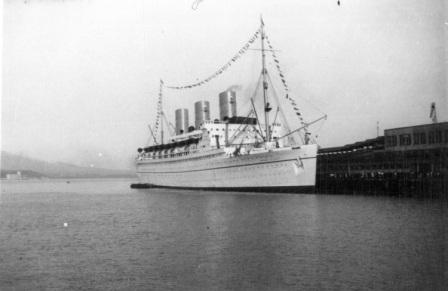
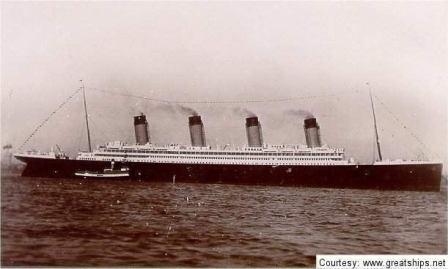
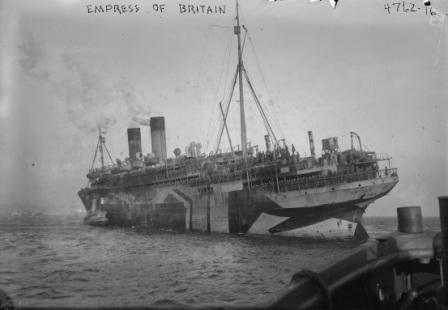
Empress of Britain in 1915 as a WWI troop ship.  (Photo source: https://cdn.loc.gov/service/pnp/ggbain/27800/27873v.jpg)

After completing basic training, Francis, as a member of the 82nd Battalion, travelled to Halifax, Nova Scotia, where they went aboard the Empress of Britain on May 20, 1916, and arrived in Liverpool, England on May 29, 1916. The battalion consisted of 34 officers and 1,006 other ranks.

Designated a reserve unit, upon arrival in England, the 82nd Battalion supplied reinforcements to the Canadian Corps in the field, typical of many Canadian Expeditionary Force (CEF) battalions formed in 1915–1916 that were broken up to support front-line units rather than fighting as a distinct unit.

On July 14, 1916, Francis was transferred to the 9th Reserve Battalion, and based in Shorncliffe while training continued for fighting in France. Then, on August 27, 1916, Francis transferred to the 31st Battalion for service in France, arriving at the Canadian Base Depot (CBD) in Le Havre a day later.

…..Francis survived the Battle of the Somme and Battle of Vimy Ridge….

On September 12, 1916, Francis was assigned for a few days to the 2nd Canadian Entrenching Battalion, where he would have been tasked with being part of working parties to help with trench repairs, wiring, road making, and as carrying parties.

He was back with the 31st Battalion on September 15, 1916. As part of the 2nd Canadian Division, the 31st Battalion endured four days fighting for the Regina Trench during the during the Battle of the Somme in late September 1916. Regina Trench was the Canadian name for the longest German trench on the Western Front, and was located along the north-facing slope of a ridge running from north-west of the village of Le Sars, close to the German fortifications at Thiepval. (See https://en.wikipedia.org/wiki/Capture_of_Regina_Trench)

Francis was promoted to Lance Corporal on April 3, 1917, just before he fought ….and survived …the Battle of Vimy Ridge on April 9, 1917. (See https://en.m.wikipedia.org/wiki/Battle_of_Vimy_Ridge)

On April 13, 1917, Francis received another promotion, to be Acting Corporal.

…..Francis was seriously wounded during the Battle of Fresnoy….

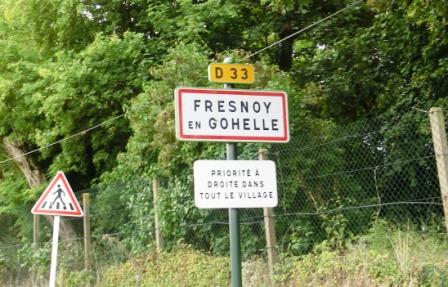
We visited Fresnoy-en-Gohelle on our 2017 European War Memorial Tour.  (Photo credit: Daria Valkenburg)

After capturing Vimy Ridge, the Canadian Corps was tasked with continuing to advance through France, specifically attacking the Fresnoy area along with British forces. The Battle of Fresnoy was part of the Third Battle of the Scarpe. Fought from May 3 to 4, 1917, this was the final part of the larger Battle of Arras, which was fought from April 9 to May 16, 1917.

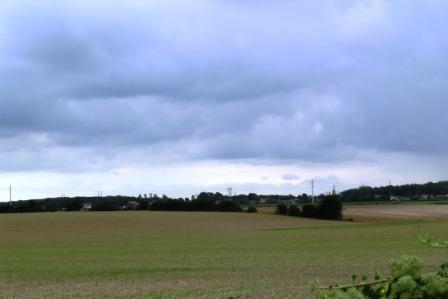
The objective of the Third Battle of the Scarpe was a general offensive to secure better defensive positions along the Scarpe. The focus for the Canadians was the village of Fresnoy-en-Gohelle, which we visited during our 2017 European War Memorial Tour.

Fresnoy-en-Gohelle in the distance. (Photo credit: Daria Valkenburg)

The battle for Fresnoy resulted in high casualties on all sides.  It was the last military battle for Francis, whose luck ran out on May 3, 1917, when he was seriously wounded “….by machine gun bullets in 3 places, which entered his left thigh close to the trunk and fracturing his left thigh bone…

His medical history case file, written by Captain Young, at Manitoba Medical Hospital in Winnipeg on September 22, 1919, summarized what followed.  “…He lay out on the field for 2 days, then lay in the trench for 2 more days….

By the time Francis was removed from the battlefield, not only would he have been in great pain, but infection would have set in. In the days before antibiotics, doctors had little chance of saving his leg. On May 8, 1917, the wounds on his leg were cleaned out at a Casualty Clearing Station.

….Francis spent 2 years in various hospitals after being wounded…

Francis was only at the beginning of a long medical ordeal.  From the Casualty Clearing Station he was transferred to No. 8 Stationary Hospital in Wimereaux, France on May 15, 1917.  The hospital was on the south side of Wimereaux, near the coast and the main road to Boulogne, and consisted of approximately 25 hutted barracks and tents.  While in Wimereaux, the doctors did an “…amputation at trunk of left leg on July 6, 1917….

He was then evacuated to England, to the 2nd Birmingham War Hospital in Birmingham on July 26, 1917.  From there, he was transferred to 3rd Northern General Hospital in Sheffield on August 7, 1917.  He was back in the city of his birth!  His older sister Charlotte, an elementary school teacher, still lived in Sheffield and perhaps was able to visit him while in hospital.

Unfortunately, Francis developed cellulitis at the amputation spot and had a second operation on “…November 25, 1917 for disarticulation of left hip-joint….

His ordeal was not over as in March 1918, Francis was transferred to Granville Canadian Special Hospital in Buxton for another operation as there was a continuous discharge from the wounded area.

On June 1, 1918, Francis was transferred to 5th Canadian General Hospital Kirkdale in Liverpool, his last stop in England. He was invalided to Canada from Liverpool on June 6, 1918 aboard HMHS Llandovery Castle and arrived in Halifax, Nova Scotia on June 18, 1918, just over two years from the day he left Canada for overseas service.

The next stop for Francis was Whitby Military Hospital in Whitby, Ontario, where he suffered through another operation on July 27, 1918 “….for exploration and scraping.  Wound kept on discharging until November 1918 when it healed and discharged ceased….

The medical report recorded that Francis “….wore his first artificial limb in January 1919 for one month.  Got new limb in April.  Then got new bucket on this limb on September 10th….

On September 19, 1919, he was “…transferred to Tuxedo Park Manitoba Military Hospital…” in Winnipeg, Manitoba where the final report on his present condition was noted as “…Wound well healed.  Bucket fits well….

….Francis lived his post-war life in Winnipeg…

Francis was discharged from the army on December 22, 1919, and remained in Winnipeg, taking a position as a clerk with the Empire Sash and Door Co. Ltd, a position he held until his death.

On June 4, 1921, he married Elizabeth Ross (nee Wilson) Hewitt, widow of WWI soldier John William HEWITT, and mother of two children: George and Irene.

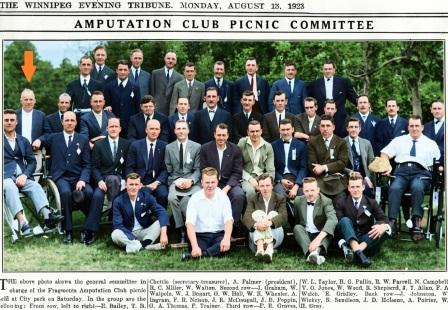
He was a member of the Fragments Amputation Club of the Great War Amputations Association (forerunner of The War Amps – see https://www.waramps.ca/about-us/history/). A photo of the Amputation Club Picnic Committee, of which Francis was a member, was published in the Winnipeg Evening Tribune on August 13, 1923.

Francis (identified by orange arrow) was a member of the Fragments Amputation Club. (Photo source: August 13, 1923 edition of Winnipeg Evening Tribune. Photo restoration and colourization by Pieter Valkenburg.)

On May 8, 1924, Francis and Elizabeth became parents to twin boys – Francis ‘Frank’ Tom and Edmund ‘Ted’ George.

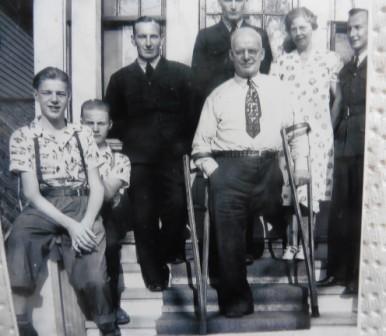
Brenda shared a photo in which Francis and his twin sons were included.  “…. Here is the picture of Stuart’s grandfather, the man wearing the tie and missing a leg. Stuart’s dad (Francis ‘Frank’ Tom) is the young man sitting down. Frank’s twin brother Ted is sitting on Frank’s lap. They are twins but not identical.…

Front row, Ted Graves, Frank Graves, Francis Edmund Graves.  (Photo courtesy of Brenda and Stuart Graves)

Francis saw his step-daughter married. Irene married RCAF officer Herbert Lines on September 19, 1936.  His step-son George immigrated to Australia and joined the Australian Army.

When Francis passed away on November 8, 1941 in Winnipeg, aged 64, his twin sons were still teenagers, aged 17. Both enlisted in the RCAF at the age of 19.

….Francis is buried in Brookside Cemetery in Winnipeg…

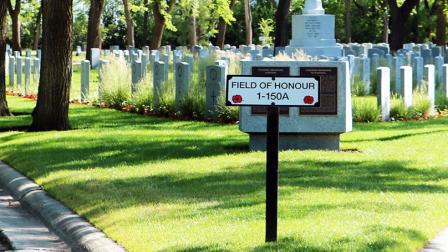
Field of Honour in Brookside Cemetery (Photo source: https://www.winnipeg.ca)

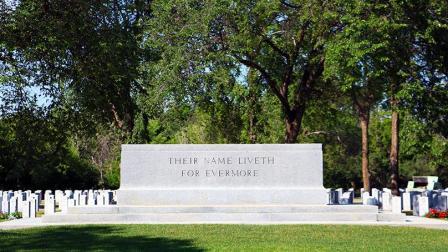
On November 10, 1941, Francis was buried in Brookside Cemetery in Winnipeg, in its Field of Honour sectionHe’s one of more than 10,000 veterans buried there since the section opened in 1915, originally as a burial site for Veterans returning from World War I.  The Field of Honour is home to the only Commonwealth War Graves Commission ‘Stone of Remembrance’ in all of the Americas and was installed in 1960.

Stone of Remembrance in Brookside Cemetery (Photo source: https://www.winnipeg.ca)

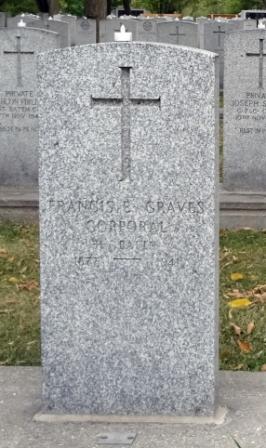
Grave of Francis Edmund Graves in Brookside Cemetery in Winnipeg.  (Photo source: Find A Grave)

Elizabeth remarried, to William Stewart, and moved to Port Coquitlam, British Columbia.  She died October 11, 1953, aged 60.

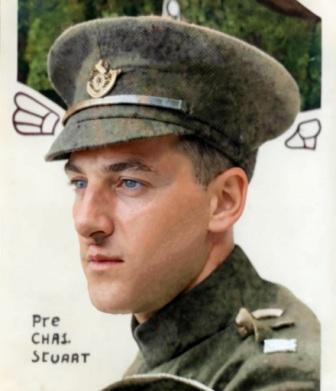
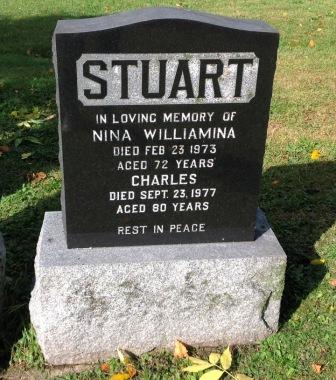
Coming up in Part 2, the story of WWI soldier Charles STUART, the maternal grandfather of Stuart Graves.

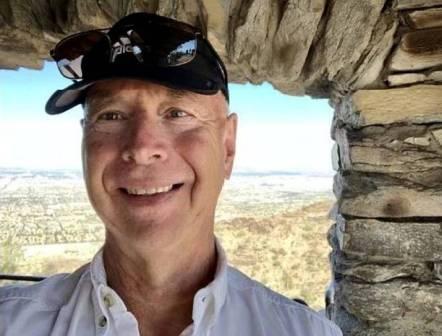
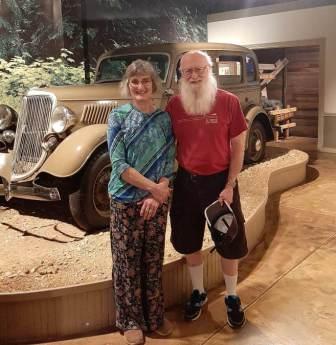
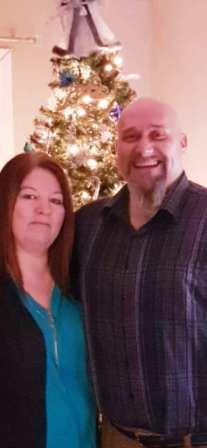
Brenda and Stuart Graves. (Photo courtesy of Brenda Graves)

Thank you to Brenda and Stuart Graves for providing information and photos, and to Shawn Rainville for extensive newspaper searches.

Shawn noticed a coincidence with his own family history, saying that Francis Graves lived directly across the street from his “great-uncle Alexander Rainville, who had enlisted in March 1918, and was wounded in the head and knees in August 1918 in France.   My great-uncle was born in 1884 and died in 1937.  So both were relatively close in age and died relatively young. It’s quite conceivable that they knew each other. My great-uncle was buried in Brookside Cemetery as well …

Living in Prince Edward Island ourselves, we were interested to learn that one of Irene Hewitt Lines’ sons, Hewitt Lines, an officer in the RCAF, married Faye Hardy of West Bloomfield in September 1968!

Pieter’s research efforts to find photos and families of soldiers continue. Do you have a story to tell? Email Pieter at memorialtrail@gmail.com, or comment on the blog.

© Daria Valkenburg

….Story about a WWI soldier who lost his life in the Battle of Fresnoy…

 ….Want to follow our research?…

If you are reading this posting, but aren’t following our research, you are welcome to do so.  Our blog address: https://onthewarmemorialtrail.com/
4 countries, 6 weeks, 7,000 km – an unforgettable war memorial journey in Europe…. Daria’s book ‘No Soldier Buried Overseas Should Ever Be Forgotten‘ is available in print and e-book formats.  Net proceeds of book sales help support research costs and the cost of maintaining this blog. For more information see https://nosoldierforgotten.com/

Subscribe to our YouTube Channel: On The War Memorial Trail With Pieter Valkenburg: https://www.youtube.com/channel/UCJ591TyjSheOR-Cb_Gs_5Kw.

Never miss a posting!  Subscribe below to have each new story from the war memorial trail delivered to your inbox.
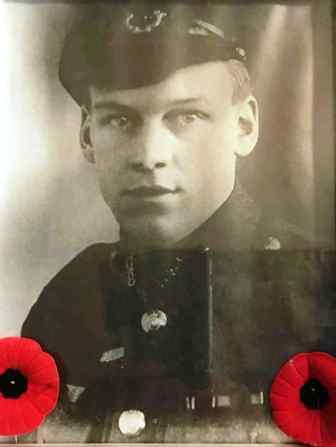
On The War Memorial Trail…..The WWII Gunner Who Died In A Vehicle Accident A Day After The Liberation Of Groningen

May 15, 2026. Since Pieter began receiving photo wish lists of soldiers buried in the Canadian War Cemeteries in The Netherlands, we’ve found that many of the names came from towns and villages that we were unfamiliar with.  We travel quite a bit in the Maritime provinces of New Brunswick, Nova Scotia, as well as our home province of Prince Edward Island.  We also occasionally drive through Quebec towards Ottawa, Ontario, where we lived for several years before Pieter’s retirement.

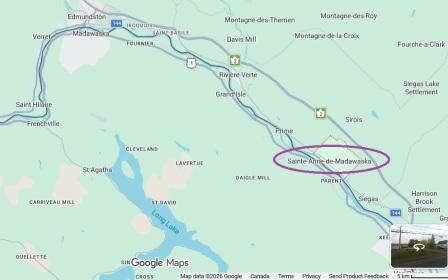
Roger Sirois was born in Sainte-Anne-de-Madawaska, New Brunswick.  (Map source: Google Maps)

The hours of driving go by quickly as it seems that, over the years, we can put a soldier to every place name listed on the highway road signs. Such was the case last fall when we were on our way to Ottawa, and passed by a sign for Sainte-Anne-de-Madawaska, 30 km (18.6 miles) southeast of Edmundston, New Brunswick. Now part of the town of Vallée-des-Rivières since 2023, it was the birthplace of WWII soldier JosephRoger’ SIROIS.

Born December 16, 1922, Roger was the son of John (Jean) and Catherine (nee Pelletier) Sirois, one of 12 children.  With the exception of one brother, who moved to Sarnia, Ontario, the rest of the siblings immigrated to the USA…. and that is where Pieter found a relative with a photo.

….The search for a photo of Roger was successful…

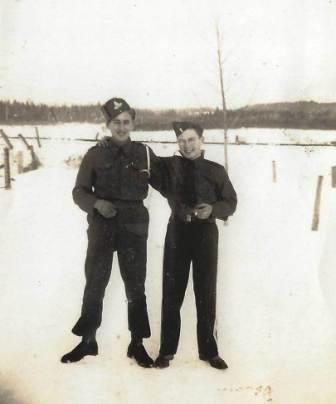
An obituary for Angeline Hounjet, wife of Roger’s brother Aurele, led Pieter to get in contact with her son Roger.  “Roger Sirois was my uncle, who died shortly before I was born in New Brunswick….” he explained.  “…. I have attached a picture of my uncle – he is the tall one on the left–with his friend, Joel.  There is a strong family likeness; definitely a Sirois!…

Roger Sirois (left) with his friend Joel.  (Photo courtesy of the Sirois Family)

When he enlisted at the No. 7 District Depot in Fredericton, New Brunswick on August 21, 1942, he stated that he worked on the family farm, spoke English and French, but was more fluent in French, and for the past year had been employed as a boilerman for the Aluminium Company of Canada (Alcan) in Arvida, Quebec. (See https://arvida.saguenay.ca/en/the-city-of-aluminum/history-and-profile-of-arvida/the-second-world-war)

When asked about hobbies and interests, Roger noted that he hunted and fished, and could play the violin.  He was described by a military interviewer as “…cheerful, sturdy, with good deportment, and appearance….

On September 18, 1942, Roger was sent to No. 70 Canadian Army Basic Training Centre (CABTC) for basic training.  He remained there until December 2, 1942, when he was transferred to A1 Canadian Artillery Corps Training Centre (CATC) in Camp Petawawa, Ontario for advanced training as a gunner.

While still at A1 CATC, he qualified as a Driver i/c Class III wheeled vehicles on January 30, 1943. (The term ‘Driver i/c’ refers to ‘Driver, internal combustion’.  Class III meant he was qualified to drive heavy trucks and armoured cars, but not tanks.)

As a driver in the Royal Canadian Artillery, Roger would be responsible for operating and maintaining military vehicles to transport crews, artillery such as 25-pounder field guns, and heavy ammunition loads to the front lines, often under fire.  As a trained gunner, he could also be expected to double as a gun crew member, switching between driving and firing, depending on the situation.

Roger was there at the same time as Arthur GAUDET of Prince Edward Island, taking the same training and subsequently going overseas at the same time before their paths diverged.  (See https://onthewarmemorialtrail.com/2025/02/12/on-the-war-memorial-trail-the-wwii-soldier-from-prince-edward-island-who-lost-his-life-in-germany-two-days-before-his-21st-birthday/)

On February 10, 1943, he was granted embarkation leave until February 23, 1943, the last chance he would have to see his family before going overseas.

….Roger left Canada for overseas service….

On March 24, 1943, Roger left Canada for the United Kingdom.  Upon arriving on March 31, 1943 he was assigned to No. 3 Canadian Artillery Reinforcement Unit (CARU), effective the following day.

On June 18, 1943, Roger was transferred to the 11th Light Anti-Aircraft (LAA) Regiment, Royal Canadian Artillery for Light Machine-Gun and Rifle training.  After this Regiment disbanded in March 1944, Roger was transferred to the 3rd Light Anti-Aircraft (LAA) Regiment, Royal Canadian Artillery.

Training continued until July 4, 1944, when the Regiment moved to an area near London and boarded a ship in preparation for going to North West Europe.  They arrived in Normandy on July 7, 1944, one month after D-Day, in support of the 3rd Canadian Division, part of the 21st Army Group.

The role of 3rd LAA was to provide mobile anti-aircraft protection for ground troops and positions, and help defend against German Luftwaffe night raids by implementing barrages to combat low-flying aircraft.

They were soon tested as on July 11, 1944, right after the Regiment arrived near Carpiquet Aerodrome, twelve low flying Messerschmitt 109s appeared on the horizon. The German planes banked sharply towards the coast and flew directly over the Regiment’s guns. Every gun in the battery opened up, sending seven Messerschmitts down in flames, while damaging the other five. The following day, six more appeared and three were shot down. This was just one example of what the Regiment experienced.

….Roger was transferred to the 4th Field Regiment….

On August 2, 1944, Roger was transferred to the 4th Field Regiment, Royal Canadian Artillery, joining them in Fleury-sur-Orne, France as they prepared for Operation Totalize. This offensive, fought between August 7-11, 1944, was designed to break through the German defences south of Caen and toward Falaise, with the objective of closing the Falaise gap and cutting off the retreating Germany 7th Army.  (See https://en.wikipedia.org/wiki/Operation_Totalize)

The Regiment moved through Normandy, France, and then into Belgium and The Netherlands in at the end of September and into October 1944 for the Battle of the Scheldt, which began officially on October 2 and lasted until November 8, 1944, and in which the Regiment provided crucial artillery support.

The Battle of the Scheldt’s objective was to free up the way to the Port of Antwerp in Belgium for supply purposes. From Antwerp, they went into The Netherlands, fighting along flooded fields and dikes leading toward Woensdrecht in a battle that lasted until October 21, 1944. (See https://www.veterans.gc.ca/eng/remembrance/history/second-world-war/scheldt)

The Regiment remained in The Netherlands until mid-February.  On February 16, 1945, they arrived in Germany in preparation for Operation Blockbuster, which began at dawn on February 26, 1945 and ended on March 3, 1945. (See https://en.wikipedia.org/wiki/Operation_Blockbuster)

The Regiment’s war diary for March 4, 1945 noted that “…the Hochwald was cleared and the Germans began the withdrawal….so that we did very little firing…

NOTE: For an idea of some of the places that the Regiment travelled through in Germany, see https://onthewarmemorialtrail.com/2026/02/06/on-the-war-memorial-trail-we-follow-the-route-taken-into-germany-by-canadian-troops-in-1945/

By the end of March the Regiment had returned to The Netherlands, and preparing for the upcoming Battle of Groningen, fought from April 14-16, 1945, an offensive to clear all approaches to the city and capture it.  (See https://www.canadiansoldiers.com/history/battlehonours/northwesteurope/groningen.htm and https://library.mcmaster.ca/battle-groningen-april-1945)

….Roger accidentally died after falling from a vehicle…

Roger had survived several major battles up to now, but his luck ran out on the morning of April 17, 1945, the day after Groningen was liberated from Nazi occupation.

According to testimony by Bombadier J.D. FLINT at a Court of Inquiry, Roger, Flint, and Gunner E. BROWN were returning from a battery position when another military vehicle passed by.  Roger “…was standing on the near side of the vehicle as it approached us.  We slowed right down as the road was very narrow…”  Brown, the driver, “…pulled over as far as possible to the right hand side of the road….” and asked Flint “…if everything was clear….”  Flint replied that as far as he could see “…there was plenty of room for both vehicles to pass…

However, Flint went on to say that “…just as we were passing, Gunner Sirois leaned back as if waving to us.  We stopped….” and saw Roger “…lying on the road…

Lt. E. J. MACROW, a passenger in the other vehicle, said that neither vehicle showed “…evidence of a collision… The tracks of both vehicles showed that there should have been ample room to pass …”   When asked if he was aware that Roger was standing on the side of the vehicle, he replied “…No. I did not see him as he must have been standing on the fender by the rear side door

The medical report showed that Roger died from injuries that included a “…crushed right chest with internal injuries, and fractured right humerus…

The Court of Inquiry ruled it an accidental death.  Most likely, Roger lost his balance and fell off the vehicle, and ended up being run over by one of the two vehicles as they passed each other.

Although Roger died on April 17, 1945, his death was incorrectly recorded a day earlier in the April 16, 1945 War Diary entry for the 4th Field Regiment of the Royal Canadian Artillery! “…Gunner Sirois, 2nd Battery driver, was accidentally killed…”  He was 22 years old.

….Roger is buried in Holten…

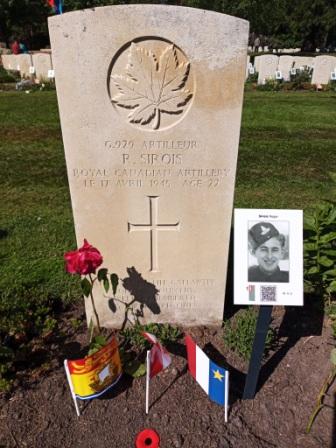
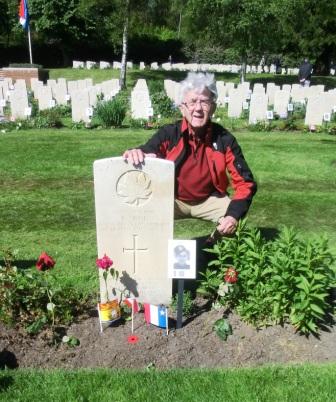
Grave of Roger Sirois with Canadian, New Brunswick, and Acadian flags placed by Pieter.  (Photo credit: Pieter Valkenburg)

Roger was temporarily buried in Eelderwolde, 5 km (3 miles) south of Groningen, before being reburied on February 14, 1946 in the Canadian War Cemetery in Holten, The Netherlands. During our 2025 European War Memorial Tour, Pieter placed Canadian, New Brunswick, and Acadian flags by his grave.

Pieter at the grave of Roger Sirois after placing Canadian, New Brunswick, and Acadian flags. (Photo credit: Daria Valkenburg)

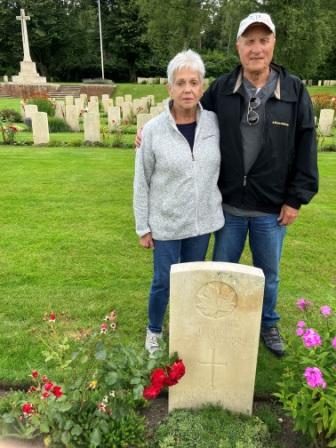
Roger Sirois and his wife Judy visited his uncle’s grave in 2024.  (Photo courtesy of Roger Sirois)

Thank you to Roger Sirois for providing a photo.  “Thank you for the very worthwhile work you do….” he wrote.  After visiting his uncle’s grave in 2024, and meeting Edwin van der Wolf, one of the volunteers at the Information Centre in Holten, Roger expressed his appreciation. “Again, you folks do such great work to, among other things, provide a vehicle to allow families to piece together family histories and a means to remember soldiers who served their respective countries….

The flags placed at Roger’s grave during our 2025 visit were donated.  Our thanks go to:

  • Alan Waddell, Constituent Assistant, on behalf of Heath MacDonald, MP for Malpeque, for the Canadian flag.
  • Jean-Claude D’Amours, MLA (Member of the Legislative Assembly) for Edmundston-Madawaska Centre, Minister responsible for Military Affairs, with the help of Cécile LePage, Province of New Brunswick, for the New Brunswick and Acadian flags.

Pieter’s research efforts to find photos and families of soldiers continue. Do you have a story to tell? Email Pieter at memorialtrail@gmail.com, or comment on the blog.

© Daria Valkenburg

….Want to follow our research?…

If you are reading this posting, but aren’t following our research, you are welcome to do so.  Our blog address: https://onthewarmemorialtrail.com/

4 countries, 6 weeks, 7,000 km – an unforgettable war memorial journey in Europe…. Daria’s book ‘No Soldier Buried Overseas Should Ever Be Forgotten‘ is available in print and e-book formats.  Net proceeds of book sales help support research costs and the cost of maintaining this blog. For more information see https://nosoldierforgotten.com/

Subscribe to our YouTube Channel: On The War Memorial Trail With Pieter Valkenburg: https://www.youtube.com/channel/UCJ591TyjSheOR-Cb_Gs_5Kw.

Never miss a posting!  Subscribe below to have each new story from the war memorial trail delivered to your inbox.
On The War Memorial Trail….. A Photo Found For A WWII Soldier From Moreton’s Harbour Killed By A Mortar Fragment While Transporting Wounded In An Ambulance

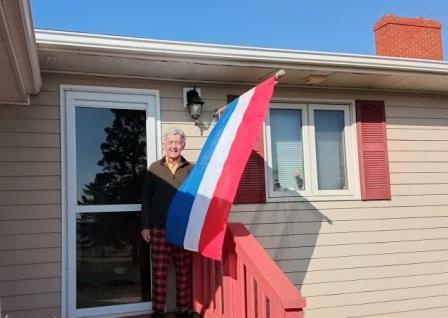
The Dutch flag was displayed on May 5 for Dutch Liberation Day. (Photo credit: Daria Valkenburg)

May 8, 2026. The first week of May is a time of reflection for Pieter, as it’s a bittersweet week in which The Netherlands remembers those who died during WWII and celebrates liberation from Nazi occupation during WWII. During last year’s 2025 European War Memorial Tour he placed flags at 383 graves of Canadian soldiers that he’d researched over the years. This posting is the story of the search for a photo of one of those soldiers.

Occasionally, Pieter helps the Canadian War Cemetery in Groesbeek, The Netherlands to find photos of soldiers for which research had already been done, but no photo could be found. He’s found that it’s almost as much work as it is do a complete research project on a soldier, as there is a reason photos aren’t readily available – they can be very difficult to find!

Since he’s always had a wonderful response when looking for soldiers from Newfoundland, when he saw a soldier from that province on a photo wish list, he thought it would be a slam dunk. Pieter had no idea of the twists and turns encountered when he began to look for a photo of John Frederick BARTLETT.

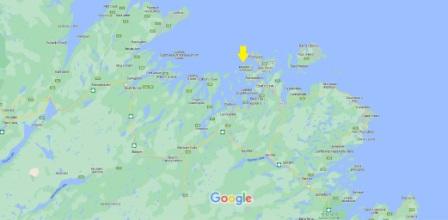
Yellow arrow identifies Moreton’s Harbour, Newfoundland. (Map source: Google Maps)

Born January 27, 1898 in Moreton’s Harbour, the son of Alfred and Jessie Lavinian (nee Taylor) Bartlett, John was serving with the South Alberta Regiment (29th Canadian Armoured Reconnaissance Regiment). As he was 47 years old, his normal duties included serving in the officers mess and being the batman (driver) for one of the officers.

He lost his life on February 27, 1945, aged 47, when fragments from a German mortar bomb hit the ambulance in which he was travelling. According to a casualty report, he had been “…riding in the half-track ambulance between stretchers. Mortar landed in field near road. Fragment entered back of canvas cover, passed clean through Bartlett’s head and out through the top of cover.  Killed outright…”  (You can read Jim Little’s story about John here: https://www.facestograves.nl/LifeStories/BARTLETT%20John%20Frederick-JLE-bio-EN.pdf)

….A great-nephew was contacted in Newfoundland…

Pieter was very quickly in contact with Gerald Bartlett, John’s great-nephew, grandson of John’s brother William Chesley Bartlett.  But his hope of receiving a photo was dashed when Gerald explained that the family no longer had a photo.  “My dad, Morgan John Bartlett, did have a photo of Uncle John but in 1983 a first cousin from Mississauga, Ontario borrowed the photo but never received the photo back, although we tried for years to get it returned…

Gerald’s father couldn’t get the photo back, the cousin died, and her daughter refused to have contact with the family.  Pieter then tried contacting her and her family, with zero response.

Gerald went on to say that he did have “….Uncle John’s entire squadron photo. The 29th South Alberta Recc Regiment, taken in February 1943 in England….”  No one was named in the photo, however.  Perhaps the next step was a Regimental Association or Regimental History?

….We struck out with the Regimental history book and museum…

Donald E. Graves, author of ‘South Albertas – A Canadian Regiment At War’, about the South Alberta Regiment, mentioned Bartlett in the book. He was a 47 year old batman who had volunteered to accompany ambulance driver Eric Nichols.

An excerpt in the book explained that “…Nichols lost one of his helpers on 27 February when fragments from a German mortar bomb which landed near his halftrack killed Trooper John Bartlett, who was riding with him. This was a particularly tragic loss because Bartlett, a farm labourer from Edmonton, was, at 47 years of age, too old for combat and had only been retained in the Regiment because he served as a batman to the officers and a waiter in their mess. John Bartlett had nothing else to do that day so he volunteered to go out in the ambulance….

There was a group photo on the inside cover – similar to the one that Gerald Bartlett had – and each man was numbered, suggesting that somewhere is a list identifying these men. We wrote the author and asked if there was an identification listing for the photo.

He said no, that he’d tried to get one himself, and suggested contacting the South Alberta Light Horse Museum in Medicine Hat, Alberta.  We did. The curator was aware of the photo, but had no identification key. He said he would investigate further, but we never heard from him again.

….Did the ambulance driver have a photo?…

We then looked at the ambulance driver, wondering if perhaps he might have photos that could include John.  We asked Judie Klassen, who has helped with really tough cases in the past, if she could find any information.   Judie learned that “…the soldier who was with Bartlett when he died was Eric Nichols.  He died in 2018….”  She also found “….Rob McCue, who knew him since he was a boy, is a retired sergeant with the South Alberta Light Horse Regiment….

It was a long shot, but Pieter contacted Rob McCue. He didn’t have a photo, but wrote that “…the driver of that Halftrack Ambulance was a Trooper by the name of Eric Nichols. He was my father’s best friend. Eric was still feeling guilt for the loss of the batman years after it happened…. My father’s friend Eric was accosted by the Officer who Tpr Bartlett worked as the Batman for.  Before Eric was even able to wash the blood off of his hands the officer was screaming at him for taking Bartlett with him. Eric told me that he had asked for volunteers to help him clear casualties from a tank and Bartlett volunteered to assist him, even though his age should have prevented him from front line service…. I talked with Eric about this incident many times, and it was still a raw wound even 75 years later….

….Did the medic whose place John took have a photo?…

Although he was well-known in the Regiment, he wasn’t a medic, so never should have been in that ambulance.  One of the medics, Glenn Burgess, was ill which was why John had volunteered to take his place.  (See https://calgaryherald.remembering.ca/obituary/glenn-burgess-1066026252)

Jim Little’s story noted that “…Trooper Glenn Burgess of C Squadron, 4 Troop, was Left Out of Battle (LOB) that day. It was a regular practice of the SAR to keep one Troop from each of its three fighting Squadrons LOB in the event of disaster, preserving a cadre of experienced personnel to rebuild with. Those who were LOB were assigned other duties, and Glenn was tasked with assisting the Regiment’s ambulance service in recovering their casualties from the field. However, Trooper Burgess had a bad case of strep throat so was excused from that duty, and John Bartlett went in his place…”  (SAR refers to South Alberta Regiment)

Maybe Glenn Burgess had a photo? During our ongoing search, Judie came across an interview with poetess Vivian Hansen.  “Vivian Hansen was close to Glenn Burgess and wrote about him, calling him ‘the old man’. She talks about looking through pictures/papers he had in an interview….” (See https://freefallmagazine.ca/interview-with-vivian-hansen/)

Although Vivian didn’t have a photo that included John Bartlett, she replied to our inquiry.  “…  Sadly, I have no photo of Bartlett.  In fact, since Glenn told me the story, I only just linked the mystery man who replaced him as John Bartlett….He never knew the name of the man who replaced him that fateful day….

Vivian let us know that she had written “…a book of poetry entitled ‘A Tincture of Sunlight’, which chronicles some of Glenn’s stories during the war. Glenn’s great-grandmother was a Cree woman from the Swampy Cree nation in northern Ontario.  He was fourth generation Cree, not eligible for treaty status. ….

…What if we went backwards in time?…

With no luck in finding a photo during John’s military years, maybe we needed to look further back in time?  Before enlisting in the South Alberta Regiment in 1940, John had worked as a farm labourer on the farm of W.B. Herder (William and Iva) in Ankerton, Alberta in the 1930s.

Judie’s research into the Herder family led us to Deborah Laidler, granddaughter of Will Herder.  “…I am very excited to correspond with you, as I am the family historian…” she wrote in 2024.

Deborah did her best to find a photo and information, even going through a local history book. “….I have spoken to half a dozen local farm families. No one has knowledge of this soldier but that is not unexpected. My 95 year old Aunt Connie does not remember him, specifically. The family never had a hired man who stayed with them or worked full time for 12 years, as his attestation papers indicate.  But, he may have worked May- September…

Unfortunately, while Deborah, her family, and a neighbor, Angeline Brausen, had a number of unidentified photos of men, none could be identified as John Bartlett.  “…My aunt thinks that the Brausens owned the threshing machine that my grandfather used in the 1930s.….

….Success when John was identified in Gerald’s Squadron photo!…

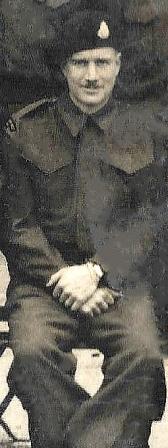
John Frederick Bartlett identified in the 29th South Alberta Reconnaissance Regiment photo from 1943.  (Photo courtesy of the Bartlett Family)

The trail had run cold. However, Gerald Bartlett and his family were able to identify John in the 29th South Alberta Reconnaissance Regiment photo he’d first told Pieter about, which had been taken in February 1943 in England.  “…I went through the regiment photo and enlarged each man to see if there were any similarities.  When I came to the photo I sent you it made me stop.  I could see so many similarities to myself and my brothers and Uncle Elijah. The resemblance to us is quite remarkable….

The photo search had come full circle and a heroic soldier was now identified!

….John is buried in Groesbeek…

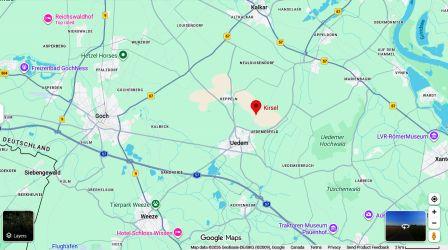
John was initially buried in Kirsel, near Uedem in Germany. (Map source: Google Maps)

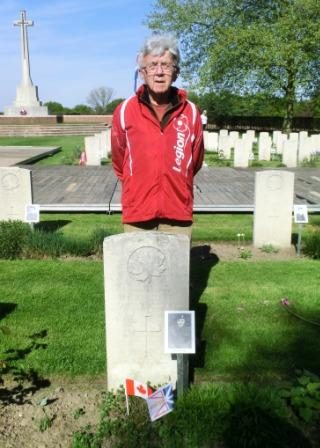
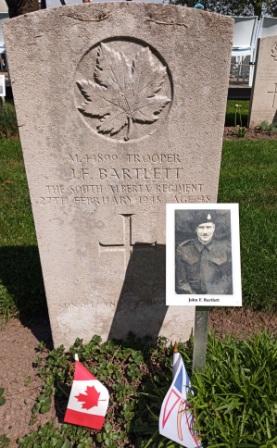
John was initially buried in a temporary burial ground in Kirsel near Uedem, Germany, before being reburied on February 25, 1945 in the Canadian War Cemetery in Groesbeek, The Netherlands.   During our 2025 European War Memorial Tour, Pieter placed flags of Canada and Newfoundland by his grave.

Pieter stands behind the grave of John Frederick Bartlett after placing flags of Canada and Newfoundland.  (Photo credit: Daria Valkenburg)

Grave of John Frederick Bartlett in Groesbeek, with the flags of Canada and Newfoundland that he placed.  (Photo credit: Pieter Valkenburg)

…. ‘You have honoured my great-uncle greatly’…

Gerald Bartlett and his wife Gail.  (Photo courtesy of Gerald Bartlett)

After John was identified by his great-nephew Gerald Bartlett, successfully completing the photo search, Gerald shared his reflections with Pieter.  “… I am so very impressed with the story of my great-uncle John. As a child, I always heard stories of his military time and how he died, but this story finally brings to life his life and heroism as a man who volunteered as he felt was his duty. Wow! I love this story and will share this with my children, my brothers, and sisters. When I saw his picture, I actually saw my grandfather. I have no doubt that this is John Frederick Bartlett… Many thanks to you, your wife, and Jim Little. You have honoured my great-uncle greatly….

….Many to thank for this search …

The long but ultimately successful search for a photo of John Frederick Bartlett was like an unfolding detective story, with a number of people helping to find clues and leads.

Thank you to Gerald Bartlett for identifying his great-uncle in the squadron photo. Thank you to Judie Klassen for going above and beyond to find reference materials, and to Shawn Rainville for newspaper searches.

Thank you also to Vivian Hansen and Rob McCue for enriching our inquiries by providing input on the two medics whose lives were impacted by John’s death: Glenn Burgess and Eric Nichols. Thank you as well to Deborah Laidler for looking into John’s time as a farm worker on the Will Herder farm.

The flags placed at John’s grave during our 2025 visit were donated.  Our thanks go to:

  • Alan Waddell, Constituent Assistant, on behalf of Heath MacDonald, MP for Malpeque, for the Canadian flag.
  • Gerald Bartlett in memory of Trooper John Frederick BARTLETT, who donated the Newfoundland flag.

Pieter’s research efforts to find photos and families of soldiers continue. Do you have a story to tell? Email Pieter at memorialtrail@gmail.com, or comment on the blog.

© Daria Valkenburg

….Want to follow our research?…

If you are reading this posting, but aren’t following our research, you are welcome to do so.  Our blog address: https://onthewarmemorialtrail.com/

4 countries, 6 weeks, 7,000 km – an unforgettable war memorial journey in Europe…. Daria’s book ‘No Soldier Buried Overseas Should Ever Be Forgotten‘ is available in print and e-book formats.  Net proceeds of book sales help support research costs and the cost of maintaining this blog. For more information see https://nosoldierforgotten.com/

Subscribe to our YouTube Channel: On The War Memorial Trail With Pieter Valkenburg: https://www.youtube.com/channel/UCJ591TyjSheOR-Cb_Gs_5Kw

Never miss a posting!  Subscribe below to have each new story from the war memorial trail delivered to your inbox.
On The War Memorial Trail….2026 Faces of Holten Exhibition

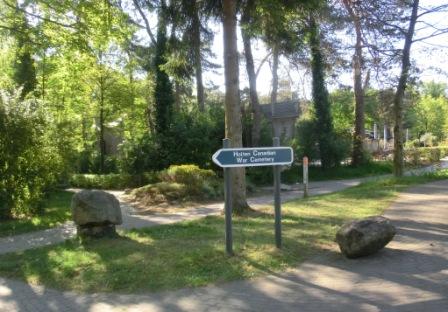
Directional sign to the Canadian War Cemetery in Holten, The Netherlands. (Photo credit: Daria Valkenburg)

May 3, 2026.  Readers of this blog are aware that Pieter has been involved in finding photos of Canadians who are buried in The Netherlands since 2014.  Last year, when we were in The Netherlands and Belgium for the 80th Anniversary of Liberation Commemoration events, Pieter placed flags at the graves of 383 soldiers in 14 cemeteries. 

Out of this total, flags were placed at 156 graves at the Canadian War Cemetery in Holten, the second largest Canadian War Cemetery in The Netherlands, with 1,394 burials, of which 1,355 are Canadian. 

….The 2026 Faces Of Holten Exhibition included photos of 4 additional soldiers researched by Pieter …

This year, for the 81st Anniversary, photos were placed at graves for the second time.  The 2026 Faces Of Holten Exhibition runs for three weeks in May.  Photos were printed onto an aluminum backing, making them impervious to rain, and reusable.  Each placard also had a QR code, allowing visitors with cell phones to scan the code and read a brief biography of the soldier.

In this posting, we feature the graves and photos of four WWII soldiers whose photos were submitted after our 2025 European War Memorial Tour.

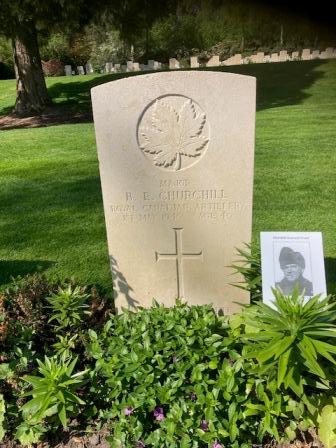
Grave of Bramwell Ernest Churchill. (Photo courtesy of Henk Vincent)

Bramwell Ernest CHURCHILL, born in Pretolia, Ontario, was serving with the 5th Anti-Tank Regiment when he was killed in Germany on May 5, 1945, aged 40, after the half-track vehicle he was riding in struck a mine. His story will be told in an upcoming blog posting.

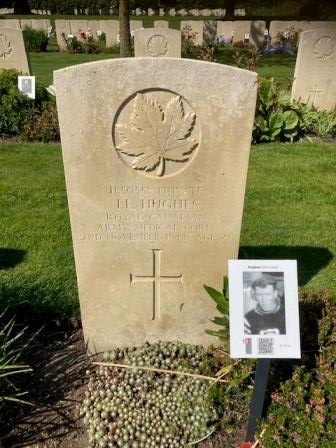
Grave of John ‘Jack’ Lewis Hughes. (Photo courtesy of Henk Vincent)

John ‘Jack’ Lewis HUGHES, from Eriksdale, Manitoba, was a nursing orderly serving with the No. 10 Canadian Field Dressing Station when he was killed at a beach dressing station during Operation Infatuate on Walcheren Island in The Netherlands on November 2, 1944, aged 28, when 3 Allied tracked vehicles exploded after being hit by German shellfire. You can read his story at https://onthewarmemorialtrail.com/2025/12/04/on-the-war-memorial-trail-remembrance-week-2025-the-wwii-nursing-orderly-killed-when-3-tracked-vehicles-exploded-near-a-field-dressing-station-on-walcheren-island/

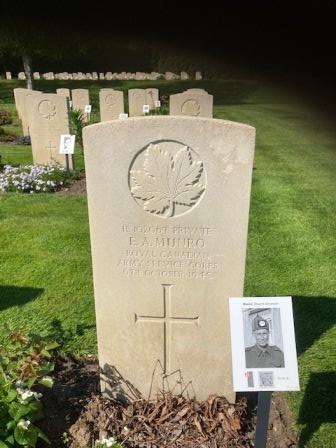
Grave of Edward Alexander Munro. (Photo courtesy of Henk Vincent)

Edward Alexander MUNRO, of Birch River, Manitoba, died in a road accident in Germany on October 6, 1945, aged 27, while serving with the Royal Canadian Army Service Corps, 219 Infantry Brigade Company.  His story will be told in an upcoming blog posting.

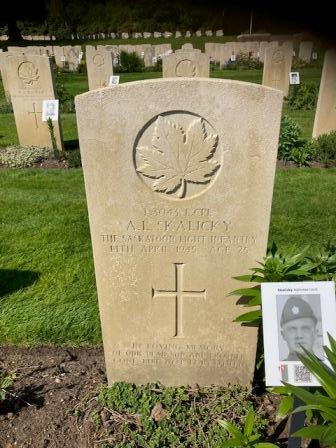
Grave of Alphonse Louis Skalicky. (Photo courtesy of Henk Vincent)

Alphonse Louis SKALICKY, of Humbolt, Saskatchewan, was killed in The Netherlands on April 14, 1945, aged 25, while serving with the Saskatoon Light Infantry.  His story will be told in an upcoming blog posting.

Thank you to Henk Vincent for taking these photos. The Dutch continue to stress the importance of remembrance to the next generation so they can continue to remember those who lost their lives in WWII. 

Pieter encourages readers with photos to come forward so that eventually all of the known graves of Canadians buried in Holten will have a photo displayed by their grave. If you have a photo of a soldier buried at the Canadian War Cemetery in Holten or one of the other cemeteries in The Netherlands, please email him at memorialtrail@gmail.com, or comment on the blog.

© Daria Valkenburg

 ….Missed the stories about the 2025 Faces Of Holten Exhibition?…

Missed the stories about the 2025 Faces of Holten Exhibition?  Here are the links:

….Want to follow our research?…

If you are reading this posting, but aren’t following our research, you are welcome to do so.  Our blog address: https://onthewarmemorialtrail.com/

4 countries, 6 weeks, 7,000 km – an unforgettable war memorial journey in Europe…. Daria’s book ‘No Soldier Buried Overseas Should Ever Be Forgotten‘ is available in print and e-book formats.  Net proceeds of book sales help support research costs and the cost of maintaining this blog. For more information see https://nosoldierforgotten.com/

Subscribe to our YouTube Channel: On The War Memorial Trail With Pieter Valkenburg: https://www.youtube.com/channel/UCJ591TyjSheOR-Cb_Gs_5Kw

Never miss a posting!  Subscribe below to have each new story from the war memorial trail delivered to your inbox.