On The War Memorial Trail…. Battlefields Tour With Joël Stoppels Part 4: From Nansum To Delfzijl And Wirdum

A life’s ambition realized! Daria in the driver’s seat of a jeep! Spoiler alert – our battlefield tour was in an SUV, not the jeep! (Photo credit: Joël Stoppels)

October 19, 2025.  While in Europe this spring for the 80th Anniversary of Liberation Commemoration events, we visited 14 cemeteries to place flags at the graves of 383 soldiers that Pieter has researched since 2014, with the stories of many of these soldiers previously told on this blog. 

On the wish list for our 2025 European War Memorial Tour was to tour some of the battlefields in which these soldiers lost their lives in order to have a better appreciation of what they had faced. 

Battlefields guide Joël Stoppels, of Groningen, The Netherlands, offered to spend a day showing us locations where the various battles that comprised the Battle of the Delfzijl Pocket took place.  Over the years, we’ve featured stories of many soldiers who lost their lives in the last weeks of the North-West Europe campaign during WWII, and we eagerly anticipated learning more. (See https://www.canadiansoldiers.com/history/battlehonours/northwesteurope/delfzijlpocket.htm)
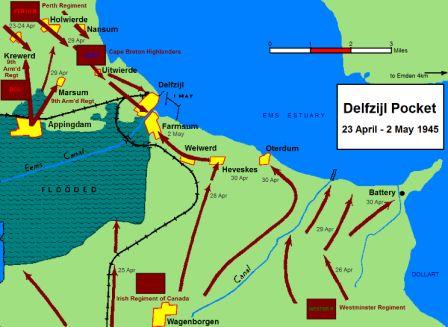
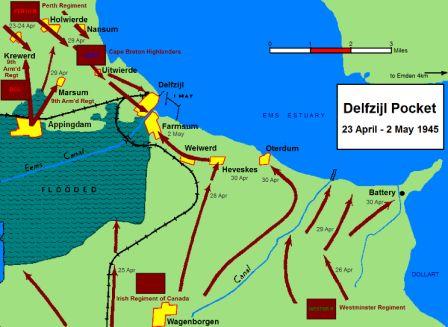
Map showing the locations during the Battle of the Delfzijl Pocket. (Map source: http://www.canadiansoldiers.com)

…. Recap…

In Part 1, our battlefield tour began at a field where 19 Canadians lost their lives during the Battle for Wagenborgen, the preliminary battle before the Battle of the Delfzijl Pocket. (See https://onthewarmemorialtrail.com/2025/10/01/on-the-war-memorial-trail-battlefields-tour-with-joel-stoppels-part-1-battle-for-wagenborgen/)

In Part 2, we travelled to Appingedam, the town where the Battle of the Delfzijl Pocket began. (See https://onthewarmemorialtrail.com/2025/10/05/on-the-war-memorial-trail-battlefields-tour-with-joel-stoppels-part-2-the-battle-of-the-delfzijl-pocket-began-in-appingedam/)

In Part 3, we left Appingedam and travelled to Holwierde, to see the plaque at Stefanuskerk that commemorated many of the Canadian soldiers who died during the Battle of the Delfzijl Pocket. (See https://onthewarmemorialtrail.com/2025/10/10/on-the-war-memorial-trail-battlefields-tour-with-joel-stoppels-part-3-visit-to-stefanuskerk-in-holwierde/)

Now, in Part 4, our battlefields tour concludes as we travel from Nansum to Delfzijl and Wirdum…..

….The Cape Breton Highlanders marched from Nansum to Delfzijl…
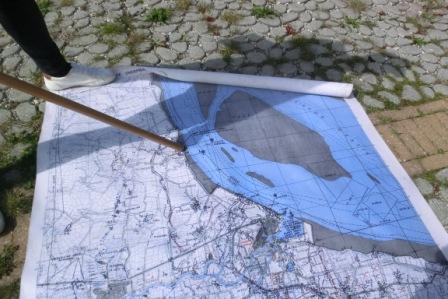
Delfzijl pointed out on Joël’s map.  (Photo credit: Daria Valkenburg)

From Nansum we followed the route taken by the Cape Breton Highlanders to Delfzijl.  Joël noted that “.…the Perth Regiment had been decimated by losses and were pulled back behind the front line, and replaced by the Cape Breton Highlanders who came from Loppersum….

The Cape Breton Highlanders “…started marching from Nansum on April 29, 1945, reaching Delfzijl on May 2, taking two routes…..” 

This was reflected in the war diary for the Cape Breton Highlanders.  The diary entry for April 28, 1945 stated that “…we received word from Brigade this morning that the Perth Regiment did not do so well last night on account of mines. We will likely relieve them tonight so we are to move to another concentration area this afternoon….” 

By late afternoon, the headquarters and ‘B’ Company were in Bierum, while the rest of the Regiment was in Spijk. While the evening itself was quiet, at 8 pm “…the Observation Post reported very dense smoke coming from the town of Delfzijl which is our objective. This could be caused by either demolitions by the enemy or our artillery which has been firing on that area….

April 29, 1945 was a cold and wet day, with the war diary reporting thatour pioneers worked with the sappers clearing mines off the road to ‘A’ Company and also repairing the road. But the night will be a busy one for all. ‘C’ and ‘D’ Companies are to relieve the two forward companies of the Perth and when that is completed ‘A’ and ‘B’ companies will pass through them and advance over a mile to their objectives….

…. ‘D’ Company travelled along the coast…

….‘D’ Company….” of the Cape Breton Highlanders “…travelled along the coast and had the most casualties as the Germans were heavily entrenched.  The other companies came via inland….” Joël said. 

The war diary for May 1, 1945 verified Joël’s account. “….The beginning of this month finds us continuing with the battle for Delfzijl…” The day was “…cold with showers throughout the day...” and “…visibility poor…” 

‘D’ Company did indeed run into difficulties. ….Flares were reported firing from the vicinity of D Company’s objective and a shoot was laid on….”  Then, as ‘D’ Company advanced they “…had to leave the carriers …as the road beyond was impassable for them. They proceeded from there without them....

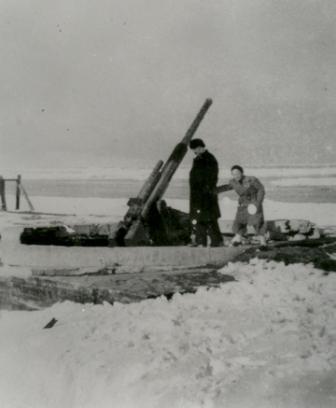
German 88 mm gun: A 10.5 cm FLAK cannon, captured by the Canadians in the Delfzijl Pocket. (Photo Courtesy of Joël Stoppels / Battlefield Tours)

The men from ‘D’ Company were now on foot, and as they advanced towards ‘C’ Company’s position, “…they were pinned down by mortars, shells and small arms fire….”  After receiving artillery support “…the advance was then continued and one platoon reached a position 100 yards short of objective where they were pinned down in a Jerry trench. D Company then reported they were running short of ammunition …

‘C’ Company was ordered totake ammunition from D Company’s carrier to their forward positions....” but they were held back by small arms and mortar fire. A second try was made, but without ammunition “…D Company at this time was in a very critical situation. The whole company was pinned down by bazookas and Spandaus. They were unable to send a guide back to bring in the party from C Company. The platoon, which had holed up in a Jerry trench, came under fire from hand-grenades from the top of the dyke, where the enemy had another trench system….

Train station in Delfzijl today.  (Photo credit: Pieter Valkenburg)

Finally the ammunition arrived, along with the other Companies.  By the early afternoon, the area around the train station in Delfzijl was cleared andone platoon was taking a firm hold along the canal, which split the town in two….

Two unidentified soldiers from the Cape Breton Highlanders Regiment in Delfzijl.  (Photo Courtesy of Joël Stoppels / Battlefield Tours.  Photo colourization by Pieter Valkenburg.)

….Retreating Germans tried to escape by boat…

A welcome report soon came from … D Company that the enemy fire had slackened …. They reported that the enemy was retreating over the dyke and pushing off in boats heading across the estuary towards Germany, Emden area. At 1106 D Company reported everything was under control and they were firm, sending contact patrols to B Company which arrived there at 1125 hours….

Not all of the Germans escaped.  “...On hearing that the enemy were leaving Delfzijl by boat, the Commanding Officer ordered the artillery to engage them. The result was that some of the boats occupied by the enemy did not reach the shores of Germany across the estuary….

Port of Delfzijl after the Canadian capture. (Photo Courtesy of Joël Stoppels / Battlefield Tours)

….The German commander surrendered on May 2, 1945…

On May 2, 1945, the war diary reported that At 0845 hours, brigade informed us that the commander of the Delfzijl pocket had surrendered to the Irish Regiment….

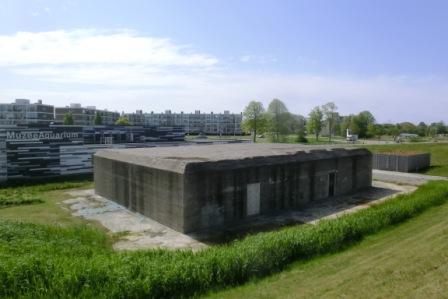
Remains of a German bunker near the Ems Estuary in Delfzijl.  (Photo credit: Daria Valkenburg)

Today, the remains of a German bunker still sits in its original location near the Ems Estuary in Delfzijl.  An aquarium sits behind it, and in front there is a hotel overlooking the Ems. 

….Our final stop was in Wirdum…

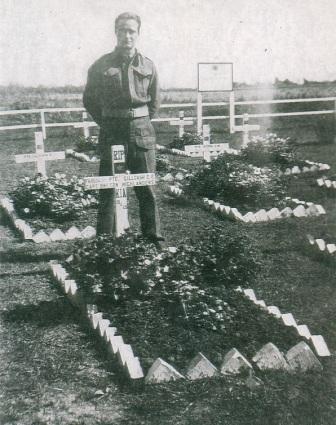
Our final stop on the Battlefields Tour was in Wirdum to look at the original field where casualties from this last battle were temporarily buried, at what was the 5th Divisional Cemetery.
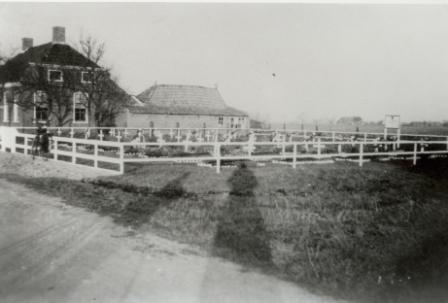
5th Divisional Cemetery in Wirdum in 1945. (Photo Courtesy of Joël Stoppels / Battlefield Tours)

The war diary for May 3, 1945 for the Cape Breton Highlanders noted that burial services were held close to noon at the 5th Divisional Cemetery in Wirdum.  Among those buried here were:

All except Louis Graham Richard, who served with the 9th Armoured Regiment (BC Dragoons), were with the Cape Breton Highlanders.  

In 1946, all of these men were reburied in the Canadian War Cemetery in Holten. 

After all that the Cape Breton Highlanders had gone through in capturing Delfizjl, the war diary for May 3 expressed the Regiment’s disgust at not being given credit for what they achieved in the ‘Maple Leaf’, a newspaper for the Canadian Forces in Europe, with a 4-page format highlighting the advance of Canadian forces.

…Today there was one disgusted battalion in the Canadian Army, namely, The Cape Breton Highlanders. Today’s edition of the ‘Maple Leaf’, which up till now, was considered a fairly reliable paper, has let the battalion down horribly. The first thing which struck the eye, in fairly large print, was the capture of the town of Delfzijl by the PERTH Regt. This write up was a terrific let down to the boys who fought hard to capture the town and lost many of their comrades in killed and wounded during the struggle...

Pieter and Joël by the field in Wirdum where the 5th Divisional Cemetery once was located. (Photo credit: Daria Valkenburg)

Today, the location of the 5th Divisional Cemetery is back to being a field, with a plaque as a reminder that it was once the resting place of Canadians who lost their lives in the battle to capture Delfzijl.

Plaque in Wirdum across the field where the 5th Divisional Cemetery once was located. (Photo credit: Daria Valkenburg)

This ended our Battlefields Tour.  All that was left was to realize a life’s ambition for me….to sit in a WWII era jeep!  After a photo was taken, Pieter was invited to sit in the passenger seat for another photo. 
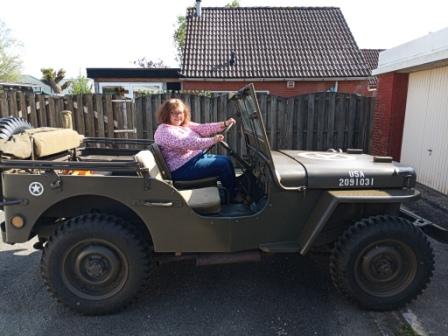
Daria in the driver’s seat of Joël’s jeep!  (Photo credit: Pieter Valkenburg)

Joël presented Pieter with a Dutch language copy of his newly published book ‘Operation Cannonshot’ which was gratefully received. 

Pieter and Joël with Joël’s book ‘Operation Cannonshot’.  (Photo credit: Daria Valkenburg)
Thank you to Joël Stoppels, guide and founder of Battlefield Tours, for a wonderful and informative tour with a friendly guide. (See www.battlefieldtours.nu) We were grateful for the chance to see the various places where the Battle of the Delfzijl Pocket was fought. We’re so glad we were able to take the tour as it’s almost impossible to imagine what the people and troops went through, until you can see it for yourself.

The Battlefield Tour ended, but our adventures continued as we went on with the next portion of our 2025 European War Memorial Tour.

If you have a story or photo to share, or are able to identify either of the two Cape Breton Highlanders in the photo taken in Delfzijl, please contact Pieter at memorialtrail@gmail.com or comment on the blog. 

© Daria Valkenburg

….Want to follow our research?…

If you are reading this posting, but aren’t following our research, you are welcome to do so.  Our blog address: https://onthewarmemorialtrail.com/
4 countries, 6 weeks, 7,000 km – an unforgettable war memorial journey in Europe…. Daria’s book ‘No Soldier Buried Overseas Should Ever Be Forgotten‘ is available in print and e-book formats.  Net proceeds of book sales help support research costs and the cost of maintaining this blog. For more information see https://nosoldierforgotten.com/

Subscribe to our YouTube Channel: On The War Memorial Trail With Pieter Valkenburg: https://www.youtube.com/channel/UCJ591TyjSheOR-Cb_Gs_5Kw

Never miss a posting!  Subscribe below to have each new story from the war memorial trail delivered to your inbox.

On The War Memorial Trail…. Battlefields Tour With Joël Stoppels Part 3: Visit To Stefanuskerk in Holwierde

A life’s ambition realized! Daria in the driver’s seat of a jeep! Spoiler alert – our battlefield tour was in an SUV, not the jeep! (Photo credit: Joël Stoppels)

October 10, 2025.  While in Europe this spring for the 80th Anniversary of Liberation Commemoration events, we visited 14 cemeteries to place flags at the graves of 383 soldiers that Pieter has researched since 2014, with the stories of many of these soldiers previously told on this blog. 

On the wish list for our 2025 European War Memorial Tour was to tour some of the battlefields in which these soldiers lost their lives in order to have a better appreciation of what they had faced. 

Battlefields guide Joël Stoppels, of Groningen, The Netherlands, offered to spend a day showing us locations where the various battles that comprised the Battle of the Delfzijl Pocket took place.  Over the years, we’ve featured stories of many soldiers who lost their lives in the last weeks of the North-West Europe campaign during WWII, and we eagerly anticipated learning more. (See https://www.canadiansoldiers.com/history/battlehonours/northwesteurope/delfzijlpocket.htm)

Map showing the locations during the Battle of the Delfzijl Pocket. (Map source: http://www.canadiansoldiers.com)

In Part 1, our battlefield tour began at a field where 19 Canadians lost their lives during the Battle for Wagenborgen, the preliminary battle before the Battle of the Delfzijl Pocket. (See https://onthewarmemorialtrail.com/2025/10/01/on-the-war-memorial-trail-battlefields-tour-with-joel-stoppels-part-1-battle-for-wagenborgen/)

In Part 2, we travelled to Appingedam, the town where the Battle of the Delfzijl Pocket began. (See https://onthewarmemorialtrail.com/2025/10/05/on-the-war-memorial-trail-battlefields-tour-with-joel-stoppels-part-2-the-battle-of-the-delfzijl-pocket-began-in-appingedam/)

Now, in Part 3, we left Appingedam and travelled to Holwierde, where our first stop was at the Canada Memorial.

…. The Canada Memorial in Holwierde…

Pieter and Joël at the Canada Memorial in Holwierde. (Photo credit: Daria Valkenburg)

Front view of the Canada Memorial in Holwierde.  (Photo credit: Daria Valkenburg)

We knew that there was a plaque at the church in Holwierde that commemorated the Canadians who lost their lives during the Battle of Delfzijl Pocket, but had no idea there was also a monument in the town itself…. with houses on either side of the main road where it’s located.

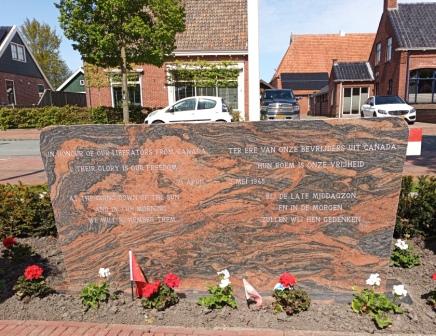
Called the Canada Memorial, with red and white flowering plants around it, the stone plaque simply states ‘In honour of our liberators from Canada. Their glory is our freedom. 21 April – 2 May 1945

Closeup of stone plaque at the Canada Memorial in Holwierde.  (Photo credit: Pieter Valkenburg)

…. Canadian soldiers called Holwierde ‘a killing ground’…

Battlefields Tour poster describing Howierde as a ‘Killing ground’.

As we walked through this quiet and picturesque town towards the Stefanuskerk, we asked Joël about his poster describing Holwierde as a ‘Killing ground’.  He explained that ….Holwierde was one of the most heavily contested villages during the Battle of the Delfzijl Pocket in April 1945. The Perth Regiment fought intense house-to-house combat here, as German paratroopers and naval infantry had fortified nearly every building.  Many Canadian soldiers referred to the village as ‘a killing ground’ due to the high casualties on both sides…..

Holwierde in April 1945, with a temporary bailey bridge, leading towards the Stefanuskerk. (Photo Courtesy of Joël Stoppels / Battlefield Tours)

Holwierde in April 1945.  A temporary bailey bridge allowed residents and troops to cross the canal.  The Stefanuskerk is on the right. (Photo Courtesy of Joël Stoppels / Battlefield Tours)

…The Stefanuskerk, although spared from destruction, stood right in the middle of the battlefield and witnessed days of shelling and close-quarters fighting….  

Holwierde in 2025, 80 years after its liberation.  The bailey bridge from 1945 is now a permanent bridge over the canal! (Photo credit: Daria Valkenburg)

 …. We found a banner for one soldier whose story was previously told…

Banner for Joseph ‘Gerald’ Fougere in Holwierde. (Photo credit: Pieter Valkenburg)

As we walked down the street towards the Stefanuskerk, the main reason for our visit to Holwierde, we saw a banner for Joseph ‘Gerald’ FOUGERE, who was serving with the Perth Regiment. He was wounded on April 24, 1945, during the Battle of the Delfzijl Pocket, and died on April 26, 1945, one month before his 29th birthday. (See https://onthewarmemorialtrail.com/2021/01/27/on-the-war-memorial-trail-atlantic-canada-remembers-part-5/)

Joseph ‘Gerald’ Fougere’s banner was by the canal in Holwierde, but this wasn’t where he died.  (Photo credit: Daria Valkenburg)

The banner was by the canal, and while I was busy snapping photos, thinking this is where he died, Joël said “…no, he actually died in nearby Nansum.  Since Nansum is such a small village, his banner was placed in Holwierde for greater visibility...” He then kindly pointed out that “…the bridge over the canal had been blown up by the Germans on April 25, 1945.

Never mind…Nansum was quickly added as our next stop after Holwierde!

…. A solemn few moments at Stefanuskerk…

Entrance to Stefanuskerk in Holwierde. (Photo credit: Pieter Valkenburg)

We continued walking down the road until we got to the Stefanuskerk.  A plaque near the door noted that the church dates to the 11th century!  In the 13th century the church was enlarged.  It was severely damaged in April 1945, but restored by 1950, to give the appearance as to how the church would have looked before 1830.

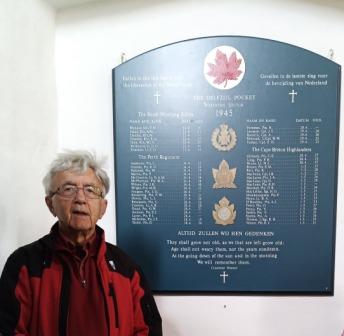
Pieter by the plaque in Stefanuskerk that commemorates Canadian soldiers who died during the Battle of the Delfzijl Pocket.  (Photo credit:  Joël Stoppels)

We wanted to visit the church in order to see the plaque that commemorates many of the Canadian soldiers who died during the Battle of the Delfzijl Pocket.  It was a very solemn few moments for us, as we looked over the names, many of them of soldiers that Pieter had researched over the past years.

From the Royal Winnipeg Rifles:

From the Perth Regiment:

From the Cape Breton Highlanders:

Not mentioned on the plaque:

From the 9th Armoured Regiment (BC Dragoons), who is commemorated on a plaque in Appingedam:

…. We couldn’t miss seeing Nansum…

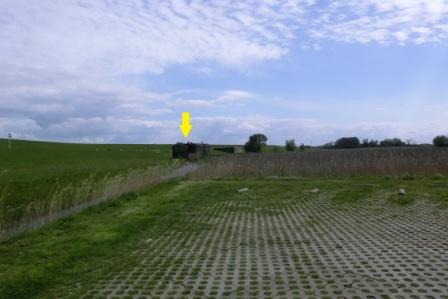
We left Stefanuskerk in a reflective mood after looking at the names on the plaque, and quietly got back in the car for the short drive to Nansum, which is indeed a tiny place, near the coast.   Joël didn’t know exactly where Joseph ‘Gerald’ FOUGERE was killed, unfortunately.  What remained of a German bunker was still visible, so he likely died of shrapnel wounds. 

Yellow arrow indicates the remains of a German bunker in Nansum.  (Photo credit: Daria Valkenburg)

Joël noted that 177 Kriegsmarine were captured here. The Kriegsmarine was Nazi Germany’s Navy from 1939-1945.  By 1945, as the war progressed, the Kriegsmarine formed infantry units from its personnel, who were re-trained as infantry to fight on land, all in an attempt to alleviate the strain on the German Army.

From Nansum we continued on the last leg of our battlefields tour, as we followed the route taken by the Cape Breton Highlanders to Delfzijl. Coming up in Battlefields Tour With Joël Stoppels Part 4: From Nansum To Delfzijl And Wirdum.

Thank you to Joël Stoppels, guide and founder of Battlefield Tours, for a wonderful and informative tour. (See www.battlefieldtours.nu)  If you have a story or photo to share, please contact Pieter at memorialtrail@gmail.com or comment on the blog. 

© Daria Valkenburg

….Want to follow our research?…

If you are reading this posting, but aren’t following our research, you are welcome to do so.  Our blog address: https://onthewarmemorialtrail.com/

4 countries, 6 weeks, 7,000 km – an unforgettable war memorial journey in Europe…. Daria’s book ‘No Soldier Buried Overseas Should Ever Be Forgotten‘ is available in print and e-book formats.  Net proceeds of book sales help support research costs and the cost of maintaining this blog. For more information see https://nosoldierforgotten.com/

Subscribe to our YouTube Channel: On The War Memorial Trail With Pieter Valkenburg: https://www.youtube.com/channel/UCJ591TyjSheOR-Cb_Gs_5Kw

Never miss a posting!  Subscribe below to have each new story from the war memorial trail delivered to your inbox.

On The War Memorial Trail….2025 Faces of Holten Exhibition Part 6: Soldiers Killed In Battle In The Netherlands

September 14, 2025.  Pieter has been involved in finding photos of Canadians who are buried in all three Canadian War Cemeteries in The Netherlands since 2014, with stories of many soldiers told on this blog. 

While in Europe for the 80th Anniversary of Liberation Commemoration events, he placed flags at the graves of 383 soldiers in 14 cemeteries. At the Canadian War Cemetery in Holten, The Netherlands, flags were placed at 156.

Our visit coincided with The 2025 Faces Of Holten Exhibition, which ran for three weeks in May, showing photos of the soldiers by their graves. Visitors found it meaningful to see what the soldiers looked like.

—-Recap…..

In Part 1, soldiers who were killed near Posterenk in April 1945, were featured.  (See https://onthewarmemorialtrail.com/2025/08/24/on-the-war-memorial-trail-2025-faces-of-holten-exhibition-part-1-soldiers-killed-near-posterenk/)

In Part 2, the graves and photos of two soldiers listed on the Cenotaph outside the Borden-Carleton Legion in Prince Edward Island, were featured.  (See https://onthewarmemorialtrail.com/2025/08/29/on-the-war-memorial-trail-2025-faces-of-holten-exhibition-part-2-the-soldiers-listed-on-the-cenotaph-in-borden-carleton/)

In Part 3, the graves and photos of two soldiers who lost their lives while travelling in military vehicles were featured. (See https://onthewarmemorialtrail.com/2025/09/01/on-the-war-memorial-trail-2025-faces-of-holten-exhibition-part-3-soldiers-killed-while-travelling-in-vehicles/)

In Part 4, the graves and photos of six soldiers who lost their lives in the Battle of Leer during Operation Duck were featured. (See https://onthewarmemorialtrail.com/2025/09/04/on-the-war-memorial-trail-2025-faces-of-holten-exhibition-part-4-soldiers-who-drowned-during-operation-duck/)

In Part 5, the graves and photos of 8 Indigenous soldiers were featured. (See https://onthewarmemorialtrail.com/2025/09/10/on-the-war-memorial-trail-2025-faces-of-holten-exhibition-part-5-indigenous-soldiers/)

…7 soldiers are commemorated…

Now, the 2025 Faces of Holten Exhibition series concludes in Part 6, as we feature the graves and photos of seven more soldiers, whose stories have previously been told, who lost their lives in battles in The Netherlands.

Grave of Clive Elbert Steele Gerow.  (Photo credit: Daria Valkenburg)

Clive Elbert Steele GEROW, from Burk’s Falls, Ontario, was killed in action during the liberation of Deventer in The Netherlands on April 10, 1945 while serving with the 27th Armoured Regiment (Sherbrooke Fusiliers Regiment), aged 30.  You can read his story at https://onthewarmemorialtrail.com/2023/10/07/on-the-war-memorial-trail-the-wwii-soldier-from-burks-falls-killed-during-the-liberation-of-deventer/

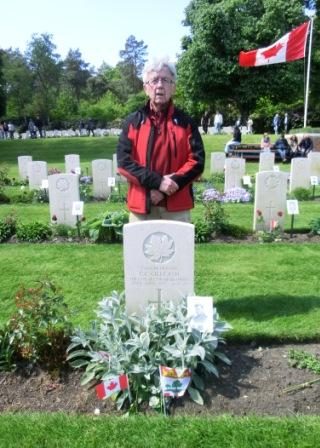
Pieter by the grave of Carman Edward Gillcash. (Photo credit: Daria Valkenburg)

Carman Edward GILLCASH, from Glenwood, Prince Edward Island, was serving with the Cape Breton Highlanders when he lost his life on April 29, 1945 during the Battle of the Delfzijl Pocket in The Netherlands, aged 27. You can read his story at https://onthewarmemorialtrail.com/2022/10/22/on-the-war-memorial-trail-the-wwii-soldier-from-glenwood-killed-during-the-battle-of-the-delfzijl-pocket/

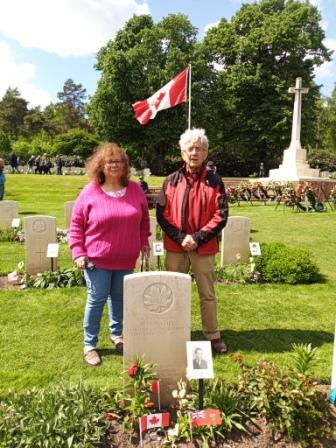
Daria and Pieter at the grave of Theodor ‘Ted’ Henschel. (Photo courtesy of Valkenburg Family)

Theodor ‘Ted’ HENSCHEL, who was born in Winnipeg, Manitoba, but lived in Trail, British Columbia, was serving with the Canadian Scottish Regiment when he was killed in action during the Battle for Wagenborgen in The Netherlands on April 22, 1945, aged 28. You can read his story at https://onthewarmemorialtrail.com/2023/08/14/on-the-war-memorial-trail-the-wwii-soldier-from-trail-who-played-the-cornet/

Just as Pieter finished placing flags at Ted’s grave, an elderly Dutch lady approached us, and asked if she could take our photo by the grave!  We were a bit confused, but then wondered if she thought that we were relatives.  Pieter explained to her that we were not relatives, but were placing flags at graves of soldiers that he had researched.  She wanted a photo anyways, and so it’s one of only two photos of the two of us together by a grave at one of the cemeteries!  (The other photo had been taken in the Canadian War Cemetery in Groesbeek by a Faces To Graves Groesbeek volunteer.)

Grave of Gordon Frederick Johnson. (Photo credit: Daria Valkenburg)

Gordon Frederick JOHNSON, from Truro, Nova Scotia, was serving with the North Nova Scotia Highlanders when he was killed in action, at the age of 33, on April 8, 1945, near Zutphen, The Netherlands, while trying to retrieve an anti-tank weapon that one of the members in his platoon had left behind. You can read his story at https://onthewarmemorialtrail.com/2021/07/17/on-the-war-memorial-trail-the-search-for-a-photo-of-gordon-frederick-johnson-is-over/

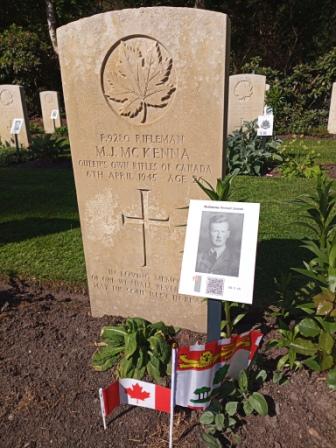
Grave of Michael Joseph ‘Joe’ McKenna. (Photo credit: Pieter Valkenburg)

Michael Joseph ‘Joe’ MCKENNA, from Newton Cross, Prince Edward Island, was serving with the Queen’s Own Rifles when was killed in The Netherlands on April 5, 1945 during the Battle of Rha, at the age of 26. You can read his story at https://onthewarmemorialtrail.com/2022/09/22/on-the-war-memorial-trail-the-wwii-soldier-from-prince-edward-island-killed-during-the-battle-of-rha/

Grave of Archibald Phillip ‘Archie’ McLean. (Photo credit: Daria Valkenburg)

Archibald Phillip ‘Archie’ MCLEAN from Edmundston, New Brunswick, was serving with the the Carleton & York Regiment when he died from wounds received on April 13, 1945 during Operation Cannonshot in The Netherlands, aged 25. You can read his story at https://onthewarmemorialtrail.com/2023/09/13/on-the-war-memorial-trail-archie-was-a-good-guy/

When Pieter was researching Archie’s story back in 2023, we met with Archie’s nephew, Donald Moore, who gave Pieter a poppy pin, and asked if Pieter would place it at his uncle’s grave next time we visited the cemetery in Holten.  Shortly after the story was published in the fall of 2023, Donald passed away. 

Pieter never forgot Donald’s request, and when we were preparing for our 2025 European War Memorial Tour, the poppy travelled with us. On May 1, 2025, Pieter affixed Donald’s poppy pin onto Archie’s grave.

Pieter places the poppy pin from Donald Moore onto the gravestone of Archibald Phillip ‘Archie’ McLean.  (Photo credit: Daria Valkenburg)

Pieter by the grave of Charles Borden Tuplin. (Photo credit: Daria Valkenburg)

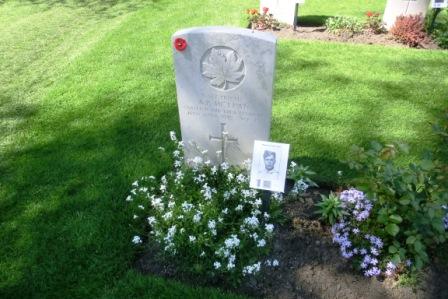
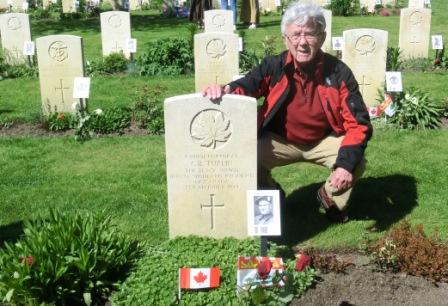
Charles ‘Charlie’ Borden TUPLIN, from Indian River, Prince Edward Island, was serving with the Black Watch when he was fatally wounded in The Netherlands, and listed as having died on December 8, 1944, aged 34. You can read his story at https://onthewarmemorialtrail.com/2021/03/29/on-the-war-memorial-trail-the-ww2-soldier-from-indian-river/

….All of the flags placed at graves were donated…

All of the flags placed at graves were donated.  Our thanks go to: 

  • Alan Waddell, Constituent Assistant, on behalf of Heath MacDonald, MP for Malpeque, for the Canadian flags.
  • Jean-Claude D’Amours, MLA for Edmundston-Madawaska Centre, Minister responsible for Military Affairs, with the help of Cécile LePage, Province of New Brunswick, for the New Brunswick flag.
  • Matt MacFarlane, MLA for District 19, Borden-Kinkora, for the Prince Edward Island flag. 
  • Don Coutts on behalf of the Muttart and Coutts families in memory of Flight Sergeant Elmer Bagnall Muttart for the Ontario flag.
  • Brad Robertson, Chief of Protocol, Government of Manitoba, on behalf of Wab Kinew, Premier of Manitoba, for the Manitoba flag.
  • Kyle Graham, Research Officer, Military Relations, Nova Scotia Intergovernmental Affairs, on behalf of Premier Tim Houston, Province of Nova Scotia, for the Nova Scotia flag.

This concludes the 2025 Faces Of Holten Exhibition series, featuring soldiers whose stories have been previously told on this blog. But our adventures are not over, as we continue with our 2025 European War Memorial Tour.

Pieter encourages readers with photos to come forward so that eventually all the known graves of Canadians buried in Holten will have a photo displayed by their grave. Email him at memorialtrail@gmail.com

© Daria Valkenburg

….Want to follow our research?…

If you are reading this posting, but aren’t following our research, you are welcome to do so.  Our blog address: https://onthewarmemorialtrail.com/

4 countries, 6 weeks, 7,000 km – an unforgettable war memorial journey in Europe…. Daria’s book ‘No Soldier Buried Overseas Should Ever Be Forgotten‘ is available in print and e-book formats.  Net proceeds of book sales help support research costs and the cost of maintaining this blog. For more information see https://nosoldierforgotten.com/

Subscribe to our YouTube Channel: On The War Memorial Trail With Pieter Valkenburg: https://www.youtube.com/channel/UCJ591TyjSheOR-Cb_Gs_5Kw

Never miss a posting!  Subscribe below to have each new story from the war memorial trail delivered to your inbox.
On The War Memorial Trail….. The WWII Soldier From Glenwood Killed During The Battle Of The Delfzijl Pocket

October 22, 2022.  In November 2014, Pieter began helping researchers at the Canadian War Cemetery in Holten to find photos of soldiers buried there who were from Prince Edward Island. It wasn’t until a year later that newspaper articles were published with stories related to Pieter’s research, and three years before this blog began.

Back in 2014, Pieter was initially sent a list of 9 names, one of which was Carman Edward GILLCASH, who was born November 6, 1916 in Glenwood.  As Carman’s story has not yet been told on this blog, we thought it was time to do so.

Photo 1 Carman Gillcash in uniform

Carman Edward Gillcash.  (Photo courtesy of Stewart Gillcash)

Stewart Gillcash submitted photos, and explained that he was the son of Carman’s brother Leland.  “…Carman Edward Gillcash, born and raised on a farm in Glenwood, Prince Edward Island in Canada, was the son of Stewart and Mae (nee Boulter) Gillcash. He had two brothers, Elton and Leland. 

Carman went to school in a one room schoolhouse not far from his home, and, as his father died when Carman was a young boy, he later worked with farmers in his community to help out at home. 

Carman and his younger brother Leland joined the army at a young age, when Leland was only 16 or 17 years of age.  Leland returned from the war, but Carman died there…

Carman enlisted with the PEI Highlanders in Charlottetown on July 15, 1940.  In his Occupational History Form, dated April 8, 1941, Carman stated that he had been working as a fisherman for Wilfred Hickey of O’Leary.

Photo 2 Carman Gillcash on right unknown on left

Carman Gillcash, right, with unidentified soldier. (Photo courtesy of Stewart Gillcash)

… Carman was sent to Newfoundland….

NFLD Map shows Botwood

Location of Botwood Military Base in Newfoundland. (Map source: http://postalhistorycorner.blogspot.com/2012/12/wwii-canadian-forces-in-newfoundland.html)

Carman was sent to Halifax with the PEI Highlanders.  In June 1941, he went to Valcartier, Quebec, and then the Regiment went to Newfoundland in July 1941. An RCAF base in Botwood had aircraft patrolling the east coast of the Atlantic. Canadian Army personnel based at Botwood were charged with protection of military facilities that had been installed there, as well as in Gander. (See https://www.heritage.nf.ca/articles/politics/botwood-base.php)

On June 4, 1942 he was sent to Gander, and then in April 1943 he was posted to Saint John, New Brunswick.  While serving in Newfoundland, Carman was promoted twice, first to Lance Corporal, and then to Corporal.

…..Two other soldiers were in Botwood…..

Carman was in Botwood at the same time as two other soldiers whose stories have been told on this blog:

…Carman was sent overseas….

On June 1, 1943, he was transferred to No 1 Transit Camp in Windsor, Nova Scotia. Just over a week later, along with fellow Islander James ‘Frank’ Mossey, he was on his way to the United Kingdom, arriving there on June 18, 1943, part of the Canadian Infantry Reinforcement Unit (CIRU).

On August 13, 1943, at his own request, Carman was demoted to private.  He then transferred to the Cape Breton Highlanders.  On October 24, 1943 the Regiment went to Italy.

On May 14, 1944 Carman was wounded, but returned to service two weeks later.

On February 19, 1945 he left Italy as part of Operation Goldflake, arriving in Marseilles, France two days later.  Operation Goldflake was the codename for moving troops from Italy to North-West Europe.  (See https://en.wikipedia.org/wiki/Operation_Goldflake)

From France, troops were moved up to the Belgian front, into The Netherlands, through the Reichswald Forest in Germany, and then back into The Netherlands.

…The Regiment participated in the Battle of the Delfzijl Pocket….

The Cape Breton Highlanders relieved The Essex Regiment in the area of Nijmegen, before going towards Dokkum. On April 21, 1945, the Regiment relieved the North Nova Scotia Highlanders.

The next objective was to liberate Delfzijl, which was strategically important to the Germans as it and the surrounding area had batteries with cannons to defend the coastline and the German port of Emden against Allied bombers.

The April 28, 1945 war diary entry for the Cape Breton Highlanders recorded that “…We received word from Brigade this morning that the Perth Regiment did not do so well last night on account of mines. We will likely relieve them tonight so we are to move to another concentration area this afternoon…

The Regiment was on the move quickly in preparation to relieve the Perth Regiment.  “…At 13:50 hours the marching personnel were on the move and half an hour later the vehicles moved. Tactical HQ and B Company were set up in the town of Bierum while the remainder of the Battalion are in the area of Spijk...

The war diary went on to report that “….At 20:00 hours the Observation Post reported very dense smoke coming from the town of Delfzijl, which is our objective. This could be caused by either demolitions by the enemy or our artillery which has been firing on that area.

At 23:55 hours ‘A’ Company moved off to relieve ‘A’ Company of the Perth Regiment. They will likely be the only Company moving tonight…

…Carman lost his life in the wee hours of April 29, 1945….

On April 29, 1945 the war diary reported that “….The first report received from ‘A’ Company was at 01:15 hours when they called for the Medical Officer’s carrier. As the Company was going forward it was met by a large group of P.O.Ws. being escorted back by the Perth Regiment, and as they were passing each other one of the enemy stepped on a mine, killing one of our men and wounding two more…

The fatality in the early morning of April 29, 1945 was Carman.

…Carman was temporarily buried in Wirdum…

Carman was initially buried in 15 Divisional Cemetery in Wirdum, The Netherlands.

Photo 4 Leland brother of Carman Gillcash at the gravesite

Carman’s brother Leland visited his grave.  (Photo courtesy of Stewart Gillcash)

.…Carman was reburied in the Canadian War Cemetery in Holten….

After the war ended, Carman was reburied in the Canadian War Cemetery in Holten, The Netherlands.  We visited his grave twice – in 2017 and again in 2019.

CIMG3219 Oct 3 2019 Holten Carmen Gillcash

Pieter (right) at the grave of Carman Gillcash with researchers Edwin van der Wolf (left) and Henk Vincent (centre) in October 2019.  (Photo credit: Daria Valkenburg)

 …A plaque commemorates Canadian soldiers who died during the Battle of the Delfzijl Pocket….

In 1995, the Stefanus Church in Holwierde placed a plaque to commemorate Canadian soldiers who lost their lives during the Battle of the Delfzijl Pocket.

Plaque at Stefanus Church in Holwierde

Plaque at Stefanus Church in Holwierde, The Netherlands.  (Source: https://www.tracesofwar.nl/sights/40531/Herinneringsplaquette-Stefanus-Kerk.htm)

…We had a chance to meet Stewart Gillcash….

CIMG2610 Sep 8 2018 Pieter with Stewart Gillcash at The Catch

Pieter (left) with Stewart Gillcash.  (Photo credit: Daria Valkenburg)

Thank you to Stewart Gillcash for sharing photos and information on his uncle.  We were able to meet him in September 2018.  (See https://onthewarmemorialtrail.com/2018/09/11/on-the-war-memorial-trail-in-prince-county-pei/)

If you know who the unidentified soldier is in the photo, or have a story to tell, please let Pieter know. You can email him at memorialtrail@gmail.com, or comment on the blog.

© Daria Valkenburg

….. Other Soldiers Mentioned On The Plaque In The Church In Holwierde….

…Want to follow our research?….

If you are reading this posting, but aren’t following our research, you are welcome to do so.  Our blog address: https://onthewarmemorialtrail.com/

Front cover OnTheWarMememorialTrailinEurope4 countries, 6 weeks, 7,000 km – an unforgettable war memorial journey in Europe…. Daria’s book ‘No Soldier Buried Overseas Should Ever Be Forgotten‘ is available in print and e-book formats.  Net proceeds of book sales help support research costs and the cost of maintaining this blog. For more information on the book, please see https://nosoldierforgotten.com/

You are also invited to subscribe to our YouTube Channel: On The War Memorial Trail With Pieter Valkenburg: https://www.youtube.com/channel/UCJ591TyjSheOR-Cb_Gs_5Kw.

Never miss a posting!  Subscribe below to have each new story from the war memorial trail delivered to your inbox.

On The War Memorial Trail….. The WWII Soldier From St Stephen Who Was A Teacher

March 7, 2021.  Last fall, the researchers at the Canadian War Cemetery in Holten, The Netherlands sent Pieter a photo wish list of 6 soldiers from the Cape Breton Highlanders who had died in the Battle of the Delfzijl Pocket.  (For more information on the Battle of the Delfzijl Pocket, see https://www.canadiansoldiers.com/history/battlehonours/northwesteurope/delfzijlpocket.htm)

Len Boudreau of the Cape Breton Highlanders Association was able to provide photos of 3 of the men,  Pieter found one on the Canadian Virtual War Memorial website, leaving 2 to try and find:  Philip Hubert LONG of Nova Scotia, and Norman James NIXON of New Brunswick.

A radio interview with CBC’s Maritime Noon about Philip Long resulted in family contacting Pieter immediately, and a photo was soon provided.  (See https://bordencarletonresearchproject.wordpress.com/2020/11/01/on-the-war-memorial-trail-a-face-for-philip-hubert-long/)

In trying to find family of Norman Nixon, Pieter sent a letter to the editor of the St. Croix Courier newspaper.  (See https://bordencarletonresearchproject.wordpress.com/2020/10/17/on-the-war-memorial-trail-continuing-the-search-for-soldiers-killed-in-action-in-ww1-and-ww2/)  Legion member Kent Caldwell sent a photo and story from the New Brunswick Military Service Recognition booklet.

It was a rare occasion that every photo request on a list could be fulfilled, but it happened! But then, the grandson (and namesake) of Norman Nixon contacted us.  “….We have quite a bit of information…..” he said.  Did we want to meet?

CIMG4775 Oct 25 2020 Pieter sorts through material compiled by the Nixon family

Pieter goes through the information saved by the Nixon family. (Photo credit: Daria Valkenburg)

Normally that would not be a problem, but with Covid-19 restrictions, we had to think twice.  The Atlantic Bubble was still open, so Pieter said a firm YES! and we made the trip to Harvey, New Brunswick to meet Norman Nixon and his wife, Kelley Gowan.

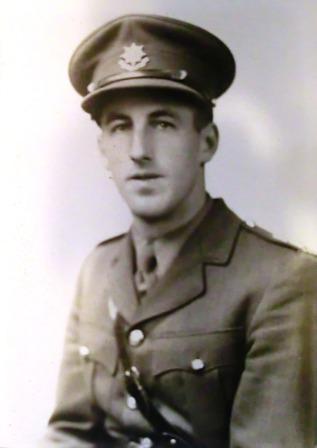
CIMG4560 Lt Norman Nixon

Norman James Nixon. (Photo courtesy of Nixon family)

Norman James Nixon was born in St. Stephen, New Brunswick, the son of Edward A. Nixon and Winnifred Trafton, and lived in nearby Mayfield.  A well-regarded schoolteacher before his enlistment, he married Berla Mae Lowery on July 29, 1940.  In 1941 they welcomed the birth of their son, Vernon James.

20201024_160813 Norman and Berla with son Vernon

Norman and Berla Mae Nixon with their son Vernon, circa 1943.  (Photo courtesy of Nixon family)

On July 20, 1940 Norman had enlisted with the Reserve Unit of the Carleton & York Regiment, but was discharged due to illness.  On February 6, 1942 he re-enlisted, this time with the Active Unit of the New Brunswick Rangers, and served with this unit in Labrador, and Canada from February 6, 1942 to July 12, 1944, and England from July 13 to August 21, 1944.

In 1944 he transferred to the Cape Breton Highlanders, and served in Italy from August 22, 1944 to February 19, 1945, and Northwest Europe in France and The Netherlands from February 20 to April 30, 1945.  He was known as ‘Nick’ by his fellow soldiers.

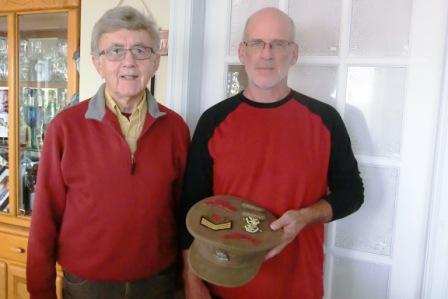
CIMG4767 Oct 25 2020 Pieter and Norman with cap and badges

Pieter and Norman Nixon.  Norman holds his grandfather’s cap and a number of the badges that Lt. Nixon had earned during his service.  (Photo credit: Daria Valkenburg)

After surviving action in Italy and France, Lt Nixon’s luck ran out near the end of WWII, when he was killed by shrapnel on April 30, 1945 during the Battle of the Delfzijl Pocket.

A May 6, 1945 letter to Bella Mae, from Norman’s Commander, Lt Colonel R B Sommerville, explained what happened.  “…Nick was killed in action at night by shell fire during a counter attack on his platoon position.  He died instantly.

At the time he was hit he was encouraging his men who were being hard pressed by fire from the part of Delfzijl on the Ems estuary….

He was initially buried in the village of Wirdum, as Lt Col Sommerville explains further in his letter.  “…his example and devotion to both his troops and duty won for him the affection and respect of officers and men alike….. At a little service in the village of Wirdum near Groningen with a brother officer and 17 of our men he was buried the next afternoon.  We will all miss him….”  The other officer mentioned as being buried was Lt B H NUNN of Halifax.

On May 10, 1945, Major P J Stephen also wrote a letter to Bella Mae, providing more details on how her husband lost his life.  “…On the evening of the 30th of April we were holding a position which we had taken the night before.  Things were quite bad as we were being heavily shelled. The men were getting jittery from loss of sleep and constant hammering.  

After each shelling Nick would jump from his trench and stroll about the platoon area as if he were in his own garden, joking with the men, caring with a smile for all their needs, setting the example to them of a first class soldier and leader.  During one of these tours Nick was fatally wounded by shrapnel from a shell which burst a few yards away. 

It was impossible to save him although we gave him medical aid immediately.  Nick passed away without regaining consciousness…

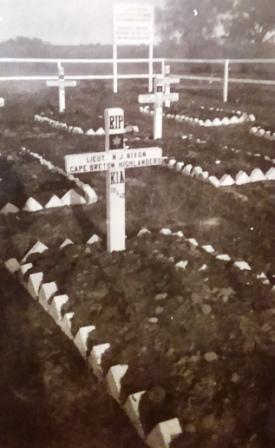
20201024_194850 Grave of Norman J Nixon in 1945

Initial burial of Norman Nixon in Wirdum. Photo sent by Lt Stackhouse.  (Photo courtesy of Nixon family)

On August 19, 1945, Lt Ron V Stackhouse wrote to Bella Mae. “…I was with ‘Nick’ on the last night about an hour before he was killed as we had both had supper together at Company Headquarters and he and I walked back to our platoons together as our platoons were right alongside of each other….”   In a postscript he mentions enclosing a photo of the grave.

After WWII ended, Lt Nixon was reburied in the Canadian War Cemetery in Holten, The Netherlands.

nixon, norman james from Holten Cemetery sent by Edwin

Grave of Norman Nixon at the Canadian War Cemetery in Holten. (Photo sent by Edwin van der Wolf.)

Visiting with Norman Nixon and Kelley Gowan and learning about Norman’s grandfather was a privilege.  But they had a surprise for us.  Norman’s father Vernon and Vernon’s wife Donna came from Grand Manan Island to meet us.

CIMG4779 Oct 25 2020 Norman and Vernon Nixon

Norman and Vernon Nixon, grandson and son of Lt Nixon. (Photo credit: Daria Valkenburg)

More memories and stories were shared, including that Vernon’s mother, Bella Mae, owned a dress shop, ‘The Hat Box’, in St. Stephen.  She was an independent woman, and never remarried after her husband’s death.

CIMG4781 Oct 25 2020 Pieter & Daria with Vernon & Donna Nixon

A final photo before we left to go back home.  Pieter and I with Vernon and Donna Nixon.  (Photo credit: Kelly Gowan)

With both the son and grandson of Lt Nixon together in one place, we asked if they wanted to share a few thoughts for a video to be sent to the Info Centre at the cemetery in Holten.  Here is the result, entitled ‘In Remembrance of Lt. Norman J. Nixon’:

It’s always an honour to meet the families of the soldiers that Pieter researches, and we hope to meet more families as travel restrictions get eased.

The 6 soldiers from the Cape Breton Highlanders on the photo wish list were:

  • Philip H. LONG, born Pictou, Nova Scotia, died April 30, 1945.
  • James Bernard MACINNIS, born Sydney, Nova Scotia, died May 1, 1945.
  • Olen B. MARSHALL, born Bridgetown, Nova Scotia, died May 1, 1945.
  • Norman James NIXON, born St. Stephen, New Brunswick, died April 30, 1945.
  • Ford Hilton SPIDLE, born Parkdale, Nova Scotia, died May 1, 1945.
  • Robert B. THOMAS, born Louisburg, Nova Scotia, died May 5, 1945.

The family of Ford Hilton SPIDLE participated in the Atlantic Canada Remembers series of postings, and you can read his story here: https://onthewarmemorialtrail.com/2021/01/07/on-the-war-memorial-trail-atlantic-canada-remembers-part-1/

Thank you to Norman Nixon and Kelley Gowan for their warm hospitality and for sharing information about Lt Nixon, and thank you to Vernon and Donna Nixon for making the trip from their home to meet with us and share memories about Vernon’s father.  It’s very clear that Lt Nixon was deeply loved and respected, and his death, so close to the end of the war, was an immeasurable loss.

Heartfelt thanks go to post-production editor Wendy Nattress, who made the YouTube tribute to Lt Nixon a reality.

20 members of the Cape Breton Highlanders lost their lives in the Battle of the Delfzijl Pocket.  If you have information or photos to share on any of these men, please email us at memorialtrail@gmail.com, or comment on the blog.

© Daria Valkenburg

…Want to follow our research?…

If you are reading this posting, but aren’t following our research, you are welcome to do so.  Our blog address: https://onthewarmemorialtrail.com/

Front cover OnTheWarMememorialTrailinEurope4 countries, 6 weeks, 7,000 km – an unforgettable war memorial journey in Europe…. Daria’s book ‘No Soldier Buried Overseas Should Ever Be Forgotten‘ is available in print and e-book formats.  Net proceeds of book sales help support research costs and the cost of maintaining this blog. For more information see https://nosoldierforgotten.com/

Screenshot_2021-02-27 On The War Memorial Trail With Pieter Valkenburg

Why not subscribe to: On The War Memorial Trail With Pieter Valkenburg: https://www.youtube.com/channel/UCJ591TyjSheOR-Cb_Gs_5Kw

Never miss a posting!  Subscribe below to have each new story from the war memorial trail delivered to your inbox.

On The War Memorial Trail….. Atlantic Canada Remembers – Part 4

January 20, 2021. Responses to the news clips on CTV’s Atlantic Live At 5 on January 4 and 13 continue to come in.  As mentioned in Parts 1, 2, and 3, Pieter is ensuring that every email is acknowledged, and that the photos of soldiers buried in The Netherlands are forwarded to the appropriate cemetery for their digital archives. 

This posting features more of the photos submitted…..      

Soldiers buried at the Canadian War Cemetery in Holten, The Netherlands

Nelson DesRoches Army

Nelson Desroches. (Photo courtesy of The Desroches Family)

Leo Gaudet submitted a photo of Nelson DESROCHES, on behalf of the Desroches family, and wrote that “We have a vet buried at Holten from Tignish, whom my wife and I visited in 2014…

Born May 23, 1915 in Tignish, Prince Edward Island, the son of John Desroches and Elizabeth Doucette, Nelson followed his older brother Merrick into military service.  He was serving with the Royal Hamilton Light Infantry when he was killed in action on April 14, 1945.

Ernest Robert Haynes

Ernest Robert Haynes.  (Photo courtesy of the Haynes Family)

On behalf of the Haynes family, Teri Haynes submitted a photo of her father-in-law, Ernest Robert HAYNES, and explained that “…my Ernie visited the grave many years ago when he was in his teens with his Mother…

Ernest Robert, born March 17, 1919 in St. John, New Brunswick, was the son of James Edward and Alice Beatrice Haynes.  A dyer in a laundromat before enlisting in 1939, he was married to Opal Bailey and the father of Teri’s late husband, Ernest David.

While serving with the North Shore (New Brunswick) Regiment, he was sent overseas to the United Kingdom in July 1944, and on June 1, 1945 to North West Europe. Unfortunately, due to a fatal accident with a passing Canadian Army truck near Soestdijk, he lost his life on July 5, 1945, age 26.  He was temporarily buried in the town of Hilversum before being reburied on March 29, 1946 in Holten.

Daniel Pearo

Daniel Pearo.  (Photo courtesy of the Pearo Family)

On behalf of the Pearo family, Colleen Hartling submitted a photo of her uncle, Daniel PEARO, and wrote that “Daniel was my mother’s brother. She looked up to him as a child and loved him dearly. She said that he was full of fun and you can see the twinkle in his kind eyes. I was born in the 60s so I did not know Daniel…

Daniel Pearo, son of Samuel and Dasie Pearo, served with the Cape Breton Highlanders and lost his life on May 1, 1945.  (A tribute to him can be found here: http://faculty.uccb.ca/highlanders/DANIEL%20PEARO.htm?fbclid=IwAR1ijEE5uz9tppYwN4dPcHA24DAGhDSAtVfQJUtRAEa21ZIY-zqRZwiUG9I)

Soldiers buried at the Canadian War Cemetery in Bergen Op Zoom, The Netherlands

Gordon Brewer 2

Gordon Thomas Brewer.  (Photo submitted by Stephen and Hazel Albert)

Stephen Albert submitted a photo of Gordon Thomas BREWER on behalf of himself and his mother Hazel, explaining that his uncle “… was 17 when he enlisted to serve his country.  Killed in action on his 21st birthday on October 25, 1944.  School children at that time adopted a grave. Willamina Proost, a young girl, adopted Gordon’s grave, corresponded with his parents for many years until she married, then stopped writing, so lost contact with her. Gordon’s medals and all letters to his parents were burned in a house fire several years ago, only few photos taken before going overseas still remain. Thank you for taking time to honour the men and women who gave their lives to protect others…

Hazel Albert, Gordon’s sister, wrote that she was the “…last remaining member of Gordon’s family….”  Gordon was born in Halifax on October 25, 1923, the son of Alonzo Wallace and Mary Ellen (nee Dean) Brewer.  

Gordon served with the Essex Scottish Regiment and lost his life during the Battle of the Scheldt.  (See https://www.veterans.gc.ca/eng/remembrance/history/second-world-war/scheldt)

Soldiers buried at the Montecchio War Cemetery in Italy

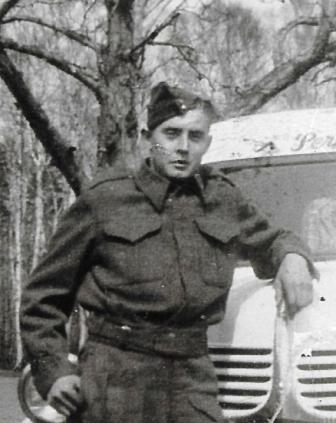
Felix Gaudet

Felix Gaudet.  (Photo submitted by Leo Gaudet)

Leo Gaudet submitted a photo of his uncle, Felix GAUDET, born May 30, 1923, son of Joseph J. and Mary Gaudet of Tignish, Prince Edward Island. After enlistment, he left Halifax for the United Kingdom in July 1943 and was transferred to the Canadian Infantry Reserve Unit a few days after his arrival.  On March 26, 1944 he was sent to Italy, and on May 13 transferred to the Cape Breton Highlanders.

On August 30, 1944 he lost his life during the battle to take a knoll on the Gothic Defence Line.  Another soldier from PEI, Albert Eugene Arsenault, also with the Cape Breton Highlanders, lost his life the same day.  (See https://bordencarletonresearchproject.wordpress.com/2020/10/09/the-ww2-soldier-killed-in-action-while-crossing-the-foglia-river-in-italy/)

The Allies began the day of August 30th with an air bombardment against German positions at dawn. At 5.30 p.m., the Perth Regiment attacked the end of a ridge northeast of Montecchio, while a knoll at the west end of the town and the high ground beyond were the objectives of the Cape Breton Highlanders. Both units faced incessant fire from the heights as well as minefields along the flat lands. The Perths managed to break through the line first, reaching and passing their objective. The Cape Breton troops had the support of tanks from the 8th Princess Louise’s (New Brunswick) Hussars, which helped three of their companies make it to the base of the knoll. After each attempt, however, they were driven back to the Foglia, with casualties totalling 19 members killed and 46 wounded. The Irish Regiment, which had been in reserve, was moved through the path of the Perths. Tanks and artillery guns were not yet available here and as a result the regiment lost 19 killed and 31 wounded.” (Source: https://www.veterans.gc.ca/eng/remembrance/memorials/overseas/second-world-war/italy/montecchio)

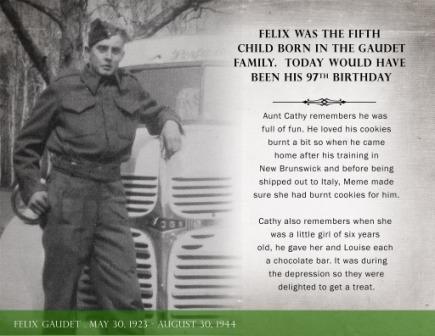
The Gaudet family made a tribute to Felix last year, on what would have been his 97th birthday.  It was so special that it’s shared here:

Felix Gaudet tribute by Aunt Cathy

Tribute to Felix Gaudet submitted by Leo Gaudet.

Thank you to Hazel Albert, Stephen Albert, Kent Caldwell, Colleen Hartling, Teri Haynes, and Leo Gaudet for sharing photos and anecdotes.  Kudos to CTV’s Atlantic Live At 5 for helping to get the word out on this quest of remembrance. Atlantic Canadians remember their loved ones who are buried overseas.

More photos and stories in Atlantic Canada Remembers – Part 5! If you have photos or information to share, please email Pieter at memorialtrail@gmail.com, or comment on the blog. 

Missed the previous postings in this series? See:

© Daria Valkenburg

….Want to follow our research?…

If you are reading this posting, but aren’t following our research, you are welcome to do so.  Our blog address: https://onthewarmemorialtrail.com/

4 countries, 6 weeks, 7,000 km – an unforgettable war memorial journey in Europe…. Daria’s book ‘No Soldier Buried Overseas Should Ever Be Forgotten‘ is available in print and e-book formats.  Net proceeds of book sales help support research costs and the cost of maintaining this blog. For more information see https://nosoldierforgotten.com/

Subscribe to our YouTube Channel: On The War Memorial Trail With Pieter Valkenburg: https://www.youtube.com/channel/UCJ591TyjSheOR-Cb_Gs_5Kw

Never miss a posting!  Subscribe below to have each new story from the war memorial trail delivered to your inbox.

On The War Memorial Trail….. Atlantic Canada Remembers – Part 1

No soldier buried overseas should be forgotten.

January 7, 2021.  “No soldier buried overseas should be forgotten.” This statement by Pieter in a news clip on CTV’s Atlantic Live At 5 touched many people who watched it, and many photos and stories were subsequently emailed to him.   Since the broadcast, Pieter has been working to ensure every email is acknowledged, and that the photos of soldiers buried in The Netherlands are forwarded to the appropriate cemetery for their digital archives. (See https://onthewarmemorialtrail.com/2021/01/05/on-the-war-memorial-trail-the-search-for-ww2-soldiers-buried-in-the-netherlands-featured-on-ctvs-atlantic-live-at-5/)

This posting will feature some of the photos submitted. There were too many submissions for one posting so more will be featured in subsequent postings.

Soldiers buried at the Canadian War Cemetery in Holten, The Netherlands

James Grant Anningson

James Grant Anningson. (Photo submitted by Brenda Budd)

Brenda Budd submitted a photo of James Grant ANNINGSON, saying “My husband’s uncle is buried there.  His name was James Grant Anningson but the family called him Grant.  He was the only one in the family that didn’t return…”  Sgt Anningson was with the New Brunswick Rangers and lost his life on April 27, 1945, at the age of 23.

image002 John Angus Beaton

John Angus Beaton. (Photo submitted by Alexander Beaton)

Alexander Beaton submitted a photo of his uncle John Angus BEATON from Mabou Ridge, Cape Breton, Nova Scotia.  Alexander’s brother Daniel wrote that his uncle  made it through the war but due to the amount of soldiers that had to return to Canada, he and other soldiers were waiting their turn to be flown home.  While waiting one Sunday morning in January 1946, He was fatally shot by a Canadian soldier suffering from a mental illness. This soldier was later charged with his murder…

The shooting occurred in Oldenburg, Germany, where there was a large Canadian base.  Daniel continued by telling us that “…I was told that John Angus’s parents, my grandparents, were happy and waiting for John Angus to return home, but were informed later that he would never return. He was 32 years old when he died, and was the son of Mary and Alex Tailor Beaton…

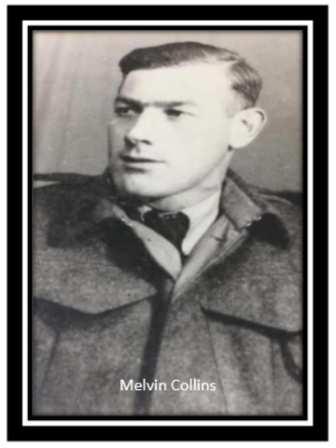
Melvin Collins

Melvin Collins.  (Photo courtesy of Phyllis Kelly)

Phyllis Kelly submitted a photo of her uncle, Melvin COLLINS, from South Kouchibouguac, New Brunswick.  He served with the New Brunswick Rangers and died on April 12, 1945 in Papenburg, Germany, age 26, when he accidentally tripped a hidden high-incendiary booby trap. 

Goldwin Marven Pollick

Goldwin Marven Pollick pushing his brother Ralph on a bike. (Photo courtesy of Gary Pollick and Family of Goldwin Pollick)

On behalf of the Goldwin Pollick family, Gary Pollick submitted a photo of his uncle, Goldwin Marven POLLICK, and explained that “We remember him as always being referred to as Goldy.  I don’t know a lot about him as I was not born yet and no one in my family spoke much about the war.  My father was in The Netherlands at the same time, and he was able to view his brother’s body before it was taken away for burial…

Goldwin Pollick was born in Minto, New Brunswick, and served with the Carleton and York Regiment.  He lost his life on April 13, 1945 in Wilp-Achterhoek. This date was familiar to us as in 2017 we visited a windmill in the nearby village of Posterenk, in which 6 members of the Carlton and York Regiment are listed as having died between April 13 and 15.  Unfortunately, this listing does not include every soldier who was killed in the area.

Ford Hilton Spidle

Ford Hilton Spidle (Photo submitted by Dawn (Spidle) Coldwell)

Dawn (Spidle) Coldwell submitted a photo of her uncle, Ford Hilton SPIDLE, explaining that “…He was a member of the Cape Breton Highlanders. I’ve been told that he was killed by a sniper bullet the day the war was declared over. He was the young age of 32.  Apparently, the information hadn’t been received that the war was over….” The war in The Netherlands ended on May 5 and Ford Hilton died on May 1, 1945 during the Battle of the Delfzijl Pocket, which lasted from April 23 to May 2.  20 soldiers from the Cape Breton Highlanders were killed in action during that battle.

Dawn went on to share a personal experience.  “…I was fortunate enough to have attended the Memorial Day Service in Holten, in 2009. While I was there the Dutch people treated me like I was royalty. I have stayed in close contact with the people over there who made my trip possible. Uncle Ford was my Dad’s only brother. I have a brother who was named after Uncle Ford.  I wasn’t even born when Uncle Ford was killed but my Dad always kept his memory alive.…

Charles Borden Tuplin

Charles Borden Tuplin. (Photo submitted by Gary Richard Perry)

Gary Richard Perry of Nova Scotia submitted a photo of Charles Borden TUPLIN of the Black Watch (Royal Highland Regiment), and explained that “…My maternal grandfather Charles Borden Tuplin of Indian River, PEI is buried at Holten. He was shot on December 7, 1944, was taken as a POW but died the next day…

Soldiers buried at the Canadian War Cemetery in Groesbeek, The Netherlands

William Francis Stewart

William Francis Stewart.  (Photo courtesy of the Stewart Family)

Phyllis Kelly submitted a photo of William Francis STEWART on behalf of the Stewart family, and explained that “…He was born in Claire Fontaine, New Brunswick (this community doesn’t exist now, it was expropriated and became part of Kouchibouguac National Park.) He was the son of John and Katherine (Butler) Stewart. He was married to Audrey Savoie and they had three daughters, Gloria, Bernetta, and Margaret. …”  He lost his life on July 8, 1945 when he fell out of a window in Amersfoort, The Netherlands in the early morning. 

Benjamin James Witherall

Benjamin James Witherall (Photo submitted by Jacqueline Inder)

Jacqueline Inder submitted a photo of Benjamin James WITHERALL of Nova Scotia, and wrote that “I would like to share with you the only picture my mother’s family had of their brother in uniform.  His name is Benjamin James Witherall who was a private with the Highland Light Infantry in WW2.  He was killed in action on December 27th, 1944 at the age of 20…

The Highland Light Infantry was based on the front line on a ridge between Nijmegen and Arnhem during that time. (See https://pipesforfreedom.com/webtxt/0502THE_HIGHLAND_LIGHT_INFANTRY_OF_CANADA.htm)

Soldiers Buried In Adegem Canadian War Cemetery in Belgium

Edison Reynolds Smith

Edison Reynolds Smith.  (Photo courtesy of Angela Leighton)

Angela Leighton submitted a photo of Edison Reynolds SMITH, explaining that “…I wish to advise that my uncle, Private Edison Reynolds Smith of the North Nova Scotia Highlanders, Service #F/57514 (date of birth May 11, 1924) was killed in action in Holland on October 16, 1944, at the age of 20…” He lost his life during the Battle of the Scheldt and was initially buried in the province of Zeeland, The Netherlands.  (See https://www.veterans.gc.ca/eng/remembrance/history/second-world-war/scheldt) Angela ended her email with the statement: “None of these heroes should ever be forgotten….”  She is correct!

Thank you to Alexander and Daniel Beaton, Brenda Budd, Dawn (Spidle) Coldwell, Jacqueline Inder, Phyllis Kelly, Angela Leighton, Gary Richard Perry, and Gary Pollick for sharing photos and anecdotes. Thank you again to CTV’s Atlantic Live At 5 for helping to get the word out on this quest of remembrance. Atlantic Canadians remember their loved ones who are buried overseas.

More photos and stories in Atlantic Canada Remembers – Part 2! If you have photos or information to share, please email Pieter at memorialtrail@gmail.com, or comment on the blog. 

© Daria Valkenburg

….Want to follow our research?….

If you are reading this posting, but aren’t following our research, you are welcome to do so.  Our blog address: https://onthewarmemorialtrail.com/

Front cover OnTheWarMememorialTrailinEurope4 countries, 6 weeks, 7,000 km – an unforgettable war memorial journey in Europe…. Daria’s book ‘No Soldier Buried Overseas Should Ever Be Forgotten‘ is available in print and e-book formats.  Net proceeds of book sales help support research costs and the cost of maintaining this blog. For more information see https://nosoldierforgotten.com/ 

You are also invited to subscribe to our YouTube Channel: On The War Memorial Trail With Pieter Valkenburg: https://www.youtube.com/channel/UCJ591TyjSheOR-Cb_Gs_5Kw

Never miss a posting!  Subscribe below to have each new story from the war memorial trail delivered to your inbox.

The WW2 Soldier Killed In Action While Crossing The Foglia River In Italy

October 9, 2020.  Four WW2 soldiers on the Cenotaph outside the Borden-Carleton Legion lost their lives in Italy…. George Alfred DUNN of the Carleton & York Regiment, Ernest Murray NORTON of the West Nova Scotia Regiment, Arnold Dudley TAYLOR, also of the West Nova Scotia Regiment, and the subject of this posting, Albert Eugene ARSENAULT of the Cape Breton Highlanders.
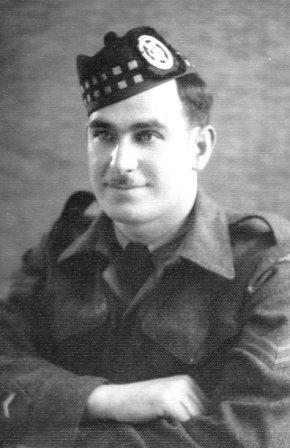
Albert Eugene Arsenault

Albert Eugene Arsenault. (Photo courtesy of Borden-Carleton Legion Branch #10)

Albert was born on May 5, 1916 in Palmer Road, the son of Joseph and Philoman (Minnie) Arsenault, whose family later moved to Albany.  A farm labourer before the war, at the time of his enlistment he was working as a lumberman with the Canadian Lumber Company in Stewiacke, Nova Scotia.   On April 30, 1940 he enlisted with the PEI Highlanders in Dartmouth, Nova Scotia. The enlistment record indicated he spoke both English and French fluently.

Like so many soldiers, he served in several units.  One of the first was the North Nova Scotia Highlanders.  On September 25, 1942 he left for England, where he served as a military guard.  He left for Italy on February 19, 1944, arriving on March 3, 1944.  In May 1944 he was transferred to the Cape Breton Highlanders.

The Allies began the day of August 30th with an air bombardment against German positions at dawn. At 5.30 p.m., the Perth Regiment attacked the end of a ridge northeast of Montecchio, while a knoll at the west end of the town and the high ground beyond were the objectives of the Cape Breton Highlanders. Both units faced incessant fire from the heights as well as minefields along the flat lands. The Perths managed to break through the line first, reaching and passing their objective. The Cape Breton troops had the support of tanks from the 8th Princess Louise’s (New Brunswick) Hussars, which helped three of their companies make it to the base of the knoll. After each attempt, however, they were driven back to the Foglia, with casualties totalling 19 members killed and 46 wounded. The Irish Regiment, which had been in reserve, was moved through the path of the Perths. Tanks and artillery guns were not yet available here and as a result the regiment lost 19 killed and 31 wounded.” (Source: https://www.veterans.gc.ca/eng/remembrance/memorials/overseas/second-world-war/italy/montecchio)

One of those killed in action while crossing the Foglia River near Montecchio, during the battle to take a knoll on the Gothic defence line on August 30, 1944 was Albert Arsenault.  He was buried in the Montecchio War Cemetery in Italy. 582 Commonwealth soldiers, including 289 Canadians, who died in late August and September 1944 in the battle to break The Gothic Line, are buried here.

MONTECCHIO-WAR-CEMETERY~838-06_06_2019-13_23 CWGC

Montecchio War Cemetery, in the locality of Montecchio in the Commune of Montelabbate (Province of Pesaro).  (Photo source: https://www.cwgc.org)

To read the previous postings on George Alfred Dunn and Ernest Murray Norton, see:

Dunn:

Norton:

Pieter has not found family members who might have more information on Albert Eugene Arsenault.  If you can help, please email Pieter at dariadv@yahoo.ca or comment on the blog.

© Daria Valkenburg