On The War Memorial Trail…. Battlefields Tour With Joël Stoppels Part 1: Battle For Wagenborgen

A life’s ambition realized! Daria in the driver’s seat of a jeep! Spoiler alert – our battlefield tour was in an SUV, not the jeep! (Photo credit: Joël Stoppels)

October 1, 2025.  Pieter has been involved in finding photos of Canadians who are buried in all three Canadian War Cemeteries in The Netherlands since 2014, with stories of many soldiers told on this blog. 

While in Europe on our 2025 European War Memorial Tour this spring, for the 80th Anniversary of Liberation Commemoration events, he not only placed flags at the graves of 383 soldiers in 14 cemeteries, but we wanted to tour some of the battlefields in order to have a better appreciation of what soldiers faced. 

Battlefields Tours guide Joël Stoppels, of Groningen, The Netherlands, offered to spend a day showing us locations where the various battles that comprised the Battle of the Delfzijl Pocket took place. The term ‘Delfzijl Pocket’ refers “….to the entire area around Delfzijl that was held by German forces and cleared by the Canadians in late April and early May 1945…”Joël explained.

Over the years, we’ve featured stories of many soldiers who lost their lives in the last weeks of the North-West Europe campaign during WWII, and we eagerly anticipated learning more. (See https://www.canadiansoldiers.com/history/battlehonours/northwesteurope/delfzijlpocket.htm)
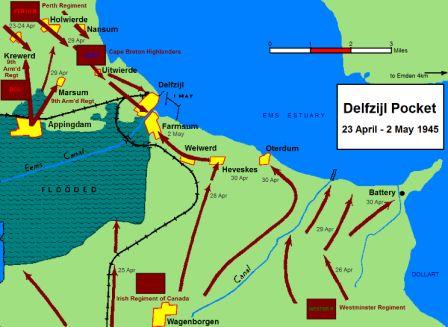
Map showing the locations during the Battle of the Delfzijl Pocket. (Map source: http://www.canadiansoldiers.com)

…. 19 Canadians lost their lives on a field just outside Wagenborgen…

Our day touring battlefields began very early, with a two hour drive from our cottage near Holten to Groningen, where we’d arranged to meet Joël. 

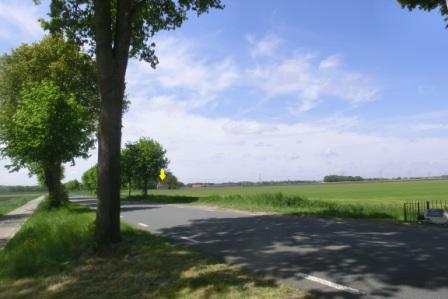
Our first stop on the battlefield tour was at a field outside Wagenborgen, where 19 Canadians lost their lives during the Battle for Wagenborgen.  This was the preliminary battle before the Battle of the Delfzijl Pocket. (See  https://www.canadiansoldiers.com/history/battlehonours/northwesteurope/wagenborgen.htm)

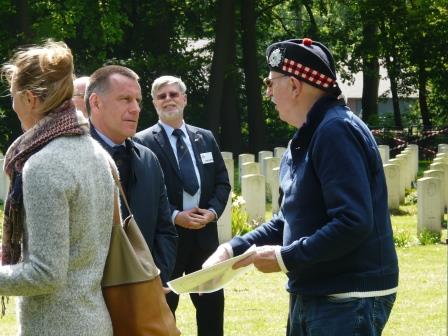
Joël Stoppels and Pieter stand across the road from the field outside Wagenborgen.  (Photo credit: Daria Valkenburg)

Joël began by saying that “….‘D’ Company of the Canadian Scottish Regiment, under the command of Major Anthony Compton-Lundie, were ordered by Battalion Command based in Groningen to undergo a dangerous mission across open fields with no rises or trees for cover…..” 

Patrols from the 7th Canadian Reconnaissance Regiment had determined that Wagenborgen, a short distance from the centre of the battalion’s line, was held by an unknown number of Germans.

‘D’ Company received orders to take the village of Wagenborgen in a one-company attack in the early hours of April 21, 1945.  “….Compton-Lundie was based at the Schmidt farm at the end of the field.  When the phone rang with orders to attack, he protested.  ‘Are you crazy?’ he said.  Orders were orders, however, and Compton-Lundie was not one to disobey…

The attack began on April 21, 1945.  By the time it was over, Anthony COMPTON-LUNDIE was dead, as was his lieutenant, Dennis George HUSCROFT, and 17 more men.

…. How did the battle go so badly for the Canadian Scottish?…

How did it go so wrong?  ... A Polish division had been in the area before the Canadian Scottish arrived and told Compton-Lundie that they believed only 100 Germans remained.  This was faulty intelligence as there were over 1500 Germans, just waiting to pick off soldiers in the open field of very flat land….”  Joël reflected that “…perhaps if Battalion Command had listened to Compton-Lundie, who had a view of the landscape, that there would have been fewer casualties….

Field outside Wagenborgen where 19 men lost their lives.  Yellow arrow indicates Schmidt Farm, where Major Compton-Lundie of the Canadian Scottish Regiment had been based. At the far right is a monument commemorating those who died. (Photo credit: Daria Valkenburg)

…. A monument by the field honours the 19 men who died…

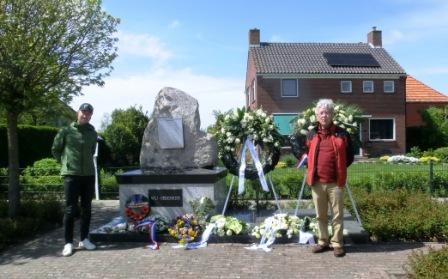
Monument by the open field where 19 men lost their lives on April 19, 1945. (Photo credit: Daria Valkenburg)

A small monument sits beside the open field where 19 men fought and lost their lives.  A translation of the Dutch text reads as follows:  Stand still for a moment at the maple leaf. On April 21, 1945, 19 Canadian men died for our freedom here at ‘Stolderij’. Stolderij refers to the hamlet where the open field is located.

The men were temporarily buried in Siddeburen before being reburied in 1946 in the Canadian War Cemetery in Holten, The Netherlands.

…. Banners were placed in Wagenborgen to commemorate fallen soldiers…

Once we finished taking photos of the field where so many men lost their lives, we drove into the town of Wagenborgen itself, where banners of the deceased soldiers had been placed, as close as possible to the location where they fell. 

Two soldiers from the Canadian Scottish Regiment who had fought in Wagenborgen have had their stories previously told on this blog.  One survived the battle, but one died, and we looked for his banner.
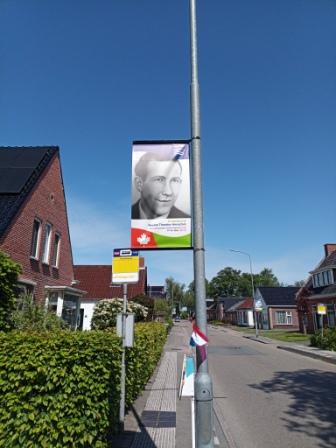
Banner for Theodor ‘Ted’ Henschel in Wagenborgen.  (Photo credit: Daria Valkenburg)

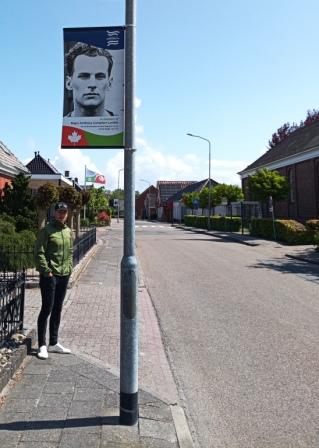
Joël by the banner for Anthony Compton-Lundie, who was from Oakbank, Manitoba. (Photo credit: Daria Valkenburg)

After being told about the impossible situation that Major Anthony Compton-Lundie faced, we wanted to see his banner, and took a photo of Joël beside it.

…. Canadian soldiers who lost their lives during the Battle for Wagenborgen…

Joël and Pieter at the War Memorial in Wagenborgen.  ‘Wij gedenken’ translates to ‘We commemorate’. (Photo credit: Daria Valkenburg)

The War Memorial in Wagenborgen commemorates the residents of Wagenborgen who died in WWII, and 27 fallen Canadian soldiers – 23 of them from the Canadian Scottish Regiment, 1 from the Royal Winnipeg Rifles, and 3 from the Royal Canadian Artillery. 

From the Canadian Scottish Regiment:

  • Pte Albert George BOUMA, aged 21, died April 23, 1945
  • Pte John BRANSCOMB, aged 32, died April 23, 1945
  • Pte Robert Stewart BULLOCK, aged 39, died April 23, 1945
  • Pte Leslie Keith BUTTERICK, aged 19, died April 21, 1945
  • L/Cpl Carmen Christie CAPONERO, aged 30, died April 21, 1945
  • Sgt Allen CLEMENTS, aged 32, died April 21, 1945
  • Major Anthony COMPTON-LUNDIE, aged 30, died April 21, 1945
  • Pte Louis Silverius DAUTREMONT, aged 25, died April 21, 1945
  • Pte Edwin Levi EMERY, aged 22, died April 21, 1945
  • Pte Peter HARASYMCHUK, aged 24, died April 23, 1945
  • Pte Theodor ‘Ted’ HENSCHEL, aged 28, died April 223, 1945
  • Pte John Charles HUGHES, aged 28, died April 23, 1945
  • Lt Denis George HUSCROFT, aged 24, died April 21, 1945
  • L/Cpl John Albert MASLIN, aged 24, died April 21, 1945
  • Pte John Raymond PATRICK, aged 29, died April 21, 1945
  • Pte James Robert POWER, aged 21, died April 21, 1945
  • Pte Robert John Wilson REID, aged 38, died April 21, 1945
  • Pte Henry Oscar RENNER, aged 24, died April 21, 1945
  • Martin George VAN SANDVOORD, aged 28, died April 22, 1945
  • Pte Emile Joseph SOENS, aged 24, April 21, 1945
  • Pte John William WILSON, aged 37, died April 23, 1945
  • Pte Fred WIRTH, aged 38 , died April 23, 1945
  • A/Cpl Gordon Scarth WOOD, aged 21, died April 21, 1945

From the Royal Winnipeg Rifles:

  • Rifleman Theodore OLENICK, aged 19, died April 21, 1945

From the Royal Canadian Artillery:

  • Captain Donald George INNES, aged 23, died April 21, 1945
  • Gunner Joseph Paul MOULINS, aged 23, died April 21, 1945
  • Gunner Arthur John MUELLER, aged 20, died April 21, 1945

From Wagenborgen, we continued our tour, with our next stop in Appingedam, coming up in Battlefields Tour With Joël Stoppels Part 2: The Battle of the Delfzijl Pocket Began In Appingedam.

Thank you to Joël Stoppels, guide and founder of Battlefield Tours, for a wonderful and informative tour. (See www.battlefieldtours.nu)  If you have a story or photo to share, please contact Pieter at memorialtrail@gmail.com or comment on the blog. 

© Daria Valkenburg

….Want to follow our research?…

If you are reading this posting, but aren’t following our research, you are welcome to do so.  Our blog address: https://onthewarmemorialtrail.com/

4 countries, 6 weeks, 7,000 km – an unforgettable war memorial journey in Europe…. Daria’s bookNo Soldier Buried Overseas Should Ever Be Forgotten is available in print and e-book formats.  Net proceeds of book sales help support research costs and the cost of maintaining this blog. For more information see https://nosoldierforgotten.com/

Subscribe to our YouTube Channel: On The War Memorial Trail With Pieter Valkenburg: https://www.youtube.com/channel/UCJ591TyjSheOR-Cb_Gs_5Kw

Never miss a posting!  Subscribe below to have each new story from the war memorial trail delivered to your inbox.

On The War Memorial Trail….2025 Faces of Holten Exhibition Part 6: Soldiers Killed In Battle In The Netherlands

September 14, 2025.  Pieter has been involved in finding photos of Canadians who are buried in all three Canadian War Cemeteries in The Netherlands since 2014, with stories of many soldiers told on this blog. 

While in Europe for the 80th Anniversary of Liberation Commemoration events, he placed flags at the graves of 383 soldiers in 14 cemeteries. At the Canadian War Cemetery in Holten, The Netherlands, flags were placed at 156.

Our visit coincided with The 2025 Faces Of Holten Exhibition, which ran for three weeks in May, showing photos of the soldiers by their graves. Visitors found it meaningful to see what the soldiers looked like.

—-Recap…..

In Part 1, soldiers who were killed near Posterenk in April 1945, were featured.  (See https://onthewarmemorialtrail.com/2025/08/24/on-the-war-memorial-trail-2025-faces-of-holten-exhibition-part-1-soldiers-killed-near-posterenk/)

In Part 2, the graves and photos of two soldiers listed on the Cenotaph outside the Borden-Carleton Legion in Prince Edward Island, were featured.  (See https://onthewarmemorialtrail.com/2025/08/29/on-the-war-memorial-trail-2025-faces-of-holten-exhibition-part-2-the-soldiers-listed-on-the-cenotaph-in-borden-carleton/)

In Part 3, the graves and photos of two soldiers who lost their lives while travelling in military vehicles were featured. (See https://onthewarmemorialtrail.com/2025/09/01/on-the-war-memorial-trail-2025-faces-of-holten-exhibition-part-3-soldiers-killed-while-travelling-in-vehicles/)

In Part 4, the graves and photos of six soldiers who lost their lives in the Battle of Leer during Operation Duck were featured. (See https://onthewarmemorialtrail.com/2025/09/04/on-the-war-memorial-trail-2025-faces-of-holten-exhibition-part-4-soldiers-who-drowned-during-operation-duck/)

In Part 5, the graves and photos of 8 Indigenous soldiers were featured. (See https://onthewarmemorialtrail.com/2025/09/10/on-the-war-memorial-trail-2025-faces-of-holten-exhibition-part-5-indigenous-soldiers/)

…7 soldiers are commemorated…

Now, the 2025 Faces of Holten Exhibition series concludes in Part 6, as we feature the graves and photos of seven more soldiers, whose stories have previously been told, who lost their lives in battles in The Netherlands.

Grave of Clive Elbert Steele Gerow.  (Photo credit: Daria Valkenburg)

Clive Elbert Steele GEROW, from Burk’s Falls, Ontario, was killed in action during the liberation of Deventer in The Netherlands on April 10, 1945 while serving with the 27th Armoured Regiment (Sherbrooke Fusiliers Regiment), aged 30.  You can read his story at https://onthewarmemorialtrail.com/2023/10/07/on-the-war-memorial-trail-the-wwii-soldier-from-burks-falls-killed-during-the-liberation-of-deventer/

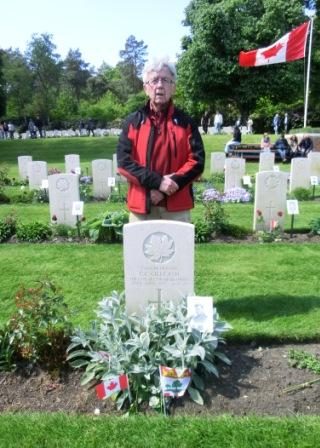
Pieter by the grave of Carman Edward Gillcash. (Photo credit: Daria Valkenburg)

Carman Edward GILLCASH, from Glenwood, Prince Edward Island, was serving with the Cape Breton Highlanders when he lost his life on April 29, 1945 during the Battle of the Delfzijl Pocket in The Netherlands, aged 27. You can read his story at https://onthewarmemorialtrail.com/2022/10/22/on-the-war-memorial-trail-the-wwii-soldier-from-glenwood-killed-during-the-battle-of-the-delfzijl-pocket/

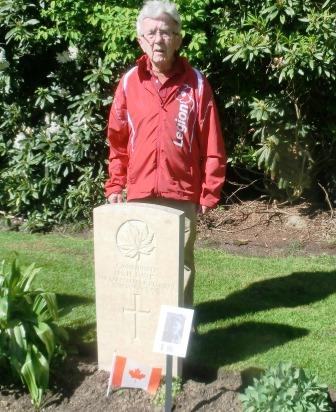
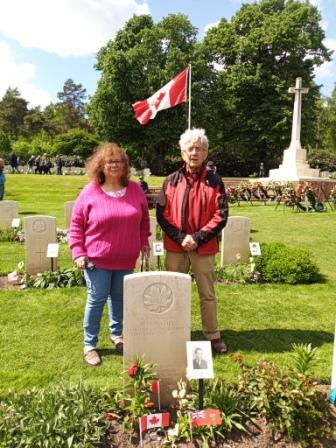
Daria and Pieter at the grave of Theodor ‘Ted’ Henschel. (Photo courtesy of Valkenburg Family)

Theodor ‘Ted’ HENSCHEL, who was born in Winnipeg, Manitoba, but lived in Trail, British Columbia, was serving with the Canadian Scottish Regiment when he was killed in action during the Battle for Wagenborgen in The Netherlands on April 22, 1945, aged 28. You can read his story at https://onthewarmemorialtrail.com/2023/08/14/on-the-war-memorial-trail-the-wwii-soldier-from-trail-who-played-the-cornet/

Just as Pieter finished placing flags at Ted’s grave, an elderly Dutch lady approached us, and asked if she could take our photo by the grave!  We were a bit confused, but then wondered if she thought that we were relatives.  Pieter explained to her that we were not relatives, but were placing flags at graves of soldiers that he had researched.  She wanted a photo anyways, and so it’s one of only two photos of the two of us together by a grave at one of the cemeteries!  (The other photo had been taken in the Canadian War Cemetery in Groesbeek by a Faces To Graves Groesbeek volunteer.)

Grave of Gordon Frederick Johnson. (Photo credit: Daria Valkenburg)

Gordon Frederick JOHNSON, from Truro, Nova Scotia, was serving with the North Nova Scotia Highlanders when he was killed in action, at the age of 33, on April 8, 1945, near Zutphen, The Netherlands, while trying to retrieve an anti-tank weapon that one of the members in his platoon had left behind. You can read his story at https://onthewarmemorialtrail.com/2021/07/17/on-the-war-memorial-trail-the-search-for-a-photo-of-gordon-frederick-johnson-is-over/

Grave of Michael Joseph ‘Joe’ McKenna. (Photo credit: Pieter Valkenburg)

Michael Joseph ‘Joe’ MCKENNA, from Newton Cross, Prince Edward Island, was serving with the Queen’s Own Rifles when was killed in The Netherlands on April 5, 1945 during the Battle of Rha, at the age of 26. You can read his story at https://onthewarmemorialtrail.com/2022/09/22/on-the-war-memorial-trail-the-wwii-soldier-from-prince-edward-island-killed-during-the-battle-of-rha/

Grave of Archibald Phillip ‘Archie’ McLean. (Photo credit: Daria Valkenburg)

Archibald Phillip ‘Archie’ MCLEAN from Edmundston, New Brunswick, was serving with the the Carleton & York Regiment when he died from wounds received on April 13, 1945 during Operation Cannonshot in The Netherlands, aged 25. You can read his story at https://onthewarmemorialtrail.com/2023/09/13/on-the-war-memorial-trail-archie-was-a-good-guy/

When Pieter was researching Archie’s story back in 2023, we met with Archie’s nephew, Donald Moore, who gave Pieter a poppy pin, and asked if Pieter would place it at his uncle’s grave next time we visited the cemetery in Holten.  Shortly after the story was published in the fall of 2023, Donald passed away. 

Pieter never forgot Donald’s request, and when we were preparing for our 2025 European War Memorial Tour, the poppy travelled with us. On May 1, 2025, Pieter affixed Donald’s poppy pin onto Archie’s grave.

Pieter places the poppy pin from Donald Moore onto the gravestone of Archibald Phillip ‘Archie’ McLean.  (Photo credit: Daria Valkenburg)

Pieter by the grave of Charles Borden Tuplin. (Photo credit: Daria Valkenburg)

Charles ‘Charlie’ Borden TUPLIN, from Indian River, Prince Edward Island, was serving with the Black Watch when he was fatally wounded in The Netherlands, and listed as having died on December 8, 1944, aged 34. You can read his story at https://onthewarmemorialtrail.com/2021/03/29/on-the-war-memorial-trail-the-ww2-soldier-from-indian-river/

….All of the flags placed at graves were donated…

All of the flags placed at graves were donated.  Our thanks go to: 

  • Alan Waddell, Constituent Assistant, on behalf of Heath MacDonald, MP for Malpeque, for the Canadian flags.
  • Jean-Claude D’Amours, MLA for Edmundston-Madawaska Centre, Minister responsible for Military Affairs, with the help of Cécile LePage, Province of New Brunswick, for the New Brunswick flag.
  • Matt MacFarlane, MLA for District 19, Borden-Kinkora, for the Prince Edward Island flag. 
  • Don Coutts on behalf of the Muttart and Coutts families in memory of Flight Sergeant Elmer Bagnall Muttart for the Ontario flag.
  • Brad Robertson, Chief of Protocol, Government of Manitoba, on behalf of Wab Kinew, Premier of Manitoba, for the Manitoba flag.
  • Kyle Graham, Research Officer, Military Relations, Nova Scotia Intergovernmental Affairs, on behalf of Premier Tim Houston, Province of Nova Scotia, for the Nova Scotia flag.

This concludes the 2025 Faces Of Holten Exhibition series, featuring soldiers whose stories have been previously told on this blog. But our adventures are not over, as we continue with our 2025 European War Memorial Tour.

Pieter encourages readers with photos to come forward so that eventually all the known graves of Canadians buried in Holten will have a photo displayed by their grave. Email him at memorialtrail@gmail.com

© Daria Valkenburg

….Want to follow our research?…

If you are reading this posting, but aren’t following our research, you are welcome to do so.  Our blog address: https://onthewarmemorialtrail.com/

4 countries, 6 weeks, 7,000 km – an unforgettable war memorial journey in Europe…. Daria’s book ‘No Soldier Buried Overseas Should Ever Be Forgotten‘ is available in print and e-book formats.  Net proceeds of book sales help support research costs and the cost of maintaining this blog. For more information see https://nosoldierforgotten.com/

Subscribe to our YouTube Channel: On The War Memorial Trail With Pieter Valkenburg: https://www.youtube.com/channel/UCJ591TyjSheOR-Cb_Gs_5Kw

Never miss a posting!  Subscribe below to have each new story from the war memorial trail delivered to your inbox.

On The War Memorial Trail….2025 Faces of Holten Exhibition Part 5: Indigenous Soldiers

September 10, 2025.  Pieter Valkenburg has been involved in finding photos of Canadians who are buried in all three Canadian War Cemeteries in The Netherlands since 2014, with stories of many soldiers told on this blog. 

While in The Netherlands and Belgium for the 80th Anniversary of Liberation Commemoration events, he placed flags at the graves of 383 soldiers in 14 cemeteries. At the Canadian War Cemetery in Holten, The Netherlands, flags were placed at 156 graves. Our visit coincided with The 2025 Faces Of Holten Exhibition, which ran for three weeks in May.

—-Recap…..

In Part 1, the graves and photos of soldiers who were killed near Posterenk in April 1945 were featured. (See https://onthewarmemorialtrail.com/2025/08/24/on-the-war-memorial-trail-2025-faces-of-holten-exhibition-part-1-soldiers-killed-near-posterenk/)

In Part 2, the graves and photos of two soldiers whose names are listed on the Cenotaph outside the Borden-Carleton Legion were featured. (See https://onthewarmemorialtrail.com/2025/08/29/on-the-war-memorial-trail-2025-faces-of-holten-exhibition-part-2-the-soldiers-listed-on-the-cenotaph-in-borden-carleton/)

In Part 3, the graves and photos of soldiers killed in vehicle accidents were featured. (See https://onthewarmemorialtrail.com/2025/09/01/on-the-war-memorial-trail-2025-faces-of-holten-exhibition-part-3-soldiers-killed-while-travelling-in-vehicles/)

In Part 4, the graves and photos of soldiers who lost their lives in the Battle of Leer during Operation Duck were featured. (See https://onthewarmemorialtrail.com/2025/09/04/on-the-war-memorial-trail-2025-faces-of-holten-exhibition-part-4-soldiers-who-drowned-during-operation-duck/)

…8 Indigenous soldiers are commemorated…

Now, in Part 5, the graves and photos of 8 Indigenous soldiers, whose stories have previously been told on this blog, are featured.

Grave of John Culbertson. (Photo credit: Daria Valkenburg)

John CULBERTSON was born in Oshawa, Ontario, and grew up on the Tyendinaga Mohawk Territory near Belleville, Ontario. While serving with the Royal Canadian Engineers, he was killed in Germany on April 30, 1944 during the Battle of Edewecht, aged 33. You can read his story at https://onthewarmemorialtrail.com/2023/02/04/on-the-war-memorial-trail-remembering-ww2-sapper-john-culbertson/

Grave of William ‘Willie’ Daniels.  (Photo credit: Daria Valkenburg)

William ‘Willie’ DANIELS, from the Big River Reserve in Depton, Saskatchewan, was serving with the Royal Winnipeg Rifles when he was killed, aged 20, on April 22, 1945 as troops moved through Appingedam in The Netherlands at the very beginning of the Battle of the Delfzijl Pocket. You can read his story at https://onthewarmemorialtrail.com/2021/07/23/on-the-war-memorial-trail-remembering-ww2-soldier-william-willie-daniels/

Pieter by the grave of Harry Henry Davis. (Photo credit: Daria Valkenburg)

Harry Henry DAVIS, from Selkirk, Yukon Territory, was serving with the Lake Superior Regiment (Motor) when he died in The Netherlands, aged 23, on January 15, 1945 from wounds received the day before after being shot while on patrol east of Kerkdriel.  You can read his story at https://onthewarmemorialtrail.com/2023/09/30/on-the-war-memorial-trail-the-only-yukon-territory-soldier-buried-in-holten/

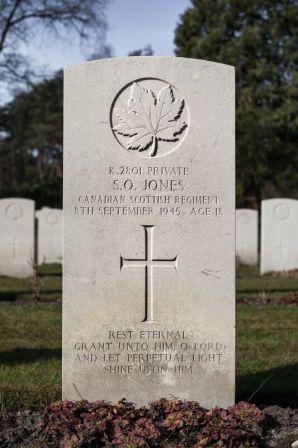
Grave of Stanley Owen Jones. (Photo credit: Daria Valkenburg)

Stanley Owen JONES, from Massett, British Columbia, drowned on September 8, 1945 in Germany when the carrier he was in overturned in a ditch, while serving with the Canadian Scottish Regiment, aged 20. You can read his story at https://onthewarmemorialtrail.com/2022/09/05/on-the-war-memorial-trail-remembering-wwii-soldier-stanley-owen-jones/
Grave of Philip Laforte. (Photo credit: Daria Valkenburg)

Philip LAFORTE, born in Lac du Bonnet, Manitoba, was serving with the Royal Winnipeg Rifles when he was killed on April 7, 1945 in The Netherlands, aged 33, as the Regiment crossed the Schipbeek, in order to establish a bridgehead as preparation for an assault on the city of Deventer by the 7th Canadian Brigade. You can read his story at https://onthewarmemorialtrail.com/2022/03/22/on-the-war-memorial-trail-remembering-ww2-soldier-philip-laforte/

Grave of Sanford Steven Saulis.  (Photo credit: Pieter Valkenburg)

Sanford Steven SAULIS, from Maliseet, New Brunswick, died of a brain hemorrhage in The Netherlands on August 10, 1945, aged 30, while serving with the 16th Field Company of the Royal Canadian Engineers. You can read his story at https://onthewarmemorialtrail.com/2023/02/27/on-the-war-memorial-trail-remembering-sanford-steven-saulis/

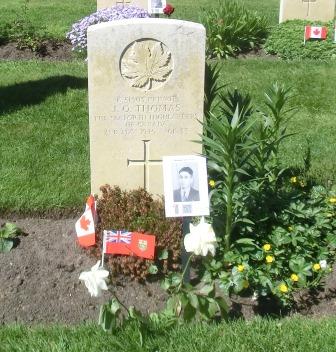
Grave of James ‘Jimmy’ Oliver Thomas. (Photo credit: Daria Valkenburg)

James ‘Jimmy’ Oliver THOMAS, born in St. Peters, Manitoba, died in Germany on May 2, 1945, aged 33, a few days after being liberated from the Stalag VII-A POW Camp in Moosburg, Germany. He had been taken prisoner of war on May 22, 1943, while serving with the Seaforth Highlanders of Canada, during the breaking of the Hitler Line. You can read his story at https://onthewarmemorialtrail.com/2024/02/18/on-the-war-memorial-trail-the-wwii-soldier-from-manitoba-who-died-shortly-after-being-liberated-from-stalag-vii-a/

After sending photos of the grave to Rodd Cooper, great-nephew of Jimmy Thomas, he wrote us to say “  I just wanted to express my infinite gratitude to you and your family on behalf of myself and my family for the work and the time you have invested in gathering the information not only for my resting family member but for the numerous others as well. 

The honour and respect you have brought and given to these men cannot be measured.  The gift that you have given my family and I is profound and we truly can’t thank you enough.  

Because of your work and dedication, my family and the future generations of my family, will be able to pay the respect to my Great Uncle Jimmy for his service and sacrifice by remembering him and telling his story.  

The gift you have given us is immeasurable.

On behalf of myself and the Thomas Family, Thank You….” 

We were immeasurably touched by his kind words. Pieter replied, saying that “…it’s important that we never forget the soldiers….and the families… who sacrificed so much for our ongoing freedom.  I’m grateful that the country of my birth continues to remember and honour their Allied liberators….” 

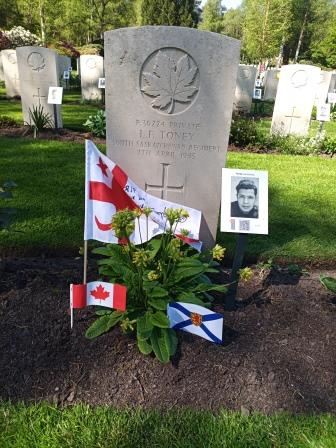
Grave of Leo Francis Toney. (Photo credit: Pieter Valkenburg)

Leo Francis TONEY, born in Wolfville, Nova Scotia, was serving with the South Saskatchewan Regiment, when he was killed on Saturday, April 7, 1945, aged 21, while trying to cross the Schipbeek in The Netherlands at  a bridgehead that had been formed at a weir on the border of the municipalities of Bathmen and Holten. You can read his story at https://onthewarmemorialtrail.com/2021/05/22/on-the-war-memorial-trail-remembering-ww2-soldier-leo-francis-toney/

After sending a photo of the grave to Della Maguire, niece of Leo Toney, she wrote to say “…thank you so much, I looked at that picture all day. I am so grateful…

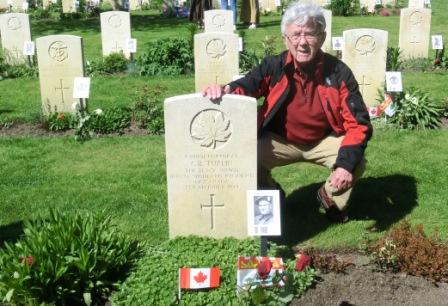
Pieter holds onto the personalized Lnu flag from the Toney family at the grave of Leo Francis Toney. (Photo credit: Daria Valkenburg)

….All of the flags placed at graves were donated…

All of the flags placed at graves were donated.  Our thanks go to: 

  • Alan Waddell, Constituent Assistant, on behalf of Heath MacDonald, MP for Malpeque, for the Canadian flags.
  • Armel ‘Mel’ Lanteigne, President of the Caraquet Legion in New Brunswick for the New Brunswick flag.
  • Kyle Graham, Research Officer, Military Relations, Nova Scotia Intergovernmental Affairs, on behalf of Premier Tim Houston, Province of Nova Scotia, for the Nova Scotia flag.
  • Don Coutts on behalf of the Muttart and Coutts families in memory of Flight Sergeant Elmer Bagnall Muttart for the Ontario flag.
  • Wayne Ewasko, MLA for Lac Du Bonnet, Manitoba, Interim Leader of the Official Opposition, Province of Manitoba, for the Manitoba flag.
  • Della Maguire on behalf of the Toney/Smith Family in memory of Pte Leo Toney for the Lnu (Mi’kmaw) flag.
  • Conrad Saulis in memory of Sapper Sanford Steven Saulis, courtesy of Grand Chief Ron Tremblay, for the Wolastoqey Nation flag

Thank you to Rodd Cooper and Della Maguire for their heartfelt and kind words.  The comments we’ve received from families as we’ve shared photos showing how their loved ones were honoured during the commemoration events made all the hard work of visiting the cemeteries and placing flags worthwhile.

The 2025 Faces of Holten Exhibition concludes with Part 6, where the graves of a few of the many soldiers killed in The Netherlands and Germany will be featured as we continue with our 2025 European War Memorial Tour.

Pieter encourages readers with photos to come forward so that eventually all the known graves of Canadians buried in Holten will have a photo displayed by their grave. Email him at memorialtrail@gmail.com.

© Daria Valkenburg

….Want to follow our research?…

If you are reading this posting, but aren’t following our research, you are welcome to do so.  Our blog address: https://onthewarmemorialtrail.com/
4 countries, 6 weeks, 7,000 km – an unforgettable war memorial journey in Europe…. Daria’s book ‘No Soldier Buried Overseas Should Ever Be Forgotten‘ is available in print and e-book formats.  Net proceeds of book sales help support research costs and the cost of maintaining this blog. For more information see https://nosoldierforgotten.com/

Subscribe to our YouTube Channel: On The War Memorial Trail With Pieter Valkenburg: https://www.youtube.com/channel/UCJ591TyjSheOR-Cb_Gs_5Kw

Never miss a posting!  Subscribe below to have each new story from the war memorial trail delivered to your inbox.

On The War Memorial Trail….. Part 1: The WWII Letters Of Edison Reynolds Smith

December 7, 2023. Whenever Pieter researches someone who has served in the military, we ask if there is any correspondence that the families might have. Sometimes a letter or postcard survives, which is wonderful.

In 2021, in the Atlantic Canada Remembers series, Angela Leighton submitted a photo of her uncle, Edison Reynolds SMITH, who was killed in action in The Netherlands on October 16, 1944, during the Battle of the Scheldt, while serving with the North Nova Scotia Highlanders.  He’s buried in the Canadian War Cemetery in Adegem, Belgium.  (See https://onthewarmemorialtrail.com/2021/01/07/on-the-war-memorial-trail-atlantic-canada-remembers-part-1/)

Edison Reynolds Smith

Edison Reynolds Smith.  (Photo courtesy of Angela Leighton)

After the article was posted, Angela wrote us with more information.  “Edison Reynolds Smith was born May 11, 1924 on Port Hood Island, Cape Breton, Nova Scotia to parents Guy and Grace (nee Watts) Smith.  After his parents passed, Edison and his siblings were taken in by their aunt and uncle, Elsie and Roland Myers, and lived in Cooks Cove, Guysborough County, Nova Scotia from 1929 until 1944….

Edison’s sense of duty was strong, and he enrolled in the 2nd (Reserve) Battalion of the Pictou Highlanders on August 24, 1942.  “…Edison joined the Militia in August 1942 and worked as a lumberman for his uncle until he enrolled in the Canadian Army on August 30, 1943….”  He enlisted at the No. 6 District Depot in Halifax, Nova Scotia.

20230616_085605_resized Angela Leighton

Angela Leighton, whose mother Dorothy was the younger sister of Edison Reynolds Smith, kept the letters he wrote to family.  (Photo submitted by Angela Leighton)

Angela then mentioned that she had letters that Edison had written during the time of his military service!  The letters reveal an engaging man who had suffered much tragedy in his young life, but never lost his optimistic spirit, even when he encountered more loss.  He was deeply interested in his family and friends, and kept up an active correspondence.  As time went on, he yearned to be back in Nova Scotia, surrounded by those he loved.

This was confirmed by Angela, whose mother Dorothy (Dot) was Edison’s sister.  “…His mother (my grandmother) died on January 11, 1928.  Her husband (my grandfather) died January 30, 1929. …It is no wonder Edison had such a love of family after such tragedy in those years before and really wanted to come back home….

1943 Edison Smith with Dot and Wesley

Edison (left) with his sister Dorothy and younger brother Wesley in 1943.  (Photo courtesy of Angela Leighton)

… Edison began his army training in September 1943…

After enlisting, Edison was sent to No. 60 Canadian Army Basic Training Centre (CABTC) in Yarmouth, Nova Scotia on September 17, 1943.

On November 19, 1943, he was sent to A14 Canadian Infantry Training Centre (CITC) in Aldershot, Nova Scotia for further training.  He received embarkation leave, from January 22 to February 4, 1944, the last chance he had to see his family.

After returning from leave, Edison remained in Aldershot until February 20, 1944, when he was transferred to the No.1 Training Brigade in Debert, Nova Scotia for final training and preparation for overseas service.

In a March 15, 1944 letter to his sister Dorothy, written from No 2 Temporary Transit Camp in Debert, Edison related one of the experiences and mentioned a friend from back home: “…We just got back off of our three day scheme.  We slept out in the woods two nights and we marched about 26 miles altogether.  I didn’t mind it though. It was a change from sleeping in the barracks…I saw Victor Shea up here the other day, he just came here about three or four days ago….It was terrible cold here right after I came back off of my weekend.  It was about 20 below zero one night.  But it’s a lot warmer now.  We moved today to a different part of the camp…

An April 1, 1944 letter to Dorothy, also written from Debert, noted that: “…my eyes have been paining me a little lately….I went on sick parade, but they only gave me a few tablets.…

… Edison left Canada for overseas service in April 1944…

Not mentioned in the letter was that Edison was on his way to the United Kingdom.  On April 6, 1944 he left Canada, arriving in the United Kingdom on April 12, 1944, where he was assigned to No 4 Canadian Infantry Reinforcement Unit (CIRU).

Edison’s initial impression of England was positive, as he related in an April 14, 1944 letter to his sister Dorothy, written from No 4 CIRU: “…It’s lovely weather over here except it rains once in a while…I spent Easter in the middle of the Atlantic.  It was a nice place to spend Easter, wasn’t it?….I had a good trip coming across but it was a little crowded….

Not long afterwards, Edison was sent to No 10 Battalion, Canadian Base Reinforcement Group (CBRG), but was still in England.  A poignant May 11, 1944 letter to his aunt, Elsie Myers, reflected that “…Today is my birthday. I hope I will be home my next birthday…

… Edison loved getting mail from back home…

In a May 25, 1944 letter, written from No 10 Battalion CBRG in England, Edison answered his sister Dorothy’s query about Victor Shea. “…I got two letters today and both from you. There’s nothing cheers me up any more than getting letters…..I haven’t seen Vic for a while.  He is not with me at all now.  He was with me all the time coming across on the ship from Canada and he ate and slept right where I did all the way coming across… 

Victor SHEA had joined the Canadian Parachute Battalion in 1942.  When more soldiers were needed for battle on the beaches of Normandy after D-Day, he transferred to infantry and was on the front lines, joining the North Nova Scotia Highlanders.   He received France’s Croix de Guerre (Medal of Valour) for his bravery in the liberation of France.

Before ending his letter, Edison assured his sister that he appreciated a parcel she’d sent. “…Thank you so much for the box you sent me.  We get lots to eat but it’s nice to have a change from army grub…

Dorothy wasn’t the only one to inquire about Victor Shea and other soldiers from their area.  In a May 25, 1944 letter to his cousin Abbie, daughter of his uncle Roland and aunt Elsie Myers, Edison explained that “…Vic Shea isn’t where I am at all now so there isn’t any one from home with me now….They are about the only ones anyways handy from home.  But I know a lot of the boys here by now because I went through all my training in Canada with them….If they send me a box from home, tell them to send me a few apples because I never tasted a bit of fruit of any kind since I came over here…

… Edison leaves for France and the D-Day invasion with the North Nova Scotia Highlanders…

On June 2, 1944, Edison was assigned to the North Nova Scotia Highlanders, as they prepared to leave the United Kingdom for France as part of the 21st Army Group.

The war diary for the North Nova Scotia Highlanders for June 3, 1944 noted that they … embarked from G1 Hard, Stokes Bay…..” and were “…lying out in the Southampton waters just outside Netley…” while awaiting clearance to cross the English Channel.

There was a delay in leaving due to heavy winds on June 4, so it wasn’t until June 5, 1944 that the crossing began.  “…At 1400 hours the flotilla moved out to the open sea and formed up with the other craft taking part in the invasion…”  This, of course, was to be what we know as D-Day.

On June 6, 1944, the war diary recorded that “…by 1400 hours all our troops were ashore, but as the Eighth Canadian Infantry Brigade had not found the going as easy as expected, we were unable to get through the town and were unable to assemble at ‘ELDER’, near Beny-Sur-Mer, as planned, and the Commanding Officer decided to assemble in a field….

D-Day was Edison’s first experience of fighting, but he survived.

… Tragedy strikes but Edison was not yet aware of another loss…

In early June, 1944, a telegram was sent to Edison’s brother, Wesley Smith in Cooks Cove, Nova Scotia, stating that Edison had been wounded on June 9, 1944, but remained on duty with his unit.  A notice of his being wounded is also recorded in Edison’s service file.  However, Edison later stated to his family that he was not wounded.

Edison and Wesley Smith better res

Edison (left) and Wesley Smith. (Photo courtesy of Angela Leighton)

What Edison didn’t know – and apparently neither did the military who sent the telegram – was that his younger brother Wesley, who was in the Reserves, had drowned on May 27, 1944.  He was only 16 years old.

….Coming up in Part 2…

In Part 2, Edison sees active service in France, Belgium, and The Netherlands and learns about the loss of his younger brother.   

Thank you to Angela Leighton for sharing photos and letters written by her uncle.  Do you have information to share about Canadian soldiers, please email us at memorialtrail@gmail.com, or comment on the blog.  

© Daria Valkenburg

….Want to follow our research?….

If you are reading this posting, but aren’t following our research, you are welcome to do so.  Our blog address: https://onthewarmemorialtrail.com/

Front cover OnTheWarMememorialTrailinEurope4 countries, 6 weeks, 7,000 km – an unforgettable war memorial journey in Europe…. Daria’s book ‘No Soldier Buried Overseas Should Ever Be Forgotten‘ is available in print and e-book formats.  Net proceeds of book sales help support research costs and the cost of maintaining this blog. For more information see https://nosoldierforgotten.com/ 

You are also invited to subscribe to our YouTube Channel: On The War Memorial Trail With Pieter Valkenburg: https://www.youtube.com/channel/UCJ591TyjSheOR-Cb_Gs_5Kw

Never miss a posting!  Subscribe below to have each new story from the war memorial trail delivered to your inbox.
On The War Memorial Trail….. The WWII Soldier From Trail Who Played The Cornet

August 14, 2023.  When Pieter begins his research into a soldier, and then contacts possible family members, he never knows what to expect.  Sometimes, his outreach surprises family members as they might not know a lot about the soldier he inquires about. 

During the search for a photo of Theodor ‘Ted’ HENSCHEL, who was born in Winnipeg, Manitoba on September 19, 1914,  Pieter learned that Ted was living in Trail, British Columbia at the time of his enlistment on June 21, 1944 at the No. XI District Depot in Vancouver, British Columbia.

When Pieter was contacted Joy Roberts, daughter of Ted’s brother Emil, she wrote that “My father didn’t talk about his brother.  So I am a little confused.  Ted Henschel is listed on the Trail, BC war dead. My father and their father lived in Trail…”  But – the family did have photos of Ted!

Theodor Henschel

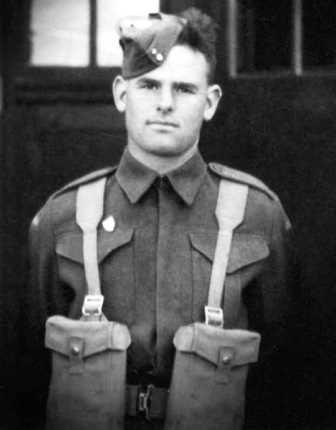
Theodor ‘Ted’ Henschel (Photo courtesy of the Henschel Family)

Ted’s parents had immigrated to Canada from Eastern Europe.  They lived in Winnipeg until Ted was a year old, then in Saskatchewan for 12 years, before moving to British Columbia. “…One brother, Fred, lived and passed away in Vancouver.  He changed his name at some point during the war, because of Henschel sounding German.  He changed it to Hansel and was the only child that immigrated with the parents (though I believe one other son died on the ship while crossing to America).  Fred was about twenty years older than my dad, Emil…” explained Joy.

Besides Fred and Emil, Ted had a brother Rudolf and a sister Annie. When Ted enlisted after being called up for service under the National Resources Mobilization Act (NRMA), he had been working for a decade as a machine operator for the Consolidated Mining and Smelting Company in Trail, British Columbia. In addition to English, it was recorded that he could speak German, and that he wore corrective lenses. (See https://en.wikipedia.org/wiki/National_Resources_Mobilization_Act)

…Ted began his basic training in Camrose….

Ted was sent to No. 131 Canadian Infantry Basic Training Centre (CIBTC) in Camrose, Alberta.

Ted identified A Company Sep 1944 Camrose

September 1944 group photo of No 131 CIBTC , taken at the Military Headquarters  in Camrose, Alberta.  Ted Henschel is in the middle row, second from right.  (Photo courtesy of the Henschel Family)

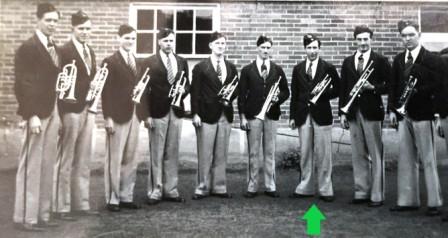
Ted was a cornet player and played in the platoon band.

Musicians Ted 3rd from right with arrow

Ted Henschel, third from right.  (Photo courtesy of the Henschel Family)

On September 16, 1944, having completed his basic training, Ted was transferred to the A-16 Advanced Canadian Infantry Training Centre (CITC) in Calgary, Alberta.

Ted remained in Calgary until December 9, 1944, when he was transferred to the No.1 Training Brigade in Debert, Nova Scotia for final training and preparation for overseas service.

…Ted left Canada for overseas service…

On Christmas Eve – December 24, 1944 – Ted left Canada for the United Kingdom.  Upon arrival in the United Kingdom on the last day of the year, he was assigned to No. 1 Canadian Infantry Training Regiment (CITR) for further training.

…Ted was sent to The Netherlands…

finalphasecanscottish

Ted Henschel joined the Canadian Scottish Regiment near Zwolle. (Map source: http://www.canadiansoldiers.com)

On March 23, 1945 he was in North West Europe with the X-4 reinforcement troops of the 21st Army Group. Then, on April 18, 1945, he was transferred to the Canadian Scottish Regiment, joining the unit in the area around Zwolle, The Netherlands.  The Regiment had established patrols around Zwolle over an area of 161 square kms (100 square miles), rounding up German stragglers.

…The Battle for Wagenborgen was fierce…

wagenborgen

The Canadian Scottish Regiment’s movements during the Battle for Wagenborgen.  (Map source: http://www.canadiansoldiers.com)

On April 19, 1945, the Regiment moved to a concentration area at Hoogezand, near Groningen. Allied troops next worked to clear the area around Groningen of enemy troops. Patrols reported that Wagenborgen was still held by Germans. 

…Roads leading in and out of Wagenborgen had been blocked, and covered by machine guns and anti-aircraft guns…. The terrain surrounding Wagenborgen was flat, unobstructed by dense foliage, and criss-crossed by numerous canals and drainage ditches which limited the avenues of approach for the attackers….”  (Excerpt from https://www.canadiansoldiers.com/history/battlehonours/northwesteurope/wagenborgen.htm)

On April 21, 1945,  an attack on Wagenborgen, located south of Delfzijl, began, in what turned out to be a terrible fight.  This was the preliminary battle before the Battle of Delfzijl Pocket. The Canadian Scottish Regiment began the attack with only ‘D’ Company, but very quickly realized that this was insufficient. There were many casualties.

However, a subsequent attack with three companies was successful and troops were able to repel counter-attacks. By the time it was over, Canadian Scottish casualties at Wagenborgen were 23 killed and 41 wounded.

…Ted lost his life during the Battle for Wagenborgen …

The war diary for the Canadian Scottish for Sunday, April 22, 1945 recorded that “… ‘A’, ‘B’, and ‘C’ Companies patrolled extensively to their fronts:  ‘A’ Company met small arms fire from the town of Wagenborgen…’B’ Company patrolled…also meeting small arms fire…. ‘C’ Company established 4 strong-points to their front on the dyke running southwest to northeast….

Ted was in ‘A’ Company, which late in the evening “pushed east towards the northern part of WAGENBORGEN with the 4.2’s firing on the Company’s left flank. ‘C’ Company sent one Platoon to secure the dyke…with the other two Platoons pushing towards the dyke ….

The after-action report for ‘A’ Company summarized what happened: “…At 2200 hours on the night of 22 April 45 A Company began their advance on the northern end of the village of WAGENBORGEN. Supporting fire commenced at 2230 and continued until 2245 during which time the Company advanced unmolested. At 2245 the assault commenced and for the first time enemy fire was apparent. The Company advanced through considerable shell –fire which caused several casualties…

By 11 pm, the war diary reported that “… ‘B’ Company’s attack was started on the southern part of WAGENBORGEN. …. ‘A’ Company secured the northern part of the village…

Sadly, at some point during the Battle for Wagenborgen on April 22, 1945, Ted lost his life. He likely hadn’t even had time to get to know the soldiers he was with, since he had only joined the Regiment a few days earlier.

…Ted is buried in the Canadian War Cemetery in Holten …

Ted was temporarily buried in Siddeburen before being reburied on February 15, 1946 in the Canadian War Cemetery in Holten, The Netherlands.

Foto graf Theodor Henschel, 21-1-013

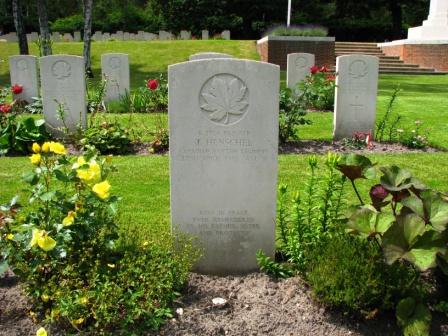
Grave of Theodor ‘Ted’ Henschel in Holten, The Netherlands.  (Photo courtesy of the Information Centre Canadian Cemetery Holten)

…Ted is remembered on memorials in Trail and Wagenborgen …

As Joy wrote in her initial email, Ted is listed on the war memorial in Trail, British Columbia: see https://www.waymarking.com/waymarks/WMN9QE_Trail_Cenotaph_Trail_BC

He is also listed on the war memorial in Wagenborgen, which commemorates the residents of Wagenborgen who died in the Second World War, and 27 fallen Canadian soldiers – 23 of them from the Canadian Scottish Regiment.  See https://www.tracesofwar.com/sights/24193/War-Memorial-Wagenborgen.htm

Thank you to Joy Roberts, who wrote “Thank you very much for your work. Joy, Gail, and Dennis – Nieces and Nephew of Ted Henschel…” A big thank you to Judie Klassen, whose genealogy research helped to find family members of Ted Henschel.

If you have a story to tell, please let Pieter know. You can email him at memorialtrail@gmail.com, or comment on the blog.  

© Daria Valkenburg

…Want to follow our research?….

If you are reading this posting, but aren’t following our research, you are welcome to do so.  Our blog address: https://onthewarmemorialtrail.com/

Front cover OnTheWarMememorialTrailinEurope4 countries, 6 weeks, 7,000 km – an unforgettable war memorial journey in Europe…. Daria’s book ‘No Soldier Buried Overseas Should Ever Be Forgotten‘ is available in print and e-book formats.  Net proceeds of book sales help support research costs and the cost of maintaining this blog. For more information on the book, please see https://nosoldierforgotten.com/

Subscribe to our YouTube Channel: On The War Memorial Trail With Pieter Valkenburg: https://www.youtube.com/channel/UCJ591TyjSheOR-Cb_Gs_5Kw

Never miss a posting!  Subscribe below to have each new story from the war memorial trail delivered to your inbox.
On The War Memorial Trail….. 1 WWII Soldier 2 Families 3 Countries

June 18, 2023.  Edwin van der Wolf, a volunteer researcher at the Canadian War Cemetery in Holten, The Netherlands, has a special research interest in the Canadian Scottish Regiment. (See https://bordencarletonresearchproject.wordpress.com/2020/05/04/new-website-on-canadian-scottish-regiment-during-ww2/)

Edwin noted that he is …also involved in the Canadian War Cemetery in Adegem, Belgium, where 38 fallen / killed soldiers of the Canadian Scottish Regiment are buried…”   In 2021 Edwin and his son Breyton adopted two of these graves.  (See Adopting A Grave In Adegem: https://onthewarmemorialtrail.com/2021/08/29/on-the-war-memorial-trail-adopting-a-grave-in-adegem/ )

…The grave of a Canadian Scottish Regiment soldier buried in Adegem was adopted by Breyten van der Wolf…

…My youngest son, Breyten van der Wolf, who is 28, adopted the grave of Cpl Joseph H. Pallister of the Canadian Scottish Regiment …” 

Adoptie Certifikaat J.H. Pallister, 11-5-019

The adoption certificate issued to Breyten van der Wolf.  (Photo courtesy Edwin van der Wolf)

When we see photos and stories about Dutch people at the war cemeteries, what is featured are usually children from schools, older people who remembered the war from their childhood, or people whose parents were alive during the war and talked about it. 

Breyten van der Wolf

Breyten van der Wolf (Photo courtesy of B. van der Wolf)

It’s not often that you see young adults actively involved, so I asked Breyten about that.  “…I remember the stories from the war told by my grandma and they were very interesting...” he explained.  “…So, I think it’s just a perception…

I then asked Breyten how he came to adopt the grave of Joseph Pallister.  “….The choice of which graves to adopt was decided by my father, and he decided to get this one because Joseph Pallister was a member of the Canadian Scottish Regiment....

I asked Breyten if he had any more thoughts, and was not surprised when he replied that “…I think my father has done a lot of good work for this cause!…”  Indeed he has.

…Who was Joseph Hudson Pallister?…

Joe Pallister 1 from Thomas Mouser

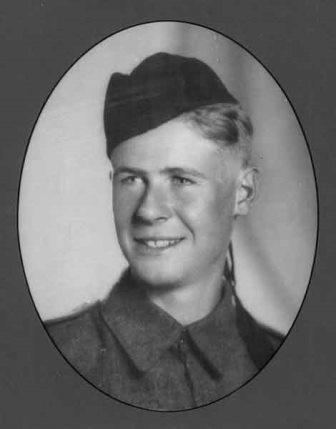
Joseph Hudson Pallister.  (Photo courtesy of the Pallister Family)

Edwin explained that when the grave was adopted, he had not been in contact with any family members.  However, he did some basic research into the life and service of Joseph Hudson PALLISTER.

…Joseph was born on September 25, 1923 in Calgary, Alberta, the son of Guy and Evelyn M. Pallister, of Turner Valley, Alberta. His brothers were: Thomas, Fred, John, Bernard, Henry, Stanley, Albert, Reginald, and Allan. And his sisters were Beatrice, Daisy, and Norah…..

From Joseph’s military service file, Edwin learned that “… his profession was a pipe fitter in the oil industry and he was a member of the Church of England. His hobbies were playing baseball and light reading….

Joseph “...enlisted on January 11, 1943 in Calgary…” and was sent to the United Kingdom that August.  He was transferred to the “….Canadian Scottish Regiment on October 10, 1943….”  With the Regiment he was “…in the first wave of the landing on D-Day….” on June 6, 1944.

… Joseph lost his life during the Battle of the Leopold Canal…

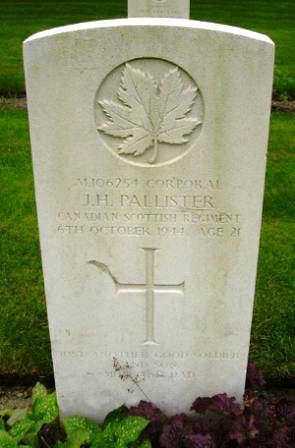
Joseph was in C Company when he was “…killed in action on Friday, October 6, 1944 during the Battle of the Leopold Canal in Belgium. He was temporarily buried in Maldegem before being reburied on July 17, 1945 in Adegem...”  He was 21 years old.  (See https://www.canadiansoldiers.com/history/battlehonours/northwesteurope/leopoldcanal.htm)

PENTAX Image

Grave of Joseph Hudson Pallister. (Photo source: http://www.findagrave.com)

 … Joseph’s great-nephew got in contact …

After the 2021 posting about the grave adoption in Adegem was published, we received an email from Thomas Mouser, the great-nephew of Joseph Pallister.

Thomas wrote that “… J.H. Pallister is my great uncle and I have begun to conduct some research on his time in the military as well as his circumstances of death. …I was also hoping for a chance to potentially get in touch with Breyten van der Wolf, as I would like to express my sincere gratitude for him taking care of my uncle’s grave….” 

IMG_20220427_145542_841 Thomas Mouser

Thomas Mouser.  (Photo courtesy of the Pallister Family)

This led to Thomas and Edwin being in contact over the past months.  …I am incredibly grateful and moved by the remembrance and acknowledgment shown by the people of Western Europe towards the sacrifices made by Canadians during World War II….”  Thomas wrote.  “… The recognition of the tremendous efforts and bravery displayed by Canadian soldiers in liberating Europe from tyranny is truly heartening. It is a testament to the enduring bond between nations and a reminder of the profound impact that collective sacrifices can have in shaping history…..

Thomas explained that Joseph was one of four brothers that served during WWII.  Joseph’s three brothers all survived the war.  John Francis PALLISTER was in the Canadian Artillery, Thomas Richard PALLISTER and Fredrick James PALLISTER were in the Canadian Signal Corps.  

IMG_2186 4 Pallister brothers from Thomas Mouser

Four Pallister brothers served in WWII.  (Photo courtesy of the Pallister Family)

…The gratitude expressed by Western Europeans is a testament to their deep understanding of the sacrifices made by Canadians, fostering a sense of unity and appreciation that transcends time and borders….” Thomas expressed what so many families of soldiers buried overseas feel.

The grave adoption by the Van der Wolf family resonated deeply.  “…This remembrance serves as a powerful reminder of the importance of honouring the sacrifices made by those who fought for freedom, ensuring that their legacy lives on for future generations. Just as Joseph has now become a part of Edwin’s family, Edwin’s family has become a part of ours. We all feel so blessed to have such incredible people taking care of one of our lost family members, so thank you to everyone stewarding Canadian war graves… your effort will never go unnoticed….” 

While the Commonwealth War Graves Commission ensures that all of the war graves are cared for and the war cemeteries beautifully landscaped, it’s something special to know that a particular family or person visits a grave so far from Canadian soil.  “All of Joseph’s nieces and nephews are incredibly excited that there are people taking care of his grave….

Thank you to Breyton and Edwin van der Wolf for remembering members of the Canadian Scottish Regiment in WWII, and to Thomas Mouser, great-nephew of Joseph Hudson Pallister, for sharing photos and heartfelt comments.

One WWII soldier’s death impacted two families – one Canadian, one Dutch – across three countries – Canada, Belgium, and The Netherlands.  His sacrifice will never be forgotten. 

Do you have a story to share? Email Pieter at memorialtrail@gmail.com, or comment on the blog.   

© Daria Valkenburg

…Want to follow our research?…

Follow our blog

If you are reading this posting, but aren’t following the blog, you are welcome to do so. Our blog address: https://onthewarmemorialtrail.com/

Front cover OnTheWarMememorialTrailinEurope4 countries, 6 weeks, 7,000 km – an unforgettable war memorial journey in Europe…. Daria’s book ‘No Soldier Buried Overseas Should Ever Be Forgotten‘ is available in print and e-book formats.  Net proceeds of book sales help support research costs and the cost of maintaining this blog. For more information see https://nosoldierforgotten.com/

You are also invited to subscribe to our YouTube Channel: On The War Memorial Trail With Pieter Valkenburg: https://www.youtube.com/channel/UCJ591TyjSheOR-Cb_Gs_5Kw

Never miss a posting!  Subscribe below to have each new story from the war memorial trail delivered to your inbox.

On The War Memorial Trail…..Honouring Two CanScots Buried In Adegem By Adopting Their Graves

January 17, 2023.  Edwin van der Wolf, a volunteer researcher at the Canadian War Cemetery in Holten, The Netherlands, has a particular area of interest into soldiers from the Canadian Scottish Regiment, and since 2020 has a website on the Regiment. (See https://bordencarletonresearchproject.wordpress.com/2020/05/04/new-website-on-canadian-scottish-regiment-during-ww2/)

He informed us that 38 soldiers from the Canadian Scottish Regiment are buried in the Canadian War Cemetery in Adegem, Belgium. In 2021 the Van der Wolf family participated in a grave adoption program for two of these soldiers.  “…If you adopt a grave at the Adegem Canadian War Cemetery you receive a certificate of this adoption during a yearly ceremony in May…  (See https://onthewarmemorialtrail.com/2021/08/29/on-the-war-memorial-trail-adopting-a-grave-in-adegem/)

P1370320(1) Edwin

Edwin van der Wolf, far right, received grave adoption certificates from the Canadian War Cemetery in Adegem. (Photo courtesy Edwin van der Wolf)

In 2022, the family adopted the graves of Ronald ‘Ronnie’ Stuart Walter HOOLE and David ‘Dave’ Stinson HENDERSON, both from the Canadian Scottish Regiment.  He then asked if we could possibly find families and photos of these two men. Of course, we agreed to investigate.

….Ronnie Hoole lost his life trying to save a friend…

Ronald ‘Ronnie’ Stuart Walter HOOLE was born October 22, 1923 in Ganges on Salt Spring Island, British Columbia, the son of Sidney Walter and Gertrude Agnes (nee Snow) Hoole.

2008001010 Ronald Hoole

Ronald Hoole.  (Photo found at https://saltspringarchives.com/Legion_Branch_92/)

A labourer before enlisting, at the age of 16, on June 26, 1940 in Victoria, British Columbia, he was sent overseas to the United Kingdom on August 23 1941. With his Regiment he arrived in Normandy for the D-Day landings on June 6, 1944 and was one of the survivors.

Battle of Scheldt map showing Eede

Map showing the Breskens Pocket. (Map source: http://www.canadiansoldiers.com)

By October 1944, the Regiment was in The Netherlands, along the Belgium border, involved in the Battle of the Breskens Pocket, an action fought south of the Scheldt Estuary as part of the Battle of the Scheldt.  The Scheldt Estuary, the waterway leading from the sea into the port of Antwerp, Belgium, was not available to Allied shipping because German coastal batteries on Walcheren Island defended the approaches.

As part of the 7th Canadian Infantry Brigade, along with the Royal Winnipeg Rifles and the Regina Rifles, the Canadian Scottish worked to clear the Breskens Pocket. (See https://www.canadiansoldiers.com/history/battlehonours/northwesteurope/breskenspocket.htm and https://en.wikipedia.org/wiki/Battle_of_the_Scheldt)

On October 27, 1944, the entry in the War Diary for the Canadian Scottish noted that this was not an easy task.  “…Plans were laid during the early morning for ‘A’ and ‘D’ Companies to move forward…. and to go after enemy positions…. The companies began what was to prove to be a very difficult day…. ‘A’ Company…were enduring painfully heavy shelling….

‘A’ Company “…launched its final assault of the day with 9 Platoon leading…. All went well until suddenly 9 Platoon found itself fired on by machine guns at point-blank range.  They were travelling along a road at the foot of a dyke and were met by a hail of fire from all sides. The enemy had allowed them to pass through and had then closed in….

It was a bloody battle that ‘A’ Company could not win.  “…Their ammunition was soon exhausted and their position in the open below the muzzles of the German machine guns was untenable.  Only 12 men of ‘A’ Company escaped being overwhelmed in the action…

Ronnie Hoole was one of the casualties on that day, losing his life while trying to save a friend’s life. He was temporarily buried in Hoofdplaat, The Netherlands, before being reburied in the Canadian War Cemetery in Adegem, Belgium on June 12, 1945.

Edwin explained that Ronnie Hoole’s “…grave was adopted on May 14, 2022 by my son, Keje van der Wolf…

Unfortunately, up to now, while we have not been able to find family of Ronnie Hoole, we were fortunate to find a photo of him online.

….Dave Henderson lost his life when a German luger accidentally went off …

The search for family of David ‘Dave’ Stinson HENDERSON was successful when his great-niece, Bonnie Wilson, contacted Pieter.  “I so appreciate you reaching out.  I think it is so important to keep memories of the fallen alive. What a cool thing that you and your wife are doing.  Very impressive!…

Bonnie had a photo and an account of her great-uncle from a book ‘So Young They Were – Armstrong’s Fallen Of The Second World War’ by Leonard J. Gamble.

IMG_2266 David Henderson

David ‘Dave’ Stinson Henderson.  (Photo courtesy of Bonnie Wilson)

Dave was born on August 30, 1919 in Belfast, Northern Ireland, the son of William and Rachel (nee Stinson) Henderson. In 1926, the family immigrated to Canada and settled near Armstrong, British Columbia.

Prior to being called up in March 1941 under the National Resources Mobilization Act, he worked in the Armstrong Sawmill. After completing basic training in Vernon, British Columbia, Dave served in various positions in the province before actively enlisting on December 16, 1943 in Prince Rupert, British Columbia.

He remained in Prince Rupert until April 1944 when he took a demotion to private so that he could serve overseas.  He left Canada, arriving in the United Kingdom on June 2, 1944. At the end of July he was sent to France as part of a reinforcement draft for the Regina Rifles, but transferred to the Canadian Scottish Regiment on August 5, 1944.  He wanted to be in the same Regiment as his brother Alf.

Battle of Leopold Canal map

Map showing the movement of troops as they crossed the Leopold Canal.  (Map source: http://www.canadiansoldiers.com)

Dave survived the crossing of the Leopold Canal in Belgium on October 6, 1944.  In ‘So Young They Were – Armstrong’s Fallen Of The Second World War’, the author explained that “…On October 16, the CanScots launched a further attack that captured the small town of Eede in Holland….. During the bitter fighting, Dave picked up a discarded German luger. The gun discharged, severing an artery in his groin and he bled to death before help could reach him….” His death was officially recorded as October 17, 1944.

Eede is in the Dutch province of Zeeland, near the Belgian border. He was temporarily buried in Maldegem, Belgium before being reburied in the Canadian War Cemetery in Adegem on July 17, 1945.

Edwin noted that Dave Henderson’s “grave was adopted on May 14 by my daughter-in-law Manon van der Wolf nee Bruggeman…

Edwin van der Wolf and Bonnie Wilson were put in contact with each other after Bonnie asked Pieter if “there is any way to get any info on the Dutch person who has adopted his grave? My family would love any information.  My Grandmother Muriel, David’s sister, did go over and see his grave with my Grandfather Henry on their travels to Europe in the 1970’.  They have since passed away.  I do hope to one day go and visit it myself….

Thank you to Edwin van der Wolf for letting us know of the two additional graves at the Canadian War Cemetery in Adegem that his family adopted, and to Bonnie Wilson for sharing photos and information about her great-uncle David Henderson.

Do you have a story to tell? Email Pieter at memorialtrail@gmail.com, comment on the blog, or tweet to @researchmemori1.

© Daria Valkenburg

…Want to follow our research?….

If you are reading this posting, but aren’t following the blog, you are welcome to do so. Our blog address: https://onthewarmemorialtrail.com/.

Front cover OnTheWarMememorialTrailinEurope4 countries, 6 weeks, 7,000 km – an unforgettable war memorial journey in Europe…. Daria’s book ‘No Soldier Buried Overseas Should Ever Be Forgotten‘ is available in print and e-book formats.  For more information see https://nosoldierforgotten.com/

You are also invited to subscribe to our YouTube Channel: On The War Memorial Trail With Pieter Valkenburg: https://www.youtube.com/channel/UCJ591TyjSheOR-Cb_Gs_5Kw.

Never miss a posting!  Subscribe below to have each new story from the war memorial trail delivered to your inbox.
On The War Memorial Trail….. Remembering WWII Soldier Stanley Owen Jones

September 5, 2022. Pieter continues to diligently work his way through photo wish lists from Dutch researchers at the Canadian War Cemeteries in The Netherlands.  Two names on the lists from the cemetery in Holten were members of First Nations: William ‘Willie’ DANIELS, a Cree Nation member from Saskatchewan, and Stanley Owen JONES, a Haida Nation member of the Massett Band in British Columbia.

After an interview on APTN with Brett Forester, families of both soldiers provided photos.  (To read the article, see https://www.aptnnews.ca/national-news/dutch-born-p-e-i-man-on-a-mission-to-find-photos-of-first-nations-soldiers-killed-overseas-in-wwii/)  Willie Daniels was featured in a posting last year.

This posting is about Stanley Owen JONES, who was born September 29, 1924 in Massett, British Columbia, the son of David and Elizabeth Jones.

….A family member from Alaska gets in contact….

It took several months, but one day Michelle Eakman, granddaughter of Stanley’s youngest sister, contacted Pieter from her home in Alaska. “Thank you for all your hard work and dedication.  My grandmother Marina was the last living sibling and she passed away on April 6, 2019...”  She included a photo, explaining that “this picture of the picture is all I’ve had…

Jones improved_photo(10) colourized

Stanley Owen Jones. (Photo submitted by Michelle Eakman.  Photo restoration and colourization by Pieter Valkenburg)

….Stanley enlisted in 1944….

Before enlisting at the No. 11 Recruiting Detachment in Vancouver, British Columbia on March 10, 1944, Stanley was employed as a fisherman for 4 years around the Queen Charlotte Islands (now called Haida Gwaii) with Nelson Brothers of Vancouver.  (See https://en.wikipedia.org/wiki/Haida_Gwaii)

After his father had died in 1938, Stanley cut short his schooling in order to work.  He’d already lost one brother and five sisters during the 1930s. His mother and five siblings remained – one brother in a sanatorium due to tuberculosis, and four sisters.

An interviewer noted in his Personnel Selection Record that Stanley used to play football, lacrosse, baseball, and basketball.  He enjoyed reading westerns and could play the piano.

He was described as having a “…quiet nature, man of few words. Has self-confidence…”  He was recommended for an infantry unit since he told the interviewer that he “.…has done a lot of hunting.

Stanley was sent for basic training to the Canadian Army Basic Training Centre (CABTC) in Prince Albert Saskatchewan.  Once that was completed, he was transferred to the Canadian Infantry Training Centre (CITC) in Shilo, Manitoba on May 28, 1944.

On October 13, 1944 he was transferred to the No. 1 Training Brigade in Debert, Nova Scotia in preparation for overseas service.

….Stanley left Canada on Christmas Eve 1944….

On December 24, 1944, Stanley left Canada for the United Kingdom, arriving on December 31, 1944. Then, on February 12, 1945 he was sent to northwest Europe and transferred to the Regina Rifle Regiment for a few weeks.

On March 13, 1945 he was transferred to the Canadian Scottish Regiment (Princess Mary’s) which was stationed in Kleve, Germany, just across the border from The Netherlands.

….Stanley was wounded during the liberation of Wagenborgen….

finalphasecanscottish

Stanley Owen Jones was injured during the liberation of Wagenborgen.  (Map courtesy of http://www.canadiansoldiers.com)

In April 1945, the Regiment travelled back and forth between The Netherlands and Germany, encountering Germany opposition but pushing through successfully.  On April 21, 1945, the Battle of Delfzijl Pocket began in a fight to liberate the Dutch village of Wagenborgen, south of Delfzijl, and the surrounding area. German resistance was heavy, resulting in Canadian Scottish casualties of 23 killed and 41 wounded before Wagenborgen was liberated on April 24. (See https://www.canadiansoldiers.com/history/battlehonours/northwesteurope/wagenborgen.htm)

Stanley was wounded in the early morning of April 24 in a blast that ruptured his right ear drum, resulting in ‘nerve deafness’.  Not only was his hearing impaired, but his balance would have been as well.

 ….Stanley drowned in an accident….

Stanley returned to the Canadian Scottish Regiment on May 24, 1945.  On September 8, 1945, while the Regiment was part of the Canadian Army Occupation Force (CAOF) in Germany, Stanley was on a duty run in a carrier that was carrying rations from the Supply Company to the detachment at Sengwarden Radio Station.  Sengwarden is a village north of Wilhelmshaven, Germany.

The driver, Pte Randle, testified that a track came off the carrier, causing it to lurch to the right and to overturn in a ditch.  Stanley and Pte Jaschinsky were the other occupants in the vehicle when it overturned.

Randle testified in a Court Of Inquiry that after freeing himself he called out to the other two men.  “…Pte Jaschinsky answered and told me he was all right but that Jones must be under the carrier. He had been riding in the front as my co-driver, so I felt around to see if I could locate him.  I felt his body under water and tried to lift him to my side but couldn’t budge him…

A vehicle from the Régiment de la Chaudière rescued Randle and Jaschinsky and pulled the carrier off Stanley, who had been pinned under the carrier, and tried unsuccessfully to revive him through artificial respiration.

In Jaschinsky’s testimony in the Court Of Inquiry, he explained that he was a cook at the Supply Company and had received a pass to travel to Sengwarden in order to see how the detachment was managing with rations.  “….We were proceeding down the Sengwarden Wilhelmshaven highway at approximately 1620 hours when I heard a strange noise and looked around and saw a carrier track lying on the road…. I saw we were heading toward a tree.  Just before colliding with the tree the remaining track dropped in a slit trench throwing the carrier at right angles. In the same motion it turned upside down….

The Court Of Inquiry ruled that Stanley’s death was due to accidental drowning.  The Jones family had suffered another loss in their family.

 ….Stanley was buried in The Netherlands….

Stanley was initially buried in Osterscheps, Germany and later reburied in the Canadian War Cemetery in Holten, The Netherlands.

2227447_t1 Jones

Stanley Owen Jones in buried in the Canadian War Cemetery in The Netherlands.  (Photo courtesy of Canadian Virtual War Memorial)

Thank you to Michelle Eakman for providing a photo.  If you have a story to tell, please let Pieter know. Email him at memorialtrail@gmail.com, or comment on the blog.

© Daria Valkenburg

…Want to follow our research?….

If you are reading this posting, but aren’t following the blog, you are welcome to do so.  Our blog address: https://onthewarmemorialtrail.com/

Front cover OnTheWarMememorialTrailinEurope4 countries, 6 weeks, 7,000 km – an unforgettable war memorial journey in Europe…. Daria’s book ‘No Soldier Buried Overseas Should Ever Be Forgotten‘ is available in print and e-book formats.  Net proceeds of book sales help support research costs and the cost of maintaining this blog. For more information see https://nosoldierforgotten.com/

You are also invited to subscribe to our YouTube Channel: On The War Memorial Trail With Pieter Valkenburg: https://www.youtube.com/channel/UCJ591TyjSheOR-Cb_Gs_5Kw.

Never miss a posting!  Subscribe below to have each new story from the war memorial trail delivered to your inbox.
On The War Memorial Trail….. Adopting A Grave In Adegem

August 29, 2021. After reading about the 7 Indigenous soldiers buried at the Canadian War Cemetery in Adegem, Belgium, Edwin van der Wolf, a volunteer researcher at the Canadian War Cemetery in Holten, The Netherlands contacted Pieter. (See https://bordencarletonresearchproject.wordpress.com/2021/08/18/on-the-war-memorial-trail-7-indigenous-soldiers-buried-in-adegem-canadian-war-cemetery/)

In a translation from the original Dutch, Edwin wrote that “On your interesting blog I read about the 7 First Nations, who are buried in the Canadian cemetery in Adegem, Belgium.

At the Canadian War Cemetery in Holten I also happen to have about 13 First Nations and three Métis, who are buried with us, as a focus area.….” 

Two of the Indigenous soldiers buried in Holten have been featured on this blog:

P1370203 Edwin by Pte Allan Trelford

Edwin van der Wolf by the grave of Allan Trelford in the Canadian War Cemetery in Adegem.  (Photo courtesy Edwin van der Wolf)

Edwin went on to say …In addition, I am also involved in the Canadian War Cemetery in Adegem, where 38 fallen / killed soldiers of the Canadian Scottish Regiment are buried and of which I have also adopted two with my son….”  Edwin has done extensive research into the Canadian Scottish Regiment and last year began a website on them.  (See https://bordencarletonresearchproject.wordpress.com/2020/05/04/new-website-on-canadian-scottish-regiment-during-ww2/)

P1370323 May 12 2018 of the certificate of Pte Allan Trelford

On May 12, 2018, Edwin van der Wolf received his certificate for adopting the grave of Allan Homer Trelford. (Photo courtesy Edwin van der Wolf)

Edwin adopted the grave of Allan Homer TRELFORD, son of Homer A. and Eleanora Jane Trelford, of Toronto, Ontario and husband of Mildred Verna Trelford, of Toronto, who died on October 18, 1944 at the age of 23. 

On May 11, 2019, Edwin’s son Breyten adopted the grave of Joseph H. PALLISTER, son of Guy and Evelyn M. Pallister, of Turner Valley, Alberta, who died on October 6, 1944 at the age of 21.

Adoptie Certifikaat J.H. Pallister, 11-5-019

The adoption certificate issued to Breyten van der Wolf.  (Photo courtesy Edwin van der Wolf)

I asked Edwin what was involved in adopting a grave, since the upkeep of the graves and cemeteries for our Canadian war dead is the responsibility of the Commonwealth War Graves Commission.  My guess was that it involved visiting the grave and perhaps being in contact with family members back in Canada.  Edwin confirmed this and went on to explain that “...You are supposed to lay flowers at the adopted grave now and then and I also ask my Belgian contact person there to do so for me sometimes. There can also be contact with family members….

Pieter and I have been to several cemeteries in Europe and in many of the smaller ones we were the only visitors in a long while, according to the visitors log book.  So, the adoption of graves is a great idea.  

No soldier buried overseas should be forgotten

Edwin explained that, unlike in The Netherlands, “If you adopt a grave at the Adegem Canadian War Cemetery you receive a certificate of this adoption during a yearly ceremony in May…  The Dutch War Graves Commission no longer issues certificates, “…not since the 1960s...” 

Thank you to Edwin van der Wolf for sharing photos and information about the grave adoption at the Canadian War Cemetery in Adegem.  If you have information to share about Canadian soldiers, please contact Pieter at  memorialtrail@gmail.com, comment on the blog, or send a tweet to @researchmemori1

© Daria Valkenburg

….Want to follow our research?….

If you are reading this posting, but aren’t following our research, you are welcome to do so.  Our blog address: https://onthewarmemorialtrail.com/

Front cover OnTheWarMememorialTrailinEurope4 countries, 6 weeks, 7,000 km – an unforgettable war memorial journey in Europe…. Daria’s book ‘No Soldier Buried Overseas Should Ever Be Forgotten‘ is available in print and e-book formats.  Net proceeds of book sales help support research costs and the cost of maintaining this blog. For more information see https://nosoldierforgotten.com/ 

Screenshot_2021-02-27 On The War Memorial Trail With Pieter Valkenburg

You are also invited to subscribe to our YouTube Channel: On The War Memorial Trail With Pieter Valkenburg: https://www.youtube.com/channel/UCJ591TyjSheOR-Cb_Gs_5Kw

Never miss a posting!  Subscribe below to have each new story from the war memorial trail delivered to your inbox.

New Website On Canadian Scottish Regiment During WW2

   speldje bevrijdingMay 4, 2020.  As the Dutch remember the 75th Anniversary of the Liberation of The Netherlands, this year without any public gatherings and events cancelled due to social distancing to prevent further outbreaks of coronavirus, Edwin van der Wolf of Hattem, The Netherlands, notified us about a website he’s begun.  This labour of love is about the 394 fallen soldiers of the Canadian Scottish Regiment during WW 2, a regiment from Victoria, BC.

The website is in Dutch and English, and includes maps, war diaries, a brief history of the regiment, photos, brief biographies of the fallen soldiers, and the cemeteries they are buried in. You can access the website at https://www.csri.nl/.

We first met Edwin on our 2017 War Memorial Tour, when we visited the graves and monuments of most of the names listed on the Cenotaph outside the Borden-Carleton Legion.  In addition to his research into the Canadian Scottish Regiment, Edwin is an active researcher at the Holten Information Centre based at the Canadian War Cemetery in Holten.  (See https://bordencarletonresearchproject.wordpress.com/2018/01/17/on-the-war-memorial-trail-at-the-information-centre-at-holten-canadian-war-cemetery/ for an account of our visit there.)

Back in 2017, we asked him about his interest in Canadian soldiers and he told us that he feels a special bond with Canada.  He explained that his grandfather lived in an area of Deventer that was liberated by Canadians. “My grandfather lived in a house in a corner of the street, and he could see a hospital fence 100 metres away.  Canadian soldiers climbed the iron gate and, in a crouching position, walked past a couple of Germans who were on the roof and firing at the Canadians who’d climbed over the gate.  The Germans withdrew as the Canadians advanced.  Grandfather told this story every Sunday!”  This story captured a young Edwin’s imagination.  “So many Canadians came from thousands of kms away to help liberate the Dutch!

CIMG9320 Edwin van der Wolf and Pieter in Schalkhaar

Edwin van der Wolf (left) with Pieter in Schalkhaar beside a panel commemorating Lt. Clayton Leroy MITCHELL of the Canadian Scottish Regiment, who lost his life on April 10, 1945.  The panel was placed at Edwin’s initiative.  (Photo credit: Daria Valkenburg)

One of the places where the Canadian Scottish Regiment fought was in Schalkhaar, near Deventer.  Edwin took us on a tour of the village and told us one story about what happened there on April 10, 1945…

The Canadians were in a villa in Schalkhaar and saw Germans coming up the road, crawling through ditches.  After the Canadians shot at them from the villa, about 25 Germans came with a white flag and surrendered themselves as prisoners of war.  The Canadians thought that was the end of the incident, but then three tanks of Germans came and shot at them right through the villa.  Corporal Frank Arthur CHERRY was killed in that villa.

You can find more about Lt Mitchell and Cpl Cherry on the website, along with 392 more soldiers.  Both men were killed during the Battle of Deventer and are buried at the Canadian War Cemetery in Holten. Kudos to Edwin for this initiative!

If you have information to share about any Canadian soldiers buried in The Netherlands, please contact Pieter at dariadv@yahoo.ca or comment on the blog.

© Daria Valkenburg