‘No Soldier Buried Overseas Should Ever Be Forgotten’ Is Not Forgotten By Readers

October 17, 2022. We very much appreciate hearing from readers of ‘No Soldier Buried Overseas Should Ever Be Forgotten’.  We love seeing the photos that you send, your feedback, and where possible, having the opportunity to meet you.

…We love meeting readers of our book!….

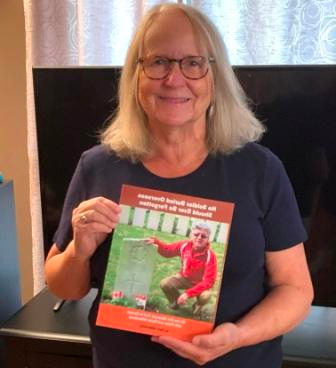
Janet Fitzgerald with book

Janet FitzGerald with book. (Photo courtesy of Janet FitzGerald)

Janet FitzGerald wrote to say that ….the work you two are doing is so important and amazing.  I am reading your book and loving every story in it.  May you both be blessed for the precious work you are doing….

Janet’s uncle, WW2 airman Rowan Charles ‘Bunky’ FITZGERALD of Charlottetown, Prince Edward Island, was on the last flight of Halifax W1175 of the 405th Squadron when it was hit by shellfire and crashed onto a sandbank in the Wadden Sea off the Dutch coast on June 28, 1942.  (See https://onthewarmemorialtrail.com/2022/10/12/on-the-war-memorial-trail-well-never-forget-uncle-bunky/)

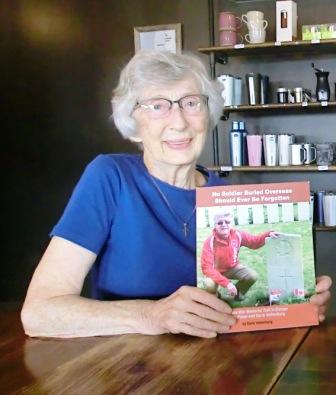
CIMG5812 Sep 12 2022 Simone Comeau and Daria with book

Simone Comeau with book. (Photo credit: Daria Valkenburg)

We first met Simone Comeau and her sister Jacqueline in 2018 while researching a tragic drowning in which her uncle lost his life.  On a recent trip to Nova Scotia, we had a chance to meet up with Simone again.

Simone’s uncle, WW2 soldier Joseph ‘Ambroise’ COMEAU, from Lower Saulnierville, Nova Scotia, was one of 5 soldiers from the North Nova Scotia Highlanders Regiment who drowned in a tragic accident on the Leda River during the Battle of Leer in Germany on April 28, 1945.  (See https://onthewarmemorialtrail.com/2021/05/17/on-the-war-memorial-trail-a-tragic-drowning-on-the-leda-river-in-germany-part-3/ and https://onthewarmemorialtrail.com/2021/11/10/on-the-war-memorial-trail-linking-the-past-with-the-present/)

…A short interview in North Bay….

In May we were in North Bay, Ontario for an Author Talk. I was interviewed by Clarke Heipel of YOUR TV North Bay prior to the talk I gave at the North Bay Public Library in North Bay, Ontario on May 19, 2022.

The Author Talk resulted in several postings about our North Bay visit and stories of several soldiers. Each posting in the North Bay series has links to previous stories. (See https://onthewarmemorialtrail.com/2022/07/27/on-the-war-memorial-trail-the-wwii-stretcher-bearer-whose-compassion-cost-him-his-life/)

At the time we hadn’t seen the interview, so we were very happy when Don Coutts received a copy of the interview clip.

Thank you to Simone Comeau and Janet FitzGerald for taking the time to share photos and comments.  Thank you to Don Coutts and YOUR TV North Bay for sharing the interview about the presentation in North Bay, Ontario.  Photos or information to share? Email Pieter at memorialtrail@gmail.com, comment on the blog, or tweet to @researchmemori1.

© Daria Valkenburg

…..Upcoming Presentation….

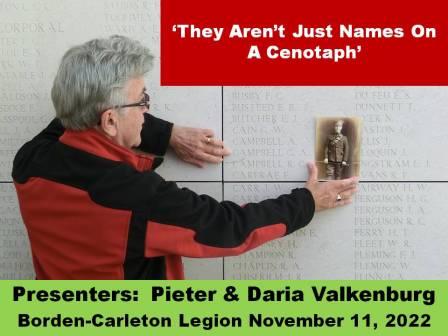
  • Friday, November 11, 2022 – Borden-Carleton, Prince Edward Island, short presentation ‘They Aren’t Just Names On A Cenotaph’ during the Inter-Faith Remembrance Day service at the Borden-Carleton Legion. Time: Service begins at 9:55 am.

…Want to follow our research?….

If you are reading this posting, but aren’t following our research, you are welcome to do so.  Our blog address: https://onthewarmemorialtrail.com/
Front cover OnTheWarMememorialTrailinEurope 4 countries, 6 weeks, 7,000 km – an unforgettable war memorial journey in Europe…. Daria’s book ‘No Soldier Buried Overseas Should Ever Be Forgotten‘ is available in print and e-book formats.  Net proceeds of book sales help support research costs and the cost of maintaining this blog. For more information on the book, please see https://nosoldierforgotten.com/

You are also invited to subscribe to our YouTube Channel: On The War Memorial Trail With Pieter Valkenburg: https://www.youtube.com/channel/UCJ591TyjSheOR-Cb_Gs_5Kw.

Never miss a posting!  Subscribe below to have each new story from the war memorial trail delivered to your inbox.

On The War Memorial Trail….. ‘We’ll Never Forget Uncle Bunky’

October 12, 2022. Recently, Douwe Drijver, a researcher at the Stichting Missing Airmen Memorial Foundation, a non-profit volunteer organization based in Leeuwarden, The Netherlands, asked if Pieter could help find family of a WWII airman from Prince Edward Island. (For more information – in Dutch – on the Foundation, see www.luchtoorlogfriesland.nl )

This organization organized the unveiling of a memorial panel in Wons, The Netherlands to honour WWII pilot Elmer Bagnall MUTTART of Cape Traverse, Prince Edward Island, who is buried in Harlingen General Cemetery, and the crew of Halifax L9561.  (See https://onthewarmemorialtrail.com/2019/10/06/unveiling-of-the-memorial-panel-for-downed-ww2-plane-halifax-l9561-in-wons/)

Douwe asked if Pieter could find family of Rowan Charles FITZGERALD….who was born in Charlottetown on July 12, 1915 and has been missing since June 28, 1942….”  The plane he was on, “… Halifax W1175 of the 405th Vancouver Squadron RCAF came down in the Wadden Sea at 03:00 that morning. Only one crew member has a known grave….

Then Douwe surprised us by saying that the crew member with a known grave, Murray Ralph KLEISDORFF of Australia, “…. found his final resting place in Harlingen….” His grave is between 3 unknown graves, one of which may just contain the remains of Rowan Charles FitzGerald.  All four graves are in the row right behind Elmer Muttart!

…We meet family of Rowan Charles ‘Bunky’ FitzGerald….

Shortly after this request came in, retired music teacher Rowan FitzGerald got in contact, explaining that Rowan Charles, known in the family as ‘Bunky’, was his uncle.  Rowan’s sister Janet was visiting from Alberta and the two of them would like to meet to share photos and stories of their uncle.

CIMG5743 Aug 7 2022 Rowan Janet Fitzgerald Pieter

Pieter, left, with Janet FitzGerald and her brother Rowan FitzGerald.  (Photo credit: Daria Valkenburg)

… ‘Bunky’ was born in Charlottetown….

Janet had prepared a summary of her uncle’s life. “Rowan Charles FitzGerald was the middle son of Geoffrey David FitzGerald and Flora Hope Wiggins.  He was born on July 12, 1915 in Charlottetown, Prince Edward Island, where he attended West Kent School and Prince of Wales College.  Rowan was active in sports. He played football, was a competitive speed skater, and played hockey with the Charlottetown Abbies and with a farm team in Colorado…..

Bunky Fitzgerald hockey picture

Bunky played hockey before enlistment.  (Photo courtesy of the FitzGerald Family)

… Bunky’s true character shone through in an anecdote….

In addition to hockey, Bunky was a keen speed skater.  Janet shared an anecdote that showed the true character of her uncle.  “The FitzGerald family loved competitive sports, but winning was never the most important thing.  I remember our father, T. L. ‘Babs’ FitzGerald, illustrating this with a story about his brother Bunky.  He was in a speed skating championship race.  He and one other contender were way out in front of the pack, neck in neck, as they rounded the turn beginning their last lap. 

The other man fell, and instead of skating on to victory, Uncle Bunky stopped, waited for his opponent to get back up on his skates, and then raced him to the finish line, winning by only a few strides.  When asked why he stopped when his opponent fell, he replied that he wanted to win fairly because he was the faster skater, not because his competition had an accident….

… Bunky enlisted with the RCAF in 1940….

From 1934 to 1935, Bunky was a signaller with the 8th Medium Battery Militia in Charlottetown. He later moved to Ontario, where he worked as a prospector for Kirkland Hudson Bay Mining in New Liskeard, an area rich in cobalt.

On July 1, 1940, Bunky enlisted with the Royal Canadian Air Force (RCAF) in Toronto, Ontario.  Janet noted that he “….began training in July 1940 ...

From January 5, 1941 to March 31, 1941 he attended an Air Observers course in Malton, Ontario.

Rowan Charles Fitzgerald in uniform in snow in Malton ON 1941

Bunky beside an Avro Anson plane in Malton, Ontario while attending an Air Observers course in 1941.  (Photo courtesy of the FitzGerald Family)

Once the Air Observers course was completed, Bunky was sent to the No. 1 Bombing and Gunnery School in Jarvis, Ontario where he took the AB Initio Bombing and AB Initio Gunnery courses.  Both were completed on May 12, 1941.

From Jarvis, Bunky went to the No. 1 Air Navigation School in Rivers, Manitoba for an Air Observers Advanced Navigation Course, which he completed on June 9, 1941.

improved_photo Bunky Fitzgerald

Bunky in uniform after receiving his Air Observer wings. (Photo courtesy of the FitzGerald Family.  Photo colourization by Pieter Valkenburg)

… Bunky was sent overseas and joined the RAF pool….

On June 29, 1941 Bunky left for the United Kingdom, and was ‘attached to the RAF from the RCAF’ as of July 28, 1941.  (RAF referred to Royal Air Force.)

Janet recorded that Bunky was “first with the 77th Squadron and in March 1942 was assigned to the 405 Squadron at Pocklington Air Force Base near York, England…

… Bunky’s father and brother also served ….

Among the treasures that Janet shared were letters that Bunky’s mother had saved.  In a May 9, 1942 letter written from Pocklington, Bunky wrote about a reunion with his father and brother Babs, who were both in the army and in England at the time.

… Dear Mother,

As you probably guessed from our telegram the three of us have finally gotten together.  In my last letter I told you about missing them when I was on leave.  Well, they got leave when they came back from their maneuvers and came up to see me.  I parked them in York and got to see them for the last three nights.  They left for London this morning.  We had a lot of fun.  It was sure good to get together again…

Unfortunately, it was the last time they met.

 … The last flight of Halifax W1175 LQ-Q ….

Janet’s account noted that “On June 27, 1942, flight W1175 LQ-Q left RAF Pocklington, piloted by Canadian F/Sgt William Field, at 23:32 hours on a mission to Bremen, Germany. Rowan FitzGerald was the navigator on the flight….

As the plane was returning from Bremen in the morning of June 28, 1942, it was hit by shellfire (flak) and crashed into a sandbank called ‘De Waard’ in the Wadden Sea, off the Dutch coast between the Island of Texel and the mainland, 15.5 km from Harlingen, in the province of Friesland.  There were no survivors.

The-Dutch-Wadden-Sea-Area

The Wadden Sea off the Dutch coast near Harlingen.  (Map source: https://www.researchgate.net/figure/The-Dutch-Wadden-Sea-Area_fig3_309826242)

The crew members were 3 Canadians, 1 Australian, and 3 British:

  • RCAF Flt Sgt W E N FIELD Captain (Pilot) – Canadian
  • RAF Sgt R F ANSELL (Flight Engineer) – British
  • RCAF Rowan Charles FITZGERALD (Navigator) – Canadian
  • RAAF Flt Sgt Murray Ralph KLEISDORFF (Air Bomber) – Australian
  • RAF Sgt E O SMITH (Wireless Air Gunner) – British
  • RCAF Flt Sgt J D AILEY (Air Gunner) – Canadian
  • RAF Sgt A DANBY (Air Gunner) – British

Douwe Drijver had explained in his request that only one crew member had been identified – Murray Ralph Kleisdorff of Australia.  For the next part of the story we had to look at records in the National Archives of Australia.

….Four bodies were buried in Harlingen General Cemetery…

The trail had run out for the information in Bunky’s service file, but reports related to the Australian crew member were available at the National Archives of Australia in Canberra.  The reports were not digitized, but when we asked Phillip Shovk of Sydney for help, he contacted Rod Covell, who lived in Canberra.  Rod and his wife Kaylene agreed to look into the files.

An investigation into the crash, based on German records, verified that a Halifax bomber matching the serial number of the plane used by W1175 crashed into the Wadden Sea on the night of June 27 into June 28, 1942.  “…Two days later, 4 corpses were recovered and as they possessed no identity, they were buried as unknown in Harlingen General Cemetery, Plot E, Row 1, Graves 3, 4, 5, 6...

After the war, the four graves were opened.  A December 29, 1948 report stated that “…only one of these could be identified….The six remaining crew members were therefore either lost at sea or at Harlingen as unidentified airmen in graves 3, 5, and 6….

What about Grave 4?  A June 22, 1948 report noted that “…the presence of RAAF dark blue material in Grave 4 indicates that ….Sgt M. R. Kleisdorff is buried there….”  Murray Kleisdorff’s headstone was amended.  The other 3 burials remain unknown.  Perhaps one holds Bunky’s remains?

Foto`s genomen op de begraafplaats van Harlingen (Harns) Prov Friesland (Fryslân). Door Remko de Jong (7)(1)

Harlingen General Cemetery in Harlingen, The Netherlands.  Murray Ralph Kleisdorff is second from the left in the front row.  The other 3 headstones are unmarked graves of airmen believed to be from the same flight.  (Photo credit: Remco de Jong)

The 6 men with no known grave are listed on the Runnymede Memorial, situated at Englefield Green, near Egham, 32 kms west of London, England. The memorial lists 20,450 members of the Air Forces of the British Commonwealth with no known grave.  (See https://www.veterans.gc.ca/eng/remembrance/memorials/overseas/second-world-war/england/runnymede)

Janet ended her summary about her uncle’s life with “…Rowan Charles FitzGerald died 2 weeks prior to his 27th birthday. His descendants still hope to gain closure by locating his final resting place and ensuring his memory is preserved…

A few weeks after we met, Janet wrote us to say “…Rowan and I are so very grateful for your interest and time spent in piecing together Uncle Bunky’s story.  Thank you for all you are doing for our fallen boys and ensuring they are never forgotten….

Thank you to Rowan FitzGerald and Janet FitzGerald for sharing photos and information on their uncle, Remco de Jong for the photo from Harlingen General Cemetery, Angela Walker for contacting the FitzGerald family, Don Smith for identifying the Avro Anson plane in the photo of Bunky in Malton, Phillip Shovk for contacting Rod Covell, and Rod and Kaylene Covell for researching the crash report in the National Archives in Canberra, Australia.

If you have a story to tell, please let Pieter know. You can email him at memorialtrail@gmail.com, comment on the blog, or send a tweet to @researchmemori1.

© Daria Valkenburg

…Want to follow our research?….

If you are reading this posting, but aren’t following the blog, you are welcome to do so.  Our blog address: https://onthewarmemorialtrail.com/

Front cover OnTheWarMememorialTrailinEurope4 countries, 6 weeks, 7,000 km – an unforgettable war memorial journey in Europe…. Daria’s book ‘No Soldier Buried Overseas Should Ever Be Forgotten‘ is available in print and e-book formats.  Net proceeds of book sales help support research costs and the cost of maintaining this blog. For more information see https://nosoldierforgotten.com/ 

You are also invited to subscribe to our YouTube Channel: On The War Memorial Trail With Pieter Valkenburg: https://www.youtube.com/channel/UCJ591TyjSheOR-Cb_Gs_5Kw.

Never miss a posting!  Subscribe below to have each new story from the war memorial trail delivered to your inbox.

On The War Memorial Trail….. The WWII Soldier From Port Lorne Who Lost His Life During The Advance To The Apeldoorn Canal

IMG_20220913_144658413_HDR Posterenk photo from John Hetherington

Posterenk town sign. (Photo credit: John Hetherington)

October 8, 2022. When Pieter and I visited the village of Posterenk in The Netherlands in 2017, with Edwin van der Wolf, one of the research volunteers at the Canadian War Cemetery in Holten, we never realized that we would be telling stories about soldiers from the Carleton & York Regiment who lost their lives during the liberation of the village in April 1945!

CIMG9296 Sep 25 2017 Edwin and Pieter by Posterenk windmill

Edwin van der Wolf (left) and Pieter in Posterenk.  (Photo credit: Daria Valkenburg)

….The Atlantic Canada connection to Posterenk…..

Edwin wanted us to visit the village because it had an Island connection.  Frank GALLANT, son of Anthony and Eleanor Gallant of Mount Carmel, Prince Edward Island, was one of the Carleton & York soldiers who died during there on April 13, 1945 at the age of 32.

Over the next years, two more Island soldiers were identified: Daniel Peter MACKENZIE, of Victoria Cross, and James Frank MOSSEY of Souris.

In April 2022, 8 names were commemorated in Posterenk. However, photos of two men were missing: James Frank MOSSEY and Harold Gordon SABEAN. (See https://onthewarmemorialtrail.com/2022/04/17/on-the-war-memorial-trail-posterenk-commemorates-its-liberation-by-the-carleton-and-york-regiment/)

…The search for a photo of Harold Gordon Sabean is successful…

Family of James Frank Mossey came forward this summer, leaving one last Carleton & York soldier whose photo was missing.  A wide-reaching effort was made to uncover a photo, which was successful when Harold E. Wright of Saint John, New Brunswick, received a photo from Harold Gordon SABEAN’s niece, Pam Godsoe.

colourized_photo(12) Sabean

Harold Gordon Sabean. (Photo courtesy of Pam Godsoe. Photo colourization by Pieter Valkenburg.)

Harold was born on March 19, 1918 in Port Lorne, Nova Scotia, son of Solomon ‘Saul’ and Susan ‘Susie’ Alice (nee Hibbard) Sabean.

… After enlistment Harold was quickly sent overseas…

Before enlisting in St John, New Brunswick on March 9, 1940 with the Carleton & York Regiment, Harold was a machinist with T. McAvity & Sons (now Clow Canada) a foundry and valve casting company.  (See https://www.clowcanada.com/about-us/company-history/)

He was initially sent to Woodstock, New Brunswick and went for infantry training in Aldershot, Nova Scotia on March 19, 1940.

On May 4, 1940 he married Josephine Marie Gray at the Stella Maris Roman Catholic Church in St. John, New Brunswick.  A month later, on June 8, 1940, he left Halifax, Nova Scotia for the United Kingdom, arriving in Liverpool on June 20, 1940.

He was sent for a number of training courses while in England – Regimental Gas Instructors Course, Gunner Wing, Qualification Level Motor Transport, Camouflage Course, and Spigot Mortar Course.  He became an Instructor.

… Harold was seconded to Canada as an Instructor…

On March 19, 1943, Harold returned to Canada as an Instructor, and was attached to A-12 Canadian Infantry Training Centre (CITC). A report stated he was a good instructor and hard working.

In July 1943 he was sent to the Battle Drill School in Vernon, British Columbia for further training.

In February 1944, he was sent to No. 1 Transit Camp in Windsor, Nova Scotia prior to returning for overseas service.  A report in his Personnel Selection Record, dated February 9, 1944, recorded that Harold was “…Married- no children.  Sabean is an only child whose parents are deceased...”  It went on to note that he was “… interested in all team sports.  His hobby is wood carving. Reads mechanical magazines. Enjoys usual social pastimes….

He was assessed as being “…suitable for overseas service on operational duties…” and that he was “…mature, willing, and cooperative…

… Harold returned overseas…

On February 16, 1944, he embarked for the United Kingdom, arriving on February 25, 1944.  A month later, on March 26, 1944, he was in Italy with the Regiment.

On August 11, 1944 he left Italy and was sent to France to a Special Services unit.  In December 1944, he left France and was back in Italy on December 9, 1944.  A few days later, on December 12, 1944, he was promoted to Sergeant.

…The Carleton & York Regiment left Italy for North-West Europe…

On March 19, 1945, Harold and his Regiment left Italy for North-West Europe as part of Operation Goldflake, arriving in Marseilles, France on March 21, 1945.  Operation Goldflake was the codename for moving troops from Italy to North-West Europe.  (See https://en.wikipedia.org/wiki/Operation_Goldflake)

From France, troops were moved up to the Belgian front, into The Netherlands, through the Reichswald Forest in Germany, and then back into The Netherlands, arriving near Zutphen on April 10, 1945.

According to the April 12, 1945 war diary entry of the Carleton & York Regiment, they “…moved across the Ijssel River at 14:30 hours….” to relieve the Seaforth Highlanders of Canada. The Regiment’s new objective was to liberate the village of Posterenk which was done on April 13, 1945.

Map western holland showing Posterenk

….Harold was originally buried near Posterenk….

Unfortunately, on April 15, 1945, Harold lost his life as the unit advanced to the Apeldoorn Canal in The Netherlands.  He was one of 6 soldiers initially buried along the main road to Posterenk, a village near Zutphen.

Posterenk list of 6 CYR members

The 6 soldiers buried near Posterenk.

On January 24, 1946, Harold was reburied in the Canadian War Cemetery in Holten.

sabean, harold gordon gravestone from ICB

Grave of Harold Gordon Sabean in Holten, The Netherlands.  (Photo courtesy of the Information Centre Canadian Cemetery Holten)

Thank you to Pam Godsoe, Harold E. Wright of Saint John Heritage, and Kent Caldwell of the Royal Canadian Legion in New Brunswick.  If you have a story to tell, please let Pieter know. You can email him at memorialtrail@gmail.com, comment on the blog, or send a tweet to @researchmemori1.

© Daria Valkenburg

…Previous stories about soldiers commemorated in Posterenk….

…Want to follow our research?….

If you are reading this posting, but aren’t following our research, you are welcome to do so.  Our blog address: https://onthewarmemorialtrail.com/

Front cover OnTheWarMememorialTrailinEurope4 countries, 6 weeks, 7,000 km – an unforgettable war memorial journey in Europe…. Daria’s book ‘No Soldier Buried Overseas Should Ever Be Forgotten‘ is available in print and e-book formats.  Net proceeds of book sales help support research costs and the cost of maintaining this blog. For more information see https://nosoldierforgotten.com/ 

You are also invited to subscribe to our YouTube Channel: On The War Memorial Trail With Pieter Valkenburg: https://www.youtube.com/channel/UCJ591TyjSheOR-Cb_Gs_5Kw.

Never miss a posting!  Subscribe below to have each new story from the war memorial trail delivered to your inbox.

On The War Memorial Trail….. The WWII Soldier From Prince Edward Island Killed During The Battle Of Rha

September 22, 2022. When we did a story on Joseph ‘Joe’ Edmund HENNEBERY, who is buried in the Canadian War Cemetery in Groesbeek, his niece, Teresa Hennebery, mentioned that “My mother Mary and I were in Holland in May 2001 for a commemoration ceremony for her brother (also named Joe) who was killed in Rha a couple of weeks before my other Uncle Joe died.  It was so beautiful and the people of Rha treated us like Royalty….

Exif_JPEG_420

Teresa Hennebery (left) shared information on her uncle, Joe McKenna.  (Photo courtesy Valkenburg Family Collection)

Teresa was referring to her mother’s brother, Michael Joseph ‘Joe’ MCKENNA, who also lost his life during WWII.  In addition to visiting the Canadian War Cemetery in Groesbeek, Teresa and her late mother “… visited Holten Cemetery where Joe McKenna is buried…” (See https://onthewarmemorialtrail.com/2020/05/31/on-the-war-memorial-trail-a-face-for-joseph-hennebery/)

Joe McKenna

Joe McKenna (Photo courtesy Hennebery Family Collection.)

Joe McKenna was born August 22, 1917 in Newton Cross, Prince Edward Island, the son of Patrick Joseph and Laura Josephine McKenna. 

…Joe began basic training in the summer of 1942…

At the time of his enrollment on August 28, 1942 with the #62 Basic Training Centre in Charlottetown, under the National Resources Mobilization Act (NRMA), he had been working on his father’s farm since he left school.  Joe’s mother had died in 1932, and he was the oldest son with two brothers and four sisters.  

The NRMA was a compulsory national registration for military service, originally for home defence, but later for service overseas as WWII continued. (See https://www.thecanadianencyclopedia.ca/en/article/national-resources-mobilization-act)

On October 28, 1942, he was sent for advanced training to A23TC in Halifax, Nova Scotia for a month, then sent to the #22 Anti Aircraft Battery in St. John, New Brunswick. 

Joe remained there until March 1, 1943, when he formally enlisted for active service in Saint John, New Brunswick and was transferred to the 8th Anti Aircraft Battery, Royal Canadian Artillery, which was also in St. John.

… Joe transferred to the Canadian Infantry….

On January 27, 1944, Joe was transferred to the No. 1 Transit Camp in Windsor, Nova Scotia.  Then, a decision was made to ‘reallocate’ Joe to an infantry regiment, and on February 13, 1944 he was transferred to No. 60 Canadian Infantry Basic Training Centre in Yarmouth, Nova Scotia for further training.

After completing basic training, Joe was transferred to the A14 Canadian Infantry Training Centre (CITC) in Aldershot, Nova Scotia on June 11, 1944.

On August 31, 1944 Joe was sent to Debert, Nova Scotia, the final staging and training area for troops going overseas.

… Joe left Canada in October 1944….

Joe’s overseas service began when he boarded a troop ship on October 14, 1944, arriving in the United Kingdom on October 20, 1944.  Upon arrival he was assigned to #4 Canadian Infantry Reinforcement Unit (CIRU).

On November 24, 1944 he went to Northwest Europe as part of a reinforcement unit, then was assigned to the Headquarters of the 8th Canadian Infantry Brigade on January 26, 1945.

Joe had his final transfer on March 14, 1945, when he joined the Queen’s Own Rifles as a rifleman in ‘A’ Company.  The Regiment was in the Reichswald Forest in Germany where Operation Blockbuster had ended.  Reinforcements were needed as preparations began for Operation Plunder

Operation Plunder, which began March 21, 1945 and ended April 1, 1945, involved the crossing of the Rhine River to the north of the Ruhr industrial region in western Germany.  (See https://en.wikipedia.org/wiki/Operation_Plunder)

…Joe’s Regiment left Germany and entered The Netherlands…

After crossing the Rhine River in Germany, the Queen’s Own Rifles entered The Netherlands.  Their new objective was to capture the town of Rha.  The town was near a bridge crossing.  In ‘Battle Diary’ author Charles Cromwell Martin explains its importance. “…The enemy command headquarters for the remaining part of Holland was located at Appeldoorn, and the bridge was the approach that led there…

Martin was the Company Sergeant-Major, ‘A’ Company, in the Queen’s Own Rifles.  He noted there were difficulties due to “…the complete changeover of our men and leaders.  We had received about thirty reinforcements….. But everything was too new, too untried, and this included our new company commander…

…The Regiment prepared to liberate the municipality of Steenderen….

On the afternoon of April 4, 1945, the Queen’s Own Rifles travelled along the IJssel River.  They had already liberated the villages of Steenderen and Toldijk the day before.

The war diary for April 4, 1945 recorded that “… ‘C’ Company was to occupy Rodenburg… and ‘D’ Company to go to Hoefken. ‘A’ Company to Eekhorn and ‘B’ Company to Zwaarte  Schar… The only trouble encountered on the move was by ‘A’ and ‘C’ Companies, who came under fire from an enemy S.P. gun on the other side of the IJssel river and mortar fire from Rha….” S.P refers to self-propelled artillery.

On April 5, 1945 the war diary stated that …plans were laid for an attack that afternoon on the bulge of the east bank of the IJssel…”  Around 3:30 pm, they occupied “…enemy trench systems that had been abandoned…” 

‘A’ Company’s assignment was to occupy Rha. Led by 9 platoon, they “…went into their series of trenches, which were full of water, and followed them around to the outskirts of Rha.  There was quite a lot of sniping and mortaring but the trenches gave them good cover…” 

By 8:00 pm “… the end of the trenches was reached….” and they began their way towards the town.  “….It was getting night time but there was plenty of light from burning buildings…”  They encountered “…furious resistance…” from bazookas.  “…Our own weapons were in very bad shape from the mud encountered in the trenches…

In the midst of counterattacks, two sections of 7 platoon got cut off from the rest. They “…got into a house near the centre of the village…” This was the Berendsen farm. 

By the time the night was over, the war diary reported that “…the final count of casualties was 5 wounded, 5 killed, and 6 missing…”  Four were found killed in the barn on the Berendsen farm.

…The Battle of Rha was deadly….

One of the men killed during the Battle of Rha, and found in the barn, was Joe McKenna. In the 2001 Special Edition of ‘De Zwerfsteen’ (The Boulder), a publication from the Historical Society of Steenderen, a bit more information was provided.  The Berendsen farm was located at 5 Rhabergseweg, and had German troops billeted on the farm.  During the evening of April 5, the family hid in the cellar.

One daughter, Be Helmerhorst-Berendsen, who was 20 years old at the time, gave an eyewitness report.  “…The Germans were not present at the time we came under fire. They must have been in the trenches in the surrounding area….

While they were in the cellar the hatch opened and two Canadians came down the steps.  “…One was injured on the leg and the other one had severe injuries on the head…”  The next morning, the Germans opened the hatch and ordered them to come out.  The Canadians were taken prisoner, the rest allowed to leave.

…As we were leaving the building through the barn, we saw the Canadians lying there, dead.  One lay behind the cows in the gutter.  The second lay in the cows’ trough, still holding the rope of the cow’s neck in his hands, and the third one lay near the back door…

….Joe was initially buried in Rha….

The official death report of the military authorities noted that the helmets of the soldiers had holes in them, likely caused by grenade fragments. They had been killed by Germans who were in trenches about 20 metres in front of the farmhouse. 

The date of deaths on this report was recorded as April 5, 1945 for each soldier.  The date of April 6, 1945 in the service file and on the gravestones was likely due to when the bodies were found and the notice of deaths were received and recorded.

Dutch explanation of deaths

Rha burial

Burial of 4 soldiers in Rha.  (Photo courtesy Hennebery Family Collection, but sent to the family by Henk Dykman.)

One of the organizers of the May 4, 2001 commemoration events in Rha, Reverend Hendrik ‘Henk’ Jan Dykman, wrote to explain that “…Joe died with three comrades in or near the farm of J Berendsen on April 5 1945. He was buried in front of it by German soldiers, with his name carefully put on the grave. The farmer’s daughter took care of the graves till the men were moved to Holten a year later….

The other three soldiers were:

  • James Earl AIKEN, aged 19, son of Basil E. and Alice A. Aiken, of Toronto, Ontario.
  • Thomas ‘Ted’ Edward Cornelius CRAWFORD, aged 31, son of Thomas A. and Nellie Crawford; husband of Marie Edmee Crawford, of Kapuskasing, Ontario. 
  • George Clifford WOODRUFF, aged 23, son of George and Jane Woodruff, of Langstaff, Ontario.

All 4 were reburied in the Canadian War Cemetery in Holten, The Netherlands. 

The 5th casualty mentioned in the war diary was John George KAVANAGH, aged 23, son of Cora Kavanagh and husband of Emily Jean (née Haddleton) of Toronto, Ontario.  He is buried in the Steenderen General Cemetery in Steenderen, The Netherlands.

…Confusion about where Joe McKenna had been originally buried….

20210717_105714 McKenna parents grave in Montague

Grave of Joe McKenna’s parents in Montague, Prince Edward Island. (Photo courtesy Hennebery Family Collection.)

Teresa Hennebery explained that there was confusion about where her uncle was initially buried. “… I was at the graveyard at St. Mary’s church in Montague.  Here is a photo of my grandparents’ gravestone which also recognizes my Uncle Joe McKenna….please note reference to Doesburg. For many years his family thought he was buried in Doesburg….

Screenshot 2022-09-17 at 11-13-37 Doesburg to Rha

Map shows the short distance between Doesburg and Rha.  (Map source: Google)

The confusion wasn’t just on the part of Teresa’s grandparents.  A Field Service Report dated June 7, 1945 recorded that Joe McKenna had died in Germany and been buried in West Bocholt, Germany!  The coordinates of the burial location were recorded as 911850.

… Joe was reburied in the Canadian War Cemetery in Holten….

We asked Henk Vincent from the Canadian War Cemetery in Holten if he could look up where Joe’s body had been before arriving for reburial, as we had a report that he had been buried in Rha. 

A translation of his reply confirmed that Rha was where he was initially buried.  “The East Gelderland area, where Rha is located, is often referred to as West Bocholt in the Canadian War Diaries. If I enter the coordinates QE911850 on the Nord de Guerre map I end up exactly in… Rha, so the report is correct, he was first temporarily buried in Rha….

CIMG3292 Oct 3 2019 Holten Michael McKenna

Grave of Joe McKenna in Holten.  (Photo credit: Daria Valkenburg)

Teresa kindly wrote to say “… Thank you for all you are doing to keep the memory of soldiers buried in Holland alive.  I am so grateful for your work and dedication to this project…” It’s an honour to tell these stories, and we are very appreciative of the effort that families put into remembrance and are willing to share photos and information.

Thank you to Teresa Hennebery for sharing photos and information on her uncle, and to Henk Dykman for sharing a photo and initial burial information.  Thank you also to Henk Vincent for confirming Joe’s original burial location. If you have a story to tell, please let Pieter know. Email him at memorialtrail@gmail.com, or comment on the blog. 

© Daria Valkenburg

…Want to follow our research?….

If you are reading this posting, but aren’t following our research, you are welcome to do so.  Our blog address: https://onthewarmemorialtrail.com/

Front cover OnTheWarMememorialTrailinEurope4 countries, 6 weeks, 7,000 km – an unforgettable war memorial journey in Europe…. Daria’s book ‘No Soldier Buried Overseas Should Ever Be Forgotten‘ is available in print and e-book formats.  Net proceeds of book sales help support research costs and the cost of maintaining this blog. For more information see https://nosoldierforgotten.com/

Subscribe to our YouTube Channel: On The War Memorial Trail With Pieter Valkenburg: https://www.youtube.com/channel/UCJ591TyjSheOR-Cb_Gs_5Kw

Never miss a posting!  Subscribe below to have each new story from the war memorial trail delivered to your inbox.

On The War Memorial Trail….. The WWII Soldier From Flin Flon Who Was Born In Stonewall

September 10, 2022. Sometimes a photo request that Pieter receives brings back childhood memories… and is the impetus for choosing which name to research out of dozens on a list.  That was the case when we looked at the list of photo requests from the Canadian War Cemetery in Holten, The Netherlands, and I saw that one of the soldiers, Neville William NISBET, was listed as being from Flin Flon, Manitoba.

That’s a soldier you have to research!”  I said to Pieter.  “I’ve been to Flin Flon!

Big deal, Pieter thought.  Since I was born in Winnipeg, it was no surprise to him that I’ve been to places in Manitoba.  But he had no idea how far north Flin Flon was and how the name captured the imagination of two young kids – my brother and me – when we travelled there with our parents, and had a photo taken at the statue at the edge of town.

Ca 1967 Daria Mom Gary by statue in Flin Flon

Daria (by red arrow) with her brother and mother by the statue of Flintabbatey Flonatin in 1967.  (Photo courtesy Valkenburg Family Photos)

Flin Flon, located in northern Manitoba, is named after Josiah Flintabbatey Flonatin, a science fiction character from the 1905 book The Sunless City, by British writer J.E. Preston Muddock. (See https://www.erbzine.com/mag18/sunless.htm)  When a mining prospector found and read a copy of the book in a cabin near the future town site in 1915, he named his claim Flin Flon, and that became the name of the town.

……Neville Nisbet was not born in Flin Flon!…

When Pieter began his research, however, he learned that Neville wasn’t born in Flin Flon, but in Stonewall, just outside of Winnipeg, Manitoba.  Neville was born on August 7, 1916, son of William J. and Lillian (nee Bennett) Nisbet.

According to the May 13, 1936 edition of the Stonewall Argus newspaper, Neville left Stonewall to take a position in Herb Lake (near Snow Lake) in northern Manitoba with Laguna Gold Mines Ltd. 

By the time of his enlistment in Winnipeg at No. 10 District Depot on June 22, 1944, Neville was living in Flin Flon, where he was employed as a millwright with Hudson Bay Mining and Smelting Company.  He had married Hazel Umpherville in Flin Flon on December 8, 1938, and by 1944 they had two children.

….Neville’s son provided a photo…

Neville’s son Don provided a photo, explaining that “we have very few pictures of my father….  Thanks for your work on this project…

img187 Neville Nisbet from Brenda Fleming

Neville Nisbet.  (Photo courtesy of the Nisbet Family)

…Neville’s military service began in Manitoba and ended in Germany…

After enlisting, Neville was sent to #103rd Canadian Infantry Basic Training Centre (CIBTC) in Winnipeg.  On September 16, 1944, he was transferred to A15 Canadian Infantry Training Centre (CITC) in Shilo, Manitoba.

On January 5, 1945, Neville was transferred to the No. 2 Transit Camp in Debert, Nova Scotia in preparation for going overseas on January 11, 1945. He arrived in the United Kingdom on January 18, 1945 and was attached to the Canadian Infantry Training Regiment (CITR).

He was sent to northwest Europe on March 18, 1945, and then transferred to the Lincoln and Welland Regiment on April 6, 1945.  The Regiment was near Delden, The Netherlands and had just captured the Twentecanal.

On April 7, 1945, the Regiment left Delden to join the rest of the Division already advancing into Germany.

…The Regiment fought for control of Bad Zwischenahn….

The War Diary for the Lincoln and Welland Regiment for April 25, 1945 noted that the Regiment “…was to come under command of 4th Canadian Armoured Brigade at 0700 hour tomorrow. The Brigade’s objective was to be the town of Bad Zwischenahn…” (See https://www.canadiansoldiers.com/history/battlehonours/northwesteurope/badzwischenahn.htm)

badzwischenahn

Map shows the path taken by the Lincoln and Welland Regiment. Neville Nisbet lost his life just outside Bad Zwischenahn. (Map courtesy of http://www.canadiansoldiers.com)

The War Diary entry for May 1, 1945 recorded that “…the emissary had been sent into the town of Bad Zwischenahn and the town had surrendered…” and that the Regiment was to be part of the 10th Brigade.  They were ordered to begin the move through Bockhorn and Neuenburg.

On May 2, 1945, under weather that was cloudy with rain, the War Diary entry stated that forward movement was hampered due to encountering heavy resistance, with artillery and sniper attacks.  At some point during that day, Neville lost his life, aged 28.

…Neville was buried in the Canadian War Cemetery in Holten….

Neville was initially buried east of Bad Zwischenahn, Germany, before being reburied in the Canadian War Cemetery in Holten, The Netherlands on March 16, 1946.

Headstone of Neville Nisbet

Neville Nisbet’s grave at the Canadian War Cemetery in Holten.  (Photo courtesy of Canadian Virtual War Memorial)

….Nisbet Lake in northern Manitoba is named in his honour…..

Screenshot 2022-09-06 at 12-10-30 Nisbet Lake _ Nisbet Lake Manitoba Canada North America

Nisbet Lake in northern Manitoba.  (Map source: google)

Nisbet Lake in northern Manitoba was named after Neville in 1974.

…Another soldier who lost his life near Bad Zwischenahn…

John ‘Jack’ Langford WALKER, who was with the 21st Canadian Armoured Regiment (The Governor General’s Foot Guards), died near Bad Zwischenahn on April 30, 1945.  You can read his story here: https://onthewarmemorialtrail.com/2022/07/13/on-the-war-memorial-trail-in-north-bay-the-ww2-soldier-who-lost-his-life-on-the-day-hitlers-death-was-announced/

Thank you to Don Nisbet for providing a photo, and thank you to Judie Klassen for help in finding family and newspaper articles.  If you have a story to tell, please let Pieter know. Email him at memorialtrail@gmail.com, comment on the blog, or tweet to @researchmemori1

…Want to follow our research?….

If you are reading this posting, but aren’t following the blog, you are welcome to do so.  See https://onthewarmemorialtrail.com/ or email me at dariadv@yahoo.ca and ask for an invitation to the blog. 

Front cover OnTheWarMememorialTrailinEuropeDaria’s book ‘No Soldier Buried Overseas Should Ever Be Forgotten‘ is available in print and e-book formats.  For more information see https://nosoldierforgotten.com/

You are also invited to subscribe to our YouTube Channel: On The War Memorial Trail With Pieter Valkenburg: https://www.youtube.com/channel/UCJ591TyjSheOR-Cb_Gs_5Kw

© Daria Valkenburg

On The War Memorial Trail….. Remembering WWII Soldier Stanley Owen Jones

September 5, 2022. Pieter continues to diligently work his way through photo wish lists from Dutch researchers at the Canadian War Cemeteries in The Netherlands.  Two names on the lists from the cemetery in Holten were members of First Nations: William ‘Willie’ DANIELS, a Cree Nation member from Saskatchewan, and Stanley Owen JONES, a Haida Nation member of the Massett Band in British Columbia.

After an interview on APTN with Brett Forester, families of both soldiers provided photos.  (To read the article, see https://www.aptnnews.ca/national-news/dutch-born-p-e-i-man-on-a-mission-to-find-photos-of-first-nations-soldiers-killed-overseas-in-wwii/)  Willie Daniels was featured in a posting last year.

This posting is about Stanley Owen JONES, who was born September 29, 1924 in Massett, British Columbia, the son of David and Elizabeth Jones.

….A family member from Alaska gets in contact….

It took several months, but one day Michelle Eakman, granddaughter of Stanley’s youngest sister, contacted Pieter from her home in Alaska. “Thank you for all your hard work and dedication.  My grandmother Marina was the last living sibling and she passed away on April 6, 2019...”  She included a photo, explaining that “this picture of the picture is all I’ve had…

Jones improved_photo(10) colourized

Stanley Owen Jones. (Photo submitted by Michelle Eakman.  Photo restoration and colourization by Pieter Valkenburg)

….Stanley enlisted in 1944….

Before enlisting at the No. 11 Recruiting Detachment in Vancouver, British Columbia on March 10, 1944, Stanley was employed as a fisherman for 4 years around the Queen Charlotte Islands (now called Haida Gwaii) with Nelson Brothers of Vancouver.  (See https://en.wikipedia.org/wiki/Haida_Gwaii)

After his father had died in 1938, Stanley cut short his schooling in order to work.  He’d already lost one brother and five sisters during the 1930s. His mother and five siblings remained – one brother in a sanatorium due to tuberculosis, and four sisters.

An interviewer noted in his Personnel Selection Record that Stanley used to play football, lacrosse, baseball, and basketball.  He enjoyed reading westerns and could play the piano.

He was described as having a “…quiet nature, man of few words. Has self-confidence…”  He was recommended for an infantry unit since he told the interviewer that he “.…has done a lot of hunting.

Stanley was sent for basic training to the Canadian Army Basic Training Centre (CABTC) in Prince Albert Saskatchewan.  Once that was completed, he was transferred to the Canadian Infantry Training Centre (CITC) in Shilo, Manitoba on May 28, 1944.

On October 13, 1944 he was transferred to the No. 1 Training Brigade in Debert, Nova Scotia in preparation for overseas service.

….Stanley left Canada on Christmas Eve 1944….

On December 24, 1944, Stanley left Canada for the United Kingdom, arriving on December 31, 1944. Then, on February 12, 1945 he was sent to northwest Europe and transferred to the Regina Rifle Regiment for a few weeks.

On March 13, 1945 he was transferred to the Canadian Scottish Regiment (Princess Mary’s) which was stationed in Kleve, Germany, just across the border from The Netherlands.

….Stanley was wounded during the liberation of Wagenborgen….

finalphasecanscottish

Stanley Owen Jones was injured during the liberation of Wagenborgen.  (Map courtesy of http://www.canadiansoldiers.com)

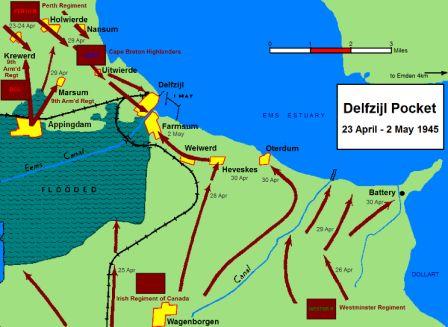
In April 1945, the Regiment travelled back and forth between The Netherlands and Germany, encountering Germany opposition but pushing through successfully.  On April 21, 1945, the Battle of Delfzijl Pocket began in a fight to liberate the Dutch village of Wagenborgen, south of Delfzijl, and the surrounding area. German resistance was heavy, resulting in Canadian Scottish casualties of 23 killed and 41 wounded before Wagenborgen was liberated on April 24. (See https://www.canadiansoldiers.com/history/battlehonours/northwesteurope/wagenborgen.htm)

Stanley was wounded in the early morning of April 24 in a blast that ruptured his right ear drum, resulting in ‘nerve deafness’.  Not only was his hearing impaired, but his balance would have been as well.

 ….Stanley drowned in an accident….

Stanley returned to the Canadian Scottish Regiment on May 24, 1945.  On September 8, 1945, while the Regiment was part of the Canadian Army Occupation Force (CAOF) in Germany, Stanley was on a duty run in a carrier that was carrying rations from the Supply Company to the detachment at Sengwarden Radio Station.  Sengwarden is a village north of Wilhelmshaven, Germany.

The driver, Pte Randle, testified that a track came off the carrier, causing it to lurch to the right and to overturn in a ditch.  Stanley and Pte Jaschinsky were the other occupants in the vehicle when it overturned.

Randle testified in a Court Of Inquiry that after freeing himself he called out to the other two men.  “…Pte Jaschinsky answered and told me he was all right but that Jones must be under the carrier. He had been riding in the front as my co-driver, so I felt around to see if I could locate him.  I felt his body under water and tried to lift him to my side but couldn’t budge him…

A vehicle from the Régiment de la Chaudière rescued Randle and Jaschinsky and pulled the carrier off Stanley, who had been pinned under the carrier, and tried unsuccessfully to revive him through artificial respiration.

In Jaschinsky’s testimony in the Court Of Inquiry, he explained that he was a cook at the Supply Company and had received a pass to travel to Sengwarden in order to see how the detachment was managing with rations.  “….We were proceeding down the Sengwarden Wilhelmshaven highway at approximately 1620 hours when I heard a strange noise and looked around and saw a carrier track lying on the road…. I saw we were heading toward a tree.  Just before colliding with the tree the remaining track dropped in a slit trench throwing the carrier at right angles. In the same motion it turned upside down….

The Court Of Inquiry ruled that Stanley’s death was due to accidental drowning.  The Jones family had suffered another loss in their family.

 ….Stanley was buried in The Netherlands….

Stanley was initially buried in Osterscheps, Germany and later reburied in the Canadian War Cemetery in Holten, The Netherlands.

2227447_t1 Jones

Stanley Owen Jones in buried in the Canadian War Cemetery in The Netherlands.  (Photo courtesy of Canadian Virtual War Memorial)

Thank you to Michelle Eakman for providing a photo.  If you have a story to tell, please let Pieter know. Email him at memorialtrail@gmail.com, or comment on the blog.

© Daria Valkenburg

…Want to follow our research?….

If you are reading this posting, but aren’t following the blog, you are welcome to do so.  Our blog address: https://onthewarmemorialtrail.com/

Front cover OnTheWarMememorialTrailinEurope4 countries, 6 weeks, 7,000 km – an unforgettable war memorial journey in Europe…. Daria’s book ‘No Soldier Buried Overseas Should Ever Be Forgotten‘ is available in print and e-book formats.  Net proceeds of book sales help support research costs and the cost of maintaining this blog. For more information see https://nosoldierforgotten.com/

You are also invited to subscribe to our YouTube Channel: On The War Memorial Trail With Pieter Valkenburg: https://www.youtube.com/channel/UCJ591TyjSheOR-Cb_Gs_5Kw.

Never miss a posting!  Subscribe below to have each new story from the war memorial trail delivered to your inbox.
On The War Memorial Trail….. The WWII Soldier From Rorketon Whose Sister Never Forgot Him

where-to-blog-header-code-on-a-wordpress-theme-September 2, 2022. In May, researchers at the Information Centre at the Canadian War Cemetery in Holten, The Netherlands honoured 27 soldiers of Ukrainian heritage that are buried in the cemetery.  Photos for 4 were missing and Pieter was asked if he could help. 

All four soldiers had a connection to the Canadian prairies. To our delight, families of all four soldiers came forward within a few weeks. 

 ….The 4 soldiers of Ukrainian heritage without photos ….

  • Elie ANTONYSZYN, born in Rorketon, Manitoba, died July 15, 1945, aged 22
  • Andrew KERELCHUK, born in Zbaraz, Manitoba, died April 19, 1945, aged 21
  • Sam MATVICHUK, born in Broadacres, Saskatchewan, died April 14, 1945, aged 19
  • John RUSNAK, born in Portage La Prairie, Manitoba, died November 22, 1945, aged 21

This posting is about Elie ANTONYSZYN, who was born March 10, 1923 in Rorketon, Manitoba, the son of Michael (Mike) and Lena (nee Dowhaniuk) Antonyszyn.  The only son, Elie had two younger sisters, Mary and Olga.

….Family of Elie Antonyszyn contact Pieter after a letter to the editor is published ….

On June 21, 2022 a Letter to the Editor about the search for a photo of Elie was published in the Dauphin Herald.

Dauphin Herald Letter to Editor

Letter to the Editor published in the June 21, 2022 edition of the Dauphin Herald.  (Clipping courtesy of Natalie Fee)

A few days after publication, Natalie Fee contacted Pieter with a photo of Elie, saying that the Letter to the Editor “was passed to me from a friend as I no longer live in that area. I am Elie, Mary, & Olga’s youngest cousin; their mother Wasalena and my Grandpa John Dowhaniuk were brother and sister….

improved_photo(5) antonyszyn

Elie Antonyszyn (Photo courtesy of Natalie Fee (cousin). Photo colourization by Pieter Valkenburg)

…Elie was drafted…

Elie enlisted on February 3, 1943 in Winnipeg, Manitoba, under the National Resources Mobilization Act. This was a compulsory national registration for military service, originally for home defence, but later for service overseas as WWII continued. (See https://www.thecanadianencyclopedia.ca/en/article/national-resources-mobilization-act)

At the time of enlistment, Elie was a high school student, in Grade 12, but was required to report for registration due to his age of 19.  As the only son of a farmer, he likely could have received an exemption from military service, had he asked for it.

The interviewer for his Personnel Selection Record noted that Elie was fluent in English and Ukrainian, and intended to become a pharmacist.  He played hockey, football, and baseball, and enjoyed playing cards and checkers. 

He was described as being “…a bright country high school lad…. Courteous and steady, more of a student type. Appears dependable and has a happy manner…

Elie was sent to Esquimalt, British Columbia for basic training, where he remained until April 15, 1943.  He was then transferred to #46 Light Anti-Aircraft Battery in Nanaimo, British Columbia.

…Elie was sent to Kiska, Alaska…

aleutianminimap

Map showing location of Kiska, part of the Aleutian Islands.  (Map source: http://www.canadiansoldiers.com)


1024px-Kiska_Island_1943.svg

Map source: By of SVG: Kuara – Aleutian Islands, United States Army Center of Military History, CC BY-SA 3.0, https://commons.wikimedia.org/w/index.php?curid=5209745

On July 12, 1943, Elie was assigned to participate in ‘special duty’ as Canadian support to Kiska, Alaska for the American led ‘Operation Cottage’. The idea was to liberate Kiska Island from Japanese forces, which had occupied it since June 7, 1942. No one seemed to be aware that the Japanese had left the Island on July 28, 1943, and it was unoccupied by the time Allied troops arrived on August 15, 1943. (See https://en.wikipedia.org/wiki/Operation_Cottage and http://www.canadiansoldiers.com/history/operations/operationcottage.htm)

As noted in Project 44’s Operation Cottage: Invasion of Kiska Island: “Despite the lack of Japanese soldiers, there still were American and Canadian casualties. Some were wounded and killed in friendly fire as nervous soldiers fired into the fog amongst the confusion. Others were wounded and killed by enemy mines, booby-traps, and explosive ordinance left on the island. The Canadians sustained eight casualties, four dead and four wounded…” (See https://www.project44.ca/kiska)

While the Americans left Kiska by September 1, 1943, the Canadians remained for over 3 months longer. 

C.P. Stacey’s ‘Official History of the Canadian Army in the Second World War: Volume I: Six Years of War: Canada, Britain and the Pacific’ recorded that troops lived “in ‘winterized’ tents, and engaged in road and pier construction, transport fatigues, building and manning defences, and carrying on such training as conditions permitted. Fog, rain and wind made the island an acutely unpleasant residence, and the troops were heartily glad when the withdrawal to British Columbia began in November 1943. The last shipload of Canadians left Kiska on 12 January 1944…. Elie returned to Canada on January 3, 1944.

…Elie was sent overseas…

On January 31, 1945 Elie left for the United Kingdom, arriving on February 9, 1945 and attached to the Canadian Army Reinforcement Unit (CARU).   He remained in the United Kingdom until May 2, 1945, when he was sent to northwest Europe and transferred to the 6th Canadian Anti-Tank Regiment, Royal Canadian Artillery.

On June 24, 1945 Elie was transferred to the 8th Light Anti-Aircraft Regiment, Royal Canadian Artillery.  While the Regiment was in The Netherlands, Elie died tragically on July 15, 1945, and was temporarily buried in the Roman Catholic Cemetery in Borculo.

…Elie was reburied in the Canadian War Cemetery in Holten…

On April 17, 1946, Elie was reburied in the Canadian War Cemetery in Holten, The Netherlands.

2226823_1 Grave of Elie Antonyszyn in Holten

Grave of Elie Antonyszyn in the Canadian War Cemetery in Holten. (Photo courtesy of the Canadian Virtual War Memorial)

Natalie Fee wrote us that her “…husband’s uncle, Brian Batter went to Holten this spring to visit Elie’s grave.  Brian was a Lieutenant-Colonel (retired) in the Royal Winnipeg Rifles. Thank you for all of the hard work you do!…

Brian Batter at grave of Elie Antonyszyn in Holten

Brian Batter at the grave of Elie Antonyszyn.  Flags of Canada and Ukraine were placed by his grave. (Photo courtesy of Natalie Fee)

…Elie’s sister Mary never forgot him…

Elie’s sister Olga died in 1997, leaving his sister Mary the last of the siblings.  When she died in 2017 at the age of 93, her obituary contained a memory of her beloved brother: “….From her stories of when she was a child living in Rorketon, MB, racing her brother Elie home from school, or when he dared her to walk across a frozen pond for 25 cents, her stories about her brother were full of admiration….” (See https://passages.winnipegfreepress.com/passage-details/id-247494/ANTONYSZYN_MARY)

….Antonyszyn Lake in northern Manitoba named in his honour…..

Screenshot 2022-08-31 at 12-29-34 Antonyszyn Lake

Antonyszyn Lake in northern Manitoba.  (Map source: https://mapcarta.com)

Antonyszyn Lake in northern Manitoba was named after Elie in 1974.  Latitude: 59.0965° or 59° 5′ 47″ north.  Longitude: -96.04037° or 96° 2′ 25″ west.

sunflower header

Thank you to Natalie Fee for providing photos, and to the Dauphin Herald newspaper for publishing the photo request.  This was the last story in this series about soldiers of Ukrainian descent who are buried in the Canadian War Cemetery in Holten.

If you have a story to tell, please let Pieter know. Email him at memorialtrail@gmail.com, comment on the blog, or tweet to @researchmemori1

…Missed the previous postings about the soldiers of Ukrainian heritage?…

…Want to follow our research?….

If you are reading this posting, but aren’t following the blog, you are welcome to do so.  See https://onthewarmemorialtrail.com/ or email me at dariadv@yahoo.ca and ask for an invitation to the blog. 

Front cover OnTheWarMememorialTrailinEuropeDaria’s book ‘No Soldier Buried Overseas Should Ever Be Forgotten‘ is available in print and e-book formats.  For more information see https://nosoldierforgotten.com/

You are also invited to subscribe to our YouTube Channel: On The War Memorial Trail With Pieter Valkenburg: https://www.youtube.com/channel/UCJ591TyjSheOR-Cb_Gs_5Kw

© Daria Valkenburg

On The War Memorial Trail….. The WWII Despatch Rider From Portage La Prairie Who Lost His Life In An Accident In Germany

where-to-blog-header-code-on-a-wordpress-theme-August 28, 2022. In May, researchers at the Information Centre at the Canadian War Cemetery in Holten, The Netherlands honoured 27 soldiers of Ukrainian heritage that are buried in the cemetery.  Photos for 4 were missing and Pieter was asked if he could help.

All four soldiers had a connection to the Canadian prairies. To our delight, families of all four soldiers came forward within a few weeks.

 ….The 4 soldiers of Ukrainian heritage without photos ….

  • Elie ANTONYSZYN, born in Rorketon, Manitoba, died July 15, 1945, aged 22
  • Andrew KERELCHUK, born in Zbaraz, Manitoba, died April 19, 1945, aged 21
  • Sam MATVICHUK, born in Broadacres, Saskatchewan, died April 14, 1945, aged 19
  • John RUSNAK, born in Portage La Prairie, Manitoba, died November 22, 1945, aged 21

This posting is about John RUSNAK, who was born September 3, 1924 in Portage La Prairie, Manitoba, the son of George and Gladys (nee Gorich) Rusnak.  Both his parents had immigrated to Canada from Ukraine.

….Family of John Rusnak contribute photos and family information ….

Mike Rusnak, John’s great-nephew, sent photos and an excerpt from their family history record, as prepared by Mike’s late wife Karen.  “…John grew up on a farm in rural Manitoba (near Curtis) and attended the Curtis school.  He left school in 1939 after completing grade 8 as he was needed to help on the family’s 125 acre farm (100 acres cleared and under cultivation) as well as help on his brothers’ farms.  Tractors and horses were being used on the family farm.  He had considerable experience repairing tractors and trucks.  John liked driving trucks and had purchased a truck before enlisting in the army….

improved_photo(7) Rusnak

John Rusnak.  (Photo courtesy of the Rusnak Family.  Photo colourization by Pieter Valkenburg)

….John enlisted twice in the army ….

John enlisted on November 18, 1943 with the No 10 District Depot in Winnipeg, Manitoba. His Occupational History Form noted that he spoke both English and Ukrainian.

The family history record included excerpts from the Personnel Selection Record, saying that “…John was a quiet person who took a normal interest in the social events of the community.  He liked to play the odd game of pool or snooker with friends.  He also played baseball and liked hunting – especially deer – but was not a good shot…. He wore glasses...

His Medical Examination and Certificate form recorded that John had been previously rejected for active military service on June 30, 1942 in Portage La Prairie, at the 100th Basic Training Camp – due to poor vision.  His eyesight hadn’t improved, but this time he was accepted.

On December 7, 1943, he was transferred to the A21 Canadian Ordnance Corps Training Centre (COCTC) in Barriefield, Ontario, located on what is now called Canadian Forces Base Kingston. Duties related to ordnance included supplying, storing, and distributing a variety of items for the field Army, including ammunition, artillery pieces, and vehicles.

On April 24, 1944 John was reallocated for motorcycle training, receiving a Class III qualification for motorcycles on August 8, 1944. On October 17, 1944 an assessment deemed him unsuitable as a motorcyclist and it was recommended he be reallocated to general ordnance duties.

..John’s family wanted him discharged to help on the farm…

John’s family petitioned the government to have him discharged and returned home to help on the farm.  The family history summarized it as follows:

…During August and October 1944 his sister Mary wrote letter to National Defence (Army), on behalf of her parents, requesting that John be discharged as he was needed on the farm.  Correspondence from the Army states ‘It is the soldier himself who must write the letter to his Commanding Officer if he wishes to apply for discharge from the Service.’ It does not appear that he did so as in October 1945 John wrote to his brother Roger and says ‘he hopes that Roger will be able to see the folks and see what they can do’ (about his discharge). He also says he was in hospital for a while.  John was looking forward to returning home and having a party to celebrate….

No letters are in John’s service file to indicate that he requested a discharge. His army service continued.

….John left Canada in November 1944 ….

On October 28, 1944 he was sent to the Canadian Army Transit Camp in Windsor, Ontario in preparation for overseas service.  John left Canada on November 24, 1944, and arrived in the United Kingdom on December 6, 1944, where he was assigned to the Canadian Ordnance and Mechanical Engineer Reinforcement Unit (COMERU).

On February 28, 1945 John passed another drivers course, and by March 15, 1945 he was transferred to the Royal Canadian Ordnance Corps (RCOC). (See https://www.canadiansoldiers.com/organization/unitlistingbycorps/rcocorbat.htm)

He was sent to northwest Europe on March 12, 1945 and a few days later transferred to HQ2 Canadian Corps Ordnance Field Park (CCOFP), which serviced the needs of infantry battalions.

Once the war in Europe ended in early May 1945, John was transferred to 2 Canadian Corps and Army Troops Sub Park.  On July 13, 1945 he was transferred to the Ordnance Demobilization Depot for a few weeks.

On August 18, 1945 he was attached to No. 4 Canadian Public Relations Group, Canadian Army Occupation Force (CAOF) as a despatch motorcycle rider.

….John died in a motorcycle accident in Germany ….

On November 19, 1945, John was returning from the port at Wilhelmshaven in Germany, carrying ADLS despatches (Air Despatch Letter Service) from HMS Rupert to Augustfehn.  At around 2:30 pm, he was on the road between Zetel and Neuenburg, when his Harley Davidson motorcycle accidentally collided with a horse drawn wagon.

Two eyewitnesses came forward, Sgt Terpetra of the Dutch Army, but who was attached to the CAOF, and German civilian Georg Meyer of Zetel.

Mr Meyer’s report stated that as he was driving from Zetel to Neunburg, “… somebody was driving with a horse drawn wagon loaded with cattle about 150 to 100 metres ahead of me.  He was driving on the right hand side of the road with the right wheels running on the verge.  A despatch rider of the Occupation Troops overtook and passed me, turned to the right of the road, and seemingly heard a rattle in some part of his motorcycle.  This he tried to remedy by banging the side of the motorcycle with his right hand….

The momentary distraction was fatal.  “… As he lifted his eyes again he sighted the wagon which was travelling in front of him. He quickly tried to bypass him on the left, but the distance between him and the wagon was too short so that he hit the wagon with his front wheel on the left hand side of the wagon. He hit the wagon box with his right side of his head….

Mr Meyer stopped and lifted the motorcycle from John’s body, then rushed to a nearby house for help.  John was taken to hospital but died of his injuries on November 22, 1945.

The family history noted what the family learned of this incident: “….24 November 1945 Roger receives telegram advising John was reported dangerously ill on 19 November with head injuries received in a motorcycle accident. 27 November 1945 Roger receives another telegram advising John had been officially reported to have died 22 November 1945….

…John was buried in Germany and then later in The Netherlands….

John was initially buried on November 26, 1945 in the Canadian Temporary Cemetery at Osterscheps, Germany.  The following year, he was reburied in the Canadian War Cemetery in Holten, The Netherlands.

john2

John Rusnak was initially buried in Osterscheps, Germany.  (Photo courtesy of the Rusnak Family)

Rusnak J john H18116

John’s final resting place is in the Canadian War Cemetery in Holten, The Netherlands.  (Photo courtesy of Canadian Virtual War Memorial)

….Rusnak Lake in northern Manitoba named in his honour…..

Screenshot 2022-08-24 at 10-45-57 Rusnak Lake

Rusnak Lake in northen Manitoba.  (Map source: https://mapcarta.com)

Rusnak Lake in northern Manitoba was named after John in 1978.

sunflower header

Thank you to Mike Rusnak for providing a photo of his uncle, and to Judie Klassen for finding newspaper articles and the reference to Lake Rusnak.  Our final story about a soldier of Ukrainian descent who is buried in the Canadian War Cemetery in Holten will be in the next posting.

If you have a story to tell, please let Pieter know. Email him at memorialtrail@gmail.com, or comment on the blog.

© Daria Valkenburg

…Missed the previous postings about the soldiers of Ukrainian heritage?…

…Want to follow our research?….

If you are reading this posting, but aren’t following our research, you are welcome to do so.  Our blog address: https://onthewarmemorialtrail.com/

Front cover OnTheWarMememorialTrailinEurope4 countries, 6 weeks, 7,000 km – an unforgettable war memorial journey in Europe…. Daria’s book ‘No Soldier Buried Overseas Should Ever Be Forgotten‘ is available in print and e-book formats.  Net proceeds of book sales help support research costs and the cost of maintaining this blog. For more information see https://nosoldierforgotten.com/

You are also invited to subscribe to our YouTube Channel: On The War Memorial Trail With Pieter Valkenburg: https://www.youtube.com/channel/UCJ591TyjSheOR-Cb_Gs_5Kw.

Never miss a posting!  Subscribe below to have each new story from the war memorial trail delivered to your inbox.
The WWII Soldier Born In Zbaraz Who Lost His Life During The Battle Of The Küsten Canal

where-to-blog-header-code-on-a-wordpress-theme-August 24, 2022. When researchers at the Information Centre at the Canadian War Cemetery in Holten, The Netherlands honoured 27 soldiers of Ukrainian heritage that are buried in the cemetery, they didn’t have photos of 4 soldiers.  Could Pieter help?

All four had a connection to the Canadian prairies. Families of all four soldiers came forward within a few weeks.

 ….The 4 soldiers of Ukrainian heritage without photos ….

  • Elie ANTONYSZYN, born in Rorketon, Manitoba, died July 15, 1945, aged 22
  • Andrew KERELCHUK, born in Zbaraz, Manitoba, died April 19, 1945, aged 21
  • Sam MATVICHUK, born in Broadacres, Saskatchewan, died April 14, 1945, aged 19
  • John RUSNAK, born in Portage La Prairie, Manitoba, died November 22, 1945, aged 21

The first posting was about Sam Matvichuk. This posting is about Andrew KERELCHUK, who was born September 17, 1923 in Zbaraz, Manitoba, the son of Michael (Mike) and Tina (nee Stonoga) Kerelchuk.

…Family of Andrew Kerelchuk contribute a photo…

The only son in the family, Andrew had five sisters: Linda, Olga, Helen, Steffie, and Rosie. It was Olga’s daughter, Barbara (Barb) Dobbie, who contributed a photo of her uncle.  When Pieter spoke with Barbara, she told him that her husband Ted served in the army and had been posted to the United Nation in New York at the same time as Pieter was posted to the Dutch consulate there.  Small world!

IMG_6657 Andrew Kerelchuk from Barb Dobbie

Andrew Kerelchuk.  (Photo courtesy of the Kerelchuk Family)

Andrew grew up speaking English and Ukrainian.  At the time of his enlistment with the #2 District Depot in Hamilton, Ontario on April 6, 1943, he was a factory worker at Electric Motors Company in Welland, Ontario.

On April 29, 1943 he was transferred to #26 Canadian Army Basic Training Centre (CABTC) in Orillia, Ontario. After completing his basic training, Andrew was transferred to Camp Borden in Ontario.  Camp Borden was a Service Flying Training School, as well as the home of the Canadian Armoured Fighting Vehicle School.  As Andrew was not in the Royal Canadian Air Force, he was there for tank training.

On August 23, 1943 he was transferred to #4 Canadian Infantry Reinforcement Unit (CIRU) and a few days later, on August 25, he was on his way overseas, arriving in the United Kingdom on September 1, 1943.

… Andrew was transferred to the Argyll and Sutherland Highlanders…

On October 1, 1943 Andrew was transferred to the Argyll and Sutherland Highlanders of Canada (Princess Louise’s), which had become part of the 10th Brigade of the 4th Canadian (Armoured) Division.    (See https://en.wikipedia.org/wiki/The_Argyll_and_Sutherland_Highlanders_of_Canada_(Princess_Louise%27s))

On 26 July 1944, the Regiment landed in France and fought in Operation Totalize, a battle to capture Caen and clear the way to Falaise. (See https://en.wikipedia.org/wiki/Operation_Totalize). This was followed by Operation Tractable, to capture Falaise and smaller towns in the area. (See https://en.wikipedia.org/wiki/Operation_Tractable)

… Andrew was wounded in France…

On August 17, 1944, during Operation Tractable, Andrew received a gunshot wound in his right hand.

According to the War Diary of the Argyll and Sutherland Highlanders of Canada for August 17, 1944, “…In the morning, the Battalion attacked and cleared Domblainville…. All the time that we were here, we were subjected to very heavy mortaring and shelling from enemy mortars on a hill to the south of Domblainville…

He didn’t rejoin the unit again until November 1944, where he was attached to Company ‘B’. By then the Regiment had moved through Belgium and was in The Netherlands.  Andrew joined them when they were in the vicinity of Heusden.

… After several months in The Netherlands, the Regiment entered Germany…

In the early hours of February 22, 1945 the Regiment left The Netherlands for the upcoming battles in Germany, all part of Operation Blockbuster.  (See https://en.wikipedia.org/wiki/Operation_Blockbuster)

The War Diary of the Argyll and Sutherland Highlanders of Canada for February 22, 1945 noted that “…shortly after turning onto Ruby Route near Nijmegen we began to encounter signs that we were ‘approaching enemy territory’, and at 0243 hours the C.O. led the Battalion into Germany….By 0615 the Battalion was concentrated around Hau….

On March 13, 1945 the Regiment returned to The Netherlands for training and a much needed rest.  However, on Good Friday, March 30, 1945, the Regiment returned to Germany, arriving in Cleve, just on the other side of the Dutch border.

On April 2, 1945, they re-entered The Netherlands.  According to that day’s War Diary of the Argyll and Sutherland Highlanders of Canada, they “…began their push towards Lochem and the Twenthe Canal.” With Lochem liberated and a bridgehead established over the Twenthe Canal, the Regiment was ordered back into Germany, “…into the plains of Northern Germany…

They arrived in Meppen, Germany on April 6, 1945.

…Andrew was photographed in Meppen…

On April 7, 1945, the War Diary of the Argyll and Sutherland Highlanders of Canada noted that “…the task of establishing a bridgehead over the Ems and capturing Meppen fell to the Argylls…”  This was accomplished the next day.

a145725-v6 Karelchuk LAC photo

Lance-Corporal A. Kerelchuk and Private H.M. Sigurdson, both of The Argyll and Sutherland Highlanders of Canada, guarding the northern approach to a bridge across the Hase River, Meppen, Germany, 8 April 1945. Photographer: Alexander Mackenzie Stirton. (Source: Library and Archives Canada/Department of National Defence fonds/a145725)

According to the War Diary for April 11, 1945, “… The entire Battalion left Meppen at 1145 hours, travelling on kangaroos…”  Kangaroos are turret-less tanks with a platform for carrying troops.  “…We travelled fairly slowly, passed Sögel in the early afternoon, and headed east towards Werlte…

On April 14, 1945 the Regiment moved to Friesoythe and after clearing the town, the War Diary of April 15, 1945 noted that “… ‘C’ Company and the carrier platoons left Friesoythe… Their task was to go as far as possible towards the Küsten Canal bridge, which was known to have been blown by the retreating enemy… ‘A’ Company left Friesoythe shortly after ‘C’ had reached its position. This Company was to advance on the road west of ‘C’ Company…

…The Battle of the Küsten Canal was fatal…

On April 17, 1945, the fight to capture the Küsten Canal began, with several Regiments involved.  The role of the Argyll and Sutherland Highlanders of Canada was to reinforce the bridgehead and help drive off counterattacks. (See https://www.canadiansoldiers.com/history/battlehonours/northwesteurope/kustencanal.htm)

The War Diary of April 19, 1945 reported that “…it was planned that during the night ‘B’ Company, supported by tanks, would recce north…. The tanks found it very difficult to maneuver on the soft roads, which had been torn and cratered by three days of continuous shelling.  The engineers were called in to work on the road…Several times during the night, fanatical enemy infantry counter-attacked our well dug-in forces…. with some losses among our own troops…

Among those who lost their lives that night of April 19, 1945 was Andrew Kerelchuk.  He was initially buried in Friesoythe, Germany.

…Andrew was reburied in the Canadian War Cemetery in Holten…

In 1946, Andrew was reburied in the Canadian War Cemetery in Holten, The Netherlands.

2227462_2 Grave Andrew Kerelchuk

Grave of Andrew Kerelchuk in the Canadian War Cemetery in Holten.  (Photo courtesy of Canadian Virtual War Memorial)

sunflower header

Thank you to Barbara Dobbie for providing a photo of her uncle, and to Judie Klassen for helping to find family members and newspaper articles. Watch for another story about a soldier of Ukrainian descent who is buried in the Canadian War Cemetery in Holten in the next posting.

If you have a story to tell, please let Pieter know. Email him at memorialtrail@gmail.com, comment on the blog, or tweet to @researchmemori1.

…Missed the previous postings about the soldiers of Ukrainian heritage?…

…Want to follow our research?….

If you are reading this posting, but aren’t following the blog, you are welcome to do so.  See https://onthewarmemorialtrail.com/ or email me at dariadv@yahoo.ca and ask for an invitation to the blog.

Front cover OnTheWarMememorialTrailinEuropeDaria’s book ‘No Soldier Buried Overseas Should Ever Be Forgotten‘ is available in print and e-book formats.  For more information see https://nosoldierforgotten.com/

You are also invited to subscribe to our YouTube Channel: On The War Memorial Trail With Pieter Valkenburg: https://www.youtube.com/channel/UCJ591TyjSheOR-Cb_Gs_5Kw.

© Daria Valkenburg

On The War Memorial Trail….. The WWII Soldier Born In Broadacres Who Died During The Battle of Groningen

where-to-blog-header-code-on-a-wordpress-theme-August 19, 2022. When researchers at the Information Centre at the Canadian War Cemetery in Holten, The Netherlands decided to honour 27 soldiers of Ukrainian heritage that are buried in the cemetery, they were missing photos of 4 soldiers. (See https://onthewarmemorialtrail.com/2022/05/31/on-the-war-memorial-trail-the-canadian-war-cemetery-in-holten-pays-tribute-to-ukrainian-canadians-buried-there/)

….The 4 soldiers of Ukrainian heritage without photos ….

Could Pieter help put a face to these names, he was asked?  They were:

  • Elie ANTONYSZYN, born in Rorketon, Manitoba, died July 15, 1945, aged 22
  • Andrew KERELCHUK, born in Zbaraz, Manitoba, died April 19, 1945, aged 21
  • Sam MATVICHUK, born in Broadacres, Saskatchewan, died April 14, 1945, aged 19
  • John RUSNAK, born in Portage La Prairie, Manitoba, died November 22, 1945, aged 21

All four had a connection to the Canadian prairies, and, in what has to be a first, families of all four soldiers came forward within a few weeks. 

Over the next blog postings, their stories will be told. This posting begins with Sam MATVICHUK, whose photo was the first we received.

…We hear from the family of Sam Matvichuk…

The first contact came from Scott Matvichuk, grandson of Sam’s brother Albert.  He mentioned that Sam’s sister, Annie Gregorwich, was 102 years old.

Then Pieter got in contact with Annie’s son Larry, who had photos.  Success!  “...The better one is with my father, Steve Gregorwich, who is sitting on the left….” wrote Larry.

dad and sam (2)

Steve Gregorwich (left) with Sam Matvichuk. (Photo courtesy of Larry Gregorwich)

Born July 13, 1925 in Broadacres, Saskatchewan, Sam was the son of John and Mary Matvichuk.  His first 11 years were spent in Saskatchewan. The family moved to Alberta, first to Smoke Lake and then to Delph, where his father, a Ukrainian immigrant, operated a farm.

…Sam enlisted at the age of 18…..

The 5th in a family of 12 children (of which two had died before 1940), Sam spoke both English and Ukrainian, and worked for his father and neighbouring farms after leaving school.  When he enlisted at the #3 District Depot in Calgary, Alberta on March 24, 1944, he was still only 18 years old.

An interviewer at the time of his enlistment noted in his Personnel Selection Record that Sam was “…a reticent young man…who has been engaged in farming….He is the out-of-doors type….but shows a good attitude to the service.  He states a desire for same Corps as his brother which he should find suitable…” 

Sam’s brother Steve was in the 1st Canadian Armoured Brigade. (See http://www.canadiansoldiers.com/organization/1stcanadianarmouredbrigade.htm) Steve survived WWII and returned home with a war bride and his son.

The Personnel Selection Record also noted that Sam “…likes camping and hiking; swims; baseball…

On April 10, 1944, Sam was sent to No. 26 Canadian Army (Basic) Training Centre (CACBTC) in Orillia, Ontario.  He was there until June 13, 1944, when he was transferred to No. 3 Canadian Armoured Corps Training Regiment (CACTR) at Camp Borden, Ontario.

Sam qualified as a driver – I/C Class III (Wheeled) – on August 17, 1944.  A few months later, on October 4, 1944 he was transferred to No. 1 Canadian Armoured Corps Trained Soldiers Regiment (CACTSR) in Borden, Ontario.

…Sam went overseas…..

Once Sam turned 19, he was eligible to go overseas.  On October 15, 1944 he left Canada and sailed to the United Kingdom, arriving on October 20, 1944.  After additional training with the Rocky Mountain Rangers, he was transferred to the Canadian Infantry Training Regiment (CITR) in November 1944.

In mid-December 1944 he was sent to North-West Europe and transferred to the Royal Regiment of Canada on December 24, 1944. (See https://en.m.wikipedia.org/wiki/The_Royal_Regiment_of_Canada)

According to the War Diary for the Royal Regiment of Canada, they were in the area of Groesbeek, The Netherlands at the time.  On December 24, 1944, the war diary entry recorded that “…The threat of a German drive from Northern Holland aimed through ‘S-Hertogenbosch and Tilburg at Antwerp has resulted in the withdrawal of our Brigade Group to act as a mob res….47 other ranks received….”  One of these other ranks was Sam. (‘Mob res’ referred to mobilization reserve – force of men remaining behind the lines to reinforce the front lines where needed)

On February 8, 1945, the war diary entry reported that “….The stillness of a perfect night was shattered at 0500 hours by the opening of the barrage which was the prelude to the attack on the Reichswald...

On February 9, 1945, the war diary entry stated that “…The battalion was concentrated in Groesbeek area prior to moving to brigade concentration area in preparation for our part in this op ‘Veritable’.  The congestion in the area makes movement difficult.  Roads are becoming quite bad in spots…” (See https://en.wikipedia.org/wiki/Operation_Veritable)

…Sam’s Regiment left The Netherlands for battles in Germany…..

Late in the night of February 16, 1945, the Regiment began its move into Germany.  The war diary entry recorded that “…The CO gave orders for the move at 1145 hours at which time the marching troops….started the journey to Molenhoek….” 

On February 17, 1945, “…the troops were on the move again towards Calcar...” 

By February 27, 1945, the war diary noted that “…at 0430 hours opening barrage for op Blockbuster commenced…” (See https://en.wikipedia.org/wiki/Operation_Blockbuster)

On March 1, 1945, the war diary recorded that “…the area of Xanten was firmly consolidated and the men of the unit spent the day cleaning up…

On March 24, 1945, the war diary entry explained that “….with an amazing amount of air support the Rhine has been crossed and we are waiting in anticipation of what our role in this big push is to be….

…The Regiment returned to The Netherlands…

Screenshot 2022-08-19 at 10-37-57 Google Maps

Map shows location of Groningen, where Sam Matvichuk lost his life, and Assen, where he was initially buried.  (Map source:  Google maps)

The Royal Regiment of Canada’s next task, as part of the 2nd Canadian Infantry Division, was to capture the city of Groningen, in the northeastern part of The Netherlands. It was during the Battle of Groningen that Sam lost his life.  (See https://www.canadiansoldiers.com/history/battlehonours/northwesteurope/groningen.htm and https://library.mcmaster.ca/battle-groningen-april-1945)

During this battle, Sam received a bullet wound in his ‘right loin’ (the area below the rib cage to just above the pelvis) and lost his life on April 14, 1945.  He was a few months shy of his 20th birthday. 

…Sam is buried in the Canadian War Cemetery in Holten…

Sam was initially buried in Assen, and then later reburied in the Canadian War Cemetery in Holten, The Netherlands.

2227678_1 grave of Sam Matvichuk

Grave of Sam Matvichuk at the Canadian War Cemetery in Holten, The Netherlands. His age is incorrectly recorded as 20, when he was only 19. (Photo courtesy of Canadian Virtual War Memorial)

sunflower header

Thank you to Larry Gregorwich for providing the photos, to Scott Matvichuk for contacting us, and to Judie Klassen for helping to find family members.  Another story about a soldier buried in Holten of Ukrainian descent coming up in the next posting.

If you have a story to tell, please let Pieter know. Email him at memorialtrail@gmail.com, comment on the blog, or tweet to @researchmemori1

…Want to follow our research?….

If you are reading this posting, but aren’t following the blog, you are welcome to do so.  See https://onthewarmemorialtrail.com/ or email me at dariadv@yahoo.ca and ask for an invitation to the blog. 

Front cover OnTheWarMememorialTrailinEuropeDaria’s book ‘No Soldier Buried Overseas Should Ever Be Forgotten‘ is available in print and e-book formats.  For more information see https://nosoldierforgotten.com/

You are also invited to subscribe to our YouTube Channel: On The War Memorial Trail With Pieter Valkenburg: https://www.youtube.com/channel/UCJ591TyjSheOR-Cb_Gs_5Kw

© Daria Valkenburg