On The War Memorial Trail…. Battlefields Tour With Joël Stoppels Part 2: The Battle of the Delfzijl Pocket Began In Appingedam

A life’s ambition realized! Daria in the driver’s seat of a jeep! Spoiler alert – our battlefield tour was in an SUV, not the jeep! (Photo credit: Joël Stoppels)

October 5, 2025.  While in Europe this spring for the 80th Anniversary of Liberation Commemoration events, we visited 14 cemeteries to place flags at the graves of 383 soldiers that Pieter has researched since 2014.  The stories of many soldiers have been told on this blog. 

On our wish list for this trip was to tour some of the battlefields in which these soldiers lost their lives in order to have a better appreciation of what they had faced. 

Battlefields guide Joël Stoppels, of Groningen, The Netherlands, offered to spend a day showing us locations where the various battles that comprised the Battle of the Delfzijl Pocket took place.  Over the years, we’ve featured stories of many soldiers who lost their lives in the last weeks of the North-West Europe campaign during WWII, and we eagerly anticipated learning more. (See https://www.canadiansoldiers.com/history/battlehonours/northwesteurope/delfzijlpocket.htm)

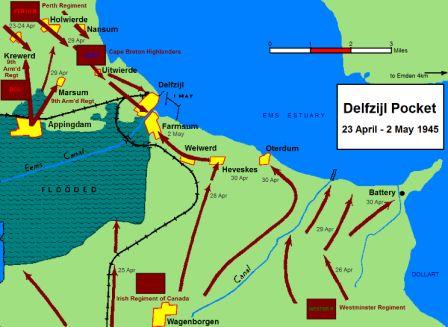
Map showing the locations during the Battle of the Delfzijl Pocket. (Map source: http://www.canadiansoldiers.com)

In Part 1, our battlefield tour began at a field where 19 Canadians lost their lives during the Battle for Wagenborgen, the preliminary battle before the Battle of the Delfzijl Pocket. (See https://onthewarmemorialtrail.com/2025/10/01/on-the-war-memorial-trail-battlefields-tour-with-joel-stoppels-part-1-battle-for-wagenborgen/)

Now, in Part 2, we travelled to Appingedam, the town where the Battle of the Delfzijl Pocket began…. 

From Wagenborgen, we made our way towards Appingedam, the location of the beginning of the Battle of the Delfzijl PocketWilliam ‘Willie’ DANIELS, Donald Charles MACKENZIE, whose stories were previously told on this blog, along with William James ‘Jimmy’ Sutherland HOLE, who Pieter also researched, lost their lives here.

…. We found banners for two soldiers whose stories were previously told…

We found the banners for Daniels and MacKenzie, but no banner was made for Hole as up to now no photo has been found of him. 

Banner for William ‘Willie’ Daniels in Appingedam. (Photo credit: Daria Valkenburg)

The banner for William ‘Willie’ Daniels was quite high up and it was hard for me to get a good angle, but thankfully Joël was kind enough to send us a better photo of the banner. 

Banner for William ‘Willie’ Daniels. (Photo courtesy of Joël Stoppels/ Battlefield Tours)

William ‘Willie’ DANIELS, from the Big River Reserve in Depton, Saskatchewan, was serving with the Royal Winnipeg Rifles when he was killed, aged 20, on April 22, 1945 as troops moved through Appingedam in The Netherlands at the very beginning of the Battle of the Delfzijl Pocket. You can read his story at https://onthewarmemorialtrail.com/2021/07/23/on-the-war-memorial-trail-remembering-ww2-soldier-william-willie-daniels/

Banner for Donald Charles MacKenzie in Appingedam. (Photo credit: Pieter Valkenburg)

Donald Charles MACKENZIE of Springhill, Nova Scotia, was serving with the Royal Winnipeg Rifles when he was killed, aged 30, on Sunday, April 22, 1945. He had been wounded during heavy fighting at the railway bridge near Appingedam, and placed in a house temporarily to rest. However, he was fatally hit by shrapnel by German shelling of the house.  You can read his story at https://onthewarmemorialtrail.com/2022/01/23/on-the-war-memorial-trail-the-ww2-soldier-from-springhill-who-received-a-memorial-cross/

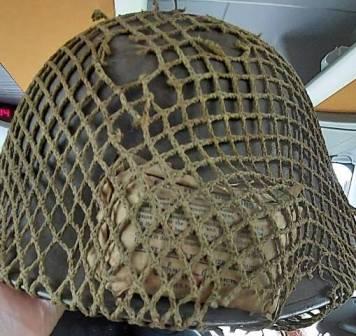
Helmet that had belonged to Donald Charles MacKenzie. (Photo Courtesy of Joël Stoppels / Battlefield Tours)

Joël told us that he has Donald Charles MacKenzie’s helmet in his private collection, and was kind enough to share a photo…a link of the past with the present! 

…. The Royal Winnipeg Rifles were in Appingedam as of April 21, 1945…

Map helped explain what happened in Appingedam in 1945.  (Photo credit: Daria Valkenburg)

In setting the scene on what unfolded in Appingedam back in 1945, Joël referred to a map that he had brought along for the battlefields tour.  “….Two roads led into Appingedam in 1945, both heavily mined by the defending Kriegsmarine…” he explained. The Kriegsmarine was Nazi Germany’s Navy from 1939-1945.  By 1945, as the war progressed, the Kriegsmarine formed infantry units from its personnel, who were re-trained as infantry to fight on land, all in an attempt to alleviate the strain on the German Army.

…The Canadians were aware of the mines…” Joël noted, and on “…April 21, 1945, the Royal Winnipeg Rifles attacked.  Heavy fighting ensued but the town was partially liberated on April 23, 1945….” allowing “….the Royal Winnipeg Rifles to move back into Wirdum….

The Regimental history, ‘Little Black Devils: a history of the Royal Winnipeg Rifles’, by Bruce Tascona and Eric Wells, describes what happened at Appingedam. “…..Beginning on April 21….the Rifles attacked with the 7th Reconnaissance Regiment, and several of the armoured cars were knocked out by anti-tank guns.  The Germans then blew up the bridge which the Rifles intended to cross…

In trying to find another plan of attack, patrols had discovered a small bridge.  …The bridge, deemed too feeble to carry motor transport, was still intact and patrols affirmed that it would carry the weight of jeeps.  With that information, the Rifles shifted position on a new start line during the night…

The plan in place, “…in the early hours of April 22, A Company….went over the bridge, followed closely by C Company.  They were met by heavy machine gun fire but the worst problem they faced were the minefields….

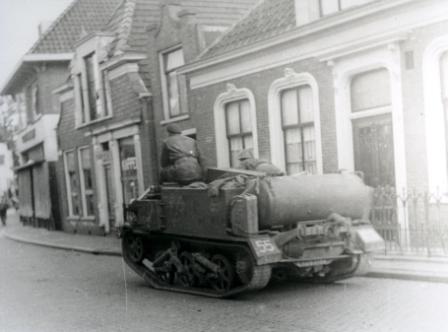
A WASP carrier with 2 soldiers from the Royal Winnipeg Rifles on a street in Appingedam in April 1945.  (Photo Courtesy of Joël Stoppels / Battlefield Tours)

In spite of the challenges, during the day “… the Battalion consolidated its position in front of the town…”  Then, a surprise attack during the night meant that…by dawn the Rifles were inside Appingedam and by mid-morning of April 23, they were mopping up. On April 24, the Rifles were replaced by the Perth Regiment….

The 9th Armoured Regiment (British Columbia Dragoons) were assigned to support the Perth Regiment.  The war diary for the BC Dragoons for April 22, 1945 explained the orders. …Lt Col Angle liaised with Commander Perth Regiment as BCD will form one portion of the 5 CAB Battle Group…” (CAB referred to Canadian Armoured Brigade)

The Situation Report for ‘A’ Squadron of the BC Dragoons noted that “…troops moved forward and positions taken over from Winnipeg Rifles before last light.  Approach to town heavily shelled by enemy heavy calibre guns…

…. Appingedam was evacuated on the night of April 23, 1945…

Per the war diary for the BC Dragoons for April 23, 1945, it was overcast and orders had been received at 2 am from HQ CAB that the Regiment was to relieve the Royal Winnipeg Rifles at 12:30 pm, and that troops from ‘A’ and ‘B’ squadrons were to be temporarily reorganized into one infantry squadron.  The tanks were parked in an area away from the town, with ….one crew member per tank to remain in the tanks and perform necessary maintenance and act as guards….”….all in preparation for the upcoming battle.

Appingedam had a population of 7,000, who were about to be in the midst of a heavy fight.  Joël told us that after “…a Dutch resistance fighter named Leugs went to Battalion HQ and offered to help, he was tasked with evacuating the town.  With the aid of Canadian trucks, this was done on the night of April 23, 1945…

On April 24, 1945, the Situation Report for ‘A’ Squadron of the BC Dragoons recorded that …the troop of tanks under Lt Gamlin, ‘C’ Squadron, took up positions at first light, spasmodic shelling throughout the day.  Underground contacted and reliable information was received concerning enemy positions….Enemy continued heavy shelling…. 

The Germans surrendered on May 2, 1945, and residents were able to return home and assess the damage to their properties.

…. Plaques to commemorate the RWR and BC Dragoons are in Appingedam…

Daria and Joël in Appingedam’s town square. The commemorative plaques are on a wall in the passageway to the right. (Photo credit: Pieter Valkenburg)

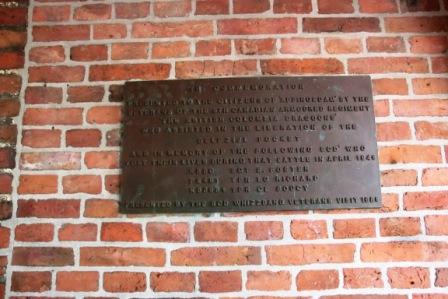
We learned about all that happened in Appingedam while standing in the town square, and next went to see two plaques placed nearby – one for the Royal Winnipeg Rifles, and the other for the British Columbia Dragoons.  We could still see shrapnel in the bricks of the buildings!

Commemorative plaque for the Royal Winnipeg Rifles.  (Photo credit: Daria Valkenburg)

Commemorative plaque for the BC Dragoons.  (Photo credit: Daria Valkenburg)

Three soldiers from the BC Dragoons are remembered on the plaque:

  • Sgt Stanley FOSTER, aged 24, died April 30, 1945
  • Trooper Louis Graham RICHARD, aged 27, died April 26, 1945
  • Trooper Charles Ernest SOUCY, aged 30, died April 30, 1945

Sgt Foster is buried in the Canadian War Cemetery in Groesbeek.  Troopers Richard and Soucy are buried in the Canadian War Cemetery in Holten.  You can read Richard’s story at https://onthewarmemorialtrail.com/2021/02/22/on-the-war-memorial-trail-atlantic-canada-remembers-part-7/

…. ‘The best stroopwafel I ever ate!’…

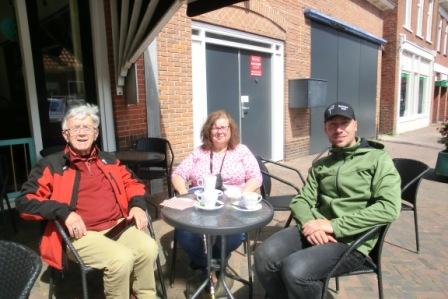
Pieter, Daria, and Joél having a much needed break in Appingedam.  (Photo courtesy of Valkenburg Family)

After digesting all the history from Wagenborgen and Appingedam, we desperately needed a break, so were very receptive to Joël’s suggestion that we go for coffee at ‘Stroopwoafeltje, Koffie & Meer’, a café in the town square.

Joël recommended the homemade stroopwafels made by the lady running the café, and both he and Pieter ordered one.  After Pieter told me “…this is the best stroopwafel I ever ate!!!!..” I tried a piece of his, and he was right.  It was much nicer than the syrupy, overly chewy ones you get commercially! 

In case you’ve never tried this treat, a stroopwafel is a traditional Dutch cookie made from two thin waffle layers sandwiched around a warm caramel filling.  I’m only sorry that I didn’t think to take a photo of Pieter’s stroopwafel before he ate it all up!

Our stay in Appingedam ended once we finished our coffee break.  It was time to move on and continue our battlefields tour as part of our 2025 European War Memorial Tour. Coming up in Battlefields Tour With Joël Stoppels Part 3: Visit To Stefanuskerk In Holwierde.

Thank you to Joël Stoppels, guide and founder of Battlefield Tours, for a wonderful and informative tour. (See www.battlefieldtours.nu)  If you have a story or photo to share, please contact Pieter at memorialtrail@gmail.com or comment on the blog. 

© Daria Valkenburg

….Want to follow our research?…

If you are reading this posting, but aren’t following our research, you are welcome to do so.  Our blog address: https://onthewarmemorialtrail.com/
4 countries, 6 weeks, 7,000 km – an unforgettable war memorial journey in Europe…. Daria’s book ‘No Soldier Buried Overseas Should Ever Be Forgotten‘ is available in print and e-book formats.  Net proceeds of book sales help support research costs and the cost of maintaining this blog. For more information see https://nosoldierforgotten.com/

Subscribe to our YouTube Channel: On The War Memorial Trail With Pieter Valkenburg: https://www.youtube.com/channel/UCJ591TyjSheOR-Cb_Gs_5Kw

Never miss a posting!  Subscribe below to have each new story from the war memorial trail delivered to your inbox.

On The War Memorial Trail…. Battlefields Tour With Joël Stoppels Part 1: Battle For Wagenborgen

A life’s ambition realized! Daria in the driver’s seat of a jeep! Spoiler alert – our battlefield tour was in an SUV, not the jeep! (Photo credit: Joël Stoppels)

October 1, 2025.  Pieter has been involved in finding photos of Canadians who are buried in all three Canadian War Cemeteries in The Netherlands since 2014, with stories of many soldiers told on this blog. 

While in Europe on our 2025 European War Memorial Tour this spring, for the 80th Anniversary of Liberation Commemoration events, he not only placed flags at the graves of 383 soldiers in 14 cemeteries, but we wanted to tour some of the battlefields in order to have a better appreciation of what soldiers faced. 

Battlefields Tours guide Joël Stoppels, of Groningen, The Netherlands, offered to spend a day showing us locations where the various battles that comprised the Battle of the Delfzijl Pocket took place. The term ‘Delfzijl Pocket’ refers “….to the entire area around Delfzijl that was held by German forces and cleared by the Canadians in late April and early May 1945…”Joël explained.

Over the years, we’ve featured stories of many soldiers who lost their lives in the last weeks of the North-West Europe campaign during WWII, and we eagerly anticipated learning more. (See https://www.canadiansoldiers.com/history/battlehonours/northwesteurope/delfzijlpocket.htm)

Map showing the locations during the Battle of the Delfzijl Pocket. (Map source: http://www.canadiansoldiers.com)

…. 19 Canadians lost their lives on a field just outside Wagenborgen…

Our day touring battlefields began very early, with a two hour drive from our cottage near Holten to Groningen, where we’d arranged to meet Joël. 

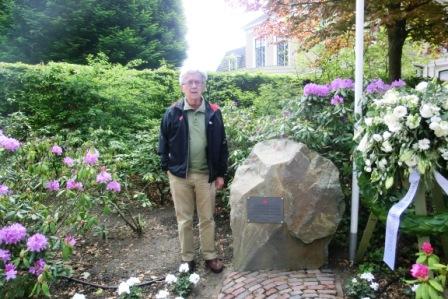
Our first stop on the battlefield tour was at a field outside Wagenborgen, where 19 Canadians lost their lives during the Battle for Wagenborgen.  This was the preliminary battle before the Battle of the Delfzijl Pocket. (See  https://www.canadiansoldiers.com/history/battlehonours/northwesteurope/wagenborgen.htm)

Joël Stoppels and Pieter stand across the road from the field outside Wagenborgen.  (Photo credit: Daria Valkenburg)

Joël began by saying that “….‘D’ Company of the Canadian Scottish Regiment, under the command of Major Anthony Compton-Lundie, were ordered by Battalion Command based in Groningen to undergo a dangerous mission across open fields with no rises or trees for cover…..” 

Patrols from the 7th Canadian Reconnaissance Regiment had determined that Wagenborgen, a short distance from the centre of the battalion’s line, was held by an unknown number of Germans.

‘D’ Company received orders to take the village of Wagenborgen in a one-company attack in the early hours of April 21, 1945.  “….Compton-Lundie was based at the Schmidt farm at the end of the field.  When the phone rang with orders to attack, he protested.  ‘Are you crazy?’ he said.  Orders were orders, however, and Compton-Lundie was not one to disobey…

The attack began on April 21, 1945.  By the time it was over, Anthony COMPTON-LUNDIE was dead, as was his lieutenant, Dennis George HUSCROFT, and 17 more men.

…. How did the battle go so badly for the Canadian Scottish?…

How did it go so wrong?  ... A Polish division had been in the area before the Canadian Scottish arrived and told Compton-Lundie that they believed only 100 Germans remained.  This was faulty intelligence as there were over 1500 Germans, just waiting to pick off soldiers in the open field of very flat land….”  Joël reflected that “…perhaps if Battalion Command had listened to Compton-Lundie, who had a view of the landscape, that there would have been fewer casualties….

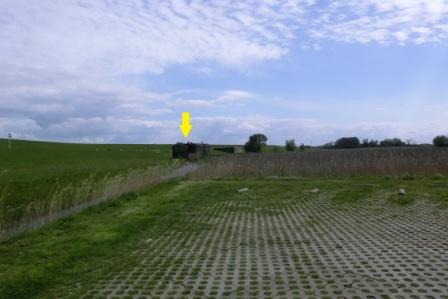
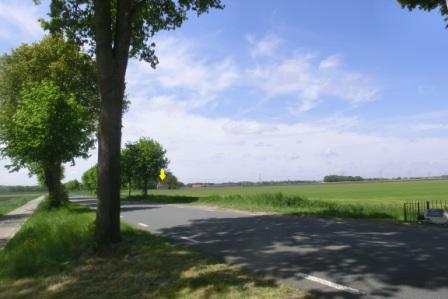
Field outside Wagenborgen where 19 men lost their lives.  Yellow arrow indicates Schmidt Farm, where Major Compton-Lundie of the Canadian Scottish Regiment had been based. At the far right is a monument commemorating those who died. (Photo credit: Daria Valkenburg)

…. A monument by the field honours the 19 men who died…

Monument by the open field where 19 men lost their lives on April 19, 1945. (Photo credit: Daria Valkenburg)

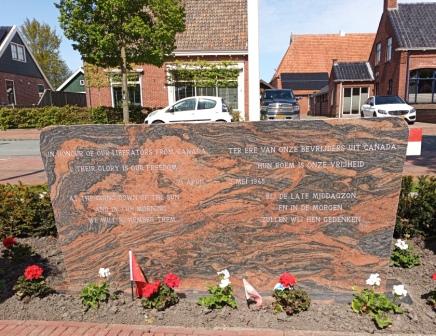
A small monument sits beside the open field where 19 men fought and lost their lives.  A translation of the Dutch text reads as follows:  Stand still for a moment at the maple leaf. On April 21, 1945, 19 Canadian men died for our freedom here at ‘Stolderij’. Stolderij refers to the hamlet where the open field is located.

The men were temporarily buried in Siddeburen before being reburied in 1946 in the Canadian War Cemetery in Holten, The Netherlands.

…. Banners were placed in Wagenborgen to commemorate fallen soldiers…

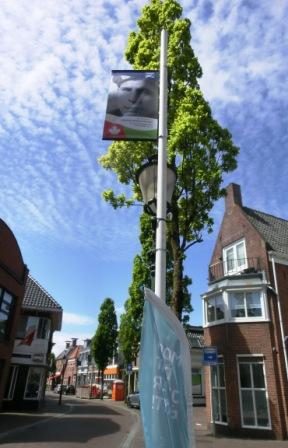
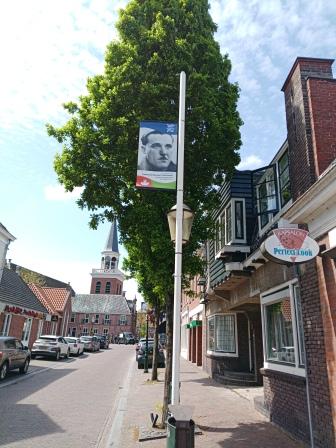
Once we finished taking photos of the field where so many men lost their lives, we drove into the town of Wagenborgen itself, where banners of the deceased soldiers had been placed, as close as possible to the location where they fell. 

Two soldiers from the Canadian Scottish Regiment who had fought in Wagenborgen have had their stories previously told on this blog.  One survived the battle, but one died, and we looked for his banner.

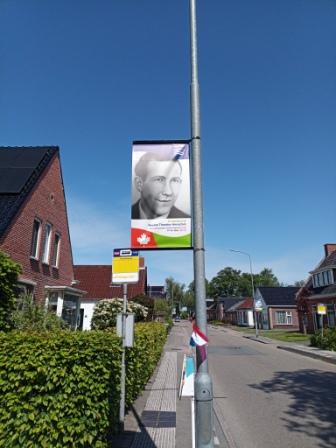
Banner for Theodor ‘Ted’ Henschel in Wagenborgen.  (Photo credit: Daria Valkenburg)

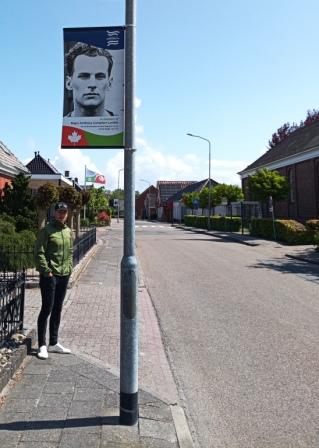
Joël by the banner for Anthony Compton-Lundie, who was from Oakbank, Manitoba. (Photo credit: Daria Valkenburg)

After being told about the impossible situation that Major Anthony Compton-Lundie faced, we wanted to see his banner, and took a photo of Joël beside it.

…. Canadian soldiers who lost their lives during the Battle for Wagenborgen…

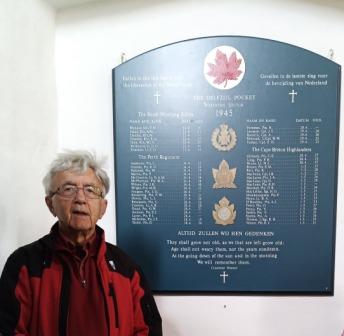
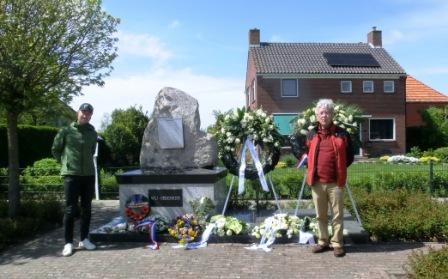
Joël and Pieter at the War Memorial in Wagenborgen.  ‘Wij gedenken’ translates to ‘We commemorate’. (Photo credit: Daria Valkenburg)

The War Memorial in Wagenborgen commemorates the residents of Wagenborgen who died in WWII, and 27 fallen Canadian soldiers – 23 of them from the Canadian Scottish Regiment, 1 from the Royal Winnipeg Rifles, and 3 from the Royal Canadian Artillery. 

From the Canadian Scottish Regiment:

  • Pte Albert George BOUMA, aged 21, died April 23, 1945
  • Pte John BRANSCOMB, aged 32, died April 23, 1945
  • Pte Robert Stewart BULLOCK, aged 39, died April 23, 1945
  • Pte Leslie Keith BUTTERICK, aged 19, died April 21, 1945
  • L/Cpl Carmen Christie CAPONERO, aged 30, died April 21, 1945
  • Sgt Allen CLEMENTS, aged 32, died April 21, 1945
  • Major Anthony COMPTON-LUNDIE, aged 30, died April 21, 1945
  • Pte Louis Silverius DAUTREMONT, aged 25, died April 21, 1945
  • Pte Edwin Levi EMERY, aged 22, died April 21, 1945
  • Pte Peter HARASYMCHUK, aged 24, died April 23, 1945
  • Pte Theodor ‘Ted’ HENSCHEL, aged 28, died April 223, 1945
  • Pte John Charles HUGHES, aged 28, died April 23, 1945
  • Lt Denis George HUSCROFT, aged 24, died April 21, 1945
  • L/Cpl John Albert MASLIN, aged 24, died April 21, 1945
  • Pte John Raymond PATRICK, aged 29, died April 21, 1945
  • Pte James Robert POWER, aged 21, died April 21, 1945
  • Pte Robert John Wilson REID, aged 38, died April 21, 1945
  • Pte Henry Oscar RENNER, aged 24, died April 21, 1945
  • Martin George VAN SANDVOORD, aged 28, died April 22, 1945
  • Pte Emile Joseph SOENS, aged 24, April 21, 1945
  • Pte John William WILSON, aged 37, died April 23, 1945
  • Pte Fred WIRTH, aged 38 , died April 23, 1945
  • A/Cpl Gordon Scarth WOOD, aged 21, died April 21, 1945

From the Royal Winnipeg Rifles:

  • Rifleman Theodore OLENICK, aged 19, died April 21, 1945

From the Royal Canadian Artillery:

  • Captain Donald George INNES, aged 23, died April 21, 1945
  • Gunner Joseph Paul MOULINS, aged 23, died April 21, 1945
  • Gunner Arthur John MUELLER, aged 20, died April 21, 1945

From Wagenborgen, we continued our tour, with our next stop in Appingedam, coming up in Battlefields Tour With Joël Stoppels Part 2: The Battle of the Delfzijl Pocket Began In Appingedam.

Thank you to Joël Stoppels, guide and founder of Battlefield Tours, for a wonderful and informative tour. (See www.battlefieldtours.nu)  If you have a story or photo to share, please contact Pieter at memorialtrail@gmail.com or comment on the blog. 

© Daria Valkenburg

….Want to follow our research?…

If you are reading this posting, but aren’t following our research, you are welcome to do so.  Our blog address: https://onthewarmemorialtrail.com/

4 countries, 6 weeks, 7,000 km – an unforgettable war memorial journey in Europe…. Daria’s bookNo Soldier Buried Overseas Should Ever Be Forgotten is available in print and e-book formats.  Net proceeds of book sales help support research costs and the cost of maintaining this blog. For more information see https://nosoldierforgotten.com/

Subscribe to our YouTube Channel: On The War Memorial Trail With Pieter Valkenburg: https://www.youtube.com/channel/UCJ591TyjSheOR-Cb_Gs_5Kw

Never miss a posting!  Subscribe below to have each new story from the war memorial trail delivered to your inbox.
On The War Memorial Trail….2025 Faces of Holten Exhibition Part 2: The Soldiers Listed On The Cenotaph In Borden-Carleton

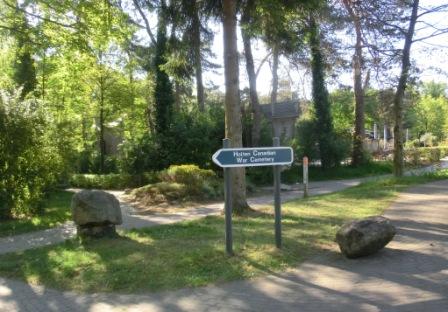
Directional sign to the Canadian War Cemetery in Holten, The Netherlands. (Photo credit: Daria Valkenburg)

August 29, 2025.  Pieter has been involved in finding photos of Canadians who are buried in all three Canadian War Cemeteries in The Netherlands since 2014.  He first started with finding photos of soldiers from Prince Edward Island buried in The Netherlands. 

In 2015, he began researching the names of 48 soldiers listed on the Cenotaph outside the Borden-Carleton Legion on Prince Edward Island.  Over the years, all 48 names were identified, each of their stories researched and told on this blog.  For most of the names, families and photos were found, and the Wall of Remembrance is in place at the Legion. 

Cenotaph outside the Borden-Carleton Legion. (Photo credit: Daria Valkenburg)

While in The Netherlands and Belgium for the 80th Anniversary of Liberation Commemoration events, he placed flags at the graves of 383 soldiers in 14 cemeteries. At the Canadian War Cemetery in Holten, The Netherlands, flags were placed at 156 graves.

Our visit coincided with The 2025 Faces Of Holten Exhibition, which ran for three weeks in May. Photos were printed onto an aluminum backing, making them impervious to rain, and reusable. Each placard also had a QR code, allowing visitors with cell phones to scan the code and read a brief biography of the soldier.

In Part 1, soldiers who were killed near Posterenk in April 1945 and are buried in the Canadian War Cemetery in Holten, were featured. (See https://onthewarmemorialtrail.com/2025/08/24/on-the-war-memorial-trail-2025-faces-of-holten-exhibition-part-1-soldiers-killed-near-posterenk/)

…2 soldiers listed on the Cenotaph in Borden-Carleton are commemorated…

Now, in Part 2, the graves and photos of William Douglas SHERREN and George Martin MCMAHON, whose stories have previously been told, are featured. Both are listed on the Cenotaph outside the Borden-Carleton Legion. You can read their stories at https://onthewarmemorialtrail.com/2018/01/20/on-the-war-memorial-trail-at-holten-canadian-war-cemetery/

Grave of William Douglas Sherren. (Photo credit: Pieter Valkenburg)

William Douglas SHERREN, from Crapaud, Prince Edward Island, was serving with the Royal Canadian Artillery and was severely injured when the vehicle he was travelling in drove over a land mine in Germany on April 25, 1945, just a few days before the end of WWII.  He died of his wounds on April 28, 1945, aged 30.  A month earlier, he had been recognized by King George VI as a Member of the Military Division of the Most Excellent Order of the British Empire, in recognition of gallant and distinguished service in North West Europe.

Grave of George Martin McMahon. (Photo credit: Pieter Valkenburg)

George Martin McMAHON, born in Emerald Junction, Prince Edward Island, and the father of 5 children, was serving with the Royal Canadian Artillery, and accidentally drowned when he fell into a canal in Amsterdam, The Netherlands on the night of August 11, 1945.  He was 32 years old.

….All of the flags placed at graves were donated…

All of the flags placed at graves were donated.  For the flags placed at the graves of Islanders, our thanks go to:  Alan Waddell, Constituent Assistant, on behalf of Heath MacDonald, MP for Malpeque, for the Canadian flags. Prince Edward Island flags were provided by Matt MacFarlane, MLA for District 19, Borden-Kinkora. 

In Part 3, the graves of soldiers killed in vehicle accidents will be featured as we continue with our 2025 European War Memorial Tour. Pieter encourages readers with photos to come forward so that eventually all the known graves of Canadians buried in Holten will have a photo displayed by their grave. Email him at memorialtrail@gmail.com

© Daria Valkenburg

….Want to follow our research?…

If you are reading this posting, but aren’t following our research, you are welcome to do so.  Our blog address: https://onthewarmemorialtrail.com/

4 countries, 6 weeks, 7,000 km – an unforgettable war memorial journey in Europe…. Daria’s book ‘No Soldier Buried Overseas Should Ever Be Forgotten‘ is available in print and e-book formats.  Net proceeds of book sales help support research costs and the cost of maintaining this blog. For more information see https://nosoldierforgotten.com/

Subscribe to our YouTube Channel: On The War Memorial Trail With Pieter Valkenburg: https://www.youtube.com/channel/UCJ591TyjSheOR-Cb_Gs_5Kw

Never miss a posting!  Subscribe below to have each new story from the war memorial trail delivered to your inbox.
On The War Memorial Trail….. The WWII Diary Of Dr. Ross Part 2: Two Years And 20 Trips Aboard HMHS Lady Nelson

Dr. Alton Ross. (Photo courtesy of Judy Parks.  Photo colourization by Pieter Valkenburg)

March 23, 2025. During WWII, Dr. James ‘Alton’ ROSS, father of Judy Parks, was a doctor aboard the hospital ship HMHS Lady Nelson, Canada’s first hospital ship, which had 515 special hospital beds, special wards for shock cases, contagious diseases and fractures, private cabins, an operating room, a sterilizing room, an inspection room for minor dressings, a dispensary, and a portable x-ray outfit.

HMHS Lady Nelson.  Note the crosses on the side of the ship!  (Photo source: Wikipedia)

In Part 1, the first two of Alton’s twenty voyages aboard the ship were summarized, providing a window into life aboard a military hospital ship, as he found himself treating patients who’d been wounded in Sicily and mainland Italy. (See https://onthewarmemorialtrail.com/2025/03/16/on-the-war-memorial-trail-the-wwii-diary-of-dr-ross-part-1-assigned-to-hmhs-lady-nelson/)

Now, in Part 2, Alton’s story concludes with a return to Italy to pick up wounded servicemen and some of the devastation of war that he saw, and finally, after his 20th voyage he was able to return to the life of a civilian and a rural medical practice….

….Alton recorded Trip No. 3 aboard the HMHS Lady Nelson….

Alton’s third trip aboard the HMHS Lady Nelson began on March 4, 1944, with a round trip of 9,400 miles (15,128 km). 

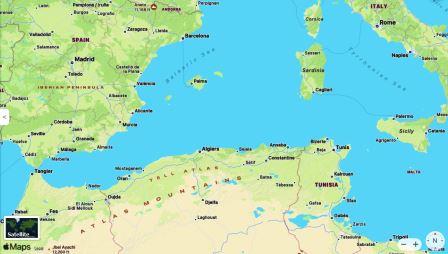
Trip No. 3 went from Halifax to Bizerte to Naples to Algiers.  (Map source: DuckDuckGo)

The route took him from the port of Halifax, Nova Scotia, across the Atlantic Ocean to Gibraltar, to Bizerte, Tunisia, and then on to Naples, Italy, from there to Algiers, Algeria, before sailing to Avonmouth, United Kingdom, and then returning to Halifax.

Alton’s diary recorded that the orchestra aboard ship, in which he played the saxophone, was larger than on his previous voyage. “…Orchestra increased by two trumpets, clarinet, and ….bass… and cymbal.  Put on three concerts across…

After leaving Halifax on March 4, 1944, the ship arrived in Gibraltar at 1:00 pm on March 13, 1944, with a stay of 7 hours before sailing on to Bizerte, Tunisia.  Alton noted that they “…had a dance that night…very successful….enjoyed by everyone.  Orchestra right on good rhythm…

In the morning of March 16, 1944, they …anchored off Bizerte in Tunisia just in bay north of Cape Bon where last of Germans gave up…..Tanker brought water to us….Remained there until 1:00 am 17 March then left for Naples…

On March 18, 1944, the ship …docked at Naples at 9:00 am…..Began loading shortly afterwards…..Left at 4:00 pm for Algiers…

When the ship had been anchored in Bizerte, no one left the ship and Alton finally found out why. “…Heard reason for not going into Bizerte was 27 enemy ships sunk in harbour…

On March 20, 1944, the ship “…docked at Algiers at 3:00 pm and loaded 50 patients…” before leaving port at 7:00 pm for England.

The ship arrived in Avonmouth on March 29, 1944, and after the patients were unloaded, Alton was free until April 1, 1944, when “…502 patients….” were brought onboard. The ship left for Halifax the following day, on a course which went “….far south this time.  Southwest to Azores, directly west on level with New York, then northwest into Halifax.  Trip seemed very long…” The journey ended when the ship arrived in Halifax on April 12, 1944.

Music remained a big part of Alton’s off-duty hours. While in England, the Auxiliary Service provided “…a trumpet and a trombone, which gave us 4 brass.  As all the boys were on day duty, we practiced about 6 to 7 nights coming from England….” 

Judy reflected on the morale boost that was provided by the orchestra.  “…The older I get I realize those crossings on the Lady Nelson were therapy sessions.  Dances and lots of music with a live orchestra…” were instrumental in “…keeping spirits up to the young volunteers anxious for some excitement on the way over, and also to the wounded returning….

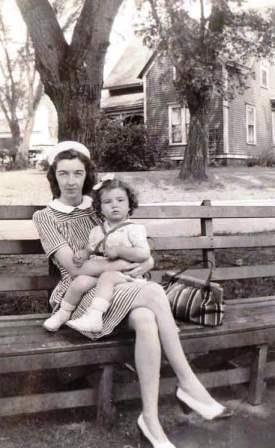
Alton’s wife Betty with their daughter Judy in New Glasgow, Nova Scotia, in a photo taken while Alton was on leave.  (Photo courtesy of Judy Parks)

At the end of Trip No. 3 Alton received 2 weeks leave, which he spent with his wife and daughter.

….Alton’s next few trips aboard the HMHS Lady Nelson were between Halifax and the United Kingdom….

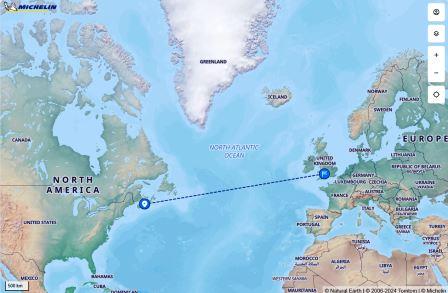
Trip No. 4 went from Halifax to Avonmouth.  (Map source: https://www.viamichelin.com)

There are 2,762 nautical miles between the Port of Halifax in Nova Scotia, and the Port of Avonmouth in the United Kingdom.  Alton’s next trip was between these two ports.

Trip No. 5 was to be the same route, but D-Day on June 6, 1944 resulted in an unexpected route change! “…Embarked 30 May carrying about 50 patients and half of 20 and 22 Canadian General Hospital staffs.  Trip over was started 31 May 44 and was fairly smooth but very foggy.

So far, nothing unusual, but then “…. on June 6th we heard the news of the Allied landings in Normandy. We were all greatly excited. On 7th June received word at 4:00 pm to change our course to the north of Ireland and again had heavy fog. At 2:00 am, 9th June went into Belfast for orders, then continued on past the Isle of Man to Liverpool….

On June 13, 1944, Alton wrote that the return journey to Canada began.  “…Loaded 505 patients…and sailed at 4:30 pm. Went around the north of Ireland…”  He noted that there were “….several cases of Malaria on board…”  Hospital records in Italy had reported since autumn 1943 that there was a severe malaria epidemic.

The next few trips found the ship returning to Liverpool rather than Avonmouth on its round trip journeys.  It wasn’t until Alton’s 14th trip in March 1945 that the Lady Nelson docked again in Avonmouth.

….Alton recorded two burials at sea on Trip No. 7….

On the return voyage back to Canada for Alton’s 7th trip, he recorded that the ship “…left Liverpool midnight 8 August….There were two burials at sea.  11th August MacGuire (sic) and 16th Captain Miller…

Private George Alfred MAGUIRE, born in Windsor, Ontario, had died aboard the Lady Nelson on August 11, 1944 from wounds received in action in France while serving with the Essex Scottish Regiment, at the age of 23, leaving behind his parents, Charles S. and Minnie Maguire, of London, Ontario. His name is inscribed on the Halifax Memorial in Point Pleasant Park in Halifax, Nova Scotia. 

Captain Theodore Albert MILLER, who was born in Halifax, Nova Scotia, had died of cancer on August 15, 1944 aboard the Lady Nelson, at the age of 47, while serving with the Royal Canadian Ordnance Corps, leaving behind his wife, Kathleen Miller of Regina, Saskatchewan, and their son David Graeme Miller. His name is inscribed on the Halifax Memorial in Point Pleasant Park in Halifax, Nova Scotia. 

….Alton looked forward to civilian life….

By June 1945, following his 16th trip aboard the Lady Nelson, Alton “…signed to go back to civilian life…

Alton with his daughter Judy in New Glasgow, Nova Scotia.  (Photo courtesy of Judy Parks)

After the conclusion of his 20th trip on October 9, 1945, “….Colonel Stone said I would be taken off the ship this trip. I went home to New Glasgow…

Following his discharge from the Royal Canadian Army Medical Corps (RCAMC), Alton returned to Salisbury, New Brunswick.  Judy explained that “…he started his practice up again, but when I was 4 he was diagnosed with cancer of the bowel and that is the only memory I have of him …in bed …very ill….” 

Sadly, Alton passed away on July 27, 1947, aged 32.  He’s buried at Christ Church Cemetery in Stellarton, Pictou County, Nova Scotia.

Alton recorded 20 trips in his diary, always being fortunate to return home for a few days with his wife and daughter between each voyage.  As he died when Judy was a child, the war diary was a way to get to know him, but she explained that she was “….50 years old” when her mother “…gave me the war diary…

Judy followed her father’s footsteps into a medical career, becoming a nurse. Going over his war diary made her reflect that “….people sometimes ask me if I was upset when my father died and I know I wasn’t.  I was only four.  No one told me he died…children were told nothing about death in those days. I suppose I thought he returned to war…

Judy Parks (left) with Daria, discussing the war service of Judy’s father. (Photo credit: Pieter Valkenburg)

Thank you to Judy Parks for sharing photos and her father’s war diary, and to Etienne Gaudet for finding newspaper articles.

© Daria Valkenburg

….Want to follow our research?….

If you are reading this posting, but aren’t following our research, you are welcome to do so.  Our blog address: https://onthewarmemorialtrail.com/

4 countries, 6 weeks, 7,000 km – an unforgettable war memorial journey in Europe…. Daria’s book ‘No Soldier Buried Overseas Should Ever Be Forgotten‘ is available in print and e-book formats.  Net proceeds of book sales help support research costs and the cost of maintaining this blog. For more information see https://nosoldierforgotten.com/

You are also invited to subscribe to our YouTube Channel: On The War Memorial Trail With Pieter Valkenburg: https://www.youtube.com/channel/UCJ591TyjSheOR-Cb_Gs_5Kw

Never miss a posting!  Subscribe below to have each new story from the war memorial trail delivered to your inbox.

On The War Memorial Trail….Remembrance Week 2024 – Visiting Acadian Memorials In New Brunswick

banner-remembrance with poppies

November 22, 2024.  This past August we visited several places along the beautiful Acadian Coastal Drive in New Brunswick, following the scenic coastline along Chaleur Bay.  One of the highlights of our trip was the chance to meet in person with Armel ‘Mel’ Lanteigne and his wife Monique.  Over the past few years, Mel has helped to find photos of soldiers from the area that are on the photo wish lists from Canadian War Cemeteries in The Netherlands, but we’d never met in person.

A veteran, Mel is involved in restoring and placing monuments in his area, and was featured in an article about the restoration of a cenotaph in Caraquet, New Brunswick.  (You can read the French language article here: Restaurer des cénotaphes, la mission spéciale d’Armel Lanteigne à Caraquet | Radio-Canada https://ici.radio-canada.ca/nouvelle/1908177/armel-lanteigne-renover-cenotaphe-grand-caraquet)

….The route plan…..

Screenshot 2024-11-17 at 12-08-35 caraquet new brunswick at DuckDuckGo

Map shows the location of the 6 memorials we visited in New Brunswick.  (Map source: DuckDuckGo)

Over dinner at our hotel in Beresford, New Brunswick, just outside of Bathurst, Mel and Monique offered to take us on a guided tour of several of the monuments in the area that Mel was involved with.  On our guided tour we would visit memorials in Grande-Anse, Maisonette, Bertrand, Caraquet, and Bas-Caraquet.  We then would bid adieu to Mel and Monique and continue on to Tracadie to visit one final memorial before heading back to Prince Edward Island.

….Memorial 1: Grande-Anse…..

CIMG6964 Aug 27 2024 Grand-Anse sign

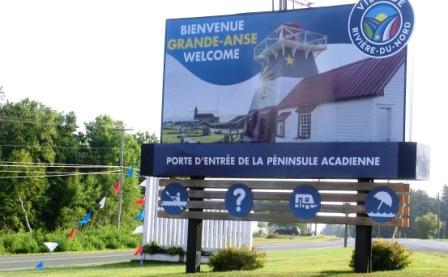
Our first stop was Grande-Anse, the entry port to the Acadian Peninsula. (Photo credit: Daria Valkenburg)

The next morning, Pieter and I drove along the Chaleur Bay to Grande-Anse, the first memorial stop on our tour, and where we would meet Mel and Monique.  We were lucky with the weather, which was beautifully warm and sunny.

CIMG6966 Aug 27 2024 Pieter by Grand-Anse Monument

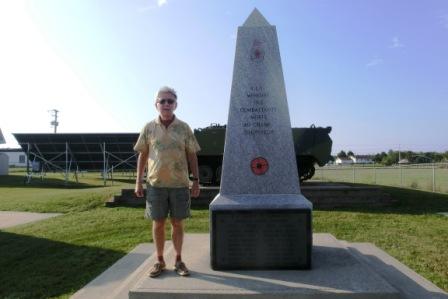
Pieter by one side of the Grande-Anse Monument.  (Photo credit: Daria Valkenburg)

CIMG6972 Aug 27 2024 Pieter & Mel by Grand-Anse Monument

Pieter (left) and Mel Lanteigne (right) by the Grande-Anse Monument. (Photo credit: Daria Valkenburg)

Of great interest to a military researcher like Pieter was the chance to see an artillery gun and armoured personnel carrier (APC), both of which were beside the Grande-Anse Monument.

CIMG6968 Aug 27 2024 Artillery gun by Grand-Anse Monument

Pieter by the artillery gun at the Grande-Anse Monument. (Photo credit: Daria Valkenburg)

CIMG6969 Aug 27 2024 APC Armoured Personnel Carrier by Grand-Anse Monument

Pieter by the armoured personnel carrier (APC) at the Grande-Anse Monument. (Photo credit: Daria Valkenburg)

….Memorial 2: Maisonnette…..

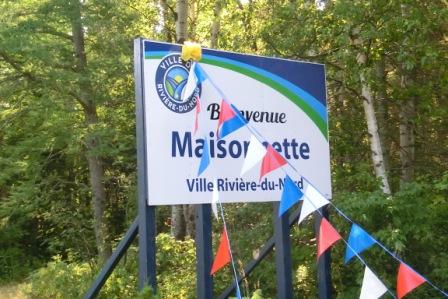
CIMG6974 Aug 27 2024 Maisonette sign

Our second stop was Maisonnette. (Photo credit: Daria Valkenburg)

From Grande-Anse, we travelled to Maisonnette, site of the Maisonnette Memorial.  Jean FRIGAULT, of Maisonnette, whose photo was recently submitted to Pieter by Mel, is listed on this memorial.  He was killed on March 2, 1945 while serving with Le Régiment de la Chaudière, and is buried in the Canadian War Cemetery in Groesbeek, The Netherlands.  His story will be told in an upcoming blog posting.

CIMG6975 Aug 27 2024 Pieter & Mel by Maisonette monument

Pieter (left) with Mel Lanteigne at the Maisonnette Memorial.  (Photo credit: Daria Valkenburg)

CIMG6977Aug 27 2024 Jean Frigault listed on Maisonette monument

Jean Frigault is one of 4 WWII casualties listed on the Maisonnette Memorial.  (Photo credit: Daria Valkenburg)

….Memorial 3: Bertrand…..

CIMG6980 Aug 27 2024 Bertrand sign

Our third stop was Bertrand. (Photo credit: Daria Valkenburg)

Our third stop was in Bertrand, where, to our surprise, we saw a familiar name listed on the monument – that of Léopold THÉRIAULT of Bertrand, whose name had been on a photo wish list from the Canadian War Cemetery in Bergen Op Zoom, The Netherlands where he is buried.  Pieter had just recently obtained a photo, otherwise the name might not have resonated when we saw it on the memorial! Léopold was killed on October 25, 1944 while serving with the Algonquin Regiment. His story will be told in an upcoming blog posting.

CIMG6983 Aug 27 2024 Mel & Pieter by Bertrand Monument

Mel (left) and Pieter at the Bertrand Memorial.  (Photo credit: Daria Valkenburg)

CIMG6986 Aug 27 2024 Pieter by list of names by Bertrand Monument

Pieter by the plaque on the Bertrand Memorial listing Léopold Thériault as one of 4 WWII casualties from the area.  (Photo credit: Daria Valkenburg)

….Memorial 4: Caraquet…..

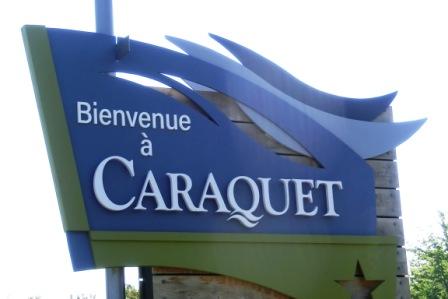
CIMG6989 Aug 27 2024 Caraquet sign

Our fourth stop was Caraquet. (Photo credit: Daria Valkenburg)

Our fourth stop was at the memorial in Caraquet, which lists the names of two WWII soldiers whose stories were previously told on this blog:  Gilles LANTEIGNE and Alphonse ROBERT.

CIMG6991 Aug 27 2024 Pieter Mel & Monique at Caraquet monument

Pieter (left) with Mel and Monique at the Caraquet Memorial. (Photo credit: Daria Valkenburg)

The Caraquet Memorial is very dear to Mel’s heart.  When the original monument was restored several years ago, a decision was made to add a statue of a WWII soldier, depicted as seated and reading a postcard from home.  The model for the statue was Mel and Monique’s son Marc-André, and the WWII uniform used for the model had been worn by Monique’s father, William D. WARD!

maky au céno de caraquet

Marc-André Lanteigne in his grandfather’s WWII uniform, standing beside the original Caraquet Memorial. (Photo courtesy of Mel Lanteigne)

CIMG6993 Aug 27 2024 Gilles Lanteigne & Alphonse Robert on list of names on Caraquet monument

Gilles Lanteigne and Alphonse Robert are two of 14 WWII casualties listed on the Caraquet Memorial. (Photo credit: Daria Valkenburg)

To read Gilles Lanteigne’s story, see https://onthewarmemorialtrail.com/2021/07/11/on-the-war-memorial-trail-atlantic-canada-remembers-part-10/

To read Alphonse Robert’s story, see:

….Memorial 5: Bas-Caraquet…..

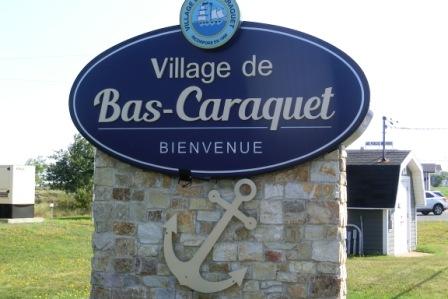
CIMG6997 Aug 27 2024 Bas Caraquet sign

Our fifth stop was Bas-Caraquet. (Photo credit: Daria Valkenburg)

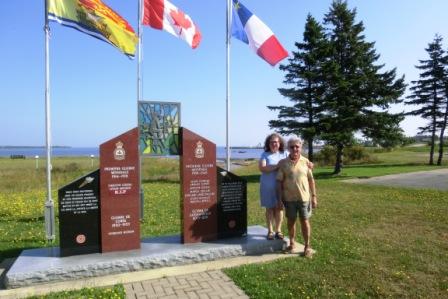
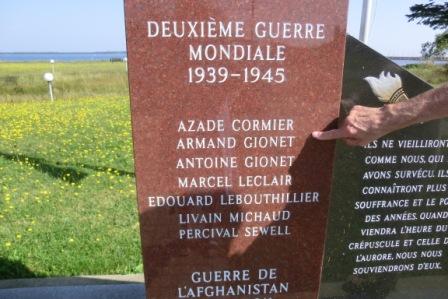
Our last stop on our tour with Mel and Monique was the village of Bas-Caraquet. WWII soldier Armand GIONET, whose photo was submitted to Pieter by Mel, is listed on the Bas-Caraquet Memorial. 

CIMG7002 Aug 27 2024 Daria & Pieter by Bas Caraquet Monument

Pieter and Daria at the Bas-Caraquet Memorial. (Photo credit: Mel Lanteigne)

CIMG7001 Aug 27 2024 Armand Gionet on list of names at Bas Caraquet Monument

Armand Gionet is one of 7 WWII casualties listed on this memorial.  (Photo credit: Daria Valkenburg)

After Armand’s story was published, we heard from Jan Braakman, a Dutch journalist, who wrote to let us know that “….Armand Gionet died in my town of birth (Laren, province of Gelderland) at the same place, same time and same way as my grandmother, Dina Koeslag.….” Both lost their lives after the building they were in was hit by a German bazooka and started on fire.

To read Armand’s story, see https://onthewarmemorialtrail.com/2021/07/11/on-the-war-memorial-trail-atlantic-canada-remembers-part-10/

….Memorial 6: Tracadie…..

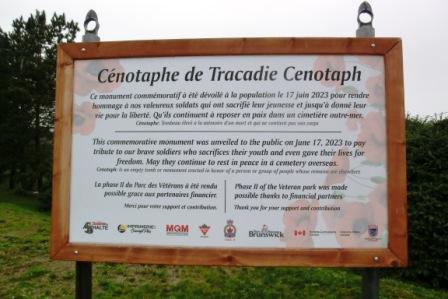
CIMG7027 Aug 28 2024 Info on Tracadie Monument

Information panel at the Tracadie Cenotaph.  (Photo credit: Daria Valkenburg)

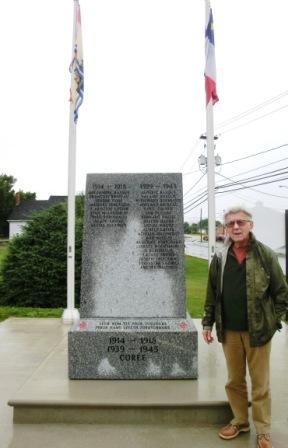
When we visited the five memorials with Mel and Monique it was warm and sunny.  The following day, however, it rained when we visited the Tracadie Cenotaph in Tracadie.   

CIMG7024 Aug 28 2024 Pieter at Tracadie Monument

Pieter at the Tracadie Cenotaph.  (Photo credit: Daria Valkenburg)

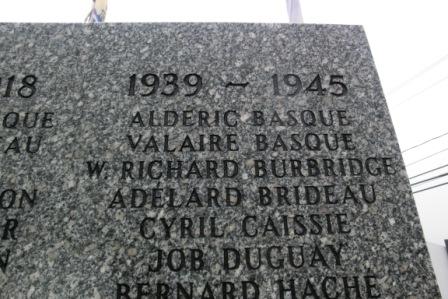
WWII soldier Alderic BASQUE, of Tracadie, whose photo was found several years ago with the help of Marc Comeau, is listed on this Cenotaph. To read Alderic’s story, see https://onthewarmemorialtrail.com/2020/12/31/on-the-war-memorial-trail-a-face-for-ww2-soldier-alderic-basque/

CIMG7026 Aug 28 2024 Alderic Basque listed on Tracadie Monument

Alderic Basque is one of 19 WWII casualties listed on this Cenotaph.  (Photo credit: Daria Valkenburg)

Also listed on this Cenotaph is WWII soldier Cyrille CAISSIE, whose photo was obtained by Pieter last year.  Born in Four Roads, New Brunswick, Cyril was the son of John and Delima Caissie.  He lost his life on February 26, 1945 at the age of 25, while serving with Le Régiment de la Chaudière, and is buried in the Canadian War Cemetery in Groesbeek, The Netherlands.

WWII soldier Sylvestre THOMAS, whose name is also on this Cenotaph, is on the photo wish list that Pieter is still searching for. The son of Xavier and Sara (nee Hebert) Thomas, of Upper Tilley Rd, Gloucester County., New Brunswick, Sylvestre lost his life on October 25, 1944 at the age of 24, while serving with the Algonquin Regiment.  He’s buried in the Canadian War Cemetery in Bergen Op Zoom.

We found visiting these memorials very moving.  Pieter summed up the experience, saying that “…after researching and telling the stories of these men, it was an honour to visit the places where they came from, and to know that they are not forgotten…

Thank you to Mel and Monique Lanteigne for showing us monuments in their area in which Acadian soldiers we’ve featured on this blog are listed. May we never forget all those who served, and continue to serve!

If you have a story to tell, or can help with the search for a photo of Sylvestre Thomas, please let Pieter know. You can email him at memorialtrail@gmail.com, or comment on the blog.  

© Daria Valkenburg

….Want to follow our research?….

If you are reading this posting, but aren’t following our research, you are welcome to do so.  Our blog address: https://onthewarmemorialtrail.com/

Front cover OnTheWarMememorialTrailinEurope4 countries, 6 weeks, 7,000 km – an unforgettable war memorial journey in Europe…. Daria’s book ‘No Soldier Buried Overseas Should Ever Be Forgotten‘ is available in print and e-book formats.  Net proceeds of book sales help support research costs and the cost of maintaining this blog. For more information see https://nosoldierforgotten.com/ 

You are also invited to subscribe to our YouTube Channel: On The War Memorial Trail With Pieter Valkenburg: https://www.youtube.com/channel/UCJ591TyjSheOR-Cb_Gs_5Kw

Never miss a posting!  Subscribe below to have each new story from the war memorial trail delivered to your inbox.
On The War Memorial Trail…. Remembrance Week 2024 – Borden-Carleton Legion At South Shore Villa and Cenotaph For Remembrance Services

banner-remembrance with poppies

November 18, 2024.  After a day of school visits for Remembrance Services on November 6, 2024, members of the Borden-Carleton Legion in Prince Edward Island gathered for a Remembrance Service at South Shore Villa in Crapaud on November 8, 2024, and then for the Remembrance Day Service beside the Cenotaph outside the Legion in Borden-Carleton on November 11, 2024.

….Remembrance Service At South Shore Villa….

On the afternoon of November 8, 2024, members of the Borden-Carleton Legion were present for the annual Remembrance Service at the South Shore Villa, a retirement and nursing care home in Crapaud, Prince Edward Island.

CIMG7243 Nov 8 2024 South Shore Villa

The March On of Colours signaled the start of the Remembrance Service at South Shore Villa.  Left to right: Arthur Ranahan, Danny Bernard, and Sgt At Arms Mario Henry.  (Photo credit: Daria Valkenburg)

Pieter was the Master of Ceremonies at this service, while the Reverend Kent Compton of the Free Church of Scotland in Cape Traverse offered the Opening prayer and Blessing. 

CIMG7246 Nov 8 2024 South Shore Villa

Remembrance Service at South Shore Villa in Crapaud, Prince Edward Island. From left to right: Danny Bernard, Pieter Valkenburg, Rev Kent Compton of the Free Church of Scotland, Arthur Ranahan. (Photo credit: Daria Valkenburg)

 ….Remembrance Day Service At Borden-Carleton Legion….

A cold and rainy day on Monday, November 11, 2024 did not deter people from attending the Remembrance Day service at Borden-Carleton Legion.  In fact, it seemed as though there were more people in attendance than in previous years.

While most members of the public, including yours truly, stood outside while protected by an umbrella, this was not the case for the Legion members who were unprotected but remained at attention for over 45 minutes during the ceremony. 

CIMG7251 Nov 11 2024 Borden-Carleton Legion

The Reverend Barbara Cairns of the Bedeque United Church in Bedeque, Prince Edward Island, offered the Opening Prayer. (Photo credit: Daria Valkenburg)

CIMG7254 Nov 11 2024 Borden-Carleton Legion

The Legion flag was lowered during the playing of The Last Post by Arthur Ranahan.  Lucien Bourgoin held the Canadian flag.  (Photo credit: Daria Valkenburg)

CIMG7258 Nov 11 2024 Borden-Carleton Legion Govt of Cda wreath being laid

Danny Bernard (left) and Pieter stand at attention after laying the Government of Canada wreath on behalf of Heath MacDonald, MP for Malpeque. Flag bearer seen on right: Arthur Ranahan. (Photo credit: Daria Valkenburg)

CIMG7262 Nov 11 2024 Borden-Carleton Legion

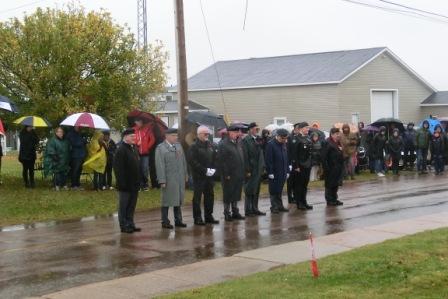
Members of the Borden-Carleton Legion and the public honour the memories of those who’ve served, despite the inclement weather, at the November 11, 2024 service in Borden-Carleton. (Photo credit: Daria Valkenburg)

Following the Remembrance Day Service, everyone was invited inside the Legion for a light lunch and a much needed cup of coffee or tea.

Thank you to the South Shore Villa for organizing the Remembrance Day Service, and to all of the Legion members who participated in the various Remembrance Week events. May we never forget all those who served, and continue to serve!

If you have a story to tell, please let Pieter know. You can email him at memorialtrail@gmail.com, or comment on the blog.  

© Daria Valkenburg

….Want to follow our research?….

If you are reading this posting, but aren’t following our research, you are welcome to do so.  Our blog address: https://onthewarmemorialtrail.com/

Front cover OnTheWarMememorialTrailinEurope4 countries, 6 weeks, 7,000 km – an unforgettable war memorial journey in Europe…. Daria’s book ‘No Soldier Buried Overseas Should Ever Be Forgotten‘ is available in print and e-book formats.  Net proceeds of book sales help support research costs and the cost of maintaining this blog. For more information see https://nosoldierforgotten.com/ 

You are also invited to subscribe to our YouTube Channel: On The War Memorial Trail With Pieter Valkenburg: https://www.youtube.com/channel/UCJ591TyjSheOR-Cb_Gs_5Kw

Never miss a posting!  Subscribe below to have each new story from the war memorial trail delivered to your inbox.
On The War Memorial Trail…. Remembrance Week 2024 – Reflections and Updates

1200x600-remembrance-day-1-1024x512

November 10, 2024.  When we write a story on the blog, we often receive additional information, sometimes about the soldiers we’ve written about, sometimes about other soldiers buried in the same cemetery or who served in the same unit. Occasionally we have a chance to meet families who’ve contributed photos and information on soldiers.  Each year we also try to visit a war memorial featuring a soldier. In this posting we feature a visit to the Sagkeeng War Memorial in Fort Alexander, Manitoba.

…Richard Reeves visited the grave of WWII soldier Everett Samuel Francis….

gravestone Everett Francis photo taken by Richard Reeves

Grave of Everett Samuel Francis in St. Matthew’s Presbyterian Cemetery in Grand Falls, Newfoundland.  (Photo credit: Richard Reeves)

One of the very first stories that Pieter researched of the names listed on the Cenotaph outside the Borden-Carleton Legion was that of WWII soldier Everett Samuel FRANCIS of Albany, Prince Edward Island.

On September 13, 1942, Everett was sent from Gander, Newfoundland, where his unit was based, to Long Branch, Ontario for a small arms training course.  He was on his way back to Gander aboard the railway ferry S.S. Caribou when it was torpedoed by German U-Boat 69 off the coast of Newfoundland on Wednesday, October 14, 1942.  101 survivors were rescued, but the captain, 30 crew, 57 service personnel, and 48 passengers were lost, including Everett. 

Everett and his wife, Janie Louise Mercer of Grand Falls, Newfoundland, were the parents of Greta, who had been born a few weeks earlier.  He was on his way home to meet his new-born daughter, who was to be christened in church on the Sunday after he was scheduled to return home, but never made it. He’s buried in St. Matthew’s Presbyterian Cemetery in Grand Falls, Newfoundland. 

In one of those interesting twists of fates, when Pieter was searching for a photo of Orville ‘Skip’ James REEVES, who was born in North Bay, Ontario, but was married to Mamie Thomas of Grand Falls, his nephew Richard Reeves not only provided a photo, but visited Everett’s grave on our behalf!  Watch for Skip’s story in a future posting.

You can read Everett’s story at:

….Nephew of WWII soldier Lt Arthur Affleck shared a memory of his last Sunday at church on Prince Edward Island…

Percy Affleck shared the following story about his uncle, Lt JamesArthur’ AFFLECK of Bedeque, Prince Edward Island:  “….The Affleck families of the Bedeque area were adherents of the United Church at Bedeque. (With a history dating back to the Methodist Church when part of the Affleck clan moved to Searletown from the Mt. Stewart area around 1858.)

According to Eldon Wright of Middleton, on his last Sunday at Church before shipping out for England, Arthur stood in full uniform on the church steps after the service and shook hands with everyone as they departed. At that era the Congregation would number in excess of 150 people and one can visualize the enthusiasm of the occasion, complete with good wishes. Arthur would have been fifth generation on the family tree dating to a marriage in Scotland in 1810…

Arthur was killed in action by artillery shells on September 17, 1944, during the first day of the Battle of Boulogne (Operation Wellhit), a 5 day battle to take the port of Boulogne from German control. He’s buried in the Calais Canadian War Cemetery in Leubringhen, France, 14 km from Calais.

You can read Arthur’s story at:

….Family of WWII Pilot Elmer Bagnall Muttart donated medals to the Borden-Carleton Legion…

20241022_185910 medals for Elmer Muttart at Borden-Carleton Legion

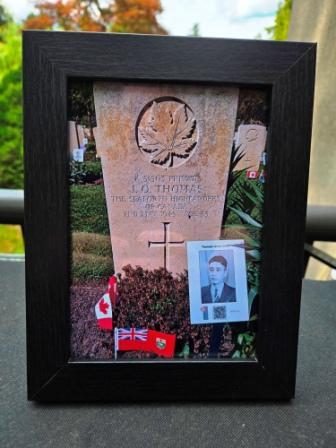
Shadow box with a photo of WWII Pilot Elmer Bagnall Muttart and his medals.  (Photo credit: Kathy Henry)

Don Coutts, nephew of WWII Pilot Elmer Bagnall MUTTART of Cape Traverse, Prince Edward Island wrote us, saying that his brother Peter  “has come across some of Elmer’s War Medals….” while going through their late mother’s boxes.  “…Do you think the Borden-Carleton Royal Canadian Legion would like them to display?…” 

The answer was yes, and a shadow box with a photo of Elmer and his medals is now on display on the Wall of Remembrance at the Borden-Carleton Legion.

Elmer was the pilot aboard Halifax L9561 when it was shot twice by German night fighters on October 12, 1941, while the plane was on its way to a bombing raid on Bremen, Germany.  After ordering the crew to bail out, Elmer managed to steer the burning plane away from the Dutch village of Wons, in the province of Friesland, before it crashed in a farmer’s field, just outside the village.  He was the only casualty and is buried in Harlingen General Cemetery in The Netherlands.

You can read Elmer’s story at:

….We visited the Sagkeeng War Memorial in Fort Alexander, Manitoba…

CIMG6783 May 9 2024 Pieter at Sagkeeng War Memorial re P Laforte

Pieter by the Sagkeeng War Memorial in Fort Alexander, Manitoba.  (Photo credit: Daria Valkenburg)

This past May we were in Winnipeg, and took a drive to the village of Fort Alexander on the Sagkeeng First Nation to visit the Sagkeeng War Memorial.  WWII Métis soldier Philip LAFORTE, who was born in Lac du Bonnet, Manitoba, is listed on this memorial.  

CIMG6785 May 9 2024 Sagkeeng War Memorial re P Laforte

WWII soldier Philip Laforte is listed on the Sagkeeng War Memorial in Fort Alexander, Manitoba.  (Photo credit: Daria Valkenburg)

While serving with the Royal Winnipeg Rifles, Philip lost his life on April 7, 1945 during the crossing of the Schipbeek Canal in The Netherlands.  He’s buried in the Canadian War Cemetery in Holten, The Netherlands.

You can read Philip’s story at:

…. A Remembrance Plaque for WWII soldier Gerald Reginald Kelly was placed outside his former home in Sarnia …

Within a few hours one day we received two emails, both with a Sarnia, Ontario connection.  First, Don Coutts let us know about a memorial project in Sarnia, where Remembrance Plaques of soldiers would be placed outside their former homes during Remembrance Week. 

Then, Patrick Michiels of Belgium wrote to let us know that his family had adopted the grave of Private Gerald Reginald KELLY, who was from Sarnia, and is buried in the Canadian War Cemetery in Adegem, Belgium.  

What were the odds that this was a coincidence?  Since our friend Sandra Wallis lives in Sarnia, an email immediately went out to her, asking if she could find out if Gerald was one of the soldiers who had a Remembrance Plaque. 

IMG_8744 Gerald Kelly remembrance plaque in front of his house from Sandra

Remembrance Plaque honouring Gerald Kelly outside his former home in Sarnia. (Photo credit: Sandra Wallis)

IMG_8743 Nov 4 2024 Kellys house in Sarnia from Sandra

Gerald Kelly’s former home in Sarnia. You can see the Remembrance Plaque on the right.  (Photo credit: Sandra Wallis)

Sandra got in contact with Tom Slater and Tom St. Amand, two retired teachers, who spearheaded the Remembrance Plaque project, and learned that a plaque had been made for Gerald. Once it was in place at his former residence, she took photos of the house and the plaque.  These photos were shared with Patrick, and the two retired teachers are now in contact with him.

Gerald was serving with the Algonquin Regiment when he lost his life on September 14, 1944 during the Battle of the Leopold Canal.  He was killed as he tried to re-cross the Leopold Canal while trying to rescue a wounded sergeant.

Here are two articles about Sarnia’s Remembrance Plaque project:

…. Meeting families of two airmen from Halifax DT630 …

CIMG6764 May 8 2024 May 8 2024 Jamie Don Craig Pieter Sue Daria at Courtyard Marriott Winnipeg

Left to right: Jamie Nelson-Dixon, Don Dixon, Craig MacKenzie, Pieter, Sue MacKenzie, Daria. (Photo courtesy of Valkenburg Family)

After we wrote the story about Jack ‘Douglas’ MACKENZIE, of Winnipeg, Manitoba, the pilot of Halifax DT630 that was shot down by a night fighter over the province of Drenthe in The Netherlands on February 3, 1943, we were contacted by Yannic Wethly of Stichting Luchtoorlog Onderzoek Drenthe (Air Research Drenthe Foundation) in The Netherlands. “….We are still searching for the pictures of Warrant Officer Second Class Raymond Hepton ‘Ray’ Hill and Sergeant Eric ‘Raymond’ Marquand, both crew members of Halifax DT630….” he wrote.

Four men died when the plane went down, including Douglas and Ray, and all are buried in Sleen General Cemetery in The Netherlands. 

We were successful in finding a photo of Raymond Hepton ‘Ray’ HILL, who was from Montreal, Quebec, but did not find any surviving family. Both Ray and his brother died during WWII, there were no other siblings, and neither man was married. 

Like Douglas MacKenzie, Eric ‘Raymond’ MARQUAND, the bomb aimer on that flight, was from Winnipeg.  He had survived the crash and spent the remaining war years in prisoner of war camps before being liberated.  We were very happy when his niece, Jamie Nelson-Dixon, got in contact and provided a photo. 

When we were in Winnipeg this past May, we asked if Jamie, and Doug MacKenzie’s nephew, Craig MacKenzie, would like to meet us and each other.  They did, and we spent a wonderful afternoon together with Jamie’s husband Don and Craig’s wife Sue.

Raymond’s story will be coming up in a future posting, but you can read Douglas’ story at:

Thank you to Percy Affleck, Don Coutts, Don Dixon, Craig and Sue MacKenzie, Jamie Nelson-Dixon, Patrick Michiels, Richard Reeves, Tom Slater, and Sandra Wallis.  The work of remembrance of those who served continues. 

If you have a story to tell, please let Pieter know. You can email him at memorialtrail@gmail.com, or comment on the blog.  

© Daria Valkenburg

….Want to follow our research?….

If you are reading this posting, but aren’t following our research, you are welcome to do so.  Our blog address: https://onthewarmemorialtrail.com/

Front cover OnTheWarMememorialTrailinEurope4 countries, 6 weeks, 7,000 km – an unforgettable war memorial journey in Europe…. Daria’s book ‘No Soldier Buried Overseas Should Ever Be Forgotten‘ is available in print and e-book formats.  Net proceeds of book sales help support research costs and the cost of maintaining this blog. For more information see https://nosoldierforgotten.com/ 

You are also invited to subscribe to our YouTube Channel: On The War Memorial Trail With Pieter Valkenburg: https://www.youtube.com/channel/UCJ591TyjSheOR-Cb_Gs_5Kw

Never miss a posting!  Subscribe below to have each new story from the war memorial trail delivered to your inbox.

On The War Memorial Trail…. Remembrance Week 2024 –Remembering Those Who Served In The RCAF During WWII

Remembrance_Day_2024_3840x2160

November 7, 2024.  As we reflect on the service and sacrifices made by so many who have served, both during conflicts and in peacetime, I took a look back at previous stories told over the years.  2024 commemorates 100 years of service for the Royal Canadian Air Force (RCAF) as a distinct military element, and so it seemed appropriate to dedicate this posting to stories previously told of those who served in the RCAF during WWII. 

…The Air Force Heritage Park in Summerside has a commemorative stone honouring Flight Officer Joe McIver….

IMG_20190807_101837076 Entrance to Air Force Heritage Park Summerside

Entrance to Air Force Heritage Park in Summerside. (Photo credit: Daria Valkenburg)

Several years ago we visited the Air Force Heritage Park in Summerside to look at the commemorative stone honouring Flight Officer Joseph ‘Joe’ Charles MCIVER of Kinkora, Prince Edward Island.  Joe was the navigator aboard B24 Liberator MkVIII EV895 on November 18, 1944, when it went down near the Arctic Circle while on anti-submarine patrol looking for a suspected U-boat off Gardskagi, Iceland.  There were no survivors.

You can read his story at:

IMG_20190807_101038750 McIver Commemorative Stone Summerside

Commemorative Stone at Air Force Heritage Park, Summerside, Prince Edward Island. (Photo credit: Pieter Valkenburg)

 … Pilot Elmer Muttart saved his crew and the Dutch village of Wons but sacrificed his own life to do so ….

The very first airman whose story was researched by Pieter was that of Elmer Bagnall MUTTART of Cape Traverse, Prince Edward Island, whose name is listed on the Cenotaph outside the Borden-Carleton Legion.  Elmer was the pilot aboard Halifax L9561 when it was shot twice by German night fighters on October 12, 1941, while the plane was on its way to a bombing raid on Bremen, Germany. 

After ordering the crew to bail out, Elmer managed to steer the burning plane away from the Dutch village of Wons, in the province of Friesland, before it crashed in a farmer’s field, just outside the village. He was the only casualty and is buried in Harlingen General Cemetery in The Netherlands.  The rest of the crew spent the war years in prisoner of war camps before being liberated. On October 12, 2019, a memorial panel was placed near the crash site in Wons to honour Elmer and his crew, an emotional journey for all of us who attended.

You can read his story here:

 … Pilot Hubert Hall was a prisoner of war after his plane was shot down in 1942 ….

John ‘Hubert’ HALL of Summerside, Prince Edward Island, was the pilot aboard Wellington Z1203, which crashed in The Netherlands near Mijdrecht on the night of March 28/29, 1942.  Hubert spent the remainder of the war years as a prisoner of war in POW camp Stalag Luft III, located in present-day Żagań, Poland, before returning home to Canada.

You can read his story at:

… Navigator Bunky FitzGerald is in an unmarked grave after Halifax W1175 crashed off the Dutch coast….

Rowan Charles ‘Bunky’ FITZGERALD, of Charlottetown, Prince Edward Island, was the navigator aboard Halifax W1175 of the 405th Vancouver Squadron RCAF when it was hit by shellfire (flak) as the plane was returning from Bremen, Germany on the morning of June 28, 1942. 

The plane crashed into a sandbank in the Wadden Sea, off the Dutch coast between the Island of Texel and the mainland, 15.5 km from Harlingen, in the province of Friesland.  There were no survivors. Only one crew member’s body was identified, and was buried in Harlingen General Cemetery in The Netherlands. His grave is between 3 unknown graves, one of which may just contain the remains of Bunky FitzGerald. 

You can read his story at:

… Pilot Lorne MacFarlane survived all his flights and returned home…

Pilot Lorne MACFARLANE, of Fernwood, Prince Edward Island, successfully flew 40 missions overseas and was then assigned to fly dignitaries, mail, and personnel between England and the front lines until the war ended.  After returning safely back to Canada, he was the Officer In Charge at RCAF No 1 Radio and Navigation School in Summerside, Prince Edward Island.

You can read his story at:

… Wireless operator Bob Dickie almost made it safely back to England…

Robert ‘Bob’ James DICKIE, of Carlton (now Borden-Carleton), Prince Edward Island, was the wireless operator aboard Lancaster JB312 on February 21, 1944 when it collided with another plane during a bombing sortie in Stuttgart, Germany.  Although badly damaged, the plane was able make it back to England, but then crashed as it approached the runway. There were no survivors. Bob is buried at Cambridge City Cemetery in England.

You can read his story at:

… Pilot Leonard Unwin’s plane crashed on Christmas Eve…

Pilot Leonard Arthur UNWIN, of Windsor, Ontario, was a flying instructor in Summerside, Prince Edward Island and Moncton, New Brunswick, before going overseas in May 1943.  On December 24, 1944, he left from his base in Belgium, one of the pilots in a section of 4 Typhoon planes on an armed reconnaissance in the Utrecht area in The Netherlands. While attacking a convoy of three German trucks in Woudenberg, the plane’s tailpiece broke off, the plane destabilized, and crashed. He’s buried in Woudenberg Municipal Cemetery in The Netherlands.

You can read his story at:

… Flight student Ralph McCutcheon lost his life in a training accident…

Flight student Ralph Gordon MCCUTCHEON, of Toronto, Ontario, but who was born in Buffalo, New York, USA, lost his life in a tragic accident that happened during his training at the No. 9 Service Flying Training School RCAF in Summerside, Prince Edward Island on the morning of June 11, 1942.  While training in a Harvard MK2 plane, it crashed in a farm field in North Tryon, Prince Edward Island.

You can read his story at:

… Gunner William Andrew Hood was aboard the last flight of Halifax JD215…

William Andrew HOOD, of Little Bras D’or, Cape Breton Island, Nova Scotia, was the mid-upper gunner aboard Halifax JD215 when it was shot down over The Netherlands on June 29, 1943.  None of the crew survived. He’s buried in Eindhoven General Cemetery in Eindhoven, The Netherlands.

You can read his story at:

… Navigator Arnold Hupman was aboard Lancaster X KB728 VR-V when it exploded over Arnhem, The Netherlands…

Navigator Arnold Freeman HUPMAN, of East Side of Ragged Island, Shelburne County, Nova Scotia, lost his life when the Lancaster bomber he was in, Lancaster X KB728 VR-V, was attacked by a German night fighter and exploded on the outskirts of Arnhem, The Netherlands as it was returning from a bombing operation against the synthetic oil plant at Sterkrade in Germany on the night of June 16 to 17, 1944. There were no survivors, and all 7 crew members are now buried in the Canadian War Cemetery in Groesbeek, The Netherlands.

You can read his story at:

… Pilot Douglas MacKenzie did not survive the last flight of Halifax DT630…

Jack ‘Douglas’ MACKENZIE,  of Winnipeg, Manitoba, was the pilot of Halifax DT630 (call sign VR-T), one of 8 heavy Halifax bombers sent on a night raid to Hamburg, Germany on February 3, 1943.  It was shot down by a night fighter over the province of Drenthe in The Netherlands. 4 men died, including Douglas, while 3 survived and spent the remainder of the war in prisoner of war camps.  He’s buried in Sleen General Cemetery in The Netherlands, along with the other 3 casualties of that flight.

You can read his story at:

… Pilot Dusty Millar’s spitfire ran out of fuel and crashed…

George Glenn ‘Dusty’ MILLAR, of Winnipeg, Manitoba, was killed on September 28, 1944 while flying a Spitfire Mark IX on patrol with his squadron over Nijmegen, The Netherlands. After Dusty reported on his radio that the plane was low in fuel, it crashed southeast of Weibosch near Schijndel, in the Dutch province of Noord-BrabantHe is buried in Uden War Cemetery in The Netherlands.

You can read his story at:

May we never forget the sacrifices made by these airmen, and their families, during WWII.  Unfortunately, while we live free in Canada, so many people today live in a war zone and are experiencing death, uncertainty, and insecurity in not knowing what will happen next.  Lest we forget is never more appropriate.

If you have a story to tell, please let Pieter know. You can email him at memorialtrail@gmail.com, comment on the blog, or send a tweet to @researchmemori1.  

© Daria Valkenburg

….Want to follow our research?….

If you are reading this posting, but aren’t following our research, you are welcome to do so.  Our blog address: https://onthewarmemorialtrail.com/

Front cover OnTheWarMememorialTrailinEurope4 countries, 6 weeks, 7,000 km – an unforgettable war memorial journey in Europe…. Daria’s book ‘No Soldier Buried Overseas Should Ever Be Forgotten‘ is available in print and e-book formats.  Net proceeds of book sales help support research costs and the cost of maintaining this blog. For more information see https://nosoldierforgotten.com/ 

You are also invited to subscribe to our YouTube Channel: On The War Memorial Trail With Pieter Valkenburg: https://www.youtube.com/channel/UCJ591TyjSheOR-Cb_Gs_5Kw

Never miss a posting!  Subscribe below to have each new story from the war memorial trail delivered to your inbox.

On The War Memorial Trail…..The WWII Soldier From Clyde River Who Lost His Life During The Attack On Hoogerheide

CIMG6927 Jul 31 2024 Cornwall Cenotaph Pieter by WWII & WW1 memorial

The Cenotaph site in Cornwall, Prince Edward Island. The WWI cenotaph is on the right, and the WWII cenotaph on the left. (Photo credit: Daria Valkenburg)

October 12, 2024. When Pieter was asked to give a presentation on September 22, 2024 at the 105th Annual Remembrance Service in Cornwall, Prince Edward Island, one of the names on the WWII Cenotaph was that of Private William Ernest STONE, who was serving with the Black Watch of Canada, when he was killed during a fierce battle in Hoogerheide, The Netherlands on October 10, 1944, at the age of 25.  (See https://onthewarmemorialtrail.com/2024/09/26/on-the-war-memorial-trail105th-annual-remembrance-service-at-cornwall-cenotaph/)

CIMG6928 Jul 31 2024 Cornwall Cenotaph WWII memorial

William Ernest Stone was one of 4 casualties listed on the WWII Cenotaph in Cornwall, Prince Edward Island.  (Photo credit: Daria Valkenburg).

William is buried in the Canadian War Cemetery in Bergen Op Zoom, The Netherlands, located near the Belgian border.  2024 is an important anniversary for this area as 80 years ago, in October 1944, Belgium and the southern part of The Netherlands were liberated, following tremendous casualties during the Battle of the Scheldt. (See https://en.wikipedia.org/wiki/Battle_of_the_Scheldt and https://www.thecanadianencyclopedia.ca/en/article/canada-and-the-battle-of-the-scheldt)

It seems only fitting that 80 years after his death, William’s story is told.  He was born August 19, 1919, in Clyde River, Prince Edward Island, the son of Edward Earnest and Sadie Stone.  

William had two brothers and two sisters.  With the help of Brenda Graves and Arlene Roberts, a photo was soon provided by Faye MacNutt, the daughter of William’s sister Ruth.

…..William enlisted under the NRMA in 1941….

William originally enlisted under the National Resources Mobilization Act (NRMA) in Charlottetown, Prince Edward Island on April 17, 1941 and underwent basic training at No. 62 Canadian Army Basic Training Centre (CABTC) in Charlottetown. (See https://en.wikipedia.org/wiki/National_Resources_Mobilization_Act)

At the time of his enlistment he had been working for two years as a stoker at Storms Construction Company Ltd in Charlottetown. Among his tasks he also worked at Charlottetown Airport for several months in 1940, tasked with running a cement mixer and doing odd jobs, when the airport was transferred to the Royal Canadian Air Force (RCAF) and the airport and runways were enlarged in preparation for using the airport to train pilots and aircrew. 

William also noted that he also had six years of farming experience from helping on his family’s farm.  He had an interest in mechanics, played tennis, volleyball, and baseball, and enjoyed singing. 

…..William received training in both Canada and the USA….

William Ernest Stone colourized

William Ernest Stone. (Photo courtesy of Faye MacNutt.  Photo colourization by Pieter Valkenburg)

On June 6, 1941, he transferred to active service at No. 62 CABTC in Charlottetown, and was immediately sent to No. 6 District Depot in Halifax, Nova Scotia for trades training in motor mechanics and welding at the Halifax Technical School.

After successfully completing the two month course in Halifax, William was attached to No. 14 Infantry Training Centre in Aldershot, Nova Scotia as of August 2, 1941.  A few days later, he was sent ‘on command’ to Automatic Course in Motor Mechanics at the Quartermaster Motor Transport School at Fort Holabird in Baltimore, Maryland, USA.  He successfully completed the course on October 15, 1941.

Next, he was sent to the Canadian Army Trade School (CATS) in Hamilton, Ontario for more training in motor mechanics.  His time there was from October 28, 1941 until June 6, 1942, when he was transferred to the A9 Canadian Armoured Corps (Advanced) Training Centre (CACATC) at Camp Borden in Ontario for wireless training.

William received a furlough from May 20 to June 2, 1942, during which time he returned to Prince Edward Island to marry Eileen Younker in Winsloe on May 27, 1942.  The couple only had a few days together before he had to return and continue his training.

On July 26, 1942, he was assigned to the 28th Armoured Regiment in Debert, Nova Scotia for final training before going overseas.  On August 4, 1942, William received embarkation leave until August 7, the last chance he had to see his family. 

….William left Canada for overseas service….

William left Canada with the 28th Armoured Regiment on August 22, 1942, arriving in the United Kingdom on September 1, 1942. He was sent for more training, and qualified as a Driver i/c Class III (Wheeled) on December 6, 1942.  (The term ‘Driver i/c’ refers to ‘Driver, internal combustion’.  Class III meant he was qualified to drive heavy trucks and armoured cars, but not tanks.)

On May 15, 1943 he was sent to 21 Canadian Armoured Regiment (CAR) for a few weeks and then on to receive training as a Driver Mechanic (Tank) Class ‘C’.  He successfully completed this training on December 3, 1943.

William was transferred to No. 3 Canadian Armoured Corps Reinforcement Unit (CACRU) on January 29, 1944.  Then, on July 25, 1944, he was transferred again, this time to No. 1 Canadian Armoured Corps Reinforcement Unit (CACRU), and re-mustered from the Canadian Armoured Corps (CAC) to the Royal Canadian Artillery (RCA).

On August 13, 1944 William was temporarily assigned to the Canadian Fusiliers (City of London Regiment) before being placed on the X-4 Canadian Infantry Corps Reinforcement List, part of the 10th Battalion, on September 21, 1944 and sent to France.

On September 28, 1944, William was transferred to the Black Watch (Royal Highland Regiment) of Canada, and joined them in Rijkevorsel, Belgium.  The war diary for that day noted that “….in the last two days, 42 reinforcements have joined us, 11 for general duty, the remainder being for the most part signallers and drivers...

The Regiment had surged through France and into Belgium, where William joined the Regiment.  From Belgium, the Regiment made its way into The Netherlands on October 7, 1944.  While the main goal was helping to clear the Scheldt Estuary, necessary to liberate the vital port of Antwerp, their first task was to attack the town of Hoogerheide.

….Attack On Hoogerheide….

Screenshot 2024-10-11 at 10-41-57 Google Maps

Map shows location of Calfven, Hoogerheide, and Ossendrecht in The Netherlands, just over the Belgian border. (Map source: Google maps)

The War Diary for October 7, 1944 noted that the Regiment had begun their journey into The Netherlands “…at 0930 hours and shortly thereafter crossed the frontier into Holland at the town of Putte…and went on to our area at a farm….In the afternoon we moved forward again into the Calfven area….

On October 8, 1944, as the troops moved up to the attack on Hoogerheide in the early morning, they found that the Start Line hadn’t been secured.  When the attack did begin, at 10:30 am, troops came under machine gun and mortar fire.

The War Diary entry for October 8, 1944 stated that “…very heavy fighting ensued and it was over two hours before the enemy decided that he had had enough….”  The respite didn’t last.

The following day, the War Diary recorded that “…during the night, mortaring and shelling continued on a heavy scale….It is apparent that there has been heavy reinforcement of this area, and that the enemy is determined to make a stand. The troops we are now meeting are definitely the cream of the crop.  They belong to paratroop battalions, with a sprinkling of glider troops and Luftwaffe personnel…..

The war diarist noted that the German troops were young and in good physical condition, …keen to fight and with excellent morale.  All day long there was heavy fire from artillery and mortar on our positions, and his snipers are very busy.  At 1600 hours the Germans opened an artillery barrage which lasted for two hours, then came in on a counter attack…

On October 10, 1944, the War Diary continued the account of the attack.  “…Weather – Misty and rain.  The heavy mortaring and shelling to which we have been subjected continues without respite”  The attack continued for the Black Watch until 3:00 pm, when they were relieved by the Royal Hamilton Light Infantry.

The Black Watch casualties for the Hoogerheide attack were counted, and totalled 81, with 12 fatalities.  Among those who were recorded as having died on October 10, 1944 was William Ernest Stone.

….William is buried in Bergen Op Zoom….

William was initially buried in the village cemetery in Ossendrecht, before being reburied in the Canadian War Cemetery in Bergen Op Zoom, The Netherlands.

William Ernest Stone from find a grave

Grave of William Ernest Stone in the Canadian War Cemetery in Bergen Op Zoom, The Netherlands.  (Photo courtesy of the Canadian Virtual War Memorial)

Later this month, the cemetery in Bergen Op Zoom is holding its 80th Anniversary of Liberation Commemorations.  Private William Ernest Stone will be one of the 968 Canadians buried there who will be remembered.

CIMG3382 Oct 7 2019 Bergen Op Zoom Pieter at Cdn War Cemetery

Pieter at the entrance to the Canadian War Cemetery in Bergen Op Zoom.  (Photo credit: Daria Valkenburg)

Thank you to Brenda Graves and Arlene Roberts for their help in finding a photo. Thank you to Faye MacNutt for submitting a photo of her uncle.

If you have photos or information to share, please email Pieter at memorialtrail@gmail.com, comment on the blog, or tweet to @researchmemori1.

© Daria Valkenburg

….Want to follow our research?….

If you are reading this posting, but aren’t following our research, you are welcome to do so.  Our blog address: https://onthewarmemorialtrail.com/

Front cover OnTheWarMememorialTrailinEurope4 countries, 6 weeks, 7,000 km – an unforgettable war memorial journey in Europe…. Daria’s book ‘No Soldier Buried Overseas Should Ever Be Forgotten‘ is available in print and e-book formats.  Net proceeds of book sales help support research costs and the cost of maintaining this blog. For more information see https://nosoldierforgotten.com/ 

You are also invited to subscribe to our YouTube Channel: On The War Memorial Trail With Pieter Valkenburg: https://www.youtube.com/channel/UCJ591TyjSheOR-Cb_Gs_5Kw

Never miss a posting!  Subscribe below to have each new story from the war memorial trail delivered to your inbox.
On The War Memorial Trail……105th Annual Remembrance Service At Cornwall Cenotaph

September 26, 2024. On Sunday, September 22, 2024, the 105th Annual Remembrance Service was held at the Cornwall Cenotaph in Cornwall, Prince Edward Island.  Pieter was invited by fellow Legion member John Yeo to be the keynote speaker at this event. 

John asked that excerpts from Pieter’s presentation in July for the 75th Anniversary of NATO be included in the presentation. (See https://onthewarmemorialtrail.com/2024/07/15/on-the-war-memorial-trail75th-nato-anniversary-commemoration-at-seacow-head-lighthouse/)

….There were two Cenotaphs – 1 for WWI and 1 for WWII….

After Pieter agreed to give a presentation, we visited Cornwall and saw that there were actually two Cenotaphs – one listing casualties from WWI and the other listing casualties from WWII.

A preliminary visit to the Cenotaph site in Cornwall. The WWI cenotaph is on the right, and the WWII cenotaph on the left. (Photo credit: Daria Valkenburg)

The WWII Cenotaph listed 4 names, with one of the men killed in The Netherlands.  In preparation for the presentation, a decision was made to briefly mention these 4 men. 

There were 4 casualties listed on the WWII Cenotaph in Cornwall.  (Photo credit: Daria Valkenburg)

 ….Pieter explained why he researches Canadian soldiers….

The PEI Regimental Band led a march past the Cenotaph just prior to the start of the ceremony.  (Photo credit: Daria Valkenburg)

Sunday, September 22, 2024 saw many citizens, veterans, and dignitaries arrive in Cornwall.  The PEI Regimental Band led the march past the Cenotaph just prior to the start of the ceremony.  Following the laying of the wreaths, Pieter was introduced as the keynote speaker.

He began by thanking the organizers for the invitation to speak “…as we gather around these two Cenotaphs commemorating those who died in WWI and WWII, on this, the 105th annual service ….” 

Pieter then briefly explained the motivation for researching Canadian soldiers.  “…If it wasn’t for the Allied soldiers fighting against tyranny in WWII, I might not be here. I was born in The Netherlands during the Hunger Year of 1944, when there was little or no food.  Our family lived in the countryside and my father spent many nights, sneaking out after curfew, looking to trade items for food to feed his family.  He wasn’t alone.  Anyone caught with food by the Nazis had it confiscated. 

So many people starved to death that winter! Allied soldiers – in particular the Canadians in our area of The Netherlands – not only liberated us from Nazi rule, they saved us from starvation.

In gratitude, now that I’m retired, one way for me to honour those who lost their lives in war is to research and share the stories of Canadians who served and died in the First and Second World Wars, helping to ensure that they will never be forgotten…

…. 2024 was a year of important anniversaries ….

Pieter at the podium in Cornwall, with the WWII Cenotaph on the left, and the WWI Cenotaph on the right. (Photo credit: Daria Valkenburg)

Pieter reflected that 2024 was a year of important anniversaries, and referenced the 80th anniversary of D-Day and the 75th anniversary of NATO.  He then explained that “…80 years ago, in October 1944, Belgium and the southern part of The Netherlands were liberated, following tremendous casualties during the Battle of the Scheldt. 

One of the names on this Cenotaph, that of Private William Ernest STONE, was serving with the Black Watch of Canada, when he was killed during a fierce battle in Hoogerheide on October 10, 1944, at the age of 25.  He’s buried in the Canadian War Cemetery in Bergen Op Zoom, which is near the Belgian border. 

The cemetery in Bergen Op Zoom is holding its 80th anniversary of liberation commemorations next month, and Private Stone will be one of the 968 Canadians buried there who will be remembered….

…. The other 3 names on the WWII Cenotaph were mentioned….

As was decided back in July when we first visited the Cenotaph location in Cornwall, Pieter briefly mentioned the other three names on the WWII Cenotaph.

…Gunner John White BELL was serving with the Royal Canadian Artillery when he died on October 3, 1944 in Italy, at the age of 21. He’s buried in Ravenna War Cemetery in Italy.

RCAF Flight Sergeant Ronald Harris BUTLER died over Germany on October 22, 1943, at the age of 24. He was the bomb aimer aboard Lancaster ED366, which was on its way to bomb a target in Kassel, Germany when it was damaged by flak and finished off by a night fighter over Obermeiser, Germany. He’s buried in Hannover War Cemetery in Germany. Out of 7 crew members, only the pilot managed to bail out safely and survived. 

RCAF Flight Sergeant Terris Haggie MILLER died on the night of August 28, 1942, at the age of 23.  He was the wireless operator aboard Halifax W7809 which was shot down over Belgium by a German night fighter, and crashed southeast of Brussels, at Overijse-Tombeek.  The bomber was on its way to a bombing mission in Nürnberg in Germany, but never made it. All 7 crew members lost their lives and are buried near the crash site in the Overijse-Tombeek Churchyard.….” 

…. An appeal for photos ….

Pieter at the podium in Cornwall.  (Photo courtesy of Heath MacDonald)

Pieter had been invited to give a presentation because of his research, and he wasn’t going to let an opportunity go by without reminding those present of the need to preserve the past.  “…Volunteers like me work diligently to find photos of the Allied casualties in the many cemeteries in which they are buried. This is my 10th year of research.  There are over 7,600 Canadians who lost their lives during WWII that are buried in The Netherlands.

While many photos have been found, there is still much research to do. It gets harder as each year passes, with so many photos, letters, and other mementos of those who served and didn’t return home get lost to the dustbin of history….” 

…. ‘They’re not just names on a Cenotaph’ ….

The presentation ended with Pieter saying that “…those who sacrificed their lives in war are not just names on a Cenotaph or buried in a war grave.  They were children, siblings, spouses, parents, friends… Each one has a story that can be told and they should not be forgotten.

Let us always remember the memories and sacrifices made by those who did their best to answer the call to fight for freedom.  Thank you….

As Pieter left the podium and returned to where he had been seated, he was both humbled and surprised as the audience gave him a standing ovation. Afterwards, many people came up to him and told him how his speech had touched them. 

Thank you to John Yeo and the organizers of the Annual Remembrance Service at Cornwall Cenotaph for inviting Pieter to speak. 

Do you have photos or information to share? Email Pieter at memorialtrail@gmail.com, comment on the blog, or tweet to @researchmemori1.

© Daria Valkenburg

….Want to follow our research?….

If you are reading this posting, but aren’t following our research, you are welcome to do so.  Our blog address: https://onthewarmemorialtrail.com/

4 countries, 6 weeks, 7,000 km – an unforgettable war memorial journey in Europe…. Daria’s book ‘No Soldier Buried Overseas Should Ever Be Forgotten‘ is available in print and e-book formats.  Net proceeds of book sales help support research costs and the cost of maintaining this blog. For more information see https://nosoldierforgotten.com/ 

You are also invited to subscribe to our YouTube Channel: On The War Memorial Trail With Pieter Valkenburg: https://www.youtube.com/channel/UCJ591TyjSheOR-Cb_Gs_5Kw

Never miss a posting!  Subscribe below to have each new story from the war memorial trail delivered to your inbox.