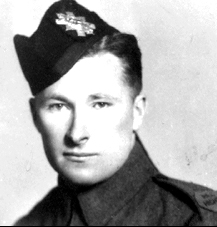
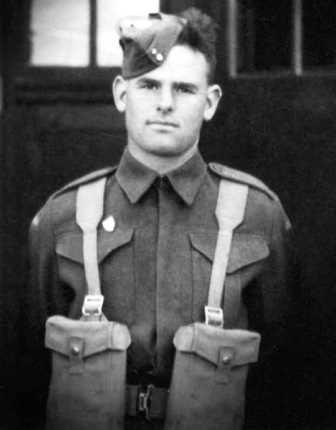
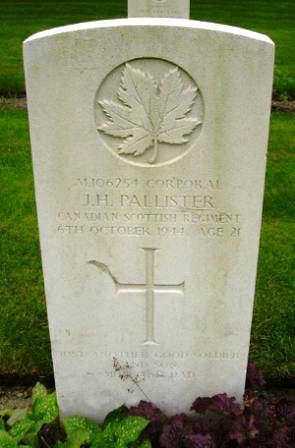
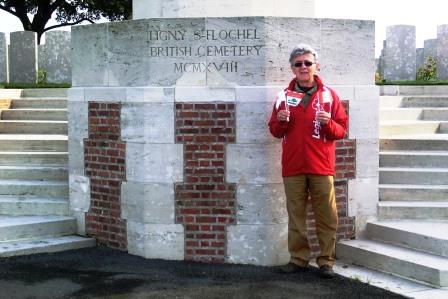
On The War Memorial Trail….The Faces Of Groesbeek Exhibition Part 3: Atlantic Canada Remembers Soldiers From Nova Scotia

CIMG9024 Sep 16 2017 Groesbeek Cemetery Pieter and Daria by A Gaudet grave

Pieter and Daria at the Canadian War Cemetery in Groesbeek, The Netherlands in 2017. (Photo credit: Ad Scheepers)

May 20, 2023.  In 2021, to commemorate the Anniversary of the Liberation of The Netherlands, photos were placed at more than 1,600 graves at the Canadian War Cemetery in Groesbeek for three weeks.  The event was so successful that the Commonwealth War Graves Commission, which oversees the cemetery, gave permission for photos to be placed by the graves every two years.

…The Faces Of Groesbeek Exhibition 2023 includes almost 2,000 photos…

This year, The Faces Of Groesbeek Exhibition runs from April 30 to May 21, 2023, with almost 2,000 photos, just over 350 more than 2 years ago!  Photos are printed onto an aluminum backing, making them impervious to rain, and reusable.

The many volunteers from Faces To Graves Foundation Groesbeek, of which Alice van Bekkum is the Chair, worked tirelessly to make this exhibition possible.  They also organized the Liberation Day commemoration events.

Pieter has been involved in finding photos of Canadians who are buried in all three Canadian War Cemeteries in The Netherlands since 2014, with many of their stories told on this blog.

In 2021, following an interview on CTV Atlantic’s Live At 5 about the search for photos of WW2 soldiers buried in The Netherlands, the response led to an 11 part series on the blog called Atlantic Canada Remembers.  (See https://atlantic.ctvnews.ca/dutch-canadian-man-on-a-mission-to-tell-stories-of-lost-soldiers-1.5266404)

…8 Soldiers From Nova Scotia Commemorated…

In Part 1, graves and photos of soldiers from Prince Edward Island were featured.  Part 2 featured Indigenous soldiers.  Now, in Part 3, eight soldiers from Nova Scotia, whose stories were told in the Atlantic Canada Remembers series from 2021, are featured.

COOLEN Gerald Burnell - X E 13 from Alice

Gerald Burnell Coolen. (Photo courtesy of Faces To Graves Groesbeek)

Gerald Burnell COOLEN, of Western Head, Nova Scotia, was serving with the Black Watch (Royal Highland Regiment) of Canada when he was killed in Germany during the Battle of the Hochwald Gap on February 27, 1945, at the age of 21. You can read his story at https://onthewarmemorialtrail.com/2021/11/28/on-the-war-memorial-trail-atlantic-canada-remembers-part-11/

CROMWELL Percy Clayton - XVI E 12 from Alice

Percy Clayton Cromwell. (Photo courtesy of Faces To Graves Groesbeek)

Percy Clayton CROMWELL, of Yarmouth, Nova Scotia, was serving with the Royal Canadian Electrical and Mechanical Engineers when he drowned in The Netherlands on February 8, 1945, 4 days before his 32nd birthday. You can read his story at https://onthewarmemorialtrail.com/2021/02/22/on-the-war-memorial-trail-atlantic-canada-remembers-part-7/

DOUCETTE Harry William - XVII H 03 from Alice

Harry William Doucette. (Photo courtesy of Faces To Graves Groesbeek)

Harry William DOUCETTE, of Yarmouth, Nova Scotia, was serving with the North Nova Scotia Highlanders when he was killed on March 25, 1945, during the Battle of Bienen in Germany, at the age of 19. You can read his story at https://onthewarmemorialtrail.com/2021/02/09/on-the-war-memorial-trail-atlantic-canada-remembers-part-6/

SONY DSC

Arnold Freeman Hupman. (Photo courtesy of Faces To Graves Groesbeek)

Arnold Freeman HUPMAN, of East Side of Ragged Island, Nova Scotia, was serving with the Royal Canadian Air Force, 419 Squadron.  He lost his life, at the age of 30, when the Lancaster bomber he was in crashed on the outskirts of Arnhem on the night of June 16 to 17, 1944, after being shot down by a German nightfighter. You can read his story at https://onthewarmemorialtrail.com/2021/02/09/on-the-war-memorial-trail-atlantic-canada-remembers-part-6/

IMG_8956 Robert Nickerson from Alice

Robert Alan Nickerson. (Photo courtesy of Alice van Bekkum)

Robert Alan NICKERSON, of Halifax, Nova Scotia, was serving with the 1st Canadian Parachute Battalion when he was killed on March 24, 1945 on his first jump from a plane over the Rhineland Forest in Germany, at the age of 23. You can read his story at https://onthewarmemorialtrail.com/2021/01/13/on-the-war-memorial-trail-atlantic-canada-remembers-part-2/

PORTER Burgess Allison - X F 10 from Alice

Burgess Allison Porter. (Photo courtesy of Faces To Graves Groesbeek)

Burgess Allison PORTER, of Grafton, Nova Scotia, was serving with the 4th Field Regiment of the Royal Canadian Artillery when he was killed on February 21, 1945 in Germany, at the age of 22. You can read his story at https://onthewarmemorialtrail.com/2021/03/16/on-the-war-memorial-trail-atlantic-canada-remembers-part-8/

SPRAY Stanley - I A 12 from Alice

Stanley Spray. (Photo courtesy of Faces To Graves Groesbeek)

Stanley SPRAY, of Digby, Nova Scotia, was serving with the Royal Canadian Artillery when he lost his life in a tragic vehicle accident near Nijmegen, The Netherlands on July 23, 1945, at the age of 32. You can read his story at https://onthewarmemorialtrail.com/2021/02/22/on-the-war-memorial-trail-atlantic-canada-remembers-part-7/

WITHERALL Benjamin James - II D 01 from Alice

Benjamin James Witherall. (Photo courtesy of Faces To Graves Groesbeek)

Benjamin James WITHERALL, of North Sydney, Nova Scotia, was serving with the Highland Light Infantry of Canada when he killed on the front line on a ridge between Nijmegen and Arnhem on December 27, 1944, at the age of 20. You can read his story at https://onthewarmemorialtrail.com/2021/01/07/on-the-war-memorial-trail-atlantic-canada-remembers-part-1/

Thank you to Alice van Bekkum and Ad Scheepers for sending these photos. In Part 4, the graves and photos of soldiers from New Brunswick whose families contacted us for the Atlantic Canada Remember series in 2021 will be featured.

If you have a photo of a soldier buried at the Canadian War Cemetery in Groesbeek or one of the other cemeteries in The Netherlands, Pieter encourages you to email him at memorialtrail@gmail.com, comment on the blog, or tweet to @researchmemori1.

© Daria Valkenburg

…Previous postings about The Faces Of Groesbeek Exhibition at the Canadian War Cemetery in Groesbeek…

…Want to follow our research?…

Follow our blog

If you are reading this posting, but aren’t following the blog, you are welcome to do so. Our blog address: https://onthewarmemorialtrail.com/.

Front cover OnTheWarMememorialTrailinEurope4 countries, 6 weeks, 7,000 km – an unforgettable war memorial journey in Europe…. Daria’s book ‘No Soldier Buried Overseas Should Ever Be Forgotten‘ is available in print and e-book formats.  Net proceeds of book sales help support research costs and the cost of maintaining this blog. For more information see https://nosoldierforgotten.com/

You are also invited to subscribe to our YouTube Channel: On The War Memorial Trail With Pieter Valkenburg: https://www.youtube.com/channel/UCJ591TyjSheOR-Cb_Gs_5Kw.

Never miss a posting!  Subscribe below to have each new story from the war memorial trail delivered to your inbox.

On The War Memorial Trail….The Faces Of Groesbeek Exhibition Part 2: Indigenous Soldiers

CIMG9023 Sep 16 2017 Groesbeek Cemetery Ad & Noor Scheepers with Pieter by Gaudets grave

Ad and Noor Scheepers with Pieter at the Canadian War Cemetery in Groesbeek, The Netherlands in 2017. (Photo credit: Daria Valkenburg)

May 18, 2023. In 2021, to commemorate the Anniversary of the Liberation of The Netherlands, photos were placed at more than 1,600 graves at the Canadian War Cemetery in Groesbeek for three weeks.  The event was so successful that the Commonwealth War Graves Commission, which oversees the cemetery, gave permission for photos to be placed by the graves every two years. 

…The Faces Of Groesbeek Exhibition 2023 includes almost 2,000 photos…

This year, The Faces Of Groesbeek Exhibition runs from April 30 to May 21, 2023, with almost 2,000 photos, just over 350 more than 2 years ago!  Photos are printed onto an aluminum backing, making them impervious to rain, and reusable.

The many volunteers from Faces To Graves Foundation Groesbeek, of which Alice van Bekkum is the Chair, worked tirelessly to make this exhibition possible.  They also organized the Liberation Day commemoration events. 

Pieter has been involved in finding photos of Canadians who are buried in all three Canadian War Cemeteries in The Netherlands since 2014, with many of their stories told on this blog. 

IMG_7618 May 6 2023 Cross of Remembrance at Groesbeek from Ad

The Cross of Remembrance at the Canadian War Cemetery in Groesbeek. (Photo courtesy of Ad Scheepers)

…4 Indigenous Soldiers Commemorated…

In Part 1, graves and photos of soldiers from Prince Edward Island were featured. In this posting, the graves and photos of four Indigenous soldiers are featured. 

IMG_7611 Tom Chaske from Ad

Tom Chaske. (Photo courtesy of Ad Scheepers)

Tom CHASKE of the Long Plain First Nation in Manitoba served with the Royal Winnipeg Rifles.  On December 12, 1944, he was part of a crew of soldiers being transported to repair a road in The Netherlands.  Unfortunately, the vehicle they were in slipped off a dike and flipped over into a flooded field, pinning them under the vehicle. Tom and six other soldiers drowned that day.  He was 24 years old.

Tom’s name was on the cemetery’s photo wish list, so when Pieter was interviewed by Kevin Rollason of the Winnipeg Free Press, about his research in finding photos of soldiers from Manitoba who are buried in The Netherlands, Tom was one of the 12 names mentioned.  The article, ‘A name without a face’, ran online on November 4, 2022 and in the print edition on November 5, 2022You can read the article at https://www.winnipegfreepress.com/local/2022/11/04/a-name-without-a-face .

Up to now, a newspaper image from Tom’s obituary in the Winnipeg Free Press is all that has been received. 

IMG_8975 Maxwell King from Alice

Maxwell Warren King. (Photo courtesy of Alice van Bekkum)

Maxwell Warren KING, of Christian Island, Ontario, was serving with the Irish Regiment of Canada when he was killed in The Netherlands on April 16, 1945, at the age of 24. Maxwell was a member of what is now the Wasauksing First Nation (formerly Parry Island First Nation). His story will be told in a future blog posting.

IMG_8928 Jack Maracle from Alice

John ‘Jack’ Richard Maracle. (Photo courtesy of Alice van Bekkum)

John ‘Jack’ Richard MARACLE of Midland, Ontario, had deep Mohawk roots on his paternal side.  His paternal grandfather was born on the Tyendinaga Reserve in Ontario, and his paternal grandmother on the Six Nations of the Grand River Reserve, also in Ontario. 

Jack was serving with the 6th Canadian Armoured Regiment when he was hit in the abdomen by a bullet from machine gun fire on March 5, 1945, during Operation Blockbuster in Germany, and died on March 12, 1945, at the age of 20. You can read his story at https://onthewarmemorialtrail.com/2022/07/17/on-the-war-memorial-trail-remembering-ww2-soldier-john-jack-richard-maracle/

IMG_7616 George Taylor from Ad

George Taylor. (Photo courtesy of Ad Scheepers)

George TAYLOR of the Curve Lake First Nations Reserve near Peterborough, Ontario, was serving with the Royal Canadian Artillery, 2 Medium Regiment when he accidentally died, aged 25, on June 17, 1945, due to asphyxia (see https://en.wikipedia.org/wiki/Asphyxia) in The Netherlands, while asleep in his army tent. His story will be told in an upcoming blog posting.

Thank you to Alice van Bekkum and Ad and Noor Scheepers for their kindness in taking these photos. Ad spoke for all of us when he sent his photos: “May the pictures give comfort to the families….

In Part 3, the graves and photos of soldiers from Nova Scotia whose families contacted us for the Atlantic Canada Remembers series in 2021 will be featured.

If you have a photo of a soldier buried at the Canadian War Cemetery in Groesbeek or one of the other cemeteries in The Netherlands, Pieter encourages you to email him at memorialtrail@gmail.com, comment on the blog, or tweet to @researchmemori1

© Daria Valkenburg

…Previous postings about The Faces Of Groesbeek Exhibition at the Canadian War Cemetery in Groesbeek…

…Want to follow our research?…

Follow our blog

If you are reading this posting, but aren’t following the blog, you are welcome to do so. Our blog address: https://onthewarmemorialtrail.com/.

Front cover OnTheWarMememorialTrailinEurope4 countries, 6 weeks, 7,000 km – an unforgettable war memorial journey in Europe…. Daria’s book ‘No Soldier Buried Overseas Should Ever Be Forgotten‘ is available in print and e-book formats.  Net proceeds of book sales help support research costs and the cost of maintaining this blog. For more information see https://nosoldierforgotten.com/

You are also invited to subscribe to our YouTube Channel: On The War Memorial Trail With Pieter Valkenburg: https://www.youtube.com/channel/UCJ591TyjSheOR-Cb_Gs_5Kw

Never miss a posting!  Subscribe below to have each new story from the war memorial trail delivered to your inbox.

On The War Memorial Trail…. The Faces Of Groesbeek Exhibition Part 1: The Soldiers From Prince Edward Island

CIMG6201 Apr 27 2023 Dutch flag by garage

The Dutch flag flew proudly at the Valkenburg household on Liberation Day.   (Photo credit: Pieter Valkenburg)

May 16, 2023.  One of the events planned for the 75th Anniversary of the Liberation of The Netherlands in May 2020 was to place photos by the graves of soldiers at the Canadian War Cemetery in Groesbeek, The Netherlands.  Unfortunately, due to social distancing measures from Covid, this was postponed for a year.

In 2021, photos were placed at more than 1,600 graves for three weeks.  The event was so successful that the Commonwealth War Graves Commission, which oversees the cemetery, gave permission for photos to be placed by the graves every two years.

…The Faces Of Groesbeek Exhibition 2023 includes almost 2,000 photos…

This year, The Faces Of Groesbeek Exhibition runs from April 30 to May 21, 2023, with almost 2,000 photos, just over 350 more than 2 years ago!  Photos are printed onto an aluminum backing, making them impervious to rain, and reusable.

CIMG8927 Sep 15 2017 Entrance to Groesbeek cemetery

View as you enter the Canadian War Cemetery in Groesbeek – before the photo exhibition.  (Photo credit: Daria Valkenburg)

Volunteers from Faces To Graves Foundation Groesbeek, of which Alice van Bekkum is the Chair, worked tirelessly to make this exhibition possible, and to organize the Liberation Day commemoration events.

Pieter has been involved in finding photos of Canadians who are buried in all three Canadian War Cemeteries in The Netherlands since 2014, with many of their stories told on this blog.

…5 Islanders Commemorated…

In this posting, the graves and photos of five soldiers from Prince Edward Island, whose stories have previously been told, are featured.

BOULTER Ralph Schurman - XIX C 01(1)

Ralph Schurman Boulter. (Photo courtesy of Faces To Graves Groesbeek)

Ralph Schurman BOULTER of O’Leary was serving with the North Nova Scotia Highlanders when he was killed on March 25, 1945, during the Battle of Bienen in Germany, at the age of 27. You can read his story at https://onthewarmemorialtrail.com/2023/03/07/on-the-war-memorial-trail-the-battle-of-bienen-part-2-the-wwii-battle-drill-instructor-from-oleary/

IMG_8925 George Ivan MacKinnon

Grave of George ‘Ivan’ MacKinnon.  (Photo courtesy of Ad Scheepers)

George ‘Ivan’ MACKINNON of Albion was serving with the North Nova Scotia Highlanders when he was killed on December 4, 1944, during the defence of the Nijmegen Salient in The Netherlands, at the age of 27. You can read his story at https://onthewarmemorialtrail.com/2022/11/02/on-the-war-memorial-trail-the-wwii-soldier-from-albion-who-died-during-the-defence-of-the-nijmegen-salient/

IMG_8941 Barney McGuigan

Grave of Bernard ‘Barney’ Reuben McGuigan.  (Photo courtesy of Alice van Bekkum)

Bernard ‘Barney’ Reuben MCGUIGAN of Sturgeon was serving with the North Shore (New Brunswick) Regiment when he was killed on February 26, 1945, during Operation Blockbuster in Germany, at the age of 16. You can read his story at https://onthewarmemorialtrail.com/2020/08/07/on-the-war-memorial-trail-the-search-for-barney-reuben-mcguigan/ and https://onthewarmemorialtrail.com/2021/12/23/on-the-war-memorial-trail-the-photo-search-for-barney-mcguigan-is-successful/

IMG_8935 John Clifford Rogers

Grave of John ‘Clifford’ Rogers. (Photo courtesy of Alice van Bekkum)

John ‘Clifford’ ROGERS of Hope River was a sapper with the North Shore (New Brunswick) Regiment when he and six other soldiers died on March 3, 1945 in the Balburger Wald, Germany.  He was 19 years old.  You can read his story at https://onthewarmemorialtrail.com/2021/08/24/on-the-war-memorial-trail-the-search-for-a-photo-of-john-clifford-rogers-is-successful/

SMITH Edison Alexander - V H 13

Edison Alexander Smith. (Photo courtesy of Faces To Graves Groesbeek)

Edison Alexander SMITH of West Point was serving with the North Nova Scotia Highlanders when he was killed on March 25, 1945, during the Battle of Bienen in Germany, at the age of 32. You can read his story at https://onthewarmemorialtrail.com/2023/03/04/on-the-war-memorial-trail-the-battle-of-bienen-part-1-the-wwii-soldier-whose-body-shielded-a-wounded-major/

…The search for photos continues…

What is striking is how many photos have been found! Out of 2,619 graves in the cemetery, 2,338 are Canadian, with 103 in graves marked ‘unknown’.  Wouldn’t it be wonderful if photos for all of the known graves of Canadians buried in Groesbeek will be found for The Faces Of Groesbeek Exhibition in 2025?

Thank you to Alice van Bekkum and Ad and Noor Scheepers for taking these photos. The Dutch continue to stress the importance of remembrance to the next generation so they can continue to remember those who lost their lives in WWII.

In Part 2, the graves and photos of Indigenous soldiers whose families contacted us will be featured.

If you have a photo of a soldier buried at the Canadian War Cemetery in Groesbeek or one of the other cemeteries in The Netherlands, Pieter encourages you to email him at memorialtrail@gmail.com, comment on the blog, or tweet to @researchmemori1.

© Daria Valkenburg

…Previous postings about The Faces Of Groesbeek Exhibition at the Canadian War Cemetery in Groesbeek…

…Want to follow our research?…

Follow our blog

If you are reading this posting, but aren’t following the blog, you are welcome to do so. Our blog address: https://onthewarmemorialtrail.com/.

Front cover OnTheWarMememorialTrailinEurope4 countries, 6 weeks, 7,000 km – an unforgettable war memorial journey in Europe…. Daria’s book ‘No Soldier Buried Overseas Should Ever Be Forgotten‘ is available in print and e-book formats.  Net proceeds of book sales help support research costs and the cost of maintaining this blog. For more information see https://nosoldierforgotten.com/

You are also invited to subscribe to our YouTube Channel: On The War Memorial Trail With Pieter Valkenburg: https://www.youtube.com/channel/UCJ591TyjSheOR-Cb_Gs_5Kw.

Never miss a posting!  Subscribe below to have each new story from the war memorial trail delivered to your inbox.

We Receive A 2023 PEI Heritage Recognition Award

May 15, 2023.  In February 2023, we received a letter saying that the Board of Governors of the Prince Edward Island Museum and Heritage Foundation had selected us – Pieter and Daria Valkenburg – for a Heritage Recognition Award for our ‘powerful’ research project ‘On The War Memorial Trail’ .   (See https://www.peimuseum.ca/pieter-and-daria-valkenburg-heritage-recognition-award)

The Awards Ceremony was held on March 12, 2023 at Beaconsfield Carriage House in Charlottetown, with Lt Governor of PEI Antoinette Perry presenting the awards.

…The Awards Ceremony was attended by members of the Tryon & Area Historical Association….

Unfortunately, we were unable to attend the ceremony.  Accepting the Award on our behalf were Arlene and Jack Sorensen (Chair) of the Tryon & Area Historical Society Inc., accompanied by Fran (Secretary) and Tom Albrecht also of Tryon.

Dr Matthew McRae, Executive Director of the PEI Museum and Heritage Foundation was the Master of Ceremonies.

IMG_7914 Mar 12 2023 PEI Heritage Awards

Dr Matthew McRae announcing our award. (Photo credit: Fran Albrecht)

Slide18

Image Courtesy of the PEI Museum and Heritage Foundation

Slide19

Image Courtesy of the PEI Museum and Heritage Foundation

IMG_7919 Mar 12 2023 PEI Heritage Awards

Jack and Arlene Sorensen accepted the award on our behalf, presented by PEI Lt Governor Antoinette Perry.  (Photo credit: Fran Albrecht)

…We thanked the PEI Museum and Heritage Foundation for the Heritage Recognition Award….

While we weren’t able to attend the ceremony, we thanked the PEI Museum and Heritage Foundation and provided the following statement….

…We thank the PEI Museum and Heritage Foundation for the Heritage Recognition Award.  We feel it honours each person whose story we have told in the ‘On The War Memorial Trail’ research project. 

Pieter began this research as his thanks to Canadian soldiers. He was born in The Netherlands during WWII, and has always said that ‘Allied soldiers not only liberated my birth country from a brutal occupation, but saved the Dutch people from starvation’.  Over 7,600 Canadian soldiers and airmen are buried in The Netherlands alone, a vivid reminder of the sacrifices made by so many. 

Over the years, as we’ve visited war cemeteries in other countries, and told the stories of many WWI and WWII service personnel, we are continually humbled by those who came before us….

Thank you to Jack and Arlene Sorensen for accepting the Heritage Recognition Award on our behalf, and to Fran Albrecht for taking the photos during the ceremony.

A huge thank you to those who nominated and supported us for this award, and to the PEI Museum and Heritage Foundation for their championship of the history and heritage of Prince Edward Island.

We will continue to research and tell the stories of those who served.  If you have a story to tell, please let Pieter know. Email him at memorialtrail@gmail.com, comment on the blog, or tweet to @researchmemori1.

© Daria Valkenburg

…Want to follow our research?….

Follow our blog

If you are reading this posting, but aren’t following the blog, you are welcome to do so. Our blog address: https://onthewarmemorialtrail.com/
Front cover OnTheWarMememorialTrailinEurope4 countries, 6 weeks, 7,000 km – an unforgettable war memorial journey in Europe…. Daria’s book ‘No Soldier Buried Overseas Should Ever Be Forgotten‘ is available in print and e-book formats.  Net proceeds of book sales help support research costs and the cost of maintaining this blog. For more information see https://nosoldierforgotten.com/

You are also invited to subscribe to our YouTube Channel: On The War Memorial Trail With Pieter Valkenburg: https://www.youtube.com/channel/UCJ591TyjSheOR-Cb_Gs_5Kw.

Never miss a posting!  Subscribe below to have each new story from the war memorial trail delivered to your inbox.

On The War Memorial Trail….. The Battle of Bienen – Part 12: The WWII Soldier From Little Dover Who Lost His Life In Germany

May 14, 2023. On a list of 39 soldiers from the North Nova Scotia Highlanders Regiment who were killed during the Battle of Bienen in Germany on March 25, 1945 and are buried in the Canadian War Cemetery in Groesbeek, The Netherlands, photos were missing for several names. 

As has been mentioned in previous postings in the Battle of Bienen series, the date of the battle was significant to Pieter as he was “…exactly one year old when this battle occurred….

…The search for a photo of Austin Havelock Munroe….

Within a few months of beginning the search for photos, family members were found for all except one – Austin Havelock MUNROE, who was born on December 2, 1919 in Little Dover, Nova Scotia, the son of Edward and Minnie (nee Murphy) Munroe. 

Austin’s parents had died when he was a child, and while he had a brother and two sisters, and had been married, we had no luck in finding family members who might have a photo.  We then turned to social media, placing an appeal on Twitter and with a short YouTube video.  (See https://onthewarmemorialtrail.com/2022/11/29/on-the-war-memorial-trail-the-search-for-a-photo-of-austin-havelock-munroe-is-on-youtube/)

As well, a Letter to the Editor was sent to the Guysborough Journal, which we later learned was published on November 2, 2022 …

Letter to Editor re search for photo of Munroe

It wasn’t until a few months later, that Pieter was contacted by Velda Myette of Little Dover, saying she had read the Letter to the Editor, and yes, she had a photo.  Her maternal grandmother, Laura Richard (nee Munroe), was Austin’s sister. “…His nickname was Rusty because of his hair being red…” Velda explained.  “…My mother’s hair was also red…

… Austin enlisted in 1940….

When Austin applied to enlist with the Pictou Highlanders in Canso, Nova Scotia on July 13, 1940, Mulgrave, Nova Scotia, he was working for Alex Keefe in Little Dover as a lobster fisherman. Ten days later, on July 23, 1940, he formally attested with the Pictou Highlanders as a member of the Canadian Active Service Force in Mulgrave, Nova Scotia.

According to his Personnel Selection Record, Austin was functionally illiterate when he enlisted, having completed only up to Grade 3.  It was noted that he “…lived far from school, seldom had a teacher, and made poor progress…” 

Austin not only received army training but also some basic education, and in January 1944, the Personnel Selection Record noted that he had “…learned to read and write…”  He was described as a “…cheerful, eager youth of likeable personality…

Austin Havelock MUNROE from Velda Myette

Austin Havelock Munroe.  (Photo courtesy of Velda Myette)

… Austin was on garrison duty in the Strait of Canso….

Over the rest of the summer and into the fall of 1940, Austin was among the Pictou Highlanders assigned to garrison duty at two artillery batteries located at both entrances to the Strait of Canso. Today, a causeway links the Nova Scotia mainland with Cape Breton Island, but that was not the case during WWII.

Screenshot 2023-05-13 at 11-15-08 Nova Scotia Maps & Facts

Map shows location of Mulgrave and the Strait of Canso. (Map source: https://www.worldatlas.com/maps/canada/nova-scotia)

In ‘The Canso Defence Area – The Second World War on the Home Front’, author Gerry Madigan explained why the artillery batteries were important. “The Strait of Canso, a key strategic gateway, led all onto or off the island of Cape Breton. Everything passed through there on the railway ferry between Mulgrave and Port Hawkesbury.

But the Strait was important in other ways. The Strait was also an open gateway to marine traffic through which Canadian National Steamships and other marine interests passed on their way to the Caribbean, American ports or travels south….

… Austin completed basic training…

After completing his duty assignment protecting the Strait of Canso, Austin was sent to Valcartier, Quebec for basic training. 

At the end of January 1941, he was admitted to the Halifax Military Hospital in Dartmouth, Nova Scotia.  After a 6 week hospital stay, he was discharged, and placed on sick furlough until August 22, 1941.

Upon his return to active duty, he was stationed in the Halifax area.  On January 23, 1942, he was assigned to McNab’s Island, located in Halifax Harbour, for a few weeks, followed by an assignment at Devil’s Battery, a military installation at the mouth of Halifax Harbour in Hartlen Point on February 6, 1942. Both locations helped protect Halifax against German U-boats.   (See https://en.wikipedia.org/wiki/McNabs_Island and https://en.wikipedia.org/wiki/Devils_Battery)

Unfortunately, on March 20, 1942, Austin was again admitted to the Halifax Military Hospital, and not discharged until April 13, 1942, when he returned to duty.  

… Austin was part of ‘B’ Force that served in Bermuda…

On October 2, 1942, Austin was assigned to ‘B’ Force of the Pictou Highlanders.  This was a ‘Special Infantry Company’ mobilized on September 10, 1942 for garrison duty in Bermuda from November 12, 1942 to April 1, 1946.

Bermuda was important as it lay at the crossroads of the Atlantic and became an important rendezvous for wartime convoys. It was an excellent listening post for war censors – all mail flown on flying boats between North America and Europe stopped in Bermuda to refuel or wait out the weather. (See https://www.bermuda-online.org/history1939-1951.htm)

… Austin returned to Canada after a 15 month assignment in Bermuda…

Austin remained in Bermuda for 15 months.  On January 16, 1944, he was transferred to No. 6 District Depot in Halifax, before being assigned to A-14 Canadian Infantry Training Corps (CITC) in Aldershot, Nova Scotia in March 1944.  Per his Personnel Selection Record, Austin was “…on regular training with the unit…” and was “…pleasant and cooperative…

On April 29, 1944, he was transferred to A-22 Canadian Army Medical Corps Training Centre (CAMC TC) in Camp Borden, Ontario.  A few months later, on May 31, 1944, he was transferred to A32 Canadian Army Medical Corps Training Centre in Peterborough, Ontario. 

He returned to A-22 CAMC TC in Camp Borden on July 30, 1944. His Personnel Selection Record recorded that he “…did Advanced Training with good efficiency and very good conduct…” and that he “…was suitable for overseas service...

… Austin married just before going overseas…

Austin applied for permission to marry, and after it was granted, he married Annie Elizabeth Barry at St Agnes Church Roman Catholic Church in Little Dover, Nova Scotia on October 2, 1944.  He had been granted 10 days of embarkation leave from September 24, 1944 to October 3, 1944, so the couple did not have very much time together!

On October 26, 1944, Austin was transferred to the No. 1 Training Brigade Group in Debert, Nova Scotia, for final preparation and training before being sent overseas. 

…Austin left Canada for overseas service in November 1944….

He left Canada on November 25, 1944, arriving in the United Kingdom on December 6, 1944 and posted to No. 1 Canadian General Reinforcement Unit (CGRU).  A note in his Personnel Selection Record indicated that he could be assigned to the “…Infantry Reinforcement if priority demands BUT not considered suitable combatant material…”    

Given the large amount of losses of personnel from combat, it was inevitable that Austin would be reassigned to No 1 Canadian Infantry Training Regiment (CITR) a few days later on December 10, 1944.

On February 4, 1945 Austin left the United Kingdom for North West Europe, and the Canadian Infantry Reinforcement Camp in Ghent, Belgium.

On March 5, 1945 he was transferred to the North Nova Scotia Highlanders, joining the Regiment in the area near Xanten, Germany. 

In March, the Regiment prepared for Operation Plunder, which began March 21, and involved Allied troops crossing the Rhine River to the north of the Ruhr industrial region in western Germany. With aerial and military support, this took place on the night of March 23, 1945 near Rees, a town situated on the right bank of the Rhine River, approximately 20 km (12.4 miles) east of Kleve. (See https://en.wikipedia.org/wiki/Operation_Plunder)

…Austin lost his life in the Battle of Bienen ….

On the next afternoon, March 24, 1945, Allied troops encountered fierce German resistance near the village of Bienen. They got as far as Bienen, when troop movement stopped due to blown bridges across the Rhine in that area.

In ‘No Retreating Footsteps’ by Will Bird, he noted that the 7th Argyll and Sutherland Highlanders had made “… three attempts …. to capture the village, but they were turned back by very heavy machine gun fire from the front of the village, supported by heavy mortar fire…

On March 25, 1945, the North Nova Scotia Highlanders reached Bienen, Germany for the climax of 9 Canadian Infantry Brigade’s role in Operation Plunder. The Regiment was tasked with passing through the 7th Argyll and Sutherland Highlanders who had been stopped in front of Bienen during the night.  

Bienen was a difficult challenge as the road through it was the only access point.  In ‘No Retreating Footsteps’ author Will Bird explained that it was “… an isthmus of solid land about half a mile wide with one road, the main Rees-Emmerich highway, which passed through Bienen exactly at the narrowest point…

Aerial Bienen post-war

Post-war aerial of Bienen (view to the southeast towards Rees). The aerial clearly demonstrates the tactical importance of Bienen, laying astride the narrow neck of land. The main road from Rees to Emmerich (nowadays Emmericher Strasse) runs straight through Bienen. (Photo source: http://www.WW2Talk.com and identified as ‘Courtesy Becker’)

March 25, 1945 was Palm Sunday – one week before Easter. The battle began in the morning and didn’t end until late that evening.  Right from the start, troops were pinned down, …suffering heavy casualties…” per the Regiment’s war diary for that day.  Worse, in terms of communications, “….contact between platoons was next to impossible because of the murderous fire and heavy mortaring….” 

The one day battle was devastating in terms of casualties, both dead and wounded, as they fought in a deadly battle on open ground. Among the casualties was Austin Havelock Munroe.  As we don’t know which Company Austin was in, we don’t know the circumstances of his death. 

The war diary for March 25, 1945 summarized the fierce challenges faced by the North Novies.  “It was a long, hard bitter fight against excellent troops who were determined to fight to the end. It cracked open the bottleneck which had restricted the bridgehead, and from then on expansion was much easier and more rapid. The road to Northern GERMANY and HOLLAND was established. Over 200 prisoners were taken and many killed. Our own casualty lists were high…

…Austin is buried in the Canadian War Cemetery in Groesbeek ….

Like Clifford BATEMAN, John Joseph BOHON, Ralph Schurman BOULTER, and Charles ‘Marshall’ CARSON, Marven Glenroy HARVEY, Kitchener ‘Kitty’ LANGILLE, Marvin William MCGREGOR, Wilfred ‘Willy’ Joseph POWER, Louis Allan SEXTON, and John Lewis WALLACE, Austin was temporarily buried on Monday, March 26, 1945 in the military cemetery in Rees, Germany before being reburied the following year in the Canadian War Cemetery in Groesbeek, The Netherlands.

We noted that Austin stated that he was Roman Catholic in his attestation form when he enlisted.  This suggested that Austin was one of the soldiers whose funeral on March 26, 1945 was one of 15 that had been presided over by Honorary Major Donald A. Kerr, Senior Chaplain (R.C.) in the 3rd Canadian Infantry Division. 

In a letter to the parents of Louis Allan SEXTON, who also died that day, H/Major Kerr wrote that “…It was indeed a sad day for me to bury fifteen of my fine Catholic boys, some of whom I knew so well…

A letter to the sister of Wilfred ‘Willy’ Joseph POWER, another Bienen casualty, by H/Major Kerr explained that Wilfred was buried “…with ten other Catholic lads of his own unit…”  Out of the 15 Catholic soldiers buried that day, 4 must have been from another unit, perhaps from the 7th Argyll and Sutherland Highlanders.

Gravestone Austin Havelock Munroe

Grave of Austin Havelock Munroe in the Canadian War Cemetery in Groesbeek, The Netherlands.  (Photo source: http://www.findagrave.com)

Thank you to Judie Klassen for helping Pieter in the search for family members, to the Guysborough Journal for publishing Pieter’s Letter to the Editor, and to Velda Myette for submitting a photo of her grand-uncle.

Thank you to all who have helped Pieter to find family members of North Novies killed in this battle. This concludes the Battle of Bienen series of postings.

If you have a story to tell, please let Pieter know. Email him at memorialtrail@gmail.com, comment on the blog, or tweet to @researchmemori1

© Daria Valkenburg

….Previous stories about North Novies killed during the Battle of Bienen and buried in Groesbeek….

…Want to follow our research?….

Follow our blog

If you are reading this posting, but aren’t following the blog, you are welcome to do so. Our blog address: https://onthewarmemorialtrail.com/

Front cover OnTheWarMememorialTrailinEurope4 countries, 6 weeks, 7,000 km – an unforgettable war memorial journey in Europe…. Daria’s book No Soldier Buried Overseas Should Ever Be Forgotten‘ is available in print and e-book formats.  Net proceeds of book sales help support research costs and the cost of maintaining this blog. For more information see https://nosoldierforgotten.com/

You are also invited to subscribe to our YouTube Channel:On The War Memorial Trail With Pieter Valkenburg:https://www.youtube.com/channel/UCJ591TyjSheOR-Cb_Gs_5Kw

Never miss a posting!  Subscribe below to have each new story from the war memorial trail delivered to your inbox.

On The War Memorial Trail….. The Battle of Bienen – Part 11: The WWII Soldier From Canning Who Lost His Life In Germany

May 2, 2023. On a list of 39 soldiers from the North Nova Scotia Highlanders Regiment who were killed during the Battle of Bienen in Germany on March 25, 1945 and are buried in the Canadian War Cemetery in Groesbeek, The Netherlands, photos were missing for several names. 

The date of the battle was significant to Pieter as he was “…exactly one year old when this battle occurred.  I was born on March 25, 1944!…

…John, known as ‘Ducky’ to his friends, enlisted in 1940….

One of the names on the list of missing photos was John Lewis WALLACE, who was born June 1, 1921 in Canning, Nova Scotia.  The son of William Edward and Amy Louis Wallace, he had 5 brothers and 5 sisters.  The youngest, Gladys Pauline Archer, explained that she was the last of the siblings and had only a poor quality newspaper photo of her older brother.

Wallace, John, HCH, 9 April 1945. p.9._part1

John Lewis Wallace.  (Source: Obituary in the April 9, 1945 issue of Halifax Chronicle Herald)

His obituary in the April 9, 1945 issue of the Halifax Chronicle Herald noted that he was “…known as ‘Ducky’ to his friends…” and that he had enlisted in 1942, “….shortly after his brother, Cpl James Wallace, was taken prisoner at Hong Kong…”  This is incorrect. According to his attestation paper, John Lewis Wallace enlisted on June 21, 1940 – shortly after his 19th birthday – at the West Nova Scotia Regiment Regimental Depot #6 in Aldershot, Nova Scotia.   

His brother James was captured in Hong Kong on December 25, 1941, but survived his time as a prisoner of war. (For more information, see interview with Roger Cyr at https://www.veterans.gc.ca/eng/video-gallery/video/4538)

On June 25, 1940, he began his basic training at A14 Canadian Infantry Training Centre at Camp Aldershot in Nova Scotia.

After completing his basic training, John was transferred to the Royal Rifles of Canada on November 29, 1940 and sent to Sussex, New Brunswick.   The Royal Rifles had been designated 1st Battalion, The Royal Rifles of Canada, CASF a few weeks earlier.  (CASF referred to Canadian Active Service Force, a term renamed as Canadian Army (Active) in late 1940.  It was the field force raised by the Canadian Army during WWII.)

… John was sent to Newfoundland….

NFLD Map shows Botwood

Location of Botwood Military Base in Newfoundland. (Map source: http://postalhistorycorner.blogspot.com/2012/12/wwii-canadian-forces-in-newfoundland.html)

John joined the Battalion in Newfoundland. The Battalion was responsible for garrison duty at Botwood and Newfoundland Airport in Gander from early November 1940 until August 1941. An RCAF base in Botwood had aircraft patrolling the east coast of the Atlantic. Canadian Army personnel based at Botwood were charged with protection of military facilities that had been installed there, as well as in Gander. (See https://www.heritage.nf.ca/articles/politics/botwood-base.php)

… Appendicitis stopped John from going to Hong Kong with his Regiment….

On September 2, 1941, John arrived in Valcartier, Quebec with the Battalion.  While the Battalion prepared for its next assignment, he ended up in hospital with appendicitis.  Therefore, he did not travel with the Battalion when it left for Hong Kong on October 27, 1941 as part of C Force.  John was still in Canada when his brother was taken prisoner of war.

After returning from convalescent leave, John was transferred twice, first to the Royal Rifles of Canada Wing and No. 5 District Depot in Quebec on October 20, 1941.  He was then sent to the No. 6 District Depot in Halifax, Nova Scotia and assigned to the Depot Police.

A June 16, 1942 medical specialist report noted that for the past 6 months, John had been assigned to do “…light duty such as waiter in Officers Mess and Police Duty…” but he was now fit for active duty again.

John requested a transfer to the Provost Corps in Aldershot. On July 1, 1942, he was transferred to the Staging Camp in Aldershot, Nova Scotia.  Then, on December 29, 1942 he was transferred to the training camp in Debert, Nova Scotia.

… While in service John became a husband and father….

John had requested permission to marry Doris Avanelle Crowe, which was granted on December 5, 1942.  The couple married in Wolfville, Nova Scotia on January 15, 1943.

On May 1, 1943, John was transferred to the Infantry Training Camp in Windsor, Nova Scotia.  While there, son William Lewis Wallace was born on October 17, 1943.

On September 28, 1944, John was transferred to the No. 1 Infantry Training Brigade in Debert, Nova Scotia for final preparation and training before being sent overseas. 

… John went overseas in November 1944….

He left Canada for the United Kingdom on November 21, 1944 – from Halifax, most likely on the same transport as John Joseph BOHON, Marven Glenroy HARVEY, Kitchener ‘Kitty’ LANGILLE, and Marvin William MCGREGOR. Like Bohon, Harvey, Langille, and McGregor, John was assigned to No. 3 Canadian Infantry Reinforcement Unit (CIRU).

Screenshot 2023-04-30 at 13-45-17 Project '44

Map shows location of North Nova Scotia Highlanders (red arrow) as troops begin making their way towards Xanten, Germany. (Map source: https://map.project44.ca/)

On January 25, 1945 he was sent to Northwest Europe as part of 21 Army Group, and then on March 4, 1945, was assigned to the North Nova Scotia Highlanders, joining them in the area near Xanten, Germany.

…John lost his life in the Battle of Bienen ….

ahq019-3 15 Operation Plunder Map

Operation Plunder (Map source: https://www.canada.ca Army Headquarters (AHQ) reports #19)

The Regiment continued its movement through Germany. By March 20, 1945, Allied troops were on the banks of the Rhine River for Operation Plunder, a military operation to cross the Rhine on the night of March 23, 1945. (See https://en.wikipedia.org/wiki/Operation_Plunder) They got as far as Bienen, when troop movement stopped due to blown bridges across the Rhine in that area.

March 25, 1945 was Palm Sunday, one week before Easter.  The Regiment’s task was to pass through the 7th Argyll and Sutherland Highlanders who had been stopped in front of Bienen.  The problem with Bienen? The road through it was the only access point.  In ‘No Retreating Footsteps’ author Will Bird explained that it was “… an isthmus of solid land about half a mile wide with one road, the main Rees-Emmerich highway, which passed through Bienen exactly at the narrowest point…

Plunder 015 Aerial of Bienen from 23 March 45, just prior to the Rhine Crossing (Courtesy Becker) ww2talk

Aerial view of Bienen taken on March 23, 1945, just prior to the Rhine Crossing (Map source: http://www.WW2Talk.com and identified as ‘Courtesy Becker’)

In the article ‘Too Close To The Guns!’ in Canadian Military History, Volume 12, Numbers 1& 2, Winter/Spring 2003, pp.5-28, author Lee Windsor explained that “terrain conditions magnified the enemy’s force ratio advantage. In the flat, featureless topography …. villages were the decisive high ground. From the many two, and sometimes three story stone houses found in those villages, German infantry and artillery fire controllers easily observed and dominated the ground around them for thousands of yards. Furthermore, the level countryside enabled the numerous German machine guns to fire at extreme ranges of up to 1,500 yards, maximizing their effectiveness while limiting the ability of Canadian artillery observers to locate and engage them…

In ‘Operation Plunder and Varsity: The British and Canadian Rhine Crossing’ author Tim Saunders noted in Chapter 9 that “the attack was divided into two phases, with H Hour at 0900 hours. The first problem was to get the attacking troops across three hundred yards of open country and to help with this support by heavy artillery fire, including plenty of smoke fired by both field guns and the battalion’s 3-inch mortars…

There were 6 platoons of riflemen involved in the fight.  By late afternoon, the North Novies “….methodically set about the task of clearing each and every building in the main part of the village. It took the remainder of the day, yielding a mixed bag of Fallschirmjäger and Panzergrenadier prisoners….”  (Note: ‘Fallschirmjäger’ are ‘Paratroopers’.  ‘Panzergrenadier’ are ‘Armoured Infantry’)

This battle, that began in the morning and didn’t end until late that evening, was devastating in terms of casualties, both dead and wounded, including John Lewis ‘Ducky’ Wallace.  As we don’t know which Company he was in, we don’t know the circumstances of his death. 

…John is buried in the Canadian War Cemetery in Groesbeek ….

Like Clifford BATEMAN, John Joseph BOHON, Ralph Schurman BOULTER, and Charles ‘Marshall’ CARSON, Marven Glenroy HARVEY, Kitchener ‘Kitty’ LANGILLE, Marvin William MCGREGOR, Wilfred ‘Willy’ Joseph POWER, and Louis Allan SEXTON, John was temporarily buried on Monday, March 26, 1945 in the military cemetery in Rees, Germany before being reburied the following year in the Canadian War Cemetery in Groesbeek, The Netherlands.

grave John Lewis Wallace groesbeek

Grave of John Lewis Wallace in the Canadian War Cemetery in Groesbeek, The Netherlands.  (Photo source: http://www.findagrave.com)

….4 Wallace sons served in the military….

The Wallace family had three sons who served in WWII:  John lost his life.  James, who had been a prisoner of war, returned home.  Another brother, Keith, was discharged on compassionate grounds after his wife died, leaving their 8 children motherless.  A fourth brother, Paul, who was serving with the United Nations Emergency Force, died in Gaza on November 27, 1964 when the vehicle he was in ran over a land mine.

Thank you to Gladys Archer for sending us information about her brother, to Judie Klassen for finding his obituary, research into the Wallace brothers who served, and helping find family, and to Margie Welin and Carrie Hogan of the Royal Canadian Legion Hants County Branch #9  in Windsor, Nova Scotia for helping in the initial search for family members.

Thank you to all who have helped Pieter to find family members of North Novies killed in this battle. Coming up in Part 12: Austin Havelock Munroe.

If you have a better photo of John Lewis ‘Ducky’ Wallace, or a story to tell, please let Pieter know. Email him at memorialtrail@gmail.com, comment on the blog, or tweet to @researchmemori1

© Daria Valkenburg

….Previous stories about North Novies killed during the Battle of Bienen and buried in Groesbeek….

…Want to follow our research?….

Follow our blog

If you are reading this posting, but aren’t following the blog, you are welcome to do so. Our blog address: https://onthewarmemorialtrail.com/

Front cover OnTheWarMememorialTrailinEurope4 countries, 6 weeks, 7,000 km – an unforgettable war memorial journey in Europe…. Daria’s book ‘No Soldier Buried Overseas Should Ever Be Forgotten‘ is available in print and e-book formats.  Net proceeds of book sales help support research costs and the cost of maintaining this blog. For more information see https://nosoldierforgotten.com/

You are also invited to subscribe to our YouTube Channel: On The War Memorial Trail With Pieter Valkenburg: https://www.youtube.com/channel/UCJ591TyjSheOR-Cb_Gs_5Kw

Never miss a posting!  Subscribe below to have each new story from the war memorial trail delivered to your inbox.
On The War Memorial Trail….. The Battle of Bienen – Part 10: The WWII Soldier Who Wanted To Be A Paratrooper

April 10, 2023.  On a list of 39 soldiers from the North Nova Scotia Highlanders Regiment who were killed during the Battle of Bienen in Germany on March 25, 1945 and are buried in the Canadian War Cemetery in Groesbeek, The Netherlands, photos were missing for 12 names. 

The date of the battle haunted Pieter as he was “…exactly one year old when this battle occurred.  I was born on March 25, 1944!…

One of the names on the list of missing photos was Wilfred ‘Willy’ Joseph POWER.

….Willy was born in Saskatchewan but grew up in British Columbia….

Born September 17, 1924 in Rosetown, Saskatchewan, the son of Francis ‘Frank’ and Annie Power, Willy grew up on the west coast of Canada after the family moved to New Westminster, British Columbia in 1928.

Before enlisting on August 3, 1943 at the XI District Depot in Vancouver, British Columbia, Willy worked as a seaman with the CPR (Canadian Pacific Railway) Steamship in Vancouver. Before signing on as a deck hand, he had worked as an electrician’s helper in New Westminster.

Wilfred Power

Wilfred ‘Willy’ Power. (Photo courtesy of Brian Power.  Photo restoration by Pieter Valkenburg and Duane MacEwen.)

Willy had three brothers and one sister, and his nephew Brian Power submitted a photo of his uncle.

….Willy was interested in joining the paratroops….

In an interview for his Personnel Selection Record, it was noted that Willy liked reading “…mystery stories…” and in his spare time enjoyed “…tennis, basketball, baseball, swimming, fishing, and hunting…” He also liked “…dancing and movies, pool, and cards…”  One asset was that he could “…drive cars and trucks up to three tons…

He was assessed as having a “…high learning capacity....” and that he was “...very anxious to join the paratroops...” His interviewer concluded by writing “…generally impresses as a good prospect for paratroops and consideration therefore is recommended…”  For whatever reason, a path towards the paratroops never happened.

On September 1, 1943, Willy was posted to No. 133 Canadian Army Basic Training Centre (CA(B)TC) in Wetaskiwin, Alberta for two months.  From there he was transferred to No. A16 Canadian Infantry Training Centre (CITC) in Calgary, Alberta. This centre provided reinforcements for the Calgary Highlanders and the Seaforth Highlanders of Canada.

….Willy was sent overseas in February 1944….

On February 14, 1944, Willy left Canada for the United Kingdom, arriving on February 25, 1944, and assigned to No. 1 Canadian Infantry Reinforcement Unit (CIRU).

On March 13, 1944 he was transferred to the Calgary Highlanders, training with them until July 2, 1944, when the Regiment left the United Kingdom for Normandy, France as part of 21 Army Group. The Calgary Highlanders arrived on open beaches near Courseulles-sur-Mer and spent several days in the cramped bridgehead behind Caen, under constant threat of air attack, while they prepared for battle.

Willy was with the Calgary Highlanders only for the start of their Normandy campaign, as on July 10, 1944 he was transferred to the North Nova Scotia Highlanders, joining them in Caen, France. 

Courseulles and Caen

Map showing Courselles-sur-Mer on the coast of France, near Caen.  ‘La Manche’ in French is what we call the ‘English Channel’.  (Map source: https://www.viamichelin.fr)

Willy was with the Regiment through Northwest Europe, including the Battle of the Scheldt,  receiving promotions to Lance Corporal on August 1, 1944 1944, Corporal on December 25, 1944, and then Lance Sergeant on February 25, 1945. (See https://en.wikipedia.org/wiki/Battle_of_the_Scheldt)

The Regiment reached Kellen, Germany near Kleve, just on the other side of the border with The Netherlands, on February 12, 1945.  On February 14, using amphibious vehicles, the North Novies evacuated Warbergen as they made their way to Emmerich.

Next, the Regiment participated in Operation Blockbuster.  (See https://en.wikipedia.org/wiki/Operation_Blockbuster). 

…Willy lost his life in the Battle of Bienen ….

By March 20, 1945, Allied troops were on the banks of the Rhine River for Operation Plunder, a military operation to cross the Rhine on the night of March 23, 1945. (See https://en.wikipedia.org/wiki/Operation_Plunder) They got as far as Bienen, when troop movement stopped due to blown bridges across the Rhine in that area.

Plunder 015 Aerial of Bienen from 23 March 45, just prior to the Rhine Crossing (Courtesy Becker) ww2talk

Aerial view of Bienen taken on March 23, 1945, just prior to the Rhine Crossing (Map source: http://www.WW2Talk.com and identified as ‘Courtesy Becker’)

On March 25, 1945, the Regiment’s task was to pass through the 7th Argyll and Sutherland Highlanders who had been stopped in front of Bienen.  The problem with Bienen? The road through it was the only access point.  In ‘No Retreating Footsteps’ author Will Bird explained that it was “… an isthmus of solid land about half a mile wide with one road, the main Rees-Emmerich highway, which passed through Bienen exactly at the narrowest point…

It was Palm Sunday, one week before Easter.  It was a battle that began in the morning and didn’t end until late that evening. 

In the article ‘Too Close To The Guns!’ in Canadian Military History, Volume 12, Numbers 1& 2, Winter/Spring 2003, pp.5-28, author Lee Windsor explained that, contrary to expectations of many Allied military planners, the Germans who were defending German villages “were extremely well-motivated considering their homeland was collapsing all around them. First Parachute Army received Germany’s last fresh draft of replacements several weeks before the battle. These were not old men, but teenagers newly-turned 17 or 18, most with Hitler Youth exposure to military training and Nazi ideology…” They were well-trained and would not give up ground.

In ‘Operation Plunder and Varsity: The British and Canadian Rhine Crossing’ author Tim Saunders noted in Chapter 9 that “The attack was divided into two phases, with H Hour at 0900 hours. The first problem was to get the attacking troops across three hundred yards of open country and to help with this support by heavy artillery fire, including plenty of smoke fired by both field guns and the battalion’s 3-inch mortars…

By late afternoon, the North Novies “….methodically set about the task of clearing each and every building in the main part of the village. It took the remainder of the day, yielding a mixed bag of Fallschirmjäger and Panzergrenadier prisoners….”  (Note: ‘Fallschirmjäger’ are ‘Paratroopers’.  ‘Panzergrenadier’ are ‘Armoured Infantry’)

The one day battle was devastating in terms of casualties, both dead and wounded, including Wilfred ‘Willy’ Joseph Power.  As we don’t know which Company Willy was in, we don’t know the circumstances of his death. 

…Willy is buried in the Canadian War Cemetery in Groesbeek ….

Like Clifford BATEMAN, John Joseph BOHON, Ralph Schurman BOULTER, and Charles ‘Marshall’ CARSON, Marven Glenroy HARVEY, Kitchener ‘Kitty’ LANGILLE, Marvin William MCGREGOR, and Louis Allan SEXTON, Willy was temporarily buried on Monday, March 26, 1945 in the military cemetery in Rees, Germany before being reburied the following year in the Canadian War Cemetery in Groesbeek, The Netherlands.

When Brian Power contacted us, he explained that he had included a “….picture of my Uncle Willy. This was a mass card given out at his memorial many years ago….

Wilfred Power pic

Mass card submitted by Brian Power.

After seeing the mass card, we noted that Willy stated he was Roman Catholic in his attestation form when he enlisted.  This suggested that Willy was one of the soldiers whose funeral on March 26, 1945 was one of 15 that had been presided over by Honorary Major Donald A. Kerr, Senior Chaplain (R.C.) in the 3rd Canadian Infantry Division. 

In a letter to the parents of Louis Allan SEXTON, who also died that day, H/Major Kerr wrote that “…It was indeed a sad day for me to bury fifteen of my fine Catholic boys, some of whom I knew so well…

POWER Wilfred Joseph - XVII H 02

Grave of William ‘Willy’ Joseph Power at the Canadian War Cemetery in Groesbeek. (Photo courtesy of Faces To Graves Foundation.)

Thank you to Brian Power for submitting photos and to Duane MacEwen for help in photo restoration.

Thank you to all who have helped Pieter to find family members of North Novies killed in this battle. Coming up in Part 11: John Lewis Wallace.

If you have a story to tell, please let Pieter know. Email him at memorialtrail@gmail.com, comment on the blog, or tweet to @researchmemori1

© Daria Valkenburg

….Previous stories about North Novies killed during the Battle of Bienen and buried in Groesbeek….

…Want to follow our research?….

Follow our blog

If you are reading this posting, but aren’t following the blog, you are welcome to do so.  Our blog address: https://onthewarmemorialtrail.com/

Front cover OnTheWarMememorialTrailinEurope4 countries, 6 weeks, 7,000 km – an unforgettable war memorial journey in Europe…. Daria’s book ‘No Soldier Buried Overseas Should Ever Be Forgotten‘ is available in print and e-book formats.  Net proceeds of book sales help support research costs and the cost of maintaining this blog. For more information see https://nosoldierforgotten.com/

You are also invited to subscribe to our YouTube Channel: On The War Memorial Trail With Pieter Valkenburg: https://www.youtube.com/channel/UCJ591TyjSheOR-Cb_Gs_5Kw

Never miss a posting!  Subscribe below to have each new story from the war memorial trail delivered to your inbox.

On The War Memorial Trail….. The Battle of Bienen – Part 9: The WWII Soldier From West Jeddore Killed In Germany

April 2, 2023. On a list of 39 soldiers from the North Nova Scotia Highlanders Regiment who were killed during the Battle of Bienen in Germany on March 25, 1945 and are buried in the Canadian War Cemetery in Groesbeek, The Netherlands, photos were missing for 12 names.  One of the names on the list of missing photos was Marvin William MCGREGOR.

The date of the battle was very meaningful as Pieter explained to Shirley Corbett when she shared photos of her uncle.  Shirley’s mother, Gertrude Margaret Kent, was Marvin’s sister. “…I was exactly one year old when Marvin was killed.  I was born on March 25, 1944!…

Marvin McGregor cropped 1

Marvin William McGregor (Photo courtesy of Shirley Corbett)

Born January 16, 1925 in West Jeddore, Nova Scotia, Marvin was the son of Norman William and Laura McGregor.  After leaving school at the age of 15, Marvin took a number of short term jobs before being employed as a truck driver with Woodlawn Dairies in Dartmouth, Nova Scotia.

…Marvin enlisted at the age of 18 ….

He’d also been in the Second Battalion of the Halifax Rifles Reserve Army since August 1943. Before enlisting at the No. 6 District Depot in Halifax, Nova Scotia on December 13, 1943, Marvin reported for a medical on October 2, 1943.  In an interview for his Personnel Selection Record on that day, it was noted that his “…mother died 2 years ago. Father is mail and bus driver in Jeddore, Nova Scotia.  Has 3 brothers – all younger – and 3 sisters…

Marvin’s ability to drive cars and trucks was recorded, and he was described as being “…friendly and sociable….”  It was recommended that he be considered for the Canadian Infantry Corps as a non-tradesman.

On January 1, 1944 he was transferred to No. 60 Canadian Infantry Basic Training Centre (CI (B) TC) in Yarmouth, Nova Scotia.

After turning 19 years of age, he was sent to A14 Canadian Infantry Training Centre (CITC) in Aldershot, Nova Scotia for additional training on February 28, 1944.  In a follow-up interview after completing basic training, his examiner noted that Marvin was “…interested in driving in the Army….”  He was approved for the Canadian Infantry Corps – Automotive Trades – Driver.

On July 21, 1944, he was sent to the S-5 Canadian Driving and Maintenance School (CD & M School) in Woodstock, Ontario, where he successfully completed a 6 week driving course to qualify as a Driver i/c Class III Wheeled Vehicles. This meant he was qualified to drive heavy trucks and armoured cars.

Marvin McGregor cropped 2

Marvin William McGregor (Photo courtesy of Shirley Corbett)

After finishing the course and returning to Aldershot, Marvin received embarkation leave, which allowed him to go home and say farewell to his family before being transferred to the No. 1 Infantry Training Brigade Group in Debert, Nova Scotia on October 27, 1944 – in preparation for going overseas.

He left Canada for the United Kingdom on November 21, 1944 – from Halifax, most likely on the same transport as John Joseph BOHON, Marven Glenroy HARVEY, and Kitchener ‘Kitty’ LANGILLE.

Upon arrival in the United Kingdom on November 28, 1944, like Bohon, Harvey, and Langille, he was assigned to No. 3 Canadian Infantry Reinforcement Unit (CIRU).

Emmerich map

Map showing Emmerich am Rhein, Germany.  To the left of the map is The Netherlands.  Many of the North Novies killed during the Battle of Bienen would be initially buried near Rees.  (Map source:  https://duckduckgo.com)

On January 25, 1945 he was sent to Northwest Europe as part of 21 Army Group, and then on February 14, 1945, was assigned to the North Nova Scotia Highlanders, joining them in the area of Emmerich am Rhein, Germany, located along the Rhine River, not that far from the Dutch border.

Marvin was a needed addition to the Regiment, as the war diary for February 14, 1945 reported that “…our total number of casualties for today’s action was 3 killed and 8 wounded…” following a successful attack the Regiment made to clear “… a triangle formed by the road running southwest and the canal running southeast…

…Marvin lost his life in the Battle of Bienen ….

The Regiment continued its movement through Germany, past Calcar and Udem. By March 20, 1945, Allied troops were on the banks of the Rhine River for Operation Plunder, a military operation to cross the Rhine on the night of March 23, 1945. (See https://en.wikipedia.org/wiki/Operation_Plunder) They got as far as Bienen, when troop movement stopped due to blown bridges across the Rhine in that area.

499 Apr 2009 Palm Sunday in Siena Italy

Palm Sunday in Siena, Italy in April 2009. (Photo credit: Daria Valkenburg)

On March 25, 1945, the Regiment’s task was to pass through the 7th Argyll and Sutherland Highlanders who had been stopped in front of Bienen.  It was Palm Sunday, one week before Easter.

Aerial Bienen post-war

Post-war aerial of Bienen (view to the southeast towards Rees). The aerial clearly demonstrates the tactical importance of Bienen, laying astride the narrow neck of land. The main road from Rees to Emmerich (nowadays Emmericher Strasse) runs straight through Bienen. (Photo source: http://www.WW2Talk.com and identified as ‘Courtesy Becker’)

The war diary for March 25, 1945 noted the challenges the North Novies faced.  “The weather – sunny and clear.  The day of the battle, 25 March 1945. …. The battalion objective was to be the town of BIENEN… code name ASTOR, which was formerly the objective of the 7th Argyll and Sutherland Highlanders. They had penetrated as far as farm buildings … but had had two attacks on BIENEN beaten off with heavy casualties.

BIENEN was of tremendous importance to the Germans because it was the focal point of a narrow bottleneck controlling two main roads, the one to EMMERICH… and the other to MILLINGEN.  Secondly, it was of extreme importance that the narrow bridgehead was expanded quickly North and North-East to protect it from enemy mortaring and shelling and allow bridging to be put up.

The enemy were strongly dug in around and in BIENEN itself. They were fresh troops of the 115 Panzer Grenadier Regiment, and fighting fanatically to hold this vital objective. The approach was over 300 yards of flat open country with only a dyke running from the Start Line up the left hand edge of the town….

Right from the start, troops were pinned down, …suffering heavy casualties…”  Worse, in terms of communications, “….contact between platoons was next to impossible because of the murderous fire and heavy mortaring….

The one day battle was devastating in terms of casualties, both dead and wounded, including Marvin William McGregor.

We don’t know which Company Marvin was in, so do not know the circumstances of his death.  Shirley Corbett wrote Pieter a story that her mother had told her.  “….Marvin’s commanding officer visited her family yearly with a fruit basket when he returned home from overseas.  Apparently, he told her that Marvin was standing in for him at the time of his being shot and he felt responsible. I am not sure if this is fact but my Mum certainly believed it…”  Perhaps the ‘commanding officer’ was a Platoon Commander?

…Marvin is buried in the Canadian War Cemetery in Groesbeek ….

Like Clifford BATEMAN, John Joseph BOHON, Ralph Schurman BOULTER, and Charles ‘Marshall’ CARSON, Marven Glenroy HARVEY, Kitchener ‘Kitty’ LANGILLE, and Louis SEXTON, Marvin was temporarily buried on Monday, March 26, 1945 in the military cemetery in Rees, Germany before being reburied the following year in the Canadian War Cemetery in Groesbeek, The Netherlands.

original mcgregor grave marker in Groesbeek

Marvin’s original burial cross in the Canadian War Cemetery in Groesbeek.  (Photo submitted by Wouter van Dijken.  Photo source: ‘De historie van de Canadese begraafplaats en de Zevenheuvelweg te Groesbeek’ by G. G. Driessen)

Grave of M W McGregor findagrave

Grave of Marvin William McGregor in the Canadian War Cemetery in Groesbeek, The Netherlands.  (Photo source: http://www.findagrave.com)

Thank you to Shirley Corbett for helping for providing a photo and information. She explained that she was “…the oldest family member left, the people with the memories and knowledge are are all gone now. Good luck and Best Wishes with this fine work you are doing…

If you can help identify Marvin’s commanding officer and/or verify the story that Shirley’s mother was told about Marvin’s death, please let Pieter know.

GG Driessen book about GroesbeekThank you to Wouter van Dijken for sharing the photo of Marvin’s original grave marker at the cemetery, and for letting us know that the photo came from the book ‘De historie van de Canadese begraafplats en de Zevenheuvelweg te Groesbeek’ by G. G. Driessen.

Thank you to all who have helped Pieter to find family members of North Novies killed in this battle. Coming up in Part 10: Wilfred Joseph ‘Willy’ Power.

If you have a story to tell, please let Pieter know. Email him at memorialtrail@gmail.com, comment on the blog, or tweet to @researchmemori1.

© Daria Valkenburg

….Previous stories about North Novies killed during the Battle of Bienen and buried in Groesbeek….

…Want to follow our research?….

Follow our blog

If you are reading this posting, but aren’t following the blog, you are welcome to do so.  Our blog address: https://onthewarmemorialtrail.com/.

Front cover OnTheWarMememorialTrailinEurope4 countries, 6 weeks, 7,000 km – an unforgettable war memorial journey in Europe…. Daria’s book ‘No Soldier Buried Overseas Should Ever Be Forgotten‘ is available in print and e-book formats.  Net proceeds of book sales help support research costs and the cost of maintaining this blog. For more information seehttps://nosoldierforgotten.com/

You are also invited to subscribe to our YouTube Channel: On The War Memorial Trail With Pieter Valkenburg: https://www.youtube.com/channel/UCJ591TyjSheOR-Cb_Gs_5Kw.

Never miss a posting!  Subscribe below to have each new story from the war memorial trail delivered to your inbox.
On The War Memorial Trail….. The Battle of Bienen – Part 8: The WWII Soldier With 7 Brothers Who Also Served

March 26, 2023. On a list of 39 soldiers from the North Nova Scotia Highlanders Regiment who were killed during the Battle of Bienen in Germany on March 25, 1945 and are buried in the Canadian War Cemetery in Groesbeek, The Netherlands, photos were missing for 12 names.

As mentioned in previous postings in this series, the date of the battle was very meaningful.  “…They died on my birthday! I was just one year old!…” Pieter exclaimed.

One of the names on the list of missing photos was Marven Glenroy HARVEY.

…Marven was one of 8 brothers serving during WWII….

After being unsuccessful in contacting family, Pieter asked Carrie Hogan, Branch Manager of Royal Canadian Legion Hants County Branch No 9 in Windsor, Nova Scotia for help.  Carrie explained that she’d …. have to reach out to some of our older members here who seem to know everyone….

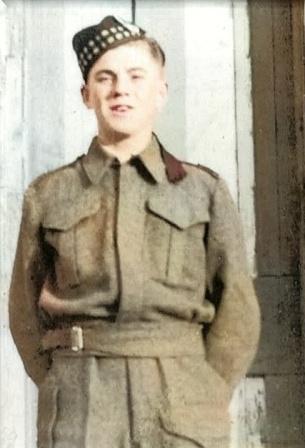
Shortly after sending that message, Carrie wrote back, saying that she reached “Victor Harvie, Marven’s nephew…” who came to the Legion in person with a photo and information.  “Please find attached photo of Marven Harvie/Harvey.  He was one of 8 brothers who were in the service during World War II. The brothers were Avard, Burrell, Ernest, Ervin, Edmond, Victor, Garnet and Marven.  I was told that this was the only family in the British Commonwealth to have 8 sons in the army during World War II….

Marven Glenroy Harvey

Marven Glenroy Harvey. (Photo courtesy of Victor Vernon Harvie and James Harvie)

…Marven enlisted at the age of 18….

Born October 2, 1925 in North Noel Road, Nova Scotia, Marven Glenroy HARVEY (surname also spelled HARVIE) was the son of Richard ‘Dick’ and Sarah ‘Pink’ (nee White) Harvie.  At the time he enlisted on May 3, 1944 at the No. 6 District Depot in Halifax, Nova Scotia, he was working as a labourer for lumber merchant M. G. Anton in Kennetcook, Nova Scotia.

On May 19, 1944 he was transferred to No. 60 Canadian Infantry Basic Training Centre (CI (B) TC) in Yarmouth, Nova Scotia.  As he was under 19 years of age, the minimum age for overseas service, he was eligible for extended infantry training.

In an interview for his Personnel Selection Record, it was recorded that Marven was “…bashful… and states that he has stuttered since childhood…”  He liked to participate “…in the usual sports and personal recreations include reading adventure stories and attending the movies…

A few weeks later, on June 17, 1944, he was assessed as being …a particularly well motivated young man, anxious to serve, willing, conscientious…. Excellent deportment to date, is trying very hard – deserves every encouragement…

On August 13, 1944, he was sent to A14 Canadian Infantry Training Centre (CITC) in Aldershot, Nova Scotia for additional training.  His examiner noted that he “…completed his basic infantry training, and his attitude toward overseas service is good….”  It was recommended that Marven go overseas with the Canadian Infantry Corps in a non-tradesman capacity.

…Marven was sent overseas shortly after his 19th birthday….

On November 21, 1944 he left Canada for the United Kingdom, arriving on November 28, 1944, most likely on the same transport as John Joseph BOHON and Kitchener ‘Kitty’ LANGILLE.  Upon arrival in the United Kingdom on November 28, 1944, like Bohon and Langille, he was assigned to No. 3 Canadian Infantry Reinforcement Unit (CIRU).

On January 8, 1945 he was sent to Northwest Europe as part of the 10th Battalion.  On February 22, 1945, Marven was transferred to the North Nova Scotia Highlanders, joining the Regiment in Calcar, Germany, on a day in which they had many casualties – 9 killed and 31 wounded, according to the war diary for that day.

…Marven lost his life in the Battle of Bienen ….

By March 20, 1945, Allied troops were on the banks of the Rhine River for Operation Plunder, a military operation to cross the Rhine on the night of March 23, 1945. (See https://en.wikipedia.org/wiki/Operation_Plunder) They got as far as Bienen, when troop movement stopped due to blown bridges across the Rhine in that area.

On March 25, 1945, the Regiment’s task was to pass through the 7th Argyll and Sutherland Highlanders who had been stopped in front of Bienen.  It was Palm Sunday, one week before Easter.

Aerial Bienen post-war

Post-war aerial of Bienen (view to the southeast towards Rees). The aerial clearly demonstrates the tactical importance of Bienen, laying astride the narrow neck of land. The main road from Rees to Emmerich (nowadays Emmericher Strasse) runs straight through Bienen. (Photo source: http://www.WW2Talk.com and identified as ‘Courtesy Becker’)

Two attempts were made that day to capture Bienen, Phase I in the morning, and, following heavy losses, Phase II began in the afternoon and ultimately cleared the village.

In ‘No Retreating Footsteps’ author Will Bird explained that Major Lloyd C. Winhold, the commander of ‘C’ Company, “…knew his men had to cross a wide open area and was insistent on a smoke barrage.  So it was agreed that fifteen minutes of artillery fire and smoke would be put down and the time was arranged so that ‘C’ Company would get into the village just as the shelling stopped…

In the article ‘Too Close To The Guns!’ in Canadian Military History, Volume 12, Numbers 1& 2, Winter/Spring 2003, pp.5-28, author Lee Windsor noted that the afternoon attack began with covering fire. “… Winhold’s ‘C’ Company hurried across the dyke level-crossing and in behind Argyll Farm where they proceeded to form up with the Dragoon Guards tanks and Wasps…

Like Louis Sexton, Marven was in ‘C’ Company, which had a more exposed route to Bienen, going across 457 metres (500 yards) of open ground to reach the first houses at the edge of the village.  The Company reached Bienen but had 33 casualties within 15 minutes – 10 killed and 23 wounded.

Major Winhold had anticipated this, as Will Bird noted that before the attack “…Winhold asked for ‘Crocodiles’, which would have saved the heavy casualties, but none were available. He asked for a longer barrage but was informed that it had been difficult enough to have the shoot for fifteen minutes…

Bienen 2 D Company's attack along the dyke

‘D’ Company attacked along the dyke on western edge of Bienen, while ‘C’ Company proceeded across open ground. (Photo source: http://www.WW2Talk.com and identified as ‘Courtesy Becker’)

Bienen 1 C Company NNSH moved along the road in the direction of the crossroads

‘C’ Company moved towards Bienen along the road in the direction of the crossroads. The brick building identifies the location of Argyll Farm. (Photo source: http://www.WW2Talk.com and identified as ‘Courtesy Becker’)

The Regimental War Diary recorded that after the second phase of the battle started at 2 pm, the “…next report received at 1445 hours was that ‘C’ Company was in the first houses on the fringe of the town after suffering heavy losses….

The one day battle was devastating in terms of casualties, both dead and wounded, including Marven Glenroy Harvey.

…Marven is buried in the Canadian War Cemetery in Groesbeek ….

Like Clifford BATEMAN, John Joseph BOHON, Ralph Schurman BOULTER, and Charles ‘Marshall’ CARSON, Marven Glenroy HARVEY, Kitchener ‘Kitty’ LANGILLE, and Louis SEXTON, Marven was temporarily buried on Monday, March 26, 1945 in the military cemetery in Rees, Germany before being reburied the following year in the Canadian War Cemetery in Groesbeek, The Netherlands.

grave stone harvey from find a grave

Grave of Marven Glenroy Harvey at the Canadian War Cemetery in Groesbeek, The Netherlands. (Photo source: http://www.findagrave.com)

Besides losing Marven, the family lost another son, James ‘Burrell’ Harvie, on October 27, 1942.

Thank you to Carrie Hogan for helping in the search for family and a photo.  Thank you to Victor Vernon Harvie and James Harvie for providing a photo and information, and to Sandra Harvey.

Thank you to all who have helped Pieter to find family members of North Novies killed in this battle. Coming up in Part 9: Marvin William McGregor.

If you have a story to tell, please let Pieter know. Email him at memorialtrail@gmail.com comment on the blog, or tweet to @researchmemori1.

© Daria Valkenburg

….Previous stories about North Novies killed during the Battle of Bienen and buried in Groesbeek….

…Want to follow our research?….

Follow our blog

If you are reading this posting, but aren’t following the blog, you are welcome to do so.  Our blog address: https://onthewarmemorialtrail.com/.

Front cover OnTheWarMememorialTrailinEurope4 countries, 6 weeks, 7,000 km – an unforgettable war memorial journey in Europe….Daria’s book ‘No Soldier Buried Overseas Should Ever Be Forgotten‘ is available in print and e-book formats.  Net proceeds of book sales help support research costs and the cost of maintaining this blog. For more information see https://nosoldierforgotten.com/

You are also invited to subscribe to our YouTube Channel: On The War Memorial Trail With Pieter Valkenburg: https://www.youtube.com/channel/UCJ591TyjSheOR-Cb_Gs_5Kw.

Never miss a posting!  Subscribe below to have each new story from the war memorial trail delivered to your inbox.

On The War Memorial Trail….. The Battle of Bienen – Part 7: The WWII Soldier From Quebec Who Has Never Been Forgotten By His Family

March 23, 2023. On a list of 39 soldiers from the North Nova Scotia Highlanders Regiment who were killed during Hthe Battle of Bienen in Germany on March 25, 1945 and are buried in the Canadian War Cemetery in Groesbeek, The Netherlands, photos were missing for 12 names.  By the end of October 2022, Pieter had managed to find photos or family for 8 of them.

Then, after Pieter was interviewed by Ceilidh Millar of CTV Atlantic News At 5 on Monday, November 7, 2022, about the search for the other 4 soldiers, a viewer contacted him about Louis Allan SEXTON. (To read the article and watch the video see: P.E.I. man identifying Canadian soldiers in The Netherlands | CTV News https://atlantic.ctvnews.ca/maritime-man-appealing-to-public-for-help-identifying-lost-canadian-soldiers-1.6143236)

…. An interview quickly resulted in a photo ….

Shortly after the broadcast, we were contacted by Irene Doyle of Campbelltown, New Brunswick, saying she saw …the story about your search on CTV and I have found a photo of Louis A. Sexton… How very nice of you to undertake this project. Thank you for what you are doing. Lest We Forget…” She then sent us a photo of Louis Sexton, which came from the Bay Chaleur Military Museum website.

photo louis sexton cropped 2

Louis Sexton. (Photo submitted by Irene Doyle, Courtesy of Bay Chaleur Military Museum)

Then we heard from Leo Allen in Baie des Chaleurs, advising he’d contacted a nephew of the soldier.   We also heard from many viewers, several of whom had found the same photo, or advised they had notified family members.  It was heartening to hear from so many people about one soldier.

Sexton reunion book coverAfter that, Judy Sexton wrote, saying “…I am Louis Sexton’s niece. My brother and my cousin have been given his name. We have been loving and honouring his memory since he died… We would be honoured and proud to share any information about his life and family…”  And they did.  Judy also included an excerpt on her uncle from a history booklet prepared for a 1997 Sexton Reunion.

Born January 21, 1923 in Maria East, Quebec, Louis Allan SEXTON was the son of James E. Sexton and Ethel Foran. After completing Grade 6, he left school to work.

In a section of the Sexton History, contributed by Velson and Darlene Sexton, it was noted that Louis “…was a hard worker, even at a young age.  For a couple of summers, he worked in Maria for 50 cents a day…A little later, he went to live in Nouvelle with his Aunt Lizzie and Uncle Jack Gough.  He worked in the woods and in the mill in Nouvelle….

…. Louis enlisted in the fall of 1943 ….

Like many young men, Louis “…moved around and found work in the Maritimes…”  While working as a carpenter with Silvers Agencies in Dartmouth, Nova Scotia, he was called up for service under the National Resources Mobilization Act (NRMA). (For more information, see https://en.wikipedia.org/wiki/National_Resources_Mobilization_Act)

Louis registered at the No. 6 NRMA Clearing Depot in Halifax, Nova Scotia on October 14, 1943, but was “…dismissed for a month due to medical reasons….” according to his service file. He returned on November 15, 1943 and assigned to No. 6 District Depot in Halifax.

In an interview for his Personnel Selection Record, it was noted that Louis “…plays hockey.  Likes cards and pool.  Reads quite a lot – mostly stories and light reading…”  Louis made a positive impression, described as “…alert, frank and cooperative, with a pleasant manner…” It was also recorded that he spoke both English and French.
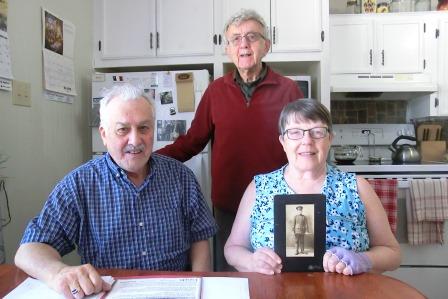
On December 10, 1943, he was transferred to No. 60 Canadian Infantry Basic Training Centre (CI (B) TC) in Yarmouth, Nova Scotia.

After successfully completing basic training, on February 12, 1944, he was sent to A14 Canadian Infantry Training Centre (CITC) in Aldershot, Nova Scotia for ordnance training.

…. Louis was sent overseas ….

On April 13, 1944, Louis was granted a week’s leave prior to being sent overseas.  The Sexton History recorded that he went home for that week, visiting family for what would be the last time.  “…After the week was over, he left home, alone, with one small blue suitcase, and many memories…

Louis didn’t have much time for reflection, as he left Canada on May 1, 1944.  Upon arrival in the United Kingdom on May 7, 1944 he was assigned to No. 4 Canadian Infantry Reinforcement Unit (CIRU).

On June 15, 1944, he was transferred to the North Nova Scotia Highlanders.  On July 18, 1944 he joined them in Les Buissons, France as part of a reinforcement group.

He was with the Regiment through Northwest Europe: for the Battle of the Scheldt (See https://en.wikipedia.org/wiki/Battle_of_the_Scheldt), and Operation Blockbuster (See https://en.wikipedia.org/wiki/Operation_Blockbuster), receiving promotions to Lance Corporal in the fall of 1944, and then Corporal on January 14, 1945.

…Louis lost his life in the Battle of Bienen ….

By March 20, 1945, Allied troops were on the banks of the Rhine River for Operation Plunder, a military operation to cross the Rhine on the night of March 23, 1945. (See https://en.wikipedia.org/wiki/Operation_Plunder) They got as far as Bienen, when troop movement stopped due to blown bridges across the Rhine in that area.

On March 25, 1945, the Regiment’s task was to pass through the 7th Argyll and Sutherland Highlanders who had been stopped in front of Bienen.  It was Palm Sunday, one week before Easter.

The problem with Bienen was that the road through it was the only access point.  In ‘No Retreating Footsteps’ author Will Bird explained that it was “… an isthmus of solid land about half a mile wide with one road, the main Rees-Emmerich highway, which passed through Bienen exactly at the narrowest point…

Aerial Bienen post-war

Post-war aerial of Bienen (view to the southeast towards Rees). The aerial clearly demonstrates the tactical importance of Bienen, laying astride the narrow neck of land. The main road from Rees to Emmerich (nowadays Emmericher Strasse) runs straight through Bienen. (Photo source: http://www.WW2Talk.com and identified as ‘Courtesy Becker’)

There was a dyke which led to the left side of the village.  However, “…inside the dyke there was a series of farms from 400 to 800 yards apart, and between these farms and the highway there was no cover of any sort…”  For this reason, capturing Bienen was vital, the task now assigned to the North Novies.

Two attempts were made that day to capture Bienen, Phase I in the morning, and, following heavy losses, Phase II began in the afternoon and ultimately cleared the village.

In the article ‘Too Close To The Guns!’ in Canadian Military History, Volume 12, Numbers 1& 2, Winter/Spring 2003, pp.5-28, author Lee Windsor recorded the reason that the first attack stalled.  “….What made the situation so difficult was the proximity of Argyll Farm to Bienen. The main German positions were close enough to pour accurate fire into the farm complex as well as anyone venturing north…

Hard lessons had been learned, and there was hope due to being able to secure what was known as Argyll Farm into a base for further action.  “….Unlike the first attack, the new North Nova assault was planned in detail taking into consideration valuable intelligence paid for that morning with ‘A’ and ‘B’ Companies’ blood….

The plan was to “…take advantage of …secure left and the winter dyke by moving Major Dave Dickson’s ‘D’ Company to the west edge of town by slipping it up the left side of the dyke in the minutes before H-Hour….” H-hour was set for 1430 hours.  One account noted that the dyke was just over 3 metres (10 feet) high.

Bienen 2 D Company's attack along the dyke

‘D’ Company attacked along the dyke on western edge of Bienen, while ‘C’ Company proceeded across open ground. (Photo source: http://www.WW2Talk.com and identified as ‘Courtesy Becker’)

Bienen 1 C Company NNSH moved along the road in the direction of the crossroads

‘C’ Company moved towards Bienen along the road in the direction of the crossroads. The brick building identifies the location of Argyll Farm. (Photo source: http://www.WW2Talk.com and identified as ‘Courtesy Becker’)

… Major Lloyd Winhold’s ‘C’ Company would form up behind Argyll Farm….” Louis was in ‘C’ Company, which had a more exposed route to Bienen, going across 457 metres (500 yards) of open ground to reach the first houses at the edge of the village.  The Company reached Bienen but had 33 casualties within 15 minutes.

The one day battle was devastating in terms of casualties, both dead and wounded, including Louis Sexton.  In ‘No Retreating Footsteps’ author Will Bird recorded the heroic actions of Louis:  “…Cpl Sexton exposed himself time after time in encouraging his men until at last he was shot down…

Among the documents in the Sexton History was a June 25, 1945 letter to the parents of Louis, from Honorary Major Donald A. Kerr, Senior Chaplain (R.C.) in the 3rd Canadian Infantry Division, who wrote that he knew Louis as he “…was the Priest in charge of his brigade for over four years…I can truthfully say he was a very fine soldier – well liked and highly thought of by his officers and men…

He went on to explain that Louis “…was killed on a Sunday afternoon – the Feast of the Annunciation – while crossing a dyke and an open field to attack the vital town of Bunner in Germany, the day after we crossed the Rhine…”  Bunner is incorrect, as the town was Bienen.

…Louis is buried in the Canadian War Cemetery in Groesbeek ….

In his letter to the parents of Louis, Father Kerr explained that he presided over the service of 15 soldiers, including Louis.  …I buried him the next Monday afternoon, in a small temporary Canadian cemetery – not very far from the spot where he died – to the lee of this same dyke I already mentioned….

Like Clifford BATEMAN, John Joseph BOHON, Ralph Schurman BOULTER, and Charles ‘Marshall’ CARSON, and Kitchener ‘Kitty’ LANGILLE, Louis was temporarily buried on Monday, March 26, 1945 in the military cemetery in Rees, Germany before being reburied the following year in the Canadian War Cemetery in Groesbeek, The Netherlands.

Grave of Louis Sexton from FindAGrave

Grave of Louis Allan Sexton at the Canadian War Cemetery in Groesbeek. (Photo source: http://www.findagrave.com)

 …Louis had written a letter the day before he died ….

Another document in the Sexton History was a March 24, 1945 letter written by Louis to his mother.  “…I am well and doing OK.  I had quite a disappointment yesterday.  I was …ready to go on my seven days leave and at the last minute it was cancelled on account I was a Corporal and doing a Sergeant’s job these last few weeks so I couldn’t go. I guess there must be something big coming up….”  If only Louis had been able to go on his leave!

Thank you to Irene Doyle for submitting a photo from the Bay Chaleur Military Museum.  Many thanks to Judy Sexton for sending a photo and information about Louis Sexton, to Leo Allen for notifying a family member, and to all who got in contact.  Thank you to Ceilidh Millar and Jayson Baxter of CTV Atlantic Live At 5 for featuring the photo search request.

Pieter has been successfully finding family members of other North Novies killed in this battle. Coming up in Part 8: Marven Glenroy HARVEY.

If you have a story to tell, please let Pieter know. Email him at memorialtrail@gmail.com, comment on the blog, or tweet to @researchmemori1.

© Daria Valkenburg

….Previous stories about North Novies killed during the Battle of Bienen and buried in Groesbeek….

…Want to follow our research?….

If you are reading this posting, but aren’t following the blog, you are welcome to do so.  Our blog address: https://onthewarmemorialtrail.com/.

Front cover OnTheWarMememorialTrailinEurope4 countries, 6 weeks, 7,000 km – an unforgettable war memorial journey in Europe…. Daria’s book ‘No Soldier Buried Overseas Should Ever Be Forgotten‘ is available in print and e-book formats.  Net proceeds of book sales help support research costs and the cost of maintaining this blog. For more information see https://nosoldierforgotten.com/

You are also invited to subscribe to our YouTube Channel: On The War Memorial Trail With Pieter Valkenburg: https://www.youtube.com/channel/UCJ591TyjSheOR-Cb_Gs_5Kw.

Never miss a posting!  Subscribe below to have each new story from the war memorial trail delivered to your inbox.