November 1, 2026. In Part 1 of ‘The Airman From Langham Who Became A POW’, a request by one of the volunteers with Stichting Luchtoorlog Onderzoek Drenthe (Air Research Drenthe Foundation) in The Netherlands for help in finding a photo of Henry ‘Hank’ PANKRATZ, was successful. Born in Langham, Saskatchewan, Hank was one of four survivors of the last flight of 424 ‘Tiger’ Squadron’s Halifax NP945. The plane had been shot down in Getelo, in the vicinity of Uelzen, Germany, near the Dutch border, on the evening of December 6, 1944, while returning from a sortie to Osnabrück, Germany.
After the pilot gave the order to jump, Hank exited the plane, and sought refuge at a nearby farm for a few hours, before being taken by the farmer to the police station in Uelzen. (See https://onthewarmemorialtrail.com/2026/10/30/on-the-war-memorial-trail-the-airman-from-langham-who-became-a-pow-part-1-the-last-flight-of-halifax-np945/)
Now, in Part 2, Hank’s story continues as he spends the remainder of WWII as a prisoner of war….
…. Hank learned three members of his crew had survived and three had not…
In ‘Road Back Complicated’ published in the March 1983 issue of Airforce magazine, after being left at the police station in Uelzen by the farmer from the farm Hank had initially approached, he was taken by a policeman to a nearby town and placed in a cell. “…On a filthy bed in one corner I tried to sleep…” Not long afterward he “…heard someone yelling in English ‘I’m hungry’ and recognized my bombardier’s voice….” This was Arthur Alexander Jaffray LOW, from Hamilton, Ontario.
Shouting through the thick walls to make themselves heard, they were soon told by their gaoler to keep quiet, but at least Hank had learned that “…the engineer….” Robert ATKINSON, from Barrowfield Glasgow, Scotland, “…was with the bombardier in the same cell. They had been there since the previous night, having been captured shortly after they had landed. Both had lost their flying boots, had walked five or six miles in their socks and were in agony…”
When the door to his cell was unlocked, a hungry Hank thought he might get fed. Instead, he and the other two crewmen “…were put in the back of a truck with three crude coffins…” and heavily guarded as the truck began its journey. At first they thought the coffins were for their execution, but when more coffins were picked up along the way, they realized that the coffins contained bodies.
They were taken to an airport guardhouse, joined by 5 other men, and were finally given something to eat and drink. “...Early next evening our navigator…” Albert Melville GARNER, from Toronto, Ontario, “…was brought in. He had a badly sprained ankle and looked quite done in. The Germans told him three members of our crew had been killed – that would have been the pilot and the gunners…”
….Hank was sent to an interrogation camp in Oberursel…
Soon the prisoners of war were on the move, and after several days of travel by truck and train, arrived at Dulug Luft Oberursel in Oberursel, just north-west of Frankfurt, “…where the interrogation camp was situated. The barbed wire, armed guards, and high towers that housed machine guns and powerful searchlights offered a dismal prospect…”
They were strip-searched, then placed in “….individual cells about 5 by 10 feet….” with a bed, chair, and window. “…There was a small electric radiator which was on only about three hours a day, and when it was on, the lice in the straw sack on my bed attacked like fighter pilots. When it was off I almost froze to death…”
Hank was photographed, finger-printed, interrogated where he provided no information at each session, and kept in solitary confinement for a week. “…Breakfast consisted of two slices of black bread with jam, and a cup of lukewarm liquid they called coffee. For lunch we got cups of soup which to my mind contained every variety of grass grown in Germany. Dinner was a repetition of breakfast except that margarine replaced the jam….”
After a week, he was interrogated again, but with a different approach. “…A smartly dressed Luftwaffe officer ….courteously bade me sit down. He spoke faultless English and was so polite I felt uncomfortable…” Opening a large book, the officer seemed to know everything – or pretended to – and stated that he only wanted confirmation.
The next morning, Hank, along with 45 other prisoners, was sent to a Dulag Luft Wetzlar, a transit and rest camp for prisoners of war who had completed their initial interrogation at Oberursel. For the first time since the crash, he was able to shower, and was provided clothes and accessories from the Red Cross. “…We could eat as much as we wanted, which was ok by me…”
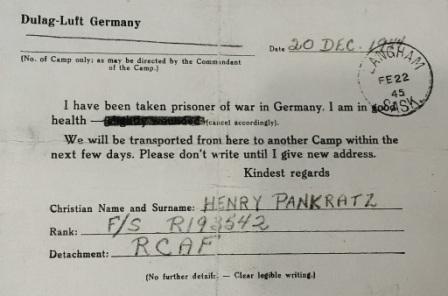
Postcard dated December 20, 1944 took until February 22, 1945 to arrive back home in Saskatchewan. (Postcard courtesy of Shana Pankratz)
Hank was allowed to send a postcard on December 20, 1944, advising that he was a POW, but the family never received it until February 22, 1945!
….Hank was sent to Stalag VII in Bankau…
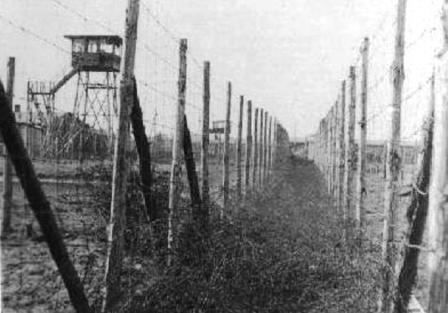
Two rows of barbed wire fencing and guard towers prohibited escape from Stalag Luft VII. (Photo source: Wartime diary of Robert E. Toomey via John Knifton)
After 4 days, Hank and 43 other men were on their way by train to a “…permanent prison camp, a trip of three days, and each of us was issued the contents of a Red Cross parcel….” Shortly after getting underway, the train pulled into a siding and a guard told them that they would be stuck in the train for 48 hours unless they handed over cigarettes. “….None of us was anxious to spend Christmas on wooden seats looking through the bars of a train, so we excelled ourselves and each threw two cigs in a hat…”
The bribe worked. “….Within ten minutes we were rolling and never stopped until we reached Bankau, our destination. From here we marched to Stalag Luft VII, two or three miles away, arriving around five in the afternoon on December 26…” Bankau, Silesia, Germany, is now named Bąków and in present-day Poland.
The camp held about 1,500 men and was divided into 10 barrack blocks. Each block had 18 rooms, and each room held 18 men. “…Although life in the camp was very monotonous, and the food shortage gave us concern, we managed to keep in fairly good spirits. Through secret radios we were able to follow the day-to-day progress of the war. These radios were so well hidden that the Germans never found them, despite the searches they made…”
There was a roll call every morning and at 3 pm in the afternoon, with lights out at 10 pm. Hank noted that they were grateful for “…the fairly substantial library maintained at the camp by the Red Cross, also the musical instruments supplied by that splendid organization…”
….The 21 day march from Stalag VII in Bankau to Stalag III-A in Luckenwalde was brutal…
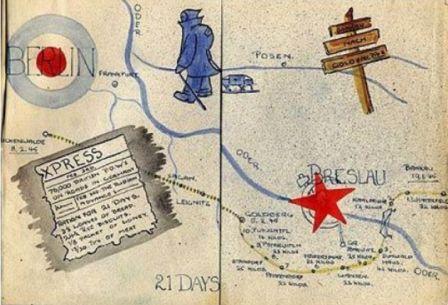
Map made by Airman Thomas Cloran showed the 21 day march from Bankau to Luckenwalde. (Map source: https://www.49squadron.co.uk/pow_camps/detail/5)
Hank wasn’t destined to remain very long at Stalag Luft VII as the camp was in the direct path of the advancing Russians heading for Berlin. “…On the afternoon of January 17, 1945, we were ordered to move off on foot within the hour….” Nothing happened, but “…that night was really grim – bombing on all sides revealed that the Russians were much closer than we had suspected…”
At 3.30 am on January 19, 1945, 1,500 prisoners of war were marched out of the camp in bitterly cold -13ºC (8oF) and into a raging blizzard. They left, with “…each man carrying what few belongings he had and enough food for one good meal…”
The prisoners were threatened that for every man falling out of the column a further five would be shot. “…Heavily-armed guards and trained dogs galore accompanied us, the roads were in bad shape, and a blinding snow-storm pressed down on us as we trudged on…”
No further food was provided until the fifth day. “…We marched from 15 to 25 kms a day and spent our nights in the farms of the various farms we passed… A number of the boys escaped, others just died on the way, while nearly all suffered frost-bite….”
There was urgency to the march as the men had to cross a bridge over the Oder River before German sappers blew it up. “…No sooner were we on the other side of the Oder river than the Germans blew the bridge up….”
“…We had an all-day rest at a big dairy farm…” but hunger was top of mind. “…Everyone was delirious with hunger…. we drove some cattle away and ate what was left of a pile of frozen, dirty, rotten sugar beets. As a result we all got dysentery….”
The punishing march continued. “…After a hard day’s march on Jan 29 we were told that the trip would be completed by train. Sagan, our first objective, was being evacuated and no one knew where we were going. All that we knew was we were damned tired and hungry. However, after about six hours’ rest we started out again and marched to Peterwitz. There was no sign of a train, the guards were in a dangerous mood, each of us got only one sixth of a loaf of bread, and the weather was at its worst….”
On February 5, 1945, after a march of over 200 km (124 miles) and suffering from dysentery, malnutrition and frostbite, they reached the Goldberg marshalling yards (now Złotoryja, Poland). From here they were taken in cramped cattle trucks to camps deeper inside Germany to their new destination: Stalag III-A, about 52 km (32 miles) south of Berlin near Luckenwalde, which already held 20,000 prisoners.
They arrived in Luckenwalde on February 8, 1945 and then walked the rest of the way to Stalag III-A. “…In 14 days on three pounds of food each…” during the long walk, “…. I lost about 50 pounds and was as weak as a kitten….” and “… had trouble standing up...”
A report on the forced march by D.C. Howatson, Royal Army Medical Corps (RAMC), the Camp Medical Officer, to the Swiss Commission verifies the terrible conditions experienced by the prisoners of war. See https://www.pegasusarchive.org/pow/cSL_7_History1.htm
….Hank spent the rest of his time as a POW at Stalag III-A in Luckenwalde…
Hank described how the men were segregated according to nationality. “…Stalag III-A held some 16,000 men made up of seven or eight nationalities which were segregated by fences within the main enclosure. The Americans were west of us, the French to our east, and across the road were the Poles, Russians, Yugoslavs and others….”
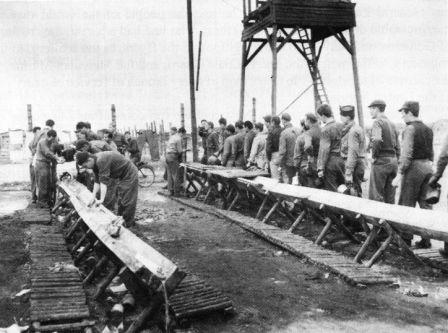
POWs washing up at a trough in Stalag III-A. (Photo source: Wartime diary of Robert E. Toomey via Leo Finegold)
Conditions were not good, but were bearable. “…At this camp we had a hot shower, my fourth in Germany, and were crowded into barracks. We slept on the bare floor rather than use the straw which was teeming with lice ready to go to work on you…”
And they did receive food on a daily basis. “…The ration consisted of one-fifth of a loaf of bread, three or four boiled potatoes, two cups of soup – pea, turnip, barley or just plain grass, which wasn’t bad considering, and one-twentieth pound of margarine....”
The long march and conditions in the camp began to take a toll. “…Our boys began dropping out like poisoned flies about this time. It seemed as if the effects of the march were just catching up with us. We lost about 200 on the march, and every day now saw more die until it got that we kept wondering who would be next….” Approximately 5,000 men in total died from disease, starvation, cold, exhaustion, and neglect at this overcrowded camp.
Hank described the reaction of the prisoners when a Red Cross parcel arrived. “…On March 8, a carload of Red Cross supplies arrived at Luckenwalde, and each man got a full parcel. Just like Christmas. Kind of grim though to see grown men break down and weep over a few pounds of food…”
….The Germans deserted Stalag III-A on April 21, 1945…
Hank and the other prisoners realized that something had changed on April 21, 1945. “…We noticed that all the gun towers were vacant and that no Jerries were in sight. They had decamped, leaving us alone. Well aware that Russian prisoners had been badly mistreated by them, they were scared stiff of their approaching eastern foe.….”
The Russian Army arrived on April 22, 1945. “…The following morning the Red Army rolled into camp on tanks, trucks, motorcycles, guys on horseback, even bicycles….”
The prisoners thought they would be liberated, but it turned out they were now held hostage by the Russians. “….Time dragged on, with the Russians refusing to let us go home. When the Red Cross parcels gave out, our diet consisted of bean soup and black bread….
…One day a large convoy of American trucks came along and offered to take us into their zone, then fly us back to England. However, the Russians vetoed that. They blocked all roads and posted machine guns at intersections, threatening to open fire if the loaded trucks moved. The trucks went back empty….
…According to the Russians they were to receive certain repatriations from the British government for every man they released….”
….Hank was freed on May 20, 1945…
Almost a month after the Russians came into the camp, Hank and the other men were finally freed. “…Finally, on May 20, a convoy of Russian trucks drove us to the American Zone. At Halle that same evening we were accorded a wonderful reception…
…On May 25 we were flown from Halle to a Canadian ex-POW camp near Brussels, and the following evening from there to Ford, England. Never was a landing more welcome! From Ford we drove in trucks to Bournemouth on the south coast of England, arriving about midnight. The next day (May 27) this kid took it easy, and 48 hours later was on a bang-up two-weeks’ holiday…”
…. Hank returned to Canada in July 1945…
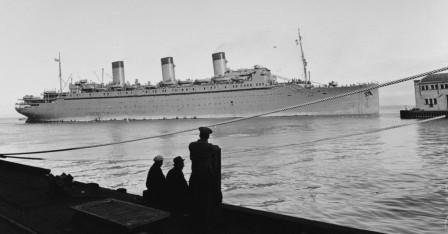
SS Île de France during WWII. (Source: Naval History and Heritage Command)
On July 8, 1945, Hank boarded the SS Île de France in Greenock, Scotland for his return to Canada, and arrived in Halifax, Nova Scotia on July 14, 1945. The war was over for Hank, but he would return to Germany several years later.
His daughter Shana explained that after his discharge, Hank “…joined the RCMP, and was posted to Camrose, Alberta, where he met my mother, Audrey Carruthers. She was 17, and they married in 1948, when she was 18…”
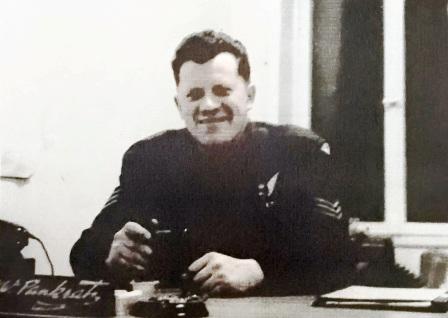
Hank Pankratz in Germany with the RCAF. (Photo courtesy of Shana Pankratz. Photo restoration by Pieter Valkenburg)
After leaving the RCMP (Royal Canadian Mounted Police), Hank rejoined the RCAF (Royal Canadian Air Force), this time as a military police officer. He was sent to Goose Bay in Labrador, and then to Edmonton, Alberta, where Shana was born. From 1953 to 1955, Hank served at 4(F) Wing in Baden, Germany. He was also stationed in Rivers, Manitoba, and was a Flight Sergeant with 447 Squadron at the Bomarc base in La Macaza, Quebec.
In ‘447 SAM Squadron some early memories’ author Bob Merrick explained that “…the RCAF entered the missile age in 1962, when it acquired two half-squadrons of Boeing’s Michigan Air Research Centre (Bomarc) missiles. The missiles guarded Canadian and American industrial centres – and American ICBM sites – from attacks by the nuclear-equipped Soviet long-range air force. 446 Surface-to-Air Missile (SAM) Squadron, based near North Bay, Ontario, began its training first, followed by 447 SAM Squadron, based at RCAF Station La Macaza, Quebec. 447 became the world’s only self-sufficient Bomarc squadron, as all the others were adjuncts of various USAF or RCAF bases….”
He went on note that “…Security played an important role in squadron operations…FS Hank Pankratz oversaw security operations, and no one ever succeeded in stealing a Bomarc…..” (See https://www.candemuseum.org/sites/default/files/archives/Pinetreeline/misc/bomarc/bomarc2d.html)
From Quebec he was stationed in Ottawa, Ontario. After retiring from the RCAF, he continued working. “…He was at General Motor Acceptance Corporation, then Ontario Hydro…”
Shana recalled that her father “…loved soup. He would prep the veggies, and my mother would make soup after her breakfast….”
Hank died of leukemia, aged 72, in Oshawa, Ontario on August 4, 1996. “….After the funeral service in the chapel at Thornton Cemetery in Oshawa, he was cremated and his ashes spread in the Niagara region. Dad had been fascinated with Niagara Falls since he first went to Ontario back in the early 1940s, and Mom and I took him there 5 times before he went into hospital just before he passed away…”
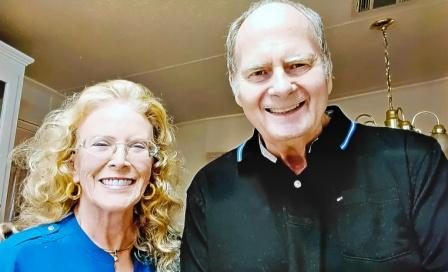
Shana Pankratz and partner Doug Hutton. (Photo courtesy of Shana Pankratz)
Hank’s brother Bill returned safely from the war, as did his three crewmates. Albert Garner died in 1994, and Arthur Low in 2008. Both had been in Stalag Luft I near Barth, Germany. Robert Atkinson was the only crewmember who was in both Bankau and Luckenwalde with Hank.
Thank you to Shana Pankratz for providing information about her father, to Judie Klassen for her help in the search for Hank’s post-war career, and to Shawn Rainville for newspaper searches.
Pieter’s research efforts to find photos and families of soldiers continue. Do you have a story to tell? Email Pieter at memorialtrail@gmail.com, or comment on the blog.
© Daria Valkenburg
….Want to follow our research?…
If you are reading this posting, but aren’t following our research, you are welcome to do so. Our blog address: https://onthewarmemorialtrail.com/
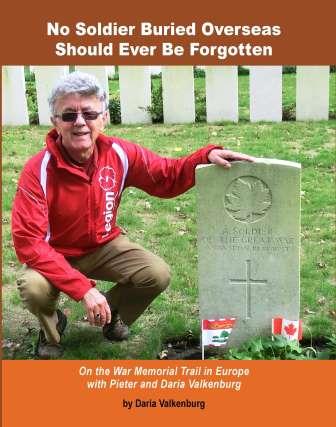 4 countries, 6 weeks, 7,000 km – an unforgettable war memorial journey in Europe…. Daria’s book ‘No Soldier Buried Overseas Should Ever Be Forgotten‘ is available in print and e-book formats. Net proceeds of book sales help support research costs and the cost of maintaining this blog. For more information see https://nosoldierforgotten.com/
Subscribe to our YouTube Channel: On The War Memorial Trail With Pieter Valkenburg: https://www.youtube.com/channel/UCJ591TyjSheOR-Cb_Gs_5Kw.
Never miss a posting! Subscribe below to have each new story from the war memorial trail delivered to your inbox.

