October 30, 2026. Occasionally, one story leads to more. In February 2023, we posted on this blog the story about Jack ‘Douglas’ MACKENZIE, of Winnipeg, Manitoba, the pilot of Halifax DT630 that was shot down by a night fighter over the province of Drenthe in The Netherlands on February 3, 1943. (See https://onthewarmemorialtrail.com/2023/02/19/on-the-war-memorial-trail-the-wwii-pilot-killed-at-the-controls-of-his-halifax-bomber/)
A few months later, we were contacted by Yannic Wethly, one of the volunteers with Stichting Luchtoorlog Onderzoek Drenthe (Air Research Drenthe Foundation) in The Netherlands. This non-profit organization researches WWII air crashes in the province and places information panels near the crash sites.
Yannic asked if we would help in finding photos and families of other Canadian airmen that were on his photo wish list. Of course we said yes, and then we were delighted to have a chance to meet him in April 2025, when we were in The Netherlands on our 2025 European War Memorial Tour. (See https://onthewarmemorialtrail.com/2025/06/15/on-the-war-memorial-trail-a-visit-to-sleen-general-cemetery/)
In January 2026, a memorial panel honouring the crew of Halifax DT630, was unveiled, closing the loop on the story about that flight’s pilot. (See https://onthewarmemorialtrail.com/2026/03/18/on-the-war-memorial-panela-memorial-panel-honours-the-crew-on-the-last-flight-of-halifax-dt630/)
….The search for a photo of Hank Pankratz began…
On Yannic’s photo wish list was Henry ‘Hank’ PANKRATZ, one of four survivors of the last flight of 424 ‘Tiger’ Squadron’s Halifax NP945, which was shot down in Germany, near the Dutch border, on December 6, 1944, while on its return from a sortie to Osnabrück, Germany. Hank ended up in a POW camp, and it was this that led to a photo being found.
During the search for a photo and family, with the help of Judie Klassen, she came across a reference to Hank in a book, ‘The Long Road: Trials and Tribulations of Airmen Prisoners from Stalag Luft VII (Bankau) to Berlin, June 1944 – May 1945‘, written by Oliver Clutton-Brock, a British writer who had included a photo in his book.
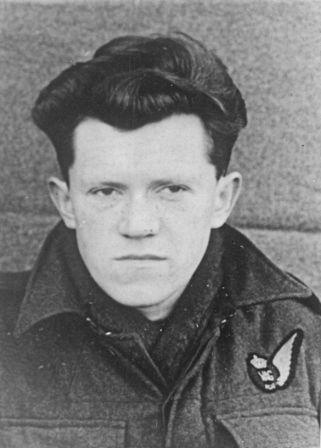
Henry ‘Hank’ Pankratz. (Photo source: Henry Pankratz)
An email for the author came back as no longer in use, but there was a phone number, which hopefully still was in service. I emailed British friends Jacqueline and Graham Hocking and asked if they would be willing to try and phone the author, and let him know about the photo search request. Jacqueline did and we did receive a photo!
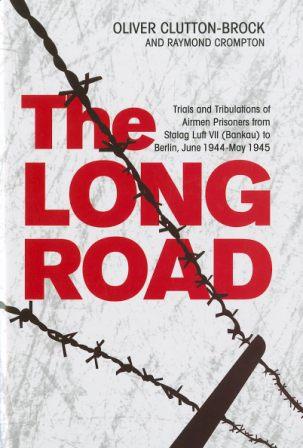
When I asked Oliver how he wanted the photo attributed, he said it should be Henry Pankratz himself. “…He contacted my co-author, Ray Crompton (sadly deceased), back in the late 1980s / early 90s and sent him the photo….”
When told about the planned memorial panel by the Air Research Drenthe Foundation, Oliver went on to say that “…I am delighted to hear that the photo will be used for such a worthy cause. I have nothing but the highest praise and admiration for the way in which the Dutch historians and ordinary people go about remembering the fallen of so long ago. Well done to all of you….“
We had a photo, but the search for family continued, and many months later, Hank’s daughter Shana contacted us, providing more photos and information about her father.
…. Hank enlisted in 1942…
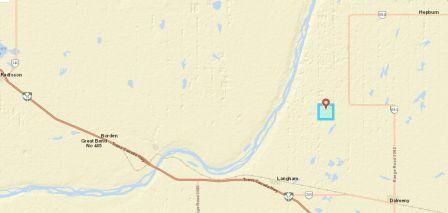
Red marker identifies the location near Langham, Saskatchewan where Henry Pankratz was born. (Map source: Sask Interactive Mapping, Saskatchewan Ministry of Environment)
Born February 22, 1924 on a farm near Langham, Saskatchewan, Hank was the son of Wilhelm Heinrich (‘William Henry’) and Maria (nee Buhr) Pankratz. One of 5 children born into a Mennonite family that had immigrated to Canada from Eastern Europe, he had two sisters and two brothers.
“…The family’s origins were in Holland…” Shana explained “…and the surname was originally Van Kratz. They went farming to Ukraine and the surname was changed to Pankratz by the Russians….”
Hank was interested in planes as a child, even writing a letter in the August 27, 1932 edition of the Star-Phoenix newspaper, about the first plane he saw. “…The first airplane I saw close by was on July 1, 1929, at Davidson, Saskatchewan, where we lived at the time. It was a two-passenger open plane from Saskatoon to take people for rides….The pilot said he had flown about 120 miles an hour from Saskatoon….
The reason I am interested in aviation is because of the speed, the greater the speed, the better I like it, and the cool clean air one goes in. If you are a farmer you do not get this kind of air…”
On September 6, 1942, at the age of 18, Hank enlisted with the RCAF (Royal Canadian Air Force) as a wireless operator/air gunner in Galt, Ontario. His brother Bill also joined the RCAF. Judie Klassen, who helped in the search for family and a photo, understood what “…must have been a difficult decision for them to join, as the pacifist beliefs of the Mennonite community may have caused conflict with family, neighbors, or within their conscience….”
The Pankratz brothers weren’t the only Mennonites to enlist in WWII. In the October 13, 2013 issue of Canadian Mennonite, the article ‘Let nobody judge them’ by Ross W. Muir, stated that “…as many as 4,500 Canadian Mennonites enlisted in this country’s military forces between 1939 and 1945….”
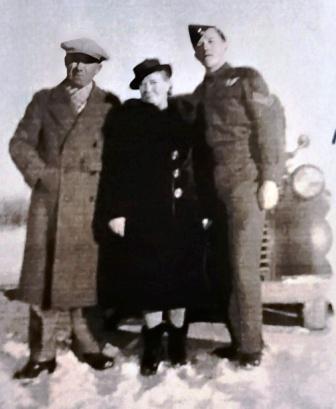
Henry ‘Hank’ Pankratz with his parents. (Photo courtesy of Shana Pankratz. Photo restoration by Pieter Valkenburg)
Hank received his Leading Aircraftman designation (LAC) in Guelph, Ontario on February 22, 1943, his 19th birthday. On September 20, 1943, he received the rank of Sergeant after graduating as a wireless operator/air gunner at the No. 2 Bombing and Gunnery School in Mossbank, Saskatchewan.
He was soon sent to the United Kingdom. A photo of himself in a flight suit included a comment on the back of the photo. “…Don’t let this picture fool you. I’m not a fighter pilot yet, but I can dream, can’t I? Ha Ha….”
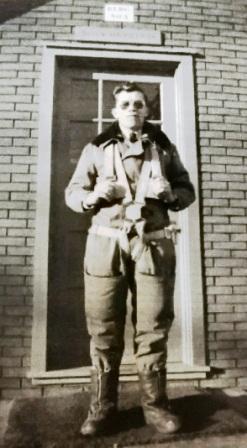
Henry ‘Hank’ Pankratz in a flight suit. (Photo courtesy of Shana Pankratz)
…. The last flight of Halifax NP945…
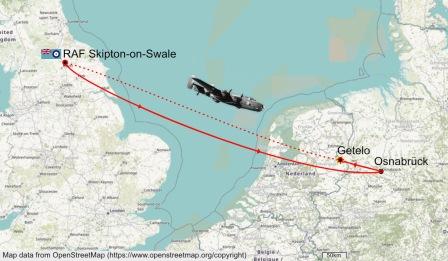
Map shows the plane’s path from England to Osnabrück. On it’s return to England, it was shot down by German flak and crashed near Getelo, Germany near the border with The Netherlands. (Map prepared by Wendy Nattress)
On December 6, 1944, Hank, now with the Royal Canadian Air Force’s 424 ‘Tiger’ Squadron, part of No. 6 Bomber Group, was aboard Halifax NP945, nicknamed ‘Der Fuehrers Fate’, as it and 435 Halifax and Lancaster bombers, plus 18 Mosquitos, were sent on a bombing mission for a night attack over Osnabrück, Germany. The plane departed at 4:43 pm from RAF Skipton-on-Swale in the UK, located 4 miles west of Thirsk in North Yorkshire, England.
Per the ‘The Bomber Command War Diaries: An Operational Reference Book, 1939–1945’ by Martin Middlebrook and Chris Everitt, “…this was the first major raid on Osnabrück since August 1942. The raid was only a partial success. The railway yards were only slightly damaged but 4 factories were hit, including the Teuto-Metallwerke munitions factory, and 203 houses were, destroyed, and 39 people were killed….”
As the plane began the return flight to England, it was shot down near Getelo, in the vicinity of Uelzen, located in Lower Saxony, Germany, right along the border with The Netherlands.
In ‘Road Back Complicated’ published in the March 1983 issue of Airforce magazine, Hank explained that “…Our machine caught fire and the pilot gave the order to jump. I was the third to go out into space and rain. My parachute opened inside the plane which was badly out of control by then but luckily it didn’t get tangled.…”
…. The crew aboard the last flight of Halifax NP945…
7 airmen were aboard Halifax NP945. 3 died and are now buried in Reichswald Forest War Cemetery in Kleve, Germany. 4 airmen, including Hank, survived the crash and ended up prisoners of war (POWs).
- Pilot: RCAF Flight Officer David Louis Caskey MCCULLOUGH, from Red Deer, Alberta, aged 22, KIA
- Navigator: RCAF Flight Officer Albert Melville GARNER, from Toronto, Ontario, aged 23, POW
- Bomb Aimer: RCAF Flight Officer Arthur Alexander Jaffray LOW, from Hamilton, Ontario, POW
- Flight Engineer: RAF Sgt Robert ATKINSON, from Barrowfield Glasgow, Scotland, POW
- Wireless Operator: RCAF Pilot Officer Henry ‘Hank’ PANKRATZ, from Langham, Saskatchewan, POW
- Midupper Gunner: RCAF Pilot Officer John Robert ‘Jack’ LEE, from Caledonia, Ontario, aged 20, KIA
- Rear gunner: RCAF Pilot Officer John Lightfoot KEOWN, from Fairfax, Manitoba, aged 25, KIA
…. Hank sought refuge at a nearby farm…
As Hank exited the plane he noticed that “…falling not far away from me was a big ball of fire. It was the aircraft I had just vacated, and a moment later it blew up and went hurtling to the ground.…” At this point, he had no idea where the other crew members were, and he found himself alone.
After freeing himself from the parachute harness, Hank “…sought shelter in a nearby clump of trees…” where he remained until dawn. He noticed “…a farmhouse a quarter of a mile away…” and walked over. “…The house and barn were all one building. The barn door was locked, so I sat down to wait…”
A few hours later, the farm couple found him, and took him inside the house to get warm. As Hank could speak German, he was able to communicate, and learned that he was “...near the town of Uelzen, about 10 miles from the Dutch border…” He was there for 2 hours, during which time the farm family considered hiding him, but were worried what would happen if they were caught.
“…They made me their prisoner and decided to hand me over to the authorities…It was all done in a friendly manner and I was assured that the prisoners were well treated in German prison camps…” This turned out to be not exactly true, as Hank would find out.
The farmer took him to Uelzen, and everyone they passed enroute to the police station “…came up and had something to say. The farmer told them he had captured me this morning and that I couldn’t understand a word of German….” Not letting on that Hank could understand and speak German was a wise move.

Hank had survived the crash, and found temporary refuge at a nearby farm, but he now faced another ordeal, as a prisoner of war. Hank’s story concludes in Part 2 as he found that life in a German POW camp was “…humdrum, unpredictable, and unbearable…” with many more challenges to face before finally being liberated, several weeks after WWII ended in Europe.

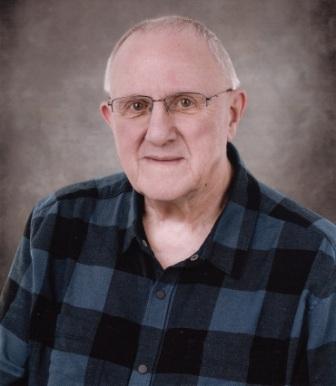
Shana Pankratz. (Photo courtesy of Shana Pankratz)
Thank you to Shana Pankratz for providing information about her father, to Judie Klassen for her help in the search for a photo and finding family, to author Oliver Clutton-Brock, who included a photo of Henry in his book ‘The Long Road: Trials and Tribulations of Airmen Prisoners from Stalag Luft VII (Bankau) to Berlin, June 1944 – May 1945‘, to Shawn Rainville for newspaper searches, to Yannic Wethly for providing information on what happened on the night of December 6, 1944, and to Wendy Nattress for preparing the map showing the flight path for Halifax NP945. Thank you also to Jacqueline and Graham Hocking for telephoning Oliver Clutton-Brock and telling him about the photo search request.
Pieter’s research efforts to find photos and families of soldiers continue. Do you have a story to tell? Email Pieter at memorialtrail@gmail.com, or comment on the blog.
© Daria Valkenburg
….Want to follow our research?…
If you are reading this posting, but aren’t following our research, you are welcome to do so. Our blog address: https://onthewarmemorialtrail.com/
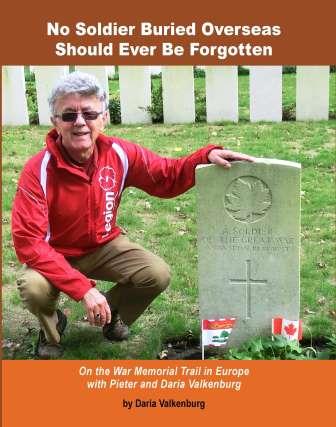
4 countries, 6 weeks, 7,000 km – an unforgettable war memorial journey in Europe…. Daria’s book ‘No Soldier Buried Overseas Should Ever Be Forgotten‘ is available in print and e-book formats. Net proceeds of book sales help support research costs and the cost of maintaining this blog. For more information see https://nosoldierforgotten.com/
Subscribe to our YouTube Channel: On The War Memorial Trail With Pieter Valkenburg: https://www.youtube.com/channel/UCJ591TyjSheOR-Cb_Gs_5Kw.
Never miss a posting! Subscribe below to have each new story from the war memorial trail delivered to your inbox.

 4 countries, 6 weeks, 7,000 km – an unforgettable war memorial journey in Europe….

