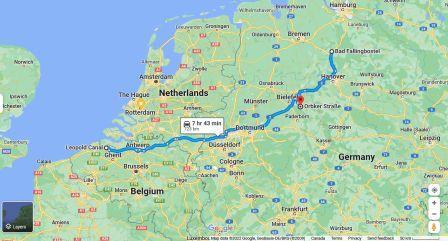
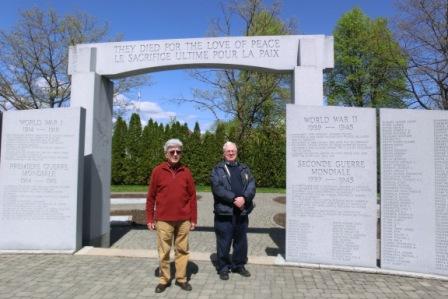
On The War Memorial Trail….. The Airman From Langham Who Became A POW Part 2: Six Months Behind Barbed Wire

November 1, 2026.  In Part 1 of ‘The Airman From Langham Who Became A POW’, a request by one of the volunteers with Stichting Luchtoorlog Onderzoek Drenthe (Air Research Drenthe Foundation) in The Netherlands for help in finding a photo of Henry ‘Hank’ PANKRATZ, was successful.  Born in Langham, Saskatchewan, Hank was one of four survivors of the last flight of 424 ‘Tiger’ Squadron’s Halifax NP945. The plane had been shot down in Getelo, in the vicinity of Uelzen, Germany, near the Dutch border, on the evening of December 6, 1944, while returning from a sortie to Osnabrück, Germany.

After the pilot gave the order to jump, Hank exited the plane, and sought refuge at a nearby farm for a few hours, before being taken by the farmer to the police station in Uelzen. (See https://onthewarmemorialtrail.com/2026/10/30/on-the-war-memorial-trail-the-airman-from-langham-who-became-a-pow-part-1-the-last-flight-of-halifax-np945/)

Now, in Part 2, Hank’s story continues as he spends the remainder of WWII as a prisoner of war….

…. Hank learned three members of his crew had survived and three had not…

In ‘Road Back Complicated’ published in the March 1983 issue of Airforce magazine, after being left at the police station in Uelzen by the farmer from the farm Hank had initially approached, he was taken by a policeman to a nearby town and placed in a cell. “…On a filthy bed in one corner I tried to sleep…” Not long afterward he “…heard someone yelling in English ‘I’m hungry’ and recognized my bombardier’s voice….”  This was Arthur Alexander Jaffray LOW, from Hamilton, Ontario.

Shouting through the thick walls to make themselves heard, they were soon told by their gaoler to keep quiet, but at least Hank had learned that “…the engineer….” Robert ATKINSON, from Barrowfield Glasgow, Scotland, “…was with the bombardier in the same cell. They had been there since the previous night, having been captured shortly after they had landed. Both had lost their flying boots, had walked five or six miles in their socks and were in agony…”

When the door to his cell was unlocked, a hungry Hank thought he might get fed. Instead, he and the other two crewmen “…were put in the back of a truck with three crude coffins…” and heavily guarded as the truck began its journey. At first they thought the coffins were for their execution, but when more coffins were picked up along the way, they realized that the coffins contained bodies.

They were taken to an airport guardhouse, joined by 5 other men, and were finally given something to eat and drink.  “...Early next evening our navigator…” Albert Melville GARNER, from Toronto, Ontario, “…was brought in. He had a badly sprained ankle and looked quite done in. The Germans told him three members of our crew had been killed – that would have been the pilot and the gunners…”

….Hank was sent to an interrogation camp in Oberursel…

Soon the prisoners of war were on the move, and after several days of travel by truck and train, arrived at Dulug Luft Oberursel in Oberursel, just north-west of Frankfurt, “…where the interrogation camp was situated. The barbed wire, armed guards, and high towers that housed machine guns and powerful searchlights offered a dismal prospect…”

They were strip-searched, then placed in “….individual cells about 5 by 10 feet….” with a bed, chair, and window.  “…There was a small electric radiator which was on only about three hours a day, and when it was on, the lice in the straw sack on my bed attacked like fighter pilots. When it was off I almost froze to death…”

Hank was photographed, finger-printed, interrogated where he provided no information at each session, and kept in solitary confinement for a week. “…Breakfast consisted of two slices of black bread with jam, and a cup of lukewarm liquid they called coffee. For lunch we got cups of soup which to my mind contained every variety of grass grown in Germany. Dinner was a repetition of breakfast except that margarine replaced the jam….”

After a week, he was interrogated again, but with a different approach.  “…A smartly dressed Luftwaffe officer ….courteously bade me sit down.  He spoke faultless English and was so polite I felt uncomfortable…”  Opening a large book, the officer seemed to know everything – or pretended to – and stated that he only wanted confirmation.

The next morning, Hank, along with 45 other prisoners, was sent to a Dulag Luft Wetzlar, a transit and rest camp for prisoners of war who had completed their initial interrogation at Oberursel. For the first time since the crash, he was able to shower, and was provided clothes and accessories from the Red Cross. “…We could eat as much as we wanted, which was ok by me…”
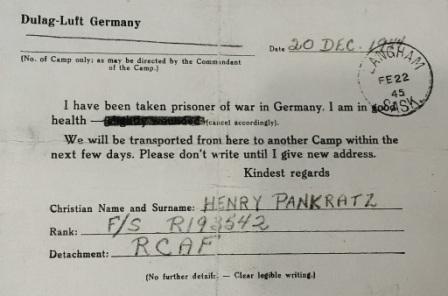
Postcard dated December 20, 1944 took until February 22, 1945 to arrive back home in Saskatchewan. (Postcard courtesy of Shana Pankratz)

Hank was allowed to send a postcard on December 20, 1944, advising that he was a POW, but the family never received it until February 22, 1945!

….Hank was sent to Stalag VII in Bankau…
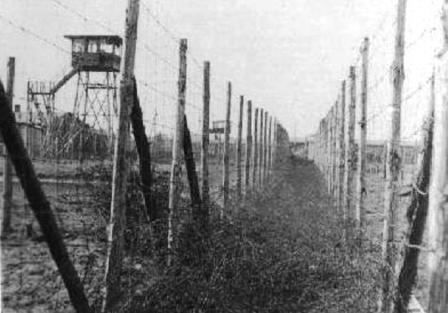
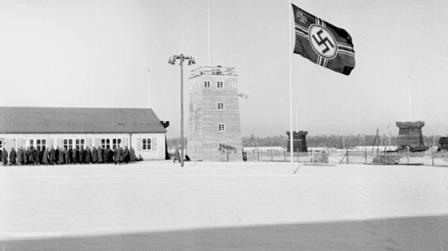
Two rows of barbed wire fencing and guard towers prohibited escape from Stalag Luft VII. (Photo source: Wartime diary of Robert E. Toomey via John Knifton)

After 4 days, Hank and 43 other men were on their way by train to a “…permanent prison camp, a trip of three days, and each of us was issued the contents of a Red Cross parcel….”  Shortly after getting underway, the train pulled into a siding and a guard told them that they would be stuck in the train for 48 hours unless they handed over cigarettes. “….None of us was anxious to spend Christmas on wooden seats looking through the bars of a train, so we excelled ourselves and each threw two cigs in a hat…”

The bribe worked. “….Within ten minutes we were rolling and never stopped until we reached Bankau, our destination. From here we marched to Stalag Luft VII, two or three miles away, arriving around five in the afternoon on December 26…” Bankau, Silesia, Germany, is now named Bąków and in present-day Poland.

The camp held about 1,500 men and was divided into 10 barrack blocks. Each block had 18 rooms, and each room held 18 men. “…Although life in the camp was very monotonous, and the food shortage gave us concern, we managed to keep in fairly good spirits. Through secret radios we were able to follow the day-to-day progress of the war. These radios were so well hidden that the Germans never found them, despite the searches they made…”

There was a roll call every morning and at 3 pm in the afternoon, with lights out at 10 pm.  Hank noted that they were grateful for “…the fairly substantial library maintained at the camp by the Red Cross, also the musical instruments supplied by that splendid organization…”

….The 21 day march from Stalag VII in Bankau to Stalag III-A in Luckenwalde was brutal…
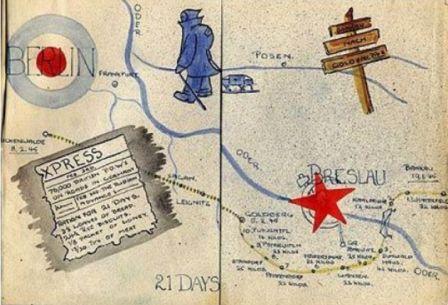
Map made by Airman Thomas Cloran showed the 21 day march from Bankau to Luckenwalde.  (Map source: https://www.49squadron.co.uk/pow_camps/detail/5)

Hank wasn’t destined to remain very long at Stalag Luft VII as the camp was in the direct path of the advancing Russians heading for Berlin.  “…On the afternoon of January 17, 1945, we were ordered to move off on foot within the hour….” Nothing happened, but “…that night was really grim – bombing on all sides revealed that the Russians were much closer than we had suspected…”

At 3.30 am on January 19, 1945, 1,500 prisoners of war were marched out of the camp in bitterly cold -13ºC (8oF) and into a raging blizzard. They left, with “…each man carrying what few belongings he had and enough food for one good meal…”

The prisoners were threatened that for every man falling out of the column a further five would be shot.  “…Heavily-armed guards and trained dogs galore accompanied us, the roads were in bad shape, and a blinding snow-storm pressed down on us as we trudged on…”

No further food was provided until the fifth day. “…We marched from 15 to 25 kms a day and spent our nights in the farms of the various farms we passed… A number of the boys escaped, others just died on the way, while nearly all suffered frost-bite….”

There was urgency to the march as the men had to cross a bridge over the Oder River before German sappers blew it up. “…No sooner were we on the other side of the Oder river than the Germans blew the bridge up….”

“…We had an all-day rest at a big dairy farm…” but hunger was top of mind. “…Everyone was delirious with hunger…. we drove some cattle away and ate what was left of a pile of frozen, dirty, rotten sugar beets. As a result we all got dysentery….”

The punishing march continued. “…After a hard day’s march on Jan 29 we were told that the trip would be completed by train. Sagan, our first objective, was being evacuated and no one knew where we were going. All that we knew was we were damned tired and hungry. However, after about six hours’ rest we started out again and marched to Peterwitz. There was no sign of a train, the guards were in a dangerous mood, each of us got only one sixth of a loaf of bread, and the weather was at its worst….”

On February 5, 1945, after a march of over 200 km (124 miles) and suffering from dysentery, malnutrition and frostbite, they reached the Goldberg marshalling yards (now Złotoryja, Poland). From here they were taken in cramped cattle trucks to camps deeper inside Germany to their new destination:  Stalag III-A, about 52 km (32 miles) south of Berlin near Luckenwalde, which already held 20,000 prisoners.

They arrived in Luckenwalde on February 8, 1945 and then walked the rest of the way to Stalag III-A. “…In 14 days on three pounds of food each…” during the long walk, “…. I lost about 50 pounds and was as weak as a kitten….” and “… had trouble standing up...”

A report on the forced march by D.C. Howatson, Royal Army Medical Corps (RAMC), the Camp Medical Officer, to the Swiss Commission verifies the terrible conditions experienced by the prisoners of war.  See https://www.pegasusarchive.org/pow/cSL_7_History1.htm

 ….Hank spent the rest of his time as a POW at Stalag III-A in Luckenwalde…

Hank described how the men were segregated according to nationality. “…Stalag III-A held some 16,000 men made up of seven or eight nationalities which were segregated by fences within the main enclosure. The Americans were west of us, the French to our east, and across the road were the Poles, Russians, Yugoslavs and others….”
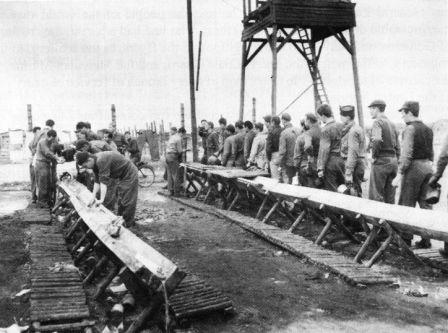
POWs washing up at a trough in Stalag III-A. (Photo source: Wartime diary of Robert E. Toomey via Leo Finegold)

Conditions were not good, but were bearable. “…At this camp we had a hot shower, my fourth in Germany, and were crowded into barracks. We slept on the bare floor rather than use the straw which was teeming with lice ready to go to work on you…”

And they did receive food on a daily basis. “…The ration consisted of one-fifth of a loaf of bread, three or four boiled potatoes, two cups of soup – pea, turnip, barley or just plain grass, which wasn’t bad considering, and one-twentieth pound of margarine....”

The long march and conditions in the camp began to take a toll. “…Our boys began dropping out like poisoned flies about this time. It seemed as if the effects of the march were just catching up with us. We lost about 200 on the march, and every day now saw more die until it got that we kept wondering who would be next….” Approximately 5,000 men in total died from disease, starvation, cold, exhaustion, and neglect at this overcrowded camp.

Hank described the reaction of the prisoners when a Red Cross parcel arrived. “…On March 8, a carload of Red Cross supplies arrived at Luckenwalde, and each man got a full parcel. Just like Christmas. Kind of grim though to see grown men break down and weep over a few pounds of food…”

….The Germans deserted Stalag III-A on April 21, 1945…

Hank and the other prisoners realized that something had changed on April 21, 1945. “…We noticed that all the gun towers were vacant and that no Jerries were in sight. They had decamped, leaving us alone. Well aware that Russian prisoners had been badly mistreated by them, they were scared stiff of their approaching eastern foe.….”

The Russian Army arrived on April 22, 1945.  “…The following morning the Red Army rolled into camp on tanks, trucks, motorcycles, guys on horseback, even bicycles….”

The prisoners thought they would be liberated, but it turned out they were now held hostage by the Russians.  “….Time dragged on, with the Russians refusing to let us go home. When the Red Cross parcels gave out, our diet consisted of bean soup and black bread….

 …One day a large convoy of American trucks came along and offered to take us into their zone, then fly us back to England. However, the Russians vetoed that. They blocked all roads and posted machine guns at intersections, threatening to open fire if the loaded trucks moved. The trucks went back empty….

…According to the Russians they were to receive certain repatriations from the British government for every man they released….”

….Hank was freed on May 20, 1945…

Almost a month after the Russians came into the camp, Hank and the other men were finally freed.  “…Finally, on May 20, a convoy of Russian trucks drove us to the American Zone. At Halle that same evening we were accorded a wonderful reception…

…On May 25 we were flown from Halle to a Canadian ex-POW camp near Brussels, and the following evening from there to Ford, England. Never was a landing more welcome! From Ford we drove in trucks to Bournemouth on the south coast of England, arriving about midnight. The next day (May 27) this kid took it easy, and 48 hours later was on a bang-up two-weeks’ holiday…”

…. Hank returned to Canada in July 1945…
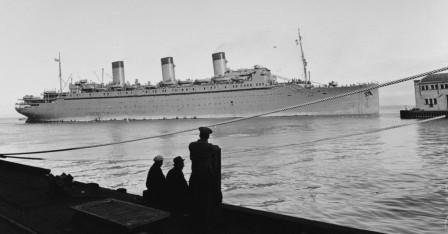
SS Île de France during WWII. (Source: Naval History and Heritage Command)

On July 8, 1945, Hank boarded the SS Île de France in Greenock, Scotland for his return to Canada, and arrived in Halifax, Nova Scotia on July 14, 1945.  The war was over for Hank, but he would return to Germany several years later.

His daughter Shana explained that after his discharge, Hank “…joined the RCMP, and was posted to Camrose, Alberta, where he met my mother, Audrey Carruthers.  She was 17, and they married in 1948, when she was 18…”
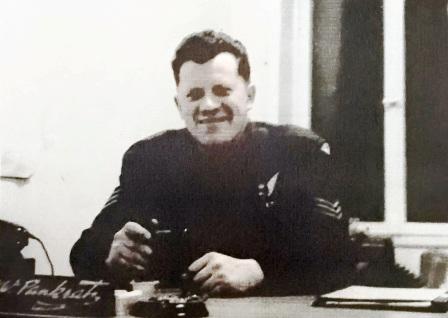
Hank Pankratz in Germany with the RCAF. (Photo courtesy of Shana Pankratz. Photo restoration by Pieter Valkenburg)

After leaving the RCMP (Royal Canadian Mounted Police), Hank rejoined the RCAF (Royal Canadian Air Force), this time as a military police officer. He was sent to Goose Bay in Labrador, and then to Edmonton, Alberta, where Shana was born. From 1953 to 1955, Hank served at 4(F) Wing in Baden, Germany. He was also stationed in Rivers, Manitoba, and was a Flight Sergeant with 447 Squadron at the Bomarc base in La Macaza, Quebec.

In ‘447 SAM Squadron some early memories’ author  Bob Merrick explained that “…the RCAF entered the missile age in 1962, when it acquired two half-squadrons of Boeing’s Michigan Air Research Centre (Bomarc) missiles. The missiles guarded Canadian and American industrial centres – and American ICBM sites – from attacks by the nuclear-equipped Soviet long-range air force. 446 Surface-to-Air Missile (SAM) Squadron, based near North Bay, Ontario, began its training first, followed by 447 SAM Squadron, based at RCAF Station La Macaza, Quebec. 447 became the world’s only self-sufficient Bomarc squadron, as all the others were adjuncts of various USAF or RCAF bases….”

He went on note that “…Security played an important role in squadron operations…FS Hank Pankratz oversaw security operations, and no one ever succeeded in stealing a Bomarc…..” (See https://www.candemuseum.org/sites/default/files/archives/Pinetreeline/misc/bomarc/bomarc2d.html)

From Quebec he was stationed in Ottawa, Ontario. After retiring from the RCAF, he continued working.  “…He was at General Motor Acceptance Corporation, then Ontario Hydro…”

Shana recalled that her father “…loved soup.  He would prep the veggies, and my mother would make soup after her breakfast….”

Hank died of leukemia, aged 72, in Oshawa, Ontario on August 4, 1996.  “….After the funeral service in the chapel at Thornton Cemetery in Oshawa, he was cremated and his ashes spread in the Niagara region. Dad had been fascinated with Niagara Falls since he first went to Ontario back in the early 1940s, and Mom and I took him there 5 times before he went into hospital just before he passed away…”
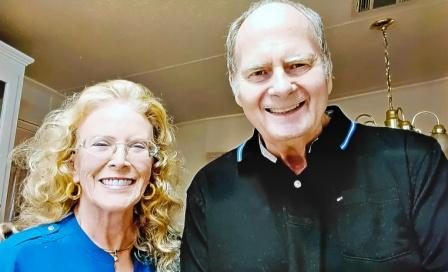
Shana Pankratz and partner Doug Hutton.  (Photo courtesy of Shana Pankratz)

Hank’s brother Bill returned safely from the war, as did his three crewmates.  Albert Garner died in 1994, and Arthur Low in 2008.  Both had been in Stalag Luft I near Barth, Germany. Robert Atkinson was the only crewmember who was in both Bankau and Luckenwalde with Hank.

Thank you to Shana Pankratz for providing information about her father, to Judie Klassen for her help in the search for Hank’s post-war career, and to Shawn Rainville for newspaper searches.

Pieter’s research efforts to find photos and families of soldiers continue. Do you have a story to tell? Email Pieter at memorialtrail@gmail.com, or comment on the blog.

© Daria Valkenburg

….Want to follow our research?…

If you are reading this posting, but aren’t following our research, you are welcome to do so.  Our blog address: https://onthewarmemorialtrail.com/
4 countries, 6 weeks, 7,000 km – an unforgettable war memorial journey in Europe…. Daria’s book ‘No Soldier Buried Overseas Should Ever Be Forgotten‘ is available in print and e-book formats.  Net proceeds of book sales help support research costs and the cost of maintaining this blog. For more information see https://nosoldierforgotten.com/

Subscribe to our YouTube Channel: On The War Memorial Trail With Pieter Valkenburg: https://www.youtube.com/channel/UCJ591TyjSheOR-Cb_Gs_5Kw.

Never miss a posting!  Subscribe below to have each new story from the war memorial trail delivered to your inbox.

On The War Memorial Trail…..The Airman From Langham Who Became A POW Part 1: The Last Flight Of Halifax NP945

October 30, 2026.  Occasionally, one story leads to more.  In February 2023, we posted on this blog the story about Jack ‘Douglas’ MACKENZIE, of Winnipeg, Manitoba, the pilot of Halifax DT630 that was shot down by a night fighter over the province of Drenthe in The Netherlands on February 3, 1943. (See https://onthewarmemorialtrail.com/2023/02/19/on-the-war-memorial-trail-the-wwii-pilot-killed-at-the-controls-of-his-halifax-bomber/)

A few months later, we were contacted by Yannic Wethly, one of the volunteers with Stichting Luchtoorlog Onderzoek Drenthe (Air Research Drenthe Foundation) in The Netherlands. This non-profit organization researches WWII air crashes in the province and places information panels near the crash sites.

Yannic asked if we would help in finding photos and families of other Canadian airmen that were on his photo wish list.  Of course we said yes, and then we were delighted to have a chance to meet him in April 2025, when we were in The Netherlands on our 2025 European War Memorial Tour.  (See https://onthewarmemorialtrail.com/2025/06/15/on-the-war-memorial-trail-a-visit-to-sleen-general-cemetery/)

In January 2026, a memorial panel honouring the crew of Halifax DT630, was unveiled, closing the loop on the story about that flight’s pilot.  (See https://onthewarmemorialtrail.com/2026/03/18/on-the-war-memorial-panela-memorial-panel-honours-the-crew-on-the-last-flight-of-halifax-dt630/)

….The search for a photo of Hank Pankratz began…

On Yannic’s photo wish list was Henry ‘Hank’ PANKRATZ, one of four survivors of the last flight of 424 ‘Tiger’ Squadron’s Halifax NP945, which was shot down in Germany, near the Dutch border, on December 6, 1944, while on its return from a sortie to Osnabrück, Germany.  Hank ended up in a POW camp, and it was this that led to a photo being found.

During the search for a photo and family, with the help of Judie Klassen, she came across a reference to Hank in a book, ‘The Long Road: Trials and Tribulations of Airmen Prisoners from Stalag Luft VII (Bankau) to Berlin, June 1944 – May 1945‘, written by  Oliver Clutton-Brock, a British writer who had included a photo in his book.

Henry ‘Hank’ Pankratz. (Photo source: Henry Pankratz)

An email for the author came back as no longer in use, but there was a phone number, which hopefully still was in service.  I emailed British friends Jacqueline and Graham Hocking and asked if they would be willing to try and phone the author, and let him know about the photo search request.  Jacqueline did and we did receive a photo!

When I asked Oliver how he wanted the photo attributed, he said it should be Henry Pankratz himself.  “…He contacted my co-author, Ray Crompton (sadly deceased), back in the late 1980s / early 90s and sent him the photo….”

When told about the planned memorial panel by the Air Research Drenthe Foundation, Oliver went on to say that “…I am delighted to hear that the photo will be used for such a worthy cause. I have nothing but the highest praise and admiration for the way in which the Dutch historians and ordinary people go about remembering the fallen of so long ago. Well done to all of you….“

We had a photo, but the search for family continued, and many months later, Hank’s daughter Shana contacted us, providing more photos and information about her father.

…. Hank enlisted in 1942…

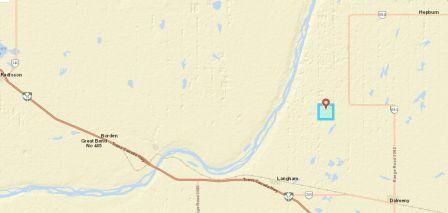
Red marker identifies the location near Langham, Saskatchewan where Henry Pankratz was born. (Map source: Sask Interactive Mapping, Saskatchewan Ministry of Environment)

Born February 22, 1924 on a farm near Langham, Saskatchewan, Hank was the son of Wilhelm Heinrich (‘William Henry’) and Maria (nee Buhr) Pankratz. One of 5 children born into a Mennonite family that had immigrated to Canada from Eastern Europe, he had two sisters and two brothers.

“…The family’s origins were in Holland…” Shana explained “…and the surname was originally Van Kratz.  They went farming to Ukraine and the surname was changed to Pankratz by the Russians….”

Hank was interested in planes as a child, even writing a letter in the August 27, 1932 edition of the Star-Phoenix newspaper, about the first plane he saw. “…The first airplane I saw close by was on July 1, 1929, at Davidson, Saskatchewan, where we lived at the time.  It was a two-passenger open plane from Saskatoon to take people for rides….The pilot said he had flown about 120 miles an hour from Saskatoon….

The reason I am interested in aviation is because of the speed, the greater the speed, the better I like it, and the cool clean air one goes in.  If you are a farmer you do not get this kind of air…”

On September 6, 1942, at the age of 18, Hank enlisted with the RCAF (Royal Canadian Air Force) as a wireless operator/air gunner in Galt, Ontario. His brother Bill also joined the RCAF. Judie Klassen, who helped in the search for family and a photo, understood what “…must have been a difficult decision for them to join, as the pacifist beliefs of the Mennonite community may have caused conflict with family, neighbors, or within their conscience….”

The Pankratz brothers weren’t the only Mennonites to enlist in WWII.  In the October 13, 2013 issue of Canadian Mennonite, the article ‘Let nobody judge them’ by Ross W. Muir, stated that “…as many as 4,500 Canadian Mennonites enlisted in this country’s military forces between 1939 and 1945….”

Henry ‘Hank’ Pankratz with his parents.  (Photo courtesy of Shana Pankratz.  Photo restoration by Pieter Valkenburg)

Hank received his Leading Aircraftman designation (LAC) in Guelph, Ontario on February 22, 1943, his 19th birthday.  On September 20, 1943, he received the rank of Sergeant after graduating as a wireless operator/air gunner at the No. 2 Bombing and Gunnery School in Mossbank, Saskatchewan.

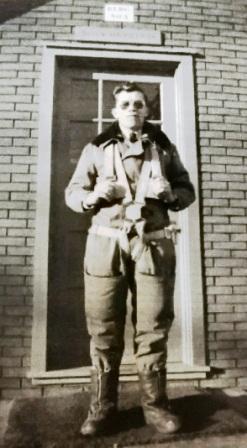
He was soon sent to the United Kingdom. A photo of himself in a flight suit included a comment on the back of the photo.  “…Don’t let this picture fool you. I’m not a fighter pilot yet, but I can dream, can’t I?  Ha Ha….”

Henry ‘Hank’ Pankratz in a flight suit. (Photo courtesy of Shana Pankratz)

…. The last flight of Halifax NP945…

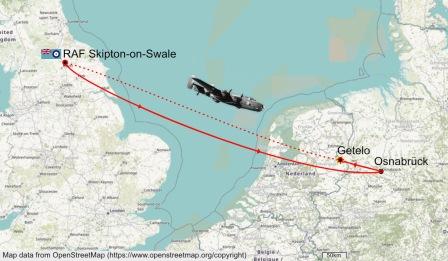
Map shows the plane’s path from England to Osnabrück.  On it’s return to England, it was shot down by German flak and crashed near Getelo, Germany near the border with The Netherlands.  (Map prepared by Wendy Nattress)

On December 6, 1944, Hank, now with the Royal Canadian Air Force’s 424 ‘Tiger’ Squadron, part of No. 6 Bomber Group, was aboard Halifax NP945, nicknamed ‘Der Fuehrers Fate’, as it and 435 Halifax and Lancaster bombers, plus 18 Mosquitos, were sent on a bombing mission for a night attack over Osnabrück, Germany.  The plane departed at 4:43 pm from  ​RAF Skipton-on-Swale in the UK, located 4 miles west of Thirsk in North Yorkshire, England.

Per the ‘The Bomber Command War Diaries: An Operational Reference Book, 1939–1945’ by Martin Middlebrook and Chris Everitt, “…this was the first major raid on Osnabrück since August 1942. The raid was only a partial success. The railway yards were only slightly damaged but 4 factories were hit, including the Teuto-Metallwerke munitions factory, and 203 houses were, destroyed, and 39 people were killed….”

As the plane began the return flight to England, it was shot down near Getelo, in the vicinity of Uelzen, located in Lower Saxony, Germany, right along the border with​ The Netherlands. ​

In ‘Road Back Complicated’ published in the March 1983 issue of Airforce magazine, Hank explained that “…Our machine caught fire and the pilot gave the order to jump.  I was the third to go out into space and rain. My parachute opened inside the plane which was badly out of control by then but luckily it didn’t get tangled.…”

…. The crew aboard the last flight of Halifax NP945…

7 airmen were aboard Halifax NP945.  3 died and are now buried in Reichswald Forest War Cemetery in Kleve, Germany.  4 airmen, including Hank, survived the crash and ended up prisoners of war (POWs).

  • Pilot: RCAF Flight Officer David Louis Caskey MCCULLOUGH, from Red Deer, Alberta, aged 22, KIA
  • Navigator: RCAF Flight Officer Albert Melville GARNER, from Toronto, Ontario, aged 23, POW
  • Bomb Aimer: RCAF Flight Officer Arthur Alexander Jaffray LOW, from Hamilton, Ontario, POW
  • Flight Engineer: RAF Sgt Robert ATKINSON, from Barrowfield Glasgow, Scotland, POW
  • Wireless Operator: RCAF Pilot Officer Henry ‘Hank’ PANKRATZ, from Langham, Saskatchewan, POW
  • Midupper Gunner: RCAF Pilot Officer John Robert ‘Jack’ LEE, from Caledonia, Ontario, aged 20, KIA
  • Rear gunner: RCAF Pilot Officer John Lightfoot KEOWN, from Fairfax, Manitoba, aged 25, KIA

…. Hank sought refuge at a nearby farm…

As Hank exited the plane he noticed that “…falling not far away from me was a big ball of fire.  It was the aircraft I had just vacated, and a moment later it blew up and went hurtling to the ground.…”  At this point, he had no idea where the other crew members were, and he found himself alone.

After freeing himself from the parachute harness, Hank “…sought shelter in a nearby clump of trees…” where he remained until dawn. He noticed “…a farmhouse a quarter of a mile away…” and walked over.  “…The house and barn were all one building.  The barn door was locked, so I sat down to wait…”

A few hours later, the farm couple found him, and took him inside the house to get warm. As Hank could speak German, he was able to communicate, and learned that he was “...near the town of Uelzen, about 10 miles from the Dutch border…”  He was there for 2 hours, during which time the farm family considered hiding him, but were worried what would happen if they were caught.

“…They made me their prisoner and decided to hand me over to the authorities…It was all done in a friendly manner and I was assured that the prisoners were well treated in German prison camps…”  This turned out to be not exactly true, as Hank would find out.

The farmer took him to Uelzen, and everyone they passed enroute to the police station “…came up and had something to say.  The farmer told them he had captured me this morning and that I couldn’t understand a word of German….” Not letting on that Hank could understand and speak German was a wise move.

Hank had survived the crash, and found temporary refuge at a nearby farm, but he now faced another ordeal, as a prisoner of war.  Hank’s story concludes in Part 2 as he found that life in a German POW camp was “…humdrum, unpredictable, and unbearable…” with many more challenges to face before finally being liberated, several weeks after WWII ended in Europe.

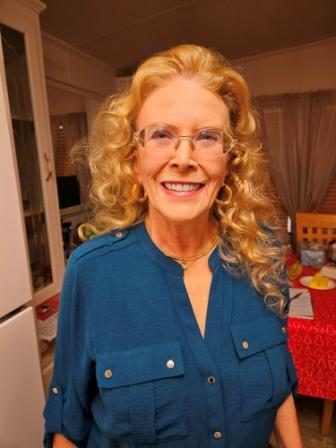
Shana Pankratz.  (Photo courtesy of Shana Pankratz)

Thank you to Shana Pankratz for providing information about her father, to Judie Klassen for her help in the search for a photo and finding family, to author Oliver Clutton-Brock, who included a photo of Henry in his book ‘The Long Road: Trials and Tribulations of Airmen Prisoners from Stalag Luft VII (Bankau) to Berlin, June 1944 – May 1945‘, to Shawn Rainville for newspaper searches, to Yannic Wethly for providing information on what happened on the night of December 6, 1944, and to Wendy Nattress for preparing the map showing the flight path for Halifax NP945. Thank you also to Jacqueline and Graham Hocking for telephoning Oliver Clutton-Brock and telling him about the photo search request.

Pieter’s research efforts to find photos and families of soldiers continue. Do you have a story to tell? Email Pieter at memorialtrail@gmail.com, or comment on the blog.

© Daria Valkenburg

….Want to follow our research?…

If you are reading this posting, but aren’t following our research, you are welcome to do so.  Our blog address: https://onthewarmemorialtrail.com/

4 countries, 6 weeks, 7,000 km – an unforgettable war memorial journey in Europe…. Daria’s book ‘No Soldier Buried Overseas Should Ever Be Forgotten‘ is available in print and e-book formats.  Net proceeds of book sales help support research costs and the cost of maintaining this blog. For more information see https://nosoldierforgotten.com/

Subscribe to our YouTube Channel: On The War Memorial Trail With Pieter Valkenburg: https://www.youtube.com/channel/UCJ591TyjSheOR-Cb_Gs_5Kw.

Never miss a posting!  Subscribe below to have each new story from the war memorial trail delivered to your inbox.

On The War Memorial Trail….. The POW Who Raised Horses In PEI Part 3….Three Years In A DP Camp Before Finally Finding Freedom

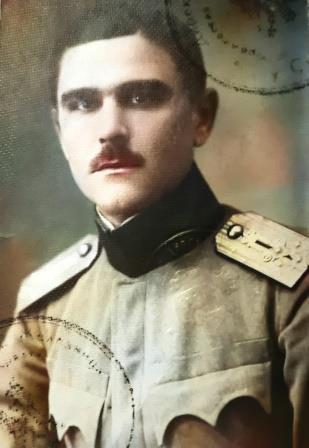
Nikola Ostojic. (Photo courtesy of the Nikola Ostojic Family.  Photo colourization by Pieter Valkenburg)

February 28, 2025. In Part 1, the active WWI and WWII military service of Croatian-born Nikola ‘Nick’ OSTOJIC, grandfather of Bedeque resident Liz Hubert, came to a halt when the Royal Yugoslav Army surrendered on April 17, 1941 and Nikola became a prisoner of war in Germany. (See https://onthewarmemorialtrail.com/2025/02/20/on-the-war-memorial-trail-the-pow-who-raised-horses-in-pei-part-1-the-serbian-colonel-who-was-a-pow-in-oflag-xiii-b/)

In Part 2, Nikola spent 4 years in a German POW camp until he was among the POWs liberated on April 6, 1945 by American troops. (See https://onthewarmemorialtrail.com/2025/02/23/on-the-war-memorial-trail-the-pow-who-raised-horses-in-pei-part-2-four-years-as-a-pow-in-oflag-xiii-b/)

Now, in Part 3, Nikola’s story concludes with the long road ahead of him before finally finding freedom and a new life in Prince Edward Island, and later Ontario, in Canada. 

….Nikola became a Displaced Person in Austria….

After 4 years in a POW camp, Nikola had to make a decision once he was liberated – whether to return to Serbia – now part of Yugoslavia and under Communist rule, or refuse repatriation.  Nikola refused to be repatriated. 

Map shows location of Hammelburg where Oflag XIII B was located, Moosburg, where the liberated POWs marched towards, and St Johann im Pongau, where Nikola lived in a DP camp.  (Map source: Google maps)

After being liberated from the POW Camp Oflag XIII B on April 6, 1945, it appears that he went his own way, as many former POWs did.  According to a report on the Liberation of Stalag 7A in Moosburg, written by Col. Paul Goode, the Senior American Officer at Oflag XIII B, after liberation, the group of freed POWs “….stayed at Hammelburg about a week, and then was marched to Stalag A, Moosburg.  It took 15 days to cover about 90 miles. There was no particular attempt at control, and escape was extremely easy, and many officers did escape, and many more just wandered off to live in the country and were ultimately picked up by the SS…”

Liz believed that Nikola was among the officers who escaped “….with another officer and was then taken by the British Army….”  No record is left of what his plans were, but perhaps he had intentions of travelling towards Serbia to find his family.  If that was the case, he never got there.

On June 23, 1945 he entered Austria, and 2 days later became a resident of the UNDP-led Camp XVIII C in Markt-Pongau, now known as Sankt Johann im Pongau, a small town south of Salzburg.  According to the information provided when Nikola entered the camp, he spoke Serbo-Croatian, English, German, and Russian. 

As a displaced persons camp in the American Zone, Pongau had a large number of Jewish refugees, as well as former POWs, like Nikola, who didn’t want to be repatriated.  During WWII, it had been Stalag 18 C, a prisoner of war camp. 

The Markt-Pongau POW Camp in May 1945. (Photo source: http://www.stalag18a.org)

After WWII ended, the former Nazi territories had been divided into British, American, and French Zones.  (See https://en.wikipedia.org/wiki/Allied-occupied_Austria)

Post WWII Austria Occupation Zones. Pongau fell under Salzburg.  (Map source:  https://commons.wikimedia.org/w/index.php?curid=95563608)

….Nikola left Continental Europe….

Nikola remained in the camp in Pongau until April 21, 1948, when he was deemed eligible to immigrate to the United Kingdom.

Nikola arrived in Halifax aboard the ‘Neptunia’.  (Photo source: www. http://ssmaritime.com)

On May 24, 1952 he immigrated again, leaving Southampton, England aboard the Greek Line T.S.S. ‘Neptunia’, and arriving in Halifax, Nova Scotia, Canada.  He was 55 years old. 

He most likely had been sponsored by Pero Bulat, who had been born in the same province of Banija, but immigrated to Canada in 1926, and became the publisher of ‘The Voice of Canadian Serbs’. On April 22, 1947, he’d visited Ottawa with Bishop Dionisije Milivojević to ask Canadian authorities to permit 10,000 out of the 80,000 displaced Serbs in Western Europe to enter Canada.  (See https://wikitia.com/wiki/Pero_Bulat)

….Nikola found peace of mind while raising horses….

Nikola (identified by red arrow) in St Peters Bay, Prince Edward Island.  (Photo courtesy of the Nikola Ostojic Family)

Once in Canada, Nikola moved to Prince Edward Island, where he settled on a farm in St Peters Bay, and raised horses. Liz explained that the quieter Island life and working with horses helped him find peace of mind.

He had never forgotten his wife and daughter.  He had “…connected with them only after he arrived to England. Once he got to PEI he sent for them. They traveled via boat to Canada….” said Liz.  “….My mother said they landed in Montreal by boat…”

While Nikola found peace of mind on the Island, his wife Marija found it too quiet. The family moved to Windsor, Ontario, where Pero Bulat lived.  “…In 1962 he was in Windsor.  Pero was very influential and a great supporter of my grandfather…”

Liz recalled that Nikola worked as a bartender into his early 70s, probably at Europe Tavern, one of the many businesses owned by Pero Bulat. Unfortunately, Nikola’s PTSD never left him.  “…Both my grandmother and mother said that his screaming at night never ceased….” 

Nikola died on September 17, 1972 at Hotel Dieu Hospital in Windsor, Ontario, aged 76, and is buried in the Windsor Memorial Gardens.  His 1972 obituary in the ‘Voice of Canadian Serbs’ summed up how so many felt about Nikola.  “….Everyone who knew him, thought that his zest for life, vitality, and physical endurance and strength were invincible…At the cemetery, final words to the Colonel were given by the famous Nationalist Pero Bulat with heartwarming words of the man who arrived in Canada and his lifework: ‘this is how we lost another unbeatable national fighter’….”

….Reflections from Nikola’s granddaughter….

Daria (standing) with Liz Hubert. (Photo credit: Pieter Valkenburg)

Researching the story of Nikola Ostojic was done with the active assistance of Liz Hubert and her brother Alexander.  Liz’s reaction was similar to that of what Pieter and I experienced when we researched my father’s WWII story.  “… It was so difficult to see, it’s so real now I feel like I’m living it….” 

As we came to the end of Nikola’s story, Liz expressed her “…reflecting thoughts on this experience with my grandfather….As a child, the towering presence of my Grandfather shone over me like a guiding beacon, inspiring awe and reverence. Throughout this process of discovery of the man he truly was, as an adult, I came to appreciate the complexity, struggles, triumphs, and passions of his life. Understanding him allowed me to understand myself, instilling a sense of responsibility, empathy, and gratitude…” 

Thank you to Liz Hubert for sharing photos and information on her grandfather, and translating his obituary into English. If you have a story or photo to share, please contact Pieter at memorialtrail@gmail.com or comment on the blog. 

© Daria Valkenburg

 ….Previous stories about WWII POWs….

To read previous stories about WWII POWs see:

 ….Want to follow our research?….

If you are reading this posting, but aren’t following our research, you are welcome to do so.  Our blog address: https://onthewarmemorialtrail.com/

4 countries, 6 weeks, 7,000 km – an unforgettable war memorial journey in Europe…. Daria’s book ‘No Soldier Buried Overseas Should Ever Be Forgotten‘ is available in print and e-book formats.  Net proceeds of book sales help support research costs and the cost of maintaining this blog. For more information see https://nosoldierforgotten.com/

You are also invited to subscribe to our YouTube Channel: On The War Memorial Trail With Pieter Valkenburg: https://www.youtube.com/channel/UCJ591TyjSheOR-Cb_Gs_5Kw. 

Never miss a posting!  Subscribe below to have each new story from the war memorial trail delivered to your inbox.

On The War Memorial Trail….. The POW Who Raised Horses In PEI Part 2….Four Years As A POW In Oflag XIII B

Daria (standing) with Liz Hubert. (Photo credit: Pieter Valkenburg)

February 23, 2025. In Part 1, the active WWI and WWII military service of Croatian-born Nikola ‘Nick’ OSTOJIC, grandfather of Bedeque resident Liz Hubert, ended when the Royal Yugoslav Army surrendered on April 17, 1941. Nikola became a prisoner of war in Germany and had a long road ahead of him before finally finding freedom and a new life in Prince Edward Island, and later Ontario, in Canada. (See https://onthewarmemorialtrail.com/2025/02/20/on-the-war-memorial-trail-the-pow-who-raised-horses-in-pei-part-1-the-serbian-colonel-who-was-a-pow-in-oflag-xiii-b/)

Now, in Part 2, Nikola spent 4 years in a prisoner of war (POW) camp until he was among the POWs liberated on April 6, 1945 by American troops.

Nikola Ostojic. (Photo courtesy of the Nikola Ostojic Family.  Photo colourization by Pieter Valkenburg)

 ….Nikola was a POW in Oflag XIII B in Germany….

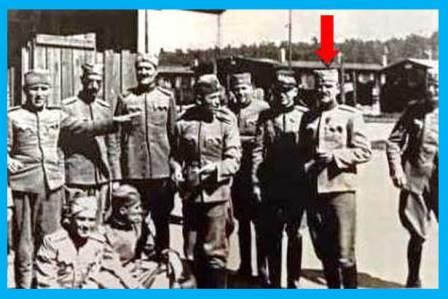
Nikola (identified by red arrow) with a group of fellow POWs at the Oflag in Nuremberg. (Photo source: https://krijgsgevangen.nl)

Oflag XIII B, the prisoner of war camp where Nikola spent the remainder of the war years, was originally in the Langwasser district of Nuremberg, Germany.

Oflag XIII B in Nuremberg, Germany, with barracks on either side of the road. (Photo source: https://krijgsgevangen.nl)

Conditions inside the Oflag were not luxurious, as can be seen in the photo below from inside one of the barracks.  The bunks were stacked 3 high, there was a small stove, and a wooden table. 

Inside one of the barracks in Oflag XIII B in Nuremberg, Germany.  (Photo source: https://krijgsgevangen.nl)

….Families of POWs generally received notification….

Liz explained that Nikola’s wife never knew that her husband was a POW.  “…She was told he was dead!…” It may be that she had received word that he was ‘missing and presumed dead’ and never got an update.  Perhaps, given that his homeland was occupied, Nikola did not feel it safe to contact his family.

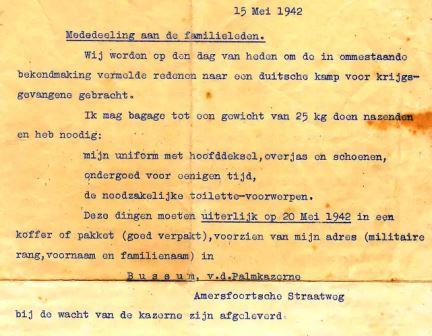
Normally, families of POWs received a notice, in the language of the prisoner’s nationality, informing that they had been captured, and prisoners were allowed to write to their families.  As an example, Maria Wilhelmina Siersema-van Erp, the wife of Klaas “Niek” Siersema, a Dutch POW in the same Oflag as Nikola, received several notices from her husband, including one dated May 15, 1942.   

The front side of this Dutch notice provided instructions of what should be sent to her husband, including his uniform, hat, overcoat, shoes, underwear, etc., the weight limit accepted, the date it should be sent by, and how to address the parcel. The letter was signed by the prisoner (not shown in the sample below).

Notice to the family of Klaas Siersema on what would be allowed in a package to be sent to him. (Source: https://digitalkinblog.wordpress.com)

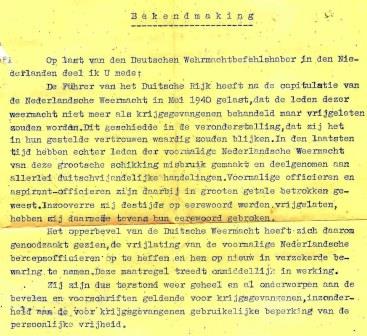
On the back side of the notice was an announcement that the Fuhrer of the German Empire had previously approved the release of officers in captivity, but that they were again being taken into custody because of their more recent actions against Nazi efforts.

Announcement with the justification for not releasing captive officers. (Source: https://digitalkinblog.wordpress.com)

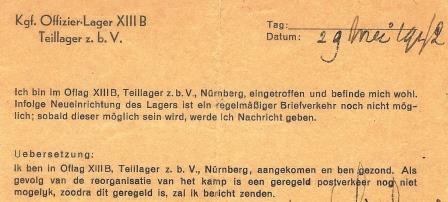
A May 29, 1942 postcard from Klaas Siersema, written in German and Dutch, informed his family that he was a POW at the camp, that he was in good health, and advised that mail was not being received on a regular basis due to a camp reorganization. 

May 29, 1942 postcard from Klaas Siersema advising that he was a POW. (Source: https://digitalkinblog.wordpress.com)

…. Oflag XIII B moved from Nuremberg to Hammelburg in April 1943….

Nikola (identified by red arrow) with a group of fellow POWs. (Photo courtesy of the Nikola Ostojic Family.

In April 1943, about 3,000 officers, many who had been, like Nikola, members of the Yugoslavian General Staff, were moved to a site 3 km (1.9 miles) south of the town of Hammelburg, just north of Schweinfurt in Bavaria, Germany.  (See https://en.wikipedia.org/wiki/Oflag_XIII-B)

Life in the POW camp was difficult, especially given the Nikola was 44 years old at the time of his imprisonment, and not a young man in his early 20s.  His 1972 obituary in the ‘Voice of Canadian Serbs’ noted that he “…endured severe abuse that led to a physical and psychological breakdown. …”

A March 25, 1945 report on conditions in the camp, prepared after a debriefing of the Senior American Officer at the camp, described the food allowed to prisoners: “….The German ration…consisted of coffee for breakfast, soup for lunch, made from barley, oatmeal, meat stock or dried vegetables, and at night the POWs were fed boiled potatoes and 1/10th of a loaf of bread, with a bit of margarine. They received a weekly issue of 4 or 5 tablespoons of sugar, and a small amount of jam once a week.  They were not issued any Red Cross parcels….”

…. Nikola was among the POWs liberated on April 6, 1945….

On April 6, 1945, Nikola was one of 1,300 prisoners of war liberated by the US Army’s 14th Armored Division, 19th Armored Infantry battalion, and tanks from the 47th Medium Tank Battalion, Combat Command B (CCB). 

As troops approached the Oflag, they came under sporadic fire from German machine guns. Infantry from of the 19th found the prison gates and forced an opening into the Oflag where they found a large contingent of Serbian and American officer prisoners.

You can watch a short YouTube video on the liberation here: 

While Nikola had suffered in the POW camp, Nikola’s wife and daughter, who remained at home in Serbia, found themselves in peril when Hungarian troops came to the farm in 1943, raided the farm of supplies, and abused his wife.  It wasn’t until 1945 that they received a letter advising that Nikola had survived the war years.

After 4 years in a POW camp, Nikola had to make a decision once he was liberated – whether to return to Serbia, now part of Yugoslavia and under Communist rule – or refuse repatriation.  In Part 3, Nikola’s story continues as, in a bid for freedom, he next ended up in a displaced persons camp in Austria, before finally immigrating to Canada.

Thank you to Liz Hubert for sharing photos and information on her grandfather, and translating his obituary into English. If you have a story or photo to share, please contact Pieter at memorialtrail@gmail.com or comment on the blog. 

© Daria Valkenburg

….Want to follow our research?….

If you are reading this posting, but aren’t following our research, you are welcome to do so.  Our blog address: https://onthewarmemorialtrail.com/

4 countries, 6 weeks, 7,000 km – an unforgettable war memorial journey in Europe…. Daria’s book ‘No Soldier Buried Overseas Should Ever Be Forgotten‘ is available in print and e-book formats.  Net proceeds of book sales help support research costs and the cost of maintaining this blog. For more information see https://nosoldierforgotten.com/

You are also invited to subscribe to our YouTube Channel: On The War Memorial Trail With Pieter Valkenburg: https://www.youtube.com/channel/UCJ591TyjSheOR-Cb_Gs_5Kw. 

Never miss a posting!  Subscribe below to have each new story from the war memorial trail delivered to your inbox.

On The War Memorial Trail…..The POW Who Raised Horses In PEI Part 1….The Serbian Colonel Who Was A POW In Oflag XIII B

February 20, 2025. Living on Prince Edward Island, it’s unusual to not only meet someone who has a shared Eastern European heritage, but whose family history was impacted by WWII. My father was taken at age 14 from his home in Western Ukraine to work in Germany and over several years, Pieter and I ‘walked in his footsteps’ in an attempt to understand what he experienced, and documented our findings in a 4 part series that saw him go from Germany to England and then finally to Canada:

My father was in Germany at the same time as Nikola ‘Nick’ OSTOJIC, grandfather of Bedeque resident Liz Hubert. While my teenaged father was a labourer, Liz’s grandfather was a prisoner of war.  After WWII ended, both ended up in displaced persons’ camps before finally finding freedom and a new life in Canada….but neither man was ever freed of the memories of what they had experienced.  

Daria (standing) with Liz Hubert. (Photo credit: Pieter Valkenburg)

….Nikola was born in Croatia….

Zirovac (indicated by red marker) is in the Banija region of Croatia, not far from Bosnia and Herzegovina border. (Map source: DuckDuckGo)

Born in the Serbian village of Zirovac, in what is now Croatia, but was then part of Austria-Hungary, on November 1, 1896, Nikola was the son of Mladen and Maria (nee Momic) Ostojic.  His father was an Orthodox bishop and a senator in pre-WWI Croatia.  According to Nikola’s 1972 obituary in the publication ‘Voice of Canadian Serbs’, in a family that had “…produced priests for 300 years…Nikola was supposed to continue the episcopal tradition, but he loved medicine….” (Translation from the original Russian by Liz Hubert)

The oldest child, with 9 younger sisters, Nikola became the head of the family after his father died when he was 18, and his mother died a year later.  Liz proudly noted that her grandfather “…sent money home to his sisters after he joined the army…” and made sure that “…all of his sisters were educated…”

….Nikola’s medical school training was interrupted by WWI….

The ‘Voice of Canadian Serbs’ obituary noted that 19 year old Nikola’s medical school training was interrupted in 1915 when he was “…mobilized by the Austro-Hungarian military…” and sent to a “…school for Officers in the Reserves. Upon completion of training, he was immediately sent in 1916 to the Russian front.  He deserted the Austro-Hungarian Army in Russia and joined the volunteer corps in Odessa, destined for the Salonika Front….”

Serbia had resisted the attacks of the Austro-Hungarian Army in the opening months of the First World War. But, in October 1915, the combined forces of Austria, Germany, and Bulgaria overwhelmed her armies and conquered the country.

As Serbia was an ally of Britain, a multi-national Allied force, under French command, with French, Serbian, British, Russian, and Italian troops, fought against the Bulgarians and their allies in what became known as The Salonika Campaign.

In 1918, when Nikola arrived in Salonika, he was “….deployed to the battle front. As a Major in the 6th division of the Drina Infantry, he participated in the breakthrough of the Salonika front, freeing his homeland…” 

Liz explained that Nikola received the Medal of Honour after being wounded during the rescue of soldiers trapped in trenches.   

The Salonika Campaign ended with an armistice signed by Bulgaria on September 28, 1918, and resulted in the defeat of Bulgaria, the liberation of Serbia and strategic exposure of Austria and Turkey. (For more information on The Salonika Campaign, see https://www.nam.ac.uk/explore/salonika-campaign)

Salonika, today known as Thessaloniki, is a port in the northern Greek region of Macedonia, and is a city I’d visited many decades ago after I graduated from university.

….Nikola remained in the military post WWI….

Nikola Ostojic. (Photo courtesy of the Nikola Ostojic Family.  Photo colourization by Pieter Valkenburg)

After WWI ended, Nikola remained in the military, in the Royal Yugoslav Army, which existed from the establishment of Yugoslavia in December 1918 until its surrender on April 17, 1941 to an invading force of Germans, Italians, and Hungarians. (See https://en.wikipedia.org/wiki/Royal_Yugoslav_Army#April_1941_Campaign)

Nikola Ostojic and Marija Lovas on their wedding day in 1938.  (Photo courtesy of the Nikola Ostojic Family)

Before that fateful day, Nikola had married Marija Lovas, who he’d met at a dance, in February 1938. Their daughter Radmilai, Liz’s mother, was born on July 28, 1939.  The family lived on a farm in Backi Petrovic in Serbia, near the Hungarian border.  Liz explained that the farm that Nikola grew up on had been sold prior to WWII after his sisters were no longer living there.

At the time of the surrender of the Royal Yugoslav Army, Nikola, now a Colonel, was, per the ‘Voice of Canadian Serbs’ obituary, on the “…main General Staff in Belgrade where he was serving as the head of a classified Intelligence unit…”

….Nikola became a POW and was sent to Oflag XIII B….

Liz’s research unveiled a Red Cross document summarizing what happened to Nikola when the Royal Yugoslav Army surrendered.  “….The Red Cross filed my Grandfather as captured in Sarajevo on April 17, 1941 and sent to OFLAG XIII B, POW # 99104. At this time he ranked as Pukovnik, which translated into Colonel…. He was captured by the German-Italian Military in Sarajevo…” 

An Oflag was a Prisoner of War (POW) Camp for officers, as opposed to a Stalag, which held mostly enlisted men. Oflag XIII B, opened for Yugoslav officers, was originally in the Langwasser district of Nuremberg.

Oflag XIII B in Nuremberg, Germany. (Photo source: https://krijgsgevangen.nl)

In April 1943, about 3,000 officers, many who had been, like Nikola, members of the Yugoslavian General Staff, were moved to a site 3 km (1.9 miles) south of the town of Hammelburg, just north of Schweinfurt in Bavaria, Germany. (See https://en.wikipedia.org/wiki/Oflag_XIII-B)

Life in the POW camp was difficult, and one that Nikola endured for 4 years.  In Part 2, Nikola’s story continues with his time in the POW camp until the camp was liberated on April 6, 1945 by American troops.

Thank you to Liz Hubert for sharing photos and information on her grandfather, and translating his obituary into English.  If you have a story or photo to share, please contact Pieter at memorialtrail@gmail.com or comment on the blog. 

© Daria Valkenburg

….Want to follow our research?….

If you are reading this posting, but aren’t following our research, you are welcome to do so.  Our blog address: https://onthewarmemorialtrail.com/

4 countries, 6 weeks, 7,000 km – an unforgettable war memorial journey in Europe…. Daria’s book ‘No Soldier Buried Overseas Should Ever Be Forgotten‘ is available in print and e-book formats.  Net proceeds of book sales help support research costs and the cost of maintaining this blog. For more information see https://nosoldierforgotten.com/

You are also invited to subscribe to our YouTube Channel: On The War Memorial Trail With Pieter Valkenburg: https://www.youtube.com/channel/UCJ591TyjSheOR-Cb_Gs_5Kw. 

Never miss a posting!  Subscribe below to have each new story from the war memorial trail delivered to your inbox.

On The War Memorial Trail….. The WWII Soldier From Manitoba Who Died Shortly After Being Liberated From Stalag VII-A

February 18, 2024.  A few years ago, we translated ‘Holtense Canadezen’, Jan Braakman’s book about some of the soldiers buried in the Canadian War Cemetery in Holten, The Netherlands, which was published in English in October 2023 as  ‘Holten Heroes: Stories from a Canadian Field of Honour’.  (See https://onthewarmemorialtrail.com/2023/11/01/new-book-about-soldiers-buried-in-the-canadian-war-cemetery-in-holten-the-netherlands/)

One very sad story related how 6 newly liberated prisoners of war – 5 Canadians, 1 Australian – died after accepting what turned out to be alcohol containing methanol from liberated Soviet prisoners of war.

The story resonated as my father, who had been in a displaced persons camp in Post-WWII Germany, had told me of similar stories. Refugees who had survived the war, many under brutal conditions, died or became blind after drinking alcohol that contained methanol (methyl alcohol) or alcohol made in containers that had once held gasoline, oil, and other substances.  Only a few sips could result in death or permanent disability.

One of the six soldiers, whose story was not told in ‘Holtense Canadezen’, was on the photo wish list from Holten – James ‘Jimmy’ Oliver THOMAS, born July 4, 1912 in St. Peters, Manitoba, the son of Henry ‘Harry’ Curtis James and Margaret Thomas.

Screenshot 2024-02-15 at 12-28-03 St. Peters

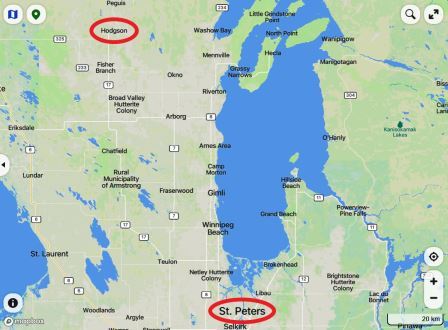
Map shows location of St. Peters and Hodgson in Manitoba.  (Map source: http://www.mapcarta.com)

St. Peters was an area familiar to me as childhood summers were spent in Grand Beach on Lake Winnipeg and we travelled often in that direction from Winnipeg, which was just a bit further south.

Jimmy’s parents left St. Peters in the fall of 1912 and moved to Hodgson, where Jimmy grew up with his siblings – 7 brothers and 1 sister.

The Peguis First Nation, whose members are of Ojibway (Saulteaux) and Swampy Cree (Maškēkowak) descent, is nearby, and the Thomas family has its roots here. (See https://en.wikipedia.org/wiki/Peguis_First_Nation)

….Jimmy’s niece provided a photo….

James Oliver Thomas

James ‘Jimmy’ Oliver Thomas. (Photo courtesy of the Thomas Family)

In the search for a photo, Pieter was in contact with Theresa Cooper, daughter of Jimmy’s brother, Rodney Thomas, one of two brothers who also served in the Canadian Army during WWII in addition to Jimmy.  The photo was emailed to us by Theresa’s son, Rodd Cooper. “…Thank you for your work and recognition in honouring him and the other Canadian soldiers….” Rodd wrote.

….Jimmy was hard-working and versatile….

After his father died in 1925, Jimmy left school at the age of thirteen to help out at home.  He spent 6 years working on the family farm, 2 years as a mechanic in a garage in Virden, Manitoba, 6 years in a hard rock quarry in Ontario and Manitoba, plus casual labour wherever he could find work.  In his Estate Form, his mother noted that he “…would look for a job anywhere he could make good money…”

By the time Jimmy enlisted at the No. XI District Depot in Vancouver, British Columbia on May 21, 1943, he was working as a plumber’s helper for a plumbing and heating company based in Prince Rupert, British Columbia, in a wartime housing project.

The interviewer for Jimmy’s Personnel Selection Record noted that he had “…above average learning ability….” and that his “…occupational background indicates versatility and adaptability.  Has been farmer, garage mechanic, fisherman, and latterly miner…”

The Record went on to describe Jimmy as having a “….robust appearance…” and that he was “…of quiet nature but self-confident and unhurried…”

Among his hobbies and interests, Jimmy “…played hockey.  Enjoys hunting and fishing.  Can swim.  Doesn’t dance.  Reads true detective stories. Attends movies…”

….Jimmy’s military career began in British Columbia….

On June 3, 1943, Jimmy was sent for basic training at No. 110 Canadian Army Basic Training Camp (CABTC) in Vernon, British Columbia.   After completing basic training, he was transferred to A16 Canadian Infantry Training Camp (CITC) in Calgary, Alberta on August 4, 1943.

At the beginning of October 1943, Jimmy was given a week’s embarkation leave, the last chance he had to visit his family before being sent overseas.

On November 3, 1943, he left Calgary when he was transferred to No. 1 Training Brigade in Debert, Nova Scotia.

On December 15, 1943, Jimmy left Canada for the United Kingdom, arriving on December 21, 1943.  He most likely had been on the same ship as Eli Ambrose SNAKE. (See https://onthewarmemorialtrail.com/2021/12/13/on-the-war-memorial-trail-remembering-ww2-soldier-eli-ambrose-snake/)  While Jimmy was assigned to No. 1 Canadian Infantry Reinforcement Unit (CIRU), Eli was sent to No. 3 CIRU. 

…Jimmy joined the Seaforth Highlanders of Canada in Italy….

On February 19, 1943, Jimmy was sent to Italy as part of the Allied Armies In Italy (AAI) and assigned to the 2 Battalion X-4 Reinforcement.  Then, on May 5, 1944, he was transferred to the Seaforth Highlanders of Canada.

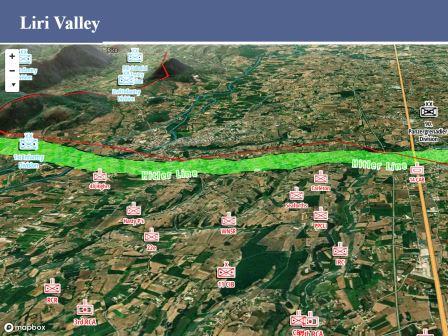
The Regiment had finished in Ortona and continued to move north, fighting through the Liri Valley.  Next, the Regiment received orders to work with other Regiments to break through the Hitler Line, the Germans’ second defensive line.  (See https://en.m.wikipedia.org/wiki/Hitler_Line and https://liri-valley.project44.ca/)

Screenshot 2024-02-18 at 09-56-04 Liri Valley

Placement of troops for breaching the Hitler Line on May 23, 1944. (Map source: https://liri-valley.project44.ca/)

On May 22, 1943, the War Diary for the Seaforth Highlanders of Canada recorded that at 4 pm, “…the Commanding Officer received orders from 2 Canadian Infantry Brigade that Seaforth Highlanders of Canada would attack the Adolph Hitler Line… The attack was ordered for 0600 hours 23 May 1944.  The PPCLI to attack on right, Seaforths on left, Edmonton Regiment reserve to exploit through PPCLI….”  (PPCLI refers to Princess Patricia Canadian Light Infantry.) 

A fierce battle occurred the following day.  The War Diary recorded that by 7:30 pm “…it was now apparent that the Adolph Hitler Line had been broken. The enemy were in full retreat, jamming the roads with his transport, which provided a good target for our Air Force…”   

…Jimmy became a POW during the breaking of the Hitler Line….

The war diary noted that there were many casualties: 51 killed, 110 wounded, and 72 missing.   Among the missing was Jimmy Thomas, who became a prisoner of war and taken to Stalag VII-A in Moosburg, Germany, where he was recorded as POW number 131885. (See https://en.wikipedia.org/wiki/Stalag_VII-A and https://www.pegasusarchive.org/pow/S7A/cSt_7A_Description.htm)

32898f4eaba6b4904152e84b63f6f18e--bavaria-vii

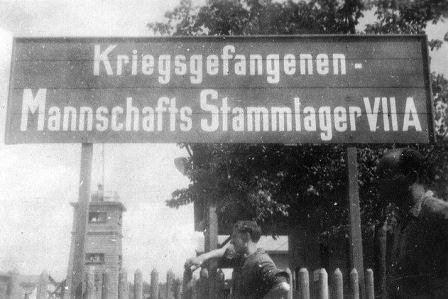
Entrance to Stalag VII-A.  (Photo source: Moosburg Online)

Stalag VII-A was captured on April 29, 1945 by Combat Command A of the 14th Armored Division of the US Army. (See https://www.moosburg.org/info/stalag/14theng.html)  Jimmy and his fellow POWs couldn’t believe how lucky they were, after all the hardships they had experienced.  Reports stated that 110,000 Allied POWs were freed from that camp alone.

The POWs were now free, but with the war still ongoing, it was impossible to evacuate all of them immediately.  They were instead moved west in large groups and placed in temporary transit camps while they waited impatiently to be transported out of Germany. 

Unfortunately, there were not enough planes to quickly transport them to Reims, France, and from there to England.  So they waited for their turn.

…A drink containing methanol proved fatal….

On May 1, 1945, Jimmy was in a temporary camp in Ettringen, Bavaria, Germany, along with other former prisoners of war.   A translated excerpt from Jan Braakman’s ‘Holtense Canadezen’ related what happened that day.  “…Canadians John Decoine, Robert Consterdine, Joe Giguire, Steven Motkaluk, James Thomas, and Australian Joe Brydon could not believe their luck when they were liberated by the Americans ….. The six met a group of Russian prisoners of war near Ettringen (Bavaria), who apparently had a large amount of liquor at their disposal….”  

The men were unaware that they were being offered liquor that contained methanol, which was fatal for all six.  “…Captain C.T. Sutherland wrote a report for the Department of National Defence about the incident …. According to him, on May 1, on the street in Ettringen, the Canadians had been given alcohol by members of a Russian labour command. (The prisoner of war camp had numerous labour commands, consisting of prisoners of war of different nationalities)….” 

Most likely, the Russians were not aware that the alcohol had been poisoned. “…British prisoner of war Tom Tate, who was captured in Germany in early 1945 after his Royal Air Force bomber was downed, said that Russian prisoners of war had found and binged on methylated spirits on the estate (Ost-Ettringen). He recalled two Russian prisoners of war who died of it and more who had severe symptoms of poisoning….”

…Jimmy died on May 2, 1945….

Captain Sutherland’s report did not include the names of Steve Motkaluk and James ‘Jimmy’ Oliver Thomas, who had both been in Stalag VII-A in Moosburg.  They had been taken to the US Hospital in Thannhausen, Germany.  Both men died on May 2, 1945.  

A medical report for Steven Motkaluk stated that the amount of alcohol he’d drunk was only 1 pint (2 cups).  Likely Jimmy had drunk the same amount or less. 

The other 4 men had been under the care of British physician John “Sandy” Rutherford, a former prisoner of war himself. 

It was a sad ending to soldiers who had endured so much during the war and their time in a POW camp. During the investigation into this incident and others involving the poisoning of Allied soldiers, the Canadian Intelligence Service “…managed to obtain an October 1944 document from the Kriminaltechnisches Institut der Sicherheitspolizei (Forensic Institute of the Security Police), describing the various possibilities of deliberate poisoning. One of these was the addition of methyl alcohol (methanol) to bottled drinks. It is conceivable that the prisoners of war were victims of this practice….”

…The other 5 victims of methanol poisoning….

In addition to Jimmy, the other 5 victims of methanol poisoning were: 

·         Robert James CONSTERDINE of Vancouver, British Columbia, died May 2, 1945

·         John DECOINE of Wabaska, Alberta, died May 1, 1945

·         Joseph ‘Joe’ August GIGUIRE of Conklin, Alberta, died May 3, 1945

·         Steven MOTKALUK, of Toronto, Ontario, but born in Lviv, Ukraine, died May 2, 1945

·         Joseph ‘Joe’ William BRYDON of Tenterfield, New South Wales, Australia, died May 2, 1945 

….Jimmy is buried in the Canadian War Cemetery in Holten….

Along with Steven Motkaluk, Jimmy was initially buried in the US Military Cemetery in Reutti, Germany, before being reburied in the British Military Cemetery in Durnbach, Germany.  Then, on June 4, 1948, they were reburied in the Canadian War Cemetery in Holten, The Netherlands.

Thomas JO James Oliver K51503

Grave of James ‘Jimmy’ Oliver Thomas in the Canadian War Cemetery in Holten, The Netherlands.  (Photo source: Canadian Virtual War Memorial)

…..Jimmy is listed on the National Métis Veterans Memorial Monument….

Jimmy is listed on the National Métis Veterans Memorial Monument just outside of Batoche, Saskatchewan.  (See https://www.metismuseum.ca/metisveteransmonument/)

His name can be found on Column 8 on the outside, Row 67. (https://www.metismuseum.ca/metisveteransmonument/column.php?v=XCHRVC)

….Thomas Esker in northern Manitoba is named in Jimmy’s honour…..

Screenshot 2024-02-21 at 08-38-47 Thomas Esker

Thomas Esker is named in honour of James ‘Jimmy Oliver Thomas. (Map source: http://www.mapcarta.com)

Thomas Esker in northern Manitoba, east of Tadoule Lake, was named after Jimmy in 1995.  This mountain has an elevation of 246 metres (807 feet).  (See https://mapcarta.com/24676318)

Thank you to Theresa and Rodd Cooper for providing a photo of James ‘Jimmy’ Oliver Thomas, to Shawn Rainville for helping with the initial newspaper search for family and information, to Judie Klassen for finding the geographic commemoration in ‘A Place Of Honour’, and to Jan Braakman for researching the May 1, 1945 incident in which 6 men lost their lives. 

Do you have photos or information to share? Email Pieter at memorialtrail@gmail.com, or comment on the blog.

© Daria Valkenburg

….Want to follow our research?….

If you are reading this posting, but aren’t following our research, you are welcome to do so.  Our blog address: https://onthewarmemorialtrail.com/

Front cover OnTheWarMememorialTrailinEurope4 countries, 6 weeks, 7,000 km – an unforgettable war memorial journey in Europe…. Daria’s book ‘No Soldier Buried Overseas Should Ever Be Forgotten‘ is available in print and e-book formats.  Net proceeds of book sales help support research costs and the cost of maintaining this blog. For more information see https://nosoldierforgotten.com/ 

You are also invited to subscribe to our YouTube Channel: On The War Memorial Trail With Pieter Valkenburg: https://www.youtube.com/channel/UCJ591TyjSheOR-Cb_Gs_5Kw. 

Never miss a posting! Subscribe below to have each new story from the war memorial trail delivered to your inbox.
On The War Memorial Trail… An Island Airman In Stalag Luft III Part 2: Escape From The POW Camp

October 30, 2023. In Part 1, Pieter’s research revealed how a small postcard-sized letter, written in September 1942 from POW camp Stalag Luft III, impacted two families from Prince Edward Island. (See https://onthewarmemorialtrail.com/2023/10/23/on-the-war-memorial-trail-an-island-airman-in-stalag-luft-iii-part-1-2-families-connected-by-1-letter-from-a-pow-camp/)

The letter was found by Don Coutts, nephew of WWII pilot Elmer Bagnall MUTTART of Cape Traverse, who lost his life on October 12, 1941.  It was written by John ‘Hubert’ HALL of Summerside, the pilot aboard Wellington Z1203, which crashed in The Netherlands near Mijdrecht on the night of March 28/29, 1942. 

The camp was near the town of Sagan, Lower Silesia, in what was then Nazi Germany (but now Żagań, Poland), 160 kilometres (100 miles) south-east of Berlin.  The movie ‘The Great Escape’ was based on an incident that happened in this camp in 1944. (See https://en.wikipedia.org/wiki/Stalag_Luft_III)

CIMG6475 Hubert Hall with mustache cropped and sharpened

John ‘Hubert’ Hall. (Photo courtesy of the Hall Family)

After meeting Hubert’s son, Robert ‘Bob’ Hall, and his wife Joanne Sheen, we came away with a wealth of information about Hubert, who sadly died young, at the age of 39.

CIMG6521 Oct 14 2023 Daria with Joanne Sheen & Bob Hall

Left to right: Joanne Sheen, Bob Hall, Daria Valkenburg (Photo credit: Pieter Valkenburg)

Now, in Part 2, more on Hubert’s story and his long march to freedom after leaving Stalag Luft III…..

Hubert was born January 4, 1915 in Summerside, Prince Edward Island, the son of Franklin and Marion (nee Howatt) Hall.  As a child, he and his brother Paddy went with their parents to Western Canada, and he attended school in Camrose, Alberta. Unfortunately, the family’s hope for a better economic future was disrupted by the Depression, and Mrs Hall returned to the Island with her sons.  Then, after WWII began, both sons enlisted in the RCAF.

Hubert enlisted at the RCAF Recruiting Centre in Moncton on June 26, 1940.  He took his initial flight training at No. 11 Elementary Flying Training School (EFTS) RCAF Station Cap de la Madeleine, in Trois-Rivières, Quebec.  He received primary pilot training, including solo flying of a basic training aircraft, and graduated on December 9, 1940.

In December 1940, he was sent to No. 2 Service Flying Training School (SFTS) RCAF Station Uplands in Ottawa, Ontario for continued pilot training on an advanced single or multi engine training aircraft.

CIMG6471 Print of Wellington bomber

Print of a Wellington bomber displayed in Bob Hall’s home office.  (Photo credit: D Valkenburg)

After receiving his wings, he left Canada for the United Kingdom and by May 1941 was training on a Wellington bomber at No. 12 Operational Training Unit (OTU) at RAF Benson, England.  

On June 19, 1941, Hubert began flying while attached to 142 Squadron of the RAF.  He was second pilot for 10 operations, and then pilot for 7 operations.  Wellington Z1203 turned out to be his 7th and final operation…..

…The air crew aboard the last flight of Wellington Z1203….

  • Pilot – Pilot Officer John ‘Hubert’ HALL, of the RCAF
  • Second Pilot – Flight Sgt Lawrence Hugh HOUGHTON, of the RAF
  • Navigator – Flight Sgt John Edward HARRITT, of the RAF
  • Wireless Operator/Air Gunner – Flight Sgt Arthur Richard TIDDER, of the RAF
  • Front Gunner – Sgt Geoffrey Peter WADSWORTH, of the RAF
  • Rear Gunner – Sgt Ernest Joseph PETTITT, of the RAF

….The last flight of Wellington Z1203….

GrimsbytoLubecktoMidrechtREV

Map shows the plane’s path from England towards Lübeck.  On the return to England, the plane was hit by flak near Kiel and diverted to The Netherlands where it crashed near Mijdrecht.  (Map prepared by Wendy Nattress)

According to the records, Wellington Z1203 departed RAF Grimsby at 21:28 pm on March 28, 1942 on a bombing operation to Lübeck, Germany. During the return to base in the early hours of March 29, the plane was hit by German flak as it crossed the coast near Kiel.  A fuel line was damaged, causing fuel loss. With insufficient fuel to return to England, the pilot – Hubert Hall – diverted the plane, turning inwards towards The Netherlands.

All six crew members were able to bail out and became prisoners of war for the duration of the war. The airplane dove into the ground and crashed in Mijdrecht, near Amsterdam Schiphol Airport.

…The long march to freedom….

According to Hubert’s Liberated Prisoner of War form, following the crash, he was first taken to Frankfurt, Germany, to Dulag Luft Frankfurt, a POW transit camp, for interrogation.  He was there from April 1, 1942 to May 7, 1942.  (See https://en.wikipedia.org/wiki/Dulag_Luft)

Hubert then was sent to POW camp Stalag Luft III in Sagan, Lower Silesia (Żagań, Poland).  He was there from May 9, 1942 until January 27, 1945.

As Russian forces advanced to less than 20 kilometres (12.4 miles) of Stalag Luft III, the POWs felt that liberation was only a matter of days away. Their hopes were dashed as on the evening of January 27, 1945, word came that Hitler had ordered the immediate evacuation of the camp. The POWs in all six compounds were instructed to prepare to march that very night. (See https://www.stalagluft3.com/long-march/)

The march began in the early hours of January 28, 1945, with the POWs trudging through heavy snow, cold weather, and even a blizzard.

march_map from Stalag Luft III

The long march from Stalag Luft III to Tarmstedt in the winter of 1945. (Map source: https://www.stalagluft3.com/long-march/)

Stuart Bruce Keith ‘Brack’ BRACKENBURY, an RCAF pilot from Ontario, was Hubert’s roommate in the Stalag, according to an account his daughter Ana Brickley gave to the Hall family. Brack was the pilot aboard the last flight of Hampden P1165, on an operation to Hüls, Germany, which was shot down and crashed at Winterswijk, Gelderland, The Netherlands on December 28, 1941. He was the only survivor of that crash.

Per her father’s recollection, Ana explained that they “…marched west away from the Russians and walked to a glass factory halfway to Hamburg, and stayed there a few months as they were too weak to walk further….”  This may be Marlag und Milag Nord in Tarmstedt, Germany, as Hubert’s Liberated Prisoner of War form stated he was there from February 4, 1945 until April 10, 1945.

marlag_und_milag_nord

Marlag und Milag Nord in Tarmstedt, Germany.  (Photo source: https://www.stalagluft3.com/long-march/)

Ana’s account noted that the men later “...went into boxcars….” by train “…to Hamburg and then walked to the Baltic Sea…”  They were eventually “…liberated in Lübeck...” which is a Baltic port.  Hubert’s Liberated Prisoner of War Form noted that they were liberated on May 2, 1945 in Trenthorst, a small settlement on the estate of German business magnate Philipp F. Reemtsma.

Their ordeal wasn’t quite over as Ana recounted that “…the army was going to drive the liberated men in trucks back to France.  They objected. Winston Churchill heard about it and said ‘they flew in, and they’ll fly out’.  And they did…..”

Hubert received his official discharge on July 27, 1945 in Halifax, Nova Scotia.

….Back on Prince Edward Island….

During his time as a POW, Hubert had contracted tuberculosis, and when he returned back to the Island, he “…was in the sanatorium in Charlottetown…” Bob explained. 

Once he left the sanatorium, Hubert worked at Hall Manufacturing, and then became the Sheriff of Prince County on July 15, 1947.  In Canada, a sheriff is a law enforcement officer, but not a police officer, as in the USA.  Sheriffs’ offices in Canada are primarily concerned with court services such as security in and around the courts, post-arrest prisoner transfer, serving legal processes, fine collection.

Bob explained that his father met his mother, Audrey ‘Forrona’ England when he became Sheriff.  “…She worked at the Bank of Nova Scotia in Summerside, and most likely that’s where they met…” 

Bob shared a story about his parents’ first date.  “…My father had a gorgeous black Rover with red leather seats.  On their first date, they went for a drive. When they stopped, my mother opened the door, and a heavy wind gust blew the door off!...”

Unfortunately, Hubert died in December 1954, leaving behind his wife Forrona and their two sons, Robert and Brenton. He’s buried at the People’s Cemetery in Summerside, Prince Edward Island, alongside his wife Forrona, who died in 2009.

Joanne Sheen wrote us, saying “….thank you so much for your visit. The tireless work and passion you both have for your project is amazing….Bob and I were very touched by the conversation….the visit brought Hubert to life.  Sad that it was a life cut short but Hubert was luckier than many in that he did get to return home and for a time, a happy life with his wife Forrona and two little boys….” 

Thank you to Bob Hall and Joanne Sheen for providing information about Hubert Hall. Thank you to Wendy Nattress, who prepared the map showing the flight path for Wellington Z1203, and to Yannic Wethly for sending Hubert’s Liberated Prisoner Of War Form.

Do you have a story to tell? Email Pieter Valkenburg at memorialtrail@gmail.com, or comment on the blog.  

© Daria Valkenburg

…Want to follow our research?….

If you are reading this posting, but aren’t following the blog, you are welcome to do so.  Our blog address: https://onthewarmemorialtrail.com/

Front cover OnTheWarMememorialTrailinEurope4 countries, 6 weeks, 7,000 km – an unforgettable war memorial journey in Europe…. Daria’s book ‘No Soldier Buried Overseas Should Ever Be Forgotten‘ is available in print and e-book formats.  Net proceeds of book sales help support research costs and the cost of maintaining this blog. For more information on the book, please see https://nosoldierforgotten.com/

You are also invited to subscribe to our YouTube Channel: On The War Memorial Trail With Pieter Valkenburg: https://www.youtube.com/channel/UCJ591TyjSheOR-Cb_Gs_5Kw. 

Never miss a posting!  Subscribe below to have each new story from the war memorial trail delivered to your inbox.
On The War Memorial Trail… An Island Airman In Stalag Luft III Part 1: 2 Families Connected By 1 Letter From A POW Camp

October 23, 2023. If you found a letter, written by someone you didn’t know, about your long-deceased uncle who died during WWII, what would your reaction be?  If you received a message saying that a 1942 letter from your long-deceased father was found, how would you react?   

….2 families…1 letter….

Two families were impacted by one small postcard-sized letter, written in September 1942 from POW camp Stalag Luft III.  The camp was near the town of Sagan, Lower Silesia, in what was then Nazi Germany (but now Żagań, Poland), 160 kilometres (100 miles) south-east of Berlin.  The movie ‘The Great Escape’ was based on an incident that happened in this camp in 1944. (See https://en.wikipedia.org/wiki/Stalag_Luft_III)

The letter was found by Don Coutts, nephew of WWII pilot Elmer Bagnall MUTTART of Cape Traverse, who lost his life on October 12, 1941.  Don found it amongst his mother’s effects after she died a few months ago.  He asked if we could “…play detective in deciphering the handwriting and as well which prisoner of war camp it came from….”  Pieter was up for the challenge.

….The letter came from Stalag Luft III….

CIMG6475 Hubert Hall with mustache cropped and sharpened

John ‘Hubert’ Hall. (Photo courtesy of the Hall Family)

The letter was sent to Mrs.  Frank H. Hall in Summerside, and was written by John ‘Hubert’ HALL, the pilot aboard Wellington Z1203, which crashed in The Netherlands near Mijdrecht on the night of March 28/29,1942. Everyone on board that flight survived and spent the remainder of the war years in POW camps. 

Hubert was in Stalag Luft III, as was Geoffrey Douglas LEYLAND of the Royal Air Force, the Squadron Leader mentioned in the letter.  Pieter’s research found that Leyland had flown three times with Elmer Muttart as second pilot! (https://aviation-safety.net/wikibase/52841)  Leyland returned to England after the war and passed away in 1970.

Hubert Hall POW Letter p2

September 6, 1942 letter from Hubert Hall to his mother Marion Hall.

The text of the letter, from Hubert to his mother, reads “…Dear Mother, How are you dear? I’m quite well and managing all right, I hate washing clothes. A few days ago I happened to mention on parade PEI and Squadron Leader overheard me and asked me if I knew Elmer Muttart. At one time Squadron Leader was Elmer’s second pilot and his praise for Elmer’s capabilities as a pilot and the work he did was very high. He says he owes his life to Elmer’s flying one night before Elmer was missing. Mrs. Muttart might like to know of this…Lots of love, Hube…”

One can imagine the relief that Mrs Hall felt in knowing that her son was alive and safe, but what she did next was a testament to her empathy for Annie Bagnall Muttart, whose son Elmer had died a year earlier.  She gave this precious letter to the Muttart family, and it was passed down to her daughter, Helen Coutts. (See https://onthewarmemorialtrail.com/2020/01/31/he-died-that-we-might-live-video-is-now-on-youtube/)

Elmer Bagnall Muttart (2)

Elmer Bagnall Muttart (Photo from Canadian Virtual War Memorial at http://www.veterans.gc.ca)

….The letter writer’s son was found….

The letter writer identified, Pieter’s next challenge was finding the family of Hubert and Mrs Frank Hall. The search led him to Robert ‘Bob’ Hall, who soon received a phone message from our intrepid detective! 

Bob was very surprised but called back immediately, confirming that Hubert was his father, and that his grandmother was Marion (nee Howatt) Hall. We met with him and his wife Joanne Sheen to learn more.

CIMG6521 Oct 14 2023 Daria with Joanne Sheen & Bob Hall

Left to right: Joanne Sheen, Bob Hall, Daria Valkenburg (Photo credit: Pieter Valkenburg)

Born January 4, 1915 in Summerside, Hubert enlisted at the RCAF Recruiting Centre in Moncton on June 26, 1940.  After receiving his wings, he left Canada for the United Kingdom and by May 1941 was sent for training on a Wellington bomber.

During his time as a POW, Hubert contracted tuberculosis, and when he returned back to the Island, he “…was in the sanatorium in Charlottetown…” Bob explained. 

Once he left the sanatorium, he worked at Hall Manufacturing, and then became the Sheriff of Prince County.  “…That’s when he met my mother, Forrona England. She worked at the Bank of Nova Scotia in Summerside, and most likely that’s where they met…” 

Bob noted that “…I was only three years old when my father died…” at age 39.  “…My mother was 29 when he died and she never got over it…”

Joanne Sheen was excited to learn about the letter.  Bob agreed. “…It’s the only letter that we’ve seen from the POW camp…”  Written on very thin and flimsy paper, it’s not surprising that letters from POW camps might not have survived.  That made the 1942 letter a special remembrance.

Thank you to Don Coutts for sharing the letter from the POW camp, and to Bob Hall and Joanne Sheen for providing information about Hubert Hall. In Part 2: more on Hubert Hall’s story and his long march to freedom that began on January 27, 1945.

Do you have a story to tell? Email Pieter Valkenburg at memorialtrail@gmail.com, or comment on the blog.  

© Daria Valkenburg

…Want to follow our research?….

If you are reading this posting, but aren’t following the blog, you are welcome to do so.  Our blog address: https://onthewarmemorialtrail.com/

Front cover OnTheWarMememorialTrailinEurope4 countries, 6 weeks, 7,000 km – an unforgettable war memorial journey in Europe…. Daria’s book ‘No Soldier Buried Overseas Should Ever Be Forgotten‘ is available in print and e-book formats.  Net proceeds of book sales help support research costs and the cost of maintaining this blog. For more information on the book, please see https://nosoldierforgotten.com/

You are also invited to subscribe to our YouTube Channel: On The War Memorial Trail With Pieter Valkenburg: https://www.youtube.com/channel/UCJ591TyjSheOR-Cb_Gs_5Kw. 

Never miss a posting!  Subscribe below to have each new story from the war memorial trail delivered to your inbox.
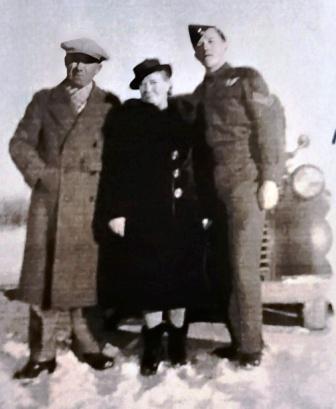
On The War Memorial Trail….. The WWII Stretcher-Bearer Whose Compassion Cost Him His Life
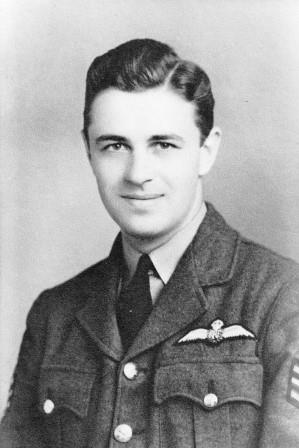
July 27, 2022. Before we travelled to North Bay, Ontario in May for an Author Talk at the North Bay Public Library, Pieter and Don Coutts prepared a letter to the editor for the local newspapers to see if photos could be found for two North Bay soldiers buried in the Canadian War Cemetery in Holten, The Netherlands: Albert Joseph COTE and John ‘Jack’ Langford WALKER.

The letter ran in the North Bay Nugget on April 19, 2022, and resulted in family of Jack Walker submitting a photo.  No family of Albert Joseph Cote came forward, but we soon uncovered enough information and references in other sources to determine that his story needed to be told.

Apr 19 2022 Letter to Editor North Bay Nugget

The letter to the editor incorrectly lists Flora’s maiden name as Larose.  It was McGinnis.  When she remarried, her surname changed from Cote to Larose.

Photo AJ Cote North Bay Nugget Oct 3 1944

Albert Joseph Cote. (Photo source: October 3, 1944 edition of North Bay Nugget newspaper)

Albert Joseph COTE was born in Quebec on July 12, 1920, the son of Augustin and Flora (nee McGinnis) Cote. His father died in 1922 in Hull (now Gatineau), Quebec and his mother remarried to Xavier Larose.  When Albert was 5 years old the family moved to North Bay.

…Albert was an active participant at the North Bay Vocational School…

Albert attended the North Bay Collegiate Institute and Vocational School (in 1958 the name changed to North Bay Algonquin Composite School) in North Bay.  Judie Klassen contacted archivist Edward Drieger of the Harris Library at the University of Nipissing, who wrote that Albert was “…a member of Form II B Vocational with Mr. K.E. Thomson in 1938.  It also appears that Albert was a member of the Junior Literary Society and a Form representative to the Northland Echo Staff….”  He also sent her two photos that included Albert.

Albert Cote yearbook 1 p39

Photo from the 1938 Algonquin Composite School yearbook. (Source: Harris Library at the University of Nipissing)

Albert Cote yearbook 2 Northland Echo

Photo from the 1938 Algonquin Composite School yearbook. (Source: Harris Library at the University of Nipissing)

…Albert enlisted shortly after his 20th birthday…

Before he enlisted on July 27, 1940 with ‘B’ Company of The Algonquin Regiment, Albert worked as a messenger boy for a newspaper, a call boy for the Canadian Pacific Railway, and as a clerk in Ligget’s Drugstore.  According to his service record he spoke French as well as English.

His Personnel Selection Record with the Canadian Army noted that he “… takes part in most sports…” and “…reads anything – mostly fiction….”  The report also stated that he was taking the “…Legion course – music group ‘C’…” and it was recommended that he “…continue as present bandsman…”  Unfortunately, no mention was made of which instrument he played!

…Albert and his Regiment served in Newfoundland…

NFLD Map shows Botwood

Location of Botwood Military Base in Newfoundland. (Map source: http://postalhistorycorner.blogspot.com/2012/12/wwii-canadian-forces-in-newfoundland.html)

Albert went to Port Arthur (now Thunder Bay), Ontario for training, and then was sent to Botwood, Newfoundland in July 1942.  Why Botwood? An RCAF base in Botwood had aircraft patrolling the east coast of the Atlantic. Canadian Army personnel, including members of The Algonquin Regiment, based at Botwood were charged with protection of military facilities that had been installed there. (See https://www.heritage.nf.ca/articles/politics/botwood-base.php)

… Albert and his Regiment were sent to Normandy, France…

In January 1943 he left Newfoundland for #2 Transit Camp in Debert, Nova Scotia in preparation for going overseas.

On June 11, 1943, Albert and The Algonquin Regiment left for England, arriving on June 19, 1943.

A year later, he and his Regiment landed in Normandy, France on July 25, 1944, as part of the 10th Infantry Brigade, 4th Canadian Armoured Division.  They were part of the contingent to capture Falaise as Allied troops moved through France following D-Day on June 6, 1944.

…Albert was mentioned for his heroism during Operation Tractable…

On August 14, Operation Tractable began north of Falaise, with Canadian and Polish troops, supported by a British tank brigade. The aim of this battle was to capture Falaise and then the smaller towns of Trun and Chambois. (See https://en.wikipedia.org/wiki/Operation_Tractable)

Title page Breakout from JunoMark Zuehlke mentioned Albert in Chapter 27 of his book ‘Breakout From Juno’. On August 17, 1944, the Algonquin Regiment was in the area of Damblainville.  “….The Algonquins were the lead element in a long column of 10th Infantry Brigade and other 4th Armoured Division formations expecting to push across the Ante River bridge and advance on Trun…”

After crossing the Ante River, Captain Clark Robertson’s platoon tried to seize a small railway bridge west of Point 77, where they were headed next.  As one section of troops crossed the railroad, they were attacked by gunfire.  Robertson was ordered to pull back.

Zuehlke explains what happened next. “…Extracting the section across the tracks proved no easy matter, but the men escaped under covering fire from the rest of the company. When it was discovered that a seriously wounded man had been left behind, ‘A’ Company’s stretcher-bearer, Private A.J. Cote went to get him.

As everyone else threw out fire, Cote dashed forward, found the man, quickly tended to his wounds, and carried him to safety.  ‘Quite the bravest act I saw during the entire war’ Robertson said later, even though Cote’s gallantry went officially unrecognized…”

…Albert was in Belgium during the Battle of the Leopold Canal…

By September The Algonquin Regiment had moved up through northwest Europe into Belgium to be part of the preparations for the upcoming Battle of the Scheldt and the liberation of The Netherlands.

Leopoldkanaal_10-06-2008_12-56-18

The Leopold Canal in peacetime. (Source:Wikipedia)

The Algonquin Regiment was tasked with establishing a bridgehead across the Leopold Canal. This was unsuccessful for many reasons, and resulted in the Battle of the Leopold Canal on September 13-14, 1944. They failed because  “…a diversion failed to draw the German forces away, the boat launch was late and the artillery support ended too quickly. Many of the paddlers from other regiments assigned to assist The Algonquin Regiment never arrived, forcing the Algonquin troops to move the heavy assault boats across the canal and over the island where many German soldiers fired at them from hidden slit trenches….” (Source: https://www.canada.ca/en/department-national-defence/services/military-history/history-heritage/casualty-identification-military/battle-leopold-canal-september-13-14-1944.html)

…Albert’s heroism continued during the Battle of the Leopold Canal…

On September 14, 1944, in the midst of heavy casualties, Allied troops were ordered to withdraw, with gunners firing all their ammunition in an attempt to provide cover for the retreating men.

Terrible Victory book coverMark Zuehlke mentions Albert Cote again in ‘Terrible Victory’:  “….The firing had the desired result, holding the Germans sufficiently at bay to enable most of the Algonquins to escape….”

“…Not all the Canadians managed to get out, despite men attempting to drag or carry the wounded while others protected them with covering fire. A number of the more badly injured had to be left. Stretcher-bearer Private Albert Joseph Coté volunteered to remain with three tourniquet cases. Soon after the other Algonquins headed off, shellfire wrecked the building where he and the wounded men sheltered. Coté was fatally wounded….”

Finding Bill book coverThis wasn’t the end of the story, however!  Albert was mentioned in ‘Finding Bill’ by Henrietta T. O’Neill, published in 2009.  She records the recollection of Cpl Bill O’Neill in one excerpt: “…Back at headquarters, a request for air re-supply was denied due to lack of aircraft, and by 12:00 that afternoon a withdrawal order was issued, accompanied by a heavy artillery barrage and smoke screen. Realizing they were being surrounded in the barn, Private A. J. Coté, a young stretcher-bearer, volunteered to stay with three soldiers who were too wounded to move. Later, the building was shelled by the Germans and Coté fatally wounded…”

Albert didn’t die in the barn, but was badly wounded with a gunshot wound to his right thigh.  He was taken prisoner of war.

…Albert’s untreated wounds cost him his life…

Screenshot 2022-07-26 at 16-17-33 Leopold Canal to Bad Fallingbostel

A badly wounded Albert Cote was transported from the Leopold Canal in Belgium, to a field hospital in Fallingbostel, Germany.  After his death, he was initially buried in a prisoner of war cemetery in Orbke. (Map source: Google)

Albert ended up in Kriegs Lagerlazarett (Field Hospital) Stalag 11B near Fallingbostel, Germany.  Most likely, he would have been transported there by train along with other prisoners of war. International Red Cross reports from November 1944 indicate that conditions were dire there, with limited medical care, limited medical supplies such as dressings, and the supply of drugs was exhausted. (See https://www.pegasusarchive.org/pow/cSt_11B_History1.htm)

According to the German records, Albert died on October 5, 1944 and was initially buried in the Prisoner of War Cemetery in Orbke, 800 km northeast of Fallingbostel.

…..Albert is buried in the Canadian War Cemetery in Holten….

In March 1948, Albert was reburied in the Canadian War Cemetery in Holten.

cote, albert j. gravestone

Albert Joseph Cote is buried in the Canadian War Cemetery in Holten, The Netherlands. (Photo courtesy of the Information Centre Canadian Cemetery Holten)

…..Albert Cote is listed on the North Bay Cenotaph in Memorial Park….

CIMG5568 May 18 2022 Pieter and Don at North Bay Memorial

Pieter and Don Coutts by a section of the Wall of Honour in Memorial Park in North Bay, Ontario.  (Photo credit: Daria Valkenburg)

DSCN2391 A J Cote name is at the very bottom

Albert Joseph Cote, buried in the Canadian War Cemetery in Holten. (Photo credit: Don Coutts)

Although he never received official recognition for his heroism, Albert Cote was remembered by several of the men he served with, and he is recognized on the Wall of Honour in Memorial Park in North Bay, Ontario where he grew up.

Researching this story took on a life of its own, as so many people volunteered their help.  Thank you to Shawn Rainville and Judie Klassen for researching the newspaper archives.  Judie also found the book references in which Albert Cote was mentioned and researched the Cote family.  Thank you to archivist Edward Drieger of the Harris Library at the University of Nipissing for the information about Albert Cote’s school activities.

Staff at the North Bay Public Library, the Nipissing District Branch of the Ontario Genealogical Society, and Captain Tim Feick and Cpl Brayton of The Algonquin Regiment independently dug into the archival material.  Special thanks go to the North Bay Nugget newspaper for its extensive coverage of WWII soldiers from the time period.

Both Mark Zuehlke and Henrietta T. O’Neill were contacted in case they had additional information on Albert Cote other than what was in their books.  Both responded, but nothing more could be added.

As our North Bay adventures conclude, we thank Don Coutts for guiding us around North Bay and arranging for the events we were able to participate in, and the North Bay Public Library for the invitation to do an Author Talk.

If you know of any soldiers that are buried in The Netherlands please let Pieter know. You can email him at memorialtrail@gmail.com, or comment on the blog.

© Daria Valkenburg

…Missed the previous postings about our North Bay Memorial Trail visit?…

…Want to follow our research?….

If you are reading this posting, but aren’t following our research, you are welcome to do so.  Our blog address: https://onthewarmemorialtrail.com/

Front cover OnTheWarMememorialTrailinEurope4 countries, 6 weeks, 7,000 km – an unforgettable war memorial journey in Europe….Daria’s book ‘No Soldier Buried Overseas Should Ever Be Forgotten‘ is available in print and e-book formats.  For more information see https://nosoldierforgotten.com/

Upcoming Author Talk: Thursday, August 11, 2022 – Victoria-By-The-Sea, Prince Edward Island, part of the ‘Our Island Talks’ series, and hosted by Victoria Playhouse and Victoria Historical Association. Time: 2:00 pm.

You are also invited to subscribe to our YouTube Channel: On The War Memorial Trail With Pieter Valkenburg: https://www.youtube.com/channel/UCJ591TyjSheOR-Cb_Gs_5Kw.

Never miss a posting!  Subscribe below to have each new story from the war memorial trail delivered to your inbox.