On The War Memorial Trail….. The WWII Soldier Born In Samburg Who Lost His Life During The Liberation Of Deventer

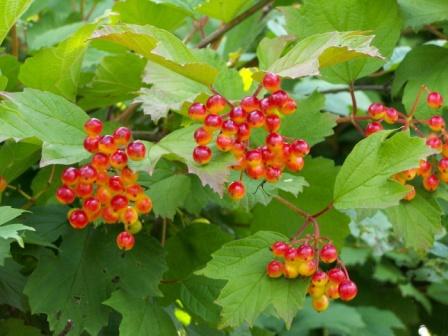
Kalyna berries and leaves. (Photo source: Wikipedia, by Lestat (Jan Mehlich) – Own work)

September 8, 2026. Sometimes Pieter asks me to select a soldier for him to research from one of the photo wish lists that he receives from the Canadian War Cemeteries in The Netherlands.  Occasionally a name is picked because of the date of death and the Regiment, other times because of a surname or place of residence.

 …Jim Kosowan was of Ukrainian heritage….

When I came across the name James ‘Jim’ John George KOSOWAN, listed as being from Kalyna, Saskatchewan, I asked Pieter to choose that soldier.  Why him? he asked.  It’s a Ukrainian surname, I replied, and Kalyna, which we know in English as a viburnum shrub (Viburnum opulus, see https://en.wikipedia.org/wiki/Viburnum_opulus) with red berries, is an ethnic and national symbol of Ukraine that symbolizes resilience, strength, and the fight for freedom.
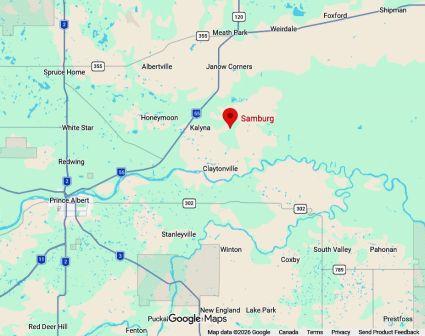
Samburg, Saskatchewan is near the larger town of Prince Albert.  (Map source: Google Maps)

Ok, Pieter said, but when he began his research, he learned that the soldier was born on December 18, 1920 in Samburg, Saskatchewan, near the town of Prince Albert, the son of George and Maria (nee Pusta) Kosowan, who had both immigrated to Canada in the late 1800s from Eastern Europe. The Kalyna reference in his service file came from where his family was living at the time of his enlistment.

…Jim’s nephew contributed a photo…

Jim had 4 sisters and 6 brothers, and it was the family of Jim’s sister Rose Sanjenko that Pieter quickly got in contact with once he began his research. When we asked Jim’s nephew, Randy Sanjenko, how the photos he submitted should be attributed, his response was heartfelt.  “….Please just say they are from family who love and miss him….Thank you for keeping the story of all those brave young men alive because l am a believer in never forget….

….Jim enlisted in 1942 under NRMA…

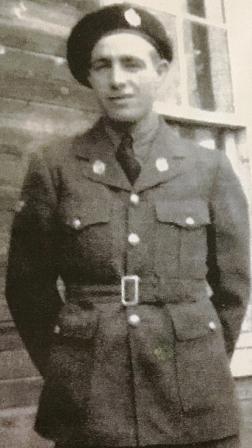
James ‘Jim’ John George Kosowan.  (Photo courtesy of the Kosowan Family)

On March 12, 1942, Jim enlisted under the National Resources Mobilization Act (NRMA) at No. 2 NRMA Clearing Depot in Newmarket, Ontario. (See https://en.wikipedia.org/wiki/National_Resources_Mobilization_Act)

At the time of his enlistment, Jim stated he was an auto mechanic, had experience working on his family’s wheat farm near Kalyna, Saskatchewan, and was working as a packer at O’Keefe Breweries in Toronto for the past 18 months. In addition to English, he could speak Russian and Ukrainian. His brother Johnny was in the Royal Canadian Artillery.

He took his basic training at No. 23 Canadian Army (Basic) Training Centre in Newmarket, and then was sent to the A11 Canadian Infantry Training Centre at Camp Borden, Ontario on May 14, 1942.

On September 15, 1942, Jim was sent to No. 4 Aerodrome Defence Platoon, a specialized mobile defensive unit tasked with safeguarding critical military airports, airfields, and Royal Canadian Air Force (RCAF) installations against ground assaults, sabotage, and enemy paratrooper attacks. A few days later, on September 19, 1942, Jim was temporarily attached to the 1st Battalion, Saint John Fusiliers (Machine Gun) in Sydney, Nova Scotia.

The Battalion was stationed in Canada on home defence duty as part of the 18th Infantry Brigade, 6th Canadian Division.  With the Battle of the Atlantic underway off of the Canadian coast, and German U-boats actively targeting shipping vessels in the Gulf of St. Lawrence and near Cape Breton, the Battalion was tasked with key security duties.  The men were on guard detail to protect vital infrastructure around the strategic industrial hub of Sydney and its heavily used wartime shipping harbour. As well, coastal defence support was provided in assisting nearby coastal batteries to deter potential enemy beach landings or sabotage. (See https://thecanadianencyclopedia.ca/en/article/battle-of-the-atlantic)

Military training also continued for the men.  Jim qualified as a Driver i/c Track Class III on March 3, 1943.  (The term ‘Driver i/c’ refers to ‘Driver, internal combustion’. Track Class III meant he was qualified to drive heavy trucks and armoured cars.)

….Jim enlisted in the Active Army in 1943…
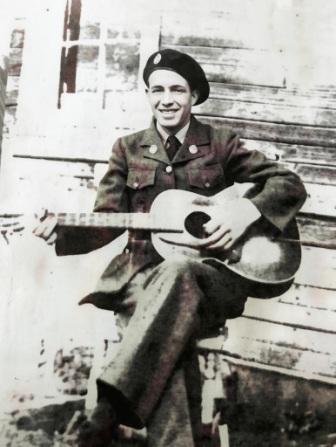
James ‘Jim’ John George Kosowan playing a guitar.  (Photo courtesy of the Kosowan Family.  Photo restoration by Pieter Valkenburg)

On October 1, 1943, Jim transferred to the Active Army, enlisting in Yarmouth, Nova Scotia, but remained with No. 4 Aerodrome Defence Platoon.  He was sent to No. 2 Transit Camp in Debert, Nova Scotia, where his training continued.

He qualified as a Driver i/c Class III (Wheeled) on October 19, 1943.  (The term ‘Driver i/c’ refers to ‘Driver, internal combustion’. Class III (Wheeled) meant he was qualified to drive heavy trucks and armoured cars, but not tanks.)

On July 5, 1944, Jim was given 9 days of special leave, in what turned out to be the last chance he had to see his family.  Upon returning from leave, he was transferred to No. 1 Transit Camp in Windsor, Nova Scotia.  This was a final staging, preparation, and administrative processing area before being sent overseas.

….Jim left Canada for overseas service ……

On September 1, 1944, Jim travelled by train directly from Windsor to the Halifax docks to board a troopship, which left Halifax on September 2, 1944, and arrived in the United Kingdom on September 6, 1944. Upon arrival, he was placed with No. 3 Canadian Infantry Reinforcement Unit (CIRU).

He didn’t remain long in the United Kingdom, as on October 7, 1944, he was transferred to the X-4 Reinforcement List of the 21st Army Group, and sent to France on October 8, 1944, arriving a day later.
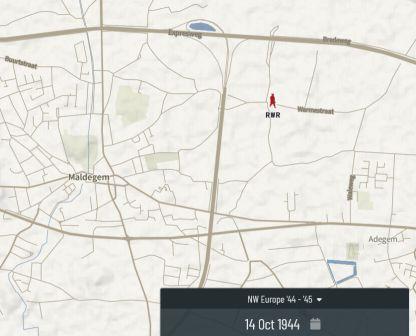
Red coloured soldier marks location of Royal Winnipeg Rifles on October 14, 1944. (Map source: Project 44)

On October 14, 1944, he was transferred to the Royal Winnipeg Rifles, joining them in Maldegem, Belgium, near the border with The Netherlands.  The Royal Winnipeg Rifles War Diary for that day noted that “…a few reinforcements arrived and were immediately posted to their companys….

The reinforcements were needed as on October 6, 1944, Operation Switchback, the second main operation of the Battle of the Scheldt had begun, with the goal of clearing the ‘Breskens Pocket’ – the German defences around Breskens in The Netherlands. (See https://www.canadiansoldiers.com/history/battlehonours/northwesteurope/breskenspocket.htm)

….Jim was wounded during Operation Switchback…
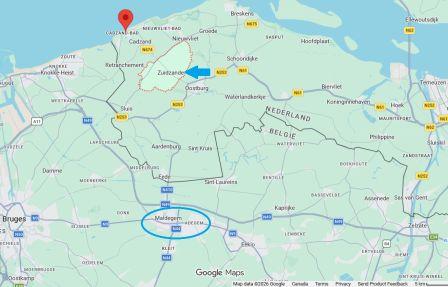
Blue arrow indicates Zuidzande where Jim Kosowan was wounded.  Blue circle shows location of Maldegem, where he joined the Royal Winnipeg Rifles. (Map source: Google Maps)

On October 28, 1944, during the final phase of Operation Switchback, part of the larger Battle of the Scheldt, the Regiment was clearing German strongholds and capturing prisoners of war in the area of Zuidzande, The Netherlands, near the Belgian-Dutch border.  As part of the 7th Canadian Infantry Brigade in the 3rd Canadian Infantry Division, they faced heavy resistance, artillery fire, and minefields, as they tried to clear the Scheldt Estuary and open the shipping route to Antwerp, Belgium.

Jim was wounded by shrapnel from an exploding grenade and spent over a month in hospital. Three members of the Royal Winnipeg Rifles died that day and are buried in the Canadian War Cemetery in Adegem, Belgium….

  • Elmond Joseph CHOQUETTE, born in Mariapolis (Glenora), Manitoba, aged 26
  • Richard Francis GYLES, of Winnipeg, Manitoba, aged 20
  • Leonard Andrew HEEKS, of Edmonton, Alberta, aged 20

…. Jim returned to duty in December 1944….

Jim returned to duty on December 12, 1944, rejoining the Royal Winnipeg Rifles, now stationed in the Nijmegen area of the Netherlands, near the German border, where they remained over the winter.  While based in a relatively safe area, they still were busy, conducting defence operations and sentry duties near the German border, reconnaissance patrols to monitor enemy positions.

They also tackled infrastructure tasks, such as clearing ice on the Waal River and doing road maintenance.  On the day Jim returned to the Regiment, 7 men drowned in a tragic accident when the vehicle they were in lost control on a dike, slid down the embankment and into the water.  The war diary explained that they “were pinned down under the carrier and were drowned….” They were part of a group of 13 men sent to repair a road running from a local railway bridge back to regimental headquarters.

…. Jim was involved in the liberation of North-West Europe….

By January 1945 the Royal Winnipeg Rifles were still in The Netherlands, and spent the New Year in ‘s-Hertogenbosch.

On February 1, 1945, the war diary recorded that the Regiment was informed of the part that the men “…would play in Operation Veritable…” This would take them into Germany. (See https://en.wikipedia.org/wiki/Operation_Veritable)  The Regiment arrived in Millingen, Germany on February 9, 1945.

By February 16, 1945, the Regiment was based in Essen, Germany, as they cleared German positions in flooded areas of the Rhine flood plain and the Reichswald forest, which is close to the Dutch-German border.

On March 11, 1945, the Regiment began moving back towards ‘s-Hertogenbosch, The Netherlands and the greater battle towards liberating the country.

….The Liberation of Deventer involved crossing the Schipbeek ….

Movement of Canadian troops towards Deventer.  Note that all first had to cross the Schipbeek.  (Map provided by Edwin van der Wolf)

On April 7, 1945, the Royal Winnipeg Rifles were ordered to cross the Schipbeek and establish a bridgehead as preparation for an assault on the city of Deventer by the 7th Canadian Infantry Brigade.

Crossing the Schipbeek was vital to the success of the bridge operation, not an easy feat as the Bridge was strongly defended by the Germans, but the Regiment was able to meet its objective.

NOTE: For an account of our visit to Schipbeek and Bathmen during our 2025 European War Memorial Tour, see https://onthewarmemorialtrail.com/2025/10/26/on-the-war-memorial-trail-visit-to-bathmen-and-the-schipbeek-canal/

….Jim lost his life during the Liberation of Deventer…

On April 10, 1945, the Regiment was involved in the liberation of Deventer, a town lying on the right bank of the IJssel River.  With the approaches protected by a maze of waterways, it was necessary to attack from the east. (See https://www.canadiansoldiers.com/history/battlehonours/northwesteurope/deventer.htm)

In ‘Little Black Devils: A History Of The Royal Winnipeg Rifles’ authors Bruce Tascona and Eric Wells noted that Deventer “…was a town of 50,000, which the Germans had fortified with an anti-tank ditch.  The battle began with a night attack at 0100 by the Canadian Scottish on the enemy’s right flank, and the Rifles struck their left flank at 0700.

Over the next 10 hours, the Rifles were continuously engaged, first in pushing back the enemy’s outer positions on the open ground before the big ditch.  Casualties were heavy….

Deventer was liberated by 5 pm, but Jim unfortunately didn’t see this outcome, as he lost his life at some point during the fight.

On our 2017 European War Memorial Tour, we’d visited Deventer and the surrounding area with Edwin van der Wolf, one of the research volunteers at the Canadian War Cemetery in Holten, The Netherlands, so we were familiar with the area where Jim and Clive Elbert Steele GEROW,  whose story was previously told, lost their lives. (See https://onthewarmemorialtrail.com/2023/10/07/on-the-war-memorial-trail-the-wwii-soldier-from-burks-falls-killed-during-the-liberation-of-deventer/)
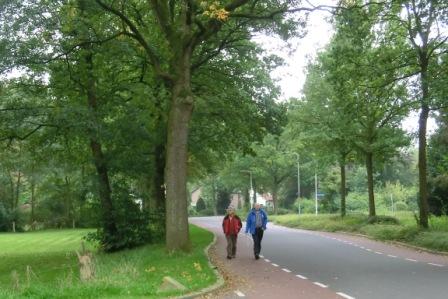
Pieter and Edwin van der Wolf (right) walked along the route near Schalkhaar that Canadian troops took before  they liberated Deventer in April 1945.  (Photo credit: Daria Valkenburg)

….Jim is buried in Holten…

Along with 45 other soldiers, Jim was initially buried beside an estate in Oxe before being reburied in the Canadian War Cemetery in Holten, The Netherlands on December 17, 1945.

Pieter at the entrance to the Canadian War Cemetery in Holten, The Netherlands. (Photo credit: Daria Valkenburg)

During our 2025 European War Memorial Tour, Pieter placed a Canadian flag by his grave.  Unfortunately, on this trip, we did not have any Saskatchewan flags.
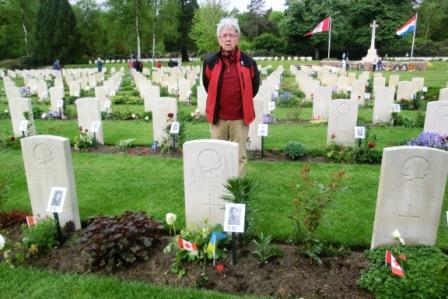
Pieter at the grave of James ‘Jim’ John George Kosowan after placing a Canadian flag. (Photo credit: Daria Valkenburg)

…The Colmschate Memorial commemorates 46 Canadians….

On April 8, 2015, a memorial had been placed in Colmschate to commemorate the 46 Canadians who had been temporarily buried on the Oxe estate.
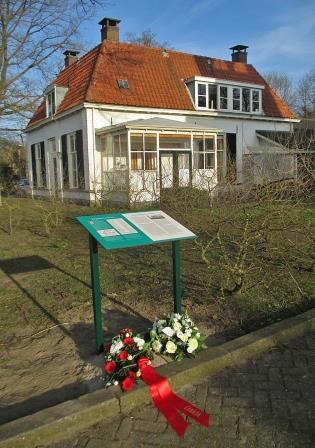
Memorial in Colmschate, commemorating 46 Canadians, including James Kosowan. (Photo courtesy of Edwin van der Wolf)

Text of Memorial in Colmschate, commemorating 46 Canadians, including Philip Laforte.  (Photo courtesy of Edwin van der Wolf)

Translation of the Dutch text was prepared by Pieter Valkenburg:

They Gave Their Lives

The liberation of Colmschate

During their advance from the Achterhoek, the Royal Winnipeg Rifles, the Regina Rifle Regiment, and the Canadian Scottish Regiment, led by Brigadier General T G Gibson reached the neighborhood of Oxe on Friday April 6, 1945. Next to the house on the Oxe estate (Oxerhof), the liberators discovered the bodies of ten Dutchmen who had been murdered in cold blood by the occupiers the day before. The Canadians passed the Schipbeek via a quickly struck bailey bridge, which replaced the destroyed Swormertoren Bridge.

Despite heavy German resistance, they continued north. Many farms went up in flames and houses were badly damaged. Many families sought refuge in the already liberated Oxe. Some residents lost their lives.

On April 8, 1945, the liberators captured (a small part of) the Snippeling, Colmschate, and the Bannink. Via the Vijfhoek they reached the Crödden Bridge over the Overijssels Canal. Schalkhaar and Deventer were then liberated and with the help of the Queen’s Own Rifles the remaining part of the Snippeling.

Many Canadians lost their lives in the battle in this area. In April 1945, the bodies of 46 fallen Canadians were buried in a temporary resting place opposite the Oxerhof house. In January 1946 they were transferred to the Canadian Cemetery in Holten (Plot I and II).

Two other soldiers whose stories were previously told are listed on this monument:

….Kosowan Lake is named after Jim…

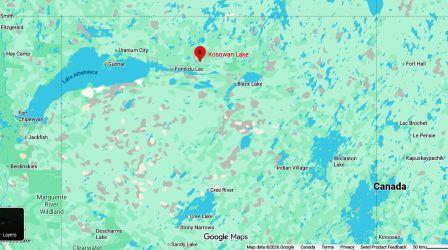
Kosowan Lake is in northern Saskatchewan. (Map source: Google Maps)

In 1952, Kosowan Lake in northern Saskatchewan, near the border with North West Territories, was named after Jim as part of the GeoMemorial Commemorative Naming Program.
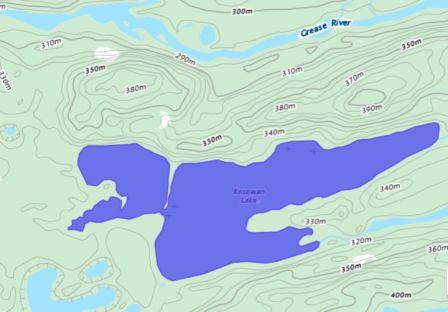
Kosowan Lake is located at the coordinates 59°25′39″N 106°28′17″W.  (Map source: https://geonames.nrcan.gc.ca)

Thank you to Randy Sanjenko, Jim’s nephew, for submitting photos and memories, to Bonnie Sanjenko for contacting her brother-in-law Randy, and to Shawn Rainville for newspaper research.

The Canadian flag placed at Jim’s grave during our 2025 European War Memorial Tour was donated.  Our thanks go to Alan Waddell, Constituent Assistant, on behalf of Heath MacDonald, MP for Malpeque.

While we were at the cemetery placing flags, we met Jane Kondakova, a Ukrainian refugee from the Kyiv region, who was living in the village of Holten with her two young children.  She was placing flags at the graves of soldiers of Ukrainian descent, including James Kosowan, to honour them and her husband, who is in the Ukrainian military.

Pieter’s research efforts to find photos and families of soldiers continue. Do you have a story to tell? Email Pieter at memorialtrail@gmail.com, or comment on the blog.

© Daria Valkenburg

….Want to follow our research?…

If you are reading this posting, but aren’t following our research, you are welcome to do so.  Our blog address: https://onthewarmemorialtrail.com/
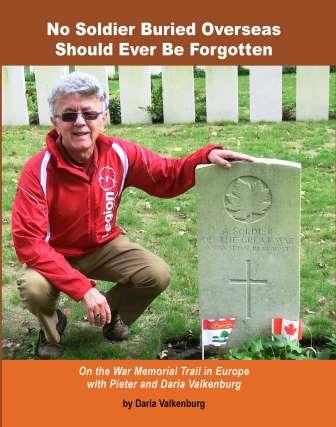
4 countries, 6 weeks, 7,000 km – an unforgettable war memorial journey in Europe…. Daria’s book ‘No Soldier Buried Overseas Should Ever Be Forgotten‘ is available in print and e-book formats.  Net proceeds of book sales help support research costs and the cost of maintaining this blog. For more information see https://nosoldierforgotten.com/

Subscribe to our YouTube Channel: On The War Memorial Trail With Pieter Valkenburg: https://www.youtube.com/channel/UCJ591TyjSheOR-Cb_Gs_5Kw.

Never miss a posting!  Subscribe below to have each new story from the war memorial trail delivered to your inbox.

On The War Memorial Trail…. Struck By Shellfire Part 2 The WWII Lieutenant From Saint John Who Lost His Life Trying To Get A Wounded Gunner To Safety

July 16, 2026.  On February 26, 1945, the lives of three WWII soldiers intersected during the Battle of Keppeln in Germany.   Private Harry BIZNAR, Lt Robert Joseph MARKEY, and Gunner Albert Donald AHLWARDT, all lost their lives when a shell burst near them as Private Biznar and Lt Markey were trying to get a wounded Gunner Ahlwardt to safety in a nearby house.

In Part 1 of Struck By Shellfire, the story of WWII soldier Harry BIZNAR was told.  (See https://onthewarmemorialtrail.com/2026/07/03/on-the-war-memorial-trail-struck-by-shellfire-part-1-the-wwii-soldier-born-to-ukrainian-immigrants-who-lost-his-life-trying-to-get-a-wounded-gunner-to-safety/)

Now, in Part 2, the Struck By Shellfire series continues with Robert ‘Bob’ Joseph MARKEY.

Born November 15, 1919 in Saint John, New Brunswick, Robert was the son of Ernest Thomas and Marion Marguerite ‘Marie’ (nee Nugent) Markey.  He graduated from Grade 11 at St. Vincent Boys’ High School in Saint John, continued on to Saint John High School for Grade 12, and then enrolled in the Nova Scotia Agricultural College in Truro, Nova Scotia in 1939. Winner of the Governor’s Award, 1941, Nova Scotia Agricultural College, he graduated in 1941 with a specialization in bacteriology.

Although Robert had a brother and two sisters, Pieter was unsuccessful in attempts to contact family members.  However, archivists Creighton Barrett and Jennifer MacIsaac of Dalhousie University Libraries uncovered photos and information from the time he was at Nova Scotia Agricultural College, providing a picture of the man behind the soldier’s uniform.

….Robert was involved in student activities…

Robert Markey as a 1941 graduate.  (Photo credit: Agricola Archives, Dalhousie University Archives)

A brief biography in the 1941 graduation issue of the student publication Agricola noted that over the past two years he had “…proven his ability as an all-around student, especially in public speaking and in basketball…

Robert Markey was on the school’s basketball team, pictured here 4th from the left (red arrow) in the 1941 graduation booklet.  (Photo credit: Agricola Archives, Dalhousie University Archives)

Robert, known as ‘Bob’ while a student, was involved in social activities of the College.  “…Being very popular with his classmates, due to his wit and personality, he was elected chairman of the Social Committee for the first term of the year ’41.  Bob also had the honour of being President of the Students’ Council while in his senior year

Robert was also known for being “…quite musical and full of jazz which was proven when he played the ‘Traps’ for the Sawfilers Orchestra at a few of the Saturday night dances…” Traps referred to drums, accompanied with other percussion instruments such as cymbals.

The account on Robert ended by stating that “… his main ambition is to specialize in Animal Husbandry but this coming summer he is joining the RCAF…

….Robert enlisted on Boxing Day 1941 …

Robert never joined the RCAF.  When he enlisted at the No. 7 District Depot’s recruiting office in Saint John, New Brunswick on December 26, 1941, it was noted that he had worked 3 summers at Atlantic Sugar Refinery in Saint John, New Brunswick. Just before enlistment, in the fall of 1941, he worked as an oiler and fireman, as well as a powerhouse technician in the plant where his father was employed as a superintendent.  As a technician, he was responsible for testing the chemical content of water and keeping a log of engine efficiency, among other duties.

He began his basic training at No. 70 Canadian Army (Basic) Training Centre (CABTC) in Fredericton, New Brunswick, but was hospitalized with a bad cold from January 4 until January 20, 1942.  He didn’t return back to No. 70 CA(B)TC until February  6, 1942, at which time he also received a promotion to Lance Corporal.

After completing his training, he was put on staff as an instructor at No. 70 CA(B)TC on May 16, 1942.

….Robert attended No. 30 Officers Training Centre in Brockville …

On September 2, 1942, an interviewer in Fredericton gave his assessment on Robert’s suitability as an Officer Candidate.  He was described as a “….tall, lean, athletic type…” with a “….. pleasant, well-balanced personality...” and “…good leadership qualities, conscientious…”  He had a “…history of commendable personal enterprise...” coupled with an “…above average level of learning ability…” and “…superior knowledge of tools and mechanical principles…”  He was recommended for officer training and to remain in the Infantry as that was what Robert himself preferred.

On October 10, 1942, Robert was sent to No. 30 Officers’ Training Centre in Brockville, Ontario for 12 weeks of intensive training in preparation for going overseas.  His time there would have overlapped with that of John ‘Weston’ CAMPBELL, from Prince Edward Island, who had arrived there in August for his 12 week course. (See https://onthewarmemorialtrail.com/2024/09/30/on-the-war-memorial-trail-the-wwii-soldier-from-clermont-killed-during-operation-veritable/)

After successfully completing his 12 week course, Robert was promoted to Provisional 2nd Lieutenant on January 16, 1943, and then sent for further training to A-17 Machine Gun Training Centre in Trois-Rivières, Quebec, a course that began on January 25, 1943 and ended on March 18, 1943….along with a promotion to Lieutenant.

….Robert was in Kiska as part of Operation Cottage …

On March 20, 1943, Robert was transferred to the 1st Battalion, Saint John Fusiliers (Machine Gun) and sent to Nanaimo, British Columbia. The battalion served in Canada in a home defense role as a part of the 18th Canadian Infantry Brigade which was first part of Pacific Command and then the 6th Canadian Infantry Division.

Summary of Canadian support for Operation Cottage in Kiska, Alaska. (Source: National Defence, National Defense University Press. Seen on the A Canadian Outlook FaceBook page)

On June 16, 1943, Robert was assigned to ‘C’ Company of the Saint John Fusiliers.  On July 12, 1943, he was on ‘special duty’ as part of a planned Canadian support to Kiska, Alaska for the American led Operation Cottage. (See https://en.wikipedia.org/wiki/Operation_Cottage and http://www.canadiansoldiers.com/history/operations/operationcottage.htm)

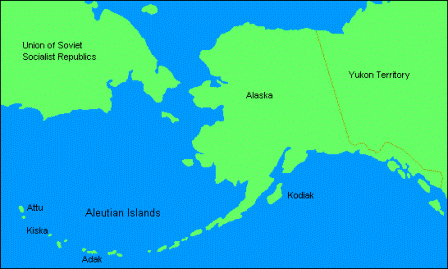
Map showing location of Kiska, part of the Aleutian Islands.  (Map source: http://www.canadiansoldiers.com)

Map source: By of SVG: Kuara – Aleutian Islands, United States Army Center of Military History, CC BY-SA 3.0, https://commons.wikimedia.org/w/index.php?curid=5209745

The intention was to liberate Kiska Island from Japanese forces, which had occupied it since June 7, 1942, after Japan seized Kiska and Attu in Alaska’s Aleutian Islands. However, no one seemed to be aware that the Japanese had left the Island on July 28, 1943, using fog as cover for their escape.

Kiska was unoccupied by the time Allied troops arrived on August 15, 1943, of which ‘C’ Company was a component of the 13th Canadian Infantry Brigade Group.  They were sent into fog, surf, volcanic rock, confusion, and uncertainty. Expecting a brutal fight, the soldiers found the island empty of Japanese troops, but they had left behind reminders of their presence in the form of mines and booby traps.

As noted in Project 44’s Operation Cottage: Invasion of Kiska Island: “…Despite the lack of Japanese soldiers, there still were American and Canadian casualties. Some were wounded and killed in friendly fire as nervous soldiers fired into the fog amongst the confusion. Others were wounded and killed by enemy mines, booby-traps, and explosive ordinance left on the island. The Canadians sustained eight casualties, four dead and four wounded…” (See https://www.project44.ca/kiska)

While the Americans left Kiska by September 1, 1943, the Canadians remained for over 3 months longer.

C.P. Stacey’s ‘Official History of the Canadian Army in the Second World War: Volume I: Six Years of War: Canada, Britain and the Pacific’ recorded that troops lived “in ‘winterized’ tents, and engaged in road and pier construction, transport fatigues, building and manning defences, and carrying on such training as conditions permitted. Fog, rain and wind made the island an acutely unpleasant residence, and the troops were heartily glad when the withdrawal to British Columbia began in November 1943. The last shipload of Canadians left Kiska on 12 January 1944…. 

Robert returned to Canada on January 3, 1944, and given 30 days leave, from January 6 until February 4, 1944.  ‘C’ Company disbanded on January 31, 1944, and when Robert returned to duty, he was assigned back to the 1st Battalion, Saint John Fusiliers (Machine Gun).

….Two soldiers whose stories have been told were also in Kiska …

…Robert was sent for more training…

On February 11, 1944, Robert was sent for two courses at the S-17 Canadian School Of Infantry in Vernon, British Columbia.  He began with a Junior Battle Wing Course. 10 days later, however, he was admitted to Vernon Military Hospital for 16 days with pneumonitis, an inflammation of lung tissue, typically caused by inhaling airborne irritants. (See https://my.clevelandclinic.org/health/diseases/24810-pneumonitis)

After completing the Junior Battle Wing Course, Robert next undertook a 4.2 Mortar Battle Wing course at S-11 Canadian Chemical Warfare School (CCWS) in Suffield, Alberta, which ran from April 16 to April 29, 1944.

….Robert qualified as a Driver for a flamethrower…

While in Suffield Robert took specialized carrier-driver training for a flamethrower-equipped variant of a Universal Carrier, qualifying as Driver i/c Class III (MC) on June 23, 1944.  (The term ‘Driver i/c’ refers to ‘Driver, internal combustion’.  Class III meant he was qualified to drive heavy trucks and armoured cars, but not tanks. MC meant he was also a qualified Motorcycle Despatch Rider.)

A June 16, 1944 Officers’ Survey report described Robert as …a very good officer.  A good leader. Has the confidence of all…” and noted that he “…speaks clearly and concisely….” with a   “…self-composed manner and confident approach. Has a strong personality.  Makes friends easily…

Robert was keen to go overseas, and the report stated that he had “…volunteered for the British Army.  Passed but not taken…”  It went on to say that he “…now has special authority to go overseas with some forty or fifty men including his own Platoon who have volunteered to go active on the understanding he will go with them.  This is a fulfillment of his wishes….” (NOTE: No mention was ever made if this happened when Robert ultimately left Canada for overseas service.)

On June 29, 1944, Robert returned to the S-17 Canadian School Of Infantry in Vernon, British Columbia for an Officers Refresher course, taken between July 1 and August 18, 1944.

The August 19, 1944 course assessment for the Junior Battle Wing Course noted that “…his knowledge and application of tactics was good. He has ability as a leader. His knowledge and handling of weapons were quite good….” but that “…at times he appeared disinterested and did not always put as much into the work as he could give…” The final comment was that with more experience, Robert would be “…a capable platoon commander…

The August 19, 1944 assessment for the Mortar Battle Wing course was positive. “…This officer was interested and enthusiastic.  He has quite a sound knowledge of the weapon and its tactical employment…” The final comment was that with further field experience, Robert “…should make a good mortar platoon commander…

….Robert left Canada for overseas service…

Robert Joseph Markey. (Photo source: Canadian Virtual War Memorial. Photo restoration by Pieter Valkenburg)

From August 20 until August 26, 1944, Robert was granted embarkation leave, for what turned out to be the last time he saw his family.

On August 27, 1944, Robert reported to No. 1 Training Brigade in Debert, Nova Scotia, for final training and preparation before going overseas.  The Brigade was a final staging point for troops waiting to cross the Atlantic Ocean.

On September 7, 1944, Robert boarded a ship that left the following day from Halifax, Nova Scotia, arriving in the United Kingdom on September 20, 1944. He was placed with No. 4 Canadian Infantry Reinforcement Unit (CIRU).

A few weeks later, on October 23, 1944, Robert was sent to No. 3 Wing (Weapons) Canadian Training School (CTS) for a Canadian Military Headquarters (CMHQ) Conversion Course at the Canadian Army Battle Drill School in Stansted Park in Rowland’s Castle, Hampshire, England. The 42 day course trained officers and NCOs to standardize infantry and joint-force tactics before deployment.  After successfully completing the course, he returned to No. 4 CIRU, which had been re-designated at No. 3 CIRU, on December 2, 1944.

….Robert joined the Lincoln & Welland Regiment……

On January 11, 1945, Robert was transferred to the 13th Battalion’s X-4 Reinforcement List of the Canadian Infantry Corps (CIC).  The following day he left for North West Europe, arriving on January 12, 1945.

On January 29, 1945, Robert was transferred to the Lincoln & Welland Regiment as a Platoon Officer in ‘C’ Company, joining them in the midst of Operation Elephant, also known as the Battle of Kapelsche Veer, a brutal and freezing battle to clear German paratroopers from Kapelsche Veer, a low-lying, water-logged island north of the Maas River in The Netherlands.

NOTE: Eli Ambrose SNAKE, whose story was previously told, had lost his life in the battle. (See https://onthewarmemorialtrail.com/2021/12/13/on-the-war-memorial-trail-remembering-ww2-soldier-eli-ambrose-snake/)

Robert had survived his first active battle, and continued with the Regiment as they moved into Germany.

….Robert lost his life during the Battle of Keppeln…

Map shows location (green circle) where the Lincoln & Welland Regiment was in support of the 4th Canadian Armoured Division during the Battle of Keppeln  on February 26, 1945. (Map source:  Project 44)

On February 26, 1945, the Regiment was involved in the Battle of Keppeln, with the objective of breaking the German Siegfried Line during Operation Blockbuster, the last part of Operation Veritable. (See https://en.wikipedia.org/wiki/Operation_Blockbuster) Troops encountered heavy artillery and mortar fire in intense fighting from German paratroopers, and had to make their way through heavy mud and minefields.

The war diary for February 26, 1945 noted the orders given for the battle.  The 4th Canadian Armoured Brigade, which the Lincoln & Welland Regiment was part of, “….was divided into five forces….”  ‘A’ and ‘C’ Companies of the Regiment were part of ‘JERRY FORCE’.

Movement began at 6 am, but “…the route from the area at KLEVE to the concentration area was through mud fields and was extremely heavy going for all vehicles. Heavy vehicles bogged down in the mud….

By 9 am, “… JERRY FORCE moved into the attack passing through 2 Canadian Infantry Division….

The battle finally ended when Canadian troops used flame-throwing Wasp carriers to clear German-held houses in Keppeln. The village needed to be secured as part of a push towards Uedem. The capture of Keppeln allowed Canadian forces to clear the Kalkar Ridge and proceed towards the Hochwald Forest gap, and later to break through to the Rhine.  Unfortunately, Robert did not live to see the end of this battle….

….What happened?…

Lance Corporal John SYMCHYCH stated in an official report that on February 26, 1945, the platoon that Robert commanded was tasked with defending a house located 9.1 metres (30 feet) from a slit trench.  Visibility was poor due to smoke from machine gun and rifle fire.  One Ram carrier had been struck by shell fire and burned, and a gunner, later identified as Albert Donald AHLWARDT of the 6th Anti-Tank Regiment, Royal Canadian Artillery, had been slightly wounded and evacuated to the slit trench that L/Cpl Symchych was in.

Around 2 pm, “…Pte Biznar and Lt Markey pulled the driver of the Ram carrier out of L/Cpl Symchych’s slit trench and were taking him to the house 15 yards away.  A shell lit four or five feet away from the three of them while L/Cpl Symchych was still in his slit trench.  L/Cpl Symchych crawled to the house and remained in the house until relieved by RHLI Regiment between the hours of three or four o’clock of the morning of February 27th. The bodies of the three men were still there when L/Cpl Symchych returned to his slit trench for his equipment…” NOTE: RHLI refers to Royal Hamilton Light Infantry Regiment.

Robert, aged 26, lost his life on that afternoon of February 26, 1945, as he and Pte Harry Biznar tried to move Gunner Alwardt to safety.

NOTE: For an idea of some of the places that the Regiment travelled through in Germany, see https://onthewarmemorialtrail.com/2026/02/06/on-the-war-memorial-trail-we-follow-the-route-taken-into-germany-by-canadian-troops-in-1945/

….Robert is buried in Groesbeek…

Pieter placed Canadian and New Brunswick flags at the grave of Robert Joseph Markey. (Photo credit: Daria Valkenburg)

Robert was initially buried in Keppeln, Germany before being reburied on February 25, 1946 in the Canadian War Cemetery in Groesbeek, The Netherlands. During our 2025 European War Memorial Tour, Pieter placed Canadian and New Brunswick flags by his grave.

Thank you to Jennifer MacIsaac and Creighton Barrett of Dalhousie University Libraries for finding photos of Lt Markey while he was at Nova Scotia Agricultural College.

The flags placed at Robert’s grave during our 2025 European War Memorial Tour were donated.  Our thanks go to:

  • Alan Waddell, Constituent Assistant, on behalf of Heath MacDonald, MP for Malpeque, for the Canadian flag.
  • Jean-Claude D’Amours, MLA for Edmundston-Madawaska Centre, Minister responsible for Military Affairs, with the help of Cécile LePage, Province of New Brunswick, for the New Brunswick flag.

…. to be continued…..

Coming up in Struck By Shellfire Part 3 will be about Albert Donald AHLWARDT of Olds, Alberta.

Pieter’s research efforts to find photos and families of soldiers continue. Do you have a story to tell? Email Pieter at memorialtrail@gmail.com, or comment on the blog.

© Daria Valkenburg

….Want to follow our research?…

If you are reading this posting, but aren’t following our research, you are welcome to do so.  Our blog address: https://onthewarmemorialtrail.com/

4 countries, 6 weeks, 7,000 km – an unforgettable war memorial journey in Europe…. Daria’s book ‘No Soldier Buried Overseas Should Ever Be Forgotten‘ is available in print and e-book formats.  Net proceeds of book sales help support research costs and the cost of maintaining this blog. For more information see https://nosoldierforgotten.com/

Subscribe to our YouTube Channel: On The War Memorial Trail With Pieter Valkenburg: https://www.youtube.com/channel/UCJ591TyjSheOR-Cb_Gs_5Kw.

Never miss a posting!  Subscribe below to have each new story from the war memorial trail delivered to your inbox.