On The War Memorial Trail…. Battlefields Tour With Joël Stoppels Part 1: Battle For Wagenborgen

A life’s ambition realized! Daria in the driver’s seat of a jeep! Spoiler alert – our battlefield tour was in an SUV, not the jeep! (Photo credit: Joël Stoppels)

October 1, 2025.  Pieter has been involved in finding photos of Canadians who are buried in all three Canadian War Cemeteries in The Netherlands since 2014, with stories of many soldiers told on this blog. 

While in Europe on our 2025 European War Memorial Tour this spring, for the 80th Anniversary of Liberation Commemoration events, he not only placed flags at the graves of 383 soldiers in 14 cemeteries, but we wanted to tour some of the battlefields in order to have a better appreciation of what soldiers faced. 

Battlefields Tours guide Joël Stoppels, of Groningen, The Netherlands, offered to spend a day showing us locations where the various battles that comprised the Battle of the Delfzijl Pocket took place. The term ‘Delfzijl Pocket’ refers “….to the entire area around Delfzijl that was held by German forces and cleared by the Canadians in late April and early May 1945…”Joël explained.

Over the years, we’ve featured stories of many soldiers who lost their lives in the last weeks of the North-West Europe campaign during WWII, and we eagerly anticipated learning more. (See https://www.canadiansoldiers.com/history/battlehonours/northwesteurope/delfzijlpocket.htm)
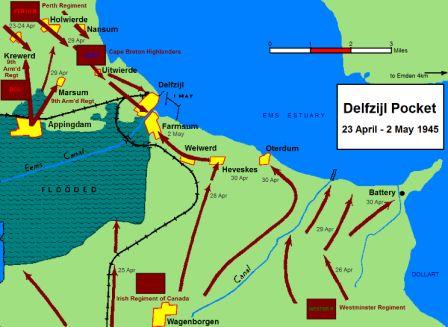
Map showing the locations during the Battle of the Delfzijl Pocket. (Map source: http://www.canadiansoldiers.com)

…. 19 Canadians lost their lives on a field just outside Wagenborgen…

Our day touring battlefields began very early, with a two hour drive from our cottage near Holten to Groningen, where we’d arranged to meet Joël. 

Our first stop on the battlefield tour was at a field outside Wagenborgen, where 19 Canadians lost their lives during the Battle for Wagenborgen.  This was the preliminary battle before the Battle of the Delfzijl Pocket. (See  https://www.canadiansoldiers.com/history/battlehonours/northwesteurope/wagenborgen.htm)

Joël Stoppels and Pieter stand across the road from the field outside Wagenborgen.  (Photo credit: Daria Valkenburg)

Joël began by saying that “….‘D’ Company of the Canadian Scottish Regiment, under the command of Major Anthony Compton-Lundie, were ordered by Battalion Command based in Groningen to undergo a dangerous mission across open fields with no rises or trees for cover…..” 

Patrols from the 7th Canadian Reconnaissance Regiment had determined that Wagenborgen, a short distance from the centre of the battalion’s line, was held by an unknown number of Germans.

‘D’ Company received orders to take the village of Wagenborgen in a one-company attack in the early hours of April 21, 1945.  “….Compton-Lundie was based at the Schmidt farm at the end of the field.  When the phone rang with orders to attack, he protested.  ‘Are you crazy?’ he said.  Orders were orders, however, and Compton-Lundie was not one to disobey…

The attack began on April 21, 1945.  By the time it was over, Anthony COMPTON-LUNDIE was dead, as was his lieutenant, Dennis George HUSCROFT, and 17 more men.

…. How did the battle go so badly for the Canadian Scottish?…

How did it go so wrong?  ... A Polish division had been in the area before the Canadian Scottish arrived and told Compton-Lundie that they believed only 100 Germans remained.  This was faulty intelligence as there were over 1500 Germans, just waiting to pick off soldiers in the open field of very flat land….”  Joël reflected that “…perhaps if Battalion Command had listened to Compton-Lundie, who had a view of the landscape, that there would have been fewer casualties….

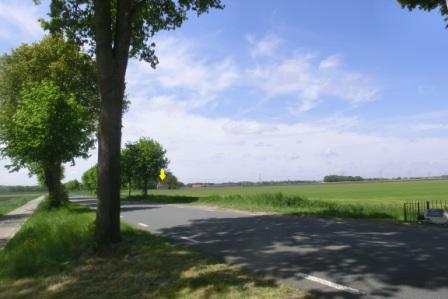
Field outside Wagenborgen where 19 men lost their lives.  Yellow arrow indicates Schmidt Farm, where Major Compton-Lundie of the Canadian Scottish Regiment had been based. At the far right is a monument commemorating those who died. (Photo credit: Daria Valkenburg)

…. A monument by the field honours the 19 men who died…

Monument by the open field where 19 men lost their lives on April 19, 1945. (Photo credit: Daria Valkenburg)

A small monument sits beside the open field where 19 men fought and lost their lives.  A translation of the Dutch text reads as follows:  Stand still for a moment at the maple leaf. On April 21, 1945, 19 Canadian men died for our freedom here at ‘Stolderij’. Stolderij refers to the hamlet where the open field is located.

The men were temporarily buried in Siddeburen before being reburied in 1946 in the Canadian War Cemetery in Holten, The Netherlands.

…. Banners were placed in Wagenborgen to commemorate fallen soldiers…

Once we finished taking photos of the field where so many men lost their lives, we drove into the town of Wagenborgen itself, where banners of the deceased soldiers had been placed, as close as possible to the location where they fell. 

Two soldiers from the Canadian Scottish Regiment who had fought in Wagenborgen have had their stories previously told on this blog.  One survived the battle, but one died, and we looked for his banner.
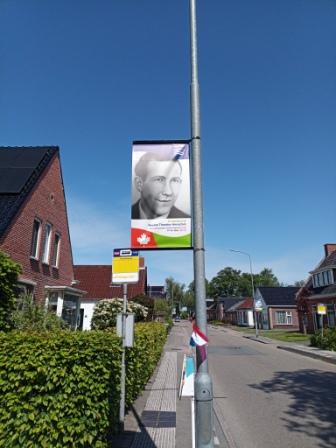
Banner for Theodor ‘Ted’ Henschel in Wagenborgen.  (Photo credit: Daria Valkenburg)

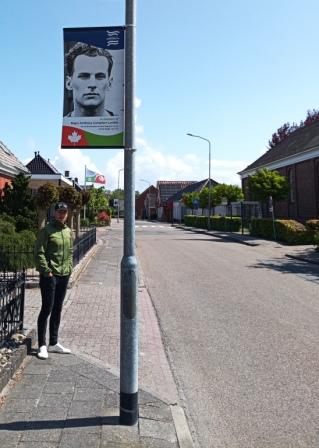
Joël by the banner for Anthony Compton-Lundie, who was from Oakbank, Manitoba. (Photo credit: Daria Valkenburg)

After being told about the impossible situation that Major Anthony Compton-Lundie faced, we wanted to see his banner, and took a photo of Joël beside it.

…. Canadian soldiers who lost their lives during the Battle for Wagenborgen…
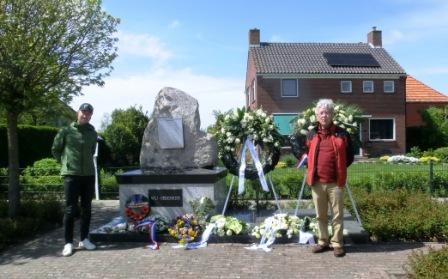
Joël and Pieter at the War Memorial in Wagenborgen.  ‘Wij gedenken’ translates to ‘We commemorate’. (Photo credit: Daria Valkenburg)

The War Memorial in Wagenborgen commemorates the residents of Wagenborgen who died in WWII, and 27 fallen Canadian soldiers – 23 of them from the Canadian Scottish Regiment, 1 from the Royal Winnipeg Rifles, and 3 from the Royal Canadian Artillery. 

From the Canadian Scottish Regiment:

  • Pte Albert George BOUMA, aged 21, died April 23, 1945
  • Pte John BRANSCOMB, aged 32, died April 23, 1945
  • Pte Robert Stewart BULLOCK, aged 39, died April 23, 1945
  • Pte Leslie Keith BUTTERICK, aged 19, died April 21, 1945
  • L/Cpl Carmen Christie CAPONERO, aged 30, died April 21, 1945
  • Sgt Allen CLEMENTS, aged 32, died April 21, 1945
  • Major Anthony COMPTON-LUNDIE, aged 30, died April 21, 1945
  • Pte Louis Silverius DAUTREMONT, aged 25, died April 21, 1945
  • Pte Edwin Levi EMERY, aged 22, died April 21, 1945
  • Pte Peter HARASYMCHUK, aged 24, died April 23, 1945
  • Pte Theodor ‘Ted’ HENSCHEL, aged 28, died April 223, 1945
  • Pte John Charles HUGHES, aged 28, died April 23, 1945
  • Lt Denis George HUSCROFT, aged 24, died April 21, 1945
  • L/Cpl John Albert MASLIN, aged 24, died April 21, 1945
  • Pte John Raymond PATRICK, aged 29, died April 21, 1945
  • Pte James Robert POWER, aged 21, died April 21, 1945
  • Pte Robert John Wilson REID, aged 38, died April 21, 1945
  • Pte Henry Oscar RENNER, aged 24, died April 21, 1945
  • Martin George VAN SANDVOORD, aged 28, died April 22, 1945
  • Pte Emile Joseph SOENS, aged 24, April 21, 1945
  • Pte John William WILSON, aged 37, died April 23, 1945
  • Pte Fred WIRTH, aged 38 , died April 23, 1945
  • A/Cpl Gordon Scarth WOOD, aged 21, died April 21, 1945

From the Royal Winnipeg Rifles:

  • Rifleman Theodore OLENICK, aged 19, died April 21, 1945

From the Royal Canadian Artillery:

  • Captain Donald George INNES, aged 23, died April 21, 1945
  • Gunner Joseph Paul MOULINS, aged 23, died April 21, 1945
  • Gunner Arthur John MUELLER, aged 20, died April 21, 1945
From Wagenborgen, we continued our tour, with our next stop in Appingedam, coming up in Battlefields Tour With Joël Stoppels Part 2: The Battle of the Delfzijl Pocket Began In Appingedam.

Thank you to Joël Stoppels, guide and founder of Battlefield Tours, for a wonderful and informative tour. (See www.battlefieldtours.nu)  If you have a story or photo to share, please contact Pieter at memorialtrail@gmail.com or comment on the blog. 

© Daria Valkenburg

….Want to follow our research?…

If you are reading this posting, but aren’t following our research, you are welcome to do so.  Our blog address: https://onthewarmemorialtrail.com/
4 countries, 6 weeks, 7,000 km – an unforgettable war memorial journey in Europe…. Daria’s bookNo Soldier Buried Overseas Should Ever Be Forgotten is available in print and e-book formats.  Net proceeds of book sales help support research costs and the cost of maintaining this blog. For more information see https://nosoldierforgotten.com/

Subscribe to our YouTube Channel: On The War Memorial Trail With Pieter Valkenburg: https://www.youtube.com/channel/UCJ591TyjSheOR-Cb_Gs_5Kw

Never miss a posting!  Subscribe below to have each new story from the war memorial trail delivered to your inbox.
On The War Memorial Trail….. The WWII Signaller From Oxford Who Was Fatally Wounded in Sögel

January 25, 2025. When Pieter begins research into a soldier’s file to find family members who might have a photo, he never knows what to expect. Sometimes, serendipity smiles, as he explained to colleagues in The Netherlands about what happened last fall in researching a WWII soldier from Nova Scotia.

 “…A few days ago I started trying to find a photo of George Allan Buchanan of Nova Scotia…” Pieter wrote.  “… When I looked at his estate form, my heart sank a little. He was married but had no children. Both parents died early. He had a half-sister, Jean Anderson, and that was all. However, I found her obituary from 2012. She was married to Gerald Allen and they had 3 sons and 3 daughters. I chose one of the daughters, Ramona Emslie, and called her in Nova Scotia and – you won’t believe it – but she had a picture!…” (Translation from the original Dutch.) 

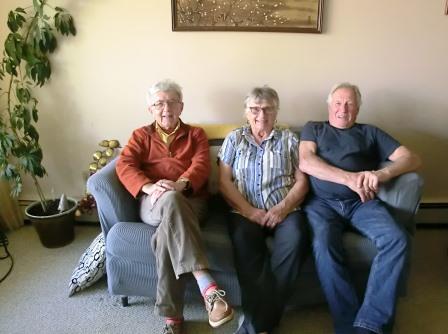
Not long after Pieter received a photo, we were in Nova Scotia, and visited with Ramona and her husband Roger. Not only did we learn more about George, we were also treated to the most delicious apple pie!

Pieter (left) with Ramona and Roger Emslie.  (Photo credit: Daria Valkenburg)

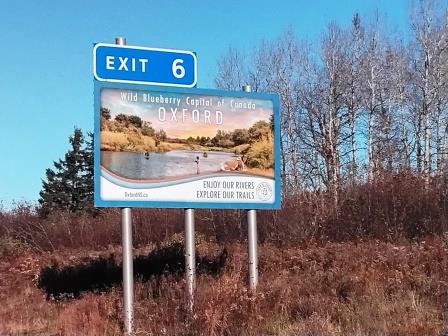
.….George was born in Oxford – the wild blueberry capital of Canada….

Sign for the turn-off to Oxford, Nova Scotia.  (Photo credit: Daria Valkenburg)

Born in Oxford, Nova Scotia on September 9, 1914, George Allan BUCHANAN was the son of George Allen and Margaret Jennie (nee Redmond) Buchanan.  George’s father died while he was a child, and his mother remarried in 1926 to Orval ‘Orlo’ Anderson.   

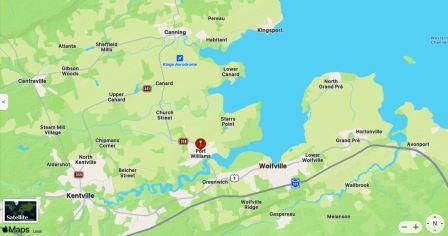
At the time of his enlistment with the 1st Anti-Aircraft Battery in Dartmouth, Nova Scotia, on August 8, 1940, George was working as a farmer for Geo Chase of Port Williams, and was also a carpenter.  He and his wife, Nancy Eva, who he’d married on December 18, 1939, were living in Lower Canard, Nova Scotia.

George Allan Buchanan lived in Lower Canada and worked for a farmer from Port Williams at the time of his enlistment in August 1940.  (Map source: DuckDuckGo)

….George served on the West Coast as part of Pacific Command….

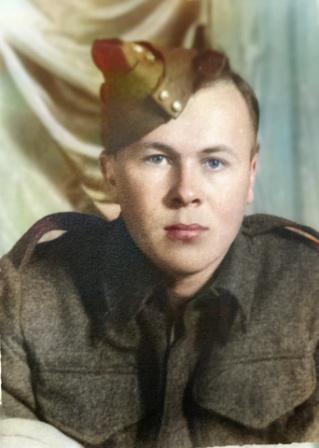
George Allan Buchanan.  (Photo courtesy of Ramona Emslie.  Photo colourization Pieter Valkenburg)

On January 11, 1942, George was attached to the 5th (BC) Coast Brigade of the Royal Canadian Artillery (RCA) and the No. 11 District Depot in Vancouver, British Columbia, remaining there until May 1, 1942, when he was posted to the 9th Anti-Aircraft Battery of the RCA in Sidney, British Columbia.  On October 9, 1942 he was assigned to the 27th Anti-Aircraft Regiment in Esquimalt, British Columbia.  

George’s West Coast posting was part of Pacific Command, which had two key functions.  The major function was to strengthen and administer home defence facilities on Canada’s Pacific Coast against possible Japanese attack. A second function was to train reinforcements to be sent to the Canadian divisions in Europe. 

On November 1, 1942 George was sent to the Coast Artillery School of Instruction in Esquimalt, for a Heavy Anti-Aircraft Artillery course, which he completed on December 12, 1942.  

George was transferred to the No. 1 Transit Camp in Windsor, Nova Scotia on August 8, 1943 for further training. 

….George was sent for a driver operator course ….

On October 29, 1943, George was transferred to A2 Canadian Army Training Centre (CATC) in Petawawa, Ontario.  As of December 17, 1943 he was attached to A7 Canadian Signal Training Centre (CSTC) at Camp Barriefield, Ontario for a Driver Operator Course, after having qualified as a Driver Class III on December 10, 1943.  Class III meant he was qualified to drive heavy trucks and armoured cars, but not tanks. 

On March 25, 1944, he had qualified as a Driver Operator Class ‘C’. He then returned to A2 Canadian Army Training Centre (CATC) in Petawawa on March 31, 1944.

On April 29, 1944, George was given embarkation leave until May 12, 1944, the last chance he had to see his family. 

….George left Canada for overseas service….

After returning from his embarkation leave, George was sent to the No. 1 Training Brigade in Debert, Nova Scotia on June 14, 1944 for final training in preparation for overseas service. 

George left Canada on June 26, 1944, arriving in the United Kingdom on July 4, 1944, and assigned to No. 1 Canadian Army Reinforcement Unit (CARU). He continued to take courses, to upgrade his skills as a Driver Operator.

On October 16, 1944, George was assigned to the X-4 Reinforcement list of the Royal Canadian Artillery, and left the United Kingdom the following day, arriving in Belgium on October 18, 1944.   

….George was transferred to the 23rd Field Regiment….

On November 18, 1944, George was transferred to the 23rd Field Regiment of the Royal Canadian Artillery, joining them in Boxtel, The Netherlands.

In ‘The History of the 23rd Canadian Field Regiment (SP) RCA’, the Regiment was on a rest period following heavy fighting, and making “….a frantic attempt to get the guns calibrated despite horrible weather conditions….”  (Note: SP refers to self-propelled)

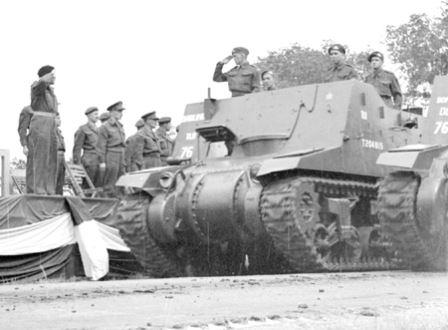
A self-propelled gun.  (Photo source: Kevin T of WW2Talk)

On December 6, 1944, the Regiment “…moved back into the line….” near ‘s-Hertogenbosch.  “…We were now living once more in a veritable “buzz-bomb alley” as the Germans intensified their efforts to knock out the port of Antwerp and render it useless to the Allies….

An excerpt from a compilation booklet from ‘The 23rd Field Regiment (SP) Royal Canadian Artillery Official SP Weekly’ included a brief description of George.  “…He was attached to the 36th Battery, as a Signaller, and was soon rated as an efficient, conscientious soldier, who did his assigned job quietly and well. It was not long before the boys were calling him ‘Buck’….

.….The 23rd Field Regiment moved into Germany in February 1945….

In February 1945, the History recorded that “about the middle of February the news arrived that we were to have a part in the next operation which would bring the forces of 21 Army Group to the banks of the Rhine – and possibly win the war then and there…

By February 22, 1945, the Regiment was in the Reichswald Forest in Germany, in place for Operation Blockbuster.  (See https://en.wikipedia.org/wiki/Operation_Blockbuster) “….In preparation for the attack the Regiment left the concentration area on the night of the 24th and moved south to deploy near Louisendorf. The roads were in terrible condition, and the heavy volume of traffic which had to roll over them ceaselessly only made matters worse. On the first deployment most of the soft vehicles were left in concentration areas back along the road, partly due to bad traffic conditions and partly due to enemy shelling in the more forward areas….

Then, “….on the 27th the Regiment made another move, going into action just east of Keppeln….”  The Regiment fought their way through Germany in March and into April. 

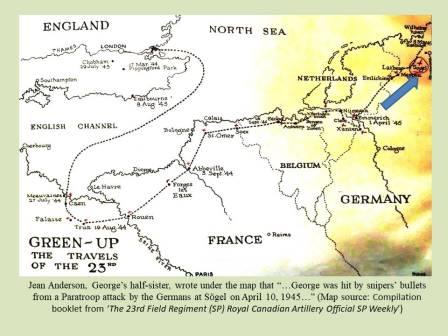
.….George was fatally wounded in Sögel….

The History explained that “…at the crack of dawn on April 9th the Regiment was on the road again, but had to spend two hours sitting on the road before crossing the canal into Meppen and striking north along the canal to Lathen. Then the axis of the advance swung east until we reached Sögel…

The Regiment was successful in taking the town of Sögel in Niedersachsen on April 9, 1945, but the following day the Germans made an unexpected counterattack.  “….The Regiment was getting packed in anticipation of another move when small arms fired began to whistle around the area….. Then mortars started dropping in to the area…. It was a counter-attack and there didn’t appear to be any infantry in front of us…

Just after 9:30 am, George was seriously injured in the fighting that had ensued, receiving shrapnel wounds in his left thigh and lower abdomen. “….Every man in the battery did an excellent job in beating off this first major counter-attack ever suffered by the unit. But although it was successfully repelled, three men paid the supreme sacrifice. They were Lieut. Doug Denton who was wounded as he lifted a casualty into a half-track and died next day, Gnr. George Buchanan who died later that day, and Gnr. Vic Hubacheck who was instantly killed by a ricochet bullet. Four or five other lads were wounded….

George was initially treated at a Field Dressing Station, before being transported to the Canadian military hospital in Almelo, The Netherlands.  Unfortunately, the medical report stated that he was dead on arrival at 9:40 pm that evening.  He was 31 years old.

.….George is buried in Holten….

George was temporarily buried in Almelo, before being reburied in the Canadian War Cemetery in Holten, The Netherlands on February 4, 1946.

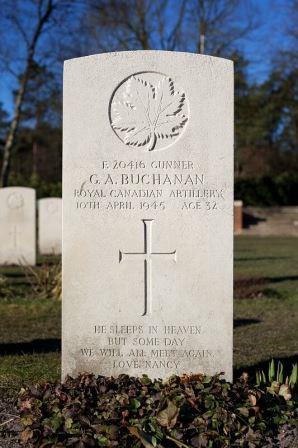
Grave of George Allan Buchanan in the Canadian War Cemetery in Holten, The Netherlands.  (Photo courtesy of Canadian Virtual War Memorial)

….George’s grave was adopted by Jo Visschers of Bathmen ….

After his reburial in the Canadian War Cemetery in Holten, George’s grave was adopted by Jo Visschers of Bathmen, The Netherlands.  Jo’s letter advising of the grave adoption was forwarded to George’s widow in March 1948 by the Department of Veterans Affairs.

Thank you to Ramona and Roger Emslie for providing photos and information, to Kevin T of WW2Talk, and to Edwin van der Wolf, a volunteer at the Canadian War Cemetery in Holten, for sending us an account of what happened in Sögel in No. 156-April 2016 ‘Informatieblad Over Verdedigingswerken En Militaire Geschiedenis – De Opmars Van De Canadezen In Noordwest Duitsland’ (Information Sheet On Defensive Works And Military History – The Rise Of The Canadians In Northwest Germany).

If you have a story or photo to share, please contact Pieter at memorialtrail@gmail.com or comment on the blog. 

© Daria Valkenburg

….Want to follow our research?….

If you are reading this posting, but aren’t following our research, you are welcome to do so.  Our blog address: https://onthewarmemorialtrail.com/

4 countries, 6 weeks, 7,000 km – an unforgettable war memorial journey in Europe…. Daria’s book ‘No Soldier Buried Overseas Should Ever Be Forgotten‘ is available in print and e-book formats.  Net proceeds of book sales help support research costs and the cost of maintaining this blog. For more information see https://nosoldierforgotten.com/

You are also invited to subscribe to our YouTube Channel: On The War Memorial Trail With Pieter Valkenburg: https://www.youtube.com/channel/UCJ591TyjSheOR-Cb_Gs_5Kw

Never miss a posting!  Subscribe below to have each new story from the war memorial trail delivered to your inbox.
On The War Memorial Trail….The WWII Soldier From St.-Georges Who Lost His Life On His Birthday

January 20, 2025.  When we were in Manitoba last year, we visited the Winnipeg River Heritage Museum, in the village of St.-Georges, in order thank Diane Dube in person for helping us with the photo searches of Edmond COULOMBE and Philip LAFORTE.  (See https://onthewarmemorialtrail.com/2021/12/24/on-the-war-memorial-trail-the-successful-search-for-a-photo-of-ww2-soldier-edmond-coulombe/ and https://onthewarmemorialtrail.com/2022/03/22/on-the-war-memorial-trail-remembering-ww2-soldier-philip-laforte/)

Daria and Pieter with Diane Dube (centre) at the Winnipeg River Heritage Museum in St.-Georges, Manitoba. (Photo courtesy of Valkenburg family)

During our visit, Diane mentioned that she had a relative from the area who was buried in the Canadian War Cemetery in Holten, The Netherlands – Omer VINCENT.  “…His father and my grandfather were brothers. He was first cousin to my father….

Diane wondered if the cemetery had a photo of him, and we assured her it did, as the researchers did not include him on their photo wish list for Manitoba soldiers.  She sent us an excerpt about Omer from a book about the Vincent family, ‘Et la rivière coule toujours 1892-1992’ (‘And the river is still flowing 1892-1992’), published by Hector H. Vincent.

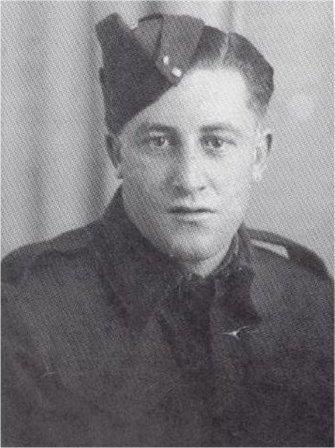
Born April 13, 1920 in St.-Georges, Manitoba, Omer was the son of Fortunat and Marie-Louise Vincent. He came from a large family, with 5 brothers and 5 sisters alive at the time of his death.  Two brothers, Philippe and Wilfred, also served during WWII.

….Omer worked with his father and brothers prior to enlistment….

Omer’s brief biography in ‘Et la rivière coule toujours 1892-1992’ explained that he helped his father and older brothers “…with the farm work.  He soon joined them cutting pulp wood during the winter and would also haul the wood by sleigh and horse team to Pine Falls…”  There was a pulp and paper mill in nearby Pine Falls, Manitoba.

Omer with his horses. (Photo source: ‘Et la rivière coule toujours 1892-1992’)

The entry went on to say that Omer’s “…favourite pastime was hunting with his brothers.  They kept the bush cutting camps well supplied with fresh meat during the winter…

Omer had worked with his father for several years when he enlisted on October 29, 1941 in Winnipeg, Manitoba with the No. 10 District Depot Anti-Aircraft Artillery, Royal Canadian Artillery (RCA). Omer’s fluency in both English and French was noted on his Occupational History Form.  It was also recorded that he could drive a vehicle, a motorcycle, and a tractor, and liked to play baseball.

Omer Vincent.  (Photo source: ‘Et la rivière coule toujours 1892-1992’)

On November 13, 1941, he was sent for basic training at No. 12 Canadian Army (Basic) Training Centre (CABTC) in Chatham, Ontario.  After completing the course on February 3, 1942, he was transferred to A1 Canadian Artillery Training Centre (CATC) at Camp Petawawa in Ontario for advanced training as a gunner. 

Omer was in Petawawa until April 4, 1942. While there, he received embarkation leave, the last time he would see his family.  He returned briefly to Petawawa until April 29, 1942, when he travelled to Halifax, Nova Scotia, the port of embarkation to the United Kingdom.

….Omer left Canada for overseas service….

On May 4, 1942, Omer left Canada for the United Kingdom.  Upon arriving on May 12, 1942 he was assigned to No. 2 Canadian Artillery Reinforcement Unit (CARU).  He continued his training and then was transferred to the 7th Anti-Tank Regiment of the Royal Canadian Artillery on July 31, 1942. 

Omer was reassigned to No. 2 Canadian Artillery Reinforcement Unit (CARU) on August 26, 1943 and sent for specialized training at the Canadian Military Headquarters in London, and then for a series of gun fitter courses at Stoke-On-Trent, where the Artillery Equipment section of the Royal College of Military Science was based during the war.

Upon completion of the courses, Omer was transferred to the X-4 reinforcement list of No. 2 Canadian Base Reinforcement Group (CBRG), part of the 21st Army Group, on August 16, 1944.  The next day he was on his way to Normandy, France, disembarking on August 18, 1944.

A few days later, on August 23, 1944, he was assigned to the 3rd Anti-Tank Regiment of the Royal Canadian Artillery. The Regiment was responsible for coordinating anti-tank defences, with troops supporting the infantry as they fought their way across Boulogne and Calais in September 1944.

In October 1944, the Regiment moved into Belgium, under the command of the 10th Canadian Infantry Brigade. On November 10, 1944, the Regiment began moving from Ghent, Belgium towards Nijmegen, The Netherlands.  On November 17, 1944, Omer was admitted to No. 12 Canadian General Hospital and remained there for a week before returning to his Regiment, now based in ‘s-Hertogenbosch, The Netherlands.

.….Omer’s Battery was tasked with holding the east bank of the IJssel River….

Map showing locations where Omer Vincent was in April 1945.  (Map source: DuckDuck Go)

The April 5, 1945 war diary for the 3rd Anti-Tank Regiment reported that “…Lt JR Cameron of the 4th Battery contacted the QOR this morning and 4 Battery is to aid in holding the east bank of the IJssel between Zutphen and Doesburg…”  QOR referred to Queen’s Own Rifles.  Omer was part of the 4th Battery.

On April 8, 1945, the war diary for the Regiment recorded that 4 Battery was involved in “was under command 8th Brigade for their part in the holding role from Zutphen to Doesburg….” as part of the “….defence system they are holding along the IJssel…..

The following day, the war diary for the Regiment noted that 4 Battery’s new position was “taken up in Steenderen….

.….Omer lost his life on his 25th birthday….

On April 13, 1945, the municipality of Bronkhorst was liberated. However, Germans were still across the IJssel River by Brummen. The war diary for the 3rd Anti-Tank Regiment for that day recorded that “….4 Battery – had skirmish with enemy in barn. Battery suffered two men killed and shot up and burnt down buildings with a Valentine SP.….”  A Valentine Self Propelled (SP) was a tank destroyer.  For more information see https://en.wikipedia.org/wiki/Archer_(tank_destroyer)

Edwin van der Wolf, a volunteer at the Canadian War Cemetery in Holten, explained that “…On the ‘t Hammink farm,  Mr. Buil, a farmhand, saw that night, through the basement window, that German soldiers were coming back and going in the back side of the farm. Farmhand Bruil went to a farm that was 1.5 km further, as he knew that Canadians were billeted there, and informed them about what he had seen….

…Then four Canadian soldiers with a tank went on patrol to ‘t Hammink. Two of them went to explore the farm, but were met by a barrage of bullets. Both were slain. The men were Gunners Omer Vincent and Leslie Temple. The ‘t Hammink farm was then set on fire….Leslie Phillip Carl TEMPLE, from Regina, Saskatchewan, was 23 years old at the time of his death. Sadly, April 13, 1945 was Omer’s 25th birthday.

Edwin went on to write that “…Mr. Breukink, the owner of ‘t Hammink, had fled because he was a member of the NSB…” NSB was the acronym for Nationaal Socialistische Beweging (National Socialist Movement), whose members were Nazi collaborators. (See https://en.wikipedia.org/wiki/National_Socialist_Movement_(Netherlands))

.….Omer is buried in Holten….

Edwin’s account noted that “…the two Canadians killed were temporarily buried in the yard of the Half Welle…” Per Omer’s service file, this was in the vicinity of Baak, south of Zutphen and near Steenderen.  On April 1, 1946, Omer was reburied in the Canadian War Cemetery in Holten, The Netherlands.

Grave of Omer Vincent in the Canadian War Cemetery in Holten, The Netherlands.  (Photo courtesy of the Information Centre Canadian Cemetery Holten)

….Omer’s grave was adopted by a doctor from Gorssel ….

After his reburial in the Canadian War Cemetery in Holten, Omer’s grave was adopted by a Dr. B. H. Upmeijer of Gorssel.  On April 6, 1947, he wrote to Omer’s family, saying that “…today we remember in our village the day of our liberation….” 

He went on to explain that he and others from the village had gone to the Canadian War Cemetery in Holten, “…15 miles from the village of Gorssel and placed flowers on the graves of those who are fallen in the neighbourhood of Zutphen, Eefde, and Gorssel…” 

Dr. Upmeijer noted that he had adopted Omer’s grave, and went on to share his own personal loss.  “…The grave of my brother is in Burma… and for me it would have been reassuring, when I knew where and how he is laying exactly…”  (Burma is now called Myanmar.)

….Vincent Island in northern Manitoba is named in Omer’s honour…..

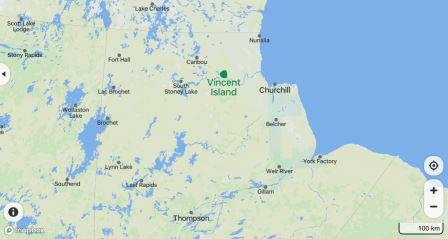
Vincent Island in Mullin Lake was named after Omer Vincent. (Map source: Mapcarta)

Vincent Island, located in Mullin Lake in northern Manitoba, west of Churchill, was named after Omer in 1995. 

Thank you to Diane Dube for providing information on Omer Vincent, to Edwin van der Wolf for the account of what happened at the ‘t Hammink farm, and to Sheldrake of WW2Talk for information about the gun fitter course.  If you have a story or photo to share, please contact Pieter at memorialtrail@gmail.com or comment on the blog. 

© Daria Valkenburg

….Want to follow our research?….

If you are reading this posting, but aren’t following our research, you are welcome to do so.  Our blog address: https://onthewarmemorialtrail.com/

4 countries, 6 weeks, 7,000 km – an unforgettable war memorial journey in Europe…. Daria’s book ‘No Soldier Buried Overseas Should Ever Be Forgotten‘ is available in print and e-book formats.  Net proceeds of book sales help support research costs and the cost of maintaining this blog. For more information see https://nosoldierforgotten.com/

You are also invited to subscribe to our YouTube Channel: On The War Memorial Trail With Pieter Valkenburg: https://www.youtube.com/channel/UCJ591TyjSheOR-Cb_Gs_5Kw

Never miss a posting!  Subscribe below to have each new story from the war memorial trail delivered to your inbox.
On The War Memorial Trail….. The WWII Soldier From Rorketon Whose Sister Never Forgot Him

where-to-blog-header-code-on-a-wordpress-theme-September 2, 2022. In May, researchers at the Information Centre at the Canadian War Cemetery in Holten, The Netherlands honoured 27 soldiers of Ukrainian heritage that are buried in the cemetery.  Photos for 4 were missing and Pieter was asked if he could help. 

All four soldiers had a connection to the Canadian prairies. To our delight, families of all four soldiers came forward within a few weeks. 

 ….The 4 soldiers of Ukrainian heritage without photos ….

  • Elie ANTONYSZYN, born in Rorketon, Manitoba, died July 15, 1945, aged 22
  • Andrew KERELCHUK, born in Zbaraz, Manitoba, died April 19, 1945, aged 21
  • Sam MATVICHUK, born in Broadacres, Saskatchewan, died April 14, 1945, aged 19
  • John RUSNAK, born in Portage La Prairie, Manitoba, died November 22, 1945, aged 21

This posting is about Elie ANTONYSZYN, who was born March 10, 1923 in Rorketon, Manitoba, the son of Michael (Mike) and Lena (nee Dowhaniuk) Antonyszyn.  The only son, Elie had two younger sisters, Mary and Olga.

….Family of Elie Antonyszyn contact Pieter after a letter to the editor is published ….

On June 21, 2022 a Letter to the Editor about the search for a photo of Elie was published in the Dauphin Herald.

Dauphin Herald Letter to Editor

Letter to the Editor published in the June 21, 2022 edition of the Dauphin Herald.  (Clipping courtesy of Natalie Fee)

A few days after publication, Natalie Fee contacted Pieter with a photo of Elie, saying that the Letter to the Editor “was passed to me from a friend as I no longer live in that area. I am Elie, Mary, & Olga’s youngest cousin; their mother Wasalena and my Grandpa John Dowhaniuk were brother and sister….

improved_photo(5) antonyszyn

Elie Antonyszyn (Photo courtesy of Natalie Fee (cousin). Photo colourization by Pieter Valkenburg)

…Elie was drafted…

Elie enlisted on February 3, 1943 in Winnipeg, Manitoba, under the National Resources Mobilization Act. This was a compulsory national registration for military service, originally for home defence, but later for service overseas as WWII continued. (See https://www.thecanadianencyclopedia.ca/en/article/national-resources-mobilization-act)

At the time of enlistment, Elie was a high school student, in Grade 12, but was required to report for registration due to his age of 19.  As the only son of a farmer, he likely could have received an exemption from military service, had he asked for it.

The interviewer for his Personnel Selection Record noted that Elie was fluent in English and Ukrainian, and intended to become a pharmacist.  He played hockey, football, and baseball, and enjoyed playing cards and checkers. 

He was described as being “…a bright country high school lad…. Courteous and steady, more of a student type. Appears dependable and has a happy manner…

Elie was sent to Esquimalt, British Columbia for basic training, where he remained until April 15, 1943.  He was then transferred to #46 Light Anti-Aircraft Battery in Nanaimo, British Columbia.

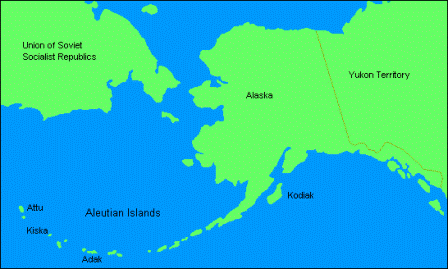
…Elie was sent to Kiska, Alaska…

aleutianminimap

Map showing location of Kiska, part of the Aleutian Islands.  (Map source: http://www.canadiansoldiers.com)


1024px-Kiska_Island_1943.svg

Map source: By of SVG: Kuara – Aleutian Islands, United States Army Center of Military History, CC BY-SA 3.0, https://commons.wikimedia.org/w/index.php?curid=5209745

On July 12, 1943, Elie was assigned to participate in ‘special duty’ as Canadian support to Kiska, Alaska for the American led ‘Operation Cottage’. The idea was to liberate Kiska Island from Japanese forces, which had occupied it since June 7, 1942. No one seemed to be aware that the Japanese had left the Island on July 28, 1943, and it was unoccupied by the time Allied troops arrived on August 15, 1943. (See https://en.wikipedia.org/wiki/Operation_Cottage and http://www.canadiansoldiers.com/history/operations/operationcottage.htm)

As noted in Project 44’s Operation Cottage: Invasion of Kiska Island: “Despite the lack of Japanese soldiers, there still were American and Canadian casualties. Some were wounded and killed in friendly fire as nervous soldiers fired into the fog amongst the confusion. Others were wounded and killed by enemy mines, booby-traps, and explosive ordinance left on the island. The Canadians sustained eight casualties, four dead and four wounded…” (See https://www.project44.ca/kiska)

While the Americans left Kiska by September 1, 1943, the Canadians remained for over 3 months longer. 

C.P. Stacey’s ‘Official History of the Canadian Army in the Second World War: Volume I: Six Years of War: Canada, Britain and the Pacific’ recorded that troops lived “in ‘winterized’ tents, and engaged in road and pier construction, transport fatigues, building and manning defences, and carrying on such training as conditions permitted. Fog, rain and wind made the island an acutely unpleasant residence, and the troops were heartily glad when the withdrawal to British Columbia began in November 1943. The last shipload of Canadians left Kiska on 12 January 1944…. Elie returned to Canada on January 3, 1944.

…Elie was sent overseas…

On January 31, 1945 Elie left for the United Kingdom, arriving on February 9, 1945 and attached to the Canadian Army Reinforcement Unit (CARU).   He remained in the United Kingdom until May 2, 1945, when he was sent to northwest Europe and transferred to the 6th Canadian Anti-Tank Regiment, Royal Canadian Artillery.

On June 24, 1945 Elie was transferred to the 8th Light Anti-Aircraft Regiment, Royal Canadian Artillery.  While the Regiment was in The Netherlands, Elie died tragically on July 15, 1945, and was temporarily buried in the Roman Catholic Cemetery in Borculo.

…Elie was reburied in the Canadian War Cemetery in Holten…

On April 17, 1946, Elie was reburied in the Canadian War Cemetery in Holten, The Netherlands.

2226823_1 Grave of Elie Antonyszyn in Holten

Grave of Elie Antonyszyn in the Canadian War Cemetery in Holten. (Photo courtesy of the Canadian Virtual War Memorial)

Natalie Fee wrote us that her “…husband’s uncle, Brian Batter went to Holten this spring to visit Elie’s grave.  Brian was a Lieutenant-Colonel (retired) in the Royal Winnipeg Rifles. Thank you for all of the hard work you do!…

Brian Batter at grave of Elie Antonyszyn in Holten

Brian Batter at the grave of Elie Antonyszyn.  Flags of Canada and Ukraine were placed by his grave. (Photo courtesy of Natalie Fee)

…Elie’s sister Mary never forgot him…

Elie’s sister Olga died in 1997, leaving his sister Mary the last of the siblings.  When she died in 2017 at the age of 93, her obituary contained a memory of her beloved brother: “….From her stories of when she was a child living in Rorketon, MB, racing her brother Elie home from school, or when he dared her to walk across a frozen pond for 25 cents, her stories about her brother were full of admiration….” (See https://passages.winnipegfreepress.com/passage-details/id-247494/ANTONYSZYN_MARY)

….Antonyszyn Lake in northern Manitoba named in his honour…..

Screenshot 2022-08-31 at 12-29-34 Antonyszyn Lake

Antonyszyn Lake in northern Manitoba.  (Map source: https://mapcarta.com)

Antonyszyn Lake in northern Manitoba was named after Elie in 1974.  Latitude: 59.0965° or 59° 5′ 47″ north.  Longitude: -96.04037° or 96° 2′ 25″ west.

sunflower header

Thank you to Natalie Fee for providing photos, and to the Dauphin Herald newspaper for publishing the photo request.  This was the last story in this series about soldiers of Ukrainian descent who are buried in the Canadian War Cemetery in Holten.

If you have a story to tell, please let Pieter know. Email him at memorialtrail@gmail.com, comment on the blog, or tweet to @researchmemori1

…Missed the previous postings about the soldiers of Ukrainian heritage?…

…Want to follow our research?….

If you are reading this posting, but aren’t following the blog, you are welcome to do so.  See https://onthewarmemorialtrail.com/ or email me at dariadv@yahoo.ca and ask for an invitation to the blog. 

Front cover OnTheWarMememorialTrailinEuropeDaria’s book ‘No Soldier Buried Overseas Should Ever Be Forgotten‘ is available in print and e-book formats.  For more information see https://nosoldierforgotten.com/

You are also invited to subscribe to our YouTube Channel: On The War Memorial Trail With Pieter Valkenburg: https://www.youtube.com/channel/UCJ591TyjSheOR-Cb_Gs_5Kw

© Daria Valkenburg

On The War Memorial Trail….. Atlantic Canada Remembers – Part 8

March 16, 2021. More of the photos submitted by Atlantic Canadians of soldiers buried overseas are featured in this posting. Pieter is ensuring that every email is acknowledged, and that the photos of soldiers buried in The Netherlands are forwarded to the appropriate cemetery for their digital archives.  Thank you to the members of Royal Canadian Legions in Nova Scotia and New Brunswick for their help.

Soldiers buried at the Canadian War Cemetery in Holten, The Netherlands

Fryday published in Toronto Newspaper

George Albert Fryday.  (Photo submitted by Marion Fryday-Cook.)

Marion Fryday-Cook, President of the Royal Canadian Legion’s Nova Scotia/Nunavat Command, submitted a photo of George Albert FRYDAY, explaining that “I am a relative of Rifleman George A. Fryday, Service Number B/136751, who is buried in Holten Canadian War Cemetery, Netherlands.  He was born in Toronto, Ontario. Thank you for honouring our fallen….” 

At the age of 15, George joined the Merchant Marine, and later the Royal Canadian Navy Volunteer Reserve.  However, once it was established that he was under age, he was discharged.  At the age of 17, he enlisted in the Canadian Army and was sent overseas in December 1944.  He was serving in the Queen’s Own Rifles Regiment when he lost his life on May 4, 1945, aged 19. 

Frederick Joseph Tait

Frederick Joseph Tait. (Photo submitted by the Grand Falls branch of the Royal Canadian Legion)

Patrick Côté of the Royal Canadian Legion, Branch 21 in Grand Falls, New Brunswick, submitted a photo of Frederick Joseph TAIT, born April 26, 1921 in Grand Falls, New Brunswick, the son of Herbert Henry Tait and Louise Emeline Leclair.

Patrick referenced a book, ‘Military Heritage – The Greater Grand Falls Region’, by Jean-Guy Plourde, which explained that “…. Prior to the war, he worked in a grocery store…”  Before enlistment on February 1, 1943 in Fredericton, he served in the New Brunswick Cadet Corps, and had been an Instructor in Infantry Training with the 2nd Carleton & York Regiment since 1940.

According to the Personnel Selection Record of his service file, he was fluent in both French and English and was assessed as “…good NCO instructor material…”  (NCO refers to Non-Commissioned Officer.)  He had a “…confident bearing…” and “…stability above average….” Unfortunately, his educational background was “…not high enough for commissioned rank…” 

After being deployed overseas in December 1943 he served in Sicily, where he fell ill and was hospitalized for 8 months.  After being released from hospital, he “…went on leave to England….” Over Christmas 1944 he was able to meet his brother Clair, also with the Canadian Army.

Clair survived WWII but Frederick didn’t.  While serving with the Carleton & York Regiment as the unit advanced to the Apeldoorn Canal in The Netherlands on April 15, 1945, he lost his life and was temporarily buried in Posterenk, near Zutphen.

CIMG9297 Sep 25 2017 Edwin and Pieter with CYR list

Edwin van der Wolf and Pieter in Posterenk in 2017.  Pieter holds up a list of the 6 Carleton & York Regiment soldiers who were temporarily buried in the village.  (Photo credit: Daria Valkenburg)

In September 2017, Pieter and I visited the village of Posterenk with Edwin van der Wolf, one of the research volunteers at the Canadian War Cemetery in Holten.  Edwin explained that “… the Carleton & York Regiment came from Italy to Marseilles, and then into The Netherlands where, on April 13, 1945, the village of Posterenk was liberated.  Six soldiers from the Regiment were buried here temporarily….” 

Edwin gave us a list of the 6 soldiers from the Carleton & York Regiment who were temporarily buried in the village.  Frederick Joseph Tait was one of these men!

Posterenk list of 6 CYR members

List of 6 Carleton & York Regiment soldiers temporarily buried in Posterenk in 1945.

Soldiers buried at the Canadian War Cemetery in Groesbeek, The Netherlands

Photo Burgess Porter

Burgess Allison Porter.  (Photo submitted by Everett Dalton)

Everett Dalton submitted a photo of Burgess Allison PORTER, writing that Burgess was “…the son of Annie ‘Laura’ (nee Porter) McCall…Born October 2, 1922 in Grafton, Nova Scotia, his mother died when he was 2 years old.  Although his biological father, Reg McCall was still alive, it was his mother’s wish that her son be raised by “…Frank Oscar and Lennie Alma (nee Pineo) Porter….”  

While not formally adopted, he was raised by them and was known by the surname Porter. His service file identifies Frank and Lennie Porter as his grandparents. 

Born October 2, 1922, Burgess was from Grafton, Nova Scotia, and a store clerk before he enlisted in Halifax on April 14, 1941.  On January 20, 1942 he arrived in the United Kingdom as part of the Artillery Holding Unit, and in April 1942 was attached to the 4th Field Regiment of the Royal Canadian Artillery as a bombardier. 

On July 7, 1944 his unit landed in France, and unfortunately Burgess was killed on February 21, 1945 in Germany and was temporarily buried in Bedburg, Germany.

Soldiers buried at the Canadian War Cemetery in Bergen Op Zoom, The Netherlands

Clayton Wilfred Shannon virtual war memorial BoZ

Clayton Wilfred Shannon.  (Photo from Canadian Virtual War Memorial)

Patrick Côté of the Royal Canadian Legion, Branch 21 in Grand Falls, New Brunswick sent the link to the Canadian Virtual War Memorial page for Clayton Wilfred SHANNON, who had served with the Calgary Highlanders and lost his life on September 22, 1944.

Patrick referenced a book, ‘Military Heritage – The Greater Grand Falls Region’, by Jean-Guy Plourde, which explained that Clayton, born August 2, 1920 in Grand Falls, the son of Frederick Herman Shannon and Bertha Mulherin, “…was musically inclined… playing guitar and singing.  Before his army service, he had even made a couple of records….

In 1940 “…with his cousin, Adrien Mulherin, he left home to enlist in the Carleton & York Regiment….”   After serving 4 years in Canada, he went overseas “…in July 1944, with the Calgary Highlanders…. While in combat near the border of Holland and Belgium, Clayton was killed, only a few weeks after arriving in Europe…

Clayton lost his life in Belgium during the Battle of the Scheldt, and was initially buried in Wommelgem, on the outskirts of Antwerp, one of 11 members of the Calgary Highlanders buried there before being reburied in Bergen Op Zoom. (For more information on what happened in Wommelgem, see https://onthewarmemorialtrail.com/2021/02/13/on-the-war-memorial-trail-the-search-for-soldiers-who-died-in-wommelgem-belgium-in-fall-1944/)

Gregory P. A. McCarthy (2)

Gregory Philip Anthony McCarthy.  (Photo submitted by the Grand Falls branch of the Royal Canadian Legion)

Patrick Côté of the Royal Canadian Legion, Branch 21 in Grand Falls, New Brunswick, submitted a photo of Gregory Philip Anthony MCCARTHY, born February 28, 1922 on a farm in California Settlement in Grand Falls, son of Thomas and Agnes McCarthy. 

Patrick referenced a book, ‘Military Heritage – The Greater Grand Falls Region’, by Jean-Guy Plourde, which explained that Gregory “…was the youngest of 11 children….He had …. helped on the farm for 8 years and also worked in lumbering prior to his enlistment…. On 26 March 1941 Gregory enlisted in the Canadian Army at Woodstock, NB…

After completing his basic training, he was “… transferred to the 1st Battalion New Brunswick Rangers….on 19 May 1941….”  After a promotion to Lance Corporal on December 1, 1941 he went to Labrador as a Driver Mechanic. 

On September 10, 1943 he left for the United Kingdom “… where he completed a mortar course and remained until his deployment to France with the 10th Independent Machine Gun Company, NB Rangers, arriving on 22 July 1944….

His commanding officers described him as “…dependable, reliable, and well-thought of in his unit….”  While serving in Germany and The Netherlands, he was a member of a mortar detachment responsible for engaging the enemy. On January 19, 1945, near Waalwijk in The Netherlands, their own mortar misfired and exploded, causing 3 members of the team to be seriously wounded, with fatal consequences for Gregory.  He was initially buried in Tilburg.

Thank you to Patrick Côté, Everett Dalton, and Marion Fryday-Cook for sharing photos and anecdotes.  Atlantic Canadians remember their loved ones who are buried overseas.

More photos and stories in Atlantic Canada Remembers – Part 9! To share photos or information, please email Pieter at memorialtrail@gmail.com, or comment on the blog. 

© Daria Valkenburg

…..Previous postings in the Atlantic Canada Remembers series….

Missed the previous postings in this series? See:

…..Want to follow our research?….

If you are reading this posting, but aren’t following the blog, you are welcome to do so.  Our blog address: https://onthewarmemorialtrail.com/

Front cover OnTheWarMememorialTrailinEurope4 countries, 6 weeks, 7,000 km – an unforgettable war memorial journey in Europe…. Daria’s book ‘No Soldier Buried Overseas Should Ever Be Forgotten‘ is available in print and e-book formats.  Net proceeds of book sales help support research costs and the cost of maintaining this blog. For more information see https://nosoldierforgotten.com/

Screenshot_2021-02-27 On The War Memorial Trail With Pieter Valkenburg

You are also invited to subscribe to our YouTube Channel: On The War Memorial Trail With Pieter Valkenburg: https://www.youtube.com/channel/UCJ591TyjSheOR-Cb_Gs_5Kw

Never miss a posting!  Subscribe below to have each new story from the war memorial trail delivered to your inbox.

On The War Memorial Trail….. Atlantic Canada Remembers – Part 7

February 22, 2021. We continue to feature more of the photos submitted by Atlantic Canadians of soldiers buried overseas. Pieter is ensuring that every email is acknowledged, and that the photos of soldiers buried in The Netherlands will be forwarded to the appropriate cemetery for their digital archives.  Thank you to the various members of Royal Canadian Legions in Nova Scotia and New Brunswick for their help.

The volunteers at all three Canadian War Cemeteries in Holten, Groesbeek, and Bergen Op Zoom are now active, and Pieter has received wish lists for photos from all three cemeteries.  Submissions for soldiers buried in municipal cemeteries are being held until Pieter gets the go-ahead that those volunteers are active again.

Soldiers buried at the Canadian War Cemetery in Holten, The Netherlands

Ken Dennis of Yarmouth let us know about the Wartime Heritage Association website, which features some of the soldiers from the area who served in WW2.  One of the profiles, written by Flip Jonkman, was of a soldier on the photo wish list of the Canadian War Cemetery in Holten…. Brenton Leroy RINGER. (See http://wartimeheritage.com/whaww2ns2/wwii_ringer_brenton_leroy.htm)

Born on March 22, 1925 in Northfield, Nova Scotia, the son of Ralph and Alberta Ringer of Clementsport, he was an electrician’s helper when he enlisted, at age 18, with the North Nova Scotia Highlanders in Halifax on January 17, 1944.  He later transferred to the 10th Armoured Regiment on March 27, 1945, and lost his life on April 12, 1945 during the liberation of Heino, The Netherlands, when the Sherman tank he was in was hit on the road to Zwolle. 

There were 5 men in the tank, with one survivor.  The survivor knocked on the door of a nearby farmhouse to ask for help, the home of Flip Jonkman’s parents.  Flip was not born at the time, but always remembered the story, and in 2020, was instrumental in getting a memorial stone placed near the site of the attack.  (See the article in Dutch for more information: https://www.destentor.nl/raalte/vurige-wens-in-vervulling-voor-flip-jonkman-73-uit-heino-nu-gedenksteen-is-geplaatst~a694b86d/?referrer=https%3A%2F%2Fduckduckgo.com%2F)

Another of the names on the photo wish list for the Canadian War Cemetery in Holten was found on the Wartime Heritage Association website…. that of Louis Graham RICHARD. (See http://wartimeheritage.com/whaww2ns/wwii_richard_louis_graham.htm)

Born February 13, 1918, the son of Raphael Daniel and Mary Ann Richard of Londonderry, Nova Scotia, Louis was a store clerk before enlisting with the No 2 Canadian Armed Corps in Halifax on February 17, 1943 as a trooper.  On October 14, 1944 he was sent to the United Kingdom, and then on March 31, 1945 to Western Europe with the 9th Armoured Regiment (BC Dragoons).  

Louis was killed in action in The Netherlands during the Battle of Delfzijl Pocket on April 26, 1945, at the age of 27, and was temporarily buried in Wirdum in the province of Groningen, The Netherlands before being reburied in the Canadian War Cemetery in Holten. (For more information on this battle, see https://www.canadiansoldiers.com/history/battlehonours/northwesteurope/delfzijlpocket.htm)

Soldiers buried at the Canadian War Cemetery in Groesbeek, The Netherlands

Percy Clayton Cromwell photo only

Percy Clayton Cromwell.  (Photo submitted by Ken Dennis)

Ken Dennis submitted a photo of Percy Clayton CROMWELL, explaining that “…I am a member of the Yarmouth Branch 61 Legion…” After receiving a wish list of photos from Pieter, he noticed one name from Yarmouth, Nova Scotia.  “…Having been shown this email, I decided to trace his local roots…

…He was a labourer, then for CP out of the Halifax area and upon enlisting moved his family to Yarmouth where they grew up….” CP refers to the Canadian Pacific Railway.

Percy was born in Yarmouth on February 12, 1914, the son of James Alfred and Annie May Cromwell.  He enlisted with the West Nova Scotia Regiment in Aldershot, Nova Scotia on May 14, 1940.

Percy was with the Royal Canadian Electrical and Mechanical Engineers when he drowned in The Netherlands on February 8, 1945.  He’d been on guard duty along a canal in the Dutch province of Brabant on a very dark, windy, and rainy night, and it would have been very easy to lose his bearings and accidentally fall into the canal.  His body was not found until March 12, 1945.  He left behind a wife, Lillian Beryl, and four children. 

Frank Lewis Libby photo only

Francis Lewis Libby. (Photo from the New Brunswick Military Recognition Booklet)

Kent Caldwell, a member of the Royal Canadian Legion in New Brunswick, sent an entry on Francis ‘Frank’ Lewis LIBBY from one of the annual issues of the New Brunswick Military Recognition Booklet, explaining that the photo was a copy from a newspaper clipping.  The entry stated that “…Francis served with the Calgary Highlanders in England and Northwest Europe.  He was killed in The Netherlands in 1945…” 

Francis was born February 21, 1918 in Milltown, New Brunswick, the son of Clifford and Mary Christine Libby.  Before enlisting on July 25, 1941, he worked at the Canadian Cottons Plant in Milltown.  On October 4, 1941, he married Dorothy Louise Caswell.  He and Dorothy had a son Francis Brian in 1944 while he was overseas in Europe, and where he transferred to the Calgary Highlanders in September 1944. Francis lost his life on January 5, 1945 after being killed along the Dutch-German border. He was temporarily buried in Nijmegen, before his reburial, on July 30, 1945, in Groesbeek.

Hiram Albion Lord photo only

Hiram Albion Lord. (Photo from the New Brunswick Military Recognition Booklet)

Kent Caldwell, a member of the Royal Canadian Legion in New Brunswick, also sent an entry on Hiram Albion LORD from one of the annual issues of the New Brunswick Military Recognition Booklet, explaining that the photo was a copy from a newspaper clipping.  The entry stated that “…Hiram served with the North Shore (New Brunswick) Regiment during the Second World War and was killed in action in 1945…” 

Born November 7, 1924 in Lords Cove, Deer Island, New Brunswick, the son of Minnie Smith, Hiram was a fisherman before enlisting on November 4, 1943 and served in Canada until his arrival in the United Kingdom on July 21, 1944.   On August 17, 1944 he went with his unit to Western Europe and lost his life on January 8, 1945 near Nijmegen, The Netherlands.

Stanley Spray

Stanley Spray. (Photo submitted by Royal Canadian Legion Branch #20 in Digby)

Donna Flaherty, President of Royal Canadian Legion Branch #20 in Digby, Nova Scotia, submitted a photo of Stanley SPRAY, writing “…This picture hangs on our Memorial Wall….

Born April 24, 1913 in Nottinghamshire, England, the son of Edgar and Edith Spray, Stanley immigrated to Canada, and settled in Digby, Nova Scotia, where he ran a small farm and worked for J. J. Wallis as a printer before his enlistment on July 6, 1940 with the 52nd Anti-Tank Battery.  He was married to Alda May and the father of two daughters, Jean Carolyn and Joan Carol. 

He received several promotions, and was a battery quartermaster sergeant with the Royal Canadian Artillery when WW2 ended.  Stanley lost his life in a tragic vehicle accident near Nijmegen, The Netherlands on July 23, 1945, when he was catapulted out of the back of an army truck that collided with an oncoming military vehicle.

Thank you to Kent Caldwell, Ken Dennis, and Donna Flaherty for sharing photos and anecdotes.  Atlantic Canadians remember their loved ones who are buried overseas. If you have a higher resolution photo of Percy Clayton Cromwell, Frank Lewis Libby, or Hiram Albion Lord, please send it in to us.

More photos and stories in Atlantic Canada Remembers – Part 8! To share photos or information, please email Pieter at memorialtrail@gmail.com, or comment on the blog. 

© Daria Valkenburg

…..Previous postings in the Atlantic Canada Remembers series….

Missed the previous postings in this series? See:

…..Want to follow our research?….

If you are reading this posting, but aren’t following the blog, you are welcome to do so.  Our blog address: https://onthewarmemorialtrail.com/

Front cover OnTheWarMememorialTrailinEurope4 countries, 6 weeks, 7,000 km – an unforgettable war memorial journey in Europe…. Daria’s book ‘No Soldier Buried Overseas Should Ever Be Forgotten‘ is available in print and e-book formats.  Net proceeds of book sales help support research costs and the cost of maintaining this blog. For more information see https://nosoldierforgotten.com/

You are also invited to subscribe to our YouTube Channel: On The War Memorial Trail With Pieter Valkenburg: https://www.youtube.com/channel/UCJ591TyjSheOR-Cb_Gs_5Kw

Never miss a posting!  Subscribe below to have each new story from the war memorial trail delivered to your inbox.
On The War Memorial Trail….. The Search For Soldiers Who Died In Wommelgem, Belgium In Fall 1944

February 13, 2021. After WWII soldier Arnold Ernest “Ernie” THORNTON was featured in a recent Atlantic Canada Remembers posting, we were contacted by Niko Van Kerckhoven, of Antwerp, Belgium.  (See https://onthewarmemorialtrail.com/2021/01/16/on-the-war-memorial-trail-atlantic-canada-remembers-part-3/)

Niko wrote that “…I am a member of the local historical society and I am doing some research about our Canadian liberators here in my hometown of Wommelgem, Belgium, in 1944.

Fort2, one of the Antwerp forts located here, housed the 9th Canadian Field Dressing Station, and as a consequence, about 40 Canadian casualties were buried in our civilian cemetery, but after the war reburied in Bergen Op Zoom Canadian Cemetery, just across the border in Holland. I visit them regularly with my son.

One of the soldiers buried here in Wommelgem was Arnold Ernest Thornton from Yarmouth. This Calgary Highlander died during the building of a bridgehead over the Albert Canal at Wijnegem. His body, together with several others, was transferred to Wommelgem to be buried, just 500m from where I live nowadays.

 I have been searching for a picture of this soldier for several years, but this week, thanks to the Yarmouth Library, they gave me the link to your site. Another search ended with a face to a name carved in stone. Every time very moving!….

Niko submitted a photoof the field grave of 11 Calgary Highlanders buried here in Wommelgem before their transfer to Bergen-Op-Zoom Cemetery. My research started in fact by seeing this picture, and it became a bit like an avalanche with new names and information….

molenbeekstraat

Field grave in Wommelgem, where 11 members of the Calgary Highlanders were initially buried after losing their lives on September 22, 1944.  (Photo credit: Heemkundige Kring De Kaeck Wommelgem)

The events in Wommelgem occurred in the fall of 1944 during the Battle of the Scheldt.  (See https://www.veterans.gc.ca/eng/remembrance/history/second-world-war/scheldt)

Niko noted that his goal is to find a photo of each soldier initially buried in Wommelgem, but is “…still struggling with the last 5 names on my list…

We know how Niko feels!  In the spirit of remembrance, let’s hope that this posting will help him in his quest! Here are the five names on his wish list…

  • George Scott Fraser COULSON, K/2209, Calgary Highlanders from Oak Bay, British Columbia, but born July 21, 1916 in Victoria, British Columbia. Died September 22, 1944.
  • Simon HOULE, M/101291, Royal Canadian Artillery, born June 18, 1922 in Saddle Lake, Alberta. Died October 1, 1944.
  • Michael SHERBANUIK, M/105737, Calgary Highlanders from Vegreville, Alberta, but born December 12, 1920 in Winnipeg, Manitoba. Died September 22, 1944.
  • Paul Alan SKLUT, K/51951, Calgary Highlanders, born April 15, 1924 in Vancouver, British Columbia. Died October 8, 1944.
  • Donald Charles SUTHERLAND, F/16788, Calgary Highlanders, born January 7, 1923 in Halifax, Nova Scotia. Died September 22, 1944.

If you can help with a photo or information on any of these 5 soldiers or the 9th Canadian Field Dressing Station, please let Pieter know.  You can email him at memorialtrail@gmail.com, or comment on the blog.

© Daria Valkenburg

….Want to follow our research?….

If you are reading this posting, but aren’t following our research, you are welcome to do so.  Our blog address: https://onthewarmemorialtrail.com/

Front cover OnTheWarMememorialTrailinEurope4 countries, 6 weeks, 7,000 km – an unforgettable war memorial journey in Europe…. Daria’s book ‘No Soldier Buried Overseas Should Ever Be Forgotten‘ is available in print and e-book formats.  Net proceeds of book sales help support research costs and the cost of maintaining this blog. For more information see https://nosoldierforgotten.com/ 

You are also invited to subscribe to our YouTube Channel: On The War Memorial Trail With Pieter Valkenburg: https://www.youtube.com/channel/UCJ591TyjSheOR-Cb_Gs_5Kw

Never miss a posting!  Subscribe below to have each new story from the war memorial trail delivered to your inbox.
On The War Memorial Trail….. Atlantic Canada Remembers – Part 3

‘No soldier buried overseas should be forgotten’ …. Pieter Valkenburg

January 16, 2021.  “No soldier buried overseas should be forgotten.” This statement by Pieter in a news clip on CTV’s Atlantic Live At 5 touched many people who watched it, and many photos and stories continue to be emailed to him.  As mentioned in Parts 1 and 2, Pieter has been working to ensure every email is acknowledged, and that the photos of soldiers buried in The Netherlands are forwarded to the appropriate cemetery for their digital archives.

This posting features more of the photos submitted…..

Soldiers buried at the Canadian War Cemetery in Holten, The Netherlands

William Broome restored

William Harold Broome. (Photo submitted by the Fleet Family)

On behalf of the Fleet Family, Diane Russo submitted a photo of her uncle, William Harold BROOME of Galt, Ontario, was born in 1913, the son of Simeon and Charlotte (nee Gilbert) Broome.  In 1937 he married Edith Cavel Gillies, and they had a son Billy.  A machine operator before enlisting in the war, he died of wounds received in action on April 25, 1945 during the Battle of Friesoythe in NW Germany, while serving with the Argyll and Sutherland Highlanders of Canada. He was buried there temporarily, before being reburied on March 9, 1946 in Holten.

Lt. Percy Dexter Higgins

Percy Dexter Higgins.  (Photo courtesy of the Higgins Family)

On behalf of the Higgins Family, Donald Higgins submitted a photo of his uncle, Percy Dexter HIGGINS, and wrote that “…My father’s brother, Lt. Percy Dexter Higgins, is buried in Holten Cemetery. He served with North Nova Scotia Highlanders R.C.I.C. (from N.S.)…

Lt Higgins lost his life during the Battle of Warnsveld which began late in the day on April 4, 1945. An account of the events is in Will R. Bird’s ‘No Retreating Footsteps… the story of the North Novas’: “…. April 4th was bright and sunny…The Brigadier arrived and the Novas’ next objective was the town of Warnsveld…. The troops were carried in vehicles to a debussing point in the woods…… there was a delay as a huge crater in the road had to be filled by the Sappers before the ‘Wasps’ could get over. Then the tanks had not arrived and the company could not get forward until 1730 hours. A Company started to hit snipers in concealed positions and progress was slow as each house had to be searched in turn….

Bird’s account mentions what happened next…. “….There was considerable shooting going on in various spots and B Company sent a platoon to make sure of an area between them and A Company.  Lt Higgins was in command. There was open ground to be crossed with a fence running at an angle. Three attempts to get over were driven back by machine gun fire.  Lt Higgins then tried to lead a rush up by the cover of the fence and was killed as he jumped over on the other side….

Like John James MURRAY, whose story was told in Atlantic Canada Remembers – Part 2, he is listed on a monument in Warnsveld. (See https://www.tracesofwar.com/sights/57960/Memorial-Canadian-Soldiers.htm).

An error might have been made in recording the date of his death as April 7, 1945 on the Canadian Virtual War Memorial and on his gravestone.  The family has been provided with the service file records should they wish to ask the Commonwealth War Graves Commission for a correction to be made on his gravestone, and for a correction to be made on the Canadian Virtual War Memorial.

IMG_7900 James King

James King. (Photo courtesy of Terry McCormick)

Aaron Bouma submitted a photo of James Gordon KING on behalf of Terry McCormick. Born July 3, 1910 in Woodstock, New Brunswick, the son of Harris Weston and May King, James was a salesman and radio technician in a music store before enlisting on September 1939.

While serving with the Royal Canadian Artillery, he died in a road accident on August 5, 1945, and was temporarily buried in Ostercheps (north west Germany) before being reburied on March 7, 1946 in Holten.

Pte Richard J Raney - 1

Richard Joseph Raney. (Photo courtesy of The Raney Family)

On behalf of the Raney family, Michelle Sutherland submitted a photo of Richard Joseph RANEY, explaining that “…My great uncle (my grandmother’s brother) was killed in action on April 8, 1945 and is buried at the Holten Canadian War Cemetery.  He was born April 12, 1926 in Point Michaud, Richmond County, Nova Scotia.  I was able to get a copy of his World War II Records & Service Files. As I was reading through his file, I realized that he actually lied about his age at the time of his enlistment. He enlisted in Sydney, Nova Scotia on August 31, 1942. He gave his birthday as February 8, 1924. Immediately I knew that could not be correct because my grandmother was born in September 1923. As it turns out, Richard was actually born on April 12, 1926 and was only 16 years old when he enlisted. He was killed a few days before his 19th birthday….

Following the successful liberation of Warnsveld, the North Nova Scotia Highlanders, which Richard Joseph was serving with, continued their advance. Will R. Bird’s ‘No Retreating Footsteps… the story of the North Novas’ explains that: “…. April 8th was clear and sunny and an O-group was held at noon.  The general plan was to seize a bridgehead over the Schipbeek Canal and penetrate into the village of Bathmen.  The bridgehead was to be taken quickly to allow Sappers to set up a Bailey bridge and open the road to traffic….” Richard Joseph lost his life at some point during the ensuing sortie.

Soldiers buried at the Canadian War Cemetery in Bergen Op Zoom, The Netherlands

Ernie Thornton

Arnold Ernest “Ernie” Thornton.  (Photo courtesy of Susan Hudson)

Susan Hudson submitted a photo of her uncle, Arnold Ernest “Ernie” THORNTON.  “…He was born in Amherst on September 30th, 1921 and was killed September 22, 1944, eight days before he turned 23….” she explained. “… He was the son of Edward Arnold and Doris Maude (MacDonald) Thornton.  He served with the Calgary Highlanders….

Ernie was killed in Belgium during the Battle of the Scheldt and initially buried near Wommelgem, Belgium, before being reburied in the Canadian War Cemetery in Bergen op Zoom.

Thank you to Aaron Bouma, Donald Higgins, Susan Hudson, Terry McCormick, Diane Russo, and Michelle Sutherland for sharing photos and anecdotes.  Thank you again to CTV’s Atlantic Live At 5 for helping to get the word out on this quest of remembrance. Atlantic Canadians remember their loved ones who are buried overseas.

More photos and stories in Atlantic Canada Remembers – Part 4! If you have photos or information to share, please email Pieter at memorialtrail@gmail.com, comment on the blog, or tweet to @researchmemori1.

© Daria Valkenburg

….Previous postings in the Atlantic Canada Remembers series….

Missed the previous postings in this series? See:

….Want to follow our research?….

If you are reading this posting, but aren’t following our research, you are welcome to do so.  Our blog address: https://onthewarmemorialtrail.com/

Front cover OnTheWarMememorialTrailinEurope4 countries, 6 weeks, 7,000 km – an unforgettable war memorial journey in Europe…. Daria’s book ‘No Soldier Buried Overseas Should Ever Be Forgotten‘ is available in print and e-book formats.  Net proceeds of book sales help support research costs and the cost of maintaining this blog. For more information see https://nosoldierforgotten.com/ 

You are also invited to subscribe to our YouTube Channel: On The War Memorial Trail With Pieter Valkenburg: https://www.youtube.com/channel/UCJ591TyjSheOR-Cb_Gs_5Kw

Never miss a posting!  Subscribe below to have each new story from the war memorial trail delivered to your inbox.
On The War Memorial Trail…..Our 2019 Visit To The Canadian War Cemetery In Bergen Op Zoom

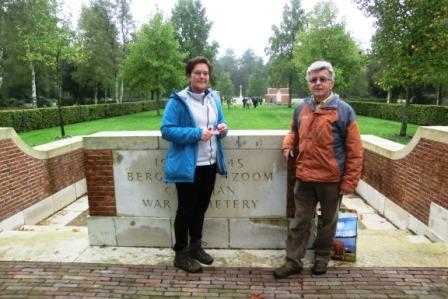
December 7, 2019.  While in The Netherlands this fall, we visited the three Canadian War Cemeteries and laid down flags of Canada and PEI for the names listed on the Cenotaph outside the Borden-Carleton Legion, as well as other Islanders who have been identified by Dutch researchers. The third Canadian War Cemetery we visited on our 2019 trip was in Bergen Op Zoom, near the Belgian border.  As no one listed on the Cenotaph is buried in this cemetery, we had not visited it before.

….Oops!  Wrong cemetery!….

On this trip, however, we decided to lay flags down at the graves of 6 soldiers from Prince Edward Island and 1 from Nova Scotia.  Our first surprise was that there are two war cemeteries, side by side, and of course we went to the wrong one, which turned out to be a British War Cemetery.  Luckily, a teacher visiting with a group of high school students noticed the bag we carried the flags in, and asked if we thought we were in the Canadian War Cemetery.  If so, it was further down the road.  Thank goodness the Dutch are not shy!

….We finally arrive at the Canadian War Cemetery!….

CIMG3382 Oct 7 2019 Bergen Op Zoom Pieter at Cdn War Cemetery

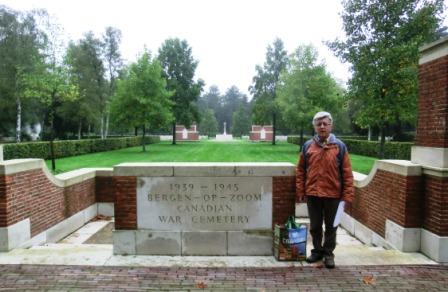
Pieter at the entrance to the Canadian War Cemetery in Bergen Op Zoom.  Our Sobey’s bag saved us from wandering around the wrong cemetery!  (Photo credit: Daria Valkenburg)

We weren’t alone in the cemetery as there were more teachers, supervising schoolchildren carrying roses.  With our Sobey’s bag filled with flags, we were easily picked out as visitors!  A teacher told us that 2,600 schoolchildren would be visiting the Canadian and British War Cemeteries, each carrying a rose to place at a designated grave, until October 28, the day of liberation for this part of The Netherlands.

….Canadian flags placed at 7 graves….

One of the most recent photos Pieter received of PEI soldiers buried in The Netherlands was that of Lawrence Adolphus SWEENEY, provided by his nephew David Perry.  Placing flags by a grave when you have a photo of the person makes this small event more meaningful.

Lawrence Sweeney from David Perry

Lawrence Sweeney.  (Photo courtesy of David Perry)

CIMG3392 Oct 7 2019 Bergen Op Zoom Lawrence Sweeney

Pieter by the grave of Lawrence Sweeney, buried in the Canadian War Cemetery in Bergen Op Zoom. (Photo credit: Daria Valkenburg)

In alphabetical order, here are the known soldiers from PEI that are buried in the cemetery:

  • Pte James Walter AULD, Algonquin Regiment, from O’Leary Station
  • Tpr Alvah Ray LEARD, Sherbrooke Fusiliers Regiment – 27th Armoured Regiment, from Northam
  • Pte Milton Evangeline LIVINGSTONE, Lincoln and Welland Regiment, from Murray River
  • Bdr Hugh Allister MACDONALD, Royal Canadian Artillery – 02 Anti-Tank Regiment, from Georgetown
  • L/Cpl Roy SMITH, Black Watch (Royal Highland Regiment) of Canada, from O’Leary
  • Pte Lawrence Adolphus SWEENEY, Lincoln and Welland Regiment, from Souris

Canadian and Nova Scotia flags were placed at the grave of one soldier from Nova Scotia, who had mistakenly been recorded as being from PEI by the Cemetery:

  • Pte Elmer D. SCHOFIELD, Lincoln and Welland Regiment, from North Alton

Unfortunately, no photo has been found for one PEI soldier:

  • James Walter AULD, born in Glenwood, son of James and Margaret Auld of O’Leary Station. He died on November 1, 1944, aged 21.

….A visit with Caroline Raaijmakers….

The weather in Bergen Op Zoom was cloudy, but it was dry.  We had just missed a rainfall, as we found out while walking through the cemetery.  The ground was saturated and my shoes were soaking wet by the time we finished, giving me an excuse to go to the car and change my shoes and warm up.  In the meantime, Caroline Raaijmakers of the Faces To Graves Bergen Op Zoom Project dropped by to invite us over for coffee and a stroopwafel (a delicious Dutch treat).

CIMG3411 Oct 7 2019 Bergen Op Zoom Pieter & Caroline Raaijmakers

Pieter with Caroline Raaijmakers at the Canadian War Cemetery in Bergen Op Zoom.  (Photo credit: Daria Valkenburg)

Caroline explained that most of the burials in the British and Canadian War Cemeteries in Bergen Op Zoom are due to casualties from the Battle of the Scheldt (For more information, see https://www.veterans.gc.ca/eng/remembrance/history/second-world-war/scheldt#scheldt03).  We learned that information on this battle, in which 6,300 Canadian lives were lost, is in the Liberation Museum Zeeland in nearby Nieuwdorp, which will be on our list of places to visit next trip.  (See https://liberationroute.com/the-netherlands/spots/l/liberation-museum-zeeland-(spot221))

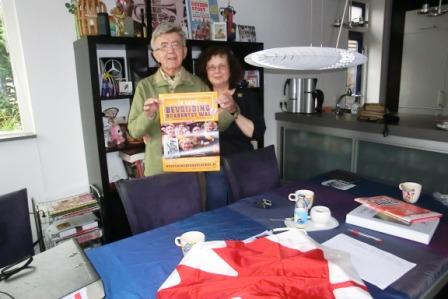
CIMG3413 Oct 7 2019 Bergen Op Zoom holding up poster at Carolines house

Holding up a poster for the 75th Anniversary of the Liberation of the province of Brabant on October 28, 2019.  (Photo credit: Caroline Raajmakers)

Pieter gave Caroline a large Canadian flag, which was provided by Senator Mike Duffy for this war memorial trip.  Flags had also been provided for Pieter to give to the cemeteries in Harlingen, Holten, and Groesbeek, which he did.

Thank you to Senator Mike Duffy for the large Canadian flag, to the office of Malpeque MP Wayne Easter for the small Canadian flags placed by the graves, and to John Wales of the North Nova Scotia Highlanders Regimental Museum in Amherst for the Nova Scotia flag. If anyone has more information to share on any of the soldiers listed above, or know of more Islanders buried in the cemetery in Bergen Op Zoom, please contact Pieter at memorialtrail@gmail.com, comment on the blog, or send a tweet to @researchmemori1.  

© Daria Valkenburg

….Want to follow our research?….

If you are reading this posting, but aren’t following our research, you are welcome to do so.  Our blog address: https://onthewarmemorialtrail.com/

Front cover OnTheWarMememorialTrailinEurope4 countries, 6 weeks, 7,000 km – an unforgettable war memorial journey in Europe…. Daria’s book ‘No Soldier Buried Overseas Should Ever Be Forgotten‘ is available in print and e-book formats.  Net proceeds of book sales help support research costs and the cost of maintaining this blog. For more information see https://nosoldierforgotten.com/ 

You are also invited to subscribe to our YouTube Channel: On The War Memorial Trail With Pieter Valkenburg: https://www.youtube.com/channel/UCJ591TyjSheOR-Cb_Gs_5Kw

Never miss a posting!  Subscribe below to have each new story from the war memorial trail delivered to your inbox.

On The War Memorial Trail….The WWII Soldier Killed in Germany But Buried in Holland

February 22, 2019.  Most of the men listed on the Cenotaph outside the Borden-Carleton Legion were unmarried.  However, William Douglas SHERREN, born November 25, 1914 in Crapaud, Prince Edward Island, son of William Douglas Sherren and Florence Amanda Carrier, was married, to Florence Mead Strickland, and the father of two children, Hubert and Harrison Blair.

An electrician with Palmer Electric in Charlottetown before WWII broke out, William Douglas enlisted with the First Survey Regiment of the Royal Canadian Artillery on January 6, 1940, receiving the rank of Lieutenant.  He was sent to England and on March 29, 1944 was promoted to Captain.  He arrived in France in July 1944, a month after D-Day.

Wiliam Douglas Sherren

William Douglas Sherren. (Photo courtesy of Holten Canadian War Cemetery Information Centre)

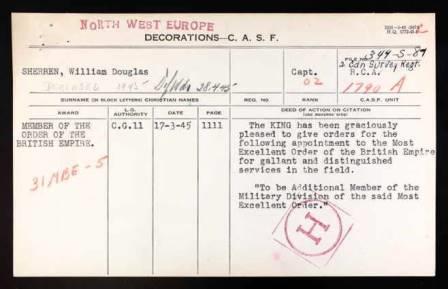
On March 17, 1945, he was recognized by King George VI as a Member of the Military Division of the Most Excellent Order of the British Empire for “gallant and distinguished services in the field” in North West Europe.  Unfortunately, we don’t know the circumstances of him receiving the award.  If anyone has more information, please let us know.

Notice of decoration awarded to WD Sherren

Notice of decoration awarded to William Douglas Sherren. (Source: http://www.ancestry.ca)

On April 25, 1945, just a few days before the end of WWII, he was severely injured when the vehicle he was travelling in drove over a land mine in Germany.  According to his service file, William Douglas died of his wounds at 3:30 am on April 28, 1945.

Originally buried in Cloppenburg Hospital Cemetery in Lower Saxony, William Douglas was reburied in Holten Canadian War Cemetery in The Netherlands in 1947.  This was one of the cemeteries we visited while in Europe, and of course we placed flags at his grave. (See On the War Memorial Trail ….. At Holten Canadian War Cemetery)

IMG_20170918_134108826 Sep 18 2017 grave of WD Sherren Holten cemetery

Grave of Captain William Douglas Sherren at Holten Canadian War Cemetery. (Photo credit: Pieter Valkenburg)

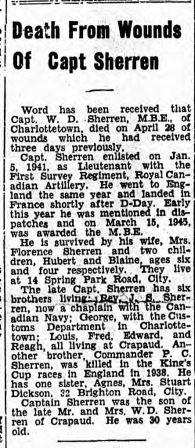
Obituary W.D. Sherren

Obituary of William Douglas Sherren. (Source: The Charlottetown Guardian, Friday, May 4, 1945, page 1)

Do you have photos or information to share on William Douglas Sherren, or any of the soldiers discussed in previous blog postings?  You can send an email to memorialtrail@gmail.com or comment on this blog.

© Daria Valkenburg

….Want to follow our research?….

If you are reading this posting, but aren’t following our research, you are welcome to do so.  Our blog address: https://onthewarmemorialtrail.com/

4 countries, 6 weeks, 7,000 km – an unforgettable war memorial journey in Europe…. Daria’s book ‘No Soldier Buried Overseas Should Ever Be Forgotten‘ is available in print and e-book formats.  Net proceeds of book sales help support research costs and the cost of maintaining this blog. For more information see https://nosoldierforgotten.com/

You are also invited to subscribe to our YouTube Channel: On The War Memorial Trail With Pieter Valkenburg: https://www.youtube.com/channel/UCJ591TyjSheOR-Cb_Gs_5Kw

Never miss a posting!  Subscribe below to have each new story from the war memorial trail delivered to your inbox.