On The War Memorial Trail…..The Bulger Brothers – Part 1: The WWII Soldier From Foxley River Killed During The Battle of Moerbrugge

August 5, 2024.  Can you imagine how difficult it was for parents to send their children off to conflict zones during WWII, and having to live with the uncertainty of whether they would return safely? For the Bulger family of Foxley River, Prince Edward Island, they suffered a double tragedy, losing two sons:  Harold ‘Hal’ Gabriel BULGER, who is buried in the Canadian War Cemetery in Adegem, Belgium, and Lawrence William BULGER, who is buried in the Canadian War Cemetery in Groesbeek, The Netherlands.

We were aware of Lawrence Bulger from last year’s series on soldiers from the North Nova Scotia Highlanders who lost their lives during the Battle of Bienen on March 25, 1945. As his name was not on a photo wish list, we didn’t research his story at that time. (See https://onthewarmemorialtrail.com/2022/11/29/on-the-war-memorial-trail-the-search-for-a-photo-of-austin-havelock-munroe-is-on-youtube/

This year we decided to tell the story of one more soldier killed during the Battle of Bienen, and asked Edison Smith for help in contacting a family member for Lawrence Bulger.  Edison’s grandfather, Edison Alexander SMITH, and great-uncle Ralph Schurman BOULTER, both lost their lives in the Battle of Bienen.  As they were from the same area of the Island, the families would have known each other.  Sometimes, it’s as simple as that to make contact with the family of a soldier!

We then learned that Lawrence’s brother, Harold ‘Hal’ Gabriel, also served in WWII and was killed in action on September 10, 1944 near the town of Oostkamp in Belgium during the early stages of the Battle of the Scheldt. (See https://www.veterans.gc.ca/eng/remembrance/history/second-world-war/scheldt and https://en.wikipedia.org/wiki/Battle_of_the_Scheldt)

We decided to tell the story of both brothers, and began with Hal, the first of the brothers to lose his life.

….Hal’s family was soon found….

Shortly after the request was made, Edison wrote to say “I was up to O’Leary this past week and spoke with my father and did some digging around for a relative of the Bulgers you had asked me about.  I was able to speak with Bev and Bernard Jeffery….. I briefly explained the work you … do and she was kind enough to email me some info and pictures which I have forwarded to you…

Bev also contacted us, explaining that her “mother was Harold and Lawrence’s sister Agatha….”  The family historian in the family, Bev was the keeper of the family photos and information.  Edison had found the right person!

It wasn’t long before we had a chance to meet Bev, and to learn more about the Bulger brothers.

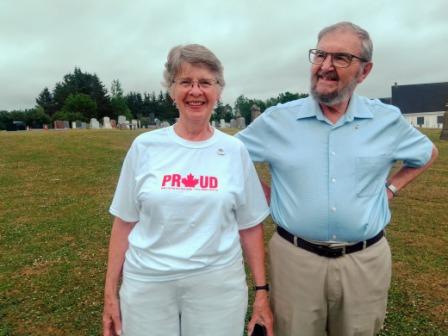
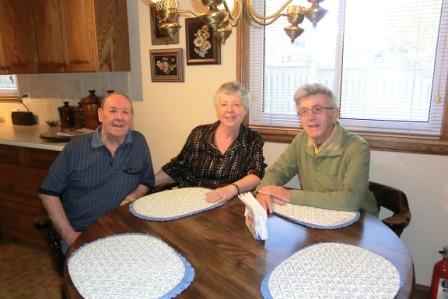
CIMG6836 May 27 2024 Bev Jeffery & Pieter Mill River Resort

Pieter with Bev Jeffery at Mill River Resort in Mill River, Prince Edward Island.  (Photo credit: Daria Valkenburg)

Born September 9, 1918 in Portage, Prince Edward Island, Hal was the son of Gabriel and Anne ‘Annie’ Marion (nee Milligan) Bulger of Foxley River, Prince Edward Island.  One of 16 children, Hal had two brothers and thirteen sisters. 

…..Hal enlisted in 1940….
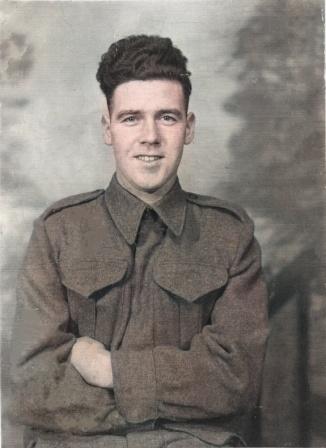
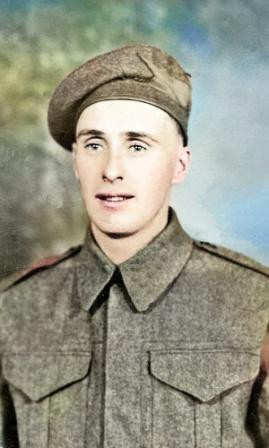
Harold Bulger colourized and restored by Pieter

Harold ‘Hal’ Gabriel Bulger. (Photo courtesy of Bev Jeffery.  Photo restoration and colourization by Pieter Valkenburg)

After leaving school at the age of 13, Hal worked on the family farm until he enlisted with the PEI Highlanders in Charlottetown, Prince Edward Island on July 31, 1940. After completing his basic training at No. 62 Canadian Army (Basic) Training Centre in Charlottetown, Hal was sent to Dartmouth, Nova Scotia for additional training.
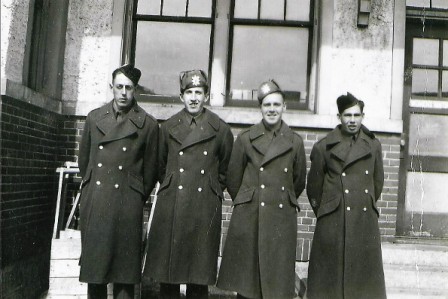
Leo Lynch, Leo Moran, Harold Bulger, Cecil MacKinnon

Left to right: Leo Lynch, Leo Moran, Harold ‘Hal’ Bulger, Cecil MacKinnon. (Photo courtesy of Bev Jeffery)

During a furlough in March 1941, a notice in the March 22, 1941 edition of the Summerside Journal noted that Pte. Leo Moran, Freeland, Pte. John McFayden, Freeland, Pte. Leo Lynch, Portage, Pte. Harold Bulger, Freeland, all of the P.E.I. Highlanders, returned to their unit in Nova Scotia. They were the guests of the Veterans’ Guard, Summerside….

HAROLD BULGER AND mother ANNIE BULGER 001

Harold ‘Hal’ Gabriel Bulger with his mother, Annie Bulger. (Photo courtesy of Bev Jeffery)

On June 4, 1941, Hal was transferred to A13 Canadian Infantry Training Centre in Camp Valcartier, Quebec, as preparation for guard duty in Newfoundland. 

Hal was sent to Newfoundland….

NFLD Map shows Botwood

Location of Botwood Military Base in Newfoundland. (Map source: http://postalhistorycorner.blogspot.com/2012/12/wwii-canadian-forces-in-newfoundland.html)

After France was occupied by the Germans in 1940, Newfoundland’s defensive position became more precarious. A British dominion at the time, Newfoundland did not join Canada until March 31, 1949. 

In 1940, Canada assumed responsibility for the defence of Newfoundland with the establishment of ‘W Force’, a Canadian garrison force responsible for defending Newfoundland against enemy incursions and providing security for existing and proposed defence facilities during WWII. It included infantry, artillery, and anti-aircraft units. (See https://en.wikipedia.org/wiki/Military_history_of_Newfoundland_during_World_War_II)

On July 23, 1941, as part of ‘W Force’, Hal was sent to Botwood, Newfoundland.  In addition to the PEI Highlanders, troops from the Black Watch of Canada, Royal Rifles of Canada, The Algonguin Regiment, Queens Own Rifles, also served at various times. While an RCAF base in Botwood had aircraft patrolling the east coast of the Atlantic, Canadian Army personnel based at Botwood were charged with protection of military facilities that had been installed there, as well as in Gander. (See https://www.heritage.nf.ca/articles/politics/botwood-base.php)

…..Four other soldiers were in Botwood…..

Hal was in Botwood at the same time as four other soldiers whose stories have been told on this blog:

Hal briefly returned to Canada….

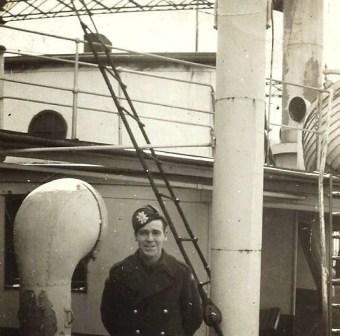
Harold Bulger aboard a ship likely in 1943 from NFLD

Harold ‘Hal’ Bulger aboard a ship returning to Canada from Newfoundland. (Photo courtesy of Bev Jeffery)

Hal remained in Newfoundland until February 12, 1943, when he was briefly sent to A14 Canadian Infantry Training Centre in Camp Aldershot, Nova Scotia and then on to Camp Sussex, New Brunswick. 

On February 23, 1943, he sent his mother a brief letter, thanking her for “…the $5.00 you sent me…” as he was getting low “…on tobacco and money….”  He explained that he didn’t know “…just when I will get home, but I will be home the first chance I get.  I might have to stay here a month before I get home…”  Based on Hal’s service record, he never did get leave to go home.

On March 8, 1943, Hal was no longer attached to ‘W’ Force, and remained at Camp Sussex until March 27, 1943, when he was transferred to the No. 1 Transit Camp in Debert, Nova Scotia, for final preparation and training before being sent overseas. 

In a March 16, 1943 interview for his Personnel Selection Record, it was noted that Hal was a “…pleasant, smiling, sturdy, well-behaved stable lad…

….Hal left Canada for overseas service….

On April 10, 1943, Hal left for Great Britain with the PEI Highlanders.  Upon arrival on April 17, 1943, he was assigned to No. 7 Canadian Infantry Reinforcement Unit (CIRU).

On June 25, 1943, he was briefly assigned to the Princess Louise Fusiliers, before being transferred to the Algonquin Regiment on August 21, 1943.  On May 28, 1944, Hal was promoted from Private to Lance Corporal. 
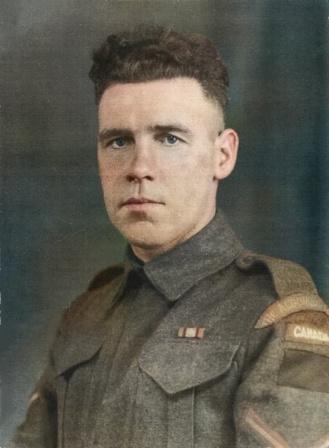
Harold Bulger in Algonquin Regiment Harold Bulger photo restored & colourized by Pieter

Harold ‘Hal’ Gabriel Bulger in his Algonquin Regiment uniform. (Photo courtesy of Bev Jeffery. Photo restoration and colourization by Pieter Valkenburg)

An excerpt from a research paper entitled ‘Rebuilding Trust: The Algonquin Regiment at War, July-September 1944’ by Ty Backer, noted that “In the summer of 1944, the Algonquins received word from divisional commander, General Kitching that the 4CAD would be used after the secret invasion of Normandy….” 4CAD refers to 4th Canadian Armoured Division. 

There was a delay in moving into France as although D-Day was a success, “…the failure to capture Caen on D-Day set back the division’s schedule for deployment… Formations were not able to move as far into Normandy as planners hoped, leaving 4CAD with no room to land at the beachheads until Caen and its surrounding area were captured. Consequently, they were delayed nearly a month and a half…

….Hal survived Operation Tractable and Operation Totalize….

Hal remained in the United Kingdom until July 20, 1944, when he and his Regiment left for France, arriving in Normandy on July 25, 1944, as part of the 21st Army Group, along with “the rest of the 10th Infantry Brigade landed in Normandy. Initially tasked with breaking through and driving south behind enemy lines, the battalion had to ensure getting armoured vehicles and infantry past the heavily entrenched areas surrounding the greater Caen area…” 

This was the lead-up to Operation Totalize, an offensive to break through German defences south of Caen and then capture the high ground north of the city of Falaise.  (See https://en.wikipedia.org/wiki/Operation_Totalize)

On August 2, 1944, Hal wrote to his father from France.  “…Well, Pop, I suppose you are going to kill me for not writing sooner, but really it is hard to get time to write over here….This is quite the place…but I can’t talk French….”  The letter ended with “…All my love. Your ever loving son. Hal…

By the end of August 1944, the Regiment was on the move towards the liberation of Belgium. Liberating the port of Antwerp, Belgium was key.  “…As the Allies progressed deeper into Europe, their supply lines needed to be augmented and strengthened…” 

The Allied High Command “…tasked 4CAD with fighting preliminary skirmishes of the Scheldt battle along the northern sector of the coast. The Algonquins and the rest of the 4CAD were tasked with clearing the areas west of the Leopold Canal on the Dutch-Belgian border.”

….Hal lost his life during the Battle of Moerbrugge….

Screenshot 2024-08-05 at 10-44-28 Moerbrugge · 8020 Oostkamp Belgium

Map shows location of Oostkamp and Moerbrugge, near Bruges in Belgium.  (Map source: Google maps)

The Algonquin Regiment arrived in Belgium from France on September 8, 1944.  The next day, the Regiment attempted to cross a bridgehead at Moerbrugge near Oostkamp, not far from Bruges, during the Battle of Moerbrugge. (See https://www.canadiansoldiers.com/history/battlehonours/northwesteurope/moerbrugge.htm)

In ‘Warpath The Story of the Algonquin Regiment 1939-1945’, author Major G. L. Cassidy wrote that “…On the evening of the 9th, ‘D’ Company was detailed to cover the bridging operations in Oostkamp, and moved up to do the job. The remainder of the battalion moved south to the chateau area behind the bridgehead. Enemy resistance was still heavy across the canal….

Hal was in ‘C’ Company, which was to cross the bridgehead at Moerbrugge across the Ghent-Bruges Canal the next day.  The War Diary for September 10, 1944 for the Algonquin Regiment recorded that “…at 21:00 hours ‘C’ Company was ordered to cross the canal and consolidate at Eekhoute farm by passing through the Argyll and Sutherland Highlanders of Canada.  The position was taken and held against continuous enemy fire. Casualties were reported to be 4 killed and 4 wounded...

Hal was one of the fatal casualties.  The other 3 soldiers who lost their lives that day were:

  • Pte Gerald Bertram MCEACHERN of Galt, Ontario
  • Sgt Marquis De MYERS of Wawota, Saskatchewan
  • Cpl John Walter PARYSEK of Timmins, Ontario

….Hal is buried in Adegem….

Hal was initially buried in Moerbrugge, before being reburied in the Canadian War Cemetery in Adegem, Belgium, along with the other 3 Algonquin Regiment soldiers killed on September 10, 1944.
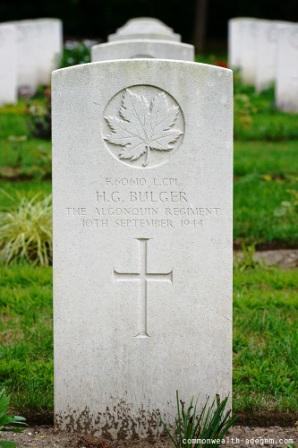
Grave of Harold Gabriel Bulger from CVWM

Grave of Harold Gabriel Bulger in the Canadian War Cemetery in Adegem, Belgium. (Photo courtesy of Canadian Virtual War Memorial)
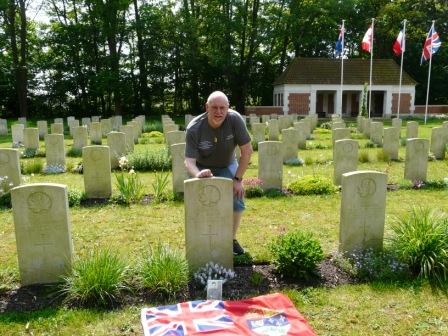
P1450929 May 11 2024 Patrick Michaels at grave of Harold Bulger in Adegem

Patrick Michiels visited the grave of Harold ‘Hal’ Gabriel Bulger in Adegem in May 2024, bringing with him the Red Ensign and a photo of Hal.  (Photo courtesy of Patrick Michiels)

Belgian citizen Patrick Michiels, Moderator of the Facebook group Canadian Scottish Regiment Adegem Canadian War Cemetery, visited Hal’s grave on May 11, 2024 at our request.  He brought with him a photo of Hal and the Red Ensign flag that was the precursor of the Maple Leaf flag we are familiar with. (See https://en.wikipedia.org/wiki/Canadian_Red_Ensign)

Coming up in Part 2, the Bulger Brothers series continues, with Lawrence William BULGER, who lost his life six months after Hal’s death.

Thank you to Bev Jeffery for submitting photos and information on her Uncle Harold, to Edison Smith for contacting the Jeffery family, and to Patrick Michiels for visiting the Canadian War Cemetery in Adegem and taking a photo of Hal’s grave.

Do you have photos or information to share? Email Pieter at memorialtrail@gmail.com, comment on the blog, or tweet to @researchmemori1.

© Daria Valkenburg

…..Missed the stories on Smith and Boulter?….

To read about Edison Smith’s grandfather and great-uncle, please see:

….Want to follow our research?….

If you are reading this posting, but aren’t following our research, you are welcome to do so.  Our blog address: https://onthewarmemorialtrail.com/
Front cover OnTheWarMememorialTrailinEurope4 countries, 6 weeks, 7,000 km – an unforgettable war memorial journey in Europe…. Daria’s book ‘No Soldier Buried Overseas Should Ever Be Forgotten‘ is available in print and e-book formats.  Net proceeds of book sales help support research costs and the cost of maintaining this blog. For more information see https://nosoldierforgotten.com/ 

You are also invited to subscribe to our YouTube Channel: On The War Memorial Trail With Pieter Valkenburg: https://www.youtube.com/channel/UCJ591TyjSheOR-Cb_Gs_5Kw

Never miss a posting!  Subscribe below to have each new story from the war memorial trail delivered to your inbox.

On The War Memorial Trail….. The WWII Soldier From Indian River

March 29, 2021. In January, our first Atlantic Canada Remembers special feature included a photo of WWII soldier Charles ‘Charlie’ Borden TUPLIN of Indian River, Prince Edward Island, submitted by the Perry family of Nova Scotia. (See https://onthewarmemorialtrail.com/2021/01/07/on-the-war-memorial-trail-atlantic-canada-remembers-part-1/)

Charles Borden Tuplin

Charles Borden Tuplin. (Photo submitted by Gary Richard Perry)

Shortly afterwards we received another submission on Charles Borden Tuplin, this time from June Gillis.  “…Charlie Tuplin was our neighbour in Indian River when I was growing up, and he went overseas with my older brother, Bruce Gordon. Bruce survived the war, but Charlie didn’t...” she told us.  June’s late husband, Dr Wilfred R. ‘Bunny’ Gillis, grew up on a family homestead in Indian River, and also knew the Tuplin family.

CIMG5087 Mar 18 2021 Visit with June Gillis and Murphy

Pieter with June Gillis and her dog Murphy.  (Photo credit: Daria Valkenburg)

Born March 13, 1910 in Indian River, Charlie was the son of William and Minnie Tuplin, and worked as a fisherman and a miller prior to enlistment.  His father, who died in 1944, was a miller.

 “…The Tuplin family members were very musical...” June recalled, “…and Charlie played the violin….

On September 3, 1939, Charlie enlisted with the PEI Highlanders, but was discharged in July 1940 after falling ill with tonsillitis.  In September 1940 he re-enlisted with the PEI Light Horse Regiment, with the rank of Sergeant, and became an instructor at the Canadian Army (Basic) Training Centre #62 in Charlottetown.

In 1943 he was in Aldershot, Nova Scotia, taking advanced infantry training.  His service file notes that in an interview he was “…anxious to proceed overseas…

In June 1944, he requested a demotion to Corporal so that he could serve overseas.  This was granted on June 25, 1944, and he left for the United Kingdom the next day. On August 18, 1944 he was in France with the PEI Light Horse Regiment.  On October 13, 1944 he was transferred to the Black Watch Regiment’s D Company, Platoon 18.

The Perry family had written that…He was shot on December 7, 1944, was taken as a POW but died the next day…” This matches what is in Charlie’s military service file, but an account by the late William McNally of Summerside, who was interviewed by Charlie’s cousin Ann Tuplin Nunes, gave a different version of how Charlie lost his life.

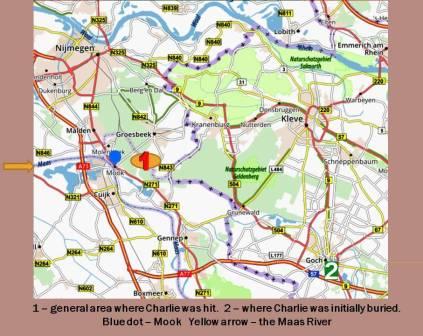
According to William McNally, as per an account by Ann Tuplin Nunes that June Gillis shared with us, on December 7, 1944, he and Charlie “…were stationed by the Maas River in Holland. In order to enable Canadian soldiers to cross the river, a makeshift bridge was made by putting planks over little boats...

While crossing the bridge, the two men were talking to each other, and crossed to the other side safely.   “….They got to the other side and went a quarter mile along the river when they ran into the German army….

The officer in charge, Major E.W. HUDSON, had decided upon a “…hit and run raid to try to get prisoners and find out from them what was going on in the German lines….” The Canadian soldier contingent drove the Germans back “….one-half mile. By then it was the middle of the night.  They came to a village where there were three houses which stood out from the others….

McNally, Tuplin, and two other soldiers “…headed for these houses because there was a lot of shooting coming from that direction…”  The men thought German soldiers were in the houses, and they wanted to “…knock out the machine guns….

Unfortunately, the men were being shelled with mortar bombs.  “…Charlie was to the right of McNally and ten or twelve feet ahead of him. McNally saw Charlie falling.  He hit the ground and never moved...

McNally ran to check on Charlie, but he appeared lifeless.  After turning him over, McNally noticed that “…there was blood on his neck...”  He may have been wounded in more than one place, as McNally believed that “…if he was wounded only in the neck, he should have showed some sign of life….”  There was speculation that he may have been “…shot in the lower stomach and killed instantly….

Stretcher bearers were sent for, while McNally and the other men continued on their mission.  “…The next day, McNally inquired as to what had happened to Charlie and was told that, when the soldier with the stretcher bearers returned, Charlie’s body could not be found….

The Black Watch war diary entry for December 7, 1944 indicates that the unit was just east of Mook, a town along the Maas River.  The following casualties were reported:

Killed: A/Sgt Leonard John KING, Pte Joseph S R PELLAND, Pte James Bissett WATT

Missing: Lt Thomas Wilson MACKENZIE, Pte Robert Albert MARTIN, Cpl Charles Borden TUPLIN, L/Cpl George Frederick ELLIOTT, Pte Joseph Edward WALKER

In addition, 14 men were wounded. According to research by the Groesbeek Airborne Friends, this December 7, 1944 event was named ‘Operation Mickey Finn’.

Pieter decided to look at the service files of the other soldiers reported missing, to see if more clarity about what happened and the exact location could be determined.  He discovered that all of the missing had died, and, with the exception of Charlie Tuplin, had been temporarily buried in the area.

The service file for Lt MacKenzie had an account that differed in some respects from William McNally’s recollections.

On December 14, 1944, a ‘Questionnaire On A Missing Officer Or Soldier’ included testimony by Major Hudson in which he stated that Lt MacKenzie was last seen by “…Pte C A CHARRON and Pte W J STEPHENS…” With them was “… Cpl C B TUPLIN…

MacKenzie was leading his men in an attack when he was “…wounded on the enemy position.  Attempts were made to evacuate him but the men carrying him were also wounded.  One man managed to evacuate himself and told the stretcher bearers that Lt MacKenzie was wounded, but they were unable to find him...

Both Pte Stephens and Charlie Tuplin were wounded.  Pte Charron was the soldier able to escape and go for help.  His statement recorded that “… At approximately 20:15 hours on December 7, 1944, I was with Lt T W MacKenzie about 10 yards from house 25.  I heard Lt MacKenzie call out for help, saying he had been hit...

After learning that MacKenzie had been hit in the back and was paralyzed, “... Cpl C B Tuplin and I tried to drag Lt MacKenzie out as we were too exposed walking.  After going about 15 feet we found we couldn’t manage so called to Pte W J Stephens to help us.  Before he got to us Cpl Tuplin was hit.  Lt MacKenzie and Cpl Tuplin told us to go for a stretcher bearer…

Stephens and Charron left, but “… after going about 15 yards, Pte Stephens was hit, so I kept going and told two of the stretcher bearers where I had left Lt MacKenzie and Cpl Tuplin. They made a search of the ground but were unable to find either of the wounded men….

MacKenzie and Tuplin were missing, but Stephens was found and hospitalized.  Like Charlie Tuplin, Lt MacKenzie was initially recorded as a prisoner of war. MacKenzie’s body was later found buried in a temporary cemetery, near where he lost his life.

According to Charron’s testimony, Charlie Tuplin was alive after being hit.  Perhaps William McNally came across Charlie Tuplin after Pte Charron left to go for help.  In the dark and under mortar fire attack, it’s very likely that he would not have seen Pte Stephens or Lt MacKenzie.  It’s also possible that William McNally found another soldier that he mistook for Charlie.

Map Goch to Mook

Map shows area of the action on December 7, 1944, and the location in Goch where Charlie Tuplin’s body was initially buried. (Map source: https://www.viamichelin.com)

Although the official records state that Charlie died while a prisoner of war on December 8, 1944, McNally believed that “…he died the night of December 7th and was never a prisoner….

What happened to Charlie Tuplin?  After the war ended, Charlie was identified, through his dental records, as a soldier buried in a public cemetery near Goch, Germany.  This is not near where he was hit, and he is the only one of the missing men identified in the war diary that was not initially buried near the location where they fell.

Therefore, the information in his service file is likely correct.  He was picked up by German soldiers while still alive, died shortly afterwards, and was buried by the Germans.

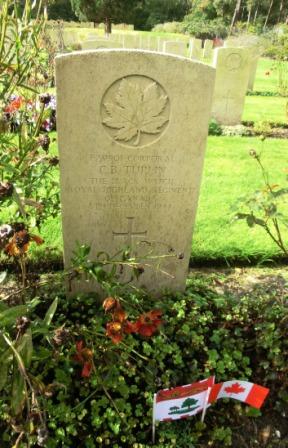
Lt MacKenzie was reburied in the Canadian War Cemetery in Groesbeek, as were the other missing men.  Charlie Tuplin was reburied in the Canadian War Cemetery in Holten, The Netherlands.

CIMG3207 Oct 3 2019 Holten Charles Tuplin

Grave of Charlie Tuplin in the Canadian War Cemetery in Holten.  (Photo credit: Daria Valkenburg)

Thank you to June Gillis for sharing information about Charles ‘Charlie’ Borden Tuplin.  If you have information to share about Canadian soldiers buried in The Netherlands, or memories to share about Charles Borden Tuplin or the other soldiers mentioned in this posting, please email us at memorialtrail@gmail.com, or comment on the blog.  

© Daria Valkenburg

…Want to follow our research?….

If you are reading this posting, but aren’t following our research, you are welcome to do so.  Our blog address: https://onthewarmemorialtrail.com/

Front cover OnTheWarMememorialTrailinEurope4 countries, 6 weeks, 7,000 km – an unforgettable war memorial journey in Europe…. Daria’s book ‘No Soldier Buried Overseas Should Ever Be Forgotten‘ is available in print and e-book formats.  Net proceeds of book sales help support research costs and the cost of maintaining this blog. For more information see https://nosoldierforgotten.com/ 

Screenshot_2021-02-27 On The War Memorial Trail With Pieter Valkenburg

You are also invited to subscribe to our YouTube Channel: On The War Memorial Trail With Pieter Valkenburg: https://www.youtube.com/channel/UCJ591TyjSheOR-Cb_Gs_5Kw.

Never miss a posting!  Subscribe below to have each new story from the war memorial trail delivered to your inbox.
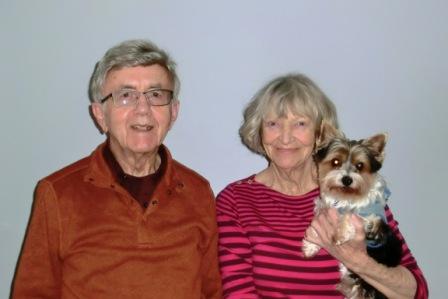
On The War Memorial Trail…..The WWII Soldier Wounded In Italy Who Came Home

February 1, 2021.  In researching soldiers from the South Shore area of Prince Edward Island, we’ve told many stories about those who didn’t survive, but of course many soldiers did come back home.  One soldier that returned was Gordon James ROGERSON, whose niece Barb Clement brought to our attention.

 “…Uncle Gordon was my mother’s brother….” she told us. “…There were 9 children in the family. My mother was third youngest, then Gordon was next, and Uncle Keith was the youngest…

Born on February 13, 1920 in Tryon, Barb explained that “…his parents, my grandparents, were Maude (nee MacKay) and Reuben Rogerson of Tryon and later Summerside…

Gordon Rogerson

Gordon James Rogerson.  (Photo submitted by Barb Clement)

After leaving school at age 15, Gordon worked as a farm labourer and a machine operator in a wood finishing mill before enlisting with the PEI Highlanders in Summerside on February 23, 1940.  On July 15, 1940, he boarded a ship in Halifax and soon was on his way to the United Kingdom as part of the 2nd Canadian Division Infantry Reinforcement Unit.

In December 1941 he was transferred to the 1st Canadian Division Infantry Reinforcement Unit, and then on January 15, 1942 he was transferred to the West Nova Scotia Regiment.  J. Ron Stonier, President of the West Nova Scotia Regimental Association explained that “…he would have trained with them and performed defensive duties until they left for the Mediterranean in late June ‘43 for the invasion of Sicily on 9 July ‘43…

On August 2, 1943 Gordon was wounded in Sicily.  Ron Stonier wrote that August 2, 1943 was “…..the day the West Novas occupied Mount Criscana which they called “Whistling Hill….

After recovering, he rejoined the Regiment, but was hurt again on December 4, 1944 in Italy, a day “when the West Novas were in action on the Ortona Front….”  Gordon’s daughter, Gloria Rogerson, wrote, in 2000, that her father “…had lost his leg after detecting and digging out a mine and stepping in the hole.  Another mine, planted below the first, had gone off….

A letter sent by Chaplain W.G. Phillips sent to his parents explained that Gordon had arrived at a casualty clearing station and noted that “… This afternoon he was injured by an enemy mine, and I regret to say that as a result, his left foot had to be amputated above the ankle.  He also received a flesh wound in the forearm…..

Chaplain Phillips noted the positive attitude that Gordon displayed, writing that “…He is most cheerful and resigned to the loss of his foot.  As he himself stated ‘I am thankful to be here safely’…. Your son is receiving the best of medical and nursing care….

In February 1945 Gordon was transferred to 19th Canadian General Hospital at Marston Green, near Birmingham, UK. Built as a series of huts, originally as a base for the Royal Canadian Air Force early in WW2, this hospital had beds for about 700 patients. After the war it became a maternity hospital.

Marston Green Maternity Hospital as a Canadian War Hospital

19th Canadian General Hospital, Marston Green, in Birmingham, UK.  (Photo found on http://www.birminghamforum.co.uk)

Gordon was not long at the 19th Canadian General Hospital as in March 1945 he was sent back to Canada and on March 21, 1945 was admitted to Camp Hill Military Hospital in Halifax, Nova Scotia.

Exif_JPEG_420

Barb Clement with her husband Steve.  (Photo credit: Daria Valkenburg)

While at Camp Hill, Barb Clement recalled being told that Gordon “…had gangrene in his leg…”  Likely he had a second amputation as his leg was ….amputated to just below the knee…” and not at the ankle as per the letter written by Chaplain Phillips.

He was officially discharged from the Canadian Army on May 1, 1945.  Over the next decades Gordon married Madeline (Peggy) Fleet and raised his children.  He became a member of the War Amputees Association of Canada and was involved with Alcoholics Anonymous for 21 years, ending with his death on February 10, 1993, at the age of 72 years.

Remembered by his family as a cheerful man who loved to joke around, Gordon Rogerson was a WWII veteran who was able to return home and live his life, surrounded by family and friends.

Thank you to Barb Clement, Gloria Rogerson, and Ron Stonier of the West Nova Scotia Regimental Association for providing information on Gordon Rogerson.  If you have information or photos to share about soldiers from PEI South Shore area, please contact Pieter at memorialtrail@gmail.com or comment on the blog.

© Daria Valkenburg

….Want to follow our research?….

If you are reading this posting, but aren’t following our research, you are welcome to do so.  Our blog address: https://onthewarmemorialtrail.com/

Front cover OnTheWarMememorialTrailinEurope4 countries, 6 weeks, 7,000 km – an unforgettable war memorial journey in Europe…. Daria’s book ‘No Soldier Buried Overseas Should Ever Be Forgotten‘ is available in print and e-book formats.  Net proceeds of book sales help support research costs and the cost of maintaining this blog. For more information see https://nosoldierforgotten.com/ 

You are also invited to subscribe to our YouTube Channel: On The War Memorial Trail With Pieter Valkenburg: https://www.youtube.com/channel/UCJ591TyjSheOR-Cb_Gs_5Kw

Never miss a posting!  Subscribe below to have each new story from the war memorial trail delivered to your inbox.
On The War Memorial Trail…..The WWII Soldier Who Had An Allergic Reaction

September 22, 2019.  How many of you have an allergy, perhaps to a food, insect, or medication?  These days, people can be treated with the aid of an EpiPen, or by avoiding the item causing an allergic reaction. During WWII, when antibiotics first came into use, researchers and medical personnel soon learned that they were not the miracle drug for all. Adverse reactions to pain medication and anesthesia also happened.

While researching the names on the Cenotaph outside the Borden-Carleton Legion, Pieter learned of a few instances where soldiers on active duty died, not as a result of war, but due to a medical condition.  Such was the case for Harrison William CRAIG, born January 3, 1909 in Cape Traverse, Prince Edward Island, the son of John Russell Craig and Mary Ellen Howatt.  Unlike most of the servicemen listed on the Cenotaph, Craig was married and a father.

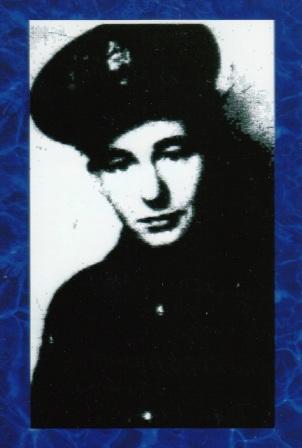
blog color photo Graig

Harrison William Craig. (Source:https://www.findagrave.com/memorial/29137050/harrison-william-craig. Photo colourization: Pieter Valkenburg)

A farm labourer before enlisting with the PEI Highlanders in Summerside on February 23, 1940, Craig spent several months in a military hospital in Dartmouth, Nova Scotia before being sent to Valcartier, Quebec for training on June 3, 1941. In July 1941 he ended up in a military hospital again for several weeks, before leaving for Newfoundland on July 31, 1941.

Unfortunately, he again landed in and out of hospital in Botwood and Gander, with a final admission to the RCAF Hospital in Gander on December 1, 1942.  While being prepared for a tonsillectomy operation, he suffered an anaphylactic reaction and died a day later, leaving behind his widow, Mildred Smith, and four children, who were living in Central Bedeque.  The youngest child had been born 8 months earlier, on April 2, while the oldest was only 7 years old. Craig was buried in Gander Military Cemetery, Newfoundland.

An obituary in the ‘Summerside Journal’ of December 17, 1942, page 4, column 1 noted that:

The community of Bedeque was deeply saddened by the news that on Wednesday, Dec. 2nd, Pte. Harrison Wm. Craig of the P.E.I. Highlanders, had passed away in the Military Hospital at St. John’s, Newfoundland, while on active service there. He was buried with full military honors in the Protestant Cemetery at St. John’s on Friday afternoon at 2 p.m., December 4. Pte. Craig joined the P.E.I Highlanders in March, 1940, and trained at Dartmouth, N.S. and in July 1941 went on active service to Newfoundland.

He is survived by his wife, Mrs. Mildred Craig, and their four children at Central Bedeque, P.E.I., his father and brother Heath at Chelton, P.E.I., and five sisters: Mrs. Stanley Jack, Glace Bay, C.B.; Mrs. Wm. Heckbert, Summerside, P.E.I.; Mrs. Charles Robertson, Carleton, P.E.I.; Mrs. Simpson Affleck, Halifax, N.S.; and Mrs. Alfred Waite of Sherbrooke, P.E.I. His Commanding Officer, Col. C. C. Thompson, wrote of his faithfulness and fidelity to duty and his splendid record of service.

The sympathy of the whole community goes out to the family in their sorrow and loss.

Craig’s death left the family in financial straits, as stated in a declaration made by his widow on January 4, 1943 before magistrate Earle. D. Leard.  Mrs. Craig wrote “I have a small house and lot on a quarter acre of land.  My husband had no insurance.  I have been paying for this place since he joined up and have no money.  I want to give my children an education.  I had quite a bill of expense when the last child was born and have no money at all laid aside.  I have to buy everything, including fuel.”  Craig’s military service record does not indicate if the declaration resulted in financial assistance.

If anyone can provide more information on Harrison William Craig, please contact Pieter at memorialtrail@gmail.com or comment on the blog.

© Daria Valkenburg

….Want to follow our research?….

If you are reading this posting, but aren’t following our research, you are welcome to do so.  Our blog address: https://onthewarmemorialtrail.com/

Front cover OnTheWarMememorialTrailinEurope4 countries, 6 weeks, 7,000 km – an unforgettable war memorial journey in Europe…. Daria’s book ‘No Soldier Buried Overseas Should Ever Be Forgotten‘ is available in print and e-book formats.  Net proceeds of book sales help support research costs and the cost of maintaining this blog. For more information see https://nosoldierforgotten.com/ 

You are also invited to subscribe to our YouTube Channel: On The War Memorial Trail With Pieter Valkenburg: https://www.youtube.com/channel/UCJ591TyjSheOR-Cb_Gs_5Kw

Never miss a posting!  Subscribe below to have each new story from the war memorial trail delivered to your inbox.
On the War Memorial Trail …..The Face of Everett Samuel Francis

March 25, 2018.  The very first article published in the County Line Courier about the Cenotaph Research Project told the stories of Vincent CARR and Everett Samuel FRANCIS.  At the time the article ran, we only had a photo for Vincent Carr.  When the Cenotaph Research Project blog began, we updated the story and provided a PDF of the original newspaper article in a blog entry, which you can read here (See The Cenotaph Research Project Begins).

As mentioned in the original article, Everett Samuel Francis was born February 2, 1921 in Albany, the son of Lester L. Francis and Annie Mary “Mae” MacDonald, and husband of Janie Louise Mercer of Grand Falls, Newfoundland. Before the war, he worked for Wilfred Inman of Albany as a farm labourer.  He enlisted on July 15, 1940, serving with the P.E.I. Highlanders.

Everett Samuel Francis head shot

Everett Samuel Francis. (Photo credit: courtesy Greta Follett family collection)

On September 13, 1942, he was sent from Gander, Newfoundland, where his unit was based, to Long Branch, Ontario for a small arms training course.  He was on his way back to Gander aboard the railway ferry S.S. Caribou when it was torpedoed by German U-Boat 69 off the coast of Newfoundland on Wednesday, October 14, 1942.  101 survivors were rescued and taken to Sydney, but the captain, 30 crew, 57 service personnel, and 48 passengers were lost, including Francis.  He’s buried in St. Matthew’s Presbyterian Cemetery in Grand Falls, Newfoundland.

One of the most rewarding aspects of this project is meeting the families behind the soldiers listed on the Cenotaph.  At the time the article was published in October 2016, we had no photo, nor could we find family on Prince Edward Island.  So we were delighted when helpful Islanders found a connection that led us to Francis’ daughter Greta May Follett, who lives in Ontario with her husband Terry.

Greta told us that she was born on September 24, 1942, and her father had been granted leave to meet his baby daughter when he lost his life.  Although she never had a chance to meet her father, she did have a few photos and so we were able to put a face and story to this name on the Cenotaph.

Everett Francis and Janie Mercer marriage P8242352

Everett Samuel Francis and Janie Louise Mercer on their wedding day, in Grand Falls, Newfoundland. (Photo credit: courtesy Greta Follett family collection)

An October 20, 1942 letter written to Francis’ mother by the Herbert J. Scott, Minister of St. Matthew’s Presbyterian Church in Grand Falls, Newfoundland, explained that Greta was to be christened in church on the Sunday after Francis was to have returned home. 

Reverend Scott explained that “During the short time that your boy was in this country, he had greatly endeared himself to all who knew him, and his loss is keenly felt here.  As a soldier, his fidelity to duty and earnest desire to rise in the ranks enlisted the commendation of his Officers.  Col. C.C. Thompson of his regiment thought much of him and said, if Everett had been spared, he might have gone far in the ranks.” (Note: Newfoundland was not part of Canada in 1942.)

Greta’s mother never remarried.  Greta herself was raised by her maternal grandmother Greta Mercer.  When we had a chance to visit them at their home in Ontario, we were warmly welcomed and experienced the hospitality Newfoundland is famous for!

CIMG9470 Oct 24 2017 Follet home in Ajax Terry Greta Pieter

Terry and Greta Follett with Pieter. (Photo credit: Daria Valkenburg)

Do you have any photos or memories of Everett Samuel Francis to share?  Perhaps a school photo?  Photos are still also needed for many of the names on the Cenotaph outside the Borden-Carleton Legion.  Please share your photos, comments, or stories by emailing us at memorialtrail@gmail.com or by commenting on this blog.

© Daria Valkenburg

….Want to follow our research?….

If you are reading this posting, but aren’t following our research, you are welcome to do so.  Our blog address: https://onthewarmemorialtrail.com/

Front cover OnTheWarMememorialTrailinEurope4 countries, 6 weeks, 7,000 km – an unforgettable war memorial journey in Europe…. Daria’s book ‘No Soldier Buried Overseas Should Ever Be Forgotten‘ is available in print and e-book formats.  Net proceeds of book sales help support research costs and the cost of maintaining this blog. For more information see https://nosoldierforgotten.com/ 

You are also invited to subscribe to our YouTube Channel: On The War Memorial Trail With Pieter Valkenburg: https://www.youtube.com/channel/UCJ591TyjSheOR-Cb_Gs_5Kw

Never miss a posting!  Subscribe below to have each new story from the war memorial trail delivered to your inbox.