On The War Memorial Trail….. The WWII Soldier Born In Samburg Who Lost His Life During The Liberation Of Deventer

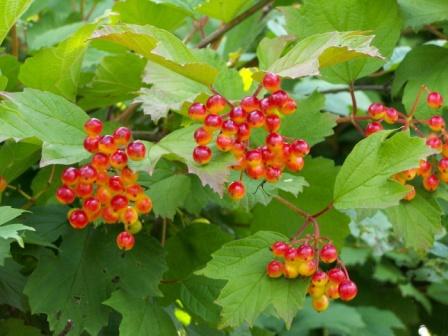
Kalyna berries and leaves. (Photo source: Wikipedia, by Lestat (Jan Mehlich) – Own work)

September 8, 2026. Sometimes Pieter asks me to select a soldier for him to research from one of the photo wish lists that he receives from the Canadian War Cemeteries in The Netherlands.  Occasionally a name is picked because of the date of death and the Regiment, other times because of a surname or place of residence.

 …Jim Kosowan was of Ukrainian heritage….

When I came across the name James ‘Jim’ John George KOSOWAN, listed as being from Kalyna, Saskatchewan, I asked Pieter to choose that soldier.  Why him? he asked.  It’s a Ukrainian surname, I replied, and Kalyna, which we know in English as a viburnum shrub (Viburnum opulus, see https://en.wikipedia.org/wiki/Viburnum_opulus) with red berries, is an ethnic and national symbol of Ukraine that symbolizes resilience, strength, and the fight for freedom.
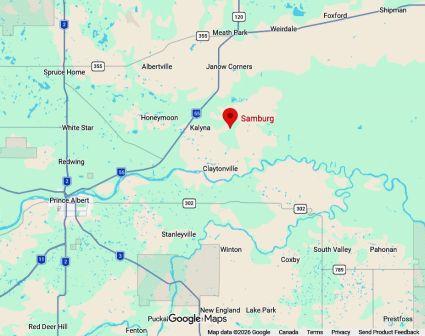
Samburg, Saskatchewan is near the larger town of Prince Albert.  (Map source: Google Maps)

Ok, Pieter said, but when he began his research, he learned that the soldier was born on December 18, 1920 in Samburg, Saskatchewan, near the town of Prince Albert, the son of George and Maria (nee Pusta) Kosowan, who had both immigrated to Canada in the late 1800s from Eastern Europe. The Kalyna reference in his service file came from where his family was living at the time of his enlistment.

…Jim’s nephew contributed a photo…

Jim had 4 sisters and 6 brothers, and it was the family of Jim’s sister Rose Sanjenko that Pieter quickly got in contact with once he began his research. When we asked Jim’s nephew, Randy Sanjenko, how the photos he submitted should be attributed, his response was heartfelt.  “….Please just say they are from family who love and miss him….Thank you for keeping the story of all those brave young men alive because l am a believer in never forget….

….Jim enlisted in 1942 under NRMA…

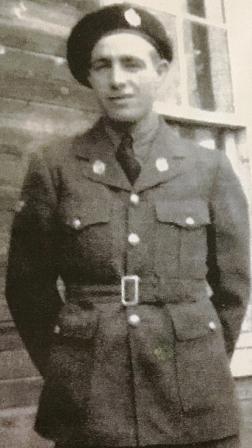
James ‘Jim’ John George Kosowan.  (Photo courtesy of the Kosowan Family)

On March 12, 1942, Jim enlisted under the National Resources Mobilization Act (NRMA) at No. 2 NRMA Clearing Depot in Newmarket, Ontario. (See https://en.wikipedia.org/wiki/National_Resources_Mobilization_Act)

At the time of his enlistment, Jim stated he was an auto mechanic, had experience working on his family’s wheat farm near Kalyna, Saskatchewan, and was working as a packer at O’Keefe Breweries in Toronto for the past 18 months. In addition to English, he could speak Russian and Ukrainian. His brother Johnny was in the Royal Canadian Artillery.

He took his basic training at No. 23 Canadian Army (Basic) Training Centre in Newmarket, and then was sent to the A11 Canadian Infantry Training Centre at Camp Borden, Ontario on May 14, 1942.

On September 15, 1942, Jim was sent to No. 4 Aerodrome Defence Platoon, a specialized mobile defensive unit tasked with safeguarding critical military airports, airfields, and Royal Canadian Air Force (RCAF) installations against ground assaults, sabotage, and enemy paratrooper attacks. A few days later, on September 19, 1942, Jim was temporarily attached to the 1st Battalion, Saint John Fusiliers (Machine Gun) in Sydney, Nova Scotia.

The Battalion was stationed in Canada on home defence duty as part of the 18th Infantry Brigade, 6th Canadian Division.  With the Battle of the Atlantic underway off of the Canadian coast, and German U-boats actively targeting shipping vessels in the Gulf of St. Lawrence and near Cape Breton, the Battalion was tasked with key security duties.  The men were on guard detail to protect vital infrastructure around the strategic industrial hub of Sydney and its heavily used wartime shipping harbour. As well, coastal defence support was provided in assisting nearby coastal batteries to deter potential enemy beach landings or sabotage. (See https://thecanadianencyclopedia.ca/en/article/battle-of-the-atlantic)

Military training also continued for the men.  Jim qualified as a Driver i/c Track Class III on March 3, 1943.  (The term ‘Driver i/c’ refers to ‘Driver, internal combustion’. Track Class III meant he was qualified to drive heavy trucks and armoured cars.)

….Jim enlisted in the Active Army in 1943…
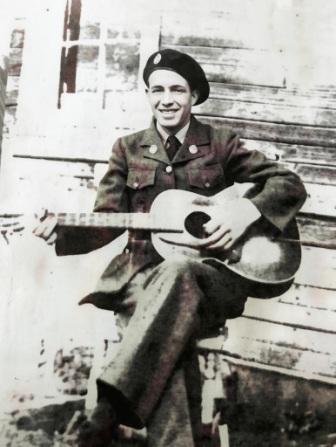
James ‘Jim’ John George Kosowan playing a guitar.  (Photo courtesy of the Kosowan Family.  Photo restoration by Pieter Valkenburg)

On October 1, 1943, Jim transferred to the Active Army, enlisting in Yarmouth, Nova Scotia, but remained with No. 4 Aerodrome Defence Platoon.  He was sent to No. 2 Transit Camp in Debert, Nova Scotia, where his training continued.

He qualified as a Driver i/c Class III (Wheeled) on October 19, 1943.  (The term ‘Driver i/c’ refers to ‘Driver, internal combustion’. Class III (Wheeled) meant he was qualified to drive heavy trucks and armoured cars, but not tanks.)

On July 5, 1944, Jim was given 9 days of special leave, in what turned out to be the last chance he had to see his family.  Upon returning from leave, he was transferred to No. 1 Transit Camp in Windsor, Nova Scotia.  This was a final staging, preparation, and administrative processing area before being sent overseas.

….Jim left Canada for overseas service ……

On September 1, 1944, Jim travelled by train directly from Windsor to the Halifax docks to board a troopship, which left Halifax on September 2, 1944, and arrived in the United Kingdom on September 6, 1944. Upon arrival, he was placed with No. 3 Canadian Infantry Reinforcement Unit (CIRU).

He didn’t remain long in the United Kingdom, as on October 7, 1944, he was transferred to the X-4 Reinforcement List of the 21st Army Group, and sent to France on October 8, 1944, arriving a day later.
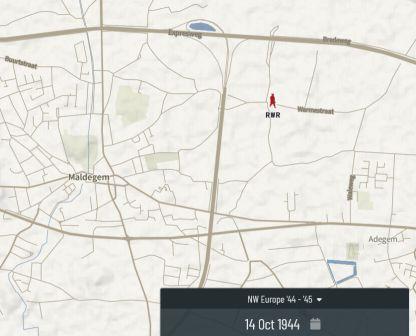
Red coloured soldier marks location of Royal Winnipeg Rifles on October 14, 1944. (Map source: Project 44)

On October 14, 1944, he was transferred to the Royal Winnipeg Rifles, joining them in Maldegem, Belgium, near the border with The Netherlands.  The Royal Winnipeg Rifles War Diary for that day noted that “…a few reinforcements arrived and were immediately posted to their companys….

The reinforcements were needed as on October 6, 1944, Operation Switchback, the second main operation of the Battle of the Scheldt had begun, with the goal of clearing the ‘Breskens Pocket’ – the German defences around Breskens in The Netherlands. (See https://www.canadiansoldiers.com/history/battlehonours/northwesteurope/breskenspocket.htm)

….Jim was wounded during Operation Switchback…
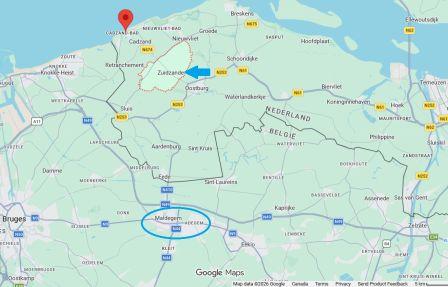
Blue arrow indicates Zuidzande where Jim Kosowan was wounded.  Blue circle shows location of Maldegem, where he joined the Royal Winnipeg Rifles. (Map source: Google Maps)

On October 28, 1944, during the final phase of Operation Switchback, part of the larger Battle of the Scheldt, the Regiment was clearing German strongholds and capturing prisoners of war in the area of Zuidzande, The Netherlands, near the Belgian-Dutch border.  As part of the 7th Canadian Infantry Brigade in the 3rd Canadian Infantry Division, they faced heavy resistance, artillery fire, and minefields, as they tried to clear the Scheldt Estuary and open the shipping route to Antwerp, Belgium.

Jim was wounded by shrapnel from an exploding grenade and spent over a month in hospital. Three members of the Royal Winnipeg Rifles died that day and are buried in the Canadian War Cemetery in Adegem, Belgium….

  • Elmond Joseph CHOQUETTE, born in Mariapolis (Glenora), Manitoba, aged 26
  • Richard Francis GYLES, of Winnipeg, Manitoba, aged 20
  • Leonard Andrew HEEKS, of Edmonton, Alberta, aged 20

…. Jim returned to duty in December 1944….

Jim returned to duty on December 12, 1944, rejoining the Royal Winnipeg Rifles, now stationed in the Nijmegen area of the Netherlands, near the German border, where they remained over the winter.  While based in a relatively safe area, they still were busy, conducting defence operations and sentry duties near the German border, reconnaissance patrols to monitor enemy positions.

They also tackled infrastructure tasks, such as clearing ice on the Waal River and doing road maintenance.  On the day Jim returned to the Regiment, 7 men drowned in a tragic accident when the vehicle they were in lost control on a dike, slid down the embankment and into the water.  The war diary explained that they “were pinned down under the carrier and were drowned….” They were part of a group of 13 men sent to repair a road running from a local railway bridge back to regimental headquarters.

…. Jim was involved in the liberation of North-West Europe….

By January 1945 the Royal Winnipeg Rifles were still in The Netherlands, and spent the New Year in ‘s-Hertogenbosch.

On February 1, 1945, the war diary recorded that the Regiment was informed of the part that the men “…would play in Operation Veritable…” This would take them into Germany. (See https://en.wikipedia.org/wiki/Operation_Veritable)  The Regiment arrived in Millingen, Germany on February 9, 1945.

By February 16, 1945, the Regiment was based in Essen, Germany, as they cleared German positions in flooded areas of the Rhine flood plain and the Reichswald forest, which is close to the Dutch-German border.

On March 11, 1945, the Regiment began moving back towards ‘s-Hertogenbosch, The Netherlands and the greater battle towards liberating the country.

….The Liberation of Deventer involved crossing the Schipbeek ….

Movement of Canadian troops towards Deventer.  Note that all first had to cross the Schipbeek.  (Map provided by Edwin van der Wolf)

On April 7, 1945, the Royal Winnipeg Rifles were ordered to cross the Schipbeek and establish a bridgehead as preparation for an assault on the city of Deventer by the 7th Canadian Infantry Brigade.

Crossing the Schipbeek was vital to the success of the bridge operation, not an easy feat as the Bridge was strongly defended by the Germans, but the Regiment was able to meet its objective.

NOTE: For an account of our visit to Schipbeek and Bathmen during our 2025 European War Memorial Tour, see https://onthewarmemorialtrail.com/2025/10/26/on-the-war-memorial-trail-visit-to-bathmen-and-the-schipbeek-canal/

….Jim lost his life during the Liberation of Deventer…

On April 10, 1945, the Regiment was involved in the liberation of Deventer, a town lying on the right bank of the IJssel River.  With the approaches protected by a maze of waterways, it was necessary to attack from the east. (See https://www.canadiansoldiers.com/history/battlehonours/northwesteurope/deventer.htm)

In ‘Little Black Devils: A History Of The Royal Winnipeg Rifles’ authors Bruce Tascona and Eric Wells noted that Deventer “…was a town of 50,000, which the Germans had fortified with an anti-tank ditch.  The battle began with a night attack at 0100 by the Canadian Scottish on the enemy’s right flank, and the Rifles struck their left flank at 0700.

Over the next 10 hours, the Rifles were continuously engaged, first in pushing back the enemy’s outer positions on the open ground before the big ditch.  Casualties were heavy….

Deventer was liberated by 5 pm, but Jim unfortunately didn’t see this outcome, as he lost his life at some point during the fight.

On our 2017 European War Memorial Tour, we’d visited Deventer and the surrounding area with Edwin van der Wolf, one of the research volunteers at the Canadian War Cemetery in Holten, The Netherlands, so we were familiar with the area where Jim and Clive Elbert Steele GEROW,  whose story was previously told, lost their lives. (See https://onthewarmemorialtrail.com/2023/10/07/on-the-war-memorial-trail-the-wwii-soldier-from-burks-falls-killed-during-the-liberation-of-deventer/)
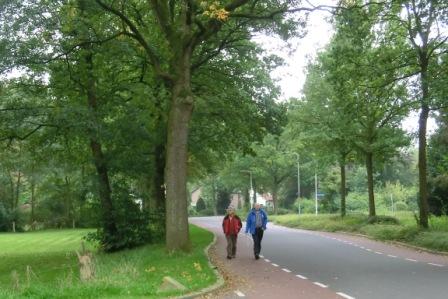
Pieter and Edwin van der Wolf (right) walked along the route near Schalkhaar that Canadian troops took before  they liberated Deventer in April 1945.  (Photo credit: Daria Valkenburg)

….Jim is buried in Holten…

Along with 45 other soldiers, Jim was initially buried beside an estate in Oxe before being reburied in the Canadian War Cemetery in Holten, The Netherlands on December 17, 1945.

Pieter at the entrance to the Canadian War Cemetery in Holten, The Netherlands. (Photo credit: Daria Valkenburg)

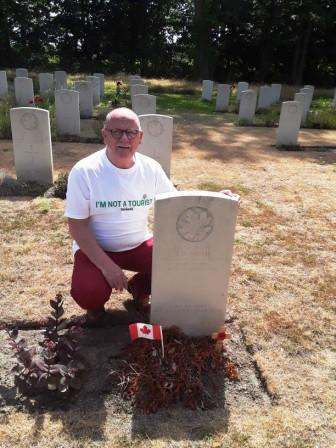
During our 2025 European War Memorial Tour, Pieter placed a Canadian flag by his grave.  Unfortunately, on this trip, we did not have any Saskatchewan flags.
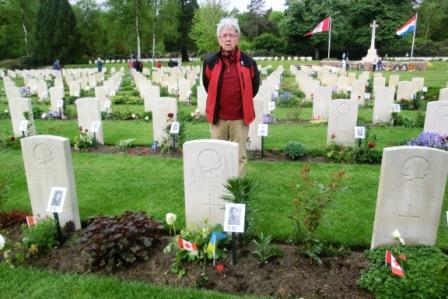
Pieter at the grave of James ‘Jim’ John George Kosowan after placing a Canadian flag. (Photo credit: Daria Valkenburg)

…The Colmschate Memorial commemorates 46 Canadians….

On April 8, 2015, a memorial had been placed in Colmschate to commemorate the 46 Canadians who had been temporarily buried on the Oxe estate.
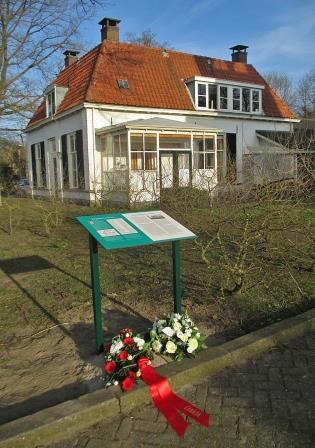
Memorial in Colmschate, commemorating 46 Canadians, including James Kosowan. (Photo courtesy of Edwin van der Wolf)

Text of Memorial in Colmschate, commemorating 46 Canadians, including Philip Laforte.  (Photo courtesy of Edwin van der Wolf)

Translation of the Dutch text was prepared by Pieter Valkenburg:

They Gave Their Lives

The liberation of Colmschate

During their advance from the Achterhoek, the Royal Winnipeg Rifles, the Regina Rifle Regiment, and the Canadian Scottish Regiment, led by Brigadier General T G Gibson reached the neighborhood of Oxe on Friday April 6, 1945. Next to the house on the Oxe estate (Oxerhof), the liberators discovered the bodies of ten Dutchmen who had been murdered in cold blood by the occupiers the day before. The Canadians passed the Schipbeek via a quickly struck bailey bridge, which replaced the destroyed Swormertoren Bridge.

Despite heavy German resistance, they continued north. Many farms went up in flames and houses were badly damaged. Many families sought refuge in the already liberated Oxe. Some residents lost their lives.

On April 8, 1945, the liberators captured (a small part of) the Snippeling, Colmschate, and the Bannink. Via the Vijfhoek they reached the Crödden Bridge over the Overijssels Canal. Schalkhaar and Deventer were then liberated and with the help of the Queen’s Own Rifles the remaining part of the Snippeling.

Many Canadians lost their lives in the battle in this area. In April 1945, the bodies of 46 fallen Canadians were buried in a temporary resting place opposite the Oxerhof house. In January 1946 they were transferred to the Canadian Cemetery in Holten (Plot I and II).

Two other soldiers whose stories were previously told are listed on this monument:

….Kosowan Lake is named after Jim…

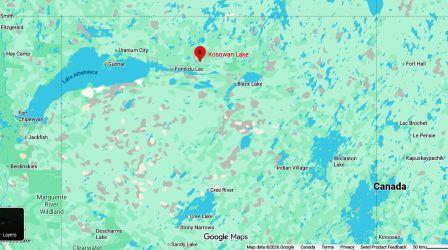
Kosowan Lake is in northern Saskatchewan. (Map source: Google Maps)

In 1952, Kosowan Lake in northern Saskatchewan, near the border with North West Territories, was named after Jim as part of the GeoMemorial Commemorative Naming Program.
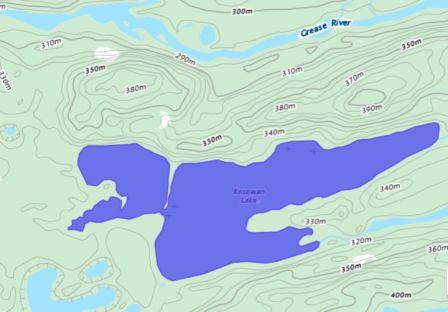
Kosowan Lake is located at the coordinates 59°25′39″N 106°28′17″W.  (Map source: https://geonames.nrcan.gc.ca)

Thank you to Randy Sanjenko, Jim’s nephew, for submitting photos and memories, to Bonnie Sanjenko for contacting her brother-in-law Randy, and to Shawn Rainville for newspaper research.

The Canadian flag placed at Jim’s grave during our 2025 European War Memorial Tour was donated.  Our thanks go to Alan Waddell, Constituent Assistant, on behalf of Heath MacDonald, MP for Malpeque.

While we were at the cemetery placing flags, we met Jane Kondakova, a Ukrainian refugee from the Kyiv region, who was living in the village of Holten with her two young children.  She was placing flags at the graves of soldiers of Ukrainian descent, including James Kosowan, to honour them and her husband, who is in the Ukrainian military.

Pieter’s research efforts to find photos and families of soldiers continue. Do you have a story to tell? Email Pieter at memorialtrail@gmail.com, or comment on the blog.

© Daria Valkenburg

….Want to follow our research?…

If you are reading this posting, but aren’t following our research, you are welcome to do so.  Our blog address: https://onthewarmemorialtrail.com/
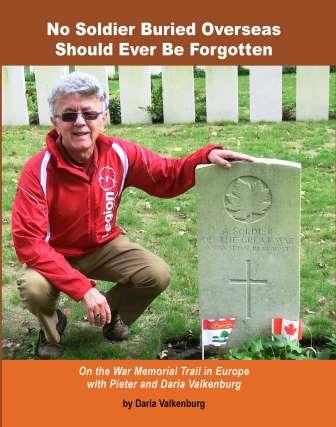
4 countries, 6 weeks, 7,000 km – an unforgettable war memorial journey in Europe…. Daria’s book ‘No Soldier Buried Overseas Should Ever Be Forgotten‘ is available in print and e-book formats.  Net proceeds of book sales help support research costs and the cost of maintaining this blog. For more information see https://nosoldierforgotten.com/

Subscribe to our YouTube Channel: On The War Memorial Trail With Pieter Valkenburg: https://www.youtube.com/channel/UCJ591TyjSheOR-Cb_Gs_5Kw.

Never miss a posting!  Subscribe below to have each new story from the war memorial trail delivered to your inbox.

On The War Memorial Trail….. Part 2: The WWII Letters Of Edison Reynolds Smith

20220903_190017 Wayne and Angela Leighton in Annapolis Valley

Angela Leighton and her husband Wayne at the Lookoff (Blomidon) in Nova Scotia’s Annapolis Valley. (Photo submitted by Angela Leighton)

December 12, 2023. In Part 1 of the WWII letters of Edison Reynolds SMITH, which had been shared by his niece, Angela Leighton, Edison had enlisted and was in France.  Meanwhile, his family was dealing with the death of Edison’s younger brother Wesley – which Edison was as yet unaware of – and had received a telegram stating that Edison had been wounded.  (See https://onthewarmemorialtrail.com/2023/12/07/on-the-war-memorial-trail-part-1-the-wwii-letters-of-edison-reynolds-smith/)

The telegram had been sent to Edison’s brother, Wesley Smith in Cooks Cove, Nova Scotia, stating that Edison had been wounded on June 9, 1944, but remained on duty with his unit.  However, Wesley did not receive the telegram – he had drowned on May 27, 1944.

Now, Edison’s story continues in Part 2…..

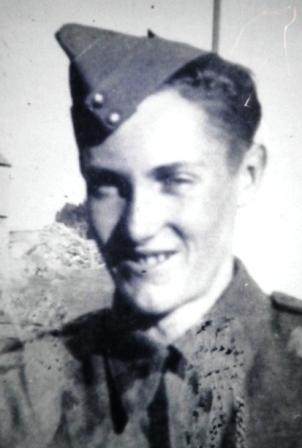
Edison Reynolds Smith

Edison Reynolds Smith.  (Photo courtesy of Angela Leighton)

… Edison was transferred to the Canadian Scottish Regiment…

According to his service file, Edison was in the hospital until June 11, 1944, after which he was transferred to the 1st Battalion, Canadian Scottish Regiment, British Western European Forces (BWEF)In his letters, Edison didn’t mention being wounded.

His first letter from France, dated June 14, 1944 letter to his aunt, Elsie Myers, confirmed he was in the 1st Battalion, Cdn Scottish Regiment, ‘A’ Company. …I am in France now.  I’ve been here a few days.  The last letter I wrote was before I left the docks in England…. The French people are very nice to us… I am with the Canadian Scottish Regiment and with a pretty good bunch of men.  George is over here too somewhere, I suppose, but he’d be with the North Nova Scotia Highlanders...”  Sgt George MYERS was a nephew of Edison’s uncle, Roland Myers.

On June 26, 1944, Edison wrote to his brother Wesley, still unaware that his brother had died on May 27, 1944.  “…Just a line or two to let you know I am still kicking….It’s pretty noisy here at times. Most of the fellows I’m with are from British Columbia….The days seem pretty long over here longer than they did in England.  I never got any leave or anything when I was in England… There are quite a few cattle over here. They are around our trenches every day….I might be able to get in the North Nova Scotia Highlanders, the same as George is in.  My name is gone in for them anyway…” 

On July 1, 1944, Edison got his wish and was transferred back to the North Nova Scotia Highlanders. 

… Edison was heartbroken to learn that his brother Wesley had died…

In a July 2, 1944 letter to his Aunt Elsie, Edison mentions he was now in ‘C’ Company of the North Nova Scotia Highlanders.  He was shocked to learn about his brother’s death. “…I was just over to see George and Percy.  I just arrived at this unit yesterday and I went to look George up this afternoon and found him, and I also saw Percy….”  Angela believes that Percy referred to Percy LUMSDEN.

 …I was shocked when George told me about Wes.  Cold chills came over me when he handed me a piece that was cut out of the newspaper telling about the terrible thing that that happened to him. How did it happen?  I can hardly believe it.  I just trembled when I read it. I suppose you sent me the news but I haven’t received it yet because I have been moved around so much. I bet there was a large funeral. I suppose the reserve army was there too….It’s going to be hard on me for a while and all of us…Wes was a friend of everybody’s and was a smart boy too. He died a good soldier….

Edison then wrote to his sister Dorothy on July 4, 1944. “…It’s hard for me to believe that Wes has been drowned. Charlie MacKenzie was drowned too…”  

… Edison related some of what he was experiencing …

In a July 12, 1944 to his Aunt Elsie, Edison carefully mentioned troop losses. “…We are moving deeper into France all the time.  We have lost a lot of the fellows I came overseas with.…I’ll be glad when we get to Paris…

On July 15, 1944, he wrote to his cousin Abbie. “…I was down to the beach yesterday for a bath and I saw Percy there…. We are back of the lines now, having a rest after being in the front lines for over a month.  It’s a lot quieter back here and we can have a night’s sleep in peace.  My nerves were getting kind of shook up and a good rest will do a fellow good…

It was Percy Lumsden who told him that the family had been informed that he was wounded, which he addressed in the letter to Abbie. “…Percy said he got a letter from Ruth and she said it was in the paper that that I was wounded.  I haven’t got a scratch on me.  It must be a mistake I guess…I hope you can make my writing out.  My hand is shakier than it was….

It’s unclear whether Edison was simply sparing his family, as his service file clearly notes that he had been wounded and briefly hospitalized.

… Edison longed for the war to end …

Edison wondered if he’d made the right decision to enlist in his July 24, 1944 letter to his sister Dorothy. “…War is awful…and you don’t realize it until you get in the thick of it… I wish I had of stayed home and helped Uncle Rollie.  I might have been able to if I had of put in for farming leave early enough, but I was so anxious to get over here and get a crack at Jerry.  I’m not quite so anxious now though…

Around the same date, he wrote more frankly to his cousin Abbie. “…I’m right in the front line.  I’ve been in the front line since D-Day, the day I landed in Normandy….The only pleasure we get here is getting letters.  We have it pretty tough of course, you can expect that in a place like this.….

… Edison delighted in getting a care package from home …

Mail and care packages were morale boosters.  Edison’s August 2, 1944 letter to his sister Dorothy reflects this.  “…I got the box you sent me for my birthday. The oranges were rotten, but I found a couple that were fit to eat. The chocolates were in good shape though and so was the cake.  I enjoyed it very much. I gave some of the boys some chocolates and some of the cake…It was a treat for me to get those chocolates because it’s something you don’t see very often over here…

 … Edison felt the tide of war was turning …

On September 2, 1944, in a letter to his sister Dorothy, Edison noted that France was nearly liberated.  “…We have been moving so fast that I don’t get much time to write.  The weather over here is terrible, wet, raining every day, but I imagine there will be a dry spell after a while… The war looks pretty good now.  Paris has fallen and we are nearing the borders of Germany and Belgium. It makes you feel good when we go into a town and see the streets lined with cheering Frenchmen.  They are certainly glad to see us coming….

Edison related a close call in a September 7, 1944 letter to his cousin Abbie. “…I’ve had some close calls, but I’m still on the go.  I had a bullet go through my pant leg and a piece of shrapnel hit my steel helmet, so I think that’s close enough .

The last letter written by Edison was on October 6, 1944 to his uncle, Roland Myers. “…I am in Belgium now and we are having pretty good weather these last few days, nice and warm.….”   

What Edison was unable to explain was that he was in the midst of the Battle of the Scheldt, which had begun on October 2, 1944. (See https://en.wikipedia.org/wiki/Battle_of_the_Scheldt and https://www.thecanadianencyclopedia.ca/en/article/canada-and-the-battle-of-the-scheldt)

On October 6, 1944, Operation Switchback, the second main operation of the Battle of the Scheldt began, with the goal of clearing the ‘Breskens Pocket’ – the German defences around Breskens in The Netherlands. (See https://www.canadiansoldiers.com/history/battlehonours/northwesteurope/breskenspocket.htm)

….How Edison Lost His Life….

Map showing where Edison lost his life

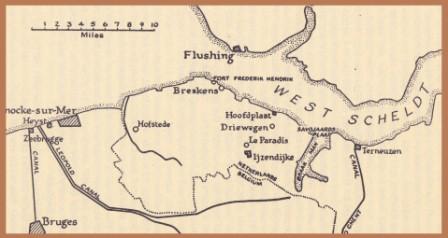
Edison was initially buried between Hoofdplaat and Terneuzen, The Netherlands.  (Map source: ‘No Retreating Footsteps’ by Will R. Bird)

On October 16, 1944, the North Nova Scotia Regiment was in The Netherlands, tasked with attacking a heavily defended dyke.  Sadly, it was the day that Edison lost his life, as was related in a November 17, 1944 letter to his aunt from Captain L.C. Niuhold, ‘C’ Company, North Nova Scotia Highlanders:  “…As second-in-command of the company in which your nephew served, I was present on the 16th of October in the battle in which he was killed. …

It was part of the campaign in the Scheldt in Holland which eventually opened the great port of Antwerp.  On the 16th of October the company was leading the battalion in an attack along a stubbornly defended dyke.  The going was slow and difficult but owing to the courage and determination of your nephew and his pals, the position was eventually taken. 

It was after we had reached our first objective and your nephew was bringing in some prisoners, that a burst of machine-gun fire from another direction hit him and instantly killed him.  The same burst of fire killed his platoon officer and another one of his pals who were with him.

Your nephew was buried, along with the other boys who died that day, in a pretty orchard in Southern Holland, with a funeral service held by our battalion padre.

I wish to extend my heartfelt sympathy to you in the loss of your nephew.  He is missed by everyone in the company as he was one of our best soldiers…

… Edison is buried in the Canadian War Cemetery in Adegem…

Edison was initially buried between the towns of Hoofdplaat and Terneuzen, The Netherlands. After the war ended, Edison was reburied in the Canadian War Cemetery in Adegem, Belgium.  Pieter’s cousin, François Breugelmans visited Edison’s grave with his wife, Mieke de Bie, and ensured a Canadian flag was placed by his headstone.

SMITH and Francois from Mieke

François Breugelmans by the grave of Edison Reynolds Smith at the Canadian War Cemetery in Adegem.  (Photo credit: Mieke de Bie)

Thank you to Angela Leighton for providing photos, Edison’s letters, and information.  Thank you also to François Breugelmans and Mieke de Bie for visiting Edison’s grave at the cemetery in Adegem. Do you have a story to tell? Email Pieter at memorialtrail@gmail.com, or comment on the blog.  

© Daria Valkenburg

….Want to follow our research?….

If you are reading this posting, but aren’t following our research, you are welcome to do so.  Our blog address: https://onthewarmemorialtrail.com/

Front cover OnTheWarMememorialTrailinEurope4 countries, 6 weeks, 7,000 km – an unforgettable war memorial journey in Europe…. Daria’s book ‘No Soldier Buried Overseas Should Ever Be Forgotten‘ is available in print and e-book formats.  Net proceeds of book sales help support research costs and the cost of maintaining this blog. For more information see https://nosoldierforgotten.com/ 

You are also invited to subscribe to our YouTube Channel: On The War Memorial Trail With Pieter Valkenburg: https://www.youtube.com/channel/UCJ591TyjSheOR-Cb_Gs_5Kw

Never miss a posting!  Subscribe below to have each new story from the war memorial trail delivered to your inbox.
On The War Memorial Trail….. Atlantic Canada Remembers – Part 5

January 27, 2021. Responses to the news clips on CTV’s Atlantic Live At 5 on January 4 and 13 continue to come in.  As mentioned in the previous 4 parts, Pieter is ensuring that every email is acknowledged, and that the photos of soldiers buried in The Netherlands are forwarded to the appropriate cemetery for their digital archives.

This posting features more of the photos submitted…..

Soldiers buried at the Canadian War Cemetery in Holten, The Netherlands

William Herbert Bellamy

William Herbert Bellamy.  (Photo courtesy of the Bellamy Family)

On behalf of the Bellamy Family, Linda Fury submitted a photo of her uncle, William Herbert “Billy’ BELLAMY, explaining that ….There are about 150 members of our family now.  We hold reunions often and all know the story of our Uncle Bill.  He belonged to the North Nova Scotia Highlanders and died in January 1945 while a prisoner in Germany.  Thanks so much for all you have done and are continuing to do.  Your work is very much appreciated by all of us….

William Herbert ‘Billy’ was born on May 2, 1921 in Hereford, England, the son of Percy and Frances Bellamy.  In 1927 he immigrated to Canada with his family and settled in Midgic Station (now Midgic), New Brunswick.  Following his 18th birthday, he enlisted with the West Nova Scotia Highlanders on August 2, 1940 in Aldershot, Nova Scotia. On April 30, 1941 he transferred to the North Nova Scotia Highlanders, and was on his way to England in July 1941.

The North Nova Scotia Highlanders were among the troops to land in Normandy on D-Day on June 6, 1944.  Unfortunately, on June 7, 1944 he was captured by the Germans in Normandy and became a prisoner of war (POW).  On August 13, 1944 he arrived at Stalag XII A [Limburg an der Lahn, Hessen, a POW transit camp] and then, on August 26, 1944 was transferred to Stalag Camp VIII B [Lamsdorf, Oberschlesien] near the German-Polish border.  On November 2, 1944 he was sent to the work camp E 902 Delbrückschächte Hindenburg where, along with other POWs, he worked in a nearby coal mine.

According to an account that a former POW sent after the war to Billy’s father, Billy was seriously injured on January 1, 1945 when the mine ceiling collapsed.  He was taken to hospital in Hindenburg (now Zabrze and part of Poland).  However, according to the POW record kept by his captors, he was seriously injured on November 23, 1944 and sent to a military hospital in Knurow (now Knurów, Poland). Curiously, the same injuries described as happening on January 1, 1945 were reported on the POW record as having occurred on November 23, 1944.

In January 1945 he died of his injuries. Records of the exact circumstances have not been found, likely due to advancing Russian troops.  His military service file lists his official date of death as January 28, 1945. On February 6, 1945, Billy was buried in the Municipal Cemetery of Teupitz (in the state of Brandenburg, Germany).  After the war ended he was reburied in the Heerstrasse British Cemetery in Berlin, and then in 1949 reburied for the final time in Holten.

Robert Cole

Robert Theodore Cole. (Photo courtesy of Emily Gilbert)

Ervin Ellis submitted a photo of Robert Theodore COLE, explaining that “I was told by Kent Caldwell that you were looking for a picture of Robert Cole, WWII Veteran from Coles Island. A woman that I knew had close ties to that area.  She said the whole family was deceased but her first husband was part of that family, if anyone had any pictures it would be her.  She looked through her old pictures and by some sort of miracle she had pictures…”  This was Emily Gilbert.  Robert Cole was the nephew of her husband.

Born in Coles Island, New Brunswick, the son of Fred and Maria Cole, Robert enlisted in March 1940 and served in Canada and Labrador before going overseas in September 1943. He was in France by 1944, and also was with his regiment in Belgium, The Netherlands, and Germany.  He lost his life on April 21, 1945 during the Battle of Friesoythe in Germany while serving with the Lorne Scots – Ground Defence Platoon.

Ervin’s assistance was invaluable in putting a face to this soldier’s name! He went on to write Pieter that “….This is a great project you are working on, saw you on TV a couple of times. I am the Zone Commander for the legions in this area so I know them pretty good and their Cenotaphs. If I can help you any let me know…”  Needless to say, Pieter has taken Ervin up on his offer and is grateful for the help that he and Kent Caldwell have provided.

Joseph Gerald Fougere

Joseph Gerald Fougere. (Photo submitted by Doug Landry)

Gerald Douglas ‘Doug’ Landry submitted a photo of his uncle, Joseph ‘Gerald’ FOUGERE, explaining that he was “….born in Poulamon, Nova Scotia, the only son of Felix and Josephine (Marchand) Fougere. Gerald had three sisters: Evelyn, married to Thomas Sampson; Anita, married to Val Poirier; and Theresa, married to James W. Landry….

Doug went on to write that “…Gerald was with the Perth Regiment.  He was dangerously wounded in action on April 24th, 1945 and died of wounds on April 26th, 1945 at the age of 28 years, 11 months….” He lost his life during the Battle of the Delfzijl Pocket.

Soldiers Buried In Adegem Canadian War Cemetery in Belgium

Arthur Jack Taylor

Arthur ‘Jack’ Taylor.  (Photo courtesy of the Taylor Family)

On behalf of the Taylor family, Art Taylor submitted a photo of his uncle, Arthur Brambel ‘Jack’ TAYLOR, explaining that “…My father and his four brothers, from the small town of Woodstock, New Brunswick, all served in WWII.  Three saw action.  My father (John Taylor) was in the Royal Canadian Navy and escorted convoys to Europe.  His two brothers were in the army.  Russell Taylor fought into Holland and survived.  His other brother Arthur ‘Jack’ Taylor was with the Winnipeg Rifles.  He was killed at the Leopold Canal on October 12, 1944.  He is buried at the Adegem Canadian War Cemetery in Belgium.  He was 26 years old…

Jack was a rifleman, killed during Operation Switchback, part of the Battle of the Scheldt.  A Wikipedia article explains that “….October 10, 11, and 12 were days of intense struggle while the men of the 7th Brigade with the Royal Winnipeg Rifles took, lost and then retook a group of houses known as Graaf Jan and the Regina Rifles found themselves pinned down by a group of well dug-in pillboxes that seemed to be resilient to artillery…(For more information see https://en.wikipedia.org/wiki/Battle_of_the_Scheldt#Operation_Switchback) Jack was initially buried in Madelgem before being reburied in Adegem.

Thank you to Ervin Ellis, Emily Gilbert, Doug Landy, Linda Fury, and Art Taylor for sharing photos and anecdotes.  Kudos to CTV’s Atlantic Live At 5 for helping to get the word out on this quest of remembrance. Atlantic Canadians remember their loved ones who are buried overseas.  Pieter and I extend our condolences to Ervin Ellis, who sadly lost his wife on January 20.

More photos and stories in Atlantic Canada Remembers – Part 6! If you have photos or information to share, please email Pieter at memorialtrail@gmail.com, or comment on the blog.

© Daria Valkenburg

…..Previous postings in the Atlantic Canada Remembers series….

Missed the previous postings in this series? See:

…Want to follow our research?…

If you are reading this posting, but aren’t following our research, you are welcome to do so.  Our blog address: https://onthewarmemorialtrail.com/

Front cover OnTheWarMememorialTrailinEurope4 countries, 6 weeks, 7,000 km – an unforgettable war memorial journey in Europe…. Daria’s book ‘No Soldier Buried Overseas Should Ever Be Forgotten‘ is available in print and e-book formats.  Net proceeds of book sales help support research costs and the cost of maintaining this blog. For more information see https://nosoldierforgotten.com/

You are also invited to subscribe to our YouTube Channel: On The War Memorial Trail With Pieter Valkenburg: https://www.youtube.com/channel/UCJ591TyjSheOR-Cb_Gs_5Kw.

Never miss a posting!  Subscribe below to have each new story from the war memorial trail delivered to your inbox.