On The War Memorial Trail…..The WWII Sergeant From Kenora Killed During The Battle Of The Scheldt Near Hoogerheide

April 4, 2026. When Caroline Raaijmakers, Chair of Faces To Graves Bergen Op Zoom, sent a photo wish list of 15 soldiers from the Fort Garry Horse – 10th Armoured Regiment, Pieter decided this was a research project he wanted to take on.

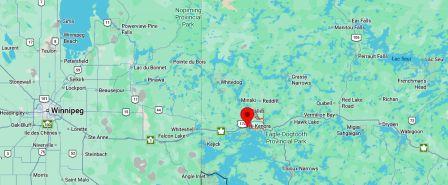
Kenora is situated on the Lake of the Woods in Ontario, near the border with Manitoba, and is about 208 km east of Winnipeg. (Map source: Google maps)

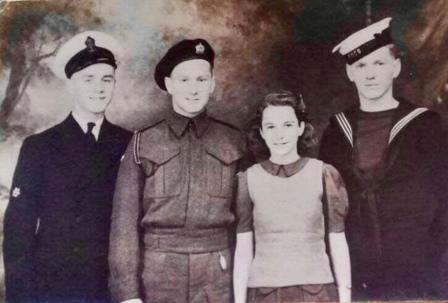
One of the soldiers was Sergeant Gerald Vincent ‘Vin’ JORGENSON, born March 22, 1921 in Kenora, Ontario, the son of Jacob and Genevieve ‘Gen’ Evelyn Jorgenson, and the husband of Marguerite Norma ‘Tiny’ nee Campbell. Both of his younger brothers, Charles Edward ‘Ted’ and James ‘Jim’ Martin, served in the Royal Canadian Navy Volunteer Reserve (RCNVR) during WWII.  He also had a younger sister, Patricia ‘Patsy’ Lenore.

The Jorgenson siblings, left to right:  Ted, Vin, Patsy, Jim.  (Photo courtesy of Terry and Leni (nee Jorgenson) Ellwood)

Not long after Pieter’s research began, he received a reply from Terry Ellwood, explaining that the soldier was his wife Leni’s uncle who died on October 23, 1944, at the age of 23.  “… He was a tank commander. Two months before he was killed he received a citation for bravery which was recorded in the New York Times.”  Leni is the daughter of Vin’s brother Ted.

After Vin’s parents separated in 1929, “…Gen raised the four kids on her own… living in the bush near Ignace (Osaquan) working a trapline and running a trading post until they moved to Kenora….  Terry wrote.  …. She was quite a gal. All the kids treated her like gold until she died….

….Vin enlisted in 1940…

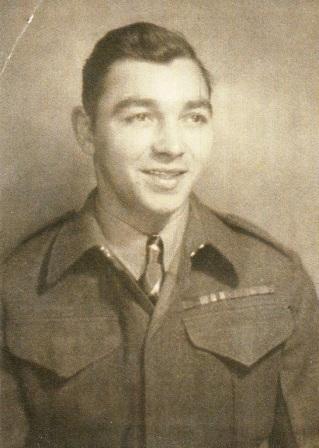
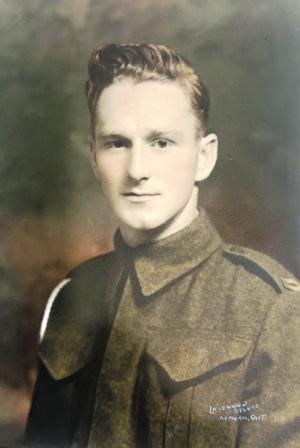
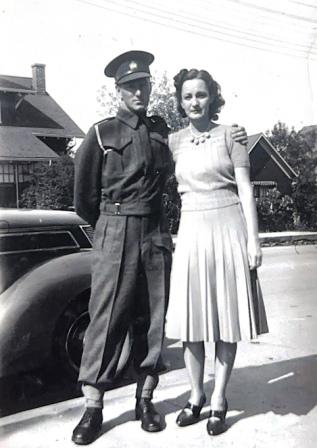
Gerald Vincent ‘Vin’ Jorgenson. (Photo courtesy of Terry and Leni (nee Jorgenson) Ellwood)

When Vin enlisted with the Fort Garry Horse in Winnipeg, Manitoba on May 22, 1940, he noted that he had served for a year in a militia unit, with the 16th Medium Battery in Kenora, Ontario, from May 1939 until the day he enlisted in the Active Army.  He’d earlier enlisted in the Kenora Light Infantry on January 30, 1936.

In an interview at the time of his enlistment, he noted that he’d worked as a tractor driver at Keewatin Lumber Company, on a seasonal basis from April 1938, and was a member of the Carpenters and Joiners Union of America.  He’d also attended a commercial course in shorthand and typing at night school in 1937. He also worked, on a seasonal basis, as a grocery store clerk for C.G. Bulmer in Kenora.

Vin listed several hobbies and interests.  He collected sports trophies and played the harmonica.  He also enjoyed boxing, skiing, skulling, and played basketball and hockey.  Terry had written that “Vin was also a great hockey player…. played for the Kenora Thistles. ….” Vin played right wing on this junior ice hockey team. “…The year he went overseas, he was selected as the most valuable player for the elite Canadian junior hockey team the Barrie Colts. As MVP for that team he certainly would have been tracked by the NHL in that era.  Although he played forward when he played for the Kenora Thistles, it seems as though he moved to defence for the Barrie Colts” (NHL refers to National Hockey League)

After completing his basic training in Winnipeg, Vin, now part of the Fort Garry Horse’s Canadian Active Service Force, was sent to the A3 Canadian Artillery Training Centre in Shilo, Manitoba for artillery training on June 8, 1940.

….Vin was a guard at a POW Camp in Red Rock…

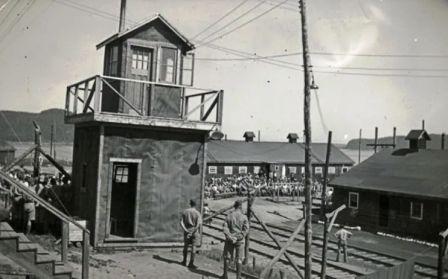
At the end of July, 1940, Vin and his Regiment were sent to Camp R, an internment camp in Red Rock, Ontario to act as guards for German prisoners of war and internees. Operational from July 1940 to October 1941, the camp held 1,145 German prisoners, among them civilians, merchant seamen, and combatants. Many of the prisoners had been active Nazi sympathizers before the war, while others came from German ships interred in Canadian ports at the outbreak of the war.

One of the guard towers at Camp R (Red Rock). LAC e006611161. (https://powsincanada.ca/pows-in-canada/internment-camps/camp-r-red-rock/#jp-carousel-3314)

Located on the grounds of a plant owned by the Lake Sulphite Pulp Co. Ltd., Camp R’s enclosure was surrounded by two layers of barbed wire fences and five guard towers – initially only elevated platforms – each with a machine gun.

Vin fell ill with a bout of influenza and was hospitalized from August 27 to 29, 1940, being discharged only a few days before his next posting. 

Guard duty at Red Rock for Vin and his Regiment lasted a few months, until September 1, 1940, when the Regiment moved to the A33 Canadian Armoured Corps Training Establishment Camp at Camp Borden, Ontario to begin training as an Armoured Regiment.

After the men from the Fort Garry Horse left, they were replaced by a company of the Veterans Guard of Canada. However, poor facilities and safety concerns caused Camp R to be closed in October 1941, and the prisoners transferred elsewhere.

….Vin qualified as a Driver Mechanic…

While at the A33 Canadian Armoured Corps Training Establishment Camp at Camp Borden, Vin qualified for a Class III Certificate as Driver (i/c) Wheeled and Tracked (W&T) on February 5, 1941.  (The term ‘Driver i/c’ refers to ‘Driver, internal combustion’.  Receiving a Class III in both Wheeled and Tracked meant he was qualified to drive heavy trucks and armoured cars, as well as tanks.)

On February 11, 1941, the Fort Garry Horse Regiment was re-designated as the 10th Canadian Armoured Regiment.

He had a change in his personal life when he married Marguerite Norma Campbell in Barrie, Ontario on April 12, 1941. 

In May 1941, the Regiment became part of the 5th Canadian Armoured Division to form the 1st Canadian Armoured Brigade, along with the Lord Strathcona’s Horse (Royal Canadians) and the 1st Hussars.

From June 15, 1941 until August 1941, Vin took a driver mechanics course in Owen Sound, Ontario, while attached to the No. 2 District Depot in Toronto, Ontario ‘On Command’.  He qualified as a Driver (i/c) Class II on September 9, 1941, which meant he was authorized to drive heavier 4×4 or 6×6 vehicles (like the Canadian Military Pattern truck/CMP), specialized trailers, and possessed advanced maintenance skills. Class II drivers handled transport duties in armoured divisions, such as the one he was in, which required expertise in convoy driving and off-road operations.

Vin also qualified as a Driver Mechanic Class ‘C’ on September 25, 1941. This meant that, in addition to being a driver, he would also be responsible for minor vehicle repairs on vehicles in his unit.

….Vin left Canada for overseas service…

Vin with his mother Genevieve Jorgenson. (Photo courtesy of Terry and Leni (nee Jorgenson) Ellwood)

From September 29, 1941 until October 3, 1941, Vin was granted embarkation leave, for what turned out to be the last time he saw his family.

In October 1941, Vin and his Regiment moved to Debert, Nova Scotia, for final training and preparation before going overseas.

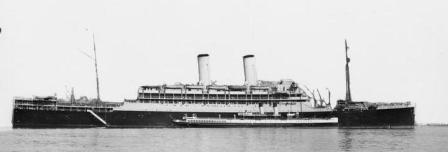
S. S. Oronsay. (Photo source: Wikipedia, photographer, Keating G (Capt))

On November 10, 1941, Vin was aboard the liner ‘S.S. Oronsay’ with the Regiment when they prepared to sail from Halifax, Nova Scotia to the United Kingdom. They finally left Halifax after several days in the harbour, along with a large flotilla of transports and Naval vessels, and arrived in Liverpool, England, on November 22, 1941.

….The Regiment continued training in the United Kingdom

The Regiment moved first to Aldershot and later to the Headley, Hampshire area where the first of the Canadian designed Ram tanks were issued.

Vin was interviewed by Lt J. Gartside on January 27, 1942, in which it was noted that he was a proficient hockey player, and that he’d …played baseball and basketball for the regiment…”  Lt Gartside also recorded that “…this man wants action more than anything else…” 

On January 31, 1942, Vin and Marguerite’s son Garry Vincent was born in Kenora, Ontario, a child that Vin would never get to meet.

Testing of the new tanks to see how they fired took place in Wales in July 1942. The Regiment moved several times within England as training continued.

Vin qualified as a Driver Mechanic Armoured Fighting Vehicles (AFV) Group ‘C’ on November 4, 1942.  This meant he would have some knowledge of overhaul and repair of armed, armoured combat vehicles designed for mobility and protection, including tanks (such as the Ram tanks), armoured cars, and personnel carriers.

The Regiment, based in Hove in December 1942, left the 5th Armoured Division, and became part of the 3rd Canadian Army Tank Brigade, along with the 1st Hussars and the Sherbrooke Fusiliers. That lasted until July 1943, when it was broken up after the 2nd Canadian Army Tank Brigade arrived in England, and became the 2nd Canadian Armoured Brigade.

On May 19, 1943, Vin qualified as a Gunner Operator Group C, a specific trade qualification which meant he was qualified to operate both a tank’s weaponry and radio equipment.

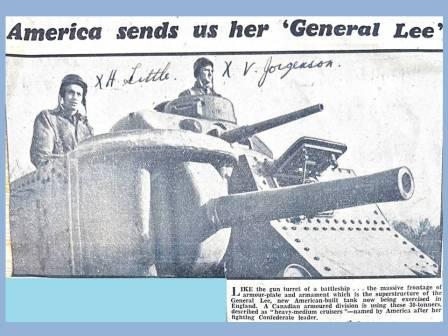
….Vin also trained in American-built tanks in preparation for D-Day…

Captioned picture showing Vin Jorgenson and H. Little in an American-built tank in the United Kingdom. (Article courtesy of Terry and (nee Jorgenson) Leni Ellwood)

On October 19, 1943, Vin was promoted to Lance Corporal.  That same month, the first of the new American Sherman tanks were issued and firing practice took place on ranges in Kirkudbright, Scotland, after which the Regiment moved to the South coast at Milford-on-Sea.

Training in combined operations and amphibious landings at Inverary, Northern Scotland, as well as exercises with the 8th Infantry Brigade of the 3rd Canadian Division in preparation for support during the planned invasion of Normandy kept Vin and other members of the Regiment occupied. The men also took French lessons.  On February 9, 1944, Vin was promoted to Corporal.

‘B’ and ‘C’ Squadrons had special training – in great secrecy – in the use of ‘Duplex Drive’ or ‘DD’ swimming tanks. (DD tanks were Sherman tanks with twin propellers and collapsible canvas sides which provided floatation.)

Once in Normandy, the DD tanks were to be carried on LCT’s (Landing Craft Tanks) to about 6,401 metres (7,000 yards) from shore where they would be launched into the water. The tanks would then swim into shore and land with the charging infantry. The tanks were equipped with 75 mm guns, making them outgunned by German tanks, but their advantage was in being very fast and maneuverable.

….Vin survived D-Day…

In May 1944 the Regiment’s squadrons moved to concentration areas prior to loading on landing craft for the upcoming Operation Overlord (the Normandy invasion) – what we refer to as D-Day on June 6, 1944. ‘B’ and ‘C’ Squadrons moved with their DD tanks to a hiding area near Fawley on the south coast of England.

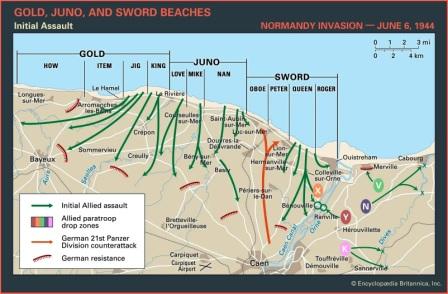
On June 2, 1944, Vin, who was in ‘C’ Squadron, boarded the ship that would take him and his Squadron to France.  They disembarked on June 6, 1944 at the eastern end of Juno Beach, an area codenamed ‘Nan Red’, near Saint-Aubin-sur-Mer, in support of the North Shore (New Brunswick) Regiment.

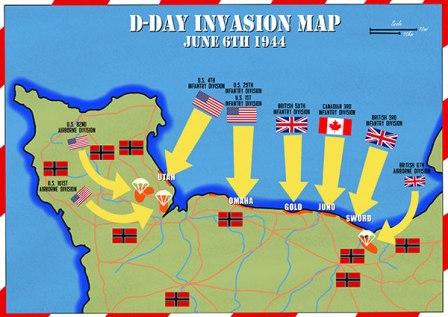
D-Day Normandy invasion map. The Canadians landed on Juno Beach in Normandy, France. (Map source: Encyclopedia Britannica)

An excerpt from the Juno Beach website noted that “..at 8:05 am the LCT’s came inshore and the order was given to launch. On their way into shore 4 tanks were knocked out in the water. One LCT was hit with the tanks still onboard and one sank in deep water. When the tanks landed they gave supporting fire in all directions from their beach positions, waiting for the AVRE’s to clear an exit through a minefield…..”  (See http://www.junobeach.info/juno-04-07.htm) AVRE refers to Armoured Vehicle, Royal Engineers.

The DD tanks were supposed to land ahead of the Infantry Regiments, but heavy seas meant that they were launched close to the shore landing later than planned.

When ‘C’ Squadron landed at St. Aubin, they had lost a few tanks due to enemy fire.  Then, because there was no breach in the sea wall, they had to make their way through a minefield, losing three tanks doing so. Due to a request for support from the North Shore (New Brunswick) Regiment, ‘C’ Squadron didn’t rejoin the 10th Armoured Regiment until June 7. Vin had survived D-Day!  He was promoted to Acting Sergeant a few days later, on June 11.

….Vin’s heroism during Operation Totalize was noted in a New York Times article…

D-Day was only the beginning of battles in Normandy that summer. Vin’s Regiment was in the midst of Operation Totalize, fought between August 7-11, 1944, in an offensive designed to break through the German defences south of Caen and toward Falaise, with the objective of closing the Falaise gap and cutting off the retreating Germany 7th Army.  (See https://en.wikipedia.org/wiki/Operation_Totalize)

On the night of August 10, 1944, Vin had an experience that was documented by journalist James MacDonald in the August 11, 1944 edition of The New York Times. It began with a description of Vin.  “….On a hilltop that he helped to capture, Sgt Vincent Jorgenson, a brawny 23 year old athlete of Kenora, Ontario, was busily getting his tank ready for action today just after having rested up from as grueling an experience as one can have and live to tell about it…..he is what his superior officers call a magnificent crew commander….

Last night his and other tanks set out from the village of Les Ifs with orders to take Hill 122. Sergeant Jorgenson’s was the second tank in line, the first being one commanded by his troop officer. Enemy mortars and 88 mm shells exploded all around them as they rattled into Rocquancourt, but they did not dare to open up with their machine guns or six-pounders lest gun flashes give their positions away.

The Germans’ artillery scored a direct hit on the leading tank commanded by a lieutenant from Winnipeg. That tank went up in flames….”  All the men in the tank survived.

…Sergeant Jorgenson was so near he had to order his tank to back up and circle around the blazing wreck. He pushed on and sent out wireless signals to tanks that had been behind him but received no answer.  He could not see them or anything else ….. because on top of the darkness and dust the Germans began laying a smokescreen around him.

Suddenly he heard German voices around him and he thought he might be isolated and surrounded. He asked his crew if they wanted to continue or attempt to retire. They wanted to go on.

The Germans tried to blind the tank’s driver by flashing torchlights into his eyes and make him halt and give anti-tank gunners direct aim.  The tank’s co-driver drove them off with his machine gun.  Then something happened to one of the tank threads that cut the machine’s speed to two miles an hour.

On and on the tank lurched, German infantrymen doggedly surrounding it. One German even climbed on the machine.  Through his slightly opened hatch cover, Sergeant Jorgenson saw him and shot him with his pistol.

Presently the tank halted in a field…..” while they worked to transform “…the machine into a little fortress, using sandbags they had carried along as an extra protection….” 

Meanwhile, “…Trooper George Johnson, of Dauphin, Manitoba, hearing German voices near by, hurled a hand grenade in their direction.  After the grenade exploded all was quiet…”  At daylight, they saw that the grenade had destroyed “… an anti-tank gun that had been trying to kill them…” 

The article concluded by saying “…the night had been won and the objective attained…

 ….From France the Regiment moved into Belgium…

Over the next week, there was no respite from fierce opposition and heavy losses that resulted in 3 Squadrons being consolidated into 2 Squadrons as they left France and moved into Belgium in September, as they prepared for the Battle of the Scheldt, which began officially on October 2 and lasted until November 8, 1944. 

The Battle of the Scheldt’s objective was to free up the way to the Port of Antwerp in Belgium for supply purposes. From Antwerp, they went into The Netherlands, fighting along flooded fields and dikes leading toward Woensdrecht in a battle that lasted until October 21, 1944. (See https://www.veterans.gc.ca/eng/remembrance/history/second-world-war/scheldt)

Vin was promoted to Sergeant on September 11, 1944. 

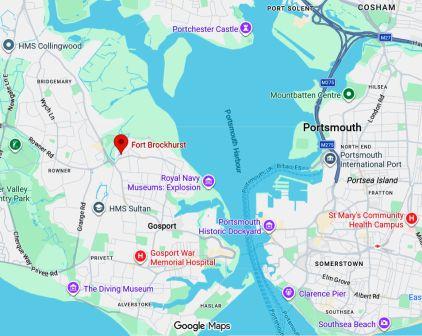
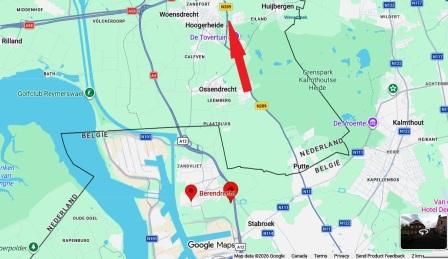
The 10th Armoured Regiment fought their way towards Woensdrecht in October 1944. Vin was killed near Hoogerheide and was temporarily buried in Berendrecht. (Map source: Google Maps)

On October 17, 1944, an exhausted Vin wrote to his mother and sister from The Netherlands, letting them know he was alive after surviving an attack on the tank he was in.  “…Forgive me for not writing sooner but have been so muddled lately….” 

He went on to say that he had been “…knocked out of another tank some twelve days back and since then much has happened and I’m still here with the regiment with a brand new tank ‘Canora III’….. No one in my old tank was killed and we were hit twice by an 88 mm gun which pierces roughly 10 inches of steel….

Vin was referring to what happened on the morning of October 2, 1944 as they were in a battle above the Turnhout Canal in Belgium, as reported in the Regiment’s war diary for that day.  “… ‘C’ Squadron moved out at 0630 hours in support of the Cameron Highlanders to clear the road running West of STERNHOVEN parallel to the ANTWERP-TURNHOUT CANAL, a distance of approximately 5 1/2 kilometres…First Troop, under Sgt Jorgenson, moved forward to lead. Three 88 mm guns and a considerable number of Jerries were encountered. Two of the guns were knocked out by well-placed shots by the forward troop and two large ammunition trucks were set on fire

The war diary entry for October 12, 1944 recorded that … ‘C’ Squadron, relieved of operational commitments, proceeded to make merry.  First a shower, then a trip to Antwerp, and a movie in harbour upon return back at 2030 hrs….” 

It was a badly needed break after 4 months of fighting, as described in Vin’s letter. “…While myself and my crew were at Tank Delivery Regiment we buggered off to Antwerp for one night, our first since D-Day….” where they enjoyed an expensive steak dinner. 

Responsible as ever, Vin let his mother know that he planned to assign more of his pay to her and his wife Tiny.  “….Mom, since getting my confirmation as a Sgt, I signed over another $12 to Tiny and $3 to you, be sure and let me know if you get it on your next cheque…

Vin was hoping to receive a new assignment.  “…Major Bray, our old Squadron leader, is in charge of a tank school in Belgium and has sent for another Sgt and myself for head instructors.  He said he wanted us badly, and besides, we deserve a rest, being two of the only D-Day Sgts left.  Don’t know how long it will take the Regiment to make up their minds about sending us….I’m dying for a chance to get away from all this for a while….”   Vin referred to Major William Roy BRAY.

….Vin was killed a few days after he wrote his letter…

None of Vin’s plans for a new assignment as instructor at the tank school or for sending more of his pay to his family happened, as he was killed on October 23, 1944, aged 23, near Hoogerheide, The Netherlands, less than a week after he wrote his last letter.

An entry in ‘Vanguard – The Fort Garry Horse In The Second World War’ by Eric Mackay Wilson simply stated that “… ‘C’ Squadron sweated it out in Hoogerheide, and also suffered casualties.  Major Fletcher and Sgt Jorgenson were killed, to the sorrow of the whole regiment...”  Major Charles Wesley FLETCHER was from McCreary, Manitoba.

….Vin is buried in Bergen Op Zoom…

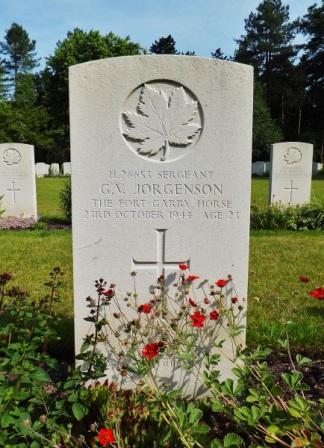
Vin was temporarily buried on October 24, 1944 in the Belgium Churchyard in Berendrecht, Belgium, with the service conducted by Honorary Captain W. E. HARRISON, one of the chaplains attached to the Fort Garry Horse – 10th Armoured Regiment, before being reburied in the Canadian War Cemetery in Bergen Op Zoom on June 4, 1945.

Grave of Gerald Vincent ‘Vin’ Jorgenson in the Canadian War Cemetery in Bergen Op Zoom, The Netherlands.  (Photo source: Find A Grave)

Thank you to Terry and Leni Ellwood for sharing photos and information about Leni’s uncle.  “….Checked out Daria’s blog … wonderful stuff….” Terry wrote, and explained that “…my dad, Keith Ellwood, was the pilot of a Lancaster bomber… his last few missions were food drops to Holland.  He always felt a close connection to the Dutch people because of this….” 

Leni and Terry Ellwood with their grandchildren.  (Photo courtesy of Terry and Leni (nee Jorgenson) Ellwood)

….The research and search for photos continues…

Pieter’s research efforts to find photos and families of soldiers continue, doing his part to ensure that each individual soldier is remembered. He’s still looking for photos of two soldiers from the Fort Garry Horse – 10th Armoured Regiment from the original photo wish list: 

  • Lance Corporal Harry Leith HOWE, born in Winnipeg, Manitoba, son of Harry John and Minnie Christina (nee Clay) Howe, died October 1, 1944.
  • Trooper Russell John KITCHEMONIA of Kamsack, Saskatchewan, son of John and Louise Kitchemonia, died October 12, 1944.

If you have photos or information to share about either of these two soldiers, please email him at memorialtrail@gmail.com, or comment on the blog.    

© Daria Valkenburg

….Want to follow our research?…

If you are reading this posting, but aren’t following our research, you are welcome to do so.  Our blog address: https://onthewarmemorialtrail.com/
4 countries, 6 weeks, 7,000 km – an unforgettable war memorial journey in Europe…. Daria’s book ‘No Soldier Buried Overseas Should Ever Be Forgotten‘ is available in print and e-book formats.  Net proceeds of book sales help support research costs and the cost of maintaining this blog. For more information see https://nosoldierforgotten.com/

Subscribe to our YouTube Channel: On The War Memorial Trail With Pieter Valkenburg: https://www.youtube.com/channel/UCJ591TyjSheOR-Cb_Gs_5Kw

Never miss a posting!  Subscribe below to have each new story from the war memorial trail delivered to your inbox.
On The War Memorial Trail…..The WWII Signalman From Charlottetown Who Died In A Vehicle Accident In The Netherlands 6 Weeks After WWII Ended In Europe

March 15, 2026.  In going through the last few names on a photo wish list for soldiers from New Brunswick who are buried in the Canadian War Cemetery in Groesbeek, Pieter’s initial research found that one of the names was of a soldier from Prince Edward Island.

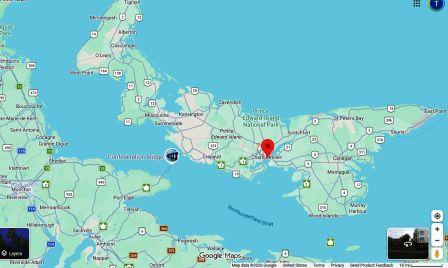
Charlottetown, the capital of Prince Edward Island, is on the east coast of Canada. (Map source: Google)

Alfred Edward Stanley FORD was born February 12, 1918 in Charlottetown, Prince Edward Island, son of Alvin Chester and Ethel Maud (nee Roebuck) Ford.  He was one of two children in the family and Pieter at first thought it would be a challenge to find a photo.

However, an obituary for Alfred’s sister Marjorie led him to the Cummins family, and he was soon in contact with Marjorie’s son Dave, who wrote to Pieter, saying “….I greatly appreciate all the work you and your wife are doing on the memories of our fallen soldiers…” And yes, he did have a photo of his uncle.

….Alfred worked as a waiter and butler…

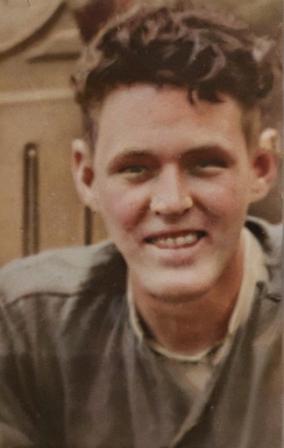
Alfred Edward Stanley Ford. (Photo courtesy of Cummins/Ford archives.  Photo restoration and colourization by Pieter Valkenburg)

When Alfred enlisted at the No. 4 District Depot in Montreal, Quebec on December 3, 1941, he stated that he had served in the Reserve Formation of the Royal Canadian Corps of Signals (RCCS) in Prince Edward Island for 2 years, from July 1936 until July 1938. 

After leaving school at aged 16, he’d worked as a waiter at various hotels between 1933 and 1936, and then was a butler for the Polish Consul-General, Dr. Sylwester Gruszka, in New York City between 1936 and 1939. (A career diplomat, Dr. Gruszka was the Consul-General from 1935–1940. For more information, see https://pl.wikipedia.org/wiki/Sylwester_Gruszka)

Alfred’s time working for the Consul-General resonated with us, as decades later Pieter worked in the Consulate in New York and later in the Embassy in Warsaw, Poland, during his career in the Dutch Foreign Service.

While working for Dr. Gruszka, Alfred took a short order-barman course and received a diploma for successfully completing a course at the Fanny Farmer School of Cooking in 1937. 

From 1939 to 1941, Alfred worked as a barman and later as a waiter in New York. 

….Alfred was drafted one country and enlisted in another….

On October 16, 1940, he was required to fill out a US Draft Card Registration. At the time, he was between jobs in New York City, and living with a friend. Although the USA didn’t officially enter World War II until December 8, 1941, after the attack on Pearl Harbor, Hawaii, US President Franklin Delano Roosevelt had signed into law in October 1940 the first peacetime selective service draft in US history because of rising world conflicts.

Since he was living in the USA, Alfred was required to register for the US Draft, but never joined the US Army as he subsequently moved to Montreal, Quebec and enlisted in the Canadian Army.

During his interview, Alfred expressed an interest in becoming a lineman with the Royal Canadian Corps of Signals, and it was noted that he played hockey as a sport.  The interviewer described Alfred as “…respectful, cheerful, and neat in appearance...” and noted that 23 year old Alfred had “…done well in civilian life…

….Alfred was trained as a Signalman….

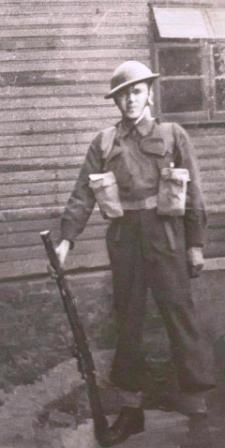
Alfred Edward Stanley Ford during basic training. (Photo courtesy of Cummins/Ford archives.  Photo restoration by Pieter Valkenburg)

Alfred’s military career began when he was sent for basic training to No. 41 Canadian Army (Basic) Training Centre (CABTC) in Huntingdon, Quebec on December 8, 1941. 

After completing his basic training, he was transferred to A7 Canadian Signal Corps Training Centre at Camp Barriefield, Ontario on March 12, 1942 for advanced training.  He remained there until May 5, 1942 when he was posted to the 6th Light Anti-Aircraft (LAA) Regiment Signals Section, Royal Canadian Artillery, in Petawawa, Ontario as a Signalman.

As a Signalman, Alfred would have been trained to manage radio (wireless), telephone, and visual signaling, and to ensure that his Regiment received air raid warnings and to relay gun target information.

On November 2, 1942, Alfred was given embarkation leave until November 15, 1942, the last chance he had to see his family. 

….Alfred left Canada for overseas service….

Shortly after returning from his embarkation leave, Alfred was on his way overseas, leaving Canada on December 12, 1942.  Upon arriving in the United Kingdom on December 18, 1942, he was assigned to No. 1 Canadian Base Staging Camp (CBSC) in Colchester.

On March 6, 1943, Alfred was sent on an Operators Course at No. 1 Canadian Signals Reinforcement Unit (CSRU), located at the Blandford Camp in Cove, Farnborough, Hampshire.

Alfred was transferred to the Canadian Signals Reinforcement Unit (CSRU) on April 2, 1943.  His training continued and on July 29, 1943, he qualified as a Lineman Group ‘C’ Class 3.  A Lineman would be involved in constructing and repairing overhead telephone and telegraph lines to support military communications.

A month later, on August 26, 1943, he was transferred to the 1st Canadian Line of Communications Signals (L of C Sigs), a key unit within the Royal Canadian Corps of Signals (RC Sigs) during WWII.  Formed in England, this unit was responsible for maintaining communications along the supply and transport routes (lines of communication) supporting the Canadian Army’s overseas operations in Europe. 

As training and preparations began for Operation Overlord (the invasion of Normandy), which began on what we know as D-Day (June 6, 1944), Alfred was transferred to the 16th Canadian Anti-Aircraft (CAA) Operations Room Signal Section in Womenswold in Kent on May 2, 1944, along with another linesmanThe war diary for May 2, 1944 noted that “…2 Line Detachments arrived today from L of C Signals….” 

This unit provided communication and signaling support for anti-aircraft operations, and training and exercises continued ahead of being sent to France after D-Day. They would be part of the signals composition of the Canadian Army Overseas.

….Alfred and his unit were sent to France in August 1944…

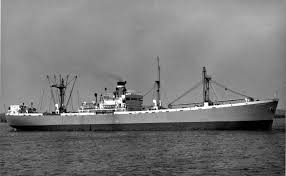
Liberty ship ‘Samarina’. (Photo source: Ships Nostalgia)

On August 1, 1944, Alfred and other members of the 16th Canadian Anti-Aircraft (CAA) Operations Room Signal Section travelled to London, for the move into France as part of the 21st Army Group.  The following day they boarded the Liberty ship ‘Samarina’, along with their vehicles and equipment. They set sail for France on August 3, 1944. 

Map showing Courselles-sur-Mer on the coast of France, near Caen.  ‘La Manche’ in French is what we call the ‘English Channel’.  (Map source: https://www.viamichelin.fr)

Per the August 5, 1944 war diary, they arrived at 9:10 pm “…at the anchorage off Courcelles…” but had to wait until August 7 to disembark.  On August 8, 1944, “…the unit arrived Bény-sur-Mer….” and “…established communications with Brigade HQ…” The unit arrived in the midst of Operation Totalize, fought between August 7-11, 1944, in an offensive designed to break through the German defences south of Caen and toward Falaise.  (See https://en.wikipedia.org/wiki/Operation_Totalize)

They had their work cut out for them once they reached Caen and took over from 51 Anti-Aircraft Operations Room (AAOR).  As recorded in the war diary for August 12, 1944, the unit “…controlled 16 AA guns in defence of Caen from 1800 hours today.  Line communications are difficult as some of the line has been badly laid and not maintained.  All broadcasts must go down to guns by line and upward intelligence must go up the same way.  This is not satisfactory….”  

On August 28, 1944, they were ordered to leave Caen and move to Lisieux. The war diary entry for August 29, 1944 recorded that at 8 am “…AAOR handed over to 152 and moved to concentration area at Lisieux….”  However, by 6 pm that same day, there was a change.  “… Unit was ordered to deploy from concentration area Lisieux for the defence of Brienne….

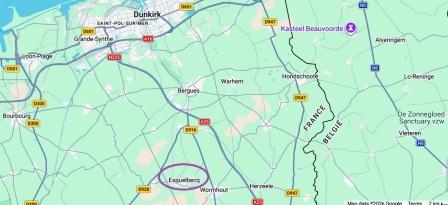
Map shows location of Esquelbecq (purple circle) in France, near the Belgian border. (Map source: Google maps)

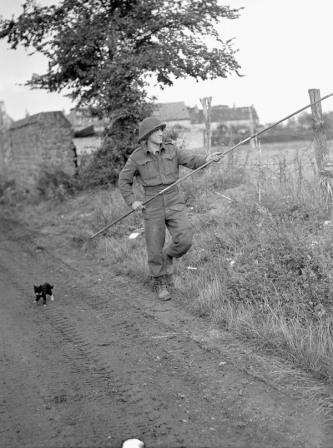
By September they had moved up through France near the Belgian border, and were based in Esquelbecq, responsible for the Gun Operations Room (GOR) in the Dunkirk area.  Linesmen like Alfred worked in difficult and dangerous conditions, as evidenced in just one line from the September 21, 1944 war diary. “…Linemen found that laying lines in the forward area became a bit tricky with snipers and machine gun fire near vicinity….

An unidentified lineman laying a telephone line in France in September 1944 gives an idea of what Alfred Ford did as a lineman. (Photo Credit: Lieut. Donald I. Grant / Canada. Dept. of National Defence / Library and Archives Canada / PA-174411)

Alfred was twice admitted to hospital, first from November 17 until December 18, 1944 at No. 16 Canadian General Hospital in Saint Omer, France, and then from January 6 to 18, 1945 at No. 2 Canadian General Hospital in Bruges, Belgium. The war diary reported that several men had been ill with colds and flu, and perhaps this is what happened to Alfred, as there was no report of an accident or being wounded by enemy action.  He returned back to his unit, which was still in France, but now in Wormhout, just a short distance from Esquelbecq, on January 28, 1945.

On February 9, 1945, the unit moved to Desselgem, Belgium, located between Ypres and Ghent.  They remained there until February 28, 1945 when they moved to Hallaar, not that far from the Dutch border, where the Operations Room for the unit would be temporarily based, during Operation Blockbuster.  (See https://en.wikipedia.org/wiki/Operation_Blockbuster). 

On March 12, 1945, the unit moved again, to Linden, The Netherlands, 10 kms (6 miles) south of Nijmegen, and near the German border. On March 13, 1945, the war diary recorded that “…as the Ops Room Section…is going to be deployed in the defence of Kleve, a Recce party went to that almost completed ruined city and found a site for the Ops Room, and billets in partially demolished houses nearby…”  The unit moved to Kleve, Germany 10 days later.

On April 14, 1945, the war diary reported that “…line party across Rhine to lay line to Units under this Unit from proposed new location of AAOR…” Two days later, they moved to Oldenzaal, The Netherlands, near the German border.

On May 7, 1945, a day before the official end of WWII hostilities in Europe, the unit moved to Oldenburg, Germany, before being redirected to Wilhelmshaven on May 10, 1945, and placed on temporary guard duty.  The war diary for May 24, 1945 noted another upcoming move. “…Guard commitments to be turned over by midnight of the 25 May 1945.  This unit will move to Arnhem area where it will come under command 2 Canadian Heavy Anti-Aircraft Regiment…

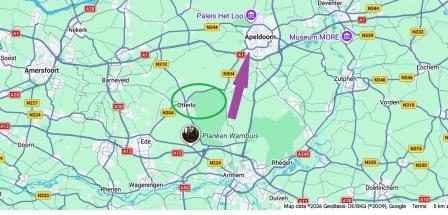
The move was delayed a few days.  On May 26, 1945, the war diary recorded that …we are to move at 0700 hours tomorrow to Otterlo in Holland where we come under Command of I-Corps and are attached to 2 Canadian Heavy Anti-Aircraft Regiment…”  In Otterlo they camped in an old Dutch barracks in the woods.

The war diary summarized May 1945 by stating that “…except for four days the entire month has been spent in Germany with the unit personnel doing guard duties for a greater portion of that period….

On June 7, 1945, Alfred was given 11 days leave to the United Kingdom, returning on June 18, 1945, just in time to learn, on June 19, 1945, that the 16th Canadian Anti-Aircraft (CAA) Operations Room Signal Section was to be disbanded immediately. The next few days were spent packing up all the equipment and vehicles. 

On June 22, 1945, most of the unit moved to the Artillery Reallocation Centre 13 Canadian Base Reinforcement, located south of Nijmegen. However, the Signals detachment, which Alfred was part of, remained at Otterloo for the night, as they had been assigned to HQ 1st Canadian Army Signals for cross postings, and were scheduled to report there on June 23, 1945. 

….Alfred died of injuries from a vehicle accident…

Alfred and the Signals Detachment were camped in a barracks in the woods outside Otterlo (green circle). The vehicle he was in was going in the direction of Apeldoorn (purple arrow).  (Map source: Google maps)

However, Alfred never arrived at his next posting as he died in a vehicle accident on June 22, 1945. The circumstances of what happened are unclear.  According to a witness, Lance Corporal R. A. MacDonald of the Canadian Provost Corps, who was on traffic patrol duty at the Arnhem-Apeldoorn Highway, around 9:15 pm a vehicle travelling in the direction of Apeldoorn approached him “…at a fast rate of speed. The vehicle was unsteady in its course, weaving as if out of control….” 

As it neared the witness, the vehicle veered to the right, likely because the driver suddenly noticed him and lost control of the vehicle in trying to avoid an accident.  Unfortunately, it crashed into a tree beside the road. The driver was 27 year old Alfred, who died from head injuries sustained in the crash. He was alone in the vehicle, and no one knew why he was driving a vehicle from another unit, as he was not assigned to be on duty at the time. A Court of Inquiry ruled it as an accidental death. 

….Alfred is buried in Groesbeek….

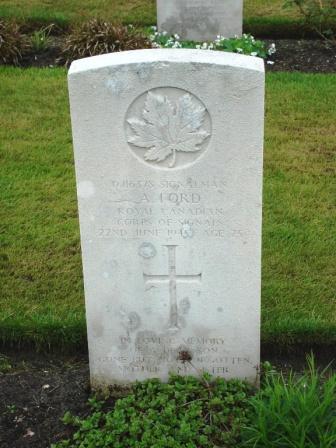
Grave of Alfred Edward Stanley Ford in the Canadian War Cemetery in Groesbeek, The Netherlands.  (Photo source: Find A Grave)

Alfred was temporarily buried in Jonkerbos Cemetery in Nijmegen, The Netherlands, before being reburied in the Canadian War Cemetery in Groesbeek on August 2, 1945.

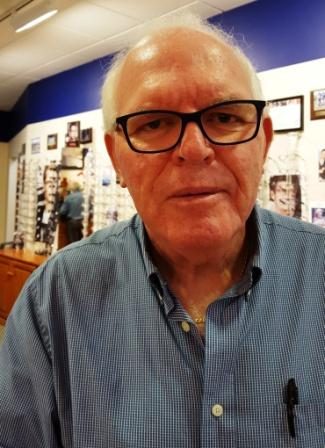
Dave Cummins provided photos of his uncle Alfred.  (Photo courtesy of Dave Cummins)

Thank you to Dave Cummins for providing photos and information on his uncle, and to Chris Cummins for notifying Dave of the photo search request. “…Thank you Pieter, my family appreciates all you have done for Alfred…” Dave wrote.  “…Keep up the good work….

Pieter’s research efforts to find photos and families of soldiers continue, doing his part to ensure that each individual soldier is remembered. If you have photos or information to share about soldiers buried in The Netherlands or Belgium, please email him at memorialtrail@gmail.com, or comment on the blog.    

© Daria Valkenburg

….Want to follow our research?…

If you are reading this posting, but aren’t following our research, you are welcome to do so.  Our blog address: https://onthewarmemorialtrail.com/

4 countries, 6 weeks, 7,000 km – an unforgettable war memorial journey in Europe…. Daria’s book ‘No Soldier Buried Overseas Should Ever Be Forgotten‘ is available in print and e-book formats.  Net proceeds of book sales help support research costs and the cost of maintaining this blog. For more information see https://nosoldierforgotten.com/

Subscribe to our YouTube Channel: On The War Memorial Trail With Pieter Valkenburg: https://www.youtube.com/channel/UCJ591TyjSheOR-Cb_Gs_5Kw

Never miss a posting!  Subscribe below to have each new story from the war memorial trail delivered to your inbox.
On The War Memorial Trail….. The WWII Soldier From Clermont Killed During Operation Veritable

September 30, 2024. When you visit a Canadian War Cemetery and place down a flag by a soldier’s grave, it stays with you, and makes you wonder about the person who is buried there.  Before our first war memorial tour in 2017, Pieter asked the Canadian War Cemeteries in The Netherlands for a list of soldiers from Prince Edward Island who are buried there, and we made sure to place flags at their graves.

Screenshot 2024-09-30 at 09-15-25 Clermont - Google Maps

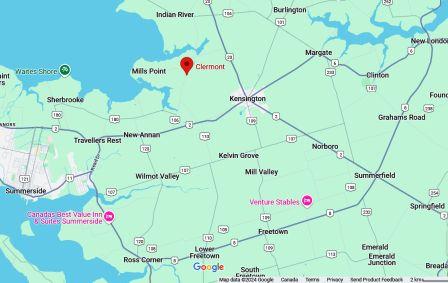
Clermont is located in Prince County, Prince Edward Island.  (Map source: Google)

Over the years, Pieter has researched many of the soldiers from Prince Edward Island who are buried in The Netherlands, and he continues to do so. One of these WWII soldiers was John ‘Weston’ CAMPBELL, born May 29, 1916 in Clermont, Prince Edward Island, the son of Archibald Joseph and Lavinia Helen (nee Brennan) Campbell.  

brant

C.G.S. Brant in Charlottetown around 1930.  (Photo source: https://sailstrait.wordpress.com)

Weston’s father was Captain of the Canadian Government Ship ‘Brant’, a buoy and lighthouse tender that operated from the Charlottetown Marine Wharf.  The family also operated a farm, and Weston worked there after leaving school upon completing Grade 10.

On June 29, 1937, Weston joined the 1st Battalion of the Prince Edward Island Highlanders Militia, before enlisting in active service with the Regiment on October 3, 1939. His basic training was taken in Charlottetown, Prince Edward Island, and Dartmouth, Nova Scotia. (See https://en.wikipedia.org/wiki/Prince_Edward_Island_Highlanders)

….Weston was transferred to the North Nova Scotia Highlanders…

Weston was promoted to Corporal and then Acting Sergeant by the time he was transferred to the North Nova Scotia Highlanders, 3rd Division, on June 20, 1940, and joined them at their headquarters in Amherst, Nova Scotia.  Training in preparation for overseas service continued.

According to his Personnel Selection Record, Weston played hockey, soccer, baseball, and softball.  His brother Vernon was a Chief Petty Officer in the Canadian Navy.  He had 4 sisters and 1 other brother.  The interviewer described Weston as…sturdy, good-looking, well-balanced, with keen pride in regiment….

CAMPBELL John Weston

John ‘Weston’ Campbell as a Sergeant.  (Photo courtesy of North Nova Scotia Highlanders Museum)

On July 5, 1941 he was promoted to Sergeant, just as the Regiment moved to Debert, Nova Scotia for final preparations before going overseas.  InNo Retreating Footsteps by Will Bird, he noted that “…the 3rd Division units were moving to Debert….Word came that the North Novas would be included in the 9th Highland Brigade along with the Highland Light Infantry and the Stormont, Dundas and Glengarry Highlanders

….Weston left Canada for England….

On July 19, 1941, Weston and his Regiment left Halifax, Nova Scotia aboard the Orion, arriving in Avonmouth, England on July 29, 1941.  Two days later, they were allowed to disembark and left by train for Aldershot, where…the North Novas arrived at Albuhera Barracks

He continued to train and take courses, and then was transferred to the No. 1 Non-Effective Transit Depot (NETD) on July 7, 1942Tweedsmuir Camp in Surrey, near the village of Thursley, was set up as Number One Transit Depot for handling thousands of medical and psychological cases during WWII.  

It was also used as a base for returning Canadian and American troops, and that appears to be why Weston was there, as shortly after his arrival he was sent back to Canada, arriving on July 29, 1942.  The following day he was assigned to No. 6 District Depot in Halifax, Nova Scotia, for a short period.

….Weston returned to Canada for officer training….

On August 14, 1942, Weston was sent to the No. 30 Officers Training Centre in Brockville, Ontario for training. After successfully completing his 12 week course on November 7, 1942, he was recommended for promotion and appointment to the rank of 2nd Lieutenant.

With his new officers’ rank, he was transferred to the A-14 Canadian Infantry Training Centre in Camp Aldershot, Nova Scotia on November 13, 1942.  He was sent for additional training to the A25 Canadian Army Small Arms Training Centre (CSATC) in Long Branch, Ontario from November 14 to December 12, 1942, after which he was promoted to Lieutenant.

On January 9, 1943, Weston was transferred to No. 61 Canadian Army (Basic) Training Centre in New Glasgow, Nova Scotia for additional training, before returning to A-14 Canadian Infantry Training Centre in Camp Aldershot on April 14, 1943.

….Weston left Canada again for overseas service….

On June 19, 1943, Weston left Canada for overseas service.  After arriving in the United Kingdom on June 24, 1943, he was assigned to No. 7 Canadian Infantry Reinforcement Unit (CIRU).   He arrived there just as a fellow Islander, Harold ‘Hal’ Gabriel BULGER, whose story was previously told, was transferred to the Princess Louise Fusiliers.  (See https://onthewarmemorialtrail.com/2024/08/05/on-the-war-memorial-trail-the-bulger-brothers-part-i-the-wwii-soldier-from-foxley-river-killed-during-the-battle-of-moerbrugge/)

On July 29, 1943, Weston returned to the North Nova Scotia Highlanders, who were still in the United Kingdom. Training and exercises continued, as extensive preparations began for Operation Overlord (the larger Normandy invasion) and Operation Neptune (the English Channel-crossing portion of Operation Overlord) on June 6, 1944 – what we know today as D-Day.

InNo Retreating Footsteps by Will Bird, he recorded that among “…the officers selected to land in France on D Day with the North Novas….” was Lt. J.W. Campbell who would be leading an anti-tank platoon.

…Weston survived D-Day….

The North Nova Scotia Highlanders left England for Normandy, France on June 6, 1944, after waiting in place in the English Channel on landing craft earlier.   The war diary for Sunday, June 4, 1944 noted that “…we are tied up with two other landing craft tank.   The Padre is on one, so he had a church service at 10:30 hours on the quarter deck of the middle craft…

On June 5, 1944 the war diary recorded that “…at 14:00 hours the flotilla moved out to the open sea and formed up with the other craft taking part in the invasion…

After landing on the beaches of Normandy on June 6, 1944, as part of the 9th Infantry Brigade, 3rd Canadian Infantry Division, 21st Army Group, the war diary noted that the Regiment had 10 casualties that day– 4 killed, 6 wounded. 

Weston had survived D-Day and received a promotion to Acting Captain on June 22, 1944. The Regiment continued to fight in North-West Europe, including the Battle of the Scheldt, which began October 2, 1944. (See https://en.wikipedia.org/wiki/Battle_of_the_Scheldt)  Weston was confirmed as Captain on October 4, 1944.

On December 19, 1944, he was promoted again.  The war diary entry for that day reported that “…Captain J. W. Campbell was made Acting Major today, and is to command ‘B’ Company…

On January 10, 1945, while on leave in the United Kingdom, he married Mary Margaret Taylor in Sheffield, Yorkshire, England. 

He returned to the Regiment on January 15, 1945 and the war diary entry for that day recorded that “…the battalion officers held a party for Major J. W. Campbell who has just returned from his privilege leave to the United Kingdom.  It appears that he was married during this leave….

….Weston lost his life during Operation Veritable…

Screenshot 2024-09-30 at 11-09-38 emmerich germany - Google Search

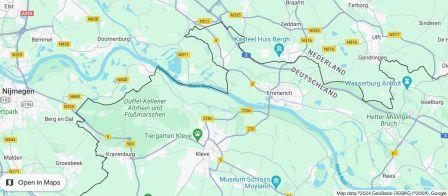
Map shows Emmerich, Germany located on the Rhine River. Allied troops had to cross the river in amphibious vehicles.  (Map source: Google maps)

The Regiment was informed that they were to take part in Operation Veritable. (See https://en.wikipedia.org/wiki/Operation_Veritable) After leaving Nijmegen in The Netherlands, they reached Kellen, Germany near Kleve, just on the other side of the border with The Netherlands, on February 12, 1945. 

On February 14, using amphibious vehicles, the North Novies made their way towards Emmerich.   The war diary for that day reported that “….we have been given the job of taking out the triangle formed by the road running southwest … and the canal running south east….

Three Companies were involved. …The attack is to be made across the river which has overflowed its banks and now forms a barrier over 200 yards wide. Buffaloes are to be used for the attack

The action began at noon, with ‘C’ Company on the left, and ‘A’ Company on the right of the road.  “… ‘B’ Company, which arrived late at the rendezvous, set out at 12:10 hours with their axis along the main road…

The war diary entry continued, explaining that “…the assault companies landed on the shore with terrific fire support from field and medium artillery, plus the machine guns of the Buffaloes…

The attack, which ended at 6:15 pm,  was ultimately successful, but “…our total number of casualties for today’s action was 3 killed and 8 wounded, including Major J. W. Campbell, commanding ‘B’ Company, who was killed…”  Both ‘B’ and ‘C’ Companies had been heavily mortared during the day.

….Weston is buried in Groesbeek…

Weston was initially buried in a churchyard in Warbeyen, Germany, located halfway between Emmerich and Kleve, before being reburied in the Canadian War Cemetery in Groesbeek, The Netherlands.  He was 28 years old and had been married just over a month.

CIMG9018 Sep 16 2017 Groesbeek Cemetery grave of JW Campbell from Daria

Grave of John ‘Weston’ Campbell in the Canadian War Cemetery in Groesbeek, The Netherlands.  (Photo credit: Daria Valkenburg)

Seven years after we placed flags at his grave, we finally know John ‘Weston’ Campbell’s story! If you have photos or information to share, please email Pieter at memorialtrail@gmail.com, or comment on the blog.

© Daria Valkenburg

….Want to follow our research?….

If you are reading this posting, but aren’t following our research, you are welcome to do so.  Our blog address: https://onthewarmemorialtrail.com/

Front cover OnTheWarMememorialTrailinEurope4 countries, 6 weeks, 7,000 km – an unforgettable war memorial journey in Europe…. Daria’s book ‘No Soldier Buried Overseas Should Ever Be Forgotten‘ is available in print and e-book formats.  Net proceeds of book sales help support research costs and the cost of maintaining this blog. For more information see https://nosoldierforgotten.com/ 

You are also invited to subscribe to our YouTube Channel: On The War Memorial Trail With Pieter Valkenburg: https://www.youtube.com/channel/UCJ591TyjSheOR-Cb_Gs_5Kw

Never miss a posting!  Subscribe below to have each new story from the war memorial trail delivered to your inbox.
On The War Memorial Trail….. D-Day Commemoration at Borden-Carleton Legion – June 6, 2024

Screenshot 2024-05-28 at 10-34-30 D-Day 80th Anniversary Banner Decoration - 1.2m

June 19, 2024.  June 6, 2024 marked the 80th anniversary of Operation Overlord (the larger Normandy invasion) and Operation Neptune (the English Channel-crossing portion of Operation Overlord) – what we refer to as D-Day.  

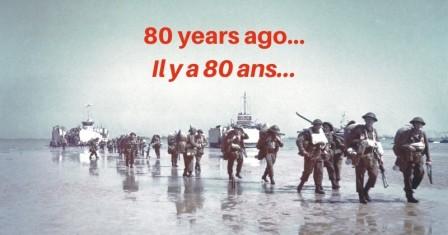
….80 years ago, Canadians landed on Juno Beach….

DDay 80 Newsletter - 3

On June 6, 1944, 14,000 Canadians and 7,000 Brits landed on Juno Beach. (Photo source: 2023 Juno Beach Centre Association (Canada))

An excerpt from the Juno Beach Centre Association (Canada) noted that “between 7:45-8:15 am, units from the 3rd Canadian Infantry Division, supported by tanks of the 2nd Canadian Armoured Brigade, launched attacks along an eight-kilometre stretch of beach between Saint-Aubin and Graye-sur-Mer.

Despite the heavily entrenched enemy, the Canadians overcame the German defences and started inland. By evening, a Canadian bridgehead had been solidly established on the coast of Normandy. So started the Battle of Normandy….

….The Borden-Carleton Legion commemorated the anniversary….

On June 6, 2024, members of the Borden-Carleton Legion gathered by the Cenotaph to commemorate the 80th anniversary of D-Day.  It was duly noted that two of the Legion veterans present had been born BEFORE June 6, 1944! 

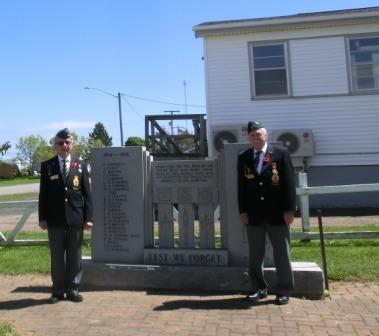
CIMG6855 Jun 6 2024 2 veterans Pieter & George Palmer Borden Carleton Legion

Two veterans from the Borden-Carleton Legion, Pieter Valkenburg (left) and George Palmer (right), were born BEFORE D-Day on June 6, 1944! (Photo credit: Daria Valkenburg)


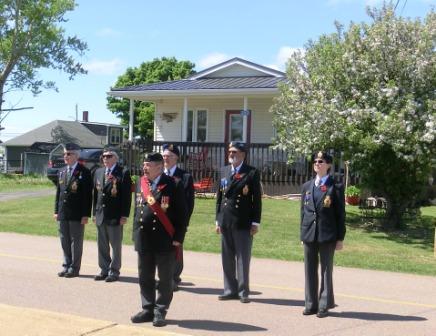
CIMG6856 Jun 6 2024 Parade lineup Borden Carleton Legion

Members of the Borden-Carleton Legion lined up for the 80th Commemoration of the D-Day landings.  Front: Sgt At Arms Mario Henry.  Back, left to right: Pieter Valkenburg, George Palmer, Barry Bernard, Danny Bernard, Trish Taylor.  (Photo credit: Daria Valkenburg)


CIMG6861 Jun 6 2024 Wreath at Cenotaph Borden Carleton Legion

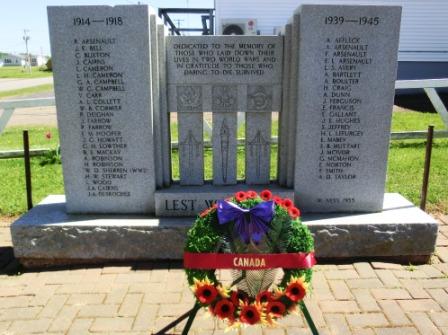
The Cenotaph outside the Borden-Carleton Legion after the laying of the wreath to honour the servicemen who were at D-Day on June 6, 1944.  (Photo credit: Daria Valkenburg)

….More information about D-Day….

Missed an earlier posting on the 80th anniversary of D-Day?  See https://onthewarmemorialtrail.com/2024/06/01/on-the-war-memorial-trail-commemorating-the-80th-anniversary-of-d-day/

Want to know more about D-Day?  Follow the photos and text  in ‘D-Day: The story of 24 hours that changed the world’ at https://news.sky.com/story/d-day-the-story-of-24-hours-that-changed-the-world-11732907

Do you have photos or information to share? Email Pieter at memorialtrail@gmail.com, or comment on the blog.

© Daria Valkenburg

….Want to follow our research?….

If you are reading this posting, but aren’t following our research, you are welcome to do so.  Our blog address: https://onthewarmemorialtrail.com/

Front cover OnTheWarMememorialTrailinEurope4 countries, 6 weeks, 7,000 km – an unforgettable war memorial journey in Europe…. Daria’s book ‘No Soldier Buried Overseas Should Ever Be Forgotten‘ is available in print and e-book formats.  Net proceeds of book sales help support research costs and the cost of maintaining this blog. For more information see https://nosoldierforgotten.com/ 

You are also invited to subscribe to our YouTube Channel: On The War Memorial Trail With Pieter Valkenburg: https://www.youtube.com/channel/UCJ591TyjSheOR-Cb_Gs_5Kw

Never miss a posting!  Subscribe below to have each new story from the war memorial trail delivered to your inbox.
On The War Memorial Trail….. Commemorating The 80th Anniversary Of D-Day

Screenshot 2024-05-28 at 10-34-30 D-Day 80th Anniversary Banner Decoration - 1.2m

June 1, 2024.  June 6, 2024 marks the 80th anniversary of Operation Overlord (the larger Normandy invasion) and Operation Neptune (the English Channel-crossing portion of Operation Overlord) – what we refer to as D-Day.

….What does D-Day mean?….

Did you know that the ‘D’ in D-Day was a military codeword referring to ‘Departure Day’?  U.S. General Dwight D. Eisenhower, Supreme Commander of the Allied Expeditionary Force in Europe,  noted, through his executive assistant, Brigadier General Robert Schultz: “Be advised that any amphibious operation has a ‘departed date;’ therefore the shortened term ‘D-Day’ is used….

While there were several other D-Days during the war, the invasion of Normandy was the biggest and most well-known. 

…..D-Day was an international effort….

Most people consider D-Day to have been solely a joint British, Canadian, and American effort.  However, it’s important to recognize that over 2 million troops from over 12 countries were in Britain in preparation for the invasion. While Allied forces consisted mainly of American, British, and Canadian troops, smaller contingents included Australian, Belgian, Czech, Dutch, French, Greek, New Zealand, Norwegian, Rhodesian, and Polish naval, air, or ground support!

Dday Invasion-map

D-Day invasion map. The Canadians landed on Juno Beach in Normandy, France. (Map source: https://www.ddaylepe.org.uk/index.php/overlord-neptune/)

On the morning of D-Day, ground troops landed across five assault beaches –Juno, Sword, Gold, Utah, and Omaha.  Canadian soldiers landed at Juno on the outskirts of Bernières.  British forces landed at Sword and Gold, while the Americans landed at Utah and Omaha.

Want to know a bit more about D-Day?  See https://news.sky.com/story/eleven-things-you-might-not-know-about-d-day-13132330  My favourite tidbit is how Hitler slept through the D-Day landings.  Even after he woke up in the late morning he believed it was just a diversionary tactic – and so no reserve troops were immediately sent to Normandy!

….11 servicemen who survived D-Day have been featured on this blog….

Over the past years, we have featured stories of 11 servicemen who were present in Normandy on June 6, 1944. All survived D-Day, but only 1 survived WWII and returned home – Airman Lorne MACFARLANE flew a night mission that coincided with the early morning hours of D-Day and realized afterwards what a lucky escape he and his crew had.  “Our mission was completed.   As we crossed the Channel on the way back, we could see through breaks in the cloud, the wakes of hundreds of ships…” heading towards the French coast.  You can read Lorne’s story here:  https://onthewarmemorialtrail.com/2021/10/20/on-the-war-memorial-trail-the-ww2-pilot-from-pei-who-flew-40-missions-overseas-and-returned-home/

The other 10 are buried in a Canadian War Cemetery in France, The Netherlands, or Belgium.  These men are:

….The actions of D-Day helped shorten WWII….

For a very brief overview of the significance of D-Day, watch this 3 minute CTV video prepared for the 75th anniversary:

….Upcoming Event at the Borden-Carleton Legion….

To commemorate the 80th anniversary of D-Day, the Borden-Carleton Legion will have a wreath laying ceremony by the Cenotaph at 3:00 pm on June 6, 2024.  Pieter and I will be there. All are welcome to attend in honour of those who fought on that day.  The wreath laying ceremony will be followed by a light lunch of hamburgers and hot dogs.

Do you have photos or information to share? Email Pieter at memorialtrail@gmail.com, or comment on the blog.

© Daria Valkenburg

….Want to follow our research?….

If you are reading this posting, but aren’t following our research, you are welcome to do so.  Our blog address: https://onthewarmemorialtrail.com/

Front cover OnTheWarMememorialTrailinEurope4 countries, 6 weeks, 7,000 km – an unforgettable war memorial journey in Europe…. Daria’s book ‘No Soldier Buried Overseas Should Ever Be Forgotten‘ is available in print and e-book formats.  Net proceeds of book sales help support research costs and the cost of maintaining this blog. For more information see https://nosoldierforgotten.com/ 

You are also invited to subscribe to our YouTube Channel: On The War Memorial Trail With Pieter Valkenburg: https://www.youtube.com/channel/UCJ591TyjSheOR-Cb_Gs_5Kw

Never miss a posting!  Subscribe below to have each new story from the war memorial trail delivered to your inbox.
On The War Memorial Trail….. The WWII Signalman From Charlottetown Whose Jeep Ran Over A Mine 6 Days Before The War Ended

May 29, 2024.  This is the 10th year that Pieter has been helping researchers at the Canadian War Cemetery in Holten, The Netherlands to find photos of soldiers buried there.  He began with a list of soldiers who were from Prince Edward Island. It wasn’t until a year later that newspaper articles were published with stories related to Pieter’s research, and three years before this blog began in 2017.   Since then, the scope of his ‘little research project’ has expanded several times to include soldiers from across Canada and several cemeteries.

Back in 2014, Pieter was initially sent a list of 9 names, one of which was Maurice James HUGHES, who was born December 19, 1919 in Charlottetown, Prince Edward Island, the son of James M. and Nora (nee Gallant) Hughes.  

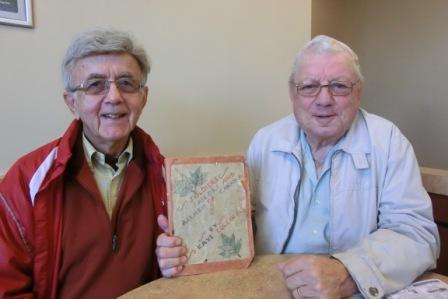
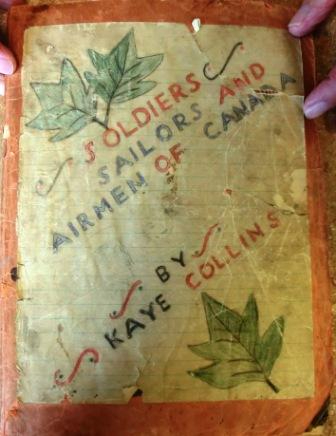
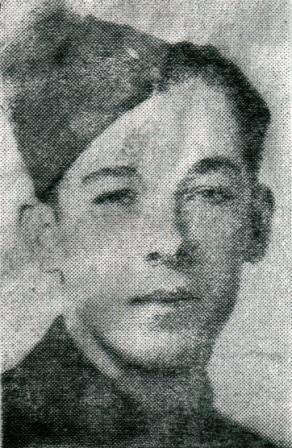
In the search for a photo of Maurice, Pieter ran into one stumbling block after another. He’d found family members, but none ever responded to inquiries.  Then, in the fall of 2019, we met with Ray Arsenault, a member of the Royal Canadian Legion in Charlottetown, who brought a scrapbook he’d received from a friend, Kaye Collins, which contained photos and articles about soldiers from the newspaper.  In a moment of serendipity that happens all too rarely, there was a photo of Maurice! 

CIMG3147 Sep 13 2019 Pieter with Ray Arsenault

Pieter with Ray Arsenault and the scrapbook in which a photo of Maurice James Hughes was found. (Photo credit: Daria Valkenburg)

CIMG3149 Sep 13 2019 Cover of Ray Arsenault notebook

The scrapbook collated by Kaye Collins that contained a picture of Maurice James Hughes. (Photo credit: Daria Valkenburg)

Maurice James Hughes newspaper article from Ray Arsenault

Picture of Maurice James Hughes found in the scrapbook collated by Kaye Collins.

…In 2023 a family member contacted us….

Four years after receiving the photo from Ray Arsenault, Pieter received an email from Lisa Hughes Bell: “… I recently read an article about you, regarding a face for every grave. My Great-Uncle was buried at the Holten Cemetery …. His name was Maurice J. Hughes from Charlottetown….” 

Lisa included a similar photo to what we’d already received.  After acknowledging her email, we received another email.  “…I really don’t know much about Maurice, but am really excited about doing research to find out as much as I can. My Grandfather (Maurice’s brother Frank) was in the Navy and really didn’t talk much about the war. We always knew that he never got over losing his big brother.…” 

As so often happens when family learns that a soldier died so close to the end of WWII, Lisa noted that “…there has always been a sadness in our family about Maurice because he died May 2, 1945, so close to coming home….”  She ended by saying that the family “….would be pleased if you did a story on Maurice…”  Since Maurice’s story had not yet been told on this blog, we decided to do so.

….Maurice was a signalman….

According to a May 10, 1945 obituary in The Guardian, he had been “…a popular member of the Maritime Electric’s staff…” as an assistant fireman before enlisting for active service as a signalman with the No. 6 District Signals, Royal Canadian Corps of Signals (RCCS) in Charlottetown on October 28, 1939. 

A signalman was a specialist responsible for military communications, doing works such as radio or telephone operators, laying cables for communications, and relaying messages for field commanders at the front line.

Before joining the active service, Maurice had joined the No. 6 District Signals militia on May 17, 1937 in Charlottetown. 

After completing his basic training, Maurice was sent to Halifax, Nova Scotia.  Then, on June 16, 1940, he was transferred to No. 3 Canadian Infantry Division, Signals.

On July 5, 1940, he reported for duty at Barriefield Camp in Kingston, Ontario. This was the home of the Royal Canadian Corps of Signals.  NOTE: As of 1966, Barriefield Camp was renamed Canadian Forces Base Kingston (CFB Kingston).

Next, Maurice was sent to Sussex Camp, New Brunswick for training as a linesman on October 15, 1940, and qualified as a Tradesman Group C Linesman on February 25, 1941.

Then, in preparation for overseas service, Maurice was assigned to No. 1 Training Brigade in Debert, Nova Scotia on July 5, 1941.

…Maurice left Canada for overseas service – including D-Day….

On July 19, 1941, Maurice and his Regiment left Canada from Halifax, Nova Scotia, arriving in Avonmouth in the United Kingdom on July 31, 1941.  His training continued, as extensive preparations began for Operation Overlord (the larger Normandy invasion) and Operation Neptune (the English Channel-crossing portion of Operation Overlord) on June 6, 1944 – what we know today as D-Day.

Assigned to the 3rd Canadian Infantry Division, the role of the Signal Corps was to ensure smooth communications on that fateful day. (See https://www.veterans.gc.ca/en/remembrance/history/second-world-war/normandy-1944)

Dday Invasion-map

D-Day invasion map. The Canadians landed on Juno Beach in Normandy, France. (Map source: https://www.ddaylepe.org.uk/index.php/overlord-neptune/)

…Maurice was recommended for a Military Medal for an incident that happened on D-Day….

No mention was made of what Maurice encountered during the day, but just before midnight on June 6, 1944, Maurice and two other signalmen, E. W. MARTIN and J. D. MCPHEE, were near Banville, when they encountered German soldiers.  Lt. (later Captain) J. W. GROSS reported that as the 3 men were ….returning from 7 Canadian Infantry Brigade Headquarters to 12 Canadian Field Regiment with a line, they were 1 ½ miles from our exchange and making a crossing at a crossroads…

They’d encountered sniper fire all night, so Martin was in a ditch, covering the other two with a Bren gun.  Suddenly, “… a German soldier walked out from a side road….” and surrendered.  Unfortunately, a German officer also stepped out and began shooting at Maurice and McPhee, which ended when Martin opened fire.

Then, “....a German Major came up….” and told them that his whole company, part of the 11th Grenadier Regiment, wanted to surrender.   As the Germans “.…came up they handed over their arms and were searched by the three linesmen…”  Within 15 minutes they had 60 prisoners of war.

This was not the end!   “… About 20 minutes later two Canadian officers came upon the scene and joined the three linesmen…” as the contingent, except for Maurice, moved toward Banville.

Maurice “... stayed at the cross roads and 30 more surrendered to him. He moved them along the road and joined the party….” 

After the prisoners of war were taken to the POW cage on the beach, the linesmen continued their work and finished laying the line!

The three linesmen were recommended for a Military Medal for their actions, but sadly, their bravery and actions in having so many Germans surrender to them was not rewarded.  The recommendation for a Military Medal was not approved. 

….A Canadian Army Newsreel film was taken in The Netherlands….

Following upon the success of D-Day, Maurice and his Regiment were involved in the Allied advance through Northwest Europe.  In The Netherlands, a Canadian Army Newsreel briefly filmed members of the Royal Canadian Corps of Signals (RCCS). Film Source: Library and Archives Canada.  Take a look:

….The Regiment moved into Germany on April 26, 1945….

Screenshot 2024-05-26 at 10-13-08 winschoten - Google Search

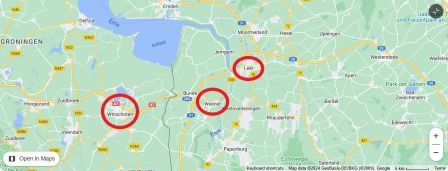
Map shows location of Winschoten, The Netherlands, as well as Weener and Leer in Germany.  (Map source: http://www.google.ca)

In the last week of April 1945, the Regiment prepared to leave The Netherlands. The after-action report on communications in the Regiment’s War Diary noted that after leaving Winschoten, The Netherlands, the “…Divisional Headquarters moved onto Germany on 26 April 1945…” and re-established “…preparatory for the operation to capture Leer….” on April 28, 1945.

In order to have communications available, a “…cable was taken across the River Ems at Weener, one circuit to connect 7 Canadian Infantry Brigade, which was on the opposite side of the river, and one circuit was extended to the bridge site on the river Leda, ready to be extended when 9 Canadian Infantry Brigade crossed into Leer. A line was laid to 16 Field Company RCE and extended on to a point on the Ems where the rafts were being assembled...

….Maurice lost his life near Leer, Germany….

Lt. Colonel George Clarence LEECH, the Commanding Officer of Maurice’s unit, had recorded in his personal notes that Maurice, whose nickname was ‘Maw’, was very well liked and had not only participated in D-Day, but had been in the front line from then until his death on May 2, 1945 when the jeep he was riding in was hit by a mine.

On May 9, 1945, Lt. Colonel LEECH wrote a letter of condolence to Maurice’s mother, saying that “….Cpl Hughes was killed while riding in a jeep with Sgt Nixon on May 2nd when it ran into an enemy mine and blew up.  He did not suffer at all as death was instantaneous….”  Sgt E. C. ‘Nick’ NIXON was seriously wounded, but survived.

Lt. Colonel Leech went on to note that “…Maurice was one of my finest Corporals.  Since enlisting in 1939, he has given everything for the cause which we have been fighting for have at lost won…” Germany had signed an unconditional surrender, ending the war in Europe, on May 8, 1945, just a few days after Maurice lost his life.

.…Maurice is buried in Holten ….

Initial burial in Ihrhove The Coordinate Translator

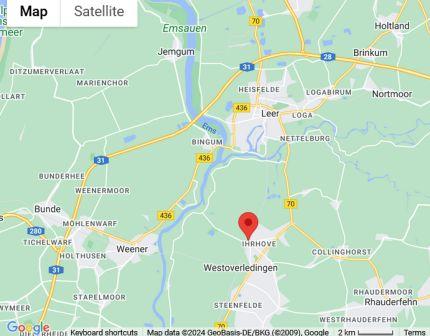
Map shows location of Ihrhove, Germany, where Maurice James Hughes was initially buried.  (Map source: Google)

Maurice was originally buried in a temporary Canadian Military Cemetery in Ihrhove, Germany.  In his letter, Lt Colonel Leech wrote that the “…burial service was conducted by Father McCarney…” and that “….most of the men of his section attended his funeral…

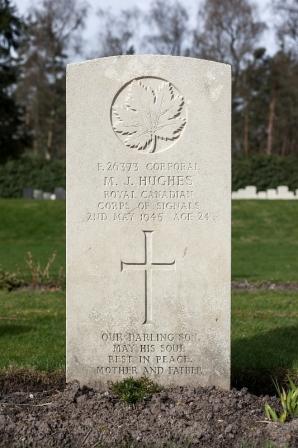
On March 12, 1946, Maurice was reburied in the Canadian War Cemetery in Holten, The Netherlands.

Hughes MJ Maurice James F26373

Grave of Maurice James Hughes in the Canadian War Cemetery in Holten, The Netherlands.  (Photo courtesy of the Canadian Virtual War Memorial)

After the war ended, many Dutch people adopted a soldier’s grave, as a way to give thanks for the sacrifices made by Allied soldiers.  Maurice’s grave was adopted by Mr. J. Schut from Deventer.  In a January 14, 1949 letter to the Department of Defence, he stated that he was 38 years old and asked that his letter be sent to Maurice’s family so they would know that Maurice would not be forgotten.  An abridged English translation of his letter was forwarded to Maurice’s father on February 28, 1949. 

Thank you to Ray Arsenault for providing a photo from the scrapbook collated by Kaye Collins, and to Lisa Hughes Bell for sharing how the family felt about the loss of Maurice. Do you have photos or information to share? Email Pieter at memorialtrail@gmail.com, comment on the blog, or tweet to @researchmemori1.

© Daria Valkenburg

….Want to follow our research?….

If you are reading this posting, but aren’t following our research, you are welcome to do so.  Our blog address: https://onthewarmemorialtrail.com/

Front cover OnTheWarMememorialTrailinEurope4 countries, 6 weeks, 7,000 km – an unforgettable war memorial journey in Europe…. Daria’s book ‘No Soldier Buried Overseas Should Ever Be Forgotten‘ is available in print and e-book formats.  Net proceeds of book sales help support research costs and the cost of maintaining this blog. For more information see https://nosoldierforgotten.com/ 

You are also invited to subscribe to our YouTube Channel: On The War Memorial Trail With Pieter Valkenburg: https://www.youtube.com/channel/UCJ591TyjSheOR-Cb_Gs_5Kw

Never miss a posting! Subscribe below to have each new story from the war memorial trail delivered to your inbox.