On The War Memorial Trail…. Remembrance Week 2026 – Visit To National Memorial Arboretum

November 13, 2026. Each year we try to visit one or more war memorials in Canada, and the previous posting featured our visit to the Tryon Cenotaph in Tryon, Prince Edward Island.  (See https://onthewarmemorialtrail.com/2026/11/11/on-the-war-memorial-trailremembrance-week-2026-visit-to-tryon-cenotaph/)

In this Remembrance Week 2026 posting, we feature a visit made by a British friend, Gail Wainwright, who lives in Somerset, to the National Memorial Arboretum in Alrewas, near Lichfield, Staffordshire in England. Officially called The Royal British Legion National Remembrance Gardens, but formerly and more commonly known as the National Memorial Arboretum, this arboretum spans 150 acres with 25,000 trees and over 400 military and civilian memorials.
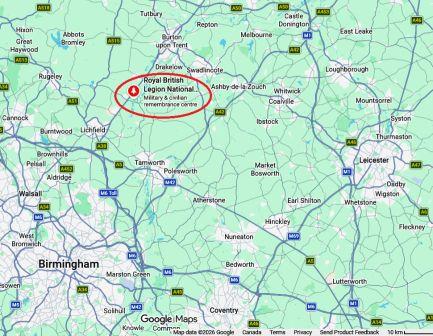
Map shows location of the National Memorial Arboretum near Lichfield.  (Map source: Google Maps)

When Gail mentioned there was an RCAF memorial at the site, and would we be interested in a photo, of course we said yes!  So many Canadians served in Bomber Command or Coastal Command during WWII, either with the Royal Canadian Air Force (RCAF) or Royal Air Force (RAF).

….The RCAF Monument is in the RAF Zone of Memorials….
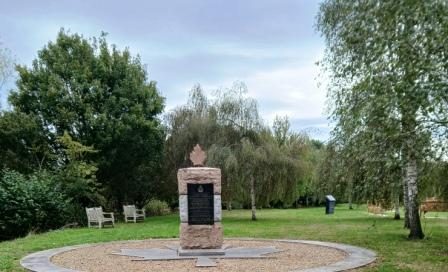
RCAF Monument.  (Photo credit: Gail Wainwright)

Unveiled in July 2011, the RCAF memorial is located in the RAF Zone, and dedicated ‘In honour of those who serve past and present in Canadian and Commonwealth Air Elements.’

The memorial is made of Canadian granite from a quarry near Sturgeon Falls, Ontario, which had been donated by Lafarge Canada. A monolith, created out of red and white granite to represent the Canadian flag, is the centrepiece of the monument. It’s topped by a maple leaf and stands upon a granite maple leaf with a matching granite ring surrounding it; from above this will show Canada’s modern Air Force roundel. The text of the poem ‘High Flight’, written by RCAF pilot Flight Lieutenant John Gillespie Magee, Jr., is inscribed on one side of the monument, with a French translation on another side.

In 2024, during the commemoration of 100 years of service for the Royal Canadian Air Force (RCAF) as a distinct military element, one Remembrance Week posting was dedicated to stories previously told of those who served in the RCAF during WWII. See https://onthewarmemorialtrail.com/2024/11/07/on-the-war-memorial-trail-remembrance-week-2024-remembering-those-who-served-in-the-rcaf-during-wwii/

The 2024 posting mentioned these airmen:

  • Robert ‘Bob’ James DICKIE
  • Rowan Charles ‘Bunky’ FITZGERALD
  • John ‘Hubert’ HALL
  • William Andrew HOOD
  • Arnold Freeman HUPMAN
  • Lorne MACFARLANE
  • Jack ‘Douglas’ MACKENZIE
  • Joseph ‘Joe’ Charles MCIVER
  • George Glenn ‘Dusty’ MILLAR
  • Elmer Bagnall MUTTART
  • Leonard Arthur UNWIN

Since that November 2024 posting, we’ve told more stories about those serving in the RCAF during WWII, including:

….The Armed Forces Memorial includes a statue of a wounded soldier on a stretcher….
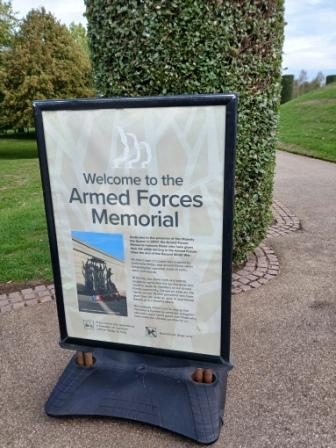
Sign at the entrance to the Armed Forces Memorial.  (Photo credit: Gail Wainwright)

One of the memorials Gail visited was the Armed Forces Memorial, which includes a wall of remembrance and a statue of soldier on a stretcher. She noted that the “…Armed Forces Memorial is large and round, and found in the middle of the arboretum. It recognises and gives thanks to all the people who have died in service since WWII. Since 1948, armed forces have taken part in more than 50 operations and conflicts around the world. There are already 16,000 names on the walls and there is room for another 15,000….”
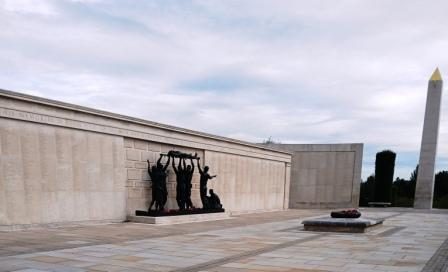
The Armed Forces Memorial has a wall of remembrance with names of those who died in conflicts post-WWII, plus a statue of an injured soldier on a stretcher. (Photo credit: Gail Wainwright)

Gail noted that the monument includes “…a stretcher to show a person injured and their family looking on…”  The purpose of this depiction “…is to show the effect of war on the family….”
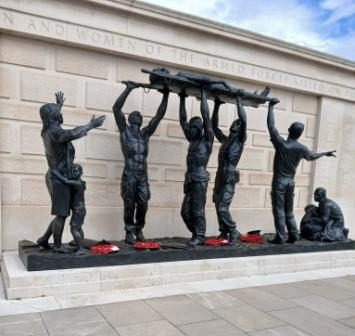
The statue depicts an injured soldier on a stretcher and being carried to safety, while family members look on.  (Photo credit: Gail Wainwright)

The explanation of the stretcher statue sent shivers down my spine!  How thoughtful to include a depiction of the families left behind!

Being a medic, nursing orderly, or a stretcher bearer during WWII was dangerous, and over the years we have told a few stories about those who did not return home:

….The Polar Bear Monument honours British troops based in Iceland during WWII….
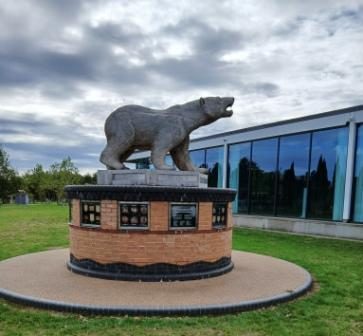
The Polar Bear Monument. (Photo credit: Gail Wainwright)

When Gail included a photo of the Polar Bear Monument, I wondered if it was because of Canada’s participation in WWII.  I was wrong!  Gail explained that she had “…enclosed photos of the Polar Bear monument because everyone likes it and polar bears are in Canada! It was the first monument unveiled at the centre – in June 1998. It is a tribute to the 49th West Riding, Yorkshire, Infantry Division, who were based in Iceland during WWII. They were trapped under deep snow and their Commander called them his polar bears. The bear became their mascot…”

The Polar Bear monument was a great explanation as we recently had done a story about Joseph ‘Joe’ Julius Augustus LAWRENCE, born in L’Ardoise. Nova Scotia, who was supposed to go to Iceland, but just as the men were at the ship in Halifax and ready to board, they were told it was a no-go and that a British regiment would go in their place.   Joe was subsequently killed on October 31, 1944 in The Netherlands during the Battle of Walcheren Causeway.  You can read Joe’s story at  https://onthewarmemorialtrail.com/2026/08/23/on-the-war-memorial-trail-the-wwii-soldier-from-lardoise-who-lost-his-life-during-the-battle-of-walcheren-causeway/​

….Gail reflected on her visit….

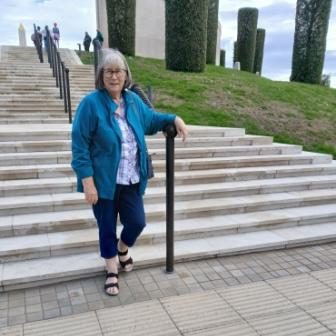
Gail Wainwright on the steps leading to the Armed Forces Memorial (Photo credit: Jackie Stone)

Gail reflected on her visit. “…My thoughts.  It is a large area, with lots of trees that were planted at the beginning, to form an arboretum, using waste land that had been excavated for gravel. 

The memorials are all shapes and sizes, plain and some are beautiful. They all depict the sadness of war, but it gives people somewhere to go and remember their loved ones. It is amazing the number of organisations that have monuments and all the sections belonging to the organisations….”

Gail was quite right about the large number of memorials and monuments.  I had read about two more memorials of interest to us that Gail did not have time to see during her visit: Mediterranean Force of WWII Memorial and Operation Market Garden Memorial.

Thank you to Gail Wainwright for sharing photos of her visit with Jackie Stone to the National Memorial Arboretum in England.

The work of remembrance of those who served continues. If you have a story to tell, please let Pieter know. You can email him at memorialtrail@gmail.com, or comment on the blog.

© Daria Valkenburg

….Want to follow our research?….

If you are reading this posting, but aren’t following our research, you are welcome to do so.  Our blog address: https://onthewarmemorialtrail.com/
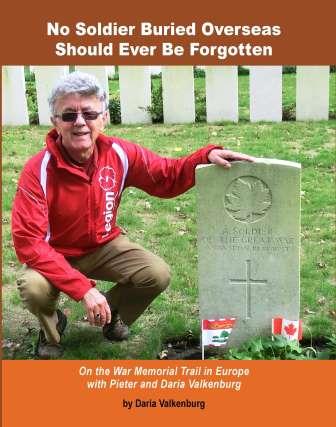
4 countries, 6 weeks, 7,000 km – an unforgettable war memorial journey in Europe…. Daria’s book ‘No Soldier Buried Overseas Should Ever Be Forgotten‘ is available in print and e-book formats.  Net proceeds of book sales help support research costs and the cost of maintaining this blog. For more information see https://nosoldierforgotten.com/

You are also invited to subscribe to our YouTube Channel: On The War Memorial Trail With Pieter Valkenburg: https://www.youtube.com/channel/UCJ591TyjSheOR-Cb_Gs_5Kw.

Never miss a posting!  Subscribe below to have each new story from the war memorial trail delivered to your inbox.
On The War Memorial Trail…..Remembrance Week 2025 – The WWII Nursing Orderly Killed When 3 Tracked Vehicles Exploded Near A Field Dressing Station On Walcheren Island

December 4, 2025.  One of the hardest searches for a photo took several years, and, in spite of dedicated help in looking for family members to contact, newspaper and archive searches, and even a November 10, 2023 article in the Winnipeg Free Press (see a Picture of compassion Winnipeg Free Press Article re John Lewis Hughes Nov 10 2023), we struck out each time.

It was difficult to understand as the soldier in question came from a large family, was married, and had worked for 12 years in a hospital in his hometown. Only one niece responded, saying she remembered that her mother, the soldier’s sister, had a photo, but after she passed away, her effects were put in the basement and were later destroyed in a flood.  We had zero luck with the family of the soldier’s wife, who had remarried.  There was also no response from the local Legion branch, nor from the hospital where he had worked.

Eventually we ran out of leads to contact, and so, although we never gave up the search, we reluctantly put John Lewis HUGHES on our Cold Case List.  (See https://onthewarmemorialtrail.com/our-cold-cases/) 

…. The Winnipeg Free Press article caught the interest of a local historian…...

Shortly after the Winnipeg Free Press article was published, we had been contacted by local historian Judy Gleich.   “…This project is of great interest to me...” she wrote. Her husband is from Eriksdale and “…I was born at E.M. Crowe Memorial Hospital and lived most of my life in the Lundar MB area…”  She explained that, unlike many small communities, “…there was no local paper in Eriksdale at that time….” and so there was no local coverage of soldiers from the area.  Like us, she also contacted someone she knew at the local Legion but no photo was found. 

Judy also told us that “…E.M. Crowe hospital is no longer run locally – but is under the umbrella of the Interlake Eastern Regional Health Authority…which covers about 1/5 of the province….” 

Judy explained why she was interested to help find a photo.  “…When I read the first article by Kevin Rollason and saw that one of the photos Pieter was looking for was of a veteran from Eriksdale– I was interested although I was not familiar with the Hughes family. I made a couple of phone calls and asked a couple of friends and came up with nothing.….”  (NOTE: A short photo appeal had initially been made in the Winnipeg Free Press in November 2022.)

“….After the second article by Kevin Rollason appeared in the Winnipeg Free Press with more information about the Hughes family it piqued my interest again. I figured if someone like Pieter was putting that much effort into this project that I would try to help him….”

…. The photo search led to a hockey photo 2 years after the Winnipeg Free Press article was published…...

Like us, Judy found that “…most of the older Hughes family members had passed on and we were getting nowhere with their families….” 

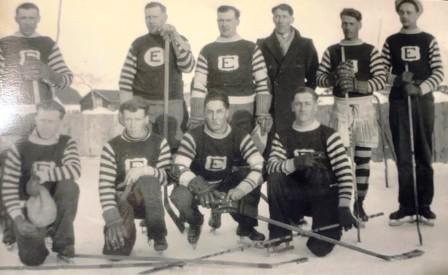
Then, two years later, Judy learned about a 1936 hockey photo.  “… Knowing several of the men on the team I was sure that some of their family members might have the photo…. A few more phone calls and BINGO – success at last….”  It was nothing short of a miracle! 

The man with the photo of the 1936 Eriksdale Hockey Team was John Forsyth, whose father Jim was a member of the team. 

Back Row L-R: Johnnie Mills, Bill Smith, Gordon Smith, Stan Mills, Johnnie Forsyth, Lawrence Whitney. Front Row L-R: Don Goodridge(?), Johnnie Hughes, Murray Cox, Jim Forsyth. (Photo courtesy of the Collection of Jim and Kay Forsyth)


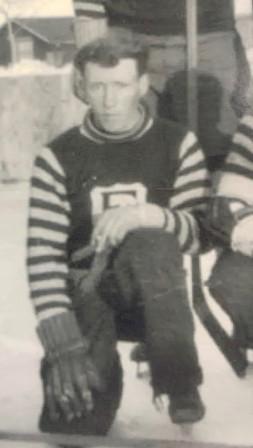
We now knew what John Lewis Hughes looked like! (Photo courtesy of the Collection of Jim and Kay Forsyth)

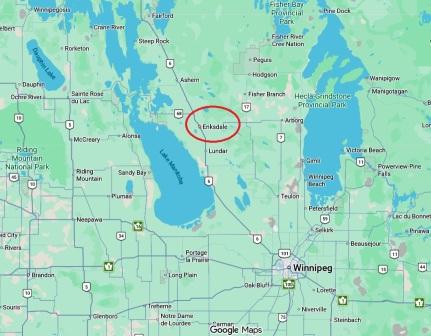
….John was from Eriksdale in Manitoba…

Eriksdale is in the Interlake Region of central Manitoba, near the eastern shore of Lake Manitoba. (Map source: Google maps)

Born January 17, 1916 in Eriksdale, Manitoba, John was the son of Ebenezer George and Ellen (nee Rogan, previously married name Johanson) Hughes.  Both parents came from the United Kingdom – his father in 1911 and his mother in 1914 with two daughters who had been born in Wales.  6 more children were added to the Hughes family, in addition to John – 3 daughters and 3 sons. 

Before enlisting with the No. 3 Field Ambulance of the Royal Canadian Army Medical Corps (RCAMC) on July 5, 1940, John had worked for 12 years as a medical orderly in the E.M. Crowe memorial hospital in Eriksdale.  On June 22, 1940, a few weeks before enlistment, he married Irene Goodwin. 

On October 5, 1940, John was transferred to No. 100 Canadian Militia Training Centre (CMTC) in Portage La Prairie, Manitoba.  He was then assigned to No. 100 Non-Permanent Active Militia (NPAM) Training Centre on November 15, 1940, while still attached to No. 100 CMTC.  (No. 100 CMTC and No. 100 NPAM were re-designated as No. 100 Canadian Army (Basic) Training Centre in February 1941.)

John remained in Portage La Prairie until April 30, 1941, when he was transferred to what the service file termed Fort Osborne Military Hospital, RCAMC, in Winnipeg, Manitoba. This was likely Deer Lodge Military Hospital, as during WWII, Winnipeg’s military hospital function was not at Fort Osborne Barracks, which had moved in 1920. Deer Lodge Military Hospital took over the former hospital facilities from Fort Osborne at that time.

….John left Canada for overseas service….

On June 8, 1941, John was transferred to No. 1 Motor Ambulance Convoy, RCAMC, Active Force, and sent to Camp Shilo, Manitoba for final training before going overseas. 

With other members of his unit, John left Canada for the United Kingdom on June 19, 1941, sailing from Halifax, Nova Scotia, disembarking in Greenock, Scotland on July 2, 1941, before moving on to Sussex, England. 

Per the ‘Official History Of The Canadian Medical Services 1939-1945’, edited by Lt Col Dr W. R. Feasby,  the RCAMC “…..order of battle included not only the medical units of the 1st, 2nd, and 3rd Divisions, and the 1st Army Tank Brigade, but also the following Corps Troops medical units: No. 18 Field Ambulance, No. 5 Field Hygiene Section, Nos. 4 and 5 Casualty Clearing Stations, No. 1 Motor Ambulance Convoy, and No. 1 Advanced Depot Medical Stores….”

The function of No. 1 Motor Ambulance Convoy was to transport wounded from main dressing stations to casualty clearing stations. Transport was by vehicles of the Motor Ambulance Convoy, supplemented by trucks for walking wounded or by railroad when available. 

John and his unit were kept busy with training and in transporting wounded soldiers who arrived in the United Kingdom for treatment. 

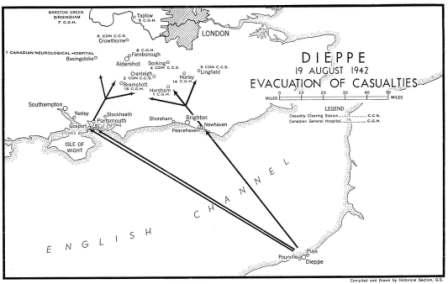
One of the largest operations came following the Dieppe Raid, known as Operation Jubilee, on August 19, 1942, a disastrous Allied amphibious attack on the German-occupied port of Dieppe in northern France, in which 505 Canadian soldiers were wounded and 916 lost their lives. (See https://www.veterans.gc.ca/en/remembrance/military-history/second-world-war/dieppe-raid and https://thecanadianencyclopedia.ca/en/article/dieppe-raid)

Evacuation of casualties from Dieppe to England on August 19, 1942.  (Map source: ‘Official History Of The Canadian Medical Services 1939-1945’)

On the morning of August 19, 1942, the medical units under the 2nd Canadian Division were “… responsible for the reception and evacuation of casualties disembarked in the Portsmouth area, where the bulk of them was expected. Two sections of No. 1 Motor Ambulance Convoy were made available … for the transport of casualties from the Portsmouth area to No. 15 General Hospital at Bramshott, and from the Newhaven-Shoreham area to No. 1 at Horsham and No. 14 at Horley…”

On January 14, 1943, No. 1 Motor Ambulance Convoy, RCAMC, became a unit of the Royal Canadian Army Service Corps (RCASC).

….John was transferred to No. 10 Canadian Field Dressing Station….

On January 21, 1944, John was transferred to No. 10 Canadian Field Dressing Station, and later sent to France, arriving on July 10, 1944, a month after D-Day. As noted in the ‘Official History Of The Canadian Medical Services 1939-1945’ “…with the formation of the 2nd Canadian Corps in France, the medical services were greatly increased. For the coming attack it was decided to constitute a massed medical centre at the Secqueville-en-Bessin area. In addition, No. 6 Canadian Casualty Clearing Station was located at Cazelle, under command of 2nd Canadian Corps, with No. 10 Canadian Field Dressing Station sited alongside….”

The ‘coming attack’ referred to the Battle of the Falaise Pocket (also called Battle of the Falaise Gap), part of the Battle of Normandy, and which was fought between August 12 and 21, 1944. (see https://en.wikipedia.org/wiki/Falaise_pocket)

In addition to a large number of battle casualties from engagement with German troops, a bombing error on August 14, 1944 resulted in more casualties when “… the Royal Air Force and the Royal Canadian Air Force bombed behind our own lines, causing 200 casualties…” placing enormous strain on Casualty Clearing Stations.  “…The bombing casualties arrived in a sudden rush about four o’clock….” making it impossible to find “…shelter for all the wounded…”

In addition to 537 admitted to the Casualty Clearing Stations, “….Nos. 9 and 10 Canadian Field Dressing Stations in the same area admitted 569 and were so rushed that it was necessary to open both No. 6 Canadian Casualty Clearing Station and No. 33 British Casualty Clearing Station at Cazelle where a further 694 casualties were taken for treatment….”

No. 10 Canadian Field Dressing Station, along with other medical units, moved just behind troops as they advanced through France, into Belgium, and then into The Netherlands.  John was very experienced by now and on September 11, 1944, he qualified as a Nursing Orderly ‘C’, which meant he was responsible for initial treatment in the most forward battlefield areas and stretcher-bearing, while working under the direction of medical officers.

…. John’s unit was assigned to British Commandos for an attack on Walcheren Island during the Battle of the Scheldt…...

John Lewis Hughes was killed on Walcheren Island (top left), near Westkappelle, on November 2, 1944.  (Map source: ‘Official History Of The Canadian Medical Services 1939-1945’)

On October 21, 1944, a number of Canadian medical units were “…put under command of the 4th Special Service Brigade….” of the Royal Marines (United Kingdom) “…for training to support the amphibious operation of the brigade….” No. 17 Light Field Ambulance Company, Nos. 8 and 9 Canadian Field Surgical Units, No. 5 Canadian Field Transfusion Unit, and No. 10 Canadian Field Dressing Station were involved.

Operation Infatuate, part of the Battle of the Scheldt, was the codename for the attack on German batteries on Walcheren Island in The Netherlands, located at the mouth of the Scheldt River. German fortification of the island blocked Allied access to the captured port of Antwerp, Belgium. The Belgian port was crucial in order to supply advancing Allied armies as they moved towards Berlin.

“…Training for the operation against Walcheren continued until the end of October when units embarked at Ostend and began to move towards their objective. At three o’clock on the morning of 1 November the flotilla of landing craft sailed out of Ostend harbour….” Ostend is in Belgium.

“…Just before dawn, they met their supporting warships, turned and bore down on Westkapelle. The assault was to be made in daylight on either side of a gap blown in the Westkapelle dyke, and just before “H” hour (9.45 a.m.) the guns of Warspite, Roberts, and Erebus opened up and flights of rocket-firing Typhoon aircraft went to work on the shore batteries….”

In ‘Towards Victory In Europe: The Battle For Walcheren’, J. O. Forfar, Medical Officer, 47 Marine Commando,  explained that “…Commander Pugsley and Brigadier Leicester had been informed on leaving Ostend that due to fog in England the Lancaster bombers which were to carry out a preliminary bombardment of the Walcheren defences while the assaulting craft moved in were grounded…” 

The two men decided to go ahead with the operation, which resulted in high casualties, but the Battle for Walcheren was ultimately successful.  “…The Germans had sown sea mines in the approaches to the island; the beaches were laced with barbed wire, landmines, and covered by machine guns firing from cement pill boxes. Five minutes before they were due to touch down the two landing craft which had been prepared as hospital ships were sunk by mines.  Immediately after this the assault began…” with shelling from cannons at the battery in Dishoek.

“…One section of No. 17 Canadian Light Field Ambulance landed with No. 41 Commando on the left of Westkapelle gap and another section with No. 48 Commando on the right of Westkapelle gap. Of the 25 close support naval craft engaged in the operation only six were left by mid-afternoon, and 172 of those on board had been killed and 210 wounded. Casualties among those who got ashore in the face of stiff enemy resistance were heavy….”  The medical teams had to work in close proximity of the fighting.

…. No. 10 Field Dressing Station set up on the beach on the afternoon of November 1, 1944…...

Beach dressing station of No. 10 Field Dressing Station being set up by personnel of No. 10 Field Dressing Station at Westkapelle. (Photo source: Provincial Archives of Alberta, Donald Carson fonds, PR2011.0001/14)

“…Casualties on the left of the gap were given first aid and collected into a shell hole on the edge of the dyke until Westkapelle was clear, when they were moved into a house in the village. On the other side of the gap the casualty collecting post was set up on the inside of the sea wall, and casualties were held until No. 10 Canadian Field Dressing Station came ashore at 2 pm and set up a beach dressing station….”

Most of those wounded on November 1, 1944 were taken off the Island during the night and returned to No. 6 Canadian Field Dressing Station at Ostend. Meanwhile the medical teams prepared for the next day.

…. John was killed in the afternoon of November 2, 1944 …...

No. 8 Canadian Field Surgical Unit, a medical operation team of around 10 people, was attached to No. 10 Field Dressing Station, and was the field hospital located behind the No. 10 Field Dressing Station. 

The November 2, 1944 War Diary entry for No. 8 Canadian Field Surgical Unit relates what happened when they came ashore with landing tracked vehicles, which the diary writer referred to as Alligators. (See https://en.wikipedia.org/wiki/Landing_Vehicle,_Tracked)  “…The morning of November 2nd dawned bright and clear….About 0900 the Alligators moved to the beach and there we met the rest of our unit.  I was relieved to find in spite of many harrowing experiences they were all quite safe. We off loaded the vehicles onto the beach….The beach head was under intermittent fire but the greatest worry we had was mines…”

Tragedy struck in the early afternoon.  “…A salvo of shells hit 3 Alligators in front of the dugout and the Alligators caught on fire.  Each Alligator had 7 tons of ammunition on board and this all exploded during the next ¾ of an hour. About 20 men were killed, including the Quartermaster and one Other Rank of No. 10 FDS….”  The ‘Other Rank of No. 10 FDS’ was John Lewis Hughes.

Caroline Raaijmakers, Chair of the Faces To Graves Bergen Op Zoom Committee, told us that  “….on the same spot….” where John was killed, “…Doctor Captain Frank Sidney Manktelow was Wounded In Action on 2-11-1944 and he died on 3-11-1944…..” 

Dr. Frank Sidney MANKTELOW, of Pointe aux Trembles, Quebec, son of Frederick Sidney and Mary Jane (nee MacKay) Manktelow, and husband of Laura Francise (nee Quinn) Manktelow, was serving with the Royal Canadian Army Medical Corps when he died, at the age of 30.

Both men were initially buried in a temporary cemetery in Zoutelande on Walcheren Island.

 …. John is buried in the Canadian War Cemetery in Holten…...

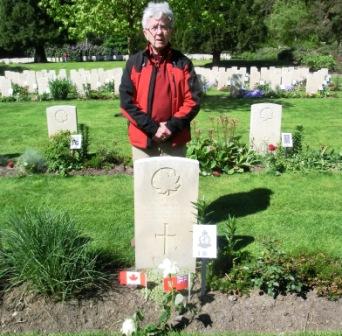
Pieter stands behind the grave of John Lewis Hughes in Holten, The Netherlands.  (Photo credit: Daria Valkenburg)

On September 9, 1946, John was reburied in the Canadian War Cemetery in Holten, The Netherlands.  We visited his grave this spring when we were in The Netherlands for our 2025 European Memorial Tour, and Pieter placed flags of Canada and Manitoba by his grave. His was one of 383 graves in 14 cemeteries that we visited on this trip.

….Hughes Hill in northern Manitoba named in John’s honour…..

Hughes Hill in northern Manitoba was named after John ‘Jack’ Lewis Hughes.  (Map source: Mapcarta)

Hughes Hill in northern Manitoba, northeast of Wither Lake, was named after him in 1995.

….A great deal of research happened before a photo was found…

Many people assume that it’s easy to find family and photos of soldiers who are buried overseas.  Unless you are lucky enough to stumble across someone else’s research, or a media appeal is seen by the right person with a photo, it can be an onerous and long drawn out process.  

The search for a photo of John Lewis Hughes took several years.  Thank you to Judie Klassen for going above and beyond to find family and reference material, to Shawn Rainville for newspaper searches, and to Judy Gleich for continually contacting people from Eriksdale.  Thank you to Robert Catsburg for sending the war diary entry for November 2, 1944 and to both Robert Catsburg and Caroline Raaijmakers for excerpts from Dutch accounts.

Thank you to John Forsyth for the hockey photo that included a photo of John.  And a big thank you to Kevin Rollason of the Winnipeg Free Press for writing the article about the photo search. 

The flags placed at John’s grave were donated.  Our thanks go to: 

  • Alan Waddell, Constituent Assistant, on behalf of Heath MacDonald, MP for Malpeque, for the Canadian flag.
  • Brad Robertson, Chief of Protocol, Government of Manitoba, on behalf of Wab Kinew, Premier of Manitoba, for the Manitoba flag. 

The work of remembrance of those who served continues as do our adventures on the next leg of our 2025 European War Memorial Tour.

If you have a story or photo to share, please contact Pieter at memorialtrail@gmail.com or comment on the blog. 

© Daria Valkenburg

….Want to follow our research?…

If you are reading this posting, but aren’t following our research, you are welcome to do so.  Our blog address: https://onthewarmemorialtrail.com/

4 countries, 6 weeks, 7,000 km – an unforgettable war memorial journey in Europe…. Daria’s book ‘No Soldier Buried Overseas Should Ever Be Forgotten‘ is available in print and e-book formats.  Net proceeds of book sales help support research costs and the cost of maintaining this blog. For more information see https://nosoldierforgotten.com/

Subscribe to our YouTube Channel: On The War Memorial Trail With Pieter Valkenburg: https://www.youtube.com/channel/UCJ591TyjSheOR-Cb_Gs_5Kw. 

Never miss a posting!  Subscribe below to have each new story from the war memorial trail delivered to your inbox.