On The War Memorial Trail…. Struck By Shellfire Part 2 The WWII Lieutenant From Saint John Who Lost His Life Trying To Get A Wounded Gunner To Safety

July 16, 2026.  On February 26, 1945, the lives of three WWII soldiers intersected during the Battle of Keppeln in Germany.   Private Harry BIZNAR, Lt Robert Joseph MARKEY, and Gunner Albert Donald AHLWARDT, all lost their lives when a shell burst near them as Private Biznar and Lt Markey were trying to get a wounded Gunner Ahlwardt to safety in a nearby house.

In Part 1 of Struck By Shellfire, the story of WWII soldier Harry BIZNAR was told.  (See https://onthewarmemorialtrail.com/2026/07/03/on-the-war-memorial-trail-struck-by-shellfire-part-1-the-wwii-soldier-born-to-ukrainian-immigrants-who-lost-his-life-trying-to-get-a-wounded-gunner-to-safety/)

Now, in Part 2, the Struck By Shellfire series continues with Robert ‘Bob’ Joseph MARKEY.

Born November 15, 1919 in Saint John, New Brunswick, Robert was the son of Ernest Thomas and Marion Marguerite ‘Marie’ (nee Nugent) Markey.  He graduated from Grade 11 at St. Vincent Boys’ High School in Saint John, continued on to Saint John High School for Grade 12, and then enrolled in the Nova Scotia Agricultural College in Truro, Nova Scotia in 1939. Winner of the Governor’s Award, 1941, Nova Scotia Agricultural College, he graduated in 1941 with a specialization in bacteriology.

Although Robert had a brother and two sisters, Pieter was unsuccessful in attempts to contact family members.  However, archivists Creighton Barrett and Jennifer MacIsaac of Dalhousie University Libraries uncovered photos and information from the time he was at Nova Scotia Agricultural College, providing a picture of the man behind the soldier’s uniform.

….Robert was involved in student activities…

Robert Markey as a 1941 graduate.  (Photo credit: Agricola Archives, Dalhousie University Archives)

A brief biography in the 1941 graduation issue of the student publication Agricola noted that over the past two years he had “…proven his ability as an all-around student, especially in public speaking and in basketball…

Robert Markey was on the school’s basketball team, pictured here 4th from the left (red arrow) in the 1941 graduation booklet.  (Photo credit: Agricola Archives, Dalhousie University Archives)

Robert, known as ‘Bob’ while a student, was involved in social activities of the College.  “…Being very popular with his classmates, due to his wit and personality, he was elected chairman of the Social Committee for the first term of the year ’41.  Bob also had the honour of being President of the Students’ Council while in his senior year

Robert was also known for being “…quite musical and full of jazz which was proven when he played the ‘Traps’ for the Sawfilers Orchestra at a few of the Saturday night dances…” Traps referred to drums, accompanied with other percussion instruments such as cymbals.

The account on Robert ended by stating that “… his main ambition is to specialize in Animal Husbandry but this coming summer he is joining the RCAF…

….Robert enlisted on Boxing Day 1941 …

Robert never joined the RCAF.  When he enlisted at the No. 7 District Depot’s recruiting office in Saint John, New Brunswick on December 26, 1941, it was noted that he had worked 3 summers at Atlantic Sugar Refinery in Saint John, New Brunswick. Just before enlistment, in the fall of 1941, he worked as an oiler and fireman, as well as a powerhouse technician in the plant where his father was employed as a superintendent.  As a technician, he was responsible for testing the chemical content of water and keeping a log of engine efficiency, among other duties.

He began his basic training at No. 70 Canadian Army (Basic) Training Centre (CABTC) in Fredericton, New Brunswick, but was hospitalized with a bad cold from January 4 until January 20, 1942.  He didn’t return back to No. 70 CA(B)TC until February  6, 1942, at which time he also received a promotion to Lance Corporal.

After completing his training, he was put on staff as an instructor at No. 70 CA(B)TC on May 16, 1942.

….Robert attended No. 30 Officers Training Centre in Brockville …

On September 2, 1942, an interviewer in Fredericton gave his assessment on Robert’s suitability as an Officer Candidate.  He was described as a “….tall, lean, athletic type…” with a “….. pleasant, well-balanced personality...” and “…good leadership qualities, conscientious…”  He had a “…history of commendable personal enterprise...” coupled with an “…above average level of learning ability…” and “…superior knowledge of tools and mechanical principles…”  He was recommended for officer training and to remain in the Infantry as that was what Robert himself preferred.

On October 10, 1942, Robert was sent to No. 30 Officers’ Training Centre in Brockville, Ontario for 12 weeks of intensive training in preparation for going overseas.  His time there would have overlapped with that of John ‘Weston’ CAMPBELL, from Prince Edward Island, who had arrived there in August for his 12 week course. (See https://onthewarmemorialtrail.com/2024/09/30/on-the-war-memorial-trail-the-wwii-soldier-from-clermont-killed-during-operation-veritable/)

After successfully completing his 12 week course, Robert was promoted to Provisional 2nd Lieutenant on January 16, 1943, and then sent for further training to A-17 Machine Gun Training Centre in Trois-Rivières, Quebec, a course that began on January 25, 1943 and ended on March 18, 1943….along with a promotion to Lieutenant.

….Robert was in Kiska as part of Operation Cottage …

On March 20, 1943, Robert was transferred to the 1st Battalion, Saint John Fusiliers (Machine Gun) and sent to Nanaimo, British Columbia. The battalion served in Canada in a home defense role as a part of the 18th Canadian Infantry Brigade which was first part of Pacific Command and then the 6th Canadian Infantry Division.

Summary of Canadian support for Operation Cottage in Kiska, Alaska. (Source: National Defence, National Defense University Press. Seen on the A Canadian Outlook FaceBook page)

On June 16, 1943, Robert was assigned to ‘C’ Company of the Saint John Fusiliers.  On July 12, 1943, he was on ‘special duty’ as part of a planned Canadian support to Kiska, Alaska for the American led Operation Cottage. (See https://en.wikipedia.org/wiki/Operation_Cottage and http://www.canadiansoldiers.com/history/operations/operationcottage.htm)
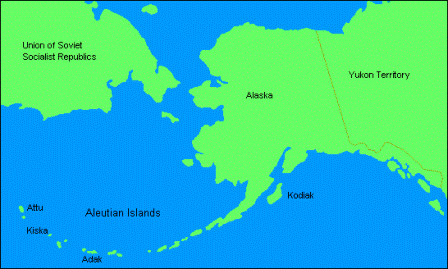
Map showing location of Kiska, part of the Aleutian Islands.  (Map source: http://www.canadiansoldiers.com)

Map source: By of SVG: Kuara – Aleutian Islands, United States Army Center of Military History, CC BY-SA 3.0, https://commons.wikimedia.org/w/index.php?curid=5209745

The intention was to liberate Kiska Island from Japanese forces, which had occupied it since June 7, 1942, after Japan seized Kiska and Attu in Alaska’s Aleutian Islands. However, no one seemed to be aware that the Japanese had left the Island on July 28, 1943, using fog as cover for their escape.

Kiska was unoccupied by the time Allied troops arrived on August 15, 1943, of which ‘C’ Company was a component of the 13th Canadian Infantry Brigade Group.  They were sent into fog, surf, volcanic rock, confusion, and uncertainty. Expecting a brutal fight, the soldiers found the island empty of Japanese troops, but they had left behind reminders of their presence in the form of mines and booby traps.

As noted in Project 44’s Operation Cottage: Invasion of Kiska Island: “…Despite the lack of Japanese soldiers, there still were American and Canadian casualties. Some were wounded and killed in friendly fire as nervous soldiers fired into the fog amongst the confusion. Others were wounded and killed by enemy mines, booby-traps, and explosive ordinance left on the island. The Canadians sustained eight casualties, four dead and four wounded…” (See https://www.project44.ca/kiska)

While the Americans left Kiska by September 1, 1943, the Canadians remained for over 3 months longer.

C.P. Stacey’s ‘Official History of the Canadian Army in the Second World War: Volume I: Six Years of War: Canada, Britain and the Pacific’ recorded that troops lived “in ‘winterized’ tents, and engaged in road and pier construction, transport fatigues, building and manning defences, and carrying on such training as conditions permitted. Fog, rain and wind made the island an acutely unpleasant residence, and the troops were heartily glad when the withdrawal to British Columbia began in November 1943. The last shipload of Canadians left Kiska on 12 January 1944…. 

Robert returned to Canada on January 3, 1944, and given 30 days leave, from January 6 until February 4, 1944.  ‘C’ Company disbanded on January 31, 1944, and when Robert returned to duty, he was assigned back to the 1st Battalion, Saint John Fusiliers (Machine Gun).

….Two soldiers whose stories have been told were also in Kiska …

…Robert was sent for more training…

On February 11, 1944, Robert was sent for two courses at the S-17 Canadian School Of Infantry in Vernon, British Columbia.  He began with a Junior Battle Wing Course. 10 days later, however, he was admitted to Vernon Military Hospital for 16 days with pneumonitis, an inflammation of lung tissue, typically caused by inhaling airborne irritants. (See https://my.clevelandclinic.org/health/diseases/24810-pneumonitis)

After completing the Junior Battle Wing Course, Robert next undertook a 4.2 Mortar Battle Wing course at S-11 Canadian Chemical Warfare School (CCWS) in Suffield, Alberta, which ran from April 16 to April 29, 1944.

….Robert qualified as a Driver for a flamethrower…

While in Suffield Robert took specialized carrier-driver training for a flamethrower-equipped variant of a Universal Carrier, qualifying as Driver i/c Class III (MC) on June 23, 1944.  (The term ‘Driver i/c’ refers to ‘Driver, internal combustion’.  Class III meant he was qualified to drive heavy trucks and armoured cars, but not tanks. MC meant he was also a qualified Motorcycle Despatch Rider.)

A June 16, 1944 Officers’ Survey report described Robert as …a very good officer.  A good leader. Has the confidence of all…” and noted that he “…speaks clearly and concisely….” with a   “…self-composed manner and confident approach. Has a strong personality.  Makes friends easily…

Robert was keen to go overseas, and the report stated that he had “…volunteered for the British Army.  Passed but not taken…”  It went on to say that he “…now has special authority to go overseas with some forty or fifty men including his own Platoon who have volunteered to go active on the understanding he will go with them.  This is a fulfillment of his wishes….” (NOTE: No mention was ever made if this happened when Robert ultimately left Canada for overseas service.)

On June 29, 1944, Robert returned to the S-17 Canadian School Of Infantry in Vernon, British Columbia for an Officers Refresher course, taken between July 1 and August 18, 1944.

The August 19, 1944 course assessment for the Junior Battle Wing Course noted that “…his knowledge and application of tactics was good. He has ability as a leader. His knowledge and handling of weapons were quite good….” but that “…at times he appeared disinterested and did not always put as much into the work as he could give…” The final comment was that with more experience, Robert would be “…a capable platoon commander…

The August 19, 1944 assessment for the Mortar Battle Wing course was positive. “…This officer was interested and enthusiastic.  He has quite a sound knowledge of the weapon and its tactical employment…” The final comment was that with further field experience, Robert “…should make a good mortar platoon commander…

….Robert left Canada for overseas service…

Robert Joseph Markey. (Photo source: Canadian Virtual War Memorial. Photo restoration by Pieter Valkenburg)

From August 20 until August 26, 1944, Robert was granted embarkation leave, for what turned out to be the last time he saw his family.

On August 27, 1944, Robert reported to No. 1 Training Brigade in Debert, Nova Scotia, for final training and preparation before going overseas.  The Brigade was a final staging point for troops waiting to cross the Atlantic Ocean.

On September 7, 1944, Robert boarded a ship that left the following day from Halifax, Nova Scotia, arriving in the United Kingdom on September 20, 1944. He was placed with No. 4 Canadian Infantry Reinforcement Unit (CIRU).

A few weeks later, on October 23, 1944, Robert was sent to No. 3 Wing (Weapons) Canadian Training School (CTS) for a Canadian Military Headquarters (CMHQ) Conversion Course at the Canadian Army Battle Drill School in Stansted Park in Rowland’s Castle, Hampshire, England. The 42 day course trained officers and NCOs to standardize infantry and joint-force tactics before deployment.  After successfully completing the course, he returned to No. 4 CIRU, which had been re-designated at No. 3 CIRU, on December 2, 1944.

….Robert joined the Lincoln & Welland Regiment……

On January 11, 1945, Robert was transferred to the 13th Battalion’s X-4 Reinforcement List of the Canadian Infantry Corps (CIC).  The following day he left for North West Europe, arriving on January 12, 1945.

On January 29, 1945, Robert was transferred to the Lincoln & Welland Regiment as a Platoon Officer in ‘C’ Company, joining them in the midst of Operation Elephant, also known as the Battle of Kapelsche Veer, a brutal and freezing battle to clear German paratroopers from Kapelsche Veer, a low-lying, water-logged island north of the Maas River in The Netherlands.

NOTE: Eli Ambrose SNAKE, whose story was previously told, had lost his life in the battle. (See https://onthewarmemorialtrail.com/2021/12/13/on-the-war-memorial-trail-remembering-ww2-soldier-eli-ambrose-snake/)

Robert had survived his first active battle, and continued with the Regiment as they moved into Germany.

….Robert lost his life during the Battle of Keppeln…

Map shows location (green circle) where the Lincoln & Welland Regiment was in support of the 4th Canadian Armoured Division during the Battle of Keppeln  on February 26, 1945. (Map source:  Project 44)

On February 26, 1945, the Regiment was involved in the Battle of Keppeln, with the objective of breaking the German Siegfried Line during Operation Blockbuster, the last part of Operation Veritable. (See https://en.wikipedia.org/wiki/Operation_Blockbuster) Troops encountered heavy artillery and mortar fire in intense fighting from German paratroopers, and had to make their way through heavy mud and minefields.

The war diary for February 26, 1945 noted the orders given for the battle.  The 4th Canadian Armoured Brigade, which the Lincoln & Welland Regiment was part of, “….was divided into five forces….”  ‘A’ and ‘C’ Companies of the Regiment were part of ‘JERRY FORCE’.

Movement began at 6 am, but “…the route from the area at KLEVE to the concentration area was through mud fields and was extremely heavy going for all vehicles. Heavy vehicles bogged down in the mud….

By 9 am, “… JERRY FORCE moved into the attack passing through 2 Canadian Infantry Division….

The battle finally ended when Canadian troops used flame-throwing Wasp carriers to clear German-held houses in Keppeln. The village needed to be secured as part of a push towards Uedem. The capture of Keppeln allowed Canadian forces to clear the Kalkar Ridge and proceed towards the Hochwald Forest gap, and later to break through to the Rhine.  Unfortunately, Robert did not live to see the end of this battle….

….What happened?…

Lance Corporal John SYMCHYCH stated in an official report that on February 26, 1945, the platoon that Robert commanded was tasked with defending a house located 9.1 metres (30 feet) from a slit trench.  Visibility was poor due to smoke from machine gun and rifle fire.  One Ram carrier had been struck by shell fire and burned, and a gunner, later identified as Albert Donald AHLWARDT of the 6th Anti-Tank Regiment, Royal Canadian Artillery, had been slightly wounded and evacuated to the slit trench that L/Cpl Symchych was in.

Around 2 pm, “…Pte Biznar and Lt Markey pulled the driver of the Ram carrier out of L/Cpl Symchych’s slit trench and were taking him to the house 15 yards away.  A shell lit four or five feet away from the three of them while L/Cpl Symchych was still in his slit trench.  L/Cpl Symchych crawled to the house and remained in the house until relieved by RHLI Regiment between the hours of three or four o’clock of the morning of February 27th. The bodies of the three men were still there when L/Cpl Symchych returned to his slit trench for his equipment…” NOTE: RHLI refers to Royal Hamilton Light Infantry Regiment.

Robert, aged 26, lost his life on that afternoon of February 26, 1945, as he and Pte Harry Biznar tried to move Gunner Alwardt to safety.

NOTE: For an idea of some of the places that the Regiment travelled through in Germany, see https://onthewarmemorialtrail.com/2026/02/06/on-the-war-memorial-trail-we-follow-the-route-taken-into-germany-by-canadian-troops-in-1945/

….Robert is buried in Groesbeek…

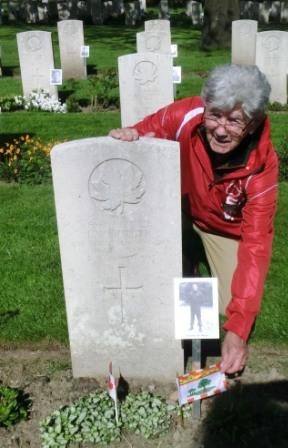
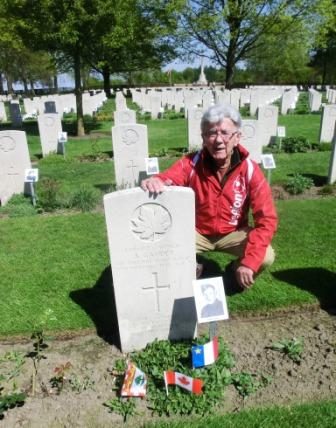
Pieter placed Canadian and New Brunswick flags at the grave of Robert Joseph Markey. (Photo credit: Daria Valkenburg)

Robert was initially buried in Keppeln, Germany before being reburied on February 25, 1946 in the Canadian War Cemetery in Groesbeek, The Netherlands. During our 2025 European War Memorial Tour, Pieter placed Canadian and New Brunswick flags by his grave.

Thank you to Jennifer MacIsaac and Creighton Barrett of Dalhousie University Libraries for finding photos of Lt Markey while he was at Nova Scotia Agricultural College.

The flags placed at Robert’s grave during our 2025 European War Memorial Tour were donated.  Our thanks go to:

  • Alan Waddell, Constituent Assistant, on behalf of Heath MacDonald, MP for Malpeque, for the Canadian flag.
  • Jean-Claude D’Amours, MLA for Edmundston-Madawaska Centre, Minister responsible for Military Affairs, with the help of Cécile LePage, Province of New Brunswick, for the New Brunswick flag.

…. to be continued…..

Coming up in Struck By Shellfire Part 3 will be about Albert Donald AHLWARDT of Olds, Alberta.

Pieter’s research efforts to find photos and families of soldiers continue. Do you have a story to tell? Email Pieter at memorialtrail@gmail.com, or comment on the blog.

© Daria Valkenburg

….Want to follow our research?…

If you are reading this posting, but aren’t following our research, you are welcome to do so.  Our blog address: https://onthewarmemorialtrail.com/
4 countries, 6 weeks, 7,000 km – an unforgettable war memorial journey in Europe…. Daria’s book ‘No Soldier Buried Overseas Should Ever Be Forgotten‘ is available in print and e-book formats.  Net proceeds of book sales help support research costs and the cost of maintaining this blog. For more information see https://nosoldierforgotten.com/

Subscribe to our YouTube Channel: On The War Memorial Trail With Pieter Valkenburg: https://www.youtube.com/channel/UCJ591TyjSheOR-Cb_Gs_5Kw.

Never miss a posting!  Subscribe below to have each new story from the war memorial trail delivered to your inbox.
On The War Memorial Trail….2025 Faces of Groesbeek Exhibition Part 2: The Soldiers From Prince Edward Island

June 26, 2025. The 2025 Faces Of Groesbeek Exhibition, which ran from April 26 to May 18, 2025 at the Canadian War Cemetery in Groesbeek, featured photos of soldiers that were placed by their graves. Photos are printed onto an aluminum backing, making them impervious to rain, and reusable. This year, 80% of the graves had a photo of the soldier.

The many volunteers from Faces To Graves Foundation Groesbeek, of which Alice van Bekkum is the Chair, worked tirelessly to make this exhibition possible.  They also organized the Liberation Day commemoration events. 

Pieter has been involved in finding photos of Canadians who are buried in all three Canadian War Cemeteries in The Netherlands since 2014, with many of their stories told on this blog. 

We were in The Netherlands and Belgium for the 80th Anniversary of Liberation Commemoration events, and placed flags at the graves of 383 soldiers in 14 cemeteries. 120 of the graves visited were in the Canadian War Cemetery in Groesbeek alone, including the graves of 17 soldiers from Prince Edward Island. (See https://onthewarmemorialtrail.com/2025/06/23/on-the-war-memorial-trail-2025-faces-of-groesbeek-exhibition-part-1-flags-placed-at-120-graves/)

5 Soldiers From Prince Edward Island Commemorated…

In Part 1, an overview of our day of flag placing at 120 graves was provided.  Now, in Part 2, the graves and photos of five soldiers from Prince Edward Island, whose stories have previously been told, are featured.

Pieter by the grave of Lawrence William Bulger.  (Photo credit: Daria Valkenburg)

Lawrence William BULGER from Portage was serving with the North Nova Scotia Highlanders when he was killed during the Battle of Bienen in Germany on March 25, 1945. He was one of several stretcher bearers who lost their lives that day, killed by machine gun fire while attending to the wounded on the battlefield.  You can read his story at https://onthewarmemorialtrail.com/2024/08/19/on-the-war-memorial-trail-the-bulger-brothers-part-2-the-wwii-stretcher-bearer-from-foxley-river-killed-during-the-battle-of-bienen/

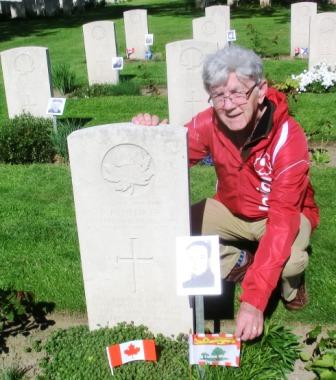
Grave of John ‘Weston’ Campbell.  (Photo credit: Daria Valkenburg)

John ‘Weston’ CAMPBELL from Clermont was killed while in command of ‘B’ Company of the North Nova Scotia Highlanders during Operation Veritable in Germany on February 14, 1945. You can read his story at https://onthewarmemorialtrail.com/2024/09/30/on-the-war-memorial-trail-the-wwii-soldier-from-clermont-killed-during-operation-veritable/

Pieter by the grave of Arthur Gaudet.  (Photo credit: Daria Valkenburg)

Arthur GAUDET from 5 Pointe, near Mount Carmel, was wounded during Operation Blockbuster in Germany on February 26, 1945, while serving with Les Fusiliers Mont-Royal, and died later that day.  He was two days short of his 21st birthday!  You can read his story at https://onthewarmemorialtrail.com/2025/02/12/on-the-war-memorial-trail-the-wwii-soldier-from-prince-edward-island-who-lost-his-life-in-germany-two-days-before-his-21st-birthday/

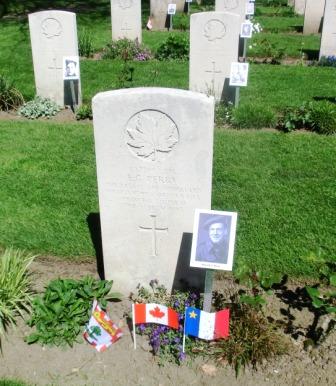
Grave of Edward Gabriel Perry.  (Photo credit: Daria Valkenburg)

Edward Gabriel PERRY from St Nicholas lost his life after being fatally wounded during the Battle of Hochwald Gap in Germany on March 1, 1945, while serving with the Argyll & Sutherland Highlanders (Princess Louise’s).  He was rushed to hospital but died in the early morning of March 2, 1945. You can read his story at https://onthewarmemorialtrail.com/2024/07/06/on-the-war-memorial-trail-the-wwii-soldier-from-st-nicholas-who-lost-his-life-during-the-battle-of-hochwald-gap/

Pieter by the grave of Ralph Kenneth Silliker.  (Photo credit: Daria Valkenburg)

Ralph Kenneth SILLIKER from O’Leary was killed in action during Operation Churchill in Germany on March 2, 1945, while serving with the Lake Superior Regiment (Motor).  He was killed as his Kangaroo (armoured personnel carrier) tried to lunge across an enemy trench. You can read his story at https://onthewarmemorialtrail.com/2024/04/18/on-the-war-memorial-trail-the-wwii-soldier-from-oleary-who-lost-his-life-during-operation-churchill/

….All of the flags placed at graves were donated…

All of the flags placed at graves were donated.  For the flags placed at the graves of Islanders, our thanks go to:  Alan Waddell, Constituent Assistant, on behalf of Heath MacDonald, MP for Malpeque, for the Canadian flags. PEI flags were provided by Matt MacFarlane, MLA for District 19, Borden-Kinkora.  La Société acadienne de Clare in Nova Scotia donated Acadian flags.

May we never forget the sacrifices made by these soldiers.  Perhaps all of the known graves of Canadians buried in Groesbeek will have a photo displayed by their grave at the next Faces Of Groesbeek Exhibition in 2027.

In Part 3, the graves and photos of soldiers from Alberta, Manitoba, and Quebec, whose stories have previously been told, will be featured.

If you have a photo of a soldier buried at the Canadian War Cemetery in Groesbeek or one of the other cemeteries in The Netherlands, Pieter encourages you to email him at memorialtrail@gmail.com, or comment on the blog.

….Want to follow our research?…

If you are reading this posting, but aren’t following our research, you are welcome to do so.  Our blog address: https://onthewarmemorialtrail.com/

4 countries, 6 weeks, 7,000 km – an unforgettable war memorial journey in Europe…. Daria’s book ‘No Soldier Buried Overseas Should Ever Be Forgotten‘ is available in print and e-book formats.  Net proceeds of book sales help support research costs and the cost of maintaining this blog. For more information see https://nosoldierforgotten.com/

Subscribe to our YouTube Channel: On The War Memorial Trail With Pieter Valkenburg: https://www.youtube.com/channel/UCJ591TyjSheOR-Cb_Gs_5Kw

Never miss a posting!  Subscribe below to have each new story from the war memorial trail delivered to your inbox.
On The War Memorial Trail….. The WWII Soldier From Clermont Killed During Operation Veritable

September 30, 2024. When you visit a Canadian War Cemetery and place down a flag by a soldier’s grave, it stays with you, and makes you wonder about the person who is buried there.  Before our first war memorial tour in 2017, Pieter asked the Canadian War Cemeteries in The Netherlands for a list of soldiers from Prince Edward Island who are buried there, and we made sure to place flags at their graves.

Screenshot 2024-09-30 at 09-15-25 Clermont - Google Maps

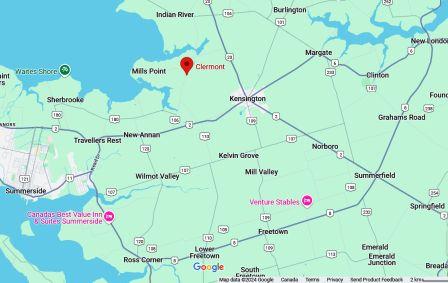
Clermont is located in Prince County, Prince Edward Island.  (Map source: Google)

Over the years, Pieter has researched many of the soldiers from Prince Edward Island who are buried in The Netherlands, and he continues to do so. One of these WWII soldiers was John ‘Weston’ CAMPBELL, born May 29, 1916 in Clermont, Prince Edward Island, the son of Archibald Joseph and Lavinia Helen (nee Brennan) Campbell.  

brant

C.G.S. Brant in Charlottetown around 1930.  (Photo source: https://sailstrait.wordpress.com)

Weston’s father was Captain of the Canadian Government Ship ‘Brant’, a buoy and lighthouse tender that operated from the Charlottetown Marine Wharf.  The family also operated a farm, and Weston worked there after leaving school upon completing Grade 10.

On June 29, 1937, Weston joined the 1st Battalion of the Prince Edward Island Highlanders Militia, before enlisting in active service with the Regiment on October 3, 1939. His basic training was taken in Charlottetown, Prince Edward Island, and Dartmouth, Nova Scotia. (See https://en.wikipedia.org/wiki/Prince_Edward_Island_Highlanders)

….Weston was transferred to the North Nova Scotia Highlanders…

Weston was promoted to Corporal and then Acting Sergeant by the time he was transferred to the North Nova Scotia Highlanders, 3rd Division, on June 20, 1940, and joined them at their headquarters in Amherst, Nova Scotia.  Training in preparation for overseas service continued.

According to his Personnel Selection Record, Weston played hockey, soccer, baseball, and softball.  His brother Vernon was a Chief Petty Officer in the Canadian Navy.  He had 4 sisters and 1 other brother.  The interviewer described Weston as…sturdy, good-looking, well-balanced, with keen pride in regiment….

CAMPBELL John Weston

John ‘Weston’ Campbell as a Sergeant.  (Photo courtesy of North Nova Scotia Highlanders Museum)

On July 5, 1941 he was promoted to Sergeant, just as the Regiment moved to Debert, Nova Scotia for final preparations before going overseas.  InNo Retreating Footsteps by Will Bird, he noted that “…the 3rd Division units were moving to Debert….Word came that the North Novas would be included in the 9th Highland Brigade along with the Highland Light Infantry and the Stormont, Dundas and Glengarry Highlanders

….Weston left Canada for England….

On July 19, 1941, Weston and his Regiment left Halifax, Nova Scotia aboard the Orion, arriving in Avonmouth, England on July 29, 1941.  Two days later, they were allowed to disembark and left by train for Aldershot, where…the North Novas arrived at Albuhera Barracks

He continued to train and take courses, and then was transferred to the No. 1 Non-Effective Transit Depot (NETD) on July 7, 1942Tweedsmuir Camp in Surrey, near the village of Thursley, was set up as Number One Transit Depot for handling thousands of medical and psychological cases during WWII.  

It was also used as a base for returning Canadian and American troops, and that appears to be why Weston was there, as shortly after his arrival he was sent back to Canada, arriving on July 29, 1942.  The following day he was assigned to No. 6 District Depot in Halifax, Nova Scotia, for a short period.

….Weston returned to Canada for officer training….

On August 14, 1942, Weston was sent to the No. 30 Officers Training Centre in Brockville, Ontario for training. After successfully completing his 12 week course on November 7, 1942, he was recommended for promotion and appointment to the rank of 2nd Lieutenant.

With his new officers’ rank, he was transferred to the A-14 Canadian Infantry Training Centre in Camp Aldershot, Nova Scotia on November 13, 1942.  He was sent for additional training to the A25 Canadian Army Small Arms Training Centre (CSATC) in Long Branch, Ontario from November 14 to December 12, 1942, after which he was promoted to Lieutenant.

On January 9, 1943, Weston was transferred to No. 61 Canadian Army (Basic) Training Centre in New Glasgow, Nova Scotia for additional training, before returning to A-14 Canadian Infantry Training Centre in Camp Aldershot on April 14, 1943.

….Weston left Canada again for overseas service….

On June 19, 1943, Weston left Canada for overseas service.  After arriving in the United Kingdom on June 24, 1943, he was assigned to No. 7 Canadian Infantry Reinforcement Unit (CIRU).   He arrived there just as a fellow Islander, Harold ‘Hal’ Gabriel BULGER, whose story was previously told, was transferred to the Princess Louise Fusiliers.  (See https://onthewarmemorialtrail.com/2024/08/05/on-the-war-memorial-trail-the-bulger-brothers-part-i-the-wwii-soldier-from-foxley-river-killed-during-the-battle-of-moerbrugge/)

On July 29, 1943, Weston returned to the North Nova Scotia Highlanders, who were still in the United Kingdom. Training and exercises continued, as extensive preparations began for Operation Overlord (the larger Normandy invasion) and Operation Neptune (the English Channel-crossing portion of Operation Overlord) on June 6, 1944 – what we know today as D-Day.

InNo Retreating Footsteps by Will Bird, he recorded that among “…the officers selected to land in France on D Day with the North Novas….” was Lt. J.W. Campbell who would be leading an anti-tank platoon.

…Weston survived D-Day….

The North Nova Scotia Highlanders left England for Normandy, France on June 6, 1944, after waiting in place in the English Channel on landing craft earlier.   The war diary for Sunday, June 4, 1944 noted that “…we are tied up with two other landing craft tank.   The Padre is on one, so he had a church service at 10:30 hours on the quarter deck of the middle craft…

On June 5, 1944 the war diary recorded that “…at 14:00 hours the flotilla moved out to the open sea and formed up with the other craft taking part in the invasion…

After landing on the beaches of Normandy on June 6, 1944, as part of the 9th Infantry Brigade, 3rd Canadian Infantry Division, 21st Army Group, the war diary noted that the Regiment had 10 casualties that day– 4 killed, 6 wounded. 

Weston had survived D-Day and received a promotion to Acting Captain on June 22, 1944. The Regiment continued to fight in North-West Europe, including the Battle of the Scheldt, which began October 2, 1944. (See https://en.wikipedia.org/wiki/Battle_of_the_Scheldt)  Weston was confirmed as Captain on October 4, 1944.

On December 19, 1944, he was promoted again.  The war diary entry for that day reported that “…Captain J. W. Campbell was made Acting Major today, and is to command ‘B’ Company…

On January 10, 1945, while on leave in the United Kingdom, he married Mary Margaret Taylor in Sheffield, Yorkshire, England. 

He returned to the Regiment on January 15, 1945 and the war diary entry for that day recorded that “…the battalion officers held a party for Major J. W. Campbell who has just returned from his privilege leave to the United Kingdom.  It appears that he was married during this leave….

….Weston lost his life during Operation Veritable…

Screenshot 2024-09-30 at 11-09-38 emmerich germany - Google Search

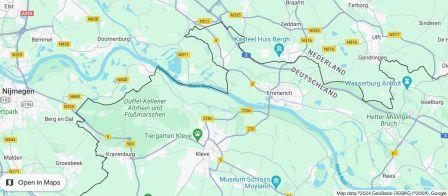
Map shows Emmerich, Germany located on the Rhine River. Allied troops had to cross the river in amphibious vehicles.  (Map source: Google maps)

The Regiment was informed that they were to take part in Operation Veritable. (See https://en.wikipedia.org/wiki/Operation_Veritable) After leaving Nijmegen in The Netherlands, they reached Kellen, Germany near Kleve, just on the other side of the border with The Netherlands, on February 12, 1945. 

On February 14, using amphibious vehicles, the North Novies made their way towards Emmerich.   The war diary for that day reported that “….we have been given the job of taking out the triangle formed by the road running southwest … and the canal running south east….

Three Companies were involved. …The attack is to be made across the river which has overflowed its banks and now forms a barrier over 200 yards wide. Buffaloes are to be used for the attack

The action began at noon, with ‘C’ Company on the left, and ‘A’ Company on the right of the road.  “… ‘B’ Company, which arrived late at the rendezvous, set out at 12:10 hours with their axis along the main road…

The war diary entry continued, explaining that “…the assault companies landed on the shore with terrific fire support from field and medium artillery, plus the machine guns of the Buffaloes…

The attack, which ended at 6:15 pm,  was ultimately successful, but “…our total number of casualties for today’s action was 3 killed and 8 wounded, including Major J. W. Campbell, commanding ‘B’ Company, who was killed…”  Both ‘B’ and ‘C’ Companies had been heavily mortared during the day.

….Weston is buried in Groesbeek…

Weston was initially buried in a churchyard in Warbeyen, Germany, located halfway between Emmerich and Kleve, before being reburied in the Canadian War Cemetery in Groesbeek, The Netherlands.  He was 28 years old and had been married just over a month.

CIMG9018 Sep 16 2017 Groesbeek Cemetery grave of JW Campbell from Daria

Grave of John ‘Weston’ Campbell in the Canadian War Cemetery in Groesbeek, The Netherlands.  (Photo credit: Daria Valkenburg)

Seven years after we placed flags at his grave, we finally know John ‘Weston’ Campbell’s story! If you have photos or information to share, please email Pieter at memorialtrail@gmail.com, or comment on the blog.

© Daria Valkenburg

….Want to follow our research?….

If you are reading this posting, but aren’t following our research, you are welcome to do so.  Our blog address: https://onthewarmemorialtrail.com/

Front cover OnTheWarMememorialTrailinEurope4 countries, 6 weeks, 7,000 km – an unforgettable war memorial journey in Europe…. Daria’s book ‘No Soldier Buried Overseas Should Ever Be Forgotten‘ is available in print and e-book formats.  Net proceeds of book sales help support research costs and the cost of maintaining this blog. For more information see https://nosoldierforgotten.com/ 

You are also invited to subscribe to our YouTube Channel: On The War Memorial Trail With Pieter Valkenburg: https://www.youtube.com/channel/UCJ591TyjSheOR-Cb_Gs_5Kw

Never miss a posting!  Subscribe below to have each new story from the war memorial trail delivered to your inbox.

On The War Memorial Trail…..Our 2019 Visit To The Canadian War Cemetery In Groesbeek

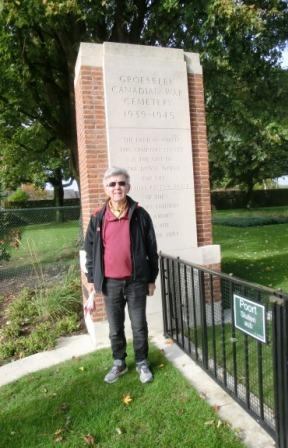
December 4, 2019.  While in The Netherlands this fall, we visited the three Canadian War Cemeteries and laid down flags of Canada and PEI for the names listed on the Cenotaph outside the Borden-Carleton Legion, as well as other Islanders who have been identified by Dutch researchers. The second Canadian War Cemetery we visited on the 2019 trip was in Groesbeek.  (See On the War Memorial Trail ….. At The Canadian War Cemetery in Groesbeek and On the War Memorial Trail ….. PEI Soldiers Buried In The Canadian War Cemetery in Groesbeek for accounts of our 2017 visit.)

CIMG3371 Oct 5 2019 Groesbeek

Pieter at the entrance to Groesbeek Canadian War Cemetery.  (Photo credit: Daria Valkenburg)

We visited the cemetery on a rare sunny and dry day during our time in The Netherlands…. it rained 19 out of 21 days! We hadn’t been as lucky when we went to Holten!  (See On The War Memorial Trail…..Our 2019 Visit To The Canadian War Cemetery In Holten)

As in 2017, we were joined by Pieter’s former colleague in the Dutch Foreign Service, Ad Scheepers, and his wife Noor, who live in Groesbeek.  Pieter and Ad served together in New Delhi and both are passionate in their gratitude to the Allied troops that liberated The Netherlands during WWII.

cimg3321-oct-5-2019-groesbeek-william-weatherbie.jpg

Pieter with Noor and Ad Scheepers by the grave of William Weatherbie.  (Photo credit: Daria Valkenburg)

Since our 2017 visit, no additional names of soldiers from PEI have been uncovered, so we placed flags at the graves of the same 17 Islanders.  Unlike in 2017, however, photos of several of these soldiers have now been provided by family members.  In alphabetical order, here are the known soldiers from PEI that are buried in the cemetery:

  • L/Cpl Ralph Schurman BOULTER, North Nova Scotia Highlanders, from West Point
  • Pte Lawrence BULGER, North Nova Scotia Highlanders, from Foxley River
  • Major John Weston CAMPBELL, North Nova Scotia Highlanders, from Clermont
  • Cpl Preston D. CAMPBELL, Algonquin Regiment, from Coleman
  • Rifleman William Alfred CANNON, Regina Rifle Regiment, from Pownal
  • Cpl Arthur GAUDET, Les Fusiliers Mont-Royal, from Mont Carmel
  • Sapper Joseph Edmond HENNEBERY, Corps of Royal Canadian Engineers, from Morrell
  • Cpl George Ivan MACKINNON, North Nova Scotia Highlanders, from Mt. Albion
  • Cpl Robert Bruce MACNEILLL, North Nova Scotia Highlanders, from Charlottetown
  • Pte Barney Ruben MCGUIGAN, North Shore Regiment, born in Souris
  • Cpl Stephen A. MCKINNON, Royal Hamilton Light Infantry, from St. Peter’s Bay
  • L/Cpl Edward Gabriel PERRY, Argyll & Sutherland Highlanders of Canada (Princess Louise), from St. Nicholas
  • Pte John Clifford ROGERS, North Shore Regiment, born in Hope River
  • Pte Ralph K. SILLIKER, Lake Superior Regiment, from O’Leary
  • Sgt Edison Alexander SMITH, North Nova Scotia Highlanders, from West Point
  • Pte George Preston SMITH, North Shore Regiment, from Kinkora
  • Pte William L. WEATHERBIE, Royal Regiment of Canada, from Charlottetown

We also placed a Canadian flag at the grave of one soldier from New Brunswick, the uncle of our neighbour Brenda Graves:

  • L/Cpl Frank Edward MCGOVERN, North Shore Regiment, born in Chipman

Photos have still not been found for:

  1. Joseph E. HENNEBERY, born in Morell, who died on April 20, 1945. (UPDATE: Photo has been found)
  2. Barney Ruben MCGUIGAN, born in St. Peter’s, son of Thomas and Sadie McGuigan, who died on February 26, 1945. (UPDATE: Photo has been found)
  3. Frank Edward MCGOVERN, born in Chipman, who died on February 26, 1945.

After placing the flags, we met with Alice van Bekkum and her husband Leendert at De Oude Molen (The Old Windmill) cafe.  Alice is the Chair of the Faces To Graves Project in The Netherlands, which is trying to find a photo for every Canadian soldier buried in one of the Dutch cemeteries for a digital archive.

CIMG3374 Oct 5 2019 Groesbeek De Oude Molen

At De Oude Molen, left to right: Ad Scheepers, Leendert van Bekkum, Alice van Bekkum, Pieter Valkenburg, Daria Valkenburg, Noor Scheepers.

During the 75th Anniversary of the Liberation of The Netherlands commemoration in May 2020, the Canadian War Cemetery in Groesbeek has received permission from the Commonwealth War Graves Commission to place photos of Canadian soldiers by their gravestones for two weeks.  Pieter is trying to ensure all of the Island soldiers have a photo, but as you can see above, there are 2 Islanders without photos, plus one from New Brunswick.

Thank you to Ad and Noor Scheepers for joining us on the memorial trail at the Canadian War Cemetery in Groesbeek!  If anyone has more information to share on any of the soldiers listed above, or know of more Islanders buried in the cemetery in Groesbeek, please contact Pieter at memorialtrail@gmail.com, comment on the blog, or tweet to @researchmemori1.    

© Daria Valkenburg

…Want to follow our research?…

If you are reading this posting, but aren’t following our research, you are welcome to do so.  Our blog address: https://onthewarmemorialtrail.com/

Front cover OnTheWarMememorialTrailinEurope4 countries, 6 weeks, 7,000 km – an unforgettable war memorial journey in Europe…. Daria’s book ‘No Soldier Buried Overseas Should Ever Be Forgotten‘ is available in print and e-book formats.  Net proceeds of book sales help support research costs and the cost of maintaining this blog. For more information see https://nosoldierforgotten.com/

Subscribe to our YouTube Channel: On The War Memorial Trail With Pieter Valkenburg: https://www.youtube.com/channel/UCJ591TyjSheOR-Cb_Gs_5Kw

Never miss a posting!  Subscribe below to have each new story from the war memorial trail delivered to your inbox.
On the War Memorial Trail ….. PEI Soldiers Buried In The Canadian War Cemetery in Groesbeek

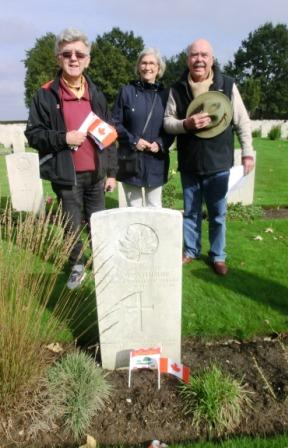
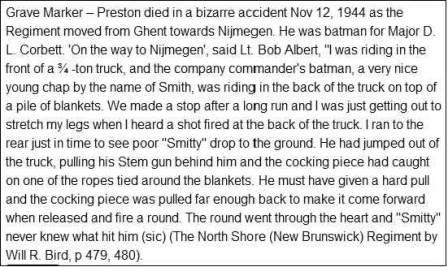
December 30, 2017.  During our first visit to the Canadian War Cemetery in Groesbeek in The Netherlands, we were able to place flags at the graves of three PEI soldiers buried there.  In the last blog entry we told the story of George Preston SMITH of Kinkora, who was with the North Shore (New Brunswick) Regiment, and the accident in which he lost his life. (See On the War Memorial Trail ….. At The Canadian War Cemetery in Groesbeek)

Our thanks to Alice van Bekkum of the Faces to Graves Project, who shared an eye witness account that was recorded by Will Bird in his 1963 book about the North Shore (New Brunswick) Regiment. (See https://books.google.com/books/about North_Shore_New_Brunswick_Regiment.html?id=Iz7WAAAAMAAJ)

Will Bird account of what happened to George Preston Smith

Excerpt about George Preston Smith from Will Bird’s book about The North Shore (New Brunswick) Regiment.

Before returning to place flags at the rest of the known soldiers from PEI, we stopped by a memorial marking the route on February 8, 1945 where soldiers marched into Germany on their way from Groesbeek, as part of Operation Veritable.  This was the northern part of an Allied pincer movement that took place between February 8 and March 11, 1945 during the final stages of the Second World War.

The operation was conducted by Field Marshal Bernard Montgomery’s Anglo-Canadian 21st Army Group, primarily consisting of the First Canadian Army under Lieutenant-General Harry Crerar and the British XXX Corps under Lieutenant-General Brian Horrocks. Their objective was to clear German forces from the area between the Rhine and Maas rivers, east of the German/Dutch frontier, in the Rhineland.

CIMG8998 Sep 15 2017 Pieter by memorial showis where soldiers marched into Germany from Groesbeek operation veritable

Pieter at the memorial for Operation Veritable in Groesbeek. (Photo credit: Daria Valkenburg)

CIMG8996 Sep 15 2017 memorial shows where soldiers marched into Germany from Groesbeek operation veritable

Close-up view of the text on the memorial for Operation Veritable in Groesbeek. (Photo credit: Pieter Valkenburg)

On our second visit to the Canadian War Cemetery in Groesbeek we were joined by Pieter’s former colleague in the Dutch Foreign Service, Ad Scheepers, and his wife Noor, who live in Groesbeek.

CIMG9023 Sep 16 2017 Groesbeek Cemetery Ad & Noor Scheepers with Pieter by Gaudets grave

Ad and Noor Scheepers with Pieter by the grave of Cpl Arthur Gaudet. (Photo credit: Daria Valkenburg)

Ad was a fountain of information about the cemetery, and noted that it was along the Liberation Route, which one can take to visit the many monuments and memorials in this part of The Netherlands.  The cemetery, on a road called Zeven Heuvelenweg (Seven Hills Way), is the largest war cemetery of the Commonwealth Graves Commission in The Netherlands.

Most of the soldiers buried here fell during the fighting on the Lower Rhine between February 8 and March 26, 1945.  It’s called the Canadian War Cemetery and we’d always assumed all of the burials were Canadian, but it’s not true.  By number and nationality, the 2,617 soldiers buried here are from:

  • 2,399 from Canada
  • 267 from Great Britain
  • 3 from Belgium
  • 2 from Poland
  • 2 from Australia
  • 1 from New Zealand
  • 1 from Russia
  • 1 from Yugoslavia
  • 1 from The Netherlands

Inscribed on the Groesbeek Memorial in the cemetery are the names of 1,103 soldiers reported missing in action between August 1944 and May 1945. Only a few have been identified since the memorial was put up. Unfortunately, most are still listed as MIA (Missing In Action).

Ad told us he’d read that the Cross of Sacrifice in the cemetery was positioned where it was so it could be clearly seen from Germany, a stone’s throw away from the border.  It’s likely true, as one prerequisite that Canadian Officers had in selecting land for the cemetery was to have a view of Germany.

In a Dutch reference we read that construction on the cemetery began in 1945 by six Canadian soldiers. The location of the cemetery, on a hilltop, was chosen by Groesbeek Mayor Grotenhuis van Onstein for its view on the German border from the cemetery. The Cemetery was officially opened on May 4, 1947 by the Dutch Queen Wilhelmina. When the cemetery opened, the headstones were made from wood, as was the Cross of Sacrifice.  Later, the headstones were temporarily replaced by metal versions, and beginning in 1950 the headstones and Cross of Sacrifice were replaced by stone designs.

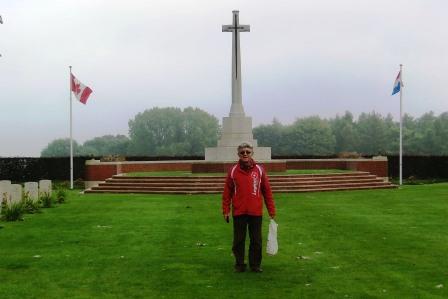
CIMG8945 Sep 15 2017 Groesbeek cemetery Pieter at Cross for remembrance

Pieter by the Cross of Sacrifice at the Canadian War Cemetery in Groesbeek. (Photo credit: Daria Valkenburg)

In alphabetical order, here are the known soldiers from PEI that are buried in the cemetery:

  • L/Cpl Ralph Schurman BOULTER, North Nova Scotia Highlanders, from West Point
  • Pte Lawrence BULGER, North Nova Scotia Highlanders, from Foxley River
  • Major John Weston CAMPBELL, North Nova Scotia Highlanders, from Clermont
  • Cpl Preston D. CAMPBELL, Algonquin Regiment, from Coleman
  • Rifleman William Alfred CANNON, Regina Rifle Regiment, from Pownal
  • Cpl Arthur GAUDET, Les Fusiliers Mont-Royal, from Mont Carmel
  • Sapper Joseph Edmond HENNEBERY, Corps of Royal Canadian Engineers, from Morrell
  • Cpl George Ivan MACKINNON, North Nova Scotia Highlanders, from Mt. Albion
  • Cpl Robert Bruce MACNEILLL, North Nova Scotia Highlanders, from Charlottetown
  • Pte Barney R. MCGUIGAN, North Shore (New Brunswick) Regiment, born in Souris
  • Cpl Stephen A. MCKINNON, Royal Hamilton Light Infantry, from St. Peter’s Bay
  • L/Cpl Edward Gabriel PERRY, Argyll & Sutherland Highlanders of Canada (Princess Louise), from St. Nicholas
  • Pte John Clifford ROGERS, North Shore (New Brunswick) Regiment, born in Hope River
  • Pte Ralph K. SILLIKER, Lake Superior Regiment, from O’Leary
  • Sgt Edison Alexander SMITH, North Nova Scotia Highlanders, from West Point
  • Pte George Preston SMITH, North Shore Regiment, from Kinkora
  • Pte William L. WEATHERBIE, Royal Regiment of Canada, from Charlottetown

Do you have photos or information on any of these soldiers?  If you know of other soldiers from PEI, please help the researchers at the Faces to Grave project by sharing that information. Photos and stories can be sent either through their website at http://facestograves.nl/index.html or by email to info@facestograves.nl.  Alternatively, you can contact us and we will forward your info for you.

Comments or stories?  You can share them by emailing us at memorialtrail@gmail.com, commenting on the blog, or tweet to @researchmemori1.    

© Daria Valkenburg

…Want to follow our research?…

If you are reading this posting, but aren’t following our research, you are welcome to do so.  Our blog address: https://onthewarmemorialtrail.com/

Front cover OnTheWarMememorialTrailinEurope4 countries, 6 weeks, 7,000 km – an unforgettable war memorial journey in Europe…. Daria’s book ‘No Soldier Buried Overseas Should Ever Be Forgotten‘ is available in print and e-book formats.  Net proceeds of book sales help support research costs and the cost of maintaining this blog. For more information see https://nosoldierforgotten.com/

Subscribe to our YouTube Channel: On The War Memorial Trail With Pieter Valkenburg: https://www.youtube.com/channel/UCJ591TyjSheOR-Cb_Gs_5Kw

Never miss a posting!  Subscribe below to have each new story from the war memorial trail delivered to your inbox.