On The War Memorial Trail….2025 Faces of Holten Exhibition Part 2: The Soldiers Listed On The Cenotaph In Borden-Carleton

Directional sign to the Canadian War Cemetery in Holten, The Netherlands. (Photo credit: Daria Valkenburg)

August 29, 2025.  Pieter has been involved in finding photos of Canadians who are buried in all three Canadian War Cemeteries in The Netherlands since 2014.  He first started with finding photos of soldiers from Prince Edward Island buried in The Netherlands. 

In 2015, he began researching the names of 48 soldiers listed on the Cenotaph outside the Borden-Carleton Legion on Prince Edward Island.  Over the years, all 48 names were identified, each of their stories researched and told on this blog.  For most of the names, families and photos were found, and the Wall of Remembrance is in place at the Legion. 

Cenotaph outside the Borden-Carleton Legion. (Photo credit: Daria Valkenburg)

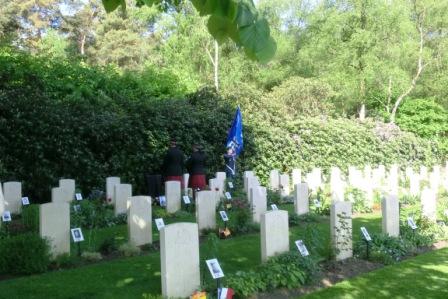
While in The Netherlands and Belgium for the 80th Anniversary of Liberation Commemoration events, he placed flags at the graves of 383 soldiers in 14 cemeteries. At the Canadian War Cemetery in Holten, The Netherlands, flags were placed at 156 graves.

Our visit coincided with The 2025 Faces Of Holten Exhibition, which ran for three weeks in May. Photos were printed onto an aluminum backing, making them impervious to rain, and reusable. Each placard also had a QR code, allowing visitors with cell phones to scan the code and read a brief biography of the soldier.

In Part 1, soldiers who were killed near Posterenk in April 1945 and are buried in the Canadian War Cemetery in Holten, were featured. (See https://onthewarmemorialtrail.com/2025/08/24/on-the-war-memorial-trail-2025-faces-of-holten-exhibition-part-1-soldiers-killed-near-posterenk/)

…2 soldiers listed on the Cenotaph in Borden-Carleton are commemorated…

Now, in Part 2, the graves and photos of William Douglas SHERREN and George Martin MCMAHON, whose stories have previously been told, are featured. Both are listed on the Cenotaph outside the Borden-Carleton Legion. You can read their stories at https://onthewarmemorialtrail.com/2018/01/20/on-the-war-memorial-trail-at-holten-canadian-war-cemetery/

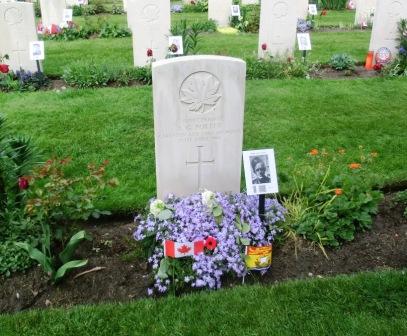
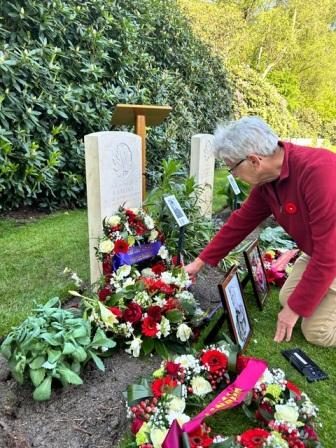
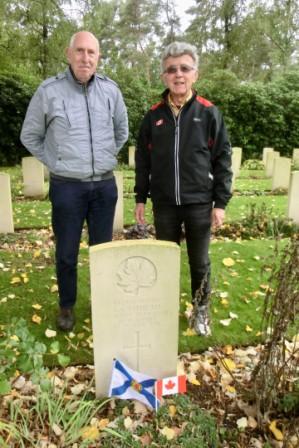
Grave of William Douglas Sherren. (Photo credit: Pieter Valkenburg)

William Douglas SHERREN, from Crapaud, Prince Edward Island, was serving with the Royal Canadian Artillery and was severely injured when the vehicle he was travelling in drove over a land mine in Germany on April 25, 1945, just a few days before the end of WWII.  He died of his wounds on April 28, 1945, aged 30.  A month earlier, he had been recognized by King George VI as a Member of the Military Division of the Most Excellent Order of the British Empire, in recognition of gallant and distinguished service in North West Europe.

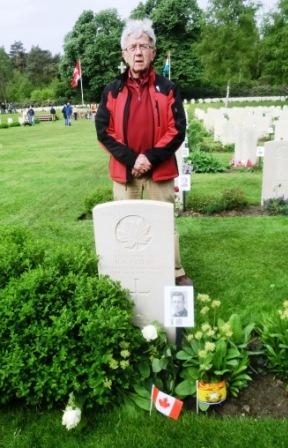
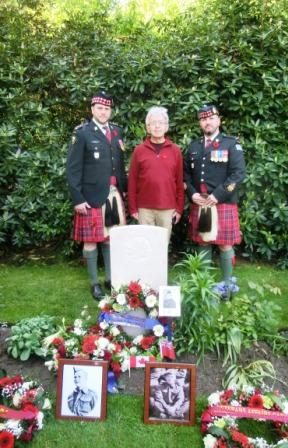
Grave of George Martin McMahon. (Photo credit: Pieter Valkenburg)

George Martin McMAHON, born in Emerald Junction, Prince Edward Island, and the father of 5 children, was serving with the Royal Canadian Artillery, and accidentally drowned when he fell into a canal in Amsterdam, The Netherlands on the night of August 11, 1945.  He was 32 years old.

….All of the flags placed at graves were donated…

All of the flags placed at graves were donated.  For the flags placed at the graves of Islanders, our thanks go to:  Alan Waddell, Constituent Assistant, on behalf of Heath MacDonald, MP for Malpeque, for the Canadian flags. Prince Edward Island flags were provided by Matt MacFarlane, MLA for District 19, Borden-Kinkora. 

In Part 3, the graves of soldiers killed in vehicle accidents will be featured as we continue with our 2025 European War Memorial Tour. Pieter encourages readers with photos to come forward so that eventually all the known graves of Canadians buried in Holten will have a photo displayed by their grave. Email him at memorialtrail@gmail.com

© Daria Valkenburg

….Want to follow our research?…

If you are reading this posting, but aren’t following our research, you are welcome to do so.  Our blog address: https://onthewarmemorialtrail.com/

4 countries, 6 weeks, 7,000 km – an unforgettable war memorial journey in Europe…. Daria’s book ‘No Soldier Buried Overseas Should Ever Be Forgotten‘ is available in print and e-book formats.  Net proceeds of book sales help support research costs and the cost of maintaining this blog. For more information see https://nosoldierforgotten.com/

Subscribe to our YouTube Channel: On The War Memorial Trail With Pieter Valkenburg: https://www.youtube.com/channel/UCJ591TyjSheOR-Cb_Gs_5Kw

Never miss a posting!  Subscribe below to have each new story from the war memorial trail delivered to your inbox.

On The War Memorial Trail….2025 Faces of Holten Exhibition Part 1:  Soldiers Killed Near Posterenk

August 24, 2025.  Readers of this blog are aware that Pieter has been involved in finding photos of Canadians who are buried in The Netherlands since 2014. 

We were in The Netherlands and Belgium for the 80th Anniversary of Liberation Commemoration events, and placed flags at the graves of 383 soldiers in 14 cemeteries.

Pieter at the entrance to the Canadian War Cemetery in Holten, The Netherlands. (Photo credit: Daria Valkenburg)

….Flags placed at the graves of soldiers from all 10 provinces and 1 Territory…

Over the next few postings, soldiers whose stories were previously told, and who are buried in the Canadian War Cemetery in Holten, the second largest Canadian War Cemetery in The Netherlands, will be featured. There are 1,394 burials here, of which 1,355 are Canadian.  Flags were placed by Pieter at 156 graves at this cemetery.  This was the final tally for the 156 graves:

  • 38 were from Nova Scotia
  • 46 from New Brunswick
  • 21 from Prince Edward Island
  • 3 from British Columbia
  • 5 from Saskatchewan
  • 20 from Manitoba
  • 2 from Alberta
  • 16 from Ontario
  • 3 from Quebec
  • 1 from Newfoundland
  • 1 from Yukon Territory

22 of the graves also received an Acadian flag, and 2 received Indigenous flags – one from the Mi’kmaq Nation, and one from the Wolastoqey Nation.  All of the graves received a Canadian flag.  Provincial flags were placed at all graves, with the exception of the soldiers from British Columbia, Saskatchewan, and Yukon Territory, for which, unfortunately, we did not receive flags.

All of the flags placed on our war memorial tour had been donated, as mentioned in an earlier posting. (See https://onthewarmemorialtrail.com/2025/06/04/on-the-war-memorial-trail-flags-and-pins-received-for-our-2025-european-war-memorial-tour/)

This year, for the 80th Anniversary, with photos having been found for 80% of the soldiers buried there, photos were placed at graves for the first time.  The 2025 Faces Of Holten Exhibition ran for three weeks in May.  Photos were printed onto an aluminum backing, making them impervious to rain, and reusable.  Each placard also had a QR code, allowing visitors with cell phones to scan the code and read a brief biography of the soldier.

…7 soldiers who died near Posterenk are commemorated…

In this posting, the graves and photos of seven WWII soldiers whose stories have previously been told are featured.  All were serving in the Carleton & York Regiment at the time of their death and died near Posterenk, The Netherlands.

Grave of François ‘Frank’ Gallant. (Photo credit: Daria Valkenburg)

François ‘Frank’ GALLANT, from Mount Carmel, Prince Edward Island, was killed during the Liberation of Posterenk in The Netherlands on April 13, 1945, aged 30.  He was one of 6 soldiers initially buried along the main road to Posterenk, a village near Zutphen. You can read his story at https://onthewarmemorialtrail.com/2024/06/30/on-the-war-memorial-trail-the-wwii-soldier-from-mount-carmel-killed-during-the-liberation-of-posterenk/

Pieter at the grave of Daniel ‘Dan’ Peter MacKenzie. (Photo credit: Daria Valkenburg)

Daniel ‘Dan’ Peter MACKENZIE, from Victoria Cross, Prince Edward Island, died from wounds received on April 13, 1945 during the Liberation of Posterenk in The Netherlands, part of Operation Cannonshot. He had been taken to a Canadian hospital in Lochem, where he died that evening, aged 26, despite heroic efforts to save him.  You can read his story at https://onthewarmemorialtrail.com/2023/06/29/on-the-war-memorial-trail-the-wwii-soldier-from-victoria-cross-fatally-wounded-during-the-liberation-of-posterenk/

Grave of James ‘Frank’ Mossey. (Photo credit: Pieter Valkenburg)

James ‘Frank’ MOSSEY, from Souris, Prince Edward Island, was killed in action on April 14, 1945 near Posterenk, The Netherlands, aged 25. He was one of 6 soldiers initially buried along the main road to Posterenk, a village near Zutphen. You can read his story at https://onthewarmemorialtrail.com/2022/08/09/on-the-war-memorial-trail-the-wwii-soldier-from-souris-killed-during-the-liberation-of-posterenk/

Pieter by the grave of Goldwin ‘Goldy’ Marven Pollick. (Photo credit: Daria Valkenburg)

Goldwin ‘Goldy’ Marven POLLICK, from Minto, New Brunswick, lost his life on April 13, 1945 in Wilp-Achterhoek, near Posterenk, aged 24. You can read his story at https://onthewarmemorialtrail.com/2021/01/07/on-the-war-memorial-trail-atlantic-canada-remembers-part-1/

Grave of Samuel Glazier Porter. (Photo credit: Pieter Valkenburg)

Samuel Glazier PORTER, from Dow Flat, Victoria County, New Brunswick, lost his life, at the age of 26, on April 15, 1945 as his Regiment advanced to the Apeldoorn Canal in The Netherlands. He was one of 6 soldiers initially buried along the main road to Posterenk, a village near Zutphen.  You can read his story at https://onthewarmemorialtrail.com/2021/11/28/on-the-war-memorial-trail-atlantic-canada-remembers-part-11/

Pieter by the grave of Harold Gordon Sabean. (Photo credit: Daria Valkenburg)

Harold Gordon SABEAN, from Port Lorne, Nova Scotia, was killed on April 15, 1945, as his Regiment advanced to the Apeldoorn Canal in The Netherlands, aged 27.  He was one of 6 soldiers initially buried along the main road to Posterenk, a village near Zutphen. You can read his story at https://onthewarmemorialtrail.com/2022/10/08/on-the-war-memorial-trail-the-wwii-soldier-from-port-lorne-who-lost-his-life-during-the-advance-to-the-apeldoorn-canal/

Grave of Frederick Joseph Tait. (Photo credit: Pieter Valkenburg)

Frederick Joseph TAIT, from Grand Falls, New Brunswick, was killed on April 15, 1945, as his Regiment advanced to the Apeldoorn Canal in The Netherlands, aged 23.  He was one of 6 soldiers initially buried along the main road to Posterenk, a village near Zutphen. You can read his story at https://onthewarmemorialtrail.com/2021/03/16/on-the-war-memorial-trail-atlantic-canada-remembers-part-8/

….All of the flags placed at graves were donated…

All of the flags placed at graves were donated.  Our thanks go to:

  • Alan Waddell, Constituent Assistant, on behalf of Heath MacDonald, MP for Malpeque, for the Canadian flags.
  • Matt MacFarlane, MLA for District 19, Borden-Kinkora, for the flags from Prince Edward Island.
  • Armel ‘Mel’ Lanteigne, President of the Caraquet Legion in New Brunswick for the New Brunswick flags and Acadian flags.
  • Kyle Graham, Research Officer, Military Relations, Nova Scotia Intergovernmental Affairs, on behalf of Premier Tim Houston, Province of Nova Scotia, for the Nova Scotia flags

The Dutch continue to stress the importance of remembrance to the next generation so they can continue to remember those who lost their lives in WWII.  ‘Opdat wij niet vergeten’ (Lest We Forget)

In Part 2, graves of soldiers from Prince Edward Island who are listed on the Cenotaph in Borden-Carleton, Prince Edward Island, and are buried in the Canadian War Cemetery in Holten, will be featured.

Pieter encourages readers with photos to come forward so that eventually all of the known graves of Canadians buried in Holten will have a photo displayed by their grave. Email him at memorialtrail@gmail.com

© Daria Valkenburg

….Want to follow our research?…

If you are reading this posting, but aren’t following our research, you are welcome to do so.  Our blog address: https://onthewarmemorialtrail.com/

4 countries, 6 weeks, 7,000 km – an unforgettable war memorial journey in Europe…. Daria’s book ‘No Soldier Buried Overseas Should Ever Be Forgotten‘ is available in print and e-book formats.  Net proceeds of book sales help support research costs and the cost of maintaining this blog. For more information see https://nosoldierforgotten.com/

Subscribe to our YouTube Channel: On The War Memorial Trail With Pieter Valkenburg: https://www.youtube.com/channel/UCJ591TyjSheOR-Cb_Gs_5Kw

Never miss a posting!  Subscribe below to have each new story from the war memorial trail delivered to your inbox.

On The War Memorial Trail…..The WWII Soldier From Kenora Who Lay In An Unknown Grave For 80 Years…. Part 2: The Grave Re- dedication Ceremony

Arthur Vanance.  (Photo credit: Daria Valkenburg)

August 22, 2025. The research file for WWII soldier Arthur VANANCE of Kenora, Ontario, who lost his life on February 15, 1945 while serving with the Lake Superior Regiment, remained open for several years because of the uncertainty as to whether he lay buried in an unknown grave – Plot XI, Row H, Grave 5 – in the Canadian War Cemetery in Holten, The Netherlands. 

Part 1 explained how after his story was sent to Dr. Sarah Lockyer, Casualty Identification Coordinator, Directorate of History and Heritage, Department of National Defence of the Government of Canada, everyone involved had to wait to see what the verdict would be.   (See https://onthewarmemorialtrail.com/2025/08/19/on-the-war-memorial-trail-the-wwii-soldier-from-kenora-who-lay-in-an-unknown-grave-for-80-years-part-1-what-happened-to-arthur-vanance/)

On March 3, 2025 we were informed that Arthur was indeed buried in that unknown grave, and he would be receiving a new headstone. Now, in Part 2, we attended the grave re-dedication ceremony for Arthur Vanance on May 3, 2025, while on our 2025 European War Memorial Trail. 

….The new headstone for Arthur Vanance was waiting to be unveiled….

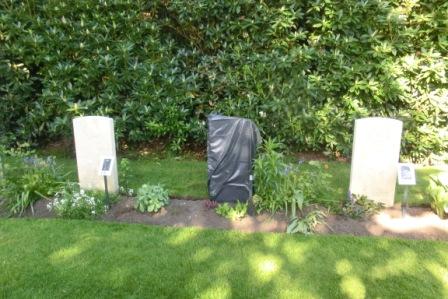
The new gravestone for Arthur Vanance was covered until the May 3, 2025 grave rededication ceremony.  The grave to the right is that of Harold Frederick Hilderley. (Photo credit: Daria Valkenburg)

On May 1, 2025, we were at the Canadian War Cemetery in Holten to begin placing flags at what turned out to be 156 graves of servicemen that Pieter has researched over the years.  When we saw the covered headstone at what was once an unknown grave, we couldn’t wait for the re-dedication ceremony on May 3!

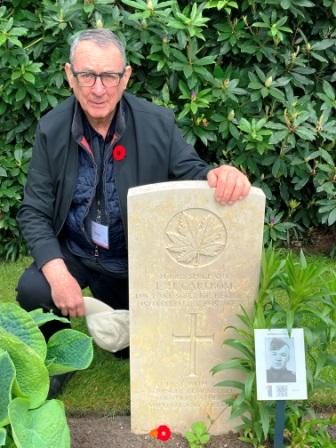
Arthur is buried next to Harold Frederick HILDERLEY of Stratford, Ontario, with Earl Herbert CARLBOM of Sioux Lookout, Ontario lying in the grave beside Harold Hilderley.  All three men died on February 15, 1945.

….The grave re-dedication ceremony was dignified….

On Saturday, May 3, 2025 a number of us gathered at the Holten Information Centre in anticipation of the grave re-dedication ceremony.  Shortly after 10 am we made our way to the cemetery and briefly spoke with His Excellency, Hugh Adsett, the Canadian Ambassador to The Netherlands, who mentioned he was from Petitcodiac, New Brunswick.  Paul Ledwell, the Deputy Minister of Veterans Affairs, also stopped by to chat.  As well, Pieter spoke with a representative from the Commonwealth War Graves Commission in the United Kingdom. 

Pieter with Master Warrant Officer Brian Keene.  (Photo credit: Daria Valkenburg)

We had a chance to meet Master Warrant Officer Brian Keene of the Directorate History and Heritage (3-3) – Dress and Ceremonial, of the Canadian Armed Forces, who’d been our contact for the date and time of the ceremony.  He said he worked closely with Dr Sarah Lockyer, who we’d originally contacted regarding Arthur Vanance. 

Formation of soldiers for the re-dedication ceremony at the grave of Arthur Vanance.  (Photo credit: Daria Valkenburg)

No family members were present, but there was a large turnout of Canadian military, including members of the Lake Superior Regiment, the Canadian Armed Forces Band, as well as the dignitaries, volunteers from the Canadian War Cemetery in Holten, media….plus us.  We had expected a much smaller event!

Soldiers and the Canadian Armed Forces Band wait for the re-dedication ceremony to start. (Photo credit: Daria Valkenburg)

The Military Chaplain of the North Shore (New Brunswick) Regiment was the Master of Ceremonies for this very dignified event.  A biography of Arthur Vanance was read out by Captain Corey Nieminen of the Lake Superior Regiment. The poem ‘In Flanders Fields’ and the Act of Remembrance were read out by Chief Warrant Officer Jon O’Connor, also of the Lake Superior Regiment.  Paul Ledwell also said a few words.

Members of the Lake Superior Regiment by the grave of Arthur Vanance. (Photo credit: Daria Valkenburg)

Wreaths were laid, ‘O Canada’ and ‘God Save The King’ were played, as well as ‘The Last Post’ and ‘Reveille’.  After the ceremony, Pieter placed flags of Canada and Ontario at the grave.

Pieter placing flags of Canada and Ontario at the grave of Arthur Vanance. (Photo credit: Bastien Sjoerts)

Pieter with Captain Corey Nieminen (left) and Chief Warrant Officer Jon O’Connor (right) by the grave of Arthur Vanance.  (Photo credit: Daria Valkenburg)

Following the ceremony, we had a chance to meet and speak with other attendees, but were among the first to leave, as we had another commitment in another town, over 1 ½ hours away.

The following day, Mitch Banks, son of Lt George Calvin ‘Cal’ BANKS, was at the Canadian War Cemetery in Holten with his wife Linda, for the annual commemoration service.  ….The ceremony was very moving, especially when the young children laid white roses on each of the headstones. It brought tears to our eyes….

While in Holten, Mitch and Linda visited the graves of three members of his father’s platoon: Arthur VANANCE, Harold Frederick HILDERLEY, and his father’s close friend, Earl Herbert CARLBOM.

Mitch Banks by the grave of Earl Herbert Carlbom.  (Photo courtesy of Mitch Banks)

After 80 years of lying in a grave marked as unknown, Arthur Vanance has a headstone that identifies him.  His story has come full circle!

Thank you to Bastien Sjoerts for taking a photo of Pieter placing flags by Arthur Vanance’s grave, and to Mitch Banks for sharing photos about his visit to Holten.  As well, thank you to the following for donating the flags that were placed at Arthur’s grave:

  • Alan Waddell, Constituent Assistant, on behalf of Heath MacDonald, MP for Malpeque, Prince Edward Island, for the Canadian flag.
  • Don Coutts on behalf of the Muttart and Coutts families in memory of Flight Sergeant Elmer Bagnall MUTTART for the Ontario flag.

More highlights of our adventures on the 2025 European War Memorial Trail will be featured in upcoming postings.  If you have a story or photo to share, please contact Pieter at memorialtrail@gmail.com or comment on the blog. 

 © Daria Valkenburg

….Want to follow our research?….

If you are reading this posting, but aren’t following our research, you are welcome to do so.  Our blog address: https://onthewarmemorialtrail.com/

4 countries, 6 weeks, 7,000 km – an unforgettable war memorial journey in Europe…. Daria’s book ‘No Soldier Buried Overseas Should Ever Be Forgotten‘ is available in print and e-book formats.  Net proceeds of book sales help support research costs and the cost of maintaining this blog. For more information see https://nosoldierforgotten.com/

You are also invited to subscribe to our YouTube Channel: On The War Memorial Trail With Pieter Valkenburg: https://www.youtube.com/channel/UCJ591TyjSheOR-Cb_Gs_5Kw

Never miss a posting!  Subscribe below to have each new story from the war memorial trail delivered to your inbox.

On The War Memorial Trail…..The WWII Soldier From Kenora Who Lay In An Unknown Grave For 80 Years…. Part 1: What Happened To Arthur Vanance?

Arthur Vanance.  (Photo credit: Daria Valkenburg)

August 19, 2025.  Sometimes research into a soldier takes years to unfold before the file can be closed.  Often a file remains open while a photo is being sought, or additional information.  When it drags on for too many years, it’s often deemed a Cold Case File.  (See https://onthewarmemorialtrail.com/our-cold-cases/)

Other times, a file remains open because of special circumstances.  This happened in the case of WWII soldier Arthur VANANCE of Kenora, Ontario, whose story was written in ‘Holtense Canadezen’, Jan Braakman’s book (in Dutch) about some of the soldiers buried in the Canadian War Cemetery in Holten, The Netherlands, which we translated in 2021. 

….Arthur was in the Lake Superior Regiment….

Born January 5, 1919 in Kenora, Ontario, Arthur Vanance (surname also spelled Vanasse) was the son of Emmanuel Joseph and Annie Rosie (nee Halley) Vanance.  After his father died in April 1934, his mother remarried and moved to Powell River, British Columbia.

Before enlisting with the Lake Superior Regiment on July 11, 1940 in Kenora, Arthur worked as a truck driver.

On October 2, 1940, he married Rita Margaret Meservier in Port Arthur (now Thunder Bay), Ontario. Rita had a son, Allan Glenn McGuire, who had been born on July 21, 1939 in Winnipeg, Manitoba.  Rita and Arthur’s son, Arthur Henry Vanance, was born on December 27, 1941 in Thunder Bay.  (After Arthur’s death, Rita married Clayton (Mickey) McGuire, Allan’s father.)

By August 22, 1942, Arthur was in the United Kingdom with his Regiment, and remained there until July 21, 1944, when they were sent to Northwest Europe.  

Pieter in Bokhoven in 2010.  (Photo credit: Daria Valkenburg)

In February 1945, the Lake Superior Regiment was near Bokhoven, The Netherlands, a place we knew very well, as Pieter’s maternal ancestor, Willem Kremers, lived there and died, along with his daughter Maria Anna, on the night of February 21-22, 1799. Strong winds had pushed up ice floes from the Maas River, and caused the collapse of a barn near a castle, where Willem and Maria Anna had been sheltering, but ended up being buried under the rubble. 

246 years later, on February 15, 1945, the area also proved to be unlucky for Arthur and three other soldiers from the Lake Superior Regiment.

……Arthur lost his life on February 15, 1945…….

An excerpt from ‘Holten Heroes: Stories from a Canadian Field of Honour’, from the chapter ‘Mission across the Maas’ gave an account of what happened on February 15, 1945…..

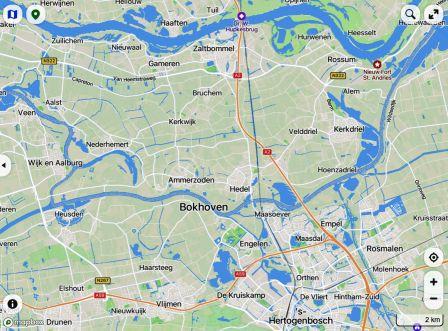
Map showing location of Bokhoven, Hedel, Zaltbommel, and Ammerzoden. (Map source: Mapbox)

….In February 1945, his regiment was stationed near Bokhoven, on the south bank of the Maas, north of Hertogenbosch. And there he was deployed early in the morning for the fateful patrol on February 15, 1945. Such patrols were undertaken by both sides. The Germans tried to penetrate the Canadian lines on the Maas at Empel, Crevecoeur, and Gewande. Meanwhile, Canadians crossed the river to carry out reconnaissance of the north side and to check whether the Germans were still occupying their positions. Prisoners of war were captured by both sides during the skirmishes.

After the war, Lieutenant Colonel H.H.A. Parker of the Lake Superior Regiment explained what had happened to the patrol that Vanance was part of. “On the night of 14-15 February, B-Company had a patrol across the River Maas . . . ran into trouble on the way back with the result that only about half of the men got back to our side.” The patrol returned battered. One soldier (Walter Russell Lahoda) had been killed, ten were wounded, and three had fallen into the hands of the enemy. Among them – probably – was Arthur Vanance.

Parker stated in a letter to relatives of the deceased Earl Carlbom that a rescue operation was set up. ‘Sergeant Carlbom, along with Lieutenant Banks and Sergeant Boomhower decided to cross the river again and search for the missing men from their platoon. Unfortunately, they were ambushed, Lieutenant Banks and your son being wounded. Sergeant Boomhower managed to make his escape and he told us that there was little doubt that your son had been taken prisoner, but apparently, his wounds must have been more serious than they appeared. We have twice carried out a search of the whole area but have been unable to locate his grave.’

What happened to Arthur Vanance after that remains unclear. One of the soldiers, W.R. Marsh, later reported that Lance-Corporal Hilderley had been fatally wounded, and that they had been unable to recover his body due to intense enemy fire. But, said the same soldier, if they had had two stretchers, they could have picked up Hilderley and Vanance.

Banks told Marsh that another NCO, Carlbom, would take care of that. But Carlbom was also ambushed and killed. After the war it turned out that Carlbom had been buried by the Germans in the cemetery in Zaltbommel. Hilderley had been buried in occupied Ammerzoden, along with an unidentified Canadian soldier. Where Arthur Vanance had gone was unclear: he was missing. Hilderley’s body was exhumed after the war and reburied in Holten Canadian War Cemetery, in Plot XI, Row H, Grave 6. Carlbom was also reburied in Plot XI, Row H, Grave 7 in the same cemetery. The unidentified Canadian from Ammerzoden also ended up in Holten Canadian War Cemetery, in Plot XI, Row H, Grave 5….

……The other casualties ……

Private Arthur Vanance wasn’t the only casualty that night….

  • Sgt Earl Herbert CARLBOM of Sioux Lookout, Ontario, aged 27
  • Lance-Corporal Harold Frederick HILDERLEY of Stratford, Ontario, aged 19
  • Private Walter Russell LAHODA of Winnipeg, Manitoba, aged 27

Carlbom and Hilderley are buried in the Canadian War Cemetery in Holten.  Lahoda is buried in the Canadian War Cemetery in Groesbeek.

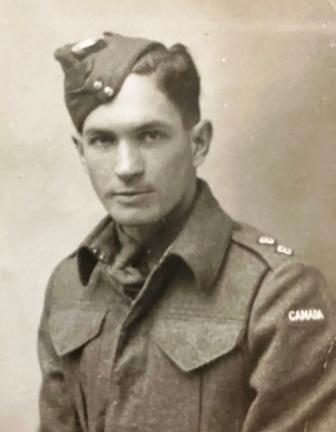
Lt. George Calvin ‘Cal’ Banks. (Photo courtesy of Mitch Banks)

Lt. George Calvin ‘Cal’ BANKS survived.  His son, Mitch Banks, wrote to let us know that “….Private Arthur Vanance is part of my Father’s story as he was his Platoon commander that fateful night on February 15th 1945 when Private Vanance and three others of Dad’s platoon were killed. My Dad was severely wounded and taken prisoner….

Mitch explained that “…having learned his friend Sergeant Carlbom was killed and Dad having lost a lot of blood, he would have been in a state of shock and probably not sure where he was initially taken….” 

In the Liberated Prisoner of War Questionnaire that was completed after the war ended, Cal stated that he had been captured near Hedel on February 15, 1945, then initially taken to a hospital in Apeldoorn until March 31, 1945, followed by a hospital in Haarlem, where he remained until May 8, 1945.  

……Was Arthur buried in that unknown grave? ……

Was Arthur Vanance in Plot XI, Row H, Grave 5 in the Canadian War Cemetery in Holten? (Photo courtesy of the Information Centre Canadian Cemetery Holten)

The account in Jan Braakman’s book ended with the belief that it was Arthur who lay buried in Plot XI, Row H, Grave 5 in the Canadian War Cemetery in Holten, and was so compelling that the translated excerpt was sent to Dr. Sarah Lockyer, Casualty Identification Coordinator, Directorate of History and Heritage, Department of National Defence of the Government of Canada. 

In a subsequent phone conversation, Dr Lockyer asked if a family member had been found, as that would be very helpful.  Pieter immediately began his research and it wasn’t long before he was in contact with Paulette Alcock of Alberta, who wrote to say that “…I can confirm that Arthur Vanance was my dad’s half-brother.  He spoke of him being missing in the war and remembers his mom receiving a medal. He was young, so it was tough, and my dad has also been gone for over 30 years. If I can help in the further steps, let me know.  It would be nice to have my uncle Arthur as a known soldier….”   Paulette agreed to have her contact information shared with Dr Lockyer, which was done.  

We heard nothing for several years, but did keep Dr Lockyer updated, such as when the translated book was published in English in October 2023 as ‘Holten Heroes: Stories from a Canadian Field of Honour’.  (See https://onthewarmemorialtrail.com/2023/11/01/new-book-about-soldiers-buried-in-the-canadian-war-cemetery-in-holten-the-netherlands/

In March 2024, Jan Braakman submitted the English language chapter about Arthur Vanance to the Commonwealth War Graves Commission (CWGC), which can be read at: https://www.cwgc.org/stories/stories/private-arthur-vanance-lake-superior-regiment-mission-across-the-river-maas/ 

….The Directorate of Heritage and History wrote to inform us that Arthur’s grave was no longer unknown ….

Then, a year later, on March 3, 2025, we received the following email from Dr. Lockyer:

….Good morning Mr. and Mrs. Valkenburg,

I am delighted to inform you that the Department of National Defence and the Canadian Armed Forces have publicly announced the identification of Private Arthur Vanance. His case was adjudicated and accepted at the December 2024 Casualty Identification Review Board and his next of kin was recently notified by the Canadian Armed Forces. I have attached a letter from the Acting Director of History and Heritage thanking you for your submission that ultimately made this happen.

The URLs for the News Release are found below….

ENGLISH: https://www.canada.ca/en/department-national-defence/news/2025/03/canadian-soldier-of-the-second-world-war-identified.html

FRENCH: https://www.canada.ca/fr/ministere-defense-nationale/nouvelles/2025/03/identification-dun-soldat-canadien-de-la-seconde-guerre-mondiale.html

The Canadian Armed Forces are aiming to conduct his rededication ceremony in early May to coincide with the 80th anniversary of the liberation of the Netherlands commemorative events hosted by Veterans Affairs Canada at Holten Cemetery.

Thank you for your help in making this happen. If you have any questions, please do not hesitate to ask.

Cheers,

Sarah

Sarah Lockyer, PhD….

The March 3, 2025 letter to us from Captain Ken Ingram, Acting Director of History and Heritage, Department of National Defence of the Government of Canada, provided the same information as Dr Lockyer, and thanked us for the small part we played in this story:

….We are pleased to inform you that following extensive research undertaken by both the CWGC and Directorate of History and Heritage (Canadian Armed Forces), the information you submitted was accepted in December 2024 by the Casualty Identification Review Board.

We sincerely thank you for submitting your report to the CWGC. Your excellent research helped to enable this incredible outcome.…

Media coverage picked up this wonderful outcome…. see https://www.ctvnews.ca/northern-ontario/article/grave-of-missing-northern-ont-solider-identified-after-80-years/

….The Re-dedication Ceremony was planned for May 3, 2025 …

Towards the end of March, we were informed by both Henk Vincent, volunteer at the Canadian War Cemetery in Holten, and by Adjum/MWO Brian Keene, Directorate History and Heritage (3-3) – Dress and Ceremonial, of the Canadian Armed Forces that the re-dedication ceremony for Arthur’s grave would be held on the morning of May 3, 2025.  As we would be in The Netherlands during the period, we were able to attend this special event.

Coming up in Part 2….we attend the grave re-dedication ceremony for Arthur Vanance, one of the highlights of our adventures on the 2025 European War Memorial Trail. 

Thank you to Mitch Banks for the information and photos about his father, Lt Banks, and to Yannic Wethly for sending us the Liberated POW Questionnaire.  Thank you to Jan Braakman for permission to quote from his book, with translation into English by Pieter and Daria Valkenburg

If you have a story or photo to share, please contact Pieter at memorialtrail@gmail.com or comment on the blog. 

 © Daria Valkenburg

….Want to follow our research?….

If you are reading this posting, but aren’t following our research, you are welcome to do so.  Our blog address: https://onthewarmemorialtrail.com/

4 countries, 6 weeks, 7,000 km – an unforgettable war memorial journey in Europe…. Daria’s book ‘No Soldier Buried Overseas Should Ever Be Forgotten‘ is available in print and e-book formats.  Net proceeds of book sales help support research costs and the cost of maintaining this blog. For more information see https://nosoldierforgotten.com/

You are also invited to subscribe to our YouTube Channel: On The War Memorial Trail With Pieter Valkenburg: https://www.youtube.com/channel/UCJ591TyjSheOR-Cb_Gs_5Kw

Never miss a posting!  Subscribe below to have each new story from the war memorial trail delivered to your inbox.

Pieter Valkenburg appointed Knight of the Order of Orange-Nassau

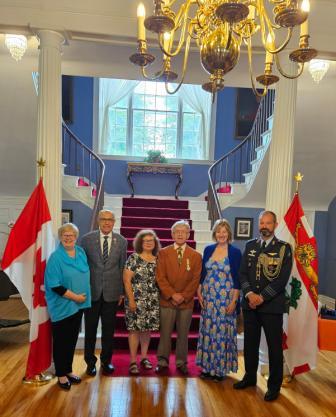
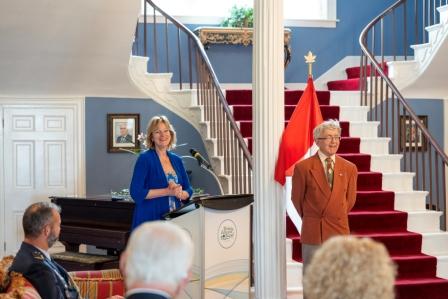
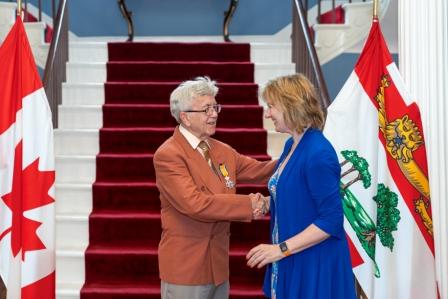
Left to right:  Her Honour Marie Salamoun-Dunne, His Honour Dr Wassim Salamoun, Lt Governor of Prince Edward Island, Daria Valkenburg, Pieter Valkenburg, Her Excellency Margriet Vonno, Ambassador of The Netherlands to Canada, Lt-Colonel  Mark De Wit, Defence Attaché for The Netherlands to Canada.  (Photo credit: Matthew B. MacFarlane)

August 11, 2025.  On July 2, 2025, by Royal Decree of His Majesty Willem-Alexander, King of The Netherlands, Pieter was appointed Knight of the Order of Orange-Nassau.  Created on April 4, 1892, the Order of Orange-Nassau is conferred on people who have made a contribution of outstanding value. Those who are appointed Knights have rendered meritorious service of national importance to The Netherlands.

Invitation to the July 2, 2025 Ceremony.

….The knighthood was in recognition of Pieter’s ongoing military research…

Pieter received his knighthood in recognition of the military research he’s done, and continues to do, to help ensure that Canadian soldiers buried in The Netherlands are not forgotten, and that their stories are told.  The Dutch have never forgotten their Canadian liberators!

English translation of what was in the Staatscourant (Government Gazette):  For services in the field of commemoration of victims of WWII (Dutch wording: voor verdiensten op het terrein van herdenking slachtoffers Tweede Wereldoorlog)

 ….Lt Colonel Mark de Wit provided background on the decoration …

Order of Orange-Nassau. (Photo credit: Daria Valkenburg)

The decoration was presented by Her Excellency Margriet Vonno, Ambassador of The Netherlands to Canada, in a beautiful ceremony hosted by His Honour, Dr Wassim Salamoun, Lt Governor of Prince Edward Island.

The ceremony began with greetings by Dr Wassim Salamoun, followed by Lt Colonel Mark de Wit of the Royal Netherlands Air Force, Netherlands Defence Attaché to Canada, who described the decoration to be presented to Pieter.

…The medal itself is a blue and white cross, topped with the royal crown. In the middle of the cross is a blue medallion with the Dutch lion. Around the lion are the French words: je maintiendrai – I will maintain, ‘ik zal handhaven’.

On the back of the medallion is the letter ‘W’, representing Queen Wilhelmina. Around the ‘W’ are the words: God is met ons – God is with us….

….The Knighthood was presented to Pieter by Ambassador Vonno…

Her Excellency Margriet Vonno, Ambassador of The Netherlands to Canada with Pieter.  (Photo by Provincial Photographer Evan Ceretti)

In her remarks just before Pieter was presented with his decoration, Her Excellency Margriet Vonno, Ambassador of The Netherlands to Canada, began by saying “We are all here to honour a Dutchman, and I am glad to see so many of his friends and family gathered today at the Lieutenant Governor’s residence here in Charlottetown.

Pieter is one of these people that has worked endlessly and voluntarily, for over many years now, to do something for our Canadian Liberators who did not return and lie buried in The Netherlands. 

Preserving their stories and literally putting faces to graves. Not a simple task, because we all know that 80 years has passed and finding the families and information about these young soldiers is not easy….

After listing the accomplishments that led to this honour, Ambassador Vonno concluded by saying  “…Pieter, you have given all your spare time to not only preserve stories of our fallen liberators but also to promote them to a wider public. I know you continue this important work to this day and I hope you will have many more years of success. I am sure that much of this was also due to the incredible support of your wife Daria.

So it is only appropriate to thank you, on behalf of all, for what you have done all those years, and to commend you.

Dear guests, His Majesty King Willem Alexander has decided to award Pieter Anthonie Valkenburg with Knight in the Order of Orange-Nassau and it is my great honour to present the insignia of the order….

Newly decorated Pieter shakes hands with Her Excellency Margriet Vonno, Ambassador of The Netherlands to Canada.  (Photo by Provincial Photographer Evan Ceretti)

…. Pieter was invited to give his remarks…

Pieter says a few words after his investiture. (Photo by Provincial Photographer Evan Ceretti)

Following his investiture, an emotional Pieter was invited to say a few words, and he began with expressing his thanks.  “….I am deeply humbled by this honour, and a bit overwhelmed. Many thanks are in order.  First, thank you to His Honour, Dr. Wassim Salamoun, Lt. Governor of Prince Edward Island, for hosting this ceremony. Thank you to Her Excellency, Margriet Vonno, Ambassador of The Netherlands to Canada, for nominating me for this precious decoration.

I’m grateful to everyone who wrote a letter of support, and to Wendy Sewell, Assistant Defence Attaché, who coordinated this nomination.

Last, but not least, I would like to thank my wife and soulmate Daria, who says I have a tendency to hide my light under a bushel. Her support has been tremendous. Without her, no one would know about our work

Pieter provided a few highlights of what happened since he began researching, and how the project has grown from a modest start in Prince Edward Island.  “….I never dreamed that this small scale Island research project could have grown into a pan-Canadian research project that keeps getting bigger, and has taken me down several paths….

In conclusion, Pieter noted that “…remembrance of those who gave their lives for our continued freedom is important, and no soldier buried overseas should ever be forgotten….”   

Wendy Sewell, Assistant Defence Attaché, with Pieter and Daria at lunch following the ceremony.  (Photo credit: Mark de Wit)

….The honour came after a very busy trip to Europe for the 80th Anniversary of the Liberation of The Netherlands…

Pieter placing flags of Canada and Prince Edward Island at the grave of Elmer Bagnall Muttart. (Photo credit: Daria Valkenburg)

This recognition came on top of a busy spring, which found us in Europe for commemoration events for the 80th anniversary of the liberation of The Netherlands. Over our 5 week stay, we visited 14 cemeteries in The Netherlands and Belgium, placing small Canadian and provincial flags at 383 graves of soldiers that Pieter had researched, as well as Acadian flags, where appropriate. We’d even been sent Indigenous flags by families to be placed at the graves of 3 Indigenous soldiers. The graves were of soldiers from all 10 provinces, plus Yukon Territory. 

After having placed 120 flags at the Canadian War Cemetery in Groesbeek on April 28, 2025, Pieter was pleased to see the flags still in place when we attended the May 2, 2025 commemoration service for the 80th Anniversary of the Liberation of The Netherlands at the cemetery.  (See https://onthewarmemorialtrail.com/2025/07/19/on-the-war-memorial-trailwe-attended-the-ceremony-at-the-canadian-war-cemetery-in-groesbeek/)

The next day, at the grave re-dedication ceremony at the Canadian War Cemetery in Holten for WWII soldier Arthur VANANCE of Kenora, Ontario, His Excellency Hugh Adsett, Ambassador of Canada to The Netherlands, commented on how much pride he’d felt in seeing so many flags of New Brunswick, his home province, the day before in Groesbeek.

We attended the grave re-dedication as we’d been recognized by the Canadian Armed Forces Casualty Identification Program for our part in finding a family member of the soldier, and for translating documents that helped in determining that the grave of an unknown soldier buried in Holten was actually the resting place of Vanance.  (Note: This story is still to come, plus more stories about our 2025 European War Memorial Tour.)

….Island media interviews …

Following the July 2 ceremony, articles about Pieter’s knighthood ran in Island newspapers:  County Line Courier, The Guardian, and by Josh Lewis of The Eastern Graphic.  Pieter also was interviewed on CBC PEI Radio’s ‘Island Morning With Mitch Cormier’ by Taylor O’Brien.

Taylor O’Brien with Pieter at the CBC studio in Charlottetown.  (Photo credit: Daria Valkenburg)

See https://www.saltwire.com/prince-edward-island/pieter-valkenburg-of-p-e-i-appointed-knight-of-the-order-of-orange-nassau and https://www.cbc.ca/listen/live-radio/1-30-island-morning/clip/16162199-islander-knighted-king-netherlands

….Previous recognition…

This was the second honour this year from The Netherlands!  In May, we received a Certificate and a Faces To Graves ‘coin’ by the Faces To Graves Groesbeek Foundation for their research into Canadian soldiers buried in the Canadian War Cemetery in Groesbeek, and for finding families and sharing photos of over 100 of the soldiers.

Pieter has also been recognized here in Canada, most recently in 2024, when he received the Minister of Veterans Affairs Commendation. (See https://onthewarmemorialtrail.com/recognition/)

Now that the excitement of receiving a Knighthood is over, the research work continues for Pieter, and we’ll continue to share the highlights of our adventures on the 2025 European War Memorial Trail on our journey of remembrance.   

If you have photos or information to share about soldiers buried in The Netherlands or Belgium, please email him at memorialtrail@gmail.com, or comment on the blog.    

© Daria Valkenburg

….Want to follow our research?…

If you are reading this posting, but aren’t following our research, you are welcome to do so.  Our blog address: https://onthewarmemorialtrail.com/

4 countries, 6 weeks, 7,000 km – an unforgettable war memorial journey in Europe…. Daria’s book ‘No Soldier Buried Overseas Should Ever Be Forgotten‘ is available in print and e-book formats.  Net proceeds of book sales help support research costs and the cost of maintaining this blog. For more information see https://nosoldierforgotten.com/

Subscribe to our YouTube Channel: On The War Memorial Trail With Pieter Valkenburg: https://www.youtube.com/channel/UCJ591TyjSheOR-Cb_Gs_5Kw

Never miss a posting!  Subscribe below to have each new story from the war memorial trail delivered to your inbox.

On The War Memorial Trail…Holten Rolled Out A Warm Welcome

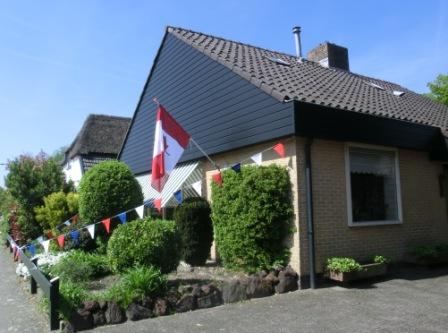
June 12, 2025. During the first part of our 2025 European War Memorial Tour we stayed in the village of Holten, just a few kms from the Canadian War Cemetery outside the village.  We’d been in Holten several times over the years, but this year we saw Canadian flags everywhere – on roundabouts, streets, houses, and businesses – all commemorating 80 years of freedom.  Who knew that orange and red looked so good together?  It quickly became our favourite colour combination!

Pieter by a roundabout in the village of Holten, The Netherlands. (Photo credit: Daria Valkenburg)

Houses in the village of Holten were bedecked with streamers and Canadian flags. (Photo credit: Daria Valkenburg)

Several signs along the street commemorated 80 years of freedom and showed Canadian and Dutch flags. (Photo credit: Daria Valkenburg)

It was a heartwarming welcome to the many Canadian visitors who made their way to the village enroute to the Canadian War Cemetery in Holten. We were just two of those visitors.

….The author and translators of ‘Holten Heroes’ finally meet in person!….

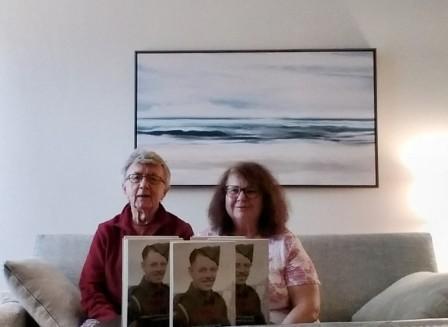
While we were in Holten, we had the opportunity to finally meet in person with Jan Braakman, whose book we had translated into English during the Covid years when we were all housebound. ‘Holten Heroes: Stories from a Canadian Field of Honour’ was translated by us from the original Dutch book ‘Holtense Canadezen’ that Jan wrote. (See https://onthewarmemorialtrail.com/2023/11/01/new-book-about-soldiers-buried-in-the-canadian-war-cemetery-in-holten-the-netherlands/)

Of course, we made sure to take a photo of the three of us with both versions of the book!

Pieter and Daria with Jan Braakman, and the English and Dutch versions of Jan’s book. (Photo credit: Trudy van ‘t Hoff)

The translators with the English language edition of ‘Holten Heroes’.  (Photo courtesy of Valkenburg family)

….We met 3 students from Rijssen….

Left to right:  Jan Braakman, Roselle de Jong, Manon ten Hove, Lieke Brinks, Jorina Lensink (teacher), Pieter Valkenburg, Henk Vincent. (Photo credit: Daria Valkenburg)

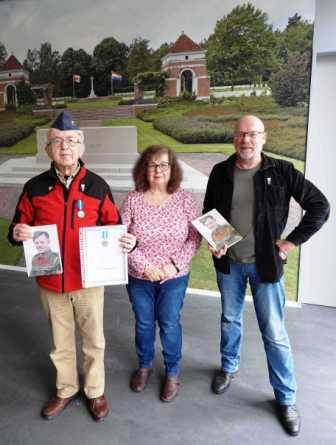
Pieter was invited by Henk Vincent, one of the volunteers at the Canadian War Cemetery in Holten, to meet with 3 high school students from Jacobus Fruytier Scholengemeenschap in Rijssen, plus their teacher, Jorina Lensink.  Roselle de Jong, Manon ten Hove, and Lieke Brinks are 16 years old and had done research on Canadian soldiers.  Ms Lensink explained that the research of soldiers was part of their history exams.

All of the soldiers researched are buried in the Canadian War Cemetery in Holten.  I asked how they chose a soldier, and learned that the names had been given to them by Henk.  Pieter briefly looked at their papers and said they had done a fantastic job of research.

Roselle had studied Victor Lloyd CARPENTER of Fort Frances, Ontario, who died April 27, 1945, aged 22, while serving with the South Alberta Regiment. 

Manon had studied Neil Patrick O’Connor STEWART of St. Paul, Alberta, who died April 8, 1945, aged 20, while serving with the South Saskatchewan Regiment.

Lieke had studied two soldiers:  Clarence Warren LORENSEN, who died April 2, 1945, while serving with the South Alberta Regiment, and Lyle Lewis CRAIG of Paddockwood, Saskatchewan, who died April 19, 1945, while also serving with the South Alberta Regiment. 

Over the next several postings, we’ll continue to share the highlights of our adventures on the 2025 European War Memorial Trail….including the various cemeteries we visited along our journey of remembrance.

Meanwhile, now that we’re back home, the research work continues for Pieter.  If you have photos or information to share about soldiers buried in The Netherlands or Belgium, please email him at memorialtrail@gmail.com, or comment on the blog.    

© Daria Valkenburg

….Want to follow our research?…

If you are reading this posting, but aren’t following our research, you are welcome to do so.  Our blog address: https://onthewarmemorialtrail.com/

4 countries, 6 weeks, 7,000 km – an unforgettable war memorial journey in Europe…. Daria’s book ‘No Soldier Buried Overseas Should Ever Be Forgotten‘ is available in print and e-book formats.  Net proceeds of book sales help support research costs and the cost of maintaining this blog. For more information see https://nosoldierforgotten.com/

Subscribe to our YouTube Channel: On The War Memorial Trail With Pieter Valkenburg: https://www.youtube.com/channel/UCJ591TyjSheOR-Cb_Gs_5Kw

Never miss a posting!  Subscribe below to have each new story from the war memorial trail delivered to your inbox.

On The War Memorial Trail…..The Inclusion Of Acadian Flags On The 2025 European War Memorial Tour Received Publicity

June 8, 2025.  In planning for the 2025 European War Memorial Tour, we were very grateful for help we received in getting flags and pins to take with us.  The many donors were identified and thanked in the previous posting.  (See https://onthewarmemorialtrail.com/2025/06/04/on-the-war-memorial-trail-flags-and-pins-received-for-our-2025-european-war-memorial-tour/)

Simone Comeau, of Nova Scotia, is the niece of Pte Joseph ‘Ambroise’ COMEAU, an Acadian soldier, whose story was told several years ago on this blog.  (See https://onthewarmemorialtrail.com/2021/05/17/on-the-war-memorial-trail-a-tragic-drowning-on-the-leda-river-in-germany-part-3/) She ensured that we received Acadian flags from La Société acadienne de Clare when she learned about the planned tour! 

When she told us that French language media in Nova Scotia was interested in interviewing her about sending us Acadian flags and in learning more about her uncle, we asked if the media could include the names of 4 Acadian soldiers from Nova Scotia whose photos Pieter has yet to find. 

Simone was subsequently interviewed this past winter on the radio by Colette Deveau of Radio-Canada’s La Mouvée, and in ‘Le Courier’ newspaper by Richard Landry.  Both interviews included the names of the 4 soldiers for which photos are still missing.

….Simone Comeau was interviewed by Richard Landry for the ‘Le Courier’ newspaper…

The following is a translation into English (by me) of an article in French by Richard Landry published in the February 21, 2025 edition of ‘Le Courier’: https://lecourrier.com/nos-communautes/nos-communautes-clare/2025/02/21/ambroise-comeau-parmi-55-soldats-acadiens-honores-avec-un-drapeau-acadien-aux-pays-bas/.  The article includes the backstory of how we met Simone, while researching her uncle’s story, as well as the donation of Acadian flags for the 2025 European War Memorial Tour.

 “…Ambroise Comeau among 55 Acadian soldiers honoured with an Acadian flag in the Netherlands

Simone proudly shows off a photo of her uncle Ambroise Comeau’s grave in the Netherlands. Credit: Richard Landry

SAULNIERVILLE – Simone Comeau of Meteghan, niece of Ambroise Comeau (born in Saulnierville), who lost his life defending Holland during the Second World War, has just paid a special tribute to her uncle. For the first time, Acadian soldiers from the Maritimes buried in Holten, Netherlands, will have an Acadian flag placed on their graves, thanks to Simone’s efforts.  (NOTE: Acadian soldiers buried in Groesbeek, Bergen Op Zoom, and Adegem (Belgium) also received flags.) 

Pieter Valkenburg, originally from Holland, lives in Prince Edward Island with his Canadian wife, Daria. He became Canadian and is a former Dutch diplomat. The couple has been working for some time on a research project called On The War Memorial Trail, which aims to find information about Maritime soldiers who served in the liberation of Holland during the Second World War. (NOTE: The research project also features soldiers from other Canadian provinces.)

Private Ambroise Comeau died during World War II in Germany. Credit: Photo from the Simone Comeau collection

Among all the soldiers killed there, they discovered 55 Acadian soldiers from the region who died there during this war, including Ambroise Comeau from Saulnierville, who died during the war in Germany at the age of 21 in 1945.  

Ambroise’s niece, Simone Comeau, of Meteghan, a retired teacher and school principal, conducted extensive research on her uncle after discovering that the Valkenburgs were looking for information. It all began four years ago. She has since accumulated a large file on her uncle. 

The Valkenburgs regularly visit the graves of Maritime soldiers in Holland. This year, on the occasion of the 80th anniversary of the end of the Second World War, they will return there in April. In the past, they have placed Canadian and provincial flags on the graves of all Maritime soldiers. This year, for the first time, they will also place an Acadian flag on the 55 graves of Acadian soldiers. 

Pieter asked Simone to find small Acadian flags to place on the graves of these Acadian soldiers. This will be the first time that the Acadian flag will be placed alongside the provincial and Canadian flags on the graves of Acadians who gave their lives defending Holland. 

Simone enlisted the help of Nathalie Robichaud, executive director of the Société acadienne de Clare, to find the 55 flags. Nathalie managed to locate them and donated them to the cause. Coincidentally, Natalie is Ambroise’s great-niece. 

There are photos of 51 of the 55 Acadian soldiers from the Maritimes in the small museums located at the entrance to the cemeteries with details available on each deceased soldier. We are looking for information and especially photos of the four missing persons. They are: Herbert A. BOUDREAU of Ward’s Brook (died October 28, 1944 while serving with the Royal Hamilton Light Infantry and buried in the cemetery at Bergen Op Zoom, Netherlands), Theodore J. GALLANT of Sydney Mines (died October 20, 1944 while serving with the Argyll and Sutherland Highlanders and buried in the cemetery at Bergen Op Zoom), Sherman William BOUTILIER of Sheet Harbour (died February 19, 1945 while serving with the North Nova Scotia Highlanders and buried in the cemetery at Groesbeek, Netherlands) and Albert G. LERUE of Halifax (died March 7, 1945 while serving with the Algonquin Regiment and buried in the cemetery at Groesbeek). 

Anyone who can offer photos or information about them is asked to email to memorialtrail@gmail.com. 

As for Ambroise Comeau, he was a carpenter during his short career. A funeral service was held in early June 1945 at Sacré-Cœur Church in Saulnierville. He was the son of the late Gus and Jessie Comeau. A military parade took place from his parents’ home to the church before the mass celebrated by Father Castonguay.

The grave of Ambroise Comeau with the cemetery caretaker in Holten, the Netherlands, and Pieter Valkenburg, right. Credit: Photo from the Simone Comeau collection (Note: The man in the photo with Pieter isn’t the cemetery caretaker but Edwin van der Wolf, one of the researchers for Holten.)

His grave in Holten reads: F.602531, J.A. Comeau, The North Nova Scotia Highlanders, April 28, 1945 (in French). “Actually, there are two graves for Ambroise. The other is in Germany, where he fell. Soldiers were buried where they fell during the war. The Dutch didn’t want these soldiers buried in an enemy country, so they brought Ambroise and the others to Holten after the armistice. They are buried in Holland, where they can be given the honour they deserve,” Simone added.  (Note: the original grave in Germany is no longer there, since Ambroise was disinterred and reburied in Holten.)….” 

….Simone Comeau was interviewed by Colette Deveau of Radio-Canad’s La Mouvée…

During an interview this past winter with Colette Deveau of Radio-Canada’s La Mouvée, Simone presented her research on her uncle. She explained that through Ambroise’s sister’s daughter, Pieter had contacted Simone, who agreed to conduct the research. (Note: You can listen to the interview, which is in French, here: https://ici.radio-canada.ca/ohdio/premiere/emissions/la-mouvee/segments/rattrapage/1984976/apercu-simone-comeau and https://ici.radio-canada.ca/ohdio/premiere/emissions/la-mouvee/segments/rattrapage/1985381/reconnaissance-soldats-acadiens-decedes-durant-seconde-guerre-mondiale

…The Dutch are quite, quite grateful to the Canadians for helping to liberate their country because they suffered so much during the Second World War. The Acadian flags that will be placed on the graves come from Clare…” Simone said proudly. 

….My sister Jacqueline had gone to Holland with her eldest son’s school band. Because they were going to schools, they also visited the Holten cemetery. There was a girl with the band who saw Comeau’s name and told Jacqueline. It was Ambroise’s grave. We knew because we had his regimental number… 

…Ambroise, born into a family of six children, was called to war a year before the end of World War II and lost his life there….

….Can you help with finding photos of 4 Acadian soldiers from Nova Scotia?…

Up to now, Pieter has not found photos of the 4 Acadian soldiers mentioned in Simone’s interviews, who are all buried in The Netherlands….and who all received Canadian, Nova Scotia, and Acadian flags during our visit to their graves.  The soldiers are: 

  • Herbert Andrew BOUDREAU of Ward’s Brook, who died October 28, 1944, aged 23, while serving with the Royal Hamilton Light Infantry and is buried in the Canadian War Cemetery in Bergen Op Zoom
  • Theodore Joseph GALLANT of Sydney Mines, who died October 20, 1944, aged 30, while serving with the Argyll and Sutherland Highlanders and is buried in the Canadian War Cemetery in Bergen Op Zoom
  • Sherman William BOUTILIER of Sheet Harbour, who died February 19, 1945, aged 26, while serving with the North Nova Scotia Highlanders and is buried in the Canadian War Cemetery in Groesbeek
  • Albert George LERUE of Halifax, who died March 7, 1945, aged 24, while serving with the Algonquin Regiment and is buried in the Canadian War Cemetery in Groesbeek

Thank you to Simone Comeau for publicizing that Acadian flags would be included in the flags we took to Europe, in addition to the Canadian and provincial flags.  Thank you also to the two reporters who interviewed her – Richard Landry and Colette Deveau.  If you have photos or information to share about the 4 Acadian soldiers mentioned, please email Pieter at memorialtrail@gmail.com, or comment on the blog.    

….We also received Acadian flags from New Brunswick…

We also received Acadian flags from New Brunswick, for which we were grateful, as in the end we placed Acadian flags at more graves than had been on our initial list!  Thank you again to:

Over the next several postings, we’ll continue to share the highlights of our adventures on the 2025 European War Memorial Trail….including the various cemeteries we visited along our journey of remembrance.  Now that we’re back home, the research work continues for Pieter.

© Daria Valkenburg

….Want to follow our research?…

If you are reading this posting, but aren’t following our research, you are welcome to do so.  Our blog address: https://onthewarmemorialtrail.com/

4 countries, 6 weeks, 7,000 km – an unforgettable war memorial journey in Europe…. Daria’s book ‘No Soldier Buried Overseas Should Ever Be Forgotten‘ is available in print and e-book formats.  Net proceeds of book sales help support research costs and the cost of maintaining this blog. For more information see https://nosoldierforgotten.com/

Subscribe to our YouTube Channel: On The War Memorial Trail With Pieter Valkenburg: https://www.youtube.com/channel/UCJ591TyjSheOR-Cb_Gs_5Kw

Never miss a posting!  Subscribe below to have each new story from the war memorial trail delivered to your inbox.

On The War Memorial Trail….. Tragedy On The Ems Part 2: The WWII Soldier From Halifax Who Drowned During Operation Duck

March 11, 2025. In 2021, in a period when we were all at home due to Covid, we translated, into English, ‘Holtense Canadezen’, Jan Braakman’s book about some of the soldiers buried in the Canadian War Cemetery in Holten, The Netherlands.  In October 2023, this was published in English as ‘Holten Heroes: Stories from a Canadian Field of Honour’.  (See https://onthewarmemorialtrail.com/2023/11/01/new-book-about-soldiers-buried-in-the-canadian-war-cemetery-in-holten-the-netherlands/)

One story in the Chapter ‘Drama On The Ems’ was about a tragic incident during the Battle of Leer in Germany on April 28, 1945, one of the final actions to end WWII in Europe. Operation Duck, which involved the crossing of the Ems and Leda rivers in northern Germany in order to take the port of Leer, turned out very badly for 19 men of the Stormont, Dundas and Glengarry Highlanders. 

Two Maritime soldiers mentioned in the chapter, one from Nova Scotia, and one from New Brunswick, were on the photo wish list from the Canadian War Cemetery in Holten, The Netherlands.  Pieter was successful in finding family and a photo of these men, who were both with the Stormont, Dundas and Glengarry Highlanders.

James Edward SULLIVAN, from Rexton, New Brunswick, was one of the Maritimers.  (See https://onthewarmemorialtrail.com/2025/03/05/on-the-war-memorial-trail-tragedy-on-the-ems-part-1-the-wwii-soldier-from-rexton-who-drowned-during-operation-duck/) Frank Eugene MUNROE, of Halifax, Nova Scotia, was the other Maritimer.

…Frank enlisted in December 1943…

Born February 1, 1923 in Halifax, Nova Scotia, FrancisFrank’ Eugene MUNROE was the son of Francis ‘Frank’ Harold and Mary Gertrude Munroe. He had 3 brothers, two of whom also served during WWII, and 3 sisters. 

When he enlisted at the No. 6 District Depot in Halifax, Nova Scotia on December 13, 1943, he stated that he’d been employed for 3 years as an iron worker at the Halifax Ship Yards.  His father had died in September 1943, just a few months before his enlistment.

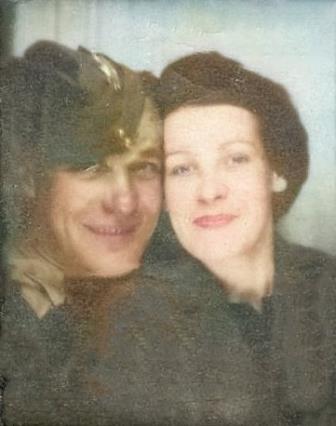
Frank’s niece, Sharon Carvery, the daughter of his sister Margaret Frances Jeffery, sent Pieter a photo, saying “…this is the only picture I could find with Uncle Frank with his sister Aunt Dot…”  Aunt Dot was Frank’s sister Dorothy Donnelly.

After completing his basic training at No. 60 Canadian Army (Basic) Training Centre (CABTC) in Yarmouth, Nova Scotia, Frank was sent to the A14 Canadian Infantry Training Centre (CITC) in Aldershot, Nova Scotia on February 27, 1944 for additional training on various rifles and mortar.

Frank Munroe with his sister Dorothy.  (Photo courtesy of Sharon Carvery. Photo colourization by Pieter Valkenburg)

Upon completion of the courses at A14, he was attached to S-5 Canadian Driving and Maintenance School (CD & M School) in Woodstock, Ontario on May 5, 1944, for a Driver i/c course.  On June 14, 1944, he qualified as a Driver i/c Class III (Wheeled).  (The term ‘Driver i/c’ refers to ‘Driver, internal combustion’.  Class III meant he was qualified to drive heavy trucks and armoured cars, but not tanks.)

He was reassigned back to A14 CITC in Aldershot in preparation for overseas service, before being granted embarkation leave from June 23, 1944 until July 6, 1944, the last chance he would have to see his family before going overseas.

….Frank left Canada for overseas service….

On July 21, 1944, Frank left Canada for the United Kingdom.  Upon arriving on July 27, 1944, he was assigned to No. 4 Canadian Infantry Reinforcement Unit (CIRU). 

Unfortunately, on August 4, 1944, while in England, he failed to requalify as a Driver i/c Class III (Wheeled), and was “…remustered for general duty…” according to his service file.

On August 16, 1944 he was assigned to the X-4 reinforcement list of No. 2 Canadian Base Reinforcement Group (CBRG) and shipped to France, arriving the following day. 

Frank joined the Stormont, Dundas & Glengarry Highlanders in Trun, France.  (Map source: DuckDuckGo)

On August 22, 1944, he was transferred to the Stormont, Dundas & Glengarry Highlanders Regiment, joining them in Normandy, France, where they were based in Trun, following a heavy day of fighting by the Regiment, which had resulted in a number of casualties.  The next day the Regiment moved north of Trun. 

Frank remained with the Regiment as it fought across France, and into The Netherlands.  It was in Nijmegen to relieve the airborne troops, and helped guard the bridge while the Rhine crossing was prepared. The Regiment then fought through the Hochwald in Germany, and continued north as it prepared to cross the Ems River and take the city of Leer on April 28, 1945, in what became known as Operation Duck.

…Operation Duck…

Map showing the Ems and Leda Rivers, and position of Regiments during the Battle for Leer.  (Map courtesy of and ©Jan Braakman)

In the plan for Operation Duck, the North Nova Scotia Highlanders would cross the Leda River in assault boats and secure the northern bank of the river in preparation for the attack to capture Leer. The Highland Light Infantry of Canada would cross the Leda River at the point where the Ems and Leda rivers meet. The Stormont, Dundas and Glengarry Highlanders would go across the Ems River towards the western edge of Leer.

These three Regiments were part of the 9th Canadian Infantry Brigade.  (See https://www.canadiansoldiers.com/history/battlehonours/northwesteurope/leer.htm)

While the men from the Highland Light Infantry all crossed safely, the North Nova Scotia Highlanders lost 5 men, and the Stormont, Dundas & Glengarry Highlanders lost 19.  It was a terrible tragedy, so close to the end of the war. 

To see what an assault boat looks like, take a look at this short YouTube video, which shows troops preparing to cross the Ems: 

…Why Operation Duck Was Important…

A translated excerpt from Jan Braakman’s ‘Holtense Canadezen’ explained why Operation Duck was important. “…At the end of April 1945, Canadian troops stood just across the Dutch-German border in Ostfriesland (East Frisia) in front of the river Ems….” (See https://en.wikipedia.org/wiki/East_Frisia)

Leer was a challenge to capture. “…The town of Leer was on the other side of the river on the route to Emden. Surrounded by inaccessible lowlands in the north and with rivers (Ems and Leda) in the west and south, Leer was a well defensible and therefore difficult to capture port city. All access bridges over the Ems and Leda were blown up by the Germans. For the Canadians there was no other option than to reach the city by water….

River crossings can be tricky due to currents and tides, and in wartime, there is always the risk of enemy fire.  “….The Ems River has an open connection with the Wadden Sea, which means that tides influence water levels and currents in the river. Tides made the currents unpredictable, and the Canadian Army didn’t have accurate information about the tides. What was clear: high tide was the best time to make the crossing. Aerial photographs showed that German troops had fortified themselves well behind the dikes that surrounded the city…. 

A decision was made on how to cross the two rivers – the Leda and the Ems.. “ Only under the protection of a smoke screen and solid artillery support would it be possible to successfully complete the attack on Leer, using boats … General Simonds ordered that on April 28, 1945, before darkness fell, there had to be a solid bridgehead, from which the capture of Leer could be initiated. That meant that the attack had to be launched during the middle of the day, around three o’clock, when the water level was at its highest…” 

The Highland Light Infantry crossed safely “ at the point where the Leda flows into the Ems, about three kilometres south of the city centre…

The other two regiments ran into trouble.  “…The crossing was made at three different places. At the same time, artillery fire and attacks from the air put the German defence line to the test. The North Nova Scotia Highlanders would cross the Leda from the south bank and take the harbour of Leer, which abutted the city on a peninsula…

…The Stormont, Dundas & Glengarry Regiment ran into trouble…

The Stormont, Dundas & Glengarry Highlanders Regiment was to cross the Ems River “…from the west bank of the Ems at Bingum to attack the city from the west.…

All three Regiments launched their attacks at the same time.  “….It began at half past two with fierce shelling, during which the positions of the German defence forces were fired upon. The attack from the south was spectacular and successful, with relatively few losses….

This wasn’t the case for the attack from the west. “….A number of boats….” from the Stormont, Dundas & Glengarry Highlanders Regiment “…showed motor defects or capsized. Some of the drowning men were rescued, but at the end of the day at least nineteen men from the Regiment were dead, drowned, or missing….

….Why did the men drown?….

After WWII ended “a team from the Stormont, Dundas & Glengarry Highlanders returned to the Ems. They dragged the river, looking for the bodies of the missing men. Some of them were found with their full kit still attached to their bodies….

Why did the men drown?  In ‘River Assault – Operation Duck: The 3rd Canadian Infantry Division’s Attack On Leer 28th April 1945’, author John Sliz noted that “…These men sank, never to rise again, even though life belts were worn.  The reason for this was the heavy equipment worn by the men was too much for the life belt that was used….

Sliz quotes from a report by Brigadier John M. Rockingham.  “…The equipment was worn….. in such a way that the waist belt alone had to be unbuckled to permit the soldier to shake it free. There was, however, a tendency for this equipment to slide down the arms, pressing them into the side, preventing any swimming motion, until it was finally clear….”  It would have been like trying to swim while wearing a straightjacket!

….Frank was one of the fatalities….

Major J.A. Forman and Lance Corporal V. C. Abrams, who survived the crossing, had recorded in their witness statements that at “….approximately 15:15 hours on April 28, 1945….” They were in an assault boat “…crossing the Ems River in the assault on Leer.  Enemy fire sunk the craft….” and 10 men were “…thrown into the river…

In the ‘Drama on the Ems’ chapter, a third survivor listed was Private Whitcombe. The three survivors “…explained what had happened to the boat in which they tried to get across. They were in an assault boat with fourteen men. Their boat ran into problems because the gunner in the front of the boat (the bow man) almost fell overboard, possibly because he was hit. The man was hanging over the bow.  Perhaps because of that, but at least practically at the same time, the prow of the storm boat dipped after being sucked into the bow wave of the boat ahead. In a matter of seconds their boat disappeared under water and the crew was in the cold river water.….

Frank was one of the 10 men who drowned, losing his life at the age of 22.

….Frank is buried in the Canadian War Cemetery in Holten….

Frank was originally buried in Bingum, Germany, before being reburied on March 26, 1946 in the Canadian War Cemetery in Holten, The Netherlands.

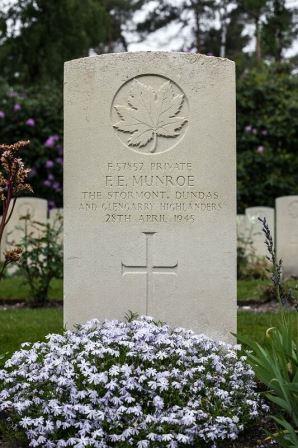
Grave of Frank Eugene Munroe in the Canadian War Cemetery in Holten, The Netherlands.  (Photo courtesy of Canadian Virtual War Memorial)

In November 1947, Frank’s grave was adopted by Mr. Arend Jan Markerink from Almelo, The Netherlands. He sent a letter, plus an international postage reply coupon, to the Department of National Defence, asking for Frank’s next of kin to be notified.  A note in the file stated that the letter and postage reply coupon were sent to the family on December 9, 1947.

….Other soldiers from the Stormont Dundas Glengarry Highlanders who lost their lives that day…

In addition to Frank Eugene Munroe, 18 more soldiers from the Stormont, Dundas and Glengarry Highlanders lost their lives on April 28, 1945, and are listed below.  If there are asterisks beside the name (****) it means there is a brief anecdote in the ‘Drama On the Ems’ chapter in ‘Holten Heroes: Stories from a Canadian Field of Honour’. 

  • A/Cpl John SAWATSKY of Petaigan, Saskatchewan, aged 20
  • L/Cpl Merle Coleman MOORE of Breckenridge Station, Quebec
  • L/Cpl James Edward SULLIVAN of Rexton, New Brunswick, aged 28 ****
  • Pte Frank Joseph BIERNASKI of Barry’s Bay, Ontario, aged 32 ****
  • Pte Walter James BROOKS of Toronto, Ontario, aged 28
  • Pte Leonard Gordon BROUGH of Sudbury, Ontario, aged 21**** 
  • Pte Steven John GRAVELLE of Peterborough, Ontario, aged 23
  • Pte Joseph Gerard HINDS of Orillia, Ontario, aged 20
  • Pte Earl Harcourt JOSLIN of Kingston, Ontario ****
  • Pte Ira Charles LANGILLE of Milton, Nova Scotia, aged 32 ****
  • Pte Cecil Albert LAWES of Frankford Ontario, aged 28
  • Pte Sidney Alexander OSLUND of Haileybury, Ontario, aged 29 ****
  • Pte Samuel Donald POWELL of Newcastle, Ontario, aged 22
  • Pte Edgar Douglas SMITH of Parrsboro, Nova Scotia, aged 28 ****
  • Pte Francis Wilber SPENCER of Stonecliffe, Ontario, aged 35 ****
  • Pte Jack Allan STEWARD of Belleville, Ontario, aged 24 ****
  • Pte Roy Ivenson THACKERAY of Peterborough, Ontario, aged 20 ****
  • Pte George Sidney WAKELY of Port Hope, Ontario, aged 31****

….A Tragic Drowning On The Leda River….

As mentioned in the ‘Holten Heroes’ excerpt, the crossing of the rivers to reach Leer involved three Regiments – Stormont Dundas and Glengarry Highlanders, North Nova Scotia Highlanders, and the Highland Light Infantry. 

The North Nova Scotia Highlanders were tasked with crossing the Leda River from the south bank and then take the harbour of Leer.  5 soldiers from this Regiment lost their lives when the storm boat they were in capsized, and their stories were told in previous blog postings as a 4 part series:

….Blog posting about another soldier mentioned in the book Holten Heroes…

Thank you to Jan Braakman for permission to quote from his book and use of the map showing the position of the Regiments, and to Sharon Carvery for a providing a photo of her uncle.  If you have a story or photo to share, please contact Pieter at memorialtrail@gmail.com or comment on the blog. 

© Daria Valkenburg

….Want to follow our research?….

If you are reading this posting, but aren’t following our research, you are welcome to do so.  Our blog address: https://onthewarmemorialtrail.com/

4 countries, 6 weeks, 7,000 km – an unforgettable war memorial journey in Europe…. Daria’s book ‘No Soldier Buried Overseas Should Ever Be Forgotten‘ is available in print and e-book formats.  Net proceeds of book sales help support research costs and the cost of maintaining this blog. For more information see https://nosoldierforgotten.com/

You are also invited to subscribe to our YouTube Channel: On The War Memorial Trail With Pieter Valkenburg: https://www.youtube.com/channel/UCJ591TyjSheOR-Cb_Gs_5Kw

Never miss a posting!  Subscribe below to have each new story from the war memorial trail delivered to your inbox.

On The War Memorial Trail…..Tragedy On The Ems Part 1: The WWII Soldier From Rexton Who Drowned During Operation Duck

March 5, 2025. In 2021, during a period when we were all at home due to Covid, we translated, into English, ‘Holtense Canadezen’, Jan Braakman’s book about some of the soldiers buried in the Canadian War Cemetery in Holten, The Netherlands.  In October 2023, this was published in English as ‘Holten Heroes: Stories from a Canadian Field of Honour’.  (See https://onthewarmemorialtrail.com/2023/11/01/new-book-about-soldiers-buried-in-the-canadian-war-cemetery-in-holten-the-netherlands/)

The chapter ‘Drama On The Ems’ was about a tragic incident during the Battle of Leer in Germany on April 28, 1945, one of the final actions to end WWII in Europe. Operation Duck, which involved the crossing of the Ems and Leda rivers in northern Germany in order to take the port of Leer, turned out very badly for 19 men of the Stormont, Dundas and Glengarry Highlanders Regiment. 

Two Maritime soldiers mentioned in the chapter, one from Nova Scotia, and one from New Brunswick, were on the photo wish list from the Canadian War Cemetery in Holten, The Netherlands.  Pieter was successful in finding family and a photo of these men, who were both with the Stormont, Dundas and Glengarry Highlanders. 

…..James is remembered on a plaque in the United Church in Rexton….
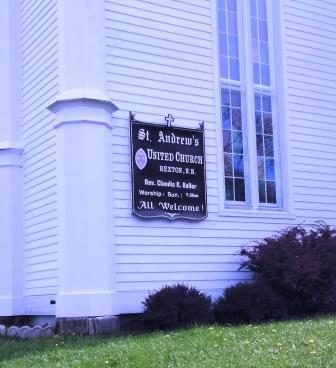
St. Andrew’s United Church in Rexton, New Brunswick.  (Photo credit: Daria Valkenburg)

James Edward SULLIVAN, from Rexton, New Brunswick, was one of the Maritimers. In a serendipitous coincidence, we’d visited Rexton to meet the family of another soldier – Janice Little and Gayle McBeath, nieces of WWII trooper Stanley Leigh MCBEATH. They took us to St. Andrew’s United Church, where Stanley’s name was listed on a plaque on the church organ. Then we noticed that James was also listed on the plaque! (See https://onthewarmemorialtrail.com/2024/02/03/on-the-war-memorial-trail-the-wwii-trooper-from-rexton-who-lost-his-life-three-days-before-his-birthday/)

James Sullivan and Stanley McBeath are listed on a memorial plaque on the organ in St Andrew’s United Church in Rexton.  (Photo credit: Daria Valkenburg)

….James’s niece had a photo!….
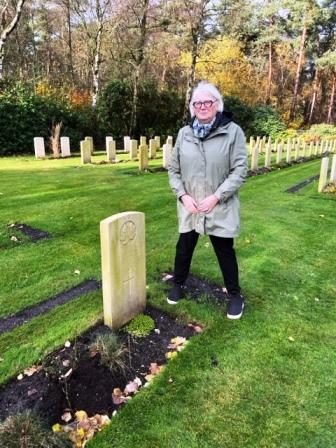
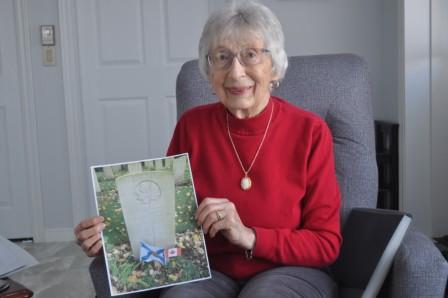
Barbara Sullivan at the grave of her uncle, James Sullivan, buried in the Canadian War Cemetery in Holten, The Netherlands.   (Photo courtesy of Barbara Sullivan)

Born July 7, 1919 in Main River, New Brunswick, James was the son of Edward and Augusta Sullivan. James had a younger brother, Kenneth, and it was through Kenneth’s daughter, Barbara Sullivan, that a photo was found, after she’d been contacted by Janice Little.  “I’m the niece of L/Corporal James Edward Sullivan of The Stormont, Dundas and Glengarry Highlanders.  I never knew him, he died a long while before I was born. His brother Kenneth is my dad.  Both of my parents passed away in 2001….”  Barbara wrote.

…..James enlisted under the NRMA in 1941….
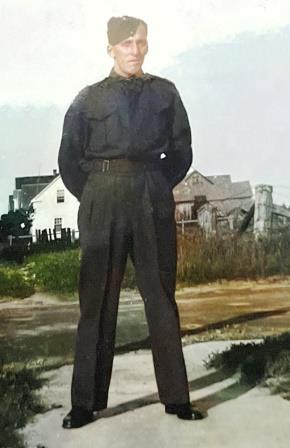
James Edward Sullivan. (Photo courtesy of the Sullivan Family.  Photo colourization by Pieter Valkenburg)

James originally enlisted under the National Resources Mobilization Act (NRMA) at the No. 7 NRMA Clearing Depot in Fredericton, New Brunswick on March 20, 1941 and began basic training at No. 70 Canadian Army Basic Training Centre in Fredericton. At the time, he stated he was employed as a truck driver and sawyer for a lumber company. (See https://en.wikipedia.org/wiki/National_Resources_Mobilization_Act)

On May 20, 1941, he was transferred to A1 Canadian Artillery Training Centre (CATC) at Camp Petawawa, Ontario for further training.  On July 26, 1941, he was sent to A23 Coast Defence and Anti-Aircraft Artillery Advanced Training Centre (C&AAATC) in Halifax, Nova Scotia for a few weeks.  The centre trained coast and anti-aircraft gunners. 

Next, James was attached to 1st (Halifax) Coast Brigade of the Royal Canadian Artillery in Halifax on August 21, 1941, which was responsible for providing coastal artillery support as part of the defences of Halifax, Nova Scotia.  

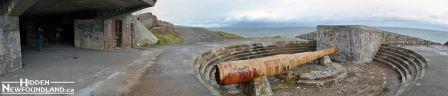
Devil’s Battery.  (Photo source: https://hmhps.ca)

On September 26, 1941, he was attached as a gunner to the 53rd Coast Battery of the 1st (Halifax) Coast Brigade, part of the defence of Devil’s Battery, and remaining there even after joining the active army in Halifax on February 1, 1942. 

James was sent back to A23 Coast Defence and Anti-Aircraft Artillery Advanced Training Centre (C&AAATC) in Halifax on August 31, 1942 for further training. After completing Range Takers Course No. 5 on October 10, 1942, he returned to the 53rd Coast Battery.

….James served in Newfoundland….

Cape Spear Battery.  (Photo source: https://www.hiddennewfoundland.ca)

On February 12, 1943, James was transferred to the 103rd Coast Battery of the Royal Canadian Artillery and sent to St. John’s, Newfoundland. Based at Cape Spear, the most eastern point in North America, the Battery was responsible for maintaining the 10″ guns.

Cape Spear’s close proximity to convoy routes and the entrance to St. Johns Harbour was an essential place to have a coastal defense battery, post-war signal station, and searchlight emplacement during World War II. (NOTE: Newfoundland and Labrador joined Canada on March 31, 1949.)

On November 18, 1943, James left Newfoundland for Shelburne, Nova Scotia and was transferred to the 104th Coast Battery of the Royal Canadian Artillery (RCA).

….James was transferred to the infantry….

On January 14, 1944, James was assigned to No. 1 Transit Camp in Windsor, Nova Scotia for preparation before being sent overseas.  However, instead of going overseas immediately, he was transferred to No. 60 Canadian Infantry (Basic) Training Centre (CIBTC) in Yarmouth, Nova Scotia for additional training.

Then, on April 9, 1944, he was sent to A14 Canadian Infantry Training Centre at Camp Aldershot, Nova Scotia for final preparations before going overseas. 

James was granted embarkation leave from June 2 to June 15, 1944, the last chance he had to see his family again.

….James left Canada for overseas service….

On June 25, 1944, James left Canada for the United Kingdom. Upon arriving on July 3, 1944 he was assigned to No. 4 Canadian Infantry Reinforcement Unit (CIRU). 

He continued his training for a few weeks before being transferred to the X-4 reinforcement list of the Canadian Infantry Corps (CIC), on July 26, 1944.  Three days later he was on his way to France, disembarking on July 30, 1944.

On July 31, 1944 he was assigned to the Stormont, Dundas and Glengarry Highlanders, part of the 21st Army Group, joining the Regiment in the vicinity of Le Vey, France, 23 km (14 miles) northwest of Falaise.  The Regiment needed downtime to get reorganized and to give the men a chance to train and have a rest following heavy fighting since landing in Normandy on D-Day.

He received a promotion to Lance Corporal a few weeks later, on August 19, 1944.  James remained with the Regiment as it fought across France, and into The Netherlands.  It was in Nijmegen to relieve the airborne troops, and helped guard the bridge while the Rhine crossing was prepared. The Regiment then fought through the Hochwald in Germany, and then north as it prepared to cross the Ems River and take the city of Leer on April 28, 1945, in what became known as Operation Duck.

… Operation Duck…

In the plan for Operation Duck, the Stormont, Dundas and Glengarry Highlanders would go across the Ems River towards the western edge of Leer. At the same time, the North Nova Scotia Highlanders would cross the Leda River in assault boats and secure the northern bank of the river in preparation for the attack to capture Leer. The Highland Light Infantry of Canada would cross the Leda River, where the Ems and Leda rivers meet.

These three Regiments were part of the 9th Canadian Infantry Brigade.  (See https://www.canadiansoldiers.com/history/battlehonours/northwesteurope/leer.htm)

While the men from the Highland Light Infantry all crossed safely, the North Nova Scotia Highlanders lost 5 men, and the Stormont, Dundas & Glengarry Highlanders lost 19.
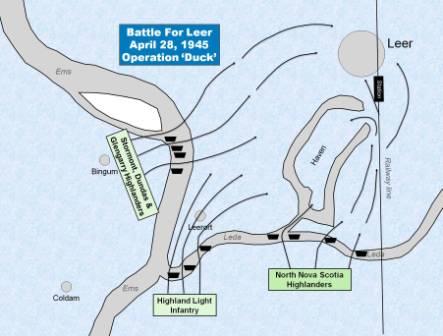
Map showing the Ems and Leda Rivers, and position of Regiments during the Battle for Leer.  (Map courtesy of and ©Jan Braakman)

…Why Operation Duck Was Important…
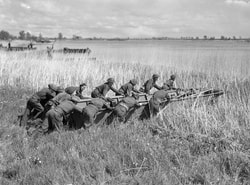
A Storm boat is moved into the water during Operation Duck on April 28, 1945. (Photo source: Library and Archives Canada)

A translated excerpt from Jan Braakman’s ‘Holten Heroes: Stories from a Canadian Field of Honour’ explained why Operation Duck was important. “…At the end of April 1945, Canadian troops stood just across the Dutch-German border in Ostfriesland (East Frisia) in front of the river Ems….” (See https://en.wikipedia.org/wiki/East_Frisia)

Leer was a challenge to capture. “…The town of Leer was on the other side of the river on the route to Emden. Surrounded by inaccessible lowlands in the north and with rivers (Ems and Leda) in the west and south, Leer was a well defensible and therefore difficult to capture port city. All access bridges over the Ems and Leda were blown up by the Germans. For the Canadians there was no other option than to reach the city by water….

River crossings can be tricky due to currents and tides, and in wartime, there is always the risk of enemy fire.  “….The Ems River has an open connection with the Wadden Sea, which means that tides influence water levels and currents in the river. Tides made the currents unpredictable, and the Canadian Army didn’t have accurate information about the tides. What was clear: high tide was the best time to make the crossing. Aerial photographs showed that German troops had fortified themselves well behind the dikes that surrounded the city…. 

A decision was made on how to cross the two rivers – the Leda and the Ems.. “ Only under the protection of a smoke screen and solid artillery support would it be possible to successfully complete the attack on Leer, using boats … General Simonds ordered that on April 28, 1945, before darkness fell, there had to be a solid bridgehead, from which the capture of Leer could be initiated. That meant that the attack had to be launched during the middle of the day, around three o’clock, when the water level was at its highest…” 

The Highland Light Infantry crossed safely “ at the point where the Leda flows into the Ems, about three kilometres south of the city centre…

The other two regiments ran into trouble.  “…The crossing was made at three different places. At the same time, artillery fire and attacks from the air put the German defence line to the test. The North Nova Scotia Highlanders would cross the Leda from the south bank and take the harbour of Leer, which abutted the city on a peninsula…

…The Stormont, Dundas & Glengarry Highlanders Regiment ran into trouble…

The Stormont, Dundas & Glengarry Highlanders Regiment was to cross the Ems River “…from the west bank of the Ems at Bingum to attack the city from the west.…” 

All three Regiments launched their attacks at the same time.  “….It began at half past two with fierce shelling, during which the positions of the German defence forces were fired upon. The attack from the south was spectacular and successful, with relatively few losses…. 

This wasn’t the case for the attack from the west. “….A number of boats….” from the Stormont, Dundas & Glengarry Highlanders Regiment “…showed motor defects or capsized. Some of the drowning men were rescued, but at the end of the day at least nineteen men from the Regiment were dead, drowned, or missing….

….James was one of the fatalities….

After WWII ended “a team from the Stormont, Dundas & Glengarry Highlanders returned to the Ems. They dragged the river, looking for the bodies of the missing men. Some of them were found with their full kit still attached to their bodies….

Sergeant G.W. McGill, who survived the crossing, had reported that at “….approximately 15:30 hours, 28-April-1945, I was crossing the river Ems in an assault craft during the attack on Leer. Suddenly, the nose of our craft dipped and the craft overturned and we were all thrown into the water. I came to the surface and was picked up by another assault craft, along with Cpl W.M.J. Wood. We cruised around for approximately ten minutes, but we could not see Sullivan anywhere. A check on the shore by the platoon commander indicated that Sullivan, Brough, and Oslund were missing….

James was not found until almost the end of May 1945.  “….25 year-old James E. Sullivan was …. initially reported missing. On May 28, his family was informed by telegram that ….” his body had been found.

….James is buried in the Canadian War Cemetery in Holten….

James was originally buried in Oldenburg, Germany, before being reburied in 1946 in the Canadian War Cemetery in Holten, The Netherlands.
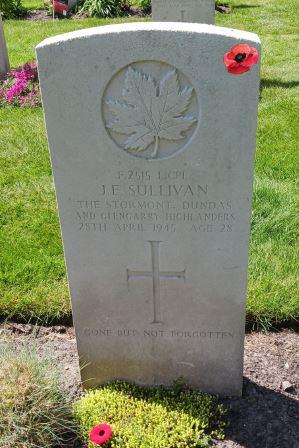
Grave of James Edward Sullivan in the Canadian War Cemetery in Holten, The Netherlands.  (Photo courtesy of Canadian Virtual War Memorial)

….Other soldiers from the Stormont Dundas Glengarry Highlanders who lost their lives that day…

In addition to James Edward Sullivan, 18 more soldiers from the Stormont, Dundas and Glengarry Highlanders lost their lives on April 28, 1945, and are listed below.  If there are asterisks beside the name (****) it means there is a brief anecdote in the ‘Drama On the Ems’ chapter in ‘Holten Heroes: Stories from a Canadian Field of Honour’. 

  • A/Cpl John SAWATSKY of Petaigan, Saskatchewan, aged 20
  • L/Cpl Merle Coleman MOORE of Breckenridge Station, Quebec, aged 22
  • Pte Frank Joseph BIERNASKI of Barry’s Bay, Ontario, aged 32 ****
  • Pte Walter James BROOKS of Toronto, Ontario, aged 28
  • Pte Leonard Gordon BROUGH of Sudbury, Ontario, aged 21**** 
  • Pte Steven John GRAVELLE of Peterborough, Ontario, aged 23
  • Pte Joseph Gerard HINDS of Orillia, Ontario, aged 20
  • Pte Earl Harcourt JOSLIN of Kingston, Ontario, aged 34****
  • Pte Ira Charles LANGILLE of Milton, Nova Scotia, aged 32 ****
  • Pte Cecil Albert LAWES of Frankford, Ontario, aged 28
  • Pte Frank Eugene MUNROE of Halifax, Nova Scotia, aged 22  
  • Pte Sidney Alexander OSLUND of Haileybury, Ontario, aged 29 ****
  • Pte Samuel Donald POWELL of Newcastle, Ontario, aged 22
  • Pte Edgar Douglas SMITH of Parrsboro, Nova Scotia, aged 28 ****
  • Pte Francis Wilber SPENCER of Stonecliffe, Ontario, aged 35 ****
  • Pte Jack Allan STEWARD of Belleville, Ontario, aged 24 ****
  • Pte Roy Ivenson THACKERAY of Peterborough, Ontario, aged 20 ****
  • Pte George Sidney WAKELY of Port Hope, Ontario, aged 31****

….A Tragic Drowning On The Leda River….

As mentioned in the ‘Holten Heroes’ excerpt, the crossing of the rivers to reach Leer involved three Regiments – Stormont Dundas and Glengarry Highlanders, North Nova Scotia Highlanders, and the Highland Light Infantry. 

The North Nova Scotia Highlanders were tasked with crossing the Leda River from the south bank and to then take the harbour of Leer.  5 soldiers from this Regiment lost their lives when the storm boat they were in capsized. Their stories were told in previous blog postings as a 4 part series:

….Blog posting about another soldier mentioned in the book Holten Heroes…

Tragedy On The Ems Part 2 will be about the other Maritimer on the photo wish list:  Frank Eugene MUNROE of Halifax, Nova Scotia.

Thank you to Jan Braakman for permission to quote from his book and use of the map showing the position of the Regiments, with translation into English by Pieter and Daria Valkenburg, and to Barbara Sullivan for sharing a photo of her uncle. If you have a story or photo to share, please contact Pieter at memorialtrail@gmail.com or comment on the blog. 

© Daria Valkenburg

….Want to follow our research?….

If you are reading this posting, but aren’t following our research, you are welcome to do so.  Our blog address: https://onthewarmemorialtrail.com/
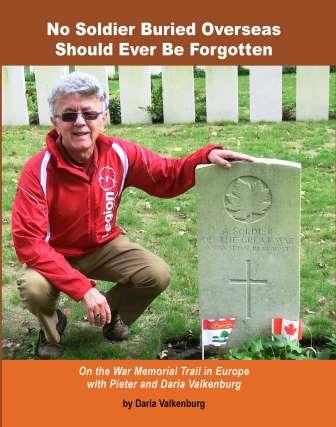
4 countries, 6 weeks, 7,000 km – an unforgettable war memorial journey in Europe…. Daria’s book ‘No Soldier Buried Overseas Should Ever Be Forgotten‘ is available in print and e-book formats.  Net proceeds of book sales help support research costs and the cost of maintaining this blog. For more information see https://nosoldierforgotten.com/

You are also invited to subscribe to our YouTube Channel: On The War Memorial Trail With Pieter Valkenburg: https://www.youtube.com/channel/UCJ591TyjSheOR-Cb_Gs_5Kw

Never miss a posting!  Subscribe below to have each new story from the war memorial trail delivered to your inbox.
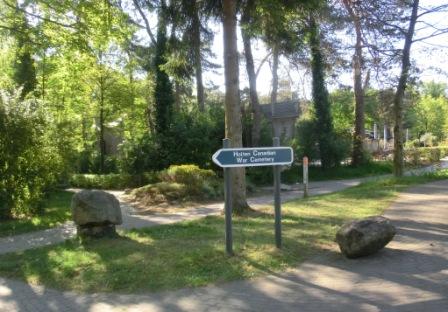
On The War Memorial Trail….. The WWII Signaller From Oxford Who Was Fatally Wounded in Sögel
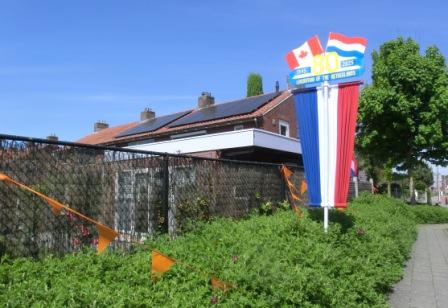
January 25, 2025. When Pieter begins research into a soldier’s file to find family members who might have a photo, he never knows what to expect. Sometimes, serendipity smiles, as he explained to colleagues in The Netherlands about what happened last fall in researching a WWII soldier from Nova Scotia.

 “…A few days ago I started trying to find a photo of George Allan Buchanan of Nova Scotia…” Pieter wrote.  “… When I looked at his estate form, my heart sank a little. He was married but had no children. Both parents died early. He had a half-sister, Jean Anderson, and that was all. However, I found her obituary from 2012. She was married to Gerald Allen and they had 3 sons and 3 daughters. I chose one of the daughters, Ramona Emslie, and called her in Nova Scotia and – you won’t believe it – but she had a picture!…” (Translation from the original Dutch.) 

Not long after Pieter received a photo, we were in Nova Scotia, and visited with Ramona and her husband Roger. Not only did we learn more about George, we were also treated to the most delicious apple pie!

Pieter (left) with Ramona and Roger Emslie.  (Photo credit: Daria Valkenburg)

.….George was born in Oxford – the wild blueberry capital of Canada….

Sign for the turn-off to Oxford, Nova Scotia.  (Photo credit: Daria Valkenburg)

Born in Oxford, Nova Scotia on September 9, 1914, George Allan BUCHANAN was the son of George Allen and Margaret Jennie (nee Redmond) Buchanan.  George’s father died while he was a child, and his mother remarried in 1926 to Orval ‘Orlo’ Anderson.   

At the time of his enlistment with the 1st Anti-Aircraft Battery in Dartmouth, Nova Scotia, on August 8, 1940, George was working as a farmer for Geo Chase of Port Williams, and was also a carpenter.  He and his wife, Nancy Eva, who he’d married on December 18, 1939, were living in Lower Canard, Nova Scotia.

George Allan Buchanan lived in Lower Canada and worked for a farmer from Port Williams at the time of his enlistment in August 1940.  (Map source: DuckDuckGo)

….George served on the West Coast as part of Pacific Command….

George Allan Buchanan.  (Photo courtesy of Ramona Emslie.  Photo colourization Pieter Valkenburg)

On January 11, 1942, George was attached to the 5th (BC) Coast Brigade of the Royal Canadian Artillery (RCA) and the No. 11 District Depot in Vancouver, British Columbia, remaining there until May 1, 1942, when he was posted to the 9th Anti-Aircraft Battery of the RCA in Sidney, British Columbia.  On October 9, 1942 he was assigned to the 27th Anti-Aircraft Regiment in Esquimalt, British Columbia.  

George’s West Coast posting was part of Pacific Command, which had two key functions.  The major function was to strengthen and administer home defence facilities on Canada’s Pacific Coast against possible Japanese attack. A second function was to train reinforcements to be sent to the Canadian divisions in Europe. 

On November 1, 1942 George was sent to the Coast Artillery School of Instruction in Esquimalt, for a Heavy Anti-Aircraft Artillery course, which he completed on December 12, 1942.  

George was transferred to the No. 1 Transit Camp in Windsor, Nova Scotia on August 8, 1943 for further training. 

….George was sent for a driver operator course ….

On October 29, 1943, George was transferred to A2 Canadian Army Training Centre (CATC) in Petawawa, Ontario.  As of December 17, 1943 he was attached to A7 Canadian Signal Training Centre (CSTC) at Camp Barriefield, Ontario for a Driver Operator Course, after having qualified as a Driver Class III on December 10, 1943.  Class III meant he was qualified to drive heavy trucks and armoured cars, but not tanks. 

On March 25, 1944, he had qualified as a Driver Operator Class ‘C’. He then returned to A2 Canadian Army Training Centre (CATC) in Petawawa on March 31, 1944.

On April 29, 1944, George was given embarkation leave until May 12, 1944, the last chance he had to see his family. 

….George left Canada for overseas service….

After returning from his embarkation leave, George was sent to the No. 1 Training Brigade in Debert, Nova Scotia on June 14, 1944 for final training in preparation for overseas service. 

George left Canada on June 26, 1944, arriving in the United Kingdom on July 4, 1944, and assigned to No. 1 Canadian Army Reinforcement Unit (CARU). He continued to take courses, to upgrade his skills as a Driver Operator.

On October 16, 1944, George was assigned to the X-4 Reinforcement list of the Royal Canadian Artillery, and left the United Kingdom the following day, arriving in Belgium on October 18, 1944.   

….George was transferred to the 23rd Field Regiment….

On November 18, 1944, George was transferred to the 23rd Field Regiment of the Royal Canadian Artillery, joining them in Boxtel, The Netherlands.

In ‘The History of the 23rd Canadian Field Regiment (SP) RCA’, the Regiment was on a rest period following heavy fighting, and making “….a frantic attempt to get the guns calibrated despite horrible weather conditions….”  (Note: SP refers to self-propelled)

A self-propelled gun.  (Photo source: Kevin T of WW2Talk)

On December 6, 1944, the Regiment “…moved back into the line….” near ‘s-Hertogenbosch.  “…We were now living once more in a veritable “buzz-bomb alley” as the Germans intensified their efforts to knock out the port of Antwerp and render it useless to the Allies….

An excerpt from a compilation booklet from ‘The 23rd Field Regiment (SP) Royal Canadian Artillery Official SP Weekly’ included a brief description of George.  “…He was attached to the 36th Battery, as a Signaller, and was soon rated as an efficient, conscientious soldier, who did his assigned job quietly and well. It was not long before the boys were calling him ‘Buck’….

.….The 23rd Field Regiment moved into Germany in February 1945….

In February 1945, the History recorded that “about the middle of February the news arrived that we were to have a part in the next operation which would bring the forces of 21 Army Group to the banks of the Rhine – and possibly win the war then and there…

By February 22, 1945, the Regiment was in the Reichswald Forest in Germany, in place for Operation Blockbuster.  (See https://en.wikipedia.org/wiki/Operation_Blockbuster) “….In preparation for the attack the Regiment left the concentration area on the night of the 24th and moved south to deploy near Louisendorf. The roads were in terrible condition, and the heavy volume of traffic which had to roll over them ceaselessly only made matters worse. On the first deployment most of the soft vehicles were left in concentration areas back along the road, partly due to bad traffic conditions and partly due to enemy shelling in the more forward areas….

Then, “….on the 27th the Regiment made another move, going into action just east of Keppeln….”  The Regiment fought their way through Germany in March and into April. 

.….George was fatally wounded in Sögel….

The History explained that “…at the crack of dawn on April 9th the Regiment was on the road again, but had to spend two hours sitting on the road before crossing the canal into Meppen and striking north along the canal to Lathen. Then the axis of the advance swung east until we reached Sögel…

The Regiment was successful in taking the town of Sögel in Niedersachsen on April 9, 1945, but the following day the Germans made an unexpected counterattack.  “….The Regiment was getting packed in anticipation of another move when small arms fired began to whistle around the area….. Then mortars started dropping in to the area…. It was a counter-attack and there didn’t appear to be any infantry in front of us…

Just after 9:30 am, George was seriously injured in the fighting that had ensued, receiving shrapnel wounds in his left thigh and lower abdomen. “….Every man in the battery did an excellent job in beating off this first major counter-attack ever suffered by the unit. But although it was successfully repelled, three men paid the supreme sacrifice. They were Lieut. Doug Denton who was wounded as he lifted a casualty into a half-track and died next day, Gnr. George Buchanan who died later that day, and Gnr. Vic Hubacheck who was instantly killed by a ricochet bullet. Four or five other lads were wounded….

George was initially treated at a Field Dressing Station, before being transported to the Canadian military hospital in Almelo, The Netherlands.  Unfortunately, the medical report stated that he was dead on arrival at 9:40 pm that evening.  He was 31 years old.

.….George is buried in Holten….

George was temporarily buried in Almelo, before being reburied in the Canadian War Cemetery in Holten, The Netherlands on February 4, 1946.

Grave of George Allan Buchanan in the Canadian War Cemetery in Holten, The Netherlands.  (Photo courtesy of Canadian Virtual War Memorial)

….George’s grave was adopted by Jo Visschers of Bathmen ….

After his reburial in the Canadian War Cemetery in Holten, George’s grave was adopted by Jo Visschers of Bathmen, The Netherlands.  Jo’s letter advising of the grave adoption was forwarded to George’s widow in March 1948 by the Department of Veterans Affairs.

Thank you to Ramona and Roger Emslie for providing photos and information, to Kevin T of WW2Talk, and to Edwin van der Wolf, a volunteer at the Canadian War Cemetery in Holten, for sending us an account of what happened in Sögel in No. 156-April 2016 ‘Informatieblad Over Verdedigingswerken En Militaire Geschiedenis – De Opmars Van De Canadezen In Noordwest Duitsland’ (Information Sheet On Defensive Works And Military History – The Rise Of The Canadians In Northwest Germany).

If you have a story or photo to share, please contact Pieter at memorialtrail@gmail.com or comment on the blog. 

© Daria Valkenburg

….Want to follow our research?….

If you are reading this posting, but aren’t following our research, you are welcome to do so.  Our blog address: https://onthewarmemorialtrail.com/

4 countries, 6 weeks, 7,000 km – an unforgettable war memorial journey in Europe…. Daria’s book ‘No Soldier Buried Overseas Should Ever Be Forgotten‘ is available in print and e-book formats.  Net proceeds of book sales help support research costs and the cost of maintaining this blog. For more information see https://nosoldierforgotten.com/

You are also invited to subscribe to our YouTube Channel: On The War Memorial Trail With Pieter Valkenburg: https://www.youtube.com/channel/UCJ591TyjSheOR-Cb_Gs_5Kw

Never miss a posting!  Subscribe below to have each new story from the war memorial trail delivered to your inbox.