On The War Memorial Trail….. An Update On The Story Of WWII Soldier Alphonse Robert

October 12, 2021.   In April 2021, in Part 9 of the Atlantic Canada Remembers series, the story of Alphonse ROBERT of Caraquet, New Brunswick, was briefly told.  His service file had very little information on the circumstances of his death and noted that he died on March 30, 1945 in Germany while serving with Les Fusiliers Mont-Royal, and was buried in Germany. (See https://onthewarmemorialtrail.com/2021/04/15/on-the-war-memorial-trail-atlantic-canada-remembers-part-9/)

Alphonse Robert

Alphonse Robert.  (Photo courtesy of the Robert Family)

Recently we received an email from Maarten Koudijs, who wrote that Alphonse Robert died during an attack on Gendringen, The Netherlands, and was initially buried in Megchelen, The Netherlands, just across the border with Germany.  After additional research to verify what Maarten told us, we have more information on what happened on March 30, 1945.

…Was Alphonse Robert buried in The Netherlands or Germany?….

Map Megchelen

The first question we had was whether Alphonse Robert had been initially buried in Germany, as stated in the service file, or in The Netherlands.  Megchelen is a small village on a tiny hook of land surrounded on three sides by the German border.  It’s easy to understand how a mistake could have been made in the official records, but was Megchelen the correct location?

We contacted Alice van Bekkum, Chair of the Groesbeek Faces to Graves Committee, and asked if she could check the cemetery record and see where Alphonse Robert had been originally buried.

Alice confirmed it was Megchelen.  “I have a list from CWGC with the coordinates of the temporary burial site where the body was exhumed when it was transferred to Groesbeek. It says Megchelen…”  (CWGC refers to Commonwealth War Graves Commission.)  The service file record was incorrect.

…How 5 members of Les Fusiliers Mont-Royal lost their lives….

How did Alphonse Robert lose his life?  Maarten explained that “…during the attack on Gendringen, a number of infantrymen were following a tank. A German shell exploded behind the tank and 5 infantry soldiers were killed.   

The soldiers who immediately lost their lives were Roland Alfred Barry, Edmond Coulombe, Jacques Fortin, and Alphonse Robert. They were temporarily buried, next to each other, in a field grave in Megchelen.  

Bernard Gaston Pilon was seriously injured and was transferred to Bedburg Military Hospital, where he died and was also temporarily buried there….”  Bedburg is in Germany.

All 5 infantrymen from Les Fusiliers Mont-Royal were later reburied in the Canadian War Cemetery in Groesbeek.

Pieter then looked at the War Diary for Les Fusiliers Mont-Royal. On March 29, 1945, the diarist recorded being in the Reichswald Forest.  …Battalion with its F Echelon vehicles crosses the Rhine at night without incident...

On March 30, 1945, the diarist wrote the location as Germany.  “…In the morning troops proceed to positions…Light opposition with intermittent shelling and mortaring...

On March 31, 1945, the diarist still wrote Germany as the location.  “…Battalion sweeps north again against stiffening resistance this time.  Mortaring and shelling. The attack was supported by tanks.  Gendringen was entered…”   Gendringen is in The Netherlands, near Megchelen.

…Two eye-witnesses saw what happened….

In an interview in ‘De Ganzenveer’ (‘The Quill’), Hans Bresser and Rudie Grin, witnesses to the attack, stated that “…At Wieskamp’s house, between Striekwold and Giezen, a Canadian tank was firing. There were also a number of infantrymen. A German shell exploded in between, possibly killing five or more Canadian soldiers. The grenade was…fired from somewhere from the Pol near Ulft. The fallen soldiers were given a field grave in Megchelen on Friesen’s land on the Nieuweweg...”  (Account translated from the original Dutch)

…The other members of Les Fusiliers Mont-Royal who lost their lives….

  • Roland Alfred BARRY, son of Horace and Rose Alma Barry of Montreal, Quebec, died March 30, 1945, aged 20.
  • Edmond COULOMBE, son of Ulric and Yvonne Coulombe, of Pine Falls, Manitoba, died March 30, 1945, aged 22.
  • Jacques FORTIN, son of Henri and Yvonne Fortin, of Chicoutimi, Quebec, died March 30, 1945, aged 21.
  • Bernard Gaston PILON, son of Emile and Emilie Pilon, of Rockland East, Ontario, died March 30, 1945, aged 19.

Thank you to Maarten Koudijs for contacting us with the additional information on Alphonse Robert, and to Alice van Bekkum for verifying that he was previously buried in Megchelen, The Netherlands.

If you have further information to share about Alphonse Robert or the other Canadian soldiers mentioned here, please contact Pieter at memorialtrail@gmail.com or comment on the blog.

Remembrance-Day-2019-Images-1024x520

With Remembrance Week coming up, please take a look through your photo albums and in your attics in case you have a photo or information to share about Canadian soldiers.

© Daria Valkenburg

…..Want to follow our research?….

If you are reading this posting, but aren’t following our research, you are welcome to do so.  Our blog address: https://onthewarmemorialtrail.com/

4 countries, 6 weeks, 7,000 km – an unforgettable war memorial journey in Europe…. Daria’s book ‘No Soldier Buried Overseas Should Ever Be Forgotten‘ is available in print and e-book formats.  Net proceeds of book sales help support research costs and the cost of maintaining this blog. For more information see https://nosoldierforgotten.com/ 

Screenshot_2021-02-27 On The War Memorial Trail With Pieter Valkenburg

You are also invited to subscribe to our YouTube Channel: On The War Memorial Trail With Pieter Valkenburg: https://www.youtube.com/channel/UCJ591TyjSheOR-Cb_Gs_5Kw

Never miss a posting!  Subscribe below to have each new story from the war memorial trail delivered to your inbox.

On The War Memorial Trail….. Remembering WWII Soldier Thomas Beresford Big Canoe

October 7, 2021. After an interview about the photo quest for soldiers buried in the Canadian War Cemeteries in The Netherlands ran on APTN, Pieter was contacted by Pat Stewart about Thomas Beresford BIG CANOE of Georgina Island, Ontario, who is buried in the Canadian War Cemetery in Groesbeek, The Netherlands.

(To read the APTN article, see https://www.aptnnews.ca/national-news/dutch-born-p-e-i-man-on-a-mission-to-find-photos-of-first-nations-soldiers-killed-overseas-in-wwii/)

Pat wrote “I live in southwest Saskatchewan now but came from Ontario 20 years ago. I worked as a journalist for the Georgina Advocate back then. Thank you for what you are doing. It is so very important to remember….” In 1999, Pat had written an article about a Dutch couple, Bill and Ellie Gertzen, who had adopted the grave of Thomas Big Canoe.  Bill had been an interpreter for the Canadian and American armies during WWII.

Thomas Beresford Big Canoe from Cdn Virtual War Memorial

Thomas Beresford Big Canoe.  (Photo source: Canadian Virtual War Memorial)

….Thomas was a member of the Chippewas Georgina Island First Nation….

Thomas Beresford BIG CANOE was born on Georgina Island, Ontario on October 13, 1925, the son of Thomas and Hannah (nee Porte) Big Canoe.  Georgina Island, located on Lake Simcoe, is an Indigenous reserve of the Chippewas Georgina Island First Nation, an Ojibwa (or Anishinaabeg) band.  (See https://en.wikipedia.org/wiki/Chippewas_of_Georgina_Island_First_Nation)

Thomas had begun work as a labourer at T.A. Wilson Lumber Company in Denbigh, Ontario when he enlisted at the #2 District Depot in Toronto on June 12, 1944.

He had keen eyesight and his medical exam noted he had 20/20 vision.  He was sent to the #26 Canadian Armoured Corps Basic Training Centre (CACBTC) in Orillia, Ontario.  On October 6, 1944 he was transferred to the A-10 Canadian Infantry Training Centre (CITC) in Camp Borden, Ontario.

After his basic training, and once he  turned 19 years old (the minimum age for overseas service), Thomas left for United Kingdom just before Christmas 1944. He remained in the United Kingdom until February 9, 1945, after which he was sent to Northwest Europe as part of the contingent of troops needed for the Battle of the Rhineland. The goal of this battle? Occupy the Rhineland and cross the Rhine River.

Thomas was assigned to the Royal Hamilton Light Infantry, where he was a member of the Scout Platoon.  The Scout Platoon’s role was to gain information on German activity through advance patrols, quite often behind enemy lines.

….Thomas lost his life during Operation Blockbuster….

In the push for the Battle of the Rhineland, Thomas was in the midst of Operation Blockbuster, which aimed to clear the Rhine River in Xanten, Germany, a battle that was fought between February 8 and March 10, 1945, and followed Operation Veritable.  These two Operations took 31 days.  (See https://en.wikipedia.org/wiki/Operation_Blockbuster)

On March 8, 1945, Phase II of Operation Blockbuster began. According to the war diary of the 2nd Canadian Infantry Division, of which the Royal Hamilton Light Infantry was part of, “…At 0530 this morning Op BLOCKBUSTER II began, designed to capture XANTEN and the ground to the SE. By last light 4 Cdn Inf Bde had reached all their objectives, after some very heavy fighting...” (Source: https://map.project44.ca/)

Operation Blockbuster II

It was dark that early in the morning, and raining heavily.  In Pat Stewart’s article, she quotes Bill Gertzen as explaining that on the morning of March 8, 1945, Thomas and his group from the Royal Hamilton Light Infantry had been “…directed to shape a bridgehead over the Rhine…But the Germans were expecting them and, in the battle that followed, there were only 26 survivors out of a company of 200….

Although we don’t know exactly what happened, Thomas unfortunately lost his life at some point in the March 8, 1945 battle.  He was only 19 years old.

Thomas was temporarily buried in Xanten, Germany before being reburied in the Canadian War Cemetery in Groesbeek, The Netherlands.

IMG_8567-AVB Grave of Thomas Big Canoe in Groesbeek

Grave of Thomas Beresford Big Canoe at the Canadian War Cemetery in Groesbeek.  (Photo credit: Ad Scheepers)

Thank you to Pat Stewart for contacting us about Thomas Beresford Big Canoe, and to Ad Scheepers for taking the photo of Thomas’s grave at the cemetery.  If you have information to share about Thomas Beresford Big Canoe or other Canadian soldiers, please contact Pieter at memorialtrail@gmail.com, or comment on the blog.

© Daria Valkenburg

…Want to follow our research?….

If you are reading this posting, but aren’t following our research, you are welcome to do so.  Our blog address: https://onthewarmemorialtrail.com/
Front cover OnTheWarMememorialTrailinEurope4 countries, 6 weeks, 7,000 km – an unforgettable war memorial journey in Europe…. Daria’s book ‘No Soldier Buried Overseas Should Ever Be Forgotten‘ is available in print and e-book formats.  Net proceeds of book sales help support research costs and the cost of maintaining this blog. For more information see https://nosoldierforgotten.com/

Screenshot_2021-02-27 On The War Memorial Trail With Pieter Valkenburg

You are also invited to subscribe to our YouTube Channel: On The War Memorial Trail With Pieter Valkenburg: https://www.youtube.com/channel/UCJ591TyjSheOR-Cb_Gs_5Kw.

Never miss a posting!  Subscribe below to have each new story from the war memorial trail delivered to your inbox.
On The War Memorial Trail….. Remembering WWII Soldier Alfred Louis Pitawanakwat (Pitwanakwat)

September 6, 2021. After an interview about the photo quest for soldiers buried in the Canadian War Cemeteries in The Netherlands ran on APTN, Pieter was contacted by Joshua Manitowabi, who explained that Alfred Pitawanakwat’s “…brothers were Thomas Pitawanakwat and Valentine Pitawanakwat and all three fought in WW2. Two returned home, but Alfred is buried overseas in Holland. Alfred was my grandfather’s brother. He was my Great-Uncle on my mom’s side. ..

(To read the APTN article, see https://www.aptnnews.ca/national-news/dutch-born-p-e-i-man-on-a-mission-to-find-photos-of-first-nations-soldiers-killed-overseas-in-wwii/)

2232439_1 Alfred Pitwanakwat from Cdn Virtual War Memorial

Alfred Louis Pitawanakwat (Pitwanakwat) (Photo source: Canadian Virtual War Memorial)

Alfred Louis PITAWANAKWAT (PITWANAKWAT) was born September 12, 1924 in Little Current, Ontario, son of Samuel and Agatha Pitwanakwat, of Wikwemikong, Ontario. Like Clarence Wilfred WAKEGIJIG, he was from the Unceded Territory on Manitoulin Island, Ontario. (For more information on the Wiikwemkoong First Nation, see https://en.wikipedia.org/wiki/Wiikwemkoong_First_Nation. To read the posting on Clarence Wilfred Wakegijig see https://onthewarmemorialtrail.com/2021/08/09/on-the-war-memorial-trail-remembering-ww2-soldier-clarence-wilfred-wakegijig/.) 

….Alfred enlisted in 1943….

Alfred enlisted on August 23, 1943 in Toronto, Ontario.  At the time, he had been working for 2 months as a farmer’s helper for George McCluny of Caledonia, Ontario.  His two older brothers were already serving overseas with the Canadian Army.  Thomas was with the #14 Company of the Canadian Forestry Corps, and William ‘Valentine’ was with the #24 Anti-Tank Battery.

In an interview with the Personnel Selection Board, it was noted that he was “…able to express himself clearly….He gives the impression of being shy, but proved a very interesting character, when encouraged to talk about himself...”  The interviewer also remarked that Alfred was good with his hands as he was “…in the habit of carving miniature boats...

Someone in the recruitment office was paying attention as a note on his attestation form was stamped with the warning that he wouldn’t be 19 years old until September 12.  This was a caution as enlistees were not to be sent overseas before the age of 19.

Alfred’s service file also noted that as he was both underage and underweight at the time of enlistment he was sent to the Royal Canadian Army Medical Corps and took basic and advanced infantry training.

….Alfred left Canada for overseas service….

On June 6, 1944 he was sent to the No 1 Transit Camp in Windsor, Ontario for ‘rations and quarters’, in preparation for going overseas with #24 Canadian General Hospital.  By June 26, 1944 he was on board a ship bound for the United Kingdom, arriving in early July 1944.

He was a runner with the hospital, but in September 1944 Alfred requested a transfer to an anti-tank battery or the infantry, explaining that as he was now fit he wanted more active employment.

The transfer request was granted and Alfred joined the Royal Winnipeg Rifles as a rifleman.  He was wounded on October 23, 1944 by a gunshot wound during the Battle of the Breskens Pocket in Belgium, but returned to his Regiment after being discharged from hospital on November 15, 1944. (See https://www.canadiansoldiers.com/history/battlehonours/northwesteurope/breskenspocket.htm)

On November 2, 1944, the Regiment was sent to Ghent, Belgium for a rest period before the Rhineland Campaign began.  From Ghent they moved into The Netherlands, stopping near the Dutch-German border.

The Regimental history, ‘Little Black Devils: a history of the Royal Winnipeg Rifles’, by Bruce Tascona and Eric Wells, describes the movement of the Regiment as it moved from The Netherlands across the border into Germany, beginning on February 8, 1945.  “… After heavy artillery and bombardment, the tanks moved in, followed by infantry. Their assignment was to push south-east from the salient at Nijmegen, clearing a corridor between the Rhine and Maas Rivers…

A salient is a piece of land or section of fortification that juts out to form an angle. Nijmegen is in The Netherlands, not far from the German border.  This area had been cleared by December 1944.  Canadian troops were kept busy here, clearing the ice on the Waal River to protect bridges further downstream.

….Alfred lost his life during the Battle of Moyland Wood….

The Regimental history account continued as the Regiment moved into Germany, “… approaching the village of Louisendorf in ‘Kangaroos’, armoured personnel carriers converted from Ram tanks. Getting within 50 yards of the enemy, the Rifles charged the remaining distance, and in close combat took 240 prisoners and occupied the village. The next day the Regiment joined the Regina Rifles and the Canadian Scottish in the attack on Moyland Wood….

They advanced into an area “…beset with booby traps, mines, snipers, and machine guns….

Moyland Woods map from Little Black Devils

Map source: ‘Little Black Devils: a history of the Royal Winnipeg Rifles’ by Bruce Tascona and Eric Wells.

An account by Terry Copp in the article ‘Clearing Moyland Wood: Army Part 43’ in the November 2002 issue of Legion Magazine explained that: “…The Royal Winnipeg Rifles left their slit trenches near Louisendorf and moved into position south of Moyland Wood. Brig. E.R. Suttie, who had replaced Brig. Stanley Todd in command of the divisional artillery, prepared an elaborate fire plan involving medium and field artillery plus mortars, anti-tank guns, machine-guns and the tanks of the Fort Garry Horse….

Lt Col Alan Gregory, temporary commander of the Regina Rifles, “….and Lt.-Col. Lockie Fulton, the aggressive young commander of the Royal Winnipeg Rifles or Little Black Devils, devised a plan to clear the eastern end of the wood combining Wasps with tank support and air attacks. …

The plan was successful, but came at a cost. “…The Royal Winnipeg Rifles displayed outstanding skill as well as courage in the day-long battle that cost the battalion more than 100 casualties, 26 of them fatal….” (See https://legionmagazine.com/clearing-moyland-wood/) Alfred was one of the fatalities, losing his life on February 21, 1945.

Map

….Alfred is buried in the Canadian War Cemetery in Groesbeek….

Alfred was initially buried in Bedburg, Germany before being reburied in the Canadian War Cemetery in Groesbeek, The Netherlands.

Grave of Alfred Pitwanakwat

Grave of Alfred Louis Pitwanakat.  (Photo credit: Ad Scheepers)

Thank you to Joshua Manitowabi for contacting us about his great-uncle, and to Ad Scheepers for taking the photo of Alfred’s grave at the cemetery.  If you have information to share about Alfred Louis PITAWANAKWAT (PITWANAKWAT) or other Canadian soldiers, please contact Pieter at memorialtrail@gmail.com, or comment on the blog.

© Daria Valkenburg

….Want to follow our research?….

If you are reading this posting, but aren’t following our research, you are welcome to do so.  Our blog address: https://onthewarmemorialtrail.com/

Front cover OnTheWarMememorialTrailinEurope4 countries, 6 weeks, 7,000 km – an unforgettable war memorial journey in Europe…. Daria’s book ‘No Soldier Buried Overseas Should Ever Be Forgotten‘ is available in print and e-book formats.  Net proceeds of book sales help support research costs and the cost of maintaining this blog. For more information see https://nosoldierforgotten.com/ 

Screenshot_2021-02-27 On The War Memorial Trail With Pieter Valkenburg

You are also invited to subscribe to our YouTube Channel: On The War Memorial Trail With Pieter Valkenburg: https://www.youtube.com/channel/UCJ591TyjSheOR-Cb_Gs_5Kw.

Never miss a posting!  Subscribe below to have each new story from the war memorial trail delivered to your inbox.

On The War Memorial Trail….. The Search For A Photo Of John ‘Clifford’ Rogers Is Successful

August 24, 2021. A few months ago, a posting summarized an ongoing search for a photo of WW2 soldier John ‘Clifford’ ROGERS of Hope River, PEI, who is buried in the Canadian War Cemetery in Groesbeek, The Netherlands.  (See https://bordencarletonresearchproject.wordpress.com/2021/01/18/on-the-war-memorial-trail-the-continued-search-for-a-photo-of-john-clifford-rogers/)

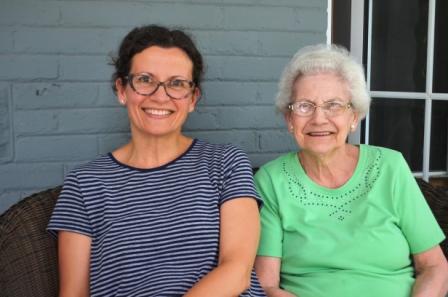
Nothing happened for several months, but then Pieter received an email from Janet ‘Jan’ O’Reilly, who wrote that “Clifford was my uncle, Gladys is my mom, and is still alive….”  Gladys is the sister of John ‘Clifford’ Rogers.

DSC_0547 john clifford rogers

John ‘Clifford’ Rogers. (Photo courtesy of Gladys O’Reilly)

Jan went on to explain that “We live in Ontario – my mom left the island in the late 1950s, I believe. Her Mom and Dad remained on the island, but her Dad died in the 1960s and my grandma later came to live with us here in Ontario. She died here in 1980 and Mom brought her home to be buried on the island. We all travelled to PEI that Christmas…” This explained why Pieter’s search on the Island was unsuccessful.

DSC_0242 janet o reilly and mother

Jan and Glady O’Reilly.  (Photo courtesy of Janet O’Reilly)

Clifford was born August 19, 1925 in Hope River, Prince Edward Island, the son of Andrew Rogers and Phoebe Gallant. The family later moved to Charlottetown.

On March 12, 1943, he enlisted in Charlottetown, and it was noted that he had served in the PEI Light Horse Regiment (17th Reserve Armoured Regiment) since 1942. At the beginning of April 1943 he was transferred to the Advanced Infantry Training Camp in Aldershot, Nova Scotia.

On October 30, 1943 he was transferred to the Advanced Driving and Maintenance School in Woodstock, Ontario, a facility where soldiers learned to drive and repair military vehicles, motorcycles, and trucks.

….4 Islanders trained together at Coldstream Ranch….

After receiving his qualification, he was transferred to the Canadian School of Infantry, located at Coldstream Ranch in Vernon, British Columbia, arriving on January 27, 1944.  Over 11,000 acres, the training area on the ranch included a log village for village fighting, an obstacle course, a bayonet assault course, a trench blasted from solid rock on the side of hill that gave trainees experience from being fired on from overhead, an ‘English’ type lane with hedges and gates, and a dam for river crossing drills.

When Pieter spoke with Gladys, she told him that 3 other Islanders were at the Coldstream Ranch at the same time as Clifford: 

Later, Jan reflected that “…Mom remembered him getting along with Pte Blanchard who was also from PEI. There were just four of them and I imagine that created a bond….

In September 1944 Clifford was sent to the transit camp at Camp Debert in Nova Scotia, in preparation for going overseas.  He arrived in the United Kingdom on November 28, 1944.  On January 8, 1945 he was in Northwest Europe as part of the contingent of reinforcement troops.

On January 26, 1945 he was transferred to the North Shore (New Brunswick) Regiment.  Not long after, the Regiment travelled just over the Dutch border into Germany for Operation Blockbuster, the last part of Operation Veritable, during the Battle of the Rhineland. (See https://en.wikipedia.org/wiki/Operation_Blockbuster)

….Action in Balberger Wald was fatal for Clifford….

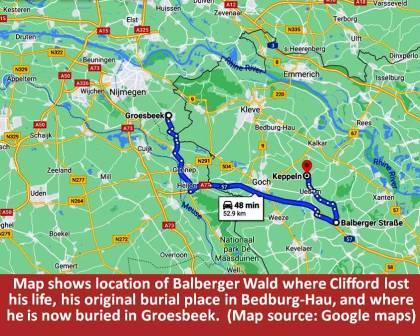
Clifford survived the Battle of Keppeln, in which fellow Islander Barney McGuigan lost his life, but his luck ran out a few days later in the Balberger Wald, a forested ridge southeast of Keppeln.  This area protected the approach to the Rhine with concrete fortifications.

Map

The North Shore (New Brunswick) Regiment moved into the area on March 1 to support other Regiments in an attempt to clear part of the forest on the eastern side, not easy in a thick forest where German snipers could easily hide. In addition to shells and grenades, many open areas were mined.  With such dense forest cover, it wasn’t difficult to get separated from the platoon.  By the time the area was cleared several days later, 6 members of the North Shore Regiment had lost their lives, including Clifford, who died on March 3, 1945.

The other 5 members of the North Shore (New Brunswick) Regiment who lost their lives in the Balberger Wald were:

  • Patrick Marshall BUCKLEY, of St. John, New Brunswick, died March 2, 1945.
  • Claude Wilber DERRICK, of Canterbury, New Brunswick, died March 2, 1945.
  • Royden Blake FOURNIER, of Perth, Ontario, died March 2, 1945.
  • Wilfred MELANSON, of Bathurst, New Brunswick, died March 2, 1945.
  • Harold Freeman STEVENS, died March 1, 1945.

Clifford was initially buried in a cemetery in present day Bedburg-Hau and later reburied at the Canadian War Cemetery in Groesbeek, The Netherlands. 

CIMG3331 Oct 5 2019 Groesbeek John Rogers

In 2019, we visited the grave of John Clifford Rogers at the Canadian War Cemetery in Groesbeek, The Netherlands. (Photo credit: Daria Valkenburg)

Jan was correct in saying that “Their family sacrificed so much…” Clifford and his brother Ferdinand (Ferdy) lost their lives in WW2 while a third brother, Walter, had a career in the military.

Gladys O’Reilly “…is the last of their immediate family….”  Walter “…left as a young man as well.  He served in Korea and later lived overseas with his family during his military service for a time in Germany. He eventually settled in Kingston and died there 10 years ago at the age of 82….

We thank Jan and Gladys O’Reilly for sharing family photos and information about John ‘Clifford’ Rogers.  If you have information to share about Canadian soldiers buried in The Netherlands, memories to share about John ‘Clifford’ Rogers, or the other soldiers mentioned, please email us at dariadv@yahoo.ca, comment on the blog, or send a tweet to @researchmemori1.  

….Want to follow our research?….

If you are reading this posting, but aren’t following the blog, you are welcome to do so.  See https://bordencarletonresearchproject.wordpress.com or email me at dariadv@yahoo.ca and ask for an invitation to the blog. 

Screenshot_2021-02-27 On The War Memorial Trail With Pieter Valkenburg

You are also invited to subscribe to our YouTube Channel: On The War Memorial Trail With Pieter Valkenburg: https://www.youtube.com/channel/UCJ591TyjSheOR-Cb_Gs_5Kw

© Daria Valkenburg

On The War Memorial Trail….. Remembering WWII Soldier Clarence Wilfred Wakegijig

August 9, 2021. After an interview about the photo quest for soldiers buried in the Canadian War Cemeteries in The Netherlands ran on APTN, Pieter was contacted by Annelind Wakegijig. (ee https://www.aptnnews.ca/national-news/dutch-born-p-e-i-man-on-a-mission-to-find-photos-of-first-nations-soldiers-killed-overseas-in-wwii/)

She sent us a photo of Clarence Wilfred WAKEGIJIG, and wrote that “…I recently saw your story featured on APTN. My great-uncle, Clarence WAKEGIJIG was from the Wiikwemkoong Unceded Territory on Manitoulin Island, Ontario. He died in Holland on March 2, 1945. He is buried in Groesbeek…”  (For more information on the Wiikwemkoong First Nation, see https://en.wikipedia.org/wiki/Wiikwemkoong_First_Nation )

Annelind explained that “… He was the youngest son of Josephine (Shawanda) Wakegijig and Joachim Wakegijig. His siblings were:

  • Victoria Corbiere 
  • Christine Wakegijig 
  • Ethel Wakegijig –  who had suffered a childhood illness and died at 5 years of age 
  • John Wakegijig -also a veteran of WWII, who died in 1971 in a motor vehicle accident 

and 

  • Raymond Wakegijig – who drowned in his late 20s 

 Clarence was a Guardsman with the Canadian Grenadier Guards…. 

Clarence Wakegijig

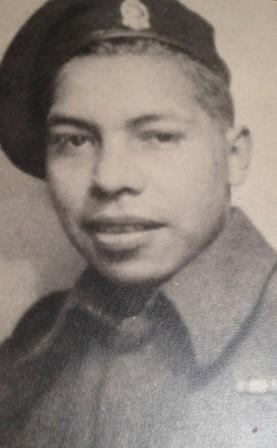
Clarence Wilfred WAKEGIJIG.  (Photo Courtesy of Clarence Wakegijig Family)

Clarence was born January 9, 1925 in Cutler, Ontario, the son of Joachim and Josephine Wakegijig (nee Shawanda), of Krugersdorf, Ontario. He enlisted on September 25, 1941 with the Sault Ste Marie and Sudbury Regiment in Sudbury, Ontario, giving his birth year as 1922 and birthplace as Wikwemikong (Wiikwemkoong in Ojibwe).  The fact that he was only 16 years old, not 19, doesn’t seem to have been discovered.

He was sent to the Basic Training Centre in North Bay, Ontario.  In February 1942 Clarence was sent to the Driving and Maintenance Training School in Woodstock, Ontario, where he learned driver mechanics and how to drive a motorcycle.

On April 22, 1942 he was posted to Trois-Rivières, Quebec as reinforcement to Infantry (MG) TC A-17 – a Machine Gun Training Centre.

….Clarence arrived in Europe in 1942….

 By the end of September 1942, Clarence was on his way to the United Kingdom, arriving on October 9, 1942 and assigned to the Machine Gun Reinforcement Unit (MGRU), where he underwent additional training.

By June 1943 he had received a promotion to Trooper and was assigned to the 32nd Reconnaissance Regiment.  On September 18, 1943 he was awarded a Good Conduct Badge.

On March 19, 1944 he was assigned to the 22nd Armoured Regiment, known as the Canadian Grenadier Guards, taking further training as a driver mechanic in preparation for the Regiment moving into action in France.

The Regiment arrived in France on July 23, 1944, and underwent heavy fighting in Normandy during Operation Totalize and Operation Tractable, which led to the capture of Falaise. (For more information, see https://en.wikipedia.org/wiki/Operation_Totalize and https://en.wikipedia.org/wiki/Operation_Tractable)

Clarence survived these actions, and continued on with the Regiment as they left Normandy, France for North West Europe, fighting in Belgium, The Netherlands, and Germany.

….The Battle of Hochwald Gap was a fierce tank battle….

According to the war diary for the Canadian Grenadier Guards, the Regiment had travelled from The Netherlands just over the border into Germany, to participate in the Battle of Hochwald Gap, part of Operation Blockbuster, the final push towards the Rhine River, along with several other Canadian Regiments. (For more information, see https://canadianbattlefieldtours.ca/operation-blockbuster/ and https://civilianmilitaryintelligencegroup.com/10742/the-battle-of-hochwald-gap-one-of-the-largest-armor-engagements-you-probably-have-never-heard-of)

On February 26, 1945 they were travelling southeast from Kalkar, Germany, getting bogged down in mud and clay, and through farm fields in which mines had been hidden by the Germans, causing many casualties.

Map showing route thru Hochwald Gap

The Regiment’s objective was to reach Xanten, the last town on the western side of the Rhine, but first they had to get through the very narrow Hochwald Gap. They reached the west end of the Hochwald Gap just after dawn on February 28, 1945.

The weather continued to be uncooperative. An early thaw meant that the tanks got bogged down in mud, making them ‘sitting ducks’ for German troops who were positioned to pick them off, one by one.

The Canadian Grenadier Guards war diary entry for March 2, 1945 noted “… Weather – cloudy, gusts of rain. ...” Artillery fire had caused a temporary halt before starting up again.

…Charge was successful and the 1st objective taken, despite the fact that 6 tanks bogged before then. Confused fighting took place from here on – Lt Ferris (2 tanks) and C Company passed through, but ran into opposition in the form of a Tiger….” Clarence was in C Company.  A Tiger was a German tank.

The war diary entry continued.  “…Somewhere in here, Lt Ferris and his other tank were knocked out, and Lt Ferris was wounded by a sniper...

At some point in this chaos, Clarence lost his life, most likely when one of the tanks was hit by German fire. A 46 minute YouTube video on the Battle of Hochwald Gap explained the fierce battle that took place.  Watching it made it clear to us that it was a miracle that anyone survived at all, a testament to the determination and courage of those who were in the midst of it.

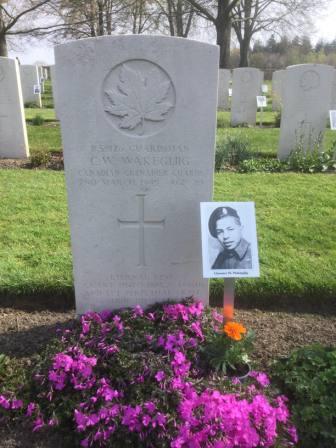
Clarence was temporarily buried in Xanten, Germany before being reburied in 1946 in the Canadian War Cemetery in Groesbeek, The Netherlands.

Grave of Clarence Wakegijig

Grave of Clarence Wilfred Wakegijig.  (Photo credit: Ad Scheepers)

Thank you to Annelind Wakegijig for sharing a photo and information about her great-uncle.  If you have information to share about Clarence Wilfred WAKEGIJIG or other Canadian soldiers, please contact Pieter at memorialtrail@gmail.com, or comment on the blog.

© Daria Valkenburg

….Want to follow our research?….

If you are reading this posting, but aren’t following our research, you are welcome to do so.  Our blog address: https://onthewarmemorialtrail.com/

Front cover OnTheWarMememorialTrailinEurope4 countries, 6 weeks, 7,000 km – an unforgettable war memorial journey in Europe…. Daria’s book ‘No Soldier Buried Overseas Should Ever Be Forgotten‘ is available in print and e-book formats.  Net proceeds of book sales help support research costs and the cost of maintaining this blog. For more information see https://nosoldierforgotten.com/

Screenshot_2021-02-27 On The War Memorial Trail With Pieter Valkenburg

You are also invited to subscribe to our YouTube Channel: On The War Memorial Trail With Pieter Valkenburg: https://www.youtube.com/channel/UCJ591TyjSheOR-Cb_Gs_5Kw.

Never miss a posting!  Subscribe below to have each new story from the war memorial trail delivered to your inbox.

On The War Memorial Trail….. The Children Who Died Along With WWII Soldier George Edward Mahar

August 6, 2021. After reading the posting about George Edward MAHAR and how he lost his life while the soldiers were lining up to go to church, Alice van Bekkum, Chair of Faces To Grave Project for the Canadian War Cemetery in Groesbeek, wrote with information about the two little girls who died in the same attack on November 26, 1944 as George Edward Mahar and Douglas Reginald SCHOFIELD. (See https://onthewarmemorialtrail.com/2021/08/02/on-the-war-memorial-trail-the-ww2-soldier-killed-while-lining-up-to-attend-church/)

The two little girls were sisters, Christobel and Lisette Jurgens, children of Jan Jurgens and Joy Anderson.  At the time of their deaths, Christobel was 9 years old, and Lisette was 5 years old.

Alice explained thatThe parents from the two little girls that died in this tragic moment wrote a message on their memory card, which is touching! The father was Dutch and the mother was British, parents of four children, before this tragic event took their two youngest children. They honoured the Allied soldiers in the Memorial card for their children…

The message, addressed to ‘Allied soldiers, Airbornes, and Workshop Boys’, was;

What good friends you were to us. How we loved you,
How you spoiled us, and how we enjoyed your kindness.
We regret we had to part from you so suddenly, be sure
That we shall not forget you. We pray God that He
will bless you, and reward you for your splendid effort.’

Alice was kind enough to send the memory card for Christobel and Lisette Jurgens:

Alice also identified the names of the two soldiers who subsequently died of their injuries following the attack:  Lyle L. BOICE and Francis K. BLACK.

Thank you to Alice van Bekkum for sharing the memory tribute to the Jurgens sisters.  It’s a reminder of the many civilian casualties in war.  If you have photos or information to share on the November 26, 1944 incident please email Pieter at memorialtrail@gmail.com,or comment on the blog. 

© Daria Valkenburg

….Want to follow our research?….

If you are reading this posting, but aren’t following our research, you are welcome to do so.  Our blog address: https://onthewarmemorialtrail.com/

4 countries, 6 weeks, 7,000 km – an unforgettable war memorial journey in Europe…. Daria’s book ‘No Soldier Buried Overseas Should Ever Be Forgotten‘ is available in print and e-book formats.  Net proceeds of book sales help support research costs and the cost of maintaining this blog. For more information see https://nosoldierforgotten.com/ 

You are also invited to subscribe to our YouTube Channel: On The War Memorial Trail With Pieter Valkenburg: https://www.youtube.com/channel/UCJ591TyjSheOR-Cb_Gs_5Kw

Screenshot_2021-02-27 On The War Memorial Trail With Pieter Valkenburg

Never miss a posting!  Subscribe below to have each new story from the war memorial trail delivered to your inbox.

On The War Memorial Trail….. The WWII Soldier Killed While Lining Up To Attend Church

20210715_094818 Jul 15 2021 Ken Barkhouse grand nephew of George Edward Mahar

Pieter with Ken Barkhouse (left), grand-nephew of George Edward Mahar.  (Photo credit: Daria Valkenburg)

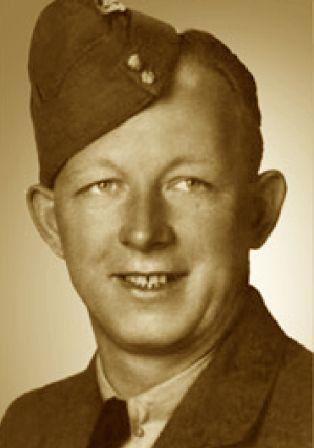
August 2, 2021. During a recent stay in Fredericton, New Brunswick, we met Ken Barkhouse, and talked about his grandfather’s brother, George Edward MAHAR, who lost his life during WW2. 

George Edward Mahar Cdn Virtual War Memorial

George Edward Mahar (Photo courtesy of Canadian Virtual War Memorial)

Born in St George, New Brunswick on June 2, 1914, George was the son of Wellington Dorcas Ellen Mahar of Blacks Harbour, New Brunswick. At the time of his enlistment with the 8th Anti-Aircraft Battery in St John, New Brunswick on September 20, 1939, he was married to Freda Augusta and employed as a tin decorator with Connors Brothers, a canning plant in Black’s Harbour.  He and Freda had a daughter, Donna Blanche, born in 1939.  A son, Edward, was born in 1942.

After receiving training as a Gunner, he transferred to the 50th Heavy Anti-Aircraft Battery in Aldershot, Nova Scotia on August 15, 1942, and appointed to the rank of Bombardier.

On February 10, 1944 his request to revert to the rank of Gunner so he could ‘join a reinforcement stream’ was accepted.  He was re-allocated to an Infantry unit with the rank of Private. 

On July 13, 1944 he arrived in the United Kingdom and assigned to the Stormont, Dundas and Glengarry Highlanders Regiment on August 16. The next day he was with the Regiment in northwest Europe, serving in Belgium and The Netherlands.

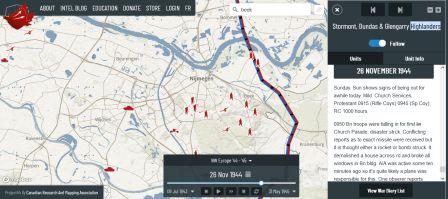
Screenshot 2021-08-02 at 11-40-25 Project '44

Map shows the area around Beek, where the Stormont, Dundas and Glengarry Highlanders Regiment was on November 26, 1944.  (Map source: https://map.project44.ca/)

On November 22, 1944, the Regiment was in the area of Beek, The Netherlands for a seven day period of training, kit inspections, bath parades, and pay parades. 

November 26, 1944 was a Sunday.  The Stormont, Dundas and Glengarry Highlanders war diary for that day notes that the “…sun shows signs of being out for awhile today. Mild…” Three church services had been organized that morning.

At 9:50 am, as the “…troops were falling in for first Church Parade, disaster struck. Conflicting reports as to exact missile were received but it is thought either a rocket or bomb struck. It demolished a house across road and broke all windows in Battalion building….

The war diary notes that “…Anti-Aircraft was active some ten minutes ago so it’s quite likely a plane was responsible for this. One observer reports having seen 4 Foch Wolfs, one of which dropped a parachute, prior to the explosion. Exact casualties not yet known but two little girls were killed. The Battalion casualties are 2 killed and 13 wounded….

George Edward Mahar was one of the two casualties killed that day.  The other was Douglas Reginald SCHOFIELD of Guelph, Ontario.  Two more men subsequently died. 

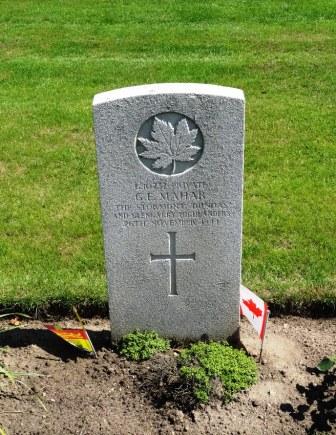
George is buried at the Canadian War Cemetery in Groesbeek, The Netherlands. 

Grave of George Edward Mahar

Grave of George Edward Mahar at the Canadian War Cemetery in Groesbeek.  (Photo source: http://www.findagrave.com)

Thank you to Ken Barkhouse for telling us about his grand-uncle.  Do you have photos or information to share on George Edward Mahar or about the November 26, 1944 incident?  If so, please email Pieter at memorialtrail@gmail.com, or comment on the blog. 

© Daria Valkenburg

….Want to follow our research?….

If you are reading this posting, but aren’t following the blog, you are welcome to do so.  Our blog address: https://onthewarmemorialtrail.com/

4 countries, 6 weeks, 7,000 km – an unforgettable war memorial journey in Europe…. Daria’s book ‘No Soldier Buried Overseas Should Ever Be Forgotten‘ is available in print and e-book formats.  Net proceeds of book sales help support research costs and the cost of maintaining this blog. For more information see https://nosoldierforgotten.com/

Screenshot_2021-02-27 On The War Memorial Trail With Pieter Valkenburg

You are invited to subscribe to our YouTube Channel: On The War Memorial Trail With Pieter Valkenburg: https://www.youtube.com/channel/UCJ591TyjSheOR-Cb_Gs_5Kw

Never miss a posting!  Subscribe below to have each new story from the war memorial trail delivered to your inbox.
On The War Memorial Trail….. Atlantic Canada Remembers – Part 10

July 11, 2021. More of the photos submitted about Atlantic Canadian soldiers buried overseas are featured in Part 10. Pieter continues to ensure that photos of soldiers buried in The Netherlands are forwarded to the appropriate cemetery for their digital archives. 

Soldier buried at the Canadian War Cemetery in Holten, The Netherlands

Armand Gionet and family from Mel

Armand Gionet, far right, and his family.  (Photo courtesy of Edmonde Lanteigne)

Armel ‘Mel’ Lanteigne, President of the Caraquet branch of the Royal Canadian Legion, submitted a photo of Armand GIONET of Middle Caraquet, New Brunswick, explaining that he had found “…a picture for Armand Gionet, taken in front of the family farm and house.  From left to right: Lazare Gionet, Nicholas Hébert, Paul-Aurèle Gionet, Hectorine Gionet, Analda Gionet and at the end Armand Gionet, no name for the dog, sorry. 

Armand was a fisherman and a farmer. I took the house’s picture and did the leg work and phone calls.  I got the family’s picture from Edmonde Lanteigne, she is the daughter of Hectorine and Nicolas.  The house is owned by Victoria and Nicole, the daughters of Paul-Aurèle Gionet, Armand’s brother...

After the photo was submitted to the researchers at the Information Centre at the Canadian War Cemetery in Holten, journalist Jan Braakman, one of the researchers at the Centre, wrote us that the photo “…has a very special meaning for me. Armand Gionet died in my town of birth (Laren, province of Gelderland) at the same place, same time and same way as my grandmother, Dina Koeslag. They were caught in flames after their hiding place had been hit by a German pantzerfaust (according to the cause of death as noted by my grandmothers’ doctor.)...” A pantzerfaust is a bazooka.

I have never had a chance to know my grandmother (nor my grandfather, who had been arrested and was killed in a concentration camp near Hamburg). But every once in a while I find pieces of her life and death. This is such a piece. Thanks very much for forwarding this photo to the Information Centre….” 

Armand was born April 26, 1924 in Middle Caraquet, New Brunswick, the son of Lazare Gionet and Laura Hebert.  One of 8 children, he worked on his parents’ farm.  He was also in the Reserve Labour Pool for the port of Halifax, and worked as a freight handler at the port on an as needed basis.

On March 25, 1944 he enlisted. After basic training he was sent to England, arriving on December 25, 1944.  By February 1945 he was in continental Europe and assigned to Le Regiment de Maisonneuve.

At the beginning of April 1945, the Regiment was in The Netherlands.  On April 4, the Regiment prepared to cross the Twente Canal near Almen for an attack from the bridgehead towards the village of Laren. The battle began at 8 pm and went throughout the night.  (See https://en.wikipedia.org/wiki/Twentekanaal)

The Regiment’s war diary for April 5, 1945 simply stated that: “…During the attack last night, we had 23 casualties and we captured 40 prisoners…” 

In a translated excerpt of a Dutch language article written by Jan Braakman, he summarized what happened. “…  Among the 23 casualties (wounded and killed) was Armand Gionet. During the fighting he ended up at a group of farms along the Zutphenseweg, just outside the church of Laren. Many civilians hid there from the violence of war. When Gionet and his mates arrived, the inhabitants were convinced that they had been liberated. They emerged from their hiding places in a euphoric mood.

Civilians and soldiers were festive on the road when suddenly fire was opened again by German soldiers. In panic everyone ran to a safe place. Armand Gionet took a position in the Klein Veldkamp farm, where many civilians… were looking for a safe place. But after a while the danger proved too great to stay there. The farm was on fire. Everyone had to go outside.

Fear reigned. In total chaos, everyone ran in one direction. Civilians were sent back by a wounded Canadian soldier as they walked towards the German fire. In the end, the neighbours found a makeshift shelter in a cowshed. Canadian soldiers sat upstairs.

The sky didn’t clear until late in the afternoon when Canadian jeeps pulled into the yard…..

In the aftermath, among the casualties were Armand Gionet and Jan Braakman’s grandmother, who both had perished at the Klein Veldkamp farm.  (To read the original Dutch article, see https://wp.janbraakman.nl/armand-gionet-kon-zijn-ambitie-niet-waarmaken/)

Armand is buried at the Canadian War Cemetery in Holten, The Netherlands.  He was 19 years old. 

Soldier buried at the Canadian War Cemetery in Groesbeek, The Netherlands

gilles lanteigne WWII

Gilles Lanteigne. (Photo courtesy of Dan Lanteigne)

Armel ‘Mel’ Lanteigne, President of the Caraquet branch of the Royal Canadian Legion, submitted a photo of Gilles LANTEIGNE, explaining that the photo came from “….Dan Lanteigne’s private collection.  He does research on the Lanteigne family…

Born March 27, 1924 in Caraquet, New Brunswick, the son of Ella and Prospère Lanteigne, Gilles was a labourer before enlisting on February 10, 1944.  On July 19, 1944 he arrived in the United Kingdom as a member of the Canadian Infantry Reserve Unit.  On August 12, 1944 he arrived in France and transferred to Le Regiment de Maisonneuve.

While serving with Le Regiment de Maisonneuve, he was severely wounded on March 8, 1945, and taken to a field hospital.  A day later, on March 9, 1945, he “…died of wounds…” received in action in Germany.  He was initially buried in Bedburg Military Cemetery before being reburied a year later in the Canadian Military Cemetery in Groesbeek, The Netherlands.

Mariner Lost At Sea

William Arnold Johnston

William ‘Bill’ Johnston.  (Image courtesy of Canadian Virtual War Memorial)

Don Coutts wrote that “…I have been enjoying your articles.  My grandmother, Annie Bagnall Muttart, came from a large family, a total of nine boys and girls.  One of her brothers was Andrew Bagnall.  Andrew and his wife, Gussie, had four children: Kay, Eleanor, Ted, and Dick.

Kay married William (Bill) Arnold JOHNSTON on June 16th, 1940. He was a Lieutenant in the Royal Canadian Navy. His ship, the HMS Itchen, was torpedoed … and he lost his life. 

The Bagnall Family encountered two deaths of young men (Elmer in October 1941, and Bill in September 1943) during WWII….”  Don’s uncle, Elmer Bagnall MUTTART, has been previously featured on this blog.  (See https://bordencarletonresearchproject.wordpress.com/2017/07/28/the-elmer-bagnall-muttart-story/ and https://www.youtube.com/watch?v=71Rzg07kPw0&list=PLaJcEVojJra-ZwR6rvb-THj8Zr2QbUXLT&index=2)

Born November 25, 1918 in Moncton, New Brunswick, Bill was the son of Frank Ariel and Eudaviela Waters Johnston, of Charlottetown, Prince Edward Island.  On May 17, 1937 he enlisted in the Militia in Charlottetown, and remained a member over the next few years, while employed as a teller at the Canadian Imperial Bank of Commerce in Charlottetown.  On June 17, 1940, a day after his marriage, he was enlisted in the Royal Canadian Naval Volunteer Reserve.

On December 13, 1941 he was appointed to serve aboard HMCS Charlottetown.  Unfortunately, the ship was torpedoed and sunk on September 11, 1942 in the St. Lawrence River along the northern shore of Gaspé Peninsula, while returning to base from convoy duty.  Bill was one of the survivors.  (See https://en.wikipedia.org/wiki/HMCS_Charlottetown_(1941)#Sinking)

After a stint of survivor’s duty at HMCS Stadacona in Halifax and short training courses, he was assigned to HMS Itchen on April 19, 1943, which was involved in anti-submarine warfare exercises off the coast of Scotland until September 1943, when it was assigned to convoy escort duty. 

While in the Atlantic Ocean, several ships in the convoy were attacked, beginning on September 19, 1943.  On September 20, HMCS St Croix was sunk.  81 survivors were picked up by HMS Itchen. 

HMS Itchen (K227)

Red dot shows location of sinking of HMS Itchen.  (Image source: https://en.wikipedia.org/wiki/HMS_Itchen_(K227))

Just after 2 am on September 23, 1943, HMS Itchen was torpedoed, causing the frigate to blow up, with a loss of 230 lives, including Bill. He was 24 years old.

Two people from HMS Itchen and one from HMCS St Croix survived and were picked up by a Polish steamer. (See https://en.wikipedia.org/wiki/HMS_Itchen_(K227) and https://www.uboat.net/allies/merchants/ship/3079.html)

Don Coutts noted that “…Kay and Bill had a son Tom who was born on March 18, 1943. Tom died a number of years ago. Kay married a Bob Mills from Nova Scotia…they split their time between Port Royal, NS (late Fall/Winter/early Spring) and Stanhope, PEI (late Spring/Summer/early Fall)...”

As his body was never recovered, Bill’s name is listed on the Halifax Memorial in Point Pleasant Park in Halifax, Nova Scotia. 

To read previous stories about other mariners listed on the Halifax Memorial, please see:

Thank you to Jan Braakman, Don Coutts, Armel ‘Mel’ Lanteigne, and Edmonde Lanteigne for sharing photos and anecdotes to ensure that Atlantic Canadians who are buried overseas are not forgotten.

More photos and stories in Atlantic Canada Remembers – Part 11! To share photos or information, please email Pieter at memorialtrail@gmail.com, comment on the blog, or tweet to @researchmemori1

© Daria Valkenburg

…Previous postings in the Atlantic Canada Remembers series…

Missed the previous postings in this series? See:

…Want to follow our research?….

If you are reading this posting, but aren’t following the blog, you are welcome to do so.  Our blog address: https://onthewarmemorialtrail.com/

Front cover OnTheWarMememorialTrailinEurope4 countries, 6 weeks, 7,000 km – an unforgettable war memorial journey in Europe…. Daria’s book ‘No Soldier Buried Overseas Should Ever Be Forgotten‘ is available in print and e-book formats.  Net proceeds of book sales help support research costs and the cost of maintaining this blog. For more information see https://nosoldierforgotten.com/

Screenshot_2021-02-27 On The War Memorial Trail With Pieter Valkenburg

You are invited to subscribe to our YouTube Channel: On The War Memorial Trail With Pieter Valkenburg: https://www.youtube.com/channel/UCJ591TyjSheOR-Cb_Gs_5Kw

Never miss a posting!  Subscribe below to have each new story from the war memorial trail delivered to your inbox.

The Photo Tribute At The Canadian War Cemetery In Groesbeek

20210505_091943 May 5 2021 Dutch flag on Liberation Day

The Dutch flag flies proudly at the Valkenburg household on Liberation Day. (Photo credit: Daria Valkenburg)

May 10, 2021. In the last blog posting, we featured photos at the graves of 7 soldiers buried in the Canadian War Cemetery in Groesbeek, The Netherlands.  As part of the Liberation Day 2021 commemoration, photos of over 1,600 soldiers were placed by their graves and will remain until May 17. 

In that posting, photos of the graves of 4 soldiers from PEI whose stories have already been told in this blog, and 3 Indigenous soldiers that Pieter is currently researching, were featured. (See https://bordencarletonresearchproject.wordpress.com/2021/05/05/commemorating-liberation-day-at-the-canadian-war-cemetery-in-groesbeek/)

Recently, we received information on one more Indigenous soldier, who has been added to Pieter’s research list.  We asked Alice van Bekkum, Chair of the Groesbeek Faces to Graves Committee, to take the photo of his grave.

…. Grave of 1 Indigenous Soldier….


IMG_8567-AVB Grave of Thomas Big Canoe in Groesbeek

Grave of Thomas Beresford Big Canoe. (Photo courtesy of Alice van Bekkum)

Thomas Beresford BIG CANOE, son of Thomas H. and Hannah Bigcanoe, of Georgina Island, Ontario, was serving with the Royal Hamilton Light Infantry when he lost his life on March 8, 1945, at the age of 19.

…. The Faces Of Groesbeek video….

Alice sent a short film about the photo exhibition at the cemetery, entitled ‘The Faces of Groesbeek’.   Make sure you have tissues handy when you watch this.  There will be tears once you see the piper playing as he walks, row by row, through the cemetery.

Thank you to Alice van Bekkum for taking the photos of the grave of Thomas Beresford Big Canoe, and for sharing ‘The Faces of Groesbeek’ video.

If you have photos or information to share about any Canadian soldiers buried in The Netherlands, please contact Pieter at memorialtrail@gmail.com, comment on the blog, or send a tweet to @researchmemori1

© Daria Valkenburg

…Want to follow our research?…

If you are reading this posting, but aren’t following our research, you are welcome to do so.  Our blog address: https://onthewarmemorialtrail.com/

Front cover OnTheWarMememorialTrailinEurope4 countries, 6 weeks, 7,000 km – an unforgettable war memorial journey in Europe…. Daria’s book ‘No Soldier Buried Overseas Should Ever Be Forgotten‘ is available in print and e-book formats.  Net proceeds of book sales help support research costs and the cost of maintaining this blog. For more information see https://nosoldierforgotten.com/

Screenshot_2021-02-27 On The War Memorial Trail With Pieter Valkenburg

You are also invited to subscribe to our YouTube Channel: On The War Memorial Trail With Pieter Valkenburg: https://www.youtube.com/channel/UCJ591TyjSheOR-Cb_Gs_5Kw

Never miss a posting!  Subscribe below to have each new story from the war memorial trail delivered to your inbox.

Commemorating Liberation Day At The Canadian War Cemetery In Groesbeek

20210505_091943 May 5 2021 Dutch flag on Liberation Day

The Dutch flag flies proudly at the Valkenburg household on Liberation Day. (Photo credit: Daria Valkenburg)

May 5, 2021.  Last year, one of the events planned for the 75th Anniversary of the Liberation of The Netherlands was to place photos by the graves of soldiers at the Canadian War Cemetery in Groesbeek.  Unfortunately, due to social distancing measures, this had to be cancelled.  Instead, white tulips were placed at each grave.  (See   https://bordencarletonresearchproject.wordpress.com/2020/05/05/tulips-placed-at-each-grave-at-the-canadian-war-cemetery-in-groesbeek/)

This year, the planned photo tribute was possible, with photos placed at more than 1,600 graves. They will remain in place until May 17. Readers of this blog are aware that Pieter has been working towards finding as many photos as possible from the Atlantic region over the past few years.  Here on PEI, all but two soldiers buried in this cemetery have their photo tributes.  We asked Alice van Bekkum, Chair of the Groesbeek Faces to Graves Committee,  to take photos of 4 soldiers whose stories have been previously told here.

….Graves of 4 PEI soldiers ….

IMG_8528 Grave of Willie Cannon

Grave of William ‘Willie’ Alfred Cannon. (Photo courtesy of Alice van Bekkum)

To read about William ‘Willie’ Alfred CANNON of Mt Mellick, please see https://bordencarletonresearchproject.wordpress.com/2018/08/04/canadian-war-graves-netherlands-foundation-project/

IMG_8522 Grave of Joe Hennebery

Grave of Joseph ‘Joe’ Edmund Hennebery. (Photo courtesy of Alice van Bekkum)

To read about Joseph ‘Joe’ Edmund HENNEBERY of Morell, please see https://bordencarletonresearchproject.wordpress.com/2020/05/31/on-the-war-memorial-trail-a-face-for-joseph-hennebery/

IMG_8526 Grave of George Preston Smith

Grave of George Preston Smith.  (Photo courtesy of Alice van Bekkum)

To read about George Preston SMITH of Kinkora, please see:

IMG_8523 Grave of William Weatherbie

Grave of William Weatherbie.  (Photo courtesy of Alice van Bekkum)

To read about William WEATHERBIE of Charlottetown, please see https://bordencarletonresearchproject.wordpress.com/2019/09/29/a-face-for-ww2-soldier-william-weatherbie/

Alice shared a short video in which she is interviewed, and volunteers can be seen placing the photos by the graves.  The photos were printed onto an aluminum backing, making them impervious to rain.  Whether you understand Dutch or not, the video is wonderful as it shows the care and precision taken for this photo tribute.

….Graves of 3 Indigenous soldiers….

Recently, several photos have come in for soldiers whose stories Pieter is still researching.  Three of these are of Indigenous soldiers, which came about after an article about Pieter’s search for photos was written by Brett Forester of APTN News.  (See https://www.aptnnews.ca/national-news/dutch-born-p-e-i-man-on-a-mission-to-find-photos-of-first-nations-soldiers-killed-overseas-in-wwii/) Their stories will be told in a future posting.

Pieter asked his friend and former colleague, Ad Scheepers, if he would take photos of 3 graves at the cemetery in Groesbeek.  Ad visited the cemetery and placed an orange flower beside each grave he took a photo of.

Grave of Alfred Pitwanakwat

Grave of Alfred Louis Pitwanakat.  (Photo credit: Ad Scheepers)

Alfred Louis PITAWANAKWAT (PITWANAKWAT) was born September 12, 1924 in Little Current, Ontario, son of Agatha Pitwanakwat, of Wikwemikong, Ontario.

Grave of Eli Snake

Grave of Eli Snake. (Photo credit: Ad Scheepers)

Eli SNAKE was born November 29, 1919 on the Muncey Reserve, the son of Eli and Marjorie Snake.

Grave of Clarence Wakegijig

Grave of Clarence Wilfred Wakegijig.  (Photo credit: Ad Scheepers)

Clarence Wilfred WAKEGIJIG was born January 9, 1925 in Wikemwikong, Ontario, the son of Joachim and Josephine Wakegijig (nee Shawanda), of Krugersdorf, Ontario.

Ad wrote that while he was near the grave of Alfred Pitwanakat, “….a boy visiting the site with his family put a Canadian flag in front of the grave of Alfred….

Child places flag by Alfreds grave

A young boy places a flag by the grave of Alfred Pitwanakat. (Photo credit: Ad Scheepers)

Child by Alfreds grave

A young boy inspects the flag he placed by the grave of Alfred Pitwanakat.  (Photo credit: Ad Scheepers)

It’s clear that the Dutch pass on the importance of remembrance to the next generation so they can continue to remember those who lost their lives in WW2!

Thank you to Alice van Bekkum and Ad Scheepers for their kindness in taking the photos of the graves.  If you have information to share about any Canadian soldiers buried in The Netherlands, please contact Pieter at  memorialtrail@gmail.com, comment on the blog, or send a tweet to @researchmemori1.

© Daria Valkenburg

…Want to follow our research?…

If you are reading this posting, but aren’t following our research, you are welcome to do so.  Our blog address: https://onthewarmemorialtrail.com/

4 countries, 6 weeks, 7,000 km – an unforgettable war memorial journey in Europe…. Daria’s book ‘No Soldier Buried Overseas Should Ever Be Forgotten‘ is available in print and e-book formats.  Net proceeds of book sales help support research costs and the cost of maintaining this blog. For more information see https://nosoldierforgotten.com/

Screenshot_2021-02-27 On The War Memorial Trail With Pieter Valkenburg

You are also invited to subscribe to our YouTube Channel: On The War Memorial Trail With Pieter Valkenburg: https://www.youtube.com/channel/UCJ591TyjSheOR-Cb_Gs_5Kw.

Never miss a posting!  Subscribe below to have each new story from the war memorial trail delivered to your inbox.