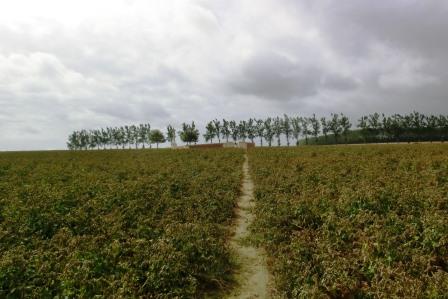
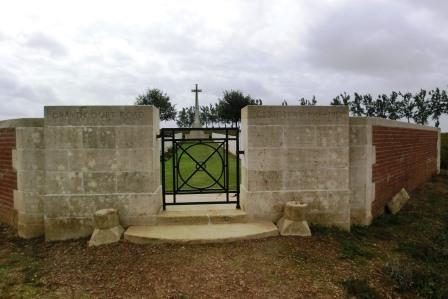
On The War Memorial Trail….. The WWI Soldier From Abrams Village Buried In Manitoba Cemetery in France

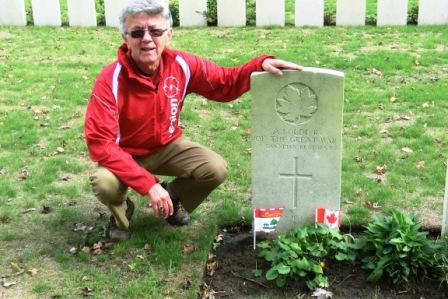
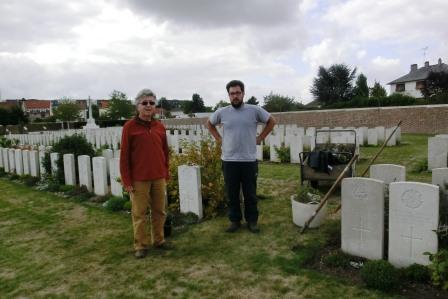
March 6, 2022.  In 2017, we visited Manitoba Cemetery outside Caix, France, to place flags by the grave of WWI soldier James CAIRNS of Kinkora, Prince Edward Island, who lost his life on August 9, 1918 during the Battle of Amiens. (See https://onthewarmemorialtrail.com/2017/09/30/the-search-for-manitoba-cemetery/)

When we signed the Guest Register Book, we were astonished to find that the previous visitors had come to honour their great-uncle and great-great uncle Theodore (Ted) Francis ARSENAULT from Abrams Village, Prince Edward Island.
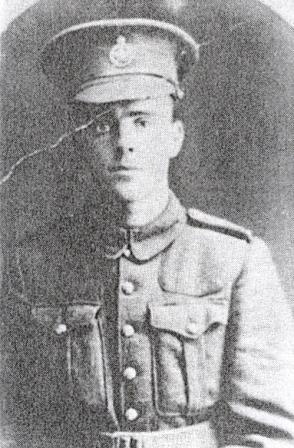
Pte Theodore Arsenault (Great great uncle)

Theodore Arsenault. (Photo submitted by Stephen Arsenault)

In November 2021, Colleen Arsenault shared a photo of her great-great-uncle, explaining that her mother and sister had signed the guest book in that far away cemetery. (See https://onthewarmemorialtrail.com/2021/11/10/on-the-war-memorial-trail-linking-the-past-with-the-present/)

…4 generations of the Arsenault family have served in the military….

Shortly after this, Stephen Arsenault sent us research on Ted Arsenault, and explained that 4 generations of his family served in the military.  “Theodore and his brother Camille were both from Abrams Village. Further descriptions as follows:

Gnr Camille Arsenault (Great Grandfather, Theodore's Brother)

Camille Arsenault. (Photo submitted by Stephen Arsenault)

  • Gnr Camille J Arsenault, 2nd Canadian (Overseas) Siege Artillery Battery CEF. Saw action at Vimy Ridge. Survived the war and re-enlisted during WW2 serving with the Canadian Army Service Corps at a POW camp in New Brunswick at the time. Camille was born August 22, 1895.
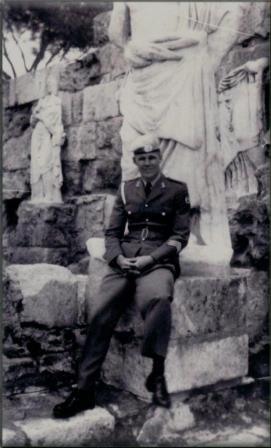
    Sgt Francis Arsenault (Grandfather)

    Francis Arsenault. (Photo submitted by Stephen Arsenault)

  • Stephen’s grandfather: Sgt Francis J Arsenault, served with 2 Royal Canadian Horse Artillery.
Portrait

Edgar Arsenault. (Photo submitted by Stephen Arsenault)

  • Stephen’s father: LCol Edgar F Arsenault, Logistics Officer, Royal Canadian Air Force. Later Honorary Colonel of 14 Mission Support Squadron, 14 Wing CFB Greenwood.  

He went on to say that “…Interestingly, in my (limited) spare time, I am an Artillery Officer serving in the Primary Reserves with 1st (Halifax-Dartmouth) Field Artillery Regiment, RCA, which makes 4 consecutive generations of military service to Canada spanning over 100 years. …

… Ted Arsenault enlisted in the 105th Overseas Battalion….

Ted Arsenault was born May 14, 1897 in Egmont Bay, Prince Edward Island, the son of François (Frank) and Adeline (nee Gallant) Arsenault.  When he enlisted with the 105th Overseas Battalion in Summerside, Prince Edward Island on May 1, 1916 he listed his occupation as farmer.

In June 1916, Ted travelled to Valcartier, Quebec with the Regiment for training prior to sailing to England from Halifax a month later aboard ‘Empress of Britain’.

…Previous stories of Islanders who were aboard the ‘Empress of Britain’ with Ted Arsenault….

Several Islanders, whose stories have previously been told, were on that same ship.  Among them were:

The ship docked in Liverpool, England on July 25, 1916.  The troops were sent to Shorncliffe and attached to the 1st Training Brigade.  They were later transferred to different training brigades in Surrey.

…Ted was gassed at Passchendaele….

In November 1916, Ted was sent to France as part of the 14th Battalion (Royal Montreal Regiment).  A year later, on November 5, 1917, during the Second Battle of Passchendaele in Belgium, Ted was poisoned by a mustard gas shell that exploded.  (For more information, see https://en.wikipedia.org/wiki/Second_Battle_of_Passchendaele)

He was invalided to England and sent to the King George Hospital in London for treatment. According to his medical file, he …had a sore throat and loss of voice for a month… and …breathing was difficult at night…” until January 13, 1918.

From the hospital in London he was sent to Manor War Hospital, a convalescent facility in Epsom.  It wasn’t until March 4, 1918 that the medical staff declared his chest was clear, and he was discharged 4 days later.  On May 16, 1918 he returned to France and the 14th Battalion.

….The Battle of Amiens…

The Battle of Amiens, also known as the Third Battle of Picardy, was the opening phase of the Allied offensive.  It began on August 8, 1918 and ended on August 18.  Later known as the Hundred Days Offensive, this was the battle that ultimately led to the end of the First World War.  (For more information, see https://en.wikipedia.org/wiki/Battle_of_Amiens_(1918) and a short video clip at https://finance.yahoo.com/video/battle-amiens-started-century-ago-173913821.html)

A few years ago, a short video onThe 100th anniversary of the Battle of Amiens and Canada’s Hundred Dayswas prepared and is available on YouTube:

…Two Islanders lost their lives on August 9, 1918…

Byce.Amiens.map_.04

Battle of Amiens.  (Map source: http://www.rememberourvets.ca)

According to the war diary of the 14th Battalion, on the morning of August 9, 1918, the Regiment was ordered to “…march towards Cayeux, the headquarters of the 2nd Canadian Infantry Brigade.  The march was very difficult owing to the congested traffic on the road. The Battalion was ordered to support the 8th Canadian Battalion and moved to assembly positions….

By 11:40 am they were in position, for the expected attack at 1 pm.  “… The attack was made over very flat ground and many casualties were caused by the intense machine gun fire…”  Among the casualties killed in action that day was Ted Arsenault.

As mentioned at the beginning of this posting, James CAIRNS, who served with the 8th Canadian Battalion, also lost his life that afternoon.

…Buried at Manitoba Cemetery outside Caix…

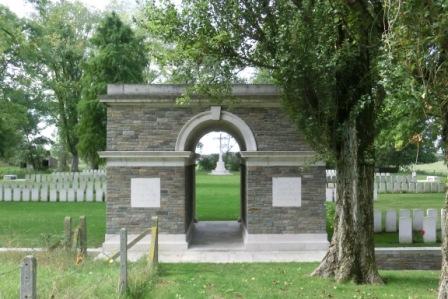
CIMG8555 Sep 6 2017 Pieter at entrance to Manitoba Cemetery

Pieter at the entrance to Manitoba Cemetery just outside Caix. (Photo credit: Daria Valkenburg)

Like so many WWI cemeteries in France, Manitoba Cemetery, where both James Cairns and Theodore (Ted) Francis Arsenault are buried, is in a rural location, surrounded by farmers’ fields.  It was fitting that during our visit in September 2017, bales of hay, a familiar site on Prince Edward Island during this period, surrounded the cemetery.

CIMG8558 Sep 6 2017 Manitoba Cemetery by hay bales

Bales of hay surround Manitoba Cemetery outside Caix.  (Photo credit: Daria Valkenburg)
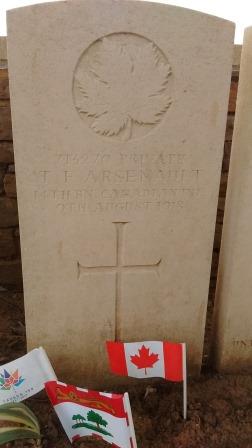
IMG_20170906_152615630 Sep 6 2017 grave of Ted Arsenault in Manitoba Cemetery in Caix

Grave of Theodore Francis Arsenault of Abrams Village. (Photo credit: Pieter Valkenburg)

Thank you to Colleen Arsenault and Steven Arsenault for sharing information on their great-uncle and their family’s ongoing military service.  If you have photos or information to share, please let Pieter know. Email him at memorialtrail@gmail.com, comment on the blog, or tweet to @researchmemori1.

© Daria Valkenburg

…Want to follow our research?….

If you are reading this posting, but aren’t following our research, you are welcome to do so.  Our blog address: https://onthewarmemorialtrail.com/

OnTheWarMememorialTrailinEurope_Barcode

4 countries, 6 weeks, 7,000 km – an unforgettable war memorial journey in Europe…. Daria’s book ‘No Soldier Buried Overseas Should Ever Be Forgotten‘ is available in print and e-book formats.  Net proceeds of book sales help support research costs and the cost of maintaining this blog. For more information see https://nosoldierforgotten.com/ 

You are also invited to subscribe to our YouTube Channel: On The War Memorial Trail With Pieter Valkenburg: https://www.youtube.com/channel/UCJ591TyjSheOR-Cb_Gs_5Kw.

Never miss a posting!  Subscribe below to have each new story from the war memorial trail delivered to your inbox.
On The War Memorial Trail….. Luck and Humanity During the Battle of Vimy Ridge

September 29, 2018.  Over the past few years, as the stories of the men on the Cenotaph outside the Borden-Carleton Legion are researched by Pieter, the level of death, destruction, and hatred from war is incomprehensible.  If you travel through any of the WWI and WWII sites in Europe, you see memorials and cemeteries.  In Normandy, France it seems as though there is a reminder of the war dead around every corner.

In a kill or be killed environment of war, survival was a luck of the draw.  In April 2017, the County Line Courier published ‘Two Unsung Heroes of Vimy Ridge’, a story about two soldiers on the Cenotaph whose names are listed on the Vimy National Memorial in France, Patrick Raymond ARSENAULT and John ‘Lymon’ WOOD. (See Learning About The Two Names On The Vimy Memorial) After this article was published, we were contacted by Ralf Gräfenstein of Berlin, Germany, who is helping the son of a WWI German soldier determine what happened at Vimy Ridge.

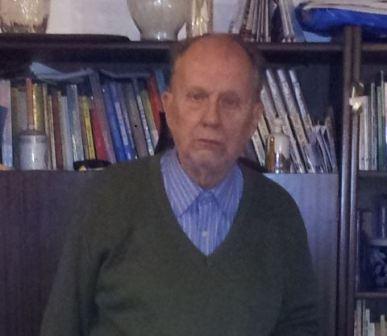
photo of Ernesto

Ernesto Brucker of Buenos Aires, Argentina.

Ernesto Ricardo Brucker, now in his 80s, who lives in Buenos Aires, Argentina, is hoping to find the Canadians who took his father prisoner during the Battle of Vimy Ridge, so he could thank them for saving his father’s life and not killing him when he surrendered.

Because of the actions of two unknown ‘tall’ Canadians, Brucker survived the Battle of Vimy Ridge and spent the remainder of the war in a Prisoner of War camp in Skipton, England.  According to the Skipton documents, he was taken prisoner between Thélus and Bailleul-Sir –Berthoult, 4.4 km south-east of Thelus.

Jorge Brucker Skipton

Georg (Jorge) Brucker at Skipton POW Camp in England. (Photo courtesy of E. Brucker)

Not only were 3,400 Germans were taken prisoner on April 9, 1917, but there were 4 Canadian Divisions involved in the battle. Could we find out how Brucker became a prisoner of war?

Georg (later known as Jorge) BRUCKER was born November 2, 1896 in Erlangen, Germany, and 18 years old when WWI started.  He joined the army and was sent to Poland, then to France.  During the Battle of Vimy Ridge, he was the Lieutenant in charge of a platoon in Machine Gun Company 1 of the Royal Bavarian Reserve Infantry Regiment I in Thélus.  They had been in the Arras area since October 1914 and held the villages of Thélus, Bailleul and the southern slope of the ridge.

On April 9, 1917, the 1st Canadian Division, under the command of Major General Arthur Currie, faced the 1st Bavarian Reserve Division, under the command of General of the Infantry Karl von Fassbender, halfway between the villages of Thélus and Bailleul-Sir –Berthoult. The 1st Canadian Division was stretched along a front of about two kilometres, with six battalions. The furthest from Vimy Ridge, they had some four kilometres of battlefield to cross in order to reach it!

Initial attack by 1st Cdn Division

Initial attack by the 1st Canadian Division (Source: http://www.webmatters.net/txtpat/index.php?id=1497)

The 13th Machine Gun Company was attached to the 1st Canadian Division in order to support the Infantry Brigades.  This is the unit that Patrick Raymond ARSENAULT was in. Was it a twist of irony that both Arsenault and Brucker were in Machine Gun Companies – on opposing sides?  Unlike Brucker, Arsenault lost his life in a shell attack on April 9, sometime around 7 am.  His body was never recovered.  Either he was buried in an unknown grave, or the shell attack scattered his body parts, making identification impossible.

John ‘Lymon’ WOOD was also in the 1st Canadian Division, as a member of the 2nd Canadian Battalion (Eastern Ontario Regiment), which was part of the 1st Canadian Infantry Brigade during the Battle of Vimy Ridge.  Wood survived the Battle of Vimy Ridge, but his luck ran out on May 3, 1917, when he was killed in action during the Battle of Arras.

Left: Patrick Raymond Arsenault in 1916 in Summerside.  (Photo courtesy of Paul Arsenault collection)  Right: John Lyman Wood shortly after enlistment in October 1915.  (Photo courtesy of Gene Rogerson collection)

Dr. Jack Sheldon researched and translated German reports from the battle.  In his 2008 book “The German Army on Vimy Ridge 1914-1917”, he recorded a description made by Brucker’s Commanding Officer, Major Meyer of the 1st Battalion Reserve Infantry Regiment:

“…At 5:30 am on 9 April enemy drum fire, supplemented by machine gun fire, came down.  It was impossible to make out the position and in fact it was almost impossible to make out signal flares amidst the clouds of smoke and dirt thrown up by the shells.  At 6:30 am heavy small arms fire could be heard and, at that moment, a message was sent by light signal to the rear.  ‘Heavy enemy attack.’  About half an hour later the wounded Muketier Hangemann happened to pass Battalion Headquarters, reporting that the British (meaning the Canadians) had overrun the right flank of 1st Bavarian Reserve Division and had then attacked our battalion in great strength from the left and rear….

In the final attack, the 1st Brigade, which John ‘Lymon’ Wood was part of, passed through the other two Brigades while the artillery dropped thousands of rounds.  As the attack began again, the wind started to turn, blowing snow and smoke from the burning village of Thélus into the faces of the Bavarians. This helped to hide the approaching Canadians, who encountered little resistance. By 1 pm the battle was over.

It’s not clear at which point Brucker was taken prisoner, but most likely it happened by 11:30 am at the latest, based on reports by Major Meyer, as recorded in Dr. Jack Sheldon’s book “The German Army on Vimy Ridge 1914-1917”:  “…Not until 11:30 am, when all the grenades had been thrown and there was no longer any prospect of timely relief, did the remainder of the garrison decide, reluctantly, to surrender...

In the book, ‘The History of the 2nd Canadian Battalion (East. Ontario Regiment) Canadian Expeditionary Force in the Great War 1914-1919’ by Colonel W. W. Murray, he records an account of the capture of German machine gunners in the morning.  “The Scouts found considerable work.  Ptes I. F. Wismer and J.F. Harrison performed a particularly daring feat near the Loen Weg.  Working in advance of No. 1 Company, they observed an enemy machine gun coming into action against the Fourth.  Pushing forward, they secured the gunner, an officer.  The pair then descended into an adjacent dug-out and forced the surrender of three more officers and four men, together with the gun…”  Were these the two Canadians who captured Georg Brucker?  It’s unlikely we’ll ever know.

At the end of the day, the 1st Division had crossed four kms of battlefield, captured 2,500 prisoners, 40 machine guns and 27 cannons at a cost of 2,500 of their own men killed or injured.  Wood survived, Arsenault died, and Brucker was taken prisoner.

Many people today may be wondering why so many German prisoners of war were allowed to surrender during the battle, and not simply killed.  In his 1986 book ‘Vimy’, author Pierre Berton gives a reason why not every Canadian soldier saw the German army as ‘the enemy’:  “…Letters and wartime reminiscences suggest that the Canadians often resented their own brass more than they disliked the grey-clad German.  You shot at him because he was shooting at you, but it wasn’t a personal matter.  He too was walling in the mud, only a few yards away….

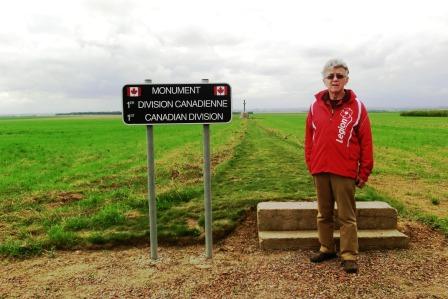
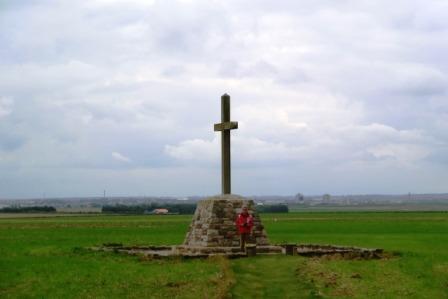
Today, a memorial to the 1st Canadian Division sits in a farmer’s field, marking the Canadian and German front lines on April 9, 1917, on the road between Thélus and Bailleul-Sir –Berthoult.  Somewhere along this line is the spot where Brucker’s last moments of WWI before becoming a prisoner of war played out.

CIMG8314 Sep 5 2017 Pieter by sign directing you to Memorial to 1st Cdn Division

Line in farmer’s field, halfway between Thélus and Bailleul-Sir –Berthoul, marks the front line where German and Canadian troops faced each other on April 9, 1917. (Photo credit: Daria Valkenburg)

CIMG8318 Sep 5 2017 Memorial to 1st Cdn Division halfway betwen Thelus & Bailleul

Memorial honouring the 1st Canadian Division in farmer’s field, halfway between Thélus and Bailleul-Sir –Berthoul, along the line where German and Canadian troops faced each other on April 9, 1917. (Photo credit: Daria Valkenburg)

After two years in Skipton, Brucker was sent to a Military Camp in Lockstedt, Germany in October 1919, and went on to work in a bank in Bavaria. He was sent on a secondment for one year to Argentina, where he met his wife.  They married in 1923 and he stayed in Argentina until his death on December 26, 1984.

Although we were unable to give Ernesto a complete answer of who to thank for saving his father’s life, we did find out the approximate area where he became a prisoner of war, surrendering to a regiment of the 1st Canadian Division (For a list of the regiments in the 1st Canadian Division see https://en.wikipedia.org/wiki/Battle_of_Vimy_Ridge_order_of_battle.) Georg Brucker was very lucky to have surrendered to soldiers who showed humanity, not revenge.

If you can add to this story, have photos or information to share on soldiers from the Cenotaph outside the Borden-Carleton Legion, or soldiers buried in The Netherlands, please let us know. You can share them by sending an email to memorialtrail@gmail.com or by commenting on this blog.

© Daria Valkenburg

….Want to follow our research?….

If you are reading this posting, but aren’t following our research, you are welcome to do so.  Our blog address: https://onthewarmemorialtrail.com/

Front cover OnTheWarMememorialTrailinEurope4 countries, 6 weeks, 7,000 km – an unforgettable war memorial journey in Europe…. Daria’s book ‘No Soldier Buried Overseas Should Ever Be Forgotten‘ is available in print and e-book formats.  Net proceeds of book sales help support research costs and the cost of maintaining this blog. For more information see https://nosoldierforgotten.com/ 

You are also invited to subscribe to our YouTube Channel: On The War Memorial Trail With Pieter Valkenburg: https://www.youtube.com/channel/UCJ591TyjSheOR-Cb_Gs_5Kw

Never miss a posting!  Subscribe below to have each new story from the war memorial trail delivered to your inbox.

On the War Memorial Trail …..WWI Soldier John Lyman Wood’s Connection With Acadia University

June 1, 2018.  In previous blog postings, we wrote about John Lyman WOOD, whose name is not only on the Cenotaph outside the Borden-Carleton Legion, but also is listed on the Vimy Memorial in France. (See Learning About The Two Names On The Vimy Memorial and Visiting The Canadian National Vimy Memorial)

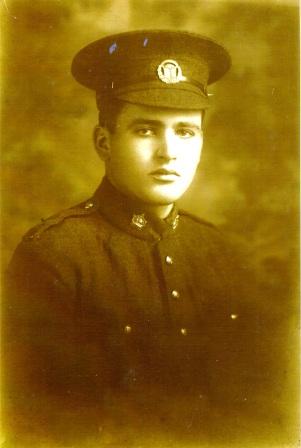
Photo Lyman Wood

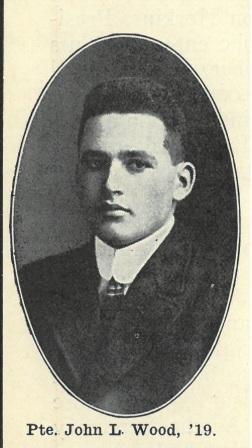
Photo: John Lyman Wood shortly after enlistment in October 1915. (Photo courtesy of Gene Rogerson collection)

Born in North Tryon on July 8, 1897, the son of George William Wood and Martha Heatly, he was raised on a farm, and was in second year engineering at Acadia University in Wolfville, Nova Scotia before enlisting in the Princess Patricia Canadian Light Infantry 4th University Company on October 12, 1915.  On November 28, 1915 he sailed from Halifax on the SS Lapland, arriving in Plymouth, England on December 7.

Upon arrival, he was sent to the 11th Reserve Battalion, stationed at St. Martin’s Plain near Folkestone, for infantry training for needed reinforcements to the Canadian Corps in the field.

Before WW1 began, Wood attended Horton Academy and Acadia University in Wolfville, Nova Scotia.   As part of his research, Pieter contacted Acadia University.  Wendy Robicheau, archivist at Acadia University, is researching WW1 soldiers who attended Acadia and posts information on a blog.  (See Acadia and the War: commemoration and dissemination blog: http://aboutacadiawar.blogspot.com/.)  Wendy explained that at Acadia University, Wood was known as ‘Lyman’, not ‘John’.

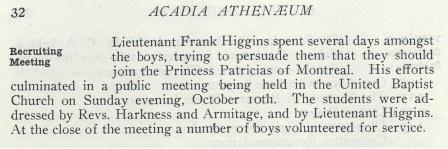
Wendy shared information from Acadia’s student newspaper, ‘The Acadia Athenaeum’, December 1915 issue. “The following men enlisted with the 4th Universities Company of the P.P.C.L.I.:–Lieut. Frank Higgins, ’14; Sergeant Murray Millet, ’16; Corporal Burton DeWolfe, ’16; Lance Corporal Don Chase Eng. ’16; Max Saunders, ’16; Charlie Fitch Eng, ’16; Harold Bishop, ex ’17; John MacNeill, ex ’18; Leyman Wood, ex ’18; John Mosher, ex ’18.”  P.P.C.L.I. refers to Princess Patricia Canadian Light Infantry. The dates after the men’s names refer to either the year of graduation or the year they should have graduated, if WW1 had not interrupted their education.

In her blog posting of June 23, 1917, (http://aboutacadiawar.blogspot.com/search?q=Higgins) , Wendy wrote that “It should be noted that Higgins played a role in recruiting several Acadia men to the P.P.C.L.I. His signature appears on the attestation papers of several students who enlisted in Wolfville.”  The following entry is from the November 1915 issue of the Acadia Athenaeum.

Recruit_Mtng_Ath_1915

Excerpt from November 1915 issue of Acadia Athenaeum of Acadia University.

Indeed, Higgins did sign the attestation papers for Wood as well, as Wendy explains in her blog posting of May 3, 2017 (http://aboutacadiawar.blogspot.com/2017/05/remembering-john-lyman-wood-died-100.html?q=Higgins): Private Wood attested in October 1915. He was a student with one year in Acadia’s O.T.C. The witness on his papers–Lieut. F.C. Higgins. Incidentally, Dr. C.E.A. deWitt, Class of ’04, signed his medical papers. DeWitt was the doctor at Camp Aldershot.

Wood_JL

Student photo from Acadia University, published in the June 1917 Acadia Athenaeum. This may have been his matriculation photo.

Wendy went on to explain that of the group of ten men mentioned in the December 1915 issue:  “Five will not survive. DeWolfe, Saunders, Fitch, and Wood all die in Europe. Bishop, severely wounded, is brought back to Nova Scotia, and dies in Halifax. Chase is taken POW at Mount Sorrell with other P.P.C.L.I. who are Acadia students, but not of the group listed above.

Wendy let us know about a book ‘As Ever’, written by John Grant, containing letters from his great-uncle Harold Fletcher Bishop, who signed up with John Lyman Wood, and was also a war casualty. (See  http://www.kingscountynews.ca/living/letters-from-auburn-soldier-in-first-world-war-inspire-book-71960/).  After contacting John Grant and asking about John Lyman Wood, he wrote back that he’d found a reference to Wood attending a dinner in Folkestone, England: “On or about January 16, 1916 the Acadia men organized a dinner at the Metropole Hotel where perhaps two dozen gathered for a meal, toasts, and to sing the Acadia songs around the piano.  I have included in my book two reports of evening that were published in the Acadia Atheneaum.  Pte. J.L. Wood, Class of ‘18” was mentioned. 

In an excerpt of one report of that evening, by Sgt F. Gregg, he explains that: “On the night in question the Acadians made their way, by bus and train, toward the Metropole hotel. Here the interior presented a happy contrast to the bleak, darkened, town without. Upon being ushered into the sanctum reserved for us we were surprised to see fellows, many of whom we thought still to be in the Blue Nose province.

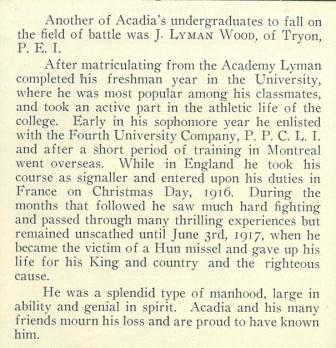
This was the only reunion dinner that Wood attended. On January 21, 1916 he was in hospital with appendicitis, then gastritis, and measles.  He was discharged on April 15, 1916, to the 39th Battalion. On December 22, 1916, he arrived in France as part of the Second Infantry Battalion, which was part of the 1st Canadian Infantry Brigade during the Battle of Vimy Ridge.   He survived that battle, but his luck ran out on May 3, 1917, when he was killed in action during the Battle of Arras, in the third battle of the Scarpe near Fresnoy.  Wood’s body was never recovered, his only memorial in Europe being his name inscribed on the Vimy Ridge Memorial, which we visited last fall.  Wood’s obituary was published in the June 1917 issue of the Acadia Athenaeum, with an unfortunate typo for the month of his death.

wood obituary

Excerpt from June 1917 issue of Acadia Athenaeum of Acadia University. Note that the date of death is incorrect. Wood died on May 3, 1917.

A big thank you to Wendy Robicheau for sharing the information about Wood from Acadia University, to Gene Rogerson for providing a photo of Wood, and to John Grant for letting us know about the Acadia reunion dinner.  Can you add anything more to Wood’s story?  Email us at memorialtrail@gmail.com, comment on the blog, or send a tweet to @researchmemori1. Comments or stories?  You can share them by email or by commenting on this blog.

UPCOMING PRESENTATION: Pieter has been invited to speak about the Cenotaph Research Project at St John The Evangelist Anglican Church in Crapaud at 7 pm on Thursday, July 12, 2018.  Location: 391 Nelson St, Trans Canada Hwy Rte, Crapaud, PE C0A 1J0.  Photos and information about soldiers welcome.

© Daria Valkenburg

…Want to follow our research?….

If you are reading this posting, but aren’t following our research, you are welcome to do so.  Our blog address: https://onthewarmemorialtrail.com/

Front cover OnTheWarMememorialTrailinEurope4 countries, 6 weeks, 7,000 km – an unforgettable war memorial journey in Europe…. Daria’s book ‘No Soldier Buried Overseas Should Ever Be Forgotten‘ is available in print and e-book formats.  Net proceeds of book sales help support research costs and the cost of maintaining this blog. For more information see https://nosoldierforgotten.com/ 

You are also invited to subscribe to our YouTube Channel: On The War Memorial Trail With Pieter Valkenburg: https://www.youtube.com/channel/UCJ591TyjSheOR-Cb_Gs_5Kw

Never miss a posting!  Subscribe below to have each new story from the war memorial trail delivered to your inbox.

On The War Memorial Trail….Two Campbell Brothers in WWI

December 8, 2017. After visiting the Sanctuary Wood Cemetery, we stopped at the Battle of Mount Sorrel Monument, honouring the 15th Canadian Infantry at Observatory Ridge.  We had noticed this monument only because of a torn Canadian flag beside it!  We learned that the plaque was unveiled on October 22, 2011 before Canadian and Belgian dignitaries by members of the 15th Battalion Memorial Project.

IMG_20170910_133239840_HDR Sep 10 2017 Batttle of Mount Sorrel Monument

Battle of Mount Sorrel Monument, honouring the 15th Canadian Infantry at Observatory Ridge. (Photo credit: Pieter Valkenburg)

While no one on the Cenotaph outside the Borden-Carleton Legion was in the 15th Canadian Infantry, these soldiers were in the thick of things during the Battle of Mount Sorrel, in which George Albert Campbell and Charles Benjamin Murray Buxton lost their lives.

Buxton’s story was told in previous blog entries, and this blog entry is to tell what little we know about George ‘Albert’ CAMPBELL and how he lost his life.

george-albert-campbell-from-gerald-tingley.jpg

Private George Albert Campbell. (Photo courtesy of Gerald Tingley family collection)

Albert was born on July 8, 1895 in Wellington, PEI, the son of John George Campbell and Grace Emma, nee Barlow.  A fisherman and farmer before enlisting on April 6, 1915 with the 6th Canadian Mounted Rifles, he later transferred to the 5th Canadian Mounted Rifles.

During the Battle of Mount Sorrel, the 5th Canadian Mounted Rifles were in a supporting position, occupying the strongpoint, dugouts, and trenches in Maple Copse and Zillebeke area, as noted in ‘With The Patricia’s In Flanders 1914-1918 Then & Now’ by Stephen K. Newman.

Newman goes on to explain in his book that “….the 5th Canadian Mounted Rifles in Maple Copse held on despite heavy shelling that flattened the entire wood and made their old trenches untenable.  They waited for the reinforcements from 2nd Canadian Mounted Rifles and the 9th Brigade.  The two eighteen pounder sacrifice guns of the 5th Battery Canadian Field Artillery hidden in the southern part of Sanctuary Wood did their job to the last man and were overrun.  The German success depended on their bulling through the Patricia line and moving the 5th Canadian Mounted Rifles out of Maple Copse….

Albert was in the midst of this battle, as a member of the 5th Canadian Mounted Rifles.  According to the Canadian War Graves Register Circumstances of Death, he was killed in action in the vicinity of Maple Copse.

The War Diary of the unit for June 2, 1916 notes: “A red letter day in the history of the battalion ever to be remembered by those who lived through it. The battalion went into the line in the night of the 31st of May /1st of June occupying a position in Brigade support at Maple Copse.

 ‘A’ company and two platoons of ‘B’ company at Maple Copse. Nothing of importance occurred until the morning of the 2nd of June when at about at 8.30 a.m., the enemy began a very heavy bombardment of the frontline and all the ground at Maple Copse and vicinity. Heavy bombardments continued till noon on the 3rd and continued again after 6 p.m

Unfortunately, Albert has no known grave, and his name is therefore listed on the Menin Gate Memorial.  It’s quite likely, however, that he might be buried in Maple Copse Cemetery in an unknown grave.

CIMG8858 Sep 10 2017 Maple Copse Cemetery

Entrance to Maple Copse Cemetery. (Photo credit: Pieter Valkenburg)

Maple Copse was the name used by the British Army for a small plantation east of Zillebeke and just west of Sanctuary Wood.  It was used by medical staff as a dressing station, and burials took place here both before and after the Battle of Mount Sorrel.

The cemetery was destroyed by shellfire during the Battle of Mount Sorrel and when fighting resumed afterwards, with the gravestones destroyed and ending up in the rubble.  Of 256 named graves that were known to exist, only 26 could be definitely located.  Perhaps Albert is in one of these.  Of the 256 graves, 114 had soldiers from the United Kingdom and 142 from Canada.

Like he did with Buxton at the Sanctuary Wood Cemetery, Pieter put Canadian flags on 4 unknown graves from a Canadian Regiment, and then placed a PEI flag on one of these in memory of George ‘Albert’ Campbell.

CIMG8864 Sep 10 2017 Pieter by grave of unknown soldier at Maple Copse Cemetery

Pieter by the grave of an unknown soldier from a Canadian regiment at Maple Copse Cemetery. (Photo credit: Daria Valkenburg)

With the advances in DNA research, perhaps one day there will be the possibility to find out who the unknown soldiers are in Maple Copse and Sanctuary Wood cemeteries.  Wouldn’t that be a genealogical project to get involved with?

Unfortunately, we have very little information about his life prior to enlistment, but are grateful for the photo of Albert sent by a distant relative, Gerald Tingley.  If anyone has more information or photos, please help us honour Albert’s memory by sharing them.  (For previous blog entries that have mentioned Albert, see A Daytime Visit To Menin Gate Memorial in Ypres and A Visit To Sanctuary Wood.)

There are two Campbells on the Cenotaph outside the Borden-Carleton Legion, one who died and one who survived, but with injuries.  George ‘Albert’ Campbell had a younger brother, William Galen CAMPBELL, born June 16, 1897 in Wellington, who enlisted on April 22, 1916 with the 5th Siege Battery as a gunner, shortly before his older brother died.  He later transferred to the 8th Siege Battery of the 3rd Brigade Canadian Garrison Artillery, and was poisoned by a mustard gas shell, during action near Lievin (Pas de Calais) in France on May 28, 1918.

The war diary of the 8th Siege Battery tersely noted what happened to the unit:

27 May 1918: Intense gas bombardment on Lievin and many gas shells fell around Thelus and vicinity.

28 May 1918: Twenty nine other ranks of Lievin section admitted to hospital, gassed.

29 May 1918: Capt. Cunningham, Lt Messeray and 39 other ranks of Lievin section to hospital, gassed.

Unlike his brother Albert, William Galen survived and married Ida May McNally on January 5, 1919.  On April 14, 1919 he was discharged from military service.  He passed away on April 24, 1954 in Charlottetown and is buried in the cemetery at the Free Church of Scotland in Cape Traverse.  We have no photo or further information on William Galen Campbell.

william-g-campbell-gravestone-free-church-of-scotland-cape-traverse.jpg

Grave of William Galen Campbell in the cemetery of the Free Church of Scotland in Cape Traverse. (Photo credit: Pieter Valkenburg)

While our visit to Maple Copse Cemetery ended our Belgian visit to graves and memorials for the names on the Cenotaph outside the Borden-Carleton Legion, we were interested in visiting some of the other memorials in the area.  So, in the next blog entry, we will continue on the war memorial trail in Belgium.

Comments or stories?  You can share them by emailing us at memorialtrail@gmail.com or by commenting on this blog.

© Daria Valkenburg

….Want to follow our research?….

If you are reading this posting, but aren’t following our research, you are welcome to do so.  Our blog address: https://onthewarmemorialtrail.com/

Front cover OnTheWarMememorialTrailinEurope4 countries, 6 weeks, 7,000 km – an unforgettable war memorial journey in Europe…. Daria’s book ‘No Soldier Buried Overseas Should Ever Be Forgotten‘ is available in print and e-book formats.  Net proceeds of book sales help support research costs and the cost of maintaining this blog. For more information see https://nosoldierforgotten.com/ 

You are also invited to subscribe to our YouTube Channel: On The War Memorial Trail With Pieter Valkenburg: https://www.youtube.com/channel/UCJ591TyjSheOR-Cb_Gs_5Kw

Never miss a posting!  Subscribe below to have each new story from the war memorial trail delivered to your inbox.

On The War Memorial Trail….A Trip To The Bayeux War Cemetery

October 6, 2017.  I was very much looking forward to the trip to Bayeux, but not for the cemetery.  Located 30 km northwest of Caen, where we were staying overnight, Bayeux is the home of the Bayeux Tapestry.  This is an embroidered cloth, dating from sometime in the 1070s, nearly 70 metres (230 ft) long and 50 centimetres (20 in) tall, which depicts the events leading up to the Norman conquest of England concerning William, Duke of Normandy (William The Conqueror), and Harold, Earl of Wessex, later King of England, and culminating in the Battle of Hastings in 1066.  This tapestry is hanging in the Musée de la Tapisserie de Bayeux (Bayeux Museum of Tapestry) in Bayeux.

Pieter’s ancestry goes back to Hamon de Masci, a cousin of William the Conqueror, and whose sons made the journey to England with him from Normandy as part of the conquest.  In the late 1500s, a descendant settled in The Netherlands and started a brick factory, and the rest is part of Valkenburg history.

….In Bayeux I wanted to see a tapestry, Pieter a war cemetery….

Of course, when I excitedly mentioned what a great coincidence it was that we were going to Bayeux, a place I wanted to go anyway, Pieter looked at me in horror.  Why would we waste time looking at an old tapestry when we were here to visit a cemetery and had not much time after the trip to Rouen, that same day? No way! He reminded me that we still had to find our lodging in Caen and that I had been in a great deal of ‘distress’ (he was too polite to say ‘in a panic’) when we were driving in very busy Rouen.

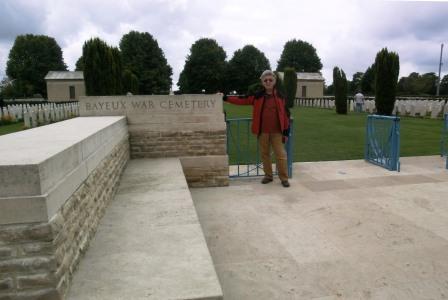
So, with no chance at examining genealogical history, we went to Bayeux, paying an additional 5.50 euros in toll charges, followed shortly afterwards by another 3.50 euro toll, and stopped at the Bayeux War Cemetery in Bayeux, where George Ashley BARTLETT, another of the men on the Cenotaph outside the Borden-Carleton Legion is buried.

CIMG8610 Sep 7 2017 Pieter at Bayeux War Cemetery entrance

Pieter at the entrance to Bayeux War Cemetery in Bayeux. (Photo credit: Daria Valkenburg)

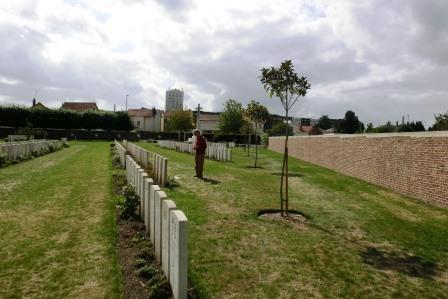
The Bayeux War Cemetery was the first one that had visitors at the same time we were there.  We weren’t alone!  We wondered if this was because it was a WWII cemetery.  All of our other visits had been to WW1 cemeteries and memorials.  It’s also the largest we’ve been to up to now, with 4,144 Commonwealth burials from WWII, 338 unidentified.  There are an additional 500 graves of other nationalities, most of them German.

The cemetery is in an urban setting, and across the street from the Bayeux Memorial, which honours the men of the British and Commonwealth land forces who fell in the early stages of the campaign in northwest Europe of 1945 and have no known grave.  Next to the Bayeux Memorial is the Battle of Normandy Memorial Museum (Musée Mémorial Bataille de Normandie) in Bayeux.  If you are interested in learning more about the D-Day Landing / Operation Overlord operations, plan a visit to Bayeux!  There were a lot of tour buses – from several European countries – and a lot of people walking around.

….George Ashley Bartlett survived D-Day but lost his life during Operation Tractable….

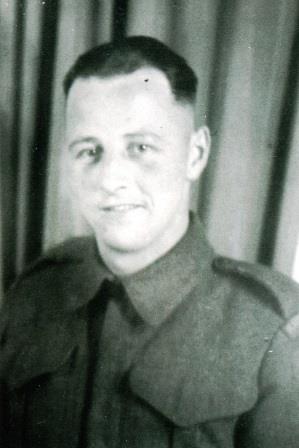
Sergeant George Ashley Bartlett was born in the Gaspé Peninsula, Quebec, on June 3, 1917, the son of Walter Philip Bartlett and Annie Alice Wright.  He enlisted with the North Nova Scotia Highlanders in Amherst in June 1940. In 1941, he married Leah Jean Campbell in Amherst, Nova Scotia, and they had a son John Ashley.

Photo George Ashley Bartlett

Photo: George Ashley Bartlett. (Photo courtesy of North Nova Scotia Highlanders Regimental Museum in Amherst, Nova Scotia)

Bartlett survived the D-Day Landing, but then, on August 14, 1944 he was wounded in action during Operation Tractable to capture Falaise Ridge, and died the following day.  Operation Tractable, fought between August 14 and 21, 1944, was the final offensive conducted by Canadian and Polish troops, supported by one brigade of British tanks, as part of the Battle of Normandy during World War II.

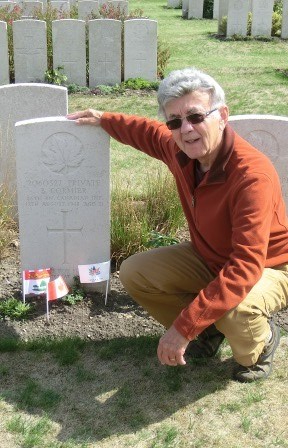
CIMG8603 Sep 7 2017 Pieter by grave of G A Bartlett in Bayeux War Cemetery

Pieter at the grave of George Ashley Bartlett in Bayeux War Cemetery after laying down the flags of Canada, PEI, and Canada 150. (Photo credit: Daria Valkenburg)

….Bartlett’s young son drowned a few years later in Crapaud….

At the time of his death, his wife and son were living in Crapaud.  Mrs. Bartlett remarried, to Ellsworth Wilson, a barber, but then she suffered a second tragedy.  Her young son drowned in March 1948 while she was at the hairdresser shop owned by the mother of Crapaud resident Gene Rogerson.  Gene recalled that young Ashley Bartlett had taken a toboggan to the nearby pond.

….A replica of the Bayeux Tapestry was on a museum wall….

As for me and my dream of seeing the Bayeux Tapestry, I had the last word on this trip to the Bayeux War Cemetery.  As we walked to the car, which was parked at the Battle of Normandy Memorial Museum, I spotted a poster of the Bayeux Tapestry on the Museum wall and managed to convince Pieter to stand beside it.

CIMG8612 Sep 7 2017 Pieter by poster of Bayeux Tapestry at British Military Museum in Bayeux

Pieter by a poster of the Bayeux Tapestry outside the Battle of Normandy Memorial Museum in Bayeux. (Photo credit: Daria Valkenburg)

In the next blog entry we make our way to our last cemetery in France, to Leubringhen, just before the Belgian border. Do you have photo or info on George Bartlett?  Comments or stories?  Email us at memorialtrail@gmail.com, comment on the blog, or tweet to @researchmemori1.

© Daria Valkenburg

….Want to follow our research?….

If you are reading this posting, but aren’t following our research, you are welcome to do so.  Our blog address: https://onthewarmemorialtrail.com/

Front cover OnTheWarMememorialTrailinEurope4 countries, 6 weeks, 7,000 km – an unforgettable war memorial journey in Europe…. Daria’s book ‘No Soldier Buried Overseas Should Ever Be Forgotten‘ is available in print and e-book formats.  Net proceeds of book sales help support research costs and the cost of maintaining this blog. For more information see https://nosoldierforgotten.com/ 

You are also invited to subscribe to our YouTube Channel: On The War Memorial Trail With Pieter Valkenburg: https://www.youtube.com/channel/UCJ591TyjSheOR-Cb_Gs_5Kw

Never miss a posting!  Subscribe below to have each new story from the war memorial trail delivered to your inbox.

On The War Memorial Trail….On The Road To Rouen

October 1, 2017.  Leaving the Arras area, which we had thought was busy enough, was an experience, as now we encountered toll roads.  We soon learned to dread the words ‘gare de péage’.  While all the toll booths have iconic names, like the first one we pulled up at, named ‘Jules Verne’, they are now mostly automated, and you need cash or a debit or credit card.

…. ‘Gare de péage’ meant frustration in trying to pay a toll in Normandy….

If you are one of the modern people thinking ‘Dinosaur’, let me describe the experience.  First off, the box where you have to pay is designed to accommodate truckers, not people in dinky toy cars like the majority of cars used in Europe.  Most people do not have the rubber arms needed to reach up to drop the money in, so each toll booth encounter takes longer than it would if you paid an attendant, as car doors open and people try to squeeze out in the available space to drop their money in manually, or pay by card.  And of course, you need first to figure out WHERE you place your money as there is more than one slot.

If you use cash, as we did, you soon also learned that it’s best to have exact change, as otherwise you have to WAIT for change and then reach up to another slot to get your money.  Anyone in a hurry sometimes leaves their change behind!

PEI is not alone in charging heavy tolls.  We left 7.70 euros at Jules Verne, only to encounter another toll booth 6 minutes later!  At this one we picked up a ticket which cost us another 5.70 euros half an hour later.  The count so far … 13.40 euros.  In Canadian dollars it comes to about $19.75, and the day was just beginning.

…. We were on the right street but in the wrong community!….

It took us just over 2 ½ hours to get to Rouen from Mont St. Eloi, and, following the GPS instructions to the St. Sever Cemetery, arrived at Boulevard Stanislas Girardin, only to find it was in downtown Rouen.  No cemetery in sight!  The streets are extremely narrow, jam packed with cars and pedestrians and most of the streets one way traffic only.  We finally gave up trying to figure out what had gone wrong and stopped in front of a short driveway into a huge government building behind a walled gate, and asked a passerby for help.

The poor man looked at our sheet from the Commonwealth War Graves Commission and finally said, very kindly, that we were on the right street, but not in Rouen.  The cemetery was in a nearby community.  Sure enough, when we looked at the cemetery location instructions, it said it was “situated on the eastern edge of the southern Rouen suburbs of Le Grand Quevilly and Le Petit Quevilly.”  But what we didn’t understand was why we’d been directed downtown when we had the right street.

The man explained that it was in either Le Grand Quevilly or Le Petit Quevilly, he wasn’t sure which.  So, the GPS got reprogrammed for Le Grand Quevilly.  The word “suburb” was a misnomer.

While this discussion had been going on, traffic was backing up as people wanting to get into or out of the government driveway were held up as we were blocking the road.  Not one person honked or showed any impatience!  We thanked the man for his help, and then slowly backed up onto the traffic, and made our way out of town.

…. A car salesman steered us in the right direction to the cemetery….

Le Grand Quevilly was a short distance away, but it was not the location of the cemetery.  We pulled into a car dealership to ask directions, only to find out that France shuts down for lunch break.  Everything was locked up, but we found a salesman in a tent on the lot, reading his emails.

I’m from a different country,” he said, when we asked about the cemetery.  Then he made us laugh when he went on to say, “I’m from Paris.”  But he was very effective at finding someone who could help us and that’s when we learned that we wanted to be in Le Petit Quevilly, and how to get there.

In Le Petit Quevilly, on a street by the same name as in Rouen (what are the odds?), we were able to find St. Sever Cemetery Extension, the location where Bazil Cormier is buried.

CIMG8598 Sep 7 2017 sign directing us to St Sever Cemetery Extension

Sign to the St. Sever Cemetery in Le Petit Quevilly. (Photo credit: Daria Valkenburg)

According to the information provided by the Canadian War Graves Commission, during WWI, Commonwealth camps and hospitals were stationed on the southern outskirts of Rouen.  Most hospitals remained there during the war.  A number of those who died in the hospitals were buried in other cemeteries, but the majority were buried at St. Sever Cemetery.  In September 1916, the Extension, where Bazil Cormier is buried, began.

In WWII, Rouen was again a hospital centre, and several Commonwealth soldiers who were prisoners of war during the German occupation are buried in the Extension.

…. St. Sever Cemetery Extension was huge….

St. Sever Cemetery Extension is the largest cemetery we’ve been to so far, with 8,348 WWI Commonwealth burials, 10 of them unidentified, 328 WWII Commonwealth burials, 18 of them unidentified, and 8 foreign nationals.

With such a large cemetery, it was not easy to find Cormier’s grave.  Luckily, in this cemetery, several gardeners from the Commonwealth War Graves Commission were on site.  While Pieter went to look in the Grave Register, I looked at the graves, trying to find the row in which Cormier was buried.  One gardener asked if I needed help.  When I explained who we were looking for, he asked if I had the paper with the burial information.  I explained it was on the other side of the cemetery with Pieter, who was comparing it to the information in the Grave Register.

Just to let you know how great these workers are, the gardener immediately went over to the other side of the cemetery and then spent the next few minutes looking for the grave, which of course was as far away as possible from where we were!

CIMG8587 Sep 7 2017 Pieter at the grave of Bazil Cormier at St Sever Cemetery Extension

Pieter at the grave of Bazil Cormier in St. Sever Cemetery Extension in Le Petit Quevilly. (Photo credit: Daria Valkenburg)

…. Bazil Cormier lost his life during the Battle of Amiens….

According to his Attestation papers, Private Bazil CORMIER was born January 6, 1898 in Tignish, the son of Joseph Cormier and Marie Arsenault.  A farmer before enlisting with the 105th Draft Regiment on December 4, 1916, he died of wounds received in the Battle of Amiens near Cachy on August 12, 1918, at the age of 21.  At the time of his death he was with the 26th New Brunswick Battalion.

The War Graves Register Circumstances of Death notes that “During operations east of Amiens, on the morning of August 8th 1918, he was hit in the head by a machine gun bullet. He was immediately dressed by a comrade and carried out, but succumbed to his wounds at No. 4 General Hospital, Rouen, four days later...”  According to the active/casualty document in his file, however, he was transported to the No. 5 General Hospital, not the No. 4 General Hospital, where he died.

The Battle of Amiens, also known as the Third Battle of Picardy, was the opening phase of the Allied offensive which began on August 8, 1918, later known as the Hundred Days Offensive, that ultimately led to the end of the First World War.  This is the same battle in which James CAIRNS lost his life on August 9, 1918.

CIMG8592 Sep 7 2017 Pieter at grave of B Cormier in St Sever Cemetery Extension

Pieter by the grave of Bazil Cormier. (Photo credit: Daria Valkenburg)

As with too many of the WWI soldiers, we have no photo or further information about Bazil Cormier.

The cemeteries we’d been to in the past days had all been in the countryside.  St. Sever Cemetery Extension was in an urban setting, and bordered the Rouen Soccer Club, which caught the interest of soccer fan Pieter.

CIMG8590 Sep 7 2017 next to St Sever Cemetery Extension is the soccer club of Rouen

The Rouen Soccer Club was on the other side of the fence of the St. Sever Cemetery Extension. (Photo credit: Daria Valkenburg)

We couldn’t leave the cemetery without giving flag pins to the gardeners, one of whom spoke English and told Pieter that he had just graduated from horticultural college and loved his job.  The head gardener, who had helped us in the beginning, was unfortunately out on an errand, so we were not able to say goodbye to him.

CIMG8596 Sep 7 2017 Pieter with a CWGC gardener at St Sever Cemetery Extension

Pieter with a young CWGC gardener at St. Sever Cemetery Extension. (Photo credit: Daria Valkenburg)

In the next blog entry we make our way to Bayeux, which has a connection with Pieter’s genealogical research as well as the Cenotaph research project. Do you have photo or info on Bazil Cormier?  Comments or stories?  You can share them by emailing us at memorialtrail@gmail.com or by commenting on this blog.

© Daria Valkenburg

….Want to follow our research?….

If you are reading this posting, but aren’t following our research, you are welcome to do so.  Our blog address: https://onthewarmemorialtrail.com/

Front cover OnTheWarMememorialTrailinEurope4 countries, 6 weeks, 7,000 km – an unforgettable war memorial journey in Europe…. Daria’s book ‘No Soldier Buried Overseas Should Ever Be Forgotten‘ is available in print and e-book formats.  Net proceeds of book sales help support research costs and the cost of maintaining this blog. For more information see https://nosoldierforgotten.com/ 

You are also invited to subscribe to our YouTube Channel: On The War Memorial Trail With Pieter Valkenburg: https://www.youtube.com/channel/UCJ591TyjSheOR-Cb_Gs_5Kw

Never miss a posting!  Subscribe below to have each new story from the war memorial trail delivered to your inbox.
On The War Memorial Trail….The Ruins of Mont St. Eloi

October 1, 2017.  While we were packing to leave Arras to go on to Rouen and Caen, Pieter expressed an interest in seeing the ruins of the Abbey in Mont St. Eloi.  “…Sure...” I said.  “…I’d love to see the Cathedral with the statue that survived hanging down….”  I went on and on until he interrupted, saying I had the wrong Cathedral in mind.  The one I was thinking of was in Albert, in the Somme Valley, the ‘Leaning Virgin of Albert’, which has since been restored and leans no more.

…Doesn’t matter…” I said.  We aren’t planning to return to this area, so if he wanted to see something, we may as well do it.  Of course, in the morning when we were leaving, it was raining and Pieter was of two minds whether to make the trip to Mont St. Eloi or skip it. There was no connection, as far as we knew, to any of the soldiers on the Cenotaph outside the Borden-Carleton Legion, so this would be a side trip.

In the end, off we went.  Mont St. Eloi is on a hill above Arras, and at the top once stood the Mont St. Eloi Abbey.  All that remains today are two towers. The rest was destroyed during various wars.

Legend has it that the Abbey began in the 7th century by Saint Vindicianus, a disciple of Saint Eligius (Saint Eloi in French).  By the Middle Ages it was a powerful religious centre, but during the French Revolution, the stone walls were stolen. Only two towers of white limestone and a porch on the west wall were left.

When WW1 began, the towers were used by French troops to observe German positions on Lorette Spur and Vimy Ridge. The Germans fired every time the French troops moved, causing the French to believe they had a spy in their midst.  It took a while before they realized that what gave them away were birds nesting on the towers which took flight when troops disturbed them.

CIMG8583 Sep 7 2017 Pieter at ruined cathedral in Mont St Eloi

Pieter by the war-damaged towers of Mont St. Eloi Abbey. (Photo credit: Daria Valkenburg)

In the next blog entry we encounter difficulties in finding St. Sever Cemetery Extension in Rouen, and learn that PEI is not alone in charging expensive tolls. Comments or stories?  You can share them by emailing us at memorialtrail@gmail.com or by commenting on this blog.

© Daria Valkenburg

….Want to follow our research?….

If you are reading this posting, but aren’t following our research, you are welcome to do so.  Our blog address: https://onthewarmemorialtrail.com/

Front cover OnTheWarMememorialTrailinEurope4 countries, 6 weeks, 7,000 km – an unforgettable war memorial journey in Europe…. Daria’s book ‘No Soldier Buried Overseas Should Ever Be Forgotten‘ is available in print and e-book formats.  Net proceeds of book sales help support research costs and the cost of maintaining this blog. For more information see https://nosoldierforgotten.com/ 

You are also invited to subscribe to our YouTube Channel: On The War Memorial Trail With Pieter Valkenburg: https://www.youtube.com/channel/UCJ591TyjSheOR-Cb_Gs_5Kw

Never miss a posting!  Subscribe below to have each new story from the war memorial trail delivered to your inbox.
On The War Memorial Trail….Reflections on the Cemetery Visits in the Arras Area

October 1, 2017.  After visiting the cemeteries and Vimy Memorial to honour the memories of the soldiers on the Cenotaph outside the Borden-Carleton Legion who perished in the area around Arras, we went to our “local” café for the past few days, L’Eurostar Café Brasserie, for a well-deserved rest and final meal before leaving the area.

IMG_20170904_185344129 Sep 4 2017 Pieter at LEurostar Cafe in Arras enjoying a Leffe beer

Pieter enjoying Leffe blond beer at L’Eurostar Café Brasserie in Arras. (Photo credit: Daria Valkenburg)

In France, dinner is not served before 7 pm.  Normally that wasn’t a problem for us as we would arrive at a restaurant completely exhausted long after 7 pm, but after the success in finally finding Manitoba Cemetery we arrived back in Arras in the late afternoon, and decided to have an early dinner before packing up to leave the area in the morning.

We arrived at the café at 5:45 pm only to be told the kitchen didn’t open before 7 pm.  We were too tired to go back to the hotel and come back later, so we ordered an appetizer, camembert cheese of course in honour of our host country, and a drink and relaxed until the chef appeared, right on the dot of 7 pm.

Since we had all this time to relax and reflect on our journey so far, I asked Pieter how he felt.  He said that, for him, “visiting the graves made things come full circle.  You start off with a name on the Cenotaph.  Then you begin the research and read up on what happened.  Hopefully you get a photo and personal stories.  Now we’ve ended up where the person died after a very short life….

Pieter thought a bit before he continued, “….on the one side, I feel sorry they died so young.  On the other hand I feel honoured to be there to pay respects to them.  It makes me want to know more about them, now that I’ve visited their grave or memorial….

We both agreed that for the soldiers without a photo the picture is not complete.  “When I stand by a grave at the cemetery and have a photo so I know how the person looked, then I can feel a connection…” Pieter explained.

…It’s especially sad for soldiers like Arthur Collett, buried in Grandcourt Road Cemetery, and James Cairns, buried in Manitoba Cemetery, that they are buried in cemeteries that get very few visitors. They are just a number…. Each identified grave lists the soldier’s name, unit, rank, and identification number.

We both also agreed that the gardeners and maintenance staff at the Commonwealth War Graves Commission do a fantastic job of keeping up the cemeteries.  Over the past days, we’ve handed out Canadian flag pins to anyone we’ve seen driving around in the white vans with CWGC written on them and they have been enthusiastically received.  Up to now, we hadn’t seen anyone in a cemetery itself, but the work they do in sometimes very difficult locations, such as Grandcourt Road Cemetery, is to be commended.

When Pieter began this project, World War I was just history to us, no different than the various dates and historical facts we learned in school over the years.  Now it’s become a story with real people, and along the way, we are meeting wonderful people who work hard to preserve the history that we have largely forgotten.

In the next blog entry we visit the ruins of Mount St. Eloi church before going on to Rouen to St. Sever Cemetery Extension. Do you have photos or information about James Cairns?  Does anyone know the family members who visited the grave of Ted Arsenault of Abrams Village? Comments or stories?  You can share them by emailing us at memorialtrail@gmail.com or by commenting on this blog.

© Daria Valkenburg

….Want to follow our research?….

If you are reading this posting, but aren’t following our research, you are welcome to do so.  Our blog address: https://onthewarmemorialtrail.com/

Front cover OnTheWarMememorialTrailinEurope4 countries, 6 weeks, 7,000 km – an unforgettable war memorial journey in Europe…. Daria’s book ‘No Soldier Buried Overseas Should Ever Be Forgotten‘ is available in print and e-book formats.  Net proceeds of book sales help support research costs and the cost of maintaining this blog. For more information see https://nosoldierforgotten.com/ 

You are also invited to subscribe to our YouTube Channel: On The War Memorial Trail With Pieter Valkenburg: https://www.youtube.com/channel/UCJ591TyjSheOR-Cb_Gs_5Kw

Never miss a posting!  Subscribe below to have each new story from the war memorial trail delivered to your inbox.
On The War Memorial Trail….A Visit to Beaumont-Hamel Newfoundland Battlefield Memorial Park

September 29, 2017.  After we left Grandcourt Road Cemetery, we decided to visit a memorial site where we were assured of easy access.  Kevin Peddle of Prince County Trophy in Summerside, Prince Edward Island, had made plaques for Pieter for two soldiers listed on Menin Gate in Ypres, Charles Benjamin BUXTON and George Albert CAMPBELL, and he had also made the plaques for Patrick Raymond ARSENAULT and John Lymon WOOD that were left at the Canadian National Vimy Memorial in April by the Kinkora Regional High School students.

….Alec Peddle is listed on the Newfoundland Memorial at Beaumont-Hamel….

So when Kevin mentioned that his great-uncle, Seaman Alec PEDDLE was killed during WWI, Pieter did some research for him and found out that he was the son of David and Mary Ann Peddle, husband of Julia Peddle, and was listed on the Newfoundland Memorial at Beaumont-Hamel Newfoundland Battlefield Memorial Park. Pieter promised to try and visit the memorial and pay his respects.

Beaumont-Hamel, the largest of the battlefield parks established in memory of Newfoundlanders who lost their lives in World War I, is located nine kilometres north of the town of Albert.  Like Vimy Ridge, this is a well visited site, with student guides and a visitors centre.  This was quite a contrast to the many cemeteries we’d been to, where we were the only visitors.

CIMG8537 Sep 6 2017 Sign to Beaumont Hamel

Sign directing us to Beaumont-Hamel. (Photo credit: Daria Valkenburg)

The Beaumont Hamel Memorial Park, opened in 1925, is the home of the monument of a bronze caribou, the emblem of the Royal Newfoundland Regiment.

CIMG8540 Sep 6 2017 Pieter at Beaumont Hamel Memorial

Pieter at the base of the Beaumont Hamel Newfoundland Memorial. (Photo credit: Daria Valkenburg)

….Alec Peddle served with the Newfoundland Royal Naval Reserve….

At the base of the caribou statue are three bronze tablets with the names of 800 members of the Royal Newfoundland Regiment, the Newfoundland Royal Naval Reserve, and the Mercantile Marine.  All of these have no known grave.

Seaman Peddle, who was with the  Newfoundland Royal Naval Reserve, had been on a ship, the H.M.S. ‘Dirk’, which was torpedoed off the east coast of England on May 28, 1918.  Although Admiralty records state that ‘Dirk’ was a trawler hired in 1917, she was a ferry owned by David MacBrayne, and was used for submarine patrol duties along with her sister ship, the ‘Lochiel’.  As Peddle has no known grave, he is mentioned on the memorial on a panel for the Newfoundland Royal Naval Reserve.

CIMG8541 Sep 6 2017 Nfld Royal Naval Reserve Memorial

Bronze plaque listing members of the Newfoundland Royal Naval Reserve who died in WWI and have no known grave. (Photo credit: Pieter Valkenburg)

CIMG8544 Sep 6 2017 Nfld Royal Naval Reserve Memorial Pieter points to where Alec Peddle is mentioned

Pieter points to Seaman A. Peddle’s name on the Newfoundland Royal Naval Reserve Plaque. (Photo credit: Daria Valkenburg)

While we were at Beaumont-Hamel, we dropped in to say hello to site manager Arlene King, who had kindly arranged for site manager Johanne Gagné to help us out at the Canadian National Vimy Memorial Park.

CIMG8552 Sep 6 2017 Pieter with Arlene King site mgr of Beaumont Hamel

Pieter with site manager Arlene King at the Beaumont Hamel Visitors Centre. (Photo credit: Daria Valkenburg)

Although the visit to Beaumont-Hamel was not part of the Borden-Carleton Cenotaph Research Project, we were honoured to pay our respects to Seaman Peddle and see this beautiful site.

In the next blog entry we continue our search for the Manitoba Cemetery. Comments or stories?  You can share them by emailing us at memorialtrail@gmail.com or by commenting on this blog.

© Daria Valkenburg

….Want to follow our research?….

If you are reading this posting, but aren’t following our research, you are welcome to do so.  Our blog address: https://onthewarmemorialtrail.com/

4 countries, 6 weeks, 7,000 km – an unforgettable war memorial journey in Europe…. Daria’s book ‘No Soldier Buried Overseas Should Ever Be Forgotten‘ is available in print and e-book formats.  Net proceeds of book sales help support research costs and the cost of maintaining this blog. For more information see https://nosoldierforgotten.com/ 
You are also invited to subscribe to our YouTube Channel: On The War Memorial Trail With Pieter Valkenburg: https://www.youtube.com/channel/UCJ591TyjSheOR-Cb_Gs_5Kw

Never miss a posting!  Subscribe below to have each new story from the war memorial trail delivered to your inbox.

On The War Memorial Trail….Grandcourt Road Cemetery in Farmers Fields

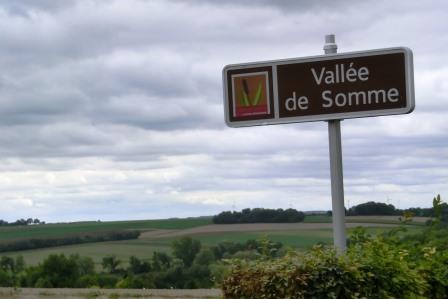
September 28, 2017.  After a few successful cemetery finds, we decided to make a second attempt at finding Grandcourt Road Cemetery, the burial place of Arthur Leigh COLLETT.  We finally found it in the afternoon on a very narrow path between farm fields, one km south of the village of Grandcourt in the spectacularly beautiful Somme Valley.

CIMG8361 Sep 5 2017 we reach the Somme Valley in France

We reach the Somme Valley in France. (Photo credit: Pieter Valkenburg)

The Commonwealth Graves Commission write up on the cemetery warned that access was difficult, saying “Please note that parking is difficult.  There is no permanent pathway to the cemetery.  Visitors must cross two fields to reach the cemetery.”  They weren’t kidding!

By “no permanent pathway” they meant you had to drive down a very narrow path which had inches to spare on either side on our small rental car.  We were dwarfed by a cornfield on one side and a potato field on the other.

CIMG8535 Sep 6 2017 corn is higher than car by Grandcourt Road Cemeter

You can see how close we were to the cornfield! (Photo credit: Daria Valkenburg)

Needless to say, there was no parking and no way to turn around except to drive backwards!  We simply stopped the car beside the sign pointing to the cemetery and crossed our fingers in the hope that no one would come along down the road or we would be in trouble before anyone saw the car.

The next challenge, now that we found the location, was getting to the cemetery.  It involved crawling up a set of steps to the first field.  One look at the steps, with no railing, and it was clear that only Pieter was attempting this journey.

CIMG8520 Sep 6 Sep 6 2017 steps going up to Grandcourt Road Cemetery

The steps leading up to the fields that one had to cross in order to reach Grandcourt Road Cemetery. The bottom step is inches away from our car! (Photo credit: Pieter Valkenburg)

From the top of the steps it was another 500 metres, across two fields, before Pieter reached the cemetery.  Poor Arthur Collett!  From Rhodes Scholar to lie buried in a field in the middle of nowhere!

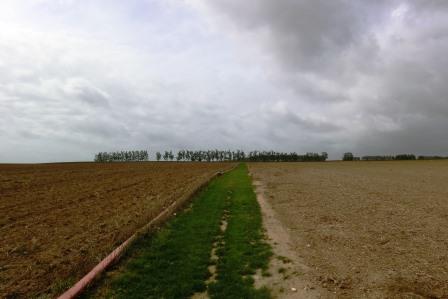
In one field, the farmer had made a grass path to walk along, in order to reach the cemetery, a thoughtful gesture that was much appreciated.

CIMG8522 Sep 6 2017 grass path leading to Grandcourt Road Cemetery

Grass path across a farmer’s field towards Grandcourt Road Cemetery. The trees in the distance indicate the cemetery location. (Photo credit: Pieter Valkenburg)

The second field wasn’t as easy to cross.  That farmer found his potatoes more important than providing access to the cemetery, and did not have a grass path.  Luckily for Pieter, it was not raining or he would have been stuck in the mud.

CIMG8523 Sep 6 2017 second field potatoes more important than access to Grandcourt Rd Cemetery

Second farmer’s field did not have a grass path towards Grandcourt Road Cemetery. The trees in the distance indicate the cemetery location. (Photo credit: Pieter Valkenburg)

Eventually, however, Pieter reached the gates of the cemetery, and learned it was made in the spring of 1917 when the Ancre battlefield was cleared.  There are 391 WWI burials, 108 of them unidentified.  390 are British soldiers, and one, our Lt Arthur Collett, the lone Canadian burial.

CIMG8524 Sep 6 2017 gates of Grandcourt Rd Cemetery

After crossing two farmers’ fields, Pieter reached Grandcourt Road Cemetery. (Photo credit: Pieter Valkenburg)

Arthur Leigh COLLETT was born December 8, 1888 in Victoria, Prince Edward Island, the son of Ella May Simmons, and was the adopted son of William Henry Collett and Alice M.  Moore.  After receiving a Bachelor of Arts from King’s College in Halifax, Nova Scotia, he went to Oxford as a Rhodes Scholar, but shortly afterwards enlisted in the 12th Regiment in September 1914, later transferring to the 8th Battalion of The Gloucestershire Regiment.  According to the King’s College history, he “at once forsook his work at Oxford and enlisted in the Imperial Army.  He served in France with the 8th Gloucesters.

Arthur Collett 1

Arthur Collett. (Photo courtesy of Heather and Paul Moore Family Collection)

In a Pioneer newspaper article from July 15, 1916, came word of an injury, which he survived. “Mr. W. H. Collett, Victoria, has received a cablegram from London, England, notifying him that his son Lieut. A. L. Collett, was wounded on July 3rd. Lieut. Collett, who is a Rhodes scholar and also an Oxford M.A., went over to England with the First Contingent and was later transferred to the 8th Gloucester Regiment.

Unfortunately, he died in action on November 18, 1916 during the last day of the Battle of the Ancre.  The Battle of the Ancre, fought against the German 1st Army between November 13 and 18, 1916, was the final large British attack of the Battle of the Somme.

The war diary for November 18, 1916 of the 8th Battalion Gloucestershire Regiment made the following record:  “Formed up in artillery formation preparatory to attack on Western outskirts of. Grandcourt. 6:10 a.m. attack launched, first objective reached and carried. The 10th regiment was right on our right being partially held up our flank was in the air. Casualties: 12 Officers, 283 Other Ranks.

And so that’s how Arthur Collett ended up in Grandcourt Road Cemetery, sharing a grave with an unknown soldier.

CIMG8528 Sep 6 2017 grave of Arthur Collett at Grandcourt Rd Cemetery

Grave of Arthur Collett in Grandcourt Road Cemetery. (Photo credit: Pieter Valkenburg)

After placing the flags by Collett’s grave, Pieter had to retrace his steps back across two fields and down the narrow steps, then squeeze himself into the small space between the steps and the car.  Then we had to gingerly inch our way back out onto an actual road.  We were lucky.  No one came onto the path while we were there!

Grandcourt Road Cemetery is difficult to access, and requires a lot of time, determination, and a good level of physical fitness.  Consequently, it’s not well visited.  Pieter wrote in the Guest Register and noted the previous entry was dated four months earlier.

In the next blog entry we visit the Newfoundland Memorial at Beaumont-Hamel Newfoundland Battlefield Memorial Park before we continue our search for the Manitoba Cemetery. Do you have information or photos for Arthur Collett? Comments or stories?  You can share them by emailing us at memorialtrail@gmail.com or by commenting on this blog.

© Daria Valkenburg

….Want to follow our research?….

If you are reading this posting, but aren’t following our research, you are welcome to do so.  Our blog address: https://onthewarmemorialtrail.com/

Front cover OnTheWarMememorialTrailinEurope4 countries, 6 weeks, 7,000 km – an unforgettable war memorial journey in Europe…. Daria’s book ‘No Soldier Buried Overseas Should Ever Be Forgotten‘ is available in print and e-book formats.  Net proceeds of book sales help support research costs and the cost of maintaining this blog. For more information see https://nosoldierforgotten.com/ 
You are also invited to subscribe to our YouTube Channel: On The War Memorial Trail With Pieter Valkenburg: https://www.youtube.com/channel/UCJ591TyjSheOR-Cb_Gs_5Kw

Never miss a posting!  Subscribe below to have each new story from the war memorial trail delivered to your inbox.