On The War Memorial Trail……The Stordy Brothers Part 2 – The WWII Airman From Brookvale Who Lost His Life On The Last Flight Of Halifax JB-920

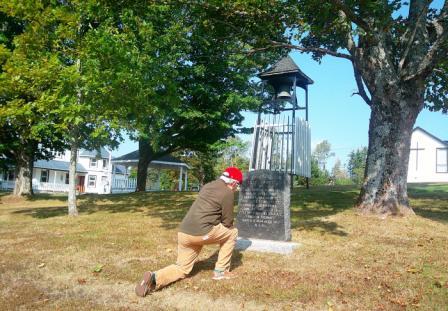
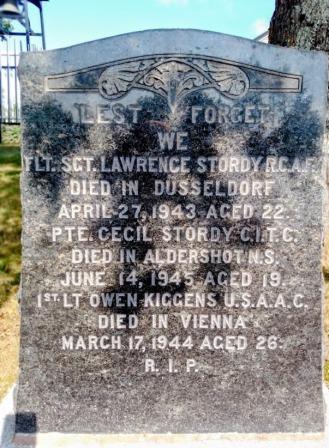
February 16, 2026. During WWII, the Stordy family of Brookvale, Prince Edward Island, lost  two sons:  first, John ‘Lawrence’ STORDY, who is buried in the Reichswald Forest War Cemetery in Kleve, Germany, and then, shortly after the war in Europe ended, Michael ‘Cecil’ STORDY, who is buried in Kelly’s Cross (St. Joseph) Parish Cemetery in Kelly’s Cross, Prince Edward Island.

….Two brothers gave their lives in WWII…
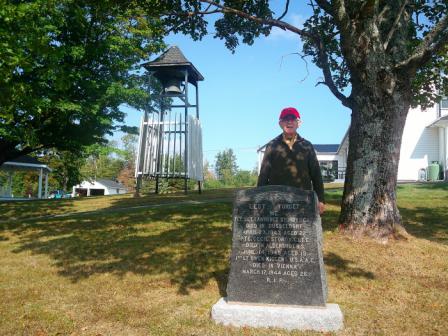
Two Stordy brothers are listed on the memorial outside St. Joseph’s Roman Catholic Church in Kelly’s Cross, behind which Pieter is standing. (Photo credit: Daria Valkenburg)

In Part 1 of this two-part series, we began with Cecil’s story, as the Stordy family became known to Pieter when he was assigned Cecil’s grave after he became a volunteer under the National Volunteer Program for the Commonwealth War Graves Commission (CWGC).  (See https://onthewarmemorialtrail.com/2026/02/11/on-the-war-memorial-trailthe-stordy-brothers-part-1-the-wwii-soldier-from-brookvale-who-drowned-during-a-swimming-exercise-in-nova-scotia/

Now, in Part 2, we tell the story of JohnLawrence’ STORDY, who lost his life in Germany on April 27, 1943, aged 22,  two years earlier than his younger brother Cecil.

….Lawrence enlisted in the RCAF in July 1941 …

Born May 31, 1921 in Brookvale, Prince Edward Island, Lawrence was the son of John ‘Anthony’ and Mary ‘Ermina’ (nee Duffy) Stordy.  When he enlisted at the Royal Canadian Air Force (RCAF) Recruiting Centre in Halifax, Nova Scotia on July 17, 1941, he stated that he had completed Grade 10 and was employed at Schwartz & Sons.  Before that he had worked as a farm labourer for D. D. MacDonald on Prince Edward Island for 4 months, then on a dairy farm for B. Baxter in Truro, Nova Scotia.

In 1940, he left the dairy farm for a better job with Nova Scotia Light and Power in Halifax, Nova Scotia, remaining there until he was laid off in 1941, after which he went to work for Schwartz & Sons, a spice and food company, as an assistant shipper.  

Asked what special qualifications or hobbies would be useful to the RCAF, he wrote down that he knew how to fish, hunt, and skate, and occasionally played baseball.

After taking his basic training in Halifax, Lawrence was sent to No. 4 Air Manning Section (AMS) in Valcartier, Quebec on September 13, 1941 and to No. 5 Manning Depot in Lachine, Quebec.  Manning Depots were reception and training centres for new RCAF recruits, serving as the initial entry point for the British Commonwealth Air Training Plan (BCATP). Recruits received uniforms, 4–5 weeks of basic military training, drills, and aptitude testing.  Upon completion, trainees were designated as ‘aircraftsmen 2’ and moved on to further specialized training schools.

Lawrence remained there until March 29, 1942, when he was sent to No. 1 Wireless School (WS) in Montreal, Quebec.  This BCATP facility for training wireless air gunners was located in the former Nazareth School for the Blind. On April 30, 1942, he was designated as Leading Aircraftman (LAC).

On June 7, 1942 he went to Composite Training School (KTS) in Trenton, Ontario for a four-week course in astro-navigation.

On July 5, 1942 he was sent to No. 9 Bombing and Gunnery (B&G) School in Mont-Joli, Quebec, where he received instruction in the techniques of bomb aiming and aerial machine gunnery.  Bombing and Gunnery schools required a large area to accommodate their bombing and gunnery ranges, and were often located near water. The Avro Anson, Fairey Battle, Bristol Bolingbroke, and Westland Lysander were the standard aircraft used.
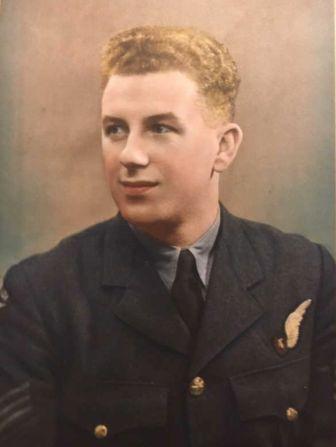
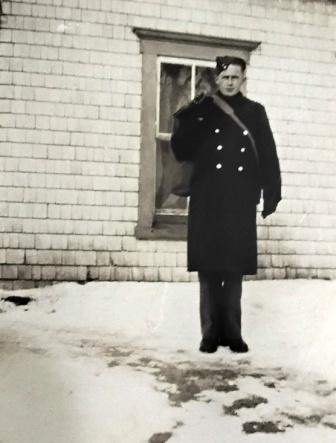
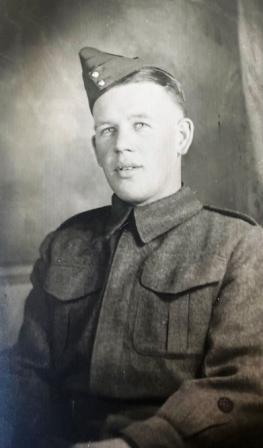
John ‘Lawrence’ Stordy. The 3 chevrons on his right arm indicate his promotion to T1 Sergeant. (Photo source: Canadian Virtual War Memorial)

While at No. 9 B&G, Lawrence was awarded his Air Gunner’s badge on August 14, 1942, and a promotion to T1 Sergeant.  (The ‘T’ stands for Technician.) His Commanding Officer at the School noted that he was “…a hard worker and applied himself diligently…

On September 11, 1942, he was sent to No. 34 Operational Training Unit (OTU) in Pennfield Ridge, New Brunswick.  An OTU was the last stop for aircrew trainees before going overseas. 

….Lawrence left Canada for overseas service …

Lawrence was only in Pennfield Ridge for a few days before being transferred to the RCAF’s No. 1 ‘Y’ Embarkation Depot in Halifax, Nova Scotia.  (See https://rcaf.info/rcaf-stations/nova-scotia-rcaf-stations/rcaf-station-halifax/)
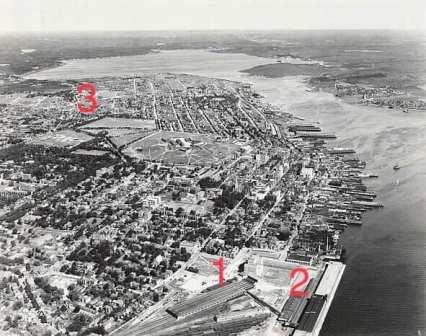
Aerial view of Halifax showing the location of the Canadian National Railroad Station (red # 1) , Pier 21 Ocean Terminals (red # 2) and No. 1 “Y” Embarkation Depot (red # 3). Halifax Harbour is foreground and right with the Bedford Basin in background. (Source: Library and Archives Canada Collections website)

Things moved quickly after that, as on September 24, 1942, Lawrence was placed in the Royal Air Force (RAF) Trainee Pool and arrived at No. 3 Personnel Reception Centre (PRC) in Bournemouth, England on October 9, 1942. This was the arrival point for thousands of Commonwealth aircrew after training in Canada. 

Lawrence would have been at No. 3 PRC at the same time as Donald David MacKenzie TAYLOR, who arrived there two days earlier, and whose story was previously told.  (See https://onthewarmemorialtrail.com/2025/12/27/on-the-war-memorial-trail-the-wwii-soldier-born-in-manitoba-who-lost-his-life-when-lst-420-hit-a-mine-in-the-harbour-outside-ostend/)

….Lawrence joined No. 405 Pathfinder Squadron…

On October 28, 1942, he was transferred to No. 405’s 1659 Conversion Fleet, the main training unit for No. 405 (Vancouver) Squadron, and based at RAF Leeming and Topcliffe in Yorkshire.  No. 405 was the only RCAF Pathfinder Squadron. Formed in April 1941, No. 405 had flown Wellingtons until April 1942, when it converted to Halifax bombers, and prepared crews for the Handley Page Halifax bomber.
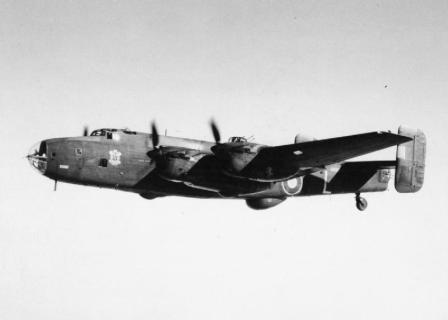
Halifax B Mk II bomber photo.  (Photo source: Royal Air Force official photographer – https://commons.wikimedia.org/w/index.php?curid=24454971)

Pathfinder Squadrons were target-marking squadrons that flew ahead of the main bombing crews to mark targets with slow falling, colour-coded parachute flares and very bright photo flash bombs that were on the centre of the target.  This helped bombing crews to increase the accuracy of their bombing.

Pathfinders didn’t immediately leave, but stayed around the target, to keep dropping markers on target, to keep second and third waves of bombers from ‘target creep’.  RAF and RCAF bombers were strung out like cars on the interstate, one behind the other, NOT in formation. Each individual aircraft had to navigate, get to the target, drop their bombs, and return to base – in the dark.  Pathfinders would remain until after the bombers had left to take photos of the damage inflicted.

On January 15, 1943, his training completed, Lawrence was assigned to No. 405 Squadron, based at RAF Beaulieu in Hampshire. At the time he joined, No. 405 had been detached to Coastal Command since October 1942. Coastal Command’s role was defensive, mainly protecting convoys from German U-boats(See https://en.wikipedia.org/wiki/RAF_Coastal_Command_during_World_War_II)

On March 1, 1943, No. 405 Squadron was reassigned back to Bomber Command as part of No. 6 (RCAF) Group, selected to be part of No. 8 Pathfinder Group on March 18, 1943, and based at RAF Gransden Lodge, located 16.3 km (10.1 miles) west of Cambridge, England. They were to be participants in a bombing campaign in the industrial heart of Germany.

….No. 405 Squadron was involved in the Battle of the Ruhr…

The Battle of the Ruhr was a strategic bombing campaign carried out by Bomber Command against the Ruhr Valley Area in Germany from March 5 to July 31, 1943.  Why Ruhr? Responsible for 60% of Germany’s industrial output, it was the main centre of German heavy industry with coke plants, steelworks, armaments factories and ten synthetic oil plants. (Coke is a coal-based fuel with a high carbon content, used mainly in the smelting of iron ore, steelworks, armaments factories and ten synthetic oil plants.)  (See https://en.wikipedia.org/wiki/Battle_of_the_Ruhr and https://www.worldhistory.org/article/2429/battle-of-the-ruhr/)

The Ruhr Valley was protected by about 200 flak batteries, each consisting of six or eight 88-mm (3.5 in) guns, many with radar capability. Some guns were even mounted on trains to follow the bombers. Due to this dense network of anti-aircraft guns and countless searchlights, Allied bombers soon gave the Ruhr the ironic nickname of ‘Happy Valley’.

In addition to anti-aircraft guns, smog was a big problem.  The Ruhr Valley was so heavily industrialized that constant smog in the skies above it not only impeded the bomb aimers, but also made it difficult for the navigators to find their target areas.

….The last flight of Halifax JB-920…

On the night of April 26 into 27, 1943, Bomber Command sent 561 bombers (215 Lancasters, 135 Wellingtons, 119 Halifaxes, 78 Stirlings, 14 Mosquitos) to Duisburg, Germany.  Duisburg had important railway yards, which connected the Ruhr to other parts of Germany, and the Thyssen steelworks.

In total, 17 planes were lost that night – 7 Halifaxes, 5 Wellingtons, 3 Lancasters, 2 Stirlings. German records show 130–207 people killed, 300 buildings destroyed and six other cities hit by bombs.
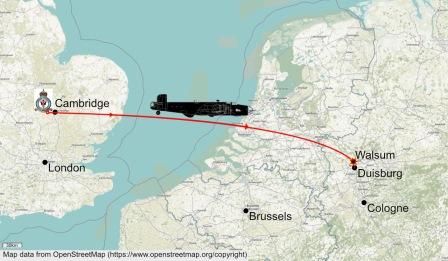
Map shows the plane’s path from England towards Duisburg.  It was shot down by German flak and crashed in Walsum, 11 km north northwest of its target of Duisburg.  (Map prepared by Wendy Nattress)

This operation was No. 405 Squadron’s first operation as a Pathfinder unit. Out of 11 Halifax aircraft dispatched, 1 was lost – Halifax JB-920.  Hit by German light and heavy flak, it was shot down as it approached the target area of Duisburg, and crashed in Walsum, 11 km (6.8 miles) north northwest of Duisburg. All eight crew members were killed, including Lawrence, who was one of the two air gunners on that flight.

….The other crew members on the last flight of Halifax JB-920…

On the last flight of Halifax JB-920, in addition to Flight Sgt John ‘Lawrence’ STORDY, the other crew members were:

  • Pilot : Pilot Officer David Edward CROCKATT of Vancouver, British Columbia
  • 2nd Pilot : RCAF Pilot Officer Chester Brockie DIXON of Maple Creek, Saskatchewan
  • Flight Engineer : RCAF Sergeant Isaac Abraham PENNER of Nipawin, Saskatchewan
  • Navigator : RCAF Pilot Officer John Robert MARRIOTT of Ottawa, Ontario
  • Navigator : RCAF Warrant Officer Class II Stewart SLEETH of Detroit, Michigan, USA
  • Wireless Operator / Air Gunner : RAF Pilot Officer Francis Edward O’HARE of the United Kingdom
  • Air Gunner : RCAF Warrant Officer Class II Thomas Lloyd BENTLEY of Moose Jaw, Saskatchewan

….Lawrence is buried in Reichswald Forest War Cemetery in Kleve…

The airmen were temporarily buried at North Cemetery in Dusseldorf, Germany, before being reburied in Reichswald Forest War Cemetery in Kleve, Germany.
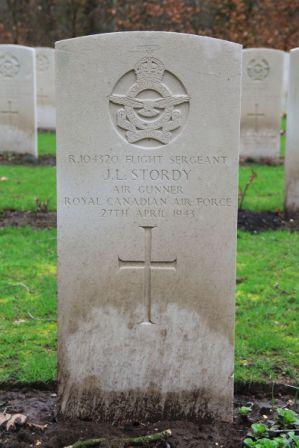
Grave of John ‘Lawrence’ Stordy in the Reichswald Forest War Cemetery in Kleve, Germany.  (Photo source: Find A Grave)

I had wondered why the men were reburied in Reichswald Forest War Cemetery, another cemetery in Germany, instead of in The Netherlands. Yannic Wethly, a volunteer with the Air Drenthe Research Foundation (Stichting Luchtoorlog Onderzoek Drenthe),  explained that “….almost all  RAF/RCAF/RAAF etc personnel who died in the German provinces that border to The Netherlands were reburied at Reichswald Forest. This explains the vast geospatial spread in the crash locations, and also why there are more than 7500 graves there….

Patti W Noonan, daughter-in-law of the late Bernadette ‘Bernie’ Stordy Noonan, the youngest sister of Cecil and Lawrence, wrote us that “….the family is very proud of the sacrifice by Lawrence and Cecil…” and rightly so.

Thank you to Wendy Nattress, who prepared the map showing the flight path for Halifax JB-920.

This concludes the 2 part series on the Stordy Brothers. Do you have a story to tell? Email Pieter at memorialtrail@gmail.com or comment on the blog. 

© Daria Valkenburg

….Want to follow our research?…

If you are reading this posting, but aren’t following our research, you are welcome to do so.  Our blog address: https://onthewarmemorialtrail.com/
4 countries, 6 weeks, 7,000 km – an unforgettable war memorial journey in Europe…. Daria’s book ‘No Soldier Buried Overseas Should Ever Be Forgotten‘ is available in print and e-book formats.  Net proceeds of book sales help support research costs and the cost of maintaining this blog. For more information see https://nosoldierforgotten.com/

Subscribe to our YouTube Channel: On The War Memorial Trail With Pieter Valkenburg: https://www.youtube.com/channel/UCJ591TyjSheOR-Cb_Gs_5Kw

Never miss a posting!  Subscribe below to have each new story from the war memorial trail delivered to your inbox.
On The War Memorial Trail……The Stordy Brothers Part 1 – The WWII Soldier From Brookvale Who Drowned During A Swimming Exercise In Nova Scotia

Pieter looks at the memorial outside St. Joseph’s Roman Catholic Cemetery in Kelly’s Cross. (Photo credit: Daria Valkenburg)

February 11, 2026. One of the cemeteries that Pieter was assigned when he became a volunteer under the National Volunteer Program for the Commonwealth War Graves Commission (CWGC) last year was Kelly’s Cross (St. Joseph) Parish Cemetery in Kelly’s Cross, Prince Edward Island.  There is only one CWGC war grave at this cemetery…. that of WWII soldier Michael ‘Cecil’ STORDY, who died June 14, 1945, aged 19.

….Two brothers gave their lives in WWII…

Two Stordy brothers are listed on the memorial outside St. Joseph’s Roman Catholic Church in Kelly’s Cross. (Photo credit: Pieter Valkenburg)

When Pieter visited the cemetery last summer to inspect the grave, he noticed a memorial outside St. Joseph’s Roman Catholic Church.  When he took a look at the memorial, he saw, to his surprise, that there were two Stordys listed – Michael ‘Cecil’ and John ‘Lawrence’. 

A curious Pieter looked up RCAF Flight Sergeant John ‘Lawrence’ Stordy, and discovered that this was Cecil’s older brother, who had died in Germany on April 27, 1943, aged 22.  “…We have to tell the stories of both brothers….” he said.    

We began with Cecil, who is buried in Kelly’s Cross, in a CWGC grave.

….A photo came from Cecil’s younger sister…

Born May 8, 1926 in Brookvale, Prince Edward Island, Cecil was the son of John ‘Anthony’ and Mary ‘Ermina’ (nee Duffy) Stordy.  When he enlisted at the No. 6 District Depot in Halifax, Nova Scotia on March 16, 1945, he stated that he had completed Grade 8 and was working on his father’s farm.

On March 23, 1945, Cecil was sent to No. 60 Canadian Army (Basic) Training Centre in Yarmouth, Nova Scotia, for basic training.  After successfully completing his basic training, on May 20, 1945, he was next sent to A14 Canadian Infantry Training Centre (CITC) – Camp Aldershot in Aldershot, Nova Scotia, and assigned to ‘E’ Company.

Michael ‘Cecil’ Stordy.  (Photo courtesy of Bernadette Stordy Noonan)

A photo of Cecil was submitted by Patti W Noonan, who explained that the photo came from the late Bernadette ‘Bernie’ Stordy Noonan, the youngest sister of Cecil and Lawrence.  Patti wrote “….my husband – Sgt Barry Noonan, RCMP (Rtd) is Bernadette’s son and the grand-nephew of both Cecil and Lawrence. He is a member of our Legion and proudly remembers them at our November 11 ceremonies as well as the December Candlelighting. …

….A drowning accident claimed Cecil’s life…

Camp Aldershot primarily featured infrastructure for land-based warfare, such as rifle ranges, trench systems, and bayonet assault courses. While undergoing infantry training at Aldershot, Cecil was part of a group involved in a swimming exercise on June 14, 1945. Swimming training was designed for ‘water-proofing’ soldiers and conducting emergency, wet-gap crossings. 

According to Cecil’s service file, the exercise took place at Peach Lake, which likely was near Kentville, in one of the water areas frequently used for training, including water obstacle courses and swimming. 

The exercise began around 2 pm. Unfortunately Cecil accidentally drowned about half an hour later, at 2:30 pm. According to a Court of Inquiry Report into the accident, Cecil “…got on a raft in the area used for swimming, got into water over his depth, was unable to hang onto the raft, and went under the surface.

 His body was found and artificial respiration was commenced and continued while being transferred to hospital and after 2 hours he was pronounced dead…

….Cecil was buried in St. Joseph’s Parish Cemetery in Kelly’s Cross…

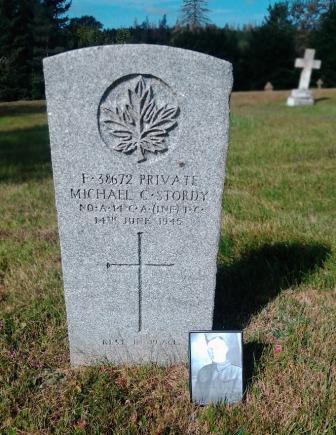
Grave of Michael ‘Cecil’ Stordy, with a photo of him that was placed by Pieter. (Photo credit: Pieter Valkenburg)

On June 17, 1945, Cecil was buried in St. Joseph’s Parish Cemetery in Kelly’s Cross, Prince Edward Island.  Reverend Ayers stated that he “….officiated at the services in the church and at the grave.  Sgt Thomas Whelan of the 17th Armoured Regiment, Charlottetown, was in charge of the firing party….

Patti wrote that “….all of the family is very proud of the sacrifice by Lawrence and Cecil…” and rightly so.

Coming up in Part 2, the Stordy Brothers series continues, with JohnLawrence’ STORDY, who lost his life in Germany in 1943.

Thank you to Patti Noonan and the late Bernadette Stordy Noonan for providing a photo. Do you have a story to tell? Email Pieter at memorialtrail@gmail.com or comment on the blog. 

© Daria Valkenburg

….Want to follow our research?…

If you are reading this posting, but aren’t following our research, you are welcome to do so.  Our blog address: https://onthewarmemorialtrail.com/

4 countries, 6 weeks, 7,000 km – an unforgettable war memorial journey in Europe…. Daria’s book ‘No Soldier Buried Overseas Should Ever Be Forgotten‘ is available in print and e-book formats.  Net proceeds of book sales help support research costs and the cost of maintaining this blog. For more information see https://nosoldierforgotten.com/

Subscribe to our YouTube Channel: On The War Memorial Trail With Pieter Valkenburg: https://www.youtube.com/channel/UCJ591TyjSheOR-Cb_Gs_5Kw

Never miss a posting!  Subscribe below to have each new story from the war memorial trail delivered to your inbox.
On The War Memorial Trail……The WWII Carpenter Buried In Seven Mile Bay Who Does Not Have A CWGC Headstone

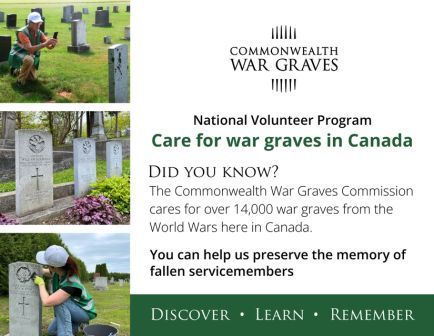
Postcard promoting CWGC’s National Volunteer Program included a photo of Pieter (top left) that Daria took at Cape Traverse Community Cemetery.

September 28, 2025. One of the cemeteries that Pieter was assigned when he became a volunteer under the National Volunteer Program for the Commonwealth War Graves Commission (CWGC) was Seven Mile Bay (St Peter’s) Cemetery in Seven Mile Bay, Prince Edward Island.  There are 4 CWGC war graves at this cemetery. 

…3 soldiers buried in Seven Mile Bay are listed on the Cenotaph outside the Borden-Carleton Legion…

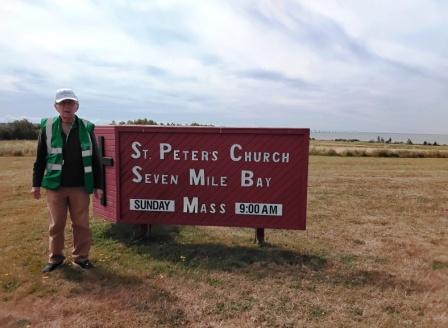
Pieter at Seven Mile Bay (St Peter’s) Cemetery.  Can you spot the Confederation Bridge in the background?  (Photo credit: Daria Valkenburg)

Three of the WWII soldiers buried in this cemetery are listed on the Cenotaph outside the Borden-Carleton Legion in Borden-Carleton, Prince Edward Island.  Their stories have been previously told on this blog….

Frank Lewis ARSENAULT of Kinkora, Prince Edward Island, was serving in the Royal Canadian Army Medical Corps, Home War Establishment Unit, and based at the Petawawa Military Hospital in Ontario, when he drowned accidentally in the Ottawa River on September 30, 1942, aged 29.  His body wasn’t found until a month later.  He left behind a wife and 4 children.  (See https://onthewarmemorialtrail.com/2019/12/14/on-the-war-memorial-trail-the-ww2-soldier-who-drowned-in-quebec/)

Leonard Stephen AVERY of Bedeque, Prince Edward Island, died accidentally in Ontario while on guard duty at the Chippewa Power Canal in Welland County on the evening of August 23, 1943, aged 19, when he was accidentally shot through the head while examining a rifle.  He was serving with the 1st Garrison Battalion of the Canadian Army, and stationed in Niagara-on-the-Lake, Ontario. (See https://onthewarmemorialtrail.com/2019/11/26/on-the-war-memorial-trail-the-ww2-soldier-who-was-accidentally-shot/  and https://onthewarmemorialtrail.com/2022/12/17/on-the-war-memorial-trail-a-photo-for-wwii-soldier-leonard-stephen-avery/)

John Daniel ‘Jack’ FERGUSON of Borden (now Borden-Carleton), Prince Edward Island, was serving in the Royal Canadian Navy Reserve, and on patrol duty out of Halifax, Nova Scotia.  After becoming ill while serving aboard the patrol ship ‘Ross Norman’, he was sent to Camp Hill Hospital in Halifax on August 19, 1942.  On August 30, 1942 he went into shock from peritonitis. Despite treatment, he died on September 6, 1942, aged 19. (See https://onthewarmemorialtrail.com/2020/03/04/the-ww2-able-seaman-who-died-of-peritonitis/)

…1 soldier buried in Seven Mile Bay did not have a CWGC headstone…

Grave of John Peter ‘JP’ White.  (Photo credit: Pieter Valkenburg)

The fourth grave, that of John Peter ‘JP’ WHITE, was listed as a CWGC grave, but did not have the distinctive CWGC headstone, and the name of the soldier was unfamiliar to Pieter.  Instead, the headstone listed the soldier, and his wife, Frances (nee Smith), who had died 3 years earlier.

His curiosity aroused, Pieter decided to research the soldier and look for a family member.  It wasn’t long before he came in contact with JP’s niece, Alice Cash Blakeney, and we had a chance to meet her in Summerside.  “….My mother was his sister Martina, and she always referred to him as JP…”  Alice explained.

Pieter with Alice Cash Blakeney, who is holding a photo of her uncle, JP White. (Photo credit: Daria Valkenburg)

…JP grew up in Emerald Junction.…

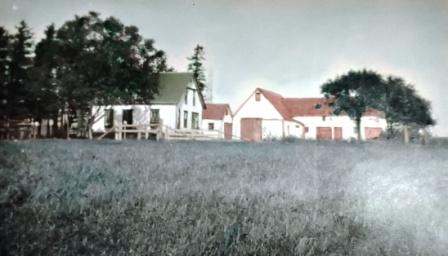
The family homestead where JP White grew up.  (Photo courtesy of Alice Cash Blakeney and Estate of Bernadette White Adler)

Born in Emerald Junction, Prince Edward Island, on June 2, 1912, JP was the son of John Thomas and Janie Josephine (nee Cameron) White.  JP had 2 brothers and 4 sisters, and although their father was a carpenter, the family also ran a small farm.

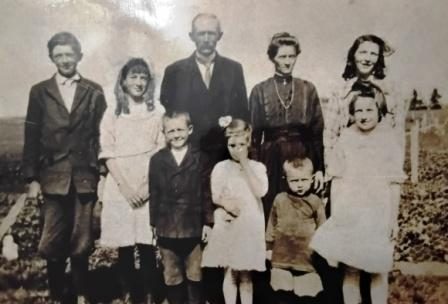
Front row, left to right:  JP, Martina, Dave, Bernadette.  Back row, left to right: Matthew, Agnes, John Thomas, Janie Josephine, Mary Catherine. (Photo courtesy of Alice Cash Blakeney and Estate of Bernadette White Adler)

….JP enlisted in 1942…

After completing Grade 8, JP began working as a carpenter.  On February 4, 1942, he married Frances Teresa Smith in Charlottetown.   “…The Whites were noted as being great dancers, so it’s likely that JP met his wife Frances Smith at a dance….”  Alice reflected.

JP originally enlisted under the National Resources Mobilization Act (NRMA) at the No. 6a NRMA Clearing Depot in Charlottetown, Prince Edward Island on August 27, 1942 and began basic training at No. 62 Canadian Army Basic Training Centre in Charlottetown. At the time, he stated he had been a carpenter for the past 10 or 12 years, having learned the trade from his father. (See https://en.wikipedia.org/wiki/National_Resources_Mobilization_Act)

Just as JP was completing his basic training, tragedy struck on October 1, 1942. Alice said that “…JP’s wife died in childbirth….

On October 30, 1942, JP was sent to A1 Canadian Artillery Training Centre (CATC) in Petawawa, Ontario for infantry training as a gunner. 

While in Petawawa, JP tried to enlist as ‘Active’, but was “…advised to remain…” under the NRMA, as he was considered “…unsuitable for operational duty…” due to bad knees.  

In January 1943, he was granted a 2 week furlough, allowing him to return home to Prince Edward Island. The furlough was then extended by another 11 days, after which he returned to Petawawa.

John Peter ‘JP’ White in January 1943 during his return to Prince Edward Island while on furlough. (Photo courtesy of Alice Cash Blakeney and Estate of Bernadette White Adler)

….JP was transferred to the 10th LAA for a short period in June 1943…

After qualifying as a Carpenter Group ‘B’ on April 26, 1943, JP was transferred to the 10th Light Anti-Aircraft (LAA) Regiment of the Royal Canadian Artillery (RCA) on June 15, 1943, and sent to Tracadie, New Brunswick. The 10th LAA was part of the 7th (Home Defence) Division and JP was posted to the 8th Light Anti-Aircraft Battery RCA in Saint John, New Brunswick.

He spent the next months working as a carpenter, but starting in August 1943, he had medical issues, resulting in brief hospitalizations.  Health issues ended his assignment with the 10th LAA and on October 28, 1943 he was transferred to No. 6 District Depot in Halifax, Nova Scotia.

In a November 30, 1943 interview that was recorded in his Personnel Selection Record, he was described as “…a mature serious-minded soldier of steady judgement….”  It went on to state that JP “…wished to remain in the service and would prefer duty in his trade…” and that his knee condition “…should not impair his efficiency as a tradesman…”  It was recommended that he be transferred to a suitable Home War Establishment (HWE) for duty as a carpenter.

….JP was assigned to the Royal Canadian Engineers as a carpenter…

John Peter ‘JP’ White. (Photo courtesy of Alice Cash Blakeney and Estate of Bernadette White Adler)

On January 19, 1944, JP was transferred to No. 6 Field Company of the Royal Canadian Engineers in Debert, Nova Scotia.  He remained there until May 24, 1944 when he was granted 6 weeks of spring farm leave in order to return to Prince Edward Island and work on the family farm.  His father had died in 1936, meaning that JP and his brothers had to help out his mother.

Upon his return back to duty on July 29, 1944, he was assigned to No. 6 Engineer Survey and Works (ES&W) Company of the Royal Canadian Engineers in Halifax, Nova Scotia, and continued to work as a carpenter. 

Unfortunately, he had another medical issue on November 28, 1944, when he was hospitalized for 3 weeks in the Military Hospital in Debert, Nova Scotia with appendicitis.

He was discharged from hospital on December 19, 1944 and sent to No. 5 Casualty Retraining Centre (CRC) in Sussex, New Brunswick for 71 days for further recovery.  On January 19, 1945, he was hospitalized again, this time at the Sussex Military Hospital.

On March 8, 1945, he was deemed ‘fit for duty’.  A report on his condition in the Supplement To Personnel Selection Record stated that JP was “…pleasant and straightforward….” and had “cooperated well and followed the training in all grades at this Centre making satisfactory recovery…”  He was assessed as remaining “…suitable for employment in RCE for base duties…” as a carpenter.

….JP enlisted in the Active Army in April 1945…

On March 21, 1945, JP was again sent to No. 6 District Depot in Halifax, Nova Scotia, in preparation for his change in status when he was deemed fit enough to enlist in the Active Army on April 5, 1945.   He returned to No. 6 Field Company of the Royal Canadian Engineers in Halifax on April 29, 1945, where it was noted that JP requested to return to No. 6 Engineer Survey and Works (ES&W) Company of the Royal Canadian Engineers.

No sooner had JP been assigned to No. 6 Engineer Survey and Works (ES&W) Company than he requested a 3 month leave of absence without pay for compassionate farm leave.  This was granted from June 28, 1945 until September 27, 1945.

When he returned back to duty, however, it was to No. 6 District Depot in Halifax.  On October 2, 1945, a few days after returning to duty, he applied again for farm leave without pay, which was granted until April 1946.

….JP died following an operation in December 1945…

JP never returned to his army duties.  While back on Prince Edward Island for the farm leave that had been granted to him, he was hospitalized in Charlottetown, and died following an operation on December 15, 1945, aged 33.

JP was buried alongside his wife Frances in Seven Mile Bay (St Peter’s) Cemetery in Seven Mile Bay, Prince Edward Island. 

A note on his death record noted that he would not receive a separate Commonwealth War Graves Commission headstone unless the family applied for it.  It further stated that ‘next of kin does not answer correspondence’. 

JP’s family was overwhelmed, not only by his death, but by the death of his mother in March 1946, leaving his brother Matthew, who lived in Charlottetown and had a family of his own, in addition to managing the farm, as the next-of-kin.

Pieter now knew what happened to JP, and resolved to ensure that his service is acknowledged when the Legion in Borden-Carleton places flags by graves of veterans during Remembrance Week 2025. No flag had been placed by his grave in previous years as no one at the Legion was aware that JP had served during WWII.  (See https://onthewarmemorialtrail.com/2024/11/03/on-the-war-memorial-trail-borden-carleton-legion-honours-veterans-by-placing-flags-at-their-graves/)

Thank you to Alice Cash Blakeney for providing the photos and information on her uncle. Do you have a story to tell? Email Pieter at memorialtrail@gmail.com or comment on the blog. 

© Daria Valkenburg

….Want to follow our research?…

If you are reading this posting, but aren’t following our research, you are welcome to do so.  Our blog address: https://onthewarmemorialtrail.com/

4 countries, 6 weeks, 7,000 km – an unforgettable war memorial journey in Europe…. Daria’s book ‘No Soldier Buried Overseas Should Ever Be Forgotten‘ is available in print and e-book formats.  Net proceeds of book sales help support research costs and the cost of maintaining this blog. For more information see https://nosoldierforgotten.com/

Subscribe to our YouTube Channel: On The War Memorial Trail With Pieter Valkenburg: https://www.youtube.com/channel/UCJ591TyjSheOR-Cb_Gs_5Kw

Never miss a posting!  Subscribe below to have each new story from the war memorial trail delivered to your inbox.
On The War Memorial Trail…..CWGC Volunteer At Cape Traverse Community Cemetery

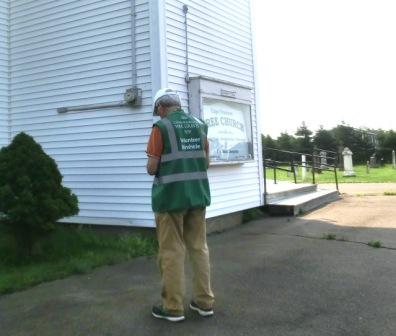
CWGC Volunteer Pieter trying to activate the Work App at Cape Traverse Community Cemetery.  (Photo credit: Daria Valkenburg)

August 8, 2025. Anyone who has visited a War Graves Cemetery managed by the Commonwealth War Graves Commission (CWGC) can attest to how well the graves are cared for and the incredible work done by the gardeners in ensuring that flowers and small shrubs are planted in each row of graves. 

And yes, the grass is kept green and well-watered, as we ourselves experienced while visiting one of the Canadian War Cemeteries in The Netherlands on a very hot day.  It wasn’t that I minded getting drenched, but I didn’t appreciate my carefully written spreadsheet of the graves to visit getting water-soaked!

We knew that the CWGC commemorates and cares for the graves of men and women of the Commonwealth that died during WWI and WWII, but were astounded to learn that this involves 1.7 million graves. Six member countries make up the CWGC– the United Kingdom, Canada, Australia, New Zealand, India, and South Africa.

According to the CWGC website, “… 23,000 locations in over 150 countries and territories….” are covered with “…. over 2,000 ‘constructed’ war cemeteries the largest being Tyne Cot in Belgium….” – which we had visited in 2017.

….Who is commemorated in a CWGC grave?…

CWGC commemorates personnel who died between August 4, 1914 and August 31, 1921 for WWI and September 3, 1939 and December 31, 1947 for WWII, while serving in a Commonwealth military force or specified auxiliary organization.

CWGC also commemorates those who died in the same WWI and WWII time period as above, after they were discharged from a Commonwealth military force, if their death was caused by their wartime service.

Commonwealth civilians who died between September 3, 1939 and December 31, 1947 as a consequence of enemy action, Allied weapons of war, or while in an enemy prison camp are also commemorated.

….Pieter is now a volunteer under CWGC’s National Volunteer Program…

Not all Canadians who died during WWI or WWII are buried overseas. They may have died of illness or accidents and were buried in Canada, but still have a CWGC gravestone.  Recently the CWGC asked for volunteers across Canada to be part of the National Volunteer Program and visit local cemeteries and gather information about the condition of CWGC war graves.

Having visited so many CWGC cemeteries, as well as CWGC graves in municipal cemeteries, in Europe, Pieter applied and was accepted as a volunteer.  After receiving training on how to inspect headstones, how to report a grave in need of repair, and how to safely clean headstones where required, he was assigned 4 cemeteries in the South Shore area on Prince Edward Island.   The 4 cemeteries are:

  • Cape Traverse Community Cemetery (3 CWGC graves)
  • Tryon People’s Cemetery (2 CWGC graves)
  • Kelly’s Cross (St Joseph) Parish Cemetery (1 CWGC grave)
  • Seven Mile Bay (St Peter’s) Cemetery  (4 CWGC graves)

….There are 3 CWGC graves at Cape Traverse Community Cemetery…

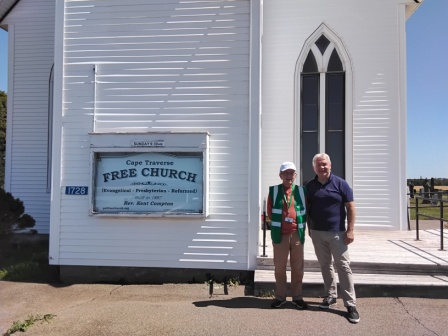
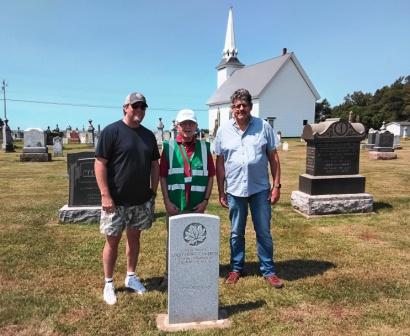
Pieter with Rev Kent Compton outside the Free Church of Scotland in Cape Traverse. (Photo credit: Daria Valkenburg

Cape Traverse Community Cemetery, formerly known as the Free Church of Scotland Cemetery, was first on Pieter’s list. A sub-committee of the Cape Traverse Ice Boat Heritage Incorporated maintains the cemetery on behalf of the Free Church of Scotland.  “…The church is still responsible for the cemetery and owns the land….” explained Reverend Kent Compton. 

Jim Glennie (left) and Andrew MacKay (right) with Pieter Valkenburg (centre).  (Photo credit: Daria Valkenburg)

…This is the third summer that we’re cutting the grass at the cemetery…” reflected Andrew MacKay. Andrew and Jim Glennie, two volunteers with the organization, said that the organization had been approached for help by older parishioners in the community.

….Three CWGC graves were inspected at Cape Traverse Community Cemetery…

There are 3 CWGC graves in this cemetery, whose stories have all been told over the years on this blog:

Andrew MacKay (left), Pieter Valkenburg (centre) and Jim Glennie (right) at the grave of Leigh Hunt Cameron.  (Photo credit: Daria Valkenburg)

….The 6 step process of inspecting and cleaning a grave…

The first grave Pieter inspected and cleaned at the Cape Traverse Community Cemetery was that of Elmyr Kruger…..

Step 1 – Take a photo of Elmyr’s  grave before cleaning begins.  (Photo credit: Daria Valkenburg)

Step 2 – Take a photo of the graves that are around Elmyr’s grave.  (Photo credit: Daria Valkenburg)

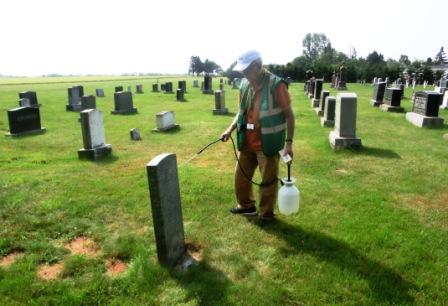
Step 3 – Gently brush off dirt on Elmyr’s grave.  (Photo credit: Daria Valkenburg)

Step 4 – Wash Elmyr’s grave with water.  (Photo credit: Daria Valkenburg)

Step 5 – Gently brush dirt off of the sides and back of Elmyr’s grave.  (Photo credit: Daria Valkenburg)

Step 6 – Wash the sides and back of Elmyr’s grave with water.  (Photo credit: Daria Valkenburg)

….Over 100 years old but a very clean grave now…

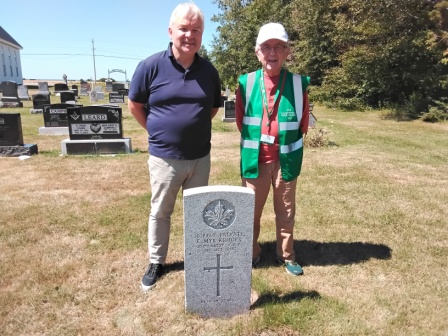
Rev Kent Compton and Pieter by the WWI grave of Elmyr Kruger.  (Photo credit: Daria Valkenburg)

The grave of Elmyr Kruger has been in place in the cemetery since October 1918, and now looks almost like new after being cleaned! Rev Compton and Pieter visited Elmyr’s grave a few days after it was cleaned.

….Can you help with finding photos?…

While a photo of Harold ‘Lloyd’ Lefurgey was provided by family years ago, no photo has yet been found for Elmyr Kruger or Leigh Hunt Cameron.  If you can help with finding a photo, please email Pieter at memorialtrail@gmail.com or comment on the blog.

When asked about his new role as a CWGC volunteer, Pieter had a simple reply. “…It’s an honour for me to take care of those graves, which I’ve already visited several times as a member of the Borden-Carleton Legion Branch, when we place flags at the graves of veterans during Remembrance Week…” (See https://onthewarmemorialtrail.com/2024/11/03/on-the-war-memorial-trail-borden-carleton-legion-honours-veterans-by-placing-flags-at-their-graves/)

© Daria Valkenburg

….Want to follow our research?…

If you are reading this posting, but aren’t following our research, you are welcome to do so.  Our blog address: https://onthewarmemorialtrail.com/

4 countries, 6 weeks, 7,000 km – an unforgettable war memorial journey in Europe…. Daria’s book ‘No Soldier Buried Overseas Should Ever Be Forgotten‘ is available in print and e-book formats.  Net proceeds of book sales help support research costs and the cost of maintaining this blog. For more information see https://nosoldierforgotten.com/

Subscribe to our YouTube Channel: On The War Memorial Trail With Pieter Valkenburg: https://www.youtube.com/channel/UCJ591TyjSheOR-Cb_Gs_5Kw

Never miss a posting!  Subscribe below to have each new story from the war memorial trail delivered to your inbox.