November 10, 2026. When we write a story on the blog, we often receive additional information about the soldiers we’ve written about, and reactions from family members of the soldiers. This Remembrance Week 2026 posting gives an update on eleven soldiers whose stories were previously told.
….The family of WWII soldier Azade Boudreau appreciated the research that went into telling his story…
WWII soldier Azade BOUDREAU from Petit Rocher Nord, New Brunswick, drowned in a canal in Ghent, Belgium on December 15, 1944, aged 22, while serving with the 4th Medium Regiment, Royal Canadian Artillery.
There is usually quite a time lag from when Pieter begins his research, family is contacted and a photo is provided, and a story is written. Azade’s story took 2 years from the initial start of research until a story was written and published on our blog, just before last Christmas.
It meant a great deal to us when Azade’s niece, Pauline Theriault, who had provided a photo, wrote us to say “….. Words can’t express how grateful the Boudreau family is for all the time and research you have invested in telling Azade’s story. We knew nothing about it at all.
The fact that you went to Petit Rocher and also visited his gravesite is beyond anything we could have ever hoped for.
We definitely treasure all you have done for us. You have no way to know how much this means to us. It’s part of our history that we can now pass on to the next generation.
Thanks very much & Happy Holidays….”
You can read Azade’s story at: https://onthewarmemorialtrail.com/2025/12/15/on-the-war-memorial-trail-the-wwii-soldier-from-petit-rocher-nord-who-accidentally-drowned-in-a-belgian-canal/
….A local Dutch researcher sent a photo of the location where WWII soldier Peter Hydichuk lost his life…
WWII soldier Peter HYDICHUK, from Theodore, Saskatchewan, lost his life in The Netherlands on March 31, 1945, aged 27, while serving with the South Saskatchewan Regiment.
Maarten Koudijs, an amateur researcher in the Gendringen area, and author of ‘Tussen Grens En Hoop’, was quoted in the story we wrote, as he’d stated that Peter was “…killed near Alofs’s house on the Tappenweg in Etten….” (Translated from the original Dutch)
In January 2026 Maarten sent us a photo of the former farm where Peter died.
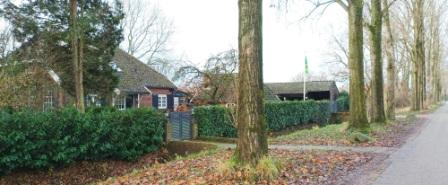
Former Alofs farm where Peter Hydichuk was killed. (Photo courtesy of Maarten Koudijs)
You can read Peter’s story at https://onthewarmemorialtrail.com/2025/11/15/on-the-war-memorial-trail-remembrance-week-2025-the-wwii-soldier-who-was-never-forgotten-by-his-girlfriend-and-her-family/
….The family of WWII soldier Gerald Vincent ‘Vin’ Jorgenson shared his story with relatives…
WWII soldier Gerald Vincent ‘Vin’ JORGENSON, from Kenora, Ontario, was serving with the Fort Garry Horse – 10th Armoured Regiment when he was killed in action during the Battle of the Scheldt in The Netherlands on October 23, 1944.
Terry and Leni Ellwood, who had provided photos and a wealth of information on Leni’s uncle Vin, were very appreciative, and wrote to say that “…we loved your article. It will become a family heirloom documenting the life of Vin Jorgenson. We will share it with all of Vin’s relatives.
Thank you so much for the effort you have taken to do the research and document this very important time in history. Bravo!…”
You can read Vin’s story at https://onthewarmemorialtrail.com/2026/04/04/on-the-war-memorial-trail-the-wwii-sergeant-from-kenora-killed-during-the-battle-of-the-scheldt-near-hoogerheide/
….The great-nephew of WWII soldier Garnet Joseph Gallant shared a photo of his original headstone in Groesbeek…
WWII soldier Garnet Joseph GALLANT, from Amherst, Nova Scotia, lost his life in Germany on February 18, 1945 during the Battle of Moyland Wood, while serving with the Regina Rifles Regiment.
Garnet’s great-nephew, Frank Elliott, got in touch after the story was written, explaining that “…. Garnet Gallant was my great-uncle. You had been talking with my Aunt Janet Lowerison when you wrote that great piece on Garnet. I have a box of old family pictures, which is where I found the one of Garnet that Janet shared with you. I also found this one of his first grave….”
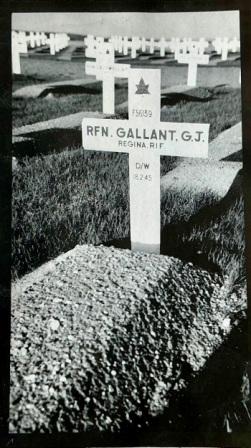
Original headstone for Garnet Gallant at the Canadian War Cemetery in Groesbeek, The Netherlands. (Photo courtesy of the Gallant Family)
Frank not only provided the photo, but went on to say “…I really enjoyed reading your website. Not just of Garnet but of the others as well. Thanks for doing the Memorial Trail project….”
You can read Garnet’s story at https://onthewarmemorialtrail.com/2025/11/21/on-the-war-memorial-trail-remembrance-week-2025-the-wwii-soldier-from-amherst-whose-photo-was-sent-a-few-days-before-what-would-have-been-his-103rd-birthday/
….Frans Nijsen empathized with a family whose relative was buried far from home…
When we were in The Netherlands on our 2025 European War Memorial Tour we encountered a sign by one grave in the Canadian War Cemetery in Groesbeek, that Pieter placed flags at, asking for whoever had been annually placing flowers at this grave to come forward – a mystery that was soon solved. After speaking with Saskia Peters, who had placed the sign, we learned that she had met Frans Nijsen, the man who had been placing the flowers.
WWII airman Arnold Freeman HUPMAN, from East Side of Ragged Island, Nova Scotia, lost his life during the last flight of Lancaster X KB728, which was shot down in Elden, The Netherlands in the early hours of June 17, 1944 as it was returning to England from a bombing mission in Germany.
You can read about this special story of remembrance at https://onthewarmemorialtrail.com/2026/04/18/on-the-war-memorial-trail-the-mystery-of-who-placed-flowers-at-one-airmans-grave-was-solved-in-a-story-spanning-two-continents/
After we shared the story about solving the mystery of who had been annually placing flowers, we heard back from Frans. “…The reason I started doing this was as a thank you to Graham’s family. I knew that it was difficult for them that Arnold wasn’t buried close to them and they couldn’t visit it. For me, this was a sign, that if they can’t, I will do it for them and let them know every year that we don’t forget. Reading the article made me emotional, in between the lines I can read the pain that still exists. My family has a similar pain, but I’m also proud of what my family members did with the resistance during the war. I will continue to bring flowers every year and let Graham know that we won’t forget. That’s the least we can do…”
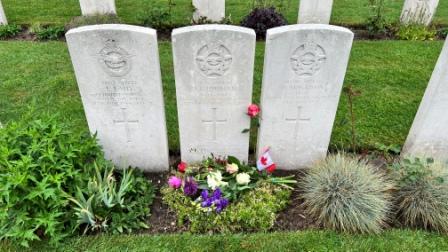
Flowers placed at the grave of Arnold Hupman on May 5, 2026. (Photo courtesy of Frans Nijsen)
In May 2026, Frans contacted us with photos of this year’s visit. “…Yesterday we visited the grave of Arnold Hupman and laid flowers on the grave together with my family. We transfer our knowledge and history so that this never happens again. I wish more people did that. We do our best to keep the memories and lessons alive….”
….A two part story about 2 brothers from Prince Edward Island brought back family history memories…
Two brothers from Prince Edward Island lost their lives during WWII. One is buried on the Island, the other in Germany….and a two part series told their stories.
WWII soldier Michael ‘Cecil’ STORDY from Brookvale, Prince Edward Island, drowned on June 14, 1945 during a swimming exercise in Nova Scotia, while training with A14 Canadian Infantry Training Centre (CITC).
WWII airman John ‘Lawrence’ STORDY from Brookvale, Prince Edward Island, was serving with the RCAF’s No. 405 Pathfinder Squadron, when he lost his life on April 27, 1943 while aboard the last flight of Halifax JB-920 when it was shot down by German flak over Germany during the Battle of the Ruhr.
After reading this two part series on the Stordy brothers, Kendra Mellish contacted us. “….Just wanted to send you a note to say Thank-You for the work you do ’On The War Memorial Trail’. Very interesting article on the two Stordy brothers in the military and from Brookvale/Kelly’s Cross. My maiden name was Stordy. My grandfather William Stordy grew up in Crapaud and his father ran Stordy’s Mill also in Crapaud. William Stordy created/owned Crystal Milk Dairy in Summerside. As a child, my father Eldon Stordy took me to Kelly’s Cross cemetery to work on family tree history….“
You can read Cecil’s story at https://onthewarmemorialtrail.com/2026/02/11/on-the-war-memorial-trailthe-stordy-brothers-part-1-the-wwii-soldier-from-brookvale-who-drowned-during-a-swimming-exercise-in-nova-scotia/
You can read Lawrence’s story at https://onthewarmemorialtrail.com/2026/02/16/on-the-war-memorial-trailthe-stordy-brothers-part-2-the-wwii-airman-from-brookvale-who-lost-his-life-on-the-last-flight-of-halifax-jb-920/
….The family of WWI soldiers Francis Edmund Graves and Charles Stuart was grateful to have their stories told…
WWI soldier Francis Edmund GRAVES, born in England, but from Winnipeg, Manitoba, was serving with the 31st Battalion when he was seriously wounded on May 3, 1917 during the Battle of Fresnoy in France. One leg was amputated and he spent 2 years in various hospitals but was able to return to civilian life in Winnipeg, Manitoba, where he raised a family and worked as a clerk at the Empire Sash and Door Co. Ltd until his death on November 8, 1941.
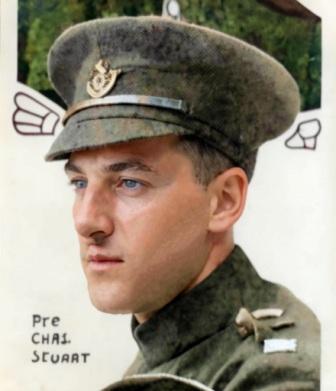
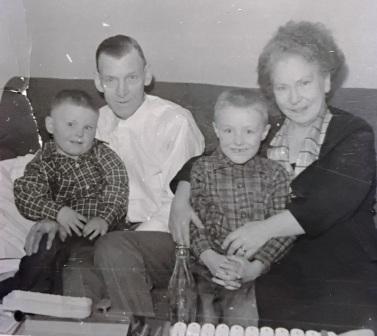
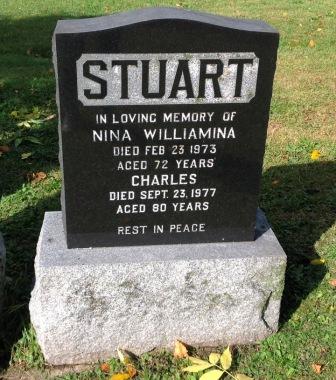
WWI soldier Charles STUART, born in England, but from Winnipeg, Manitoba, was serving with the 8th Battalion when he was seriously wounded on August 10, 1918 during the Battle of Amiens in France. He received multiple shrapnel wounds in scalp, jaw, larynx, neck, hand, and chest, and he spent almost 2 years in various hospitals, requiring reconstructive surgery on his nose and face, but was able to return to civilian life in Winnipeg, Manitoba, where he raised a family and worked for the CNR (Canadian National Railway) until retirement, before passing away on September 23, 1977 in Winnipeg.
Brenda Graves wrote us after reading Part 2 of the two part series on her husband Stuart’s grandfathers, who both served in WWI and returned home with major injuries. “….Amazing story! And to think about how we complain about relatively minor aches and pains. Charles and Francis were so critically injured and medical care was slow coming and without antibiotics, it was incredible that they even survived. Another great piece. Good job seems to be so inadequate on such well researched pieces. Thanks again. ….”
You can read Francis’ story at https://onthewarmemorialtrail.com/2026/05/18/on-the-war-memorial-trail-duty-sacrifice-resilience-part-1-the-wwi-soldier-whose-war-injuries-didnt-stop-him-from-living-his-life/
You can read Charles’ story at https://onthewarmemorialtrail.com/2026/05/24/on-the-war-memorial-trail-duty-sacrifice-resilience-part-2-the-wwi-soldier-who-was-seriously-wounded-by-an-exploding-grenade-during-the-battle-of-amiens/
….The niece of WWII soldier Albert Ahlwardt shares the same birth day as her uncle…
WWII soldier Albert Donald AHLWARDT, from Olds, Alberta, was serving with the 6th Anti-Tank Regiment, Royal Canadian Artillery, when he was killed on February 26, 1945 during the Battle of Keppeln in Germany, after a shell burst near him, as Pte Harry BIZNAR and Lt Robert Joseph MARKEY were trying to him to safety in a nearby house, after he was wounded.
His niece, Betty Askeland, daughter of Albert’s sister Stella, wrote us, saying “…thank you so much for sending this article, it means so much to me. I am his sister’s daughter Betty and we shared the same birth day June 2. This means so much to have this information…“
You can read Albert’s story at https://onthewarmemorialtrail.com/2026/07/22/on-the-war-memorial-trail-struck-by-shellfire-part-3-the-wwii-gunner-from-olds-who-lost-his-life-as-he-was-being-moved-to-safety/
….The nephew of WWII soldier James ‘Jim’ Kosowan found his story a reminder of ‘how much honour and respect we owe to so many from so long ago’.…
WWII soldier James ‘Jim’ John George KOSOWAN, born in Samburg, Saskatchewan, was serving with the Royal Winnipeg Rifles when he was killed in action during the Liberation of Deventer in The Netherlands on April 10, 1945.
After reading Jim’s story, his nephew, Randy Sanjenko, wrote us. “…I read the beautiful article you wrote about my uncle Jim it touched the hearts of my wife and children and the tears from me are still falling. It is not with sadness that I read it but with the knowledge that many fallen soldiers are somewhere silently thanking you for the work and sacrifice you make to keep their memories alive and the honour and respect you bring to them.
In a world with so much division and hate remembering those who fought against it is an honourable thing and I thank you from the bottom of my heart…“
You can read Jim’s story at https://onthewarmemorialtrail.com/2026/09/08/on-the-war-memorial-trail-the-wwii-soldier-born-in-samburg-who-lost-his-life-during-the-liberation-of-deventer/
Thank you to Betty Askeland, Brenda Graves, Frank Elliott, Terry and Leni Ellwood, Kendra Mellish, Frans Nijsen, Maarten Koudijs, Randy Sanjenko, and Pauline Theriault. The work of remembrance of those who served continues.
If you have a story to tell, please let Pieter know. You can email him at memorialtrail@gmail.com, or comment on the blog.
© Daria Valkenburg
….Want to follow our research?….
If you are reading this posting, but aren’t following our research, you are welcome to do so. Our blog address: https://onthewarmemorialtrail.com/
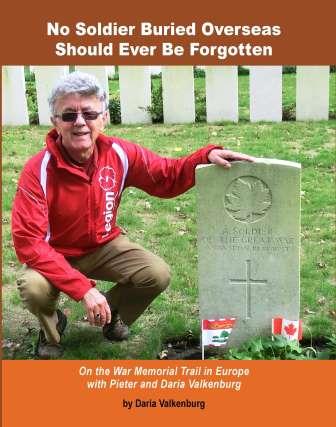
4 countries, 6 weeks, 7,000 km – an unforgettable war memorial journey in Europe…. Daria’s book ‘No Soldier Buried Overseas Should Ever Be Forgotten‘ is available in print and e-book formats. Net proceeds of book sales help support research costs and the cost of maintaining this blog. For more information see https://nosoldierforgotten.com/
You are also invited to subscribe to our YouTube Channel: On The War Memorial Trail With Pieter Valkenburg: https://www.youtube.com/channel/UCJ591TyjSheOR-Cb_Gs_5Kw.
Never miss a posting! Subscribe below to have each new story from the war memorial trail delivered to your inbox.
 4 countries, 6 weeks, 7,000 km – an unforgettable war memorial journey in Europe….

