August 17, 2026. One can imagine the relief that soldiers and their families felt when WWII in Europe was officially over, after the Allies formally accepted Germany’s unconditional surrender on May 8, 1945. While some soldiers slowly began returning home, others remained in Europe, tasked with various duties in liberated countries and as a post-occupation force in Germany.
Unfortunately, not everyone who had survived WWII returned home. Accidents and illness led to the death of several soldiers. One such soldier was Edward Alexander MUNRO, who died in a road accident in Germany in October 1945, at the age of 27, while serving with the 2nd Line 9th Canadian Infantry Brigade Company of the Royal Canadian Army Service Corps (Canadian Army Occupation Force).

Birch River is in northern Manitoba, near the border with the province of Saskatchewan. (Map source: Google Maps)
Born September 17, 1917 in Birch River, Manitoba, Edward was the son of Thomas ‘Tom’ Henry and Margaret ‘Maggie’ (nee Moore) Munro. He had three brothers: John Peter, Angus James, and Charles ‘Charley’ George, and two sisters: Kathleen (married name Delyea) and Sarah Louise.
Blanche Cowley-Head, a First Nations genealogist, wrote to let us know that Edward’s mother Maggie, and her sister Harriet, “…were sisters that married Munro brothers. The two sisters were the daughters of Peter Moore of the Shoal River Band (now known as Sapotaweyak Cree Nation). They lost their Treaty and Indian status upon their marriage to non-status Indians….” (See https://en.wikipedia.org/wiki/Sapotaweyak_Cree_Nation)
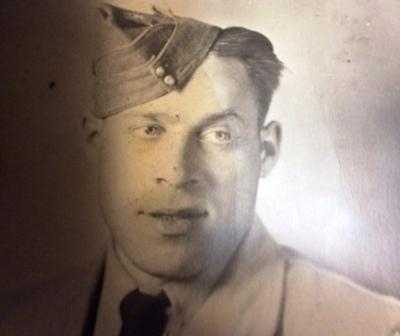
The search for a photo of Edward was successful when Glenda Foster, Office Administer at the Swan Valley Legion Branch #39 in Manitoba was able to find one. Glenda explained that she “…was born and raised in Birch River, I do know of the family and was well acquainted with Charley….”
….Edward enlisted in 1942…
When he enlisted at Military District No. 10 ‘B’ Company of the Royal Canadian Army Service Corps (RCASC) in Winnipeg, Manitoba on August 27, 1942, Edward was working at his father’s mixed farming operation in Birch River, and said that he’d left school at the age of 17. His Personnel Selection Record stated that he was “…pleasant mannered and cooperative…” and “…walks with a slouch, talks freely and is quite friendly…” and noted that all three of his brothers were in the army – two with the Royal Canadian Artillery and one with the Queens Own Cameron Highlanders. He enjoyed playing softball and was interested in becoming a barber after the war.
On September 19, 1942, Edward was transferred to No. 100 Canadian Army (Basic) Training Centre (CABTC) in Portage La Prairie, Manitoba. Shortly before completing his basic training, his Platoon Commander stated that he was a “… good soldier…” with a “…smart appearance, talkative…” and “…might be a good prospect for Provost duties, as a Corporal in charge of a small group of men…”

Edward Alexander Munro. (Photo submitted by Glenda Foster of the Swan Valley Legion Branch #39 in Manitoba)
After completing his basic training, Edward was sent to A20 Royal Canadian Army Service Corps Training Centre in Red Deer, Alberta on November 18, 1942 for further training. He qualified as a Driver Class III wheeled vehicles on December 23, 1942. (This meant he had passed the tests to drive standard military trucks and soft-skin wheeled vehicles at a beginner-to-intermediate trade proficiency level.)
After receiving his Class III certification, he was granted Christmas leave until December 27, 1942, in what turned out to be the last chance he would have to see his family before going overseas.
Once he returned back to Red Deer, he was hospitalized on December 30, 1942 until January 4, 1943 with a fractured rib.
….Edward left Canada for overseas service….
On March 11, 1943, Edward left Canada for the United Kingdom. Upon arriving on March 17, 1943 he was assigned to No. 1 Canadian Army Service Corps Reinforcement Unit (RCASC RU), effective the following day. This logistical training and staging unit was based in Aldershot in Hampshire, and administered by Canadian Military Headquarters (CMHQ) in London.
Newly arrived soldiers from the Royal Canadian Army Service Corps (RCASC) received additional operational and combat training. As active field units in the First Canadian Army needed reinforcements due to casualties, No. 1 Reinforcement Unit could deploy combat-ready replacements directly to the front lines.
On June 4, 1943, Edward was assigned to No. 3 Canadian Infantry Brigade (CIB) of the Royal Canadian Army Service Corps (RCASC). A few weeks later, on June 25, 1943, he was sent to 1st Canadian Infantry Divisional Troops Company (12 Company) RCASC for more training, before returning to No. 3 Canadian Infantry Brigade (CIB) on July 7, 1943. Edward was among the soldiers being prepared for the Italian Campaign – the upcoming Allied invasion of Italy, which began after the successful landings in Sicily (Operation Husky). (See https://www.veterans.gc.ca/en/military-history/second-world-war/italian-campaign)
….Edward served in Italy….
On August 16, 1943, Edward boarded a ship that left the United Kingdom the following day and arrived in Sicily on August 27, 1943, where his unit, No. 3 Canadian Infantry Brigade Company, RCASC, was taking part in the final stages of the Operation Husky before going on to mainland Italy for the upcoming Italian Campaign.
The unit had a transport and supply logistical role, supporting the 3rd Canadian Infantry Brigade of the 1ar Canadian Infantry Division with essential tasks such as hauling ammunition, food, fuel, and equipment across treacherous mountain roads and river valleys in Italy.
On September, 1943, Edward and the rest of his unit later crossed the Strait of Messina to land on mainland Italy at Reggio di Calabria under Operation Baytown, the start of the Italian Campaign. (See https://project44.ca/storymaps/southern-italy/)

The Italian Campaign followed Operation Husky in Sicily. (Map source: Juno Beach Centre)
Vehicles would be driven under severe conditions, with heavy reliance on relay drivers and field maintenance during the upcoming battles as troops moved up through mainland Italy, including Ortona and the breakthroughs of the Hitler and Gothic Lines.
On November 4, 1943, Edward was transferred to No. 1 Canadian Infantry Brigade Company, RCASC, and a few days later, on November 12, 1943, seconded to 112 Forward Maintenance Centre (FMC), one of several highly mobile logistical hubs set up just behind the front lines, where ammunition, fuel, food, and spare parts were stored.
Edward remained with 112 FMC until July 4, 1944, when he was hospitalized at No. 15 Canadian General Hospital in Caserta, Italy. There is no indication that Edward was wounded, so it’s possible that he was in hospital for an infection. During the summer of 1944, malaria was a major issue, due to the marshy, mosquito-heavy terrain that had been intentionally flooded by retreating German forces.
After his hospital discharge on July 15, 1944, Edward was placed in an X-4 Reinforcement Unit for a short period, until July 25, 1944, when he was transferred to No. 2 Canadian Infantry Brigade Company, RCASC. The unit was stationed in a rest area along the Volturno River valley in southern Italy, near the towns of Piedimonte d’Alife (today’s Piedimonte Matese) and Raviscanina.
Edward had a chance to recuperate more fully, before returning to No. 1 Canadian Infantry Brigade Company, RCASC on August 23, 1944. The unit was in central Italy, positioned just south of the Gothic Line, and had begun staging logistics for Operation Olive, an offensive aimed at breaking through the German Gothic Line fortifications. This meant moving large quantities of ammunition, rations, and fuel up mountainous terrain to sustain front line infantry units. The main assault on the Gothic Line began 3 days later, on August 26, 1944.
It was also a period when Edward took additional training, qualifying as a Driver i/c Class III on September 15, 1944. (The term ‘Driver i/c’ refers to ‘Driver, internal combustion’. Class III meant he was qualified to drive heavy trucks and armoured cars, but not tanks.)
On October 18, 1944, he qualified as a Driver Mechanic (MV) ‘C’, which meant he not only was qualified to operate military vehicles, but was also able handle field repairs, basic mechanical troubleshooting, and routine vehicle maintenance.
Shortly after completing his training, his unit moved north across the Apennines to prepare for the assault on the Gothic Line.
….Edward left Italy for northwest Europe…
On March 7, 1945, Edward and his unit left Italy from Leghorn, the port in Livorno, as part of Operation Goldflake, arriving in Marseilles, France two days later. Operation Goldflake was the codename for moving troops from Italy to North-West Europe. (See https://en.wikipedia.org/wiki/Operation_Goldflake)
Once in France, the unit travelled north by road and train to join the 1st Canadian Army in Belgium and The Netherlands, again providing crucial logistical and transport support. In The Netherlands, the unit was part of the support provided for the advance across the IJsselmeer, the liberation of Apeldoorn, and beginning on May 2, 1945, for Operation Faust, the delivery of food, coal and medical supplies across German lines for the relief of the starving Dutch.
Operation Faust ended on May 9, 1945 with the surrender of Germany, but in that short one week period had delivered between 840 and 1,141 tons of food and supplies EACH day! (See https://rclsa-asrlc.org/stories/op-faust/)
….Edward was in Germany with the CAOF….
With the end of WWII, Edward was granted a well-deserved leave to the United Kingdom, from May 18 to 31, 1945. Shortly after returning to his unit, he was transferred to the newly formed 2nd Line 9th Canadian Infantry Brigade Company (Canadian Army Occupation Force), RCASC as a Driver Mechanic (MV) ‘C’ on June 14, 1945. This new unit was sent to Germany to support the 3rd Canadian Infantry Division (Occupation Force), as part of the Canadian Army Occupation Force (CAOF), which was involved in policing, rebuilding, and securing the British Zone of occupied Germany.
Edward’s unit was responsible for transporting bulk supplies using 3-ton to 10-ton trucks, and accounting for the supplies and rations, and maintaining fuel depots. On-site mechanics, like Edward, kept the unit’s vehicle fleet operational.
He was given an 11 day leave to the United Kingdom, from August 12 until 24, 1945. On September 27, 1945, Edward was admitted to No. 6 Canadian Field Dressing Station (RCAMC) in Apeldoorn, Netherlands, a distance of 257 km (160 miles), remaining there until he was discharged on October 3, 1945.

The distance between Apeldoorn and Oldenburg is 257 km. (Map source: Google Maps)
….Edward died in a road accident in Germany…

Drawing of accident site from Edward Munro’s service file.
Just a few days after being discharged, Edward lost his life in a vehicle accident while a passenger in an armoured scout car that was returning from ‘Alexandra Airport’ (Flughafen Oldenburg/Alexanderheide) located 5 km (3 miles) from Oldenburg. His brother, Charles ‘Charley’ George, who also served in 2nd Line 9th Canadian Infantry Brigade Company, was a passenger in the front seat of the vehicle, and was injured in the same accident.
According to the Court of Inquiry, an accident occurred “…on the Bad Zwischenahn Road between Bad Zwischenahn and Oldenburg, Germany at 2305 hours 5 Oct 1945…” with 4 soldiers in the vehicle. The speed of the vehicle was judged to be “….normal, at approximately 25 miles per hour….” and evidence indicated that “…the accident occurred due to a combination of weather conditions, slippery roads, bad lights, and poor visibility…”
Edward “…was instantly killed as a result of this accident…” Three other soldiers from the same unit were injured: Pte A. THOMSON (the driver of the vehicle); Pte C. G. MUNRO (Edward’s brother); and L/Cpl M. D. WHITE.
Testimony by several witnesses who stopped to help following the accident reported that the vehicle had hit a tree. Pte R. E. QUADE stated that he “….looked inside the vehicle and noticed that three of the men were inside, and one, I would say, was dead or dying….and the fourth was outside, walking around with blood on his face….”
Cpl Roy W. STATES, another witness, said he’d stopped to help, tried unsuccessfully to immediately get help, before returning to the vehicle and “…saw to my horror a body with his head smashed in…”
Edward, with a fractured skull, was the only fatality. He was taken to No. 16 Canadian General Hospital in Oldenburg, with the death certificate signed on October 6, 1945.
Charley was seriously injured with “…head lacerations, concussion, and a fractured right scapula…” He returned home to Birch River after being discharged from the Canadian Army and died in 2002.
….Edward is buried in Holten…
Edward was initially buried in the Canadian Military Cemetery in Osterscheps, Germany (near Oldenburg) before being reburied in the Canadian War Cemetery in Holten, The Netherlands on March 8, 1946. During our 2025 European War Memorial Tour, Pieter placed Canadian and Manitoba flags by his grave.

Pieter at the grave of Edward Alexander Munro after placing Canadian and Manitoba flags. (Photo credit: Daria Valkenburg)
Pieter reflected that Edward’s death resonated after learning that not only had he helped so many soldiers as a member of the essential services provided by the RCASC, he had been part of Operation Faust. “…After being involved in saving the lives of so many starving Dutch citizens, it is tragic that this man lost his life in a vehicle accident over which he had no control…”
…..Edward will be listed on the National Métis Veterans Memorial Monument….
Once we noticed that Edward is not listed on the National Métis Veterans Memorial Monument just outside of Batoche, Saskatchewan, but his brother Charley is, we sent in an application to have his name added. (See https://www.metismuseum.ca/metisveteransmonument/)
In January 2026, we received an email from Ryan Nordmarken, Senior Administrative Coordinator at the Gabriel Dumont Institute – Métis Culture & Heritage Dept., advising that the application was approved. “…This submission has been added to the list to be included with the next engraving. Thank you!...”
…..Munro Peninsula is named in Edward’s honour….

Munro Peninsula in northern Manitoba was in Edward Alexander Munro’s honour. (Map source: Mapcarta)
Munro Peninsula, on Obuyi Lake (formerly known as Pincock Lake) in northern Manitoba (approximately latitude 59°07′ N, longitude 97°07′ W) was named after him in 1995. ‘Obuyi’ comes from the Chipewyan language and means ‘trees have been burned around the lake’.
Thank you to Glenda Foster of the Swan Valley Legion Branch #39 in Manitoba for sending a photo, and to Jennifer Laviolette, Editor at The Swan Valley Star and Times newspaper, for referring us to the Swan Valley Legion. Thank you also to Blanche Cowley-Head for confirming that Edward’s mother Maggie had Indigenous roots.
The flags placed at Edward’s grave during our 2025 European War Memorial Tour were donated. Our thanks go to:
- Alan Waddell, Constituent Assistant, on behalf of Heath MacDonald, MP for Malpeque, for the Canadian flag.
- Brad Robertson, Chief of Protocol, Government of Manitoba, on behalf of Wab Kinew, Premier of Manitoba, who donated the Manitoba flag.
Pieter’s research efforts to find photos and families of soldiers continue. Do you have a story to tell? Email Pieter at memorialtrail@gmail.com, or comment on the blog.
© Daria Valkenburg
….Want to follow our research?…
If you are reading this posting, but aren’t following our research, you are welcome to do so. Our blog address: https://onthewarmemorialtrail.com/
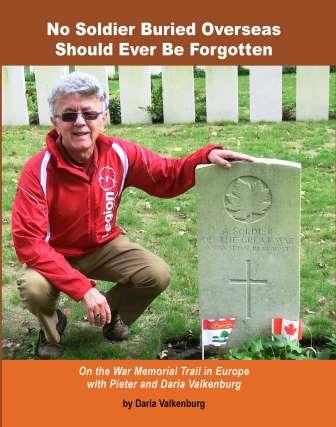 4 countries, 6 weeks, 7,000 km – an unforgettable war memorial journey in Europe…. Daria’s book ‘No Soldier Buried Overseas Should Ever Be Forgotten‘ is available in print and e-book formats. Net proceeds of book sales help support research costs and the cost of maintaining this blog. For more information see https://nosoldierforgotten.com/
Subscribe to our YouTube Channel: On The War Memorial Trail With Pieter Valkenburg: https://www.youtube.com/channel/UCJ591TyjSheOR-Cb_Gs_5Kw.
Never miss a posting! Subscribe below to have each new story from the war memorial trail delivered to your inbox.