
November 13, 2026. Each year we try to visit one or more war memorials in Canada, and the previous posting featured our visit to the Tryon Cenotaph in Tryon, Prince Edward Island. (See https://onthewarmemorialtrail.com/2026/11/11/on-the-war-memorial-trailremembrance-week-2026-visit-to-tryon-cenotaph/)
In this Remembrance Week 2026 posting, we feature a visit made by a British friend, Gail Wainwright, who lives in Somerset, to the National Memorial Arboretum in Alrewas, near Lichfield, Staffordshire in England. Officially called The Royal British Legion National Remembrance Gardens, but formerly and more commonly known as the National Memorial Arboretum, this arboretum spans 150 acres with 25,000 trees and over 400 military and civilian memorials.
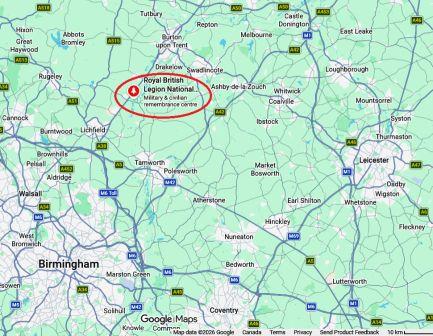
Map shows location of the National Memorial Arboretum near Lichfield. (Map source: Google Maps)
When Gail mentioned there was an RCAF memorial at the site, and would we be interested in a photo, of course we said yes! So many Canadians served in Bomber Command or Coastal Command during WWII, either with the Royal Canadian Air Force (RCAF) or Royal Air Force (RAF).
….The RCAF Monument is in the RAF Zone of Memorials….
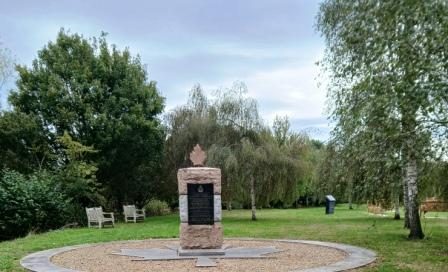
RCAF Monument. (Photo credit: Gail Wainwright)
Unveiled in July 2011, the RCAF memorial is located in the RAF Zone, and dedicated ‘In honour of those who serve past and present in Canadian and Commonwealth Air Elements.’
The memorial is made of Canadian granite from a quarry near Sturgeon Falls, Ontario, which had been donated by Lafarge Canada. A monolith, created out of red and white granite to represent the Canadian flag, is the centrepiece of the monument. It’s topped by a maple leaf and stands upon a granite maple leaf with a matching granite ring surrounding it; from above this will show Canada’s modern Air Force roundel. The text of the poem ‘High Flight’, written by RCAF pilot Flight Lieutenant John Gillespie Magee, Jr., is inscribed on one side of the monument, with a French translation on another side.
In 2024, during the commemoration of 100 years of service for the Royal Canadian Air Force (RCAF) as a distinct military element, one Remembrance Week posting was dedicated to stories previously told of those who served in the RCAF during WWII. See https://onthewarmemorialtrail.com/2024/11/07/on-the-war-memorial-trail-remembrance-week-2024-remembering-those-who-served-in-the-rcaf-during-wwii/
The 2024 posting mentioned these airmen:
- Robert ‘Bob’ James DICKIE
- Rowan Charles ‘Bunky’ FITZGERALD
- John ‘Hubert’ HALL
- William Andrew HOOD
- Arnold Freeman HUPMAN
- Lorne MACFARLANE
- Jack ‘Douglas’ MACKENZIE
- Joseph ‘Joe’ Charles MCIVER
- George Glenn ‘Dusty’ MILLAR
- Elmer Bagnall MUTTART
- Leonard Arthur UNWIN
Since that November 2024 posting, we’ve told more stories about those serving in the RCAF during WWII, including:
- WWII airman Allison ‘Boyce’ MCKIE, born in Southport (now part of Stratford), Prince Edward Island, died in a training accident in Scotland when Spitfire L1083, in which he was the pilot and sole occupant in the plane, was lost in low clouds during a formation exercise flight and crashed on November 11, 1941. You can read Boyce’s story at https://onthewarmemorialtrail.com/2026/04/13/on-the-war-memorial-trail-the-spitfire-pilot-killed-in-a-training-accident-during-the-last-flight-of-spitfire-l1083/
- WWII airman Henry ‘Hank’ PANKRATZ, born in Langham, Saskatchewan, was one of 4 survivors of the last flight of 424 ‘Tiger’ Squadron’s Halifax NP945, which was shot down in Germany, near the Dutch border, on December 6, 1944, while on its return from a sortie to Osnabrück, Germany. Hank became a POW, but was able to return home, where he raised a family and served in the RCMP and RCAF. He died on August 4, 1996. You can read Hank’s story at https://onthewarmemorialtrail.com/2026/10/30/on-the-war-memorial-trail-the-airman-from-langham-who-became-a-pow-part-1-the-last-flight-of-halifax-np945/ and https://onthewarmemorialtrail.com/2026/11/01/on-the-war-memorial-trail-the-airman-from-langham-who-became-a-pow-part-2-six-months-behind-barbed-wire/
- WWII airman John ‘Lawrence’ STORDY from Brookvale, Prince Edward Island, was serving with the RCAF’s No. 405 Pathfinder Squadron, who lost his life on April 27, 1943 while aboard the last flight of Halifax JB-920 when it was shot down by German flak over Germany during the Battle of the Ruhr. You can read Lawrence’s story at https://onthewarmemorialtrail.com/2026/02/16/on-the-war-memorial-trailthe-stordy-brothers-part-2-the-wwii-airman-from-brookvale-who-lost-his-life-on-the-last-flight-of-halifax-jb-920/
- WWII soldier Donald David MacKenzie TAYLOR, born in Winnipeg, Manitoba, drowned on November 7, 1944 when the Landing Ship Tank LST- 420, carrying members of No. 1 Base Signals and Radar Unit (BSRU) of the Royal Canadian Air Force (RCAF), sank after it hit a mine near the harbour in Ostend, Belgium. You can read Donald’s story at https://onthewarmemorialtrail.com/2025/12/27/on-the-war-memorial-trail-the-wwii-soldier-born-in-manitoba-who-lost-his-life-when-lst-420-hit-a-mine-in-the-harbour-outside-ostend/
….The Armed Forces Memorial includes a statue of a wounded soldier on a stretcher….
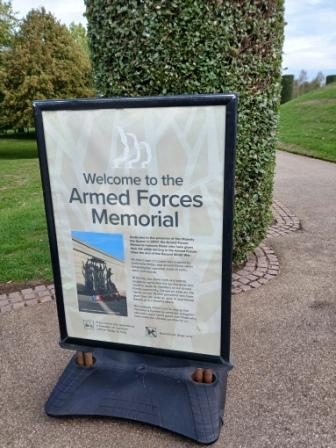
Sign at the entrance to the Armed Forces Memorial. (Photo credit: Gail Wainwright)
One of the memorials Gail visited was the Armed Forces Memorial, which includes a wall of remembrance and a statue of soldier on a stretcher. She noted that the “…Armed Forces Memorial is large and round, and found in the middle of the arboretum. It recognises and gives thanks to all the people who have died in service since WWII. Since 1948, armed forces have taken part in more than 50 operations and conflicts around the world. There are already 16,000 names on the walls and there is room for another 15,000….”
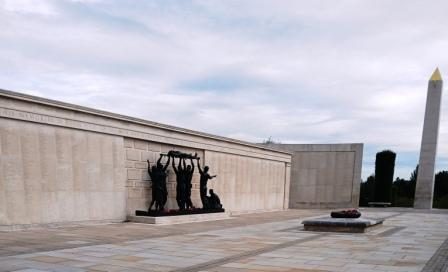
The Armed Forces Memorial has a wall of remembrance with names of those who died in conflicts post-WWII, plus a statue of an injured soldier on a stretcher. (Photo credit: Gail Wainwright)
Gail noted that the monument includes “…a stretcher to show a person injured and their family looking on…” The purpose of this depiction “…is to show the effect of war on the family….”
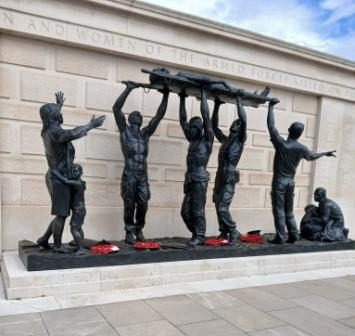
The statue depicts an injured soldier on a stretcher and being carried to safety, while family members look on. (Photo credit: Gail Wainwright)
The explanation of the stretcher statue sent shivers down my spine! How thoughtful to include a depiction of the families left behind!
Being a medic, nursing orderly, or a stretcher bearer during WWII was dangerous, and over the years we have told a few stories about those who did not return home:
- WWII soldier Lawrence William BULGER from Foxley River, Prince Edward Island, was killed during the Battle of Bienen in Germany on March 25, 1945, one of several stretcher bearers who lost their lives that day, killed by machine gun fire while attending to the wounded on the battlefield. You can read Lawrence’s story at https://onthewarmemorialtrail.com/2024/08/19/on-the-war-memorial-trail-the-bulger-brothers-part-2-the-wwii-stretcher-bearer-from-foxley-river-killed-during-the-battle-of-bienen/
- WWII soldier Albert Joseph COTE, who was born in Quebec but grew up in North Bay, Ontario, was a stretcher-bearer who volunteered to remain with three tourniquet cases during the Battle of the Leopold Canal on September 14, 1944. Soon after his Regiment headed off to continue fighting, shellfire wrecked the barn where he and the wounded men were sheltered. Albert was badly wounded with a gunshot wound to his right thigh, and taken prisoner of war. Not receiving immediate treatment that proved fatal, Albert ended up in Kriegs Lagerlazarett (Field Hospital) Stalag 11B near Fallingbostel, Germany, where he died on October 5, 1944. You can read Albert’s story at https://onthewarmemorialtrail.com/2022/07/27/on-the-war-memorial-trail-the-wwii-stretcher-bearer-whose-compassion-cost-him-his-life/
- WWII soldier John Lewis HUGHES from Eriksdale, Manitoba, a nursing orderly, was killed at a beach dressing station during Operation Infatuate on Walcheren Island in The Netherlands on November 2, 1944, when 3 Allied tracked vehicles exploded after being hit by German shellfire. You can read John’s story at https://onthewarmemorialtrail.com/2025/12/04/on-the-war-memorial-trail-remembrance-week-2025-the-wwii-nursing-orderly-killed-when-3-tracked-vehicles-exploded-near-a-field-dressing-station-on-walcheren-island/
….The Polar Bear Monument honours British troops based in Iceland during WWII….
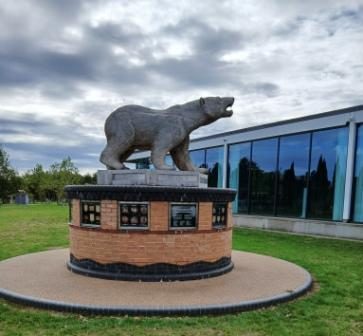
The Polar Bear Monument. (Photo credit: Gail Wainwright)
When Gail included a photo of the Polar Bear Monument, I wondered if it was because of Canada’s participation in WWII. I was wrong! Gail explained that she had “…enclosed photos of the Polar Bear monument because everyone likes it and polar bears are in Canada! It was the first monument unveiled at the centre – in June 1998. It is a tribute to the 49th West Riding, Yorkshire, Infantry Division, who were based in Iceland during WWII. They were trapped under deep snow and their Commander called them his polar bears. The bear became their mascot…”
The Polar Bear monument was a great explanation as we recently had done a story about Joseph ‘Joe’ Julius Augustus LAWRENCE, born in L’Ardoise. Nova Scotia, who was supposed to go to Iceland, but just as the men were at the ship in Halifax and ready to board, they were told it was a no-go and that a British regiment would go in their place. Joe was subsequently killed on October 31, 1944 in The Netherlands during the Battle of Walcheren Causeway. You can read Joe’s story at https://onthewarmemorialtrail.com/2026/08/23/on-the-war-memorial-trail-the-wwii-soldier-from-lardoise-who-lost-his-life-during-the-battle-of-walcheren-causeway/
….Gail reflected on her visit….
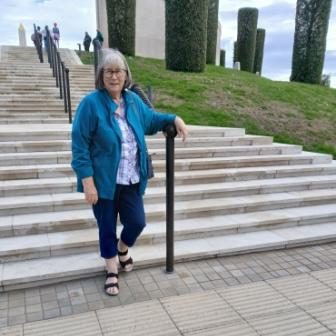
Gail Wainwright on the steps leading to the Armed Forces Memorial (Photo credit: Jackie Stone)
Gail reflected on her visit. “…My thoughts. It is a large area, with lots of trees that were planted at the beginning, to form an arboretum, using waste land that had been excavated for gravel.
The memorials are all shapes and sizes, plain and some are beautiful. They all depict the sadness of war, but it gives people somewhere to go and remember their loved ones. It is amazing the number of organisations that have monuments and all the sections belonging to the organisations….”
Gail was quite right about the large number of memorials and monuments. I had read about two more memorials of interest to us that Gail did not have time to see during her visit: Mediterranean Force of WWII Memorial and Operation Market Garden Memorial.
Thank you to Gail Wainwright for sharing photos of her visit with Jackie Stone to the National Memorial Arboretum in England.
The work of remembrance of those who served continues. If you have a story to tell, please let Pieter know. You can email him at memorialtrail@gmail.com, or comment on the blog.
© Daria Valkenburg
….Want to follow our research?….
If you are reading this posting, but aren’t following our research, you are welcome to do so. Our blog address: https://onthewarmemorialtrail.com/
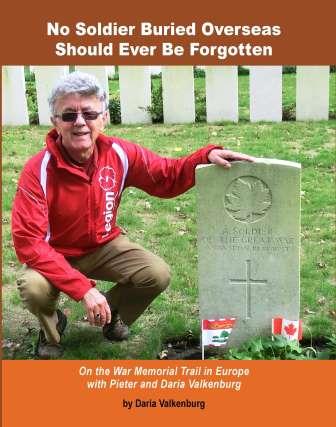 4 countries, 6 weeks, 7,000 km – an unforgettable war memorial journey in Europe…. Daria’s book ‘No Soldier Buried Overseas Should Ever Be Forgotten‘ is available in print and e-book formats. Net proceeds of book sales help support research costs and the cost of maintaining this blog. For more information see https://nosoldierforgotten.com/
You are also invited to subscribe to our YouTube Channel: On The War Memorial Trail With Pieter Valkenburg: https://www.youtube.com/channel/UCJ591TyjSheOR-Cb_Gs_5Kw.
Never miss a posting! Subscribe below to have each new story from the war memorial trail delivered to your inbox.

