On The War Memorial Trail…Remembrance Week 2026 – Reflections and Updates

November 10, 2026.  When we write a story on the blog, we often receive additional information about the soldiers we’ve written about, and reactions from family members of the soldiers. This Remembrance Week 2026 posting gives an update on eleven soldiers whose stories were previously told.

….The family of WWII soldier Azade Boudreau appreciated the research that went into telling his story…

WWII soldier Azade BOUDREAU from Petit Rocher Nord, New Brunswick, drowned in a canal in Ghent, Belgium on December 15, 1944, aged 22, while serving with the 4th Medium Regiment, Royal Canadian Artillery.

There is usually quite a time lag from when Pieter begins his research, family is contacted and a photo is provided, and a story is written.  Azade’s story took 2 years from the initial start of research until a story was written and published on our blog, just before last Christmas.

It meant a great deal to us when Azade’s niece, Pauline Theriault, who had provided a photo, wrote us to say “….. Words can’t express how grateful the Boudreau family is for all the time and research you have invested in telling Azade’s story.  We knew nothing about it at all.

The fact that you went to Petit Rocher and also visited his gravesite is beyond anything we could have ever hoped for.

We definitely treasure all you have done for us.  You have no way to know how much this means to us. It’s part of our history that we can now pass on to the next generation.

 Thanks very much & Happy Holidays….”

You can read Azade’s story at: https://onthewarmemorialtrail.com/2025/12/15/on-the-war-memorial-trail-the-wwii-soldier-from-petit-rocher-nord-who-accidentally-drowned-in-a-belgian-canal/

….A local Dutch researcher sent a photo of the location where WWII soldier Peter Hydichuk lost his life…

WWII soldier Peter HYDICHUK, from Theodore, Saskatchewan, lost his life in The Netherlands on March 31, 1945, aged 27, while serving with the South Saskatchewan Regiment.

Maarten Koudijs, an amateur researcher in the Gendringen area, and author of ‘Tussen Grens En Hoop’, was quoted in the story we wrote, as he’d stated that Peter was “…killed near Alofs’s house on the Tappenweg in Etten….”  (Translated from the original Dutch)

In January 2026 Maarten sent us a photo of the former farm where Peter died.
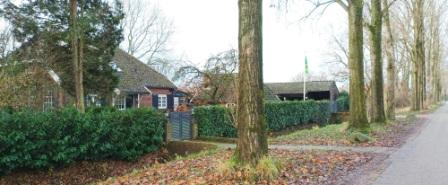
Former Alofs farm where Peter Hydichuk was killed. (Photo courtesy of Maarten Koudijs)

You can read Peter’s story at https://onthewarmemorialtrail.com/2025/11/15/on-the-war-memorial-trail-remembrance-week-2025-the-wwii-soldier-who-was-never-forgotten-by-his-girlfriend-and-her-family/

 ….The family of WWII soldier Gerald Vincent ‘Vin’ Jorgenson shared his story with relatives…

WWII soldier Gerald Vincent ‘Vin’ JORGENSON, from Kenora, Ontario, was serving with the Fort Garry Horse – 10th Armoured Regiment when he was killed in action during the Battle of the Scheldt in The Netherlands on October 23, 1944.

Terry and Leni Ellwood, who had provided photos and a wealth of information on Leni’s uncle Vin, were very appreciative, and wrote to say that “…we loved your article. It will become a family heirloom documenting the life of Vin Jorgenson. We will share it with all of Vin’s relatives.

Thank you so much for the effort you have taken to do the research and document this very important time in history. Bravo!…”

You can read Vin’s story at https://onthewarmemorialtrail.com/2026/04/04/on-the-war-memorial-trail-the-wwii-sergeant-from-kenora-killed-during-the-battle-of-the-scheldt-near-hoogerheide/

….The great-nephew of WWII soldier Garnet Joseph Gallant shared a photo of his original headstone in Groesbeek…

WWII soldier Garnet Joseph GALLANT, from Amherst, Nova Scotia, lost his life in Germany on February 18, 1945 during the Battle of Moyland Wood, while serving with the Regina Rifles Regiment.

Garnet’s great-nephew, Frank Elliott, got in touch after the story was written, explaining that “…. Garnet Gallant was my great-uncle. You had been talking with my Aunt Janet Lowerison when you wrote that great piece on Garnet. I have a box of old family pictures, which is where I found the one of Garnet that Janet shared with you. I also found this one of his first grave….” 
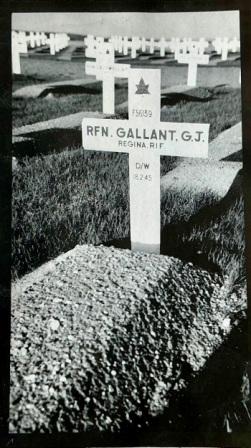
Original headstone for Garnet Gallant at the Canadian War Cemetery in Groesbeek, The Netherlands. (Photo courtesy of the Gallant Family)

Frank not only provided the photo, but went on to say “…I really enjoyed reading your website. Not just of Garnet but of the others as well. Thanks for doing the Memorial Trail project….”

You can read Garnet’s story at https://onthewarmemorialtrail.com/2025/11/21/on-the-war-memorial-trail-remembrance-week-2025-the-wwii-soldier-from-amherst-whose-photo-was-sent-a-few-days-before-what-would-have-been-his-103rd-birthday/

….Frans Nijsen empathized with a family whose relative was buried far from home…

When we were in The Netherlands on our 2025 European War Memorial Tour we encountered a sign by one grave in the Canadian War Cemetery in Groesbeek, that Pieter placed flags at, asking for whoever had been annually placing flowers at this grave to come forward – a mystery that was soon solved. After speaking with Saskia Peters, who had placed the sign, we learned that she had met Frans Nijsen, the man who had been placing the flowers.

WWII airman Arnold Freeman HUPMAN, from East Side of Ragged Island, Nova Scotia, lost his life during the last flight of Lancaster X KB728, which was shot down in Elden, The Netherlands in the early hours of June 17, 1944 as it was returning to England from a bombing mission in Germany.

You can read about this special story of remembrance at https://onthewarmemorialtrail.com/2026/04/18/on-the-war-memorial-trail-the-mystery-of-who-placed-flowers-at-one-airmans-grave-was-solved-in-a-story-spanning-two-continents/

After we shared the story about solving the mystery of who had been annually placing flowers, we heard back from Frans.  “…The reason I started doing this was as a thank you to Graham’s family. I knew that it was difficult for them that Arnold wasn’t buried close to them and they couldn’t visit it. For me, this was a sign, that if they can’t, I will do it for them and let them know every year that we don’t forget. Reading the article made me emotional, in between the lines I can read the pain that still exists. My family has a similar pain, but I’m also proud of what my family members did with the resistance during the war. I will continue to bring flowers every year and let Graham know that we won’t forget. That’s the least we can do…”
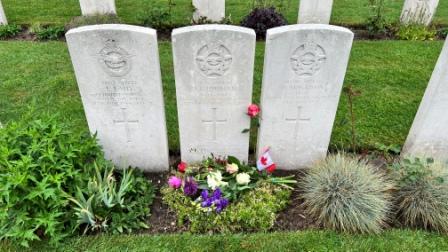
Flowers placed at the grave of Arnold Hupman on May 5, 2026. (Photo courtesy of Frans Nijsen)

In May 2026, Frans contacted us with photos of this year’s visit.  “…Yesterday we visited the grave of Arnold Hupman and laid flowers on the grave together with my family. We transfer our knowledge and history so that this never happens again. I wish more people did that. We do our best to keep the memories and lessons alive….”

….A two part story about 2 brothers from Prince Edward Island brought back family history memories…

Two brothers from Prince Edward Island lost their lives during WWII.  One is buried on the Island, the other in Germany….and a two part series told their stories.

WWII soldier Michael ‘Cecil’ STORDY from Brookvale, Prince Edward Island, drowned on June 14, 1945 during a swimming exercise in Nova Scotia, while training with A14 Canadian Infantry Training Centre (CITC).

WWII airman John ‘Lawrence’ STORDY from Brookvale, Prince Edward Island, was serving with the RCAF’s No. 405 Pathfinder Squadron, when he lost his life on April 27, 1943 while aboard the last flight of Halifax JB-920 when it was shot down by German flak over Germany during the Battle of the Ruhr.

After reading this two part series on the Stordy brothers, Kendra Mellish contacted us.  “….Just wanted to send you a note to say Thank-You for the work you do ’On The War Memorial Trail’.  Very interesting article on the two Stordy brothers in the military and from Brookvale/Kelly’s Cross.  My maiden name was Stordy. My grandfather William Stordy grew up in Crapaud and his father ran Stordy’s Mill also in Crapaud. William Stordy created/owned Crystal Milk Dairy in Summerside.  As a child, my father Eldon Stordy took me to Kelly’s Cross cemetery to work on family tree history….“

You can read Cecil’s story at https://onthewarmemorialtrail.com/2026/02/11/on-the-war-memorial-trailthe-stordy-brothers-part-1-the-wwii-soldier-from-brookvale-who-drowned-during-a-swimming-exercise-in-nova-scotia/

You can read Lawrence’s story at https://onthewarmemorialtrail.com/2026/02/16/on-the-war-memorial-trailthe-stordy-brothers-part-2-the-wwii-airman-from-brookvale-who-lost-his-life-on-the-last-flight-of-halifax-jb-920/

….The family of WWI soldiers Francis Edmund Graves and Charles Stuart was grateful to have their stories told…

WWI soldier Francis Edmund GRAVES, born in England, but from Winnipeg, Manitoba, was serving with the 31st Battalion when he was seriously wounded on May 3, 1917 during the Battle of Fresnoy in France. One leg was amputated and he spent 2 years in various hospitals but was able to return to civilian life in Winnipeg, Manitoba, where he raised a family and worked as a clerk at the Empire Sash and Door Co. Ltd until his death on November 8, 1941.

WWI soldier Charles STUART, born in England, but from Winnipeg, Manitoba, was serving with the 8th Battalion when he was seriously wounded on August 10, 1918 during the Battle of Amiens in France. He received multiple shrapnel wounds in scalp, jaw, larynx, neck, hand, and chest, and he spent almost 2 years in various hospitals, requiring reconstructive surgery on his nose and face, but was able to return to civilian life in Winnipeg, Manitoba, where he raised a family and worked for the CNR (Canadian National Railway) until retirement, before passing away on September 23, 1977 in Winnipeg.

Brenda Graves wrote us after reading Part 2 of the two part series on her husband Stuart’s grandfathers, who both served in WWI and returned home with major injuries.  “….Amazing story! And to think about how we complain about relatively minor aches and pains. Charles and Francis were so critically injured and medical care was slow coming and without antibiotics, it was incredible that they even survived. Another great piece.  Good job seems to be so inadequate on such well researched pieces.  Thanks again. ….”

You can read Francis’ story at https://onthewarmemorialtrail.com/2026/05/18/on-the-war-memorial-trail-duty-sacrifice-resilience-part-1-the-wwi-soldier-whose-war-injuries-didnt-stop-him-from-living-his-life/

You can read Charles’ story at https://onthewarmemorialtrail.com/2026/05/24/on-the-war-memorial-trail-duty-sacrifice-resilience-part-2-the-wwi-soldier-who-was-seriously-wounded-by-an-exploding-grenade-during-the-battle-of-amiens/

….The niece of WWII soldier Albert Ahlwardt shares the same birth day as her uncle…

WWII soldier Albert Donald AHLWARDT, from Olds, Alberta, was serving with the 6th Anti-Tank Regiment, Royal Canadian Artillery, when he was killed on February 26, 1945 during the Battle of Keppeln in Germany, after a shell burst near him, as Pte Harry BIZNAR and Lt Robert Joseph MARKEY were trying to him to safety in a nearby house, after he was wounded.

His niece, Betty Askeland, daughter of Albert’s sister Stella, wrote us, saying “…thank you so much for sending this article, it means so much to me.  I am his sister’s daughter Betty and we shared the same birth day June 2. This means so much to have this information…“

You can read Albert’s story at https://onthewarmemorialtrail.com/2026/07/22/on-the-war-memorial-trail-struck-by-shellfire-part-3-the-wwii-gunner-from-olds-who-lost-his-life-as-he-was-being-moved-to-safety/

….The nephew of WWII soldier James ‘Jim’ Kosowan found his story a reminder of ‘how much honour and respect we owe to so many from so long ago’.…

WWII soldier James ‘Jim’ John George KOSOWAN, born in Samburg, Saskatchewan, was serving with the Royal Winnipeg Rifles when he was killed in action during the Liberation of Deventer in The Netherlands on April 10, 1945.

After reading Jim’s story, his nephew, Randy Sanjenko, wrote us. “…I read the beautiful article you wrote about my uncle Jim it touched the hearts of my wife and children and the tears from me are still falling. It is not with sadness that I read it but with the knowledge that many fallen soldiers are somewhere silently thanking you for the work and sacrifice you make to keep their memories alive and the honour and respect you bring to them.

In a world with so much division and hate remembering those who fought against it is an honourable thing and I thank you from the bottom of my heart…“

You can read Jim’s story at https://onthewarmemorialtrail.com/2026/09/08/on-the-war-memorial-trail-the-wwii-soldier-born-in-samburg-who-lost-his-life-during-the-liberation-of-deventer/

Thank you to Betty Askeland, Brenda Graves, Frank Elliott, Terry and Leni Ellwood, Kendra Mellish, Frans Nijsen, Maarten Koudijs, Randy Sanjenko, and Pauline Theriault. The work of remembrance of those who served continues.
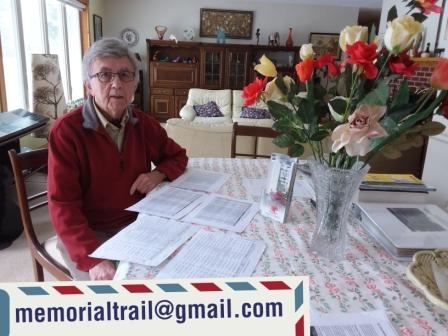
If you have a story to tell, please let Pieter know. You can email him at memorialtrail@gmail.com, or comment on the blog.

© Daria Valkenburg

….Want to follow our research?….

If you are reading this posting, but aren’t following our research, you are welcome to do so.  Our blog address: https://onthewarmemorialtrail.com/

4 countries, 6 weeks, 7,000 km – an unforgettable war memorial journey in Europe…. Daria’s book ‘No Soldier Buried Overseas Should Ever Be Forgotten‘ is available in print and e-book formats.  Net proceeds of book sales help support research costs and the cost of maintaining this blog. For more information see https://nosoldierforgotten.com/

You are also invited to subscribe to our YouTube Channel: On The War Memorial Trail With Pieter Valkenburg: https://www.youtube.com/channel/UCJ591TyjSheOR-Cb_Gs_5Kw.

Never miss a posting!  Subscribe below to have each new story from the war memorial trail delivered to your inbox.

On The War Memorial Trail…. Struck By Shellfire Part 3 The WWII Gunner From Olds Who Lost His Life As He Was Being Moved To Safety

July 22, 2026. On February 26, 1945, the lives of three WWII soldiers intersected during the Battle of Keppeln in Germany. Private Harry BIZNAR, Lt Robert Joseph MARKEY, and Gunner Albert Donald AHLWARDT, all lost their lives when a shell burst near them as Private Biznar and Lt Markey were trying to get a wounded Gunner Ahlwardt to safety in a nearby house.

In Part 1 of Struck By Shellfire, the story of WWII soldier Harry BIZNAR was told.  (See https://onthewarmemorialtrail.com/2026/07/03/on-the-war-memorial-trail-struck-by-shellfire-part-1-the-wwii-soldier-born-to-ukrainian-immigrants-who-lost-his-life-trying-to-get-a-wounded-gunner-to-safety/)

In Part 2 of Struck By Shellfire, the story of WWII soldier Robert Joseph MARKEY was told.  (See https://onthewarmemorialtrail.com/2026/07/16/on-the-war-memorial-trail-struck-by-shellfire-part-2-the-wwii-lieutenant-from-saint-john-who-lost-his-life-trying-to-get-a-wounded-gunner-to-safety/)

Now, in Part 3, the Struck By Shellfire series concludes with Albert Donald AHLWARDT.  The report on the circumstances of death for Harry Biznar and Robert Joseph Markey did not identify the gunner from the Ram carrier from a regiment other than Lincoln & Welland, but detective work on Pieter’s part resulted in identifying the gunner as Albert Donald Ahlwardt.

Born June 2, 1923 in Olds, Alberta, Albert was the son of Herman August and Edith May Ahlwardt.  The youngest of 5 children, Albert had a brother and three sisters. Pieter was able to connect with Diane McLeaghn, daughter of Albert’s sister Stella McLean, who submitted a photo.

….Albert enlisted in 1943…

When he enlisted at Military District No. 13 in Calgary, Alberta on July 26, 1943, Albert was employed as a truck driver for Cliff Sturgeon, a wholesale gas company for Imperial Oil in Olds. His Personnel Selection Record noted that he had left school at age 17 in order to assist his family financially, as his 72 year old father was “…frequently confined to hospital…” with an “…old age pension…” as his sole income.  Albert had been driving 3 ton gasoline trucks since he left school.  It was recommended that he be trained to drive military trucks.

On August 3, 1943, he was sent for basic training to the A1 Canadian Artillery Training Centre (CATC) in Petawawa, Ontario.  After 6 weeks, he was interviewed, and recorded as being “….happy in the army….”

Albert remained at A1 CATC for training as a Driver i/c Class III (Wheeled), and received his qualification on November 16, 1943. With this qualification, Albert was deemed “…suitable for operational service overseas…” (The term ‘Driver i/c’ refers to ‘Driver, internal combustion’.  Class III meant he was qualified to drive heavy trucks and armoured cars, but not tanks. Wheeled refers to wheeled vehicles.)

….Albert left Canada for overseas service…

From December 1 to December 8, 1943, Albert was granted special leave, for what turned out to be the last time he saw his family. While on leave, he had been transferred to No. 2 Transit Company, and then, on December 10, 1943, Albert reported to No. 1 Training Brigade in Debert, Nova Scotia, for final training and preparation before going overseas.  The Brigade provided refresher courses and was a final staging point for troops waiting to cross the Atlantic Ocean.

On March 3, 1944, Albert was transferred to Serial 292 – the No. 1 Canadian Artillery Reinforcement Unit (CARU). This unit was stationed in the United Kingdom to train and supply replacements for overseas artillery regiments.

Albert boarded a ship on March 5, 1944 that left the following day from Halifax, Nova Scotia, arriving in the United Kingdom on March 15, 1944, and reported the next day to No. 1 Canadian Artillery Reinforcement Unit (CARU).

In an interview shortly after his arrival at No. 1 CARU, he was described as having an “…attractive personality, although a bit reserved…” and that he “…wishes to continue as Driver i/c and seems best suited for such work…”

Albert’s training continued, beginning with a 2 week basic refresher course, which he completed on April 5, 1944.  On June 3, 1944, he qualified as a Driver i/c Wheeled Class ‘A’. Class ‘A’ referred to armoured and fighting vehicles, such as tanks and Universal Carriers.

A few weeks later, on June 24, 1944, he qualified as a Driver i/c (Tank) Class ‘B’. With this qualification, Albert would be responsible for steering, manoeuvring, and performing basic maintenance on the tracks and engine of a tank. Class ‘B’ meant that he had above-average mechanical aptitude, and would be tasked with both driving vehicles and executing minor field repairs, even under battle conditions.

….Albert left the UK for France in July 1944….

On July 7, 1944, Albert was transferred to ‘E’ Squadron of the 25th Canadian Armoured Delivery Regiment (CADR), which was preparing to go into France, attached to II Canadian Corps.  He joined them in Seabrook, one of 3 reinforcements that arrived that day, along with 2 Staghounds (an armoured vehicle that could also be used as a scout car).

Over the next two days, personnel and vehicles began leaving by train towards a marshalling area, where they gathered until ready to move to their embarkation point.

On the evening of July 10, 1944, they boarded LST-414. (Note: LST refers to Landing Ship, Tanks). The following morning, the ship left England across the English Channel towards France, and, per the war diary for July 11, 1944, “…sighted land about 1900 hours, vehicles warmed up in preparation to land, large numbers of various types of craft in vicinity, all personnel in high spirits, dropped anchor 2000 hours…”

Map showing Courselles-sur-Mer on the coast of France, near Caen.  ‘La Manche’ in French is what we call the ‘English Channel’.  (Map source: https://www.viamichelin.fr)

After disembarking the following day, the Regiment slowly made it’s way to their temporary base on July 23, 1944 at an “…area situated in an apple orchard close to crossroads at Villons-les-Buissons…” which had been the site of intense fighting on June 7, 1944, a day after D-Day, until July 11, 1944.

‘E’ Squadron’s role was to serve as a vehicle pool attached for II Canadian Corps, responsible for maintaining, forwarding, and distributing replacement tanks, self-propelled guns, and modified armoured personnel carriers to front-line fighting units, as well as recovering them. As the Allies moved through France, so did ‘E’ Squadron.

As just one example, during Operation Totalize, an offensive designed to break through the German defences south of Caen and toward Falaise, fought between August 7-11, 1944, ‘E’ Squadron provided and issued specialized vehicles like the M7 Priest Kangaroos to infantry brigades to safely transport soldiers under heavy fire.  (See https://en.wikipedia.org/wiki/Operation_Totalize)

….Albert was transferred to the 6th Anti-Tank Regiment….

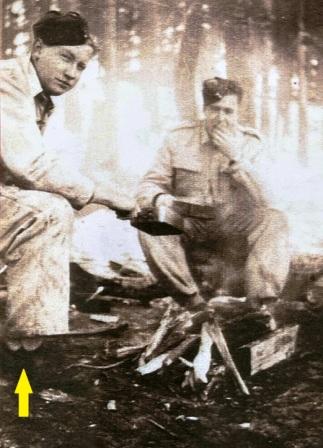
Albert Donald Ahlwardt (identified by yellow arrow) and an unidentified soldier warming up a meal by a campfire. (Photo courtesy of the McLean family on behalf of his sister Stella (Ahlwardt) McLean)

On August 28, 1944, Albert was transferred to the 6th Anti-Tank Regiment, Royal Canadian Artillery, joining them in the area of Le Gros-Theil (now part of Le Bosc-du-Theil) in northern France. Equipped with towed 6-pounders and 17-pounder guns, this Regiment, part of II Canadian Corps, was in continuous frontline combat to supplement the anti-tank defenses of both the 2nd and 3rd Canadian Infantry Divisions.

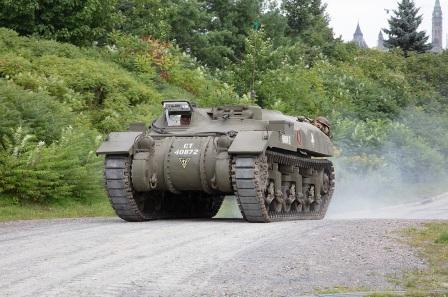
Ram Mk II Kangaroo could carry 2 crew and up to 8 passengers, and was armed with a .30 calibre machine gun. (Photo source: Canadian War Museum)

The Regiment used turretless Ram tanks as gun tractors to tow their heavy 17-pounder anti-tank guns, as well as Armoured Personnel Carriers (Kangaroos). These converted vehicles, which Albert would be familiar with, provided essential mobility and armour.

Albert joined the Regiment during the advance in late August and early September 1944 to secure and clear the heavily fortified French coastal ports before pushing forward into Belgium and The Netherlands.

From September to November 1944, the Regiment provided crucial anti-tank and direct fire support to clear the vital shipping routes into Antwerp in northern Belgium and the southwest Netherlands during the Battle of the Scheldt.  (See https://www.veterans.gc.ca/eng/remembrance/history/second-world-war/scheldt)

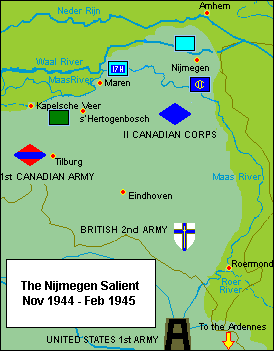
6th Anti-Tank Regiment, as part of II Canadian Corps, held defensive lines in the Nijmegen Salient.  (Map source: http://www.canadiansoldiers.com)

The Regiment spent the winter of 1944 and early 1945 holding defensive lines in the Nijmegen Salient area, while preparing for the upcoming fight in the Rhineland in February 1945, and supporting offensive thrusts along the German frontier.

….Albert lost his life during the Battle of Keppeln…

The 6th Anti-Tank Regiment’s War Diary entry for February 22, 1945 noted that “…message received today ordering us to have 24 Ram towers ready to move without further notice to the Reichswald to undertake a task for 2 Canadian Corps. Exact nature to the job not yet known. The Rams will be ready but the Batterys are hard put to it to find drivers and co-drivers with 72 or the 103 men still on guard….”

The Regiment was about to be involved in the upcoming Battle of Keppeln, with the objective of breaking the German Siegfried Line during Operation Blockbuster, the last part of Operation Veritable. (See https://en.wikipedia.org/wiki/Operation_Blockbuster)

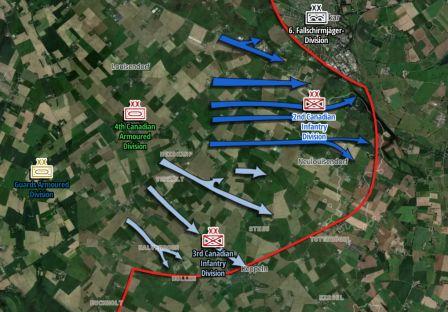
Map shows the location of the 4th Canadian Armoured Division, which the 6th Anti-Tank Regiment and the Lincoln and Welland Regiment supported, during the Battle of Keppeln  on February 26, 1945. (Map source:  Project 44)

The February 25, 1945 war diary entry stated that “…all is in readiness for the offensive and both Batterys will move to concentration areas this evening….The Rams will carry the infantry of the Lincs and Wellands in the attack on the Hochswald by the 4th Canadian Armoured Regiment….”

On February 26, 1945, the war diary entry recorded that “…the great Operation got under way today at 0430 hrs in wet and windy weather.…”  Troops encountered heavy artillery and mortar fire in intense fighting from German paratroopers, and had to make their way through heavy mud and minefields. During the battle, “…one Ram was struck by shell fire and burnt up and Gunner Ahlwardt was slightly wounded and evacuated….”

The battle finally ended when Canadian troops used flame-throwing Wasp carriers to clear German-held houses in Keppeln. The village needed to be secured as part of a push towards Uedem. The capture of Keppeln allowed Canadian forces to clear the Kalkar Ridge and proceed towards the Hochwald Forest gap, and later to break through to the Rhine.  Unfortunately, Albert didn’t live to see the end of this battle….

….What happened?….

Lance Corporal John SYMCHYCH of the Lincoln and Welland Regiment stated in an official report that on February 26, 1945, one of the Regiment’s platoons, commanded by Lt Robert Joseph MARKEY and which Pte Harry BIZNAR was in, had been tasked with defending a house located 9.1 metres (30 feet) from a slit trench.  Visibility was poor due to smoke from machine gun and rifle fire.  One Ram carrier had been struck by shell fire and burned, and a gunner, later identified as Albert Donald AHLWARDT of the 6th Anti-Tank Regiment, Royal Canadian Artillery, had been slightly wounded and evacuated to the slit trench that L/Cpl Symchych was in.

Around 2 pm, “…Pte Biznar and Lt Markey pulled the driver of the Ram carrier out of L/Cpl Symchych’s slit trench and were taking him to the house 15 yards away.  A shell lit four or five feet away from the three of them while L/Cpl Symchych was still in his slit trench.  L/Cpl Symchych crawled to the house and remained in the house until relieved by RHLI Regiment between the hours of three or four o’clock of the morning of February 27th. The bodies of the three men were still there when L/Cpl Symchych returned to his slit trench for his equipment…” NOTE: RHLI refers to Royal Hamilton Light Infantry Regiment.

Albert, aged 22, lost his life on that afternoon of February 26, 1945, as Pte Biznar and Lt Markey tried to move him to safety.

NOTE: For an idea of some of the places that the Regiment travelled through in Germany, see https://onthewarmemorialtrail.com/2026/02/06/on-the-war-memorial-trail-we-follow-the-route-taken-into-germany-by-canadian-troops-in-1945/

….Albert is buried in Groesbeek…

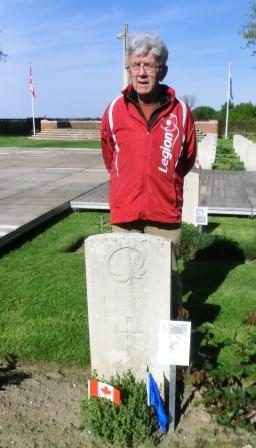
Pieter at the grave of Albert Donald Ahlwardt after placing Canadian and Alberta flags. (Photo credit: Daria Valkenburg)

Albert was initially buried in Keppeln, Germany before being reburied on February 25, 1946 in the Canadian War Cemetery in Groesbeek, The Netherlands. During our 2025 European War Memorial Tour, Pieter placed Canadian and Alberta flags by his grave.

Thank you to Diane McLeaghn for finding a photo, and to Shawn Rainville for newspaper research.

The flags placed at Albert’s grave during our 2025 European War Memorial Tour were donated.  Our thanks go to:

  • Alan Waddell, Constituent Assistant, on behalf of Heath MacDonald, MP for Malpeque, for the Canadian flag.
  • Marie Renaud, MLA St Albert, Alberta at the request of Roman Berezowsky, for the Alberta flag.

This concludes the 3 part Struck By Shellfire series.  However, Pieter’s research efforts to find photos and families of soldiers continue. Do you have a story to tell? Can you identify the soldier in the photo with Albert? Email Pieter at memorialtrail@gmail.com, or comment on the blog.

© Daria Valkenburg

….Want to follow our research?…

If you are reading this posting, but aren’t following our research, you are welcome to do so.  Our blog address: https://onthewarmemorialtrail.com/

4 countries, 6 weeks, 7,000 km – an unforgettable war memorial journey in Europe…. Daria’s book ‘No Soldier Buried Overseas Should Ever Be Forgotten‘ is available in print and e-book formats.  Net proceeds of book sales help support research costs and the cost of maintaining this blog. For more information see https://nosoldierforgotten.com/

Subscribe to our YouTube Channel: On The War Memorial Trail With Pieter Valkenburg: https://www.youtube.com/channel/UCJ591TyjSheOR-Cb_Gs_5Kw.

Never miss a posting!  Subscribe below to have each new story from the war memorial trail delivered to your inbox.
On The War Memorial Trail…. Struck By Shellfire Part 2 The WWII Lieutenant From Saint John Who Lost His Life Trying To Get A Wounded Gunner To Safety

July 16, 2026.  On February 26, 1945, the lives of three WWII soldiers intersected during the Battle of Keppeln in Germany.   Private Harry BIZNAR, Lt Robert Joseph MARKEY, and Gunner Albert Donald AHLWARDT, all lost their lives when a shell burst near them as Private Biznar and Lt Markey were trying to get a wounded Gunner Ahlwardt to safety in a nearby house.

In Part 1 of Struck By Shellfire, the story of WWII soldier Harry BIZNAR was told.  (See https://onthewarmemorialtrail.com/2026/07/03/on-the-war-memorial-trail-struck-by-shellfire-part-1-the-wwii-soldier-born-to-ukrainian-immigrants-who-lost-his-life-trying-to-get-a-wounded-gunner-to-safety/)

Now, in Part 2, the Struck By Shellfire series continues with Robert ‘Bob’ Joseph MARKEY.

Born November 15, 1919 in Saint John, New Brunswick, Robert was the son of Ernest Thomas and Marion Marguerite ‘Marie’ (nee Nugent) Markey.  He graduated from Grade 11 at St. Vincent Boys’ High School in Saint John, continued on to Saint John High School for Grade 12, and then enrolled in the Nova Scotia Agricultural College in Truro, Nova Scotia in 1939. Winner of the Governor’s Award, 1941, Nova Scotia Agricultural College, he graduated in 1941 with a specialization in bacteriology.

Although Robert had a brother and two sisters, Pieter was unsuccessful in attempts to contact family members.  However, archivists Creighton Barrett and Jennifer MacIsaac of Dalhousie University Libraries uncovered photos and information from the time he was at Nova Scotia Agricultural College, providing a picture of the man behind the soldier’s uniform.

….Robert was involved in student activities…

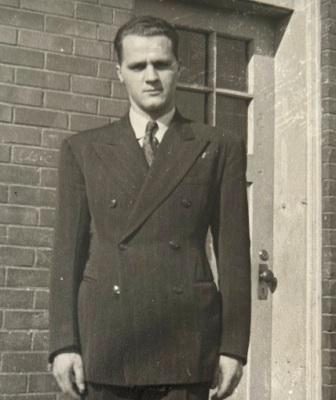
Robert Markey as a 1941 graduate.  (Photo credit: Agricola Archives, Dalhousie University Archives)

A brief biography in the 1941 graduation issue of the student publication Agricola noted that over the past two years he had “…proven his ability as an all-around student, especially in public speaking and in basketball…”

Robert Markey was on the school’s basketball team, pictured here 4th from the left (red arrow) in the 1941 graduation booklet.  (Photo credit: Agricola Archives, Dalhousie University Archives)

Robert, known as ‘Bob’ while a student, was involved in social activities of the College.  “…Being very popular with his classmates, due to his wit and personality, he was elected chairman of the Social Committee for the first term of the year ’41.  Bob also had the honour of being President of the Students’ Council while in his senior year…”

Robert was also known for being “…quite musical and full of jazz which was proven when he played the ‘Traps’ for the Sawfilers Orchestra at a few of the Saturday night dances…” Traps referred to drums, accompanied with other percussion instruments such as cymbals.

The account on Robert ended by stating that “… his main ambition is to specialize in Animal Husbandry but this coming summer he is joining the RCAF…”

….Robert enlisted on Boxing Day 1941 …

Robert never joined the RCAF.  When he enlisted at the No. 7 District Depot’s recruiting office in Saint John, New Brunswick on December 26, 1941, it was noted that he had worked 3 summers at Atlantic Sugar Refinery in Saint John, New Brunswick. Just before enlistment, in the fall of 1941, he worked as an oiler and fireman, as well as a powerhouse technician in the plant where his father was employed as a superintendent.  As a technician, he was responsible for testing the chemical content of water and keeping a log of engine efficiency, among other duties.

He began his basic training at No. 70 Canadian Army (Basic) Training Centre (CABTC) in Fredericton, New Brunswick, but was hospitalized with a bad cold from January 4 until January 20, 1942.  He didn’t return back to No. 70 CA(B)TC until February  6, 1942, at which time he also received a promotion to Lance Corporal.

After completing his training, he was put on staff as an instructor at No. 70 CA(B)TC on May 16, 1942.

….Robert attended No. 30 Officers Training Centre in Brockville …

On September 2, 1942, an interviewer in Fredericton gave his assessment on Robert’s suitability as an Officer Candidate.  He was described as a “….tall, lean, athletic type…” with a “….. pleasant, well-balanced personality...” and “…good leadership qualities, conscientious…”  He had a “…history of commendable personal enterprise...” coupled with an “…above average level of learning ability…” and “…superior knowledge of tools and mechanical principles…”  He was recommended for officer training and to remain in the Infantry as that was what Robert himself preferred.

On October 10, 1942, Robert was sent to No. 30 Officers’ Training Centre in Brockville, Ontario for 12 weeks of intensive training in preparation for going overseas.  His time there would have overlapped with that of John ‘Weston’ CAMPBELL, from Prince Edward Island, who had arrived there in August for his 12 week course. (See https://onthewarmemorialtrail.com/2024/09/30/on-the-war-memorial-trail-the-wwii-soldier-from-clermont-killed-during-operation-veritable/)

After successfully completing his 12 week course, Robert was promoted to Provisional 2nd Lieutenant on January 16, 1943, and then sent for further training to A-17 Machine Gun Training Centre in Trois-Rivières, Quebec, a course that began on January 25, 1943 and ended on March 18, 1943….along with a promotion to Lieutenant.

….Robert was in Kiska as part of Operation Cottage …

On March 20, 1943, Robert was transferred to the 1st Battalion, Saint John Fusiliers (Machine Gun) and sent to Nanaimo, British Columbia. The battalion served in Canada in a home defense role as a part of the 18th Canadian Infantry Brigade which was first part of Pacific Command and then the 6th Canadian Infantry Division.

Summary of Canadian support for Operation Cottage in Kiska, Alaska. (Source: National Defence, National Defense University Press. Seen on the A Canadian Outlook FaceBook page)

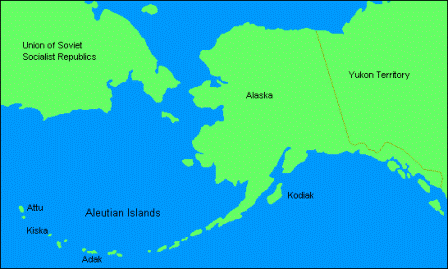
On June 16, 1943, Robert was assigned to ‘C’ Company of the Saint John Fusiliers.  On July 12, 1943, he was on ‘special duty’ as part of a planned Canadian support to Kiska, Alaska for the American led Operation Cottage. (See https://en.wikipedia.org/wiki/Operation_Cottage and http://www.canadiansoldiers.com/history/operations/operationcottage.htm)

Map showing location of Kiska, part of the Aleutian Islands.  (Map source: http://www.canadiansoldiers.com)

Map source: By of SVG: Kuara – Aleutian Islands, United States Army Center of Military History, CC BY-SA 3.0, https://commons.wikimedia.org/w/index.php?curid=5209745

The intention was to liberate Kiska Island from Japanese forces, which had occupied it since June 7, 1942, after Japan seized Kiska and Attu in Alaska’s Aleutian Islands. However, no one seemed to be aware that the Japanese had left the Island on July 28, 1943, using fog as cover for their escape.

Kiska was unoccupied by the time Allied troops arrived on August 15, 1943, of which ‘C’ Company was a component of the 13th Canadian Infantry Brigade Group.  They were sent into fog, surf, volcanic rock, confusion, and uncertainty. Expecting a brutal fight, the soldiers found the island empty of Japanese troops, but they had left behind reminders of their presence in the form of mines and booby traps.

As noted in Project 44’s Operation Cottage: Invasion of Kiska Island: “…Despite the lack of Japanese soldiers, there still were American and Canadian casualties. Some were wounded and killed in friendly fire as nervous soldiers fired into the fog amongst the confusion. Others were wounded and killed by enemy mines, booby-traps, and explosive ordinance left on the island. The Canadians sustained eight casualties, four dead and four wounded…” (See https://www.project44.ca/kiska)

While the Americans left Kiska by September 1, 1943, the Canadians remained for over 3 months longer.

C.P. Stacey’s ‘Official History of the Canadian Army in the Second World War: Volume I: Six Years of War: Canada, Britain and the Pacific’ recorded that troops lived “…in ‘winterized’ tents, and engaged in road and pier construction, transport fatigues, building and manning defences, and carrying on such training as conditions permitted. Fog, rain and wind made the island an acutely unpleasant residence, and the troops were heartily glad when the withdrawal to British Columbia began in November 1943. The last shipload of Canadians left Kiska on 12 January 1944….”  

Robert returned to Canada on January 3, 1944, and given 30 days leave, from January 6 until February 4, 1944.  ‘C’ Company disbanded on January 31, 1944, and when Robert returned to duty, he was assigned back to the 1st Battalion, Saint John Fusiliers (Machine Gun).

….Two soldiers whose stories have been told were also in Kiska …

…Robert was sent for more training…

On February 11, 1944, Robert was sent for two courses at the S-17 Canadian School Of Infantry in Vernon, British Columbia.  He began with a Junior Battle Wing Course. 10 days later, however, he was admitted to Vernon Military Hospital for 16 days with pneumonitis, an inflammation of lung tissue, typically caused by inhaling airborne irritants. (See https://my.clevelandclinic.org/health/diseases/24810-pneumonitis)

After completing the Junior Battle Wing Course, Robert next undertook a 4.2 Mortar Battle Wing course at S-11 Canadian Chemical Warfare School (CCWS) in Suffield, Alberta, which ran from April 16 to April 29, 1944.

….Robert qualified as a Driver for a flamethrower…

While in Suffield Robert took specialized carrier-driver training for a flamethrower-equipped variant of a Universal Carrier, qualifying as Driver i/c Class III (MC) on June 23, 1944.  (The term ‘Driver i/c’ refers to ‘Driver, internal combustion’.  Class III meant he was qualified to drive heavy trucks and armoured cars, but not tanks. MC meant he was also a qualified Motorcycle Despatch Rider.)

A June 16, 1944 Officers’ Survey report described Robert as “…a very good officer.  A good leader. Has the confidence of all…” and noted that he “…speaks clearly and concisely….” with a   “…self-composed manner and confident approach. Has a strong personality.  Makes friends easily…”

Robert was keen to go overseas, and the report stated that he had “…volunteered for the British Army.  Passed but not taken…”  It went on to say that he “…now has special authority to go overseas with some forty or fifty men including his own Platoon who have volunteered to go active on the understanding he will go with them.  This is a fulfillment of his wishes….” (NOTE: No mention was ever made if this happened when Robert ultimately left Canada for overseas service.)

On June 29, 1944, Robert returned to the S-17 Canadian School Of Infantry in Vernon, British Columbia for an Officers Refresher course, taken between July 1 and August 18, 1944.

The August 19, 1944 course assessment for the Junior Battle Wing Course noted that “…his knowledge and application of tactics was good. He has ability as a leader. His knowledge and handling of weapons were quite good….” but that “…at times he appeared disinterested and did not always put as much into the work as he could give…” The final comment was that with more experience, Robert would be “…a capable platoon commander…”

The August 19, 1944 assessment for the Mortar Battle Wing course was positive. “…This officer was interested and enthusiastic.  He has quite a sound knowledge of the weapon and its tactical employment…” The final comment was that with further field experience, Robert “…should make a good mortar platoon commander…”

….Robert left Canada for overseas service…

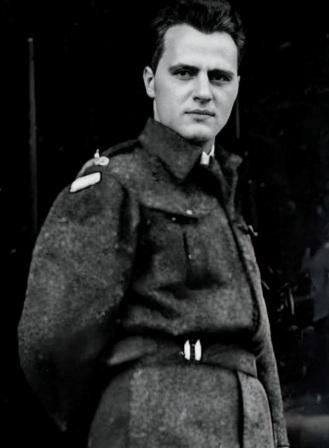
Robert Joseph Markey. (Photo source: Canadian Virtual War Memorial. Photo restoration by Pieter Valkenburg)

From August 20 until August 26, 1944, Robert was granted embarkation leave, for what turned out to be the last time he saw his family.

On August 27, 1944, Robert reported to No. 1 Training Brigade in Debert, Nova Scotia, for final training and preparation before going overseas.  The Brigade was a final staging point for troops waiting to cross the Atlantic Ocean.

On September 7, 1944, Robert boarded a ship that left the following day from Halifax, Nova Scotia, arriving in the United Kingdom on September 20, 1944. He was placed with No. 4 Canadian Infantry Reinforcement Unit (CIRU).

A few weeks later, on October 23, 1944, Robert was sent to No. 3 Wing (Weapons) Canadian Training School (CTS) for a Canadian Military Headquarters (CMHQ) Conversion Course at the Canadian Army Battle Drill School in Stansted Park in Rowland’s Castle, Hampshire, England. The 42 day course trained officers and NCOs to standardize infantry and joint-force tactics before deployment.  After successfully completing the course, he returned to No. 4 CIRU, which had been re-designated at No. 3 CIRU, on December 2, 1944.

….Robert joined the Lincoln & Welland Regiment……

On January 11, 1945, Robert was transferred to the 13th Battalion’s X-4 Reinforcement List of the Canadian Infantry Corps (CIC).  The following day he left for North West Europe, arriving on January 12, 1945.

On January 29, 1945, Robert was transferred to the Lincoln & Welland Regiment as a Platoon Officer in ‘C’ Company, joining them in the midst of Operation Elephant, also known as the Battle of Kapelsche Veer, a brutal and freezing battle to clear German paratroopers from Kapelsche Veer, a low-lying, water-logged island north of the Maas River in The Netherlands.

NOTE: Eli Ambrose SNAKE, whose story was previously told, had lost his life in the battle. (See https://onthewarmemorialtrail.com/2021/12/13/on-the-war-memorial-trail-remembering-ww2-soldier-eli-ambrose-snake/)

Robert had survived his first active battle, and continued with the Regiment as they moved into Germany.

….Robert lost his life during the Battle of Keppeln…

Map shows location (green circle) where the Lincoln & Welland Regiment was in support of the 4th Canadian Armoured Division during the Battle of Keppeln  on February 26, 1945. (Map source:  Project 44)

On February 26, 1945, the Regiment was involved in the Battle of Keppeln, with the objective of breaking the German Siegfried Line during Operation Blockbuster, the last part of Operation Veritable. (See https://en.wikipedia.org/wiki/Operation_Blockbuster) Troops encountered heavy artillery and mortar fire in intense fighting from German paratroopers, and had to make their way through heavy mud and minefields.

The war diary for February 26, 1945 noted the orders given for the battle.  The 4th Canadian Armoured Brigade, which the Lincoln & Welland Regiment was part of, “….was divided into five forces….”  ‘A’ and ‘C’ Companies of the Regiment were part of ‘JERRY FORCE’.

Movement began at 6 am, but “…the route from the area at KLEVE to the concentration area was through mud fields and was extremely heavy going for all vehicles. Heavy vehicles bogged down in the mud….”

By 9 am, “… JERRY FORCE moved into the attack passing through 2 Canadian Infantry Division….”

The battle finally ended when Canadian troops used flame-throwing Wasp carriers to clear German-held houses in Keppeln. The village needed to be secured as part of a push towards Uedem. The capture of Keppeln allowed Canadian forces to clear the Kalkar Ridge and proceed towards the Hochwald Forest gap, and later to break through to the Rhine.  Unfortunately, Robert did not live to see the end of this battle….

….What happened?…

Lance Corporal John SYMCHYCH stated in an official report that on February 26, 1945, the platoon that Robert commanded was tasked with defending a house located 9.1 metres (30 feet) from a slit trench.  Visibility was poor due to smoke from machine gun and rifle fire.  One Ram carrier had been struck by shell fire and burned, and a gunner, later identified as Albert Donald AHLWARDT of the 6th Anti-Tank Regiment, Royal Canadian Artillery, had been slightly wounded and evacuated to the slit trench that L/Cpl Symchych was in.

Around 2 pm, “…Pte Biznar and Lt Markey pulled the driver of the Ram carrier out of L/Cpl Symchych’s slit trench and were taking him to the house 15 yards away.  A shell lit four or five feet away from the three of them while L/Cpl Symchych was still in his slit trench.  L/Cpl Symchych crawled to the house and remained in the house until relieved by RHLI Regiment between the hours of three or four o’clock of the morning of February 27th. The bodies of the three men were still there when L/Cpl Symchych returned to his slit trench for his equipment…” NOTE: RHLI refers to Royal Hamilton Light Infantry Regiment.

Robert, aged 26, lost his life on that afternoon of February 26, 1945, as he and Pte Harry Biznar tried to move Gunner Alwardt to safety.

NOTE: For an idea of some of the places that the Regiment travelled through in Germany, see https://onthewarmemorialtrail.com/2026/02/06/on-the-war-memorial-trail-we-follow-the-route-taken-into-germany-by-canadian-troops-in-1945/

….Robert is buried in Groesbeek…

Pieter placed Canadian and New Brunswick flags at the grave of Robert Joseph Markey. (Photo credit: Daria Valkenburg)

Robert was initially buried in Keppeln, Germany before being reburied on February 25, 1946 in the Canadian War Cemetery in Groesbeek, The Netherlands. During our 2025 European War Memorial Tour, Pieter placed Canadian and New Brunswick flags by his grave.

Thank you to Jennifer MacIsaac and Creighton Barrett of Dalhousie University Libraries for finding photos of Lt Markey while he was at Nova Scotia Agricultural College.

The flags placed at Robert’s grave during our 2025 European War Memorial Tour were donated.  Our thanks go to:

  • Alan Waddell, Constituent Assistant, on behalf of Heath MacDonald, MP for Malpeque, for the Canadian flag.
  • Jean-Claude D’Amours, MLA for Edmundston-Madawaska Centre, Minister responsible for Military Affairs, with the help of Cécile LePage, Province of New Brunswick, for the New Brunswick flag.

…. to be continued…..

Coming up in Struck By Shellfire Part 3 will be about Albert Donald AHLWARDT of Olds, Alberta.

Pieter’s research efforts to find photos and families of soldiers continue. Do you have a story to tell? Email Pieter at memorialtrail@gmail.com, or comment on the blog.

© Daria Valkenburg

….Want to follow our research?…

If you are reading this posting, but aren’t following our research, you are welcome to do so.  Our blog address: https://onthewarmemorialtrail.com/

4 countries, 6 weeks, 7,000 km – an unforgettable war memorial journey in Europe…. Daria’s book ‘No Soldier Buried Overseas Should Ever Be Forgotten‘ is available in print and e-book formats.  Net proceeds of book sales help support research costs and the cost of maintaining this blog. For more information see https://nosoldierforgotten.com/

Subscribe to our YouTube Channel: On The War Memorial Trail With Pieter Valkenburg: https://www.youtube.com/channel/UCJ591TyjSheOR-Cb_Gs_5Kw.

Never miss a posting!  Subscribe below to have each new story from the war memorial trail delivered to your inbox.
On The War Memorial Trail….Struck By Shellfire Part 1 The WWII Soldier Born To Ukrainian Immigrants Who Lost His Life Trying To Get A Wounded Gunner To Safety

July 3, 2026.  It seems as though every time we go away for a short holiday, Pieter receives good news about a soldier he’s researching and in the search to find a photo and family.  Last year, we were delayed by a week for our annual wedding anniversary getaway, but while in Moncton, New Brunswick on the first day of our trip, we found out that the Windsor Star had published Pieter’s Letter To The Editor, asking for help in finding family and a photo of WWII soldier Harry BIZNAR.  (See Reader asks: Anyone in Windsor know family of WW2 vet Harry Biznar? | Windsor Star https://windsorstar.com/opinion/letters/reader-letter-dutch-veteran-asks-anyone-in-windsor-area-know-family-of-ww2-veteran-harry-biznar)

Harry’s story intersected with two other soldiers: Lt Robert Joseph MARKEY and Gunner Albert Donald AHLWARDT, as all three lost their lives when a shell burst near them as Harry and Lt Markey were trying to get a wounded Gunner Ahlwardt to safety in a nearby house.

….The Letter To The Editor was successful…

On our way to Moncton, we had spent much of the day in Memramcook (see https://onthewarmemorialtrail.com/2025/11/09/on-the-war-memorial-trail-remembrance-week-2025-reflections-and-updates/), so it wasn’t until we were settled in our hotel room and had a brief time to rest before dinner with two other couples that we noticed emails in reply to the Windsor Star letter.

One email from Carol Cox made Pieter’s heart beat faster! She wrote that “…a friend of mine who reads the Windsor Star faithfully sent me the letter this morning that you had printed in the newspaper regarding Harry Biznar.

It was very emotional for me to read the letter as I seem to have some kind of connection to him although I never met him. I did some research back in 2017 and found a great deal of information on Uncle Harry… It was like piecing together the life of a very young man who gave up his life for our freedom. I have 3 grown sons of my own so I suppose my gratitude is three fold as my sons did not have to leave home and go to war at such a young age.

My mother was Florence Ducharme, Harry’s sister. My mom was the last of the family to pass at the age of 94 in 2018….

I am truly touched and grateful for the effort that you and the Canadian War Cemeteries in the Netherlands are continuing to put into this important endeavour. May God Bless you….”

….Harry’s parents were Ukrainian…

Harry Biznar.  (Photo courtesy of the Biznar Family)

Born February 8, 1917 in Montreal, Quebec, Harry was the son of Frederick ‘Fred’ (born Toader Dmitrievich Bezhenariu) and Katherine (nee Benec aka Binuk) Biznar.  In addition to Harry, “… his sisters Lena, Dora, Mary and brother Mike were all born in Montreal. Sisters Florence and Irene were born in Windsor, Ontario….” Carol wrote.  Mike also served during WWII, and survived the war.

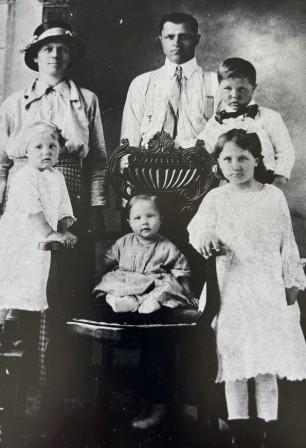
Harry with his parents and sisters Dora (left), Mary (sitting), and Lena (right) in Montreal in 1921.   (Photo courtesy of the Biznar Family)

Carol shared a number of photos, and explained that her grandparents – Harry’s parents – had met in Montreal, Quebec, but both were Ukrainian immigrants.  Frederick had been born in Velykyi Kuchuriv (See https://en.wikipedia.org/wiki/Velykyi_Kuchuriv) and Katherine in Chernivtsi (See https://www.britannica.com/place/Chernivtsi-Ukraine).

After completing Grade 8 at Gordon MacGregor School in Windsor, Ontario, Harry took a 2 year auto mechanics course at the Windsor Vocational School. He worked as a seasonal farm hand, and a machine operator for the printing press at a bag manufacturing company.

….Harry enlisted in 1942…

On January 10, 1941, Harry enrolled in the Essex Scottish Reserve Force militia.  Then, on October 8, 1942, he enlisted under the National Resources Mobilization Act (NRMA) at the No. 1 NRMA Clearing Depot in London, Ontario. (See https://en.wikipedia.org/wiki/National_Resources_Mobilization_Act)

At the time of his enlistment, Harry was employed as a machine operator by Bendix-Eclipse of Canada Ltd., a manufacturing facility and division of the Bendix Corporation that operated in Windsor, Ontario. During World War II, the Windsor plant was a vital part of the Canadian motor vehicle parts industry, manufacturing essential components for military vehicles and aircraft.

On October 31, 1942, Harry was sent to the No. 12 Canadian Army (Basic) Training Centre (CABTC) in Chatham, Ontario.  His Personnel Selection Record noted that he spoke both English and Ukrainian, and that he enjoyed sports – boxing, baseball, rugby, soccer, and swimming.  He was described by an interviewer as someone who “…makes friends easily…”

After completing his basic training, on January 6, 1943 he was sent for advanced training at A29 Canadian Infantry Training Centre at Camp Ipperwash, Ontario. A few weeks later, he was transferred to the Kent Regiment on January 25, 1943, and sent on a 6 Pounder Anti-Tank Gun course in Terrace, British Columbia.

He next was sent for a month to the Canadian Small Arms School (Western Canada) in Nanaimo, British Columbia, before returning to the Kent Regiment in Terrace on June 8, 1943.

Harry Biznar in December 1943.  (Photo courtesy of the Biznar Family. Photo restoration by Pieter Valkenburg)

On June 17, 1944, he enlisted in the Active Army in Courtney, British Columbia, remaining with the Kent Regiment.  His Personnel Selection Record was updated with an interviewer noting that Harry had “…trained as an anti-tank gunner…” and was “…presently in rifle company…”  

The interviewer’s appraisal went on to say that Harry was “…keen on getting overseas.  Impresses as the ‘strong and silent type’.  Rather uncommunicative but gets along with his fellow soldiers. Well motivated and well adjusted to army life…”  Harry was recommended for overseas service with the Canadian Infantry Corps.

….Harry wanted to join the paratroops…

Harry, however, was interested in joining the paratroops, and after being re-interviewed in July 1944, he was sent to the A35 Canadian Paratrooper Training Centre at Camp Shilo, Manitoba. He quickly realized he’d made a mistake.  Shortly after arriving, he learned he’d have to retake the basic infantry training he’d already taken, and told an interviewer on August 9, 1944 that “…the nature and duration of training at A35 were misrepresented to him…”  He asked to be transferred to A15 Canadian Infantry Training Centre (CITC) at Camp Shilo, a request which was granted.

….Harry returned to the infantry before leaving Canada for overseas service…

Harry’s final infantry training course in Canada took place at No. 1 Training Brigade in Debert, Nova Scotia from October 16 to October 30, 1944. The Brigade provided refresher courses and was a final staging point for troops waiting to cross the Atlantic Ocean.  Harry’s training evaluation recorded him as being “…well trained and efficient…” with a “…knowledge of work and good judgment…”

On November 20, 1944, he left Canada for the United Kingdom, arriving on November 28, 1944, where he was assigned to No. 3 Canadian Infantry Training Regiment (CITR), and underwent more intensive training that included battle drills, tactical field exercises, and physical conditioning.

After being rated as fully qualified and operational, he was transferred to the X-4 Reinforcement List Infantry General Unit (IGU) of the Canadian Infantry Corps (CIC) on January 6, 1945.  The following day he left for North West Europe, arriving on January 8, 1945.

….Harry joined the Lincoln & Welland Regiment…

On January 28, 1945 Harry was transferred to ‘C’ Company of the Lincoln & Welland Regiment, joining them in the midst of Operation Elephant, also known as the Battle of Kapelsche Veer, a brutal and freezing battle to clear German paratroopers from Kapelsche Veer, a low-lying, water-logged island north of the Maas River in The Netherlands.

NOTE: Eli SNAKE, whose story was previously told, had lost his life that same day in the battle.  (See https://onthewarmemorialtrail.com/2021/12/13/on-the-war-memorial-trail-remembering-ww2-soldier-eli-ambrose-snake/)

Harry had survived his first battle, and continued with the Regiment as they moved into Germany.

….Harry lost his life during the Battle of Keppeln…

Map shows area where the Lincoln & Welland Regiment was in support of the 4th Canadian Armoured Division during the Battle of Keppeln  on February 26, 1945. (Map source:  Wikipedia)

On February 26, 1945, the Regiment was involved in the Battle of Keppeln, with the objective of breaking the German Siegfried Line during Operation Blockbuster, the last part of Operation Veritable. (See https://en.wikipedia.org/wiki/Operation_Blockbuster) Troops encountered heavy artillery and mortar fire in intense fighting from German paratroopers, and had to make their way through heavy mud and minefields.

The war diary for February 26, 1945 noted the orders given for the battle.  The 4th Canadian Armoured Brigade, which the Lincoln & Welland Regiment was part of, “….was divided into five forces….”  ‘A’ and ‘C’ Companies of the Regiment were part of ‘JERRY FORCE’.

Movement began at 6 am, but “…the route from the area at KLEVE to the concentration area was through mud fields and was extremely heavy going for all vehicles. Heavy vehicles bogged down in the mud….”

By 9 am, “… JERRY FORCE moved into the attack passing through 2 Canadian Infantry Division….”

The battle finally ended when Canadian troops used flame-throwing Wasp carriers to clear German-held houses in Keppeln. The village needed to be secured as part of a push towards Uedem. The capture of Keppeln allowed Canadian forces to clear the Kalkar Ridge and proceed towards the Hochwald Forest gap, and later to break through to the Rhine.  Unfortunately, Harry did not live to see the end of this battle….

….What happened?….

Lance Corporal John SYMCHYCH stated in an official report that on February 26, 1945, Lt Robert Joseph MARKEY’s platoon, which Harry was in, was tasked with defending a house located 9.1 metres (30 feet) from a slit trench.  Visibility was poor due to smoke from machine gun and rifle fire.  One Ram carrier had been struck by shell fire and burned, and a gunner, later identified as Albert Donald AHLWARDT of the 6th Anti-Tank Regiment, Royal Canadian Artillery, had been slightly wounded and evacuated to the slit trench that  L/Cpl Symchych was in.

Around 2 pm, “…Pte Biznar and Lt Markey pulled the driver of the Ram carrier out of L/Cpl Symchych’s slit trench and were taking him to the house 15 yards away.  A shell lit four or five feet away from the three of them while L/Cpl Symchych was still in his slit trench.  L/Cpl Symchych crawled to the house and remained in the house until relieved by RHLI Regiment between the hours of three or four o’clock of the morning of February 27th. The bodies of the three men were still there when L/Cpl Symchych returned to his slit trench for his equipment…” NOTE: RHLI refers to Royal Hamilton Light Infantry Regiment.

Harry, aged 28, lost his life on that afternoon of February 26, 1945, as he and Lt Markey tried to move Gunner Ahlwardt to safety.

NOTE: For an idea of some of the places that the Regiment travelled through in Germany, see https://onthewarmemorialtrail.com/2026/02/06/on-the-war-memorial-trail-we-follow-the-route-taken-into-germany-by-canadian-troops-in-1945/

….Harry is buried in Groesbeek…

Harry was initially buried in Keppeln, Germany before being reburied on February 25, 1946 in the Canadian War Cemetery in Groesbeek, The Netherlands. During our 2025 European War Memorial Tour, Pieter placed Canadian and Quebec flags by his grave.

Pieter at the grave of Harry Biznar after placing Canadian and Quebec flags. (Photo credit: Daria Valkenburg)

Thank you to the Windsor Star for publishing the Letter To The Editor asking for a photo of Harry Biznar, to Debbie McGivney for sending us the published letter to the editor, to Harry Biznar’s niece Carol Cox for photos and information, plus niece Shelly French.  This Letter To The Editor resonated with those who read it, and we thank all who took the time to get in touch with both us and Harry’s family.

Carol Cox, niece of Harry Biznar. (Photo courtesy of Carol Cox)

As the information and photos about Harry were being compiled, Carol Cox told Pieter that “….you have resurrected emotions and gratitude for our freedom that is too easy to take for granted….”

Another niece, Shelly French, also contacted us, writing to say “…thank you for your hard work in locating all this information and caring deeply about our lost souls….” Shelly explained that her mother, Irene Peleshok, was “…Harry’s sister….” and reflected that her grandmother “…never got over the loss of her son Harry. She cried many tears over his passing….”

The flags placed at Harry’s grave during our 2025 European War Memorial Tour were donated.  Our thanks go to:

  • Alan Waddell, Constituent Assistant, on behalf of Heath MacDonald, MP for Malpeque, for the Canadian flag.
  • Mario Henry and his brother Etienne Henry, who donated the Quebec flag.

…. to be continued…..

Struck By Shellfire Part 2 will be about Robert Joseph MARKEY of Saint John, New Brunswick.

Pieter’s research efforts to find photos and families of soldiers continue. Do you have a story to tell? Email Pieter at memorialtrail@gmail.com, or comment on the blog.

© Daria Valkenburg

….Want to follow our research?…

If you are reading this posting, but aren’t following our research, you are welcome to do so.  Our blog address: https://onthewarmemorialtrail.com/

4 countries, 6 weeks, 7,000 km – an unforgettable war memorial journey in Europe…. Daria’s book ‘No Soldier Buried Overseas Should Ever Be Forgotten‘ is available in print and e-book formats.  Net proceeds of book sales help support research costs and the cost of maintaining this blog. For more information see https://nosoldierforgotten.com/

Subscribe to our YouTube Channel: On The War Memorial Trail With Pieter Valkenburg: https://www.youtube.com/channel/UCJ591TyjSheOR-Cb_Gs_5Kw.

Never miss a posting!  Subscribe below to have each new story from the war memorial trail delivered to your inbox.