July 22, 2026. On February 26, 1945, the lives of three WWII soldiers intersected during the Battle of Keppeln in Germany. Private Harry BIZNAR, Lt Robert Joseph MARKEY, and Gunner Albert Donald AHLWARDT, all lost their lives when a shell burst near them as Private Biznar and Lt Markey were trying to get a wounded Gunner Ahlwardt to safety in a nearby house.
In Part 1 of Struck By Shellfire, the story of WWII soldier Harry BIZNAR was told. (See https://onthewarmemorialtrail.com/2026/07/03/on-the-war-memorial-trail-struck-by-shellfire-part-1-the-wwii-soldier-born-to-ukrainian-immigrants-who-lost-his-life-trying-to-get-a-wounded-gunner-to-safety/)
In Part 2 of Struck By Shellfire, the story of WWII soldier Robert Joseph MARKEY was told. (See https://onthewarmemorialtrail.com/2026/07/16/on-the-war-memorial-trail-struck-by-shellfire-part-2-the-wwii-lieutenant-from-saint-john-who-lost-his-life-trying-to-get-a-wounded-gunner-to-safety/)
Now, in Part 3, the Struck By Shellfire series concludes with Albert Donald AHLWARDT. The report on the circumstances of death for Harry Biznar and Robert Joseph Markey did not identify the gunner from the Ram carrier from a regiment other than Lincoln & Welland, but detective work on Pieter’s part resulted in identifying the gunner as Albert Donald Ahlwardt.
Born June 2, 1923 in Olds, Alberta, Albert was the son of Herman August and Edith May Ahlwardt. The youngest of 5 children, Albert had a brother and three sisters. Pieter was able to connect with Diane McLeaghn, daughter of Albert’s sister Stella McLean, who submitted a photo.
….Albert enlisted in 1943…
When he enlisted at Military District No. 13 in Calgary, Alberta on July 26, 1943, Albert was employed as a truck driver for Cliff Sturgeon, a wholesale gas company for Imperial Oil in Olds. His Personnel Selection Record noted that he had left school at age 17 in order to assist his family financially, as his 72 year old father was “…frequently confined to hospital…” with an “…old age pension…” as his sole income. Albert had been driving 3 ton gasoline trucks since he left school. It was recommended that he be trained to drive military trucks.
On August 3, 1943, he was sent for basic training to the A1 Canadian Artillery Training Centre (CATC) in Petawawa, Ontario. After 6 weeks, he was interviewed, and recorded as being “….happy in the army….”
Albert remained at A1 CATC for training as a Driver i/c Class III (Wheeled), and received his qualification on November 16, 1943. With this qualification, Albert was deemed “…suitable for operational service overseas…” (The term ‘Driver i/c’ refers to ‘Driver, internal combustion’. Class III meant he was qualified to drive heavy trucks and armoured cars, but not tanks. Wheeled refers to wheeled vehicles.)
….Albert left Canada for overseas service…
From December 1 to December 8, 1943, Albert was granted special leave, for what turned out to be the last time he saw his family. While on leave, he had been transferred to No. 2 Transit Company, and then, on December 10, 1943, Albert reported to No. 1 Training Brigade in Debert, Nova Scotia, for final training and preparation before going overseas. The Brigade provided refresher courses and was a final staging point for troops waiting to cross the Atlantic Ocean.
On March 3, 1944, Albert was transferred to Serial 292 – the No. 1 Canadian Artillery Reinforcement Unit (CARU). This unit was stationed in the United Kingdom to train and supply replacements for overseas artillery regiments.
Albert boarded a ship on March 5, 1944 that left the following day from Halifax, Nova Scotia, arriving in the United Kingdom on March 15, 1944, and reported the next day to No. 1 Canadian Artillery Reinforcement Unit (CARU).
In an interview shortly after his arrival at No. 1 CARU, he was described as having an “…attractive personality, although a bit reserved…” and that he “…wishes to continue as Driver i/c and seems best suited for such work…”
Albert’s training continued, beginning with a 2 week basic refresher course, which he completed on April 5, 1944. On June 3, 1944, he qualified as a Driver i/c Wheeled Class ‘A’. Class ‘A’ referred to armoured and fighting vehicles, such as tanks and Universal Carriers.
A few weeks later, on June 24, 1944, he qualified as a Driver i/c (Tank) Class ‘B’. With this qualification, Albert would be responsible for steering, manoeuvring, and performing basic maintenance on the tracks and engine of a tank. Class ‘B’ meant that he had above-average mechanical aptitude, and would be tasked with both driving vehicles and executing minor field repairs, even under battle conditions.
….Albert left the UK for France in July 1944….
On July 7, 1944, Albert was transferred to ‘E’ Squadron of the 25th Canadian Armoured Delivery Regiment (CADR), which was preparing to go into France, attached to II Canadian Corps. He joined them in Seabrook, one of 3 reinforcements that arrived that day, along with 2 Staghounds (an armoured vehicle that could also be used as a scout car).
Over the next two days, personnel and vehicles began leaving by train towards a marshalling area, where they gathered until ready to move to their embarkation point.
On the evening of July 10, 1944, they boarded LST-414. (Note: LST refers to Landing Ship, Tanks). The following morning, the ship left England across the English Channel towards France, and, per the war diary for July 11, 1944, “…sighted land about 1900 hours, vehicles warmed up in preparation to land, large numbers of various types of craft in vicinity, all personnel in high spirits, dropped anchor 2000 hours…”

Map showing Courselles-sur-Mer on the coast of France, near Caen. ‘La Manche’ in French is what we call the ‘English Channel’. (Map source: https://www.viamichelin.fr)
After disembarking the following day, the Regiment slowly made it’s way to their temporary base on July 23, 1944 at an “…area situated in an apple orchard close to crossroads at Villons-les-Buissons…” which had been the site of intense fighting on June 7, 1944, a day after D-Day, until July 11, 1944.
‘E’ Squadron’s role was to serve as a vehicle pool attached for II Canadian Corps, responsible for maintaining, forwarding, and distributing replacement tanks, self-propelled guns, and modified armoured personnel carriers to front-line fighting units, as well as recovering them. As the Allies moved through France, so did ‘E’ Squadron.
As just one example, during Operation Totalize, an offensive designed to break through the German defences south of Caen and toward Falaise, fought between August 7-11, 1944, ‘E’ Squadron provided and issued specialized vehicles like the M7 Priest Kangaroos to infantry brigades to safely transport soldiers under heavy fire. (See https://en.wikipedia.org/wiki/Operation_Totalize)
….Albert was transferred to the 6th Anti-Tank Regiment….
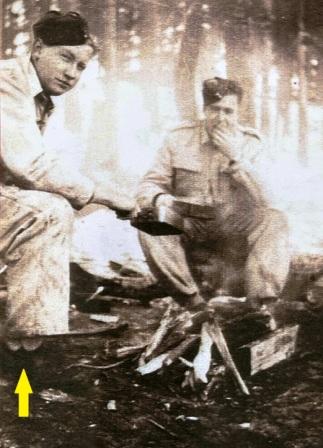
Albert Donald Ahlwardt (identified by yellow arrow) and an unidentified soldier warming up a meal by a campfire. (Photo courtesy of the McLean family on behalf of his sister Stella (Ahlwardt) McLean)
On August 28, 1944, Albert was transferred to the 6th Anti-Tank Regiment, Royal Canadian Artillery, joining them in the area of Le Gros-Theil (now part of Le Bosc-du-Theil) in northern France. Equipped with towed 6-pounders and 17-pounder guns, this Regiment, part of II Canadian Corps, was in continuous frontline combat to supplement the anti-tank defenses of both the 2nd and 3rd Canadian Infantry Divisions.
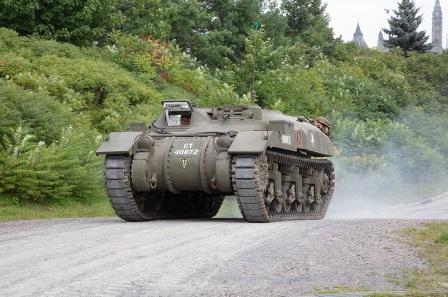
Ram Mk II Kangaroo could carry 2 crew and up to 8 passengers, and was armed with a .30 calibre machine gun. (Photo source: Canadian War Museum)
The Regiment used turretless Ram tanks as gun tractors to tow their heavy 17-pounder anti-tank guns, as well as Armoured Personnel Carriers (Kangaroos). These converted vehicles, which Albert would be familiar with, provided essential mobility and armour.
Albert joined the Regiment during the advance in late August and early September 1944 to secure and clear the heavily fortified French coastal ports before pushing forward into Belgium and The Netherlands.
From September to November 1944, the Regiment provided crucial anti-tank and direct fire support to clear the vital shipping routes into Antwerp in northern Belgium and the southwest Netherlands during the Battle of the Scheldt. (See https://www.veterans.gc.ca/eng/remembrance/history/second-world-war/scheldt)
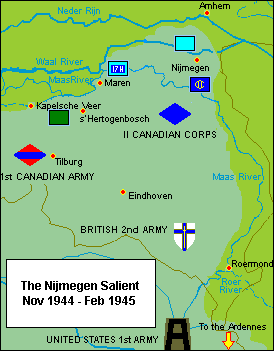
6th Anti-Tank Regiment, as part of II Canadian Corps, held defensive lines in the Nijmegen Salient. (Map source: http://www.canadiansoldiers.com)
The Regiment spent the winter of 1944 and early 1945 holding defensive lines in the Nijmegen Salient area, while preparing for the upcoming fight in the Rhineland in February 1945, and supporting offensive thrusts along the German frontier.
….Albert lost his life during the Battle of Keppeln…
The 6th Anti-Tank Regiment’s War Diary entry for February 22, 1945 noted that “…message received today ordering us to have 24 Ram towers ready to move without further notice to the Reichswald to undertake a task for 2 Canadian Corps. Exact nature to the job not yet known. The Rams will be ready but the Batterys are hard put to it to find drivers and co-drivers with 72 or the 103 men still on guard….”
The Regiment was about to be involved in the upcoming Battle of Keppeln, with the objective of breaking the German Siegfried Line during Operation Blockbuster, the last part of Operation Veritable. (See https://en.wikipedia.org/wiki/Operation_Blockbuster)
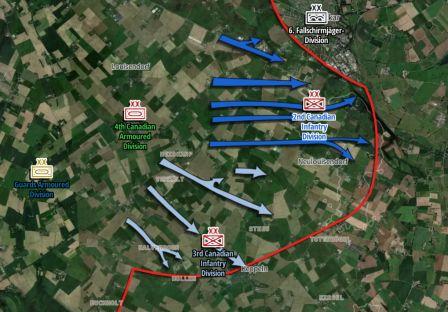
Map shows the location of the 4th Canadian Armoured Division, which the 6th Anti-Tank Regiment and the Lincoln and Welland Regiment supported, during the Battle of Keppeln on February 26, 1945. (Map source: Project 44)
The February 25, 1945 war diary entry stated that “…all is in readiness for the offensive and both Batterys will move to concentration areas this evening….The Rams will carry the infantry of the Lincs and Wellands in the attack on the Hochswald by the 4th Canadian Armoured Regiment….”
On February 26, 1945, the war diary entry recorded that “…the great Operation got under way today at 0430 hrs in wet and windy weather.…” Troops encountered heavy artillery and mortar fire in intense fighting from German paratroopers, and had to make their way through heavy mud and minefields. During the battle, “…one Ram was struck by shell fire and burnt up and Gunner Ahlwardt was slightly wounded and evacuated….”
The battle finally ended when Canadian troops used flame-throwing Wasp carriers to clear German-held houses in Keppeln. The village needed to be secured as part of a push towards Uedem. The capture of Keppeln allowed Canadian forces to clear the Kalkar Ridge and proceed towards the Hochwald Forest gap, and later to break through to the Rhine. Unfortunately, Albert didn’t live to see the end of this battle….
….What happened?….
Lance Corporal John SYMCHYCH of the Lincoln and Welland Regiment stated in an official report that on February 26, 1945, one of the Regiment’s platoons, commanded by Lt Robert Joseph MARKEY and which Pte Harry BIZNAR was in, had been tasked with defending a house located 9.1 metres (30 feet) from a slit trench. Visibility was poor due to smoke from machine gun and rifle fire. One Ram carrier had been struck by shell fire and burned, and a gunner, later identified as Albert Donald AHLWARDT of the 6th Anti-Tank Regiment, Royal Canadian Artillery, had been slightly wounded and evacuated to the slit trench that L/Cpl Symchych was in.
Around 2 pm, “…Pte Biznar and Lt Markey pulled the driver of the Ram carrier out of L/Cpl Symchych’s slit trench and were taking him to the house 15 yards away. A shell lit four or five feet away from the three of them while L/Cpl Symchych was still in his slit trench. L/Cpl Symchych crawled to the house and remained in the house until relieved by RHLI Regiment between the hours of three or four o’clock of the morning of February 27th. The bodies of the three men were still there when L/Cpl Symchych returned to his slit trench for his equipment…” NOTE: RHLI refers to Royal Hamilton Light Infantry Regiment.
Albert, aged 22, lost his life on that afternoon of February 26, 1945, as Pte Biznar and Lt Markey tried to move him to safety.
NOTE: For an idea of some of the places that the Regiment travelled through in Germany, see https://onthewarmemorialtrail.com/2026/02/06/on-the-war-memorial-trail-we-follow-the-route-taken-into-germany-by-canadian-troops-in-1945/
….Albert is buried in Groesbeek…
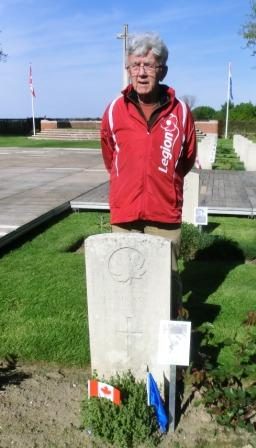
Pieter at the grave of Albert Donald Ahlwardt after placing Canadian and Alberta flags. (Photo credit: Daria Valkenburg)
Albert was initially buried in Keppeln, Germany before being reburied on February 25, 1946 in the Canadian War Cemetery in Groesbeek, The Netherlands. During our 2025 European War Memorial Tour, Pieter placed Canadian and Alberta flags by his grave.
Thank you to Diane McLeaghn for finding a photo, and to Shawn Rainville for newspaper research.
The flags placed at Albert’s grave during our 2025 European War Memorial Tour were donated. Our thanks go to:
- Alan Waddell, Constituent Assistant, on behalf of Heath MacDonald, MP for Malpeque, for the Canadian flag.
- Marie Renaud, MLA St Albert, Alberta at the request of Roman Berezowsky, for the Alberta flag.
This concludes the 3 part Struck By Shellfire series. However, Pieter’s research efforts to find photos and families of soldiers continue. Do you have a story to tell? Can you identify the soldier in the photo with Albert? Email Pieter at memorialtrail@gmail.com, or comment on the blog.
© Daria Valkenburg
….Want to follow our research?…
If you are reading this posting, but aren’t following our research, you are welcome to do so. Our blog address: https://onthewarmemorialtrail.com/
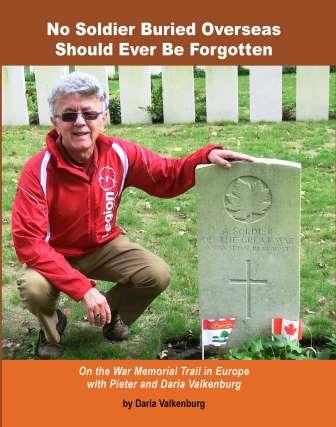 4 countries, 6 weeks, 7,000 km – an unforgettable war memorial journey in Europe…. Daria’s book ‘No Soldier Buried Overseas Should Ever Be Forgotten‘ is available in print and e-book formats. Net proceeds of book sales help support research costs and the cost of maintaining this blog. For more information see https://nosoldierforgotten.com/
Subscribe to our YouTube Channel: On The War Memorial Trail With Pieter Valkenburg: https://www.youtube.com/channel/UCJ591TyjSheOR-Cb_Gs_5Kw.
Never miss a posting! Subscribe below to have each new story from the war memorial trail delivered to your inbox.

