On The War Memorial Trail….Struck By Shellfire Part 1 The WWII Soldier Born To Ukrainian Immigrants Who Lost His Life Trying To Get A Wounded Gunner To Safety

July 3, 2026.  It seems as though every time we go away for a short holiday, Pieter receives good news about a soldier he’s researching and in the search to find a photo and family.  Last year, we were delayed by a week for our annual wedding anniversary getaway, but while in Moncton, New Brunswick on the first day of our trip, we found out that the Windsor Star had published Pieter’s Letter To The Editor, asking for help in finding family and a photo of WWII soldier Harry BIZNAR.  (See Reader asks: Anyone in Windsor know family of WW2 vet Harry Biznar? | Windsor Star https://windsorstar.com/opinion/letters/reader-letter-dutch-veteran-asks-anyone-in-windsor-area-know-family-of-ww2-veteran-harry-biznar)

Harry’s story intersected with two other soldiers: Lt Robert Joseph MARKEY and Gunner Albert Donald AHLWARDT, as all three lost their lives when a shell burst near them as Harry and Lt Markey were trying to get a wounded Gunner Ahlwardt to safety in a nearby house.

….The Letter To The Editor was successful…

On our way to Moncton, we had spent much of the day in Memramcook (see https://onthewarmemorialtrail.com/2025/11/09/on-the-war-memorial-trail-remembrance-week-2025-reflections-and-updates/), so it wasn’t until we were settled in our hotel room and had a brief time to rest before dinner with two other couples that we noticed emails in reply to the Windsor Star letter.

One email from Carol Cox made Pieter’s heart beat faster! She wrote that “…a friend of mine who reads the Windsor Star faithfully sent me the letter this morning that you had printed in the newspaper regarding Harry Biznar.

It was very emotional for me to read the letter as I seem to have some kind of connection to him although I never met him. I did some research back in 2017 and found a great deal of information on Uncle Harry… It was like piecing together the life of a very young man who gave up his life for our freedom. I have 3 grown sons of my own so I suppose my gratitude is three fold as my sons did not have to leave home and go to war at such a young age.

My mother was Florence Ducharme, Harry’s sister. My mom was the last of the family to pass at the age of 94 in 2018….

I am truly touched and grateful for the effort that you and the Canadian War Cemeteries in the Netherlands are continuing to put into this important endeavour. May God Bless you….

….Harry’s parents were Ukrainian…

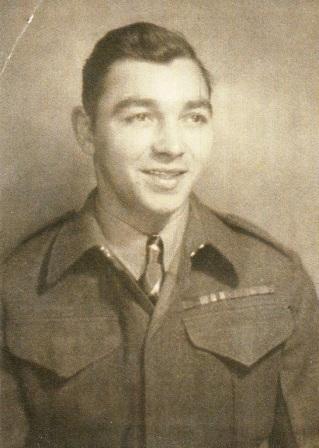
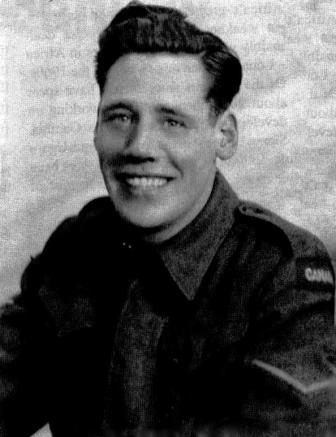
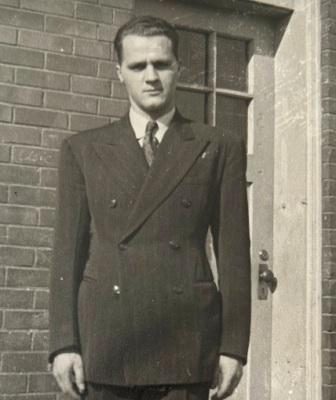
Harry Biznar.  (Photo courtesy of the Biznar Family)

Born February 8, 1917 in Montreal, Quebec, Harry was the son of Frederick ‘Fred’ (born Toader Dmitrievich Bezhenariu) and Katherine (nee Benec aka Binuk) Biznar.  In addition to Harry, “… his sisters Lena, Dora, Mary and brother Mike were all born in Montreal. Sisters Florence and Irene were born in Windsor, Ontario….” Carol wrote.  Mike also served during WWII, and survived the war.

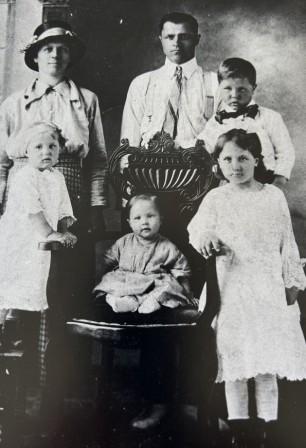
Harry with his parents and sisters Dora (left), Mary (sitting), and Lena (right) in Montreal in 1921.   (Photo courtesy of the Biznar Family)

Carol shared a number of photos, and explained that her grandparents – Harry’s parents – had met in Montreal, Quebec, but both were Ukrainian immigrants.  Frederick had been born in Velykyi Kuchuriv (See https://en.wikipedia.org/wiki/Velykyi_Kuchuriv) and Katherine in Chernivtsi (See https://www.britannica.com/place/Chernivtsi-Ukraine).

After completing Grade 8 at Gordon MacGregor School in Windsor, Ontario, Harry took a 2 year auto mechanics course at the Windsor Vocational School. He worked as a seasonal farm hand, and a machine operator for the printing press at a bag manufacturing company.

….Harry enlisted in 1942…

On January 10, 1941, Harry enrolled in the Essex Scottish Reserve Force militia.  Then, on October 8, 1942, he enlisted under the National Resources Mobilization Act (NRMA) at the No. 1 NRMA Clearing Depot in London, Ontario. (See https://en.wikipedia.org/wiki/National_Resources_Mobilization_Act)

At the time of his enlistment, Harry was employed as a machine operator by Bendix-Eclipse of Canada Ltd., a manufacturing facility and division of the Bendix Corporation that operated in Windsor, Ontario. During World War II, the Windsor plant was a vital part of the Canadian motor vehicle parts industry, manufacturing essential components for military vehicles and aircraft.

On October 31, 1942, Harry was sent to the No. 12 Canadian Army (Basic) Training Centre (CABTC) in Chatham, Ontario.  His Personnel Selection Record noted that he spoke both English and Ukrainian, and that he enjoyed sports – boxing, baseball, rugby, soccer, and swimming.  He was described by an interviewer as someone who “…makes friends easily…

After completing his basic training, on January 6, 1943 he was sent for advanced training at A29 Canadian Infantry Training Centre at Camp Ipperwash, Ontario. A few weeks later, he was transferred to the Kent Regiment on January 25, 1943, and sent on a 6 Pounder Anti-Tank Gun course in Terrace, British Columbia.

He next was sent for a month to the Canadian Small Arms School (Western Canada) in Nanaimo, British Columbia, before returning to the Kent Regiment in Terrace on June 8, 1943.

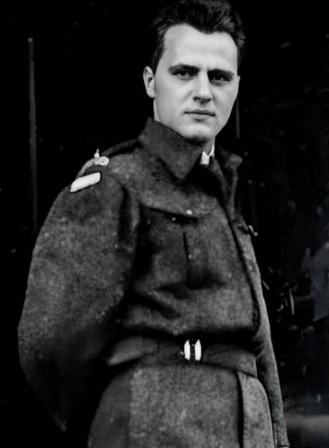
Harry Biznar in December 1943.  (Photo courtesy of the Biznar Family. Photo restoration by Pieter Valkenburg)

On June 17, 1944, he enlisted in the Active Army in Courtney, British Columbia, remaining with the Kent Regiment.  His Personnel Selection Record was updated with an interviewer noting that Harry had “…trained as an anti-tank gunner…” and was “…presently in rifle company… 

The interviewer’s appraisal went on to say that Harry was “…keen on getting overseas.  Impresses as the ‘strong and silent type’.  Rather uncommunicative but gets along with his fellow soldiers. Well motivated and well adjusted to army life…”  Harry was recommended for overseas service with the Canadian Infantry Corps.

….Harry wanted to join the paratroops…

Harry, however, was interested in joining the paratroops, and after being re-interviewed in July 1944, he was sent to the A35 Canadian Paratrooper Training Centre at Camp Shilo, Manitoba. He quickly realized he’d made a mistake.  Shortly after arriving, he learned he’d have to retake the basic infantry training he’d already taken, and told an interviewer on August 9, 1944 that “…the nature and duration of training at A35 were misrepresented to him…”  He asked to be transferred to A15 Canadian Infantry Training Centre (CITC) at Camp Shilo, a request which was granted.

….Harry returned to the infantry before leaving Canada for overseas service…

Harry’s final infantry training course in Canada took place at No. 1 Training Brigade in Debert, Nova Scotia from October 16 to October 30, 1944. The Brigade provided refresher courses and was a final staging point for troops waiting to cross the Atlantic Ocean.  Harry’s training evaluation recorded him as being “…well trained and efficient…” with a “…knowledge of work and good judgment…

On November 20, 1944, he left Canada for the United Kingdom, arriving on November 28, 1944, where he was assigned to No. 3 Canadian Infantry Training Regiment (CITR), and underwent more intensive training that included battle drills, tactical field exercises, and physical conditioning.

After being rated as fully qualified and operational, he was transferred to the X-4 Reinforcement List Infantry General Unit (IGU) of the Canadian Infantry Corps (CIC) on January 6, 1945.  The following day he left for North West Europe, arriving on January 8, 1945.

….Harry joined the Lincoln & Welland Regiment…

On January 28, 1945 Harry was transferred to ‘C’ Company of the Lincoln & Welland Regiment, joining them in the midst of Operation Elephant, also known as the Battle of Kapelsche Veer, a brutal and freezing battle to clear German paratroopers from Kapelsche Veer, a low-lying, water-logged island north of the Maas River in The Netherlands.

NOTE: Eli SNAKE, whose story was previously told, had lost his life that same day in the battle.  (See https://onthewarmemorialtrail.com/2021/12/13/on-the-war-memorial-trail-remembering-ww2-soldier-eli-ambrose-snake/)

Harry had survived his first battle, and continued with the Regiment as they moved into Germany.

….Harry lost his life during the Battle of Keppeln…

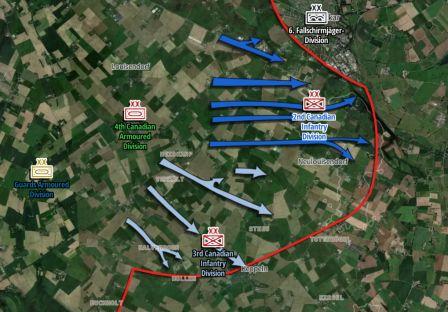
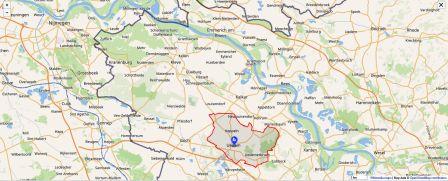
Map shows area where the Lincoln & Welland Regiment was in support of the 4th Canadian Armoured Division during the Battle of Keppeln  on February 26, 1945. (Map source:  Wikipedia)

On February 26, 1945, the Regiment was involved in the Battle of Keppeln, with the objective of breaking the German Siegfried Line during Operation Blockbuster, the last part of Operation Veritable. (See https://en.wikipedia.org/wiki/Operation_Blockbuster) Troops encountered heavy artillery and mortar fire in intense fighting from German paratroopers, and had to make their way through heavy mud and minefields.

The war diary for February 26, 1945 noted the orders given for the battle.  The 4th Canadian Armoured Brigade, which the Lincoln & Welland Regiment was part of, “….was divided into five forces….”  ‘A’ and ‘C’ Companies of the Regiment were part of ‘JERRY FORCE’.

Movement began at 6 am, but “…the route from the area at KLEVE to the concentration area was through mud fields and was extremely heavy going for all vehicles. Heavy vehicles bogged down in the mud….

By 9 am, “… JERRY FORCE moved into the attack passing through 2 Canadian Infantry Division….

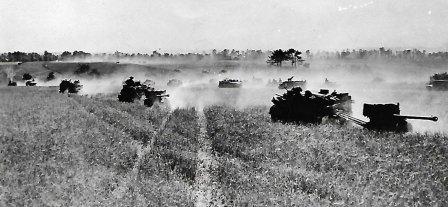
The battle finally ended when Canadian troops used flame-throwing Wasp carriers to clear German-held houses in Keppeln. The village needed to be secured as part of a push towards Uedem. The capture of Keppeln allowed Canadian forces to clear the Kalkar Ridge and proceed towards the Hochwald Forest gap, and later to break through to the Rhine.  Unfortunately, Harry did not live to see the end of this battle….

….What happened?….

Lance Corporal John SYMCHYCH stated in an official report that on February 26, 1945, Lt Robert Joseph MARKEY’s platoon, which Harry was in, was tasked with defending a house located 9.1 metres (30 feet) from a slit trench.  Visibility was poor due to smoke from machine gun and rifle fire.  One Ram carrier had been struck by shell fire and burned, and a gunner, later identified as Albert Donald AHLWARDT of the 6th Anti-Tank Regiment, Royal Canadian Artillery, had been slightly wounded and evacuated to the slit trench that  L/Cpl Symchych was in.

Around 2 pm, “…Pte Biznar and Lt Markey pulled the driver of the Ram carrier out of L/Cpl Symchych’s slit trench and were taking him to the house 15 yards away.  A shell lit four or five feet away from the three of them while L/Cpl Symchych was still in his slit trench.  L/Cpl Symchych crawled to the house and remained in the house until relieved by RHLI Regiment between the hours of three or four o’clock of the morning of February 27th. The bodies of the three men were still there when L/Cpl Symchych returned to his slit trench for his equipment…” NOTE: RHLI refers to Royal Hamilton Light Infantry Regiment.

Harry, aged 28, lost his life on that afternoon of February 26, 1945, as he and Lt Markey tried to move Gunner Ahlwardt to safety.

NOTE: For an idea of some of the places that the Regiment travelled through in Germany, see https://onthewarmemorialtrail.com/2026/02/06/on-the-war-memorial-trail-we-follow-the-route-taken-into-germany-by-canadian-troops-in-1945/

….Harry is buried in Groesbeek…

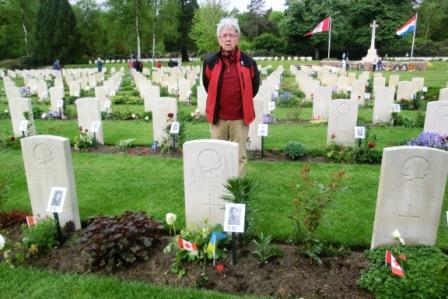
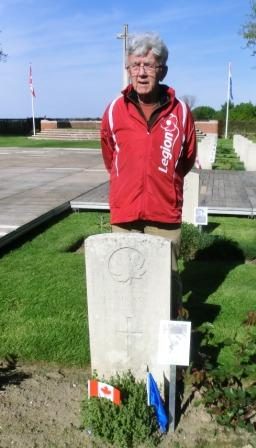
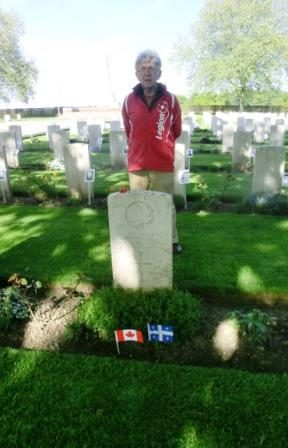
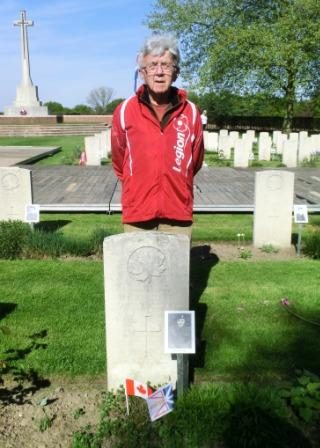
Harry was initially buried in Keppeln, Germany before being reburied on February 25, 1946 in the Canadian War Cemetery in Groesbeek, The Netherlands. During our 2025 European War Memorial Tour, Pieter placed Canadian and Quebec flags by his grave.

Pieter at the grave of Harry Biznar after placing Canadian and Quebec flags. (Photo credit: Daria Valkenburg)

Thank you to the Windsor Star for publishing the Letter To The Editor asking for a photo of Harry Biznar, to Debbie McGivney for sending us the published letter to the editor, to Harry Biznar’s niece Carol Cox for photos and information, plus niece Shelly French.  This Letter To The Editor resonated with those who read it, and we thank all who took the time to get in touch with both us and Harry’s family.

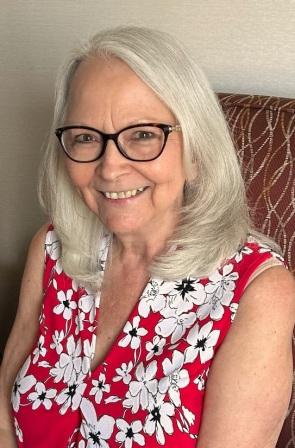
Carol Cox, niece of Harry Biznar. (Photo courtesy of Carol Cox)

As the information and photos about Harry were being compiled, Carol Cox told Pieter that “….you have resurrected emotions and gratitude for our freedom that is too easy to take for granted….

Another niece, Shelly French, also contacted us, writing to say “thank you for your hard work in locating all this information and caring deeply about our lost souls….” Shelly explained that her mother, Irene Peleshok, was “…Harry’s sister….” and reflected that her grandmother “never got over the loss of her son Harry. She cried many tears over his passing….

The flags placed at Harry’s grave during our 2025 European War Memorial Tour were donated.  Our thanks go to:

  • Alan Waddell, Constituent Assistant, on behalf of Heath MacDonald, MP for Malpeque, for the Canadian flag.
  • Mario Henry and his brother Etienne Henry, who donated the Quebec flag.

…. to be continued…..

Struck By Shellfire Part 2 will be about Robert Joseph MARKEY of Saint John, New Brunswick.

Pieter’s research efforts to find photos and families of soldiers continue. Do you have a story to tell? Email Pieter at memorialtrail@gmail.com, or comment on the blog.

© Daria Valkenburg

….Want to follow our research?…

If you are reading this posting, but aren’t following our research, you are welcome to do so.  Our blog address: https://onthewarmemorialtrail.com/
4 countries, 6 weeks, 7,000 km – an unforgettable war memorial journey in Europe…. Daria’s book ‘No Soldier Buried Overseas Should Ever Be Forgotten‘ is available in print and e-book formats.  Net proceeds of book sales help support research costs and the cost of maintaining this blog. For more information see https://nosoldierforgotten.com/

Subscribe to our YouTube Channel: On The War Memorial Trail With Pieter Valkenburg: https://www.youtube.com/channel/UCJ591TyjSheOR-Cb_Gs_5Kw.

Never miss a posting!  Subscribe below to have each new story from the war memorial trail delivered to your inbox.
On The War Memorial Trail….. The WWII Soldier From The Pas Who Died When A Flame Thrower Hit A Mine In Germany

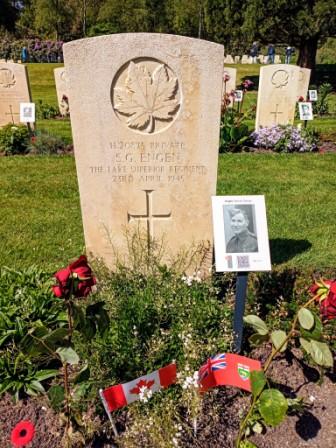
June 12, 2026. It’s wonderful when the search for a photo of a soldier takes flight, with many people actively involved in helping in this quest.  That’s what happened when Pieter looked for a photo of WWII soldier Samuel George ENGEN of The Pas, Manitoba. It was a search that took 18 months and involved many family members.

Near the end of December 2024, while we were on our way to a winter vacation, we woke up in our hotel room in Virginia with the wonderful news that a photo of Samuel had been found, and sent to us by Ralph McLean, a researcher that we’d written to earlier in 2024, and Samuel’s nephews Eric and Wilfred Sanderson.

Eric explained that he’d received the photo from Ralph who “…got the picture from Devyn Rusk. … I was so excited to receive the photo. I hope Diane and I can make the journey to see my uncle’s grave site….”  Eric and his wife Diane were the people Pieter first talked to about finding a photo of Samuel.  At the time, Eric explained that the photos were lost when his mother’s house burned down.

But, the search continued amongst family members and eventually a photo was found. Devyn, a teaching assistant at a school in The Pas, Manitoba, is the great-granddaughter of Samuel’s brother Aaron. She explained that the photo had been found “…in an old album.  It had all of Samuel’s Dad’s old post cards….

…A cookbook connection with the Opaskwayak Cree Nation…

Born February 15, 1918 in The Pas, Manitoba, Samuel was the son of Louis Julius, a WWI veteran, and Mary Helen (nee Buck) Engen.  His mother was a member of the Opaskwayak Cree Nation. (See https://en.wikipedia.org/wiki/Opaskwayak_Cree_Nation)

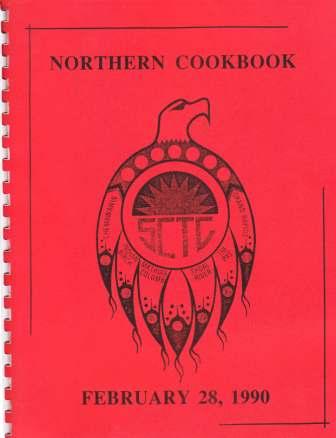
The search for a photo of Samuel had a personal connection.  More years ago than I care to remember, I taught for one semester at Keewatin Community College (now called University College of the North) in The Pas, and one group of community leaders from the Opaskwayak Cree Nation learned basic computer skills that led to a practical outcome with the development of a cookbook.  Eric told us that he was familiar with the names of some of the community leaders listed in the cookbook.

Cover of the Northern Cookbook designed and prepared by students from the Opaskwayak Cree Nation.  (Photo courtesy of Valkenburg Family)

…Samuel enlisted in 1941…

Samuel had married Miriam Susan Pranteau on January 16, 1940, and was working for The Pas Lumber Company in The Pas, Manitoba, and as a trapper, when he enlisted at the No. 10 District Depot Recruiting Office in Dauphin, Manitoba on September 6, 1941.

On September 13, 1941, he was sent to No. 100 Canadian Army (Basic) Training Centre (CABTC) in Portage La Prairie, Manitoba.  After successfully completing basic training, he went on to A15 Infantry Advanced Training Centre (Rifle) at Camp Shilo, Manitoba on December 4, 1941. His training included battle drill tactics, marksmanship, bayonet drill, and field exercises that simulated actual combat environments.

On January 6, 1942, Samuel was hospitalized in Winnipeg, Manitoba for 13 days with mumps, and returned to Camp Shilo upon recovery.  After completing advanced training as a rifleman, he was posted to the A15 Canadian Infantry Training Centre, also located in Camp Shilo, on May 15, 1942.

…Samuel left Canada for overseas service…

In preparation for being sent overseas, Samuel given embarkation leave from May 29, 1942 until June 2, 1942, the last chance he had to see his family.  In the end, Samuel didn’t report back to base until June 15, understandable considering the distance he would have had to travel to go so far up north and then back again.

On July 21, 1942, he left Canada for the United Kingdom, arriving on July 29, 1942, where he was assigned to No. 2 Canadian Divisional Infantry Reinforcement Unit (CDIRU).

A few weeks later, on August 21, 1942, Samuel was transferred to the Queen’s Own Cameron Highlanders of Canada (C of C), joining the regiment in Hassocks, Sussex.  Training continued in anticipation of going into Normandy, France, and to implement lessons learned from other regiments that participated in Operation Jubilee, also known as the Dieppe Raid, on August 19, 1942. (See https://en.wikipedia.org/wiki/Dieppe_Raid)

On December 16, 1942, Samuel was admitted to hospital.  Upon being discharged on January 14, 1943, he was assigned to No. 2 Canadian Divisional Infantry Reinforcement Unit (CDIRU).  He was hospitalized again, from April 23, 1943 until May 27, 1943.

On June 25, 1943, he returned to the Queen’s Own Cameron Highlanders of Canada (C of C), to participate in Exercise ‘Smashex’, part of ongoing intensive amphibious and infantry training to prepare soldiers before being deployed to Normandy the following year.

Unfortunately, Samuel was hospitalized again, from July 30, 1943 until August 14, 1943, when he was discharged.

…Samuel joined the Lake Superior Regiment (Motor)…

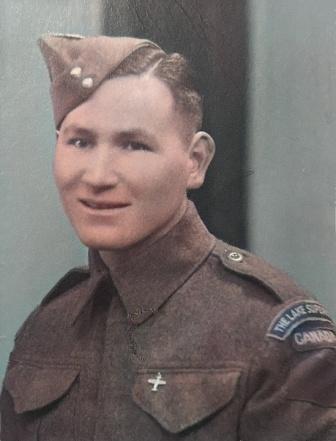
Samuel George Engen. (Photo courtesy of the Engen Family.  Photo restoration and colourization by Pieter Valkenburg)

On August 27, 1943, Samuel was transferred to the Lake Superior Regiment (Motor), the infantry component of an Armoured Brigade serving in an Infantry Division. Canada fielded only two such Motor battalions in WWII – Lake Superior Regiment (Motor) of the 4th Canadian (Armoured) Division was one and the other was the Westminster Regiment (Motor) of the 5th Canadian (Armoured) Division.

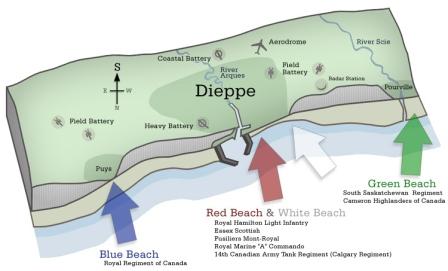
Map showing the Dieppe Raid in 1942, which marks the location of Red Beach. (Map source: https://cbf-fccb.ca/)

Training continued in Britain until July 26, 1944, when Samuel, along with the rest of the Lake Superior Regiment (Motor), left the United Kingdom aboard ‘SS Houston City’ and landed in Normandy, France as part of the 4th Canadian (Armoured) Brigade, 4th Canadian (Armoured) Division. Over the next two days, vehicles disembarked near Graye-sur-Mer on Red Beach, a codename for the heavily fortified Dieppe waterfront during the 1942 Dieppe Raid (Operation Jubilee), while the main battalion went ashore shortly after to join the Normandy campaign, which had begun on June 6, 1944 (D-Day).

They began active service on the front as of July 30, 1944, and over the next two months the Regiment battled its way through Normandy, Falaise, and across northern France into Belgium and The Netherlands. The men did whatever they could to increase the Regiment’s firepower with weapons, including those salvaged from destroyed Sherman tanks and 50 calibre machine guns from downed aircraft.  These were fitted onto their universal carriers and other vehicles.

‘The Mad Dash’ on August 14, 1944 through the Falaise Pocket to surround the Germans as part of Operation Tractable fought from August 14-21, 1944.  (Photo source: Posted by George Romick on Facebook page of Canadian Military Photos Lost and Found – Research Group)

…The Lake Superior Regiment (Motor) sank 3 German naval vessels in Zeeland…

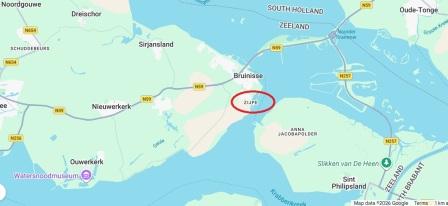
By October 1944, the 4th Canadian (Armoured) Division was in The Netherlands, tasked with clearing the Germans from an area south of the Maas River. When fighting brought the Lake Superior Regiment into the village of Sint Philipsland in the province of Zeeland on November 4, Dutch civilians told troops that there were German naval vessels in the harbour of Zijpe on the island of Schouwen en Duiveland, just across the strait.

The Lake Superior Regiment (Motor) bombed German naval vessels in Zijpe’s harbour.  (Map source: Google Maps)

The next day, with help from the tanks of the British Columbia Regiment, the Regiment bombarded the ships with their 6 pounder antitank guns and mortars. Within 15 minutes the Germans ceased fire. Due to high winds, it wasn’t until a day later that the Regiment’s boarding party later found a corvette burning and 3 other vessels sinking, with 20 fatalities and 80 wounded.

…The Lake Superior Regiment (Motor) advanced into Germany in 1945…

Most of February saw the Regiment based in the ‘s-Hertogenbosch area of The Netherlands as they continued their patrols, but on February 21, 1945, the Regiment began moving towards Germany for the upcoming Operation Blockbuster, which began at dawn on February 26, 1945. (See https://en.wikipedia.org/wiki/Operation_Blockbuster)

By 2:00 am in the early morning of February 23, 1945 the Regiment had arrived at their initial position in the Reichswald Forest, just over the border from The Netherlands.  The next afternoon the Regiment moved to Kleve.

On March 1, 1945, the war diary for the Lake Superior Regiment recorded that instructions had been received for “…the assault on the Hochwald Forest Gap….” This attack was codenamed Operation Churchill.

Clearing the very narrow Hochwald Gap was a difficult task, given that the weather was anything but cooperative. An early thaw meant that the tanks got bogged down in mud, making them ‘sitting ducks’ for German troops who were positioned to pick them off, one by one. Troops had no choice but to press on, as the Battle of Hochwald Gap, part of Operation Blockbuster, was the final push towards the Rhine River.

Miraculously, Samuel survived these difficult battles, and was with the Regiment when it returned to The Netherlands for a short rest, before going again into Germany at the end of March.   The Regiment then fought battles in Meppen, Sögel, and Friesoythe.

The 4th Canadian (Armoured) Division crossed the Twente Canal on April 4, 1945 and reached the Ems River.  However, flooded terrain made it difficult for the tanks to maneuver. On April 17, 1945, the Battle of the Küsten Canal began, with several Regiments involved in trying to capture and cross it.  The Küsten Canal was a 30.5 metre (100 feet) wide obstacle that was a challenge to cross due to the soft ground and German defences.  (See https://www.canadiansoldiers.com/history/battlehonours/northwesteurope/kustencanal.htm)

….Samuel lost his life right after the Battle for the Küsten Canal…

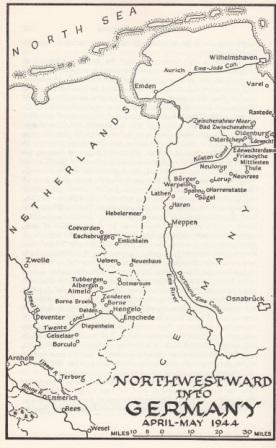
Map showing movement of troops towards Bad Zwischenahn along the Küsten Canal. NOTE: Date on map is incorrect – it should say 1945, not 1944. (Map source: ‘In The Face Of Danger – The History Of The Lake Superior Regiment’)

An account by author Lt-Col George Stanley of ‘In The Face Of Danger – The History Of The Lake Superior Regiment’ told what happened as Allied troops moved beyond the Küsten Canal towards Bad Zwischenahn.  “….Lieutenant-Colonel Keane and several of his officers visited the bridgehead to get a clear idea of the tactical picture; for it was the Lake Sups who were expected to achieve the break out.

With the support of the tanks of the Canadian Grenadier Guards, they were to drive due north astride the road which led from Friesoythe to the little spa on the shores of Zwischenahn lake just ten miles away.

The next day the battalion began to move forward. The road had been badly damaged by gun fire and the holes hastily filled with rubble, thus making it passable for armoured vehicles. The fighting on the perimeter of the bridgehead was, however, very sticky and the Brigade commander decided that, rather than strike hard ahead over the mine strewn, body-littered fields ahead, the Lake Sups should stab eastwards along both sides of the Küsten Canal, in the hope, not only of widening the base of the bridgehead, but also of relieving some of the pressure upon the forward infantry battalions.

Thus it was that “B” Company, as soon as it crossed the Canal, struck immediately to the eastwards in company with a troop of Grenadier tanks and a Wasp flame-thrower. There was a road that ran along the north side of the Canal, but the going here was slow and halting.…

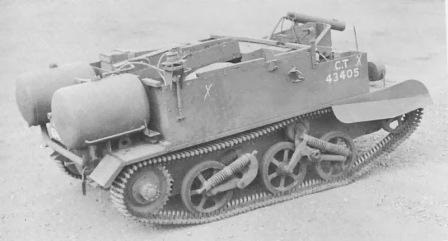
The first streak of daylight on April 23rd was the signal for “A” and “B” Companies to resume their drive eastwards along the Küsten Canal. On both sides the enemy was active …. There was no steady advance; rather the move took the form of a series of short bounds preceded by heavy firing and not inconsiderable battling. There were casualties… One of the Lake Superior flame-throwers was blown high into the air by a mine, both of its crew members being killed….

Example of a Wasp flame thrower. (Photo source: http://www.canadiansoldiers.com)

The April 23, 1945 war diary entry for the Lake Superior Regiment verified that Samuel was one of the two crew members who died.  “…At 0700 hours ‘B’ Company prepared to move forward…” of a crater “…to the road junction.  The motor platoons went forward on foot with a Wasp flame thrower in support.  Suddenly the flame thrower struck a mine and both members of the crew were killed, Pte Giving, R.V. and Pte Engen, S.G….”  The other crew member mentioned was Royal Victor GIVING of Kenora, Ontario.

….Samuel is buried in the Canadian War Cemetery in Holten….

Grave of Samuel Engen with Canadian and Manitoba flags placed by Pieter.  (Photo credit: Pieter Valkenburg)

Samuel was temporarily buried in Oldenburg, Germany at the “…right hand side of the road running North near a red brick building…” before being reburied in the Canadian War Cemetery in Holten, The Netherlands on March 23, 1946.  During our 2025 European War Memorial Tour, Pieter placed Canadian and Manitoba flags by his grave.

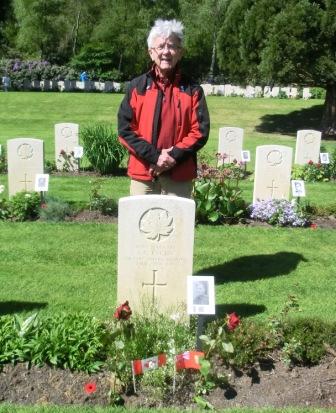
Pieter at the grave of Samuel Engen after placing Canadian and Manitoba flags. (Photo credit: Daria Valkenburg)

…..Samuel is listed on the National Métis Veterans Memorial Monument….

Samuel is listed on the National Métis Veterans Memorial Monument just outside of Batoche, Saskatchewan.  (See https://www.metismuseum.ca/metisveteransmonument/)

His name can be found on Column 5 on the outside.  Row 40. (See https://www.metismuseum.ca/metisveteransmonument/column.php?v=LWSBNZ)

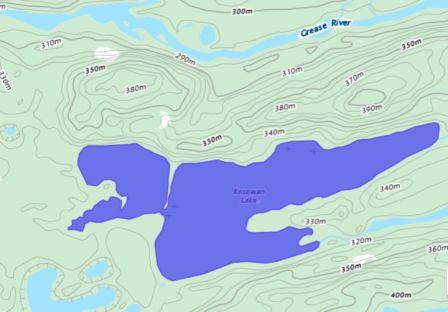
…..Engen Lake is named in Samuel’s honour….

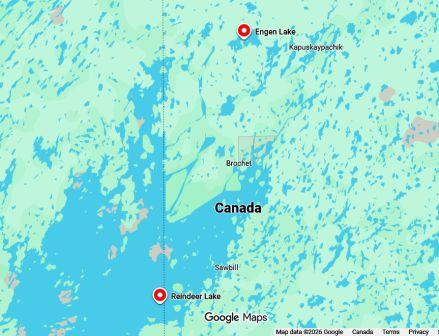
Engen Lake was named in Samuel Engen’s honour in 1961.  (Map source: Google Maps)

Engen Lake in northwestern Manitoba, northeast of Reindeer Lake which straddles the Manitoba-Saskatchewan border, was named after Samuel in 1961.

Devyn Rusk. (Photo courtesy of Devyn Rusk)

Thank you to Ralph McLean, Devyn Rusk, Eric Sanderson, and Wilfred Sanderson for finding and sending a photo.  Thank you to Judie Klassen for family history research.

The flags placed at Samuel’s grave during our 2025 European War Memorial Tour were donated.  Our thanks go to:

  • Alan Waddell, Constituent Assistant, on behalf of Heath MacDonald, MP for Malpeque, for the Canadian flag.
  • Brad Robertson, Chief of Protocol, Government of Manitoba, on behalf of Wab Kinew, Premier of Manitoba, who donated the Manitoba flag.

Pieter’s research efforts to find photos and families of soldiers continue. Do you have a story to tell? Email Pieter at memorialtrail@gmail.com, or comment on the blog.

© Daria Valkenburg

….Want to follow our research?…

If you are reading this posting, but aren’t following our research, you are welcome to do so.  Our blog address: https://onthewarmemorialtrail.com/

4 countries, 6 weeks, 7,000 km – an unforgettable war memorial journey in Europe…. Daria’s book ‘No Soldier Buried Overseas Should Ever Be Forgotten‘ is available in print and e-book formats.  Net proceeds of book sales help support research costs and the cost of maintaining this blog. For more information see https://nosoldierforgotten.com/

Subscribe to our YouTube Channel: On The War Memorial Trail With Pieter Valkenburg: https://www.youtube.com/channel/UCJ591TyjSheOR-Cb_Gs_5Kw.

Never miss a posting!  Subscribe below to have each new story from the war memorial trail delivered to your inbox.
On The War Memorial Trail…..The WWII Gunner Who Died In A Vehicle Accident A Day After The Liberation Of Groningen

May 15, 2026. Since Pieter began receiving photo wish lists of soldiers buried in the Canadian War Cemeteries in The Netherlands, we’ve found that many of the names came from towns and villages that we were unfamiliar with.  We travel quite a bit in the Maritime provinces of New Brunswick, Nova Scotia, as well as our home province of Prince Edward Island.  We also occasionally drive through Quebec towards Ottawa, Ontario, where we lived for several years before Pieter’s retirement.

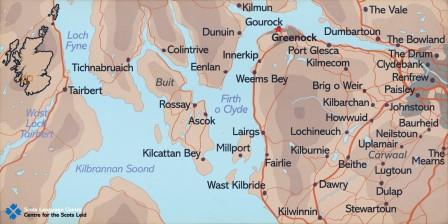
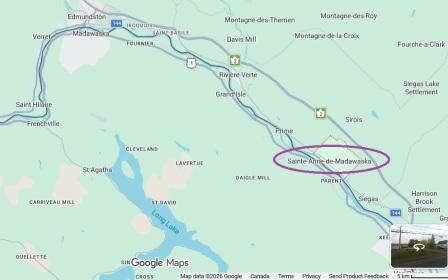
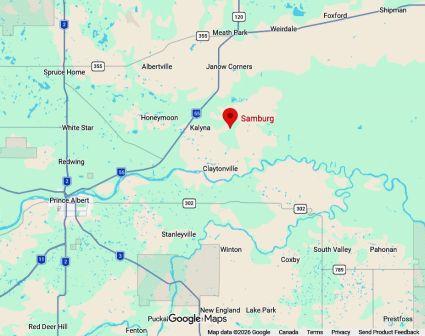
Roger Sirois was born in Sainte-Anne-de-Madawaska, New Brunswick.  (Map source: Google Maps)

The hours of driving go by quickly as it seems that, over the years, we can put a soldier to every place name listed on the highway road signs. Such was the case last fall when we were on our way to Ottawa, and passed by a sign for Sainte-Anne-de-Madawaska, 30 km (18.6 miles) southeast of Edmundston, New Brunswick. Now part of the town of Vallée-des-Rivières since 2023, it was the birthplace of WWII soldier JosephRoger’ SIROIS.

Born December 16, 1922, Roger was the son of John (Jean) and Catherine (nee Pelletier) Sirois, one of 12 children.  With the exception of one brother, who moved to Sarnia, Ontario, the rest of the siblings immigrated to the USA…. and that is where Pieter found a relative with a photo.

….The search for a photo of Roger was successful…

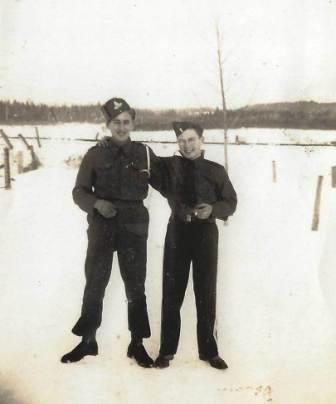
An obituary for Angeline Hounjet, wife of Roger’s brother Aurele, led Pieter to get in contact with her son Roger.  “Roger Sirois was my uncle, who died shortly before I was born in New Brunswick….” he explained.  “…. I have attached a picture of my uncle – he is the tall one on the left–with his friend, Joel.  There is a strong family likeness; definitely a Sirois!…

Roger Sirois (left) with his friend Joel.  (Photo courtesy of the Sirois Family)

When he enlisted at the No. 7 District Depot in Fredericton, New Brunswick on August 21, 1942, he stated that he worked on the family farm, spoke English and French, but was more fluent in French, and for the past year had been employed as a boilerman for the Aluminium Company of Canada (Alcan) in Arvida, Quebec. (See https://arvida.saguenay.ca/en/the-city-of-aluminum/history-and-profile-of-arvida/the-second-world-war)

When asked about hobbies and interests, Roger noted that he hunted and fished, and could play the violin.  He was described by a military interviewer as “…cheerful, sturdy, with good deportment, and appearance….

On September 18, 1942, Roger was sent to No. 70 Canadian Army Basic Training Centre (CABTC) for basic training.  He remained there until December 2, 1942, when he was transferred to A1 Canadian Artillery Corps Training Centre (CATC) in Camp Petawawa, Ontario for advanced training as a gunner.

While still at A1 CATC, he qualified as a Driver i/c Class III wheeled vehicles on January 30, 1943. (The term ‘Driver i/c’ refers to ‘Driver, internal combustion’.  Class III meant he was qualified to drive heavy trucks and armoured cars, but not tanks.)

As a driver in the Royal Canadian Artillery, Roger would be responsible for operating and maintaining military vehicles to transport crews, artillery such as 25-pounder field guns, and heavy ammunition loads to the front lines, often under fire.  As a trained gunner, he could also be expected to double as a gun crew member, switching between driving and firing, depending on the situation.

Roger was there at the same time as Arthur GAUDET of Prince Edward Island, taking the same training and subsequently going overseas at the same time before their paths diverged.  (See https://onthewarmemorialtrail.com/2025/02/12/on-the-war-memorial-trail-the-wwii-soldier-from-prince-edward-island-who-lost-his-life-in-germany-two-days-before-his-21st-birthday/)

On February 10, 1943, he was granted embarkation leave until February 23, 1943, the last chance he would have to see his family before going overseas.

….Roger left Canada for overseas service….

On March 24, 1943, Roger left Canada for the United Kingdom.  Upon arriving on March 31, 1943 he was assigned to No. 3 Canadian Artillery Reinforcement Unit (CARU), effective the following day.

On June 18, 1943, Roger was transferred to the 11th Light Anti-Aircraft (LAA) Regiment, Royal Canadian Artillery for Light Machine-Gun and Rifle training.  After this Regiment disbanded in March 1944, Roger was transferred to the 3rd Light Anti-Aircraft (LAA) Regiment, Royal Canadian Artillery.

Training continued until July 4, 1944, when the Regiment moved to an area near London and boarded a ship in preparation for going to North West Europe.  They arrived in Normandy on July 7, 1944, one month after D-Day, in support of the 3rd Canadian Division, part of the 21st Army Group.

The role of 3rd LAA was to provide mobile anti-aircraft protection for ground troops and positions, and help defend against German Luftwaffe night raids by implementing barrages to combat low-flying aircraft.

They were soon tested as on July 11, 1944, right after the Regiment arrived near Carpiquet Aerodrome, twelve low flying Messerschmitt 109s appeared on the horizon. The German planes banked sharply towards the coast and flew directly over the Regiment’s guns. Every gun in the battery opened up, sending seven Messerschmitts down in flames, while damaging the other five. The following day, six more appeared and three were shot down. This was just one example of what the Regiment experienced.

….Roger was transferred to the 4th Field Regiment….

On August 2, 1944, Roger was transferred to the 4th Field Regiment, Royal Canadian Artillery, joining them in Fleury-sur-Orne, France as they prepared for Operation Totalize. This offensive, fought between August 7-11, 1944, was designed to break through the German defences south of Caen and toward Falaise, with the objective of closing the Falaise gap and cutting off the retreating Germany 7th Army.  (See https://en.wikipedia.org/wiki/Operation_Totalize)

The Regiment moved through Normandy, France, and then into Belgium and The Netherlands in at the end of September and into October 1944 for the Battle of the Scheldt, which began officially on October 2 and lasted until November 8, 1944, and in which the Regiment provided crucial artillery support.

The Battle of the Scheldt’s objective was to free up the way to the Port of Antwerp in Belgium for supply purposes. From Antwerp, they went into The Netherlands, fighting along flooded fields and dikes leading toward Woensdrecht in a battle that lasted until October 21, 1944. (See https://www.veterans.gc.ca/eng/remembrance/history/second-world-war/scheldt)

The Regiment remained in The Netherlands until mid-February.  On February 16, 1945, they arrived in Germany in preparation for Operation Blockbuster, which began at dawn on February 26, 1945 and ended on March 3, 1945. (See https://en.wikipedia.org/wiki/Operation_Blockbuster)

The Regiment’s war diary for March 4, 1945 noted that “…the Hochwald was cleared and the Germans began the withdrawal….so that we did very little firing…

NOTE: For an idea of some of the places that the Regiment travelled through in Germany, see https://onthewarmemorialtrail.com/2026/02/06/on-the-war-memorial-trail-we-follow-the-route-taken-into-germany-by-canadian-troops-in-1945/

By the end of March the Regiment had returned to The Netherlands, and preparing for the upcoming Battle of Groningen, fought from April 14-16, 1945, an offensive to clear all approaches to the city and capture it.  (See https://www.canadiansoldiers.com/history/battlehonours/northwesteurope/groningen.htm and https://library.mcmaster.ca/battle-groningen-april-1945)

….Roger accidentally died after falling from a vehicle…

Roger had survived several major battles up to now, but his luck ran out on the morning of April 17, 1945, the day after Groningen was liberated from Nazi occupation.

According to testimony by Bombadier J.D. FLINT at a Court of Inquiry, Roger, Flint, and Gunner E. BROWN were returning from a battery position when another military vehicle passed by.  Roger “…was standing on the near side of the vehicle as it approached us.  We slowed right down as the road was very narrow…”  Brown, the driver, “…pulled over as far as possible to the right hand side of the road….” and asked Flint “…if everything was clear….”  Flint replied that as far as he could see “…there was plenty of room for both vehicles to pass…

However, Flint went on to say that “…just as we were passing, Gunner Sirois leaned back as if waving to us.  We stopped….” and saw Roger “…lying on the road…

Lt. E. J. MACROW, a passenger in the other vehicle, said that neither vehicle showed “…evidence of a collision… The tracks of both vehicles showed that there should have been ample room to pass …”   When asked if he was aware that Roger was standing on the side of the vehicle, he replied “…No. I did not see him as he must have been standing on the fender by the rear side door

The medical report showed that Roger died from injuries that included a “…crushed right chest with internal injuries, and fractured right humerus…

The Court of Inquiry ruled it an accidental death.  Most likely, Roger lost his balance and fell off the vehicle, and ended up being run over by one of the two vehicles as they passed each other.

Although Roger died on April 17, 1945, his death was incorrectly recorded a day earlier in the April 16, 1945 War Diary entry for the 4th Field Regiment of the Royal Canadian Artillery! “…Gunner Sirois, 2nd Battery driver, was accidentally killed…”  He was 22 years old.

….Roger is buried in Holten…

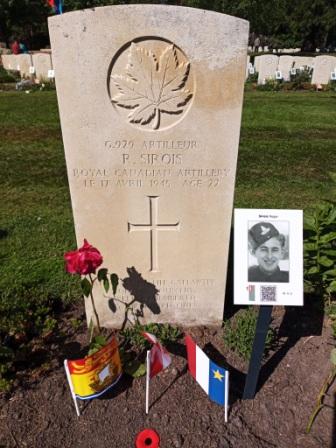
Grave of Roger Sirois with Canadian, New Brunswick, and Acadian flags placed by Pieter.  (Photo credit: Pieter Valkenburg)

Roger was temporarily buried in Eelderwolde, 5 km (3 miles) south of Groningen, before being reburied on February 14, 1946 in the Canadian War Cemetery in Holten, The Netherlands. During our 2025 European War Memorial Tour, Pieter placed Canadian, New Brunswick, and Acadian flags by his grave.

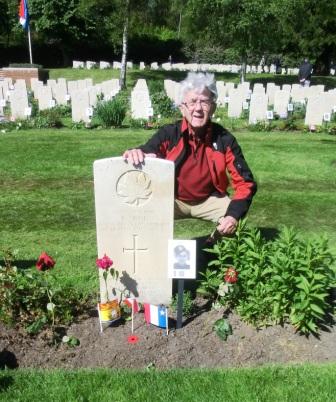
Pieter at the grave of Roger Sirois after placing Canadian, New Brunswick, and Acadian flags. (Photo credit: Daria Valkenburg)

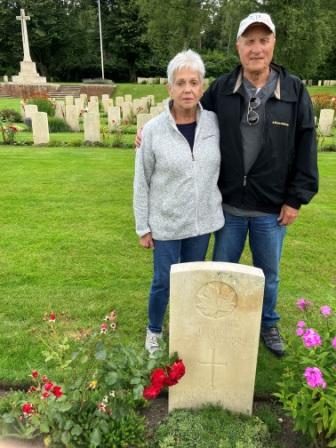
Roger Sirois and his wife Judy visited his uncle’s grave in 2024.  (Photo courtesy of Roger Sirois)

Thank you to Roger Sirois for providing a photo.  “Thank you for the very worthwhile work you do….” he wrote.  After visiting his uncle’s grave in 2024, and meeting Edwin van der Wolf, one of the volunteers at the Information Centre in Holten, Roger expressed his appreciation. “Again, you folks do such great work to, among other things, provide a vehicle to allow families to piece together family histories and a means to remember soldiers who served their respective countries….

The flags placed at Roger’s grave during our 2025 visit were donated.  Our thanks go to:

  • Alan Waddell, Constituent Assistant, on behalf of Heath MacDonald, MP for Malpeque, for the Canadian flag.
  • Jean-Claude D’Amours, MLA (Member of the Legislative Assembly) for Edmundston-Madawaska Centre, Minister responsible for Military Affairs, with the help of Cécile LePage, Province of New Brunswick, for the New Brunswick and Acadian flags.

Pieter’s research efforts to find photos and families of soldiers continue. Do you have a story to tell? Email Pieter at memorialtrail@gmail.com, or comment on the blog.

© Daria Valkenburg

….Want to follow our research?…

If you are reading this posting, but aren’t following our research, you are welcome to do so.  Our blog address: https://onthewarmemorialtrail.com/

4 countries, 6 weeks, 7,000 km – an unforgettable war memorial journey in Europe…. Daria’s book ‘No Soldier Buried Overseas Should Ever Be Forgotten‘ is available in print and e-book formats.  Net proceeds of book sales help support research costs and the cost of maintaining this blog. For more information see https://nosoldierforgotten.com/

Subscribe to our YouTube Channel: On The War Memorial Trail With Pieter Valkenburg: https://www.youtube.com/channel/UCJ591TyjSheOR-Cb_Gs_5Kw.

Never miss a posting!  Subscribe below to have each new story from the war memorial trail delivered to your inbox.
On The War Memorial Trail….. A Photo Found For A WWII Soldier From Moreton’s Harbour Killed By A Mortar Fragment While Transporting Wounded In An Ambulance

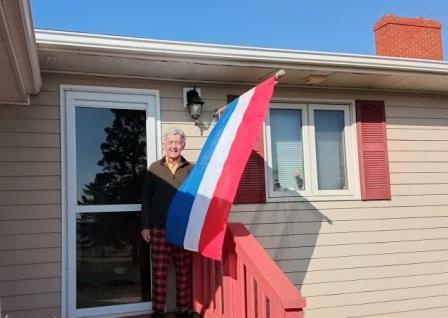
The Dutch flag was displayed on May 5 for Dutch Liberation Day. (Photo credit: Daria Valkenburg)

May 8, 2026. The first week of May is a time of reflection for Pieter, as it’s a bittersweet week in which The Netherlands remembers those who died during WWII and celebrates liberation from Nazi occupation during WWII. During last year’s 2025 European War Memorial Tour he placed flags at 383 graves of Canadian soldiers that he’d researched over the years. This posting is the story of the search for a photo of one of those soldiers.

Occasionally, Pieter helps the Canadian War Cemetery in Groesbeek, The Netherlands to find photos of soldiers for which research had already been done, but no photo could be found. He’s found that it’s almost as much work as it is do a complete research project on a soldier, as there is a reason photos aren’t readily available – they can be very difficult to find!

Since he’s always had a wonderful response when looking for soldiers from Newfoundland, when he saw a soldier from that province on a photo wish list, he thought it would be a slam dunk. Pieter had no idea of the twists and turns encountered when he began to look for a photo of John Frederick BARTLETT.

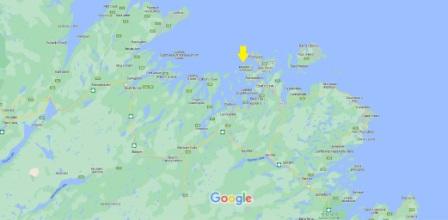
Yellow arrow identifies Moreton’s Harbour, Newfoundland. (Map source: Google Maps)

Born January 27, 1898 in Moreton’s Harbour, the son of Alfred and Jessie Lavinian (nee Taylor) Bartlett, John was serving with the South Alberta Regiment (29th Canadian Armoured Reconnaissance Regiment). As he was 47 years old, his normal duties included serving in the officers mess and being the batman (driver) for one of the officers.

He lost his life on February 27, 1945, aged 47, when fragments from a German mortar bomb hit the ambulance in which he was travelling. According to a casualty report, he had been “…riding in the half-track ambulance between stretchers. Mortar landed in field near road. Fragment entered back of canvas cover, passed clean through Bartlett’s head and out through the top of cover.  Killed outright…”  (You can read Jim Little’s story about John here: https://www.facestograves.nl/LifeStories/BARTLETT%20John%20Frederick-JLE-bio-EN.pdf)

….A great-nephew was contacted in Newfoundland…

Pieter was very quickly in contact with Gerald Bartlett, John’s great-nephew, grandson of John’s brother William Chesley Bartlett.  But his hope of receiving a photo was dashed when Gerald explained that the family no longer had a photo.  “My dad, Morgan John Bartlett, did have a photo of Uncle John but in 1983 a first cousin from Mississauga, Ontario borrowed the photo but never received the photo back, although we tried for years to get it returned…

Gerald’s father couldn’t get the photo back, the cousin died, and her daughter refused to have contact with the family.  Pieter then tried contacting her and her family, with zero response.

Gerald went on to say that he did have “….Uncle John’s entire squadron photo. The 29th South Alberta Recc Regiment, taken in February 1943 in England….”  No one was named in the photo, however.  Perhaps the next step was a Regimental Association or Regimental History?

….We struck out with the Regimental history book and museum…

Donald E. Graves, author of ‘South Albertas – A Canadian Regiment At War’, about the South Alberta Regiment, mentioned Bartlett in the book. He was a 47 year old batman who had volunteered to accompany ambulance driver Eric Nichols.

An excerpt in the book explained that “…Nichols lost one of his helpers on 27 February when fragments from a German mortar bomb which landed near his halftrack killed Trooper John Bartlett, who was riding with him. This was a particularly tragic loss because Bartlett, a farm labourer from Edmonton, was, at 47 years of age, too old for combat and had only been retained in the Regiment because he served as a batman to the officers and a waiter in their mess. John Bartlett had nothing else to do that day so he volunteered to go out in the ambulance….

There was a group photo on the inside cover – similar to the one that Gerald Bartlett had – and each man was numbered, suggesting that somewhere is a list identifying these men. We wrote the author and asked if there was an identification listing for the photo.

He said no, that he’d tried to get one himself, and suggested contacting the South Alberta Light Horse Museum in Medicine Hat, Alberta.  We did. The curator was aware of the photo, but had no identification key. He said he would investigate further, but we never heard from him again.

….Did the ambulance driver have a photo?…

We then looked at the ambulance driver, wondering if perhaps he might have photos that could include John.  We asked Judie Klassen, who has helped with really tough cases in the past, if she could find any information.   Judie learned that “…the soldier who was with Bartlett when he died was Eric Nichols.  He died in 2018….”  She also found “….Rob McCue, who knew him since he was a boy, is a retired sergeant with the South Alberta Light Horse Regiment….

It was a long shot, but Pieter contacted Rob McCue. He didn’t have a photo, but wrote that “…the driver of that Halftrack Ambulance was a Trooper by the name of Eric Nichols. He was my father’s best friend. Eric was still feeling guilt for the loss of the batman years after it happened…. My father’s friend Eric was accosted by the Officer who Tpr Bartlett worked as the Batman for.  Before Eric was even able to wash the blood off of his hands the officer was screaming at him for taking Bartlett with him. Eric told me that he had asked for volunteers to help him clear casualties from a tank and Bartlett volunteered to assist him, even though his age should have prevented him from front line service…. I talked with Eric about this incident many times, and it was still a raw wound even 75 years later….

….Did the medic whose place John took have a photo?…

Although he was well-known in the Regiment, he wasn’t a medic, so never should have been in that ambulance.  One of the medics, Glenn Burgess, was ill which was why John had volunteered to take his place.  (See https://calgaryherald.remembering.ca/obituary/glenn-burgess-1066026252)

Jim Little’s story noted that “…Trooper Glenn Burgess of C Squadron, 4 Troop, was Left Out of Battle (LOB) that day. It was a regular practice of the SAR to keep one Troop from each of its three fighting Squadrons LOB in the event of disaster, preserving a cadre of experienced personnel to rebuild with. Those who were LOB were assigned other duties, and Glenn was tasked with assisting the Regiment’s ambulance service in recovering their casualties from the field. However, Trooper Burgess had a bad case of strep throat so was excused from that duty, and John Bartlett went in his place…”  (SAR refers to South Alberta Regiment)

Maybe Glenn Burgess had a photo? During our ongoing search, Judie came across an interview with poetess Vivian Hansen.  “Vivian Hansen was close to Glenn Burgess and wrote about him, calling him ‘the old man’. She talks about looking through pictures/papers he had in an interview….” (See https://freefallmagazine.ca/interview-with-vivian-hansen/)

Although Vivian didn’t have a photo that included John Bartlett, she replied to our inquiry.  “…  Sadly, I have no photo of Bartlett.  In fact, since Glenn told me the story, I only just linked the mystery man who replaced him as John Bartlett….He never knew the name of the man who replaced him that fateful day….

Vivian let us know that she had written “…a book of poetry entitled ‘A Tincture of Sunlight’, which chronicles some of Glenn’s stories during the war. Glenn’s great-grandmother was a Cree woman from the Swampy Cree nation in northern Ontario.  He was fourth generation Cree, not eligible for treaty status. ….

…What if we went backwards in time?…

With no luck in finding a photo during John’s military years, maybe we needed to look further back in time?  Before enlisting in the South Alberta Regiment in 1940, John had worked as a farm labourer on the farm of W.B. Herder (William and Iva) in Ankerton, Alberta in the 1930s.

Judie’s research into the Herder family led us to Deborah Laidler, granddaughter of Will Herder.  “…I am very excited to correspond with you, as I am the family historian…” she wrote in 2024.

Deborah did her best to find a photo and information, even going through a local history book. “….I have spoken to half a dozen local farm families. No one has knowledge of this soldier but that is not unexpected. My 95 year old Aunt Connie does not remember him, specifically. The family never had a hired man who stayed with them or worked full time for 12 years, as his attestation papers indicate.  But, he may have worked May- September…

Unfortunately, while Deborah, her family, and a neighbor, Angeline Brausen, had a number of unidentified photos of men, none could be identified as John Bartlett.  “…My aunt thinks that the Brausens owned the threshing machine that my grandfather used in the 1930s.….

….Success when John was identified in Gerald’s Squadron photo!…

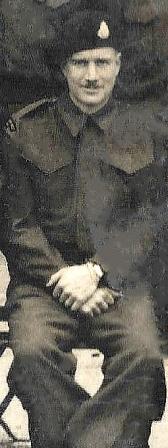
John Frederick Bartlett identified in the 29th South Alberta Reconnaissance Regiment photo from 1943.  (Photo courtesy of the Bartlett Family)

The trail had run cold. However, Gerald Bartlett and his family were able to identify John in the 29th South Alberta Reconnaissance Regiment photo he’d first told Pieter about, which had been taken in February 1943 in England.  “…I went through the regiment photo and enlarged each man to see if there were any similarities.  When I came to the photo I sent you it made me stop.  I could see so many similarities to myself and my brothers and Uncle Elijah. The resemblance to us is quite remarkable….

The photo search had come full circle and a heroic soldier was now identified!

….John is buried in Groesbeek…

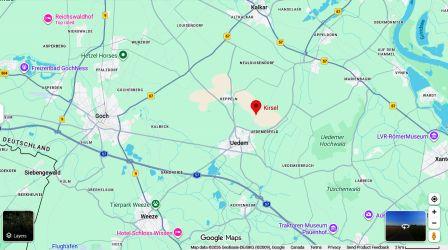
John was initially buried in Kirsel, near Uedem in Germany. (Map source: Google Maps)

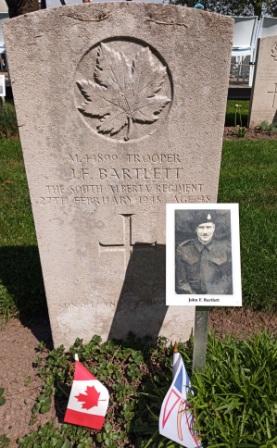
John was initially buried in a temporary burial ground in Kirsel near Uedem, Germany, before being reburied on February 25, 1945 in the Canadian War Cemetery in Groesbeek, The Netherlands.   During our 2025 European War Memorial Tour, Pieter placed flags of Canada and Newfoundland by his grave.

Pieter stands behind the grave of John Frederick Bartlett after placing flags of Canada and Newfoundland.  (Photo credit: Daria Valkenburg)

Grave of John Frederick Bartlett in Groesbeek, with the flags of Canada and Newfoundland that he placed.  (Photo credit: Pieter Valkenburg)

…. ‘You have honoured my great-uncle greatly’…

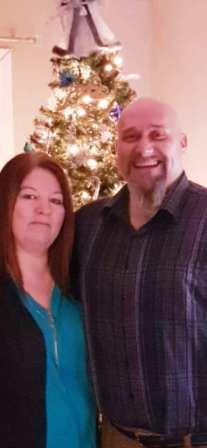
Gerald Bartlett and his wife Gail.  (Photo courtesy of Gerald Bartlett)

After John was identified by his great-nephew Gerald Bartlett, successfully completing the photo search, Gerald shared his reflections with Pieter.  “… I am so very impressed with the story of my great-uncle John. As a child, I always heard stories of his military time and how he died, but this story finally brings to life his life and heroism as a man who volunteered as he felt was his duty. Wow! I love this story and will share this with my children, my brothers, and sisters. When I saw his picture, I actually saw my grandfather. I have no doubt that this is John Frederick Bartlett… Many thanks to you, your wife, and Jim Little. You have honoured my great-uncle greatly….

….Many to thank for this search …

The long but ultimately successful search for a photo of John Frederick Bartlett was like an unfolding detective story, with a number of people helping to find clues and leads.

Thank you to Gerald Bartlett for identifying his great-uncle in the squadron photo. Thank you to Judie Klassen for going above and beyond to find reference materials, and to Shawn Rainville for newspaper searches.

Thank you also to Vivian Hansen and Rob McCue for enriching our inquiries by providing input on the two medics whose lives were impacted by John’s death: Glenn Burgess and Eric Nichols. Thank you as well to Deborah Laidler for looking into John’s time as a farm worker on the Will Herder farm.

The flags placed at John’s grave during our 2025 visit were donated.  Our thanks go to:

  • Alan Waddell, Constituent Assistant, on behalf of Heath MacDonald, MP for Malpeque, for the Canadian flag.
  • Gerald Bartlett in memory of Trooper John Frederick BARTLETT, who donated the Newfoundland flag.

Pieter’s research efforts to find photos and families of soldiers continue. Do you have a story to tell? Email Pieter at memorialtrail@gmail.com, or comment on the blog.

© Daria Valkenburg

….Want to follow our research?…

If you are reading this posting, but aren’t following our research, you are welcome to do so.  Our blog address: https://onthewarmemorialtrail.com/

4 countries, 6 weeks, 7,000 km – an unforgettable war memorial journey in Europe…. Daria’s book ‘No Soldier Buried Overseas Should Ever Be Forgotten‘ is available in print and e-book formats.  Net proceeds of book sales help support research costs and the cost of maintaining this blog. For more information see https://nosoldierforgotten.com/

Subscribe to our YouTube Channel: On The War Memorial Trail With Pieter Valkenburg: https://www.youtube.com/channel/UCJ591TyjSheOR-Cb_Gs_5Kw

Never miss a posting!  Subscribe below to have each new story from the war memorial trail delivered to your inbox.
On The War Memorial Trail….2026 Faces of Holten Exhibition

Directional sign to the Canadian War Cemetery in Holten, The Netherlands. (Photo credit: Daria Valkenburg)

May 3, 2026.  Readers of this blog are aware that Pieter has been involved in finding photos of Canadians who are buried in The Netherlands since 2014.  Last year, when we were in The Netherlands and Belgium for the 80th Anniversary of Liberation Commemoration events, Pieter placed flags at the graves of 383 soldiers in 14 cemeteries. 

Out of this total, flags were placed at 156 graves at the Canadian War Cemetery in Holten, the second largest Canadian War Cemetery in The Netherlands, with 1,394 burials, of which 1,355 are Canadian. 

….The 2026 Faces Of Holten Exhibition included photos of 4 additional soldiers researched by Pieter …

This year, for the 81st Anniversary, photos were placed at graves for the second time.  The 2026 Faces Of Holten Exhibition runs for three weeks in May.  Photos were printed onto an aluminum backing, making them impervious to rain, and reusable.  Each placard also had a QR code, allowing visitors with cell phones to scan the code and read a brief biography of the soldier.

In this posting, we feature the graves and photos of four WWII soldiers whose photos were submitted after our 2025 European War Memorial Tour.

Grave of Bramwell Ernest Churchill. (Photo courtesy of Henk Vincent)

Bramwell Ernest CHURCHILL, born in Pretolia, Ontario, was serving with the 5th Anti-Tank Regiment when he was killed in Germany on May 5, 1945, aged 40, after the half-track vehicle he was riding in struck a mine. His story will be told in an upcoming blog posting.

Grave of John ‘Jack’ Lewis Hughes. (Photo courtesy of Henk Vincent)

John ‘Jack’ Lewis HUGHES, from Eriksdale, Manitoba, was a nursing orderly serving with the No. 10 Canadian Field Dressing Station when he was killed at a beach dressing station during Operation Infatuate on Walcheren Island in The Netherlands on November 2, 1944, aged 28, when 3 Allied tracked vehicles exploded after being hit by German shellfire. You can read his story at https://onthewarmemorialtrail.com/2025/12/04/on-the-war-memorial-trail-remembrance-week-2025-the-wwii-nursing-orderly-killed-when-3-tracked-vehicles-exploded-near-a-field-dressing-station-on-walcheren-island/

Grave of Edward Alexander Munro. (Photo courtesy of Henk Vincent)

Edward Alexander MUNRO, of Birch River, Manitoba, died in a road accident in Germany on October 6, 1945, aged 27, while serving with the Royal Canadian Army Service Corps, 219 Infantry Brigade Company.  His story will be told in an upcoming blog posting.

Grave of Alphonse Louis Skalicky. (Photo courtesy of Henk Vincent)

Alphonse Louis SKALICKY, of Humbolt, Saskatchewan, was killed in The Netherlands on April 14, 1945, aged 25, while serving with the Saskatoon Light Infantry.  His story will be told in an upcoming blog posting.

Thank you to Henk Vincent for taking these photos. The Dutch continue to stress the importance of remembrance to the next generation so they can continue to remember those who lost their lives in WWII. 

Pieter encourages readers with photos to come forward so that eventually all of the known graves of Canadians buried in Holten will have a photo displayed by their grave. If you have a photo of a soldier buried at the Canadian War Cemetery in Holten or one of the other cemeteries in The Netherlands, please email him at memorialtrail@gmail.com, or comment on the blog.

© Daria Valkenburg

 ….Missed the stories about the 2025 Faces Of Holten Exhibition?…

Missed the stories about the 2025 Faces of Holten Exhibition?  Here are the links:

….Want to follow our research?…

If you are reading this posting, but aren’t following our research, you are welcome to do so.  Our blog address: https://onthewarmemorialtrail.com/

4 countries, 6 weeks, 7,000 km – an unforgettable war memorial journey in Europe…. Daria’s book ‘No Soldier Buried Overseas Should Ever Be Forgotten‘ is available in print and e-book formats.  Net proceeds of book sales help support research costs and the cost of maintaining this blog. For more information see https://nosoldierforgotten.com/

Subscribe to our YouTube Channel: On The War Memorial Trail With Pieter Valkenburg: https://www.youtube.com/channel/UCJ591TyjSheOR-Cb_Gs_5Kw

Never miss a posting!  Subscribe below to have each new story from the war memorial trail delivered to your inbox.
On The War Memorial Trail….The Mystery Of Who Placed Flowers At One Airman’s Grave Was Solved In A Story Spanning Two Continents

April 18, 2026.  When we were in The Netherlands last year on our 2025 European War Memorial Tour, we visited the Canadian War Cemetery in Groesbeek, where Pieter placed 120 flags at the graves of soldiers he’d done research on over the years. (See https://onthewarmemorialtrail.com/2025/06/23/on-the-war-memorial-trail-2025-faces-of-groesbeek-exhibition-part-1-flags-placed-at-120-graves/)

….There was a surprise when we visited the grave of WWII airman Arnold Freeman Hupman…

After placing flags of Canada and Nova Scotia, Pieter stands behind the grave of Arnold Freeman Hupman.  (Photo credit: Daria Valkenburg)

One of the graves visited, and where Pieter placed flags of Canada and Nova Scotia, was that of WWII airman Arnold Freeman HUPMAN, of East Side of Ragged Island, Nova Scotia.

Arnold Freeman Hupman.  (Photo submitted by Marilyn Hupman)

Arnold was serving with 419 Squadron of the Royal Canadian Air Force (RCAF), and lost his lost his life, at the age of 30, when the Lancaster bomber he was in crashed on the outskirts of Arnhem on the night of June 16 to 17, 1944, after being shot down by a German nightfighter. (You can read his story at https://onthewarmemorialtrail.com/2021/02/09/on-the-war-memorial-trail-atlantic-canada-remembers-part-6/)

Arnold Hupman’s grave is between two of his crewmates: Donald Morissen and Edward Fahy. (Photo credit: Daria Valkenburg)

There was a surprise at his grave as we found a note from Saskia Peters, a member of the Faces To Graves Groesbeek Foundation Board, asking if whoever had been annually placing flowers at the grave to get in contact with her.   

Note left by Saskia Peters beside the graves of Hupman, Morissen, and Fahy.  (Photo credit: Daria Valkenburg)

 ….The last flight of Lancaster X KB728

Map shows the plane’s path from Middleton St. George to Holten, Germany and then to where it crashed in Elden, The Netherlands.  (Map prepared by Wendy Nattress)

On the night of June 16, 1944, at 11:08 pm, Lancaster X KB728 took off from RAF Middleton St. George, England for a bombing operation against the synthetic oil plant at Sterkrade/Holten in Germany.  

On its return back to England in the early hours of June 17, 1944, the plane was attacked by a nightfighter and exploded following combat with nightfighter pilot Hans Schadowski of the 3./NJG 3 based at Vechta airfield in Germany, who was flying a Messerschmitt Bf 110 G-4.

The Lancaster crashed close to the Dutch Reformed Church at Elden in the province of Gelderland, 4 km (2.5 miles) southwest of Arnhem.

All seven crew members lost their lives. In addition to Flying Officer Arnold Hupman, the navigator on that flight, the other crew members were:

  • Pilot : RCAF Pilot Officer Donald MORISSEN of Winnipeg, Manitoba
  • Bomb Aimer: RCAF Pilot Officer Gerald Edgar QUINN of Montreal, Quebec
  • Wireless Operator/Air Gunner: RAF Pilot Officer Harold FLETCHER of Bolton, Lancashire, England
  • Air Gunner: RCAF Pilot Officer Clifford JOHNSTON of North Bay, Ontario
  • Air Gunner: RAF Pilot Officer Philip Joseph MCMANUS of Herne Hill, London, England
  • Flight Engineer: RAF Pilot Officer Edward FAHY of Rhyl, Flintshire, Wales

They were temporarily buried in the Netherlands Reformed Church Cemetery in Huissensedijk on June 29, and later reburied in the Canadian War Cemetery in Groesbeek.  (More information can be found in this English translation of an article by the late Willem Tiemans: https://airbornearnhem.nl/WillemTiemens/Elden%20bomber%20crash.htm)

….The mystery of who placed the flowers was solved by Saskia…

Almost a month later, we met Saskia when we were honoured by the Faces To Graves Groesbeek Foundation at one of their meetings, and asked if she had received any response. (See https://onthewarmemorialtrail.com/2025/05/30/on-the-war-memorial-trail-pieter-and-daria-honoured-by-faces-to-graves-groesbeek-foundation/)

…Yes!…” she replied and said she would follow up with a few photos and emails, which she did.  “….As I told you at our Research meeting, I have indeed found the person on May 4, who put the flowers at Arnold Hupman’s place for the past few years….

She said she’d placed the sign at Arnold’s grave in mid-April. “…I had also asked the gardeners for permission and they were eager to help me keep an eye out if they saw anyone walking by his grave….

To Saskia’s disappointment, however, “….before we had the opening ceremony of The Faces of Groesbeek, there were still no flowers….”  We attended the Opening Ceremony on May 2, 2025 and Saskia was correct – the sign was still there, but no flowers.  (For our story on the Opening Ceremony, see  https://onthewarmemorialtrail.com/2025/07/19/on-the-war-memorial-trailwe-attended-the-ceremony-at-the-canadian-war-cemetery-in-groesbeek/)

 Then, on May 4, 2025, “….it was our National Remembrance Day.   I wasn’t on duty to host The Faces of Groesbeek, but I saw that no one was scheduled so I went anyway. Around noon, my colleagues came to ‘relieve me’ as they were scheduled for the afternoon....” 

Saskia should have gone home to rest at this point as she was scheduled to lay a wreath at the cemetery that evening with Alice van Bekkum, Chair of the Faces To Graves Groesbeek Foundation.  “…. But my heart said, ‘Go to Hupman’s grave one more time and ask for his help’….

Saskia explained that as she “… walked back across the wide grassy area in the middle that runs from the Stone of Remembrance to the Sacrificial Cross.” she noticed “…a man walking into the cemetery with a bouquet of flowers in his hands….

After asking if the man had come to visit a particular grave, he said yes, but couldn’t remember where it was located, but explained that the grave was  “…. different from the others, the stones are closer together….” 

Saskia immediately knew he was looking for Arnold Hupman’s grave from this description.  The headstones of 3 graves were closer together than with other graves as, according to the crash reports, only 5 bodies were ever found – not the 7 that were known to be in the plane. It was surmised that the remains of 2 had burned beyond recognition in the crash.

….Tears sprang to my eyes ….  Saskia wrote.  “… I tell him that I think he is looking for the grave of the flying officer I stood by about a minute ago before, asking for help to find the person who has been putting flowers at his grave for years.  We walk together up the side to Hupman’s grave, the man enthusiastically confirming that this is indeed the grave he was looking for…..

Frans Nijsen with Saskia Peters.  (Photo courtesy of Saskia Peters)

The mystery was solved! The man who had brought the brought the bouquet was Frans Nijsen, a resident of Berg en Dal, which is very close to the cemetery. 

Frans Nijsen beside the grave of Arnold Hupman. The flags of Canada and Nova Scotia had been placed several days earlier by Pieter. (Photo courtesy of Saskia Peters)

….The story of why the flowers were placed spanned two continents…

We were curious to know why a Dutch guy chose Arnold Hupman’s grave to place an annual bouquet. Perhaps Frans had been in the Royal Netherlands Air Force, as Pieter had been?  We wrote to him and asked. To our surprise, the answer circled back to a neighbouring Maritime province, not that far from where we live.

….I work with a company called QPS, in the Netherlands and we have a Canadian office in Fredericton, New Brunswick…..”  Frans wrote.  “…. I’m a hydrographer, and I work for a software company that produces software to map the seabed and to produce maritime charts.  

I used to have a colleague, Graham Nickerson, who lives in Freddy. At some point he came over to our office in the Netherlands for training in our software, and when the weekend was almost there, I asked him what his plans were. He told me that he has a relative who was killed in action, shot down over Arnhem and that he was visiting his grave in Oosterbeek…. I learned that the cemetery in Oosterbeek is a British one and that there is a Canadian cemetery close to where I live now. I started looking on internet and found his grave at the cemetery in Groesbeek, which is 5 minutes from my home town, Berg en Dal.  

I invited him to come over, so I could bring him to the cemetery. In the meantime I did some more digging around and found that there is a small monument at the crash site….

Memorial plaque for the crew of Lancaster X KB728 in Elden, The Netherlands. (Photo source: Facebook RAF Bomber Command Memorials, photo taken by Chris de Vries)

…So, he came over, we visited the cemetery, which meant a lot to him, it was emotional for him to not have his relative buried close to home, but he was very happy how the cemetery…” cared for the graves.  “...After that I told him about the monument of the crash site and that I’m going to take him there. He was very surprised and interested in it…. He was very glad that the sacrifice was not unnoticed….” 

…Since his visit I made it my personal goal to visit this grave every year around the 4th of May to bring flowers. I have two young kids that I bring with me as well, and we try to explain what happened and why it’s important to honour the men and women who are buried at the cemetery. Every year I send a picture to Graham with fresh flowers at the grave…..This year I was there as well, and I bumped into Saskia. The rest is history….” 

Quite a story, in which serendipity certainly played a big part! As we near the 81st Anniversary of the Liberation of Europe, it’s a poignant reminder that those who gave their lives in war should never be forgotten.

Thank you to Saskia Peters and Frans Nijsen for unlocking the mystery behind the note, and for sharing the story about the flowers placed each May at the grave of Arnold Freeman Hupman.  Thank you to Wendy Nattress, who prepared the map showing the flight path for Lancaster X KB728.

Pieter’s research efforts to find photos and families of soldiers continue. Do you have a story to tell? Email Pieter at memorialtrail@gmail.com, or comment on the blog.    

© Daria Valkenburg

….Want to follow our research?…

If you are reading this posting, but aren’t following our research, you are welcome to do so.  Our blog address: https://onthewarmemorialtrail.com/

4 countries, 6 weeks, 7,000 km – an unforgettable war memorial journey in Europe…. Daria’s book ‘No Soldier Buried Overseas Should Ever Be Forgotten‘ is available in print and e-book formats.  Net proceeds of book sales help support research costs and the cost of maintaining this blog. For more information see https://nosoldierforgotten.com/

Subscribe to our YouTube Channel: On The War Memorial Trail With Pieter Valkenburg: https://www.youtube.com/channel/UCJ591TyjSheOR-Cb_Gs_5Kw

Never miss a posting!  Subscribe below to have each new story from the war memorial trail delivered to your inbox.
On The War Memorial Trail…..We Follow The Route Taken Into Germany By Canadian Troops In 1945

February 6, 2026. Last spring we were in The Netherlands and Belgium for the 80th Anniversary of Liberation Commemoration events. We placed flags at the graves of 383 soldiers in 14 cemeteries, plus visited a number of memorials, museums related to WWII, and even did a battlefield tour. 

We had one last adventure on our 2025 European War Memorial Tour – a trip to Germany to follow the route taken by Canadian troops during the winter of 1945.

We had been in Mook, near Groesbeek, in The Netherlands, as we’d been invited to attend a Faces To Graves Groesbeek meeting, at which we had been surprised with a Faces To Graves Groesbeek ‘coin’ and a certificate for the work done in researching soldiers, finding families, and sharing photos.  (See https://onthewarmemorialtrail.com/2025/05/30/on-the-war-memorial-trail-pieter-and-daria-honoured-by-faces-to-graves-groesbeek-foundation/

Route taken into Germany from Groesbeek to Kleve, Kalkar, Xanten, Bienen (now part of Rees), and Gendringen. (Map source: Michelin Maps)

Instead of returning to Zaltbommel, where we were staying, Pieter decided to drive into Germany and follow the route taken by Canadian troops in the winter of 1945.  We first travelled to Kleve, then went on to Kalkar, from there to Xanten, and then to Bienen, which is now part of Rees.  From Bienen we returned to The Netherlands and made a very brief stop in Gendringen. 

.…Our first stop was Kleve…

Canadian troops would have travelled along this route into Kleve.  (Photo credit: Daria Valkenburg)

Kleve was bombed heavily before being captured by Allied troops on February 11, 1945 during Operation Veritable, as the 21st Canadian Army Group and British troops fought their way through the difficult terrain of the Reichswald Forest.  The goal of Operation Veritable was to reach the Rhine, part of a pincer movement to allow Allied troops to advance towards Berlin. (See https://en.wikipedia.org/wiki/Operation_Veritable)

The dense wooded area of the Reichswald Forest. (Photo credit: Daria Valkenburg)

When the Allies crossed the border into Germany they entered the Reichswald Forest, a densely wooded area, as we saw from the road. It wasn’t hard to understand how the Germans had turned the forest into a death trap during WWII. The already natural obstacles of a forested area were heavily reinforced by German troops and rigged with trenches, mortar pits, barbed wire, mines, and anti-tank ditches.

Two major roads provided the only means of an Allied approach, while inside the forest there were no surfaced roads. Zig-zagged paths snaked through the woods, making it ideal for preparing ambushes to trap Allied troops.

Canadian and British troops were forced to advance on a narrow front, with their movements further restricted by bad weather and mud….as well as German ambushes.

On this journey through Kleve and the road bordering the Reichswald, we remembered:

…..Kalkar was the scene of brutal battles in February 1945….

Canadian troops continued from Kleve towards Kalkar.  (Photo credit: Daria Valkenburg)

About 10 km (6 miles) south-east of Kleve is Kalkar, scene of two terrible battles that Canadian troops participated in during Operation Veritable

First came the Battle of Moyland Wood, which lasted a brutal six days, from February 16–21, 1945, in which several Canadian Regiments, such as the Regina Rifle Regiment, Canadian Scottish Regiment, and Royal Winnipeg Rifles fought to clear German paratroopers from a key position near Kalkar.  (See https://legionmagazine.com/clearing-moyland-wood/

The goal of the Battle of Keppeln, fought on February 26, 1945, was to break the German Siegfried Line during Operation Blockbuster, the last part of Operation Veritable. (See https://en.wikipedia.org/wiki/Operation_Blockbuster) Troops encountered heavy artillery and mortar fire in intense fighting from German paratroopers, and had to make their way through heavy mud and minefields.

The battle finally ended when Canadian troops used flame-throwing Wasp carriers to clear German-held houses in Keppeln. The village needed to be secured as part of a push towards Uedem. The capture of Keppeln allowed Canadian forces to clear the Kalkar Ridge and proceed towards the Hochwald Forest gap, and later to break through to the Rhine.

As we passed Kalkar on our way towards the Hochwald Forest, we remembered:

….The Hochwald Forest was where the Battle of Hochwald Gap was fought….

The road bordering the Hochwald Forest was bleak and lonely on the rainy day we drove on it.  (Photo credit: Daria Valkenburg)

From Kalkar we turned off the road to go along the Hochwald Forest.  It was perhaps fitting that by this time it was raining, with bleak, grey skies, as so many tears would have been shed here during the winter of 1945.   We were alone on this road, with the Hochwald off in the distance, and the only colour coming from the red poppies growing in the field by the road.

Red poppies grew along the road bordering the Hochwald Forest.  (Photo credit: Pieter Valkenburg)

The Hochwald Forest was a second, separate defensive line located about 10 km (six miles) east/southeast of the Reichswald, stretching toward the Rhine.  It was where the Battle of Hochwald Gap, part of Operation Blockbuster, was fought between February 28 and March 1, 1945, the final push by Canadian troops towards the Rhine River. (For more information, see https://canadianbattlefieldtours.ca/operation-blockbuster/ and https://civilianmilitaryintelligencegroup.com/10742/the-battle-of-hochwald-gap-one-of-the-largest-armor-engagements-you-probably-have-never-heard-of)

On this bleak and lonely road bordering the Hochwald Forest, we remembered:

….Xanten is now the home of an archeological park…

We followed the road from Kleve to Xanten. (Photo credit: Daria Valkenburg)

After detouring onto the road along the Hochwald, we returned to the highway and travelled to Xanten, 26 km (16 miles) from Kleve.  The battle to capture Xanten, near the end of Operation Blockbuster, was the responsibility of Canadian troops of 2nd Canadian Infantry Division, in early March 1945.  (See https://legionmagazine.com/the-taking-of-xanten/)

Beginning on March 8, each brigade was accompanied by two squadrons of flame-throwing tanks, with enemy artillery positions attacked by air support. German troops were desperate to win against the Allies, and fought fiercely, but in the end they evacuated Xanten in the middle of the night on March 10 into March 11.

Poster advertising the upcoming Siegfried Spectacle in Xanten. (Photo credit: Pieter Valkenburg)

Much of Xanten had been destroyed during WWII, but today it’s the site an archeological park, with no reminders of WWII – at least none that we saw. When we drove through the town, we noticed a large poster advertising a medieval festival to honour Siegfried, a hero of Xanten, billed as a reunion with knights, jugglers, and dragons! It was an odd note on this solemn journey we were taking, in which we remembered:

….In Bienen we looked for the memorial plaque honouring North Novies who died during the Battle of Bienen….

We travelled to Bienen from Xanten. (Photo credit: Daria Valkenburg)

From Xanten, we began the journey back into The Netherlands, with a slight detour along the way to Bienen, the scene of the Battle of Bienen on March 25, 1945. In 2023 we’d done a multi-part series on several soldiers from the North Nova Scotia Highlanders Regiment who had died in this battle. We wanted to see a memorial plaque, which was on a wall behind a church in Bienen.

Pieter beside the memorial plaque behind a church in Bienen. (Photo credit: Daria Valkenburg)

Alice van Bekkum, Chair Faces To Graves Foundation Groesbeek, had told us that the memorial plaque by the church in Bienen, Germany, commemorating the lives lost by the North Nova Scotia Highlanders during the Battle of Bienen on March 25, 1945, was the …first German/Canadian (Commonwealth) monument in Germany….

It might have been raining while we were by the memorial plaque, but we made sure to remember:

….The final stop on our journey of remembrance was in Gendringen….

Pieter by the memorial in the cemetery in Gendringen.  (Photo credit: Daria Valkenburg)

From Bienen, we returned to The Netherlands, stopping for a few moments in Gendringen, where 3 soldiers who had been researched by Pieter had lost their lives. Although it was still raining, we wanted to see the memorial, located in a cemetery in Gendringen. 

The text on the memorial means ‘so that we don’t forget’, or, as said more commonly during Remembrance Services in Canada, ‘lest we forget’.  While at the memorial, we remembered:

By now, it was well after 4 pm, with the rain making the skies very grey.  We were tired and still had a long drive back through heavy traffic to our hotel in Zaltbommel.  Luckily, Pieter is a genius at staying calm in traffic, and we arrived safely, in time to enjoy a quiet and relaxing dinner. 

This concludes the stories of the highlights of our 2025 European War Memorial Tour to commemorate the 80th Anniversary of the Liberation of Europe.

Our trip is now long over, but the research work continues for Pieter.  If you have photos or information to share about soldiers buried in The Netherlands or Belgium, please email him at memorialtrail@gmail.com, or comment on the blog.    

© Daria Valkenburg

….Want to follow our research?…

If you are reading this posting, but aren’t following our research, you are welcome to do so.  Our blog address: https://onthewarmemorialtrail.com/

4 countries, 6 weeks, 7,000 km – an unforgettable war memorial journey in Europe…. Daria’s book ‘No Soldier Buried Overseas Should Ever Be Forgotten‘ is available in print and e-book formats.  Net proceeds of book sales help support research costs and the cost of maintaining this blog. For more information see https://nosoldierforgotten.com/

Subscribe to our YouTube Channel: On The War Memorial Trail With Pieter Valkenburg: https://www.youtube.com/channel/UCJ591TyjSheOR-Cb_Gs_5Kw

Never miss a posting!  Subscribe below to have each new story from the war memorial trail delivered to your inbox.

On The War Memorial Trail…..Our 2025 Visit To The Indigenous Liberators Exhibition At Freedom Museum Groesbeek

Ottoman in the Indigenous Liberators Exhibition room at Freedom Museum Groesbeek. (Photo credit: Daria Valkenburg)

February 2, 2026. Last spring we were in The Netherlands and Belgium for the 80th Anniversary of Liberation Commemoration events, and placed flags at the graves of 383 soldiers in 14 cemeteries, plus visited a number of memorials, museums related to WWII, and even did a battlefield tour. 

….4 photos of Indigenous Soldiers had been provided by us…

Banner at the entrance to the Indigenous Liberators Exhibtion room.  (Photo credit: Daria Valkenburg)

Towards the end of our stay in Europe, we went to the Freedom Museum (Vrijheids Museum in Dutch) in Groesbeek to see the Indigenous Liberators Exhibition, entitled ‘Indigenous Liberators: First Nation, Métis and Native American soldiers and the Liberation of the Netherlands WWII. It was a very special visit for us as over the years we’d provided 4 of the photos of soldiers that were used:

Interactive map showed where the Indigenous soldiers came from.  Two examples: Harry Henry Davis is seen at the top far left, and at the far right is Leo Francis Toney. (Photo credit: Daria Valkenburg)

….Niece of WWII soldier Leo Toney provided a Lnu flag as well as permission to use a photo of her uncle…

Leo Francis Toney Exhibit. (Photo credit: Daria Valkenburg)

Before featuring photos of the WWII soldiers in the Indigenous Liberators Exhibition, permission had been received from the families to do so. When we contacted Della Maguire, niece of Leo Francis TONEY, on behalf of Radboud University, which was preparing the exhibits,  she emailed us to say “…yes of course I would feel very honoured for Radboud University to use Uncle Leo’s photos.… This sounds like a beautiful Indigenous Exhibition….So happy you both will be there. Wela’lin (thank you)….

Rense Havinga, holding the Lnu flag, and Pieter by the Leo Francis Toney exhibit.  (Photo credit: Daria Valkenburg)

Della then asked if we would give a Lnu (Mi’Kmaq) flag to the museum, which we did. (See https://en.wikipedia.org/wiki/Mi’kmaq) The flag was presented to Rense Havinga, Curator at the Freedom Museum, who was deeply touched by this donation.

….We wrote in the visitors’ book that we’d come on behalf of the Toney family…

Daria wrote in the visitors’ book. (Photo credit: Pieter Valkenburg)

I wrote in the visitors’ book that we had come on behalf of the Leo Toney family, and mentioned the names of the other 3 soldiers whose photos we had provided. 

Entry in the visitors’ book. (Photo credit: Daria Valkenburg)

Thank you to Della Maguire for providing a Lnu (Mi’Kmaq) flag to donate to the museum. 

We had one last adventure on our 2025 European War Memorial Tour – a trip to Germany to follow the route taken by Canadian troops during the winter of 1945.

The research work continues for Pieter.  If you have photos or information to share about soldiers buried in The Netherlands or Belgium, please email him at memorialtrail@gmail.com, or comment on the blog.    

© Daria Valkenburg

….Want to follow our research?…

If you are reading this posting, but aren’t following our research, you are welcome to do so.  Our blog address: https://onthewarmemorialtrail.com/

4 countries, 6 weeks, 7,000 km – an unforgettable war memorial journey in Europe…. Daria’s book ‘No Soldier Buried Overseas Should Ever Be Forgotten‘ is available in print and e-book formats.  Net proceeds of book sales help support research costs and the cost of maintaining this blog. For more information see https://nosoldierforgotten.com/

Subscribe to our YouTube Channel: On The War Memorial Trail With Pieter Valkenburg: https://www.youtube.com/channel/UCJ591TyjSheOR-Cb_Gs_5Kw

Never miss a posting!  Subscribe below to have each new story from the war memorial trail delivered to your inbox.
On The War Memorial Trail…..Our 2025 Visit To Freedom Museum Zeeland

January 31, 2026. Last spring we were in The Netherlands and Belgium for the 80th Anniversary of Liberation Commemoration events, and placed flags at the graves of 383 soldiers in 14 cemeteries. 

After visiting the Canadian War Cemetery in Bergen Op Zoom (see https://onthewarmemorialtrail.com/2026/01/12/on-the-war-memorial-trail-our-2025-visit-to-the-canadian-war-cemetery-in-bergen-op-zoom/) and the Canadian War Cemetery in Adegem (see https://onthewarmemorialtrail.com/2025/12/08/on-the-war-memorial-trail-a-visit-to-the-canadian-war-cemetery-in-adegem/), we were very interested in learning more about the Battle of the Scheldt, as so many of the men buried in these two cemeteries lost their lives in this battle.  

….Why was the Battle of the Scheldt so important?…

Map shows Battle of the Scheldt in The Netherlands.  (Map source: http://www.canadiansoldiers.com)

The Battle of the Scheldt’s objective was to free up the way to the Port of Antwerp in Belgium for supply purposes. Canadian soldiers suffered almost 8,000 casualties (wounded and dead) in what turned out to be the battle with the most Canadian casualties in The Netherlands. (See https://www.veterans.gc.ca/eng/remembrance/history/second-world-war/scheldt)

….The Freedom Museum Zeeland focuses on the Battle of the Scheldt…

One sunny Saturday in May 2025 we visited the Freedom Museum Zeeland (Bevrijdingsmuseum Zeeland in Dutch) in the very small village of Nieuwdorp.  This is a privately run museum that focuses on the Battle of the Scheldt. We found it very informative, with lots of displays and panels in 4 languages – Dutch, English, French, and German. 

Site map from the Museum’s pamphlet.

The Museum pamphlet stated that the museum “…takes you through the eventful years in the province of Zeeland during World War II.  The ‘Battle of the Scheldt’ is the central thread of this story. The fierce battle fought in the autumn of 1944 between the Allied and German troops for command over the Western Scheldt, the main waterway to the already liberated port of Antwerp.  A battle that is often forgotten, despite its crucial significance for the ensuing liberation of Western Europe….” 

While the battle isn’t forgotten in Canada, as it cost so many Canadian soldiers their lives, we were unaware that the struggle for control of the Scheldt began years earlier, with French forces trying to help protect Zeeland in May 1940. 

A panel explained that “…on 16 May 1940 German SS troops cross the South Beveland Canal, taking the French by surprise. Come evening the Germans have already reached the Sloedam, the only connection with Walcheren island by land.  The defence of the Sloedam is not impossible, so the French entrench themselves to stop the Germans….

Unfortunately, on May 17, the Germans prevailed. “…Despite fierce resistance, the Germans succeed in crossing the Sloedam, thanks to heavy air support” 

The Mayor of Middelburg had “…anticipated the military violence and already advised citizens to leave town on 14 May.  He was proved right because on 17 May a large part of the old town centre of Middelburg goes up in flames….

The French retreated to Vlissingen, and boarded ships to leave.  “…Dutch capitulation is reported to the Germans, who then invade Middelburg…”  Zeeland was the last province of The Netherlands to be occupied, and remained under German occupation until November 1944. 

The harrowing story of the effect of German occupation on Dutch citizens, and the struggle to liberate Zeeland in the fall of 1944 is vividly told through displays and information panels.

….We saw military equipment that had been featured in many of our stories…

Pieter stands in front of a Sherman tank.  (Photo credit: Daria Valkenburg)

After completing the circuit of information panels and displays indoors, we went outside to look at more displays and military equipment, including a Sherman tank.

Pieter inside a German one-man bunker. (Photo credit: Daria Valkenburg)

One object that intrigued us was a German one-man bunker, made of reinforced concrete.  An information panel explained that this “…Splitterschutzzelle (splinter protection cell) offered protection against shelling, air raids, and bombardments.  They were often placed in residential districts, near factories or military installations….”  While it offered some protection, the one-man bunker was not able to withstand a direct hit.

….We were able to drive across a Bailey bridge…

We were delighted to see a Bailey bridge, which we’d never seen in real life before.  Pieter of course went across it, but it was a bit too far away for me to tackle.  The bridge was in an area that was only for pedestrian traffic, and not for vehicles.

After seeing all of the exhibits and the military equipment, we returned to the parking lot.  Just as we reached our vehicle, a man in a jeep pulled up and asked if we were the Canadians. When we’d paid the entrance fee for the museum, we’d mentioned that we were from Canada.  The man in the jeep was Kees Traas, who owns the museum, and wanted to meet us.  

Pieter with Kees Traas in his WWII era jeep.  (Photo credit: Daria Valkenburg)

Kees was very happy that Pieter spoke Dutch and the two of them became very engaged in conversation about the museum and how it began.  Kees became my hero when he told Pieter to take the car and drive it across the Bailey bridge so that I could see it, and to make sure we stopped in at the church, which had a story about a Canadian soldier. 

Pieter asked if the bridge could hold the car.  “…Oh yes…” said Kees, “…it can hold 3 tons….”  So an overjoyed Pieter got to experience travelling over a ‘temporary’ bridge that we’d only read about in war diaries.

A Bailey bridge, named after it’s British inventor, was “…an emergency bridge to replace bridges that were destroyed, or as an alternative next to bridges that did not have enough bearing capacity….” 

Pieter drove our vehicle across the Bailey bridge. The building seen on the right is a chapel.  (Photo credit: Daria Valkenburg)

We went back and forth across the bridge, so that I could experience it, and then once more with just Pieter in the car, while I took photos of the crossing.

….The chapel featured the story of Jean-Maurice Dicaire….

Display case in the chapel featured Pte Jean-Maurice Dicaire. (Photo credit: Daria Valkenburg)

We also visited the chapel that Kees had mentioned to us, which had a display case featuring the story of Jean-Maurice DICAIRE, born in Hawkesbury, Ontario, who was serving with Le Régiment de Maisonneuve, when he lost his life on October 29, 1944, aged 23.

Jean-Maurice Dicaire was featured on an information panel in the chapel.

An information panel explained that the original grave marker had been found near a garbage container and given to the museum.  Unlike many Canadian soldiers who were reburied in the Canadian War Cemetery in Bergen Op Zoom, Jean-Maurice’s body was never removed from the Kloetinge General Cemetery. 

The original grave marker was likely discarded as his surname was incorrectly spelled.  The wooden marker was replaced with a stone at his grave that has his correct surname.  Today the grave marker with the incorrect spelling is in the chapel at the Freedom Museum Zeeland, as part of the memorabilia that features this young soldier. 

Thank you to Kees Traas, Chair of the Freedom Museum Zeeland Foundation, for allowing us to drive over the Bailey bridge. 

After arriving back at our hotel, we enjoyed a delicious and relaxing dinner.  After visiting 383 graves in 14 cemeteries, in 2 countries, plus the Halifax L9561 memorial panel in Wons, we wanted to celebrate the completion of our goal. 

But we still weren’t finished! More adventures awaited as we continued with our 2025 European War Memorial Tour to visit a special Indigenous Exhibit at the Freedom Museum in Groesbeek. 

The research work continues for Pieter.  If you have photos or information to share about soldiers buried in The Netherlands or Belgium, please email him at memorialtrail@gmail.com, or comment on the blog.    

© Daria Valkenburg

….Want to follow our research?…

If you are reading this posting, but aren’t following our research, you are welcome to do so.  Our blog address: https://onthewarmemorialtrail.com/

4 countries, 6 weeks, 7,000 km – an unforgettable war memorial journey in Europe…. Daria’s book ‘No Soldier Buried Overseas Should Ever Be Forgotten‘ is available in print and e-book formats.  Net proceeds of book sales help support research costs and the cost of maintaining this blog. For more information see https://nosoldierforgotten.com/

Subscribe to our YouTube Channel: On The War Memorial Trail With Pieter Valkenburg: https://www.youtube.com/channel/UCJ591TyjSheOR-Cb_Gs_5Kw

Never miss a posting!  Subscribe below to have each new story from the war memorial trail delivered to your inbox.

On The War Memorial Trail…..Our 2025 Visit To The Canadian War Cemetery In Bergen Op Zoom

Entrance to the Canadian War Cemetery in Bergen Op Zoom.  Pieter can be seen in the distance carrying the bag of flags!  (Photo credit: Daria Valkenburg)
January 12, 2026. Readers of this blog are aware that Pieter has been involved in finding photos of Canadians who are buried in The Netherlands since 2014.  Last spring we were in The Netherlands and Belgium for the 80th Anniversary of Liberation Commemoration events, and placed flags at the graves of 383 soldiers in 14 cemeteries. 

….Flags placed at the graves of soldiers from 5 provinces…

After visiting a number of cemeteries in The Netherlands and Belgium during our 2025 European War Memorial Tour, we travelled back to The Netherlands to visit the last cemetery on our list – the Canadian War Cemetery in Bergen Op Zoom. 

Many Canadians who are buried here lost their lives during the Battle of the Scheldt. Others were reburied here from other cemeteries, while some, mostly airmen, had drowned and their bodies washed up.

There are 1,119 WWII Commonwealth burials, 968 of them Canadian. There are also 109 casualties from the United Kingdom, 6 from New Zealand, 5 from Australia, and 31 that are unidentified. Flags were placed by Pieter at 51 graves at this cemetery:

  • 14 were from Nova Scotia
  • 21 from New Brunswick
  • 7 from Prince Edward Island
  • 1 from Saskatchewan
  • 8 from Ontario

9 of the graves also received an Acadian flag.  All of the graves received a Canadian flag.  Provincial flags were placed at all graves, with the exception of the soldier from Saskatchewan, for which, unfortunately, we did not receive flags.

.…This was our second visit to Bergen Op Zoom…

We’d first been to the cemetery in 2019. (See https://onthewarmemorialtrail.com/2019/12/07/on-the-war-memorial-trail-our-2019-visit-to-the-canadian-war-cemetery-in-bergen-op-zoom/)

The cemetery was an hour’s drive from our hotel in Tilburg.  In The Netherlands, no one talks kms, it’s all about the time it takes to get to a destination….and that varies depending on the time of day, if it’s a weekend or holiday, or a normal weekday.  Distances aren’t far by North American standards, but traffic is so congested – and drivers so impatient and aggressive – that it can take an hour or longer to travel a distance that would take 10 or 15 minutes back home.

As always, when we are in a war cemetery, we write an entry in the visitors’ book.  (Photo credit: Daria Valkenburg)

Whenever we visit a war cemetery, we always make time to write in the visitors’ book, and this time I wrote that we were here to place flags at 51 graves.

….A surprise encounter led to one more grave receiving a Canadian flag…

While in the cemetery, we met a family from Calgary, Fred and Tasha Best, and their two children, who’d come to visit Fred’s great-uncle, Hans Karl GRAFFUNDER, a soldier from British Columbia who died on October 1, 1944, aged 23, while serving with the Calgary Highlanders.

Standing behind the grave of Hans Karl Graffunder, from left to right: Tasha, Samantha, Fred (the soldier’s great-nephew), and Nate Best of Calgary, Alberta. (Photo credit: Daria Valkenburg)

Pieter contributed a Canadian flag to be placed by the grave. After Pieter explained about the search for photos of soldiers, they immediately emailed a photo of Hans Karl to us, which was then shared with Caroline Raaijmakers, Chair of Faces To Graves Bergen Op Zoom. If only it was that easy to get all the photos on the wish lists!

Fred Best explained that originally it was thought that his great-uncle was a German soldier, due to his surname, blond hair, and blue eyes, but once he was identified as Canadian, he was buried in Bergen Op Zoom.

….It took us 2 hours to place flags…

It was not as hot and humid as in previous days, and as the cemetery is smaller than the other two Canadian War Cemeteries in The Netherlands, we were finished in 2 hours, an amazing feat.

Pieter stands behind the grave of Albert James Lounsbury.  (Photo credit: Daria Valkenburg)

When we visited the grave of WWII soldier Albert James LOUNSBURY, of Petitcodiac, New Brunswick, we brought a photo of him with us.  Pieter placed the photo at the grave along with flags of Canada and New Brunswick.  The photo was later given to Caroline Raaijmakers.  While serving with the Black Watch of Canada, Albert lost his life on October 13, 1944, aged 36.  His story will be coming up in a future posting.

Pieter stands behind the grave of Gregory Philip Anthony McCarthy. (Photo credit: Daria Valkenburg)

WWII soldier Gregory Philip Anthony MCCARTHY, born in Grand Falls, New Brunswick, was serving with the 10th Independent Machine Gun Company, New Brunswick Rangers when he killed in The Netherlands, aged 22, on January 19, 1945, when the company’s own mortar misfired and exploded. (See https://onthewarmemorialtrail.com/2021/03/16/on-the-war-memorial-trail-atlantic-canada-remembers-part-8/)

Pieter stands behind the grave of Arnold Ernest ‘Ernie’ Thornton. (Photo credit: Daria Valkenburg)

WWII soldier Arnold Ernest ‘Ernie’ THORNTON, born in Amherst, Nova Scotia, was serving with the Calgary Highlanders when he killed in Belgium, eight days before his 23rd birthday, on September 22, 1944, during the Battle of the Scheldt. (See https://onthewarmemorialtrail.com/2021/01/16/on-the-war-memorial-trail-atlantic-canada-remembers-part-3/)

….An invitation to lunch…

We finished placing flags a few minutes before we were scheduled to meet Caroline Raaijmakers and her husband Han.  They invited us to their home for lunch, where we enjoyed a delicious bowl of white asparagus soup and sandwiches.

Caroline Raaijmakers, Daria, Pieter, and Han Raaijmakers. Pieter holds a plaque from the family of Alvah Leard, a soldier from Prince Edward Island. (Photo credit: Dorus Raaijmakers)

Caroline showed us some of the material left at graves by Canadian students visiting the cemetery a few weeks before us. They saved everything as otherwise it would have been discarded or ruined by rain.  It was amazing!  Some students had painted pictures to be placed by graves. Plaques, photos, letters to the deceased soldiers, pins, and little ceramic animals were also left. 

All of the material will be saved for the upcoming Visitors Centre, located between the Canadian and British War Cemeteries, and which is scheduled to open in May 2026.

….All of the flags placed at graves were donated…

All of the flags placed at graves were donated.  Our thanks go to:

  • Alan Waddell, Constituent Assistant, on behalf of Heath MacDonald, MP for Malpeque, for the Canadian flags.
  • Matt MacFarlane, MLA for District 19, Borden-Kinkora, for the flags from Prince Edward Island.
  • Kyle Graham, Research Officer, Military Relations, Nova Scotia Intergovernmental Affairs, on behalf of Premier Tim Houston, Province of Nova Scotia, for the Nova Scotia flags.
  • Don Coutts on behalf of the Muttart and Coutts families in memory of Flight Sergeant Elmer Bagnall Muttart for the Ontario flags.
  • Jean-Claude D’Amours, MLA for Edmundston-Madawaska Centre, Minister responsible for Military Affairs, with the help of Cécile LePage, Province of New Brunswick, for the New Brunswick flags.
  • La Société acadienne de Clare at the request of Simone Comeau for the Acadian flags.

Thank you to Caroline and Han Raaijmakers for inviting us for lunch, and letting us see what the Canadian students had left at the graves they visited.  Thank you also to the Best family for sending a photo of Hans Karl Graffunder. 

We arrived back at our hotel after 4:30 pm, and enjoyed an early dinner and relaxing evening.  More adventures awaited this droopy but dynamic duo as we continued with our 2025 European War Memorial Tour. 

Meanwhile, long after our return home, the research work continues for Pieter.  If you have photos or information to share about soldiers buried in The Netherlands or Belgium, please email him at memorialtrail@gmail.com, or comment on the blog.    

© Daria Valkenburg

….Want to follow our research?…

If you are reading this posting, but aren’t following our research, you are welcome to do so.  Our blog address: https://onthewarmemorialtrail.com/

4 countries, 6 weeks, 7,000 km – an unforgettable war memorial journey in Europe…. Daria’s book ‘No Soldier Buried Overseas Should Ever Be Forgotten‘ is available in print and e-book formats.  Net proceeds of book sales help support research costs and the cost of maintaining this blog. For more information see https://nosoldierforgotten.com/

Subscribe to our YouTube Channel: On The War Memorial Trail With Pieter Valkenburg: https://www.youtube.com/channel/UCJ591TyjSheOR-Cb_Gs_5Kw

Never miss a posting!  Subscribe below to have each new story from the war memorial trail delivered to your inbox.