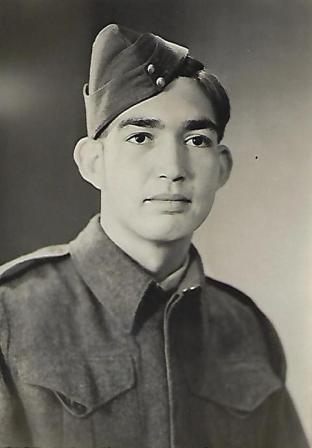
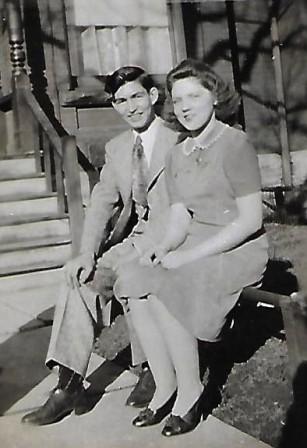
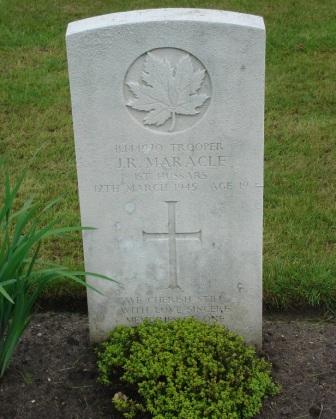
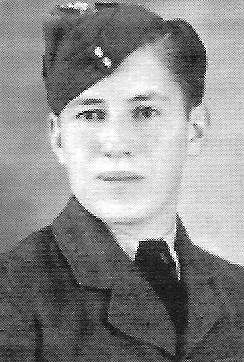
On The War Memorial Trail….. Remembering WWII Soldier Philip Laforte

March 22, 2022. Sometimes a story takes you in directions that you never expected.  After the success in finding a photo of WWII soldier Edmond COULOMBE of Manitoba (See https://onthewarmemorialtrail.com/2021/12/24/on-the-war-memorial-trail-the-successful-search-for-a-photo-of-ww2-soldier-edmond-coulombe/), we hoped to have similar success with a photo wish list of WW2 soldiers from Manitoba who are buried in the Canadian War Cemetery in Holten, The Netherlands.

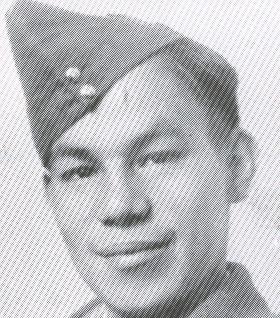
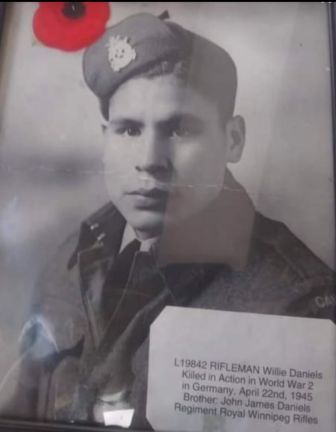
One soldier, who came from an area near where Edmond Coloumbe lived, was Philip LAFORTE.  With the help Philip’s niece Michelle Wazny, Diane Dube of the Winnipeg River Heritage Museum in St.-Georges, and genealogy researcher Judie Klassen, a photo was found, as was information on his Métis roots.

Philip was born September 12, 1911 in Lac du Bonnet, Manitoba, the son of Napoleon and Rosalie (nee Mainville) LaForte.  His mother’s Métis status meant that Philip too was Métis.

A trapper before he enlisted in Winnipeg with the Royal Winnipeg Rifles on July 31, 1941, Philip was married to Eva Jane (nee Johnston) and they had one son, Felix Joseph.  Another son, Donald Philip, was born shortly after he enlisted. Philip had previously been married to Sarah Louise Bird, who had died of tuberculosis.  Their son Leon was brought up by his grandparents, Mr and Mrs Joseph Daniels, of Sagkeeng First Nation.

Philip Laforte 3

Philip Laforte. (Photo courtesy of the Laforte family)

Philip’s service file noted that he was fluent in English, French, and Cree, and had trapped furs for the Hudson’s Bay Company, and worked as a bush labourer for Brown and Rutherford.

As a new recruit, Philip was sent to Fort William (now part of Thunder Bay), Ontario for two months of basic training.  Then he was attached to the Infantry Advanced Training Centre (Rifle) in Winnipeg, Manitoba..

On December 12, 1941, he became part of the 3rd Division Infantry Reinforcement Unit (DIRU) as a Rifleman, and was on his way to the United Kingdom, arriving on December 23, 1941.

On May 28, 1942, Philip was transferred to the Royal Winnipeg Rifles.  Still in the United Kingdom, he was taken on strength to the #1 Educational Company on November 1, 1942, and stayed in that unit until February 1943, when he was transferred to the #2 Canadian Infantry Reinforcement Unit (CIRU).

…. Philip is involved in the liberation of North-West Europe….

On April 12, 1943, Philip was reassigned to the Royal Winnipeg Rifles. On September 1, 1944 he arrived in France as reinforcement for troops lost during the Battle of Caen and the Battle of Falaise Gap.

He participated in the fight to clear the Scheldt Estuary to allow the re-opening of the Antwerp harbour. (See https://en.wikipedia.org/wiki/Battle_of_the_Scheldt) By January 1945 the Royal Winnipeg Rifles were in The Netherlands, and spent the New Year in ‘s-Hertogenbosch.

On February 1, 1945, the war diary recorded that the Regiment was informed of the part that the men “…would play in Operation Veritable…” This would take them into Germany. (See https://en.wikipedia.org/wiki/Operation_Veritable)  The Regiment arrived in Millingen, Germany on February 9, 1945.

By February 16, 1945 the Regiment was based in Essen, Germany, as they cleared German positions in flooded areas of the Rhine flood plain and the Reichswald forest, which is close to the Dutch-German border.

On March 11, 1945 the Regiment began moving back towards ‘s-Hertogenbosch, The Netherlands and the greater battle towards liberating the country.

A short video produced by the Canadian Army gives an idea of what troops faced in this period:

….The battle for Deventer involved crossing the Schipbeek ….

CIMG9306 Sep 25 2017 map of Deventer liberation from Edwin

Movement of Canadian troops towards Deventer.  Note that all first had to cross the Schipbeek.  (Map provided by Edwin van der Wolf)

On April 7, 1945 the Royal Winnipeg Rifles were ordered to cross the Schipbeek and establish a bridgehead as preparation for an assault on the city of Deventer by the 7th Canadian Brigade.

Crossing the Schipbeek was vital to the success of the bridge operation, not an easy feat as the Bridge was strongly defended by the Germans.

Lt Donald Charles MACKENZIE of Springhill, Nova Scotia received a Military Cross for his actions in ensuring the bridgehead was secured.  The citation explained how the Regiment was surrounded by enemy troops and soldiers faced intense fire. (See https://onthewarmemorialtrail.com/2022/01/23/on-the-war-memorial-trail-the-ww2-soldier-from-springhill-who-received-a-memorial-cross/)

Unfortunately, one of the casualties during the events of April 7, 1945 was Philip Laforte, and it seems most likely that he lost his life during the crossing of the Schipbeek.

Along with 45 other soldiers, he was temporarily buried beside an estate in Oxe, which had been the site of the murder of Dutch resistance fighters.

On April 6, 1945, just before the Schipbeek, Royal Winnipeg Rifles troops arrived at an estate in Oxe (Oxerhof). This had been taken over as Gestapo Headquarters, but had been hastily vacated ahead of the Regiment.

To the horror of the Canadian soldier who first approached, he found the graves of ten Dutch resistance fighters, who had been shot just before the Gestapo withdrew. (For more information on De Oxerhof and the murder of 10 Dutch prisoners, see https://www.tracesofwar.com/articles/5041/Estate-The-Oxerhof-in-Deventer.htm and https://www.tracesofwar.com/sights/56914/Memorial-Execution-5-April-1945.htm)

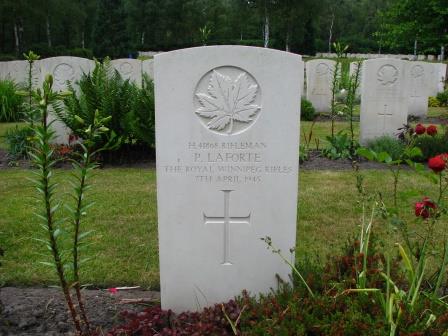
In January 1946, all 46 Canadian soldiers were reburied in the Canadian War Cemetery in Holten, The Netherlands.

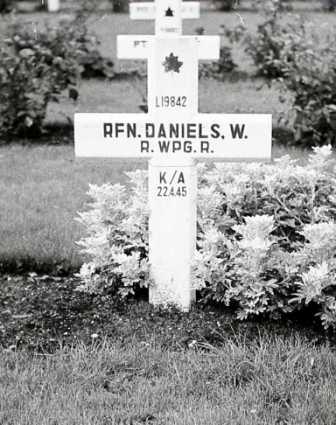
laforte, philip gravestone

Grave of Philip Laforte in the Canadian War Cemetery in Holten, The Netherlands. (Photo courtesy of the Information Centre Canadian Cemetery Holten)

…The Colmschate Memorial commemorates 46 Canadians….

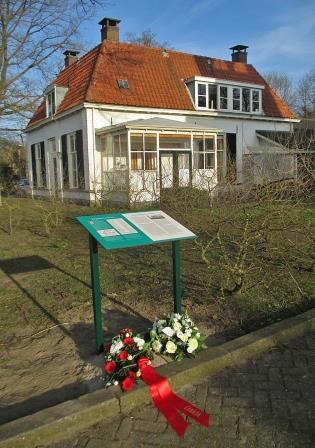
On April 8, 2015, a memorial was placed in Colmschate to commemorate the 46 Canadians who had been temporarily buried on the Oxe estate.

Gedenkbord Colmschate, 8-04-2015

Memorial in Colmschate, commemorating 46 Canadians, including Philip Laforte. (Photo courtesy of Edwin van der Wolf)

Memorial plaque placed Apr 8 2015 Colmschate

Text of Memorial in Colmschate, commemorating 46 Canadians, including Philip Laforte.  (Photo courtesy of Edwin van der Wolf)

Translation of the Dutch text was prepared by Pieter Valkenburg:

They Gave Their Lives

The liberation of Colmschate

During their advance from the Achterhoek, the Royal Winnipeg Rifles, the Regina Rifle Regiment, and the Canadian Scottish Regiment, led by Brigadier General T G Gibson reached the neighborhood of Oxe on Friday April 6, 1945. Next to the house on the Oxe estate (Oxerhof), the liberators discovered the bodies of ten Dutchmen who had been murdered in cold blood by the occupiers the day before. The Canadians passed the Schipbeek via a quickly struck bailey bridge, which replaced the destroyed Swormertoren Bridge.

Despite heavy German resistance, they continued north. Many farms went up in flames and houses were badly damaged. Many families sought refuge in the already liberated Oxe. Some residents lost their lives.

On April 8, 1945, the liberators captured (a small part of) the Snippeling, Colmschate, and the Bannink. Via the Vijfhoek they reached the Crödden Bridge over the Overijssels Canal. Schalkhaar and Deventer were then liberated and with the help of the Queen’s Own Rifles the remaining part of the Snippeling.

Many Canadians lost their lives in the battle in this area. In April 1945, the bodies of 46 fallen Canadians were buried in a temporary resting place opposite the Oxerhof house. In January 1946 they were transferred to the Canadian Cemetery in Holten (Plot I and II).

…..Philip is listed on the National Métis Veterans Memorial Monument….

Judie Klassen let us know that Philip is listed on the National Métis Veterans Memorial Monument just outside of Batoche, Saskatchewan.  (See https://www.metismuseum.ca/metisveteransmonument/)

His name can be found on Column 4 on the inside.  Row 58 https://www.metismuseum.ca/metisveteransmonument/column.php?c=4&s=i

Judie also noted that Philip and his father Napoleon (a WW1 veteran) are listed on the Sagkeeng First Nation website (see http://www.sagkeeng.ca/our-veterans/) and on their memorial in Fort Alexander (see http://www.mhs.mb.ca/docs/sites/sagkeengwarmemorial.shtml)

Thank you to Philip’s niece Michelle Wazny, Diane Dube of the Winnipeg River Heritage Museum in St.-Georges, and genealogy researcher Judie Klassen. It can be a challenge to find family and photos, and we appreciate the help we receive!  If you have photos or information to share, please let Pieter know. Email him at memorialtrail@gmail.com, or comment on the blog.

© Daria Valkenburg

…Want to follow our research?….

If you are reading this posting, but aren’t following the blog, you are welcome to do so.  Our blog address: https://onthewarmemorialtrail.com/

Front cover OnTheWarMememorialTrailinEurope

goodreads-badge-add-plus-71eae69ca0307d077df66a58ec0688984 countries, 6 weeks, 7,000 km – an unforgettable war memorial journey in Europe…. Daria’s book ‘No Soldier Buried Overseas Should Ever Be Forgotten‘ is available in print and e-book formats.  Net proceeds of book sales help support research costs and the cost of maintaining this blog. For more information see https://nosoldierforgotten.com/

You are also invited to subscribe to our YouTube Channel:On The War Memorial Trail With Pieter Valkenburg: https://www.youtube.com/channel/UCJ591TyjSheOR-Cb_Gs_5Kw.

Never miss a posting!  Subscribe below to have each new story from the war memorial trail delivered to your inbox.

On The War Memorial Trail….. Remembering WW2 Soldier Eli Ambrose Snake

December 13, 2021. After an interview about the photo quest for soldiers buried in the Canadian War Cemeteries in The Netherlands ran on APTN, Pieter was contacted by Carolyn Henry about her great-uncle Eli SNAKE, who is buried in the Canadian War Cemetery in Groesbeek, The Netherlands.

(To read the APTN article, see https://www.aptnnews.ca/national-news/dutch-born-p-e-i-man-on-a-mission-to-find-photos-of-first-nations-soldiers-killed-overseas-in-wwii/)

Carolyn explained that “….I saw your article on the APTN Facebook page. Here is a picture of my great-uncle Eli Snake (my dad’s mother’s brother) from Munsee Delaware First Nation. My dad spoke about him often as if he was a hero in our family….

Eli Snake family

Eli Snake (circled) in 1937 with his family, including his brother Gordon (far left), sister Rose Ann (seated) and brother William (far right).  Children are Rose’s children Marilyn, Bruce, Arnold, and Leo.  (Photo courtesy of Carolyn Henry).

Eli Ambrose SNAKE was born November 29, 1919 on the Munsee Reserve, the son of Eli and Marjorie (nee Peters) Snake.  Munsee-Delaware Nation, also known as Lenni Lenape, is one of several subgroups of Delaware, the Unalachtigo, the Unami, and the Minisink (later known as the Munsee), located in southwest Ontario. (For more information see https://en.wikipedia.org/wiki/Munsee-Delaware_Nation)

Prior to joining the Canadian Army, Eli worked as a farm labourer.  He enlisted on May 6, 1942 at the No.1 District Depot in Chatham, Ontario, after having earlier completed 60 days of basic training at the #12 Basic Training Centre, also in Chatham.  Eli had originally enlisted on November 15, 1941 in London, Ontario, under the National Resources Mobilization Act.

In October 1943, he was described in his Personnel Selection Record as “… quiet and well-built…” and who “…likes the Army… and gets along well with other fellows...

On November 3, 1943 he was transferred to the No 1 Training Brigade in Debert, Nova Scotia, in preparation for being sent for overseas service the following month.  On December 21, 1943 he arrived in the United Kingdom and taken on strength as part of No 3 Canadian Infantry Reinforcement Unit (CIRU).

On January 11, 1944 he was transferred to the Lincoln & Welland Regiment. By July 25, 1944 he was with his Regiment in France and then later further into Northwest Europe.

…Operation Elephant was a battle to capture the island of Kapelsche Veer….

By January 1945 the Regiment was in The Netherlands, preparing for Operation Elephant on January 25, 1945.  The objective of this battle, also known as the Battle of Kapelsche Veer, was to clear a small island, Kapelsche Veer, north of the Maas River in The Netherlands.

The island was flat, cold, windy, and water-logged during a January winter, and offered no cover against German paratroopers who already held a defensive position between two brick houses (codenamed ‘Grapes’ and ‘Raspberry’) there.  Troops were issued white snowsuits and trained in French-built canoes in preparation for an attack to capture the island.

…Eli Snake lost his life on January 28, 1945….

The Lincoln and Welland Regiment war diary for January 28, 1945 noted that it was “….clear and cold…

The struggle to clear the island was continuing from the day before with no respite. Rising temperatures had turned ice into mud.  At 23:50 on January 27, the war diary noted that “…one tank was reported bogged down….” blocking the tank behind it.

At 1 am in the morning of January 28, there was “…heavy mortaring of forward company positions from the north bank of the River Maas…”  One tank had moved forward, but ran into heavy fire with many casualties.

At noon the war diary noted that “… ‘D’ Company came under heavy mortar fire but continued to advance…” At 12:30 pm Lt Thompson “…took 30 rafts to relieve the situation…. where the enemy was making an effort to split our forces…

At some point in all this on January 28, 1945, Eli was killed in action.  He was initially buried in ‘s’Hertogenbosch before his reburial in the Canadian War Cemetery in Groesbeek, The Netherlands.

Grave of Eli Snake

Grave of Eli Snake at the Canadian War Cemetery in Groesbeek.  (Photo credit: Ad Scheepers)

Thank you to Carolyn Henry for contacting us about Eli Snake, and to Ad Scheepers for taking the photo of Eli’s grave at the cemetery.  If you have information to share about Eli SNAKE or other Canadian soldiers, please contact Pieter at memorialtrail@gmail.com, comment on the blog, or send a tweet to @researchmemori1.

© Daria Valkenburg

… More about Operation Elephant…

To learn more about Operation Elephant, see:

If you are reading this posting, but aren’t following our research, you are welcome to do so.  Our blog address: https://onthewarmemorialtrail.com/
Front cover OnTheWarMememorialTrailinEurope4 countries, 6 weeks, 7,000 km – an unforgettable war memorial journey in Europe…. Daria’s book ‘No Soldier Buried Overseas Should Ever Be Forgotten‘ is available in print and e-book formats.  Net proceeds of book sales help support research costs and the cost of maintaining this blog. For more information see https://nosoldierforgotten.com/

Screenshot_2021-02-27 On The War Memorial Trail With Pieter Valkenburg

You are invited to subscribe to our YouTube Channel: On The War Memorial Trail With Pieter Valkenburg: https://www.youtube.com/channel/UCJ591TyjSheOR-Cb_Gs_5Kw.

Never miss a posting!  Subscribe below to have each new story from the war memorial trail delivered to your inbox.

On The War Memorial Trail….. Remembering WWII Soldier Thomas Beresford Big Canoe

October 7, 2021. After an interview about the photo quest for soldiers buried in the Canadian War Cemeteries in The Netherlands ran on APTN, Pieter was contacted by Pat Stewart about Thomas Beresford BIG CANOE of Georgina Island, Ontario, who is buried in the Canadian War Cemetery in Groesbeek, The Netherlands.

(To read the APTN article, see https://www.aptnnews.ca/national-news/dutch-born-p-e-i-man-on-a-mission-to-find-photos-of-first-nations-soldiers-killed-overseas-in-wwii/)

Pat wrote “I live in southwest Saskatchewan now but came from Ontario 20 years ago. I worked as a journalist for the Georgina Advocate back then. Thank you for what you are doing. It is so very important to remember….” In 1999, Pat had written an article about a Dutch couple, Bill and Ellie Gertzen, who had adopted the grave of Thomas Big Canoe.  Bill had been an interpreter for the Canadian and American armies during WWII.

Thomas Beresford Big Canoe from Cdn Virtual War Memorial

Thomas Beresford Big Canoe.  (Photo source: Canadian Virtual War Memorial)

….Thomas was a member of the Chippewas Georgina Island First Nation….

Thomas Beresford BIG CANOE was born on Georgina Island, Ontario on October 13, 1925, the son of Thomas and Hannah (nee Porte) Big Canoe.  Georgina Island, located on Lake Simcoe, is an Indigenous reserve of the Chippewas Georgina Island First Nation, an Ojibwa (or Anishinaabeg) band.  (See https://en.wikipedia.org/wiki/Chippewas_of_Georgina_Island_First_Nation)

Thomas had begun work as a labourer at T.A. Wilson Lumber Company in Denbigh, Ontario when he enlisted at the #2 District Depot in Toronto on June 12, 1944.

He had keen eyesight and his medical exam noted he had 20/20 vision.  He was sent to the #26 Canadian Armoured Corps Basic Training Centre (CACBTC) in Orillia, Ontario.  On October 6, 1944 he was transferred to the A-10 Canadian Infantry Training Centre (CITC) in Camp Borden, Ontario.

After his basic training, and once he  turned 19 years old (the minimum age for overseas service), Thomas left for United Kingdom just before Christmas 1944. He remained in the United Kingdom until February 9, 1945, after which he was sent to Northwest Europe as part of the contingent of troops needed for the Battle of the Rhineland. The goal of this battle? Occupy the Rhineland and cross the Rhine River.

Thomas was assigned to the Royal Hamilton Light Infantry, where he was a member of the Scout Platoon.  The Scout Platoon’s role was to gain information on German activity through advance patrols, quite often behind enemy lines.

….Thomas lost his life during Operation Blockbuster….

In the push for the Battle of the Rhineland, Thomas was in the midst of Operation Blockbuster, which aimed to clear the Rhine River in Xanten, Germany, a battle that was fought between February 8 and March 10, 1945, and followed Operation Veritable.  These two Operations took 31 days.  (See https://en.wikipedia.org/wiki/Operation_Blockbuster)

On March 8, 1945, Phase II of Operation Blockbuster began. According to the war diary of the 2nd Canadian Infantry Division, of which the Royal Hamilton Light Infantry was part of, “…At 0530 this morning Op BLOCKBUSTER II began, designed to capture XANTEN and the ground to the SE. By last light 4 Cdn Inf Bde had reached all their objectives, after some very heavy fighting...” (Source: https://map.project44.ca/)

Operation Blockbuster II

It was dark that early in the morning, and raining heavily.  In Pat Stewart’s article, she quotes Bill Gertzen as explaining that on the morning of March 8, 1945, Thomas and his group from the Royal Hamilton Light Infantry had been “…directed to shape a bridgehead over the Rhine…But the Germans were expecting them and, in the battle that followed, there were only 26 survivors out of a company of 200….

Although we don’t know exactly what happened, Thomas unfortunately lost his life at some point in the March 8, 1945 battle.  He was only 19 years old.

Thomas was temporarily buried in Xanten, Germany before being reburied in the Canadian War Cemetery in Groesbeek, The Netherlands.

IMG_8567-AVB Grave of Thomas Big Canoe in Groesbeek

Grave of Thomas Beresford Big Canoe at the Canadian War Cemetery in Groesbeek.  (Photo credit: Ad Scheepers)

Thank you to Pat Stewart for contacting us about Thomas Beresford Big Canoe, and to Ad Scheepers for taking the photo of Thomas’s grave at the cemetery.  If you have information to share about Thomas Beresford Big Canoe or other Canadian soldiers, please contact Pieter at memorialtrail@gmail.com, comment on the blog, or send a tweet to @researchmemori1.

© Daria Valkenburg

…Want to follow our research?….

If you are reading this posting, but aren’t following our research, you are welcome to do so.  Our blog address: https://onthewarmemorialtrail.com/

Front cover OnTheWarMememorialTrailinEurope4 countries, 6 weeks, 7,000 km – an unforgettable war memorial journey in Europe…. Daria’s book ‘No Soldier Buried Overseas Should Ever Be Forgotten‘ is available in print and e-book formats.  Net proceeds of book sales help support research costs and the cost of maintaining this blog. For more information see https://nosoldierforgotten.com/

Screenshot_2021-02-27 On The War Memorial Trail With Pieter Valkenburg

You are also invited to subscribe to our YouTube Channel: On The War Memorial Trail With Pieter Valkenburg: https://www.youtube.com/channel/UCJ591TyjSheOR-Cb_Gs_5Kw.

Never miss a posting!  Subscribe below to have each new story from the war memorial trail delivered to your inbox.

On The War Memorial Trail….. Remembering WWII Soldier Alfred Louis Pitawanakwat (Pitwanakwat)

September 6, 2021. After an interview about the photo quest for soldiers buried in the Canadian War Cemeteries in The Netherlands ran on APTN, Pieter was contacted by Joshua Manitowabi, who explained that Alfred Pitawanakwat’s “…brothers were Thomas Pitawanakwat and Valentine Pitawanakwat and all three fought in WW2. Two returned home, but Alfred is buried overseas in Holland. Alfred was my grandfather’s brother. He was my Great-Uncle on my mom’s side. ..

(To read the APTN article, see https://www.aptnnews.ca/national-news/dutch-born-p-e-i-man-on-a-mission-to-find-photos-of-first-nations-soldiers-killed-overseas-in-wwii/)

2232439_1 Alfred Pitwanakwat from Cdn Virtual War Memorial

Alfred Louis Pitawanakwat (Pitwanakwat) (Photo source: Canadian Virtual War Memorial)

Alfred Louis PITAWANAKWAT (PITWANAKWAT) was born September 12, 1924 in Little Current, Ontario, son of Samuel and Agatha Pitwanakwat, of Wikwemikong, Ontario. Like Clarence Wilfred WAKEGIJIG, he was from the Unceded Territory on Manitoulin Island, Ontario. (For more information on the Wiikwemkoong First Nation, see https://en.wikipedia.org/wiki/Wiikwemkoong_First_Nation. To read the posting on Clarence Wilfred Wakegijig see https://onthewarmemorialtrail.com/2021/08/09/on-the-war-memorial-trail-remembering-ww2-soldier-clarence-wilfred-wakegijig/.) 

….Alfred enlisted in 1943….

Alfred enlisted on August 23, 1943 in Toronto, Ontario.  At the time, he had been working for 2 months as a farmer’s helper for George McCluny of Caledonia, Ontario.  His two older brothers were already serving overseas with the Canadian Army.  Thomas was with the #14 Company of the Canadian Forestry Corps, and William ‘Valentine’ was with the #24 Anti-Tank Battery.

In an interview with the Personnel Selection Board, it was noted that he was “…able to express himself clearly….He gives the impression of being shy, but proved a very interesting character, when encouraged to talk about himself...”  The interviewer also remarked that Alfred was good with his hands as he was “…in the habit of carving miniature boats...

Someone in the recruitment office was paying attention as a note on his attestation form was stamped with the warning that he wouldn’t be 19 years old until September 12.  This was a caution as enlistees were not to be sent overseas before the age of 19.

Alfred’s service file also noted that as he was both underage and underweight at the time of enlistment he was sent to the Royal Canadian Army Medical Corps and took basic and advanced infantry training.

….Alfred left Canada for overseas service….

On June 6, 1944 he was sent to the No 1 Transit Camp in Windsor, Ontario for ‘rations and quarters’, in preparation for going overseas with #24 Canadian General Hospital.  By June 26, 1944 he was on board a ship bound for the United Kingdom, arriving in early July 1944.

He was a runner with the hospital, but in September 1944 Alfred requested a transfer to an anti-tank battery or the infantry, explaining that as he was now fit he wanted more active employment.

The transfer request was granted and Alfred joined the Royal Winnipeg Rifles as a rifleman.  He was wounded on October 23, 1944 by a gunshot wound during the Battle of the Breskens Pocket in Belgium, but returned to his Regiment after being discharged from hospital on November 15, 1944. (See https://www.canadiansoldiers.com/history/battlehonours/northwesteurope/breskenspocket.htm)

On November 2, 1944, the Regiment was sent to Ghent, Belgium for a rest period before the Rhineland Campaign began.  From Ghent they moved into The Netherlands, stopping near the Dutch-German border.

The Regimental history, ‘Little Black Devils: a history of the Royal Winnipeg Rifles’, by Bruce Tascona and Eric Wells, describes the movement of the Regiment as it moved from The Netherlands across the border into Germany, beginning on February 8, 1945.  “… After heavy artillery and bombardment, the tanks moved in, followed by infantry. Their assignment was to push south-east from the salient at Nijmegen, clearing a corridor between the Rhine and Maas Rivers…

A salient is a piece of land or section of fortification that juts out to form an angle. Nijmegen is in The Netherlands, not far from the German border.  This area had been cleared by December 1944.  Canadian troops were kept busy here, clearing the ice on the Waal River to protect bridges further downstream.

….Alfred lost his life during the Battle of Moyland Wood….

The Regimental history account continued as the Regiment moved into Germany, “… approaching the village of Louisendorf in ‘Kangaroos’, armoured personnel carriers converted from Ram tanks. Getting within 50 yards of the enemy, the Rifles charged the remaining distance, and in close combat took 240 prisoners and occupied the village. The next day the Regiment joined the Regina Rifles and the Canadian Scottish in the attack on Moyland Wood….

They advanced into an area “…beset with booby traps, mines, snipers, and machine guns….

Moyland Woods map from Little Black Devils

Map source: ‘Little Black Devils: a history of the Royal Winnipeg Rifles’ by Bruce Tascona and Eric Wells.

An account by Terry Copp in the article ‘Clearing Moyland Wood: Army Part 43’ in the November 2002 issue of Legion Magazine explained that: “…The Royal Winnipeg Rifles left their slit trenches near Louisendorf and moved into position south of Moyland Wood. Brig. E.R. Suttie, who had replaced Brig. Stanley Todd in command of the divisional artillery, prepared an elaborate fire plan involving medium and field artillery plus mortars, anti-tank guns, machine-guns and the tanks of the Fort Garry Horse….

Lt Col Alan Gregory, temporary commander of the Regina Rifles, “….and Lt.-Col. Lockie Fulton, the aggressive young commander of the Royal Winnipeg Rifles or Little Black Devils, devised a plan to clear the eastern end of the wood combining Wasps with tank support and air attacks. …

The plan was successful, but came at a cost. “…The Royal Winnipeg Rifles displayed outstanding skill as well as courage in the day-long battle that cost the battalion more than 100 casualties, 26 of them fatal….” (See https://legionmagazine.com/clearing-moyland-wood/) Alfred was one of the fatalities, losing his life on February 21, 1945.

Map

….Alfred is buried in the Canadian War Cemetery in Groesbeek….

Alfred was initially buried in Bedburg, Germany before being reburied in the Canadian War Cemetery in Groesbeek, The Netherlands.

Grave of Alfred Pitwanakwat

Grave of Alfred Louis Pitwanakat.  (Photo credit: Ad Scheepers)

Thank you to Joshua Manitowabi for contacting us about his great-uncle, and to Ad Scheepers for taking the photo of Alfred’s grave at the cemetery.  If you have information to share about Alfred Louis PITAWANAKWAT (PITWANAKWAT) or other Canadian soldiers, please contact Pieter at memorialtrail@gmail.com, comment on the blog, or send a tweet to @researchmemori1.

© Daria Valkenburg

….Want to follow our research?….

If you are reading this posting, but aren’t following our research, you are welcome to do so.  Our blog address: https://onthewarmemorialtrail.com/

Front cover OnTheWarMememorialTrailinEurope4 countries, 6 weeks, 7,000 km – an unforgettable war memorial journey in Europe…. Daria’s book ‘No Soldier Buried Overseas Should Ever Be Forgotten‘ is available in print and e-book formats.  Net proceeds of book sales help support research costs and the cost of maintaining this blog. For more information see https://nosoldierforgotten.com/ 

Screenshot_2021-02-27 On The War Memorial Trail With Pieter Valkenburg

You are also invited to subscribe to our YouTube Channel: On The War Memorial Trail With Pieter Valkenburg: https://www.youtube.com/channel/UCJ591TyjSheOR-Cb_Gs_5Kw.

Never miss a posting!  Subscribe below to have each new story from the war memorial trail delivered to your inbox.
On The War Memorial Trail….. Adopting A Grave In Adegem

August 29, 2021. After reading about the 7 Indigenous soldiers buried at the Canadian War Cemetery in Adegem, Belgium, Edwin van der Wolf, a volunteer researcher at the Canadian War Cemetery in Holten, The Netherlands contacted Pieter. (See https://bordencarletonresearchproject.wordpress.com/2021/08/18/on-the-war-memorial-trail-7-indigenous-soldiers-buried-in-adegem-canadian-war-cemetery/)

In a translation from the original Dutch, Edwin wrote that “On your interesting blog I read about the 7 First Nations, who are buried in the Canadian cemetery in Adegem, Belgium.

At the Canadian War Cemetery in Holten I also happen to have about 13 First Nations and three Métis, who are buried with us, as a focus area.….” 

Two of the Indigenous soldiers buried in Holten have been featured on this blog:

P1370203 Edwin by Pte Allan Trelford

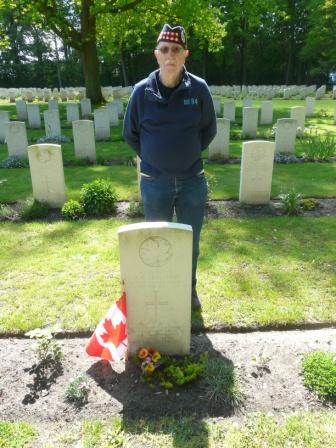
Edwin van der Wolf by the grave of Allan Trelford in the Canadian War Cemetery in Adegem.  (Photo courtesy Edwin van der Wolf)

Edwin went on to say …In addition, I am also involved in the Canadian War Cemetery in Adegem, where 38 fallen / killed soldiers of the Canadian Scottish Regiment are buried and of which I have also adopted two with my son….”  Edwin has done extensive research into the Canadian Scottish Regiment and last year began a website on them.  (See https://bordencarletonresearchproject.wordpress.com/2020/05/04/new-website-on-canadian-scottish-regiment-during-ww2/)

P1370323 May 12 2018 of the certificate of Pte Allan Trelford

On May 12, 2018, Edwin van der Wolf received his certificate for adopting the grave of Allan Homer Trelford. (Photo courtesy Edwin van der Wolf)

Edwin adopted the grave of Allan Homer TRELFORD, son of Homer A. and Eleanora Jane Trelford, of Toronto, Ontario and husband of Mildred Verna Trelford, of Toronto, who died on October 18, 1944 at the age of 23. 

On May 11, 2019, Edwin’s son Breyten adopted the grave of Joseph H. PALLISTER, son of Guy and Evelyn M. Pallister, of Turner Valley, Alberta, who died on October 6, 1944 at the age of 21.

Adoptie Certifikaat J.H. Pallister, 11-5-019

The adoption certificate issued to Breyten van der Wolf.  (Photo courtesy Edwin van der Wolf)

I asked Edwin what was involved in adopting a grave, since the upkeep of the graves and cemeteries for our Canadian war dead is the responsibility of the Commonwealth War Graves Commission.  My guess was that it involved visiting the grave and perhaps being in contact with family members back in Canada.  Edwin confirmed this and went on to explain that “...You are supposed to lay flowers at the adopted grave now and then and I also ask my Belgian contact person there to do so for me sometimes. There can also be contact with family members….

Pieter and I have been to several cemeteries in Europe and in many of the smaller ones we were the only visitors in a long while, according to the visitors log book.  So, the adoption of graves is a great idea.  

No soldier buried overseas should be forgotten

Edwin explained that, unlike in The Netherlands, “If you adopt a grave at the Adegem Canadian War Cemetery you receive a certificate of this adoption during a yearly ceremony in May…  The Dutch War Graves Commission no longer issues certificates, “…not since the 1960s...” 

Thank you to Edwin van der Wolf for sharing photos and information about the grave adoption at the Canadian War Cemetery in Adegem.  If you have information to share about Canadian soldiers, please contact Pieter at  memorialtrail@gmail.com, comment on the blog, or send a tweet to @researchmemori1

© Daria Valkenburg

….Want to follow our research?….

If you are reading this posting, but aren’t following our research, you are welcome to do so.  Our blog address: https://onthewarmemorialtrail.com/

Front cover OnTheWarMememorialTrailinEurope4 countries, 6 weeks, 7,000 km – an unforgettable war memorial journey in Europe…. Daria’s book ‘No Soldier Buried Overseas Should Ever Be Forgotten‘ is available in print and e-book formats.  Net proceeds of book sales help support research costs and the cost of maintaining this blog. For more information see https://nosoldierforgotten.com/ 

Screenshot_2021-02-27 On The War Memorial Trail With Pieter Valkenburg

You are also invited to subscribe to our YouTube Channel: On The War Memorial Trail With Pieter Valkenburg: https://www.youtube.com/channel/UCJ591TyjSheOR-Cb_Gs_5Kw

Never miss a posting!  Subscribe below to have each new story from the war memorial trail delivered to your inbox.
On The War Memorial Trail….. 7 Indigenous Soldiers Buried in Adegem Canadian War Cemetery

August 18, 2021. After reading the posting about WWII Soldier Clarence Wilfred Wakegijig, Pieter was contacted by Willy van Ee of Sas-van-Gent, The Netherlands, who explained that he is the son of Indigenous soldier Walter MEKAJI of the Sagamok Anishnawbek First Nation and Hendrike Herber of The Netherlands.  “My father also came from Wikwemikong and met my mother in Utrecht during the liberation of The Netherlands…

Willy’s compelling story has been extensively told.  See:

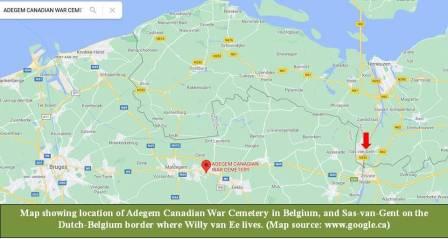
In a translation of Willy’s email exchange with Pieter, he wrote “…I live 20 km from the Adegem Canadian War Cemetery in Belgium.  Every year, on the second weekend of September, there is a ceremony with many VIPs, and a lot of people.  This year it’s on September 12. I’ve been going there for about 40 years, because of a veteran from Vancouver Island, Art BRIDGE, who has visited us a number of times.  His friend L MORGAN is buried there....”   Most likely, Willy is referring to Lionel Albert MORGAN, son of Reuben and Pearl Morgan, of Toronto, Ontario, who died on September 8, 1944 while serving with the Argyll and Sutherland Highlanders of Canada (Princess Louise’s).

Map showing Adegem Canadian War Cemetery

Willy wanted to let Pieter know that he believed that 7 Indigenous soldiers are buried in Adegem Canadian War Cemetery.  He visited the cemetery and sent the names:

No photo available

  • Maurice BELLEGARDE, son of Moise and Margaret Bellegarde, of Abernethy, Saskatchewan. Died November 3, 1944 while serving with the Regina Rifle Regiment.
Jacob Shelby Brant

Jacob Shelby Brant. (Photo source: Canadian Virtual War Memorial)

  • Jacob Shelby BRANT, born February 12, 1925 in Hagersville, Ontario, son of Austin and Bessie Brant.  Died September 11, 1944 while serving with the Lincoln and Welland Regiment, aged 19.
Harvey Dreaver

Harvey Dreaver. (Photo source: Canadian Virtual War Memorial)

  • Harvey DREAVER, born November 29, 1914 in Leask, Saskatchewan, son of Joseph and Evelyn Dreaver of Saskatoon, Saskatchewan. Husband of Mary Dreaver of Saskatoon, Saskatchewan. Died October 6, 1944 while serving with the Regina Rifle Regiment, aged 29.

No photo available

  • Joseph HENRY, son of Thomas and Philomene Henry. Husband of Alice Henry, of Roseau River Reserve, Manitoba.  Died October 2, 1944 while serving with the Algonquin Regiment, aged 22.
Roland David Riel

Roland David Riel. (Photo source: Canadian Virtual War Memorial)

  • Roland David RIEL, born December 8, 1925 in St Vital (now Winnipeg), Manitoba, son of Henry and Yvonne Mary Eugenie Riel.   Died October 15, 1944 while serving with the Regina Rifle Regiment, aged 18.
Kenneth Scribe

Kenneth Scribe. (Photo source: Canadian Virtual War Memorial)

  • Kenneth SCRIBE, son of John and Jessie Scribe, of Norway House, Manitoba. Died October 11, 1944 while serving with the Highland Light Infantry of Canada, aged 23.

No photo available

  • Charles William Myers ST GERMAINE, son of John and Lillian St. Germaine, of Rama, Ontario. Died September 16, 1944 while serving with the South Saskatchewan Regiment, aged 23.

Thank you to Willy van Ee for sharing his story and letting us know about the soldiers buried in Adegem Canadian War Cemetery.  If you have photo or information to share about any of the men mentioned in this posting, or other Canadian soldiers, please contact Pieter at memorialtrail@gmail.com, comment on the blog, or send a tweet to @researchmemori1.

© Daria Valkenburg

 ….Want to follow our research?….

If you are reading this posting, but aren’t following the blog, you are welcome to do so.  Our blog address: https://onthewarmemorialtrail.com/

Front cover OnTheWarMememorialTrailinEurope4 countries, 6 weeks, 7,000 km – an unforgettable war memorial journey in Europe…. Daria’s book ‘No Soldier Buried Overseas Should Ever Be Forgotten‘ is available in print and e-book formats.  Net proceeds of book sales help support research costs and the cost of maintaining this blog. For more information see https://nosoldierforgotten.com/

Screenshot_2021-02-27 On The War Memorial Trail With Pieter Valkenburg

You are also invited to subscribe to our YouTube Channel: On The War Memorial Trail With Pieter Valkenburg: https://www.youtube.com/channel/UCJ591TyjSheOR-Cb_Gs_5Kw.

Never miss a posting!  Subscribe below to have each new story from the war memorial trail delivered to your inbox.

On The War Memorial Trail….. Remembering WW2 Soldier Clarence Wilfred Wakegijig

August 9, 2021. After an interview about the photo quest for soldiers buried in the Canadian War Cemeteries in The Netherlands ran on APTN, Pieter was contacted by Annelind Wakegijig. (ee https://www.aptnnews.ca/national-news/dutch-born-p-e-i-man-on-a-mission-to-find-photos-of-first-nations-soldiers-killed-overseas-in-wwii/)

She sent us a photo of Clarence Wilfred WAKEGIJIG, and wrote that “…I recently saw your story featured on APTN. My great-uncle, Clarence WAKEGIJIG was from the Wiikwemkoong Unceded Territory on Manitoulin Island, Ontario. He died in Holland on March 2, 1945. He is buried in Groesbeek…”  (For more information on the Wiikwemkoong First Nation, see https://en.wikipedia.org/wiki/Wiikwemkoong_First_Nation )

Annelind explained that “… He was the youngest son of Josephine (Shawanda) Wakegijig and Joachim Wakegijig. His siblings were:

  • Victoria Corbiere 
  • Christine Wakegijig 
  • Ethel Wakegijig –  who had suffered a childhood illness and died at 5 years of age 
  • John Wakegijig -also a veteran of WWII, who died in 1971 in a motor vehicle accident 

and 

  • Raymond Wakegijig – who drowned in his late 20s 

 Clarence was a Guardsman with the Canadian Grenadier Guards…. 

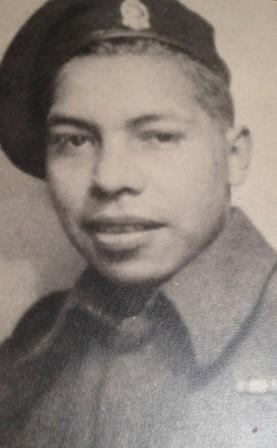
Clarence Wakegijig

Clarence Wilfred WAKEGIJIG.  (Photo Courtesy of Clarence Wakegijig Family)

Clarence was born January 9, 1925 in Cutler, Ontario, the son of Joachim and Josephine Wakegijig (nee Shawanda), of Krugersdorf, Ontario. He enlisted on September 25, 1941 with the Sault Ste Marie and Sudbury Regiment in Sudbury, Ontario, giving his birth year as 1922 and birthplace as Wikwemikong (Wiikwemkoong in Ojibwe).  The fact that he was only 16 years old, not 19, doesn’t seem to have been discovered.

He was sent to the Basic Training Centre in North Bay, Ontario.  In February 1942 Clarence was sent to the Driving and Maintenance Training School in Woodstock, Ontario, where he learned driver mechanics and how to drive a motorcycle.

On April 22, 1942 he was posted to Trois-Rivières, Quebec as reinforcement to Infantry (MG) TC A-17 – a Machine Gun Training Centre.

….Clarence arrived in Europe in 1942….

 By the end of September 1942, Clarence was on his way to the United Kingdom, arriving on October 9, 1942 and assigned to the Machine Gun Reinforcement Unit (MGRU), where he underwent additional training.

By June 1943 he had received a promotion to Trooper and was assigned to the 32nd Reconnaissance Regiment.  On September 18, 1943 he was awarded a Good Conduct Badge.

On March 19, 1944 he was assigned to the 22nd Armoured Regiment, known as the Canadian Grenadier Guards, taking further training as a driver mechanic in preparation for the Regiment moving into action in France.

The Regiment arrived in France on July 23, 1944, and underwent heavy fighting in Normandy during Operation Totalize and Operation Tractable, which led to the capture of Falaise. (For more information, see https://en.wikipedia.org/wiki/Operation_Totalize and https://en.wikipedia.org/wiki/Operation_Tractable)

Clarence survived these actions, and continued on with the Regiment as they left Normandy, France for North West Europe, fighting in Belgium, The Netherlands, and Germany.

….The Battle of Hochwald Gap was a fierce tank battle….

According to the war diary for the Canadian Grenadier Guards, the Regiment had travelled from The Netherlands just over the border into Germany, to participate in the Battle of Hochwald Gap, part of Operation Blockbuster, the final push towards the Rhine River, along with several other Canadian Regiments. (For more information, see https://canadianbattlefieldtours.ca/operation-blockbuster/ and https://civilianmilitaryintelligencegroup.com/10742/the-battle-of-hochwald-gap-one-of-the-largest-armor-engagements-you-probably-have-never-heard-of)

On February 26, 1945 they were travelling southeast from Kalkar, Germany, getting bogged down in mud and clay, and through farm fields in which mines had been hidden by the Germans, causing many casualties.

Map showing route thru Hochwald Gap

The Regiment’s objective was to reach Xanten, the last town on the western side of the Rhine, but first they had to get through the very narrow Hochwald Gap. They reached the west end of the Hochwald Gap just after dawn on February 28, 1945.

The weather continued to be uncooperative. An early thaw meant that the tanks got bogged down in mud, making them ‘sitting ducks’ for German troops who were positioned to pick them off, one by one.

The Canadian Grenadier Guards war diary entry for March 2, 1945 noted “… Weather – cloudy, gusts of rain. ...” Artillery fire had caused a temporary halt before starting up again.

…Charge was successful and the 1st objective taken, despite the fact that 6 tanks bogged before then. Confused fighting took place from here on – Lt Ferris (2 tanks) and C Company passed through, but ran into opposition in the form of a Tiger….” Clarence was in C Company.  A Tiger was a German tank.

The war diary entry continued.  “…Somewhere in here, Lt Ferris and his other tank were knocked out, and Lt Ferris was wounded by a sniper...

At some point in this chaos, Clarence lost his life, most likely when one of the tanks was hit by German fire. A 46 minute YouTube video on the Battle of Hochwald Gap explained the fierce battle that took place.  Watching it made it clear to us that it was a miracle that anyone survived at all, a testament to the determination and courage of those who were in the midst of it.

Clarence was temporarily buried in Xanten, Germany before being reburied in 1946 in the Canadian War Cemetery in Groesbeek, The Netherlands.

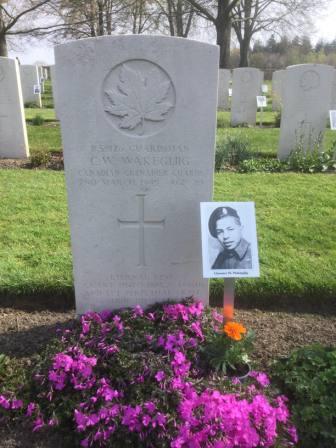
Grave of Clarence Wakegijig

Grave of Clarence Wilfred Wakegijig.  (Photo credit: Ad Scheepers)

Thank you to Annelind Wakegijig for sharing a photo and information about her great-uncle.  If you have information to share about Clarence Wilfred WAKEGIJIG or other Canadian soldiers, please contact Pieter at memorialtrail@gmail.com, comment on the blog, or send a tweet to @researchmemori1.

© Daria Valkenburg

….Want to follow our research?….

If you are reading this posting, but aren’t following our research, you are welcome to do so.  Our blog address: https://onthewarmemorialtrail.com/

Front cover OnTheWarMememorialTrailinEurope4 countries, 6 weeks, 7,000 km – an unforgettable war memorial journey in Europe…. Daria’s book ‘No Soldier Buried Overseas Should Ever Be Forgotten‘ is available in print and e-book formats.  Net proceeds of book sales help support research costs and the cost of maintaining this blog. For more information see https://nosoldierforgotten.com/

Screenshot_2021-02-27 On The War Memorial Trail With Pieter Valkenburg

You are also invited to subscribe to our YouTube Channel: On The War Memorial Trail With Pieter Valkenburg: https://www.youtube.com/channel/UCJ591TyjSheOR-Cb_Gs_5Kw.

Never miss a posting!  Subscribe below to have each new story from the war memorial trail delivered to your inbox.

On The War Memorial Trail….. Remembering WWII Soldier William (Willie) Daniels

July 23, 2021. Over the past months, Pieter has been diligently working his way through photo wish lists from Dutch researchers at the Canadian War Cemetery in Holten, The Netherlands.  Two names on the lists were members of First Nations: William ‘Willie’ DANIELS, a Cree Nation member from Saskatchewan, and Stanley Owen JONES, a Haida Nation member from British Columbia.  Both men are buried in the Canadian War Cemetery in Holten, The Netherlands.

Pieter had no luck in finding family so, as he has done over the past years, he turned to the media for help, this time from APTN, where he was interviewed by Brett Forester.  (To read the article, see https://www.aptnnews.ca/national-news/dutch-born-p-e-i-man-on-a-mission-to-find-photos-of-first-nations-soldiers-killed-overseas-in-wwii/)

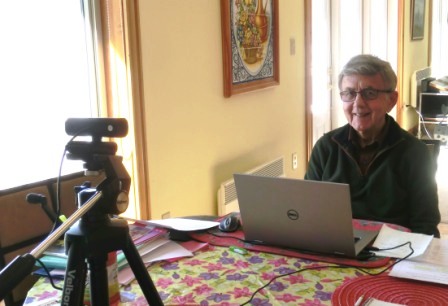
CIMG5084 Mar 17 2021 Pieter Valkenburg

Pieter on a Zoom interview with Brett Forester of APTN.  (Photo credit:  Daria Valkenburg)

Several readers of the article came forward to share photos and information about Indigenous soldiers, and these will be featured in future postings as Pieter completes his research.  (The story of Leo Francis TONEY was told previously.  See https://onthewarmemorialtrail.com/2021/05/22/on-the-war-memorial-trail-remembering-ww2-soldier-leo-francis-toney/)

… William Daniels was a member of the Sturgeon Lake First Nation…

What about the two soldiers mentioned in the article?  A photo of William ‘Willie’ DANIELS was sent by Dakota Ballantyne on behalf of Vince Daniels, with a note saying that “Willie Daniels from Sturgeon Lake First Nation, Saskatchewan was his uncle….

William Daniels

William ‘Willie’ Daniels. (Photo courtesy of Vince Daniels)

The son of John Daniels, Willie was born March 20, 1925 on the Big River Reserve in Depton, Saskatchewan.  On September 24, 1941, he enlisted in Saskatoon, Saskatchewan, stating that he was born in 1922.  He was sent for training as a Sapper with the Royal Canadian Engineers, until it was discovered he was underage. He was discharged in March 1942 for being “…under 17 years of age at date of application….

On October 19, 1943, Willie re-enlisted.  According to his military records, his parents were dead and he listed a brother, Narcisse Daniels, as his next-of-kin.  He also noted that he spoke English and Cree. This time he was allowed to stay in the army, but on Canadian soil as soldiers under 19 years of age were not to be sent overseas.

It wasn’t until May 1, 1944 that he left for the United Kingdom, arriving on May 8 for additional training.  On July 7, 1944 he was transferred to the Royal Winnipeg Rifles as a Rifleman and sent to Northwest Europe.

… The Royal Winnipeg Rifles were in Germany and The Netherlands in 1945…

The war diary of the Royal Winnipeg Rifles gives an indication of what Willie Daniels and his fellow soldiers experienced in 1945. By January 1945 the Royal Winnipeg Rifles were in The Netherlands, and spent the New Year in ‘s-Hertogenbosch.  The war diary for January 1, 1945 states that “…the Germans precipitated the New Year by opening up with considerable SA and mortar fire a few minutes before midnight.  Our artillery answered directly at midnight…..

On February 1, 1945, the war diary recorded that the Regiment was informed of the part that the men “…would play in Operation Veritable…” This would take them into Germany. (See https://en.wikipedia.org/wiki/Operation_Veritable)

The Regiment arrived in Millingen, Germany on February 9, 1945.  The weather was uncooperative “…cloudy with rain….” and led to flooding.  In one area, the water rose “…another six feet, the only high ground in the area being in and near Keeken…

They were ordered to move further back, but some of the men were stranded due to a shortage of equipment to get them out, or because the equipment itself got “…bogged down or diverted for other purposes….

By February 16, 1945 the Regiment was based in Essen, Germany, as they cleared German positions in flooded areas of the Rhine flood plain and the Reichswald forest, which is close to the Dutch-German border.

On March 11, 1945 the Regiment began moving back towards ‘s-Hertogenbosch.  “…The whole day was spent in building the new camp….”  There were some peaceful days and time for training before the men moved back towards a base in Essen to participate in Operation Plunder. (See https://canadianbattlefieldtours.ca/operation-plunder/)

The war diary for March 27, 1945 reported that “…Orders to move came through in the early hours of the morning ….. and after many starts and stops we finally crossed the Rhine River at 1700 hours…

On April 10, 1945 the war diary noted that the Regiment “….would take over from the Regina Rifle Regiment…” and returned to The Netherlands, this time based in Almelo.  Then, on April 18, they were ordered to Groningen.

Map showing Appingedam

Purple arrow on the map indicates movement from Groningen towards Delfzijl, and Appingedam, where Willie Daniels lost his life.  The map also indicates the location of Loppersum, where he was initially buried.

On April 21, 1945 the Regiment was ordered to move towards Appingedam.  The war diary noted that on April 21, 1945 “…civilian reports claim mines set in cement….Blown bridges, snipers, and machine guns make the going very difficult.  Our casualties are becoming very heavy….

At some point on April 22, 1945, a few weeks after his 20th birthday, Willie Daniels lost his life.  The movement of troops through Appingedam was the very beginning of the Battle of the Delfzijl Pocket. Willie was initially buried in Loppersum General Cemetery in Groningen.  After the war Willie was reburied in the Canadian War Cemetery in Holten.

initial gravemarker for Willie Daniels

Initial burial marker for Willie Daniels.  (Photo courtesy of Library and Archives Canada, service file for William Daniels)

In March 1948, Mrs. W.G. Verbeek-Hermans of Enschede sent a letter to Veterans Affairs, asking that her letter be forwarded to a family member of Willie.  She wanted to let the family know that she had adopted Willie’s grave, a volunteer program that was organized by the Netherlands War Graves Committee. A separate letter for the family was enclosed, explaining that she was the mother of 4 children and felt it was her duty to look after the grave.  She also offered to send a photo of his grave.

This was not unusual. Many family members of soldiers that we have met over the years have explained that their families had been in contact with Dutch citizens who adopted a grave.

In 1995, the Stefanus Church in Holwierde placed a plaque to commemorate Canadian soldiers who lost their lives during the Battle of the Delfzijl Pocket.  Willie Daniels was one of the men commemorated.

Plaque at Stefanus Church in Holwierde

Plaque at Stefanus Church in Holwierde, The Netherlands.  (Source: https://www.tracesofwar.nl/sights/40531/Herinneringsplaquette-Stefanus-Kerk.htm)

Current grave of Willie Daniels

Grave of Willie Daniels at the Canadian War Cemetery in Holten.  (Photo courtesy of Canadian Virtual War  Memorial)

Thank you to Dakota Ballantyne and Vince Daniels for sharing a photo of William ‘Willie’ Daniels.  Thank you also to Brett Forester and APTN for the article on the search for photos of Indigenous soldiers buried in The Netherlands.

If you have information to share about William ‘Willie’ Daniels or other Canadian soldiers buried in The Netherlands, please contact Pieter at memorialtrail@gmail.com, or comment on the blog.

© Daria Valkenburg

…Other soldiers who lost their lives during the Battle of the Delfzijl Pocket …..

For previous stories on soldiers who lost their lives during the Battle of the Delfzijl Pocket, please see:

…Want to follow our research?…

If you are reading this posting, but aren’t following our research, you are welcome to do so.  Our blog address: https://onthewarmemorialtrail.com/

Front cover OnTheWarMememorialTrailinEurope4 countries, 6 weeks, 7,000 km – an unforgettable war memorial journey in Europe…. Daria’s book ‘No Soldier Buried Overseas Should Ever Be Forgotten‘ is available in print and e-book formats.  Net proceeds of book sales help support research costs and the cost of maintaining this blog. For more information see https://nosoldierforgotten.com/

Screenshot_2021-02-27 On The War Memorial Trail With Pieter Valkenburg

You are also invited to subscribe to our YouTube Channel: On The War Memorial Trail With Pieter Valkenburg: https://www.youtube.com/channel/UCJ591TyjSheOR-Cb_Gs_5Kw.

Never miss a posting!  Subscribe below to have each new story from the war memorial trail delivered to your inbox.

On The War Memorial Trail….. Remembering WWII Soldier Leo Francis Toney

May 22, 2021. No soldier buried overseas should be forgotten. This statement by Pieter underlines the efforts he has been making over the past years.  Currently he’s been working his way through a ‘photo wish list’ of soldiers buried in The Netherlands, on behalf of Dutch researchers.  After completing a list of soldiers from Prince Edward Island, last fall he started on a list of soldiers from New Brunswick and Nova Scotia who are buried in the Canadian War Cemetery in Holten.

In January 2021 a series entitled Atlantic Canada Remembers began on this blog.  Currently it’s up to Part 9, with ongoing research for Part 10.  The list has expanded to include the two Canadian War Cemeteries in Groesbeek and Bergen Op Zoom, and Adegem Canadian War Cemetery in Belgium.

An article ‘First Nations in The Second World War’ by Berry Swarthoff and Glenn Miller, published in the Dutch magazine ‘Nanai’ noted that after Canada declared war in 1939, “the country’s indigenous community responded quickly…. Officially, about 4,000 First Nations soldiers served abroad in World War I, while 4,250 First Nations soldiers served in World War II. Recent research has shown that thousands of other First Nations, Métis and Inuit soldiers … volunteered without identifying themselves as a First Nation….In total, more than 500 native soldiers died…”  This posting honours the sacrifice of one of these Indigenous soldiers.

….Remembering Leo Toney….

Leo Toney

Leo Francis Toney. (Photo courtesy of the Toney Family)

When Della Maguire contributed photos and information about her uncle, Leo Francis TONEY, on behalf of the Toney family, she explained that he “…was of Mi’kmaq ancestry and a member of the Annapolis Valley First Nation in Nova Scotia. The Mi’kmaq way to spell Leo is Li’o…

Born March 24, 1924 in Wolfville, Nova Scotia, Leo was the son of Frank Robert Toney and Mary Lucy Bradford of Cambridge, Nova Scotia.

Before he enlisted in 1943 in Halifax, Nova Scotia, Leo worked as a farmer for Earl Brown of Cambridge.  Upon enlistment he was initially stationed at the No 6 District Depot on Chebucto Road in Halifax.

On January 14, 1944 he was sent to the Canadian Infantry Training Centre (CITC) in Yarmouth, Nova Scotia for training.  On April 30, 1944 he was assigned to the Canadian Infantry Training Centre (CITC) in Aldershot, Nova Scotia.

He arrived in the United Kingdom on July 27, 1944 and transferred to the Canadian Base Reinforcement Group (CBRG).   On August 18, 1944 he went to France as a member of the PEI Light Horse Regiment, and then, on October 6, 1944 was transferred to the South Saskatchewan Regiment.

leo xxx

Leo Francis Toney. (Photo courtesy of the Toney Family)

….The South Saskatchewan Regiment liberated the Schipbeek Canal bridge….

In a brief account by Lt Col G. B. Buchanan in ‘The March Of The Prairie Men – being a story of the South Saskatchewan Regiment’, in early April 1945, the liberation of Holten, The Netherlands, began as troops crossed the Twente Canal and began to build a bridge. “...The intention of the 6th Canadian Infantry Brigade was to pass through 5th Canadian Infantry Brigade and hold a bridgehead over the Schipbeek Canal north of Laren….”  (See https://en.wikipedia.org/wiki/Schipbeek)

They made it safely across on April 5.  They got stuck at the Schipbeek after the Germans blew up all bridges on April 6, and a bridgehead was formed at a weir on the border of the municipalities of Bathmen and Holten. The heavily defended Wipperts Bridge (Wippertsbrug) was a major obstacle between Laren and Holten.

…The South Saskatchewan Regiment was to make the crossing with ‘H’ hour set at 0330 hours, 7th April.  ‘C’ and ‘D’ Companies were to make the initial crossings with ‘A’ and ‘B’ Companies passing through them.  The opening artillery barrage caused casualties when a few rounds fell short….

….10 soldiers were buried on Nijenhuis farm…

At some point during the fighting, Leo was killed in action on Saturday, April 7, 1945. In addition to Leo, the following members of the South Saskatchewan Regiment lost their lives in the battle:

  • Pte Murray James Hilton ELLIS, died April 9, 1945
  • Lt Richard Kelso KERR, of Port Arthur, Ontario, died April 8, 1945
  • Pte Edwin Allan ‘Eddie’ NUGENT, of Delisle, Saskatchewan, died April 9, 1945
  • Pte Arthur Francis PURCELL, of  East Petpeswick, Nova Scotia, died April 7, 1945
  • Pte Elmer Alphonso RICHARDS, of  Thorold, Ontario, died April 7, 1945
  • Pte Neil Patrick O‘Connor STEWART, of St. Paul, Alberta, died April 8, 1945
  • Sgt Kenneth Earl STUBBS, of Winnipeg, Manitoba, died April 7, 1945

Leo and his fellow soldiers from the South Saskatchewan Regiment, with the exception of Nugent and Stewart, were temporarily buried in a field on the Nijenhuis farm, along with 4 soldiers from other Regiments:

  • Lance Cpl Roger George COLLIN, Le Regiment de Maisonneuve, of Gogama, Ontario, died April 9, 1945
  • Sgt Donald Mayford FIFE, Canadian Provost Corps, of Halfway River, Nova Scotia, died April 7, 1945
  • Sapper Andrew Lawrence FORD, Royal Canadian Engineers, of St. Thomas, Ontario, died April 7, 1945
  • Pte Cyrille GIGUERE, Le Regiment de Maisonneuve, of Quebec City, Quebec, died April 9, 1945
Map showing Nijenhuis farm location

Map showing location of burials on the Nijenhuis farm.  (Map courtesy of the Holten Canadian War Cemetery Information centre.)

An account in ‘The Liberation Of The Beuseberg – How Canadians set a village in the Netherlands free’ quotes Bertus Ebrecht, who was 16 years old at the time, that the burials were “…in the meadow of Nijenhuis, about 70 metres from the ‘Larensweg’…”  This book, edited by Agnes van Wieringen, written by Joice Schutte, records the stories told to Gert Jansen by the people from the Beuseberg area.

In another excerpt from the book, Florina Dijkshoorn, 15 years old at the time, recalled that the Nijenhuis farm housed a German hospital.  “…April 7, half past four, it was still dim….”  People had been hiding in a dugout shelter, and after the shooting stopped, they were able to get out.  “… we walked to the farm….The German hospital flag was replaced by an allied flag.  What we also saw were a lot of soldiers walking in the meadow and on the road from the direction of ‘Schipbeek’. We had to go to Meijerman’s farm. Nijenhuis’ farm was probably filled with wounded Canadians…..

When they were allowed to leave “…we were shown a path in the meadow which was cleared of explosive material.  It also meant we had to walk along the dead.  Once I was alone….I …. thought of all the mothers, fathers, women and children that might not even know they were dead!…. An hour later they were picked up and carried away in a closed lorry….

On April 7, 2016 a memorial was placed to honour the members of the South Saskatchewan Regiment who died during this event. (See https://www.tracesofwar.com/sights/100747/Memorial-The-South-Saskatchewan-Regiment.htm)

….Nugent and Stewart were buried elsewhere….

Map showing location of Nijenhuis farm and burial location near Lochem

Map showing location of burials on the Nijenhuis farm and near Lochem.  (Map courtesy of the Holten Canadian War Cemetery Information centre.)

I asked Henk Vincent, one of the researchers for the Canadian War Cemetery in Holten, if he had information on where Nugent and Stewart were first buried.  He confirmed that they “were temporarily buried near Lochem, where there was a military hospital at the time. Perhaps they had been transported there seriously injured….

….Leo’s brother-in-law was concerned….

Della’s father, Abraham ‘Abe’ SMITH, was with the Royal Canadian Army Service Corps 36 Depot, an administrative and transport corps of the Canadian Army. “….My Father enlisted in September 1, 1943.  He became a truck driver delivering food, supplies, troops, and equipment to various places in England, Germany, France and Belgium, and was discharged May 29, 1946….”  (To learn more about Abraham Smith, see https://www.saltwire.com/atlantic-canada/news/canada/honouring-first-nations-wartime-experiences-accomplished-nova-scotian-mikmaq-basket-maker-remembered-518058/)

Abe had a feeling something had happened to his brother-in-law.   “….When he told us about Uncle Leo he said: ‘I used to write to Leo and he’d write back. I didn’t hear from him for a long time and I told Rita he must be wounded or got killed’….”   They had been in regular correspondence with each other and the silence suggested Leo was either wounded or had lost his life.

… Leo has a permanent resting place at the Canadian War Cemetery in Holten….

Leo was reburied at the Canadian War Cemetery in Holten after the war.

toney, leo francis

Grave of Leo Toney at the Canadian War Cemetery in Holten.  (Photo courtesy of Holten Canadian War Cemetery Information Centre)

Della reflected that her Uncle Leo “would have been proud of his sister, my mother Rita, for being the only Mi’kmaq woman to become Chief of two communities…

Thank you to Della Maguire for sharing photos and anecdotes of Leo Toney.  If you have information to share about Leo Toney or any Canadian soldiers buried in The Netherlands, please contact Pieter at memorialtrail@gmail.com, or comment on the blog.

© Daria Valkenburg

…Want to follow our research?….

If you are reading this posting, but aren’t following the blog, you are welcome to do so.  Our blog address: https://onthewarmemorialtrail.com/

Front cover OnTheWarMememorialTrailinEurope4 countries, 6 weeks, 7,000 km – an unforgettable war memorial journey in Europe…. Daria’s book ‘No Soldier Buried Overseas Should Ever Be Forgotten‘ is available in print and e-book formats.  Net proceeds of book sales help support research costs and the cost of maintaining this blog. For more information see https://nosoldierforgotten.com/

Screenshot_2021-02-27 On The War Memorial Trail With Pieter Valkenburg

You are also invited to subscribe to our YouTube Channel: On The War Memorial Trail With Pieter Valkenburg: https://www.youtube.com/channel/UCJ591TyjSheOR-Cb_Gs_5Kw.

Never miss a posting!  Subscribe below to have each new story from the war memorial trail delivered to your inbox.

Commemorating Liberation Day At The Canadian War Cemetery In Groesbeek

20210505_091943 May 5 2021 Dutch flag on Liberation Day

The Dutch flag flies proudly at the Valkenburg household on Liberation Day. (Photo credit: Daria Valkenburg)

May 5, 2021.  Last year, one of the events planned for the 75th Anniversary of the Liberation of The Netherlands was to place photos by the graves of soldiers at the Canadian War Cemetery in Groesbeek.  Unfortunately, due to social distancing measures, this had to be cancelled.  Instead, white tulips were placed at each grave.  (See   https://bordencarletonresearchproject.wordpress.com/2020/05/05/tulips-placed-at-each-grave-at-the-canadian-war-cemetery-in-groesbeek/)

This year, the planned photo tribute was possible, with photos placed at more than 1,600 graves. They will remain in place until May 17. Readers of this blog are aware that Pieter has been working towards finding as many photos as possible from the Atlantic region over the past few years.  Here on PEI, all but two soldiers buried in this cemetery have their photo tributes.  We asked Alice van Bekkum, Chair of the Groesbeek Faces to Graves Committee,  to take photos of 4 soldiers whose stories have been previously told here.

….Graves of 4 PEI soldiers ….

IMG_8528 Grave of Willie Cannon

Grave of William ‘Willie’ Alfred Cannon. (Photo courtesy of Alice van Bekkum)

To read about William ‘Willie’ Alfred CANNON of Mt Mellick, please see https://bordencarletonresearchproject.wordpress.com/2018/08/04/canadian-war-graves-netherlands-foundation-project/

IMG_8522 Grave of Joe Hennebery

Grave of Joseph ‘Joe’ Edmund Hennebery. (Photo courtesy of Alice van Bekkum)

To read about Joseph ‘Joe’ Edmund HENNEBERY of Morell, please see https://bordencarletonresearchproject.wordpress.com/2020/05/31/on-the-war-memorial-trail-a-face-for-joseph-hennebery/

IMG_8526 Grave of George Preston Smith

Grave of George Preston Smith.  (Photo courtesy of Alice van Bekkum)

To read about George Preston SMITH of Kinkora, please see:

IMG_8523 Grave of William Weatherbie

Grave of William Weatherbie.  (Photo courtesy of Alice van Bekkum)

To read about William WEATHERBIE of Charlottetown, please see https://bordencarletonresearchproject.wordpress.com/2019/09/29/a-face-for-ww2-soldier-william-weatherbie/

Alice shared a short video in which she is interviewed, and volunteers can be seen placing the photos by the graves.  The photos were printed onto an aluminum backing, making them impervious to rain.  Whether you understand Dutch or not, the video is wonderful as it shows the care and precision taken for this photo tribute.

….Graves of 3 Indigenous soldiers….

Recently, several photos have come in for soldiers whose stories Pieter is still researching.  Three of these are of Indigenous soldiers, which came about after an article about Pieter’s search for photos was written by Brett Forester of APTN News.  (See https://www.aptnnews.ca/national-news/dutch-born-p-e-i-man-on-a-mission-to-find-photos-of-first-nations-soldiers-killed-overseas-in-wwii/) Their stories will be told in a future posting.

Pieter asked his friend and former colleague, Ad Scheepers, if he would take photos of 3 graves at the cemetery in Groesbeek.  Ad visited the cemetery and placed an orange flower beside each grave he took a photo of.

Grave of Alfred Pitwanakwat

Grave of Alfred Louis Pitwanakat.  (Photo credit: Ad Scheepers)

Alfred Louis PITAWANAKWAT (PITWANAKWAT) was born September 12, 1924 in Little Current, Ontario, son of Agatha Pitwanakwat, of Wikwemikong, Ontario.

Grave of Eli Snake

Grave of Eli Snake. (Photo credit: Ad Scheepers)

Eli SNAKE was born November 29, 1919 on the Muncey Reserve, the son of Eli and Marjorie Snake.

Grave of Clarence Wakegijig

Grave of Clarence Wilfred Wakegijig.  (Photo credit: Ad Scheepers)

Clarence Wilfred WAKEGIJIG was born January 9, 1925 in Wikemwikong, Ontario, the son of Joachim and Josephine Wakegijig (nee Shawanda), of Krugersdorf, Ontario.

Ad wrote that while he was near the grave of Alfred Pitwanakat, “….a boy visiting the site with his family put a Canadian flag in front of the grave of Alfred….

Child places flag by Alfreds grave

A young boy places a flag by the grave of Alfred Pitwanakat. (Photo credit: Ad Scheepers)

Child by Alfreds grave

A young boy inspects the flag he placed by the grave of Alfred Pitwanakat.  (Photo credit: Ad Scheepers)

It’s clear that the Dutch pass on the importance of remembrance to the next generation so they can continue to remember those who lost their lives in WW2!

Thank you to Alice van Bekkum and Ad Scheepers for their kindness in taking the photos of the graves.  If you have information to share about any Canadian soldiers buried in The Netherlands, please contact Pieter at  memorialtrail@gmail.com, comment on the blog, or send a tweet to @researchmemori1.

© Daria Valkenburg

…Want to follow our research?…

If you are reading this posting, but aren’t following our research, you are welcome to do so.  Our blog address: https://onthewarmemorialtrail.com/

4 countries, 6 weeks, 7,000 km – an unforgettable war memorial journey in Europe…. Daria’s book ‘No Soldier Buried Overseas Should Ever Be Forgotten‘ is available in print and e-book formats.  Net proceeds of book sales help support research costs and the cost of maintaining this blog. For more information see https://nosoldierforgotten.com/

Screenshot_2021-02-27 On The War Memorial Trail With Pieter Valkenburg

You are also invited to subscribe to our YouTube Channel: On The War Memorial Trail With Pieter Valkenburg: https://www.youtube.com/channel/UCJ591TyjSheOR-Cb_Gs_5Kw.

Never miss a posting!  Subscribe below to have each new story from the war memorial trail delivered to your inbox.