On The War Memorial Trail….. Remembering WWII Soldier Leo Francis Toney

May 22, 2021. No soldier buried overseas should be forgotten. This statement by Pieter underlines the efforts he has been making over the past years.  Currently he’s been working his way through a ‘photo wish list’ of soldiers buried in The Netherlands, on behalf of Dutch researchers.  After completing a list of soldiers from Prince Edward Island, last fall he started on a list of soldiers from New Brunswick and Nova Scotia who are buried in the Canadian War Cemetery in Holten.

In January 2021 a series entitled Atlantic Canada Remembers began on this blog.  Currently it’s up to Part 9, with ongoing research for Part 10.  The list has expanded to include the two Canadian War Cemeteries in Groesbeek and Bergen Op Zoom, and Adegem Canadian War Cemetery in Belgium.

An article ‘First Nations in The Second World War’ by Berry Swarthoff and Glenn Miller, published in the Dutch magazine ‘Nanai’ noted that after Canada declared war in 1939, “the country’s indigenous community responded quickly…. Officially, about 4,000 First Nations soldiers served abroad in World War I, while 4,250 First Nations soldiers served in World War II. Recent research has shown that thousands of other First Nations, Métis and Inuit soldiers … volunteered without identifying themselves as a First Nation….In total, more than 500 native soldiers died…”  This posting honours the sacrifice of one of these Indigenous soldiers.

….Remembering Leo Toney….

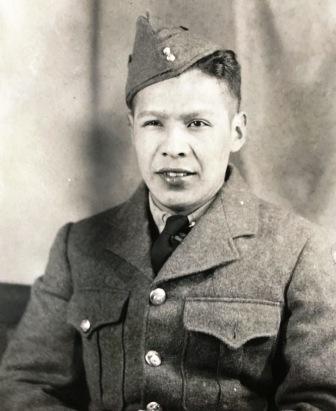
Leo Toney

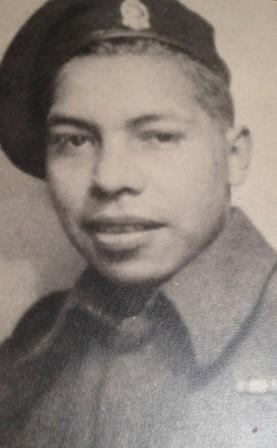
Leo Francis Toney. (Photo courtesy of the Toney Family)

When Della Maguire contributed photos and information about her uncle, Leo Francis TONEY, on behalf of the Toney family, she explained that he “…was of Mi’kmaq ancestry and a member of the Annapolis Valley First Nation in Nova Scotia. The Mi’kmaq way to spell Leo is Li’o…

Born March 24, 1924 in Wolfville, Nova Scotia, Leo was the son of Frank Robert Toney and Mary Lucy Bradford of Cambridge, Nova Scotia.

Before he enlisted in 1943 in Halifax, Nova Scotia, Leo worked as a farmer for Earl Brown of Cambridge.  Upon enlistment he was initially stationed at the No 6 District Depot on Chebucto Road in Halifax.

On January 14, 1944 he was sent to the Canadian Infantry Training Centre (CITC) in Yarmouth, Nova Scotia for training.  On April 30, 1944 he was assigned to the Canadian Infantry Training Centre (CITC) in Aldershot, Nova Scotia.

He arrived in the United Kingdom on July 27, 1944 and transferred to the Canadian Base Reinforcement Group (CBRG).   On August 18, 1944 he went to France as a member of the PEI Light Horse Regiment, and then, on October 6, 1944 was transferred to the South Saskatchewan Regiment.

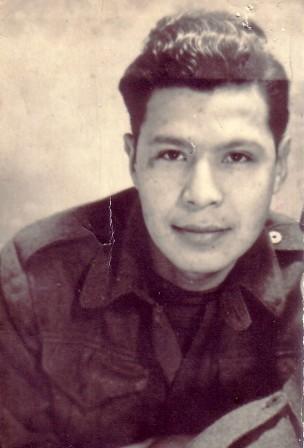
leo xxx

Leo Francis Toney. (Photo courtesy of the Toney Family)

….The South Saskatchewan Regiment liberated the Schipbeek Canal bridge….

In a brief account by Lt Col G. B. Buchanan in ‘The March Of The Prairie Men – being a story of the South Saskatchewan Regiment’, in early April 1945, the liberation of Holten, The Netherlands, began as troops crossed the Twente Canal and began to build a bridge. “...The intention of the 6th Canadian Infantry Brigade was to pass through 5th Canadian Infantry Brigade and hold a bridgehead over the Schipbeek Canal north of Laren….”  (See https://en.wikipedia.org/wiki/Schipbeek)

They made it safely across on April 5.  They got stuck at the Schipbeek after the Germans blew up all bridges on April 6, and a bridgehead was formed at a weir on the border of the municipalities of Bathmen and Holten. The heavily defended Wipperts Bridge (Wippertsbrug) was a major obstacle between Laren and Holten.

…The South Saskatchewan Regiment was to make the crossing with ‘H’ hour set at 0330 hours, 7th April.  ‘C’ and ‘D’ Companies were to make the initial crossings with ‘A’ and ‘B’ Companies passing through them.  The opening artillery barrage caused casualties when a few rounds fell short….

….10 soldiers were buried on Nijenhuis farm…

At some point during the fighting, Leo was killed in action on Saturday, April 7, 1945. In addition to Leo, the following members of the South Saskatchewan Regiment lost their lives in the battle:

  • Pte Murray James Hilton ELLIS, died April 9, 1945
  • Lt Richard Kelso KERR, of Port Arthur, Ontario, died April 8, 1945
  • Pte Edwin Allan ‘Eddie’ NUGENT, of Delisle, Saskatchewan, died April 9, 1945
  • Pte Arthur Francis PURCELL, of  East Petpeswick, Nova Scotia, died April 7, 1945
  • Pte Elmer Alphonso RICHARDS, of  Thorold, Ontario, died April 7, 1945
  • Pte Neil Patrick O‘Connor STEWART, of St. Paul, Alberta, died April 8, 1945
  • Sgt Kenneth Earl STUBBS, of Winnipeg, Manitoba, died April 7, 1945

Leo and his fellow soldiers from the South Saskatchewan Regiment, with the exception of Nugent and Stewart, were temporarily buried in a field on the Nijenhuis farm, along with 4 soldiers from other Regiments:

  • Lance Cpl Roger George COLLIN, Le Regiment de Maisonneuve, of Gogama, Ontario, died April 9, 1945
  • Sgt Donald Mayford FIFE, Canadian Provost Corps, of Halfway River, Nova Scotia, died April 7, 1945
  • Sapper Andrew Lawrence FORD, Royal Canadian Engineers, of St. Thomas, Ontario, died April 7, 1945
  • Pte Cyrille GIGUERE, Le Regiment de Maisonneuve, of Quebec City, Quebec, died April 9, 1945
Map showing Nijenhuis farm location

Map showing location of burials on the Nijenhuis farm.  (Map courtesy of the Holten Canadian War Cemetery Information centre.)

An account in ‘The Liberation Of The Beuseberg – How Canadians set a village in the Netherlands free’ quotes Bertus Ebrecht, who was 16 years old at the time, that the burials were “…in the meadow of Nijenhuis, about 70 metres from the ‘Larensweg’…”  This book, edited by Agnes van Wieringen, written by Joice Schutte, records the stories told to Gert Jansen by the people from the Beuseberg area.

In another excerpt from the book, Florina Dijkshoorn, 15 years old at the time, recalled that the Nijenhuis farm housed a German hospital.  “…April 7, half past four, it was still dim….”  People had been hiding in a dugout shelter, and after the shooting stopped, they were able to get out.  “… we walked to the farm….The German hospital flag was replaced by an allied flag.  What we also saw were a lot of soldiers walking in the meadow and on the road from the direction of ‘Schipbeek’. We had to go to Meijerman’s farm. Nijenhuis’ farm was probably filled with wounded Canadians…..

When they were allowed to leave “…we were shown a path in the meadow which was cleared of explosive material.  It also meant we had to walk along the dead.  Once I was alone….I …. thought of all the mothers, fathers, women and children that might not even know they were dead!…. An hour later they were picked up and carried away in a closed lorry….

On April 7, 2016 a memorial was placed to honour the members of the South Saskatchewan Regiment who died during this event. (See https://www.tracesofwar.com/sights/100747/Memorial-The-South-Saskatchewan-Regiment.htm)

….Nugent and Stewart were buried elsewhere….

Map showing location of Nijenhuis farm and burial location near Lochem

Map showing location of burials on the Nijenhuis farm and near Lochem.  (Map courtesy of the Holten Canadian War Cemetery Information centre.)

I asked Henk Vincent, one of the researchers for the Canadian War Cemetery in Holten, if he had information on where Nugent and Stewart were first buried.  He confirmed that they “were temporarily buried near Lochem, where there was a military hospital at the time. Perhaps they had been transported there seriously injured….

….Leo’s brother-in-law was concerned….

Della’s father, Abraham ‘Abe’ SMITH, was with the Royal Canadian Army Service Corps 36 Depot, an administrative and transport corps of the Canadian Army. “….My Father enlisted in September 1, 1943.  He became a truck driver delivering food, supplies, troops, and equipment to various places in England, Germany, France and Belgium, and was discharged May 29, 1946….”  (To learn more about Abraham Smith, see https://www.saltwire.com/atlantic-canada/news/canada/honouring-first-nations-wartime-experiences-accomplished-nova-scotian-mikmaq-basket-maker-remembered-518058/)

Abe had a feeling something had happened to his brother-in-law.   “….When he told us about Uncle Leo he said: ‘I used to write to Leo and he’d write back. I didn’t hear from him for a long time and I told Rita he must be wounded or got killed’….”   They had been in regular correspondence with each other and the silence suggested Leo was either wounded or had lost his life.

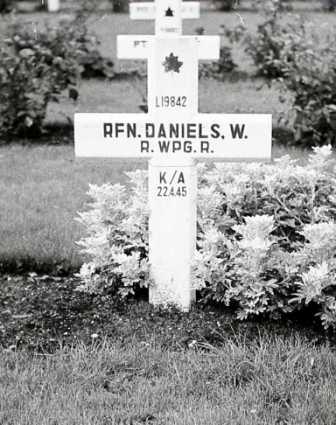
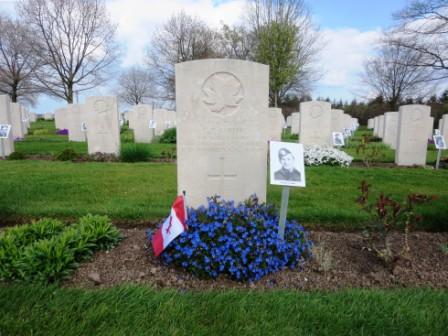
… Leo has a permanent resting place at the Canadian War Cemetery in Holten….

Leo was reburied at the Canadian War Cemetery in Holten after the war.

toney, leo francis

Grave of Leo Toney at the Canadian War Cemetery in Holten.  (Photo courtesy of Holten Canadian War Cemetery Information Centre)

Della reflected that her Uncle Leo “would have been proud of his sister, my mother Rita, for being the only Mi’kmaq woman to become Chief of two communities…

Thank you to Della Maguire for sharing photos and anecdotes of Leo Toney.  If you have information to share about Leo Toney or any Canadian soldiers buried in The Netherlands, please contact Pieter at memorialtrail@gmail.com, or comment on the blog.

© Daria Valkenburg

…Want to follow our research?….

If you are reading this posting, but aren’t following the blog, you are welcome to do so.  Our blog address: https://onthewarmemorialtrail.com/

Front cover OnTheWarMememorialTrailinEurope4 countries, 6 weeks, 7,000 km – an unforgettable war memorial journey in Europe…. Daria’s book ‘No Soldier Buried Overseas Should Ever Be Forgotten‘ is available in print and e-book formats.  Net proceeds of book sales help support research costs and the cost of maintaining this blog. For more information see https://nosoldierforgotten.com/

Screenshot_2021-02-27 On The War Memorial Trail With Pieter Valkenburg

You are also invited to subscribe to our YouTube Channel: On The War Memorial Trail With Pieter Valkenburg: https://www.youtube.com/channel/UCJ591TyjSheOR-Cb_Gs_5Kw.

Never miss a posting!  Subscribe below to have each new story from the war memorial trail delivered to your inbox.

Commemorating Liberation Day At The Canadian War Cemetery In Groesbeek

20210505_091943 May 5 2021 Dutch flag on Liberation Day

The Dutch flag flies proudly at the Valkenburg household on Liberation Day. (Photo credit: Daria Valkenburg)

May 5, 2021.  Last year, one of the events planned for the 75th Anniversary of the Liberation of The Netherlands was to place photos by the graves of soldiers at the Canadian War Cemetery in Groesbeek.  Unfortunately, due to social distancing measures, this had to be cancelled.  Instead, white tulips were placed at each grave.  (See   https://bordencarletonresearchproject.wordpress.com/2020/05/05/tulips-placed-at-each-grave-at-the-canadian-war-cemetery-in-groesbeek/)

This year, the planned photo tribute was possible, with photos placed at more than 1,600 graves. They will remain in place until May 17. Readers of this blog are aware that Pieter has been working towards finding as many photos as possible from the Atlantic region over the past few years.  Here on PEI, all but two soldiers buried in this cemetery have their photo tributes.  We asked Alice van Bekkum, Chair of the Groesbeek Faces to Graves Committee,  to take photos of 4 soldiers whose stories have been previously told here.

….Graves of 4 PEI soldiers ….

IMG_8528 Grave of Willie Cannon

Grave of William ‘Willie’ Alfred Cannon. (Photo courtesy of Alice van Bekkum)

To read about William ‘Willie’ Alfred CANNON of Mt Mellick, please see https://bordencarletonresearchproject.wordpress.com/2018/08/04/canadian-war-graves-netherlands-foundation-project/

IMG_8522 Grave of Joe Hennebery

Grave of Joseph ‘Joe’ Edmund Hennebery. (Photo courtesy of Alice van Bekkum)

To read about Joseph ‘Joe’ Edmund HENNEBERY of Morell, please see https://bordencarletonresearchproject.wordpress.com/2020/05/31/on-the-war-memorial-trail-a-face-for-joseph-hennebery/

IMG_8526 Grave of George Preston Smith

Grave of George Preston Smith.  (Photo courtesy of Alice van Bekkum)

To read about George Preston SMITH of Kinkora, please see:

IMG_8523 Grave of William Weatherbie

Grave of William Weatherbie.  (Photo courtesy of Alice van Bekkum)

To read about William WEATHERBIE of Charlottetown, please see https://bordencarletonresearchproject.wordpress.com/2019/09/29/a-face-for-ww2-soldier-william-weatherbie/

Alice shared a short video in which she is interviewed, and volunteers can be seen placing the photos by the graves.  The photos were printed onto an aluminum backing, making them impervious to rain.  Whether you understand Dutch or not, the video is wonderful as it shows the care and precision taken for this photo tribute.

….Graves of 3 Indigenous soldiers….

Recently, several photos have come in for soldiers whose stories Pieter is still researching.  Three of these are of Indigenous soldiers, which came about after an article about Pieter’s search for photos was written by Brett Forester of APTN News.  (See https://www.aptnnews.ca/national-news/dutch-born-p-e-i-man-on-a-mission-to-find-photos-of-first-nations-soldiers-killed-overseas-in-wwii/) Their stories will be told in a future posting.

Pieter asked his friend and former colleague, Ad Scheepers, if he would take photos of 3 graves at the cemetery in Groesbeek.  Ad visited the cemetery and placed an orange flower beside each grave he took a photo of.

Grave of Alfred Pitwanakwat

Grave of Alfred Louis Pitwanakat.  (Photo credit: Ad Scheepers)

Alfred Louis PITAWANAKWAT (PITWANAKWAT) was born September 12, 1924 in Little Current, Ontario, son of Agatha Pitwanakwat, of Wikwemikong, Ontario.

Grave of Eli Snake

Grave of Eli Snake. (Photo credit: Ad Scheepers)

Eli SNAKE was born November 29, 1919 on the Muncey Reserve, the son of Eli and Marjorie Snake.

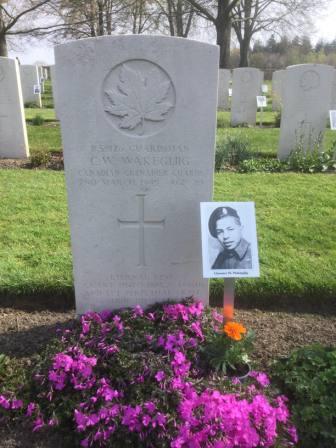
Grave of Clarence Wakegijig

Grave of Clarence Wilfred Wakegijig.  (Photo credit: Ad Scheepers)

Clarence Wilfred WAKEGIJIG was born January 9, 1925 in Wikemwikong, Ontario, the son of Joachim and Josephine Wakegijig (nee Shawanda), of Krugersdorf, Ontario.

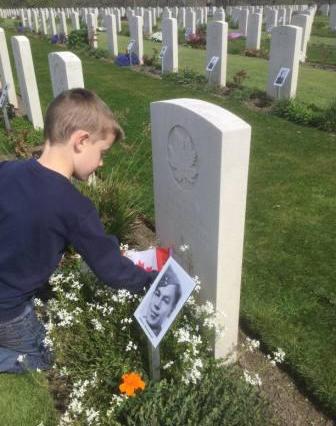
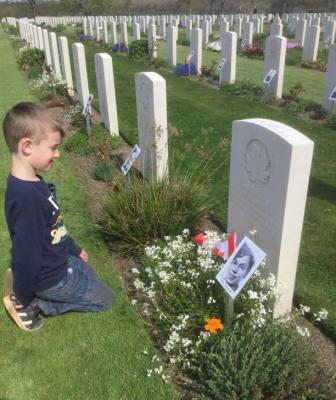
Ad wrote that while he was near the grave of Alfred Pitwanakat, “….a boy visiting the site with his family put a Canadian flag in front of the grave of Alfred….

Child places flag by Alfreds grave

A young boy places a flag by the grave of Alfred Pitwanakat. (Photo credit: Ad Scheepers)

Child by Alfreds grave

A young boy inspects the flag he placed by the grave of Alfred Pitwanakat.  (Photo credit: Ad Scheepers)

It’s clear that the Dutch pass on the importance of remembrance to the next generation so they can continue to remember those who lost their lives in WW2!

Thank you to Alice van Bekkum and Ad Scheepers for their kindness in taking the photos of the graves.  If you have information to share about any Canadian soldiers buried in The Netherlands, please contact Pieter at  memorialtrail@gmail.com, comment on the blog, or send a tweet to @researchmemori1.

© Daria Valkenburg

…Want to follow our research?…

If you are reading this posting, but aren’t following our research, you are welcome to do so.  Our blog address: https://onthewarmemorialtrail.com/
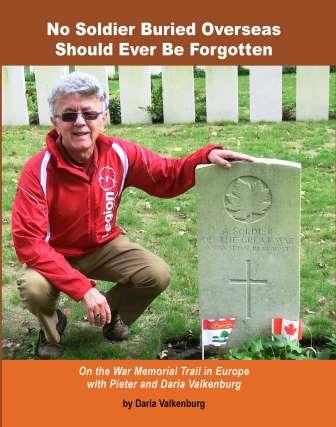
4 countries, 6 weeks, 7,000 km – an unforgettable war memorial journey in Europe…. Daria’s book ‘No Soldier Buried Overseas Should Ever Be Forgotten‘ is available in print and e-book formats.  Net proceeds of book sales help support research costs and the cost of maintaining this blog. For more information see https://nosoldierforgotten.com/

Screenshot_2021-02-27 On The War Memorial Trail With Pieter Valkenburg

You are also invited to subscribe to our YouTube Channel: On The War Memorial Trail With Pieter Valkenburg: https://www.youtube.com/channel/UCJ591TyjSheOR-Cb_Gs_5Kw.

Never miss a posting!  Subscribe below to have each new story from the war memorial trail delivered to your inbox.