On The War Memorial Trail…..The WWII Acadian Soldier Serving With Le Régiment de Maisonneuve Who Made The Ultimate Sacrifice In The Hochwald Forest

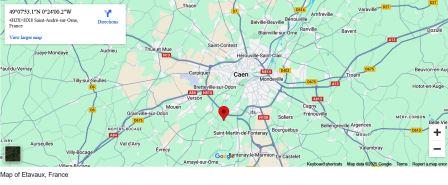
Balmoral and Shannonvale Google Maps

We travelled to Balmoral, New Brunswick, to meet the sister of a WWII soldier. (Map source: Google Maps)

November 27, 2024. After completing our tour along the Acadian Coastal Drive, visiting Acadian Memorials, we went to Balmoral, New Brunswick, to meet with Léa LeClair, the youngest sister of WWII soldier Ange Aimé LECLAIR. (See https://onthewarmemorialtrail.com/2024/11/22/on-the-war-memorial-trail-remembrance-week-2024-visiting-acadian-memorials-in-new-brunswick/)

CIMG7020 Aug 27 2024 Visit to Balmoral Romeo Le Page & Lea Le Clair

Pieter (centre) with Léa LeClair and her brother-in-law, Romeo LePage. (Photo credit: Daria Valkenburg)

When Pieter had begun his research to find family of Ange Aimé, he found an obituary for the soldier’s sister Viola, who was married to Romeo LePage.  Then he found a phone number for Mr. LePage and, with great trepidation given that he isn’t fluent in French, he dialed the number.  After a few minutes, Mr. LePage’s sister-in-law, retired teacher Léa LeClair, came on the line, and listened patiently.  “…Oui…” she had a photo of Ange Aimé, and then, happily, switched to English.  She explained that she was the youngest sister of the soldier, only 10 years old when he died on March 2, 1945.

Pieter let her know that we were planning a trip to New Brunswick, and asked if she would like to meet in person.  This was agreeable, and so, when we went to Balmoral, we were only expecting to get a photo of the soldier.  Boy, were we wrong! The family’s historian, Léa had several photos and letters written by her brother, and more.  Ange Aimé was clearly loved and remembered by his family!

Born in Shannonvale (now part of Eel River Crossing), Restigouche County, New Brunswick on March 14, 1925, Ange Aimé was the son of Thomas and Marguerite Anne (nee Basque) LeClair.  He came from a large family, and had 5 sisters, 3 brothers, 4 half-brothers, and 2 half-sisters.

…..Ange Aimé enlisted under the NRMA in 1944….

Léa recalled that “My brother Albénie was called up in the Spring. He did not pass the physical as he was sick. Ange-Aimé asked Papa if he should stay and wait for a call to join. They chose for him to go to work in the Kedgwick area. Later in the summer, the Army came looking for him in Dundee. Papa did not know exactly where he was cutting wood and said so to the Army. After a while, the Army did find him, in the Kedgwick area…. He was registered and then was sent for training…

Ange Aimé originally enlisted under the National Resources Mobilization Act (NRMA) at the No. 7 District Depot in Fredericton, New Brunswick on May 31, 1944 and underwent basic training at No. 71 Canadian Army Basic Training Centre (CABTC) in Edmundston, New Brunswick. (See https://en.wikipedia.org/wiki/National_Resources_Mobilization_Act)

ange aime le clair as a student colourized

Ange Aimé LeClair as a student.  (Photo courtesy of the LeClair family. Photo colourization by Pieter Valkenburg)

At the time of his enlistment, Ange Aimé had been working for 2 years as a woodsman for Raymond LeBlanc of Darlington, New Brunswick.  Léa recalled that he had studied at a seminary, with his family expecting him to be a priest, but he preferred working outdoors. While his Occupational History Form does not mention studying at a seminary, he most likely had his post-elementary education at a seminary. The form stated that Ange Aimé was fluent in both French and English, which was unusual for a young man who grew up in a rural area and in a French speaking household.

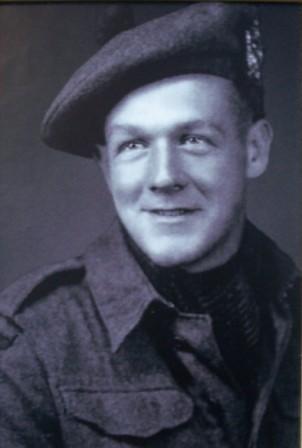
AA Leclair photo from memorial card colourized

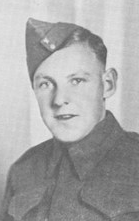
Ange Aimé LeClair in uniform.  (Photo courtesy of the LeClair family. Photo colourization by Pieter Valkenburg)

On July 25, 1944, Ange Aimé enlisted for active duty while in Edmundston, and remained there until September 1, 1944, when he was transferred to the A-30 Canadian Infantry Training Centre (CITC) at Camp Utopia in Pennfield Ridge, New Brunswick.  On September 14, 1944, he received a promotion to Lance Corporal.

….Ange Aimé received embarkation leave….

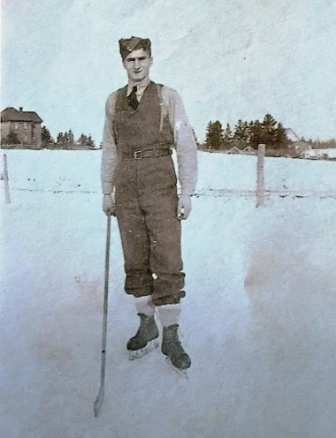
After completing his training at Camp Utopia, Ange Aimé received embarkation leave, prior to being sent overseas, from November 21 to December 7, 1944.  He returned home to the family farm in Dundee, New Brunswick, where a photo was taken of him playing hockey.

20240827_140114 AA Le Clair playing hockey in Dundee during embarkation leave

Ange Aimé LeClair on skates with a hockey stick during his embarkation leave.  (Photo courtesy of the LeClair family)

While on leave, Ange Aimé helped out at home, and spent time in the woods.  Time went by very quickly, and unfortunately he didn’t immediately return to Camp Utopia when his leave was up. Military police came to look for him, thinking he had deserted.  Léa recalled that her …father was in the garden and told them that Ange Aimé was in the woods.  After he returned, he was arrested and taken back to Camp Utopia, where he spent a night in the stockade...

The repercussions were harsh, given that he was only late returning by a few days.  On December 10, 1944, he was transferred to the No. 1 Training Brigade in Debert, Nova Scotia for final preparations and training before being posted overseas.  But, on December 17, 1944, he was demoted in rank and reverted to Private. 

 ….We had help in translating letters from French into English….

CIMG7053 Sep 10 2024 Daria & Etienne Gaudet translating AA LeClair letters in Moncton NB

Daria and Etienne Gaudet worked diligently to translate all the letters from French into English. (Photo credit: Pieter Valkenburg)

Because Léa had saved letters written by her brother, we were able to hear his thoughts during this period.  We were grateful for the help of Etienne Gaudet, who kindly translated all of the letters written by Ange Aimé from the original French into English.

In a December 20, 1944 letter to his sister Delphine, written from Debert, it’s clear that there was illness in the family. “…. Are you better after your flu? … Please give my regards to the others and please tell me if mother is better, and tell her not to worry about me.  It’s not worth it.  Nothing has happened to me yet.  There’s a higher power above us and his wishes must be respected.

I wouldn’t be worse off there (ie heaven) than here. Besides that, I’m lucky that I’m the only one in the army instead of all of us.  I’m not scared and I’m taking things as they come….

On the same day, he also wrote to his brother Ovila, mentioning his demotion.  “I thought I’d be able to have a pass for Christmas or New Year’s, but I won’t now.  I no longer have my stripe and I don’t know if I’ll have one later, or if I’m here for a long time.

….Ange Aimé left Canada for overseas service….

Ange Aimé didn’t have long to wonder how long he’d be in Debert.  On December 24, 1944 he left Canada, arriving in the United Kingdom on December 31, 1944, where he was assigned to No. 4 Canadian Infantry Training Regiment (CITR).

He shared his impressions with his brother Ovila in a January 3, 1945 letter.  “.I am now in England and it’s pretty good and a funny country. Their language is nearly impossible to understand. They do not pronounce their words like we do.

I’m anxious to get to the front and see what it’s like.  If it can be warm, I’ll be happy as here it’s humid and we’re freezing.  The humidity is going through us and we have to ration the coal.  I have had a cold since I arrived here, as have the others….

In a January 4, 1945 letter to his sister Delphine, he wrote about the climate, and shared that he saw his cousin, René LEBLANC.  “I have a cold.  It’s humid as hell here.  My nose is always running.  It takes time to get used to the climate….. René is here....” 

Then, in a January 29, 1945 letter to Delphine, he again mentions the weather, and spending Christmas while on his overseas voyage. “The climate here is humid and a bit cold.  There are 4 inches of snow…. It’s not as beautiful as I had thought and holidays on the water are not fun...

Ange Aimé was aware that he would soon be sent to Northwest Europe. In a February 8, 1945 letter to his brother Ovila, he wrote that “I am preparing for the draft. I have to face the front, see what it looks like, but I would not want to take a bullet or shrapnel….”  

….Ange Aimé was flown to Northwest Europe from the United Kingdom….

The day after he wrote to his brother Ovila, Ange Aimé was transferred to the X-4 Reinforcement List of the 10th Battalion of the Canadian Infantry Corps, and flown to Northwest Europe on February 10, 1945. 

By February 12, 1945 he was at No. 2 Canadian Base Reinforcement Group (CBRG) and wrote to his sister Delphine that he was “now in Belgium.  It’s really beautiful here.

I am not yet at the front.  Those that go come back, at least most of them.  I have as good a chance as them.  I might never go since it looks really bad for the Germans.

People are really nice to us ‘Canadians’ here.  Yesterday I went to supper with a man who brought us to his home.  He has three small children.  They were really nice to us.  I was with two of my friends.  Like he said, it reminded us of home to have a family supper and it took away some of the longing for home….

On the same day, he wrote to his parents about the dinner.  “….Yesterday I went to town with two others, and an older man invited us to his place for supper with him.  We were served like princes.  They are really nice. There were three little boys and they all shook our hands....” This was the last letter the family received from Ange Aimé. 

…. Ange Aimé’s transfer to Le Régiment de Maisonneuve was his last….

On February 15, 1945, Ange Aimé was transferred to Le Régiment de Maisonneuve, joining them near Nijmegen, The Netherlands, as the Regiment prepared to move into Germany. 

The February 18, 1945 war diary entry for the Regiment stated that “…the whole Battalion left Nijmegen at 19:30 hours to proceed via Cleve, Germany and had penetrated in Germany by 20:40 hours...

By the end of February, the Regiment was involved in the Battle of Hochwald Gap, part of Operation Blockbuster, the final push towards the Rhine River, along with several other Canadian Regiments.  This offensive began on February 28, 1945 to clear the Germans from the Reichswald, a heavily forested area between the Maas and the Rhine Rivers, driving them back over the Rhine, taking the fight well into German territory.  (For more information, see https://canadianbattlefieldtours.ca/operation-blockbuster/ and https://civilianmilitaryintelligencegroup.com/10742/the-battle-of-hochwald-gap-one-of-the-largest-armor-engagements-you-probably-have-never-heard-of)

Each day the war diary reported heavy shelling of the troops, with several casualties.  On March 1, 1945, the war diary reflected that because shelling was heavy “…the morale of the troops was quite low as nothing could be done but wait…

On March 2, 1945, the war diary recorded that “…Captain Provost is back with us.  The rifle companies are in position in the Hochwald Gap at 03:40.  ‘C’ Company sent out patrols to feel enemy’s disposition. ….Heavy shelling all day…” Sadly, one of the casualties on March 2 was Ange Aimé. 

….Letter from Captain Provost described how Ange Aimé lost his life….

On March 3, 1945, Captain Paul-Marcel Provost wrote a letter of condolence to Ange Aimé’s mother. “….I have the terrible duty to inform you of the death of your son, Pte LeClair.  He was killed in action on March 2, 1945….. He was an excellent soldier and brave, who made the ultimate sacrifice.

In the name of the commander and all his officers, I ask you, Madame, to accept our deepest condolences for the loss that has struck you. May the legitimate pride you feel for the departed ease your pain. This pride is shared by all in Le Régiment de Maisonneuve…..

This was followed by an April 6, 1945 letter, explaining how Ange Aimé lost his life.  “….Please know that you have all my sincere sympathies in the sorrow with which you have been struck.  I also have a bit of sorrow, as your son was one of ours and I was his commander…..

Your son died a few days after we finished the offensive that brought us to the side of the Rhine and decided the German defeat – two days after an attack that had been especially challenging for our company.  The Regiment was called to take up defensive positions along the Hochwald Forest – a forest situated a few miles from Kleve and Xanten.

Our first hours in these positions were quiet.  Near 6 pm, supper was brought, and Ange Aimé was designated, with a few others, to transport it from our Command Post to his platoon.  It’s when he was on his way back that the German artillery began to fire at us, and your son fell, along with a few other unlucky men.

He was killed instantly and buried the next day in one of our Canadian cemeteries. I include here memorial cards, printed in memory of our friends killed during this period of the offensive in Germany….

Ange Aimé’s cousin, Rene LeBlanc, was injured in this attack, but survived the war to return home.

As with Ange Aimé’s letters, Etienne Gaudet kindly translated the letters written by Captain Provost from the original French into English. I was especially grateful for Etienne’s help with the letters from Captain Provost as it was extremely difficult to read his handwriting.

The memorial card that Captain Provost referred to had been prepared for a March 16, 1945 prayer service at Sint-Bartholomaeuskerk, a Roman Catholic Church in Beek (now Berg en Dal), The Netherlands. The memorial card lists 37 names of those who died between February 8 and March 13, 1945. (See https://rijksmonumenten.nl/monument/35784/grote-stbartholomeus/beek/ and  https://nl.wikipedia.org/w/index.php?title=Sint-Bartholomaeuskerk_(Beek_(Berg_en_Dal))

20240827_143311 Mar 16 1945 Memorial service in Holland for Regt de Maisonneuve KIA in Germany

Memorial card sent to Ange Aimé LeClair’s mother.  (Photo of card courtesy of the LeClair family)

….Ange Aimé is buried in Groesbeek….

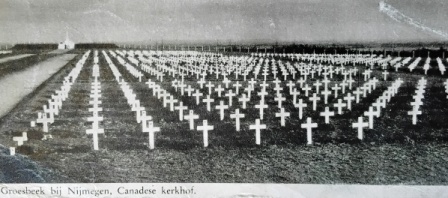
20240827_144251 Aug 27 2024 Groesbeek postcard sent by Ton in 1950

A 1950 postcard, sent by Ton Bersen to the LeClair family, shows how the Canadian War Cemetery in Groesbeek looked in that time period. (Photo courtesy of the LeClair family)

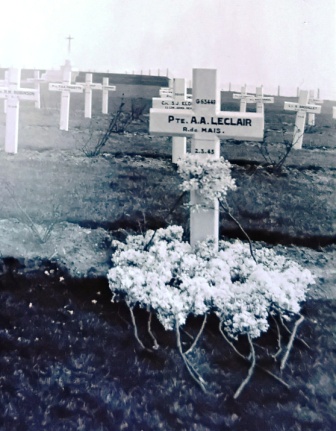
Ange Aimé was temporarily buried on land owned by a Catholic farmer named Augenendt, 3.2 km (two miles) west of Udem in Germany, before being reburied the following year in the Canadian War Cemetery in Groesbeek, The Netherlands.

20240827_144334 Aug 27 2024 Original Groesbeek grave AA Le Clair

The original gravestone for Ange Aimé LeClair in the Canadian War Cemetery in Groesbeek.  (Photo courtesy of the LeClair family)

Grave of AA LeClair from find a grave

Grave of Ange Aimé LeClair in the Canadian War Cemetery in Groesbeek, The Netherlands. (Photo courtesy of FindAGrave)

….Ange Aimé’s grave was adopted by Ton Bersen ….

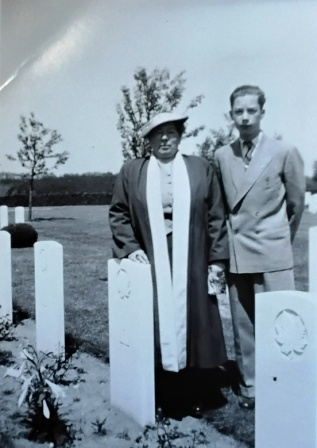
After his reburial in the Canadian War Cemetery in Groesbeek, Ange Aimé’s grave was adopted by a young scout, Ton Bersen, and his family.  Ton remained in contact with the LeClair family until his death in 2020!

20240827_140515 Ton Bersen & mother by grave of AA Le Clair

Ange Aimé LeClair’s grave was adopted by Ton Bersen, seen in this photo with his mother. (Photo courtesy of the LeClair family)

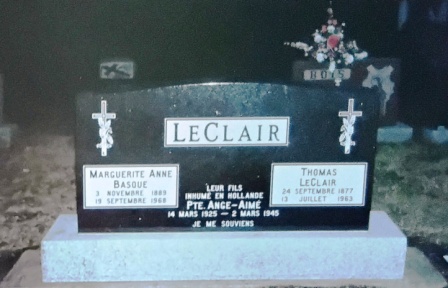
….Ange Aimé is remembered on his parents’ gravestone ….

Ange Aimé’s sister Léa told us that after her parents’ original gravestone in Dundee, New Brunswick crumbled, she replaced it with a new headstone and commemorated her brother as well. 

20240827_144026 Aug 27 2024 Le Clair gravestone in Dundee

Gravestone of the LeClair family in Dundee, New Brunswick.  (Photo courtesy of the LeClair family)

Thank you to Léa LeClair for providing photos and information on her brother, and to Etienne Gaudet for help in translating letters from French into English.  Do you have photos or information to share? Email Pieter at memorialtrail@gmail.com, comment on the blog, or tweet to @researchmemori1.

© Daria Valkenburg

….Previous postings about soldiers who died during the Battle of Hochwald Gap….

….Want to follow our research?….

If you are reading this posting, but aren’t following our research, you are welcome to do so.  Our blog address: https://onthewarmemorialtrail.com/

Front cover OnTheWarMememorialTrailinEurope4 countries, 6 weeks, 7,000 km – an unforgettable war memorial journey in Europe…. Daria’s book ‘No Soldier Buried Overseas Should Ever Be Forgotten‘ is available in print and e-book formats.  Net proceeds of book sales help support research costs and the cost of maintaining this blog. For more information see https://nosoldierforgotten.com/ 

You are also invited to subscribe to our YouTube Channel: On The War Memorial Trail With Pieter Valkenburg: https://www.youtube.com/channel/UCJ591TyjSheOR-Cb_Gs_5Kw

Never miss a posting!  Subscribe below to have each new story from the war memorial trail delivered to your inbox.

On The War Memorial Trail…… The WWII Soldier From St. Nicholas Who Lost His Life During The Battle of Hochwald Gap

July 6, 2024.  Back in 2015, Pieter received a photo of WWII soldier Edward Gabriel PERRY, whose name was on a photo wish list from the Canadian War Cemetery in Groesbeek, The Netherlands. 

Edward was born in St. Nicholas, a small community west of Summerside, Prince Edward Island, on October 6, 1924, the son of John F. and Zelia Perry. He was one of 11 children, with 5 brothers, three of whom also served overseas during WWII, and 5 sisters.

….Edward enlisted at age 18….

PERRY Edward Gabriel

Edward Gabriel Perry.

When he enlisted at the No. 6 District Depot in Charlottetown, Prince Edward Island, on February 25, 1943, he was only 18 years old, too young to be sent into an active combat zone.  At the time, he stated that he grew up on a farm, but had spent the past two months working as a carpenter for Fred Cameron of Saint John, New Brunswick, who had a lumber business.

Edward’s Personnel Selection Record noted that he “…plays hockey…” and that his “…chief diversion is reading….”  It went on to describe him as “…reserved, determined…” and concluded that he would “…make an efficient soldier…

From Charlottetown, Edward was sent to Halifax, Nova Scotia, and from there to No. 61 Canadian Army (Basic) Training Centre (CABTC) in New Glasgow, Nova Scotia on March 13, 1943. 

After completing his basic training, Edward was sent to the A1 Canadian Artillery Training Centre in Petawawa, Ontario on May 12, 1943 to be trained as a gunner. 

On June 14, 1943, he was assigned to the 23rd Anti-Aircraft Regiment of the 50th Anti-Aircraft Battery of the Royal Canadian Artillery.  Edward’s new assignment was coastal defence in Sydney, Nova Scotia.  During WWII, Sydney was the second-most-important port for convoy formation after Halifax.

He remained in Sydney until March 23, 1944 when he was transferred to No. 1 Transit Camp in Windsor, Nova Scotia, in preparation for overseas service. Then, on May 15, 1944, he was reallocated to the Training Brigade Group in Debert, Nova Scotia for further training.

….Edward left Canada for overseas service….

On July 19, 1944 Edward left Canada, arriving in the United Kingdom on July 27, 1944, where he was assigned to No. 3 Canadian Infantry Reinforcement Unit (CIRU).

A month later, on August 29, 1944, he was sent to France, and then transferred to the Argyll & Sutherland Highlanders (Princess Louise’s), part of the 21st Army Group, on September 2, 1944. On December 10, 1944, he was promoted to Lance Corporal.

….The Battle of Hochward Gap was deadly….

ASH Can map1

Map shows plan for the Battle of Hochwald Gap.  Note: Kanten on map should read Xanten.  (Map source: ‘The Argyll & Sutherland Highlanders of Canada (Princess Louise’s) 1928-1953, edited by Lt-Col H. M. Jackson)

The end of February 1945 saw the Regiment in Germany for the Battle of Hochwald Gap, part of Operation Blockbuster, the final push towards the Rhine River, along with several other Canadian Regiments.  This offensive began on February 28, 1945 to clear the Germans from the Reichswald, a heavily forested area between the Maas and the Rhine Rivers, driving them back over the Rhine, taking the fight well into German territory for a full-scale invasion of Berlin.  (For more information, see https://canadianbattlefieldtours.ca/operation-blockbuster/ and https://civilianmilitaryintelligencegroup.com/10742/the-battle-of-hochwald-gap-one-of-the-largest-armor-engagements-you-probably-have-never-heard-of)

Troops faced a battlefield that was cold, wet, and muddy, and a ferocious fight by desperate Germans who recognized that they were about to lose the war. On March 1, 1945, Edward was badly wounded during the battle, and brought to a field hospital just after 6 pm “…in very poor condition…” and given “…1 pint of plasma….” 

He was sent on an urgent basis to No. 3 Casualty Clearing Centre, arriving at 9 pm. The medical report noted that he had “…shell fragment wounds with compound fracture of the right femur, injury of the femoral vessels, and multiple lacerations of both legs, and a penetrating wound to the abdomen…”  Edward was rushed into surgery, but died at 5:15 am on March 2, 1945. 

….Edward is buried in the Canadian War Cemetery in Groesbeek….

CIMG3330 Oct 5 2019 grave Groesbeek Edward Perry from daria

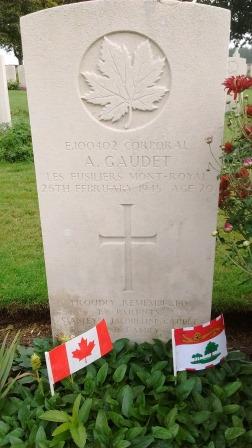
Grave of Edward Gabriel Perry in the Canadian War Cemetery in Groesbeek, The Netherlands. (Photo credit: Daria Valkenburg)

Edward was initially buried in the Canadian Military Cemetery in Bedburg, Germany, before being reburied in the Canadian War Cemetery in Groesbeek, The Netherlands. 
Do you have photos or information to share? Email Pieter at memorialtrail@gmail.com, or comment on the blog.

© Daria Valkenburg

 ….Previous postings about soldiers who died during the Battle of Hochwald Gap….

….Want to follow our research?….

If you are reading this posting, but aren’t following our research, you are welcome to do so.  Our blog address: https://onthewarmemorialtrail.com/
Front cover OnTheWarMememorialTrailinEurope4 countries, 6 weeks, 7,000 km – an unforgettable war memorial journey in Europe…. Daria’s book ‘No Soldier Buried Overseas Should Ever Be Forgotten‘ is available in print and e-book formats.  Net proceeds of book sales help support research costs and the cost of maintaining this blog. For more information see https://nosoldierforgotten.com/ 

You are also invited to subscribe to our YouTube Channel: On The War Memorial Trail With Pieter Valkenburg: https://www.youtube.com/channel/UCJ591TyjSheOR-Cb_Gs_5Kw

Never miss a posting!  Subscribe below to have each new story from the war memorial trail delivered to your inbox.
On The War Memorial Trail…..The WWII Soldier From Mount Carmel Killed During The Liberation Of Posterenk

June 30, 2024.  In 2017, Pieter and I visited the village of Posterenk in The Netherlands with Edwin van der Wolf, one of the research volunteers at the Canadian War Cemetery in Holten.

CIMG9302 Sep 25 2017 Posterenk Windmill

Windmill in Posterenk, which has a memorial stone inscribed on the wall.  (Photo credit: Daria Valkenburg)

CIMG9300 Sep 25 2017 Sign Posterenk freed by CYR Apr 13 1945

Translation of memorial stone on the windmill: Posterenk freed by the Carleton & York Regiment of Canada on April 13, 1945. (Photo credit: Daria Valkenburg)

….The Island connection to Posterenk…..

Edwin wanted us to visit the village because it had an Island connection.  François ‘Frank’ GALLANT, son of Antoine and Eleanor (nee Poirier) Gallant of Mount Carmel, Prince Edward Island,  died there on April 13, 1945, while serving with the Carleton & York Regiment.

CIMG9296 Sep 25 2017 Edwin and Pieter by Posterenk windmill

Edwin van der Wolf (left) and Pieter in Posterenk.  (Photo credit: Daria Valkenburg)

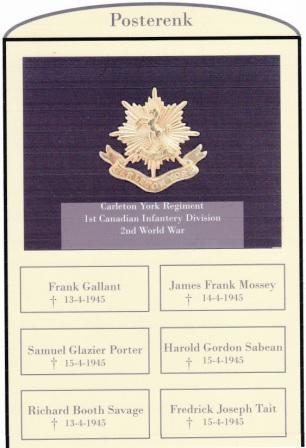
The village had a list of 6 soldiers to commemorate from the Carleton & York Regiment, who had all been buried in the area.  Unfortunately, not all soldiers who died are included on this list, but Edwin worked towards including two more, who were not buried near Posterenk, but “were temporarily buried in Lochem because they had previously died in a Canadian hospital there…” 

In total, out of the 8 soldiers, three were from Prince Edward Island!  The stories of Daniel Peter MACKENZIE and James ‘Frank’ MOSSEY were previously told.  In this posting, we feature the story of Frank GALLANT, the reason we were in Posterenk back in 2017!

Gallant Frank

François ‘Frank’ Gallant.  (Photo courtesy of the Information Centre Canadian Cemetery Holten)

….Three Gallant brothers served…..

Born November 24, 1914, Frank originally enlisted under the National Resources Mobilization Act (NRMA) in Charlottetown, Prince Edward Island on August 13, 1942 and underwent basic training at No. 62 Canadian Army Basic Training Centre (CABTC), which he completed on October 12, 1942. (See https://en.wikipedia.org/wiki/National_Resources_Mobilization_Act)

His Personnel Information Record noted that he could speak both French and English, and came from a rural farming background, which likely accounted for him having only a Grade 4 education.  In addition to farming, Frank had experience in carpentry work, and had worked in a lumber mill.  He could drive a vehicle, and played baseball and hockey. Two of his brothers, Georges and Simon, were also in the army. 

With his basic training successfully completed, Frank was transferred to A5 Canadian Engineer Training Camp (CETC) in Petawawa, Ontario for advanced training on October 13, 1942.  Upon completion of that training, he remained in Petawawa for an additional two months, doing general repair work. 

On January 28, 1943, Frank was transferred to No. 2 Engineer Services and Works Company (ES&W Company) of the Royal Canadian Engineers, where his task was to fire and repair boilers at No. 2 District Depot in Toronto, Ontario. He was with ‘D’ Wing, a ‘supernumerary to establishment’ reserve unit, while a decision about the direction his army career was to take was made.

Frank had expressed interest in being considered in the Tradesman category as a fireman or maintenance man, but it was determined that since his occupation background was “… erratic….” with no “…special training…” and he was considered very fit, in the “…A-1 category…”, he should be reallocated to “…Infantry (Non-Tradesman)” and receive infantry training. 

Frank received special leave to return home to Prince Edward Island to help with the family’s farm operation on August 29, 1943, after which he returned to Toronto on November 1, 1943.

….Frank transferred to the Infantry…..

As a result of the assessment that he be assigned to an Infantry Unit, Frank was transferred to the 1st Battalion Victoria Rifles of Canada on November 10, 1943 and sent the following day to Stratford, Ontario to be re-mustered as a rifleman.

Frank remained in Stratford for training until February 18, 1944, when he was sent to Niagara-on-the-Lake, Ontario. 

On August 24, 1944, Frank transferred from the non-active militia to active service in the Canadian Army, remaining with the 1st Battalion Victoria Rifles of Canada in Niagara-on-the-Lake.

….Frank left Canada for overseas service…..

On November 21, 1944, Frank left for Great Britain with the 1st Battalion, to provide reinforcements to the Canadian Army in the field.  Upon arrival on November 28, 1944, he was assigned to No. 3 Canadian Infantry Training Regiment (CITR).

He continued receiving further training until January 23, 1945, when he left the United Kingdom for Italy, as part of the X-4 Reinforcements, arriving on February 7, 1945.  On February 13, 1945 he was transferred to the Carleton & York Regiment, joining them north of Rossi (Russi), part of a group of reinforcements, at the tail end of the Italian Campaign. (See https://en.m.wikipedia.org/wiki/Italian_campaign_(World_War_II))

He joined the Carleton & York Regiment at the same time as Archibald Phillip ‘Archie’ MCLEAN of Edmundston, New Brunswick.  Archie’s story was previously told on this blog.  (See https://onthewarmemorialtrail.com/2023/09/13/on-the-war-memorial-trail-archie-was-a-good-guy/)

Screenshot 2023-09-04 at 16-28-14 Map of Russi Italy

The Carleton & York Regiment was north of Russi on February 13, 1945.  (Map source: http://www.gosur.com)

On March 17, 1945, he left Italy as part of Operation Goldflake, arriving in Marseilles, France three days later.  Operation Goldflake was the codename for moving troops from Italy to North-West Europe.  (See https://en.wikipedia.org/wiki/Operation_Goldflake)

The Carleton & York Regiment was now part of the 21st Army Group. From France, troops were moved up to the Belgian front, into The Netherlands, through the Reichswald Forest in Germany, and then back into The Netherlands.

The Liberation of Posterenk…

On April 12, 1945 the Regiment was part of Operation Cannonshot, which led to the crossing of the IJssel River between the villages of Gorssel and Wilp in the eastern part of The Netherlands. (See https://www.liberationroute.com/stories/190/operation-cannonshot)

Map western holland showing Posterenk

According to the April 12, 1945 war diary entry of the Carleton & York Regiment, they “…moved across the Ijssel River at 14:30 hours….” to relieve the Seaforth Highlanders of Canada.

On April 13, 1945, the war diary entry noted that “…‘D’ Company’s objective is Posterenk…The Regiment didn’t expect much opposition, but they “met with stiff resistance just after starting at 11:25 hrs…

In ‘Invicta – The Carleton and York Regiment in the Second World War’ author Robert Tooley explained that “…on the CYR front D Company was to lead off towards its first objective, the village of Posterenk: the opposition was expected to be light, and the company was instructed to continue to move forward until strong opposition was encountered.  The battalion now had in support a troop of M10 SP anti-tank guns, a troop of tanks, a platoon of medium machine guns, and a platoon of 4.2 inch mortars. D Company pushed off at 10:50 am….. Contrary to expectations, D Company met stiff resistance and suffered several casualties from small arms fire….”   

At some point during that day, Frank lost his life. 

…Frank is buried in Holten…

Frank was one of 6 soldiers initially buried along the main road to Posterenk, a village near Zutphen, before being reburied in the Canadian War Cemetery in Holten.

Posterenk list of 6 CYR members

The 6 soldiers buried near Posterenk.

CIMG3198 Oct 3 2019 Holten Frank Gallant

Grave of François ‘Frank’ Gallant at the Canadian War Cemetery in Holten.  (Photo credit: Daria Valkenburg)

…Frank is remembered on the war memorial in Wellington…

In May 2024, we visited the war memorial in Wellington, Prince Edward Island, where Frank’s name is listed.

CIMG6840 May 27 2024 Wellington Monument - Francis Gallant - photo by Pieter

François ‘Frank’ Gallant is remembered on the war memorial in Wellington, Prince Edward Island.  (Photo credit: Pieter Valkenburg)

…Previous stories about soldiers commemorated in Posterenk….

Do you have photos or information to share? Email Pieter at memorialtrail@gmail.com, comment on the blog, or tweet to @researchmemori1.

© Daria Valkenburg

….Want to follow our research?….

If you are reading this posting, but aren’t following our research, you are welcome to do so.  Our blog address: https://onthewarmemorialtrail.com/

Front cover OnTheWarMememorialTrailinEurope4 countries, 6 weeks, 7,000 km – an unforgettable war memorial journey in Europe…. Daria’s book ‘No Soldier Buried Overseas Should Ever Be Forgotten‘ is available in print and e-book formats.  Net proceeds of book sales help support research costs and the cost of maintaining this blog. For more information see https://nosoldierforgotten.com/ 

You are also invited to subscribe to our YouTube Channel: On The War Memorial Trail With Pieter Valkenburg: https://www.youtube.com/channel/UCJ591TyjSheOR-Cb_Gs_5Kw

Never miss a posting!  Subscribe below to have each new story from the war memorial trail delivered to your inbox.
On The War Memorial Trail….. The WWII Lumberjack From Belledune Killed By Stray Mortar Fire In The Nijmegen Salient

June 24, 2024.  It’s surprising how often a chance meeting will lead to a photo.  In September 2023, while staying at a hotel in Ottawa, Ontario, we were approached by a fellow guest, Victor Richard, who had seen us coming out of our car the day before and had noticed the Prince Edward Island licence plate.  The following day, when he saw us in the lobby, he explained that he was from New Brunswick, the province next to ours. 

….The road to a soldier’s photo can be circuitous….

Victor showed an interest in the On The War Memorial Trail research project.  Pieter asked for his help in finding a photo of a particular soldier, and after we all returned back home, Victor put us in contact with Jean Gaudet.  In the meantime, Pieter had found a photo of the soldier online, as it had recently been posted on the Canadian Virtual War Memorial by Captain (Retired) Etienne L.L. Gaudet. 

Jean knew Captain Gaudet well and very quickly Pieter was put in contact with Etienne, who works diligently in ‘…promoting the memory of soldiers in New Brunswick…’ – as Jean put it.  During the Covid period, Etienne had visited 244 cemeteries, documenting the graves of soldiers across New Brunswick. (See https://www.cbc.ca/news/canada/new-brunswick/nb-veteran-journey-cemeteries-1.6237590)

After learning about the On The War Memorial Trail research project, Etienne emailed Pieter. “God bless you for the work you are doing. I certainly share your passion in ensuring none of these heroes are ever forgotten. I have worked very hard to build the Canadian Virtual War Memorial especially for those soldiers buried in New Brunswick who lacked pictures on the site.

I am now the person responsible for Veterans in Memramcook, which involves organizing our Remembrance Day ceremony and all other things related to honouring those that have served from …Memramcook….

Etienne ended by making an offer to help.  “…Please don’t hesitate to write if I can assist you in any way…

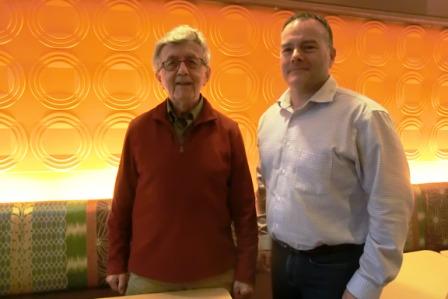
Etienne and Pieter 2

Pieter with Etienne Gaudet.  (Photo credit: Daria Valkenburg)

….An offer to help led to a photo….

Pieter soon asked for Etienne’s assistance with a photo search, asking if he would be willing to contact the family of an Acadian soldier, Edgar M. GUITARD.  “….He lost his life in The Netherlands on the 15th of January 1945. He had 6 brothers and 4 sisters. This morning I called the daughter of his youngest sister Emelia, Nicole Lagace, but she said that she had never heard of Nicole Lagace or Emelia Guitard. I have a feeling that she thought that I was a scammer and did not trust me….. Would you be able to help?….

Pieter hoped that a French-speaking voice on the phone might reassure Nicole Lagace, but Etienne decided to pay a visit in person the following morning.  That evening he reported back. “I was able to speak with Nicole in person. She has a photo of Edgar in her albums, but didn’t have time today to go through them. She apologized for her reaction to your phone call and stated that she has been scammed before and is incredibly careful now….” 

A few days later…success!  Etienne reported that he’d “…received the photo from Nicole Guitard Lagace, who confirms that the gentleman in the photo is her uncle, Edgar M. Guitard.…I do hope his memory can live forever although he died way too young. It was an honour to assist you and help preserve his memory in perpetuity. We will remember them….

Nicole also contacted Pieter, explaining that “…the photo donated by me belonged to my mom.  Thank you very much….” 

….Edgar was born in Belledune….

Screenshot 2024-06-21 at 12-03-44 belledune new brunswick - Google Search

Map shows location of Belledune, New Brunswick, located on Chaleur Bay.  (Map source: Google maps)

Edgar was born on September 17, 1917 in Belledune, New Brunswick, a port village on Chaleur Bay, the son of Jean ‘Mickey’ and Bridgitte Guitard.  One of 11 children, Edgar grew up on his parents’ farm. 

When he enlisted at District Depot No. 5 in Rimouski, Quebec on April 8, 1941, he stated that he had served in the Active Militia since January 1941 – with No. 71 Centre Militaire out of Edmundston, New Brunswick.  He also stated that he was a fisherman during the spring and summer, and had worked as a lumberjack since 1930 for Fraser Brothers, out of Causapscal, Quebec.  Edgar enjoyed snowshoeing and fishing.

His Soldiers Qualification Card noted that he was illiterate, due to not having attended school, and was French speaking.

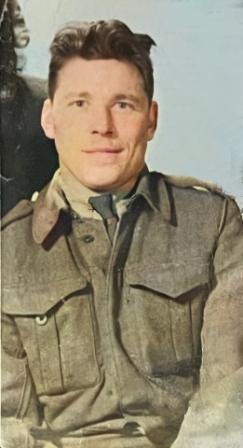
colourized improved_photo(37)

Edgar M. Guitard. (Photo courtesy of Nicole Lagace.  Photo colourization by Pieter Valkenburg)

Based on his extensive experience as a lumberjack with Fraser Brothers, Edgar was transferred to No. 12 Company of the Canadian Forestry Corps (CFC) in Valcartier, Quebec on April 12, 1941.

Unlike other members of the Canadian Army, members of the Canadian Forestry Corps were not expected to be in combat.  Their role was to help the British with their need for timber.  As stated in an article on http://www.canadiansoldiers.com/corpsbranches/forestrycorps.htm  “wood was needed for living quarters, messes, and recreation facilities, as well as crates for vital supplies such as food, ammunition and even vehicles, and for the creation of explosives, stocks for weapons, the construction of ships, aircraft and factory facilities….

Canada agreed to send workers and equipment to Great Britain, with the Corps Headquarters based in Scotland.  The British designated the areas of work, and the final disposal of the lumber created, but all military operations were under the control of Canadian Military Headquarters in London, England.

Although the men serving in the Canadian Forestry Corps were not in a combat role, they were provided with very rudimentary basic training in using firearms, only because of the impending threat of German invasion.

….Edgar left Canada for overseas service….

After about 6 weeks of basic training, Edgar left Halifax, Nova Scotia for the United Kingdom on June 18, 1941, arriving in Gourock, Scotland on July 2, 1941. He remained with No. 12 Company until September 29, 1943, when he was transferred to No. 11 Company, and then on March 19, 1944 to No. 5 Company. 

The work done by the Canadian Forestry Corps (CFC) included building barracks, roads, bridges, and setting up power plants. They also helped with snow clearance on the highland roads in Scotland. Each company of the CFC had two sections, one cutting in the bush and bringing out the timber, and the other sawing it into lumber at the company mill.

For an idea of the hard work done by the Corps, take a look at this very short British Pathé video Canadian Forestry Corps In Britain (1941)….

It was work that Edgar thrived at, but things were about to change.  By the spring of 1943, a desperate need for more soldiers in the Canadian Army caused several hundred soldiers to be redeployed.  Edgar was able to remain in the United Kingdom until after D-Day on June 6, 1944.

….Edgar was sent to France….

The above referenced Canadian Soldiers article explained that “…..after the landings in Normandy in June 1944, ten companies eventually moved to the Continent to continue operations there; 77 square timber rafts and 54 round timber rafts had been created in Southampton to move timber across the English Channel with them. By the end of August 1944, operations had commenced on the continent….

No. 5 Company was one of these ten companies, now part of the 21st Army Group.  On July 26, 1944, Edgar left for France with No. 5 Company, arriving a day later.

Edgar remained with the No. 5 Company until November 25, 1944, when he was transferred to the X-4 Reinforcement List of the 10th Battalion of the Canadian Infantry Corps.  The lumberjack was now a soldier, even though his training had not prepared him for combat.

….Edgar’s transfer to Le Régiment de la Chaudière was his last….

On January 13, 1945, Edgar was transferred to Le Régiment de la Chaudière and allotted to ‘A’ Company.  The Regiment had wintered in the Nijmegen Salient, while preparing for the upcoming fight in the Rhineland in February 1945.  They were based on the Holthurnsche estate in The Netherlands, near the German border, between the cities of Berg en Dal and Nijmegen.

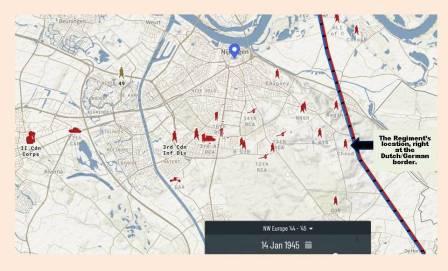
While on the estate, Edgar was one of two casualties hit by stray mortar fire.  The Regiment’s War diary entry for January 14, 1945, written at 10:30 am….  “…La cie A:  2 casualties par l’action des mortiers allemands….” (English translation: ‘A’ Company: 2 casualties by the action of German mortars.)  He died the following day, aged 27.

Map Jan 14 1945 position of Regt

Location of Le Régiment de la Chaudière on January 14, 1945, near the Dutch/German border. (Map source: Project ’44)

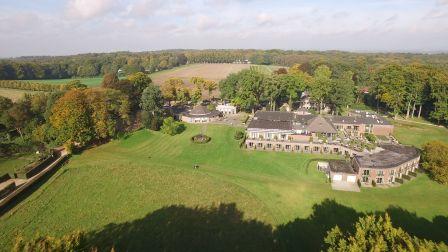
Today the area where the Regiment overwintered is the Hotel Holthurnsche Hof.

footer banner_holthurnsche_hof

Hotel Holthurnsche Hof is now where Le Régiment de la Chaudière was located in mid-January 1945. (Photo source:  http://realhealth.nl/hotel-holthurnsche-hof/)

..…Edgar is buried in Groesbeek …..

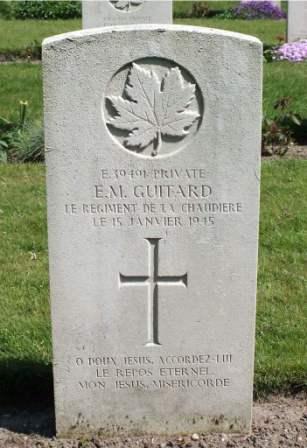
Edgar was initially buried in a temporary Canadian cemetery in Nijmegen on January 16, 1945, before being reburied in the Canadian War Cemetery in Groesbeek, The Netherlands on August 7, 1945.

grave stone Edward Guitard from Find A Grave

Grave of Edgar M. Guitard in the Canadian War Cemetery in Groesbeek, The Netherlands.  (Photo source: Find A Grave)

Thank you to Etienne Gaudet for going above and beyond to meet a family member of Edgar Guitard, and to Nicole Lagace for submitting a photo of her uncle. Many thanks also to Victor Richard and Jean Gaudet for connecting the dots that led to us meeting Etienne! Do you have photos or information to share? Email Pieter at memorialtrail@gmail.com, comment on the blog, or tweet to @researchmemori1.

© Daria Valkenburg

….Want to follow our research?….

If you are reading this posting, but aren’t following our research, you are welcome to do so.  Our blog address: https://onthewarmemorialtrail.com/

Front cover OnTheWarMememorialTrailinEurope4 countries, 6 weeks, 7,000 km – an unforgettable war memorial journey in Europe…. Daria’s book ‘No Soldier Buried Overseas Should Ever Be Forgotten‘ is available in print and e-book formats.  Net proceeds of book sales help support research costs and the cost of maintaining this blog. For more information see https://nosoldierforgotten.com/ 

You are also invited to subscribe to our YouTube Channel: On The War Memorial Trail With Pieter Valkenburg: https://www.youtube.com/channel/UCJ591TyjSheOR-Cb_Gs_5Kw

Never miss a posting!  Subscribe below to have each new story from the war memorial trail delivered to your inbox.
On The War Memorial Trail…..The WWII Soldier From St Louis Killed During The Attack On Weener

January 13, 2024. This past summer, Pieter noticed that four names on the photo wish lists from the Canadian War Cemetery in Holten had lost their lives on April 24, 1945, and all four were with the North Shore (New Brunswick) Regiment – 2 from New Brunswick and 2 from Nova Scotia.  What had happened that day?

We soon learned that nine men from the Regiment died during the Attack On Weener in Germany.  Pieter decided to research all four soldiers and was able to find family and photos for two.  Family was found for the other two, but, as occasionally happens, there were no photos.  Those two soldiers ended up on our Cold Case List when all other research possibilities were exhausted. (See https://onthewarmemorialtrail.com/our-cold-cases/)

Thanks to the efforts of two cousins, Irene Caissie and Maria Mazerolle, the first photo found was that of François ‘Frank’ GUIMOND, born April 15, 1919 in St. Louis, Kent County, New Brunswick.  He was the son of Théodore and Marie Leona (nee Doucet) Guimond.  Frank had 5 brothers and 5 sisters, which helped in finding living family members who might have a photo.

…. Frank’s niece provided a photo….

Frank’s photo was delivered in person by his niece, Maria Mazerolle (nee Guimond), who stopped by while on her way to the Sea Glass Festival in Souris, Prince Edward Island.  She explained that she was ….the eldest daughter of Frank’s brother Alcide, who served in Italy during WWII and died at the age of 52….”  Alcide and his wife Margaret (nee Leblanc) had 11 children. 

CIMG6436 Jul 29 2023 Pieter with Maria Mazerolle & photo of Frank Guimond

Maria Mazerolle and Pieter with a photo of Frank Guimond.  (Photo credit: Daria Valkenburg)

Maria explained that Delore, another of brother of Frank’s, “….was in England during WWII and married a lady from London.  One of his daughters is still alive at the age of 80….

Like in so many families, …his two brothers, Alcide and Delore had left to go to war, so Frank wanted to go too…

…. Frank enlisted in June 1941….

Frank Guimond from Maria Mazerolle photo circa Dec 1941 improved colourized _photo

Frank Guimond, circa December 1941. (Photo courtesy of Maria Mazerolle. Photo restoration and colourization: Pieter Valkenburg)

When he enlisted at the No. 7A District Depot in Richibucto, New Brunswick, on June 18, 1941, Frank was working with his father at Harry O’Leary’s sawmill in Richibucto, a job he’d held for six years already. His personnel file stated that Frank was fluent in French and English, and that he’d spent 30 days training in Fredericton with the New Brunswick Rangers militia.

On July 31, 1941, Frank was sent to No. 70 Canadian Army Basic Training Camp (CABTC) in Fredericton, New Brunswick for basic training.  After completing his basic training Frank was assigned to No A14 Infantry Training Camp in Aldershot, Nova Scotia on August 1, 1941.

…. Frank left Canada for service overseas in December 1941 ….

Frank’s training in Canada was not long, as by December 12, 1941, he was on his way to the United Kingdom, arriving on December 26, 1941, where he was assigned to No. 1 Canadian Divisional Infantry Reinforcement Unit (CDIRU).

While in the United Kingdom, Frank, along with other Canadian soldiers, undertook further training, as well as being tasked with defending the coastal regions of the United Kingdom, particularly Sussex, until early in 1944.

On January 16, 1944, Frank was sent for an educational course at 3 Wing Canadian Training School (CTS), remaining there until November 10, 1944 when he was assigned to No. 3 Canadian Infantry Training Regiment (CITR), in preparation for being sent to Continental Europe. 

…. Frank was transferred to the North Shore (New Brunswick) Regiment….

On December 27, 1944, he left the United Kingdom as part of the unallocated reinforcement troops needed in Northwestern Europe.   On February 14, 1945, he was transferred to the North Shore (New Brunswick) Regiment, joining them in Nijmegen, The Netherlands as they prepared to go across the border into Germany for the Battle of Keppeln, followed by the Battle of the Balberger Wald, and then for the push across the Rhine River.

On April 3, 1945, the Regiment was back in The Netherlands for the liberation of Zutphen, on the east bank of the IJssel River, an attack that began on April 6, 1945 and ended on April 8.  Canadian and Polish troops then worked until April 19, 1945 to liberate the Dutch towns of Heino, Meppel, and Makkum.

Screenshot 2024-01-10 at 08-52-00 weener germany map at DuckDuckGo

Map shows location of Weener, Germany where several soldiers from the North Shore (New Brunswick) Regiment lost their lives on April 24, 1945.  Below Weener is Stapelmoor, where the soldiers were initially buried. The dotted line shows the border between The Netherlands and Germany.  (Map source: http://www.viamichelin.com)

On April 20, 1945, the Regiment’s war diary reported new orders, requiring them to advance 140 km (87 miles) back into Germany, to relieve a Polish Armoured Division near Weener.  …We are to take over from the Poles on the night of April 21…

On April 23, 1945, the Regiment’s war diary reported that the …plan is for North Shore to capture Weener….”  After encountering resistance, the Regiment noted that ….by 1800 hours all companies were on objectives and were taking prisoners of war from houses and cellars…. A total of 103 prisoners of war were taken from the town. These were identified as Kriegsmarine fighting as infantry…”  Kriegsmarine was the navy of Nazi Germany.

…. Frank lost his life on April 24, 1945 ….

The war diary entry for April 24, 1945 was not as positive. The Battalion was unsure if the bridge over the Ems River to Leer was intact and sent out a reconnaissance party to check it out.  This was important information needed for the upcoming push to Leer a few days later. 

…This morning at 0900 hours a battle group consisting of A Company mounted on the Carrier platoon were sent to recce the bridge … over the Ems River at Leer “…to see if it was intact, but ran into heavy enemy fire… It was found the enemy was using a new device for mining the roads, which had not been encountered before…The first two carriers passed over the mined area, but the third was blown up and created a crater approximately 40 feet by 20 feet…

All on board of that third troop carrier were casualties. Things got worse as two German self-propelled guns then opened fire and a second carrier took a direct hit. 

Among the casualties was Frank Guimond, dead at age 26.

In ‘Fields of Valour’ by Ken Smith, it was noted that soldiers had been killed trying to locate a bridge that was no longer there. Lives might have been saved if information from air surveillance had been received.

Smith wrote that “….the attack on Weener was supposed to be an easy affair using ‘A’ Company, but ‘C’ Company had to be brought in to outflank the enemy, as ‘A’ Company was attempting to take the Leer bridge when a carrier was lost to a mine with casualties. At the same time several dreaded 88 guns began firing. The men were pinned and Typhoons had to be called in to finally silence the big guns.

The whole affair was useless as the Leer Bridge was already out of commission, with the attack costing the lives of men, mostly by mines or shelling….

Either an Allied strike took out the bridge or the Germans had blown it. Given that the area was mined, it suggests that it was the Germans who had blown up the bridge to delay the Allied advance.

….Other soldiers from the North Shore (New Brunswick) Regiment who lost their lives on April 24, 1945….

Besides Frank Guimond, those who were killed on April 24, 1945 included:

  • Private Emile Joseph ARSENEAULT of Lewisville, New Brunswick, age 22
  • Private Ronald Burton DOHERTY of St. John, New Brunswick, age 19
  • Private Wallace Herbert LARLEE of Perth, New Brunswick, age 19  (on our Cold Case List)
  • Private Andrew MEEHAN of Hammondvale, New Brunswick, but born in Ireland, age 21
  • Private Owen Burton MILLER of Deseronto, Ontario, age 21
  • Corporal Sydney Guy MOSHER of Bridgewater, Nova Scotia, age 30 (upcoming story)
  • Private Francis Leslie MULCAHY of Halifax, Nova Scotia, age 21 (on our Cold Case List)
  • Private Edmund SAMPSON of Cannes, Nova Scotia, age 30

….Frank is buried in the Canadian War Cemetery in Holten….

Frank was initially buried on April 26, 1945 “…in front of the school…” near the German village of Staplemoor, before being reburied the following year in the Canadian War Cemetery in Holten, The Netherlands.

guimond, frank gravestone

Grave of Frank Guimond in the Canadian War Cemetery in Holten, The Netherlands.  (Photo courtesy of the Information Centre Canadian Cemetery Holten)

On January 3, 1948 a letter from Mrs. A. C. Alberts-Fredricks of Deventer, The Netherlands, was sent to the Department of Veterans Affairs, in which she explained that she had adopted Frank’s grave and asked if her letter could be forwarded to the family.  A note at the bottom of the letter verified that it had been forwarded to Frank’s mother.

…. We met another niece in Richibucto….

It’s not often that we get to meet more than one group of family members, but a few months after meeting Maria Mazerolle, we met her cousin, Irene Caissie, along with Irene’s husband Rheal in Richibucto.  Irene explained that Frank’s brother, Edgar, was her father.

20230918_120957 Sep 18 2023 Pieter with Irene and Rheal Caissie

Pieter with Irene and Rheal Caissie.  (Photo credit: Daria Valkenburg)

Thank you to Irene Caissie and Maria Mazerolle for ensuring we received a photo of Frank Guimond.

Sydney Guy MOSHER’s story will be coming up.  If you can help with photos for two other soldiers killed on April 24, 1945 who are currently on the Cold Case List, please let us know.  The names: Wallace Herbert LARLEE of Perth, New Brunswick, and Francis Leslie MULCAHY of Halifax, Nova Scotia.

Do you have photos or information to share? Email Pieter at memorialtrail@gmail.com, comment on the blog, or tweet to @researchmemori1.

© Daria Valkenburg

….Want to follow our research?….

If you are reading this posting, but aren’t following our research, you are welcome to do so.  Our blog address: https://onthewarmemorialtrail.com/

Front cover OnTheWarMememorialTrailinEurope4 countries, 6 weeks, 7,000 km – an unforgettable war memorial journey in Europe…. Daria’s book ‘No Soldier Buried Overseas Should Ever Be Forgotten‘ is available in print and e-book formats.  Net proceeds of book sales help support research costs and the cost of maintaining this blog. For more information see https://nosoldierforgotten.com/ 

You are also invited to subscribe to our YouTube Channel: On The War Memorial Trail With Pieter Valkenburg: https://www.youtube.com/channel/UCJ591TyjSheOR-Cb_Gs_5Kw

Never miss a posting!  Subscribe below to have each new story from the war memorial trail delivered to your inbox.

On The War Memorial Trail….. The WWII Soldier From Meteghan Killed During The Battle Of Five Woods

October 18, 2023.  Last fall we visited the war memorial in Saulnierville, Nova Scotia, as two soldiers that Pieter had researched are listed on this monument.  Coincidentally, both are buried in the Canadian War Cemetery in Holten.  At the time of our visit, we’d told the story of one of the soldiers, but not the other.  (See https://onthewarmemorialtrail.com/2022/11/09/on-the-war-memorial-trail-the-importance-of-remembrance/)

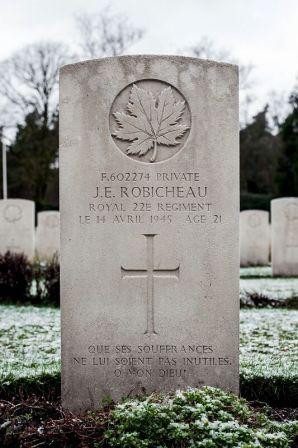
This second soldier was Joseph ‘Edmond’ ROBICHEAU, from Meteghan, Nova Scotia, who lost his life on April 14, 1945 near Deventer, The Netherlands, while serving with the Royal 22e Regiment. 

Born November 16, 1923 in Meteghan, Edmond was the son of Césaire and Vitaline Robicheau.  When he enlisted at the No. 6 National Resources Mobilization Act (NRMA) Clearing Depot in Halifax, Nova Scotia, on August 18, 1943, he noted that he had worked as a fisherman for 2 years and had served in the 2nd Battalion West Nova Scotia Infantry (Reserve) since October 1942.  (See https://en.wikipedia.org/wiki/National_Resources_Mobilization_Act)

…A photo of Edmond was found in Saulnierville…

Although Edmond had 3 brothers and 4 sisters, Pieter was not able to find any family members during the photo search.  This unfortunately happens more often than you’d think.  A photo was found through a nearby resident, Ann Louise Doucet, who explained that “the photo is located at the Clare Veterans Association…” in Saulnierville, Nova Scotia, “ so I would credit them as there is no name on the photo…

IMG_3047v Joseph Robicheau

Joseph ‘Edmond’ Robicheau. (Photo source: Clare Veterans Association)

… Edmond served in the Coast Battery and home defence…

On September 17, 1943, Edmond was sent to No. 61 Canadian Army Basic Training Centre (CABTC) in New Glasgow, Nova Scotia for training as a gunner.  After completing his basic training, he was attached to A23 Training Centre in Halifax, Nova Scotia on November 16, 1943. A23 was a Coast and Anti-Aircraft Artillery Training Centre established to train coast and anti-aircraft gunners.

On March 11, 1944, Edmond was transferred to the 16th (C) Regiment of the Royal Canadian Artillery and sent to Sydney, Nova Scotia. Not long afterwards, on April 26, 1944, he was assigned to the 104th Coast Battery of the Royal Canadian Artillery and posted to Shelburne, Nova Scotia.

The 104th Coast Battery was garrisoned at Fort McNutt on McNutt’s Island, as coastal defence to protect the port of Shelburne. The threat of German submarine activity was a concern.  This is why Shelburne had been designated as an alternate port to Halifax Harbour during the war.

On September 7, 1944, Edmond transferred to the Royal Regiment of Canada, and sent for a 4 day tactical training course at the Special Infantry Training Camp in Vernon, British Columbia on September 27, 1944.

On October 1, 1944, Edmond was attached to the 1st Battalion Oxford Rifles, part of the Royal Regiment of Canada, which served in Canada in a home defence role as part of the 16th Infantry Brigade, 8th Canadian Division.

… Edmond left Canada for overseas service in January 1945…

On January 2, 1945, Edmond was among the soldiers of the 1st Battalion Oxford Rifles who left Canada for the United Kingdom, arriving on January 8, 1945.  The Battalion was disbanded on January 10, 1945 to provide reinforcements for the First Canadian Army. 

Edmond was assigned to No. 6 Canadian Infantry Training Regiment (CITR) upon arrival, for further training, then to No. 4 Canadian Infantry Training Regiment (CITR) on February 4, 1945.

Screenshot 2023-10-09 at 11-44-19 Putte · 2580 Belgium

Putte, Belgium is near the Dutch border.  (Map source: Google maps)

On March 9, 1945 he was sent to North West Europe as part of the X-4 reinforcement troops of the 21st Army Group.  Then, on April 2, 1945 he was transferred to the Royal 22e Regiment (also known as the Van Doos), joining them while they were in Putte, Belgium.

In the Regimental history, ‘The Royal 22e Regiment’, author Serge Bernier records that “…on April 4, the regiment made an incursion into the Reichswald, near Clèves, which the Canadians had recently liberated at considerable cost...”  Clèves (Kleve in English) is just over the Dutch border in Germany.

After a few days, the Regiment made its way back into The Netherlands. “…On the 10th the Royal 22e left the sector, passing through Clèves and Emmerich, before moving into eastern Holland, and stopping near Zutphen.  On the 13th it crossed the Yssel to take up a position in a bridgehead that the 3rd Brigade would use as a base to attack the town of Appeldoorn....”  Yssel refers to the IJssel River in The Netherlands.

… Edmond lost his life during the Battle of the Five Woods…

Screenshot Deventer Google Maps

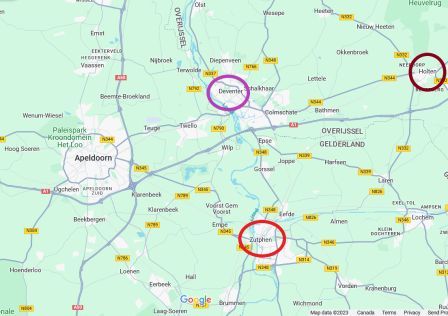
The locations in The Netherlands where the Royal 22e Regiment for April 1945, where Robicheau was initially buried and where he is permanently buried. (Map source: Google maps)

The next day, April 14, 1945, the Regiment received a change in plans.  “… The WNSR and the CYR were the first to leave, closely followed by the Royal 22e, but at 7:30 am the regiment received orders to capture a well-defended wooded area....”  WNSR refers to West Nova Scotia Regiment.  CYR refers to Carleton & York Regiment.

This was the Battle of the Five Woods.  “…Assisted by tanks, the companies performed mopping-up operations in the sector for 24 hours.  The assignment proved costly: 11 men were reported killed, 19 wounded and two missing…” Among those who lost their lives that day was Edmond Robicheau.

…Edmond is buried in the Canadian War Cemetery in Holten…

He was initially buried in a temporary cemetery near Deventer, before being reburied in the Canadian War Cemetery in Holten, The Netherlands in 1946.

Grave of Joseph Robicheau from CVWM

Grave of Joseph ‘Edmond’ Robicheau.  (Photo source: Canadian Virtual War Memorial)

Thank you to Ann Louise Doucet for sending a photo of Joseph Robicheau.  Thank you also to David (dryan67) from the WW2Talk Forum for sharing information from the Royal 22e Regimental history. If you have a story to tell, please let Pieter know. You can email him at memorialtrail@gmail.com, comment on the blog, or send a tweet to @researchmemori1.  

© Daria Valkenburg

…Want to follow our research?….

If you are reading this posting, but aren’t following the blog, you are welcome to do so.  Our blog address: https://onthewarmemorialtrail.com/

Front cover OnTheWarMememorialTrailinEurope4 countries, 6 weeks, 7,000 km – an unforgettable war memorial journey in Europe…. Daria’s book ‘No Soldier Buried Overseas Should Ever Be Forgotten‘ is available in print and e-book formats.  Net proceeds of book sales help support research costs and the cost of maintaining this blog. For more information on the book, please see https://nosoldierforgotten.com/

You are also invited to subscribe to our YouTube Channel: On The War Memorial Trail With Pieter Valkenburg: https://www.youtube.com/channel/UCJ591TyjSheOR-Cb_Gs_5Kw

Never miss a posting!  Subscribe below to have each new story from the war memorial trail delivered to your inbox.

On The War Memorial Trail….. An Update On The Story Of WWII Soldier Alphonse Robert

October 12, 2021.   In April 2021, in Part 9 of the Atlantic Canada Remembers series, the story of Alphonse ROBERT of Caraquet, New Brunswick, was briefly told.  His service file had very little information on the circumstances of his death and noted that he died on March 30, 1945 in Germany while serving with Les Fusiliers Mont-Royal, and was buried in Germany. (See https://onthewarmemorialtrail.com/2021/04/15/on-the-war-memorial-trail-atlantic-canada-remembers-part-9/)

Alphonse Robert

Alphonse Robert.  (Photo courtesy of the Robert Family)

Recently we received an email from Maarten Koudijs, who wrote that Alphonse Robert died during an attack on Gendringen, The Netherlands, and was initially buried in Megchelen, The Netherlands, just across the border with Germany.  After additional research to verify what Maarten told us, we have more information on what happened on March 30, 1945.

…Was Alphonse Robert buried in The Netherlands or Germany?….

Map Megchelen

The first question we had was whether Alphonse Robert had been initially buried in Germany, as stated in the service file, or in The Netherlands.  Megchelen is a small village on a tiny hook of land surrounded on three sides by the German border.  It’s easy to understand how a mistake could have been made in the official records, but was Megchelen the correct location?

We contacted Alice van Bekkum, Chair of the Groesbeek Faces to Graves Committee, and asked if she could check the cemetery record and see where Alphonse Robert had been originally buried.

Alice confirmed it was Megchelen.  “I have a list from CWGC with the coordinates of the temporary burial site where the body was exhumed when it was transferred to Groesbeek. It says Megchelen…”  (CWGC refers to Commonwealth War Graves Commission.)  The service file record was incorrect.

…How 5 members of Les Fusiliers Mont-Royal lost their lives….

How did Alphonse Robert lose his life?  Maarten explained that “…during the attack on Gendringen, a number of infantrymen were following a tank. A German shell exploded behind the tank and 5 infantry soldiers were killed.   

The soldiers who immediately lost their lives were Roland Alfred Barry, Edmond Coulombe, Jacques Fortin, and Alphonse Robert. They were temporarily buried, next to each other, in a field grave in Megchelen.  

Bernard Gaston Pilon was seriously injured and was transferred to Bedburg Military Hospital, where he died and was also temporarily buried there….”  Bedburg is in Germany.

All 5 infantrymen from Les Fusiliers Mont-Royal were later reburied in the Canadian War Cemetery in Groesbeek.

Pieter then looked at the War Diary for Les Fusiliers Mont-Royal. On March 29, 1945, the diarist recorded being in the Reichswald Forest.  …Battalion with its F Echelon vehicles crosses the Rhine at night without incident...

On March 30, 1945, the diarist wrote the location as Germany.  “…In the morning troops proceed to positions…Light opposition with intermittent shelling and mortaring...

On March 31, 1945, the diarist still wrote Germany as the location.  “…Battalion sweeps north again against stiffening resistance this time.  Mortaring and shelling. The attack was supported by tanks.  Gendringen was entered…”   Gendringen is in The Netherlands, near Megchelen.

…Two eye-witnesses saw what happened….

In an interview in ‘De Ganzenveer’ (‘The Quill’), Hans Bresser and Rudie Grin, witnesses to the attack, stated that “…At Wieskamp’s house, between Striekwold and Giezen, a Canadian tank was firing. There were also a number of infantrymen. A German shell exploded in between, possibly killing five or more Canadian soldiers. The grenade was…fired from somewhere from the Pol near Ulft. The fallen soldiers were given a field grave in Megchelen on Friesen’s land on the Nieuweweg...”  (Account translated from the original Dutch)

…The other members of Les Fusiliers Mont-Royal who lost their lives….

  • Roland Alfred BARRY, son of Horace and Rose Alma Barry of Montreal, Quebec, died March 30, 1945, aged 20.
  • Edmond COULOMBE, son of Ulric and Yvonne Coulombe, of Pine Falls, Manitoba, died March 30, 1945, aged 22.
  • Jacques FORTIN, son of Henri and Yvonne Fortin, of Chicoutimi, Quebec, died March 30, 1945, aged 21.
  • Bernard Gaston PILON, son of Emile and Emilie Pilon, of Rockland East, Ontario, died March 30, 1945, aged 19.

Thank you to Maarten Koudijs for contacting us with the additional information on Alphonse Robert, and to Alice van Bekkum for verifying that he was previously buried in Megchelen, The Netherlands.

If you have further information to share about Alphonse Robert or the other Canadian soldiers mentioned here, please contact Pieter at memorialtrail@gmail.com or comment on the blog.

Remembrance-Day-2019-Images-1024x520

With Remembrance Week coming up, please take a look through your photo albums and in your attics in case you have a photo or information to share about Canadian soldiers.

© Daria Valkenburg

…..Want to follow our research?….

If you are reading this posting, but aren’t following our research, you are welcome to do so.  Our blog address: https://onthewarmemorialtrail.com/

4 countries, 6 weeks, 7,000 km – an unforgettable war memorial journey in Europe…. Daria’s book ‘No Soldier Buried Overseas Should Ever Be Forgotten‘ is available in print and e-book formats.  Net proceeds of book sales help support research costs and the cost of maintaining this blog. For more information see https://nosoldierforgotten.com/ 

Screenshot_2021-02-27 On The War Memorial Trail With Pieter Valkenburg

You are also invited to subscribe to our YouTube Channel: On The War Memorial Trail With Pieter Valkenburg: https://www.youtube.com/channel/UCJ591TyjSheOR-Cb_Gs_5Kw

Never miss a posting!  Subscribe below to have each new story from the war memorial trail delivered to your inbox.
On The War Memorial Trail….. Atlantic Canada Remembers – Part 10

July 11, 2021. More of the photos submitted about Atlantic Canadian soldiers buried overseas are featured in Part 10. Pieter continues to ensure that photos of soldiers buried in The Netherlands are forwarded to the appropriate cemetery for their digital archives. 

Soldier buried at the Canadian War Cemetery in Holten, The Netherlands

Armand Gionet and family from Mel

Armand Gionet, far right, and his family.  (Photo courtesy of Edmonde Lanteigne)

Armel ‘Mel’ Lanteigne, President of the Caraquet branch of the Royal Canadian Legion, submitted a photo of Armand GIONET of Middle Caraquet, New Brunswick, explaining that he had found “…a picture for Armand Gionet, taken in front of the family farm and house.  From left to right: Lazare Gionet, Nicholas Hébert, Paul-Aurèle Gionet, Hectorine Gionet, Analda Gionet and at the end Armand Gionet, no name for the dog, sorry. 

Armand was a fisherman and a farmer. I took the house’s picture and did the leg work and phone calls.  I got the family’s picture from Edmonde Lanteigne, she is the daughter of Hectorine and Nicolas.  The house is owned by Victoria and Nicole, the daughters of Paul-Aurèle Gionet, Armand’s brother...

After the photo was submitted to the researchers at the Information Centre at the Canadian War Cemetery in Holten, journalist Jan Braakman, one of the researchers at the Centre, wrote us that the photo “…has a very special meaning for me. Armand Gionet died in my town of birth (Laren, province of Gelderland) at the same place, same time and same way as my grandmother, Dina Koeslag. They were caught in flames after their hiding place had been hit by a German pantzerfaust (according to the cause of death as noted by my grandmothers’ doctor.)...” A pantzerfaust is a bazooka.

I have never had a chance to know my grandmother (nor my grandfather, who had been arrested and was killed in a concentration camp near Hamburg). But every once in a while I find pieces of her life and death. This is such a piece. Thanks very much for forwarding this photo to the Information Centre….” 

Armand was born April 26, 1924 in Middle Caraquet, New Brunswick, the son of Lazare Gionet and Laura Hebert.  One of 8 children, he worked on his parents’ farm.  He was also in the Reserve Labour Pool for the port of Halifax, and worked as a freight handler at the port on an as needed basis.

On March 25, 1944 he enlisted. After basic training he was sent to England, arriving on December 25, 1944.  By February 1945 he was in continental Europe and assigned to Le Regiment de Maisonneuve.

At the beginning of April 1945, the Regiment was in The Netherlands.  On April 4, the Regiment prepared to cross the Twente Canal near Almen for an attack from the bridgehead towards the village of Laren. The battle began at 8 pm and went throughout the night.  (See https://en.wikipedia.org/wiki/Twentekanaal)

The Regiment’s war diary for April 5, 1945 simply stated that: “…During the attack last night, we had 23 casualties and we captured 40 prisoners…” 

In a translated excerpt of a Dutch language article written by Jan Braakman, he summarized what happened. “…  Among the 23 casualties (wounded and killed) was Armand Gionet. During the fighting he ended up at a group of farms along the Zutphenseweg, just outside the church of Laren. Many civilians hid there from the violence of war. When Gionet and his mates arrived, the inhabitants were convinced that they had been liberated. They emerged from their hiding places in a euphoric mood.

Civilians and soldiers were festive on the road when suddenly fire was opened again by German soldiers. In panic everyone ran to a safe place. Armand Gionet took a position in the Klein Veldkamp farm, where many civilians… were looking for a safe place. But after a while the danger proved too great to stay there. The farm was on fire. Everyone had to go outside.

Fear reigned. In total chaos, everyone ran in one direction. Civilians were sent back by a wounded Canadian soldier as they walked towards the German fire. In the end, the neighbours found a makeshift shelter in a cowshed. Canadian soldiers sat upstairs.

The sky didn’t clear until late in the afternoon when Canadian jeeps pulled into the yard…..

In the aftermath, among the casualties were Armand Gionet and Jan Braakman’s grandmother, who both had perished at the Klein Veldkamp farm.  (To read the original Dutch article, see https://wp.janbraakman.nl/armand-gionet-kon-zijn-ambitie-niet-waarmaken/)

Armand is buried at the Canadian War Cemetery in Holten, The Netherlands.  He was 19 years old. 

Soldier buried at the Canadian War Cemetery in Groesbeek, The Netherlands

gilles lanteigne WWII

Gilles Lanteigne. (Photo courtesy of Dan Lanteigne)

Armel ‘Mel’ Lanteigne, President of the Caraquet branch of the Royal Canadian Legion, submitted a photo of Gilles LANTEIGNE, explaining that the photo came from “….Dan Lanteigne’s private collection.  He does research on the Lanteigne family…

Born March 27, 1924 in Caraquet, New Brunswick, the son of Ella and Prospère Lanteigne, Gilles was a labourer before enlisting on February 10, 1944.  On July 19, 1944 he arrived in the United Kingdom as a member of the Canadian Infantry Reserve Unit.  On August 12, 1944 he arrived in France and transferred to Le Regiment de Maisonneuve.

While serving with Le Regiment de Maisonneuve, he was severely wounded on March 8, 1945, and taken to a field hospital.  A day later, on March 9, 1945, he “…died of wounds…” received in action in Germany.  He was initially buried in Bedburg Military Cemetery before being reburied a year later in the Canadian Military Cemetery in Groesbeek, The Netherlands.

Mariner Lost At Sea

William Arnold Johnston

William ‘Bill’ Johnston.  (Image courtesy of Canadian Virtual War Memorial)

Don Coutts wrote that “…I have been enjoying your articles.  My grandmother, Annie Bagnall Muttart, came from a large family, a total of nine boys and girls.  One of her brothers was Andrew Bagnall.  Andrew and his wife, Gussie, had four children: Kay, Eleanor, Ted, and Dick.

Kay married William (Bill) Arnold JOHNSTON on June 16th, 1940. He was a Lieutenant in the Royal Canadian Navy. His ship, the HMS Itchen, was torpedoed … and he lost his life. 

The Bagnall Family encountered two deaths of young men (Elmer in October 1941, and Bill in September 1943) during WWII….”  Don’s uncle, Elmer Bagnall MUTTART, has been previously featured on this blog.  (See https://bordencarletonresearchproject.wordpress.com/2017/07/28/the-elmer-bagnall-muttart-story/ and https://www.youtube.com/watch?v=71Rzg07kPw0&list=PLaJcEVojJra-ZwR6rvb-THj8Zr2QbUXLT&index=2)

Born November 25, 1918 in Moncton, New Brunswick, Bill was the son of Frank Ariel and Eudaviela Waters Johnston, of Charlottetown, Prince Edward Island.  On May 17, 1937 he enlisted in the Militia in Charlottetown, and remained a member over the next few years, while employed as a teller at the Canadian Imperial Bank of Commerce in Charlottetown.  On June 17, 1940, a day after his marriage, he was enlisted in the Royal Canadian Naval Volunteer Reserve.

On December 13, 1941 he was appointed to serve aboard HMCS Charlottetown.  Unfortunately, the ship was torpedoed and sunk on September 11, 1942 in the St. Lawrence River along the northern shore of Gaspé Peninsula, while returning to base from convoy duty.  Bill was one of the survivors.  (See https://en.wikipedia.org/wiki/HMCS_Charlottetown_(1941)#Sinking)

After a stint of survivor’s duty at HMCS Stadacona in Halifax and short training courses, he was assigned to HMS Itchen on April 19, 1943, which was involved in anti-submarine warfare exercises off the coast of Scotland until September 1943, when it was assigned to convoy escort duty. 

While in the Atlantic Ocean, several ships in the convoy were attacked, beginning on September 19, 1943.  On September 20, HMCS St Croix was sunk.  81 survivors were picked up by HMS Itchen. 

HMS Itchen (K227)

Red dot shows location of sinking of HMS Itchen.  (Image source: https://en.wikipedia.org/wiki/HMS_Itchen_(K227))

Just after 2 am on September 23, 1943, HMS Itchen was torpedoed, causing the frigate to blow up, with a loss of 230 lives, including Bill. He was 24 years old.

Two people from HMS Itchen and one from HMCS St Croix survived and were picked up by a Polish steamer. (See https://en.wikipedia.org/wiki/HMS_Itchen_(K227) and https://www.uboat.net/allies/merchants/ship/3079.html)

Don Coutts noted that “…Kay and Bill had a son Tom who was born on March 18, 1943. Tom died a number of years ago. Kay married a Bob Mills from Nova Scotia…they split their time between Port Royal, NS (late Fall/Winter/early Spring) and Stanhope, PEI (late Spring/Summer/early Fall)...”

As his body was never recovered, Bill’s name is listed on the Halifax Memorial in Point Pleasant Park in Halifax, Nova Scotia. 

To read previous stories about other mariners listed on the Halifax Memorial, please see:

Thank you to Jan Braakman, Don Coutts, Armel ‘Mel’ Lanteigne, and Edmonde Lanteigne for sharing photos and anecdotes to ensure that Atlantic Canadians who are buried overseas are not forgotten.

More photos and stories in Atlantic Canada Remembers – Part 11! To share photos or information, please email Pieter at memorialtrail@gmail.com, comment on the blog, or tweet to @researchmemori1

© Daria Valkenburg

…Previous postings in the Atlantic Canada Remembers series…

Missed the previous postings in this series? See:

…Want to follow our research?….

If you are reading this posting, but aren’t following the blog, you are welcome to do so.  Our blog address: https://onthewarmemorialtrail.com/

Front cover OnTheWarMememorialTrailinEurope4 countries, 6 weeks, 7,000 km – an unforgettable war memorial journey in Europe…. Daria’s book ‘No Soldier Buried Overseas Should Ever Be Forgotten‘ is available in print and e-book formats.  Net proceeds of book sales help support research costs and the cost of maintaining this blog. For more information see https://nosoldierforgotten.com/

Screenshot_2021-02-27 On The War Memorial Trail With Pieter Valkenburg

You are invited to subscribe to our YouTube Channel: On The War Memorial Trail With Pieter Valkenburg: https://www.youtube.com/channel/UCJ591TyjSheOR-Cb_Gs_5Kw

Never miss a posting!  Subscribe below to have each new story from the war memorial trail delivered to your inbox.

On The War Memorial Trail…..A Tragic Drowning On The Leda River in Germany – Part 3

May 17, 2021.  When we visited the Canadian War Cemetery in Holten in October 2019, we laid flags down at the graves of five soldiers from the North Nova Scotia Highlanders who drowned in a tragic accident in Germany on April 28, 1945.

Recap: In Part 1, the 5 soldiers were identified and the circumstances leading up to the accident were summarized. In Part 2, more information on the accident was discussed, as well as a brief story on Lloyd William Murray, one of the 5 soldiers.  The rest of this series features the other North Nova Scotia Highlanders who lost their lives that day.

In October 2018, while we were in Nova Scotia, we were able to meet two nieces of Joseph Ambroise COMEAU, the only family members of the 5 soldiers we were able to meet in person – up to now.

CIMG2715 Oct 11 2018 Simone Comeau Pieter Jacqueline Comeau in Windsor

Pieter with Simone Comeau, left, and Jacqueline Comeau, right.  (Photo credit: Daria Valkenburg)

Simone, Jacqueline, and their two sisters are diligent in remembering their uncle.

IMG-1039 Comeau sisters

The Comeau sisters of Nova Scotia.  Left to right:  Simone Comeau, Jacqueline Comeau, Anna (Comeau) Gammell, and Rose-Marie Comeau. (Photo courtesy of Simone Comeau)

…. Joseph ‘Ambroise’ Comeau Remembered….

Joseph Ambroise Comeau from Simone

Joseph ‘Ambroise’ Comeau.  (Photo courtesy of niece Simone Comeau)

Niece Simone Comeau wrote a brief overview of her ‘oncle Ambroise’.  “… Private Joseph Ambroise Comeau was born on October 1, 1923 in Lower Saulnierville, Nova Scotia, Canada, the fourth of six children to Gustave and Jessie (Saulnier) Comeau.

Ambroise was baptized on October 4, 1923 in Sacred Heart, Saulnierville, the local parish church. He also made his first confession, first Communion, and confirmation, all sacraments of the Roman Catholic faith in this church.

According to records, he had little schooling. Being from a poor family, his farmer/blacksmith father had no financial means to send him to the private local boys’ college. At the time of his draft he was employed as a carpenter for Clare Shipbuilding Company.

One has to wonder as to whether he had a premonition regarding the probability of his not returning to Canada as a veteran, since he was most reluctant to leave, according to the family of his then three old goddaughter, to whom he had brought a gift on his good-bye visit.

Sadly, Private J. Ambroise Comeau (F.602531) of the North Nova Scotia Highlanders was killed on April 28, 1945, a victim of World War II. On June 3, 1945, a memorial was held in Sacred Heart Church where he had practised his faith until his departure for the war. Being ever faithful to his beliefs, at the time of his death he carried a religious medal and a rosary on his person….

Ambroise, who was fluent in both English and French, enlisted on April 28, 1944 in Halifax, Nova Scotia, and lost his life exactly a year later.  As part of the Canadian Infantry Training Regiment (CITR) he arrived in the United Kingdom on January 10, 1945.  He was temporarily assigned to the St John Fusiliers, before being reassigned to the CITR.  On March 28, 1945 he arrived in North West Europe as part of the IGU (Infantry General Unit) before being transferred to the North Nova Scotia Highlanders on April 19, 1945.

According to his service file, on May 19, 1945 Ambroise was buried on top of a dike in Leer, Germany before being reburied in the Canadian War Cemetery in Holten.

Grave of Joseph Ambroise Comeau

Original grave marker in Germany for J.A. Comeau.  (Photo from the service file.)

CIMG3274 Oct 3 2019 Holten Joseph Comeau

By the grave of Joseph ‘Ambroise’ Comeau at the Canadian War Cemetery in Holten in October 2019.  Pieter is standing with Dutch researcher Edwin van der Wolf, left. (Photo credit: Daria Valkenburg)

…. to be continued…..

In Part 4 we learn about more of the North Novies who lost their lives.   Thank you to Simone and Jacqueline Comeau for sharing photos and information about their uncle.

If you have information to share about these or any Canadian soldiers buried in The Netherlands, please contact Pieter at memorialtrail@gmail.com, or comment on the blog.

© Daria Valkenburg

…. Previous postings in this series…..

Missed the previous postings in this series? See:

…Want to follow our research?…

If you are reading this posting, but aren’t following our research, you are welcome to do so.  Our blog address: https://onthewarmemorialtrail.com/

Front cover OnTheWarMememorialTrailinEurope4 countries, 6 weeks, 7,000 km – an unforgettable war memorial journey in Europe…. Daria’s book ‘No Soldier Buried Overseas Should Ever Be Forgotten‘ is available in print and e-book formats.  Net proceeds of book sales help support research costs and the cost of maintaining this blog. For more information see https://nosoldierforgotten.com/

Screenshot_2021-02-27 On The War Memorial Trail With Pieter Valkenburg

You are also invited to subscribe to our YouTube Channel: On The War Memorial Trail With Pieter Valkenburg: https://www.youtube.com/channel/UCJ591TyjSheOR-Cb_Gs_5Kw.

Never miss a posting!  Subscribe below to have each new story from the war memorial trail delivered to your inbox.
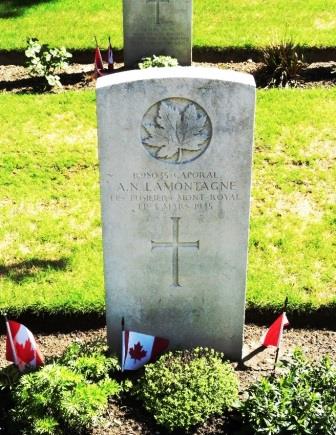
On The War Memorial Trail…..A Tragic Drowning On The Leda River in Germany – Part 1

May 15, 2021.  When we visited the Canadian War Cemetery in Holten in October 2019, we laid flags down at the graves of five Canadian soldiers who drowned in a tragic accident in the Battle of Leer in Germany on April 28, 1945, one of the final actions to end WWII in Europe.
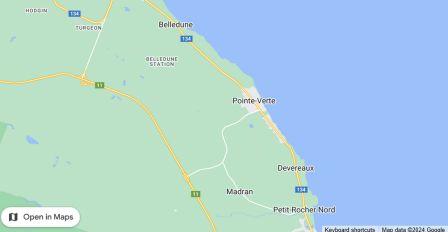
(See https://onthewarmemorialtrail.com/2019/10/08/on-the-war-memorial-trail-our-2019-visit-to-the-canadian-war-cemetery-in-holten/)

…5 North Nova Scotia Highlanders Drowned….

These 5 soldiers, all from the North Nova Scotia Highlanders Regiment, were:

  • Joseph ‘Ambroise’ COMEAU, age 22, of Saulnierville, Nova Scotia
  • Lewis Wilkieson MARSH, age 19, of Sydney Mines, Nova Scotia
  • Ruel Kitchener MATHESON, age 29, of Charlottetown, Prince Edward Island
  • Lloyd William MURRAY, age 28, of Tatamagouche, Nova Scotia
  • Howard Milo NICHOLLS, age 21, of Mattawa, Ontario

This tragedy became known to us when the people at the Holten Canadian Cemetery Information Centre asked for help in finding family of these soldiers as part of their project to put a face to every name on each gravestone.

Two families immediately came forward – the Comeau family in Nova Scotia shared information about Joseph ‘Ambroise’ COMEAU, as did the nephew of Lloyd William MURRAY.

Joseph ‘Ambroise’ Comeau.  (Photo courtesy of niece Simone Comeau)

Lloyd William Murray.  (Photo courtesy of Murray Baillie)

…Operation Duck…

Putting faces to names made us want to know more about what happened in this event with the aptly named codename Operation Duck (See https://codenames.info/operation/duck-iii/).

The plan? The North Nova Scotia Highlanders would cross the Leda River in assault boats and secure the northern bank of the river in preparation for the attack to capture Leer. The Highland Light Infantry of Canada would cross the Leda River, where the Ems and Leda rivers meet. The Stormont, Dundas and Glengarry Highlanders would go across the Ems River towards the western edge of Leer.

These three Regiments were part of the 9th Canadian Infantry Brigade.  (See https://www.canadiansoldiers.com/history/battlehonours/northwesteurope/leer.htm)

Map showing the Ems and Leda Rivers, and position of Regiments during the Battle for Leer.  (Map courtesy of and ©Jan Braakman)

In a translated excerpt from the recently published book ‘Holtense Canadezen’ (The Faces Of Holten) by Jan Braakman, we learned that the North Novies were not the only Regiment to have had casualties.  The men from the Highland Light Infantry all crossed safely, but 19 men from the Stormont, Dundas & Glengarry Highlanders didn’t.

…Why Operation Duck Was Important…

Jan Braakman’s account explained why Operation Duck was important. “…At the end of April 1945, Canadian troops stood just across the Dutch-German border in Ostfriesland (East Frisia in Germany) in front of the river Ems. The town of Leer was on the other side of the river on the route to Emden. Surrounded by inaccessible lowlands in the north and with rivers (Ems and Leda) in the west and south, Leer was a well defensible and therefore difficult to capture port city. All access bridges over the Ems and Leda were blown up by the Germans. For the Canadians there was no other option than to reach the city by water….

River crossings can be tricky due to currents and tides, and in wartime, there is always the risk of enemy fire.  “….The Ems River has an open connection with the Wadden Sea, which means that tides influence water levels and currents in the river. Tides made the currents unpredictable, and the Canadian Army didn’t have accurate information about the tides. What was clear: high tide was the best time to make the crossing. Aerial photographs showed that German troops had fortified themselves well behind the dikes that surrounded the city…. 

A decision was made on how to cross the two rivers – the Leda and the Ems.. “ Only under the protection of a smoke screen and solid artillery support would it be possible to successfully complete the attack on Leer, using boats … General Simonds ordered that on April 28, 1945, before darkness fell, there had to be a solid bridgehead, from which the capture of Leer could be initiated. That meant that the attack had to be launched during the middle of the day, around three o’clock, when the water level was at its highest… 

The Highland Light Infantry crossed safely, but the other two regiments ran into trouble.  “…The crossing was made at three different places. At the same time, artillery fire and attacks from the air put the German defence line to the test. The North Nova Scotia Highlanders would cross the Leda from the south bank and take the harbour of Leer, which abutted the city on a peninsula...

 ….Panic Led To Tragedy….

Things didn’t go as planned.  3 sets of assault boats used by the North Nova Scotia Highlanders set off at 15:45 hours on April 28.  In ‘No Retreating Footsteps… the story of the North Novas’ by Will Bird, he explained that “…9 men were allotted to a boat at the river crossing.  Two men in each were operating these boats which used outboard motors….

In each boat were 7 North Novies and two boat operators from the Royal Canadian Engineers.  “…. C Company, commanded by Major Winhold, had moved off from Driever …. with Thirteen Platoon leading, then…. Fourteen Platoon under Lt S Laskin and Fifteen under Lt McGlashen…

Unfortunately for the men in the boat from Fifteen Platoon, one of the Engineers didn’t have nerves of steel.  “…Just as the craft were launched some shelling began and the young Engineer at the motor of the boat ….. became very excited.  His mate shouted at him not to turn on full power as the heavy load would sink when the motor dipped, but a shell landed quite near and the nervous man gave the motor the gun, sinking the boat at once…

Five of the North Novies drowned.  Lt McGlashen managed to save himself and another man.  Men were not the only casualties.  “…Fifteen Platoon had been chosen to lead the attack, but most of its weapons were lost…

What a tragic accident!  To see what an assault boat looks like, take a look at this short YouTube video, which shows troops preparing to cross the Ems:

…. to be continued…..

In Part 2 the aftermath of the accident is discussed and we’ll learn about the men who drowned.

Thank you to Jan Braakman for permission to quote from his book and use of the map showing the position of the Regiments, and to Simone Comeau and Murray Baillie for sharing photos.

If you have information to share about these or any Canadian soldiers buried in The Netherlands, please contact Pieter at memorialtrail@gmail.com or comment on the blog. 

© Daria Valkenburg

…Want to follow our research?…

If you are reading this posting, but aren’t following our research, you are welcome to do so.  Our blog address: https://onthewarmemorialtrail.com/

Front cover OnTheWarMememorialTrailinEurope4 countries, 6 weeks, 7,000 km – an unforgettable war memorial journey in Europe…. Daria’s book ‘No Soldier Buried Overseas Should Ever Be Forgotten‘ is available in print and e-book formats.  Net proceeds of book sales help support research costs and the cost of maintaining this blog. For more information see https://nosoldierforgotten.com/

You are also invited to subscribe to our YouTube Channel: On The War Memorial Trail With Pieter Valkenburg: https://www.youtube.com/channel/UCJ591TyjSheOR-Cb_Gs_5Kw.

Never miss a posting!  Subscribe below to have each new story from the war memorial trail delivered to your inbox.