August 31, 2026. A few months ago, when I visited our local library, the library technician, Elsie Hovey, asked if I’d like to meet a woman who had just taken out ‘Holten Heroes: Stories from a Canadian Field of Honour’, a compilation of stories about many of the 1,394 Canadians buried in the Canadian War Cemetery in Holten, The Netherlands.
Written by Dutch journalist Jan Braakman, the book was translated by us from the original Dutch language book ‘Holtense Canadezen’, and a copy of the book was added to the Prince Edward Island Library Catalogue in the fall of 2025. (For more information on the book, see https://onthewarmemorialtrail.com/2023/11/01/new-book-about-soldiers-buried-in-the-canadian-war-cemetery-in-holten-the-netherlands/)
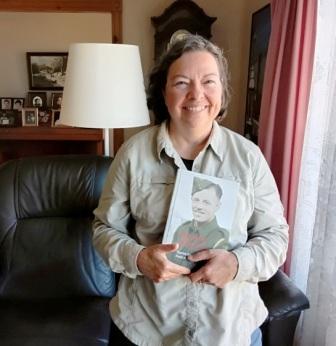
Laurie Ann McCardle with the Holten Heroes book. (Photo credit: Daria Valkenburg)
Of course, I said yes, which is how we met Laurie Ann McCardle of Lady Fane, a community not far from where we live. She explained that her great-uncle, Edgar BLAQUIERE, was buried in Holten, and his name was listed in the book’s index on page 124.
Although Edgar was from New Brunswick, his father had been born in Rustico, Prince Edward Island. Laurie Ann and her family are not only Islanders, but it turned out there was a rich history of military service.
“…My Mom, Shirley Gauthier, lives in Summerside, and is 90 years old. Dad was Ron Gauthier, nephew of Edgar Blaquiere, whose mother Dorina was Edgar’s sister. Dad died 22 years ago….” Laurie Ann explained.
“…Both of my parents were in the military. Dad was a radar operator in the RCAF. Mom was a plotter in the RCAF but had to leave the service when she got pregnant. Mom’s dad, George Emmerson Gallant, came from Bloomfield. He was in the North Novies and survived the war….”
….Edgar enlisted at the age of 19…
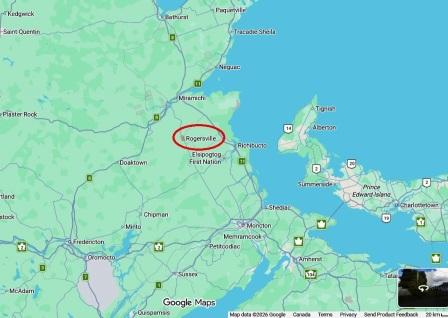
Located about 90 km from Moncton, Rogersville, New Brunswick became part of the village of Nouvelle-Arcadie in 2022. (Map source: Google Maps)
Born July 25, 1921 in Rogersville, Northumberland County, New Brunswick, Edgar was the son of Jonas and Anna (nee LeBlanc) Blaquiere. One of 6 children, he had one brother Edward ‘Eddie’, who also served in WWII, and four sisters: Doris, Elva, Dorina, Viola.
Edgar left school at the age of 14, and was employed as a miner and driller at NB Coal, a coal mining company in Minto, New Brunswick for two years when he enlisted at the Carleton & York Regimental Depot in Woodstock, New Brunswick on May 31, 1940. Before that he had worked at Sturgeon River Gold Mines in Sturgeon River, Ontario, and was a member of the United Mine Workers of America.
Fluent in both English and French orally and in written English, he stated that he enjoyed playing team sports – baseball, softball, and soccer. Edgar explained in an interview that he supported his mother and younger sister Viola, as his mother “…has throat trouble and loss of speech…” His father, a cobbler who had been paralyzed for many years, died in 1932, when Edgar was only 11 years old.
After completing his basic training, Edgar was transferred to the A14 Canadian Infantry Training Centre (CITC) in Camp Aldershot, Nova Scotia on July 17, 1940 for more intensive combat training in tactical firearm use and field exercises.
He remained at Camp Aldershot until March 28, 1941, when he was transferred to the North Shore (New Brunswick) Regiment in Sussex, New Brunswick, which was preparing for overseas duty.
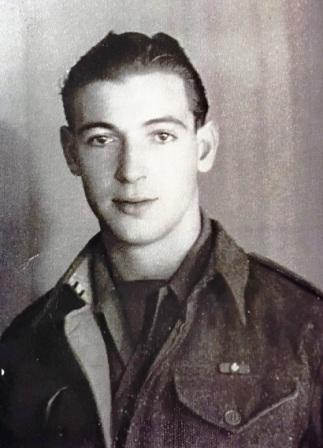
Edgar Blaquiere. (Photo courtesy of the Gauthier Family)
On July 4, 1941, Edgar was given 3 days of embarkation leave, the last chance he had to see his family.
….Edgar left Canada for overseas service ……
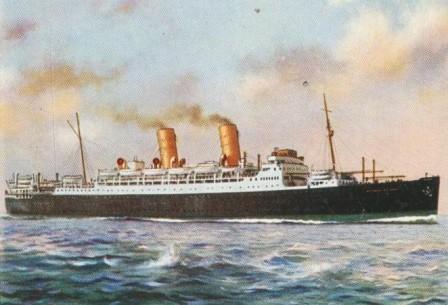
Edgar left Canada aboard the Duchess of York troopship. (Photo source: Wikipedia re New York Public Library digital gallery)
After returning from leave, Edgar, along with other members of the North Shore (New Brunswick) Regiment, travelled by train from Bathurst, New Brunswick to Halifax, Nova Scotia, and boarded the troopship Duchess of York, which sailed for Great Britain on July 18, 1941. Part of the 3rd Canadian Infantry Division, the soldiers disembarked in Liverpool, England on July 30, 1941, and began intensive physical and amphibious assault training.
On October 16, 1941, Edgar was posted to the 3rd Division’s Reinforcement Infantry Holding Unit, before being transferred to the No. 1 Canadian Engineers Holding Unit, Royal Canadian Engineers, in Hawley, Hampshire, as a sapper on December 3, 1941.
In a December 10, 1941 interview, Edgar expressed a wish to join a tunnelling company. He subsequently passed the technical tests, and qualified as a Miner Group ‘C’ and a Driver Group ‘B’. (A Group ‘B’ driver was qualified to drive non-combat transport trucks. A Miner Group ‘C’ Group ‘C’ qualification was focused on fundamental hard-rock mining, hand tools, and field safety.)
On March 6, 1942, Edgar was transferred to 1st Mechanical Equipment Company, a specialized unit of the Royal Canadian Engineers, whose role was to operate heavy engineering and mechanical equipment in support of large-scale construction, fortification, and infrastructure projects.
….Edgar was transferred to No. 1 Canadian Tunnelling Company ……
Edgar’s wish to join a tunnelling company within the Royal Canadian Engineers became a reality on October 19, 1942, when he was transferred to No. 1 Canadian Tunnelling Company, which was involved in airfield demolition, mining and power plant construction in the British Isles.
He was injured in his right knee on February 16, 1943 and hospitalized until March 19, 1943, after an accident while working on a military bridge. According to the accident report, Edgar “….was part of a transom party. He was carrying the end of a transom when he slipped in the mud. The end of the transom slipped down and hit him on the knee…” Transoms of timber were used as support beams for military bridging or heavy tunneling equipment.
….Edgar was in the Italian Campaign ……

The Italian Campaign followed Operation Husky in Sicily. (Map source: Juno Beach Centre)
On August 16, 1943, as a member of a special detachment of No. 1 Canadian Tunnelling Company, Royal Canadian Engineers, Edgar boarded a ship, which left the United Kingdom on August 17, 1943, and arrived in Sicily on August 24, 1943, part of the Central Mediterranean Force, just as Operation Husky (the invasion of Sicily) was ending and the Italian Campaign beginning. (See https://project44.ca/storymaps/southern-italy/)
Other units in No. 1 Canadian Tunnelling Company had been involved in Operation Husky since it began in July 1943. From Sicily, the Company crossed over to the Italian mainland across the Strait of Messina via amphibious transport and landing craft as part of the Allied invasion forces, following in the general path of the British Eighth Army, in September 1943.
In the Italian Campaign, hard-rock miners and engineers immediately needed to begin blasting mountain passes, clearing high-altitude routes, and repairing demolished infrastructure obstructed by retreating Axis (German and Italian) forces. The unit supported the British Eighth Army in harsh winter conditions, cutting roads into sheer rock cliffs, clearing mountain blockages, and maintaining vital supply routes.
….Edgar was hospitalized on Boxing Day 1943……
On December 26, 1943, the No. 1 Canadian Tunnelling Company was on the front lines of the Italian Campaign as Allied forces pushed through the rugged terrain of mainland Italy, in the immediate aftermath of the Battle of Ortona (which saw its fiercest fighting from December 20–28, see https://en.wikipedia.org/wiki/Battle_of_Ortona). While not in a direct combat role, the unit was clearing high-altitude routes, blasting obstructed mountain passes, and removing German demolitions so that British, Canadian, and American combat groups could advance.
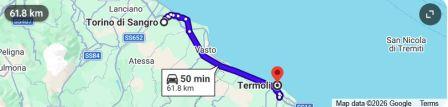
61.8 km (38 miles) separate Torino di Sangro and Termoli in Italy. (Map source: Google Maps)
At some point during the day, Edgar was admitted to 216th Field Ambulance of the British Royal Army Medical Corps (RAMC), which was located in Torino di Sangro, Italy during the Moro River Campaign and the Battle of Ortona. Later that day, Edgar was taken to the British Army’s 19 Casualty Clearing Station (CCS), located inside the San Antonio de Padua Seminary in the coastal town of Termoli.
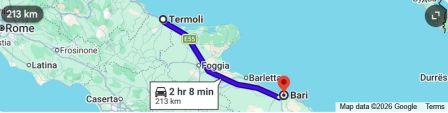
The distance between Termoli and Bari is 213 km (132 miles). (Map source: Google Maps)
The following day, Edgar was moved 213 km (132 miles) down the coast to the 98th British General Hospital in Bari, Italy. It wouldn’t have been an easy journey in war-time conditions.
The circumstance of why Edgar was hospitalized was not documented in his service file, but as no mention was made of combat injuries from blasting work, enemy shellfire, or falling rock, he may have been hospitalized due to a winter-related illness, such as cold or flu, trench foot from being in wet and cold conditions, or exhaustion.
Edgar remained in hospital until January 14, 1944, when he returned to duty.
….Edgar served in Italy until April 1945…
In March 1944, No. 1 Canadian Tunnelling Company was renamed No. 1 Canadian Drilling Company to better reflect its updated technical role and changing military technology, but the unit remained in Italy, undertaking critical infrastructure, demolition, and engineering tasks, until April 1945, long after other Canadian forces had left for North-West Europe.
Edgar qualified as a Driver i/c Wheeled on September 5, 1944. (The term ‘Driver i/c’ refers to ‘Driver, internal combustion’. Wheeled meant he was qualified to drive heavy trucks and armoured cars.)
On April 17, 1945, Edgar left Italy as part of Operation Goldflake, arriving in Marseilles, France the following day. Operation Goldflake was the codename for moving troops from Italy to North-West Europe. (See https://en.wikipedia.org/wiki/Operation_Goldflake) While the main body of the 1st Canadian Corps had moved earlier in February and March 1945, specialized engineer units like No. 1 Canadian Drilling Company completed their final transfers out of Italy in April.
After arriving in France, and now serving under the 1st Canadian Army Group Royal Engineers, the unit moved to temporary transit camps set up around Marseilles, where they processed administrative paperwork, underwent equipment checks, and prepared their heavily specialized diamond-drilling and tunneling gear for northern transit. Travelling by convoy trucks and trains, they went north through the Rhone Valley towards Belgium and The Netherlands.
Arriving in North-West Europe shortly before Victory in Europe (V-E) Day on May 8, 1945, the unit was tasked with supporting structural engineering tasks. After the 2nd Canadian Infantry Division captured the city of Oldenburg, Germany on May 2, 1945, the unit was one of the engineering and drilling units tasked with securing infrastructure and clearing pathways.
….Edgar died in a vehicle accident…
Edgar had survived to see V-E Day, but he was not fated to return home to Canada. On May 14, 1945, while filling in as a despatch rider while the regular despatch rider was on leave, 24 year old Edgar died in a vehicle accident in Germany.
In a statement during the Court of Inquiry following the accident, Sgt F. M. GRONERT, Acting Platoon Commander for No. 2 Drilling Platoon, stated that at 1 pm on the afternoon of May 14, Edgar had been sent “…to pick up situation reports from other platoons and deliver them to Headquarters…”
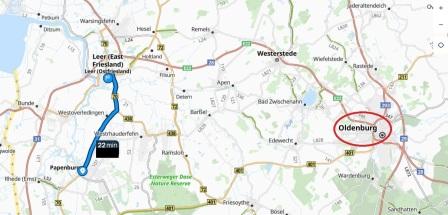
Red circle shows Oldenburg where Edgar was based. He was travelling on the 21 km (13 miles) route from Papenburg towards Leer when the accident happened. (Map source: Michelin Maps)
One of the witnesses, Bombardier J. P. REID of 58 Battery, 4th Canadian Medium Regiment, Royal Canadian Artillery, testified that “…on the road between Papenburg and Leer there was a despatch rider going in front of our vehicle at about 25 miles per hour. There was a Polish convoy coming from the other direction. There was a bump in the road…” Edgar was going towards Leer, the Polish convoy was coming from Leer.
Trying to avoid the bump, Edgar “…swung to the centre of the road… and lost control….” Unfortunately, he crashed his motorcycle “…into the first vehicle of the Polish Convoy….”
In trying to avoid the motorcycle, the Polish driver “…pulled over to the left of the road and crashed into our lorry. When the vehicles finally came to rest, the motorcycle was between the two lorries and the despatch rider was under the right wheel of the Polish vehicle…”
The soldiers tried to help free him from the wreckage and “…a Canadian padre took him to a hospital towards Leer…” but his injuries were fatal.
….Edgar is buried in Holten…
Edgar was initially buried, on May 16, 1945, in a temporary cemetery just south-west of Winschoten, before being reburied in the Canadian War Cemetery in Holten on April 12, 1946.
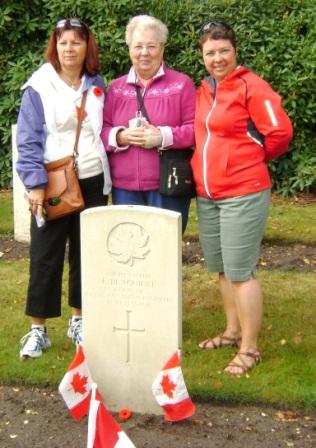
Shirley Gauthier with her daughters Michele Vander Kooi (left) and Laurie Ann McCardle (right) visited the grave of Edgar Blaquiere on September 10, 2012. (Photo courtesy of Laurie Ann McCardle)
Thank you to Laurie Ann McCardle for providing photos and information. Thank you also to Etienne Gaudet for clarifying terminology in French language documents. Pieter’s research efforts to find photos and families of soldiers continue. Do you have a story to tell? Email Pieter at memorialtrail@gmail.com, or comment on the blog.
© Daria Valkenburg
….Want to follow our research?…
If you are reading this posting, but aren’t following our research, you are welcome to do so. Our blog address: https://onthewarmemorialtrail.com/
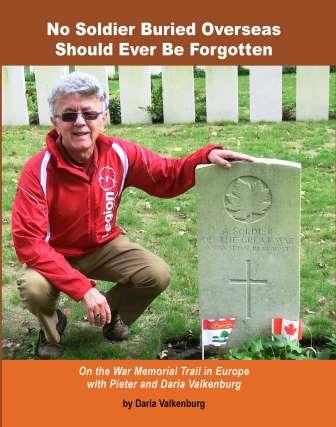 4 countries, 6 weeks, 7,000 km – an unforgettable war memorial journey in Europe…. Daria’s book ‘No Soldier Buried Overseas Should Ever Be Forgotten‘ is available in print and e-book formats. Net proceeds of book sales help support research costs and the cost of maintaining this blog. For more information see https://nosoldierforgotten.com/
Subscribe to our YouTube Channel: On The War Memorial Trail With Pieter Valkenburg: https://www.youtube.com/channel/UCJ591TyjSheOR-Cb_Gs_5Kw.
Never miss a posting! Subscribe below to have each new story from the war memorial trail delivered to your inbox.

