On The War Memorial Trail…..Tragedy On The Ems Part 1: The WWII Soldier From Rexton Who Drowned During Operation Duck

March 5, 2025. In 2021, during a period when we were all at home due to Covid, we translated, into English, ‘Holtense Canadezen’, Jan Braakman’s book about some of the soldiers buried in the Canadian War Cemetery in Holten, The Netherlands.  In October 2023, this was published in English as ‘Holten Heroes: Stories from a Canadian Field of Honour’.  (See https://onthewarmemorialtrail.com/2023/11/01/new-book-about-soldiers-buried-in-the-canadian-war-cemetery-in-holten-the-netherlands/)

The chapter ‘Drama On The Ems’ was about a tragic incident during the Battle of Leer in Germany on April 28, 1945, one of the final actions to end WWII in Europe. Operation Duck, which involved the crossing of the Ems and Leda rivers in northern Germany in order to take the port of Leer, turned out very badly for 19 men of the Stormont, Dundas and Glengarry Highlanders Regiment. 

Two Maritime soldiers mentioned in the chapter, one from Nova Scotia, and one from New Brunswick, were on the photo wish list from the Canadian War Cemetery in Holten, The Netherlands.  Pieter was successful in finding family and a photo of these men, who were both with the Stormont, Dundas and Glengarry Highlanders. 

…..James is remembered on a plaque in the United Church in Rexton….

St. Andrew’s United Church in Rexton, New Brunswick.  (Photo credit: Daria Valkenburg)

James Edward SULLIVAN, from Rexton, New Brunswick, was one of the Maritimers. In a serendipitous coincidence, we’d visited Rexton to meet the family of another soldier – Janice Little and Gayle McBeath, nieces of WWII trooper Stanley Leigh MCBEATH. They took us to St. Andrew’s United Church, where Stanley’s name was listed on a plaque on the church organ. Then we noticed that James was also listed on the plaque! (See https://onthewarmemorialtrail.com/2024/02/03/on-the-war-memorial-trail-the-wwii-trooper-from-rexton-who-lost-his-life-three-days-before-his-birthday/)

James Sullivan and Stanley McBeath are listed on a memorial plaque on the organ in St Andrew’s United Church in Rexton.  (Photo credit: Daria Valkenburg)

….James’s niece had a photo!….

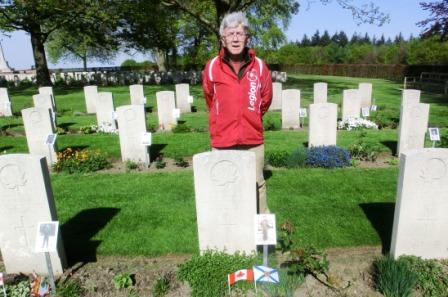
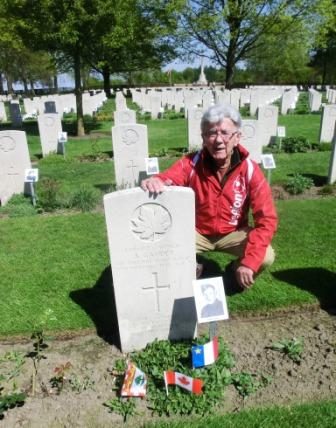
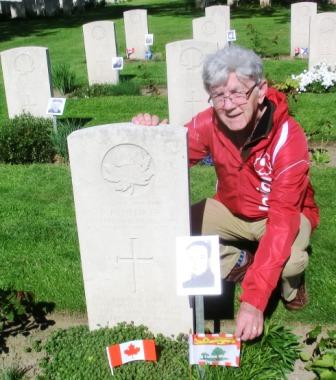
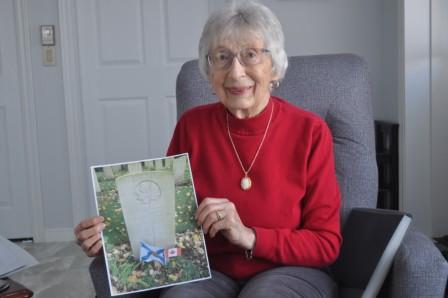
Barbara Sullivan at the grave of her uncle, James Sullivan, buried in the Canadian War Cemetery in Holten, The Netherlands.   (Photo courtesy of Barbara Sullivan)

Born July 7, 1919 in Main River, New Brunswick, James was the son of Edward and Augusta Sullivan. James had a younger brother, Kenneth, and it was through Kenneth’s daughter, Barbara Sullivan, that a photo was found, after she’d been contacted by Janice Little.  “I’m the niece of L/Corporal James Edward Sullivan of The Stormont, Dundas and Glengarry Highlanders.  I never knew him, he died a long while before I was born. His brother Kenneth is my dad.  Both of my parents passed away in 2001….”  Barbara wrote.

…..James enlisted under the NRMA in 1941….

James Edward Sullivan. (Photo courtesy of the Sullivan Family.  Photo colourization by Pieter Valkenburg)

James originally enlisted under the National Resources Mobilization Act (NRMA) at the No. 7 NRMA Clearing Depot in Fredericton, New Brunswick on March 20, 1941 and began basic training at No. 70 Canadian Army Basic Training Centre in Fredericton. At the time, he stated he was employed as a truck driver and sawyer for a lumber company. (See https://en.wikipedia.org/wiki/National_Resources_Mobilization_Act)

On May 20, 1941, he was transferred to A1 Canadian Artillery Training Centre (CATC) at Camp Petawawa, Ontario for further training.  On July 26, 1941, he was sent to A23 Coast Defence and Anti-Aircraft Artillery Advanced Training Centre (C&AAATC) in Halifax, Nova Scotia for a few weeks.  The centre trained coast and anti-aircraft gunners. 

Next, James was attached to 1st (Halifax) Coast Brigade of the Royal Canadian Artillery in Halifax on August 21, 1941, which was responsible for providing coastal artillery support as part of the defences of Halifax, Nova Scotia.  

Devil’s Battery.  (Photo source: https://hmhps.ca)

On September 26, 1941, he was attached as a gunner to the 53rd Coast Battery of the 1st (Halifax) Coast Brigade, part of the defence of Devil’s Battery, and remaining there even after joining the active army in Halifax on February 1, 1942. 

James was sent back to A23 Coast Defence and Anti-Aircraft Artillery Advanced Training Centre (C&AAATC) in Halifax on August 31, 1942 for further training. After completing Range Takers Course No. 5 on October 10, 1942, he returned to the 53rd Coast Battery.

….James served in Newfoundland….

Cape Spear Battery.  (Photo source: https://www.hiddennewfoundland.ca)

On February 12, 1943, James was transferred to the 103rd Coast Battery of the Royal Canadian Artillery and sent to St. John’s, Newfoundland. Based at Cape Spear, the most eastern point in North America, the Battery was responsible for maintaining the 10″ guns.

Cape Spear’s close proximity to convoy routes and the entrance to St. Johns Harbour was an essential place to have a coastal defense battery, post-war signal station, and searchlight emplacement during World War II. (NOTE: Newfoundland and Labrador joined Canada on March 31, 1949.)

On November 18, 1943, James left Newfoundland for Shelburne, Nova Scotia and was transferred to the 104th Coast Battery of the Royal Canadian Artillery (RCA).

….James was transferred to the infantry….

On January 14, 1944, James was assigned to No. 1 Transit Camp in Windsor, Nova Scotia for preparation before being sent overseas.  However, instead of going overseas immediately, he was transferred to No. 60 Canadian Infantry (Basic) Training Centre (CIBTC) in Yarmouth, Nova Scotia for additional training.

Then, on April 9, 1944, he was sent to A14 Canadian Infantry Training Centre at Camp Aldershot, Nova Scotia for final preparations before going overseas. 

James was granted embarkation leave from June 2 to June 15, 1944, the last chance he had to see his family again.

….James left Canada for overseas service….

On June 25, 1944, James left Canada for the United Kingdom. Upon arriving on July 3, 1944 he was assigned to No. 4 Canadian Infantry Reinforcement Unit (CIRU). 

He continued his training for a few weeks before being transferred to the X-4 reinforcement list of the Canadian Infantry Corps (CIC), on July 26, 1944.  Three days later he was on his way to France, disembarking on July 30, 1944.

On July 31, 1944 he was assigned to the Stormont, Dundas and Glengarry Highlanders, part of the 21st Army Group, joining the Regiment in the vicinity of Le Vey, France, 23 km (14 miles) northwest of Falaise.  The Regiment needed downtime to get reorganized and to give the men a chance to train and have a rest following heavy fighting since landing in Normandy on D-Day.

He received a promotion to Lance Corporal a few weeks later, on August 19, 1944.  James remained with the Regiment as it fought across France, and into The Netherlands.  It was in Nijmegen to relieve the airborne troops, and helped guard the bridge while the Rhine crossing was prepared. The Regiment then fought through the Hochwald in Germany, and then north as it prepared to cross the Ems River and take the city of Leer on April 28, 1945, in what became known as Operation Duck.

… Operation Duck…

In the plan for Operation Duck, the Stormont, Dundas and Glengarry Highlanders would go across the Ems River towards the western edge of Leer. At the same time, the North Nova Scotia Highlanders would cross the Leda River in assault boats and secure the northern bank of the river in preparation for the attack to capture Leer. The Highland Light Infantry of Canada would cross the Leda River, where the Ems and Leda rivers meet.

These three Regiments were part of the 9th Canadian Infantry Brigade.  (See https://www.canadiansoldiers.com/history/battlehonours/northwesteurope/leer.htm)

While the men from the Highland Light Infantry all crossed safely, the North Nova Scotia Highlanders lost 5 men, and the Stormont, Dundas & Glengarry Highlanders lost 19.

Map showing the Ems and Leda Rivers, and position of Regiments during the Battle for Leer.  (Map courtesy of and ©Jan Braakman)

…Why Operation Duck Was Important…

A Storm boat is moved into the water during Operation Duck on April 28, 1945. (Photo source: Library and Archives Canada)

A translated excerpt from Jan Braakman’s ‘Holten Heroes: Stories from a Canadian Field of Honour’ explained why Operation Duck was important. “…At the end of April 1945, Canadian troops stood just across the Dutch-German border in Ostfriesland (East Frisia) in front of the river Ems….” (See https://en.wikipedia.org/wiki/East_Frisia)

Leer was a challenge to capture. “…The town of Leer was on the other side of the river on the route to Emden. Surrounded by inaccessible lowlands in the north and with rivers (Ems and Leda) in the west and south, Leer was a well defensible and therefore difficult to capture port city. All access bridges over the Ems and Leda were blown up by the Germans. For the Canadians there was no other option than to reach the city by water….

River crossings can be tricky due to currents and tides, and in wartime, there is always the risk of enemy fire.  “….The Ems River has an open connection with the Wadden Sea, which means that tides influence water levels and currents in the river. Tides made the currents unpredictable, and the Canadian Army didn’t have accurate information about the tides. What was clear: high tide was the best time to make the crossing. Aerial photographs showed that German troops had fortified themselves well behind the dikes that surrounded the city…. 

A decision was made on how to cross the two rivers – the Leda and the Ems.. “ Only under the protection of a smoke screen and solid artillery support would it be possible to successfully complete the attack on Leer, using boats … General Simonds ordered that on April 28, 1945, before darkness fell, there had to be a solid bridgehead, from which the capture of Leer could be initiated. That meant that the attack had to be launched during the middle of the day, around three o’clock, when the water level was at its highest…” 

The Highland Light Infantry crossed safely “ at the point where the Leda flows into the Ems, about three kilometres south of the city centre…

The other two regiments ran into trouble.  “…The crossing was made at three different places. At the same time, artillery fire and attacks from the air put the German defence line to the test. The North Nova Scotia Highlanders would cross the Leda from the south bank and take the harbour of Leer, which abutted the city on a peninsula…

…The Stormont, Dundas & Glengarry Highlanders Regiment ran into trouble…

The Stormont, Dundas & Glengarry Highlanders Regiment was to cross the Ems River “…from the west bank of the Ems at Bingum to attack the city from the west.…” 

All three Regiments launched their attacks at the same time.  “….It began at half past two with fierce shelling, during which the positions of the German defence forces were fired upon. The attack from the south was spectacular and successful, with relatively few losses…. 

This wasn’t the case for the attack from the west. “….A number of boats….” from the Stormont, Dundas & Glengarry Highlanders Regiment “…showed motor defects or capsized. Some of the drowning men were rescued, but at the end of the day at least nineteen men from the Regiment were dead, drowned, or missing….

….James was one of the fatalities….

After WWII ended “a team from the Stormont, Dundas & Glengarry Highlanders returned to the Ems. They dragged the river, looking for the bodies of the missing men. Some of them were found with their full kit still attached to their bodies….

Sergeant G.W. McGill, who survived the crossing, had reported that at “….approximately 15:30 hours, 28-April-1945, I was crossing the river Ems in an assault craft during the attack on Leer. Suddenly, the nose of our craft dipped and the craft overturned and we were all thrown into the water. I came to the surface and was picked up by another assault craft, along with Cpl W.M.J. Wood. We cruised around for approximately ten minutes, but we could not see Sullivan anywhere. A check on the shore by the platoon commander indicated that Sullivan, Brough, and Oslund were missing….

James was not found until almost the end of May 1945.  “….25 year-old James E. Sullivan was …. initially reported missing. On May 28, his family was informed by telegram that ….” his body had been found.

….James is buried in the Canadian War Cemetery in Holten….

James was originally buried in Oldenburg, Germany, before being reburied in 1946 in the Canadian War Cemetery in Holten, The Netherlands.

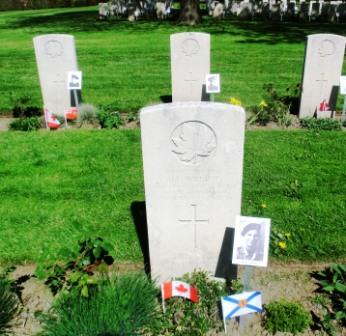
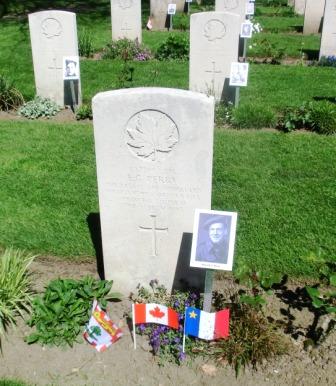
Grave of James Edward Sullivan in the Canadian War Cemetery in Holten, The Netherlands.  (Photo courtesy of Canadian Virtual War Memorial)

….Other soldiers from the Stormont Dundas Glengarry Highlanders who lost their lives that day…

In addition to James Edward Sullivan, 18 more soldiers from the Stormont, Dundas and Glengarry Highlanders lost their lives on April 28, 1945, and are listed below.  If there are asterisks beside the name (****) it means there is a brief anecdote in the ‘Drama On the Ems’ chapter in ‘Holten Heroes: Stories from a Canadian Field of Honour’. 

  • A/Cpl John SAWATSKY of Petaigan, Saskatchewan, aged 20
  • L/Cpl Merle Coleman MOORE of Breckenridge Station, Quebec, aged 22
  • Pte Frank Joseph BIERNASKI of Barry’s Bay, Ontario, aged 32 ****
  • Pte Walter James BROOKS of Toronto, Ontario, aged 28
  • Pte Leonard Gordon BROUGH of Sudbury, Ontario, aged 21**** 
  • Pte Steven John GRAVELLE of Peterborough, Ontario, aged 23
  • Pte Joseph Gerard HINDS of Orillia, Ontario, aged 20
  • Pte Earl Harcourt JOSLIN of Kingston, Ontario, aged 34****
  • Pte Ira Charles LANGILLE of Milton, Nova Scotia, aged 32 ****
  • Pte Cecil Albert LAWES of Frankford, Ontario, aged 28
  • Pte Frank Eugene MUNROE of Halifax, Nova Scotia, aged 22  
  • Pte Sidney Alexander OSLUND of Haileybury, Ontario, aged 29 ****
  • Pte Samuel Donald POWELL of Newcastle, Ontario, aged 22
  • Pte Edgar Douglas SMITH of Parrsboro, Nova Scotia, aged 28 ****
  • Pte Francis Wilber SPENCER of Stonecliffe, Ontario, aged 35 ****
  • Pte Jack Allan STEWARD of Belleville, Ontario, aged 24 ****
  • Pte Roy Ivenson THACKERAY of Peterborough, Ontario, aged 20 ****
  • Pte George Sidney WAKELY of Port Hope, Ontario, aged 31****

….A Tragic Drowning On The Leda River….

As mentioned in the ‘Holten Heroes’ excerpt, the crossing of the rivers to reach Leer involved three Regiments – Stormont Dundas and Glengarry Highlanders, North Nova Scotia Highlanders, and the Highland Light Infantry. 

The North Nova Scotia Highlanders were tasked with crossing the Leda River from the south bank and to then take the harbour of Leer.  5 soldiers from this Regiment lost their lives when the storm boat they were in capsized. Their stories were told in previous blog postings as a 4 part series:

….Blog posting about another soldier mentioned in the book Holten Heroes…

Tragedy On The Ems Part 2 will be about the other Maritimer on the photo wish list:  Frank Eugene MUNROE of Halifax, Nova Scotia.

Thank you to Jan Braakman for permission to quote from his book and use of the map showing the position of the Regiments, with translation into English by Pieter and Daria Valkenburg, and to Barbara Sullivan for sharing a photo of her uncle. If you have a story or photo to share, please contact Pieter at memorialtrail@gmail.com or comment on the blog. 

© Daria Valkenburg

….Want to follow our research?….

If you are reading this posting, but aren’t following our research, you are welcome to do so.  Our blog address: https://onthewarmemorialtrail.com/
4 countries, 6 weeks, 7,000 km – an unforgettable war memorial journey in Europe…. Daria’s book ‘No Soldier Buried Overseas Should Ever Be Forgotten‘ is available in print and e-book formats.  Net proceeds of book sales help support research costs and the cost of maintaining this blog. For more information see https://nosoldierforgotten.com/

You are also invited to subscribe to our YouTube Channel: On The War Memorial Trail With Pieter Valkenburg: https://www.youtube.com/channel/UCJ591TyjSheOR-Cb_Gs_5Kw

Never miss a posting!  Subscribe below to have each new story from the war memorial trail delivered to your inbox.

On The War Memorial Trail….. The POW Who Raised Horses In PEI Part 3….Three Years In A DP Camp Before Finally Finding Freedom

Nikola Ostojic. (Photo courtesy of the Nikola Ostojic Family.  Photo colourization by Pieter Valkenburg)

February 28, 2025. In Part 1, the active WWI and WWII military service of Croatian-born Nikola ‘Nick’ OSTOJIC, grandfather of Bedeque resident Liz Hubert, came to a halt when the Royal Yugoslav Army surrendered on April 17, 1941 and Nikola became a prisoner of war in Germany. (See https://onthewarmemorialtrail.com/2025/02/20/on-the-war-memorial-trail-the-pow-who-raised-horses-in-pei-part-1-the-serbian-colonel-who-was-a-pow-in-oflag-xiii-b/)

In Part 2, Nikola spent 4 years in a German POW camp until he was among the POWs liberated on April 6, 1945 by American troops. (See https://onthewarmemorialtrail.com/2025/02/23/on-the-war-memorial-trail-the-pow-who-raised-horses-in-pei-part-2-four-years-as-a-pow-in-oflag-xiii-b/)

Now, in Part 3, Nikola’s story concludes with the long road ahead of him before finally finding freedom and a new life in Prince Edward Island, and later Ontario, in Canada. 

….Nikola became a Displaced Person in Austria….

After 4 years in a POW camp, Nikola had to make a decision once he was liberated – whether to return to Serbia – now part of Yugoslavia and under Communist rule, or refuse repatriation.  Nikola refused to be repatriated. 

Map shows location of Hammelburg where Oflag XIII B was located, Moosburg, where the liberated POWs marched towards, and St Johann im Pongau, where Nikola lived in a DP camp.  (Map source: Google maps)

After being liberated from the POW Camp Oflag XIII B on April 6, 1945, it appears that he went his own way, as many former POWs did.  According to a report on the Liberation of Stalag 7A in Moosburg, written by Col. Paul Goode, the Senior American Officer at Oflag XIII B, after liberation, the group of freed POWs “….stayed at Hammelburg about a week, and then was marched to Stalag A, Moosburg.  It took 15 days to cover about 90 miles. There was no particular attempt at control, and escape was extremely easy, and many officers did escape, and many more just wandered off to live in the country and were ultimately picked up by the SS…

Liz believed that Nikola was among the officers who escaped “….with another officer and was then taken by the British Army….”  No record is left of what his plans were, but perhaps he had intentions of travelling towards Serbia to find his family.  If that was the case, he never got there.

On June 23, 1945 he entered Austria, and 2 days later became a resident of the UNDP-led Camp XVIII C in Markt-Pongau, now known as Sankt Johann im Pongau, a small town south of Salzburg.  According to the information provided when Nikola entered the camp, he spoke Serbo-Croatian, English, German, and Russian. 

As a displaced persons camp in the American Zone, Pongau had a large number of Jewish refugees, as well as former POWs, like Nikola, who didn’t want to be repatriated.  During WWII, it had been Stalag 18 C, a prisoner of war camp. 

The Markt-Pongau POW Camp in May 1945. (Photo source: http://www.stalag18a.org)

After WWII ended, the former Nazi territories had been divided into British, American, and French Zones.  (See https://en.wikipedia.org/wiki/Allied-occupied_Austria)

Post WWII Austria Occupation Zones. Pongau fell under Salzburg.  (Map source:  https://commons.wikimedia.org/w/index.php?curid=95563608)

….Nikola left Continental Europe….

Nikola remained in the camp in Pongau until April 21, 1948, when he was deemed eligible to immigrate to the United Kingdom.

Nikola arrived in Halifax aboard the ‘Neptunia’.  (Photo source: www. http://ssmaritime.com)

On May 24, 1952 he immigrated again, leaving Southampton, England aboard the Greek Line T.S.S. ‘Neptunia’, and arriving in Halifax, Nova Scotia, Canada.  He was 55 years old. 

He most likely had been sponsored by Pero Bulat, who had been born in the same province of Banija, but immigrated to Canada in 1926, and became the publisher of ‘The Voice of Canadian Serbs’. On April 22, 1947, he’d visited Ottawa with Bishop Dionisije Milivojević to ask Canadian authorities to permit 10,000 out of the 80,000 displaced Serbs in Western Europe to enter Canada.  (See https://wikitia.com/wiki/Pero_Bulat)

….Nikola found peace of mind while raising horses….

Nikola (identified by red arrow) in St Peters Bay, Prince Edward Island.  (Photo courtesy of the Nikola Ostojic Family)

Once in Canada, Nikola moved to Prince Edward Island, where he settled on a farm in St Peters Bay, and raised horses. Liz explained that the quieter Island life and working with horses helped him find peace of mind.

He had never forgotten his wife and daughter.  He had “connected with them only after he arrived to England. Once he got to PEI he sent for them. They traveled via boat to Canada….” said Liz.  “….My mother said they landed in Montreal by boat…

While Nikola found peace of mind on the Island, his wife Marija found it too quiet. The family moved to Windsor, Ontario, where Pero Bulat lived.  “In 1962 he was in Windsor.  Pero was very influential and a great supporter of my grandfather…

Liz recalled that Nikola worked as a bartender into his early 70s, probably at Europe Tavern, one of the many businesses owned by Pero Bulat. Unfortunately, Nikola’s PTSD never left him.  “…Both my grandmother and mother said that his screaming at night never ceased….” 

Nikola died on September 17, 1972 at Hotel Dieu Hospital in Windsor, Ontario, aged 76, and is buried in the Windsor Memorial Gardens.  His 1972 obituary in the ‘Voice of Canadian Serbs’ summed up how so many felt about Nikola.  “….Everyone who knew him, thought that his zest for life, vitality, and physical endurance and strength were invincibleAt the cemetery, final words to the Colonel were given by the famous Nationalist Pero Bulat with heartwarming words of the man who arrived in Canada and his lifework: ‘this is how we lost another unbeatable national fighter’….

….Reflections from Nikola’s granddaughter….

Daria (standing) with Liz Hubert. (Photo credit: Pieter Valkenburg)

Researching the story of Nikola Ostojic was done with the active assistance of Liz Hubert and her brother Alexander.  Liz’s reaction was similar to that of what Pieter and I experienced when we researched my father’s WWII story.  “It was so difficult to see, it’s so real now I feel like I’m living it….” 

As we came to the end of Nikola’s story, Liz expressed her “…reflecting thoughts on this experience with my grandfather….As a child, the towering presence of my Grandfather shone over me like a guiding beacon, inspiring awe and reverence. Throughout this process of discovery of the man he truly was, as an adult, I came to appreciate the complexity, struggles, triumphs, and passions of his life. Understanding him allowed me to understand myself, instilling a sense of responsibility, empathy, and gratitude…” 

Thank you to Liz Hubert for sharing photos and information on her grandfather, and translating his obituary into English. If you have a story or photo to share, please contact Pieter at memorialtrail@gmail.com or comment on the blog. 

© Daria Valkenburg

 ….Previous stories about WWII POWs….

To read previous stories about WWII POWs see:

 ….Want to follow our research?….

If you are reading this posting, but aren’t following our research, you are welcome to do so.  Our blog address: https://onthewarmemorialtrail.com/

4 countries, 6 weeks, 7,000 km – an unforgettable war memorial journey in Europe…. Daria’s book ‘No Soldier Buried Overseas Should Ever Be Forgotten‘ is available in print and e-book formats.  Net proceeds of book sales help support research costs and the cost of maintaining this blog. For more information see https://nosoldierforgotten.com/

You are also invited to subscribe to our YouTube Channel: On The War Memorial Trail With Pieter Valkenburg: https://www.youtube.com/channel/UCJ591TyjSheOR-Cb_Gs_5Kw

Never miss a posting!  Subscribe below to have each new story from the war memorial trail delivered to your inbox.

On The War Memorial Trail….. The POW Who Raised Horses In PEI Part 2….Four Years As A POW In Oflag XIII B

Daria (standing) with Liz Hubert. (Photo credit: Pieter Valkenburg)

February 23, 2025. In Part 1, the active WWI and WWII military service of Croatian-born Nikola ‘Nick’ OSTOJIC, grandfather of Bedeque resident Liz Hubert, ended when the Royal Yugoslav Army surrendered on April 17, 1941. Nikola became a prisoner of war in Germany and had a long road ahead of him before finally finding freedom and a new life in Prince Edward Island, and later Ontario, in Canada. (See https://onthewarmemorialtrail.com/2025/02/20/on-the-war-memorial-trail-the-pow-who-raised-horses-in-pei-part-1-the-serbian-colonel-who-was-a-pow-in-oflag-xiii-b/)

Now, in Part 2, Nikola spent 4 years in a prisoner of war (POW) camp until he was among the POWs liberated on April 6, 1945 by American troops.

Nikola Ostojic. (Photo courtesy of the Nikola Ostojic Family.  Photo colourization by Pieter Valkenburg)

 ….Nikola was a POW in Oflag XIII B in Germany….

Nikola (identified by red arrow) with a group of fellow POWs at the Oflag in Nuremberg. (Photo source: https://krijgsgevangen.nl)

Oflag XIII B, the prisoner of war camp where Nikola spent the remainder of the war years, was originally in the Langwasser district of Nuremberg, Germany.

Oflag XIII B in Nuremberg, Germany, with barracks on either side of the road. (Photo source: https://krijgsgevangen.nl)

Conditions inside the Oflag were not luxurious, as can be seen in the photo below from inside one of the barracks.  The bunks were stacked 3 high, there was a small stove, and a wooden table. 

Inside one of the barracks in Oflag XIII B in Nuremberg, Germany.  (Photo source: https://krijgsgevangen.nl)

….Families of POWs generally received notification….

Liz explained that Nikola’s wife never knew that her husband was a POW.  “…She was told he was dead!…” It may be that she had received word that he was ‘missing and presumed dead’ and never got an update.  Perhaps, given that his homeland was occupied, Nikola did not feel it safe to contact his family.

Normally, families of POWs received a notice, in the language of the prisoner’s nationality, informing that they had been captured, and prisoners were allowed to write to their families.  As an example, Maria Wilhelmina Siersema-van Erp, the wife of Klaas “Niek” Siersema, a Dutch POW in the same Oflag as Nikola, received several notices from her husband, including one dated May 15, 1942.   

The front side of this Dutch notice provided instructions of what should be sent to her husband, including his uniform, hat, overcoat, shoes, underwear, etc., the weight limit accepted, the date it should be sent by, and how to address the parcel. The letter was signed by the prisoner (not shown in the sample below).

Notice to the family of Klaas Siersema on what would be allowed in a package to be sent to him. (Source: https://digitalkinblog.wordpress.com)

On the back side of the notice was an announcement that the Fuhrer of the German Empire had previously approved the release of officers in captivity, but that they were again being taken into custody because of their more recent actions against Nazi efforts.

Announcement with the justification for not releasing captive officers. (Source: https://digitalkinblog.wordpress.com)

A May 29, 1942 postcard from Klaas Siersema, written in German and Dutch, informed his family that he was a POW at the camp, that he was in good health, and advised that mail was not being received on a regular basis due to a camp reorganization. 

May 29, 1942 postcard from Klaas Siersema advising that he was a POW. (Source: https://digitalkinblog.wordpress.com)

…. Oflag XIII B moved from Nuremberg to Hammelburg in April 1943….

Nikola (identified by red arrow) with a group of fellow POWs. (Photo courtesy of the Nikola Ostojic Family.

In April 1943, about 3,000 officers, many who had been, like Nikola, members of the Yugoslavian General Staff, were moved to a site 3 km (1.9 miles) south of the town of Hammelburg, just north of Schweinfurt in Bavaria, Germany.  (See https://en.wikipedia.org/wiki/Oflag_XIII-B)

Life in the POW camp was difficult, especially given the Nikola was 44 years old at the time of his imprisonment, and not a young man in his early 20s.  His 1972 obituary in the ‘Voice of Canadian Serbs’ noted that he “endured severe abuse that led to a physical and psychological breakdown. …

A March 25, 1945 report on conditions in the camp, prepared after a debriefing of the Senior American Officer at the camp, described the food allowed to prisoners: ….The German ration…consisted of coffee for breakfast, soup for lunch, made from barley, oatmeal, meat stock or dried vegetables, and at night the POWs were fed boiled potatoes and 1/10th of a loaf of bread, with a bit of margarine. They received a weekly issue of 4 or 5 tablespoons of sugar, and a small amount of jam once a week.  They were not issued any Red Cross parcels….

…. Nikola was among the POWs liberated on April 6, 1945….

On April 6, 1945, Nikola was one of 1,300 prisoners of war liberated by the US Army’s 14th Armored Division, 19th Armored Infantry battalion, and tanks from the 47th Medium Tank Battalion, Combat Command B (CCB). 

As troops approached the Oflag, they came under sporadic fire from German machine guns. Infantry from of the 19th found the prison gates and forced an opening into the Oflag where they found a large contingent of Serbian and American officer prisoners.

You can watch a short YouTube video on the liberation here: 

While Nikola had suffered in the POW camp, Nikola’s wife and daughter, who remained at home in Serbia, found themselves in peril when Hungarian troops came to the farm in 1943, raided the farm of supplies, and abused his wife.  It wasn’t until 1945 that they received a letter advising that Nikola had survived the war years.

After 4 years in a POW camp, Nikola had to make a decision once he was liberated – whether to return to Serbia, now part of Yugoslavia and under Communist rule – or refuse repatriation.  In Part 3, Nikola’s story continues as, in a bid for freedom, he next ended up in a displaced persons camp in Austria, before finally immigrating to Canada.

Thank you to Liz Hubert for sharing photos and information on her grandfather, and translating his obituary into English. If you have a story or photo to share, please contact Pieter at memorialtrail@gmail.com or comment on the blog. 

© Daria Valkenburg

….Want to follow our research?….

If you are reading this posting, but aren’t following our research, you are welcome to do so.  Our blog address: https://onthewarmemorialtrail.com/

4 countries, 6 weeks, 7,000 km – an unforgettable war memorial journey in Europe…. Daria’s book ‘No Soldier Buried Overseas Should Ever Be Forgotten‘ is available in print and e-book formats.  Net proceeds of book sales help support research costs and the cost of maintaining this blog. For more information see https://nosoldierforgotten.com/

You are also invited to subscribe to our YouTube Channel: On The War Memorial Trail With Pieter Valkenburg: https://www.youtube.com/channel/UCJ591TyjSheOR-Cb_Gs_5Kw

Never miss a posting!  Subscribe below to have each new story from the war memorial trail delivered to your inbox.

On The War Memorial Trail…..The POW Who Raised Horses In PEI Part 1….The Serbian Colonel Who Was A POW In Oflag XIII B

February 20, 2025. Living on Prince Edward Island, it’s unusual to not only meet someone who has a shared Eastern European heritage, but whose family history was impacted by WWII. My father was taken at age 14 from his home in Western Ukraine to work in Germany and over several years, Pieter and I ‘walked in his footsteps’ in an attempt to understand what he experienced, and documented our findings in a 4 part series that saw him go from Germany to England and then finally to Canada:

My father was in Germany at the same time as Nikola ‘Nick’ OSTOJIC, grandfather of Bedeque resident Liz Hubert. While my teenaged father was a labourer, Liz’s grandfather was a prisoner of war.  After WWII ended, both ended up in displaced persons’ camps before finally finding freedom and a new life in Canada….but neither man was ever freed of the memories of what they had experienced.  

Daria (standing) with Liz Hubert. (Photo credit: Pieter Valkenburg)

….Nikola was born in Croatia….

Zirovac (indicated by red marker) is in the Banija region of Croatia, not far from Bosnia and Herzegovina border. (Map source: DuckDuckGo)

Born in the Serbian village of Zirovac, in what is now Croatia, but was then part of Austria-Hungary, on November 1, 1896, Nikola was the son of Mladen and Maria (nee Momic) Ostojic.  His father was an Orthodox bishop and a senator in pre-WWI Croatia.  According to Nikola’s 1972 obituary in the publication ‘Voice of Canadian Serbs’, in a family that had “…produced priests for 300 years…Nikola was supposed to continue the episcopal tradition, but he loved medicine….” (Translation from the original Russian by Liz Hubert)

The oldest child, with 9 younger sisters, Nikola became the head of the family after his father died when he was 18, and his mother died a year later.  Liz proudly noted that her grandfather “…sent money home to his sisters after he joined the army…” and made sure that “…all of his sisters were educated…

….Nikola’s medical school training was interrupted by WWI….

The ‘Voice of Canadian Serbs’ obituary noted that 19 year old Nikola’s medical school training was interrupted in 1915 when he was “mobilized by the Austro-Hungarian military…” and sent to a “…school for Officers in the Reserves. Upon completion of training, he was immediately sent in 1916 to the Russian front.  He deserted the Austro-Hungarian Army in Russia and joined the volunteer corps in Odessa, destined for the Salonika Front….

Serbia had resisted the attacks of the Austro-Hungarian Army in the opening months of the First World War. But, in October 1915, the combined forces of Austria, Germany, and Bulgaria overwhelmed her armies and conquered the country.

As Serbia was an ally of Britain, a multi-national Allied force, under French command, with French, Serbian, British, Russian, and Italian troops, fought against the Bulgarians and their allies in what became known as The Salonika Campaign.

In 1918, when Nikola arrived in Salonika, he was “….deployed to the battle front. As a Major in the 6th division of the Drina Infantry, he participated in the breakthrough of the Salonika front, freeing his homeland…” 

Liz explained that Nikola received the Medal of Honour after being wounded during the rescue of soldiers trapped in trenches.   

The Salonika Campaign ended with an armistice signed by Bulgaria on September 28, 1918, and resulted in the defeat of Bulgaria, the liberation of Serbia and strategic exposure of Austria and Turkey. (For more information on The Salonika Campaign, see https://www.nam.ac.uk/explore/salonika-campaign)

Salonika, today known as Thessaloniki, is a port in the northern Greek region of Macedonia, and is a city I’d visited many decades ago after I graduated from university.

….Nikola remained in the military post WWI….

Nikola Ostojic. (Photo courtesy of the Nikola Ostojic Family.  Photo colourization by Pieter Valkenburg)

After WWI ended, Nikola remained in the military, in the Royal Yugoslav Army, which existed from the establishment of Yugoslavia in December 1918 until its surrender on April 17, 1941 to an invading force of Germans, Italians, and Hungarians. (See https://en.wikipedia.org/wiki/Royal_Yugoslav_Army#April_1941_Campaign)

Nikola Ostojic and Marija Lovas on their wedding day in 1938.  (Photo courtesy of the Nikola Ostojic Family)

Before that fateful day, Nikola had married Marija Lovas, who he’d met at a dance, in February 1938. Their daughter Radmilai, Liz’s mother, was born on July 28, 1939.  The family lived on a farm in Backi Petrovic in Serbia, near the Hungarian border.  Liz explained that the farm that Nikola grew up on had been sold prior to WWII after his sisters were no longer living there.

At the time of the surrender of the Royal Yugoslav Army, Nikola, now a Colonel, was, per the ‘Voice of Canadian Serbs’ obituary, on the “…main General Staff in Belgrade where he was serving as the head of a classified Intelligence unit…

….Nikola became a POW and was sent to Oflag XIII B….

Liz’s research unveiled a Red Cross document summarizing what happened to Nikola when the Royal Yugoslav Army surrendered.  “….The Red Cross filed my Grandfather as captured in Sarajevo on April 17, 1941 and sent to OFLAG XIII B, POW # 99104. At this time he ranked as Pukovnik, which translated into Colonel…. He was captured by the German-Italian Military in Sarajevo…” 

An Oflag was a Prisoner of War (POW) Camp for officers, as opposed to a Stalag, which held mostly enlisted men. Oflag XIII B, opened for Yugoslav officers, was originally in the Langwasser district of Nuremberg.

Oflag XIII B in Nuremberg, Germany. (Photo source: https://krijgsgevangen.nl)

In April 1943, about 3,000 officers, many who had been, like Nikola, members of the Yugoslavian General Staff, were moved to a site 3 km (1.9 miles) south of the town of Hammelburg, just north of Schweinfurt in Bavaria, Germany. (See https://en.wikipedia.org/wiki/Oflag_XIII-B)

Life in the POW camp was difficult, and one that Nikola endured for 4 years.  In Part 2, Nikola’s story continues with his time in the POW camp until the camp was liberated on April 6, 1945 by American troops.

Thank you to Liz Hubert for sharing photos and information on her grandfather, and translating his obituary into English.  If you have a story or photo to share, please contact Pieter at memorialtrail@gmail.com or comment on the blog. 

© Daria Valkenburg

….Want to follow our research?….

If you are reading this posting, but aren’t following our research, you are welcome to do so.  Our blog address: https://onthewarmemorialtrail.com/

4 countries, 6 weeks, 7,000 km – an unforgettable war memorial journey in Europe…. Daria’s book ‘No Soldier Buried Overseas Should Ever Be Forgotten‘ is available in print and e-book formats.  Net proceeds of book sales help support research costs and the cost of maintaining this blog. For more information see https://nosoldierforgotten.com/

You are also invited to subscribe to our YouTube Channel: On The War Memorial Trail With Pieter Valkenburg: https://www.youtube.com/channel/UCJ591TyjSheOR-Cb_Gs_5Kw

Never miss a posting!  Subscribe below to have each new story from the war memorial trail delivered to your inbox.

On The War Memorial Trail…..The WWII Soldier From Prince Edward Island Who Lost His Life In Germany Two Days Before His 21st Birthday

February 12, 2025. Once you visit a Canadian War Cemetery and place down a flag by the grave of a soldier from the province where you live, it stays with you, and makes you wonder about the young man who is buried there. 

In 2017, when we visited the Canadian War Cemetery in Groesbeek, The Netherlands, with our friends Ad and Noor Scheepers, we had a list of soldiers from Prince Edward Island buried there, but only knew the story of one, George Preston SMITH, whose name is listed on the Cenotaph outside the Borden-Carleton Legion.  (See On the War Memorial Trail ….. At The Canadian War Cemetery in Groesbeek and On the War Memorial Trail ….. PEI Soldiers Buried In The Canadian War Cemetery in Groesbeek and https://onthewarmemorialtrail.com/2018/03/21/another-photo-for-wwii-soldier-george-preston-smith/)

Ad and Noor Scheepers with Pieter (right) by the grave of Arthur Gaudet at the Canadian War Cemetery in Groesbeek, The Netherlands.  (Photo credit: Daria Valkenburg)

Since then, Pieter has researched and we’ve told the stories of 12 more Islanders buried in that Dutch cemetery. Our 14th story is about Arthur GAUDET of Mount Carmel, Prince Edward Island.  While Arthur had been on the list of Islanders buried in Groesbeek, he was not on the cemetery’s photo wish list as they had a photo of him. 

15 Pointe is a cape not far from Mount Carmel, Prince Edward Island.  (Map source: https://www.geodata.us/canada_names_maps)

Born February 28, 1924 in 15 Pointe, near Mount Carmel, Prince Edward Island, Arthur was the son of Joseph Stanley and Mary Jacqueline Gaudet.  He was one of 10 children, 8 of them still alive at the time that he enlisted at the No. 5 District Depot in Quebec City, Quebec on July 24, 1942.  His three older brothers were also in the Canadian Army.

Arthur Gaudet. (Photo courtesy of Alice van Bekkum, Chair of the Faces To Graves Foundation Groesbeek)

According to his Personnel Selection Record, Arthur spoke English, not French, and had completed Grade 9.  He was working as a labourer for the PEI Bag Company. (See https://atlanticbusinessmagazine.ca/web-exclusives/89-years-in-the-bag-and-counting-for-p-e-i-bag-company/)

After completing his basic training, Arthur was sent to No. 22 Canadian Army Educational (Basic) Training Centre in North Bay, Ontario on September 19, 1942.

He remained there until December 2, 1942, when he was transferred to A1 Canadian Artillery Training Centre (CATC) in Camp Petawawa, Ontario, for training as a gunner.  While still at A1 CATC, he qualified as a Driver i/c Class III wheeled vehicles on January 29, 1943. (The term ‘Driver i/c’ refers to ‘Driver, internal combustion’.  Class III meant he was qualified to drive heavy trucks and armoured cars, but not tanks.)

On February 8, 1943, he was granted embarkation leave until February 21, 1943, the last chance he would have to see his family before going overseas.

….Arthur left Canada for overseas service….

On March 24, 1943, Arthur left Canada for the United Kingdom.  Upon arriving on March 31, 1943 he was assigned to No. 3 Canadian Artillery Reinforcement Unit (CARU). 

On June 18, 1943, Arthur was transferred to No. 3 Light Anti-Aircraft Regiment, Royal Canadian Artillery for Light Machine-Gun and Rifle training, and undertook various Tests of Elementary Training (TOET).

Arthur was allocated to the X-4 Reinforcement List of the Canadian Infantry Corps (CIC), part of the 10th Battalion, 21st Army Group, on June 21, 1944, in preparation for going to North West Europe.

….Arthur was transferred to Les Fusiliers Mont-Royal….

Arthur Gaudet joined Les Fusiliers Mont-Royal near Etavaux, France, indicated by the large red marker.  (Map source: Google maps)

On July 22, 1944 he left the United Kingdom for France, arriving a day later. On July 25, 1944, he was transferred to Les Fusiliers Mont-Royal, joining them in an area behind Etavaux in Normandy, France.

The Regiment remained in France until September 9, 1944 when it moved into Belgium.  Arthur received a promotion to Acting Corporal a few days later, on September 12, 1944.

.….Arthur was badly wounded during the Battle of the Scheldt ….

Map shows location of Kapellen and Brasschaat, not far from Antwerp in Belgium.  (Map source: DuckDuckGo)

On October 2, 1944, the Battle of the Scheldt began and involved Canadian forces advancing through northern Belgium, including areas like Kapellen, to clear German defenses and secure access to the port of Antwerp.

The municipality of Kapellen, in Belgium, was liberated on October 4, 1944 by Les Fusiliers Mont-Royal. The war diary entry for October 4, 1944 for Les Fusiliers Mont-Royal confirmed this.  “…Advance up to Brasschaat.  In the afternoon, advance towards Cappellan, which we taken, then sweep towards north-east of town.  Positions at night, anti-tank ditch 2 miles from Cappellan…”   Cappellan is the old spelling of Kapellen.

Arthur, who was in ‘A’ Company, was wounded by a bullet in the shoulder on October 5, 1944 and was evacuated to No. 9 Canadian General Hospital (CGH) in Horsham, England.  After a recuperation period of three months, Arthur left the United Kingdom on January 10, 1945, returning to Les Fusiliers Mont-Royal 2 days later.  He joined them in Mook, The Netherlands, which is near Nijmegen.

.….Arthur lost his life during Operation Blockbuster ….

By February 17, 1945, the Regiment was in Germany, in place for Operation Blockbuster, as part of the 6th Canadian Infantry Brigade, along with several other Canadian Regiments. The Operation was to begin at dawn on February 26, 1945. (See https://en.wikipedia.org/wiki/Operation_Blockbuster)

Arthur Gaudet lost his life during a battle near Kalkar, Germany.  (Map source: DuckDuckGo)

On February 25, 1945, the war diary for Les Fusiliers Mont-Royal recorded that during a briefing of troops for Operation Blockbuster, the brigade’s task was “to capture high ground west of Kalkar. The attack is to be made at night with troops mounted on tanks….”  Kalkar is a municipality in the district of Kleve, in North Rhine-Westphalia, Germany, and is located near the Rhine River.

The war diary for February 26, 1945 described what happened.  “….The attack commenced at 0400 hrs under cover of an artillery barrage. Camerons of Canada regiment on our right encountered mines a few hundred yards from the FDL’s which caused the Commander’s tank to be knocked out resulting in considerable confusion. South Saskatchewan regiment on our left and our Battalion reached the objective…”  FDL refers to the French acronym for Les Fusiliers Mont-Royal.

During the February 26, 1945 attack, Arthur was wounded and died later that day.  He was two days short of his 21st birthday!

Arthur lost his life about a week before another soldier in the same Regiment, Joseph ‘Albert Noel’ LAMONTAGNE, whose story was previously told, lost his on March 3, 1945. See https://onthewarmemorialtrail.com/2025/02/05/on-the-war-memorial-trail-the-wwii-soldier-from-saint-basile-who-lost-his-life-during-the-advance-towards-xanten/

.….11 other soldiers died on February 26, 1945….

Arthur was one of 12 members of Les Fusiliers Mont-Royal who lost their lives on February 26, 1945.  The other 11 were:

  • Private Rosaire BELLERIVE of Ste Flore, Quebec, aged 19
  • Private Romeo BENOIT of Montreal, Quebec, aged 41
  • Private Joseph Wilfrid Rheal GUERTIN of Moose Creek, Ontario, aged 19
  • Private Marcel LAVIGNE of Henri, Montreal, Quebec, aged 19
  • Private Maurice PAQUETTE of Sherbrooke, Quebec, aged 22
  • Lieutenant Ovide Joseph PAQUETTE of North Bay, Ontario, aged 24
  • Private Paul Eugene PARENT of St. Honore, Beauce County, Quebec, aged 24
  • Private Alphie Raymond PELTIER, born in Chatham, Ontario, aged 30
  • Private Jean Marie ST ONGE of Amqui, Quebec, aged 23
  • Lieutenant Robert TALBOT of Quebec City, Quebec, aged 25
  • Private Vincent THIBODEAU of Maria, Bonaventure County, Quebec, aged 24

.….Arthur is buried in Groesbeek….

Arthur was initially buried in the Canadian Military Cemetery in Bedburg, Germany, before being reburied in the Canadian War Cemetery in Groesbeek, The Netherlands. 

Grave of Arthur Gaudet in the Canadian War Cemetery in Groesbeek, The Netherlands.  (Photo credit: Daria Valkenburg)

Thank you to Alice van Bekkum, Chair of the Faces To Graves Foundation Groesbeek, for sending Pieter that initial list of soldiers from Prince Edward Island who are buried in the Canadian War Cemetery in Groesbeek, The Netherlands.  If you have a story or photo to share, please contact Pieter at memorialtrail@gmail.com or comment on the blog. 

© Daria Valkenburg

….Want to follow our research?….

If you are reading this posting, but aren’t following our research, you are welcome to do so.  Our blog address: https://onthewarmemorialtrail.com/

4 countries, 6 weeks, 7,000 km – an unforgettable war memorial journey in Europe…. Daria’s book ‘No Soldier Buried Overseas Should Ever Be Forgotten‘ is available in print and e-book formats.  Net proceeds of book sales help support research costs and the cost of maintaining this blog. For more information see https://nosoldierforgotten.com/

You are also invited to subscribe to our YouTube Channel: On The War Memorial Trail With Pieter Valkenburg: https://www.youtube.com/channel/UCJ591TyjSheOR-Cb_Gs_5Kw

Never miss a posting!  Subscribe below to have each new story from the war memorial trail delivered to your inbox.

On The War Memorial Trail….. The WWII Soldier From Saint-Basile Who Lost His Life During The Advance Towards Xanten

February 5, 2025. We never know what a photo search might lead to once Pieter begins researching a soldier. In the case of a WWII soldier listed as being from New Brunswick, the search led to his birth in the province of Quebec, to his enlistment in Ontario, to the widow of his nephew, and finally to a Legion in New Brunswick where a shadow box with photos had been donated.

Joseph ‘Albert Noel’ LAMONTAGNE was born on December 25, 1918 in Saint-Basile, Quebec, the son of Joseph Lamontagne and Marie ‘Alexina’ Jacques. Saint-Basile is in Portneuf Regional County Municipality in Quebec, past Quebec City.  To our surprise, we realized we’d driven past the turn-off to Saint-Basile every time we travelled between our home in Prince Edward Island and Ottawa, Ontario!

Albert Noel Lamontagne was born in Saint-Basile, Quebec.  (Map source: Mapcarta)

…..Albert Noel enlisted under the NRMA in 1942….

Albert Noel originally enlisted under the National Resources Mobilization Act (NRMA) in North Bay, Ontario on January 8, 1942 and began basic training at No. 2 NRMA Clearing Depot, before joining the active army on January 20, 1942.   He took his basic training at No. 22 Canadian Army Basic Training Centre in North Bay. (See https://en.wikipedia.org/wiki/National_Resources_Mobilization_Act)

Albert Noel Lamontagne in training.  (Photo courtesy of the Albert Joseph Chevarie Family)

At the time of his enlistment, he had been working as a labourer, having left school after completing Grade 3 in Quebec City.  He spoke French and had a basic knowledge of English. His father had died in 1920, and his mother had remarried, in 1928, to Emilien Chevarie.  His brother, Paul-Emile, was also in the Canadian Army. As well, he had a sister Rose-Aimée, a half-brother George, and a half-sister Juliette.

  ….George Chevarie’s son was the key to finding a photo of Albert Noel….

It was through Albert Noel’s half-brother, George Chevarie, that a photo of Albert Noel was found.  George’s son, Albert Joseph, had died in 2020. However, after Pieter spoke to Joyce Chevarie, the widow of Albert Joseph Chevarie, she told him that her husband had donated a shadow box with a photo of Albert Noel, a letter, and his medals to the Royal Canadian Legion branch in Richibucto, New Brunswick.

Pieter then got in contact with the Legion in Richibucto.  Legion Branch president Malcolm John took everything out of the shadow box donated by the family of Albert Chevarie, photographed each item, and emailed the photos to Pieter!  The next time we were in New Brunswick, we visited the Legion and met Malcolm.

Pieter with Malcolm John (right), President of the Richibucto Legion in New Brunswick.  (Photo credit: Daria Valkenburg)

….Albert Noel served in Newfoundland….

On March 12, 1942, Albert Noel was sent to A23 Coast Defence and Anti-Aircraft Artillery Advanced Training Centre (CD & AA) in Halifax, Nova Scotia.  A23 was a Coast and Anti-Aircraft Artillery Training Centre established to train coast and anti-aircraft gunners.

Upon completing his training, Albert Noel was given embarkation leave on May 5, 1942, prior to being posted to Newfoundland with the 106th Coast Battery of the Royal Canadian Artillery (RCA) on June 1, 1942.  The Battery was part of Atlantic Command, tasked with strengthening and administering home defence facilities on Canada’s Atlantic Coast. 

Albert Noel was in Botwood, at a Royal Canadian Air Force (RCAF) base, which had aircraft patrolling the east coast of the Atlantic. Canadian Army personnel based at Botwood were charged with protection of military facilities that had been installed there. (See https://www.heritage.nf.ca/articles/politics/botwood-base.php)

Location of Botwood Military Base in Newfoundland. (Map source: http://postalhistorycorner.blogspot.com/2012/12/wwii-canadian-forces-in-newfoundland.html)

Albert Noel was in Newfoundland at the same time as two other soldiers whose stories have been told on this blog:

….Albert Noel volunteered for paratroop training….

In an interview for his Personnel Selection Record on September 30, 1943, while at Botwood, Albert Noel volunteered for Paratroop Training.  The interviewer recorded that Albert Noel “….has a good training record and seems a very dependable, reliable type, although badly handicapped by lack of education. Not suitable for Paratroops under present regulations which require Grade VI education…”  Albert Noel had only completed Grade 3.

On February 14, 1944, Albert Noel left Newfoundland for Shelburne, Nova Scotia and was transferred to the 104th Coast Battery of the Royal Canadian Artillery (RCA).

On May 1, 1944, Albert Noel was assigned to No. 1 Transit Camp in Windsor, Nova Scotia for final training and preparation before being sent overseas.  He then was transferred to No. 1 Infantry Training Battalion in Camp Debert, Nova Scotia on June 8, 1944.

While at No. 1 Infantry Training Battalion, he was re-interviewed on June 28, 1944 and again volunteered for Paratroop Training.  The response was the same: “…not suitable for Paratroops.  His education is lacking…

On July 21, 1944, Albert Noel was sent to the Training Brigade Group in Debert, and granted 2 weeks embarkation leave, the last chance he had to see his family again.

Albert Noel Lamontagne in dress uniform.  (Photo courtesy of the Albert Joseph Chevarie Family)

….Albert Noel’s mother tried to have him released….

The embarkation leave in July must have been bittersweet, as after the death of Albert Noel’s stepfather in April 1944, his mother, who was living in St. Charles, New Brunswick, had contacted the Military Authorities in June 1944, asking that her son be returned home. 

She was interviewed on June 21, 1944 and explained that “….I am left alone with two children, one boy George Chevarie, 14 years of age, and one girl Julia Chevarie, 11 years of age…..The reason I want my son to come home is because I am sick, suffering from liver trouble…

Although Mrs Chevarie had acute hepatitis and was unable to work, the military did not consider this grounds to release Albert Noel.  The report stated that her doctor was consulted, and in his opinion her son “…could not help her much, insofar as her sickness goes…” 

Therefore, the report concluded that “…if her son was home he could not help her very much, other than financial circumstances… It was further pointed out that Mrs Chevarie was already was receiving a Dependents’ Allowance. Albert Noel remained in the Canadian Army.

….Albert Noel left Canada for overseas service….

On September 2, 1944, Albert Noel left Canada for the United Kingdom. Upon arriving on September 6, 1944 he was assigned to No. 3 Canadian Infantry Reinforcement Unit (CIRU). 

He continued his training for a few weeks before being transferred to the X-4 reinforcement list of the Canadian Infantry Corps (CIC), part of the 10th Battalion, on October 7, 1944.  The next day he was on his way to Northwest Europe, disembarking on October 9, 1944.

….Albert Noel was transferred to Les Fusiliers Mont-Royal….

Albert Noel joined Les Fusiliers Mont-Royal in Noordeinde, The Netherlands. (Map source: DuckDuckGo)

On October 18, 1944, Albert Noel was transferred to ‘C’ Company of Les Fusiliers Mont-Royal, joining them in Noordeinde, The Netherlands.

Then, on December 14, 1944, Albert Noel received a promotion, from Private to Lance Corporal. On February 15, 1945, he was promoted again, to Acting Corporal.

.….The battle to clear Xanten began in early March 1945 ….

By February 17, 1945, the Regiment was in Germany, in place for the Battle of Hochwald Gap, part of Operation Blockbuster, as part of the 6th Canadian Infantry Brigade, along with several other Canadian Regiments.  This offensive began on February 28, 1945 to clear the Germans from the Reichswald, a heavily forested area between the Maas and the Rhine Rivers, driving them back over the Rhine, taking the fight well into German territory.

On March 1, 1945 the war diary for the 6th Canadian Infantry Brigade stated that “…the task of clearing the high ground south of Calcar was completed…..Relief of 10 Canadian Infantry Brigade commenced at 0400 hours. Some mortaring and shelling reported during the takeover but relief completed by first light…

This account matched the March 1, 1945 entry in the war diary for Les Fusiliers Mont-Royal. “….Battalion moves to a concentration …” near “….ESSEN to relieve 10 Cdn Inf Bde at first light 2 March 45…

An update in the March 2 1945 war diary explained that “6 Cdn Inf Bde relieves the Argyle and Sutherland Regiment which has been taking a severe beating by both small arms and gun fire which continue as we get in position with our companies…Enemy resistance is very stubborn and a screen of TIGERS and Self Propelled guns is reported….

Sharon Adams wrote in the March 2022 Legion Magazine’s articleThe Taking Of Xantenthat  “In early March, the Canadians were assigned to take Xanten, established by the Romans in about 15 B.C. and the place from which the German 256th Infantry Division launched its 1940 invasion of the Netherlands.

It began with opening approaches to the town by Les Fusiliers Mont-Royal. Resistance was stiff. On March 3, a direct hit took out the wireless radio set and operator in the lead company…

.….Albert Noel lost his life on March 3, 1945 ….

The war diary for March 3, 1945 for the 6th Canadian Infantry Brigade reported that it was raining as troops moved into position.  “…Going was very hard due to the rise in ground, heavy growth of trees, and the well dug in positions of the enemy.  The enemy within the forest is not strong in numbers but equipped with many automatic weapons….

The Fusiliers Mont-Royal started on their way at 1400 hours.  Going was very hard with the advance being hampered by heavy shelling and mortaring from the south east….

The March 3, 1945 war diary entry for Les Fusiliers Mont-Royal confirmed the challenges they faced. “….Enemy, although offering stubborn resistance in the gap, is reported to be withdrawing over the RHINE. Tac R reports the road Geldern – Wesel jammed with traffic moving north east and ferries at Wesel and Xanten very active. Enemy must hold line in front of Xanten until last possible moment to protect escape routes.

Muddy condition of country renders support task of tanks very difficult. Evacuation of wounded and transportation of rations to forward troops is a problem….

At some point during March 3, 1945, Albert Noel lost his life during the battle, aged 26, one of 8 fatal casualties of the Regiment.  The other 7 men who died that day were:

  • Lionel BEAUDOIN of Magog, Quebec, aged 20
  • Wilbert FIOLA of Verdun, Quebec, aged 19
  • Henry Edward LACELLE of Massey, Ontario, aged 27
  • Lucien Joseph MASSON of Callender, Ontario, aged 25
  • Gerard PAQUETTE of Montreal, Quebec, aged 22
  • Roger TAILLEFER of Montreal, Quebec, aged 18
  • Philias ZASTE of Rose du Lac, Manitoba, aged 21

.….Albert Noel is buried in Groesbeek….

Albert Noel was initially buried in the Canadian Military Cemetery in Bedburg, Germany, before being reburied in the Canadian War Cemetery in Groesbeek, The Netherlands. 

The original grave for Albert Noel Lamontagne at the Canadian War Cemetery in Groesbeek. (Photo courtesy of the Albert Joseph Chevarie Family)

Grave of Albert Noel Lamontagne in the Canadian War Cemetery in Groesbeek, The Netherlands.  (Photo source: Find A Grave)

Thank you to Joyce Chevarie for letting us know where to find a photo, to Malcolm John, President of RCL 30 in Richibuto for sharing the photos of Albert Noel Lamontagne, and to Shawn Rainville for newspaper research. If you have a story or photo to share, please contact Pieter at memorialtrail@gmail.com or comment on the blog. 

© Daria Valkenburg

….Want to follow our research?….

If you are reading this posting, but aren’t following our research, you are welcome to do so.  Our blog address: https://onthewarmemorialtrail.com/

4 countries, 6 weeks, 7,000 km – an unforgettable war memorial journey in Europe…. Daria’s book ‘No Soldier Buried Overseas Should Ever Be Forgotten‘ is available in print and e-book formats.  Net proceeds of book sales help support research costs and the cost of maintaining this blog. For more information see https://nosoldierforgotten.com/

You are also invited to subscribe to our YouTube Channel: On The War Memorial Trail With Pieter Valkenburg: https://www.youtube.com/channel/UCJ591TyjSheOR-Cb_Gs_5Kw

Never miss a posting!  Subscribe below to have each new story from the war memorial trail delivered to your inbox.

On The War Memorial Trail….. The WWII Signaller From Oxford Who Was Fatally Wounded in Sögel

January 25, 2025. When Pieter begins research into a soldier’s file to find family members who might have a photo, he never knows what to expect. Sometimes, serendipity smiles, as he explained to colleagues in The Netherlands about what happened last fall in researching a WWII soldier from Nova Scotia.

 “…A few days ago I started trying to find a photo of George Allan Buchanan of Nova Scotia…” Pieter wrote.  “… When I looked at his estate form, my heart sank a little. He was married but had no children. Both parents died early. He had a half-sister, Jean Anderson, and that was all. However, I found her obituary from 2012. She was married to Gerald Allen and they had 3 sons and 3 daughters. I chose one of the daughters, Ramona Emslie, and called her in Nova Scotia and – you won’t believe it – but she had a picture!…” (Translation from the original Dutch.) 

Not long after Pieter received a photo, we were in Nova Scotia, and visited with Ramona and her husband Roger. Not only did we learn more about George, we were also treated to the most delicious apple pie!

Pieter (left) with Ramona and Roger Emslie.  (Photo credit: Daria Valkenburg)

.….George was born in Oxford – the wild blueberry capital of Canada….

Sign for the turn-off to Oxford, Nova Scotia.  (Photo credit: Daria Valkenburg)

Born in Oxford, Nova Scotia on September 9, 1914, George Allan BUCHANAN was the son of George Allen and Margaret Jennie (nee Redmond) Buchanan.  George’s father died while he was a child, and his mother remarried in 1926 to Orval ‘Orlo’ Anderson.   

At the time of his enlistment with the 1st Anti-Aircraft Battery in Dartmouth, Nova Scotia, on August 8, 1940, George was working as a farmer for Geo Chase of Port Williams, and was also a carpenter.  He and his wife, Nancy Eva, who he’d married on December 18, 1939, were living in Lower Canard, Nova Scotia.

George Allan Buchanan lived in Lower Canada and worked for a farmer from Port Williams at the time of his enlistment in August 1940.  (Map source: DuckDuckGo)

….George served on the West Coast as part of Pacific Command….

George Allan Buchanan.  (Photo courtesy of Ramona Emslie.  Photo colourization Pieter Valkenburg)

On January 11, 1942, George was attached to the 5th (BC) Coast Brigade of the Royal Canadian Artillery (RCA) and the No. 11 District Depot in Vancouver, British Columbia, remaining there until May 1, 1942, when he was posted to the 9th Anti-Aircraft Battery of the RCA in Sidney, British Columbia.  On October 9, 1942 he was assigned to the 27th Anti-Aircraft Regiment in Esquimalt, British Columbia.  

George’s West Coast posting was part of Pacific Command, which had two key functions.  The major function was to strengthen and administer home defence facilities on Canada’s Pacific Coast against possible Japanese attack. A second function was to train reinforcements to be sent to the Canadian divisions in Europe. 

On November 1, 1942 George was sent to the Coast Artillery School of Instruction in Esquimalt, for a Heavy Anti-Aircraft Artillery course, which he completed on December 12, 1942.  

George was transferred to the No. 1 Transit Camp in Windsor, Nova Scotia on August 8, 1943 for further training. 

….George was sent for a driver operator course ….

On October 29, 1943, George was transferred to A2 Canadian Army Training Centre (CATC) in Petawawa, Ontario.  As of December 17, 1943 he was attached to A7 Canadian Signal Training Centre (CSTC) at Camp Barriefield, Ontario for a Driver Operator Course, after having qualified as a Driver Class III on December 10, 1943.  Class III meant he was qualified to drive heavy trucks and armoured cars, but not tanks. 

On March 25, 1944, he had qualified as a Driver Operator Class ‘C’. He then returned to A2 Canadian Army Training Centre (CATC) in Petawawa on March 31, 1944.

On April 29, 1944, George was given embarkation leave until May 12, 1944, the last chance he had to see his family. 

….George left Canada for overseas service….

After returning from his embarkation leave, George was sent to the No. 1 Training Brigade in Debert, Nova Scotia on June 14, 1944 for final training in preparation for overseas service. 

George left Canada on June 26, 1944, arriving in the United Kingdom on July 4, 1944, and assigned to No. 1 Canadian Army Reinforcement Unit (CARU). He continued to take courses, to upgrade his skills as a Driver Operator.

On October 16, 1944, George was assigned to the X-4 Reinforcement list of the Royal Canadian Artillery, and left the United Kingdom the following day, arriving in Belgium on October 18, 1944.   

….George was transferred to the 23rd Field Regiment….

On November 18, 1944, George was transferred to the 23rd Field Regiment of the Royal Canadian Artillery, joining them in Boxtel, The Netherlands.

In ‘The History of the 23rd Canadian Field Regiment (SP) RCA’, the Regiment was on a rest period following heavy fighting, and making “….a frantic attempt to get the guns calibrated despite horrible weather conditions….”  (Note: SP refers to self-propelled)

A self-propelled gun.  (Photo source: Kevin T of WW2Talk)

On December 6, 1944, the Regiment “…moved back into the line….” near ‘s-Hertogenbosch.  “…We were now living once more in a veritable “buzz-bomb alley” as the Germans intensified their efforts to knock out the port of Antwerp and render it useless to the Allies….

An excerpt from a compilation booklet from ‘The 23rd Field Regiment (SP) Royal Canadian Artillery Official SP Weekly’ included a brief description of George.  “…He was attached to the 36th Battery, as a Signaller, and was soon rated as an efficient, conscientious soldier, who did his assigned job quietly and well. It was not long before the boys were calling him ‘Buck’….

.….The 23rd Field Regiment moved into Germany in February 1945….

In February 1945, the History recorded that “about the middle of February the news arrived that we were to have a part in the next operation which would bring the forces of 21 Army Group to the banks of the Rhine – and possibly win the war then and there…

By February 22, 1945, the Regiment was in the Reichswald Forest in Germany, in place for Operation Blockbuster.  (See https://en.wikipedia.org/wiki/Operation_Blockbuster) “….In preparation for the attack the Regiment left the concentration area on the night of the 24th and moved south to deploy near Louisendorf. The roads were in terrible condition, and the heavy volume of traffic which had to roll over them ceaselessly only made matters worse. On the first deployment most of the soft vehicles were left in concentration areas back along the road, partly due to bad traffic conditions and partly due to enemy shelling in the more forward areas….

Then, “….on the 27th the Regiment made another move, going into action just east of Keppeln….”  The Regiment fought their way through Germany in March and into April. 

.….George was fatally wounded in Sögel….

The History explained that “…at the crack of dawn on April 9th the Regiment was on the road again, but had to spend two hours sitting on the road before crossing the canal into Meppen and striking north along the canal to Lathen. Then the axis of the advance swung east until we reached Sögel…

The Regiment was successful in taking the town of Sögel in Niedersachsen on April 9, 1945, but the following day the Germans made an unexpected counterattack.  “….The Regiment was getting packed in anticipation of another move when small arms fired began to whistle around the area….. Then mortars started dropping in to the area…. It was a counter-attack and there didn’t appear to be any infantry in front of us…

Just after 9:30 am, George was seriously injured in the fighting that had ensued, receiving shrapnel wounds in his left thigh and lower abdomen. “….Every man in the battery did an excellent job in beating off this first major counter-attack ever suffered by the unit. But although it was successfully repelled, three men paid the supreme sacrifice. They were Lieut. Doug Denton who was wounded as he lifted a casualty into a half-track and died next day, Gnr. George Buchanan who died later that day, and Gnr. Vic Hubacheck who was instantly killed by a ricochet bullet. Four or five other lads were wounded….

George was initially treated at a Field Dressing Station, before being transported to the Canadian military hospital in Almelo, The Netherlands.  Unfortunately, the medical report stated that he was dead on arrival at 9:40 pm that evening.  He was 31 years old.

.….George is buried in Holten….

George was temporarily buried in Almelo, before being reburied in the Canadian War Cemetery in Holten, The Netherlands on February 4, 1946.

Grave of George Allan Buchanan in the Canadian War Cemetery in Holten, The Netherlands.  (Photo courtesy of Canadian Virtual War Memorial)

….George’s grave was adopted by Jo Visschers of Bathmen ….

After his reburial in the Canadian War Cemetery in Holten, George’s grave was adopted by Jo Visschers of Bathmen, The Netherlands.  Jo’s letter advising of the grave adoption was forwarded to George’s widow in March 1948 by the Department of Veterans Affairs.

Thank you to Ramona and Roger Emslie for providing photos and information, to Kevin T of WW2Talk, and to Edwin van der Wolf, a volunteer at the Canadian War Cemetery in Holten, for sending us an account of what happened in Sögel in No. 156-April 2016 ‘Informatieblad Over Verdedigingswerken En Militaire Geschiedenis – De Opmars Van De Canadezen In Noordwest Duitsland’ (Information Sheet On Defensive Works And Military History – The Rise Of The Canadians In Northwest Germany).

If you have a story or photo to share, please contact Pieter at memorialtrail@gmail.com or comment on the blog. 

© Daria Valkenburg

….Want to follow our research?….

If you are reading this posting, but aren’t following our research, you are welcome to do so.  Our blog address: https://onthewarmemorialtrail.com/

4 countries, 6 weeks, 7,000 km – an unforgettable war memorial journey in Europe…. Daria’s book ‘No Soldier Buried Overseas Should Ever Be Forgotten‘ is available in print and e-book formats.  Net proceeds of book sales help support research costs and the cost of maintaining this blog. For more information see https://nosoldierforgotten.com/

You are also invited to subscribe to our YouTube Channel: On The War Memorial Trail With Pieter Valkenburg: https://www.youtube.com/channel/UCJ591TyjSheOR-Cb_Gs_5Kw

Never miss a posting!  Subscribe below to have each new story from the war memorial trail delivered to your inbox.
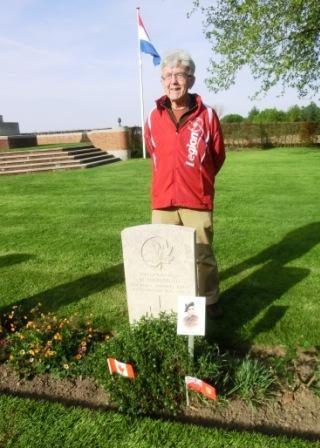
On The War Memorial Trail….The WWII Soldier From St.-Georges Who Lost His Life On His Birthday

January 20, 2025.  When we were in Manitoba last year, we visited the Winnipeg River Heritage Museum, in the village of St.-Georges, in order thank Diane Dube in person for helping us with the photo searches of Edmond COULOMBE and Philip LAFORTE.  (See https://onthewarmemorialtrail.com/2021/12/24/on-the-war-memorial-trail-the-successful-search-for-a-photo-of-ww2-soldier-edmond-coulombe/ and https://onthewarmemorialtrail.com/2022/03/22/on-the-war-memorial-trail-remembering-ww2-soldier-philip-laforte/)

Daria and Pieter with Diane Dube (centre) at the Winnipeg River Heritage Museum in St.-Georges, Manitoba. (Photo courtesy of Valkenburg family)

During our visit, Diane mentioned that she had a relative from the area who was buried in the Canadian War Cemetery in Holten, The Netherlands – Omer VINCENT.  “…His father and my grandfather were brothers. He was first cousin to my father….

Diane wondered if the cemetery had a photo of him, and we assured her it did, as the researchers did not include him on their photo wish list for Manitoba soldiers.  She sent us an excerpt about Omer from a book about the Vincent family, ‘Et la rivière coule toujours 1892-1992’ (‘And the river is still flowing 1892-1992’), published by Hector H. Vincent.

Born April 13, 1920 in St.-Georges, Manitoba, Omer was the son of Fortunat and Marie-Louise Vincent. He came from a large family, with 5 brothers and 5 sisters alive at the time of his death.  Two brothers, Philippe and Wilfred, also served during WWII.

….Omer worked with his father and brothers prior to enlistment….

Omer’s brief biography in ‘Et la rivière coule toujours 1892-1992’ explained that he helped his father and older brothers “…with the farm work.  He soon joined them cutting pulp wood during the winter and would also haul the wood by sleigh and horse team to Pine Falls…”  There was a pulp and paper mill in nearby Pine Falls, Manitoba.

Omer with his horses. (Photo source: ‘Et la rivière coule toujours 1892-1992’)

The entry went on to say that Omer’s “…favourite pastime was hunting with his brothers.  They kept the bush cutting camps well supplied with fresh meat during the winter…

Omer had worked with his father for several years when he enlisted on October 29, 1941 in Winnipeg, Manitoba with the No. 10 District Depot Anti-Aircraft Artillery, Royal Canadian Artillery (RCA). Omer’s fluency in both English and French was noted on his Occupational History Form.  It was also recorded that he could drive a vehicle, a motorcycle, and a tractor, and liked to play baseball.

Omer Vincent.  (Photo source: ‘Et la rivière coule toujours 1892-1992’)

On November 13, 1941, he was sent for basic training at No. 12 Canadian Army (Basic) Training Centre (CABTC) in Chatham, Ontario.  After completing the course on February 3, 1942, he was transferred to A1 Canadian Artillery Training Centre (CATC) at Camp Petawawa in Ontario for advanced training as a gunner. 

Omer was in Petawawa until April 4, 1942. While there, he received embarkation leave, the last time he would see his family.  He returned briefly to Petawawa until April 29, 1942, when he travelled to Halifax, Nova Scotia, the port of embarkation to the United Kingdom.

….Omer left Canada for overseas service….

On May 4, 1942, Omer left Canada for the United Kingdom.  Upon arriving on May 12, 1942 he was assigned to No. 2 Canadian Artillery Reinforcement Unit (CARU).  He continued his training and then was transferred to the 7th Anti-Tank Regiment of the Royal Canadian Artillery on July 31, 1942. 

Omer was reassigned to No. 2 Canadian Artillery Reinforcement Unit (CARU) on August 26, 1943 and sent for specialized training at the Canadian Military Headquarters in London, and then for a series of gun fitter courses at Stoke-On-Trent, where the Artillery Equipment section of the Royal College of Military Science was based during the war.

Upon completion of the courses, Omer was transferred to the X-4 reinforcement list of No. 2 Canadian Base Reinforcement Group (CBRG), part of the 21st Army Group, on August 16, 1944.  The next day he was on his way to Normandy, France, disembarking on August 18, 1944.

A few days later, on August 23, 1944, he was assigned to the 3rd Anti-Tank Regiment of the Royal Canadian Artillery. The Regiment was responsible for coordinating anti-tank defences, with troops supporting the infantry as they fought their way across Boulogne and Calais in September 1944.

In October 1944, the Regiment moved into Belgium, under the command of the 10th Canadian Infantry Brigade. On November 10, 1944, the Regiment began moving from Ghent, Belgium towards Nijmegen, The Netherlands.  On November 17, 1944, Omer was admitted to No. 12 Canadian General Hospital and remained there for a week before returning to his Regiment, now based in ‘s-Hertogenbosch, The Netherlands.

.….Omer’s Battery was tasked with holding the east bank of the IJssel River….

Map showing locations where Omer Vincent was in April 1945.  (Map source: DuckDuck Go)

The April 5, 1945 war diary for the 3rd Anti-Tank Regiment reported that “…Lt JR Cameron of the 4th Battery contacted the QOR this morning and 4 Battery is to aid in holding the east bank of the IJssel between Zutphen and Doesburg…”  QOR referred to Queen’s Own Rifles.  Omer was part of the 4th Battery.

On April 8, 1945, the war diary for the Regiment recorded that 4 Battery was involved in “was under command 8th Brigade for their part in the holding role from Zutphen to Doesburg….” as part of the “….defence system they are holding along the IJssel…..

The following day, the war diary for the Regiment noted that 4 Battery’s new position was “taken up in Steenderen….

.….Omer lost his life on his 25th birthday….

On April 13, 1945, the municipality of Bronkhorst was liberated. However, Germans were still across the IJssel River by Brummen. The war diary for the 3rd Anti-Tank Regiment for that day recorded that “….4 Battery – had skirmish with enemy in barn. Battery suffered two men killed and shot up and burnt down buildings with a Valentine SP.….”  A Valentine Self Propelled (SP) was a tank destroyer.  For more information see https://en.wikipedia.org/wiki/Archer_(tank_destroyer)

Edwin van der Wolf, a volunteer at the Canadian War Cemetery in Holten, explained that “…On the ‘t Hammink farm,  Mr. Buil, a farmhand, saw that night, through the basement window, that German soldiers were coming back and going in the back side of the farm. Farmhand Bruil went to a farm that was 1.5 km further, as he knew that Canadians were billeted there, and informed them about what he had seen….

…Then four Canadian soldiers with a tank went on patrol to ‘t Hammink. Two of them went to explore the farm, but were met by a barrage of bullets. Both were slain. The men were Gunners Omer Vincent and Leslie Temple. The ‘t Hammink farm was then set on fire….Leslie Phillip Carl TEMPLE, from Regina, Saskatchewan, was 23 years old at the time of his death. Sadly, April 13, 1945 was Omer’s 25th birthday.

Edwin went on to write that “…Mr. Breukink, the owner of ‘t Hammink, had fled because he was a member of the NSB…” NSB was the acronym for Nationaal Socialistische Beweging (National Socialist Movement), whose members were Nazi collaborators. (See https://en.wikipedia.org/wiki/National_Socialist_Movement_(Netherlands))

.….Omer is buried in Holten….

Edwin’s account noted that “…the two Canadians killed were temporarily buried in the yard of the Half Welle…” Per Omer’s service file, this was in the vicinity of Baak, south of Zutphen and near Steenderen.  On April 1, 1946, Omer was reburied in the Canadian War Cemetery in Holten, The Netherlands.

Grave of Omer Vincent in the Canadian War Cemetery in Holten, The Netherlands.  (Photo courtesy of the Information Centre Canadian Cemetery Holten)

….Omer’s grave was adopted by a doctor from Gorssel ….

After his reburial in the Canadian War Cemetery in Holten, Omer’s grave was adopted by a Dr. B. H. Upmeijer of Gorssel.  On April 6, 1947, he wrote to Omer’s family, saying that “…today we remember in our village the day of our liberation….” 

He went on to explain that he and others from the village had gone to the Canadian War Cemetery in Holten, “…15 miles from the village of Gorssel and placed flowers on the graves of those who are fallen in the neighbourhood of Zutphen, Eefde, and Gorssel…” 

Dr. Upmeijer noted that he had adopted Omer’s grave, and went on to share his own personal loss.  “…The grave of my brother is in Burma… and for me it would have been reassuring, when I knew where and how he is laying exactly…”  (Burma is now called Myanmar.)

….Vincent Island in northern Manitoba is named in Omer’s honour…..

Vincent Island in Mullin Lake was named after Omer Vincent. (Map source: Mapcarta)

Vincent Island, located in Mullin Lake in northern Manitoba, west of Churchill, was named after Omer in 1995. 

Thank you to Diane Dube for providing information on Omer Vincent, to Edwin van der Wolf for the account of what happened at the ‘t Hammink farm, and to Sheldrake of WW2Talk for information about the gun fitter course.  If you have a story or photo to share, please contact Pieter at memorialtrail@gmail.com or comment on the blog. 

© Daria Valkenburg

….Want to follow our research?….

If you are reading this posting, but aren’t following our research, you are welcome to do so.  Our blog address: https://onthewarmemorialtrail.com/

4 countries, 6 weeks, 7,000 km – an unforgettable war memorial journey in Europe…. Daria’s book ‘No Soldier Buried Overseas Should Ever Be Forgotten‘ is available in print and e-book formats.  Net proceeds of book sales help support research costs and the cost of maintaining this blog. For more information see https://nosoldierforgotten.com/

You are also invited to subscribe to our YouTube Channel: On The War Memorial Trail With Pieter Valkenburg: https://www.youtube.com/channel/UCJ591TyjSheOR-Cb_Gs_5Kw

Never miss a posting!  Subscribe below to have each new story from the war memorial trail delivered to your inbox.
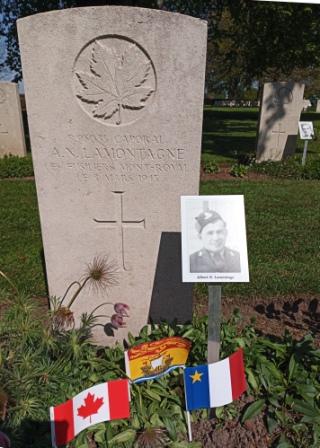
On The War Memorial Trail…..The WWI Soldier From Tryon Who Became A Mailman In New Brunswick

January 7, 2025.  Several months ago, Pieter received a phone call from Carmen Ross, explaining that his granddaughter Lauren was doing a school project on his great-uncle, WWI soldier John Joseph FOY, who was born in Tryon, Prince Edward Island, very near to where we live. Could Pieter help with information about his great-uncle’s military service?

In 2021, we’d written about another WWI soldier from Tryon with the same surname, Maynard FOY.  Was he a relative? Pieter asked.  It turned out that the two families were distantly related.  (See https://onthewarmemorialtrail.com/2021/04/24/on-the-war-memorial-trail-the-ww1-soldier-who-returned-to-tryon/)

CIMG7040 Sep 4 2024 Pieter with Carmen and Margaret Ross

Pieter with Carmen and Margaret Ross.  (Photo credit: Daria Valkenburg)

Like Maynard, John Foy survived the war and returned to Canada.  As one of the goals of the ‘On The War Memorial Trail’ research project is the opportunity to tell the stories of Islanders who survived their war service, Pieter not only helped provide information for Lauren’s school project, we also met with Carmen and his wife Margaret. 

…My grandfather, Alfred Foy, known as Allie, was John’s brother…  Carmen explained.  He also recalled his mother Hilda telling him that John “…was such a nice man!…

….John enlisted in 1915….

John Joseph Foy

John Joseph Foy.  (Photo courtesy of Carmen Ross)

Born on October 25, 1882, John was the son of Philip Morris Callbeck and Rachel (nee Bynon) Foy.  A farmer at the time of his enlistment on September 25, 1915 in Charlottetown, Prince Edward Island, John had served in the No. 2 Heavy Battery Depot since July 1915, when it had been first organized in Prince Edward Island under the command of Major A. G. Peake, and which became No. 2 Overseas Battery, Canadian Siege Artillery, on September 29, 1915.

….John left Canada for overseas service shortly after enlistment….

File written by Adobe Photoshop? 4.0

SS Lapland.  (Photo source: https://www.wikitree.com)

With his Battery, John sailed aboard the SS Lapland, leaving Halifax, Nova Scotia on November 28, 1915, and arriving at Plymouth Sound, United Kingdom on December 7, 1915. 

The Battery was housed at Raffey Camp, at Horsham Siege Artillery School, in West Sussex.  As a gunner, John and the other members of his Battery underwent four months of training there. While in England, the Battery was re-designated as No. 98 (Canadian) Siege Battery, Canadian Siege Brigade.

He remained with No. 98 (Canadian) Siege Battery Artillery until January 19, 1916, when he was transferred to the 3rd Reserve Brigade, Canadian Field Artillery, which was at Shorncliffe, for further training, and as part of reinforcement troops.

….John was sent to France for the Battle of the Somme….

DAC_Pack_Ammo_Apr17

Ammunition Column Pack horses transporting ammunition to a brigade in France.  (Photo source: Library and Archives Canada, MIKAN no. 3194763)

On August 25, 1916 he left for France and was assigned to the 1st Divisional Ammunition Column (DAC), whose role was to bring ammunition forward to the gun positions of the 1st Division batteries for the Battle of the Somme. (See https://en.m.wikipedia.org/wiki/Battle_of_the_Somme)

Ammunition was moved by motor and horse drawn transport, heavy and light rail, and tramways.  From his service file, it appears that John worked in the stables and in the transport of ammunition by horses.

….John was reassigned to his artillery battery….

John remained with the 1st DAC until September 12, 1916, when he returned to the 2nd Brigade, and continued to work with horses, which were used in transporting the heavy guns and ammunition to the front lines, as the Battle of the Somme continued into the fall of 1916.  The Brigade served continuously behind the United Kingdom’s 4th Army’s front until December 1916, when troops were ordered to dig their guns out of the mud and move northward.

In January 1917, the battery became part of the Canadian Corps Heavy Artillery and was renamed No. 2 Canadian Siege Battery, Canadian Garrison Artillery (CGA).  On January 22, 1917, John was admitted to a field hospital in France with bronchitis and pneumonia, and remained there until January 27, 1917, when he rejoined his unit.

Preparations were underway for the Battle of Vimy Ridge, a three day battle from April 9 to 12, 1917, which John survived. (See https://en.m.wikipedia.org/wiki/Battle_of_Vimy_Ridge) Following Vimy Ridge, John’s unit was involved in the Battle of Hill 70, just east of Loos and north of Lens, which was fought between August 15 and 25, 1917. (See https://en.m.wikipedia.org/wiki/Battle_of_Hill_70)

On October 4, 1917, John was sent to a rest camp in Boulogne for 2 weeks, returning to his unit on October 19, 1917.  A few weeks later he was sent to England on leave for a few weeks, returning on November 30, 1917, where he and his unit were assigned to the 48th Battery, Canadian Field Artillery. 

….A handkerchief from Belgium remains in the family!….

LAC_BL_6-inch_26_cwt_Howitzer

Crew positioning a BL 6-inch howitzer. (Photo source: Library and Archives Canada MIKAN No. 3395353)

John’s battery was involved in the March 1918 German Spring Offensive in West Flanders, Belgium. (See https://en.m.wikipedia.org/wiki/German_spring_offensive) While in Belgium, he managed to buy an embroidered handkerchief, which was given to Carmen’s mother Hilda.

image0 Belgian hankie 2 from Jen Huber

Embroidered handkerchief from Belgium that John Foy brought back to Canada.  (Photo courtesy of Jen Huber)

As fighting continued, troops were involved in the Hundred Days Offensive, which began in August 1918 and continued until the end of the war. (See https://en.m.wikipedia.org/wiki/Hundred_Days_Offensive) They moved frequently, through the Hindenburg Line, and advancing north during the Battle of Cambrai in France, from October 8 to 10, 1918.  (See https://en.m.wikipedia.org/wiki/Hundred_Days_Offensive)

In December 1918, the battery moved briefly into Germany, positioned on the west bank of the Rhine at Cologne to protect the crossing of the 1st Canadian Division on December 13, 1918.  The battery returned to the United Kingdom, leaving France from Le Havre on March 30, 1919, and arriving in the United Kingdom at Weymouth.

….John was discharged from the army and returned to Canada….

By April 14, 1919, John was on his way back to Canada, leaving Southampton aboard the SS Olympic.  He was discharged from service on April 30, 1919 in Charlottetown, aged 36.

Screenshot 2025-01-07 at 09-48-24 Lewisville Map - Locality - Westmorland County New Brunswick Canada

John Foy lived in Turtle Creek and was a mailman in rural Lewisville, now part of Moncton.  (Map source: http://www.mapcarta.com)

John never married and moved to New Brunswick. He was involved in harness racing as a driver and worked as a rural mailman in Lewisville (now part of Moncton), while living in nearby Turtle Creek, before he retired due to ill health.

….John is buried in St. John, New Brunswick….

He died on July 1, 1964, aged 81, at the Lancaster Department of Veterans Affairs Hospital in Lancaster, New Brunswick, following a lengthy illness, and was buried in the Field of Honour at Cedar Hill Extension Cemetery in St. John.

cemetery where he is buried Find a Grave

Grave of John Joseph Foy in Cedar Hill Extension Cemetery in St. John, New Brunswick. (Photo courtesy of FindAGrave)

Thank you to Carmen and Margaret Ross, and Jen Huber, for sharing photos and information about John Foy, and to Shawn Rainville and Etienne Gaudet for newspaper research. If you have a story or photo to share, please contact Pieter at memorialtrail@gmail.com or comment on the blog. 

© Daria Valkenburg

….Want to follow our research?….

If you are reading this posting, but aren’t following our research, you are welcome to do so.  Our blog address: https://onthewarmemorialtrail.com/

Front cover OnTheWarMememorialTrailinEurope4 countries, 6 weeks, 7,000 km – an unforgettable war memorial journey in Europe…. Daria’s book ‘No Soldier Buried Overseas Should Ever Be Forgotten‘ is available in print and e-book formats.  Net proceeds of book sales help support research costs and the cost of maintaining this blog. For more information see https://nosoldierforgotten.com/

You are also invited to subscribe to our YouTube Channel: On The War Memorial Trail With Pieter Valkenburg: https://www.youtube.com/channel/UCJ591TyjSheOR-Cb_Gs_5Kw

Never miss a posting!  Subscribe below to have each new story from the war memorial trail delivered to your inbox.
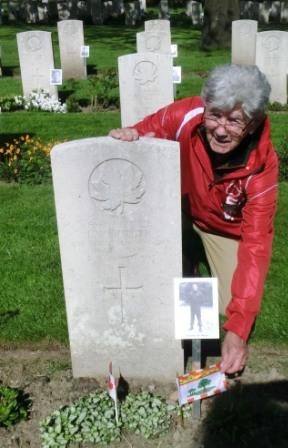
2024 Christmas Eve Candle Lighting At The Canadian War Cemetery In Adegem

christmas-red-candles-header

December 31, 2024.  For over 30 years, it’s been a Christmas Eve tradition in Europe to light candles by the graves of Allied soldiers who are buried in War Cemeteries or in municipal cemeteries.
These candles are funded by various non-profit groups at each cemetery participating in the candle-lighting ceremony.  In many of the cemeteries, children are active participants, placing candles at each grave. On a day when many of us in Canada are thinking of presents, a visit by Santa, and preparations for our Christmas Day meal, volunteers spend their day in an act of commemoration.

In previous years, we’ve featured photos from cemeteries in The Netherlands.  This year, we include photos of the candlelit graves for 9 soldiers – that Pieter has researched – who are buried in the Canadian War Cemetery in Adegem, Belgium. 

The photos are courtesy of Patrick Michiels, who travelled an hour each way from his home on Christmas Day to take the photos for us.  He explained that he went over myself to Adegem….” because his friend, who lives near Adegem and had planned to take the photos, couldn’t make it, and Patrick himself was unable to go on Christmas Eve. He made the time on Christmas Day to travel to Adegem and take the photos. …The weather was terrible, so the state of the cemetery was not very pleasant to take photos…” but it didn’t deter him.

…9 graves visited in Adegem….

Candles were placed at all of the graves at the Canadian War Cemetery in Adegem, and we had asked for photos of 9 of these graves:

IMG_0819 Boudreau

Candle placed at the grave of Azade Boudreau.  (Photo credit: Patrick Michiels)

WWII soldier Azade BOUDREAU of Petit Rocher Nord, New Brunswick, was serving with the Royal Canadian Artillery, when he drowned accidentally in a canal of the lower Scheldt River on December 15, 1944, at the age of 21. Azade’s story will be told in an upcoming posting.

IMG_0797 Bulger

Candle placed at the grave of Harold Gabriel Bulger.  (Photo credit: Patrick Michiels)

WWII soldier Harold ‘Hal’ Gabriel BULGER of Foxley River, Prince Edward Island, was serving with the Algonquin Regiment when he was killed during the Battle of Moerbrugge in Belgium on September 10, 1944, at the age of 26.  (See https://onthewarmemorialtrail.com/2024/08/05/on-the-war-memorial-trail-the-bulger-brothers-part-i-the-wwii-soldier-from-foxley-river-killed-during-the-battle-of-moerbrugge/)

IMG_0808 Churchill

Candle placed at the grave of Bruce Wilbur Churchill.  (Photo credit: Patrick Michiels)

WWI soldier Bruce Wilbur CHURCHILL of Sandford, Nova Scotia, was serving with the Algonquin Regiment when he lost his life in a monastery garden in Hulst, The Netherlands, accidentally killed when a Bren gun ricocheted on September 29, 1944. He was 27 years old. (See https://onthewarmemorialtrail.com/2022/06/05/on-the-war-memorial-trail-the-ww2-soldier-who-lost-his-life-in-a-monastery-garden/)

IMG_0805 Henderson

Candle placed at the grave of David Stinson Henderson.  (Photo credit: Patrick Michiels)

David Stinson HENDERSON of Armstrong, British Columbia, was serving with the Canadian Scottish Regiment when he lost his life on October 17, 1944, at the age of 25, after a discarded German luger he had picked up accidentally went off.  (See https://onthewarmemorialtrail.com/2023/01/17/on-the-war-memorial-trail-honouring-two-canscots-buried-in-adegem-by-adopting-their-graves/)

IMG_0815 Hoole

Candle placed at the grave of Ronald Stuart Walter Hoole.  (Photo credit: Patrick Michiels)

Ronald Stuart Walter HOOLE of Salt Spring Island, British Columbia, was serving with the Canadian Scottish Regiment when he lost his life on October 27, 1944, at the age of 21, during the Battle of Breskens Pocket. (See https://onthewarmemorialtrail.com/2023/01/17/on-the-war-memorial-trail-honouring-two-canscots-buried-in-adegem-by-adopting-their-graves/)

IMG_0817 MacDonald

Candle placed at the grave of Alexander Fraser MacDonald.  (Photo credit: Patrick Michiels)

Alexander Fraser MACDONALD of Trenton, Nova Scotia, was serving with the Regina Rifles, when he lost his life on October 31, 1944, at the age of 27, during the Battle of the Scheldt. (See https://onthewarmemorialtrail.com/2021/01/13/on-the-war-memorial-trail-atlantic-canada-remembers-part-2/)

IMG_0802 Pallister

Candle placed at the grave of Joseph Hudson Pallister.  (Photo credit: Patrick Michiels)

Joseph Hudson PALLISTER of Calgary, Alberta, was serving with the Canadian Scottish Regiment, when he lost his life on October 6, 1944, at the age of 21, during the Battle of the Leopold Canal. (See https://onthewarmemorialtrail.com/2023/06/18/on-the-war-memorial-trail-1-wwii-soldier-2-families-3-countries/)

IMG_0811 Smith

Candle placed at the grave of Edison Reynolds Smith.  (Photo credit: Patrick Michiels)

Edison Reynolds SMITH of Nova Scotia, was serving with the North Nova Scotia Highlanders, when he lost his life in The Netherlands on October 15, 1944, at the age of 20, during the Battle of the Scheldt. (See https://onthewarmemorialtrail.com/2021/01/07/on-the-war-memorial-trail-atlantic-canada-remembers-part-1/ and https://onthewarmemorialtrail.com/2023/12/07/on-the-war-memorial-trail-part-1-the-wwii-letters-of-edison-reynolds-smith/ and https://onthewarmemorialtrail.com/2023/12/12/on-the-war-memorial-trail-part-2-the-wwii-letters-of-edison-reynolds-smith/)

IMG_0799 Taylor

Candle placed at the grave of Arthur Brambel ‘Jack’ Taylor.  (Photo credit: Patrick Michiels)

Arthur Brambel ‘Jack’ TAYLOR of Woodstock, New Brunswick, was serving with the Royal Winnipeg Rifles when he lost his life on October 12, 1944, at the age of 26, during the Battle of the Leopold Canal. (See https://onthewarmemorialtrail.com/2021/01/27/on-the-war-memorial-trail-atlantic-canada-remembers-part-5/)

Thank you to Patrick Michiels for sharing photos from the Canadian War Cemetery in Adegem, Belgium.

If you have a story or photo to share about Canadian military personnel buried in The Netherlands or Belgium, please contact Pieter at memorialtrail@gmail.com or comment on the blog. 

© Daria Valkenburg

…Previous postings about Christmas Eve Candle Lighting…

…Want to follow our research?….

If you are reading this posting, but aren’t following our research, you are welcome to do so.  Our blog address: https://onthewarmemorialtrail.com/

Front cover OnTheWarMememorialTrailinEurope4 countries, 6 weeks, 7,000 km – an unforgettable war memorial journey in Europe…. Daria’s book ‘No Soldier Buried Overseas Should Ever Be Forgotten‘ is available in print and e-book formats.  Net proceeds of book sales help support research costs and the cost of maintaining this blog. For more information see https://nosoldierforgotten.com/

You are also invited to subscribe to our YouTube Channel: On The War Memorial Trail With Pieter Valkenburg: https://www.youtube.com/channel/UCJ591TyjSheOR-Cb_Gs_5Kw

Never miss a posting!  Subscribe below to have each new story from the war memorial trail delivered to your inbox.