September 26, 2026. We love it when a story about one soldier leads to a story about a family member! A few months ago, Brenda Graves of North Tryon, Prince Edward Island, had told us about her grandfather, Cyrus Joseph GALLANT, of Piusville, Prince Edward Island, who served in both WWI and WWII before his death from pancreatic cancer on October 31, 1942. (See https://onthewarmemorialtrail.com/2026/06/20/on-the-war-memorial-trail-the-wwi-soldier-from-piusville-who-enlisted-in-the-veterans-guard-of-canada-in-wwii/)
While researching Cyrus’s story, Brenda explained that his son, Everett John GALLANT, had served in WWII and survived the war, in spite of being wounded twice. Would we be willing to research her uncle’s service? Of course, we said, and that led to Brenda and me subsequently meeting with Everett’s daughter Elaine Gallant, who provided photos and information on her father’s post-WWII life.
Born August 19, 1923 in Piusville, Prince Edward Island, Everett was the son of Cyrus Joseph and Elizabeth ‘Lizzie’ Marie (nee Gallant) Gallant.
….Everett enlisted in 1943….
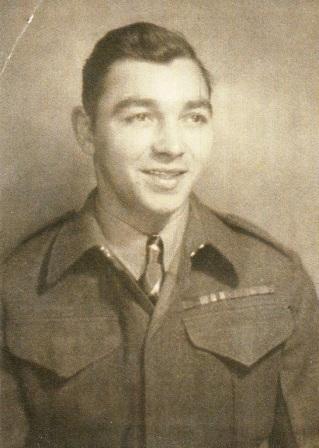
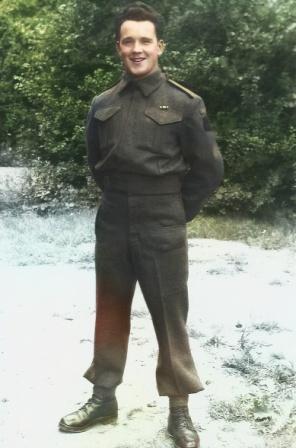
Everett John Gallant. (Photo courtesy of the Gallant Family)
When he enlisted on March 11, 1943 at No. 6 District Depot in Charlottetown, Prince Edward Island, Everett had several years already of work experience, as he’d left school after completing Grade 8. He’d been employed as a stevedore in Halifax, Nova Scotia for Cunard Steamships, Ltd since 1942. Before that, he’d worked as a farm labourer, with seasonal work in woods as a chopper. It was noted that he was fluent in English, and could speak French.
After successfully completing his basic training at No. 62 Canadian Army (Basic) Training Centre in Charlottetown, Everett was transferred to A14 Canadian Infantry Training Centre (CITC) at Camp Aldershot in Nova Scotia on April 2, 1943. Here he would have been given for more intensive combat training in tactical firearm use and field exercises.
On July 17, 1943, he was given 6 days of special leave, the last chance he had to see his family before being posted overseas.
….Everett left Canada for overseas service ……
On August 27, 1943, Everett left Canada aboard a troopship in Halifax, and arrived in the United Kingdom on September 1, 1943. Upon arrival, he was placed with No. 7 Canadian Infantry Reinforcement Unit (CIRU), a training and holding base for infantry reinforcements located in Airedale, Castleford in West Yorkshire.
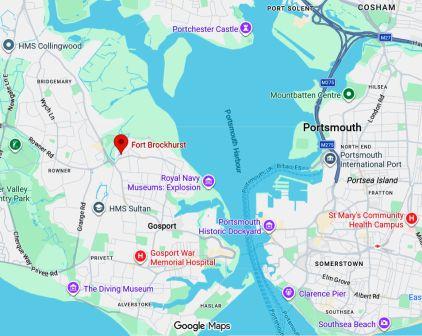
The North Nova Scotia Highlanders were based in Fort Brockhurst in December 1943. (Map source: Google Maps)
On December 10, 1943, Everett was transferred to the North Nova Scotia Highlanders, joining them at their winter base in Fort Brockhurst in Gosport, near Portsmouth. The Regiment was carrying out combined operations and tactical exercises in preparation for Operation Overlord – the landing on Juno Beach in Normandy on June 6, 1944 – in what we know today at D-Day.
He would have trained with John ‘Weston’ CAMPBELL from Clermont, Prince Edward Island. In ‘No Retreating Footsteps’, author Will Bird recorded that among “…the officers selected to land in France on D Day with the North Novas….” was Lt. J.W. Campbell who would be leading an anti-tank platoon. (See https://onthewarmemorialtrail.com/2024/09/30/on-the-war-memorial-trail-the-wwii-soldier-from-clermont-killed-during-operation-veritable/)
…Everett survived D-Day….
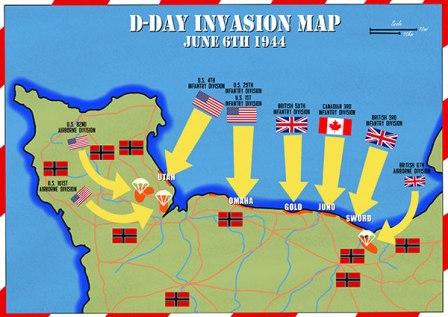
D-Day invasion map. The Canadians landed on Juno Beach in Normandy, France. (Map source: https://www.ddaylepe.org.uk/index.php/overlord-neptune/)
In April 1943, the Regiment moved to a marshalling area south of Southampton and continued training….and waiting….
The North Nova Scotia Highlanders, as part of the 21st Army Group’s Allied Expeditionary Force, left England for Normandy, France on June 6, 1944, after waiting in place in the English Channel on landing craft earlier. The war diary for Sunday, June 4, 1944 noted that “…we are tied up with two other landing craft tank. The Padre is on one, so he had a church service at 10:30 hours on the quarter deck of the middle craft…”
On June 5, 1944 the war diary recorded that “…at 14:00 hours the flotilla moved out to the open sea and formed up with the other craft taking part in the invasion…”
After landing on the beaches of Normandy on June 6, 1944, as part of the 9th Infantry Brigade, 3rd Canadian Infantry Division, 21st Army Group, the war diary noted that the Regiment had 10 casualties that day– 4 killed, 6 wounded. (See https://onthewarmemorialtrail.com/2024/06/01/on-the-war-memorial-trail-commemorating-the-80th-anniversary-of-d-day/)
Everett had survived D-Day but his luck ran out a month later, as the Regiment moved through France towards Caen.
…Everett was wounded during Operation Charnwood….
On July 8, 1944, the war diary recorded that “….at 0600 hours this morning, operation ‘Charnwood’ commenced with a heavy aerial bombardment…” prior to the participation a few hours later by the Regiment. Operation Charnwood was an Anglo-Canadian offensive that took place from July 8-9, 1944, during the Battle for Caen, part of the larger Operation Overlord. The objective of Operation Charnwood was to clear Caen up to the Orne river and, if possible, to secure bridgeheads in southern Caen. (See https://en.wikipedia.org/wiki/Operation_Charnwood)
The Regiment’s task, once two towns were captured by other troops, was to “…capture Authie, exploiting forward to Franqueville….This phase of the battle began at 0900 hours…. At approximately 1045 hours, when the two villages were considered held, we pushed forward to the forming up point which was just south of Buron…Very heavy casualties were inflicted on us by mortar and 88 mm shell fire…”
Everett was one of the casualties, with a gunshot wound in his right leg. He was evacuated to England, and then taken by train to No. 4 Canadian General Hospital in Aldershot on July 10, 1944. He was moved to No. 13 Canadian General Hospital on July 16, 1944, remaining there until September 5, 1944, when he was sent for a few days to No. 1 Canadian Special Hospital in Hellingly, East Sussex.
The Canadian Red Cross Overseas Headquarters received a request for a welfare check on Everett by his family on September 18, 1944, and the Matron in Charge at No. 1 Canadian Special Hospital was duly notified and requested for information.
By this point, however, Everett had been transferred to the 4th Canadian Convalescent Depot (CCD) in Farnborough, Hampshire on September 8, 1944. This was a military facility where recovering Canadian soldiers stayed to regain strength and physical fitness before returning to active duty or reinforcement units. This was Everett’s home until he was discharged on December 22, 1944, and placed with No. 3 Canadian Infantry Training Regiment (CITR) for additional physical conditioning before being sent back to active duty.
….Everett returned to his Regiment in March 1945….
Everett returned to active duty, rejoining the North Nova Scotia Highlanders on March 5, 1945. By this time, the Regiment was in Germany, part of the 2nd Canadian Infantry Division, preparing to capture Xanten, near the end of Operation Blockbuster, in a battle that took place between March 8 and 11, 1945. (See https://legionmagazine.com/the-taking-of-xanten/)
By March 20, 1945, Allied troops were on the banks of the Rhine River for Operation Plunder, a military operation to cross the Rhine on the night of March 23, 1945. (See https://en.wikipedia.org/wiki/Operation_Plunder)
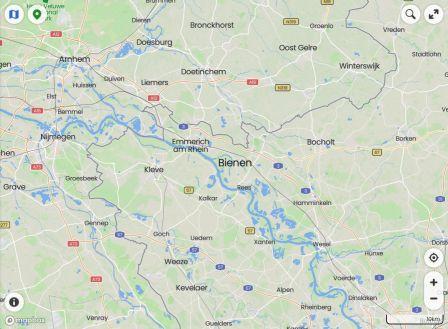
On March 25, 1945, the North Nova Scotia Highlanders were in Bienen, Germany for the climax of 9 Canadian Infantry Brigade’s role in Operation Plunder.
A few years ago, Alice van Bekkum, Chair of the Groesbeek Cemetery Faces To Graves Foundation, had sent Pieter a list of 39 soldiers from the North Nova Scotia Highlanders Regiment who were killed during the Battle of Bienen in Germany on March 25, 1945. Although there were more casualties from this battle, the list was of North Nova Scotia Highlanders buried in the Canadian War Cemetery in Groesbeek, The Netherlands.
The date of the battle was very meaningful. “…They died on my birthday! I was just one year old!…” Pieter had exclaimed. This resulted in a series of stories about several of the fatalities, and a visit to Bienen during our 2025 European War Memorial Tour.
….Everett was wounded a second time during the Battle of Bienen….

Map shows position of North Novies on March 25, 1945, near Bienen. (Map source: Project ’44)
Stolpi on WW2Talk provided background on the leadup to the battle. “… As night fell on D-Day, 24 March, only on the extreme left of the forces involved in the 21st Army Group’s Rhine Crossing was the situation sketchy indeed. There, in the 30 Corps’ sector at Rees, twelve British and Canadian battalions, supported by 44 DD tanks had crossed the river and formed a small bridgehead. The 51st Highland Division had reached the edge of Bienen, penetrated into Speldrop and were in, though not yet master of, Rees.
A further expansion of the bridgehead was canalized by the old river beds. Only two openings were available through which led the main roads to the north and northwest. One was on the left at Bienen, a narrow land bridge formed by the old river arm of the Alter Rhein and the Millinger Meer, through which passed the main road to Emmerich; the other was at Empel formed by the Millinger and Empeler Meer, here ran the main road to Isselburg. Both offered great advantages to the enemy defense: they were easy to block and he only could be dislodged by frontal assault.
Early on March 25th, it was decided to step up the 30 Corps’ operation to enlarge the bridgehead, by inserting the 9th Canadian Infantry Brigade,commanded by Brigadier J.M. Rockingham, on the left. The 9th Canadian Infantry Brigade was to relieve the 154 Brigade and continue the attack on Bienen.
All through the 25th the 9th Canadian Infantry Brigade made strenuous efforts to seize Bienen and open up a passage towards the north and northwest, in the direction of Millingen and Emmerich. The assignment went to the North Nova Scotia Highlanders, which was the last of the battalions of the 9th Canadian Infantry Brigade to arrive in the bridgehead….”
March 25, 1945 was Palm Sunday – one week before Easter. The battle began in the morning and didn’t end until late that evening. Right from the start, troops were pinned down, “…suffering heavy casualties…” per the Regiment’s war diary for that day. Worse, in terms of communications, “….contact between platoons was next to impossible because of the murderous fire and heavy mortaring….”
The one day battle proved devastating in terms of casualties, both dead and wounded, as they fought in a deadly battle on open ground. Less than 3 weeks after returning to active duty, Everett was in the midst of his second battle. Around 3 pm, he received serious wounds that ended his active war service: gunshot wound with shrapnel in his chest and shrapnel wounds in his right upper arm. A bazooka bomb that had exploded near him during the battle resulted in permanent hearing loss. He was one of 68 men wounded, but unlike so many of the soldiers, he survived.
He was initially taken to the nearby No. 3 Canadian Casualty Clearing Station. On March 30, 1945, he was transferred to No. 6 Canadian General Hospital in Sint-Michielsgestel, The Netherlands, before being evacuated to No. 19 Canadian General Hospital in Basingstoke, England on April 17, 1945.
Everett was still in hospital recovering from wounds received during the Battle of Bienen when WWII ended in Europe. On May 22, 1945, Everett was sent to Roman Way Convalescent Hospital in Colchester, Essex, for physical rehabilitation and recovery, remaining there until June 25, 1945.
NOTE: For an idea of some of the places that the Regiment travelled through in Germany, and our visit to Bienen during our 2025 European War Memorial Tour, see https://onthewarmemorialtrail.com/2026/02/06/on-the-war-memorial-trail-we-follow-the-route-taken-into-germany-by-canadian-troops-in-1945/
….Everett returned to Prince Edward Island after being demobilized….
After leaving hospital, Everett remained on light duty in England until January 27, 1946, when he was repatriated back to Canada, and posted to No. 6 District Depot in Halifax, until he was demobilized from the Canadian Army on April 17, 1946.
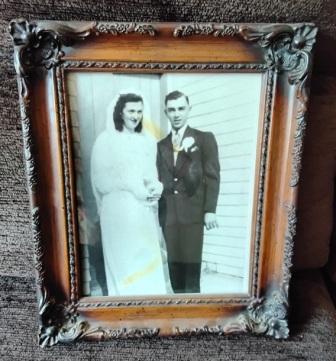
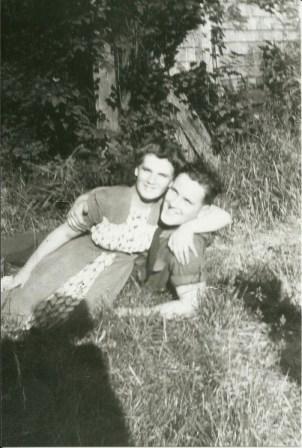
Edna and Everett Gallant on their wedding day. (Photo courtesy of the Gallant Family. Photo restoration by Pieter Valkenburg)
Everett married Edna Mary Gallant at St. Anthony’s Church in Bloomfield, Prince Edward Island, on August 6, 1947, and they raised 9 children. “…My parents both grew up in Piusville and were neighbours….” Elaine said.

Gallant’s Scrap Iron & Metal in Summerside is run by the Gallant family. (Photo credit: Daria Valkenburg)
Everett worked for 14 years for the Department of Defence at the Canadian Forces Base in Summerside, before starting a scrap metal business in 1966. Gallant’s Scrap Iron & Metal is still run by the Gallant family.
A few years before his death, Everett was interviewed for a ‘Memories of D-Day’ article, published on July 27, 2001 in the Journal Pioneer newspaper. “….One of those serving was a 20 year old from Piusville, Everett J. Gallant. For Gallant, now 77 and living in Summerside, the memories of D-Day have been left behind with time.
Gallant says the more he talks about it, the more memories come back. He was a member of the North Nova Scotia Highlanders then and a young private in the army. About a month after the landing he was wounded in France when a piece of shrapnel went into his right leg. His first cousin ‘Johnny’ Gallant dressed his wound.
After spending some time in an English hospital he went out again to serve and was later wounded in Germany. He still has a piece of shrapnel in his chest, but he says it doesn’t bother him a bit.
Once back in Canada, Gallant married a former classmate, Edna, and later became involved in the Miscouche Legion, of which he is past president...”
Elaine noted that it wasn’t until just a few years before Everett died that he learned that it was his cousin ‘Johnny’ Gallant, who also survived the war, who had dressed his wound so long ago in France!
….Everett is buried in Summerside….
Everett passed away, aged 82, at Prince County Hospital in Summerside, Prince Edward Island, on September 24, 2005, and is buried in Saint Paul’s Roman Catholic Cemetery in Summerside.
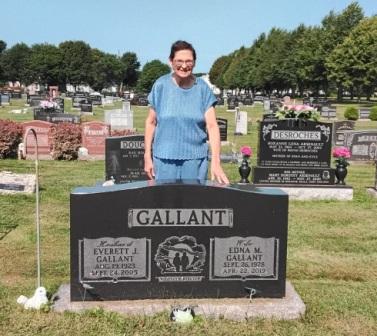
Elaine Gallant by the grave of her parents. (Photo credit: Daria Valkenburg)
Elaine, Brenda, and I visited Everett’s grave one sunny morning in August. Asked to describe her father as we left the cemetery, Elaine reflected that he “…was a gentle man who loved his family, was devoted to Mom, loved his animals. He was a hard working man who would give the shirt off of his back to anyone who needed it…”
Both Elaine and Brenda explained that Everett never spoke about the war, except to express his “…profound sadness at the loss of all the young men who died, including his friends...”
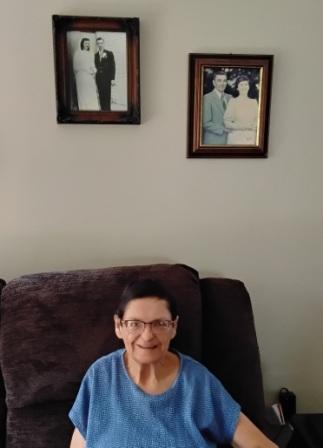
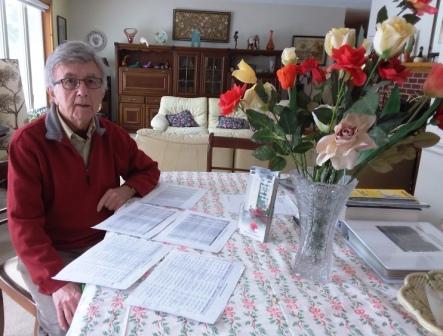
Elaine Gallant with photos of her parents. (Photo credit: Daria Valkenburg)
Thank you to Elaine Gallant and Brenda Graves for providing photos and information, and Stolpi on WW2Talk for background on the leadup to the Battle of Bienen. Pieter’s research efforts to find photos and families of soldiers continue. Do you have a story to tell? Email Pieter at memorialtrail@gmail.com, or comment on the blog.
© Daria Valkenburg
….Previous stories about North Novies killed during the Battle of Bienen and buried in Groesbeek….
- Clifford BATEMAN: https://onthewarmemorialtrail.com/2023/03/16/on-the-war-memorial-trail-the-battle-of-bienen-part-4-the-wwii-soldier-from-a-small-fishing-village-in-newfoundland-who-lost-his-life-in-germany/
- John Joseph BOHON: https://onthewarmemorialtrail.com/2023/03/18/on-the-war-memorial-trail-the-battle-of-bienen-part-5-the-wwii-soldier-whose-parents-immigrated-to-save-their-family-from-war/
- Ralph Schurman BOULTER: https://onthewarmemorialtrail.com/2023/03/07/on-the-war-memorial-trail-the-battle-of-bienen-part-2-the-wwii-battle-drill-instructor-from-oleary/
- Lawrence William BULGER: https://onthewarmemorialtrail.com/2024/08/19/on-the-war-memorial-trail-the-bulger-brothers-part-2-the-wwii-stretcher-bearer-from-foxley-river-killed-during-the-battle-of-bienen/
- Charles ‘Marshall’ CARSON: https://onthewarmemorialtrail.com/2023/03/12/on-the-war-memorial-trail-the-battle-of-bienen-part-3-the-wwii-soldier-from-cape-tormentine-who-lost-his-life-in-germany/
- Harry William DOUCETTE: https://onthewarmemorialtrail.com/2021/02/09/on-the-war-memorial-trail-atlantic-canada-remembers-part-6/
- Marven Glenroy HARVEY: https://onthewarmemorialtrail.com/2023/03/26/on-the-war-memorial-trail-the-battle-of-bienen-part-8-the-wwii-soldier-with-7-brothers-who-also-served/
- Kitchener ‘Kitty’ LANGILLE: https://onthewarmemorialtrail.com/2023/03/21/on-the-war-memorial-trail-the-battle-of-bienen-part-6-the-wwii-soldier-from-new-glasgow-nicknamed-kitty/
- Marvin William MCGREGOR:https://onthewarmemorialtrail.com/2023/04/02/on-the-war-memorial-trail-the-battle-of-bienen-part-9-the-wwii-soldier-from-west-jeddore-killed-in-germany/
- Austin Havelock MUNROE, plus a list of the 39 soldiers: https://onthewarmemorialtrail.com/2022/11/29/on-the-war-memorial-trail-the-search-for-a-photo-of-austin-havelock-munroe-is-on-youtube/ and https://onthewarmemorialtrail.com/2023/05/14/on-the-war-memorial-trail-the-battle-of-bienen-part-12-the-wwii-soldier-from-little-dover-who-lost-his-life-in-germany/
- Wilfred ‘Willy’ Joseph POWER: https://onthewarmemorialtrail.com/2023/04/10/on-the-war-memorial-trail-the-battle-of-bienen-part-10-the-wwii-soldier-who-wanted-to-be-a-paratrooper/
- Louis Allan SEXTON: https://onthewarmemorialtrail.com/2023/03/23/on-the-war-memorial-trail-the-battle-of-bienen-part-7-the-wwii-soldier-from-quebec-who-has-never-been-forgotten-by-his-family/
- Edison Alexander SMITH: https://onthewarmemorialtrail.com/2023/03/04/on-the-war-memorial-trail-the-battle-of-bienen-part-1-the-wwii-soldier-whose-body-shielded-a-wounded-major/
- John Lewis WALLACE: https://onthewarmemorialtrail.com/2023/05/02/on-the-war-memorial-trail-the-battle-of-bienen-part-11-the-wwii-soldier-from-canning-who-lost-his-life-in-germany/
- YouTube Video: https://onthewarmemorialtrail.com/2023/09/02/on-the-war-memorial-trail-honouring-the-memories-of-the-north-novies-who-lost-their-lives-during-the-battle-of-bienen/
….Want to follow our research?…
If you are reading this posting, but aren’t following our research, you are welcome to do so. Our blog address: https://onthewarmemorialtrail.com/
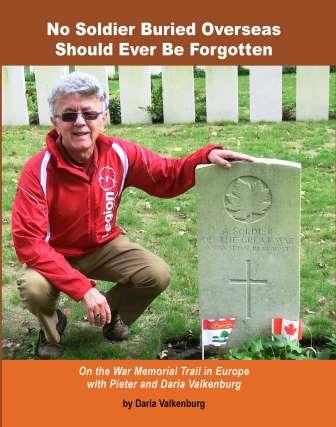 4 countries, 6 weeks, 7,000 km – an unforgettable war memorial journey in Europe…. Daria’s book ‘No Soldier Buried Overseas Should Ever Be Forgotten‘ is available in print and e-book formats. Net proceeds of book sales help support research costs and the cost of maintaining this blog. For more information see https://nosoldierforgotten.com/
Subscribe to our YouTube Channel: On The War Memorial Trail With Pieter Valkenburg: https://www.youtube.com/channel/UCJ591TyjSheOR-Cb_Gs_5Kw.
Never miss a posting! Subscribe below to have each new story from the war memorial trail delivered to your inbox.