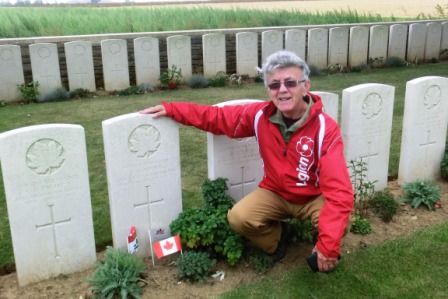
On The War Memorial Trail….. The WWII Soldier From Springhill Who Received A Military Cross

January 23, 2022.  In the quest for a photo of Lt Donald Charles MACKENZIE of Springhill, Nova Scotia, Pieter placed a request on ‘THE SPECTATOR: A Little Good News from Springhill, NS’ Facebook page.  Pat Crowe submitted a newspaper photo and obituary shortly afterwards, explaining that “…Donald had 4 brothers and sisters but they are all gone now…

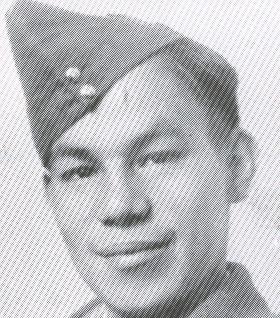
image0 Donald Charles MacKenzie

Donald Charles MacKenzie.  (Photo courtesy of Lydia Prange)

Pat then contacted Donald’s niece, Lydia Prange, who had a photo and explained that her mother, Lydia Jean Nelson, was Donald’s sister.  I was born in 1949 so never knew my uncle or grandmother….” Lydia wrote.

Born September 3, 1914 in Springhill, Nova Scotia, Donald was the son of Charles Tupper MacKenzie and Lydia MacKay.  Before enlisting for active duty with the North Nova Scotia Highlanders in Springhill on September 15, 1939, Donald was in the Cumberland Highlanders militia from June 11, 1936 until August 27, 1939.  He was employed as a road layer by Dominion Steel and Coal, a mining company.

Donald married …Mary MacSavaney on June 19, 1936.  Their son Gordon was born on March 15, 1940…

….Donald took a demotion in rank in order to serve overseas more quickly….

Upon enlistment, he was given the rank of Sergeant and sent to Halifax with the North Nova Scotia Highlanders.  However, in order to see active overseas service more quickly, he transferred to the Royal Canadian Engineers 6th Field Company on January 7, 1941, taking a demotion in rank to Private, and was transferred to Debert, Nova Scotia in preparation for going overseas.

On June 18, 1941 he was on his way to the United Kingdom.  On August 1, 1941 he was promoted to Lance Corporal, and later promoted to Corporal on July 6, 1943. On September 21, 1944 he received a further promotion, to Lieutenant, upon the successful completion of officer training at Sandhurst, in the United Kingdom.

…After receiving a promotion to Lieutenant he was transferred to the Royal Winnipeg Rifles…

He requested a transfer back to the North Nova Scotia Highlanders, but instead, in October 1944 he was sent to Belgium and assigned to the Royal Winnipeg Rifles.
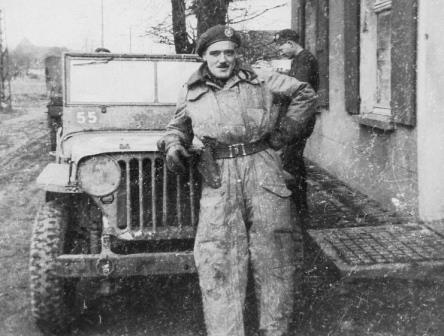
image1 Donald Charles MacKenzie

Donald Charles MacKenzie.  (Photo courtesy of Lydia Prange)

On April 7, 1945 the Royal Winnipeg Rifles were in The Netherlands, and ordered to cross the Schipbeek Canal and establish a bridgehead as preparation for an assault on the city of Deventer by the 7th Canadian Brigade.  Crossing the Canal was vital to the success of the bridge operation, not an easy feat as the Bridge was strongly defended by the Germans.

…Courage and bravery led to a Military Cross recommendation…

Donald’s actions on that day resulted in a recommendation for a Military Cross.  The citation recorded that “…it was due only to the determination and boundless courage of Lt Douglas MacKenzie that a quick crossing was made possible without heavy casualties.

The enemy had a battle group dispersed around the bridge, making it impassable.  Lt MacKenzie, in command of the unit Pioneers attached to ‘D’ Company, had the responsibility of bridging the canal so that a bridgehead could be rapidly built up ready for a breakout.

The enemy fire was intense but with covering fire from ‘D’ Company, Lt MacKenzie succeeded in crawling out onto the Bridge, dragging a couple of planks. He was working well within grenade range of the enemy and at least six grenades exploded nearby, wounding him by shrapnel and blast.

With complete disregard for his own safety, he continued working until he had four planks in position, allowing the company to cross quickly and secure a solid bridgehead.

His dauntless spirit and untiring efforts inspired the men around him and resulted in the momentum of the advance being maintained…

…Appingedam was at the beginning of the Battle of the Delfzijl Pocket…
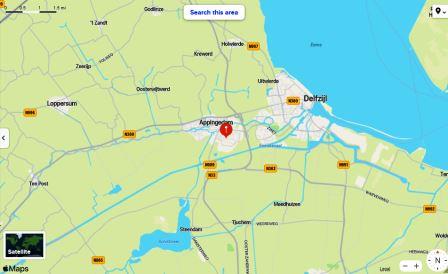
Screenshot 2022-01-21 at 10-19-20 appingedam ww2 at DuckDuckGo

Map showing Appingedam courtesy of Wikipedia.

On April 21, 1945, the Royal Winnipeg Rifles neared Appingedam, a small town of 7,000 in the northeastern corner of The Netherlands.  Along with the 7th Reconnaissance Regiment, they advanced, but the Germans blew up the bridge over the canal which the Rifles had intended to cross.

The movement of troops through Appingedam was the very beginning of the Battle of the Delfzijl Pocket.  (For more information on the Battle of the Delfzijl Pocket, see https://www.canadiansoldiers.com/history/battlehonours/northwesteurope/delfzijlpocket.htm)

A translated excerpt from a Dutch account, written by Joël Stoppels of Battlefield Tours and sent by the Informatiecentrum Canadese Begraafplaats Holten, gave an eye witness account.  “…On Sunday morning, April 22, the Royal Winnipeg Rifles travelled via the railway line at Tjamsweer to the level crossing. They came under fire from the bunkers on the south side of the rails, but these were soon defused. By six o’clock they reached the railway crossing, after which they continued along the railway towards Appingedam. They were noticed by the Germans, who started to fire on the Canadians. As a result, the entire area between Tjamsweer and Appingedam came under heavy machine-gun fire and shell fire. … 

It appears that the Germans were initially surprised as they expected troops to advance by the main road. “… There was heavy fighting at the railway bridge over the Kleine Heekt. The Germans withdrew, but not before blowing up the bridge. This was not an insurmountable problem for the Canadians. Partly to protect themselves against enemy fire, the Canadians continued dredging through the ditches. Fifteen Canadians thus reached the level crossing at Jukwerd, where they entered Mr H. Jongsma’s house, soaked and muddy, because of their platoon commander….”

The platoon commander was Lt Donald MacKenzie “…. who had suffered a gunshot wound to his right shoulder…He was placed on a bed to allow him to rest…”  In an unlucky twist of fate, this temporary resting place proved fatal.

….The Germans unleashed concentrated fire, with two shells hitting the house. When the residents later were able to check on the wounded soldier, it turned out that he had been fatally hit by shrapnel…

The Canadian soldiers who had brought him to the house … had moved to the home of Mr. P. Puisten (on the same street), and could no longer offer help. Red Cross soldiers moved his remains outside the line of fire….

Donald was 30 years old when he died in that house on April 22, 1945.  The Military Cross was awarded to him posthumously and presented to his widow.  Donald was initially buried in Loppersum General Cemetery in Groningen.  After the war he was reburied in the Canadian War Cemetery in Holten.

image2 Gravestone Donald Charles MacKenzie

Grave of Donald Charles MacKenzie in the Canadian War Cemetery in Holten.  (Photo courtesy of Informatiecentrum Canadese Begraafplaats Holten)

… A plaque commemorates Canadian soldiers who died during the Battle of the Delfzijl Pocket….

This is the second story told about a soldier with the Royal Winnipeg Rifles who lost his life near Appingedam.  William ‘Willie’ DANIELS, whose story was previously told, also lost his life on April 22, 1945.

In 1995, the Stefanus Church in Holwierde placed a plaque to commemorate Canadian soldiers who lost their lives during the Battle of the Delfzijl Pocket.  Donald MacKenzie and Willie Daniels are among those who are commemorated.

Plaque at Stefanus Church in Holwierde

Plaque at Stefanus Church in Holwierde, The Netherlands.  (Source: https://www.tracesofwar.nl/sights/40531/Herinneringsplaquette-Stefanus-Kerk.htm)

….. Other Soldiers Mentioned On The Plaque In The Church In Holwierde….

Thank you to Lydia Prange for sharing photos and information on Donald Charles MacKenzie and to Elaine Falconer, who manages the The Spectator Facebook page in Springhill, Nova Scotia.  This Canadian hero was featured in a Remembrance Week video entitled ‘In Remembrance’ on our YouTube Channel, which you can see here:

Do you have photos or stories to share?  Email Pieter at memorialtrail@gmail.com, or comment on the blog.

© Daria Valkenburg

…Want to follow our research?….

If you are reading this posting, but aren’t following the blog, you are welcome to do so. Our blog address: https://onthewarmemorialtrail.com/
Front cover OnTheWarMememorialTrailinEurope4 countries, 6 weeks, 7,000 km – an unforgettable war memorial journey in Europe…. Daria’s book ‘No Soldier Buried Overseas Should Ever Be Forgotten‘ is available in print and e-book formats.  Net proceeds of book sales help support research costs and the cost of maintaining this blog. For more information see https://nosoldierforgotten.com/

Screenshot_2021-02-27 On The War Memorial Trail With Pieter Valkenburg

You are also invited to subscribe to our YouTube Channel: On The War Memorial Trail With Pieter Valkenburg: https://www.youtube.com/channel/UCJ591TyjSheOR-Cb_Gs_5Kw.

Never miss a posting!  Subscribe below to have each new story from the war memorial trail delivered to your inbox.
On The War Memorial Trail….. Linking The Past With The Present

November 10, 2021. Recently our friend Annie Lee MacDonald sent an email to say that she and her husband had been sent a story by their friend Jim, “about his Father and brothers. We didn’t know any of this. Shows the important contribution you two are making of taking the past and sharing it with the present…” (See https://onthewarmemorialtrail.com/2021/10/20/on-the-war-memorial-trail-the-ww2-pilot-from-pei-who-flew-40-missions-overseas-and-returned-home//)

We loved her phrase of ‘taking the past and sharing it with the present’ as that is what we are doing in telling these stories.  Many of the postings and articles have had a ripple effect, leading to more remembrances, information, and stories. This posting shares some of these ….

In May 2021, a 4 part series entitled ‘A Tragic Drowning On The Leda River in Germany’ told the story of five Canadian soldiers from the North Nova Scotia Highlanders Regiment who drowned in a tragic accident in the Battle of Leer in Germany on April 28, 1945, one of the final actions to end WW2 in Europe.  All 5 men are buried in the Canadian War Cemetery in Holten.

…A series of coincidences ensures this niece will never forget…..

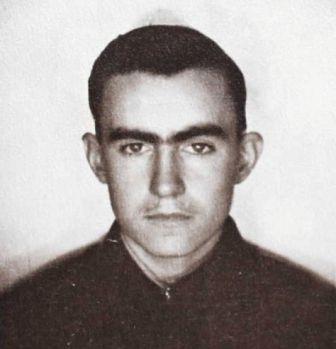
Joseph ‘Ambroise’ COMEAU of Saulnierville, Nova Scotia, was one of these men.  (See https://onthewarmemorialtrail.com/2021/05/17/on-the-war-memorial-trail-a-tragic-drowning-on-the-leda-river-in-germany-part-3/)

Joseph Ambroise Comeau from Simone

Joseph ‘Ambroise’ Comeau.  (Photo courtesy of niece Simone Comeau)

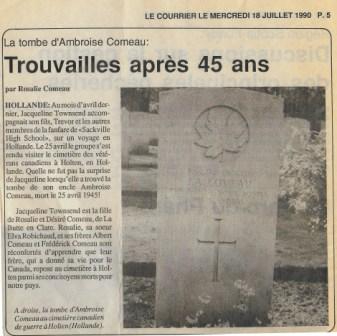
His nieces have never forgotten him. Jacqueline Comeau shared how she found her uncle’s gravesite at the Canadian War Cemetery in Holten in 1990 while on a school band trip with her son.

….In 1990 I visited The Netherlands with my older son on a high school band trip. To say we had a marvelous time and were so warmly greeted everywhere we went is an understatement. Thankfully we were taken to the Holten War Cemetery and, purely by accident, while walking the grounds, I spotted my uncle’s grave. To that moment, my mother’s family believed he was buried in Germany, perhaps because he died on German land.

This was a momentous event for myself as we were at the cemetery on the 45th anniversary of his death, I was 45 years old and I then discovered that he had a memorial service in his home village on the day I was born (June 3, 1945) …

Ambroise had indeed initially been buried in Germany, and then was reburied in the Canadian War Cemetery in Holten afterwards.  Jacqueline shared her story in a French language newspaper, Le Courrier….

article about Jacqueline Comeau visit to Holten

Newspaper article submitted by Jacqueline Comeau. The headline reads ‘Found after 45 years’.

…The discovery of my uncle’s grave in 1990, with the coincidences of dates, such as the date of his death is the date I discovered his grave; a memorial service was held in his honor in his home parish of Saulnierville on the day I was born, June 3, 1945 is unique…

…A telegram one niece will never forget…..

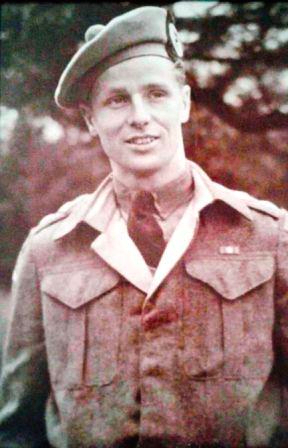
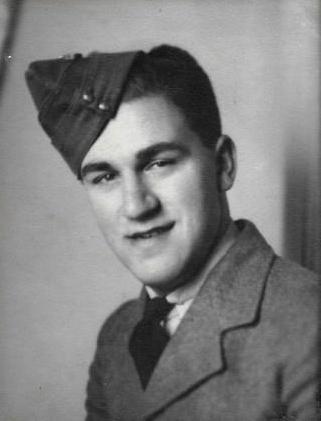
Photo Lewis Marsh

Lewis Wilkieson Marsh. (Photo source:  Canadian Virtual War Memorial)

Lewis Wilkieson MARSH, of Sydney Mines, Nova Scotia, was another casualty of the drowning in the Leda River. (See https://onthewarmemorialtrail.com/2021/05/18/on-the-war-memorial-trail-a-tragic-drowning-on-the-leda-river-in-germany-part-4/)

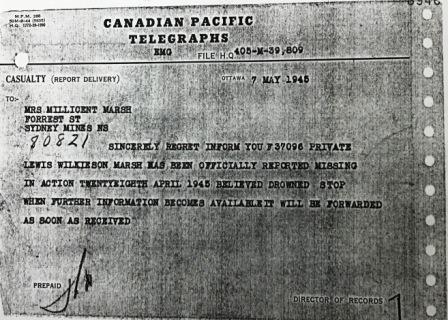
Burnie Reynaert wrote to say that “My Uncle Lewis Wilkieson Marsh died on April 28, 1945. I was with my Nana when she received the first telegram that he was believed drowned.  I remember I was standing on the last step near front door when this boy gave her the telegram….

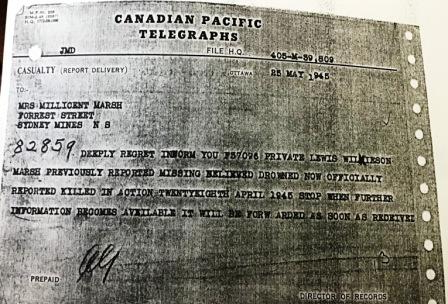
Burnie shared the telegram she was witness to.  One can just feel the horror and fear that her grandmother must have felt upon receiving it.

Telegram advising Marsh is missing

First telegram advising that Lewis Marsh was missing and believed drowned.  (Document courtesy of Burnie Reynaert)

Worse news was to come, as a second telegram confirmed that Lewis had lost his life.

Telegram advising Marsh is KIA

Second telegram advising that Lewis Marsh was killed in action.  (Document courtesy of Burnie Reynaert)

Burnie went on to say “…Thank you so much for your research, I never thought I would see his name and the others that died with him.  I want to thank you both. I am so emotional with love and gratitude for all you have done. I am finally feeling some closure.

My uncle was born November 14, 1925 in Sydney Mines, Cape Breton, Nova Scotia. He had 8 siblings and his father died in 1934. Nana raised them, and had me to raise.

Uncle Lewis worked in Princess Collieries in Sydney Mines for thirteen months. He would be seventeen. I recall Nana and my mom arguing with Lewis that he was not old enough to join. Maybe she had to sign papers? He enlisted on May 26 1944, embarked from Halifax on December 1944, and embarked from UK on December 25 1944….”

…A niece now knows what happened to her uncle …..

Charles Borden Tuplin

Charles Borden Tuplin. (Photo submitted by Gary Richard Perry)

As part of the Atlantic Canada Remembers series of postings, we did a story in March 2021 on Charles ‘Charlie’ Borden TUPLIN of Indian River, Prince Edward Island, who lost his life on December 7, 1944 while serving with the Black Watch.  While crossing a bridge on the Maas River in The Netherlands, Charlie was shot while trying to retrieve the body of Lt Thomas Wilson MacKenzie.  (See https://onthewarmemorialtrail.com/2021/03/29/on-the-war-memorial-trail-the-ww2-soldier-from-indian-river/

Charlie was wounded and taken by the Germans, but died very shortly afterwards.  He’s buried in the Canadian War Cemetery in Holten. Months after the story about Tuplin was posted on our blog, Lt MacKenzie’s niece, Judy Hopkins, got in contact to say that until she read the story that arose out of Pieter’s research, no one in the family knew how Lt MacKenzie had died.  This is probably right as MacKenzie’s service file had multiple letters from his parents asking for this information.

Judy wrote that “I am responding to your article of March 29, 2021, about Charles B. Tuplin. My uncle was Lieutenant Thomas Wilson MacKenzie of No. 1 Black Watch of Canada RHR, mentioned in the article.  And what astonishment to see and read this account of the raid on the front line that took both these men’s lives.

I have just recently been researching this event, as I am writing a life story for the ‘Faces to Graves’ project involving the soldiers buried at Groesbeek Canadian War Cemetery. So, it was with intense interest that I read this article.

My uncle was ‘Missing in Action’ for several months, causing great concern to his family in Calgary, Alberta. When the regiment moved forward in February, no graves were located for Tuplin or MacKenzie, leaving them to believe that they may have been taken POW.

It was never explained to my grandmother where her son’s remains were found….just that after some months, a body had been identified as his.

In the article, it stated: ‘MacKenzie’s body was later found buried in a temporary cemetery, near where he lost his life.’ And so these two men were together at the end of their lives; Tuplin was taken prisoner, and my uncle likely died at the site of his injury.

After all these years, it is still incredible that new information is learned, and also that people such as yourself are providing a space to honor these men’s memories. Thank you for this. ..

Thomas_MacKenzie-GAV

Thomas Wilson MacKenzie. (Photo submitted by Judy Hopkins)

…He was the much beloved son of Christine MacKenzie, a widow, and brother to my mother, Margaret.  In his letters home, which I still have, he writes about the great bunch of men under his command, and speaks highly of all of them…

…A street in The Netherlands may be named for one soldier …..

Lt. Percy Dexter Higgins

Percy Dexter Higgins.  (Photo courtesy of the Higgins Family)

In a January 2021 posting in the Atlantic Canada Remembers series, we wrote a story about Percy Dexter HIGGINS of Stellarton, Nova Scotia, who was serving with the North Nova Scotia Highlanders when he lost his life during the Battle of Warnsveld on April 4, 1945.  He’s buried in the Canadian War Cemetery in Holten. (See https://onthewarmemorialtrail.com/2021/01/16/on-the-war-memorial-trail-atlantic-canada-remembers-part-3/)

Shortly afterwards, we received an email from Harm Kuijper in The Netherlands, who explained that there was “…a proposed plan to name a street for Lt Percy Dexter Higgins in the city of Zutphen, Netherlands in the new Looer Enk Subdivision….”  The Higgins family was notified of this proposal and we look forward to hearing more on the street naming as plans progress.

…Two WWI soldiers from Prince Edward Island are buried in France …..

In 2017, we visited the Manitoba Cemetery in Caix, France, to place flags by the grave of WWI soldier James CAIRNS of Kinkora, Prince Edward Island, who lost his life on August 9, 1918 during the Battle of Amiens.  James had moved to Manitoba and was serving with what is now the Royal Winnipeg Rifles.  (See https://onthewarmemorialtrail.com/2017/09/30/the-search-for-manitoba-cemetery/)

We weren’t surprised to see soldiers from the Prairie Provinces in the cemetery, but when we signed the Guest Register Book, we were astonished to find that the previous visitors had come to honour their great-uncle and great-great uncle Theodore (Ted) ARSENAULT from Abrams Village, Prince Edward Island.

Although this posting dates back to 2017, it wasn’t until a few days ago that Colleen Arsenault wrote us.  “Hi there, in doing a bit of internet research on my Great Great Uncle Ted (Theodore Arsenault) to prepare my kids for Canadian Remembrance Day here in Toronto, I came across this post. I instantly recognized my mother Debi and sister Melanie’s handwriting above your entry in the guest book at Manitoba Cemetery. It is so lovely for our family to know that you had put an additional decoration up for our Uncle Ted. Sometimes the internet can truly be a wonderful place! The Arsenault family thanks you….

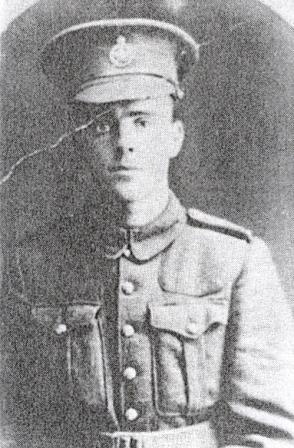
A mystery was solved!  The Arsenault family sent us a picture of Theodore.  Unfortunately, up to now, no photo has ever been found for James Cairns.

Pte Theodore Arsenault (Great great uncle)

Theodore Arsenault. (Photo submitted by Stephen Arsenault)

Thank you to Colleen Arsenault, Jacqueline Comeau, Judy Hopkins, Harm Kuijper, and Burnie Reynaert for sharing photos and anecdotes. We very much appreciate hearing from readers and having them share their stories.

If you have photos and information to share about Canadian soldiers, please contact Pieter at memorialtrail@gmail.com, comment on the blog, or send a tweet to @researchmemori1.

© Daria Valkenburg

Rememberance-Day-2020-Canada-5

..Want to follow our research?….

If you are reading this posting, but aren’t following our research, you are welcome to do so.  Our blog address: https://onthewarmemorialtrail.com/

Front cover OnTheWarMememorialTrailinEurope4 countries, 6 weeks, 7,000 km – an unforgettable war memorial journey in Europe…. Daria’s book ‘No Soldier Buried Overseas Should Ever Be Forgotten‘ is available in print and e-book formats.  Net proceeds of book sales help support research costs and the cost of maintaining this blog. For more information see https://nosoldierforgotten.com/ 

Screenshot_2021-02-27 On The War Memorial Trail With Pieter Valkenburg

You are also invited to subscribe to our YouTube Channel: On The War Memorial Trail With Pieter Valkenburg: https://www.youtube.com/channel/UCJ591TyjSheOR-Cb_Gs_5Kw.

Never miss a posting!  Subscribe below to have each new story from the war memorial trail delivered to your inbox.
On The War Memorial Trail….. Remembering WWII Soldier Alfred Louis Pitawanakwat (Pitwanakwat)

September 6, 2021. After an interview about the photo quest for soldiers buried in the Canadian War Cemeteries in The Netherlands ran on APTN, Pieter was contacted by Joshua Manitowabi, who explained that Alfred Pitawanakwat’s “…brothers were Thomas Pitawanakwat and Valentine Pitawanakwat and all three fought in WW2. Two returned home, but Alfred is buried overseas in Holland. Alfred was my grandfather’s brother. He was my Great-Uncle on my mom’s side. ..

(To read the APTN article, see https://www.aptnnews.ca/national-news/dutch-born-p-e-i-man-on-a-mission-to-find-photos-of-first-nations-soldiers-killed-overseas-in-wwii/)

2232439_1 Alfred Pitwanakwat from Cdn Virtual War Memorial

Alfred Louis Pitawanakwat (Pitwanakwat) (Photo source: Canadian Virtual War Memorial)

Alfred Louis PITAWANAKWAT (PITWANAKWAT) was born September 12, 1924 in Little Current, Ontario, son of Samuel and Agatha Pitwanakwat, of Wikwemikong, Ontario. Like Clarence Wilfred WAKEGIJIG, he was from the Unceded Territory on Manitoulin Island, Ontario. (For more information on the Wiikwemkoong First Nation, see https://en.wikipedia.org/wiki/Wiikwemkoong_First_Nation. To read the posting on Clarence Wilfred Wakegijig see https://onthewarmemorialtrail.com/2021/08/09/on-the-war-memorial-trail-remembering-ww2-soldier-clarence-wilfred-wakegijig/.) 

….Alfred enlisted in 1943….

Alfred enlisted on August 23, 1943 in Toronto, Ontario.  At the time, he had been working for 2 months as a farmer’s helper for George McCluny of Caledonia, Ontario.  His two older brothers were already serving overseas with the Canadian Army.  Thomas was with the #14 Company of the Canadian Forestry Corps, and William ‘Valentine’ was with the #24 Anti-Tank Battery.

In an interview with the Personnel Selection Board, it was noted that he was “…able to express himself clearly….He gives the impression of being shy, but proved a very interesting character, when encouraged to talk about himself...”  The interviewer also remarked that Alfred was good with his hands as he was “…in the habit of carving miniature boats...

Someone in the recruitment office was paying attention as a note on his attestation form was stamped with the warning that he wouldn’t be 19 years old until September 12.  This was a caution as enlistees were not to be sent overseas before the age of 19.

Alfred’s service file also noted that as he was both underage and underweight at the time of enlistment he was sent to the Royal Canadian Army Medical Corps and took basic and advanced infantry training.

….Alfred left Canada for overseas service….

On June 6, 1944 he was sent to the No 1 Transit Camp in Windsor, Ontario for ‘rations and quarters’, in preparation for going overseas with #24 Canadian General Hospital.  By June 26, 1944 he was on board a ship bound for the United Kingdom, arriving in early July 1944.

He was a runner with the hospital, but in September 1944 Alfred requested a transfer to an anti-tank battery or the infantry, explaining that as he was now fit he wanted more active employment.

The transfer request was granted and Alfred joined the Royal Winnipeg Rifles as a rifleman.  He was wounded on October 23, 1944 by a gunshot wound during the Battle of the Breskens Pocket in Belgium, but returned to his Regiment after being discharged from hospital on November 15, 1944. (See https://www.canadiansoldiers.com/history/battlehonours/northwesteurope/breskenspocket.htm)

On November 2, 1944, the Regiment was sent to Ghent, Belgium for a rest period before the Rhineland Campaign began.  From Ghent they moved into The Netherlands, stopping near the Dutch-German border.

The Regimental history, ‘Little Black Devils: a history of the Royal Winnipeg Rifles’, by Bruce Tascona and Eric Wells, describes the movement of the Regiment as it moved from The Netherlands across the border into Germany, beginning on February 8, 1945.  “… After heavy artillery and bombardment, the tanks moved in, followed by infantry. Their assignment was to push south-east from the salient at Nijmegen, clearing a corridor between the Rhine and Maas Rivers…

A salient is a piece of land or section of fortification that juts out to form an angle. Nijmegen is in The Netherlands, not far from the German border.  This area had been cleared by December 1944.  Canadian troops were kept busy here, clearing the ice on the Waal River to protect bridges further downstream.

….Alfred lost his life during the Battle of Moyland Wood….

The Regimental history account continued as the Regiment moved into Germany, “… approaching the village of Louisendorf in ‘Kangaroos’, armoured personnel carriers converted from Ram tanks. Getting within 50 yards of the enemy, the Rifles charged the remaining distance, and in close combat took 240 prisoners and occupied the village. The next day the Regiment joined the Regina Rifles and the Canadian Scottish in the attack on Moyland Wood….

They advanced into an area “…beset with booby traps, mines, snipers, and machine guns….

Moyland Woods map from Little Black Devils

Map source: ‘Little Black Devils: a history of the Royal Winnipeg Rifles’ by Bruce Tascona and Eric Wells.

An account by Terry Copp in the article ‘Clearing Moyland Wood: Army Part 43’ in the November 2002 issue of Legion Magazine explained that: “…The Royal Winnipeg Rifles left their slit trenches near Louisendorf and moved into position south of Moyland Wood. Brig. E.R. Suttie, who had replaced Brig. Stanley Todd in command of the divisional artillery, prepared an elaborate fire plan involving medium and field artillery plus mortars, anti-tank guns, machine-guns and the tanks of the Fort Garry Horse….

Lt Col Alan Gregory, temporary commander of the Regina Rifles, “….and Lt.-Col. Lockie Fulton, the aggressive young commander of the Royal Winnipeg Rifles or Little Black Devils, devised a plan to clear the eastern end of the wood combining Wasps with tank support and air attacks. …

The plan was successful, but came at a cost. “…The Royal Winnipeg Rifles displayed outstanding skill as well as courage in the day-long battle that cost the battalion more than 100 casualties, 26 of them fatal….” (See https://legionmagazine.com/clearing-moyland-wood/) Alfred was one of the fatalities, losing his life on February 21, 1945.

Map

….Alfred is buried in the Canadian War Cemetery in Groesbeek….

Alfred was initially buried in Bedburg, Germany before being reburied in the Canadian War Cemetery in Groesbeek, The Netherlands.

Grave of Alfred Pitwanakwat

Grave of Alfred Louis Pitwanakat.  (Photo credit: Ad Scheepers)

Thank you to Joshua Manitowabi for contacting us about his great-uncle, and to Ad Scheepers for taking the photo of Alfred’s grave at the cemetery.  If you have information to share about Alfred Louis PITAWANAKWAT (PITWANAKWAT) or other Canadian soldiers, please contact Pieter at memorialtrail@gmail.com, comment on the blog, or send a tweet to @researchmemori1.

© Daria Valkenburg

….Want to follow our research?….

If you are reading this posting, but aren’t following our research, you are welcome to do so.  Our blog address: https://onthewarmemorialtrail.com/

Front cover OnTheWarMememorialTrailinEurope4 countries, 6 weeks, 7,000 km – an unforgettable war memorial journey in Europe…. Daria’s book ‘No Soldier Buried Overseas Should Ever Be Forgotten‘ is available in print and e-book formats.  Net proceeds of book sales help support research costs and the cost of maintaining this blog. For more information see https://nosoldierforgotten.com/ 

Screenshot_2021-02-27 On The War Memorial Trail With Pieter Valkenburg

You are also invited to subscribe to our YouTube Channel: On The War Memorial Trail With Pieter Valkenburg: https://www.youtube.com/channel/UCJ591TyjSheOR-Cb_Gs_5Kw.

Never miss a posting!  Subscribe below to have each new story from the war memorial trail delivered to your inbox.
On The War Memorial Trail….. Remembering WWII Soldier William (Willie) Daniels

July 23, 2021. Over the past months, Pieter has been diligently working his way through photo wish lists from Dutch researchers at the Canadian War Cemetery in Holten, The Netherlands.  Two names on the lists were members of First Nations: William ‘Willie’ DANIELS, a Cree Nation member from Saskatchewan, and Stanley Owen JONES, a Haida Nation member from British Columbia.  Both men are buried in the Canadian War Cemetery in Holten, The Netherlands.

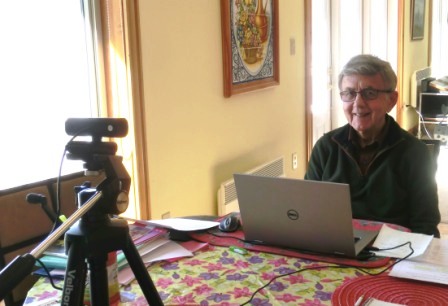
Pieter had no luck in finding family so, as he has done over the past years, he turned to the media for help, this time from APTN, where he was interviewed by Brett Forester.  (To read the article, see https://www.aptnnews.ca/national-news/dutch-born-p-e-i-man-on-a-mission-to-find-photos-of-first-nations-soldiers-killed-overseas-in-wwii/)

CIMG5084 Mar 17 2021 Pieter Valkenburg

Pieter on a Zoom interview with Brett Forester of APTN.  (Photo credit:  Daria Valkenburg)

Several readers of the article came forward to share photos and information about Indigenous soldiers, and these will be featured in future postings as Pieter completes his research.  (The story of Leo Francis TONEY was told previously.  See https://onthewarmemorialtrail.com/2021/05/22/on-the-war-memorial-trail-remembering-ww2-soldier-leo-francis-toney/)

… William Daniels was a member of the Sturgeon Lake First Nation…

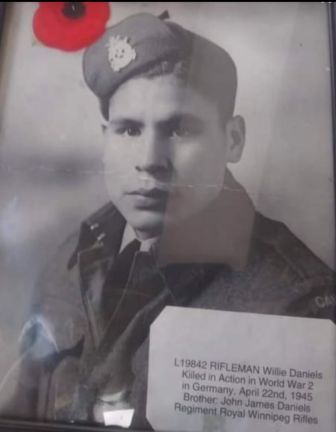
What about the two soldiers mentioned in the article?  A photo of William ‘Willie’ DANIELS was sent by Dakota Ballantyne on behalf of Vince Daniels, with a note saying that “Willie Daniels from Sturgeon Lake First Nation, Saskatchewan was his uncle….

William Daniels

William ‘Willie’ Daniels. (Photo courtesy of Vince Daniels)

The son of John Daniels, Willie was born March 20, 1925 on the Big River Reserve in Depton, Saskatchewan.  On September 24, 1941, he enlisted in Saskatoon, Saskatchewan, stating that he was born in 1922.  He was sent for training as a Sapper with the Royal Canadian Engineers, until it was discovered he was underage. He was discharged in March 1942 for being “…under 17 years of age at date of application….

On October 19, 1943, Willie re-enlisted.  According to his military records, his parents were dead and he listed a brother, Narcisse Daniels, as his next-of-kin.  He also noted that he spoke English and Cree. This time he was allowed to stay in the army, but on Canadian soil as soldiers under 19 years of age were not to be sent overseas.

It wasn’t until May 1, 1944 that he left for the United Kingdom, arriving on May 8 for additional training.  On July 7, 1944 he was transferred to the Royal Winnipeg Rifles as a Rifleman and sent to Northwest Europe.

… The Royal Winnipeg Rifles were in Germany and The Netherlands in 1945…

The war diary of the Royal Winnipeg Rifles gives an indication of what Willie Daniels and his fellow soldiers experienced in 1945. By January 1945 the Royal Winnipeg Rifles were in The Netherlands, and spent the New Year in ‘s-Hertogenbosch.  The war diary for January 1, 1945 states that “…the Germans precipitated the New Year by opening up with considerable SA and mortar fire a few minutes before midnight.  Our artillery answered directly at midnight…..

On February 1, 1945, the war diary recorded that the Regiment was informed of the part that the men “…would play in Operation Veritable…” This would take them into Germany. (See https://en.wikipedia.org/wiki/Operation_Veritable)

The Regiment arrived in Millingen, Germany on February 9, 1945.  The weather was uncooperative “…cloudy with rain….” and led to flooding.  In one area, the water rose “…another six feet, the only high ground in the area being in and near Keeken…

They were ordered to move further back, but some of the men were stranded due to a shortage of equipment to get them out, or because the equipment itself got “…bogged down or diverted for other purposes….

By February 16, 1945 the Regiment was based in Essen, Germany, as they cleared German positions in flooded areas of the Rhine flood plain and the Reichswald forest, which is close to the Dutch-German border.

On March 11, 1945 the Regiment began moving back towards ‘s-Hertogenbosch.  “…The whole day was spent in building the new camp….”  There were some peaceful days and time for training before the men moved back towards a base in Essen to participate in Operation Plunder. (See https://canadianbattlefieldtours.ca/operation-plunder/)

The war diary for March 27, 1945 reported that “…Orders to move came through in the early hours of the morning ….. and after many starts and stops we finally crossed the Rhine River at 1700 hours…

On April 10, 1945 the war diary noted that the Regiment “….would take over from the Regina Rifle Regiment…” and returned to The Netherlands, this time based in Almelo.  Then, on April 18, they were ordered to Groningen.

Map showing Appingedam

Purple arrow on the map indicates movement from Groningen towards Delfzijl, and Appingedam, where Willie Daniels lost his life.  The map also indicates the location of Loppersum, where he was initially buried.

On April 21, 1945 the Regiment was ordered to move towards Appingedam.  The war diary noted that on April 21, 1945 “…civilian reports claim mines set in cement….Blown bridges, snipers, and machine guns make the going very difficult.  Our casualties are becoming very heavy….

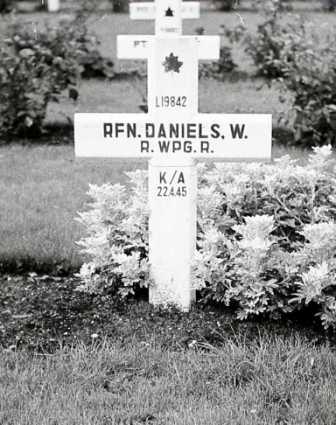
At some point on April 22, 1945, a few weeks after his 20th birthday, Willie Daniels lost his life.  The movement of troops through Appingedam was the very beginning of the Battle of the Delfzijl Pocket. Willie was initially buried in Loppersum General Cemetery in Groningen.  After the war Willie was reburied in the Canadian War Cemetery in Holten.

initial gravemarker for Willie Daniels

Initial burial marker for Willie Daniels.  (Photo courtesy of Library and Archives Canada, service file for William Daniels)

In March 1948, Mrs. W.G. Verbeek-Hermans of Enschede sent a letter to Veterans Affairs, asking that her letter be forwarded to a family member of Willie.  She wanted to let the family know that she had adopted Willie’s grave, a volunteer program that was organized by the Netherlands War Graves Committee. A separate letter for the family was enclosed, explaining that she was the mother of 4 children and felt it was her duty to look after the grave.  She also offered to send a photo of his grave.

This was not unusual. Many family members of soldiers that we have met over the years have explained that their families had been in contact with Dutch citizens who adopted a grave.

In 1995, the Stefanus Church in Holwierde placed a plaque to commemorate Canadian soldiers who lost their lives during the Battle of the Delfzijl Pocket.  Willie Daniels was one of the men commemorated.

Plaque at Stefanus Church in Holwierde

Plaque at Stefanus Church in Holwierde, The Netherlands.  (Source: https://www.tracesofwar.nl/sights/40531/Herinneringsplaquette-Stefanus-Kerk.htm)

Current grave of Willie Daniels

Grave of Willie Daniels at the Canadian War Cemetery in Holten.  (Photo courtesy of Canadian Virtual War  Memorial)

Thank you to Dakota Ballantyne and Vince Daniels for sharing a photo of William ‘Willie’ Daniels.  Thank you also to Brett Forester and APTN for the article on the search for photos of Indigenous soldiers buried in The Netherlands.

If you have information to share about William ‘Willie’ Daniels or other Canadian soldiers buried in The Netherlands, please contact Pieter at memorialtrail@gmail.com, or comment on the blog.

© Daria Valkenburg

…Other soldiers who lost their lives during the Battle of the Delfzijl Pocket …..

For previous stories on soldiers who lost their lives during the Battle of the Delfzijl Pocket, please see:

…Want to follow our research?…

If you are reading this posting, but aren’t following our research, you are welcome to do so.  Our blog address: https://onthewarmemorialtrail.com/

Front cover OnTheWarMememorialTrailinEurope4 countries, 6 weeks, 7,000 km – an unforgettable war memorial journey in Europe…. Daria’s book ‘No Soldier Buried Overseas Should Ever Be Forgotten‘ is available in print and e-book formats.  Net proceeds of book sales help support research costs and the cost of maintaining this blog. For more information see https://nosoldierforgotten.com/

Screenshot_2021-02-27 On The War Memorial Trail With Pieter Valkenburg

You are also invited to subscribe to our YouTube Channel: On The War Memorial Trail With Pieter Valkenburg: https://www.youtube.com/channel/UCJ591TyjSheOR-Cb_Gs_5Kw.

Never miss a posting!  Subscribe below to have each new story from the war memorial trail delivered to your inbox.
On The War Memorial Trail….The Search For A Photo Of James Cairns Moves To YouTube

CIMG8559 Sep 6 2017 Pieter by grave of James Cairns at Manitoba Cemetery

Pieter by the grave of James Cairns at Manitoba Cemetery in Caix, France.  (Photo credit: Daria Valkenburg)

December 17, 2020.  When you look at a gravestone in a cemetery, particularly one filled with graves from soldiers who were killed, you can easily see them as a collection of graves, not individuals who had hopes and dreams of their own.

In 2017, when we visited cemeteries in France, Belgium, The Netherlands, and Germany to honour soldiers from WWI and WWII who are listed on the Cenotaph outside the Borden-Carleton Legion, Pieter tried to have a photo of each person whose grave or memorial we were visiting.

It wasn’t always possible, and one of those without a photo was WWI soldier James CAIRNS, who was born on February 22, 1897 in Kinkora, the son of Thomas Cairns and Mary Jane MacDonald.

Before WWI began, several members of the family moved to Manitoba from the Island, and so it was no surprise to learn that Cairns enlisted with the 190th Battalion Manitoba Regiment on July 8, 1916. This Regiment became part of the Winnipeg Rifles.  (See https://en.m.wikipedia.org/wiki/190th_Battalion_(Winnipeg_Rifles),_CEF#:~:text=The%20190th%20(Winnipeg%20Rifles)%20Battalion,that%20city%20and%20surrounding%20district)

James was killed in action during the Battle of Amiens on August 9, 1918 and is buried in the Manitoba Cemetery in Caix, France.

Appeals for a photo on the blog and in newspaper articles went nowhere, and neither did a letter to the editor in a Manitoba newspaper in the area where members of the Cairns family had lived.

Four years of an unsuccessful search later, Pieter has taken his appeal for a photo to YouTube, in the hope that a viewer might come forward:

Pieters saying

You can read more about James Cairns, our visit to the Manitoba Cemetery, and the appeal for a photo, here:

Thank you to post-production editor Wendy Nattress, who made this YouTube video a reality. If you have photos or information to share about James Cairns, please email Pieter at memorialtrail@gmail.com, or  comment on the blog.    

© Daria Valkenburg

..Want to follow our research?…

If you are reading this posting, but aren’t following our research, you are welcome to do so.  Our blog address: https://onthewarmemorialtrail.com/

Front cover OnTheWarMememorialTrailinEurope4 countries, 6 weeks, 7,000 km – an unforgettable war memorial journey in Europe…. Daria’s book ‘No Soldier Buried Overseas Should Ever Be Forgotten‘ is available in print and e-book formats.  Net proceeds of book sales help support research costs and the cost of maintaining this blog. For more information see https://nosoldierforgotten.com/

Subscribe to our YouTube Channel: On The War Memorial Trail With Pieter Valkenburg: https://www.youtube.com/channel/UCJ591TyjSheOR-Cb_Gs_5Kw

Never miss a posting!  Subscribe below to have each new story from the war memorial trail delivered to your inbox.