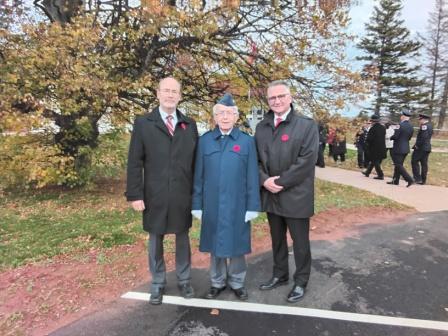
On The War Memorial Trail…..The WWI Voyage To Europe Of The 26th (New Brunswick) Battalion

March 31, 2026.  111 years ago, on June 13, 1915, 1,148 soldiers – 42 officers and 1,106 other ranks – from the 26th New Brunswick Battalion boarded the Anchor Line Steamship ‘Caledonia’ and left the Saint John, New Brunswick harbour, enroute to the United Kingdom, for military service in the WWI battlefields in Europe.

Scene at embarkation of 26th Battalion and ammunition column CEF, St. John, New Brunswick, June 13, 1915. No. 9.  (Photo source: D. Smith Reid, Public domain, via Wikimedia Commons)

When the battalion returned home at the end of the war, only 4 of the original 42 officers and 113 of the original 1,106 other ranks were still with the battalion.  The others had been killed, wounded, or transferred to other battalions.

One of the soldiers who never returned home was Private Arthur Clinton ROBINSON of Tryon, Prince Edward Island, who was born July 20, 1896, the son of Albert James Robinson and Flora P. Scruton. 110 years ago, on March 27, 1916, he was killed during the Actions of St Eloi Craters when shell fire hit the trenches southeast of Kemmel, which is only 10 km (6 miles) south west of Ypres.  He was buried at La Laiterie Military Cemetery in Belgium.

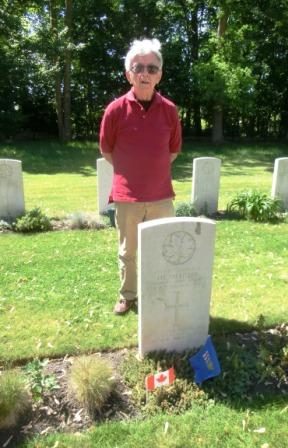
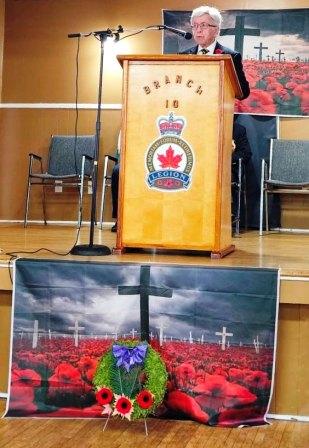
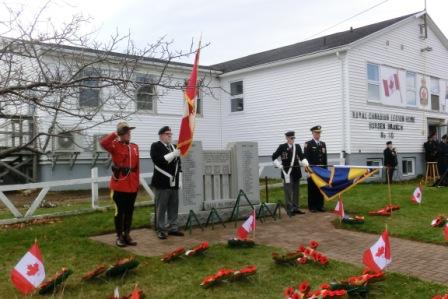
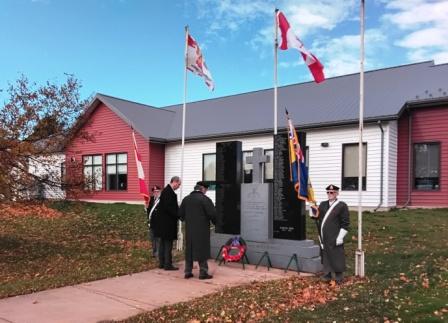
One of the names listed on the Cenotaph outside the Borden-Carleton Legion in Prince Edward Island, we have not yet found of a photo of him, and neither has his family. 

….The ‘Caledonia’ arrived in Canada from Egypt …

But, in 1915, most of the soldiers preparing to go overseas didn’t know what horrors of war lay ahead of them. When the S. S. ‘Caledonia’ arrived in Saint John, an article in the June 12, 1915 edition of the St. John Standard newspaper reported that it had arrived the day before from Sydney, Nova Scotia.  It had travelled from Alexandria, Egypt after delivering wounded Australian soldiers from Turkey. “…The Caledonia has been transporting troops since early in December and spent some time in the Dardanelles…” and was in the midst of heavy fighting.  The Dardanelles is a narrow strait of northwestern Turkey that divides Europe from Asia. (See https://www.iwm.org.uk/history/a-short-history-of-the-dardanelles-campaign)

After the ‘Caledonia’ left Saint John at 11:30 am on Sunday, June 13, 1915, it sailed to Halifax, Nova Scotia, arriving the next day, where 250 members of the Heavy Artillery, 50 from Nova Scotia Cycle Corps, and 250 reinforcements from the 10th Nova Scotia Battalion, joined the ship for its voyage to Plymouth, England.

The ship didn’t leave Halifax until the following morning, as recorded in the Plymouth Evening Mail newspaper on June 24, 1915. “…The troops at once went aboard the transport, but there was a large quantity of ammunition to put aboard and there were the 4.7 guns and howitzers. In consequence the Caledonia remained at pier until 9:30 the next morning when she sailed down the harbour, followed by the best wishes of the thousands of loyal people

….The voyage of the ‘Caledonia’…

The ‘Caledonia’ travelled from Saint John, New Brunswick to Halifax, Nova Scotia, and then across the Atlantic Ocean to Plymouth, England.  (Map source: Google maps)

A description of the voyage in the July 20, 1915 Caledonia Telegraph Journal included excerpts from the diary of Corporal Clarence Beverley SMITH of the 26th Battalion.  “…June 17. Very rough weather, many very sick. June 18. Weather smoother, but not calm. Most of the men too sick for any actual drill; most lying around decks. June 19. Weather very smooth. Expect to get to England about Wednesday evening. June 20. Weather very calm.  The ocean is just like a river and the boat makes good progress. June 21. Weather very calm. Received orders of absolute quiet and silence with no lights at night.  June 22. Weather very calm and very warm.  June 23. We were picked up by a British destroyer which stood by us until we arrived at Devonport about 10 am. June 24. We were boarded by the doctor and other officials and tied up at the wharf. About 2 pm we were put on board a train and got into Sandling Camp 1 am on June 25. Altogether, the voyage was a very pleasant one…

Private William John SWETKA, with the Signalling Division of the 26th Battalion, gave a similar account, published in the July 14, 1915 edition of the St. John Standard newspaper. He had a bit more to say as the ship arrived in Plymouth, England on June 24, 1915. “…About six o’clock passed Eddystone lighthouse. In about an hour entered Plymouth harbour. Several steamers with invalids from the Dardanelles were there.  They cheered us. We were towed into the inner harbour. There are quite a few cruisers, destroyers, etc in dock being repaired. Harbour is full of war vessels of all kinds…

The soldiers were in England only for a short period, as by the end of August 1915, the 26th Battalion began preparations for a move into France.  On September 13, 1915 an advance party left England, followed 2 days later by the troops, who arrived in Boulogne, France in the early hours of September 16, 1915. 

….More about Arthur Clinton Robinson…

Unlike Arthur Robinson, Clarence Smith and William Swetka survived WWI and returned home.  To read more about Arthur, see:

Thank you to Shawn Rainville for newspaper searches about the Caledonia’s voyage in 1915.  Meanwhile, Pieter’s research efforts to find photos and families of soldiers continue. Do you have a photo of Arthur Clinton Robinson to share, please email Pieter at memorialtrail@gmail.com, or comment on the blog.    

© Daria Valkenburg

….Want to follow our research?…

If you are reading this posting, but aren’t following our research, you are welcome to do so.  Our blog address: https://onthewarmemorialtrail.com/

4 countries, 6 weeks, 7,000 km – an unforgettable war memorial journey in Europe…. Daria’s book ‘No Soldier Buried Overseas Should Ever Be Forgotten‘ is available in print and e-book formats.  Net proceeds of book sales help support research costs and the cost of maintaining this blog. For more information see https://nosoldierforgotten.com/

Subscribe to our YouTube Channel: On The War Memorial Trail With Pieter Valkenburg: https://www.youtube.com/channel/UCJ591TyjSheOR-Cb_Gs_5Kw

Never miss a posting!  Subscribe below to have each new story from the war memorial trail delivered to your inbox.

On The War Memorial Trail…..The WWII Signalman From Charlottetown Who Died In A Vehicle Accident In The Netherlands 6 Weeks After WWII Ended In Europe

March 15, 2026.  In going through the last few names on a photo wish list for soldiers from New Brunswick who are buried in the Canadian War Cemetery in Groesbeek, Pieter’s initial research found that one of the names was of a soldier from Prince Edward Island.

Charlottetown, the capital of Prince Edward Island, is on the east coast of Canada. (Map source: Google)

Alfred Edward Stanley FORD was born February 12, 1918 in Charlottetown, Prince Edward Island, son of Alvin Chester and Ethel Maud (nee Roebuck) Ford.  He was one of two children in the family and Pieter at first thought it would be a challenge to find a photo.

However, an obituary for Alfred’s sister Marjorie led him to the Cummins family, and he was soon in contact with Marjorie’s son Dave, who wrote to Pieter, saying “….I greatly appreciate all the work you and your wife are doing on the memories of our fallen soldiers…” And yes, he did have a photo of his uncle.

….Alfred worked as a waiter and butler…

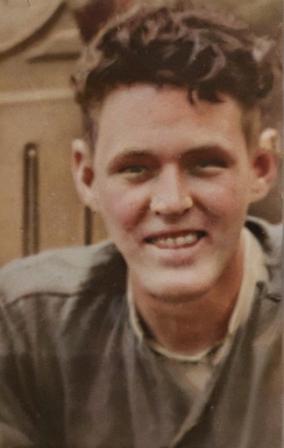
Alfred Edward Stanley Ford. (Photo courtesy of Cummins/Ford archives.  Photo restoration and colourization by Pieter Valkenburg)

When Alfred enlisted at the No. 4 District Depot in Montreal, Quebec on December 3, 1941, he stated that he had served in the Reserve Formation of the Royal Canadian Corps of Signals (RCCS) in Prince Edward Island for 2 years, from July 1936 until July 1938. 

After leaving school at aged 16, he’d worked as a waiter at various hotels between 1933 and 1936, and then was a butler for the Polish Consul-General, Dr. Sylwester Gruszka, in New York City between 1936 and 1939. (A career diplomat, Dr. Gruszka was the Consul-General from 1935–1940. For more information, see https://pl.wikipedia.org/wiki/Sylwester_Gruszka)

Alfred’s time working for the Consul-General resonated with us, as decades later Pieter worked in the Consulate in New York and later in the Embassy in Warsaw, Poland, during his career in the Dutch Foreign Service.

While working for Dr. Gruszka, Alfred took a short order-barman course and received a diploma for successfully completing a course at the Fanny Farmer School of Cooking in 1937. 

From 1939 to 1941, Alfred worked as a barman and later as a waiter in New York. 

….Alfred was drafted one country and enlisted in another….

On October 16, 1940, he was required to fill out a US Draft Card Registration. At the time, he was between jobs in New York City, and living with a friend. Although the USA didn’t officially enter World War II until December 8, 1941, after the attack on Pearl Harbor, Hawaii, US President Franklin Delano Roosevelt had signed into law in October 1940 the first peacetime selective service draft in US history because of rising world conflicts.

Since he was living in the USA, Alfred was required to register for the US Draft, but never joined the US Army as he subsequently moved to Montreal, Quebec and enlisted in the Canadian Army.

During his interview, Alfred expressed an interest in becoming a lineman with the Royal Canadian Corps of Signals, and it was noted that he played hockey as a sport.  The interviewer described Alfred as “…respectful, cheerful, and neat in appearance...” and noted that 23 year old Alfred had “…done well in civilian life…

….Alfred was trained as a Signalman….

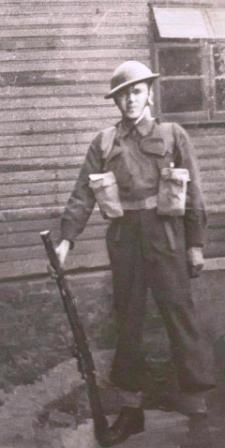
Alfred Edward Stanley Ford during basic training. (Photo courtesy of Cummins/Ford archives.  Photo restoration by Pieter Valkenburg)

Alfred’s military career began when he was sent for basic training to No. 41 Canadian Army (Basic) Training Centre (CABTC) in Huntingdon, Quebec on December 8, 1941. 

After completing his basic training, he was transferred to A7 Canadian Signal Corps Training Centre at Camp Barriefield, Ontario on March 12, 1942 for advanced training.  He remained there until May 5, 1942 when he was posted to the 6th Light Anti-Aircraft (LAA) Regiment Signals Section, Royal Canadian Artillery, in Petawawa, Ontario as a Signalman.

As a Signalman, Alfred would have been trained to manage radio (wireless), telephone, and visual signaling, and to ensure that his Regiment received air raid warnings and to relay gun target information.

On November 2, 1942, Alfred was given embarkation leave until November 15, 1942, the last chance he had to see his family. 

….Alfred left Canada for overseas service….

Shortly after returning from his embarkation leave, Alfred was on his way overseas, leaving Canada on December 12, 1942.  Upon arriving in the United Kingdom on December 18, 1942, he was assigned to No. 1 Canadian Base Staging Camp (CBSC) in Colchester.

On March 6, 1943, Alfred was sent on an Operators Course at No. 1 Canadian Signals Reinforcement Unit (CSRU), located at the Blandford Camp in Cove, Farnborough, Hampshire.

Alfred was transferred to the Canadian Signals Reinforcement Unit (CSRU) on April 2, 1943.  His training continued and on July 29, 1943, he qualified as a Lineman Group ‘C’ Class 3.  A Lineman would be involved in constructing and repairing overhead telephone and telegraph lines to support military communications.

A month later, on August 26, 1943, he was transferred to the 1st Canadian Line of Communications Signals (L of C Sigs), a key unit within the Royal Canadian Corps of Signals (RC Sigs) during WWII.  Formed in England, this unit was responsible for maintaining communications along the supply and transport routes (lines of communication) supporting the Canadian Army’s overseas operations in Europe. 

As training and preparations began for Operation Overlord (the invasion of Normandy), which began on what we know as D-Day (June 6, 1944), Alfred was transferred to the 16th Canadian Anti-Aircraft (CAA) Operations Room Signal Section in Womenswold in Kent on May 2, 1944, along with another linesmanThe war diary for May 2, 1944 noted that “…2 Line Detachments arrived today from L of C Signals….” 

This unit provided communication and signaling support for anti-aircraft operations, and training and exercises continued ahead of being sent to France after D-Day. They would be part of the signals composition of the Canadian Army Overseas.

….Alfred and his unit were sent to France in August 1944…

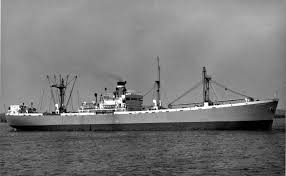
Liberty ship ‘Samarina’. (Photo source: Ships Nostalgia)

On August 1, 1944, Alfred and other members of the 16th Canadian Anti-Aircraft (CAA) Operations Room Signal Section travelled to London, for the move into France as part of the 21st Army Group.  The following day they boarded the Liberty ship ‘Samarina’, along with their vehicles and equipment. They set sail for France on August 3, 1944. 

Map showing Courselles-sur-Mer on the coast of France, near Caen.  ‘La Manche’ in French is what we call the ‘English Channel’.  (Map source: https://www.viamichelin.fr)

Per the August 5, 1944 war diary, they arrived at 9:10 pm “…at the anchorage off Courcelles…” but had to wait until August 7 to disembark.  On August 8, 1944, “…the unit arrived Bény-sur-Mer….” and “…established communications with Brigade HQ…” The unit arrived in the midst of Operation Totalize, fought between August 7-11, 1944, in an offensive designed to break through the German defences south of Caen and toward Falaise.  (See https://en.wikipedia.org/wiki/Operation_Totalize)

They had their work cut out for them once they reached Caen and took over from 51 Anti-Aircraft Operations Room (AAOR).  As recorded in the war diary for August 12, 1944, the unit “…controlled 16 AA guns in defence of Caen from 1800 hours today.  Line communications are difficult as some of the line has been badly laid and not maintained.  All broadcasts must go down to guns by line and upward intelligence must go up the same way.  This is not satisfactory….”  

On August 28, 1944, they were ordered to leave Caen and move to Lisieux. The war diary entry for August 29, 1944 recorded that at 8 am “…AAOR handed over to 152 and moved to concentration area at Lisieux….”  However, by 6 pm that same day, there was a change.  “… Unit was ordered to deploy from concentration area Lisieux for the defence of Brienne….

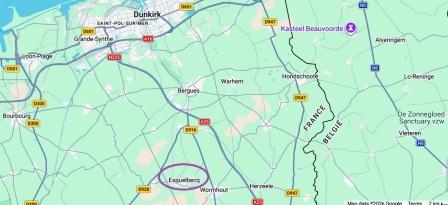
Map shows location of Esquelbecq (purple circle) in France, near the Belgian border. (Map source: Google maps)

By September they had moved up through France near the Belgian border, and were based in Esquelbecq, responsible for the Gun Operations Room (GOR) in the Dunkirk area.  Linesmen like Alfred worked in difficult and dangerous conditions, as evidenced in just one line from the September 21, 1944 war diary. “…Linemen found that laying lines in the forward area became a bit tricky with snipers and machine gun fire near vicinity….

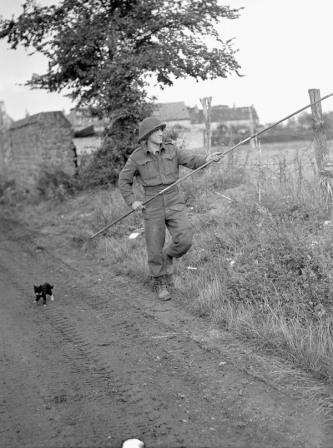
An unidentified lineman laying a telephone line in France in September 1944 gives an idea of what Alfred Ford did as a lineman. (Photo Credit: Lieut. Donald I. Grant / Canada. Dept. of National Defence / Library and Archives Canada / PA-174411)

Alfred was twice admitted to hospital, first from November 17 until December 18, 1944 at No. 16 Canadian General Hospital in Saint Omer, France, and then from January 6 to 18, 1945 at No. 2 Canadian General Hospital in Bruges, Belgium. The war diary reported that several men had been ill with colds and flu, and perhaps this is what happened to Alfred, as there was no report of an accident or being wounded by enemy action.  He returned back to his unit, which was still in France, but now in Wormhout, just a short distance from Esquelbecq, on January 28, 1945.

On February 9, 1945, the unit moved to Desselgem, Belgium, located between Ypres and Ghent.  They remained there until February 28, 1945 when they moved to Hallaar, not that far from the Dutch border, where the Operations Room for the unit would be temporarily based, during Operation Blockbuster.  (See https://en.wikipedia.org/wiki/Operation_Blockbuster). 

On March 12, 1945, the unit moved again, to Linden, The Netherlands, 10 kms (6 miles) south of Nijmegen, and near the German border. On March 13, 1945, the war diary recorded that “…as the Ops Room Section…is going to be deployed in the defence of Kleve, a Recce party went to that almost completed ruined city and found a site for the Ops Room, and billets in partially demolished houses nearby…”  The unit moved to Kleve, Germany 10 days later.

On April 14, 1945, the war diary reported that “…line party across Rhine to lay line to Units under this Unit from proposed new location of AAOR…” Two days later, they moved to Oldenzaal, The Netherlands, near the German border.

On May 7, 1945, a day before the official end of WWII hostilities in Europe, the unit moved to Oldenburg, Germany, before being redirected to Wilhelmshaven on May 10, 1945, and placed on temporary guard duty.  The war diary for May 24, 1945 noted another upcoming move. “…Guard commitments to be turned over by midnight of the 25 May 1945.  This unit will move to Arnhem area where it will come under command 2 Canadian Heavy Anti-Aircraft Regiment…

The move was delayed a few days.  On May 26, 1945, the war diary recorded that …we are to move at 0700 hours tomorrow to Otterlo in Holland where we come under Command of I-Corps and are attached to 2 Canadian Heavy Anti-Aircraft Regiment…”  In Otterlo they camped in an old Dutch barracks in the woods.

The war diary summarized May 1945 by stating that “…except for four days the entire month has been spent in Germany with the unit personnel doing guard duties for a greater portion of that period….

On June 7, 1945, Alfred was given 11 days leave to the United Kingdom, returning on June 18, 1945, just in time to learn, on June 19, 1945, that the 16th Canadian Anti-Aircraft (CAA) Operations Room Signal Section was to be disbanded immediately. The next few days were spent packing up all the equipment and vehicles. 

On June 22, 1945, most of the unit moved to the Artillery Reallocation Centre 13 Canadian Base Reinforcement, located south of Nijmegen. However, the Signals detachment, which Alfred was part of, remained at Otterloo for the night, as they had been assigned to HQ 1st Canadian Army Signals for cross postings, and were scheduled to report there on June 23, 1945. 

….Alfred died of injuries from a vehicle accident…

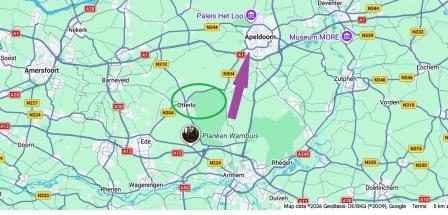
Alfred and the Signals Detachment were camped in a barracks in the woods outside Otterlo (green circle). The vehicle he was in was going in the direction of Apeldoorn (purple arrow).  (Map source: Google maps)

However, Alfred never arrived at his next posting as he died in a vehicle accident on June 22, 1945. The circumstances of what happened are unclear.  According to a witness, Lance Corporal R. A. MacDonald of the Canadian Provost Corps, who was on traffic patrol duty at the Arnhem-Apeldoorn Highway, around 9:15 pm a vehicle travelling in the direction of Apeldoorn approached him “…at a fast rate of speed. The vehicle was unsteady in its course, weaving as if out of control….” 

As it neared the witness, the vehicle veered to the right, likely because the driver suddenly noticed him and lost control of the vehicle in trying to avoid an accident.  Unfortunately, it crashed into a tree beside the road. The driver was 27 year old Alfred, who died from head injuries sustained in the crash. He was alone in the vehicle, and no one knew why he was driving a vehicle from another unit, as he was not assigned to be on duty at the time. A Court of Inquiry ruled it as an accidental death. 

….Alfred is buried in Groesbeek….

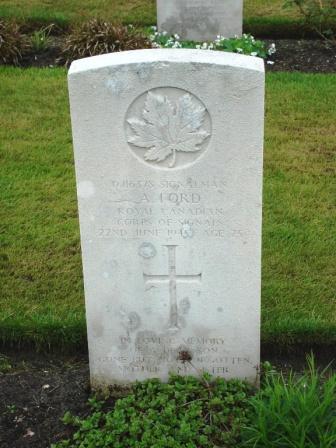
Grave of Alfred Edward Stanley Ford in the Canadian War Cemetery in Groesbeek, The Netherlands.  (Photo source: Find A Grave)

Alfred was temporarily buried in Jonkerbos Cemetery in Nijmegen, The Netherlands, before being reburied in the Canadian War Cemetery in Groesbeek on August 2, 1945.

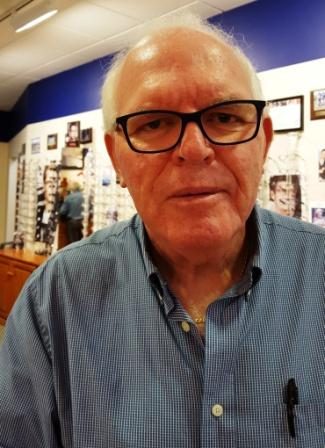
Dave Cummins provided photos of his uncle Alfred.  (Photo courtesy of Dave Cummins)

Thank you to Dave Cummins for providing photos and information on his uncle, and to Chris Cummins for notifying Dave of the photo search request. “…Thank you Pieter, my family appreciates all you have done for Alfred…” Dave wrote.  “…Keep up the good work….

Pieter’s research efforts to find photos and families of soldiers continue, doing his part to ensure that each individual soldier is remembered. If you have photos or information to share about soldiers buried in The Netherlands or Belgium, please email him at memorialtrail@gmail.com, or comment on the blog.    

© Daria Valkenburg

….Want to follow our research?…

If you are reading this posting, but aren’t following our research, you are welcome to do so.  Our blog address: https://onthewarmemorialtrail.com/

4 countries, 6 weeks, 7,000 km – an unforgettable war memorial journey in Europe…. Daria’s book ‘No Soldier Buried Overseas Should Ever Be Forgotten‘ is available in print and e-book formats.  Net proceeds of book sales help support research costs and the cost of maintaining this blog. For more information see https://nosoldierforgotten.com/

Subscribe to our YouTube Channel: On The War Memorial Trail With Pieter Valkenburg: https://www.youtube.com/channel/UCJ591TyjSheOR-Cb_Gs_5Kw

Never miss a posting!  Subscribe below to have each new story from the war memorial trail delivered to your inbox.

On The War Memorial Trail….. The WWII Soldier From Newport Who Lost His Life During The Moro River Campaign In Italy

March 2, 2026. The search for photos of soldiers who lost their lives in wartime sometimes takes Pieter on unexpected paths. Whenever possible, he tries to help other researchers.  One of them was David Archer, who explained that he was “with the 48th Highlanders army reserve in the 1970s….” 

Over the past 20 plus years, David has been looking for photos of members from that Regiment, and when he wrote to Pieter, he said that “… there is one PEI soldier on my cold list. His name is Kevin Delorie KIA Dec 20th 1943. …

Pieter decided to help find a photo, and the search for a photo of WWII soldier Kevin Joseph DELORIE began. Pieter’s initial research found that most of the family moved to Oregon (USA), but one sister, Margaret ‘Clare’, married a Murphy and remained in Canada.

….A newspaper appeal led to family and a photo of the soldier…

In the hope to find family, Charlotte MacAulay, Editor of the Eastern Graphic newspaper was contacted, and she agreed to publish a photo appeal.  (See EAG-A04-102324-K Searching for photo of Kevin Delorie)

Within hours of the article being published, Pieter received a phone call from Bernice Delory in Georgetown, Prince Edward Island, saying that Clare had a photo at one time. Bernice gave Pieter contact information for Clare’s daughter, Tammy Murphy, in Halifax.  When he called her, Tammy said that her brother, Tim Murphy, a retired teacher in Montague, may have photos. 

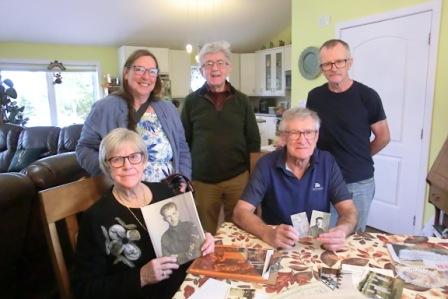
She called Tim and it wasn’t long before we were on our way to Montague to meet Tim, Clare, and Clare’s nephew, Norbert Murphy, who brought the photos. Charlotte MacAulay came as well, to do a follow-up story.  (See EAG-A11-110624 C Remembering Kevin Delorie)  “…It’s wonderful that Kevin is being honoured…” Clare said.

Left to right: Clare Murphy holding a photo of her brother Kevin, Charlotte MacAulay, Pieter, Norbert Murphy, Tim Murphy. (Photo credit: Daria Valkenburg)

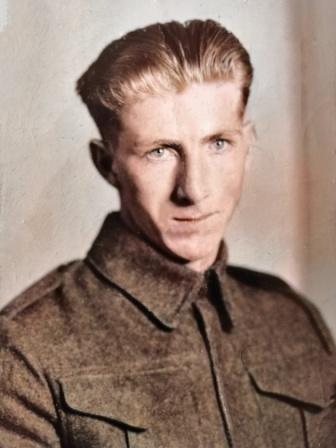
Born June 30, 1923 in Newport, Prince Edward Island, Kevin was the son of Eugene and Catherine ‘Katie’ (nee McDonald) Delorie.

Kevin Joseph Delorie. (Photo courtesy of the Delorie Family.  Photo colourization: Pieter Valkenburg)

When he enlisted on August 15, 1940 with the Prince Edward Island (PEI) Highlanders in Charlottetown, Prince Edward Island, Kevin stated he was born in 1921, adding 2 years to his actual age of 17.  At 6 feet 4 inches (1.93 metres), he was very tall!  Clare told us that she had travelled with her brother from Newport to Charlottetown on the day that he enlisted.

After completing his basic training at No. 62 Canadian Army (Basic) Training Centre in Charlottetown, he joined others from PEI Highlanders in serving at the Halifax Fortress (specifically the Halifax Citadel and surrounding areas in Nova Scotia), tasked with guard duties and receiving additional training in the Halifax/Dartmouth area as part of Canada’s home defence.

Kevin remained in Halifax until June 3, 1941, when he was sent to Valcartier, Quebec in preparation for guard duty in Newfoundland.   Another Islander was with him – Daniel ‘Dan’ Peter MACKENZIE. (See https://onthewarmemorialtrail.com/2023/06/29/on-the-war-memorial-trail-the-wwii-soldier-from-victoria-cross-fatally-wounded-during-the-liberation-of-posterenk/)

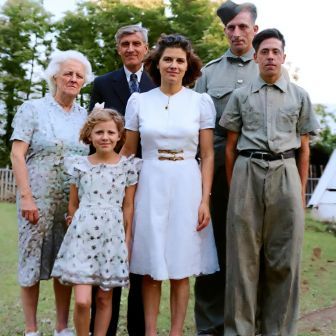
Back row:  Kevin Delorie with his parents Katie and Eugene.  Front row: siblings Clare, Rose, and Francis. (Photo courtesy of the Delorie Family. Photo restoration and colourization: Pieter Valkenburg)

Kevin was sent to Newfoundland as part of ‘W’ Force….

Location of Botwood Military Base in Newfoundland. (Map source: http://postalhistorycorner.blogspot.com/2012/12/wwii-canadian-forces-in-newfoundland.html)

After France was occupied by the Germans in 1940, Newfoundland’s defensive position became more precarious. That same year, Canada assumed responsibility for the defence of Newfoundland with the establishment of ‘W Force’, a Canadian garrison force responsible for defending Newfoundland against enemy invasion and attacks, and providing security for existing and proposed defence facilities during WWII. It included infantry, artillery, and anti-aircraft units. (See https://en.wikipedia.org/wiki/Military_history_of_Newfoundland_during_World_War_II)

On July 23, 1941, as part of ‘W Force’, Kevin was sent to Botwood, Newfoundland.  In addition to the PEI Highlanders, troops from the Black Watch of Canada, Royal Rifles of Canada, The Algonguin Regiment, Queens Own Rifles, also served at various times. While an RCAF base in Botwood had aircraft patrolling the east coast of the Atlantic, Canadian Army personnel based at Botwood were charged with protection of military facilities that had been installed there, as well as in Gander. (See https://www.heritage.nf.ca/articles/politics/botwood-base.php)

…..Four other soldiers were in Botwood…..

Kevin was in Botwood at the same time as four other soldiers whose stories have been told on this blog:

On March 1, 1943, Kevin was temporarily promoted to the rank of Lance Corporal. Then, on March 20, 1943, he left Newfoundland, and was sent to Sussex, New Brunswick.  On June 2, 1943, Kevin was transferred to the No. 1 Transit Camp in Windsor, Nova Scotia, for final preparation and training before being sent overseas.

…..Kevin was in North Africa before going on to Italy….

Kevin boarded a ship on June 10, 1943, which left Canada on June 11, 1943.  Upon arriving in the United Kingdom on June 18, 1943, he was posted to No. 7 Canadian Infantry Reinforcement Unit (CIRU), where he reverted back to the rank of private.  Training continued to prepare troops who would be part of the Central Mediterranean Force (CMF).

On September 12, 1943, Kevin was transferred to the West Nova Scotia Regiment’s X-4 Reinforcement List, and boarded a ship that left the United Kingdom.  He arrived in North Africa on September 23, 1943, and was attached to ‘B’ Company of the 3rd Battalion of the British North Africa Force (BNAF), prior to being sent on to Italy.

On October 7, 1943 he wrote a note to his mother, confirming that he was “…now down in North Africa….”  He went on to write that “…I haven’t had any mail for 6 weeks…” and commented that “….the weather is fairly warm.  We buy lots of fruit such as grapes and melons.  The oranges will soon be ripe…

Mail arrived for Kevin, as he noted in an October 23, 1943 letter to his father.  He was still in North Africa, but had been reassigned to D Company, 1st Battalion, No. 1 Canadian Base Reinforcement Depot (CBRD), Canadian Army, BNAF.

On November 12, 1943, Kevin was part of the 4th Battalion and on his way to Italy with the CMF and the Allied Army in Italy (AAI) for the Italian Campaign, joining the West Nova Scotia Regiment, as it prepared to move towards Agnone, on November 29, 1943, one of 42 reinforcements(See https://en.m.wikipedia.org/wiki/Italian_campaign_(World_War_II))

On December 6, 1943, Canadian forces, along with British, Indian, and New Zealand infantry divisions, began the Moro River Campaign, a series of large-scale assaults on major crossing points along the Moro River in Eastern Italy, with the objective of securing a large bridgehead along the defensive line. The intention was to breach the German Army’s Winter Line defensive system and advance to Pescara—and eventually Rome. (For more information see https://en.wikipedia.org/wiki/Moro_River_Campaign)

…..Kevin was transferred to the 48th Highlanders Regiment….

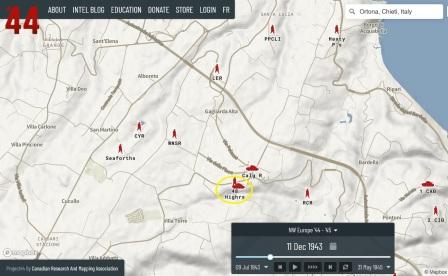
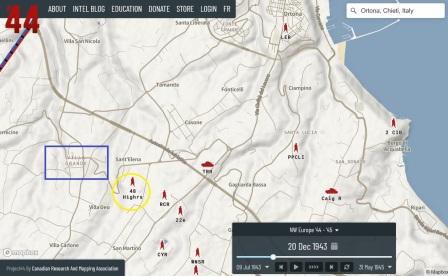
Position of 48th Highlanders on December 11, 1943 (see yellow circle).  WNSR to the left shows the position of the West Nova Scotia Regiment that Kevin had been with.  (Map source: Project 44)

On December 11, 1943, he was transferred to ‘B’ Company of the 48th Highlanders Regiment, joining them after they had moved from the Ortona area towards Villa Torre.  In what would be his last letter home, he wrote to his mother on December 14, 1943.  “….Just a few lines to say I’m OK and to give you another address. I am now with the 48th Highlanders. Aeneas Johnston and I came to the same company. I don’t know where Charlie MacDonald is, he went to some other company…

Kevin was referring to Aeneas Daniel JOHNSTON, born in Primrose, Prince Edward Island, was the son of Joseph and Gertrude Johnston, and husband of Mary Johnston.  Aeneas had been killed on December 8, 1943 and is buried in Moro River Canadian War Cemetery in Italy. 

It’s possible that Kevin was referring to Charles James MACDONALD, who was born in New Annan, Prince Edward Island, son of Mr. and Mrs. Joseph MacDonald. He died July 8, 1944 while serving with the North Nova Scotia Highlanders, and is buried in Beny-Sur-Mer Canadian War Cemetery in France.

…..Kevin was listed as MIA on December 20, 1943….

Position of 48th Highlanders on December 20, 1943 (see yellow circle) as they attempted an attack on Villa Grande (see blue square). (Map source: Project 44)

The war diary for December 20, 1943 indicated that an attack on Villa Grande was not as successful as hoped. “….Essex Regiment ….attempted to take Villa Grande and failed….Ordered by Brigade to send one Company…. ‘B’ Company attacked 1500 hours, but tanks bogged down, and Company pinned down….Tanks encountered minefield and was mined….Under cover of dark, ‘B’ Company withdrew to position around tanks”  Kevin was never seen again, and he was listed as Missing In Action (MIA) and presumed dead.

Kevin’s family was notified that he was missing, and of course hoped that he was not killed, but had been taken prisoner of war. 

Clare had gone to church, and through a miscommunication, didn’t know what happened to her brother until the moment the priest asked the congregation to pray for the fallen… and Kevin’s name was mentioned.  “…I was 13 at the time” she said.  “…Helen Farrell had a phone in her store and was supposed to tell me, but didn’t get the message to me in time…

…..The 48th Highlanders Chaplain wrote what happened on December 20, 1943….

A January 12, 1944 letter written to Kevin’s mother by Padre Stewart Bland EAST, Chaplain for the 48th Highlanders Regiment, provided an account of what happened.  “….I write to assure you that everything in our power has been done to locate his body and that we have failed. The full story is as follows.

On the afternoon of 20 December, one Company of the Highlanders were given instruction to capture an enemy position. The attack was not a success because the tanks were unable to proceed because of mines.

When the Company returned to their position, five men were missing.  The bodies of only three of these have been found, in spite of a thorough search.  All I can suggest is that your son was buried by the Germans or was not killed as reported, but was wounded and taken prisoner…

Although the letter was dated January 12, 1944, it was not mailed until much later, as a March 27, 1944 postscript explained that he had only received the day before a mailing address, and asked if she had received any further word about Kevin’s fate.

The 3 soldiers that Padre East mentioned as being found were:

  • Cpl Alexander John MACKINNON, born in Whycocomagh, Cape Breton Island, Nova Scotia, aged 26
  • Cpl Eric Morris NETTLETON of Hamilton, Ontario, aged 21
  • Pte Jack STEWART of Hastings, Ontario, aged 34

All 3 are now buried in Moro River Canadian War Cemetery.

…..Kevin is buried in Moro River Canadian War Cemetery….

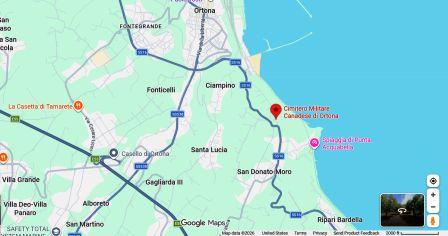
Moro River Canadian War Cemetery. To the far left is Villa Grande, near where Kevin Delorie lost his life. (Map source: Google maps)

Kevin’s distraught family kept in contact with the Department of National Defence, and asked the Canadian Red Cross for help in locating him.  In June 1945, his body was found, and he was buried in the Moro River Canadian War Cemetery, located near the Adriatic Sea, 5 km (3 miles) from San Donato-Moro, near Ortona in Italy.

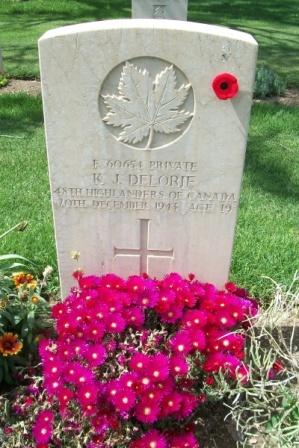
Grave of Kevin Joseph Delorie in Moro River Canadian War Cemetery in Italy. (Photo source: Canadian Virtual War Memorial)

Thank you to Charlotte MacAulay of the Eastern Graphic for publicizing the search for a photo of Kevin Delorie.  A huge thank you goes to Clare Murphy, Tim Murphy, and Norbert Murphy for sharing photos and information. 

Do you have a story to tell? Email Pieter at memorialtrail@gmail.com or comment on the blog. 

© Daria Valkenburg

….Previous postings on soldiers killed in Italy….

Kevin Delorie is not the only soldier from Prince Edward Island killed in Italy, and whose story has previously been told on this blog.  See:

….Want to follow our research?…

If you are reading this posting, but aren’t following our research, you are welcome to do so.  Our blog address: https://onthewarmemorialtrail.com/

4 countries, 6 weeks, 7,000 km – an unforgettable war memorial journey in Europe…. Daria’s book ‘No Soldier Buried Overseas Should Ever Be Forgotten‘ is available in print and e-book formats.  Net proceeds of book sales help support research costs and the cost of maintaining this blog. For more information see https://nosoldierforgotten.com/

Subscribe to our YouTube Channel: On The War Memorial Trail With Pieter Valkenburg: https://www.youtube.com/channel/UCJ591TyjSheOR-Cb_Gs_5Kw

Never miss a posting!  Subscribe below to have each new story from the war memorial trail delivered to your inbox.

On The War Memorial Trail……The Stordy Brothers Part 2 – The WWII Airman From Brookvale Who Lost His Life On The Last Flight Of Halifax JB-920

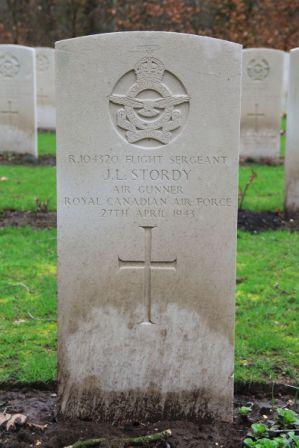
February 16, 2026. During WWII, the Stordy family of Brookvale, Prince Edward Island, lost  two sons:  first, John ‘Lawrence’ STORDY, who is buried in the Reichswald Forest War Cemetery in Kleve, Germany, and then, shortly after the war in Europe ended, Michael ‘Cecil’ STORDY, who is buried in Kelly’s Cross (St. Joseph) Parish Cemetery in Kelly’s Cross, Prince Edward Island.

….Two brothers gave their lives in WWII…

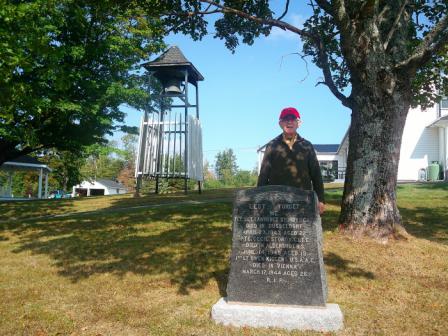
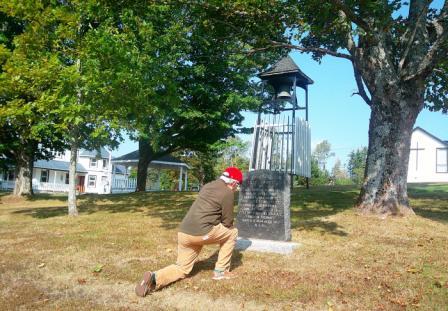
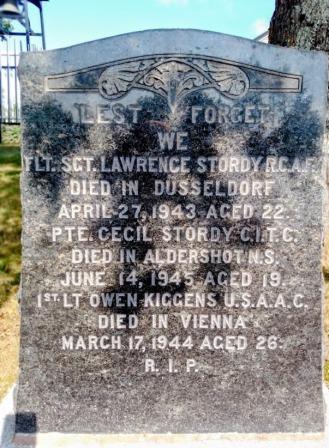
Two Stordy brothers are listed on the memorial outside St. Joseph’s Roman Catholic Church in Kelly’s Cross, behind which Pieter is standing. (Photo credit: Daria Valkenburg)

In Part 1 of this two-part series, we began with Cecil’s story, as the Stordy family became known to Pieter when he was assigned Cecil’s grave after he became a volunteer under the National Volunteer Program for the Commonwealth War Graves Commission (CWGC).  (See https://onthewarmemorialtrail.com/2026/02/11/on-the-war-memorial-trailthe-stordy-brothers-part-1-the-wwii-soldier-from-brookvale-who-drowned-during-a-swimming-exercise-in-nova-scotia/

Now, in Part 2, we tell the story of JohnLawrence’ STORDY, who lost his life in Germany on April 27, 1943, aged 22,  two years earlier than his younger brother Cecil.

….Lawrence enlisted in the RCAF in July 1941 …

Born May 31, 1921 in Brookvale, Prince Edward Island, Lawrence was the son of John ‘Anthony’ and Mary ‘Ermina’ (nee Duffy) Stordy.  When he enlisted at the Royal Canadian Air Force (RCAF) Recruiting Centre in Halifax, Nova Scotia on July 17, 1941, he stated that he had completed Grade 10 and was employed at Schwartz & Sons.  Before that he had worked as a farm labourer for D. D. MacDonald on Prince Edward Island for 4 months, then on a dairy farm for B. Baxter in Truro, Nova Scotia.

In 1940, he left the dairy farm for a better job with Nova Scotia Light and Power in Halifax, Nova Scotia, remaining there until he was laid off in 1941, after which he went to work for Schwartz & Sons, a spice and food company, as an assistant shipper.  

Asked what special qualifications or hobbies would be useful to the RCAF, he wrote down that he knew how to fish, hunt, and skate, and occasionally played baseball.

After taking his basic training in Halifax, Lawrence was sent to No. 4 Air Manning Section (AMS) in Valcartier, Quebec on September 13, 1941 and to No. 5 Manning Depot in Lachine, Quebec.  Manning Depots were reception and training centres for new RCAF recruits, serving as the initial entry point for the British Commonwealth Air Training Plan (BCATP). Recruits received uniforms, 4–5 weeks of basic military training, drills, and aptitude testing.  Upon completion, trainees were designated as ‘aircraftsmen 2’ and moved on to further specialized training schools.

Lawrence remained there until March 29, 1942, when he was sent to No. 1 Wireless School (WS) in Montreal, Quebec.  This BCATP facility for training wireless air gunners was located in the former Nazareth School for the Blind. On April 30, 1942, he was designated as Leading Aircraftman (LAC).

On June 7, 1942 he went to Composite Training School (KTS) in Trenton, Ontario for a four-week course in astro-navigation.

On July 5, 1942 he was sent to No. 9 Bombing and Gunnery (B&G) School in Mont-Joli, Quebec, where he received instruction in the techniques of bomb aiming and aerial machine gunnery.  Bombing and Gunnery schools required a large area to accommodate their bombing and gunnery ranges, and were often located near water. The Avro Anson, Fairey Battle, Bristol Bolingbroke, and Westland Lysander were the standard aircraft used.

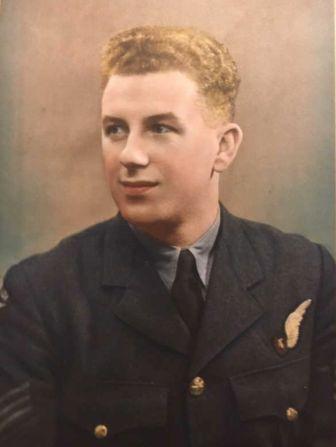
John ‘Lawrence’ Stordy. The 3 chevrons on his right arm indicate his promotion to T1 Sergeant. (Photo source: Canadian Virtual War Memorial)

While at No. 9 B&G, Lawrence was awarded his Air Gunner’s badge on August 14, 1942, and a promotion to T1 Sergeant.  (The ‘T’ stands for Technician.) His Commanding Officer at the School noted that he was “…a hard worker and applied himself diligently…

On September 11, 1942, he was sent to No. 34 Operational Training Unit (OTU) in Pennfield Ridge, New Brunswick.  An OTU was the last stop for aircrew trainees before going overseas. 

….Lawrence left Canada for overseas service …

Lawrence was only in Pennfield Ridge for a few days before being transferred to the RCAF’s No. 1 ‘Y’ Embarkation Depot in Halifax, Nova Scotia.  (See https://rcaf.info/rcaf-stations/nova-scotia-rcaf-stations/rcaf-station-halifax/)

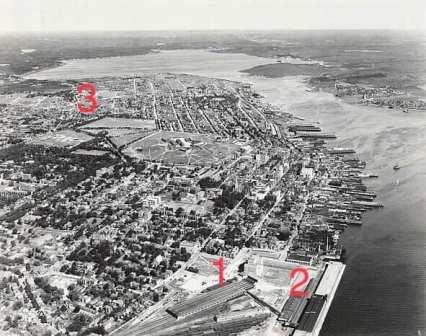
Aerial view of Halifax showing the location of the Canadian National Railroad Station (red # 1) , Pier 21 Ocean Terminals (red # 2) and No. 1 “Y” Embarkation Depot (red # 3). Halifax Harbour is foreground and right with the Bedford Basin in background. (Source: Library and Archives Canada Collections website)

Things moved quickly after that, as on September 24, 1942, Lawrence was placed in the Royal Air Force (RAF) Trainee Pool and arrived at No. 3 Personnel Reception Centre (PRC) in Bournemouth, England on October 9, 1942. This was the arrival point for thousands of Commonwealth aircrew after training in Canada. 

Lawrence would have been at No. 3 PRC at the same time as Donald David MacKenzie TAYLOR, who arrived there two days earlier, and whose story was previously told.  (See https://onthewarmemorialtrail.com/2025/12/27/on-the-war-memorial-trail-the-wwii-soldier-born-in-manitoba-who-lost-his-life-when-lst-420-hit-a-mine-in-the-harbour-outside-ostend/)

….Lawrence joined No. 405 Pathfinder Squadron…

On October 28, 1942, he was transferred to No. 405’s 1659 Conversion Fleet, the main training unit for No. 405 (Vancouver) Squadron, and based at RAF Leeming and Topcliffe in Yorkshire.  No. 405 was the only RCAF Pathfinder Squadron. Formed in April 1941, No. 405 had flown Wellingtons until April 1942, when it converted to Halifax bombers, and prepared crews for the Handley Page Halifax bomber.

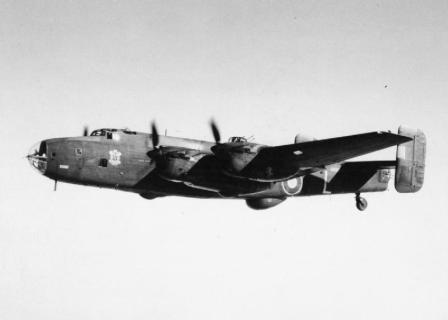
Halifax B Mk II bomber photo.  (Photo source: Royal Air Force official photographer – https://commons.wikimedia.org/w/index.php?curid=24454971)

Pathfinder Squadrons were target-marking squadrons that flew ahead of the main bombing crews to mark targets with slow falling, colour-coded parachute flares and very bright photo flash bombs that were on the centre of the target.  This helped bombing crews to increase the accuracy of their bombing.

Pathfinders didn’t immediately leave, but stayed around the target, to keep dropping markers on target, to keep second and third waves of bombers from ‘target creep’.  RAF and RCAF bombers were strung out like cars on the interstate, one behind the other, NOT in formation. Each individual aircraft had to navigate, get to the target, drop their bombs, and return to base – in the dark.  Pathfinders would remain until after the bombers had left to take photos of the damage inflicted.

On January 15, 1943, his training completed, Lawrence was assigned to No. 405 Squadron, based at RAF Beaulieu in Hampshire. At the time he joined, No. 405 had been detached to Coastal Command since October 1942. Coastal Command’s role was defensive, mainly protecting convoys from German U-boats(See https://en.wikipedia.org/wiki/RAF_Coastal_Command_during_World_War_II)

On March 1, 1943, No. 405 Squadron was reassigned back to Bomber Command as part of No. 6 (RCAF) Group, selected to be part of No. 8 Pathfinder Group on March 18, 1943, and based at RAF Gransden Lodge, located 16.3 km (10.1 miles) west of Cambridge, England. They were to be participants in a bombing campaign in the industrial heart of Germany.

….No. 405 Squadron was involved in the Battle of the Ruhr…

The Battle of the Ruhr was a strategic bombing campaign carried out by Bomber Command against the Ruhr Valley Area in Germany from March 5 to July 31, 1943.  Why Ruhr? Responsible for 60% of Germany’s industrial output, it was the main centre of German heavy industry with coke plants, steelworks, armaments factories and ten synthetic oil plants. (Coke is a coal-based fuel with a high carbon content, used mainly in the smelting of iron ore, steelworks, armaments factories and ten synthetic oil plants.)  (See https://en.wikipedia.org/wiki/Battle_of_the_Ruhr and https://www.worldhistory.org/article/2429/battle-of-the-ruhr/)

The Ruhr Valley was protected by about 200 flak batteries, each consisting of six or eight 88-mm (3.5 in) guns, many with radar capability. Some guns were even mounted on trains to follow the bombers. Due to this dense network of anti-aircraft guns and countless searchlights, Allied bombers soon gave the Ruhr the ironic nickname of ‘Happy Valley’.

In addition to anti-aircraft guns, smog was a big problem.  The Ruhr Valley was so heavily industrialized that constant smog in the skies above it not only impeded the bomb aimers, but also made it difficult for the navigators to find their target areas.

….The last flight of Halifax JB-920…

On the night of April 26 into 27, 1943, Bomber Command sent 561 bombers (215 Lancasters, 135 Wellingtons, 119 Halifaxes, 78 Stirlings, 14 Mosquitos) to Duisburg, Germany.  Duisburg had important railway yards, which connected the Ruhr to other parts of Germany, and the Thyssen steelworks.

In total, 17 planes were lost that night – 7 Halifaxes, 5 Wellingtons, 3 Lancasters, 2 Stirlings. German records show 130–207 people killed, 300 buildings destroyed and six other cities hit by bombs.

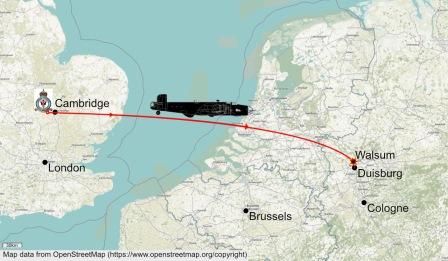
Map shows the plane’s path from England towards Duisburg.  It was shot down by German flak and crashed in Walsum, 11 km north northwest of its target of Duisburg.  (Map prepared by Wendy Nattress)

This operation was No. 405 Squadron’s first operation as a Pathfinder unit. Out of 11 Halifax aircraft dispatched, 1 was lost – Halifax JB-920.  Hit by German light and heavy flak, it was shot down as it approached the target area of Duisburg, and crashed in Walsum, 11 km (6.8 miles) north northwest of Duisburg. All eight crew members were killed, including Lawrence, who was one of the two air gunners on that flight.

….The other crew members on the last flight of Halifax JB-920…

On the last flight of Halifax JB-920, in addition to Flight Sgt John ‘Lawrence’ STORDY, the other crew members were:

  • Pilot : Pilot Officer David Edward CROCKATT of Vancouver, British Columbia
  • 2nd Pilot : RCAF Pilot Officer Chester Brockie DIXON of Maple Creek, Saskatchewan
  • Flight Engineer : RCAF Sergeant Isaac Abraham PENNER of Nipawin, Saskatchewan
  • Navigator : RCAF Pilot Officer John Robert MARRIOTT of Ottawa, Ontario
  • Navigator : RCAF Warrant Officer Class II Stewart SLEETH of Detroit, Michigan, USA
  • Wireless Operator / Air Gunner : RAF Pilot Officer Francis Edward O’HARE of the United Kingdom
  • Air Gunner : RCAF Warrant Officer Class II Thomas Lloyd BENTLEY of Moose Jaw, Saskatchewan

….Lawrence is buried in Reichswald Forest War Cemetery in Kleve…

The airmen were temporarily buried at North Cemetery in Dusseldorf, Germany, before being reburied in Reichswald Forest War Cemetery in Kleve, Germany.

Grave of John ‘Lawrence’ Stordy in the Reichswald Forest War Cemetery in Kleve, Germany.  (Photo source: Find A Grave)

I had wondered why the men were reburied in Reichswald Forest War Cemetery, another cemetery in Germany, instead of in The Netherlands. Yannic Wethly, a volunteer with the Air Drenthe Research Foundation (Stichting Luchtoorlog Onderzoek Drenthe),  explained that “….almost all  RAF/RCAF/RAAF etc personnel who died in the German provinces that border to The Netherlands were reburied at Reichswald Forest. This explains the vast geospatial spread in the crash locations, and also why there are more than 7500 graves there….

Patti W Noonan, daughter-in-law of the late Bernadette ‘Bernie’ Stordy Noonan, the youngest sister of Cecil and Lawrence, wrote us that “….the family is very proud of the sacrifice by Lawrence and Cecil…” and rightly so.

Thank you to Wendy Nattress, who prepared the map showing the flight path for Halifax JB-920.

This concludes the 2 part series on the Stordy Brothers. Do you have a story to tell? Email Pieter at memorialtrail@gmail.com or comment on the blog. 

© Daria Valkenburg

….Want to follow our research?…

If you are reading this posting, but aren’t following our research, you are welcome to do so.  Our blog address: https://onthewarmemorialtrail.com/

4 countries, 6 weeks, 7,000 km – an unforgettable war memorial journey in Europe…. Daria’s book ‘No Soldier Buried Overseas Should Ever Be Forgotten‘ is available in print and e-book formats.  Net proceeds of book sales help support research costs and the cost of maintaining this blog. For more information see https://nosoldierforgotten.com/

Subscribe to our YouTube Channel: On The War Memorial Trail With Pieter Valkenburg: https://www.youtube.com/channel/UCJ591TyjSheOR-Cb_Gs_5Kw

Never miss a posting!  Subscribe below to have each new story from the war memorial trail delivered to your inbox.

On The War Memorial Trail……The Stordy Brothers Part 1 – The WWII Soldier From Brookvale Who Drowned During A Swimming Exercise In Nova Scotia

Pieter looks at the memorial outside St. Joseph’s Roman Catholic Cemetery in Kelly’s Cross. (Photo credit: Daria Valkenburg)

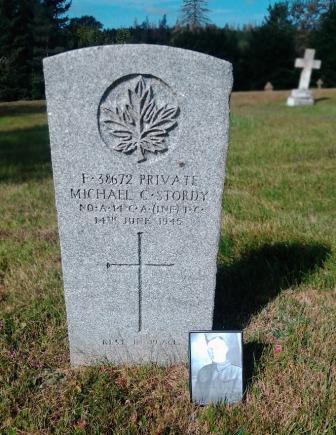
February 11, 2026. One of the cemeteries that Pieter was assigned when he became a volunteer under the National Volunteer Program for the Commonwealth War Graves Commission (CWGC) last year was Kelly’s Cross (St. Joseph) Parish Cemetery in Kelly’s Cross, Prince Edward Island.  There is only one CWGC war grave at this cemetery…. that of WWII soldier Michael ‘Cecil’ STORDY, who died June 14, 1945, aged 19.

….Two brothers gave their lives in WWII…

Two Stordy brothers are listed on the memorial outside St. Joseph’s Roman Catholic Church in Kelly’s Cross. (Photo credit: Pieter Valkenburg)

When Pieter visited the cemetery last summer to inspect the grave, he noticed a memorial outside St. Joseph’s Roman Catholic Church.  When he took a look at the memorial, he saw, to his surprise, that there were two Stordys listed – Michael ‘Cecil’ and John ‘Lawrence’. 

A curious Pieter looked up RCAF Flight Sergeant John ‘Lawrence’ Stordy, and discovered that this was Cecil’s older brother, who had died in Germany on April 27, 1943, aged 22.  “…We have to tell the stories of both brothers….” he said.    

We began with Cecil, who is buried in Kelly’s Cross, in a CWGC grave.

….A photo came from Cecil’s younger sister…

Born May 8, 1926 in Brookvale, Prince Edward Island, Cecil was the son of John ‘Anthony’ and Mary ‘Ermina’ (nee Duffy) Stordy.  When he enlisted at the No. 6 District Depot in Halifax, Nova Scotia on March 16, 1945, he stated that he had completed Grade 8 and was working on his father’s farm.

On March 23, 1945, Cecil was sent to No. 60 Canadian Army (Basic) Training Centre in Yarmouth, Nova Scotia, for basic training.  After successfully completing his basic training, on May 20, 1945, he was next sent to A14 Canadian Infantry Training Centre (CITC) – Camp Aldershot in Aldershot, Nova Scotia, and assigned to ‘E’ Company.

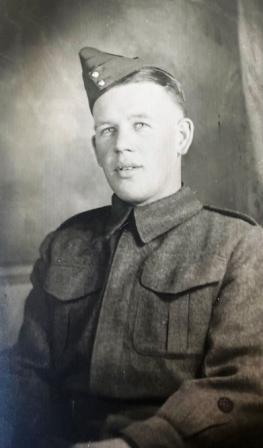
Michael ‘Cecil’ Stordy.  (Photo courtesy of Bernadette Stordy Noonan)

A photo of Cecil was submitted by Patti W Noonan, who explained that the photo came from the late Bernadette ‘Bernie’ Stordy Noonan, the youngest sister of Cecil and Lawrence.  Patti wrote “….my husband – Sgt Barry Noonan, RCMP (Rtd) is Bernadette’s son and the grand-nephew of both Cecil and Lawrence. He is a member of our Legion and proudly remembers them at our November 11 ceremonies as well as the December Candlelighting. …

….A drowning accident claimed Cecil’s life…

Camp Aldershot primarily featured infrastructure for land-based warfare, such as rifle ranges, trench systems, and bayonet assault courses. While undergoing infantry training at Aldershot, Cecil was part of a group involved in a swimming exercise on June 14, 1945. Swimming training was designed for ‘water-proofing’ soldiers and conducting emergency, wet-gap crossings. 

According to Cecil’s service file, the exercise took place at Peach Lake, which likely was near Kentville, in one of the water areas frequently used for training, including water obstacle courses and swimming. 

The exercise began around 2 pm. Unfortunately Cecil accidentally drowned about half an hour later, at 2:30 pm. According to a Court of Inquiry Report into the accident, Cecil “…got on a raft in the area used for swimming, got into water over his depth, was unable to hang onto the raft, and went under the surface.

 His body was found and artificial respiration was commenced and continued while being transferred to hospital and after 2 hours he was pronounced dead…

….Cecil was buried in St. Joseph’s Parish Cemetery in Kelly’s Cross…

Grave of Michael ‘Cecil’ Stordy, with a photo of him that was placed by Pieter. (Photo credit: Pieter Valkenburg)

On June 17, 1945, Cecil was buried in St. Joseph’s Parish Cemetery in Kelly’s Cross, Prince Edward Island.  Reverend Ayers stated that he “….officiated at the services in the church and at the grave.  Sgt Thomas Whelan of the 17th Armoured Regiment, Charlottetown, was in charge of the firing party….

Patti wrote that “….all of the family is very proud of the sacrifice by Lawrence and Cecil…” and rightly so.

Coming up in Part 2, the Stordy Brothers series continues, with JohnLawrence’ STORDY, who lost his life in Germany in 1943.

Thank you to Patti Noonan and the late Bernadette Stordy Noonan for providing a photo. Do you have a story to tell? Email Pieter at memorialtrail@gmail.com or comment on the blog. 

© Daria Valkenburg

….Want to follow our research?…

If you are reading this posting, but aren’t following our research, you are welcome to do so.  Our blog address: https://onthewarmemorialtrail.com/

4 countries, 6 weeks, 7,000 km – an unforgettable war memorial journey in Europe…. Daria’s book ‘No Soldier Buried Overseas Should Ever Be Forgotten‘ is available in print and e-book formats.  Net proceeds of book sales help support research costs and the cost of maintaining this blog. For more information see https://nosoldierforgotten.com/

Subscribe to our YouTube Channel: On The War Memorial Trail With Pieter Valkenburg: https://www.youtube.com/channel/UCJ591TyjSheOR-Cb_Gs_5Kw

Never miss a posting!  Subscribe below to have each new story from the war memorial trail delivered to your inbox.

On The War Memorial Trail….The Search For The Trench Where WWI Soldier Vincent Carr Was Originally Buried

December 22, 2025.  The very first story uncovered by Pieter, when he began researching the names on the Cenotaph outside the Borden-Carleton Legion, was that of WWI soldier Vincent Earl CARR, who lost his life on October 30, 1917 during the Battle of Passchendaele in Belgium.  Born May 3, 1894 in North Tryon, Prince Edward Island, Vincent was the son of Robert and Catherine (nee McLeod) Carr, and the husband of Bessie Carr (who died exactly a year later!) 

Photo: Vincent Carr in 1915, in the uniform of the 55th Battalion. (Photo courtesy of Delbert Carr collection. Photo colourization: Pieter Valkenburg)

….Why were 3 WWI Canadian Soldiers were buried side by side?…

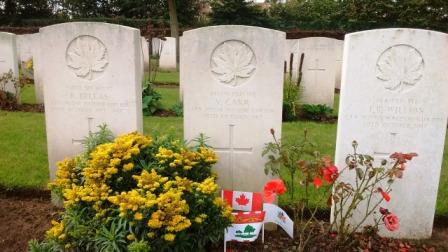
Vincent is buried in Cement House Cemetery in Langemark, Belgium, which we visited in 2017.  During that visit, Pieter noticed that the graves on either side of him were Canadians from the same unit as Vincent, and that they had died on the same day. 

Photo at Cement House Cemetery of Bellas, Carr, and Willson.  (Photo credit: Pieter Valkenburg)

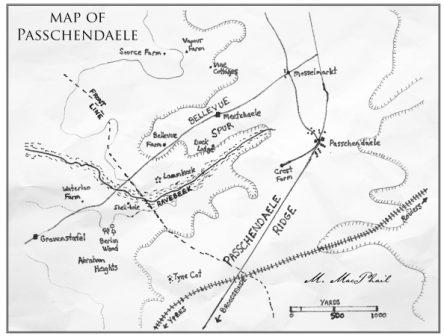
While in Passchendaele, a brochure ‘Did Your Granddad Fight in Passchendaele 1917?’ from the Memorial Museum Passchendaele 1917 invited people to submit names and photos. In return, museum staff would send a trench map with the approximate place where the person was killed. 

You can see Abraham Heights towards the bottom left corner of the map. (Map: courtesy http://www.darrellduthie.com/maps/)

….A trench map showed that Vincent Carr and 4 other soldiers were buried in Abraham Heights…

It took almost 2 years before we received the trench map in October 2019, along with more information on what happened on October 30, 1917.  On that fateful day, Vincent Carr, and two soldiers from Ontario, Jack Bingham WILLSON and Robert BELLAS, were all killed by the same high explosive shell on Abraham Heights.  They had been buried in the same grave on Abraham Heights, where they lost their lives, along with 2 British soldiers. 

In 1939, when all 5 bodies were exhumed and reburied in Cement House Cemetery, all three Canadians were still identifiable.  The British Army’s cardboard identity ‘tags’ had disintegrated, leaving the two British soldiers as unidentified.   (See https://onthewarmemorialtrail.com/2019/09/01/the-three-ww1-soldiers-who-were-buried-together-at-passchendaele/ )

The Memorial Museum Passchendaele 1917 wrote us that: “…According to the War Diary of the 1st Canadian Motor Machine Gun Brigade, three machine gun companies were in the field around October 30. ‘A’-Battery from the 28th till the 31st of October, ‘B’-Battery from the 29th till the 31st of October and the ‘Eaton’-Battery from the 30th October till the 1st of November. Although the positions on Abraham Heights (28.D.15.b.7.4.) were abandoned on the 29th to take up new positions just north of Tyne Cot Cemetery (28.D.16.b.6.9.), many runners were sent to the supply stores behind the front to resupply the machine guns on the front line. It’s likely that the men were killed by shellfire while hauling equipment between the gun positions and the back areas….”  (Note: The numbers and letters in brackets beside Abraham Heights and Tyne Cot Cemetery are the GPS coordinates.)

Trench map showing the coordinates where Carr, Willson, and Bellas were originally buried on Abraham Heights. (Map: courtesy of Memorial Museum Passchendaele 1917)

….Where EXACTLY had the men been buried?…

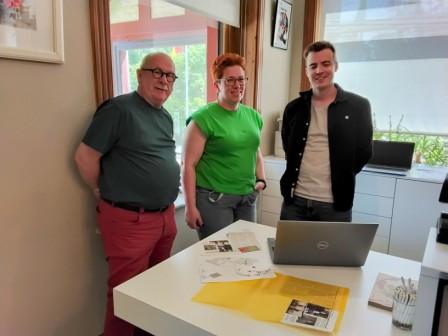
While in Belgium, Pieter’s cousin François Breugelmans and his wife Mieke de Bie joined us for this portion of our 2025 European War Memorial Tour. We drove to Zonnebeke, home of the Memorial Museum Passchendaele 1917, hoping that someone would be able to decipher the coordinates on the trench map sent to us in 2019…which of course we’d brought with us, along with articles from the County Line Courier newspaper about Vincent’s story to date.  Could we find the exact location?

François and I were excited to figure out the trench map coordinates.  Pieter thought it was a fool’s errand after over 100 years, and pointed out that since I’m directionally challenged (ie get lost everywhere), it would be a miracle if we found out where it was.  He and Mieke decided to sit on a couch and wait for the results of the discussion with the museum receptionist.

Mieke and Pieter left the trench map discussion to François and Daria. (Photo credit: Daria Valkenburg)

The museum receptionist was astonished by the question posed, but was so interested she said to wait while she made a phone call.  One of the archivists was called in to help.  “…I remember this map!…” he exclaimed.

François Breugelmans (left) with the Museum receptionist, and the young archivist (right) who figured out the coordinates on the trench map.  (Photo credit: Daria Valkenburg)

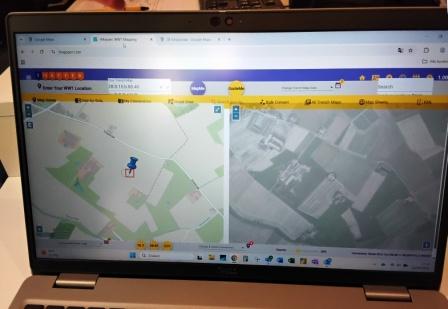
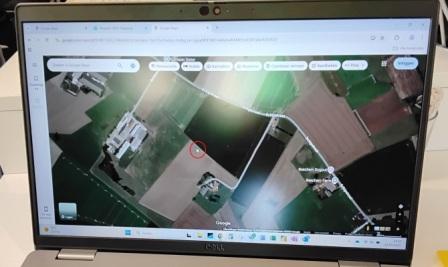
The archivist overlaid the trench map with a Google map, found the location, and then showed us a street view of how it looks today…..in a farm field near Beecham Farm. 

Side by side view – the trench map (left) and Google map (right) was shown to us on the archivist’s laptop.  (Photo credit: Daria Valkenburg)

A red circled arrow marked the location of where the trench was on Google Street View Maps.  (Photo credit: Daria Valkenburg)

….We searched for the location that was on the map…

We thanked the museum personnel and immediately went to the location marked on the map, finding out it was just outside Zonnebeke.  We got excited when we saw a sign indicating that we were beside Beecham Farm. It still existed!

Beecham Farm was still in existence!  (Photo credit: Daria Valkenburg)

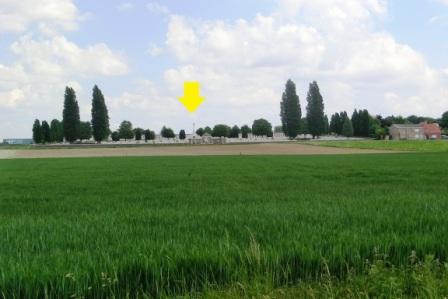
Across the road from Beecham Farm we could see Tyne Cot Cemetery, which we’d visited in 2017.  (See https://onthewarmemorialtrail.com/2017/11/12/a-visit-to-tyne-cot-cemetery/)

We could see Tyne Cot Cemetery (see yellow arrow) across the road from Beecham Farm.  (Photo credit: Daria Valkenburg)

Tyne Cot was listed on the original trench map, so we knew were in the right location!  A field belonging to Beecham Farm was the location of the trench where Vincent Carr was originally buried.

The trench where Vincent Carr was originally buried was in this field on Beecham Farm. (Photo credit: Daria Valkenburg)

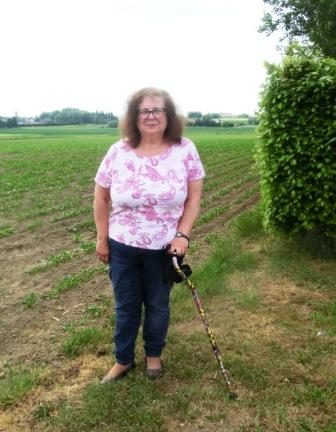
I felt like a detective who’d solved a mystery, while standing beside the field at Beecham Farm where Vincent Carr was originally buried! (Photo credit: François Breugelmans)

….We celebrated our success in Ypres…

Flush with the victory of finding the original trench location….not bad for 4 seniors… we decided to celebrate with a well-earned snack and rest in Ypres before continuing on with our 2025 European War Memorial Tour in Belgium.  It was over 30oC and very humid, and we needed a break!

We enjoyed a drink and bitterballen in Ypres.  (Photo credit: Daria Valkenburg)

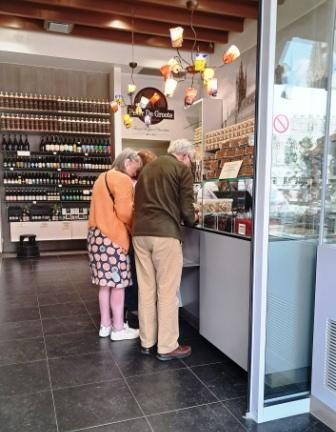
Of course, no trip to Ypres was complete without a stop at the Peter de Groote chocolate shop!  I never pass up their delicious ginger chocolates!

Daria, Mieke, and Pieter at the chocolate shop in Ypres.  (Photo credit: François Breugelmans)

Thank you to the staff at Memorial Museum Passchendaele 1917 in Zonnebeke for helping us in our quest to find the trench location. Thank you also to François Breugelmans and Mieke de Bie for joining us on our Belgian adventures.

Our adventures continue as we share the highlights of our 2025 European War Memorial Tour. 

If you have a story or photo to share, please contact Pieter at memorialtrail@gmail.com or comment on the blog. 

© Daria Valkenburg

….Want to follow our research?…

If you are reading this posting, but aren’t following our research, you are welcome to do so.  Our blog address: https://onthewarmemorialtrail.com/

4 countries, 6 weeks, 7,000 km – an unforgettable war memorial journey in Europe…. Daria’s book ‘No Soldier Buried Overseas Should Ever Be Forgotten‘ is available in print and e-book formats.  Net proceeds of book sales help support research costs and the cost of maintaining this blog. For more information see https://nosoldierforgotten.com/

Subscribe to our YouTube Channel: On The War Memorial Trail With Pieter Valkenburg: https://www.youtube.com/channel/UCJ591TyjSheOR-Cb_Gs_5Kw

Never miss a posting! Subscribe below to have each new story from the war memorial trail delivered to your inbox.

On The War Memorial Trail…..The Knights of Columbus Auxiliary Services Supervisor Who Drowned In A Belgian Canal

December 21, 2025. Pieter’s research results are faster than I can keep up with, and so several of the graves we visited during our 2025 European War Memorial Tour were for soldiers whose stories have yet to be told. One of the cemeteries we visited was the Canadian War Cemetery in Adegem, Belgium. (See https://onthewarmemorialtrail.com/2025/12/08/on-the-war-memorial-trail-a-visit-to-the-canadian-war-cemetery-in-adegem/

Before we left for Europe this past spring, we looked at the names of 12 soldiers from Prince Edward Island are buried in this cemetery. One surname was familiar as we had researched a soldier who was born in the same village and had the same surname,  Michael Joseph ‘Joe’ MACKENNA. (See https://onthewarmemorialtrail.com/2022/09/22/on-the-war-memorial-trail-the-wwii-soldier-from-prince-edward-island-killed-during-the-battle-of-rha/) We contacted Joe MacKenna’s niece, Teresa Hennebery, and asked if there was a family connection.

 ….The search for a photo of Joseph began…

Teresa was certain the families were distantly related and began a search into family records.  In the meantime, Pieter began his own research.    

Joseph Augustine MACKENNA, born June 28, 1903 in Newton Cross, Prince Edward Island, was the son of James and Georgina (nee MacMillan) MacKenna of Newtown, Prince Edward Island, and the husband of Mary (nee Hanrahan) MacKenna, of Antigonish, Nova Scotia.

When he enlisted with the 13th Company of the Canadian Army Forestry Corps (CAFC) in Halifax, Nova Scotia on September 2, 1940, he had been a bank manager with the Royal Bank of Canada, and had over 20 years of banking experience.  It was also noted that he had graduated from high school, was married, and was the father of three daughters:  Mary Eileen, Alice Clare, and Enid Gertrude.

His daughter Mary Eileen later married Cliff Gorman, and it was their son Mike Gorman who first provided a photo of his grandfather. Not long afterwards, Mary McPherson, daughter of Joseph’s brother Francis, also provided photos of her uncle.

Joseph Augustine MacKenna, likely taken in the United Kingdom.  (Photo courtesy of Mike Gorman)

 ….Joseph underwent basic training in Valcartier…

Joseph was sent to A13 Canadian Infantry Training Centre in Valcartier, Quebec for basic training, as were all members of the Canadian Army Forestry Corps, whose role was to cut down and process trees for wood and lumber in the United Kingdom. 

As stated in an article on http://www.canadiansoldiers.com/corpsbranches/forestrycorps.htm  “…wood was needed for living quarters, messes, and recreation facilities, as well as crates for vital supplies such as food, ammunition and even vehicles, and for the creation of explosives, stocks for weapons, the construction of ships, aircraft and factory facilities….

Although members of the CAFC were not expected to be in combat, very rudimentary basic training in using firearms was considered essential due to the threat to the United Kingdom of invasion by German forces.  As a result, members of CAFC “…received five to seven months of training…” at Valcartier.

On January 15, 1941, while still in Valcartier, Joseph was promoted to Acting Lance Corporal.  A few months later, on April 10, 1941, he was confirmed as Lance Corporal, and at the same time transferred to a Royal Canadian Army Medical Corps (RCAMC) unit that was attached to the Canadian Forestry Corps Headquarters.  He was a few months short of his 38th birthday, and while he likely was seen as finding active logging work a challenge, his extensive banking and administrative experience was considered a valuable asset.  

Joseph remained in Valcartier, assigned temporarily to No. 12, No. 14, and No. 19 Companies as needed. 

He was granted embarkation leave from May 23 to June 5, 1941, the last chance he had to see his family again.

….Joseph left Canada for overseas service….

Joseph left Canada for the United Kingdom on June 18, 1941, sailing from Halifax, Nova Scotia, disembarking in Gourock, Scotland on July 2, 1941, before moving on to Canadian Army Forestry Corps Headquarters in Beauly, Scotland. 
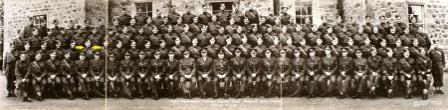
August 1941 photo of staff at CAFC HQ in Beauly, Scotland.  Joseph Augustine MacKenna is identified by yellow arrows.  (Photo courtesy of Mary McPherson)

While in Scotland, Joseph received a number of promotions.  On September 2, 1941 he was made Acting Sergeant, and classified as a Clerk Class III, Group C.  He was confirmed in the rank of Sergeant on December 2, 1941.

On July 1, 1942, Joseph was promoted to Staff Sergeant, and a month later promoted again to Acting Quarter Master Sergeant.  On November 1, 1942 he was confirmed in the rank of Quarter Master Sergeant.

Part of an August 1943 photo of staff at CAFC HQ in Beauly, Scotland.  Joseph Augustine MacKenna is identified by red arrow.  (Photo courtesy of Mary McPherson)

Joseph was transferred to the Canadian Army Forestry Corps Headquarters in London, England on September 28, 1943, and requested a demotion to Sergeant on October 15, 1943.  Over the next months, he was posted back and forth ‘On Command’ between London and Camp Whitley in Surrey, England, as Acting Staff Sergeant.

 ….Joseph was appointed Auxiliary Services Supervisor…

On July 18, 1944, Joseph was officially discharged from the Canadian Army and transferred to the Canadian Army Auxiliary Services (CAAS) upon receiving an appointment as Auxiliary Services Supervisor with the Canadian Military Headquarters in London.

What did Auxiliary Services do?  Members organized sports and dances, provided movies and concerts, reading and writing and recreation rooms, libraries, mobile canteens, and established leave hostels and information bureaus for troops on leave.

The Auxiliary Services section included four national volunteer service organizations: Canadian Legion War Services, Knights of Columbus, Salvation Army Canadian War Services, and Canadian Young Men’s Christian Association (YMCA) Overseas.  Joseph was with the Knights of Columbus.

Now a civilian employee of the government, as were all members of Auxiliary Services, Joseph was considered an officer, with equivalent rank of captain, and addressed as Supervisor. As an Auxiliary Services officer he wore a modified service uniform.

 ….Joseph waited for an assignment in Continental Europe…
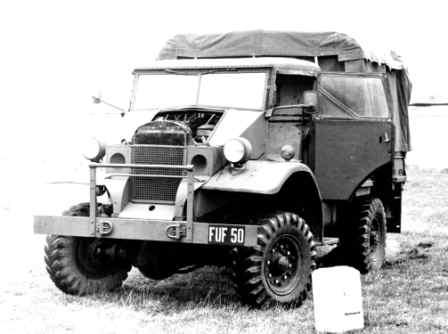
Example of a dual drive truck.  (Photo courtesy of The Royal Canadian Artillery Museum)

As Allied troops moved through France following D-Day on June 6, 1944 and then into Belgium, The Netherlands, and Germany, Auxiliary Services needed to plan for the support services needed as troops advanced. 

Joseph’s first task was to learn how to operate a Dual Drive truck with front wheel drive, an essential vehicle for the services that the Knights of Columbus would provide in France, Belgium, and The Netherlands, receiving his qualification in early August 1944.

On August 8, 1944, as a member of No. 11 Canadian Army Auxiliary Section (CAAS) Joseph was attached to No. 24 Canadian General Hospital in Horley, Surrey. It was a busy environment with wounded soldiers coming for treatment from the French front. He was there almost 8 months before being transferred to No. 1 Canadian General Reinforcement Unit (CGRU) on March 6, 1945, in preparation for a posting in North West Europe.

 ….Joseph was posted to Belgium…

On March 10, 1945, Joseph was transferred to the X4 General Reinforcement List of the 9th Battalion, leaving England and arriving in Belgium the following day. On March 13, 1945, he was assigned to the 14th Canadian Army Auxiliary Section (CAAS), which was attached to the 13th Canadian Base Reinforcement (CBR) Battalion.  This Battalion was part of the 13th Canadian Infantry Training Brigade, whose main role was administration and training for infantry reinforcements rather than a combat role in the field.
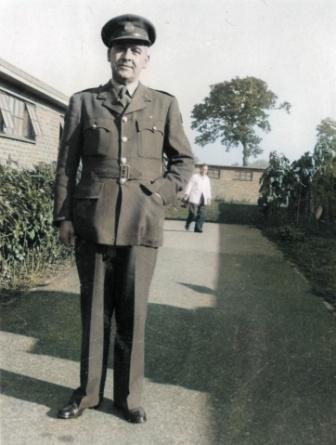
Joseph Augustine MacKenna, likely taken in Belgium. (Photo courtesy of Mary McPherson.  Photo restoration and colourization by Pieter Valkenburg.)

By the time Joseph arrived in Belgium, the country had been liberated since February 4, 1945.  At the time that Joseph arrived, the 14th CAAS, and 13th CBR Battalion, were based in Ghent, which had been liberated months earlier, on September 6, 1944. Among its’ other duties, the 13th CBR Battalion provided 14th CAAS with the supplies it required.

The Knights of Columbus recreation huts stated ‘Everybody Welcome, Everything Free’, providing services to soldiers regardless of race or religion. Travelling by truck to Knights of Columbus huts in Belgium and The Netherlands, Joseph transported supplies such as cigarettes, chocolates, and magazines, as well as equipment such as movie projectors and films. 

One of the many items provided to soldiers was stationery to allow them to write home to their family and friends.
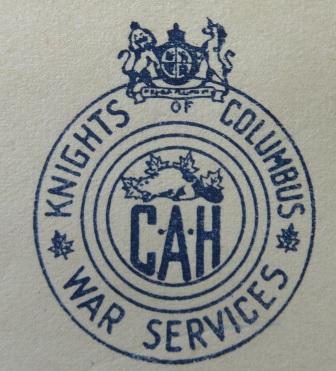
Stationery provided to soldiers by the Knights of Columbus, with the logo showing Canadian symbols of the beaver and the maple leaf and the royal coat of arms at the top. (Photos source: Tales From The Supply Depot)

While Joseph was qualified to drive a truck, as an officer he was entitled to a driver who drove the vehicle in which they travelled to deliver supplies and equipment, before returning to Ghent for more supplies before the next journey.

 ….Mystery of what happened on June 12, 1945…

All went well with Joseph’s assignment with 14th CAAS until the evening of June 12, 1945, when he disappeared after arriving back in Ghent from a trip.  According to testimony by his driver, Private A. J. FONTAINE, after arriving at 14th CAAS in Ghent, “…we unloaded a movie projector and cigarettes and turned them in there.…” Joseph told him that he …had other business to do here.  He told me to go and park the vehicle and to meet him at the Marguerite Café later.  On the way to Marguerite Café I stopped in at the American Café for a drink….

Joseph met him at the American Café and they had a drink before going on to Marguerite Café, located at 230 Groendreef, at 7:30 pm. 

At the Marguerite Café Pte Fontaine stated that Joseph told the proprietor, Marguerite Cador, that “…I would occupy his room for the night there for that night and he would occupy another room across the canal he had already arranged for….

They left the café together at 8 pm and crossed to the other side of the canal. Joseph then “…told me to return to the Marguerite Café to my room and to meet him the next morning at 14 Canadian Auxiliary Services Section at 1000 hours. I returned to the Marguerite Café, bought myself another drink and went to my room….”  It was the last time he saw Joseph.

Marguerite Cador, proprietor of Marguerite Café, testified that Pte Fontaine returned to the café “…15 or 20 minutes…” after they had left.  When she asked where Joseph was, he replied that “…I took him over the bridge to the other side of the canal and left him.  I gave him his bag before I left…

When Joseph didn’t report for work the following day, Pte Fontaine returned to Marguerite Café “….at different times during the day and the same for the next two days. He always asked if I had seen Mr. MacKenna…” Where had Joseph gone?

 ….A body was found in a canal in Ghent…

On the morning of June 21, 1945, Sgt Alexander MATTHEW, special investigator for the Canadian Provost Corps (Military Police), 3rd Canadian Base Reinforcement Group, was informed by the Ghent Civil Police that “….the body of a soldier was in the canal at Ketelplein Bridge….” Sgt Matthew proceeded to the bridge.  “…I looked down from the bank of the canal and saw the body.  I could see that the uniform on it bore ‘Canada’ flashes

The local fire department retrieved the body and transported it to No. 2 Canadian General Hospital’s morgue, and the body was turned over to Quartermaster Sgt G. H. MACMILLAN, chief ward master at the hospital.  With Quartermaster Sgt MacMillan, Sgt Matthew stated that they “… searched his battle dress and obtained a wallet enclosing the identity card of Joseph Augustine MacKenna. There was also a sum of Dutch money…”   

Quartermaster Sgt MacMillan noted that the body was “…badly decomposed…

Major J. D. DUFFIN, Royal Canadian Army Medical Corps, Pathologist at No. 2 Canadian General Hospital, performed an autopsy. His report noted that “…There were no marks of injury either on the clothes or on the skin….” The lungs “…were heavy, voluminous, and filled with dirty water…” leading Major Duffin to surmise that “…death was apparently due to drowning….” The only oddity was that the drowning appeared to have occurred “…an estimated 5 to 7 weeks previously…” and not the 9 days since Joseph had last been seen.

On June 29, 1945, a Court of Inquiry concluded that Joseph died an accidental death by drowning in a canal in Ghent, Belgium.  Although Joseph was last seen on the evening of June 12, 1945, his death was ‘arbitrarily determined’ to be June 20, 1945, and his death ‘confirmed’ on June 21, 1945.

 ….Joseph is buried in the Canadian War Cemetery in Adegem…
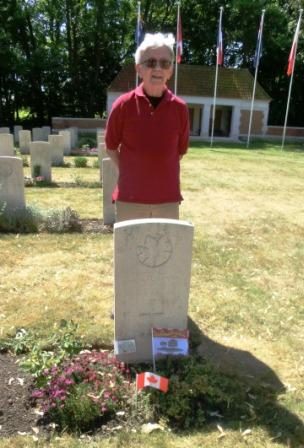
Pieter stands behind the grave of Joseph Augustine MacKenna.  (Photo credit: Daria Valkenburg)

Joseph was buried at the Canadian War Cemetery in Adegem, Belgium on June 24, 1945.  We visited his grave during our 2025 European War Memorial Tour, and Pieter placed flags of Canada and Prince Edward Island at his grave. 

This was the second story written about a canal drowning in Ghent!  New Brunswick soldier Azade BOUDREAU also drowned in a canal in Ghent in 1945. See https://onthewarmemorialtrail.com/2025/12/15/on-the-war-memorial-trail-the-wwii-soldier-from-petit-rocher-nord-who-accidentally-drowned-in-a-belgian-canal/

….A surprise encounter in the Canadian War Cemetery in Holten….

Amy Meunier (left) with Daria and Pieter at the Canadian War Cemetery in Holten.  (Photo credit: Ben Miller)

When Mike Gorman had learned that we would be in Europe for the 80th Anniversary of Liberation Commemoration events, he mentioned that we might meet up with Amy Meunier, who works for Veterans Affairs.  “Amy is my 1st cousin’s (Duane Gorman) ex…

We didn’t think anything about it, but then, when we were at the Canadian War Cemetery in Holten, The Netherlands for the grave re-dedication ceremony for WWII soldier Arthur VANANCE of Kenora, Ontario, Paul Ledwell, Deputy Minister of Veterans Affairs, was in attendance with several people from Veterans Affairs.  One of them was Amy!  (See https://onthewarmemorialtrail.com/2025/08/22/on-the-war-memorial-trail-the-wwii-soldier-from-kenora-who-lay-in-an-unknown-grave-for-80-years-part-2-the-grave-re-dedication-ceremony/)

Paul called Amy over and once she realized that we were the people that Mike had told her about, she said “…OMG, my son Levi will love this…”  This surprise encounter helped bridge the past with the present, helping to ensure that those buried overseas will not be forgotten.
The flags placed at Joseph’s grave were donated.  Our thanks go to: 

  • Alan Waddell, Constituent Assistant, on behalf of Heath MacDonald, MP for Malpeque, for the Canadian flag.
  • Matt MacFarlane, MLA for District 19, Borden-Kinkora, for the flag from Prince Edward Island.

Thank you to Joseph’s grandson Mike Gorman and Joseph’s niece Mary McKenna MacPherson for sharing photos and information. Thank you also to Teresa Hennebery. We’ll continue to share the highlights of our adventures on the 2025 European War Memorial Tour. 

The research work continues for Pieter.  If you have photos or information to share about soldiers buried in The Netherlands or Belgium, please email him at memorialtrail@gmail.com, or comment on the blog.    

© Daria Valkenburg

….Another Canadian Army Forestry Corps story….

This was the second story written on this blog about the CAFC.  Edgar M. GUITARD of New Brunswick also served in the Canadian Army Forestry Corps.  You can read his story at https://onthewarmemorialtrail.com/2024/06/24/on-the-war-memorial-trail-the-wwii-lumberjack-from-belledune-killed-by-stray-mortar-fire-in-the-nijmegen-salient/

….Want to follow our research?…

If you are reading this posting, but aren’t following our research, you are welcome to do so.  Our blog address: https://onthewarmemorialtrail.com/
4 countries, 6 weeks, 7,000 km – an unforgettable war memorial journey in Europe…. Daria’s book ‘No Soldier Buried Overseas Should Ever Be Forgotten‘ is available in print and e-book formats.  Net proceeds of book sales help support research costs and the cost of maintaining this blog. For more information see https://nosoldierforgotten.com/

Subscribe to our YouTube Channel: On The War Memorial Trail With Pieter Valkenburg: https://www.youtube.com/channel/UCJ591TyjSheOR-Cb_Gs_5Kw

Never miss a posting!  Subscribe below to have each new story from the war memorial trail delivered to your inbox.
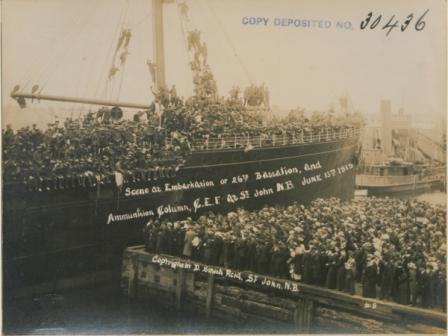
On The War Memorial Trail….The WWII Soldier From Piusville Killed During The Battle Of The Leopold Canal

December 10, 2025. In the course of his research into WWII soldiers buried in The Netherlands, Pieter soon learned that many Canadians who lost their lives during the Battle of the Scheldt are not only buried in the Canadian War Cemetery in Bergen Op Zoom in The Netherlands, but are also buried at the Canadian War Cemetery in Adegem, Belgium.

While most of the men buried in Adegem died during the operations for the clearance of the south bank of the Scheldt, many Canadians who lost their lives elsewhere in Belgium were also brought here for burial. Out of 848 Canadians buried here, 12 are from Prince Edward Island, and this spring an appeal went out in the local media for photos and information on the soldiers.

Pieter’s research results are faster than I can keep up with, and so several of the graves we visited during our 2025 European War Memorial Tour were for soldiers whose stories have yet to be told.  One of these is the subject of this posting….

….Steve Gallant’s niece had a photo of her uncle….

After reading about the appeal for photos in the County Line Courier newspaper, Pauline Stewart of New Annan, Prince Edward Island contacted us, writing that “we follow your memorial trail column.  In the last edition my uncle was mentioned….  Her uncle was Joseph Stephen ‘Steve’ GALLANT, of Piusville, who was serving with the Royal Winnipeg Rifles when he lost his life on October 11, 1944 at the age of 29.

At the time of Pauline’s email, we were still in Europe.  We sent her a photo taken of her uncle’s grave, and explained that Pieter would give her a call once we were home again.  She replied with a surprise. By the way the Two Bulger Boys from Foxley River are my husband’s uncles…” 

Last year, a two-part series on Harold ‘Hal’ Gabriel BULGER, who is buried in Adegem, and his brother Lawrence William BULGER, who is buried in the Canadian War Cemetery in Groesbeek, was published. (You can read Lawrence’s story at https://onthewarmemorialtrail.com/2024/08/19/on-the-war-memorial-trail-the-bulger-brothers-part-2-the-wwii-stretcher-bearer-from-foxley-river-killed-during-the-battle-of-bienen/ and Hal’s at https://onthewarmemorialtrail.com/2024/08/05/on-the-war-memorial-trail-the-bulger-brothers-part-i-the-wwii-soldier-from-foxley-river-killed-during-the-battle-of-moerbrugge/)

Pauline and Charles Stewart with Pieter. (Photo credit: Daria Valkenburg)

A few months later, we had a chance to meet with Pauline and her husband Charles.  Pauline explained that her father, John P. Gallant, was Steve’s brother. Another brother, Vincent, also served during WWII, but survived. “…Steve was the groomsman at the marriage of my parents….

She recalled that “….Steve was on leave right after I was born in August 1944, and he died a few months later….

Born in Piusville, Prince Edward Island on July 31, 1915, Joseph Stephen ‘Steve’ GALLANT was the son of Archie and Jannie Gallant.  He had 5 brothers and 1 sister.

….Steve enlisted in 1942…

Joseph Stephen ‘Steve’ Gallant.  (Photo Courtesy of Pauline and Charles Stewart On Behalf Of The Gallant Family)

Steve originally enlisted under the National Resources Mobilization Act (NRMA) at the No. 6a NRMA Clearing Depot in Charlottetown, Prince Edward Island on May 15, 1942 and began basic training at No. 62 Canadian Army Basic Training Centre in Charlottetown. At the time, he stated that he’d left school at the age of 12 after completing Grade 5, that he was working on his father’s farm in Piusville, and that he was fluent in both French and English.   (See https://en.wikipedia.org/wiki/National_Resources_Mobilization_Act)

….Steve transferred to the 5th SMAA S/L Troop…

After completing basic training on July 11, 1942, Steve was transferred to the 5th Special Mobile Anti-Aircraft Search Light Troop (5th SMAA S/L Troop) and was stationed at various airports, beginning with Ives Point, Nova Scotia, near Halifax. As explained in a Government of Canada history of the Royal Canadian Air Force during WWII, the main task of this unit was “…to provide realistic training to aircrews – the terrifying experience of being ‘coned’ by enemy anti-Aircraft battery searchlights….” (See https://www.canada.ca/en/air-force/corporate/wings/14-wing/history.html)

On October 5, 1942, Steve enlisted in the Active Army in Halifax, Nova Scotia, and remained with the 5th SMAA S/L Troop.  A few days later, on October 8, 1942, he was attached to No. 6 Detachment, Royal Canadian Ordnance Corps (RCOC) in Debert, Nova Scotia, for a month.

He was next attached to No. 34 Operational Training Unit (OTU) of the Royal Air Force in Pennfield, New Brunswick.  An airport had been built in 1940 to train Air Observers as part of the British Commonwealth Air Training Plan (BCATP). The Operational Training Unit at the airport was used to train four crew members for World War II action: Pilot, Navigator, Wireless Air Gunner and Air Gunner. (See https://en.wikipedia.org/wiki/British_Commonwealth_Air_Training_Plan)

A month later, Steve was attached to No. 36 Operational Training Unit (OTU) of the Royal Air Force in Greenwood, Nova Scotia.  The site for RAF Station Greenwood, which opened in 1942, had been chosen by the Royal Canadian Air Force (RCAF) and Royal Air Force for an airfield as part of the British Commonwealth Air Training Plan (BCATP) due to the area having a relatively fog-free climate.

On February 2, 1943, Steve was again attached to No. 6 Detachment, Royal Canadian Ordnance Corps (RCOC) in Debert, Nova Scotia, for a few months.  Then, on May 8, 1943, he was again attached to No. 36 Operational Training Unit (OTU) in Greenwood, Nova Scotia.

A month later, he was attached again to No. 34 Operational Training Unit (OTU) in Pennfield, New Brunswick for 2 months before returning to No. 36 Operational Training Unit (OTU) in Greenwood, Nova Scotia. While in Greenwood, Steve was sent ‘On Command’ to Winnipeg, Manitoba, on October 10, 1943.

….Steve left Canada for overseas service….

On March 27, 1944, Steve was transferred to the 21st Anti-Aircraft Regiment of the Royal Canadian Artillery, and posted to 1st Anti-Aircraft Searchlight (AA S/L) Battery in Halifax, Nova Scotia, for additional training as a gunner. A few weeks later, on April 22, 1944, he was sent to No. 1 Transit Camp in Windsor, Nova Scotia in preparation for overseas duty.

Steve was granted embarkation leave from May 5 to 9, 1944. It must have been a bittersweet time as he didn’t return back until May 12, 1944, resulting in the forfeiture of 3 days pay and allowance and being confined to barracks for 4 days. 

On May 20, 1944, Steve was sent to the No. 1 Training Battalion of the Canadian Infantry Corps in Debert, Nova Scotia for final training and preparation for overseas service.  On July 21, 1944, he was transferred to the Training Brigade Group in Debert.  He was granted another leave from August 3 to 15, 1944, in what turned out to be the last time he would ever see his family again.

On August 29, 1944, Steve left Canada for the United Kingdom.  Upon arriving on September 4, 1944 he was assigned to No. 4 Canadian Infantry Reinforcement Unit (CIRU). 

He wasn’t in the United Kingdom even a month when he was transferred to the X4 Reinforcement List for the Canadian Base Reinforcement Group (CBRG), part of the 13th Battalion, 21st Army Group, on October 1, 1944 and sent to Northwest Europe, arriving a day later.

….Steve lost his life during the Battle of the Leopold Canal….

Map showing the Battle for the Leopold Canal.  (Map source: Little Black Devils: A History of the Royal Winnipeg Rifles)

On October 10, 1944, Steve was transferred to the Royal Winnipeg Rifles, joining the Regiment in the vicinity of the dike by Graaf Jan, The Netherlands, where they were engaged in fierce fighting during the Battle of the Leopold Canal on the border between The Netherlands and Belgium.   

The War Diary for October 10, 1944 for the Royal Winnipeg Rifles stated that the Commanding Officer had “… received orders to occupy the Southern approaches to the village of GRAAF JAN. With A Company giving covering fire, B Company succeeded in reaching the objectives at 1500 hrs. Superior enemy forces in the village forced the company to withdraw when ammunition was getting low….

The War Diary for October 11, 1944 noted numerous casualties.  “…Cloudy and cool with slight rain in the afternoon. Visibility poor. During the morning A Company assisted the Regina Rifles in destroying an enemy held pill box. Another C Company patrol to GRAAF JAN failed to contact the enemy…. Enemy shelling was slightly less intense than during the first three days. Small Arms fire continued to make it extremely difficult and dangerous to move about. Supplies and casualties were still ferried across the Canal. Capt H.C. Chadderton of C Company and Lt L. Mendels of B Company were among the numerous casualties for the day….” 

Unfortunately, Steve was one of the ‘numerous casualties’ referred to in the war diary.  He was 29 years old.

….Steve is buried in the Canadian War Cemetery in Adegem….

Steve is buried in the Canadian War Cemetery in Adegem, Belgium. We visited his grave on a very hot Sunday this past May, where Pieter placed Acadian, Prince Edward Island, and Canadian flags in remembrance.

Pieter by the grave of Joseph Stephen ‘Steve’ Gallant. (Photo credit: Daria Valkenburg)

….Steve’s mother wanted answers….

On November 13, 1944, a distraught and upset Jannie Gallant – Steve’s mother – wrote to the Department of National Defence, asking questions that so many mothers of soldiers must have had.  “….I received a telegram on October 20 stating that …” Steve had been killed on October 11. “…We haven’t received any more news since.  It makes a very sad house. My husband has been in ill health since 1933. It was a great shock to him and also to me...

She explained that they had received two letters from him once he left Canada.  “…We received a letter from him on the 29th of September and he was still in England, and we received one that was written on October the 7th and he was already in Belgium…” 

Then came the hard question and a query as to whether he was really dead.  “…I want to know how much training that boy had to be sent that soon to Belgium as a rifleman with no training as a rifleman.  I hope that the boy is still living as he was a great help to his father and also to myself….” 

She ended by saying that “…I want to know the particulars of him if he is dead or living….

Mrs Gallant did receive a reply from Lt Cameron, Military Secretary, on November 18, 1944, offering sympathies and explaining that Steve had “…received careful training during the period he was in England and that he would not have been permitted to proceed until he was declared trained…

The reality was that training couldn’t fully prepare a soldier for actual combat. To make things worse, Steve had been sent to the Royal Winnipeg Rifles in the midst of a battle, with not even the chance to get to know the men in the Company he was assigned to.

Thank you to Pauline and Charles Stewart for providing photos and information on Pauline’s uncle. If you have a story to tell, or can provide a photo of one of the soldiers from Prince Edward Island buried in Adegem, please email Pieter at memorialtrail@gmail.com or comment on the blog. 

© Daria Valkenburg

….The 12 soldiers from Prince Edward Island who are buried in Adegem….

  1. Harold ‘Hal’ Gabriel BULGER of Foxley River was serving with the Algonquin Regiment when he was killed during the Battle of Moerbrugge in Belgium on September 10, 1944, at the age of 26.  
  2. Charles John ACORN of Peters Road was serving with the North Nova Scotia Highlanders when he lost his life on October 15, 1944 at the age of 22. A poor quality newspaper photo was found.
  3. William Henry DEVEAUX of Dundee was serving with the North Nova Scotia Highlanders when he lost his life on October 16, 1944 at the age of 23.
  4. Joseph Stephen GALLANT of Piusville was serving with the Royal Winnipeg Rifles when he lost his life on October 11, 1944 at the age of 29.
  5. Cecil Aneas MACDONALD of Glencoe was serving with the North Shore (New Brunswick) Regiment when he lost his life on October 15, 1944 at the age of 23. NOTE: The Belgian family that adopted his grave would like to be in contact with a family member.
  6. Joseph ‘Joe’ Augustine MACKENNA of Newton Cross was serving with Auxiliary Service as a member of the Knights of Columbus when he drowned in Belgium on June 21, 1945 at the age of 41. 
  7. Adolphus Peter MCCORMACK of New Zealand was serving with the Regina Rifle Regiment when he lost his life on October 30, 1944 at the age of 25.
  8. James Hector MUNN of New Zealand was serving with the Regina Rifle Regiment, 1st Battalion, when he lost his life on October 30, 1944 at the age of 28.
  9. Valmont PERRY of St. Louis was serving with the Stormont, Dundas and Glengarry Highlanders when he lost his life on October 21, 1944 at the age of 26. No photo has been found of him to date.
  10. Allan Rattenbury READ of Read’s Corner was serving with the Regina Rifle Regiment when he lost his life on October 27, 1944 at the age of 21. A poor quality newspaper photo was found.
  11. John James SAUNDERS of Bloomfield was serving with the South Saskatchewan Regiment when he lost his life on September 22, 1944 at the age of 27. No photo has been found of him to date.
  12. Joseph Roy SILLIPHANT of Summerside was serving with the North Nova Scotia Highlanders when he lost his life on October 27, 1944 at the age of 28. A poor quality newspaper photo was found.

….Want to follow our research?…

If you are reading this posting, but aren’t following our research, you are welcome to do so.  Our blog address: https://onthewarmemorialtrail.com/

4 countries, 6 weeks, 7,000 km – an unforgettable war memorial journey in Europe…. Daria’s book ‘No Soldier Buried Overseas Should Ever Be Forgotten‘ is available in print and e-book formats.  Net proceeds of book sales help support research costs and the cost of maintaining this blog. For more information see https://nosoldierforgotten.com/

Subscribe to our YouTube Channel: On The War Memorial Trail With Pieter Valkenburg: https://www.youtube.com/channel/UCJ591TyjSheOR-Cb_Gs_5Kw

Never miss a posting!  Subscribe below to have each new story from the war memorial trail delivered to your inbox.
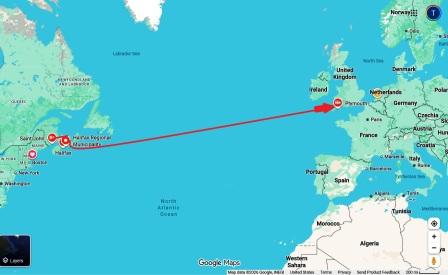
On The War Memorial Trail….A Visit To The Canadian War Cemetery In Adegem

Pieter (left) with Patrick Michiels at the Canadian War Cemetery in Adegem.  The bags by Pieter’s feet contain flags!  (Photo credit: Daria Valkenburg)

December 8, 2025.  Readers of this blog are aware that Pieter has been involved in finding photos of Canadians who are buried in The Netherlands since 2014.  This past spring we were in The Netherlands and Belgium for the 80th Anniversary of Liberation Commemoration events, and placed flags at the graves of 383 soldiers in 14 cemeteries. 

….Flags placed at the graves of soldiers from 8 provinces…

After visiting a number of cemeteries in The Netherlands during our 2025 European War Memorial Tour, we made our way into Belgium. The first cemetery there that we visited was the Canadian War Cemetery in Adegem.  Many Canadians who lost their lives during the Battle of the Scheldt are not only buried in the Canadian War Cemetery in Bergen Op Zoom in The Netherlands, but are also buried at the Canadian War Cemetery in Adegem, Belgium.

While most of those buried in Adegem died during the operations for the clearance of the south bank of the Scheldt, many Canadians who lost their lives elsewhere in Belgium were also brought here for burial.  

There are 1,119 WWII Commonwealth burials, 848 of them Canadian, and one unidentified burial from WWI. There are also 33 Polish and two French burials.  Flags were placed by Pieter at 29 graves at this cemetery:

  • 3 were from Nova Scotia
  • 2 from New Brunswick
  • 12 from Prince Edward Island
  • 2 from British Columbia
  • 2 from Saskatchewan
  • 3 from Manitoba
  • 1 from Alberta
  • 4 from Ontario

4 of the graves also received an Acadian flag.  All of the graves received a Canadian flag.  Provincial flags were placed at all graves, with the exception of the soldiers from British Columbia and Saskatchewan, for which, unfortunately, we did not receive flags.

….This was our first visit to Adegem…

Our journey to the cemetery in Adegem had a few hiccups.  It started with a mistake on my part, when I left my tablet behind at the hotel in Zaltbommel, and didn’t realize it was missing until we were half an hour into our journey to Adegem and had to turn around and go back.  Luckily, it was still in the hotel room, and we were on our way again. 

Then the GPS couldn’t find the cemetery and we got lost before Pieter’s good sense of direction got us to the cemetery….1 ½ hours later than planned.

As always, when we are in a war cemetery, we write an entry in the visitors’ book.  (Photo credit: Daria Valkenburg)

We were joined by Patrick Michiels, a Belgian researcher, who had been so helpful to us over the past few years in taking photos of graves of soldiers that Pieter had researched, even going on Christmas Day last year to take photos of the Christmas Eve candles at their graves.  (See https://onthewarmemorialtrail.com/2024/12/31/2024-christmas-eve-candle-lighting-at-the-canadian-war-cemetery-in-adegem/)

Overview of the Canadian War Cemetery in Adegem with the Cross of Sacrifice.  (Photo credit: Daria Valkenburg)

It took over 2 hours for Pieter to place the flags and to photograph each of the 29 graves, with a slight delay caused when Pieter cut his hand on a sharp knife that Patrick had lent him so he could poke a hole into the very dry soil in order to get the flags placed.  There was no real damage to his hand, but lots of blood!  It didn’t help that it was over 30oC (86oF) and the hot sun was beating down on us, making it feel hotter.

…4 soldiers whose stories were previously told are commemorated…

The graves and photos of 4 soldiers, whose stories have previously been told on this blog, are featured.

Pieter stands behind the grave of Harold ‘Hal’ Gabriel Bulger.  (Photo credit: Daria Valkenburg)

Harold ‘Hal’ Gabriel BULGER of Foxley River, Prince Edward Island, was serving with the Algonquin Regiment when he was killed during the Battle of Moerbrugge in Belgium on September 10, 1944, at the age of 26. You can read his story at https://onthewarmemorialtrail.com/2024/08/05/on-the-war-memorial-trail-the-bulger-brothers-part-i-the-wwii-soldier-from-foxley-river-killed-during-the-battle-of-moerbrugge/

Pieter stands behind the grave of Bruce Wilbur Churchill.  (Photo credit: Daria Valkenburg)

Bruce Wilbur CHURCHILL, born in Sandford, Yarmouth County, Nova Scotia, was serving with the Algonquin Regiment when was accidentally killed at the age of 23 on September 29, 1944 in The Netherlands when a bullet from a Bren Gun ricocheted and hit him.  You can read his story at https://onthewarmemorialtrail.com/2022/06/05/on-the-war-memorial-trail-the-ww2-soldier-who-lost-his-life-in-a-monastery-garden/

Pieter stands behind the grave of Joseph ‘Joe’ Hudson Pallister.  (Photo credit: Daria Valkenburg)

Joseph ‘Joe’ Hudson PALLISTER, born in Calgary, Alberta, was serving with the Canadian Scottish Regiment when he was killed during the Battle of the Leopold Canal in Belgium on October 6, 1944, aged 21.  You can read his story at https://onthewarmemorialtrail.com/2023/06/18/on-the-war-memorial-trail-1-wwii-soldier-2-families-3-countries/

After we sent photos of our visit to Joseph’s grave to his great-nephew, Thomas Mouser, he not only thanked us, but shared a letter written by Captain John ‘Jack’ Lawrence GALLAGHER to Joseph’s mother about her son…. 

….I wish to express my deepest sympathies to you on the loss of your son, Joe.  He was with the battalion for a long time, and was with me in ‘C’ Company from D-Day until the severe action in which he was killed.

During that time he became liked by everyone for his easy-going good humour and respected for his coolness in action and resourcefulness as our NCO. 

I can only say that he was killed instantly while carrying out his job, and that his conduct in that battle and all others that he participated in was an example to us all….”  

What a heartfelt letter of sympathy to a grieving mother! Captain Gallagher survived WWII, with the rank of Major and a Croix de Guerre (Bel) with Palm, and passed away in 2012. (See https://www.legacy.com/us/obituaries/legacyremembers/john-gallagher-obituary?id=44106495)

Pieter stands behind the grave of Edison Reynolds Smith.  (Photo credit: Daria Valkenburg)

Edison Reynolds SMITH, born on Port Hood Island, Cape Breton, Nova Scotia, was serving with the North Nova Scotia Highlanders when he lost his life in The Netherlands on October 16, 1944 during the Battle of the Scheldt, at the age of 20.  You can read his story at https://onthewarmemorialtrail.com/2023/12/07/on-the-war-memorial-trail-part-1-the-wwii-letters-of-edison-reynolds-smith/ and https://onthewarmemorialtrail.com/2023/12/12/on-the-war-memorial-trail-part-2-the-wwii-letters-of-edison-reynolds-smith/

….Photos of 3 soldiers from Prince Edward Island are sought…

Photos are still being sought for three soldiers from Prince Edward Island who are buried in Adegem:

  • Valmont PERRY of St. Louis was serving with the Stormont, Dundas and Glengarry Highlanders when he lost his life on October 21, 1944 at the age of 26.
  • Allan Rattenbury READ of Read’s Corner was serving with the Regina Rifle Regiment when he lost his life on October 27, 1944 at the age of 21.
  • John James SAUNDERS of Bloomfield was serving with the South Saskatchewan Regiment when he lost his life on September 22, 1944 at the age of 27.  

If you have photos or information to share about these men, please let Pieter know.

….All of the flags placed at graves were donated…

All of the flags placed at graves were donated.  Our thanks go to:

  • Alan Waddell, Constituent Assistant, on behalf of Heath MacDonald, MP for Malpeque, for the Canadian flags.
  • Matt MacFarlane, MLA for District 19, Borden-Kinkora, for the flags from Prince Edward Island.
  • Kyle Graham, Research Officer, Military Relations, Nova Scotia Intergovernmental Affairs, on behalf of Premier Tim Houston, Province of Nova Scotia, for the Nova Scotia flags.
  • Wayne Ewasko, MLA for Lac Du Bonnet, Manitoba, Interim Leader of the Official Opposition, Province of Manitoba, who donated the Manitoba flags.
  • Don Coutts on behalf of the Muttart and Coutts families in memory of Flight Sergeant Elmer Bagnall Muttart for the Ontario flags.
  • Jean-Claude D’Amours, MLA for Edmundston-Madawaska Centre, Minister responsible for Military Affairs, with the help of Cécile LePage, Province of New Brunswick, for the New Brunswick flags.
  • Marie Renaud, MLA St Albert, Alberta at the request of Roman Berezowsky, for the Alberta flag.
  • La Société acadienne de Clare at the request of Simone Comeau for the Acadian flags.

Thank you to Patrick Michiels for joining us during our visit to Adegem.  Thank you also to Thomas Mouser for sharing the letter of sympathy written by Captain Gallagher.  We’ll continue to share the highlights of our adventures on the 2025 European War Memorial Tour. 

The research work continues for Pieter.  If you have photos or information to share about soldiers buried in The Netherlands or Belgium, please email him at memorialtrail@gmail.com, or comment on the blog.    

© Daria Valkenburg

….Want to follow our research?…

If you are reading this posting, but aren’t following our research, you are welcome to do so.  Our blog address: https://onthewarmemorialtrail.com/

4 countries, 6 weeks, 7,000 km – an unforgettable war memorial journey in Europe…. Daria’s book ‘No Soldier Buried Overseas Should Ever Be Forgotten‘ is available in print and e-book formats.  Net proceeds of book sales help support research costs and the cost of maintaining this blog. For more information see https://nosoldierforgotten.com/

Subscribe to our YouTube Channel: On The War Memorial Trail With Pieter Valkenburg: https://www.youtube.com/channel/UCJ591TyjSheOR-Cb_Gs_5Kw

Never miss a posting!  Subscribe below to have each new story from the war memorial trail delivered to your inbox.
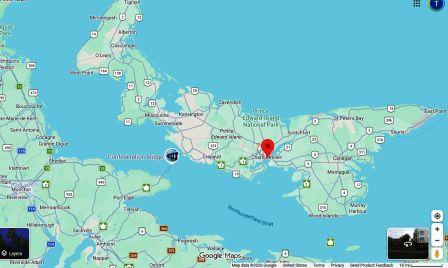
On The War Memorial Trail….Remembrance Week 2025 – Remembrance Day Services At Borden-Carleton Legion And In Kinkora

November 17, 2025. A cool but dry day on Tuesday, November 11, 2025 here on Prince Edward Island was very welcome for those standing outside during Remembrance Day services at Borden-Carleton Legion in Borden-Carleton and in Kinkora.  It seemed as though more people were in attendance than in previous years.

 ….Remembrance Day Service At Borden-Carleton Legion….

Pieter was the guest speaker during the Remembrance Day service at Borden-Carleton Legion. (Photo credit: Matt MacFarlane)

Remembrance Day at the Borden-Carleton Legion began with an inter-faith service, with Reverend Barbara Cairns of the United Church in Bedeque, and Father Babu A. Jesuraj of St. Malachy’s Roman Catholic Church in Kinkora.  Father Jesuraj, who is from the Tamil Nadu province in India, explained that he had only been assigned to the parish in Kinkora for a month.  Trish Taylor spoke about the 80th anniversary of the end of WWII and invited dignitaries from the area to say a few words about remembrance. 

Pieter was the guest speaker, and gave the same presentation he’d given a few days earlier at the Remembrance Service in Crapaud Community Hall.  (See https://onthewarmemorialtrail.com/2025/11/12/on-the-war-memorial-trail-remembrance-week-2025-remembrance-service-at-crapaud-community-hall/)

Flag lowered by Arthur Ranahan during the playing of ‘The Last Post’ by the Cenotaph at the Legion in Borden-Carleton. (Photo credit: Daria Valkenburg)

Wreath laid on behalf of the Government of Canada by the Cenotaph at the Legion in Borden-Carleton was placed by Pieter and carried by Danny Bernard. (Photo credit: Daria Valkenburg)

Following the Remembrance Day Service, everyone was invited inside the Legion for a light lunch and a much needed cup of coffee or tea.  We also had a chance to look at the posters prepared by members of the local 4-H club, which were on display in the Legion hall.

Posters for Remembrance Day from the 4-H club were displayed in the Borden-Carleton Legion.  (Photo credit: Daria Valkenburg)

….Remembrance Day Service by the Memorial in Kinkora….

The Remembrance Day service was over in Borden-Carleton by the end of the morning, but Legion members made their way to the memorial in Kinkora in the afternoon for a service there.

Wreath carried by Pieter Valkenburg and placed by Cenotaph in Kinkora by The Honourable Heath MacDonald, MP for Malpeque, Minister of Agriculture and Agri-Food. (Photo credit: Daria Valkenburg)

Wreath carried by Brian O’Connor and placed by Cenotaph in Kinkora by Matt MacFarlane, MLA for District 19, Borden-Kinkora Leader of the Green Party of PEI. (Photo credit: Daria Valkenburg)

Following the service in Kinkora, Pieter (centre) posed for a photo with Matt MacFarlane (left) and Heath MacDonald (right).  (Photo credit: Daria Valkenburg

Following the Remembrance Day Service, everyone was invited inside the community hall for a bowl of chile or chicken corn chowder and a much needed cup of coffee or tea.

….Statement by Matt MacFarlane in the PEI Legislature….

Matt MacFarlane, MLA for District 19, Borden-Kinkora, Leader of the Green Party of Prince Edward Island, informed us that he’d given a brief statement about us in the legislature on November 4, 2025.  We had no idea he’d done this until he sent us the link! (https://www.facebook.com/share/v/1Ame5ppZio/)

Thank you to the Legion members who participated in the various Remembrance Week events, and to the volunteers at the Borden-Carleton Legion and Kinkora Community Hall for preparing the snacks and hot drinks.

May we never forget all those who served, and continue to serve!  The work of remembrance of those who served continues.  More Remembrance Week stories to come.

If you have a story to tell, please let Pieter know. You can email him at memorialtrail@gmail.com, or comment on the blog.

© Daria Valkenburg

….Want to follow our research?….

If you are reading this posting, but aren’t following our research, you are welcome to do so.  Our blog address: https://onthewarmemorialtrail.com/

4 countries, 6 weeks, 7,000 km – an unforgettable war memorial journey in Europe…. Daria’s book ‘No Soldier Buried Overseas Should Ever Be Forgotten‘ is available in print and e-book formats.  Net proceeds of book sales help support research costs and the cost of maintaining this blog. For more information see https://nosoldierforgotten.com/ 

You are also invited to subscribe to our YouTube Channel: On The War Memorial Trail With Pieter Valkenburg: https://www.youtube.com/channel/UCJ591TyjSheOR-Cb_Gs_5Kw

Never miss a posting!  Subscribe below to have each new story from the war memorial trail delivered to your inbox.