On The War Memorial Trail….. The WWII Soldier From Clarence Who Lost His Life During Operation Cannonshot

September 7, 2024. When Pieter has to choose which name on a photo wish list to research, we never know what to expect. Sometimes a name is chosen because of the location where the soldier came from, sometimes it’s because of a particular battle in which he died, or because the surname seems to be rare enough that any information found would be relevant….and might lead to a family member who has a photo.

..…A lion featured in an old TV program led to one successful photo search …..

Sometimes, word association helps us decide on a name to search.  That’s what happened when scanning the list of names of Nova Scotia soldiers, and I noticed that one soldier, Ronald ‘Ronnie’ Eugene SMITH, came from Clarence.  That reminded me of Clarence, the cross-eyed lion, from a TV program I watched as a child. 

Daktari was a children’s program that followed the work of Dr. Tracy, a veterinarian at the fictional Wameru Study Centre for Animal Behaviour in East Africa, his daughter Paula, his staff, and a cross-eyed lion named Clarence.

…That’s the soldier whose photo you need to look for next….” I told Pieter.  The look on his face when I told him why was priceless!  But, Pieter began his research and quickly found a great-niece, Jennifer Wallis, the granddaughter of Ronnie’s only sibling – his brother Allison, who confirmed that yes, the family had a photo of the soldier.  A few months later, Jennifer wrote to let us know that photos were “… found after searching many boxes at my father’s home….

Before telling the story of the Canadian soldier from Clarence, Nova Scotia, take a look at the opening sequence from Daktari…

..…Ronnie enlisted in January 1944 …..

Screenshot 2024-09-02 at 12-28-34 Clarence · Annapolis County NS B0S 1C0

Ronald ‘Ronnie’ Eugene Smith was born in Clarence, Annapolis County, Nova Scotia.  (Map source: Google)

Ronald ‘Ronnie’ Eugene SMITH was born in Clarence, Nova Scotia on August 28, 1925, the son of Floyd Murdock and Ruby Gertrude (nee Palmer) Smith.  When he enlisted with the No. 6 District Depot in Yarmouth, Nova Scotia on January 3, 1944, he stated that he had left school after 2 years of high school and was working on his parents’ farm in Bridgetown, Nova Scotia as a farm hand.

Ronnie Smith colourized improved_photo(44)

Ronald ‘Ronnie’ Eugene Smith. (Photo courtesy of Donnie Smith. Photo colourization by Pieter Valkenburg)

On January 4, 1944, he was sent to the No. 6 Depot in Halifax, Nova Scotia for basic training, and then on January 14, 1944 to No. 60 Canadian Infantry (Basic) Training Centre (CIBTC) in Yarmouth, Nova Scotia, where his father, Captain Floyd Smith, was a trainer at this centre.

From February 11, 1944 until April 17, 1944, Ronnie was in and out of Yarmouth Military Hospital.  While he was recuperating he worked as a clerk in the Quartermaster stores between March and May 1944, after which he returned to general duties.

On July 30, 1944, Ronnie was transferred to A14 Canadian Infantry Training Centre (CITC) in Aldershot, Nova Scotia for further training.  He received embarkation leave, from September 23 to October 6, 1944, the last chance he had to see his family.

….Ronnie left Canada for overseas service….

On November 25, 1944, Ronnie left for Great Britain, part of a group to provide reinforcements to the Canadian Army in the field.  Upon arrival on December 6, 1944, he was assigned to No. 3 Canadian Infantry Training Regiment (CITR). 

Ronnie continued receiving further training until January 23, 1945, when he left the United Kingdom for Italy, as part of the X-4 Reinforcements of the 1st Infantry Battalion, arriving on February 7, 1945.

As he arrived at No. 3 CITR a few days after Frank GALLANT of Prince Edward Island, perhaps the two Maritime soldiers had a chance to meet. The two men also left the United Kingdom for Italy on the same day. Once in Italy, although they were in the same location, their paths diverged as they were assigned to different regiments. (See https://onthewarmemorialtrail.com/2024/06/30/on-the-war-memorial-trail-the-wwii-soldier-from-mount-carmel-killed-during-the-liberation-of-posterenk/)
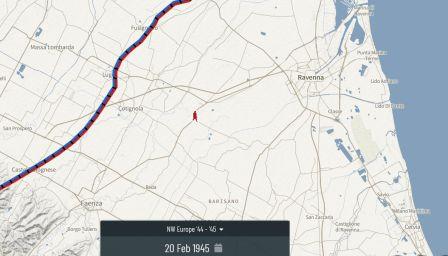
Screenshot 2024-09-07 at 11-06-35 Project '44

The West Nova Scotia Regiment was near Rossi, indicated by the soldier in the centre of the map, on February 20, 1945.  (Map source: Project ‘44)

On February 20, 1945, Ronnie was transferred to the West Nova Scotia Regiment, joining them north of Rossi (Russi), part of a group of reinforcements, at the tail end of the Italian Campaign. (See https://en.m.wikipedia.org/wiki/Italian_campaign_(World_War_II))
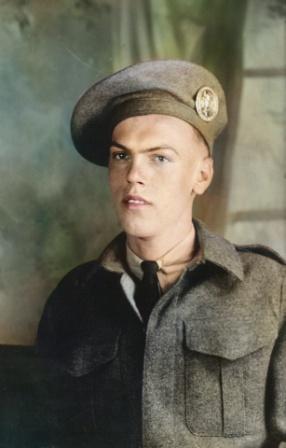
Ronnie Smith colourized improved_photo(43)

Ronald ‘Ronnie’ Eugene Smith joined the West Nova Scotia Regiment in February 1945. (Photo courtesy of Donnie Smith. Photo colourization by Pieter Valkenburg)

On March 20, 1945, he left Italy at the port in Livorno as part of Operation Goldflake, arriving in Marseilles, France two days later.  Operation Goldflake was the codename for moving troops from Italy to North-West Europe.  (See https://en.wikipedia.org/wiki/Operation_Goldflake)

After one night of rest, the Battalion left Marseilles for Belgium, arriving in Berlaer on March 28, 1945. 

….Ronnie was part of Operation Cannonshot….

On April 4, 1945, the Battalion arrived at a concentration area in the Reichswald Forest in Germany, where they stayed briefly for training in preparation for Operation Cannonshot.  The 49th British Division was to clear Arnhem in The Netherlands, and launch the 5th Canadian Armoured Division on a drive northwards. The 1st Canadian Division would bridgehead the IJssel River and head west to meet them.

On April 10, 1945, they moved to Hummelo, The Netherlands. Operation Cannonshot began on April 11, 1945, with Allied troops preparing to cross the IJssel River the following night and then advance towards Apeldoorn, The Netherlands. (See https://www.liberationroute.com/stories/190/operation-cannonshot)

The Battalion moved to the Royal Canadian Regiment area at Zutphen, just across the IJssel River on the night of April 12 into 13, 1945, crossing it at 2:30 am and establishing its Tactical Headquarters.

On April 13, 1945 the Regiment was committed to a breakout of a bridgehead on the IJssel River. According to the war diary for that day, the attack was expected to begin at 8:30 am “…but the attack did not begin until approximately 1100 hours, at which time ‘A’ Company, supported by tanks, started for their first objective.  They were barely on their way when, due to an artillery concentration called down by Carleton & York Regiment, it was necessary to hold up until 1130 hours….

By noon, ‘A’ Company was making good progress allowing both ‘A’ and ‘C’ Companies to advance on a two-company front. Progress slowed as resistance increased and ended at 7:45 pm.

….Ronnie lost his life near Zutphen….

On April 14, 1945, Tactical Headquarters was established in Zutphen area early in the morning. Companies sent out reconnaissance patrols during the rest of the night and into the early morning hours. The battalion was now in brigade reserve with the Royal 22nd Regiment on the left and the Carleton & York Regiment on the right. The Battalion attacked at 3:30 pm through the Royal 22nd Regiment to clear the woods on both sides of the highway leading to Apeldoorn but was held up by enemy fire and the attack was postponed.

At some point on April 14, 1945, Ronnie lost his life.  He was only 19 years old.  He was killed near a house beside a wooded area, and was initially buried in a field behind a house on the crossroads near Wilp/Achterhoek, The Netherlands. 

Henk Vincent, a volunteer at the Canadian War Cemetery in Holten, explained that “only from December 1945, when the construction of the cemetery in Holten was completed, did the final burial take place….

Ten zuid oosten van Apeldoorn(1)

Red marker shows temporary burial in Wilp/Achterhoek area southeast of Appeldoorn. (Map source: Google maps)

….Ronnie is buried in Holten…

After being exhumed from the temporary cemetery in Wilp/Achterhoek, Ronnie was reburied in the Canadian War Cemetery in Holten, The Netherlands on January 26, 1946.  When the cemetery was first opened, metal crosses were used to mark each grave.

Ronald E Smith - Marker in Holten

The original metal grave marker at the Canadian War Cemetery in Holten for Ronald ‘Ronnie’ Eugene Smith.  (Photo courtesy of Donnie Smith)


smith, ronald eugene gravestone photo from Holten Info Centre

Grave of Ronald ‘Ronnie’ Eugene Smith in the Canadian War Cemetery in Holten, The Netherlands.  (Photo courtesy of the Information Centre Canadian Cemetery Holten)

..…We met with Ronnie’s family …..

We love meeting family members, and were delighted when we had a chance to meet Jennifer Wallis and her husband Kevin at a restaurant in Enfield, Nova Scotia.

CIMG6571 Oct 25 2023 Kevin & Jennifer with Pieter in Enfield

Kevin and Jennifer Wallis with Pieter in Enfield, Nova Scotia.  (Photo credit: Daria Valkenburg)

Thank you to Jennifer and Kevin Wallis and Jennifer’s father Donnie Smith.  Do you have photos or information to share? Email Pieter at memorialtrail@gmail.com, comment on the blog, or tweet to @researchmemori1.

© Daria Valkenburg

….Want to follow our research?….

If you are reading this posting, but aren’t following our research, you are welcome to do so.  Our blog address: https://onthewarmemorialtrail.com/
Front cover OnTheWarMememorialTrailinEurope4 countries, 6 weeks, 7,000 km – an unforgettable war memorial journey in Europe…. Daria’s book ‘No Soldier Buried Overseas Should Ever Be Forgotten‘ is available in print and e-book formats.  Net proceeds of book sales help support research costs and the cost of maintaining this blog. For more information see https://nosoldierforgotten.com/ 

You are also invited to subscribe to our YouTube Channel: On The War Memorial Trail With Pieter Valkenburg: https://www.youtube.com/channel/UCJ591TyjSheOR-Cb_Gs_5Kw

Never miss a posting!  Subscribe below to have each new story from the war memorial trail delivered to your inbox.

On The War Memorial Trail…..The WWII Soldier From Mount Carmel Killed During The Liberation Of Posterenk

June 30, 2024.  In 2017, Pieter and I visited the village of Posterenk in The Netherlands with Edwin van der Wolf, one of the research volunteers at the Canadian War Cemetery in Holten.

CIMG9302 Sep 25 2017 Posterenk Windmill

Windmill in Posterenk, which has a memorial stone inscribed on the wall.  (Photo credit: Daria Valkenburg)

CIMG9300 Sep 25 2017 Sign Posterenk freed by CYR Apr 13 1945

Translation of memorial stone on the windmill: Posterenk freed by the Carleton & York Regiment of Canada on April 13, 1945. (Photo credit: Daria Valkenburg)

….The Island connection to Posterenk…..

Edwin wanted us to visit the village because it had an Island connection.  François ‘Frank’ GALLANT, son of Antoine and Eleanor (nee Poirier) Gallant of Mount Carmel, Prince Edward Island,  died there on April 13, 1945, while serving with the Carleton & York Regiment.

CIMG9296 Sep 25 2017 Edwin and Pieter by Posterenk windmill

Edwin van der Wolf (left) and Pieter in Posterenk.  (Photo credit: Daria Valkenburg)

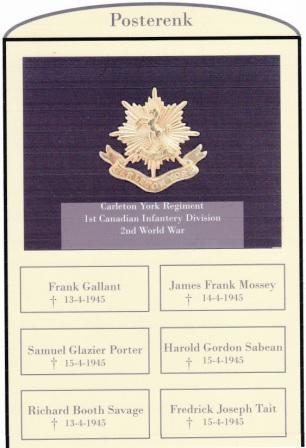
The village had a list of 6 soldiers to commemorate from the Carleton & York Regiment, who had all been buried in the area.  Unfortunately, not all soldiers who died are included on this list, but Edwin worked towards including two more, who were not buried near Posterenk, but “were temporarily buried in Lochem because they had previously died in a Canadian hospital there…” 

In total, out of the 8 soldiers, three were from Prince Edward Island!  The stories of Daniel Peter MACKENZIE and James ‘Frank’ MOSSEY were previously told.  In this posting, we feature the story of Frank GALLANT, the reason we were in Posterenk back in 2017!

Gallant Frank

François ‘Frank’ Gallant.  (Photo courtesy of the Information Centre Canadian Cemetery Holten)

….Three Gallant brothers served…..

Born November 24, 1914, Frank originally enlisted under the National Resources Mobilization Act (NRMA) in Charlottetown, Prince Edward Island on August 13, 1942 and underwent basic training at No. 62 Canadian Army Basic Training Centre (CABTC), which he completed on October 12, 1942. (See https://en.wikipedia.org/wiki/National_Resources_Mobilization_Act)

His Personnel Information Record noted that he could speak both French and English, and came from a rural farming background, which likely accounted for him having only a Grade 4 education.  In addition to farming, Frank had experience in carpentry work, and had worked in a lumber mill.  He could drive a vehicle, and played baseball and hockey. Two of his brothers, Georges and Simon, were also in the army. 

With his basic training successfully completed, Frank was transferred to A5 Canadian Engineer Training Camp (CETC) in Petawawa, Ontario for advanced training on October 13, 1942.  Upon completion of that training, he remained in Petawawa for an additional two months, doing general repair work. 

On January 28, 1943, Frank was transferred to No. 2 Engineer Services and Works Company (ES&W Company) of the Royal Canadian Engineers, where his task was to fire and repair boilers at No. 2 District Depot in Toronto, Ontario. He was with ‘D’ Wing, a ‘supernumerary to establishment’ reserve unit, while a decision about the direction his army career was to take was made.

Frank had expressed interest in being considered in the Tradesman category as a fireman or maintenance man, but it was determined that since his occupation background was “… erratic….” with no “…special training…” and he was considered very fit, in the “…A-1 category…”, he should be reallocated to “…Infantry (Non-Tradesman)” and receive infantry training. 

Frank received special leave to return home to Prince Edward Island to help with the family’s farm operation on August 29, 1943, after which he returned to Toronto on November 1, 1943.

….Frank transferred to the Infantry…..

As a result of the assessment that he be assigned to an Infantry Unit, Frank was transferred to the 1st Battalion Victoria Rifles of Canada on November 10, 1943 and sent the following day to Stratford, Ontario to be re-mustered as a rifleman.

Frank remained in Stratford for training until February 18, 1944, when he was sent to Niagara-on-the-Lake, Ontario. 

On August 24, 1944, Frank transferred from the non-active militia to active service in the Canadian Army, remaining with the 1st Battalion Victoria Rifles of Canada in Niagara-on-the-Lake.

….Frank left Canada for overseas service…..

On November 21, 1944, Frank left for Great Britain with the 1st Battalion, to provide reinforcements to the Canadian Army in the field.  Upon arrival on November 28, 1944, he was assigned to No. 3 Canadian Infantry Training Regiment (CITR).

He continued receiving further training until January 23, 1945, when he left the United Kingdom for Italy, as part of the X-4 Reinforcements, arriving on February 7, 1945.  On February 13, 1945 he was transferred to the Carleton & York Regiment, joining them north of Rossi (Russi), part of a group of reinforcements, at the tail end of the Italian Campaign. (See https://en.m.wikipedia.org/wiki/Italian_campaign_(World_War_II))

He joined the Carleton & York Regiment at the same time as Archibald Phillip ‘Archie’ MCLEAN of Edmundston, New Brunswick.  Archie’s story was previously told on this blog.  (See https://onthewarmemorialtrail.com/2023/09/13/on-the-war-memorial-trail-archie-was-a-good-guy/)

Screenshot 2023-09-04 at 16-28-14 Map of Russi Italy

The Carleton & York Regiment was north of Russi on February 13, 1945.  (Map source: http://www.gosur.com)

On March 17, 1945, he left Italy as part of Operation Goldflake, arriving in Marseilles, France three days later.  Operation Goldflake was the codename for moving troops from Italy to North-West Europe.  (See https://en.wikipedia.org/wiki/Operation_Goldflake)

The Carleton & York Regiment was now part of the 21st Army Group. From France, troops were moved up to the Belgian front, into The Netherlands, through the Reichswald Forest in Germany, and then back into The Netherlands.

The Liberation of Posterenk…

On April 12, 1945 the Regiment was part of Operation Cannonshot, which led to the crossing of the IJssel River between the villages of Gorssel and Wilp in the eastern part of The Netherlands. (See https://www.liberationroute.com/stories/190/operation-cannonshot)

Map western holland showing Posterenk

According to the April 12, 1945 war diary entry of the Carleton & York Regiment, they “…moved across the Ijssel River at 14:30 hours….” to relieve the Seaforth Highlanders of Canada.

On April 13, 1945, the war diary entry noted that “…‘D’ Company’s objective is Posterenk…The Regiment didn’t expect much opposition, but they “met with stiff resistance just after starting at 11:25 hrs…

In ‘Invicta – The Carleton and York Regiment in the Second World War’ author Robert Tooley explained that “…on the CYR front D Company was to lead off towards its first objective, the village of Posterenk: the opposition was expected to be light, and the company was instructed to continue to move forward until strong opposition was encountered.  The battalion now had in support a troop of M10 SP anti-tank guns, a troop of tanks, a platoon of medium machine guns, and a platoon of 4.2 inch mortars. D Company pushed off at 10:50 am….. Contrary to expectations, D Company met stiff resistance and suffered several casualties from small arms fire….”   

At some point during that day, Frank lost his life. 

…Frank is buried in Holten…

Frank was one of 6 soldiers initially buried along the main road to Posterenk, a village near Zutphen, before being reburied in the Canadian War Cemetery in Holten.

Posterenk list of 6 CYR members

The 6 soldiers buried near Posterenk.

CIMG3198 Oct 3 2019 Holten Frank Gallant

Grave of François ‘Frank’ Gallant at the Canadian War Cemetery in Holten.  (Photo credit: Daria Valkenburg)

…Frank is remembered on the war memorial in Wellington…

In May 2024, we visited the war memorial in Wellington, Prince Edward Island, where Frank’s name is listed.

CIMG6840 May 27 2024 Wellington Monument - Francis Gallant - photo by Pieter

François ‘Frank’ Gallant is remembered on the war memorial in Wellington, Prince Edward Island.  (Photo credit: Pieter Valkenburg)

…Previous stories about soldiers commemorated in Posterenk….

Do you have photos or information to share? Email Pieter at memorialtrail@gmail.com, comment on the blog, or tweet to @researchmemori1.

© Daria Valkenburg

….Want to follow our research?….

If you are reading this posting, but aren’t following our research, you are welcome to do so.  Our blog address: https://onthewarmemorialtrail.com/

Front cover OnTheWarMememorialTrailinEurope4 countries, 6 weeks, 7,000 km – an unforgettable war memorial journey in Europe…. Daria’s book ‘No Soldier Buried Overseas Should Ever Be Forgotten‘ is available in print and e-book formats.  Net proceeds of book sales help support research costs and the cost of maintaining this blog. For more information see https://nosoldierforgotten.com/ 

You are also invited to subscribe to our YouTube Channel: On The War Memorial Trail With Pieter Valkenburg: https://www.youtube.com/channel/UCJ591TyjSheOR-Cb_Gs_5Kw

Never miss a posting!  Subscribe below to have each new story from the war memorial trail delivered to your inbox.

On The War Memorial Trail….. “Archie Was A Good Guy”

September 12, 2023.  When Pieter begins researching a soldier whose name is on a photo wish list from one of the Canadian War Cemeteries in The Netherlands, he quite often finds current family members in various parts of Canada or the USA. 

A zigzag virtual search is not uncommon, but it’s rare that a search from one part of the country leads him right back to our own province of Prince Edward Island! But that’s what happened in the search for a photo of Archibald Phillip ‘Archie’ MCLEAN of Edmundston, New Brunswick!

The son of Allan John and Mary Rose ‘Minnie’ (nee Comfort) McLean, Archie was born August 5, 1920 in Edmundston.  When he enlisted in Edmundston on May 14, 1941 at the No. 7A District Field Office, he listed his occupation as paper maker with the Fraser Pulp Company in Edmundston, a pulp mill. (See https://en.wikipedia.org/wiki/Fraser_Papers – the Edmundston mill is still in operation, owned by Twin Rivers Paper Company.)

His enlistment form recorded that he had been serving in the 2nd Battalion Carleton & York Militia since July 1940.  It also noted that he enjoyed skating, and playing hockey and baseball.

Three of his brothers were also serving – and survived the war: Lawrence and Wilfred were in the Canadian Army.  Allan was in the Canadian Navy.  He also had five  sisters: Mae, Patricia, Emma, Theresa, and Hilda.

…The search for a photo of Archie led to two nephews….

The key to finding family came from two of the sisters.  Mae married Bertrand Clarence Michaud, and Pieter contacted her son Michael, who lives in Brunswick, Maine.   Michael didn’t have a photo but said his cousin, Donald Moore, who lives in Summerside, Prince Edward Island, and is himself a veteran, likely would.  Donald’s mother Theresa was another sister of Archie’s.

Pieter then contacted George Dalton, a veteran who lives in Summerside. Did he know him?  “…Yes…” George said.  “…He’s not been well, but someone from our group will contact him…

In the mysterious way that the Island works, it turned out that Pieter had previously met Donald Moore’s daughter, Tina Mundy!  It wasn’t very long before Tina’s daughter, Erin Mundy Montgomery, sent photos and information.  And a few days later, we met with Donald.

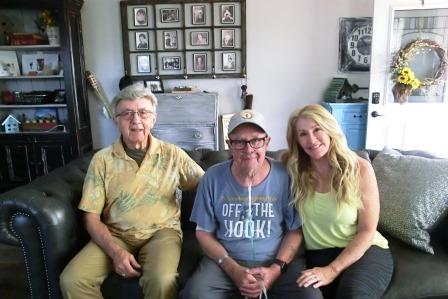
CIMG6452 Aug 29 2023 Pieter Don Moore Tina Mundy

Pieter with Donald Moore and Tina Mundy.  (Photo credit: Daria Valkenburg)

…Archie was a good guy…” Donald said.  “… I became 84 years old on July 23, and am the oldest of the cousins.  I spent 38 years in the military, with the RCAF, including a 4 year posting in France.  I made about 20 trips to Holland, but I never knew where Archie was buried…”  A planned trip to visit his grave in 2020 got cancelled due to Covid.

… Archie joined the Royal Canadian Engineers as a sapper….

On May 21, 1941, Archie was assigned to No. 71 Basic Training Centre in Edmundston.  After completing basic training, he was sent to the A5 Royal Canadian Engineers Training Centre in Petawawa, Ontario for training as a sapper on July 25, 1941. 

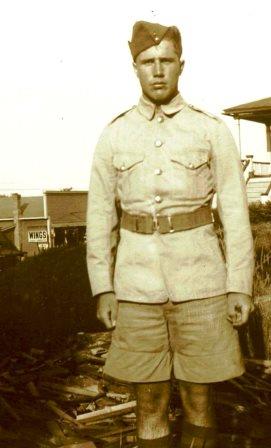
Archie McLean slightly corrected

Archibald Phillip ‘Archie’ McLean. (Photo courtesy of Donald Moore)

Life moved quickly for Archie, as on September 27, 1941 he was transferred to the 1st Field Squadron of the Royal Canadian Engineers.  On October 1, 1941, he passed the Standard Army Trade Test for Pioneer Class ‘C’.   This classification took into account a soldier’s civilian trade skills and experience and meant formal training might not be needed. 

…Archie left Canada for overseas service….

Shortly afterwards, on October 6, 1941, he left Canada, arriving in the United Kingdom on October 19, 1941.

On March 9, 1942, he was reassigned to the Engineer Reinforcement Unit (ERU) for a short period, then was transferred to No. 2 Canadian Construction Company of the Royal Canadian Engineers.  Archie was sent for a number of courses.  He completed a firefighting course on April 6, 1942, a Steel Square course on May 23, 1942, and received a qualification as a Carpenter ‘B’ on June 5, 1942. Around this period, No. 2 Construction Company was designated as No. 6 Canadian Construction Company.

Among the tasks that Archie would have participated in was the building of an RCAF bomber airport in Dunsfold, a task that was completed in a record-breaking 6 months. (See https://en.wikipedia.org/wiki/Dunsfold_Aerodrome)

Following the completion of the airport, the Company underwent training in bridge construction.  In January 1943, according to the Company’s Regimental history, ‘The Story of 2 Battalion R.C.E. 1940-1945’  “…we moved briefly into the Worthing area to construct pillboxes to a German design, for a tank outfit to shoot at…

After that they were tasked with renovations to an airport in Cornwall, in what was not a happy experience. “…After a battalion movement by train, we arrived at scintillating St Eval in the most fearfully depressing rain storm imaginable.  Day after day it lasted…”  Their assignment was “…to construct extensions to the existing standings and runways of the airport….” 

However, “… as soon as the cement had been poured, the rain would drum down, ignore tarpaulins and matting placed over the cement to protect it, and rot it, before it had a chance to set. Yard after yard of it had to be torn up and re-laid…”   (See https://en.wikipedia.org/wiki/RAF_St_Mawgan)

Renovations of the airport finally completed, the Company went to “…Bedford, for another spell of bridging…” so that heavy artillery could cross gaps in fields.

On June 1, 1944, Archie was transferred to No 1 Canadian Engineer Reinforcement Unit (CERU).  He briefly entered the world of show business between September 18, 1944 and October 10, 1944, when he was attached to ICA Shows when the Canadian Army Show came to England to perform for troops. He would have been involved in preparing stages and sets. (See https://www.silverhawkauthor.com/post/canadian-army-show-first-canadian-army-in-the-north-west-europe-campaign-of-1944-1945)

On November 18, 1944, Archie was transferred to the Canadian Infantry Corps (CIC) and assigned to No. 3 Canadian Infantry Training Regiment (CITR).

…Archie joined the Carleton & York Regiment in Italy….

Screenshot 2023-09-04 at 16-28-14 Map of Russi Italy

The Carleton & York Regiment was north of Rossi on February 13, 1945.  (Map source: http://www.gosur.com)

On January 4, 1945 Archie left the United Kingdom for Italy.  Then, on February 13, 1945 he was transferred to the Carleton & York Regiment, and reclassified from Pioneer ‘C’ to General Duty.   He joined them as the Regiment was north of Rossi, part of a group of reinforcements, at the tail end of the Italian Campaign. (See https://en.m.wikipedia.org/wiki/Italian_campaign_(World_War_II))

On March 16, 1945, he left Italy as part of Operation Goldflake, arriving in Marseilles, France two days later.  Operation Goldflake was the codename for moving troops from Italy to North-West Europe.  (See https://en.wikipedia.org/wiki/Operation_Goldflake)

The Carleton & York Regiment was now part of the 21st Army Group. From France, troops were moved up to the Belgian front, into The Netherlands, through the Reichswald Forest in Germany, and then back into The Netherlands.

On April 12, 1945 the Regiment was part of Operation Cannonshot, which led to the crossing of the IJssel River between the villages of Gorssel and Wilp in the eastern part of The Netherlands. (See https://www.liberationroute.com/stories/190/operation-cannonshot)

According to the April 12, 1945 war diary entry of the Carleton & York Regiment, they “…moved across the Ijssel River at 14:30 hours….” to relieve the Seaforth Highlanders of Canada.

Map western holland showing Posterenk

On April 13, 1945, the war diary of the Carleton & York Regiment noted that troops were south of Deventer. “Weather – morning, dull and foggy, sunny in the afternoon, cold at night….

The objective was to clear Posterenk and move further up. Four Companies of the Carleton & York Regiment were engaged.  ‘D’ Company was to clear Posterenk, while the rest followed in support.  After Posterenk was cleared in the early afternoon, “…At 1538 hrs ‘B’ Company began to move up in carriers with one platoon of tanks in support…”  ‘D’ Company was then held up due to enemy fire.

… ‘B’ Company pushed through ‘D’ Company but were held up … by small arms and mortar fire…. At 1723 hrs ‘B’ Company moved forward again under heavy mortar fire, these mortars were engaged, also an enemy SP firing on ‘B’ Company from their left…” SP refers to self-propelled weapons.

It got worse. “… ‘B’ Company met with stiff enemy resistance….”  However, “…at 1925 hrs ‘B’ Company had cleared enemy and were moving forward slowly…” Then came a report of more problems. “… ‘B’ Company ….are now … meeting considerable enemy resistance…

…So far during B Company’s attack they have eight wounded and one killed, Lt. W.E. Brousseau being one of those wounded…

Both ‘B’ and ‘D’ Companies came under attack from high explosives. ‘D’ Company reported two wounded during the liberation of Posterenk.  One of these was Daniel ‘Dan’ Peter MACKENZIE. (See https://onthewarmemorialtrail.com/2023/06/29/on-the-war-memorial-trail-the-wwii-soldier-from-victoria-cross-fatally-wounded-during-the-liberation-of-posterenk/

Archie was among those wounded on April 13, 1945. While it’s possible that he was one of the two wounded from ‘D’ Company, he has never been mentioned as one of the soldiers that liberated Posterenk.  Therefore, we believe that he was one of the 8 soldiers wounded from ‘B’ Company.

The medical file stated that Archie received shrapnel wounds from a high explosive that penetrated his left chest.  He was taken to No 3. Casualty Clearing Centre, a Canadian military field hospital in Lochem, where he died in the very early hours of April 17, 1945.  He was 25 years old.

The records of his death go back and forth between April 16 and 17, but an ‘Amendment As To Date Of Casualty’ finally determined it was April 17, 1945.  That was the date that he was ‘struck off strength’ for his final pay, for the Estates Department, and on his New Brunswick Death Certificate.

…Archie is buried in the Canadian War Cemetery in Holten….

On April 17, 1945, Archie was temporarily buried in the Lochem Civil Cemetery, before being reburied in 1946 in the Canadian War Cemetery in Holten.   

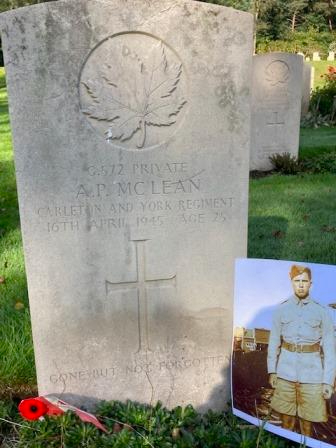
IMG_1003 Sep 4 2023 Grave of Archie McLean with photo

Grave of Archibald Phillip ‘Archie’ McLean in Holten, The Netherlands.  (Photo credit: Henk Vincent)

Thank you to Erin Mundy Montgomery, Don Moore, and Tina Mundy for sharing photos and information on Archie McLean.  Thank you to George Dalton and Michael Michaud for help in finding family. Thank you to Barry Miller for helping with information on troop movements on April 13, 1945.  Thank you to Edwin van der Wolf and Henk Vincent, volunteer researchers for the Canadian War Cemetery in Holten and at the Information Centre Canadian Cemetery Holten, for placing Archie’s picture beside his grave and taking a photo for us.

If you have a story to tell, please let Pieter know. You can email him at memorialtrail@gmail.com, or comment on the blog.  

© Daria Valkenburg

…Want to follow our research?….

If you are reading this posting, but aren’t following the blog, you are welcome to do so.  Our blog address: https://onthewarmemorialtrail.com/

Front cover OnTheWarMememorialTrailinEurope4 countries, 6 weeks, 7,000 km – an unforgettable war memorial journey in Europe…. Daria’s book ‘No Soldier Buried Overseas Should Ever Be Forgotten‘ is available in print and e-book formats.  Net proceeds of book sales help support research costs and the cost of maintaining this blog. For more information see https://nosoldierforgotten.com/

Subscribe to our YouTube Channel: On The War Memorial Trail With Pieter Valkenburg: https://www.youtube.com/channel/UCJ591TyjSheOR-Cb_Gs_5Kw

Never miss a posting!  Subscribe below to have each new story from the war memorial trail delivered to your inbox.

On The War Memorial Trail…..The WWII Soldier From Victoria Cross Fatally Wounded During The Liberation Of Posterenk

June 29, 2023.  In 2017, Pieter and I visited the village of Posterenk in The Netherlands with Edwin van der Wolf, one of the research volunteers at the Canadian War Cemetery in Holten.

CIMG9295 Sep 25 2017 Posterenk windmill

Windmill in Posterenk, which has a memorial stone inscribed on the wall.  (Photo credit: Daria Valkenburg)

….The Island connection to Posterenk…..

Edwin wanted us to visit the village because it had an Island connection.  Frank GALLANT, son of Anthony and Eleanor Gallant of Mount Carmel, Prince Edward Island, who was with the Carleton & York Regiment, died during there on April 13, 1945 at the age of 32.

The village had a list of 6 soldiers to commemorate from the Carleton & York Regiment, who had all been buried in the area.  In addition to Frank Gallant, the list named another Islander, James ‘Frank’ MOSSEY, of Souris.

Unfortunately, not all soldiers who died are included on this list, but Edwin worked towards including two more, who were not buried near Posterenk, but “were temporarily buried in Lochem because they had previously died in a Canadian hospital there….

These two additional soldiers were: Goldwin Marven POLLICK of Minto, New Brunswick, and Daniel Peter MACKENZIE of Victoria Cross, Prince Edward Island. 

Born March 22, 1918 in Victoria Cross, Daniel ‘Dan’ Peter MACKENZIE was the son of John and Rachael MacKenzie.  His niece, Carol Burke, provided more information on his life when she contacted Pieter in 2015:  “Dan MacKenzie grew up on a farm in Victoria Cross, Prince Edward Island, and attended Victoria Cross school.  He had 3 brothers Johnny, Billy, and Angus, all deceased, and 3 sisters: Florence Rodgerson, Mabel MacNeill, and Edna Campbell, all living in Prince Edward Island. Dan enjoyed playing hockey and ball with his siblings and working on the farm with his father…” 

….Dan MacKenzie enlisted in 1940…..

Before enlisting with the PEI Highlanders in Charlottetown, Prince Edward Island on May 15, 1940, Dan had served in the militia with the PEI Light Horse Regiment (17th Reserve Armoured Regiment) since 1937.  He had been working as a farm labourer for Gavin Read of Montague, Prince Edward Island, and hoped to have a dairy farm of his own.

MacKenzie-Daniel-P (2)

Daniel ‘Dan’ Peter MacKenzie. (Photo courtesy of Carol Burke)

He went to Dartmouth, Nova Scotia for basic training, and remained there until June 3, 1941, when he was sent to Valcartier, Quebec in preparation for guard duty in Newfoundland. 

… Dan was sent to Newfoundland….

NFLD Map shows Botwood

Location of Botwood Military Base in Newfoundland. (Map source: http://postalhistorycorner.blogspot.com/2012/12/wwii-canadian-forces-in-newfoundland.html)

After France was occupied by the Germans in 1940, Newfoundland’s defensive position became more precarious. That same year, Canada assumed responsibility for the defence of Newfoundland with the establishment of ‘W Force’, a Canadian garrison force responsible for defending Newfoundland against enemy incursions and providing security for existing and proposed defence facilities during WWII. It included infantry, artillery, and anti-aircraft units. (See https://en.wikipedia.org/wiki/Military_history_of_Newfoundland_during_World_War_II)

On July 23, 1941, as part of ‘W Force’, Dan was sent to Botwood, Newfoundland.  In addition to the PEI Highlanders, troops from the Black Watch of Canada, Royal Rifles of Canada, The Algonguin Regiment, Queens Own Rifles, also served at various times. While an RCAF base in Botwood had aircraft patrolling the east coast of the Atlantic, Canadian Army personnel based at Botwood were charged with protection of military facilities that had been installed there, as well as in Gander. (See https://www.heritage.nf.ca/articles/politics/botwood-base.php)

…..Three other soldiers were in Botwood…..

Dan was in Botwood at the same time as three other soldiers whose stories have been told on this blog:

Dan remained in Newfoundland until March 20, 1943, when he was sent to Sussex, New Brunswick.  On June 2, 1943, Dan was transferred to the No. 1 Transit Camp in Debert, Nova Scotia, for final preparation and training before being sent overseas. 

…Dan was in the Italian Campaign….

He left Canada on June 10, 1943, arriving in the United Kingdom on June 18, 1943 and posted to No. 7 Canadian Infantry Reinforcement Unit (CIRU).  On October 25, 1943 he participated in Hot Dog, an exercise to prepare troops who would be part of the Central Mediterranean Force (CMF) and travelled on to mainland Europe with the CMF and the Allied Army in Italy (AAI).  Not long afterwards, he was transferred to the Carleton & York Regiment on December 23, 1943, fighting in the Italian Campaign. (See https://en.m.wikipedia.org/wiki/Italian_campaign_(World_War_II))

Carol Burke had noted that Dan’s “… regiment fought just north of Ortona, Italy…. and was in the forefront of the assaulting Infantry that bitterly fought Gustav, Hitler and Gothic Line battles....”

On December 31, 1944 Dan was attached to Allied Forces Headquarters (AFHQ), which controlled all Allied operational forces in the Mediterranean Theatre of Operations until the end of the war.  AFHQ was based in Caserta, Italy after the capture of Sicily and invasion of Italy.

On March 19, 1945 he left Italy as part of Operation Goldflake, arriving in Marseilles, France two days later.  Operation Goldflake was the codename for moving troops from Italy to North-West Europe.  (See https://en.wikipedia.org/wiki/Operation_Goldflake)

The Carleton & York Regiment was now part of the 21st Army Group. From France, troops were moved up to the Belgian front, into The Netherlands, through the Reichswald Forest in Germany, and then back into The Netherlands.

…The Liberation of Posterenk…

On April 12, 1945 the Regiment was part of Operation Cannonshot, which led to the crossing of the IJssel River between the villages of Gorssel and Wilp in the eastern part of The Netherlands. (See https://www.liberationroute.com/stories/190/operation-cannonshot)

Map western holland showing Posterenk

According to the April 12, 1945 war diary entry of the Carleton & York Regiment, they “…moved across the Ijssel River at 14:30 hours….” to relieve the Seaforth Highlanders of Canada.

On April 13, 1945, the war diary entry noted that …‘D’ Company’s objective is Posterenk…The Regiment didn’t expect much opposition, but they “met with stiff resistance just after starting at 11:25 hrs…

With the help of a tank troop, they were able to move forward.  According to the war diary entry, “at 13:37 hrs ‘D’ Company reported that POSTERENK was clear of the enemy, having had one officer killed (Lt. R.B. Savage) and two other ranks wounded but a total of 50 POWs. ‘D’ Company were ordered to push on up the road which they did at once and came under enemy fire…

Dan was one of those wounded. The medical file stated he received gunshot wounds to his abdomen and left hip.  He was taken to a Canadian hospital in Lochem, where he died at 7:30 pm, despite heroic efforts to save him.  He was 26 years old.

…Dan is buried in the Canadian War Cemetery in Holten…

Dan was initially buried in the Lochem Civil Cemetery, before being reburied on February 1, 1946 in the Canadian War Cemetery in Holten.

We visited his grave in 2017 and 2019.  See: https://onthewarmemorialtrail.com/2018/01/20/on-the-war-memorial-trail-at-holten-canadian-war-cemetery/

CIMG9112 Sep 18 2017 Holten Cemetery Pieter by grave of D MacKenzie

Pieter by the grave of Daniel ‘Dan’ Peter MacKenzie at the Canadian War Cemetery in Holten.  (Photo credit: Daria Valkenburg)

Thank you to Carol Burke for sharing a photo and information. “The fact that Cpl MacKenzie’s death came so close to the end of the war and after such a long period of action only added to the sorrow of his loved ones…” she wrote.

If you have a story to tell, Pieter encourages you to email him at memorialtrail@gmail.com, comment on the blog, or tweet to @researchmemori1.    

© Daria Valkenburg

…Previous stories about soldiers commemorated in Posterenk….

…Want to follow our research?…

Follow our blog

If you are reading this posting, but aren’t following the blog, you are welcome to do so. Our blog address: https://onthewarmemorialtrail.com/

Front cover OnTheWarMememorialTrailinEurope4 countries, 6 weeks, 7,000 km – an unforgettable war memorial journey in Europe…. Daria’s book ‘No Soldier Buried Overseas Should Ever Be Forgotten‘ is available in print and e-book formats.  Net proceeds of book sales help support research costs and the cost of maintaining this blog. For more information see https://nosoldierforgotten.com/

You are also invited to subscribe to our YouTube Channel: On The War Memorial Trail With Pieter Valkenburg: https://www.youtube.com/channel/UCJ591TyjSheOR-Cb_Gs_5Kw

Never miss a posting!  Subscribe below to have each new story from the war memorial trail delivered to your inbox.

On The War Memorial Trail….. The WWII Soldier From Glenwood Killed During The Battle Of The Delfzijl Pocket

October 22, 2022.  In November 2014, Pieter began helping researchers at the Canadian War Cemetery in Holten to find photos of soldiers buried there who were from Prince Edward Island. It wasn’t until a year later that newspaper articles were published with stories related to Pieter’s research, and three years before this blog began.

Back in 2014, Pieter was initially sent a list of 9 names, one of which was Carman Edward GILLCASH, who was born November 6, 1916 in Glenwood.  As Carman’s story has not yet been told on this blog, we thought it was time to do so.

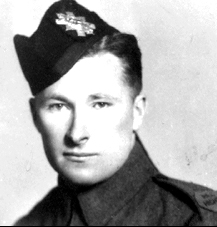
Photo 1 Carman Gillcash in uniform

Carman Edward Gillcash.  (Photo courtesy of Stewart Gillcash)

Stewart Gillcash submitted photos, and explained that he was the son of Carman’s brother Leland.  “…Carman Edward Gillcash, born and raised on a farm in Glenwood, Prince Edward Island in Canada, was the son of Stewart and Mae (nee Boulter) Gillcash. He had two brothers, Elton and Leland. 

Carman went to school in a one room schoolhouse not far from his home, and, as his father died when Carman was a young boy, he later worked with farmers in his community to help out at home. 

Carman and his younger brother Leland joined the army at a young age, when Leland was only 16 or 17 years of age.  Leland returned from the war, but Carman died there…

Carman enlisted with the PEI Highlanders in Charlottetown on July 15, 1940.  In his Occupational History Form, dated April 8, 1941, Carman stated that he had been working as a fisherman for Wilfred Hickey of O’Leary.

Photo 2 Carman Gillcash on right unknown on left

Carman Gillcash, right, with unidentified soldier. (Photo courtesy of Stewart Gillcash)

… Carman was sent to Newfoundland….

NFLD Map shows Botwood

Location of Botwood Military Base in Newfoundland. (Map source: http://postalhistorycorner.blogspot.com/2012/12/wwii-canadian-forces-in-newfoundland.html)

Carman was sent to Halifax with the PEI Highlanders.  In June 1941, he went to Valcartier, Quebec, and then the Regiment went to Newfoundland in July 1941. An RCAF base in Botwood had aircraft patrolling the east coast of the Atlantic. Canadian Army personnel based at Botwood were charged with protection of military facilities that had been installed there, as well as in Gander. (See https://www.heritage.nf.ca/articles/politics/botwood-base.php)

On June 4, 1942 he was sent to Gander, and then in April 1943 he was posted to Saint John, New Brunswick.  While serving in Newfoundland, Carman was promoted twice, first to Lance Corporal, and then to Corporal.

…..Two other soldiers were in Botwood…..

Carman was in Botwood at the same time as two other soldiers whose stories have been told on this blog:

…Carman was sent overseas….

On June 1, 1943, he was transferred to No 1 Transit Camp in Windsor, Nova Scotia. Just over a week later, along with fellow Islander James ‘Frank’ Mossey, he was on his way to the United Kingdom, arriving there on June 18, 1943, part of the Canadian Infantry Reinforcement Unit (CIRU).

On August 13, 1943, at his own request, Carman was demoted to private.  He then transferred to the Cape Breton Highlanders.  On October 24, 1943 the Regiment went to Italy.

On May 14, 1944 Carman was wounded, but returned to service two weeks later.

On February 19, 1945 he left Italy as part of Operation Goldflake, arriving in Marseilles, France two days later.  Operation Goldflake was the codename for moving troops from Italy to North-West Europe.  (See https://en.wikipedia.org/wiki/Operation_Goldflake)

From France, troops were moved up to the Belgian front, into The Netherlands, through the Reichswald Forest in Germany, and then back into The Netherlands.

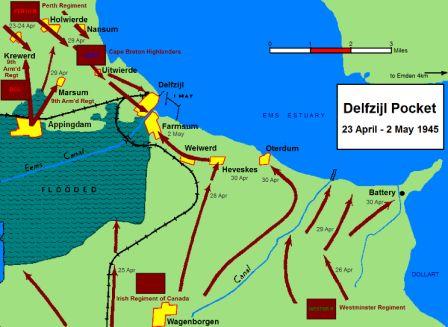
…The Regiment participated in the Battle of the Delfzijl Pocket….

The Cape Breton Highlanders relieved The Essex Regiment in the area of Nijmegen, before going towards Dokkum. On April 21, 1945, the Regiment relieved the North Nova Scotia Highlanders.

The next objective was to liberate Delfzijl, which was strategically important to the Germans as it and the surrounding area had batteries with cannons to defend the coastline and the German port of Emden against Allied bombers.

The April 28, 1945 war diary entry for the Cape Breton Highlanders recorded that “…We received word from Brigade this morning that the Perth Regiment did not do so well last night on account of mines. We will likely relieve them tonight so we are to move to another concentration area this afternoon…

The Regiment was on the move quickly in preparation to relieve the Perth Regiment.  “…At 13:50 hours the marching personnel were on the move and half an hour later the vehicles moved. Tactical HQ and B Company were set up in the town of Bierum while the remainder of the Battalion are in the area of Spijk...

The war diary went on to report that “….At 20:00 hours the Observation Post reported very dense smoke coming from the town of Delfzijl, which is our objective. This could be caused by either demolitions by the enemy or our artillery which has been firing on that area.

At 23:55 hours ‘A’ Company moved off to relieve ‘A’ Company of the Perth Regiment. They will likely be the only Company moving tonight…

…Carman lost his life in the wee hours of April 29, 1945….

On April 29, 1945 the war diary reported that “….The first report received from ‘A’ Company was at 01:15 hours when they called for the Medical Officer’s carrier. As the Company was going forward it was met by a large group of P.O.Ws. being escorted back by the Perth Regiment, and as they were passing each other one of the enemy stepped on a mine, killing one of our men and wounding two more…

The fatality in the early morning of April 29, 1945 was Carman.

…Carman was temporarily buried in Wirdum…

Carman was initially buried in 15 Divisional Cemetery in Wirdum, The Netherlands.

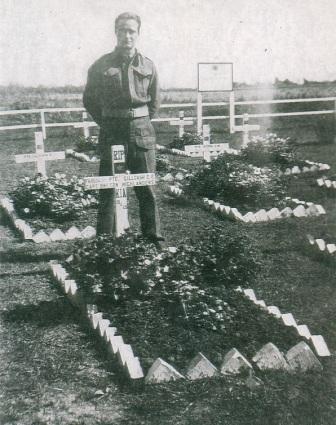
Photo 4 Leland brother of Carman Gillcash at the gravesite

Carman’s brother Leland visited his grave.  (Photo courtesy of Stewart Gillcash)

.…Carman was reburied in the Canadian War Cemetery in Holten….

After the war ended, Carman was reburied in the Canadian War Cemetery in Holten, The Netherlands.  We visited his grave twice – in 2017 and again in 2019.

CIMG3219 Oct 3 2019 Holten Carmen Gillcash

Pieter (right) at the grave of Carman Gillcash with researchers Edwin van der Wolf (left) and Henk Vincent (centre) in October 2019.  (Photo credit: Daria Valkenburg)

 …A plaque commemorates Canadian soldiers who died during the Battle of the Delfzijl Pocket….

In 1995, the Stefanus Church in Holwierde placed a plaque to commemorate Canadian soldiers who lost their lives during the Battle of the Delfzijl Pocket.

Plaque at Stefanus Church in Holwierde

Plaque at Stefanus Church in Holwierde, The Netherlands.  (Source: https://www.tracesofwar.nl/sights/40531/Herinneringsplaquette-Stefanus-Kerk.htm)

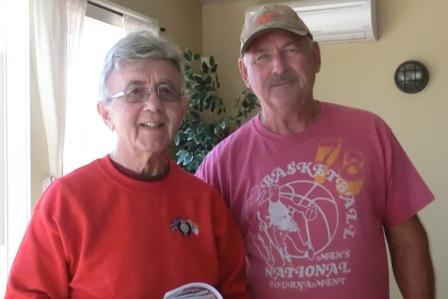
…We had a chance to meet Stewart Gillcash….

CIMG2610 Sep 8 2018 Pieter with Stewart Gillcash at The Catch

Pieter (left) with Stewart Gillcash.  (Photo credit: Daria Valkenburg)

Thank you to Stewart Gillcash for sharing photos and information on his uncle.  We were able to meet him in September 2018.  (See https://onthewarmemorialtrail.com/2018/09/11/on-the-war-memorial-trail-in-prince-county-pei/)

If you know who the unidentified soldier is in the photo, or have a story to tell, please let Pieter know. You can email him at memorialtrail@gmail.com, or comment on the blog.

© Daria Valkenburg

….. Other Soldiers Mentioned On The Plaque In The Church In Holwierde….

…Want to follow our research?….

If you are reading this posting, but aren’t following our research, you are welcome to do so.  Our blog address: https://onthewarmemorialtrail.com/

Front cover OnTheWarMememorialTrailinEurope4 countries, 6 weeks, 7,000 km – an unforgettable war memorial journey in Europe…. Daria’s book ‘No Soldier Buried Overseas Should Ever Be Forgotten‘ is available in print and e-book formats.  Net proceeds of book sales help support research costs and the cost of maintaining this blog. For more information on the book, please see https://nosoldierforgotten.com/

You are also invited to subscribe to our YouTube Channel: On The War Memorial Trail With Pieter Valkenburg: https://www.youtube.com/channel/UCJ591TyjSheOR-Cb_Gs_5Kw.

Never miss a posting!  Subscribe below to have each new story from the war memorial trail delivered to your inbox.

On The War Memorial Trail….. The WWII Soldier From Souris Killed During The Liberation Of Posterenk

August 9, 2022. In 2017, Pieter and I visited the village of Posterenk in The Netherlands with Edwin van der Wolf, one of the research volunteers at the Canadian War Cemetery in Holten.  At the time, we never expected that we would be doing several stories about soldiers from the Carleton & York Regiment who lost their lives during the liberation of the village in April 1945.

CIMG9295 Sep 25 2017 Posterenk windmill

Windmill in Posterenk, which has a memorial stone inscribed on the wall.  (Photo credit: Daria Valkenburg)

….The Island connection to Posterenk…..

Edwin wanted us to visit the village because it had an Island connection.  Frank GALLANT, son of Anthony and Eleanor Gallant of Mount Carmel, Prince Edward Island, was one of the Carleton & York soldiers who died during there on April 13, 1945 at the age of 32.

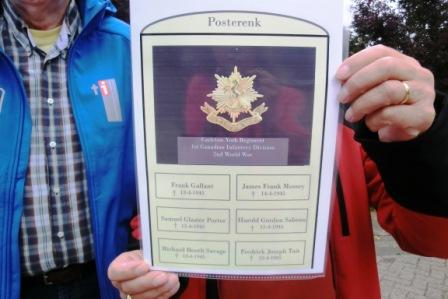
CIMG9299 Sep 25 2017 Pieter with the Posterenk list of 6 soldiers

Pieter holds the list of 6 Carleton & York Regiment soldiers temporarily buried in Posterenk in 1945. (Photo credit: Daria Valkenburg)


CIMG9297 Sep 25 2017 Edwin and Pieter with CYR list

Edwin van der Wolf and Pieter in Posterenk in 2017.  Pieter holds up a list of the 6 Carleton & York Regiment soldiers who were temporarily buried in the village.  (Photo credit: Daria Valkenburg)

The village prepared a list of 6 soldiers to commemorate from the Carleton & York Regiment.  Unfortunately, not all soldiers who died are included on this list, but Edwin worked towards making for a more inclusive list.

One soldier not on the original list of 6, Daniel Peter MACKENZIE, who was born in Victoria Cross, Prince Edward Island, son of John and Rachel MacKenzie, also died on April 13, 1945 during the liberation of Posterenk.  Pieter had been able to find a family member and photo in 2015.

That made two soldiers from Prince Edward Island.  In 2021, a soldier from Minto, New Brunswick, who wasn’t on the original list, was identified: Goldwin Marven POLLICK.

In April 2022, 8 names were commemorated in Posterenk. However, photos of two men were missing.  To our surprise, one was from Prince Edward Island, making for a third Island soldier.   (See https://onthewarmemorialtrail.com/2022/04/17/on-the-war-memorial-trail-posterenk-commemorates-its-liberation-by-the-carleton-and-york-regiment/)

…The search began for a photo of James ‘Frank’ Mossey….

Pieter immediately began researching James ‘Frank’ MOSSEY, born on April 20, 1919 in Souris, Prince Edward Island, son of William and Mary (nee McMillan) Mossey.

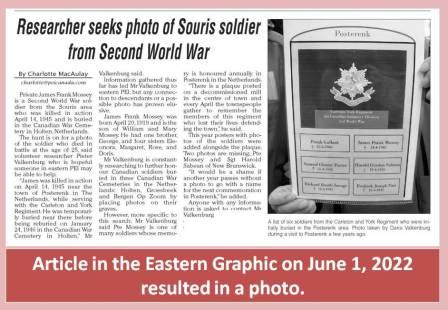
Article in Eastern Graphic re James Frank Mossey Jun 1 2022

… Frank Mossey’s niece contacts Pieter….

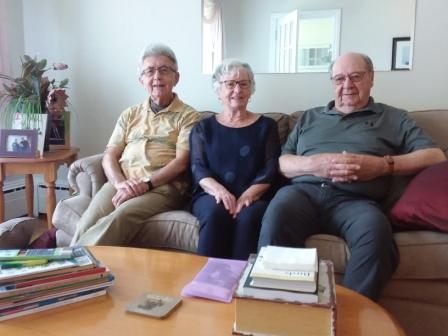
20220616_122329 Jun 16 2022 Pieter with Glynne and Bob Squires

Pieter (left) with Glynne and Bob Squires. (Photo credit: Daria Valkenburg)

A few days after the article was published in the Eastern Graphic, Glynne Squires contacted Pieter, explaining that “My Mother is Margaret (deceased) – a sister of Frank.  The members of Frank’s family are small.  A few cousins, myself, Karen Sereda, and Marilyn Jones – nieces of Frank’s.  Thank you for the work you are doing to keep the memory alive of these brave young men….”  And Glynne had a picture to share…

James Frank Mossey

James ‘Frank’ Mossey.  (Photo courtesy of Glynne Squires and Family)

When he enlisted in Charlottetown on July 10, 1940 with the PEI Highlanders, Frank was working as a meter reader for the Town of Souris.  He had also worked with his father who had been the town electrical inspector.

… Frank was sent to Newfoundland….

NFLD Map shows Botwood

Location of Botwood Military Base in Newfoundland. (Map source: http://postalhistorycorner.blogspot.com/2012/12/wwii-canadian-forces-in-newfoundland.html)

He was sent to Halifax with the PEI Highlanders, and then in 1941 the Regiment went to Newfoundland. An RCAF base in Botwood had aircraft patrolling the east coast of the Atlantic. Canadian Army personnel based at Botwood were charged with protection of military facilities that had been installed there, as well as in Gander. (See https://www.heritage.nf.ca/articles/politics/botwood-base.php)

On November 7, 1941 Frank was attached to the No. 6 District Depot, the default unit for troops in the area that weren’t members of another unit.  Military District 6 comprised Nova Scotia and Prince Edward Island, with headquarters in Halifax.  However, he remained in Newfoundland.

… Frank was anxious to go overseas….

 An April 29, 1943 interviewer recorded in his Personnel Selection Record that Frank was “…now a section commander in ‘A’ company….” and that he “… gets along well with his men…

The report went on to say that Frank “…expresses himself well; has a decisive but attractive manner…”  It also noted that he “… likes the army and is very anxious to get overseas….

Frank was soon to get his wish. He was transferred to the No. 1 Transit Camp in Windsor, Nova Scotia on June 2, 1943, and just over a week later he was on his way to the United Kingdom, arriving there on June 18, 1943, part of the Canadian Infantry Reinforcement Unit (CIRU).

… In December 1943 Frank joined the Carleton & York Regiment in Italy…

On December 12, 1943 he was transferred to the Carleton & York Regiment, joining the Regiment in Ortona, Italy, part of the reinforcement of troops following the battles in Sicily.

On March 19, 1945, he and his Regiment left Italy for North-West Europe as part of Operation Goldflake, arriving in Marseilles, France on March 21, 1945.  Operation Goldflake was the codename for moving troops from Italy to North-West Europe.  (See https://en.wikipedia.org/wiki/Operation_Goldflake)

From France, troops were moved up to the Belgian front, into The Netherlands, through the Reichswald Forest in Germany, and then back into The Netherlands, arriving near Zutphen on April 10, 1945.

…The Liberation of Posterenk…

Map western holland showing Posterenk

According to the April 12, 1945 war diary entry of the Carleton & York Regiment, they “…moved across the Ijssel River at 14:30 hours….” to relieve the Seaforth Highlanders of Canada.

On April 13, 1945, the war diary entry noted that …‘D’ Company’s objective is Posterenk…” The Regiment didn’t expect much opposition, but they “met with stiff resistance just after starting at 11:25 hrs…

With the help of a tank troop, they were able to move forward.  According to the war diary entry, “at 13:37 hrs ‘D’ Company reported that POSTERENK was clear of the enemy, having had one officer killed (Lt. R.B. Savage) and two other ranks wounded but a total of 50 POWs. ‘D’ Company were ordered to push on up the road which they did at once and came under enemy fire…

In the evening ‘B’ Company moved forward and encountered “…considerable enemy resistance…”  Very late into the night and into April 14, 1945, “…during ‘B’ Company’s attack they have eight wounded and one killed, Lt. W.E. Brousseau being one of those wounded…

The war diary entry noted that in the middle of the night – into April 14, 1945 – “‘B’ Company’s patrol met stiff opposition…

It’s not clear exactly what happened to Frank. The service file only notes that he was killed in action on April 14, 1945 near Posterenk.  He was 25 years old.

….Frank was originally buried near Posterenk….

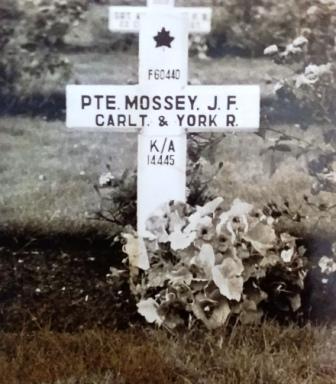
Frank was temporarily buried near the crossing next to the windmill in Posterenk.

20220616_114707 Original grave burial

Frank was originally buried near the windmill in Posterenk. (Photo courtesy of Glynne Squires and Family)

On January 24, 1946 Frank was reburied in the Canadian War Cemetery in Holten, The Netherlands.

Grave of Frank Mossey in Holten

Grave of Frank Mossey in the Canadian War Cemetery in Holten.  (Photo source: Canadian Virtual War Memorial)

After the war ended, Frank’s family was informed that he was twice mentioned in despatches “…in recognition of gallant and distinguished services…” and they subsequently received a certificate from King George VI.

….Mossey Island in northern Canada named in his honour…..

Mossey Lake in NWT

Mossey Island in the Northwest Territories was named in honour of Frank Mossey.  (Map source: https://www.geodata.us/canada_names_maps/maps.php?featureid=LAQCJ&f=316)

A 2010 email from Blair Neatby in Yellowknife to Greg Gallant of the PEI Regimental Museum noted that Mossey Island, located on Faber Lake in the Northwest Territories, in northern Canada, was named in his honour on October 12, 1952. (Location coordinates: Latitude 63.93374° or 63° 56′ 2″ north, Longitude -117.15295° or 117° 9′ 11″ west, Elevation 213 metres or 699 feet.)

Thank you to Glynne and Bob Squires for sharing photos and information about Frank Mossey, and to Charlotte MacAulay of the Eastern Graphic for writing about the photo search. If you have a story to tell, please let Pieter know. You can email him at memorialtrail@gmail.com, or comment on the blog.

© Daria Valkenburg

…Previous stories about soldiers commemorated in Posterenk….

…Want to follow our research?….

If you are reading this posting, but aren’t following our research, you are welcome to do so.  Our blog address: https://onthewarmemorialtrail.com/

4 countries, 6 weeks, 7,000 km – an unforgettable war memorial journey in Europe…. Daria’s book ‘No Soldier Buried Overseas Should Ever Be Forgotten‘ is available in print and e-book formats.  Net proceeds of book sales help support research costs and the cost of maintaining this blog. For more information see https://nosoldierforgotten.com/ 

Front cover OnTheWarMememorialTrailinEuropeUpcoming Author Talk: Thursday, August 11, 2022 – Victoria-By-The-Sea, Prince Edward Island, part of the ‘Our Island Talks’ series, and hosted by Victoria Playhouse and Victoria Historical Association. Time: 2:00 pm.

You are also invited to subscribe to our YouTube Channel: On The War Memorial Trail With Pieter Valkenburg: https://www.youtube.com/channel/UCJ591TyjSheOR-Cb_Gs_5Kw.

Never miss a posting!  Subscribe below to have each new story from the war memorial trail delivered to your inbox.