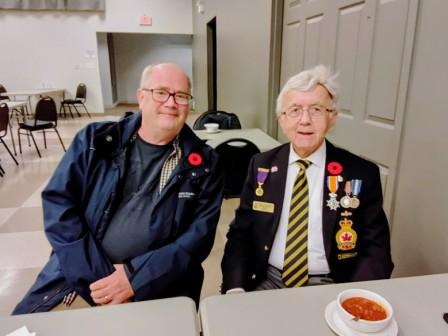
Mike Johnston, left, with Pieter after the 2025 Remembrance Day service in Kinkora. (Photo credit: Daria Valkenburg)
November 4, 2026. Following the 2025 Remembrance Day Service held outdoors on a chilly afternoon in Kinkora, Prince Edward Island, everyone was invited inside the community hall for a bowl of chile or chicken corn chowder, and a much needed cup of coffee or tea.
We were joined by our North Tryon neighbour Mike Johnston, who asked about doing a story on his great-uncle, Albert Joseph LAROSE, who lost his life on September 13, 1944, while serving with the Black Watch (Royal Highland Regiment) of Canada.
It seems fitting, as we near another Remembrance Day, to honour Albert’s memory.
Born December 27, 1916 in Toronto, Ontario, the son of Ernest and Catherine (nee Campbell) LaRose, Albert was one of 10 children, having 5 brothers and 4 sisters. After leaving school, he worked 6 years as a knitting machine mechanic at a textile plant, and then joined Ontario Hydro Electric Commission as a plant operator.
….Albert enlisted in 1942 under NRMA…
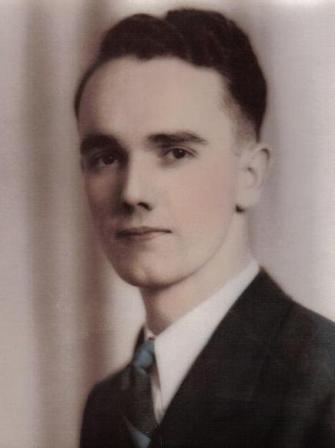
Albert Joseph LaRose. (Photo source: Canadian Virtual War Memorial)
On June 11, 1942, Albert enlisted under the National Resources Mobilization Act (NRMA) at No. 2 NRMA Clearing Depot in Newmarket, Ontario. (See https://en.wikipedia.org/wiki/National_Resources_Mobilization_Act)
At the time of his enlistment, Albert had been working for 2 years at Ontario Hydro Electric Commission. An interviewer described him as “…a good looking, attractive, bright lad – is definitely interested in radio and electricity and wants to get into Signal Platoon. Single hobby is singing – belongs to choir – healthy – should do well….”
He took his basic training at No. 23 Canadian Army (Basic) Training Centre in Newmarket, and then was sent to the A11 Canadian Infantry Training Centre at Camp Borden, Ontario on May 14, 1942.
On June 15, 1942, Albert was transferred to the Prince of Wales Rangers and sent to the Temporary Basic Training Centre (TBTC) ‘B’ Company at Camp Niagara, located in Niagara-on-the-Lake, Ontario. Albert would have undergone two months of rigorous physical conditioning, small arms training, tactical manoeuvres, and drills.
Soldiers stationed at Camp Niagara were on guard duty to protect local infrastructure, such as the nearby Welland Canal and regional hydro-electric plants, against potential enemy sabotage.
….Albert was transferred to Prince George as a member of the Prince of Wales Rangers…
With his basic training completed, Albert was sent to Prince George, British Columbia on September 23, 1942. Still with the Prince of Wales Rangers, he was now part of Canada’s Home Defence. The Prince of Wales Rangers were part of the 16th Infantry Brigade, which in turn was under the 8th Canadian Division, tasked with Pacific coastal defence and protecting Canada’s West Coast from potential enemy threats.
On December 15, 1942, Albert married Loretta Marie Bowyer, and received leave to do so.
Albert continued to receive additional training, and after completing a signallers course, received the qualification of Classified Regimental Signallers on June 20, 1943. This qualification meant he’d received training in military communications for the purpose of maintaining links between front-line units and headquarters. He was next sent to Wainwright, Alberta for additional training in manoeuvres and battle courses.
….Albert was sent for a mountaineering course…
On July 8, 1943, Albert was sent on another training course – to the Little Yoho Mountaineering School run by the Alpine Club of Canada, located in Little Yoho Valley in Yoho National Park near Field, British Columbia. He took an intensive course in climbing with equipment, rescue work in ice and snow, and using ropes under a simulated night attack. He did so well in the course, which he completed on July 29, 1943, that he was selected to be an Assistant Instructor for the next course. Albert was described as “…capable and conscientious…”
As Assistant Instructor for the course that ran August 8 to 30, 1943, he was assessed as “…very helpful at all times. Has capable working knowledge of basic principles involved and able to impart instruction…”
On August 1, 1943, Albert had received a promotion to Lance Corporal, but on September 14, 1943, he asked to revert to the rank of Private. In the meantime, he had returned to the Prince of Wales Rangers as of August 31, 1943.
….Albert was an instructor at the Winter Training School in Jasper…
By November 9, 1943, he was in Port Alberni, British Columbia, and requested to attend a Mountaineering Instructors Course. This was approved and he successfully completed the course in Terrace, British Columbia. As of November 16, 1943, he was attached to the Winter Training School in Jasper National Park, Alberta where he was to be an instructor in a course that began in January 1944. On January 15, 1944, he was promoted to Acting Corporal.
Jasper National Park in the Canadian Rocky Mountains became a high-altitude winter and mountain warfare training centre for the British Army’s Lovat Scouts (Scottish Highlanders) and Canadian Army personnel, who trained in preparation for an Allied-led invasion of Nazi-occupied Norway and to combat Axis mountain specialist units.
In a course that ran from January 9, 1944 until the final group left on April 22, 1944, they were instructed in military skiing, snowshoeing, ice climbing, glacier travel, crevasse rescue, survival camping in temperatures down to -45°C (-49oF), and carrying full gear with rifles.
A short film by the National Film Board of Canada, ‘Ordeal By Ice’ (10:44 minutes) documents the extreme winter conditions faced by members of the Canadian Army and British Army’s Lovat Scouts who trained at the Winter Training School…..
….Albert joined the Active Army…
On April 8, 1944, Albert’s assignment at the Winter Training School ended. He returned to the Prince of Wales Rangers in Terrace, British Columbia….and reverted back to the rank of private. A week later, on April 15, 1944, he enlisted in the Active Army with the Prince of Wales Rangers.
Then, on April 19, 1944, he was transferred to the 1st Battalion of the Canadian Fusiliers, which was under Pacific Command as part of the 6th Canadian Infantry Division’s Home Defence. However, the Battalion was preparing to go the United Kingdom and become a training battalion.
Albert received 10 days of embarkation leave starting on May 5, 1944, in what turned out to be the last chance he had to see his family. Upon returning from leave, he was transferred to No. 1 Transit Camp in Windsor, Nova Scotia. This was a final staging, preparation, and administrative processing area before being sent overseas.
….Albert left Canada for overseas service ……
With others in the 1st Battalion, Canadian Fusiliers, Albert boarded a ship on May 25, 1944 that left the following day from Halifax, Nova Scotia, arriving in the United Kingdom on June 2, 1944.
Then, in a strange twist, instead of remaining with the Canadian Fusiliers and continuing as an Instructor, Albert was transferred to the X-4 Reinforcement List of the Black Watch of Canada (Royal Highland Regiment), part of the 21st Army Group, joining the unit in Folkestone, England.
On July 13, 1944, Albert left England for France, arriving the following day, where, due to his Classified Regimental Signallers qualification, he was assigned to the Signal Platoon, Headquarters Company of the Black Watch, joining the Regiment in Franqueville in the midst of the Battle of Caen, part of the ongoing Battle of Normandy. (See https://en.wikipedia.org/wiki/Battle_for_Caen)
From July 18 to 21, 1944, the Regiment was involved in Operation Atlantic, with the goal of clearing German forces from the southern and eastern sectors of Caen, cross the Orne River, and seize Verrières Ridge in an attempt to block enemy reinforcements. (See https://en.wikipedia.org/wiki/Operation_Atlantic)
This was immediately followed by a disaster on July 25, 1944, with Operation Spring, when the Regiment launched an assault on Verrières Ridge to capture Fontenay-le-Marmion. Out of 325 soldiers who launched the attack, there were 307 casualties, with 118 killed in just under four hours—a near 94% casualty rate. (See https://en.wikipedia.org/wiki/Operation_Spring)
In a July 29, 1944 letter to his sister Grace, Albert wrote that he was not at the front, but at Battalion Head Quarters. “…About me being in France….I can’t say much about things here, except that I am still in the best of health and I haven’t been in action up to now and I don’t expect to be going up to the front for some time yet. It wouldn’t hurt my feelings at all if I never got up there, but I guess the war won’t end that soon….”
The letter was written over a few days. “…Incidentally, I started this letter a few days ago, but never got it finished. Right now I am on duty at the Telephone Exchange and I get a chance to write here…”
….Albert lost his life on September 13, 1944 ……
Over the next 6 weeks, the Black Watch, as part of the 5th Canadian Infantry Brigade, 2nd Canadian Infantry Division, advanced along the French coast, participating in operations to clear coastal areas, cross canals, and secure vital infrastructure against retreating German forces.
On Wednesday, September 13, 1944, the Regiment was positioned at Spycker in northern France near the coastal town of Bourbourg, securing the village and bridgeheads around Bourbourgville and Grand Millebrugge, and very close to the Belgian border. (See https://www.europeremembers.com/en/pois/2436/the-black-watch-at-grand-millebrugge)
Albert lost his life on that day, but the war diary entry for that day gave no information on what happened. “…Heavy shelling on Grand Millebrugge commenced at Reveille this morning. Battalion Head Quarters received five direct hits and the Regimental Aid Post one direct hit and two near misses. During the morning the shelling did not let up and by noon, when it began to slacken off, eight vehicles had been destroyed and six motor cycles burned….”
The war diary went on to report that there were no fatalities, and none missing or taken as prisoners of war, but this wasn’t true. Six men were missing, and had died that day… one of them Albert, who likely was in Battalion Head Quarters when it was hit by German shellfire.
In addition to Albert, the following soldiers from the Black Watch were killed on September 13, 1944:
- A/Cpl Alfred Alexander ANDERSON, born in Innisfeil, Alberta, aged 32
- L/Sgt Robert BURNSIDE, from Montreal, Quebec, but born in Glasgow, Scotland, aged 33
- Pte Michael DOBRENSKY, of Toronto, Ontario, aged 21
- A/Cpl Gordon Edward GORMAN, of Ottawa, Ontario, aged 20
- A/Cpl Vernon Andrew JOHNSTON, of Pine Creek, Manitoba, aged 21
Several families of the soldiers were aware that 6 of them were missing. The family of Gordon Edward GORMAN persisted in asking what happened to him, and eventually a letter in the service file indicated what may have happened to him. “…He was making his way across open field after very heavy shelling and a counter attack by the Germans. A German machine gun fired from the house on the left flank and he fell to the ground. Two German soldiers came out of the house, picked him up and took him into the house….” where he died of his wounds. “… This action took place in the small town of Spycker, east of Dunkirk, France…”
All 6 men were eventually buried in November, almost two months after their deaths. At the age of 27, Albert left his wife, parents, 5 brothers and 4 sisters to mourn his loss.
….Albert is buried in Calais Canadian War Cemetery…
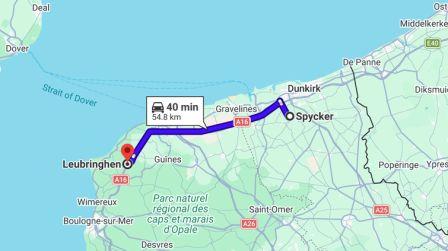
Albert LaRose was initially buried in Spycker before being reburied in the Calais Canadian War Cemetery in Leubringhen. (Map source: Google Maps)
On November 6, 1944, Albert was initially buried in a church cemetery in nearby Spycker, before being reburied in the Calais Canadian War Cemetery in Leubringhen on August 5, 1945.
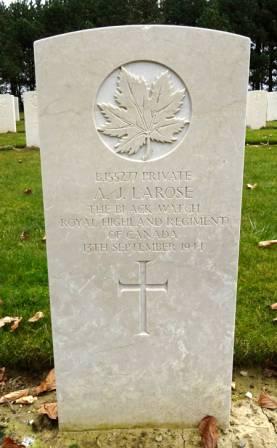
Grave of Albert Joseph LaRose in the Calais Canadian War Cemetery in Leubringhen, France. (Photo source: Find A Grave)
Leubringhen is a village in the Department of the Pas-de-Calais, halfway between Calais and Boulogne. The Calais Canadian War Cemetery is in Leubringhen, 14 kms (8.7 miles) from Calais.

Sign off of the highway exit directing us to Calais Canadian War Cemetery. (Photo credit: Daria Valkenburg)
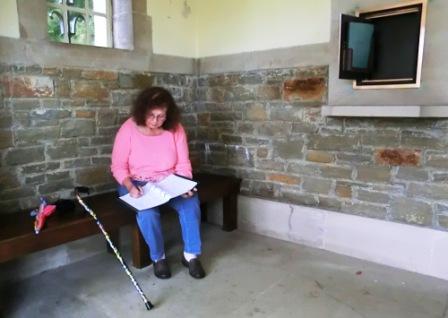
Daria writing in the Visitors Book at Calais Canadian War Cemetery during our 2017 visit. (Photo credit: Pieter Valkenburg)
We’d visited this cemetery in September 2017, where we had placed flags down at the grave of James Arthur AFFLECK from Bedeque, Prince Edward Island, who died a few days after Albert. (See https://onthewarmemorialtrail.com/2017/10/08/the-calais-canadian-war-cemetery/)
Thank you to Mike Johnston for sharing the letter written by his great-uncle, and to Shawn Rainville for newspaper research.
Pieter’s research efforts to find photos and families of soldiers continue. Do you have a story to tell? Email Pieter at memorialtrail@gmail.com, or comment on the blog.
© Daria Valkenburg
….Want to follow our research?…
If you are reading this posting, but aren’t following our research, you are welcome to do so. Our blog address: https://onthewarmemorialtrail.com/
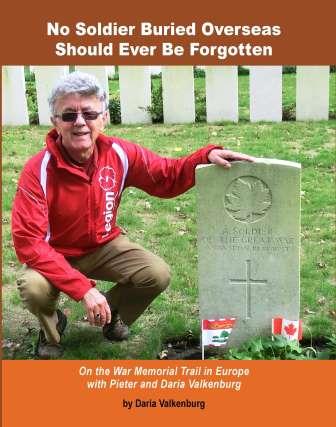 4 countries, 6 weeks, 7,000 km – an unforgettable war memorial journey in Europe…. Daria’s book ‘No Soldier Buried Overseas Should Ever Be Forgotten‘ is available in print and e-book formats. Net proceeds of book sales help support research costs and the cost of maintaining this blog. For more information see https://nosoldierforgotten.com/
Subscribe to our YouTube Channel: On The War Memorial Trail With Pieter Valkenburg: https://www.youtube.com/channel/UCJ591TyjSheOR-Cb_Gs_5Kw.
Never miss a posting! Subscribe below to have each new story from the war memorial trail delivered to your inbox.

