On The War Memorial Trail…. Remembrance Week 2024 –Remembering Those Who Served In The RCAF During WWII

Remembrance_Day_2024_3840x2160

November 7, 2024.  As we reflect on the service and sacrifices made by so many who have served, both during conflicts and in peacetime, I took a look back at previous stories told over the years.  2024 commemorates 100 years of service for the Royal Canadian Air Force (RCAF) as a distinct military element, and so it seemed appropriate to dedicate this posting to stories previously told of those who served in the RCAF during WWII. 

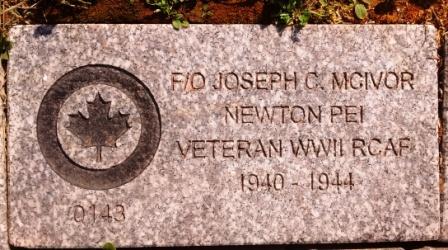
…The Air Force Heritage Park in Summerside has a commemorative stone honouring Flight Officer Joe McIver….

IMG_20190807_101837076 Entrance to Air Force Heritage Park Summerside

Entrance to Air Force Heritage Park in Summerside. (Photo credit: Daria Valkenburg)

Several years ago we visited the Air Force Heritage Park in Summerside to look at the commemorative stone honouring Flight Officer Joseph ‘Joe’ Charles MCIVER of Kinkora, Prince Edward Island.  Joe was the navigator aboard B24 Liberator MkVIII EV895 on November 18, 1944, when it went down near the Arctic Circle while on anti-submarine patrol looking for a suspected U-boat off Gardskagi, Iceland.  There were no survivors.

You can read his story at:

IMG_20190807_101038750 McIver Commemorative Stone Summerside

Commemorative Stone at Air Force Heritage Park, Summerside, Prince Edward Island. (Photo credit: Pieter Valkenburg)

 … Pilot Elmer Muttart saved his crew and the Dutch village of Wons but sacrificed his own life to do so ….

The very first airman whose story was researched by Pieter was that of Elmer Bagnall MUTTART of Cape Traverse, Prince Edward Island, whose name is listed on the Cenotaph outside the Borden-Carleton Legion.  Elmer was the pilot aboard Halifax L9561 when it was shot twice by German night fighters on October 12, 1941, while the plane was on its way to a bombing raid on Bremen, Germany. 

After ordering the crew to bail out, Elmer managed to steer the burning plane away from the Dutch village of Wons, in the province of Friesland, before it crashed in a farmer’s field, just outside the village. He was the only casualty and is buried in Harlingen General Cemetery in The Netherlands.  The rest of the crew spent the war years in prisoner of war camps before being liberated. On October 12, 2019, a memorial panel was placed near the crash site in Wons to honour Elmer and his crew, an emotional journey for all of us who attended.

You can read his story here:

 … Pilot Hubert Hall was a prisoner of war after his plane was shot down in 1942 ….

John ‘Hubert’ HALL of Summerside, Prince Edward Island, was the pilot aboard Wellington Z1203, which crashed in The Netherlands near Mijdrecht on the night of March 28/29, 1942.  Hubert spent the remainder of the war years as a prisoner of war in POW camp Stalag Luft III, located in present-day Żagań, Poland, before returning home to Canada.

You can read his story at:

… Navigator Bunky FitzGerald is in an unmarked grave after Halifax W1175 crashed off the Dutch coast….

Rowan Charles ‘Bunky’ FITZGERALD, of Charlottetown, Prince Edward Island, was the navigator aboard Halifax W1175 of the 405th Vancouver Squadron RCAF when it was hit by shellfire (flak) as the plane was returning from Bremen, Germany on the morning of June 28, 1942. 

The plane crashed into a sandbank in the Wadden Sea, off the Dutch coast between the Island of Texel and the mainland, 15.5 km from Harlingen, in the province of Friesland.  There were no survivors. Only one crew member’s body was identified, and was buried in Harlingen General Cemetery in The Netherlands. His grave is between 3 unknown graves, one of which may just contain the remains of Bunky FitzGerald. 

You can read his story at:

… Pilot Lorne MacFarlane survived all his flights and returned home…

Pilot Lorne MACFARLANE, of Fernwood, Prince Edward Island, successfully flew 40 missions overseas and was then assigned to fly dignitaries, mail, and personnel between England and the front lines until the war ended.  After returning safely back to Canada, he was the Officer In Charge at RCAF No 1 Radio and Navigation School in Summerside, Prince Edward Island.

You can read his story at:

… Wireless operator Bob Dickie almost made it safely back to England…

Robert ‘Bob’ James DICKIE, of Carlton (now Borden-Carleton), Prince Edward Island, was the wireless operator aboard Lancaster JB312 on February 21, 1944 when it collided with another plane during a bombing sortie in Stuttgart, Germany.  Although badly damaged, the plane was able make it back to England, but then crashed as it approached the runway. There were no survivors. Bob is buried at Cambridge City Cemetery in England.

You can read his story at:

… Pilot Leonard Unwin’s plane crashed on Christmas Eve…

Pilot Leonard Arthur UNWIN, of Windsor, Ontario, was a flying instructor in Summerside, Prince Edward Island and Moncton, New Brunswick, before going overseas in May 1943.  On December 24, 1944, he left from his base in Belgium, one of the pilots in a section of 4 Typhoon planes on an armed reconnaissance in the Utrecht area in The Netherlands. While attacking a convoy of three German trucks in Woudenberg, the plane’s tailpiece broke off, the plane destabilized, and crashed. He’s buried in Woudenberg Municipal Cemetery in The Netherlands.

You can read his story at:

… Flight student Ralph McCutcheon lost his life in a training accident…

Flight student Ralph Gordon MCCUTCHEON, of Toronto, Ontario, but who was born in Buffalo, New York, USA, lost his life in a tragic accident that happened during his training at the No. 9 Service Flying Training School RCAF in Summerside, Prince Edward Island on the morning of June 11, 1942.  While training in a Harvard MK2 plane, it crashed in a farm field in North Tryon, Prince Edward Island.

You can read his story at:

… Gunner William Andrew Hood was aboard the last flight of Halifax JD215…

William Andrew HOOD, of Little Bras D’or, Cape Breton Island, Nova Scotia, was the mid-upper gunner aboard Halifax JD215 when it was shot down over The Netherlands on June 29, 1943.  None of the crew survived. He’s buried in Eindhoven General Cemetery in Eindhoven, The Netherlands.

You can read his story at:

… Navigator Arnold Hupman was aboard Lancaster X KB728 VR-V when it exploded over Arnhem, The Netherlands…

Navigator Arnold Freeman HUPMAN, of East Side of Ragged Island, Shelburne County, Nova Scotia, lost his life when the Lancaster bomber he was in, Lancaster X KB728 VR-V, was attacked by a German night fighter and exploded on the outskirts of Arnhem, The Netherlands as it was returning from a bombing operation against the synthetic oil plant at Sterkrade in Germany on the night of June 16 to 17, 1944. There were no survivors, and all 7 crew members are now buried in the Canadian War Cemetery in Groesbeek, The Netherlands.

You can read his story at:

… Pilot Douglas MacKenzie did not survive the last flight of Halifax DT630…

Jack ‘Douglas’ MACKENZIE,  of Winnipeg, Manitoba, was the pilot of Halifax DT630 (call sign VR-T), one of 8 heavy Halifax bombers sent on a night raid to Hamburg, Germany on February 3, 1943.  It was shot down by a night fighter over the province of Drenthe in The Netherlands. 4 men died, including Douglas, while 3 survived and spent the remainder of the war in prisoner of war camps.  He’s buried in Sleen General Cemetery in The Netherlands, along with the other 3 casualties of that flight.

You can read his story at:

… Pilot Dusty Millar’s spitfire ran out of fuel and crashed…

George Glenn ‘Dusty’ MILLAR, of Winnipeg, Manitoba, was killed on September 28, 1944 while flying a Spitfire Mark IX on patrol with his squadron over Nijmegen, The Netherlands. After Dusty reported on his radio that the plane was low in fuel, it crashed southeast of Weibosch near Schijndel, in the Dutch province of Noord-BrabantHe is buried in Uden War Cemetery in The Netherlands.

You can read his story at:

May we never forget the sacrifices made by these airmen, and their families, during WWII.  Unfortunately, while we live free in Canada, so many people today live in a war zone and are experiencing death, uncertainty, and insecurity in not knowing what will happen next.  Lest we forget is never more appropriate.

If you have a story to tell, please let Pieter know. You can email him at memorialtrail@gmail.com, comment on the blog, or send a tweet to @researchmemori1.  

© Daria Valkenburg

….Want to follow our research?….

If you are reading this posting, but aren’t following our research, you are welcome to do so.  Our blog address: https://onthewarmemorialtrail.com/
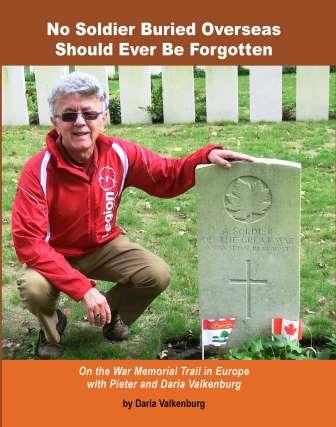
Front cover OnTheWarMememorialTrailinEurope4 countries, 6 weeks, 7,000 km – an unforgettable war memorial journey in Europe…. Daria’s book ‘No Soldier Buried Overseas Should Ever Be Forgotten‘ is available in print and e-book formats.  Net proceeds of book sales help support research costs and the cost of maintaining this blog. For more information see https://nosoldierforgotten.com/ 

You are also invited to subscribe to our YouTube Channel: On The War Memorial Trail With Pieter Valkenburg: https://www.youtube.com/channel/UCJ591TyjSheOR-Cb_Gs_5Kw

Never miss a posting!  Subscribe below to have each new story from the war memorial trail delivered to your inbox.
On The War Memorial Trail….. Commemorating The 80th Anniversary Of D-Day

Screenshot 2024-05-28 at 10-34-30 D-Day 80th Anniversary Banner Decoration - 1.2m

June 1, 2024.  June 6, 2024 marks the 80th anniversary of Operation Overlord (the larger Normandy invasion) and Operation Neptune (the English Channel-crossing portion of Operation Overlord) – what we refer to as D-Day.

….What does D-Day mean?….

Did you know that the ‘D’ in D-Day was a military codeword referring to ‘Departure Day’?  U.S. General Dwight D. Eisenhower, Supreme Commander of the Allied Expeditionary Force in Europe,  noted, through his executive assistant, Brigadier General Robert Schultz: “Be advised that any amphibious operation has a ‘departed date;’ therefore the shortened term ‘D-Day’ is used….

While there were several other D-Days during the war, the invasion of Normandy was the biggest and most well-known. 

…..D-Day was an international effort….

Most people consider D-Day to have been solely a joint British, Canadian, and American effort.  However, it’s important to recognize that over 2 million troops from over 12 countries were in Britain in preparation for the invasion. While Allied forces consisted mainly of American, British, and Canadian troops, smaller contingents included Australian, Belgian, Czech, Dutch, French, Greek, New Zealand, Norwegian, Rhodesian, and Polish naval, air, or ground support!

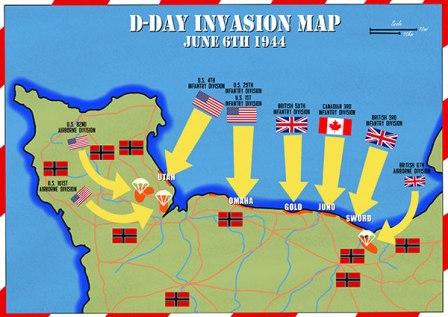
Dday Invasion-map

D-Day invasion map. The Canadians landed on Juno Beach in Normandy, France. (Map source: https://www.ddaylepe.org.uk/index.php/overlord-neptune/)

On the morning of D-Day, ground troops landed across five assault beaches –Juno, Sword, Gold, Utah, and Omaha.  Canadian soldiers landed at Juno on the outskirts of Bernières.  British forces landed at Sword and Gold, while the Americans landed at Utah and Omaha.

Want to know a bit more about D-Day?  See https://news.sky.com/story/eleven-things-you-might-not-know-about-d-day-13132330  My favourite tidbit is how Hitler slept through the D-Day landings.  Even after he woke up in the late morning he believed it was just a diversionary tactic – and so no reserve troops were immediately sent to Normandy!

….11 servicemen who survived D-Day have been featured on this blog….

Over the past years, we have featured stories of 11 servicemen who were present in Normandy on June 6, 1944. All survived D-Day, but only 1 survived WWII and returned home – Airman Lorne MACFARLANE flew a night mission that coincided with the early morning hours of D-Day and realized afterwards what a lucky escape he and his crew had.  “Our mission was completed.   As we crossed the Channel on the way back, we could see through breaks in the cloud, the wakes of hundreds of ships…” heading towards the French coast.  You can read Lorne’s story here:  https://onthewarmemorialtrail.com/2021/10/20/on-the-war-memorial-trail-the-ww2-pilot-from-pei-who-flew-40-missions-overseas-and-returned-home/

The other 10 are buried in a Canadian War Cemetery in France, The Netherlands, or Belgium.  These men are:

….The actions of D-Day helped shorten WWII….

For a very brief overview of the significance of D-Day, watch this 3 minute CTV video prepared for the 75th anniversary:

….Upcoming Event at the Borden-Carleton Legion….

To commemorate the 80th anniversary of D-Day, the Borden-Carleton Legion will have a wreath laying ceremony by the Cenotaph at 3:00 pm on June 6, 2024.  Pieter and I will be there. All are welcome to attend in honour of those who fought on that day.  The wreath laying ceremony will be followed by a light lunch of hamburgers and hot dogs.

Do you have photos or information to share? Email Pieter at memorialtrail@gmail.com, comment on the blog, or tweet to @researchmemori1.

© Daria Valkenburg

….Want to follow our research?….

If you are reading this posting, but aren’t following our research, you are welcome to do so.  Our blog address: https://onthewarmemorialtrail.com/

Front cover OnTheWarMememorialTrailinEurope4 countries, 6 weeks, 7,000 km – an unforgettable war memorial journey in Europe…. Daria’s book ‘No Soldier Buried Overseas Should Ever Be Forgotten‘ is available in print and e-book formats.  Net proceeds of book sales help support research costs and the cost of maintaining this blog. For more information see https://nosoldierforgotten.com/ 

You are also invited to subscribe to our YouTube Channel: On The War Memorial Trail With Pieter Valkenburg: https://www.youtube.com/channel/UCJ591TyjSheOR-Cb_Gs_5Kw

Never miss a posting!  Subscribe below to have each new story from the war memorial trail delivered to your inbox.
On The War Memorial Trail…..The WWII Pilot From PEI Who Flew 40 Missions Overseas …. And Returned Home

October 20, 2021.  Recently, we heard from Jim MacFarlane of Fernwood, Prince Edward Island.  “ I have been reading with interest your war time stories and thought you may be interested in my family’s participation in the Second World War. My father, as well as my two oldest brothers, all served in the war at that same time. All are now deceased

Jim went on to explain that “My father, Herman, was an LAC in the air force and my oldest brother, F/L Lorne, was a Mitchell bomber pilot who flew 40 missions overseas. My second oldest brother George was in the navy and was just about to be shipped overseas when the ended…” LAC refers to ‘leading aircraft man’ and Herman, an air engine mechanic, was stationed at the air base in Summerside.

F/L refers to Flight Lieutenant.  We visited Jim and his wife Fernande to learn more about Lorne, who survived 40 overseas missions.

CIMG5292 Aug 31 2021 Jim & Fernande MacFarlane

Jim and Fernande MacMacFarlane.  (Photo credit:  Daria Valkenburg)

Lorne MACFARLANE was born May 23, 1923 in Fernwood, Prince Edward Island, son of Herman and Belle (nee Williams) MacFarlane.  “…When he was 18 years old, after graduating from Prince of Wales College in Charlottetown, Lorne enlisted with the RCAF…” Jim explained.  Lorne arrived at Manning Depot in Toronto on August 2, 1941. “…He was then posted to Trenton as a security guard and did mostly night duty for 5 to 6 weeks…”  RCAF is the Royal Canadian Air Force.

….Lorne began pilot training….

From Trenton, Lorne was posted to the #1 Initial Training School in Toronto for initial training, and then sent for pilot training at No 22 Elementary Flying Training School at Ancienne Lorette outside of Quebec City.   “…You needed to be able to distinguish certain colours to be a pilot….” Jim said.

….Lorne’s wings were presented by his father….

From Quebec, Lorne was posted to the No 9 Summerside Flying Training School in Summerside, Prince Edward Island where he learned to fly a Harvard plane.  “…My father was also stationed in Summerside, and when Lorne received his wings in May 1942, they allowed my father to present it to him…

IMG_0698 Lorne and Herman MacFarlane in Fernwood

Lorne MacFarlane with his father Herman at their home in Fernwood. (Photo courtesy of Jim MacFarlane Collection)

Lorne was now 19 years old, and two weeks after receiving his wings he was posted back to Trenton.  But before he left, Jim chuckled as he recalled that “…Lorne did spins and acrobatics over our house in Fernwood.  My mother was pregnant with me at the time….

Lorne became a flying instructor in Trenton, and then at No 5 Service Flying Training School in Brantford, where he met his future wife, June Turner.  From Brantford, Lorne was sent to complete his Operational Training Unit at #34 Pennfield Ridge in New Brunswick.  “…While in New Brunswick, Lorne flew over the Island and threw rocks out the window near our home, but up to now, no one has found them….

In 1943, Lorne went by train to New York City and then travelled to Great Britain aboard the Queen Mary, which had been converted to a troop ship.  “…Lorne told me that there were no escort ships, so they were all on watch duty…” Jim said.

Although he had his wings, Lorne was sent to various flight training schools in England to learn skills such as how to fly in smog, and then to #13 Operational Training Unit Finmere Bucks, where he learned to fly the B-25 Mitchell plane. (See https://en.wikipedia.org/wiki/North_American_B-25_Mitchell)

….The first of 40 missions began in May 1944….

He then was assigned to #98 Squadron, Royal Air Force (RAF) in Dunsfold. (See https://en.m.wikipedia.org/wiki/No._98_Squadron_RAF)  Lorne’s written account of his service noted that “…My first Operation was on May 19, 1944 as 2nd Pilot…. when we flew a daylight raid on gun positions at Houlgatte.  No Flak was encountered…” Houlgatte is in Normany, France.

He was the Captain on his second mission, a day later.  This time, and in most of his subsequent flights, he and his crew encountered ‘flak’ – anti-aircraft fire.

20210831_101655~2 Lorne MacFarlane

Lorne MacFarlane by his B-25 Mitchell II in Dunsfold, England in 1944. (Photo courtesy of Jim MacFarlane Collection)

 ….A night mission coincided with D-Day!….

The first 13 missions were flown during the day.  His 14th mission, the first done at night, coincided with D-Day – although he and his crew were unaware of it at the time.  Lorne’s account recorded that at 2 am on June 6, 1944, with a news reporter identified as Cpl Fairbairn plus eight 500-pound bombs on board,  “…our target is a bridge south of Caen over the River Orne.  Our flight is two hours and we ran into heavy accurate to light flak at Caen…”  Caen is in Normandy, France.

Long after the event, Lorne recounted what happened on that fateful night, and the lucky escape the crew had.  “…Our mission was completed and as we crossed the coast on the way back, the enemy seemed to throw everything they had at us. We didn’t even realize it was D-Day – but as we crossed the Channel we could see through breaks in the cloud the wakes of hundreds of ships – so we knew something big was up….

 ….Lorne was transferred to Belgium….

Lorne’s next flight was on June 7, so he was not part of the air support for D-Day.  He completed his 40th mission on August 12, 1944, and given a much needed leave before his next posting, which began on September 15, 1944 in London, at RAF Station Northolt. From there he was sent to “…2nd Tactical Air Force Communication Squadron, Brussels.  We were the first air force to be located here…”  The Squadron was based at ‘Evere’, now Haren Airport. (See https://en.wikipedia.org/wiki/Haren_Airport)

Lorne flew a variety of planes and noted that “…our duty was to fly passengers to England, take mail, either pick-up or deliver personnel to the Front Lines – Colonels, Generals, or what have you….

Among the dignitaries Lorne transported, Pieter found it interesting that Lorne flew Prince Bernhard of The Netherlands to Antwerp.  At the time Prince Bernhard was Commander of the Dutch Armed Forces.  (See https://en.wikipedia.org/wiki/Prince_Bernhard_of_Lippe-Biesterfeld#Second_World_War)

Lorne was not dropping bombs any longer, but war was still nearby, as per his account of what happened on January 1, 1945.  “…While stationed at Evere I experienced the ‘Battle of the Bulge’ for on New Year’s Day our Station was attacked…by the Germans’ last ‘Hurrah’.  They attacked our Airfield with many planes and destroyed about everything on the ground. We had a ‘Fighter Squadron’ located on our field and only very few….Spitfires got off the ground – some were shot down as they were taking off…”  (See https://en.wikipedia.org/wiki/Battle_of_the_Bulge)

During his time in Brussels, Lorne caught what was believed to be a cold and was hospitalized for a week.  When he later was diagnosed with tuberculosis after returning to Canada, he wondered if that hospital stay was where he caught it.

….A new posting in Canada took Lorne back to the Island….

On February 15, 1945 Lorne learned he was on his way back to Canada.  “…We sailed on the ‘Louis Pasteur’, arriving in Lachine, Quebec.  During my leave I was married….on April 28, 1945, then my posting was to RCAF No 1 Radio and Navigation School in Summerside…

Between May and October 1945, Lorne was the Officer in Charge.  Jim found it ironic that now that Lorne was in charge “…Dad reported to him!…

Lorne wrote that “…While here I had the chance to take my father on flights as he was in Maintenance and in reality had to check out his own work…

Lorne was discharged from the RCAF on October 10, 1945 and moved to Ontario, where he and June lived in Burlington.  Lorne went into the insurance business.  He passed away on February 3, 2004.

Thank you to Jim MacFarlane for contacting us about his brother Lorne, and for sharing photos and stories about his brother’s war service.

Remembrance-Day-2019-Images-1024x520

With Remembrance Week coming up, please take a look through your photo albums and in your attics in case you have a photo or information to share about Canadian soldiers.  There are many more stories still to be told!

Pieter encourages blog readers to contact him if they have a story to share about Canadians who served. You can email him at memorialtrail@gmail.com, comment on the blog, or send a tweet to @researchmemori1.

© Daria Valkenburg

….Want to follow our research?….

If you are reading this posting, but aren’t following our research, you are welcome to do so.  Our blog address: https://onthewarmemorialtrail.com/

Front cover OnTheWarMememorialTrailinEurope4 countries, 6 weeks, 7,000 km – an unforgettable war memorial journey in Europe…. Daria’s book ‘No Soldier Buried Overseas Should Ever Be Forgotten‘ is available in print and e-book formats.  Net proceeds of book sales help support research costs and the cost of maintaining this blog. For more information see https://nosoldierforgotten.com/ 

Screenshot_2021-02-27 On The War Memorial Trail With Pieter Valkenburg

You are also invited to subscribe to our YouTube Channel: On The War Memorial Trail With Pieter Valkenburg: https://www.youtube.com/channel/UCJ591TyjSheOR-Cb_Gs_5Kw.

Never miss a posting!  Subscribe below to have each new story from the war memorial trail delivered to your inbox.