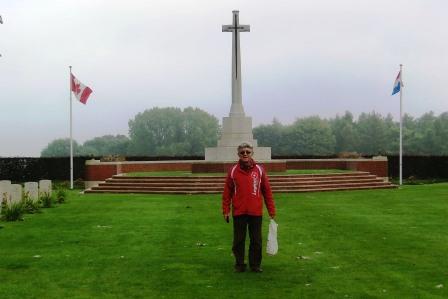
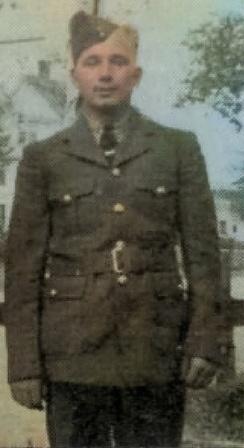
June 12, 2026. It’s wonderful when the search for a photo of a soldier takes flight, with many people actively involved in helping in this quest. That’s what happened when Pieter looked for a photo of WWII soldier Samuel George ENGEN of The Pas, Manitoba. It was a search that took 18 months and involved many family members.
Near the end of December 2024, while we were on our way to a winter vacation, we woke up in our hotel room in Virginia with the wonderful news that a photo of Samuel had been found, and sent to us by Ralph McLean, a researcher that we’d written to earlier in 2024, and Samuel’s nephews Eric and Wilfred Sanderson.
Eric explained that he’d received the photo from Ralph who “…got the picture from Devyn Rusk. … I was so excited to receive the photo. I hope Diane and I can make the journey to see my uncle’s grave site….” Eric and his wife Diane were the people Pieter first talked to about finding a photo of Samuel. At the time, Eric explained that the photos were lost when his mother’s house burned down.
But, the search continued amongst family members and eventually a photo was found. Devyn, a teaching assistant at a school in The Pas, Manitoba, is the great-granddaughter of Samuel’s brother Aaron. She explained that the photo had been found “…in an old album. It had all of Samuel’s Dad’s old post cards….”
…A cookbook connection with the Opaskwayak Cree Nation…
Born February 15, 1918 in The Pas, Manitoba, Samuel was the son of Louis Julius, a WWI veteran, and Mary Helen (nee Buck) Engen. His mother was a member of the Opaskwayak Cree Nation. (See https://en.wikipedia.org/wiki/Opaskwayak_Cree_Nation)
The search for a photo of Samuel had a personal connection. More years ago than I care to remember, I taught for one semester at Keewatin Community College (now called University College of the North) in The Pas, and one group of community leaders from the Opaskwayak Cree Nation learned basic computer skills that led to a practical outcome with the development of a cookbook. Eric told us that he was familiar with the names of some of the community leaders listed in the cookbook.
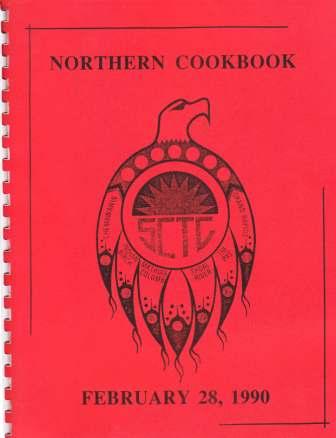
Cover of the Northern Cookbook designed and prepared by students from the Opaskwayak Cree Nation. (Photo courtesy of Valkenburg Family)
…Samuel enlisted in 1941…
Samuel had married Miriam Susan Pranteau on January 16, 1940, and was working for The Pas Lumber Company in The Pas, Manitoba, and as a trapper, when he enlisted at the No. 10 District Depot Recruiting Office in Dauphin, Manitoba on September 6, 1941.
On September 13, 1941, he was sent to No. 100 Canadian Army (Basic) Training Centre (CABTC) in Portage La Prairie, Manitoba. After successfully completing basic training, he went on to A15 Infantry Advanced Training Centre (Rifle) at Camp Shilo, Manitoba on December 4, 1941. His training included battle drill tactics, marksmanship, bayonet drill, and field exercises that simulated actual combat environments.
On January 6, 1942, Samuel was hospitalized in Winnipeg, Manitoba for 13 days with mumps, and returned to Camp Shilo upon recovery. After completing advanced training as a rifleman, he was posted to the A15 Canadian Infantry Training Centre, also located in Camp Shilo, on May 15, 1942.
…Samuel left Canada for overseas service…
In preparation for being sent overseas, Samuel given embarkation leave from May 29, 1942 until June 2, 1942, the last chance he had to see his family. In the end, Samuel didn’t report back to base until June 15, understandable considering the distance he would have had to travel to go so far up north and then back again.
On July 21, 1942, he left Canada for the United Kingdom, arriving on July 29, 1942, where he was assigned to No. 2 Canadian Divisional Infantry Reinforcement Unit (CDIRU).
A few weeks later, on August 21, 1942, Samuel was transferred to the Queen’s Own Cameron Highlanders of Canada (C of C), joining the regiment in Hassocks, Sussex. Training continued in anticipation of going into Normandy, France, and to implement lessons learned from other regiments that participated in Operation Jubilee, also known as the Dieppe Raid, on August 19, 1942. (See https://en.wikipedia.org/wiki/Dieppe_Raid)
On December 16, 1942, Samuel was admitted to hospital. Upon being discharged on January 14, 1943, he was assigned to No. 2 Canadian Divisional Infantry Reinforcement Unit (CDIRU). He was hospitalized again, from April 23, 1943 until May 27, 1943.
On June 25, 1943, he returned to the Queen’s Own Cameron Highlanders of Canada (C of C), to participate in Exercise ‘Smashex’, part of ongoing intensive amphibious and infantry training to prepare soldiers before being deployed to Normandy the following year.
Unfortunately, Samuel was hospitalized again, from July 30, 1943 until August 14, 1943, when he was discharged.
…Samuel joined the Lake Superior Regiment (Motor)…
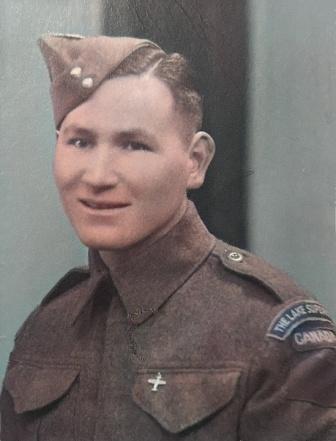
Samuel George Engen. (Photo courtesy of the Engen Family. Photo restoration and colourization by Pieter Valkenburg)
On August 27, 1943, Samuel was transferred to the Lake Superior Regiment (Motor), the infantry component of an Armoured Brigade serving in an Infantry Division. Canada fielded only two such Motor battalions in WWII – Lake Superior Regiment (Motor) of the 4th Canadian (Armoured) Division was one and the other was the Westminster Regiment (Motor) of the 5th Canadian (Armoured) Division.
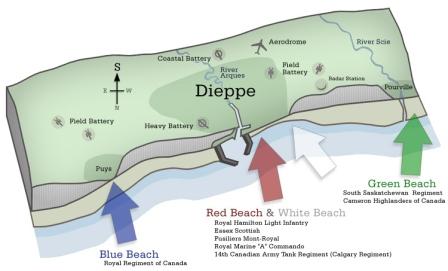
Map showing the Dieppe Raid in 1942, which marks the location of Red Beach. (Map source: https://cbf-fccb.ca/)
Training continued in Britain until July 26, 1944, when Samuel, along with the rest of the Lake Superior Regiment (Motor), left the United Kingdom aboard ‘SS Houston City’ and landed in Normandy, France as part of the 4th Canadian (Armoured) Brigade, 4th Canadian (Armoured) Division. Over the next two days, vehicles disembarked near Graye-sur-Mer on Red Beach, a codename for the heavily fortified Dieppe waterfront during the 1942 Dieppe Raid (Operation Jubilee), while the main battalion went ashore shortly after to join the Normandy campaign, which had begun on June 6, 1944 (D-Day).
They began active service on the front as of July 30, 1944, and over the next two months the Regiment battled its way through Normandy, Falaise, and across northern France into Belgium and The Netherlands. The men did whatever they could to increase the Regiment’s firepower with weapons, including those salvaged from destroyed Sherman tanks and 50 calibre machine guns from downed aircraft. These were fitted onto their universal carriers and other vehicles.
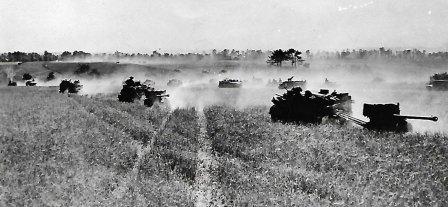
‘The Mad Dash’ on August 14, 1944 through the Falaise Pocket to surround the Germans as part of Operation Tractable fought from August 14-21, 1944. (Photo source: Posted by George Romick on Facebook page of Canadian Military Photos Lost and Found – Research Group)
…The Lake Superior Regiment (Motor) sank 3 German naval vessels in Zeeland…
By October 1944, the 4th Canadian (Armoured) Division was in The Netherlands, tasked with clearing the Germans from an area south of the Maas River. When fighting brought the Lake Superior Regiment into the village of Sint Philipsland in the province of Zeeland on November 4, Dutch civilians told troops that there were German naval vessels in the harbour of Zijpe on the island of Schouwen en Duiveland, just across the strait.
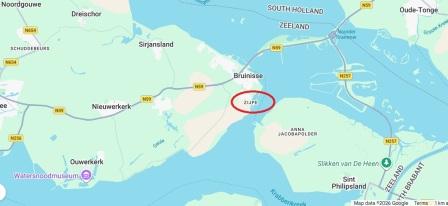
The Lake Superior Regiment (Motor) bombed German naval vessels in Zijpe’s harbour. (Map source: Google Maps)
The next day, with help from the tanks of the British Columbia Regiment, the Regiment bombarded the ships with their 6 pounder antitank guns and mortars. Within 15 minutes the Germans ceased fire. Due to high winds, it wasn’t until a day later that the Regiment’s boarding party later found a corvette burning and 3 other vessels sinking, with 20 fatalities and 80 wounded.
…The Lake Superior Regiment (Motor) advanced into Germany in 1945…
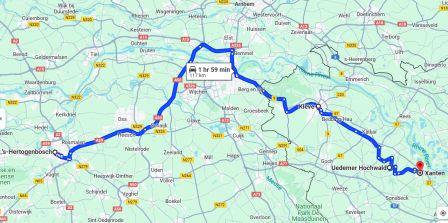
Most of February saw the Regiment based in the ‘s-Hertogenbosch area of The Netherlands as they continued their patrols, but on February 21, 1945, the Regiment began moving towards Germany for the upcoming Operation Blockbuster, which began at dawn on February 26, 1945. (See https://en.wikipedia.org/wiki/Operation_Blockbuster)
By 2:00 am in the early morning of February 23, 1945 the Regiment had arrived at their initial position in the Reichswald Forest, just over the border from The Netherlands. The next afternoon the Regiment moved to Kleve.
On March 1, 1945, the war diary for the Lake Superior Regiment recorded that instructions had been received for “…the assault on the Hochwald Forest Gap….” This attack was codenamed Operation Churchill.
Clearing the very narrow Hochwald Gap was a difficult task, given that the weather was anything but cooperative. An early thaw meant that the tanks got bogged down in mud, making them ‘sitting ducks’ for German troops who were positioned to pick them off, one by one. Troops had no choice but to press on, as the Battle of Hochwald Gap, part of Operation Blockbuster, was the final push towards the Rhine River.
Miraculously, Samuel survived these difficult battles, and was with the Regiment when it returned to The Netherlands for a short rest, before going again into Germany at the end of March. The Regiment then fought battles in Meppen, Sögel, and Friesoythe.
The 4th Canadian (Armoured) Division crossed the Twente Canal on April 4, 1945 and reached the Ems River. However, flooded terrain made it difficult for the tanks to maneuver. On April 17, 1945, the Battle of the Küsten Canal began, with several Regiments involved in trying to capture and cross it. The Küsten Canal was a 30.5 metre (100 feet) wide obstacle that was a challenge to cross due to the soft ground and German defences. (See https://www.canadiansoldiers.com/history/battlehonours/northwesteurope/kustencanal.htm)
….Samuel lost his life right after the Battle for the Küsten Canal…
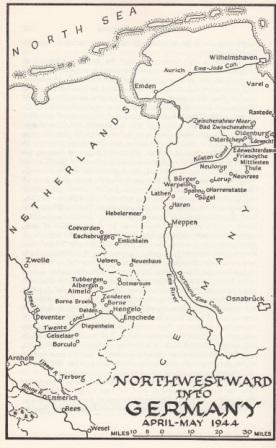
Map showing movement of troops towards Bad Zwischenahn along the Küsten Canal. NOTE: Date on map is incorrect – it should say 1945, not 1944. (Map source: ‘In The Face Of Danger – The History Of The Lake Superior Regiment’)
An account by author Lt-Col George Stanley of ‘In The Face Of Danger – The History Of The Lake Superior Regiment’ told what happened as Allied troops moved beyond the Küsten Canal towards Bad Zwischenahn. “….Lieutenant-Colonel Keane and several of his officers visited the bridgehead to get a clear idea of the tactical picture; for it was the Lake Sups who were expected to achieve the break out.
With the support of the tanks of the Canadian Grenadier Guards, they were to drive due north astride the road which led from Friesoythe to the little spa on the shores of Zwischenahn lake just ten miles away.
The next day the battalion began to move forward. The road had been badly damaged by gun fire and the holes hastily filled with rubble, thus making it passable for armoured vehicles. The fighting on the perimeter of the bridgehead was, however, very sticky and the Brigade commander decided that, rather than strike hard ahead over the mine strewn, body-littered fields ahead, the Lake Sups should stab eastwards along both sides of the Küsten Canal, in the hope, not only of widening the base of the bridgehead, but also of relieving some of the pressure upon the forward infantry battalions.
Thus it was that “B” Company, as soon as it crossed the Canal, struck immediately to the eastwards in company with a troop of Grenadier tanks and a Wasp flame-thrower. There was a road that ran along the north side of the Canal, but the going here was slow and halting.…
The first streak of daylight on April 23rd was the signal for “A” and “B” Companies to resume their drive eastwards along the Küsten Canal. On both sides the enemy was active …. There was no steady advance; rather the move took the form of a series of short bounds preceded by heavy firing and not inconsiderable battling. There were casualties… One of the Lake Superior flame-throwers was blown high into the air by a mine, both of its crew members being killed….”
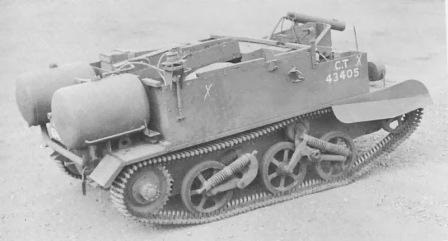
Example of a Wasp flame thrower. (Photo source: http://www.canadiansoldiers.com)
The April 23, 1945 war diary entry for the Lake Superior Regiment verified that Samuel was one of the two crew members who died. “…At 0700 hours ‘B’ Company prepared to move forward…” of a crater “…to the road junction. The motor platoons went forward on foot with a Wasp flame thrower in support. Suddenly the flame thrower struck a mine and both members of the crew were killed, Pte Giving, R.V. and Pte Engen, S.G….” The other crew member mentioned was Royal Victor GIVING of Kenora, Ontario.
….Samuel is buried in the Canadian War Cemetery in Holten….
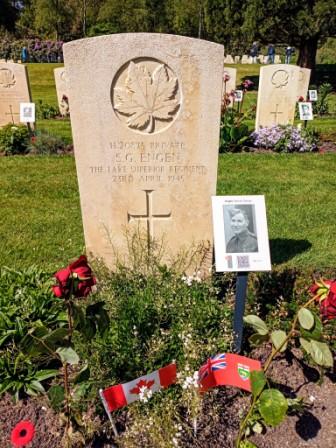
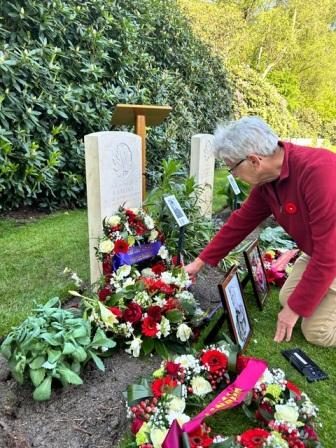
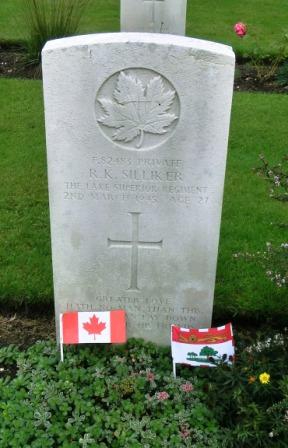
Grave of Samuel Engen with Canadian and Manitoba flags placed by Pieter. (Photo credit: Pieter Valkenburg)
Samuel was temporarily buried in Oldenburg, Germany at the “…right hand side of the road running North near a red brick building…” before being reburied in the Canadian War Cemetery in Holten, The Netherlands on March 23, 1946. During our 2025 European War Memorial Tour, Pieter placed Canadian and Manitoba flags by his grave.
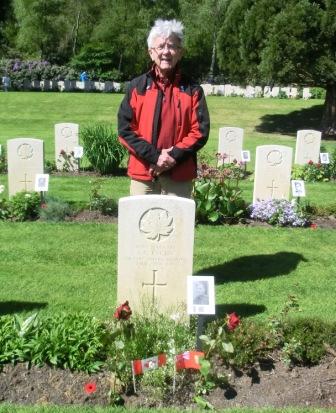
Pieter at the grave of Samuel Engen after placing Canadian and Manitoba flags. (Photo credit: Daria Valkenburg)
…..Samuel is listed on the National Métis Veterans Memorial Monument….
Samuel is listed on the National Métis Veterans Memorial Monument just outside of Batoche, Saskatchewan. (See https://www.metismuseum.ca/metisveteransmonument/)
His name can be found on Column 5 on the outside. Row 40. (See https://www.metismuseum.ca/metisveteransmonument/column.php?v=LWSBNZ)
…..Engen Lake is named in Samuel’s honour….
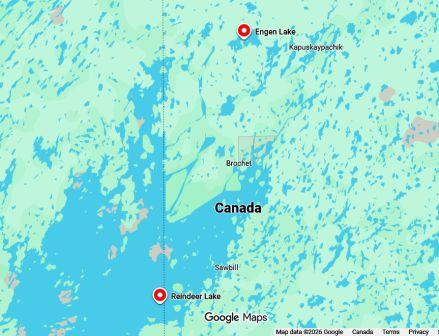
Engen Lake was named in Samuel Engen’s honour in 1961. (Map source: Google Maps)
Engen Lake in northwestern Manitoba, northeast of Reindeer Lake which straddles the Manitoba-Saskatchewan border, was named after Samuel in 1961.

Devyn Rusk. (Photo courtesy of Devyn Rusk)
Thank you to Ralph McLean, Devyn Rusk, Eric Sanderson, and Wilfred Sanderson for finding and sending a photo. Thank you to Judie Klassen for family history research.
The flags placed at Samuel’s grave during our 2025 European War Memorial Tour were donated. Our thanks go to:
- Alan Waddell, Constituent Assistant, on behalf of Heath MacDonald, MP for Malpeque, for the Canadian flag.
- Brad Robertson, Chief of Protocol, Government of Manitoba, on behalf of Wab Kinew, Premier of Manitoba, who donated the Manitoba flag.
Pieter’s research efforts to find photos and families of soldiers continue. Do you have a story to tell? Email Pieter at memorialtrail@gmail.com, or comment on the blog.
© Daria Valkenburg
….Want to follow our research?…
If you are reading this posting, but aren’t following our research, you are welcome to do so. Our blog address: https://onthewarmemorialtrail.com/
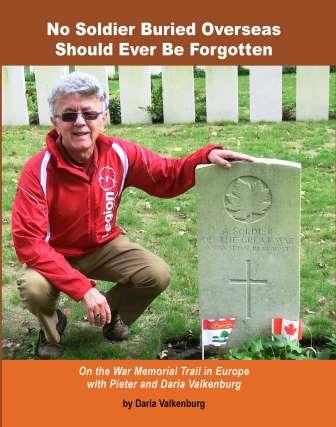 4 countries, 6 weeks, 7,000 km – an unforgettable war memorial journey in Europe…. Daria’s book ‘No Soldier Buried Overseas Should Ever Be Forgotten‘ is available in print and e-book formats. Net proceeds of book sales help support research costs and the cost of maintaining this blog. For more information see https://nosoldierforgotten.com/
Subscribe to our YouTube Channel: On The War Memorial Trail With Pieter Valkenburg: https://www.youtube.com/channel/UCJ591TyjSheOR-Cb_Gs_5Kw.
Never miss a posting! Subscribe below to have each new story from the war memorial trail delivered to your inbox.


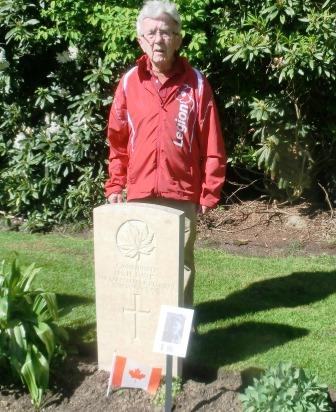


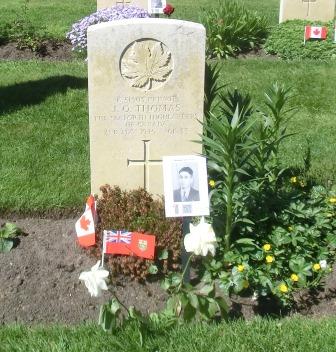
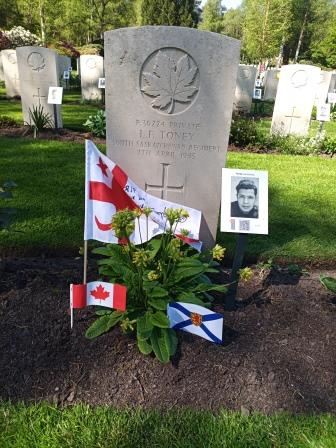







 From this one article, we learned that Harry Davis was Indigenous. His mother was a member of the Tr’ondëk Hwëch’in (loosely translated as ‘people of the river’), a First Nation whose members are descendants of the Hän-speaking people who have lived along the Yukon River for millennia. (See