On The War Memorial Trail…. Remembrance Week 2024 –Remembering Those Who Served In The RCAF During WWII

Remembrance_Day_2024_3840x2160

November 7, 2024.  As we reflect on the service and sacrifices made by so many who have served, both during conflicts and in peacetime, I took a look back at previous stories told over the years.  2024 commemorates 100 years of service for the Royal Canadian Air Force (RCAF) as a distinct military element, and so it seemed appropriate to dedicate this posting to stories previously told of those who served in the RCAF during WWII. 

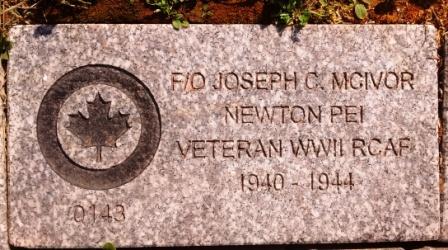
…The Air Force Heritage Park in Summerside has a commemorative stone honouring Flight Officer Joe McIver….

IMG_20190807_101837076 Entrance to Air Force Heritage Park Summerside

Entrance to Air Force Heritage Park in Summerside. (Photo credit: Daria Valkenburg)

Several years ago we visited the Air Force Heritage Park in Summerside to look at the commemorative stone honouring Flight Officer Joseph ‘Joe’ Charles MCIVER of Kinkora, Prince Edward Island.  Joe was the navigator aboard B24 Liberator MkVIII EV895 on November 18, 1944, when it went down near the Arctic Circle while on anti-submarine patrol looking for a suspected U-boat off Gardskagi, Iceland.  There were no survivors.

You can read his story at:

IMG_20190807_101038750 McIver Commemorative Stone Summerside

Commemorative Stone at Air Force Heritage Park, Summerside, Prince Edward Island. (Photo credit: Pieter Valkenburg)

 … Pilot Elmer Muttart saved his crew and the Dutch village of Wons but sacrificed his own life to do so ….

The very first airman whose story was researched by Pieter was that of Elmer Bagnall MUTTART of Cape Traverse, Prince Edward Island, whose name is listed on the Cenotaph outside the Borden-Carleton Legion.  Elmer was the pilot aboard Halifax L9561 when it was shot twice by German night fighters on October 12, 1941, while the plane was on its way to a bombing raid on Bremen, Germany. 

After ordering the crew to bail out, Elmer managed to steer the burning plane away from the Dutch village of Wons, in the province of Friesland, before it crashed in a farmer’s field, just outside the village. He was the only casualty and is buried in Harlingen General Cemetery in The Netherlands.  The rest of the crew spent the war years in prisoner of war camps before being liberated. On October 12, 2019, a memorial panel was placed near the crash site in Wons to honour Elmer and his crew, an emotional journey for all of us who attended.

You can read his story here:

 … Pilot Hubert Hall was a prisoner of war after his plane was shot down in 1942 ….

John ‘Hubert’ HALL of Summerside, Prince Edward Island, was the pilot aboard Wellington Z1203, which crashed in The Netherlands near Mijdrecht on the night of March 28/29, 1942.  Hubert spent the remainder of the war years as a prisoner of war in POW camp Stalag Luft III, located in present-day Żagań, Poland, before returning home to Canada.

You can read his story at:

… Navigator Bunky FitzGerald is in an unmarked grave after Halifax W1175 crashed off the Dutch coast….

Rowan Charles ‘Bunky’ FITZGERALD, of Charlottetown, Prince Edward Island, was the navigator aboard Halifax W1175 of the 405th Vancouver Squadron RCAF when it was hit by shellfire (flak) as the plane was returning from Bremen, Germany on the morning of June 28, 1942. 

The plane crashed into a sandbank in the Wadden Sea, off the Dutch coast between the Island of Texel and the mainland, 15.5 km from Harlingen, in the province of Friesland.  There were no survivors. Only one crew member’s body was identified, and was buried in Harlingen General Cemetery in The Netherlands. His grave is between 3 unknown graves, one of which may just contain the remains of Bunky FitzGerald. 

You can read his story at:

… Pilot Lorne MacFarlane survived all his flights and returned home…

Pilot Lorne MACFARLANE, of Fernwood, Prince Edward Island, successfully flew 40 missions overseas and was then assigned to fly dignitaries, mail, and personnel between England and the front lines until the war ended.  After returning safely back to Canada, he was the Officer In Charge at RCAF No 1 Radio and Navigation School in Summerside, Prince Edward Island.

You can read his story at:

… Wireless operator Bob Dickie almost made it safely back to England…

Robert ‘Bob’ James DICKIE, of Carlton (now Borden-Carleton), Prince Edward Island, was the wireless operator aboard Lancaster JB312 on February 21, 1944 when it collided with another plane during a bombing sortie in Stuttgart, Germany.  Although badly damaged, the plane was able make it back to England, but then crashed as it approached the runway. There were no survivors. Bob is buried at Cambridge City Cemetery in England.

You can read his story at:

… Pilot Leonard Unwin’s plane crashed on Christmas Eve…

Pilot Leonard Arthur UNWIN, of Windsor, Ontario, was a flying instructor in Summerside, Prince Edward Island and Moncton, New Brunswick, before going overseas in May 1943.  On December 24, 1944, he left from his base in Belgium, one of the pilots in a section of 4 Typhoon planes on an armed reconnaissance in the Utrecht area in The Netherlands. While attacking a convoy of three German trucks in Woudenberg, the plane’s tailpiece broke off, the plane destabilized, and crashed. He’s buried in Woudenberg Municipal Cemetery in The Netherlands.

You can read his story at:

… Flight student Ralph McCutcheon lost his life in a training accident…

Flight student Ralph Gordon MCCUTCHEON, of Toronto, Ontario, but who was born in Buffalo, New York, USA, lost his life in a tragic accident that happened during his training at the No. 9 Service Flying Training School RCAF in Summerside, Prince Edward Island on the morning of June 11, 1942.  While training in a Harvard MK2 plane, it crashed in a farm field in North Tryon, Prince Edward Island.

You can read his story at:

… Gunner William Andrew Hood was aboard the last flight of Halifax JD215…

William Andrew HOOD, of Little Bras D’or, Cape Breton Island, Nova Scotia, was the mid-upper gunner aboard Halifax JD215 when it was shot down over The Netherlands on June 29, 1943.  None of the crew survived. He’s buried in Eindhoven General Cemetery in Eindhoven, The Netherlands.

You can read his story at:

… Navigator Arnold Hupman was aboard Lancaster X KB728 VR-V when it exploded over Arnhem, The Netherlands…

Navigator Arnold Freeman HUPMAN, of East Side of Ragged Island, Shelburne County, Nova Scotia, lost his life when the Lancaster bomber he was in, Lancaster X KB728 VR-V, was attacked by a German night fighter and exploded on the outskirts of Arnhem, The Netherlands as it was returning from a bombing operation against the synthetic oil plant at Sterkrade in Germany on the night of June 16 to 17, 1944. There were no survivors, and all 7 crew members are now buried in the Canadian War Cemetery in Groesbeek, The Netherlands.

You can read his story at:

… Pilot Douglas MacKenzie did not survive the last flight of Halifax DT630…

Jack ‘Douglas’ MACKENZIE,  of Winnipeg, Manitoba, was the pilot of Halifax DT630 (call sign VR-T), one of 8 heavy Halifax bombers sent on a night raid to Hamburg, Germany on February 3, 1943.  It was shot down by a night fighter over the province of Drenthe in The Netherlands. 4 men died, including Douglas, while 3 survived and spent the remainder of the war in prisoner of war camps.  He’s buried in Sleen General Cemetery in The Netherlands, along with the other 3 casualties of that flight.

You can read his story at:

… Pilot Dusty Millar’s spitfire ran out of fuel and crashed…

George Glenn ‘Dusty’ MILLAR, of Winnipeg, Manitoba, was killed on September 28, 1944 while flying a Spitfire Mark IX on patrol with his squadron over Nijmegen, The Netherlands. After Dusty reported on his radio that the plane was low in fuel, it crashed southeast of Weibosch near Schijndel, in the Dutch province of Noord-BrabantHe is buried in Uden War Cemetery in The Netherlands.

You can read his story at:

May we never forget the sacrifices made by these airmen, and their families, during WWII.  Unfortunately, while we live free in Canada, so many people today live in a war zone and are experiencing death, uncertainty, and insecurity in not knowing what will happen next.  Lest we forget is never more appropriate.

If you have a story to tell, please let Pieter know. You can email him at memorialtrail@gmail.com, comment on the blog, or send a tweet to @researchmemori1.  

© Daria Valkenburg

….Want to follow our research?….

If you are reading this posting, but aren’t following our research, you are welcome to do so.  Our blog address: https://onthewarmemorialtrail.com/
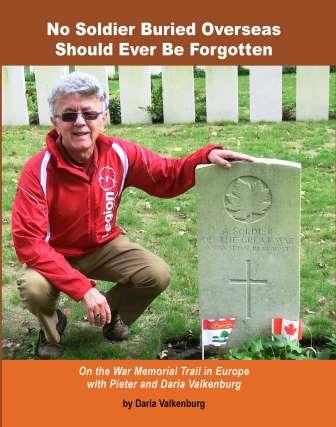
Front cover OnTheWarMememorialTrailinEurope4 countries, 6 weeks, 7,000 km – an unforgettable war memorial journey in Europe…. Daria’s book ‘No Soldier Buried Overseas Should Ever Be Forgotten‘ is available in print and e-book formats.  Net proceeds of book sales help support research costs and the cost of maintaining this blog. For more information see https://nosoldierforgotten.com/ 

You are also invited to subscribe to our YouTube Channel: On The War Memorial Trail With Pieter Valkenburg: https://www.youtube.com/channel/UCJ591TyjSheOR-Cb_Gs_5Kw

Never miss a posting!  Subscribe below to have each new story from the war memorial trail delivered to your inbox.
On The War Memorial Trail….. A WWII Letter From ‘Somewhere In North Russia’

January 14, 2023.  Several years ago, when Pieter was researching the names listed on the Cenotaph outside the Borden-Carleton Legion, the story of WWII Flight Officer Joseph “Joe” Charles MCIVER of Kinkora, Prince Edward Island, was told.

Joe was posted to RAF Coastal Command, a formation with the Royal Air Force (RAF), which had a mandate to protect convoys from German U-boats and Allied shipping from aerial threats from the German Air Forces.  Squadrons operated from various bases, including in the Arctic Circle.

Joseph Charles McIver

Joseph Charles McIver. (Photo: The Canadian Virtual War Memorial – Veterans Affairs Canada)

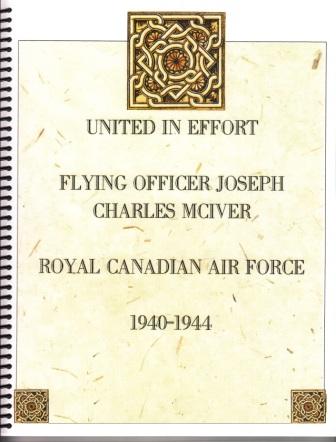
Joe’s nephew, Alan A. McIvor, wrote a book on his uncle called ‘United In Effort…Flying Officer Joseph Charles McIver…Royal Canadian Air Force…1940-1944’. One of the documents in the book was a letter Joe wrote to his wife Helen from the far north of the Soviet Union (now Russia) on September 23, 1942.  Joe’s actual location in the letter was erased by censors, but his heading ‘Somewhere In North Russia’ was left intact.

We were reminded of the letter when we met Lorna Johnston, Alan’s cousin, and she gave us a copy of the same letter.

…Joe McIver’s Squadron participates in Operation Orator ….

1024px-Barents_Sea_map

Map shows the location of the Barents Sea north of Russia and Norway, and the surrounding seas and islands. (Map created by Norman Einstein, 2005. Courtesy of https://en.wikipedia.org/wiki/Operation_Orator#/media/File:Barents_Sea_map.png)

On September 4, 1942, Joe McIver was in the Royal Australian Air Force’s (RAAF) 455 Squadron with a group flying to the Soviet Union as part of ‘Operation Orator, a search and strike force to operate over the Barents Sea.  The plan was to fly on a course to reach Norway, cross the mountains in the dark, overfly northern Sweden and Finland, and land at Afrikanda air base, at the southern end of Murmansk Oblast (an oblast is similar to a province). (See https://en.wikipedia.org/wiki/Operation_Orator for more information on Operation Orator and https://en.wikipedia.org/wiki/Afrikanda_(air_base) for more information on Afrikanda.)

…Joe’s plane ran out of fuel and crashed ….

As Joe explained in his September 23, 1942 letter “…we were at 8,000 feet and below us were solid clouds and not a break in them. We couldn’t come down for fear of crashing into a mountain.  So we decided to fly to the White Sea and follow it up, which we did, and finally came to our destination….but there was no aerodome in sight...

Then they realized they were running out of fuel! “…Our fuel was getting very low and we started to look for a half decent paddy to set down on.  We spotted a marshy field and were running up to it when both motors cut out of gas, and down we went in a woods…

All five crew members got out safely, thankful that the plane “…didn’t go up in flames as we expected…Nobody said much for five minutes….

They were soon met by 15 Soviet soldiers who at first mistook them for Germans.  “…This was the first time I was scared, knowing we were close to the front line and that they couldn’t understand us. It was the first time for me to put my hands up while I was being searched and I put them up good and high!…

After establishing that they were Allied airmen, the Soviets “…got a truck and took us to a Military Camp and gave us a bang up dinner…”  After dinner, they were taken to where the rest of the Squadron were housed.

They stayed for a few days and were allowed to look for their personal belongings on the downed plane.  Then, with the aid of an interpreter, they travelled by train and truck “…for the drome from which we are going to operate.  We have no aircraft so there’ll be no operations for us unless somebody gets sick or hurt….

Their journey took them 190 km to Vayenga, located on the coast of the Barents Sea along the Kola Bay 25 kilometers (16 miles) northeast of Murmansk.

Vayenga, now called Severomorsk, is the main administrative base of the Russian Northern Fleet.  During WWII, a naval airfield built in a neighbouring bay was used by the British, namely No. 151 Wing RAF, to protect the Arctic.

…Joe’s letter from the Arctic Circle ….

Joe’s Squadron was in Vayenga for just over a month. In his letter, he included his impressions of life in the far north.  “…Up here we are eating RAF supplies and not Russian food.  We spend most of our time reading, cutting wood.  We’re in the Arctic Circle and it’s getting fairly cool!…

Joe hoped they would be sent back to England soon.  “…We expect to get back soon.  If we don’t soon go, I think I’ll get into a dugout.  I’ll be glad to get back to get some letters, English papers, radio, etc.  Everybody’s in uniform here! No leave until Victory!….

Although they got an allowance from the Soviets, “…there’s absolutely nothing to buy.  One can spend a few roubles for a shave now and again…

Of course, no trip to the Soviet Union would be complete without trying what their Soviet colleagues drank to keep warm. “…I’ve had one drink of vodka and it’s sudden death!  Summerside’s screech is mild compared to it….” Vodka’s high alcohol content can warm the body, helpful when temperatures are below freezing point!

Joe and his Squadron may have been in the far north, but they were still subject to enemy attacks.  “…I have spent quite a few hours in the air raid shelters.  I never thought I could run so fast.  I can pass anybody on the way to the shelter…

The day before he wrote his letter, he noted that “…during a dog fight yesterday over the aerodome, an aircraft was shot up.  The pilot bailed out and the aircraft came down and crashed in the building. There were no people in it at the time.  Lots of excitement every day!…

Joe summarized the trip by saying “…this trip has been a great experience, one that I wouldn’t have missed for the world, but I wouldn’t want to do it again.  That crash landing, the first meeting with the Ruskies, and the first Russian meal are incidents I’ll always remember…

…Joe did not survive WWII….

In October 1942 Joe’s Squadron returned to England, but it wasn’t long before Joe found himself back in the Arctic Circle.  On November 18, 1944, Joe was part of the crew of Liberator MK VA EV-895, which took off on anti-submarine patrol looking for a suspected U-boat off Gardskagi, Iceland.

Unfortunately, the plane disappeared over the Arctic Ocean and was never seen again.  (See https://onthewarmemorialtrail.com/2019/08/17/the-ww2-flight-officer-whose-plane-went-down-while-on-patrol-near-the-arctic-circle/)

Thank you to the Alan McIvor and Lorna Johnston for sharing Joe McIver’s letter from Russia, which provided a glimpse into what he experienced in his own words. If you have a story to share, please contact Pieter at memorialtrail@gmail.com, comment on the blog, or tweet to @researchmemori1.

© Daria Valkenburg

…Want to follow our research?….

If you are reading this posting, but aren’t following the blog, you are welcome to do so. Our blog address: https://onthewarmemorialtrail.com/.

Front cover OnTheWarMememorialTrailinEurope4 countries, 6 weeks, 7,000 km – an unforgettable war memorial journey in Europe…. Daria’s book ‘No Soldier Buried Overseas Should Ever Be Forgotten‘ is available in print and e-book formats.  Net proceeds of book sales help support research costs and the cost of maintaining this blog. For more information on the book, please see https://nosoldierforgotten.com/

You are also invited to subscribe to our YouTube Channel: On The War Memorial Trail With Pieter Valkenburg: https://www.youtube.com/channel/UCJ591TyjSheOR-Cb_Gs_5Kw.

Never miss a posting!  Subscribe below to have each new story from the war memorial trail delivered to your inbox.

We Hear From Readers About ‘No Soldier Buried Overseas Should Ever Be Forgotten’

Front cover OnTheWarMememorialTrailinEurope

March 13, 2022. Once ‘No Soldier Buried Overseas Overseas Should Ever Be Forgotten’ was published, we were delighted to receive a number of photos and emails.  And we were able to meet in person with a few people. (For the original posting about the book, see https://onthewarmemorialtrail.com/2022/02/19/new-book-no-soldier-buried-overseas-should-ever-be-forgotten/)

…Some of the feedback we’ve received….

PXL_20220221_163612516~3 Feb 21 2022 Brien Robertson with book photo by Moira

Brien Robertson reads the book.  (Photo credit: Moira Robertson)

Brien and Moira Robertson wrote “We received No Soldier… today and have been reading it ever since. Such a wonderful journey telling of your travels and memorializing those lost in the tragedy of wars. And here we go again, thinking about what could happen in Ukraine. Reading the book brings home the thought that all wars are really civil wars. Lives lost for nothing. Great job telling the story so not to forget those lost. We are proud to be your friends….

IMG_1581 Feb 18 2022 Mindy Patrick with Daria

Mindy Patrick and Daria with the book.  (Photo courtesy of Valkenburg family collection)

Mindy Patrick wanted a book for her father, a veteran who served in the US Coast Guard.

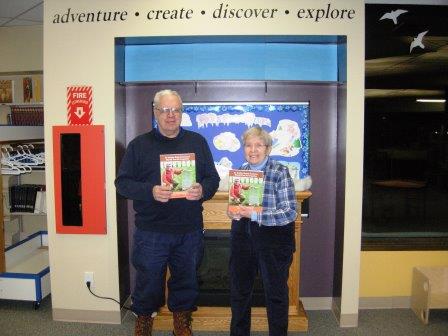
DSCN2378 Feb 22 2022 Don and Nora Coutts at North Bay Public Library

Don and Nora Coutts at the North Bay Public Library in Ontario. (Photo taken by Brad Jacobs)

Don Coutts, nephew of WW2 pilot Elmer Bagnall MUTTART, who is featured in the book, explained he ordered copies for himself and for the North Bay Public Library in North Bay, Ontario, where his wife Nora is Head of Children’s Services and Deputy CEO.

(See https://onthewarmemorialtrail.com/2019/10/17/on-the-war-memorial-trail-the-presentations-at-hannemahuis-in-harlingen/ for comments made by Don during the presentation in The Netherlands in 2019 to honour his uncle and the crew of Halifax L9561.)

Alexander Tuinhout of the Missing Airmen Memorial Foundation: Original comment in Dutch: “…We hebben het boek “No Soldier Buried Overseas Should Ever Be Forgotten” besteld en inmiddels ook al uit Canada ontvangen. Hoewel we nog geen tijd hebben gehad om alles te lezen is de eerste indruk voortreffelijk! Zo’n publicatie is een monument op zich en zeker een felicitatie waard!…

(English translation by Pieter: We ordered the book ‘No Soldier Buried Overseas Should Ever Be Forgotten’ and have already received it from Canada. Although we haven’t had time to read everything yet, the first impression is excellent! Such a publication is a monument in itself and certainly worth congratulating!…”)

The Missing Airmen Memorial Foundation organized the memorial panel to honour Elmer Bagnall MUTTART and the crew of Halifax L9561.  During the events in October 2019, Alexander gave a presentation on the crew and what happened on October 12, 1941.  You can watch part of his presentation in the documentary made about the events.

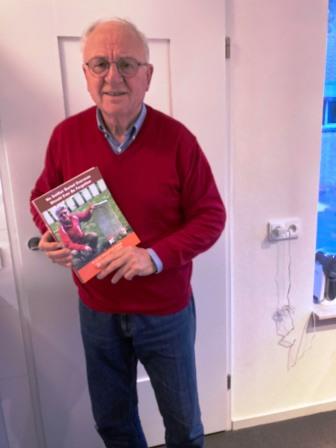
IMG_0360 Feb 23 2022 Henk Vincent

Henk Vincent, a volunteer at the Holten Cemetery Information Centre, with the book.  (Photo courtesy of H. Vincent)

The work done by the Holten Cemetery Information Centre to remember Canadian soldiers buried in the Canadian War Cemetery in Holten, The Netherlands is ongoing.  Pieter is one of the volunteers helping with photo wish lists for a digital archive.  (For more information on the Info Centre, see https://www.canadesebegraafplaatsholten.nl/en/home/)

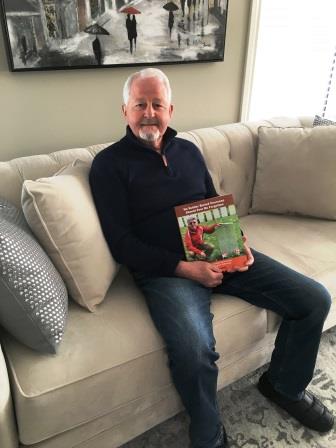
IMG_6170 (1) Feb 25 2022 Alan McIvor

Alan McIvor, nephew of WW2 Flight Officer Joseph ‘Joe’ Charles McIver, wrote a book on his uncle’s service. (Photo courtesy of A. McIvor)

Alan McIvor wrote …Congratulations on your book, “NO SOLDIER BURIED OVERSEAS.”  Good work.  I am sure it was a labour of love but lots of work, research, writing and editing…

Alan’s uncle, WW2 Flight Officer Joseph ‘Joe’ Charles MCIVER of Kinkora, Prince Edward Island, was one of the names listed on the Cenotaph outside the Borden-Carleton Legion – the research project that launched this blog.

(See https://onthewarmemorialtrail.com/2019/08/17/the-ww2-flight-officer-whose-plane-went-down-while-on-patrol-near-the-arctic-circle/)

CIMG5511 Feb 25 2022 Daria with Susan & Charlie

Daria visits with Susan and Charlie Choi. (Photo credit: Daria Valkenburg)

Last fall, Charlie CHOI, who was 4 years old when the Korean War started in June 1950, shared his memories in a 3 part series.  If you missed these postings, please see:

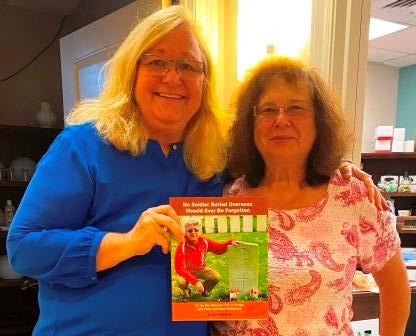
CIMG5506 Feb 21 2022 Daria with Mary Ann Greiner

Daria with Mary Ann Greiner.  (Photo credit: Pieter Valkenburg)

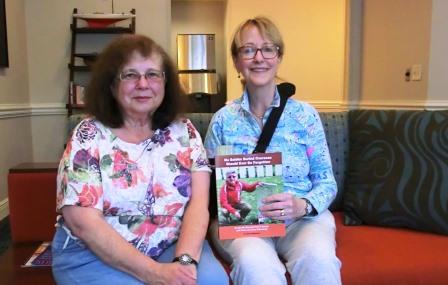
Mary Ann Greiner has an abiding interest in military history. Pieter and I were able to meet with her and her husband Rick, a US army veteran.

20220303_202843 Mar 3 2022 John Davis photo by Susan

John Davis is the author of ‘Outside Time Looking In’, which features two alternative history stories.  (Photo credit: Susan Choi)

John Davis is the author of ‘Outside Time Looking In’, featuring two alternative history stories, and which I’ve read with great interest.  (See https://www.lulu.com/en/us/shop/john-davis/outside-time-looking-in/paperback/product-18rekkpk.html?page=1&pageSize=4)

Thank you to everyone who sent in comments and photos with themselves with the book, and for your support. Email Pieter at memorialtrail@gmail.com, comment on the blog, or tweet to @researchmemori1.

© Daria Valkenburg

…Book trailer and website….

Thanks to the amazing talents of Wendy Nattress, who does the post-production editing for the On The War Memorial Trail YouTube Channel, we have a book website: see https://nosoldierforgotten.com/.  The website has a book description, preview pages, and ordering information.

Wendy also prepared a short book trailer…

…Want to follow our research?….

If you are reading this posting, but aren’t following the blog, you are welcome to do so.  Our blog address: https://onthewarmemorialtrail.com/

goodreads-badge-add-plus-71eae69ca0307d077df66a58ec0688984 countries, 6 weeks, 7,000 km – an unforgettable war memorial journey in Europe…. Daria’s book ‘No Soldier Buried Overseas Should Ever Be Forgotten‘ is available in print and e-book formats.  Net proceeds of book sales help support research costs and the cost of maintaining this blog. For more information see https://nosoldierforgotten.com/ 

You are also invited to subscribe to our YouTube Channel: On The War Memorial Trail With Pieter Valkenburg: https://www.youtube.com/channel/UCJ591TyjSheOR-Cb_Gs_5Kw

Never miss a posting!  Subscribe below to have each new story from the war memorial trail delivered to your inbox.

The WWII Flight Officer Whose Plane Went Down While On Patrol Near The Arctic Circle

August 17, 2019.  In researching the names on the Cenotaph outside the Borden-Carleton Legion, normally Pieter encounters one of four situations:

  • family members who have a photo but know little or nothing else about the soldier.
  • family members who are aware of the soldier but have no photo and little or no information.
  • family members who know nothing about the soldier, have no photo, and aren’t at all interested. This situation tends to occur with WW1 soldiers, who died at a young age, with no spouse or children. “It happened over 100 years ago! That’s ancient history!” one woman told Pieter.
  • family members who have a photo and have saved letters or cards written by the soldier or about him, and may have his medals. These family members have a general idea of what happened to the soldier and may have visited his grave or a memorial listing his name.

In researching the story of Flight Officer Joseph “Joe” Charles MCIVER of Kinkora, Pieter encountered a fifth situation …… family members so dedicated to preserving his memory that they did extensive research on their own!  Not only were there photos and documents, but one nephew, Alan A. McIvor of Kelowna, BC, wrote a book on his uncle called ‘United In Effort..Flying Officer Joseph Charles McIver…Royal Canadian Air Force…1940-1944’ and was kind enough to send it to Pieter.

Cover of Alan McIvors book

Cover of Alan McIvor’s book.

But the story begins here on Prince Edward Island with Alan McIvor’s sister-in-law Joyce Philips and her husband Gordon, who invited us to visit them at their home.

CIMG2545 Aug 28 2018 Pieter with Gordon & Joyce Philips

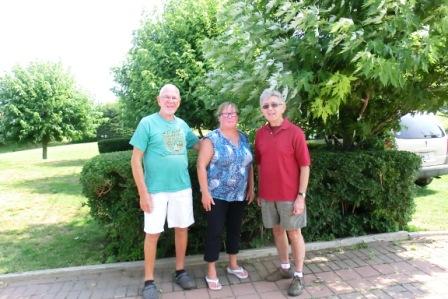
Left to right: Gordon Philips, Joyce Philips, Pieter Valkenburg. (Photo credit: Daria Valkenburg)

Joseph Charles McIver was born July 26, 1916 in Kinkora, the son of Peter D McIver and Margaret Anne McKenna, “the sixth of fourteen children” as noted in Alan McIvor’s book ‘United In Effort’. Before enlisting with the Royal Canadian Air Force in Charlottetown on November 15, 1940, he was a warehouse foreman for the PEI Potato Growers Association.  McIvor goes on to explain in his book that his uncle enlisted “as an Aircraftsman 2nd Class.  In the area on his application form where it asked for the reason he wanted to join he declared ‘Wanted to help Win the War.’

Joseph Charles McIver

Joseph Charles McIver. (Photo: The Canadian Virtual War Memorial – Veterans Affairs Canada)

McIver didn’t qualify as a pilot, but was trained for the position of Observer/Navigator in Ontario.  On June 16, 1941 he married Helen Elizabeth McNeill, “a nurse from Summerside”, in Trenton, Ontario.

UNCLE JOE & HELEN McIvor from Alan McIvor

Helen and Joseph Charles McIver. (Photo courtesy A. McIvor family collection)

In January 1942, McIver was posted to England to train with the British Royal Air Force in Coastal Command.  RAF Coastal Command, a formation with the Royal Air Force (RAF) had a mandate to protect convoys from German U-boats and Allied shipping from aerial threats from the German Air Forces.  Squadrons operated from various bases and McIver soon found himself in the Arctic Circle. (For more information on Coastal Command see https://en.wikipedia.org/wiki/RAF_Coastal_Command_during_World_War_II)

On September 4, 1942, McIver was in the Royal Australian Air Force’s (RAAF) 455 Squadron with a group flying to the Soviet Union as part of ‘Operation Orator’, a search and strike force to operate over the Barents Sea.  The plan was to fly on a course to reach Norway, cross the mountains in the dark, overfly northern Sweden, in violation of Swedish neutrality, Finland and land at Afrikanda air base, at the southern end of Murmansk Oblast (an oblast is similar to a province). The flight to Afrikanda was expected to take five to eight hours, depending on the weather and German opposition. After refuelling, the group McIver was in was to fly the remaining 190 km to Vayenga, following the Kandalaksha–Murmansk railway northwards.  (See https://en.wikipedia.org/wiki/Operation_Orator for more information on Operation Orator and https://en.wikipedia.org/wiki/Afrikanda_(air_base) for more information on Afrikanda.)

1024px-Barents_Sea_map

Map shows the location of the Barents Sea north of Russia and Norway, and the surrounding seas and islands. (Map created by Norman Einstein, 2005. Courtesy of https://en.wikipedia.org/wiki/Operation_Orator#/media/File:Barents_Sea_map.png)

McIvor’s ‘United In Effort’ explains what happened to his uncle’s plane after making it to Afrikanda…. “after several attempts at landing in the mist their fuel position became critical.”  The pilot flew towards Kandalaksha to find an emergency landing spot.  “All he could find was an area where the silver birch trees had been cut down, leaving tall thin stumps.

The plane landed intact and no one was hurt, but containers of tools brought by a ground crew passenger “were strewn along the crash path as the bomb bay had been torn open.”  In trying to retrieve the containers, “a bullet smashed into the ground at his feet.”  The ground crew passenger returned to the plane very quickly!  “Eventually a troop of Soviet soldiers arrived and thinking the crew were the hated Nazis, treated them roughly.  They were taken to an underground interview room where an English speaking Soviet Commissar was able to understand they were allies.”  They were then reunited with the rest of the Squadron at Afrikanda and the next day escorted to Vayenga.  Over the next months McIver and his crewmates flew 35 flights, 30 of them Operational Patrols.

In September 1943, McIver was promoted to Temporary Flying Officer, transferred to No. 1 Torpedo Training Unit, and sent to the United Kingdom for further training, followed by a stint as an instructor.  In May 1944 he was given Special Leave and allowed 30 days back in Canada with his wife and relatives before returning to the United Kingdom.

In August 1944, McIver was transferred to RAF No. 53 Squadron, which flew Liberator planes.  These planes were important in the war effort as they “doubled the reach of Britain’s maritime reconnaissance force.  This added range enabled Coastal Command patrols to cover the Mid-Atlantic gap, where U-boats had operated with near impunity.

Liberator No. 53 Squadron RAF Coast Command Credit Australian War Memorial

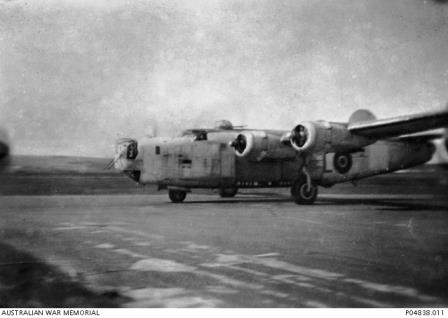
A B24 Liberator MkVIII, aircraft of 53 Squadron, RAF, Coastal Command, on the runway at the airfield at Reykjavik, Iceland. (Photo courtesy of Australian War Memorial https://www.awm.gov.au)

In September 1944, the Squadron, along with McIver, was posted to Reykjavik, Iceland. At 1:10 am on November 18, 1944 he was part of the crew of aircraft EV895 that took off on anti-submarine patrol looking for a suspected U-boat off Gardskagi, Iceland ….. and “were never heard from again.” When the plane was overdue back at base, a search began, with wreckage and floating debris seen at sea.  “A surface vessel is dispatched and recovers a nose wheel that appears to be from a Liberator and other flotsam floating on the surface.

Among the items recovered were clothing identified as belonging to the pilot,  wireless operator, and gunner, suggesting that the plane had sunk.  “There were no surface ships reported missing or overdue from that time frame.  No German U-boats operating in the area were reported missing.

A fire spotted at 2:47 am by another aircraft in the Squadron “was not very far from Iceland and EV895 was very early into its patrol.  It would have been loaded with enough fuel for 14 hours of flying. It would take some time for that amount of fuel to burn off and it would create quite a heat.  It was not uncommon for some Liberators to fly into the water.  It was a big heavy aircraft and flying at night 100 feet above the ocean was potentially risky business.

No one to this day knows what happened, but the likeliest explanation is that the plane flew too close to the ocean and couldn’t pull back up.  The B-24 Liberator was nicknamed ‘The Flying Coffin’ because the only entry and exit from the bomber was in the rear, making it almost impossible for the flight crew and nose gunner to get from the flight deck to the rear when wearing parachutes. Plus, the roller-type bomb bay doors retracted into the fuselage, creating a minimum of aerodynamic drag to keep speed high over a target area.  (See https://sites.google.com/site/willowrunvillage/b-24-bombers)

Reported missing in action were:

  • Captain W.C. PAYNE
  • 2nd Pilot L. A. WINDRESS
  • 1st Navigator J. C. MCIVER
  • 2nd Navigator A. PALMER
  • Warrant Officer R.A. SCOTT
  • Warrant Officer J. G. CHAMBERLAIN
  • Warrant Officer H.A. STEPHEN
  • Warrant Officer Mechanical K. J. SPACKMAN
  • Air Gunner J. BASSETT
  • Flight Engineer G. M. COCKBURN

Although McIver’s plane disappeared on November 18, 1944 he was not officially declared dead until September 1945.  At the time of the disappearance his wife Helen was pregnant, and gave birth to a son Peter Joseph Charles in March 1945.  Helen died in 1978 and son Peter passed away in 2007.

While there is no memorial to the crew in Iceland, there is one in Runnymede, England. As well, McIver has a commemorative stone at the Air Force Heritage Park in Summerside, located at the entrance to the former Canadian Armed Forces Base.

IMG_20190807_101038750 McIver Commemorative Stone Summerside

Commemorative Stone at Air Force Heritage Park, Summerside, Prince Edward Island. (Photo credit: Pieter Valkenburg)

Today, McIver’s medals are on display at the community centre in Kinkora since 2014.  Unfortunately, the whereabouts of the original medals are unknown.  As explained in ‘United In Effort’, “In 2013, through the combined efforts of Joe McIver’s last remaining sibling, Mary Ita Smith and the author, we have had all his medals reissued, including a new one called The Arctic Star for his time spent in the Arctic Circle with RAAF Squadron 455.

OLYMPUS DIGITAL CAMERA

Shadow box with medal of Flight Officer Joseph Charles McIver in the community centre in Kinkora, Prince Edward Island. (Photo credit: Pieter Valkenburg)

Thank you to Alan McIvor and Gordon and Joyce Philips for sharing so much information.  If you have information and photos to share on Flight Officer Joe McIver, the other crew members on that last flight, or any of the other names on the Cenotaph, please contact Pieter at memorialtrail@gmail.com or comment on the blog.

© Daria Valkenburg

….Want to follow our research?….

If you are reading this posting, but aren’t following our research, you are welcome to do so.  Our blog address: https://onthewarmemorialtrail.com/

Front cover OnTheWarMememorialTrailinEurope4 countries, 6 weeks, 7,000 km – an unforgettable war memorial journey in Europe…. Daria’s book ‘No Soldier Buried Overseas Should Ever Be Forgotten‘ is available in print and e-book formats.  Net proceeds of book sales help support research costs and the cost of maintaining this blog. For more information see https://nosoldierforgotten.com/ 

You are also invited to subscribe to our YouTube Channel: On The War Memorial Trail With Pieter Valkenburg: https://www.youtube.com/channel/UCJ591TyjSheOR-Cb_Gs_5Kw

Never miss a posting!  Subscribe below to have each new story from the war memorial trail delivered to your inbox.
On The War Memorial Trail….Honouring The Lives Of Soldiers From the Anglican Church in Crapaud

July 15, 2018.  On July 12, Pieter was invited to give a presentation about the Cenotaph Research Project at St. John the Evangelist Church in Crapaud.  As the families of a number of the names on the Cenotaph outside the Borden-Carleton Legion had been members of this church, we made sure that they were featured in the presentation.

These included:

  • Arthur Leigh COLLETT (WWI)
  • Henry Warburton STEWART (WWI)
  • Ernest Murray NORTON (WWII)
  • William Douglas SHERREN (WWII)

Reverend Margaret Collins introduced Pieter, tying in Pieter’s research to remembrance. Among the audience members were several families of the names on the Cenotaph, which made the event very special. Many brought photos and letters, which will increase our knowledge of the lives of these men.  Families in attendance represented the following men:

  • Arthur Leigh COLLETT  (WWI)
  • Elmer Allister MABEY (WWII)
  • Joseph Charles MCIVER (WWII)
  • Ernest Murray NORTON (WWII)
  • Arthur Clinton ROBINSON  (WWI)
  • William Douglas SHERREN (WWII)
  • George Preston SMITH (WWII)
  • John Lyman WOOD  (WWI)
CIMG1010 Jul 12 2018 Pieter at podium Presentation at Anglican Church in Crapaud

Pieter at the podium at St John the Evangelist Anglican Church in Crapaud. (Photo credit: Daria Valkenburg)

The presentation was well received, with refreshments provided by the Church afterwards, where people could speak with Pieter and each other. Hazel Robinson of the Tryon & Area Historical Society accepted donations to the “Muttart Memorial Fund”.

One person who attended commented afterwards that “I was there to hear more info on Lyman Wood, an ancestor. So pleased to see an interest, amazing to me to see someone speak of him 100 years on. Wood family is very proud of him. I did get to Vimy Ridge in 2007 for 90th, and found his name as well, pretty awesome.  I love Canadian military history, just love the stories, good and bad. Really enjoyed your presentation.  Thanks for all the amazing work that you have done!

CIMG1016 Jul 12 2018 With George Preston Smith family Presentation at Anglican Church in Crapaud

Pieter with the family of WW2 soldier George Preston Smith. (Photo credit: Daria Valkenburg)

CIMG1022 Jul 12 2018 With Reid & Bruce Norton Presentation at Anglican Church in Crapaud

Pieter with Reid (left) and Bruce (right) Norton, nephews of WW2 soldier Ernest Murray Norton. (Photo credit: Daria Valkenburg)

CIMG1023 Jul 12 2018 With Charlie Sherren Presentation at Anglican Church in Crapaud

Pieter with Charlie Sherren, nephew of WW2 soldier William Douglas Sherren. (Photo credit: Daria Valkenburg)

Our thanks to Reverend Margaret Collins and Connie MacKinnon of St. John the Evangelist Anglican Church for inviting Pieter to speak, and for their warm hospitality in making this event the success it was.

If you would like Pieter to come and speak about his research, he is open to receiving invitations.  Email him at memorialtrail@gmail.com.

Photos are still needed for many of the names on the Cenotaph outside the Borden-Carleton Legion, so please dig out those old albums and take a look.  You can share your photos, comments, or stories by emailing us at memorialtrail@gmail.com, comment on the blog, or send a tweet to @researchmemori1.

UPDATE:  This project was completed in October 2019!

Donations are still being collected towards the ‘Muttart Memorial Fund’ for a memorial panel in Wons, The Netherlands.  If you would like to donate, cheques may be written out to TAHS and mailed to Tryon & Area Historical Society (TAHS), PO Box 38, Crapaud PE C0A 1J0.  In the subject line, identify your cheque as being for the “Muttart Memorial Fund”.  A charitable donation receipt will be sent to all donors. 

If you wish to donate and you live in Europe:  Bank transfers may be made to Stichting Missing Airmen Memorial Foundation, Bank Account # (IBAN) NL35ABNA0569579856, and state in the subject line “Attn D.S. Drijver for Halifax L9561”.

© Daria Valkenburg

…Want to follow our research?….

If you are reading this posting, but aren’t following our research, you are welcome to do so.  Our blog address: https://onthewarmemorialtrail.com/

Front cover OnTheWarMememorialTrailinEurope4 countries, 6 weeks, 7,000 km – an unforgettable war memorial journey in Europe…. Daria’s book ‘No Soldier Buried Overseas Should Ever Be Forgotten‘ is available in print and e-book formats.  Net proceeds of book sales help support research costs and the cost of maintaining this blog. For more information see https://nosoldierforgotten.com/ 

You are also invited to subscribe to our YouTube Channel: On The War Memorial Trail With Pieter Valkenburg: https://www.youtube.com/channel/UCJ591TyjSheOR-Cb_Gs_5Kw

Never miss a posting!  Subscribe below to have each new story from the war memorial trail delivered to your inbox.