On The War Memorial Trail…Remembrance Week 2026 – Reflections and Updates

November 10, 2026.  When we write a story on the blog, we often receive additional information about the soldiers we’ve written about, and reactions from family members of the soldiers. This Remembrance Week 2026 posting gives an update on eleven soldiers whose stories were previously told.

….The family of WWII soldier Azade Boudreau appreciated the research that went into telling his story…

WWII soldier Azade BOUDREAU from Petit Rocher Nord, New Brunswick, drowned in a canal in Ghent, Belgium on December 15, 1944, aged 22, while serving with the 4th Medium Regiment, Royal Canadian Artillery.

There is usually quite a time lag from when Pieter begins his research, family is contacted and a photo is provided, and a story is written.  Azade’s story took 2 years from the initial start of research until a story was written and published on our blog, just before last Christmas.

It meant a great deal to us when Azade’s niece, Pauline Theriault, who had provided a photo, wrote us to say “….. Words can’t express how grateful the Boudreau family is for all the time and research you have invested in telling Azade’s story.  We knew nothing about it at all.

The fact that you went to Petit Rocher and also visited his gravesite is beyond anything we could have ever hoped for.

We definitely treasure all you have done for us.  You have no way to know how much this means to us. It’s part of our history that we can now pass on to the next generation.

 Thanks very much & Happy Holidays….”

You can read Azade’s story at: https://onthewarmemorialtrail.com/2025/12/15/on-the-war-memorial-trail-the-wwii-soldier-from-petit-rocher-nord-who-accidentally-drowned-in-a-belgian-canal/

….A local Dutch researcher sent a photo of the location where WWII soldier Peter Hydichuk lost his life…

WWII soldier Peter HYDICHUK, from Theodore, Saskatchewan, lost his life in The Netherlands on March 31, 1945, aged 27, while serving with the South Saskatchewan Regiment.

Maarten Koudijs, an amateur researcher in the Gendringen area, and author of ‘Tussen Grens En Hoop’, was quoted in the story we wrote, as he’d stated that Peter was “…killed near Alofs’s house on the Tappenweg in Etten….”  (Translated from the original Dutch)

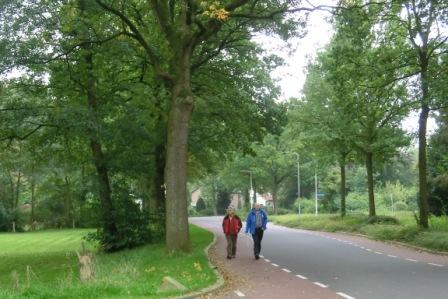
In January 2026 Maarten sent us a photo of the former farm where Peter died.
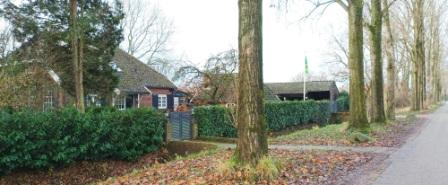
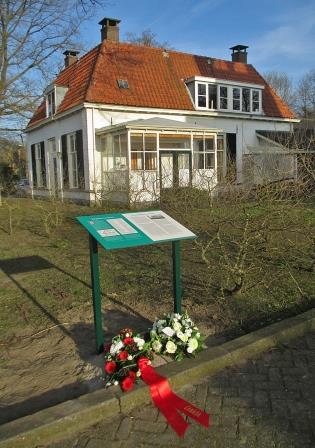
Former Alofs farm where Peter Hydichuk was killed. (Photo courtesy of Maarten Koudijs)

You can read Peter’s story at https://onthewarmemorialtrail.com/2025/11/15/on-the-war-memorial-trail-remembrance-week-2025-the-wwii-soldier-who-was-never-forgotten-by-his-girlfriend-and-her-family/

 ….The family of WWII soldier Gerald Vincent ‘Vin’ Jorgenson shared his story with relatives…

WWII soldier Gerald Vincent ‘Vin’ JORGENSON, from Kenora, Ontario, was serving with the Fort Garry Horse – 10th Armoured Regiment when he was killed in action during the Battle of the Scheldt in The Netherlands on October 23, 1944.

Terry and Leni Ellwood, who had provided photos and a wealth of information on Leni’s uncle Vin, were very appreciative, and wrote to say that “…we loved your article. It will become a family heirloom documenting the life of Vin Jorgenson. We will share it with all of Vin’s relatives.

Thank you so much for the effort you have taken to do the research and document this very important time in history. Bravo!…”

You can read Vin’s story at https://onthewarmemorialtrail.com/2026/04/04/on-the-war-memorial-trail-the-wwii-sergeant-from-kenora-killed-during-the-battle-of-the-scheldt-near-hoogerheide/

….The great-nephew of WWII soldier Garnet Joseph Gallant shared a photo of his original headstone in Groesbeek…

WWII soldier Garnet Joseph GALLANT, from Amherst, Nova Scotia, lost his life in Germany on February 18, 1945 during the Battle of Moyland Wood, while serving with the Regina Rifles Regiment.

Garnet’s great-nephew, Frank Elliott, got in touch after the story was written, explaining that “…. Garnet Gallant was my great-uncle. You had been talking with my Aunt Janet Lowerison when you wrote that great piece on Garnet. I have a box of old family pictures, which is where I found the one of Garnet that Janet shared with you. I also found this one of his first grave….” 
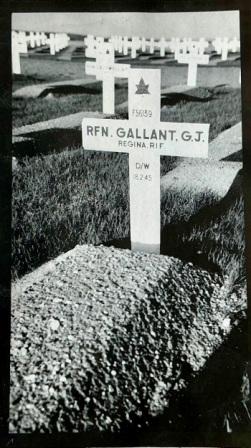
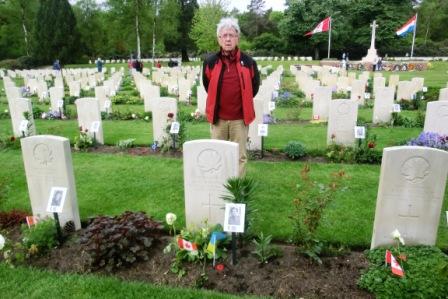
Original headstone for Garnet Gallant at the Canadian War Cemetery in Groesbeek, The Netherlands. (Photo courtesy of the Gallant Family)

Frank not only provided the photo, but went on to say “…I really enjoyed reading your website. Not just of Garnet but of the others as well. Thanks for doing the Memorial Trail project….”

You can read Garnet’s story at https://onthewarmemorialtrail.com/2025/11/21/on-the-war-memorial-trail-remembrance-week-2025-the-wwii-soldier-from-amherst-whose-photo-was-sent-a-few-days-before-what-would-have-been-his-103rd-birthday/

….Frans Nijsen empathized with a family whose relative was buried far from home…

When we were in The Netherlands on our 2025 European War Memorial Tour we encountered a sign by one grave in the Canadian War Cemetery in Groesbeek, that Pieter placed flags at, asking for whoever had been annually placing flowers at this grave to come forward – a mystery that was soon solved. After speaking with Saskia Peters, who had placed the sign, we learned that she had met Frans Nijsen, the man who had been placing the flowers.

WWII airman Arnold Freeman HUPMAN, from East Side of Ragged Island, Nova Scotia, lost his life during the last flight of Lancaster X KB728, which was shot down in Elden, The Netherlands in the early hours of June 17, 1944 as it was returning to England from a bombing mission in Germany.

You can read about this special story of remembrance at https://onthewarmemorialtrail.com/2026/04/18/on-the-war-memorial-trail-the-mystery-of-who-placed-flowers-at-one-airmans-grave-was-solved-in-a-story-spanning-two-continents/

After we shared the story about solving the mystery of who had been annually placing flowers, we heard back from Frans.  “…The reason I started doing this was as a thank you to Graham’s family. I knew that it was difficult for them that Arnold wasn’t buried close to them and they couldn’t visit it. For me, this was a sign, that if they can’t, I will do it for them and let them know every year that we don’t forget. Reading the article made me emotional, in between the lines I can read the pain that still exists. My family has a similar pain, but I’m also proud of what my family members did with the resistance during the war. I will continue to bring flowers every year and let Graham know that we won’t forget. That’s the least we can do…”
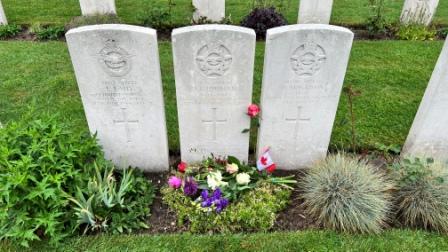
Flowers placed at the grave of Arnold Hupman on May 5, 2026. (Photo courtesy of Frans Nijsen)

In May 2026, Frans contacted us with photos of this year’s visit.  “…Yesterday we visited the grave of Arnold Hupman and laid flowers on the grave together with my family. We transfer our knowledge and history so that this never happens again. I wish more people did that. We do our best to keep the memories and lessons alive….”

….A two part story about 2 brothers from Prince Edward Island brought back family history memories…

Two brothers from Prince Edward Island lost their lives during WWII.  One is buried on the Island, the other in Germany….and a two part series told their stories.

WWII soldier Michael ‘Cecil’ STORDY from Brookvale, Prince Edward Island, drowned on June 14, 1945 during a swimming exercise in Nova Scotia, while training with A14 Canadian Infantry Training Centre (CITC).

WWII airman John ‘Lawrence’ STORDY from Brookvale, Prince Edward Island, was serving with the RCAF’s No. 405 Pathfinder Squadron, when he lost his life on April 27, 1943 while aboard the last flight of Halifax JB-920 when it was shot down by German flak over Germany during the Battle of the Ruhr.

After reading this two part series on the Stordy brothers, Kendra Mellish contacted us.  “….Just wanted to send you a note to say Thank-You for the work you do ’On The War Memorial Trail’.  Very interesting article on the two Stordy brothers in the military and from Brookvale/Kelly’s Cross.  My maiden name was Stordy. My grandfather William Stordy grew up in Crapaud and his father ran Stordy’s Mill also in Crapaud. William Stordy created/owned Crystal Milk Dairy in Summerside.  As a child, my father Eldon Stordy took me to Kelly’s Cross cemetery to work on family tree history….“

You can read Cecil’s story at https://onthewarmemorialtrail.com/2026/02/11/on-the-war-memorial-trailthe-stordy-brothers-part-1-the-wwii-soldier-from-brookvale-who-drowned-during-a-swimming-exercise-in-nova-scotia/

You can read Lawrence’s story at https://onthewarmemorialtrail.com/2026/02/16/on-the-war-memorial-trailthe-stordy-brothers-part-2-the-wwii-airman-from-brookvale-who-lost-his-life-on-the-last-flight-of-halifax-jb-920/

….The family of WWI soldiers Francis Edmund Graves and Charles Stuart was grateful to have their stories told…

WWI soldier Francis Edmund GRAVES, born in England, but from Winnipeg, Manitoba, was serving with the 31st Battalion when he was seriously wounded on May 3, 1917 during the Battle of Fresnoy in France. One leg was amputated and he spent 2 years in various hospitals but was able to return to civilian life in Winnipeg, Manitoba, where he raised a family and worked as a clerk at the Empire Sash and Door Co. Ltd until his death on November 8, 1941.

WWI soldier Charles STUART, born in England, but from Winnipeg, Manitoba, was serving with the 8th Battalion when he was seriously wounded on August 10, 1918 during the Battle of Amiens in France. He received multiple shrapnel wounds in scalp, jaw, larynx, neck, hand, and chest, and he spent almost 2 years in various hospitals, requiring reconstructive surgery on his nose and face, but was able to return to civilian life in Winnipeg, Manitoba, where he raised a family and worked for the CNR (Canadian National Railway) until retirement, before passing away on September 23, 1977 in Winnipeg.

Brenda Graves wrote us after reading Part 2 of the two part series on her husband Stuart’s grandfathers, who both served in WWI and returned home with major injuries.  “….Amazing story! And to think about how we complain about relatively minor aches and pains. Charles and Francis were so critically injured and medical care was slow coming and without antibiotics, it was incredible that they even survived. Another great piece.  Good job seems to be so inadequate on such well researched pieces.  Thanks again. ….”

You can read Francis’ story at https://onthewarmemorialtrail.com/2026/05/18/on-the-war-memorial-trail-duty-sacrifice-resilience-part-1-the-wwi-soldier-whose-war-injuries-didnt-stop-him-from-living-his-life/

You can read Charles’ story at https://onthewarmemorialtrail.com/2026/05/24/on-the-war-memorial-trail-duty-sacrifice-resilience-part-2-the-wwi-soldier-who-was-seriously-wounded-by-an-exploding-grenade-during-the-battle-of-amiens/

….The niece of WWII soldier Albert Ahlwardt shares the same birth day as her uncle…

WWII soldier Albert Donald AHLWARDT, from Olds, Alberta, was serving with the 6th Anti-Tank Regiment, Royal Canadian Artillery, when he was killed on February 26, 1945 during the Battle of Keppeln in Germany, after a shell burst near him, as Pte Harry BIZNAR and Lt Robert Joseph MARKEY were trying to him to safety in a nearby house, after he was wounded.

His niece, Betty Askeland, daughter of Albert’s sister Stella, wrote us, saying “…thank you so much for sending this article, it means so much to me.  I am his sister’s daughter Betty and we shared the same birth day June 2. This means so much to have this information…“

You can read Albert’s story at https://onthewarmemorialtrail.com/2026/07/22/on-the-war-memorial-trail-struck-by-shellfire-part-3-the-wwii-gunner-from-olds-who-lost-his-life-as-he-was-being-moved-to-safety/

….The nephew of WWII soldier James ‘Jim’ Kosowan found his story a reminder of ‘how much honour and respect we owe to so many from so long ago’.…

WWII soldier James ‘Jim’ John George KOSOWAN, born in Samburg, Saskatchewan, was serving with the Royal Winnipeg Rifles when he was killed in action during the Liberation of Deventer in The Netherlands on April 10, 1945.

After reading Jim’s story, his nephew, Randy Sanjenko, wrote us. “…I read the beautiful article you wrote about my uncle Jim it touched the hearts of my wife and children and the tears from me are still falling. It is not with sadness that I read it but with the knowledge that many fallen soldiers are somewhere silently thanking you for the work and sacrifice you make to keep their memories alive and the honour and respect you bring to them.

In a world with so much division and hate remembering those who fought against it is an honourable thing and I thank you from the bottom of my heart…“

You can read Jim’s story at https://onthewarmemorialtrail.com/2026/09/08/on-the-war-memorial-trail-the-wwii-soldier-born-in-samburg-who-lost-his-life-during-the-liberation-of-deventer/

Thank you to Betty Askeland, Brenda Graves, Frank Elliott, Terry and Leni Ellwood, Kendra Mellish, Frans Nijsen, Maarten Koudijs, Randy Sanjenko, and Pauline Theriault. The work of remembrance of those who served continues.
If you have a story to tell, please let Pieter know. You can email him at memorialtrail@gmail.com, or comment on the blog.

© Daria Valkenburg

….Want to follow our research?….

If you are reading this posting, but aren’t following our research, you are welcome to do so.  Our blog address: https://onthewarmemorialtrail.com/

4 countries, 6 weeks, 7,000 km – an unforgettable war memorial journey in Europe…. Daria’s book ‘No Soldier Buried Overseas Should Ever Be Forgotten‘ is available in print and e-book formats.  Net proceeds of book sales help support research costs and the cost of maintaining this blog. For more information see https://nosoldierforgotten.com/

You are also invited to subscribe to our YouTube Channel: On The War Memorial Trail With Pieter Valkenburg: https://www.youtube.com/channel/UCJ591TyjSheOR-Cb_Gs_5Kw.

Never miss a posting!  Subscribe below to have each new story from the war memorial trail delivered to your inbox.
On The War Memorial Trail….. The WWII Soldier Born In Samburg Who Lost His Life During The Liberation Of Deventer

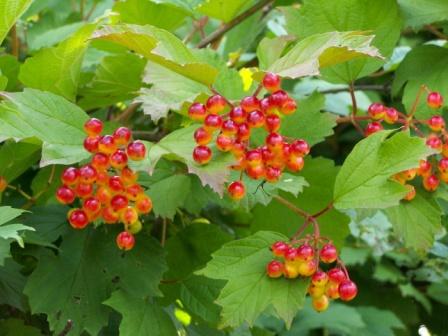
Kalyna berries and leaves. (Photo source: Wikipedia, by Lestat (Jan Mehlich) – Own work)

September 8, 2026. Sometimes Pieter asks me to select a soldier for him to research from one of the photo wish lists that he receives from the Canadian War Cemeteries in The Netherlands.  Occasionally a name is picked because of the date of death and the Regiment, other times because of a surname or place of residence.

 …Jim Kosowan was of Ukrainian heritage….

When I came across the name James ‘Jim’ John George KOSOWAN, listed as being from Kalyna, Saskatchewan, I asked Pieter to choose that soldier.  Why him? he asked.  It’s a Ukrainian surname, I replied, and Kalyna, which we know in English as a viburnum shrub (Viburnum opulus, see https://en.wikipedia.org/wiki/Viburnum_opulus) with red berries, is an ethnic and national symbol of Ukraine that symbolizes resilience, strength, and the fight for freedom.

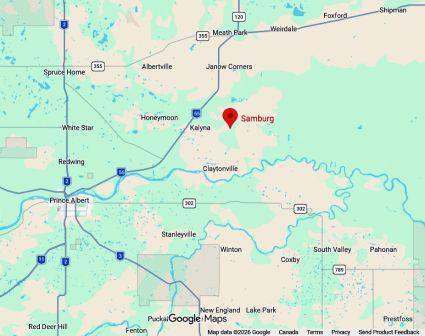
Samburg, Saskatchewan is near the larger town of Prince Albert.  (Map source: Google Maps)

Ok, Pieter said, but when he began his research, he learned that the soldier was born on December 18, 1920 in Samburg, Saskatchewan, near the town of Prince Albert, the son of George and Maria (nee Pusta) Kosowan, who had both immigrated to Canada in the late 1800s from Eastern Europe. The Kalyna reference in his service file came from where his family was living at the time of his enlistment.

…Jim’s nephew contributed a photo…

Jim had 4 sisters and 6 brothers, and it was the family of Jim’s sister Rose Sanjenko that Pieter quickly got in contact with once he began his research. When we asked Jim’s nephew, Randy Sanjenko, how the photos he submitted should be attributed, his response was heartfelt.  “….Please just say they are from family who love and miss him….Thank you for keeping the story of all those brave young men alive because l am a believer in never forget….”

….Jim enlisted in 1942 under NRMA…

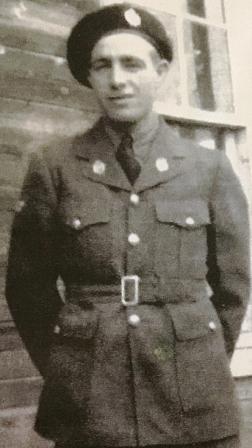
James ‘Jim’ John George Kosowan.  (Photo courtesy of the Kosowan Family)

On March 12, 1942, Jim enlisted under the National Resources Mobilization Act (NRMA) at No. 2 NRMA Clearing Depot in Newmarket, Ontario. (See https://en.wikipedia.org/wiki/National_Resources_Mobilization_Act)

At the time of his enlistment, Jim stated he was an auto mechanic, had experience working on his family’s wheat farm near Kalyna, Saskatchewan, and was working as a packer at O’Keefe Breweries in Toronto for the past 18 months. In addition to English, he could speak Russian and Ukrainian. His brother Johnny was in the Royal Canadian Artillery.

He took his basic training at No. 23 Canadian Army (Basic) Training Centre in Newmarket, and then was sent to the A11 Canadian Infantry Training Centre at Camp Borden, Ontario on May 14, 1942.

On September 15, 1942, Jim was sent to No. 4 Aerodrome Defence Platoon, a specialized mobile defensive unit tasked with safeguarding critical military airports, airfields, and Royal Canadian Air Force (RCAF) installations against ground assaults, sabotage, and enemy paratrooper attacks. A few days later, on September 19, 1942, Jim was temporarily attached to the 1st Battalion, Saint John Fusiliers (Machine Gun) in Sydney, Nova Scotia.

The Battalion was stationed in Canada on home defence duty as part of the 18th Infantry Brigade, 6th Canadian Division.  With the Battle of the Atlantic underway off of the Canadian coast, and German U-boats actively targeting shipping vessels in the Gulf of St. Lawrence and near Cape Breton, the Battalion was tasked with key security duties.  The men were on guard detail to protect vital infrastructure around the strategic industrial hub of Sydney and its heavily used wartime shipping harbour. As well, coastal defence support was provided in assisting nearby coastal batteries to deter potential enemy beach landings or sabotage. (See https://thecanadianencyclopedia.ca/en/article/battle-of-the-atlantic)

Military training also continued for the men.  Jim qualified as a Driver i/c Track Class III on March 3, 1943.  (The term ‘Driver i/c’ refers to ‘Driver, internal combustion’. Track Class III meant he was qualified to drive heavy trucks and armoured cars.)

….Jim enlisted in the Active Army in 1943…

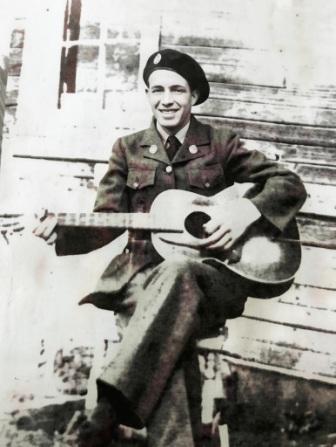
James ‘Jim’ John George Kosowan playing a guitar.  (Photo courtesy of the Kosowan Family.  Photo restoration by Pieter Valkenburg)

On October 1, 1943, Jim transferred to the Active Army, enlisting in Yarmouth, Nova Scotia, but remained with No. 4 Aerodrome Defence Platoon.  He was sent to No. 2 Transit Camp in Debert, Nova Scotia, where his training continued.

He qualified as a Driver i/c Class III (Wheeled) on October 19, 1943.  (The term ‘Driver i/c’ refers to ‘Driver, internal combustion’. Class III (Wheeled) meant he was qualified to drive heavy trucks and armoured cars, but not tanks.)

On July 5, 1944, Jim was given 9 days of special leave, in what turned out to be the last chance he had to see his family.  Upon returning from leave, he was transferred to No. 1 Transit Camp in Windsor, Nova Scotia.  This was a final staging, preparation, and administrative processing area before being sent overseas.

….Jim left Canada for overseas service ……

On September 1, 1944, Jim travelled by train directly from Windsor to the Halifax docks to board a troopship, which left Halifax on September 2, 1944, and arrived in the United Kingdom on September 6, 1944. Upon arrival, he was placed with No. 3 Canadian Infantry Reinforcement Unit (CIRU).

He didn’t remain long in the United Kingdom, as on October 7, 1944, he was transferred to the X-4 Reinforcement List of the 21st Army Group, and sent to France on October 8, 1944, arriving a day later.

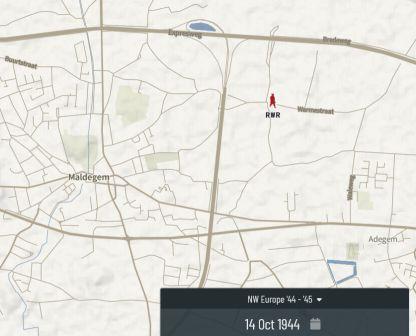
Red coloured soldier marks location of Royal Winnipeg Rifles on October 14, 1944. (Map source: Project 44)

On October 14, 1944, he was transferred to the Royal Winnipeg Rifles, joining them in Maldegem, Belgium, near the border with The Netherlands.  The Royal Winnipeg Rifles War Diary for that day noted that “…a few reinforcements arrived and were immediately posted to their companys….”

The reinforcements were needed as on October 6, 1944, Operation Switchback, the second main operation of the Battle of the Scheldt had begun, with the goal of clearing the ‘Breskens Pocket’ – the German defences around Breskens in The Netherlands. (See https://www.canadiansoldiers.com/history/battlehonours/northwesteurope/breskenspocket.htm)

….Jim was wounded during Operation Switchback…

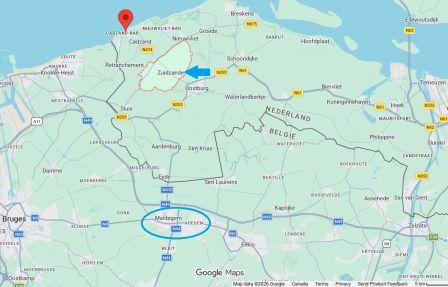
Blue arrow indicates Zuidzande where Jim Kosowan was wounded.  Blue circle shows location of Maldegem, where he joined the Royal Winnipeg Rifles. (Map source: Google Maps)

On October 28, 1944, during the final phase of Operation Switchback, part of the larger Battle of the Scheldt, the Regiment was clearing German strongholds and capturing prisoners of war in the area of Zuidzande, The Netherlands, near the Belgian-Dutch border.  As part of the 7th Canadian Infantry Brigade in the 3rd Canadian Infantry Division, they faced heavy resistance, artillery fire, and minefields, as they tried to clear the Scheldt Estuary and open the shipping route to Antwerp, Belgium.

Jim was wounded by shrapnel from an exploding grenade and spent over a month in hospital. Three members of the Royal Winnipeg Rifles died that day and are buried in the Canadian War Cemetery in Adegem, Belgium….

  • Elmond Joseph CHOQUETTE, born in Mariapolis (Glenora), Manitoba, aged 26
  • Richard Francis GYLES, of Winnipeg, Manitoba, aged 20
  • Leonard Andrew HEEKS, of Edmonton, Alberta, aged 20

…. Jim returned to duty in December 1944….

Jim returned to duty on December 12, 1944, rejoining the Royal Winnipeg Rifles, now stationed in the Nijmegen area of the Netherlands, near the German border, where they remained over the winter.  While based in a relatively safe area, they still were busy, conducting defence operations and sentry duties near the German border, reconnaissance patrols to monitor enemy positions.

They also tackled infrastructure tasks, such as clearing ice on the Waal River and doing road maintenance.  On the day Jim returned to the Regiment, 7 men drowned in a tragic accident when the vehicle they were in lost control on a dike, slid down the embankment and into the water.  The war diary explained that they “…were pinned down under the carrier and were drowned….” They were part of a group of 13 men sent to repair a road running from a local railway bridge back to regimental headquarters.

…. Jim was involved in the liberation of North-West Europe….

By January 1945 the Royal Winnipeg Rifles were still in The Netherlands, and spent the New Year in ‘s-Hertogenbosch.

On February 1, 1945, the war diary recorded that the Regiment was informed of the part that the men “…would play in Operation Veritable…” This would take them into Germany. (See https://en.wikipedia.org/wiki/Operation_Veritable)  The Regiment arrived in Millingen, Germany on February 9, 1945.

By February 16, 1945, the Regiment was based in Essen, Germany, as they cleared German positions in flooded areas of the Rhine flood plain and the Reichswald forest, which is close to the Dutch-German border.

On March 11, 1945, the Regiment began moving back towards ‘s-Hertogenbosch, The Netherlands and the greater battle towards liberating the country.

….The Liberation of Deventer involved crossing the Schipbeek ….

Movement of Canadian troops towards Deventer.  Note that all first had to cross the Schipbeek.  (Map provided by Edwin van der Wolf)

On April 7, 1945, the Royal Winnipeg Rifles were ordered to cross the Schipbeek and establish a bridgehead as preparation for an assault on the city of Deventer by the 7th Canadian Infantry Brigade.

Crossing the Schipbeek was vital to the success of the bridge operation, not an easy feat as the Bridge was strongly defended by the Germans, but the Regiment was able to meet its objective.

NOTE: For an account of our visit to Schipbeek and Bathmen during our 2025 European War Memorial Tour, see https://onthewarmemorialtrail.com/2025/10/26/on-the-war-memorial-trail-visit-to-bathmen-and-the-schipbeek-canal/

….Jim lost his life during the Liberation of Deventer…

On April 10, 1945, the Regiment was involved in the liberation of Deventer, a town lying on the right bank of the IJssel River.  With the approaches protected by a maze of waterways, it was necessary to attack from the east. (See https://www.canadiansoldiers.com/history/battlehonours/northwesteurope/deventer.htm)

In ‘Little Black Devils: A History Of The Royal Winnipeg Rifles’ authors Bruce Tascona and Eric Wells noted that Deventer “…was a town of 50,000, which the Germans had fortified with an anti-tank ditch.  The battle began with a night attack at 0100 by the Canadian Scottish on the enemy’s right flank, and the Rifles struck their left flank at 0700.

Over the next 10 hours, the Rifles were continuously engaged, first in pushing back the enemy’s outer positions on the open ground before the big ditch.  Casualties were heavy….”

Deventer was liberated by 5 pm, but Jim unfortunately didn’t see this outcome, as he lost his life at some point during the fight.

On our 2017 European War Memorial Tour, we’d visited Deventer and the surrounding area with Edwin van der Wolf, one of the research volunteers at the Canadian War Cemetery in Holten, The Netherlands, so we were familiar with the area where Jim and Clive Elbert Steele GEROW,  whose story was previously told, lost their lives. (See https://onthewarmemorialtrail.com/2023/10/07/on-the-war-memorial-trail-the-wwii-soldier-from-burks-falls-killed-during-the-liberation-of-deventer/)

Pieter and Edwin van der Wolf (right) walked along the route near Schalkhaar that Canadian troops took before  they liberated Deventer in April 1945.  (Photo credit: Daria Valkenburg)

….Jim is buried in Holten…

Along with 45 other soldiers, Jim was initially buried beside an estate in Oxe before being reburied in the Canadian War Cemetery in Holten, The Netherlands on December 17, 1945.

Pieter at the entrance to the Canadian War Cemetery in Holten, The Netherlands. (Photo credit: Daria Valkenburg)

During our 2025 European War Memorial Tour, Pieter placed a Canadian flag by his grave.  Unfortunately, on this trip, we did not have any Saskatchewan flags.

Pieter at the grave of James ‘Jim’ John George Kosowan after placing a Canadian flag. (Photo credit: Daria Valkenburg)

…The Colmschate Memorial commemorates 46 Canadians….

On April 8, 2015, a memorial had been placed in Colmschate to commemorate the 46 Canadians who had been temporarily buried on the Oxe estate.

Memorial in Colmschate, commemorating 46 Canadians, including James Kosowan. (Photo courtesy of Edwin van der Wolf)

Text of Memorial in Colmschate, commemorating 46 Canadians, including Philip Laforte.  (Photo courtesy of Edwin van der Wolf)

Translation of the Dutch text was prepared by Pieter Valkenburg:

They Gave Their Lives

The liberation of Colmschate

During their advance from the Achterhoek, the Royal Winnipeg Rifles, the Regina Rifle Regiment, and the Canadian Scottish Regiment, led by Brigadier General T G Gibson reached the neighborhood of Oxe on Friday April 6, 1945. Next to the house on the Oxe estate (Oxerhof), the liberators discovered the bodies of ten Dutchmen who had been murdered in cold blood by the occupiers the day before. The Canadians passed the Schipbeek via a quickly struck bailey bridge, which replaced the destroyed Swormertoren Bridge.

Despite heavy German resistance, they continued north. Many farms went up in flames and houses were badly damaged. Many families sought refuge in the already liberated Oxe. Some residents lost their lives.

On April 8, 1945, the liberators captured (a small part of) the Snippeling, Colmschate, and the Bannink. Via the Vijfhoek they reached the Crödden Bridge over the Overijssels Canal. Schalkhaar and Deventer were then liberated and with the help of the Queen’s Own Rifles the remaining part of the Snippeling.

Many Canadians lost their lives in the battle in this area. In April 1945, the bodies of 46 fallen Canadians were buried in a temporary resting place opposite the Oxerhof house. In January 1946 they were transferred to the Canadian Cemetery in Holten (Plot I and II).

Two other soldiers whose stories were previously told are listed on this monument:

….Kosowan Lake is named after Jim…

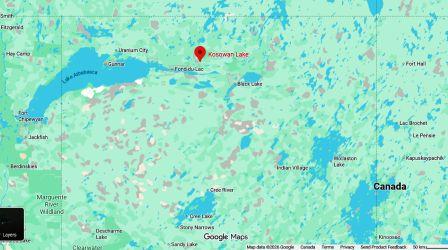
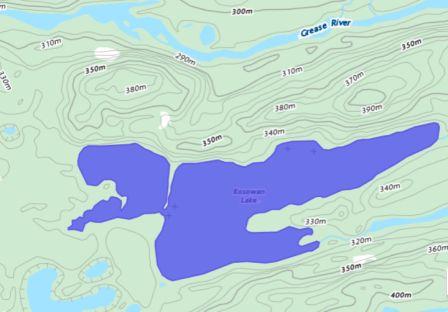
Kosowan Lake is in northern Saskatchewan. (Map source: Google Maps)

In 1952, Kosowan Lake in northern Saskatchewan, near the border with North West Territories, was named after Jim as part of the GeoMemorial Commemorative Naming Program.

Kosowan Lake is located at the coordinates 59°25′39″N 106°28′17″W.  (Map source: https://geonames.nrcan.gc.ca)

Thank you to Randy Sanjenko, Jim’s nephew, for submitting photos and memories, to Bonnie Sanjenko for contacting her brother-in-law Randy, and to Shawn Rainville for newspaper research.

The Canadian flag placed at Jim’s grave during our 2025 European War Memorial Tour was donated.  Our thanks go to Alan Waddell, Constituent Assistant, on behalf of Heath MacDonald, MP for Malpeque.

While we were at the cemetery placing flags, we met Jane Kondakova, a Ukrainian refugee from the Kyiv region, who was living in the village of Holten with her two young children.  She was placing flags at the graves of soldiers of Ukrainian descent, including James Kosowan, to honour them and her husband, who is in the Ukrainian military.

Pieter’s research efforts to find photos and families of soldiers continue. Do you have a story to tell? Email Pieter at memorialtrail@gmail.com, or comment on the blog.

© Daria Valkenburg

….Want to follow our research?…

If you are reading this posting, but aren’t following our research, you are welcome to do so.  Our blog address: https://onthewarmemorialtrail.com/

4 countries, 6 weeks, 7,000 km – an unforgettable war memorial journey in Europe…. Daria’s book ‘No Soldier Buried Overseas Should Ever Be Forgotten‘ is available in print and e-book formats.  Net proceeds of book sales help support research costs and the cost of maintaining this blog. For more information see https://nosoldierforgotten.com/

Subscribe to our YouTube Channel: On The War Memorial Trail With Pieter Valkenburg: https://www.youtube.com/channel/UCJ591TyjSheOR-Cb_Gs_5Kw.

Never miss a posting!  Subscribe below to have each new story from the war memorial trail delivered to your inbox.