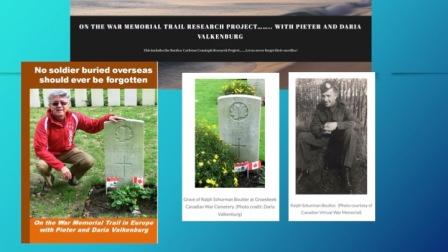
In Memoriam To John Robinson and Donald Moore

In_memoriam

November 4, 2023. Over the past years, the On The War Memorial Trail Research Project has been telling stories of those who have served our country.  This isn’t done in isolation but with the help of many families who contributed photos and personal recollections.

..John Robinson was the nephew of WWI soldier Arthur Clinton Robinson…

This week, we received word that Arthur ‘John’ Robinson, nephew of Arthur Clinton ROBINSON, a WWI soldier with the 26th (New Brunswick) Battalion, from Tryon, Prince Edward Island, who is buried in Belgium, passed away. (See https://www.saltwire.com/prince-edward-island/obituaries/arthur-john-cm-robinson-94002/)

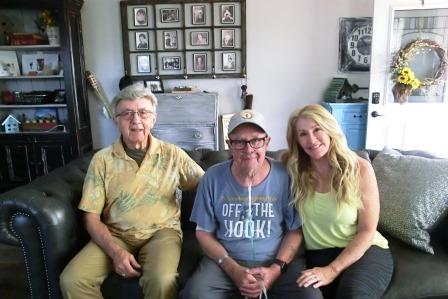
IMG_3466 Hazel and John Robinson

Hazel and John Robinson. (Photo courtesy of the Robinson Family)

We visited Arthur’s grave in La Laiterie Military Cemetery in 2017.  Up to now, however, neither we nor the family have been able to find a photo of this WWI soldier, who is listed on the Cenotaph outside the Borden-Carleton Legion in Borden-Carleton, Prince Edward Island.

For more information on Arthur Clinton ROBINSON, see:

…Donald Moore was the nephew of WWII soldier Archie McLean…

Today we learned that Donald Allan Shadrach Moore, nephew of WWII soldier Archibald Phillip ‘Archie’ MCLEAN of Edmundston, New Brunswick, passed away. (See https://www.saltwire.com/prince-edward-island/obituaries/donald-allan-shadrach-moore-94043/)

CIMG6452 Aug 29 2023 Pieter Don Moore Tina Mundy

Pieter with Donald Moore and Tina Mundy.  (Photo credit: Daria Valkenburg)

Archie, who was serving with the Carleton & York Regiment at the time of his death on April 17, 1945, is buried in the Canadian War Cemetery in Holten, The Netherlands. You can read his story here: https://onthewarmemorialtrail.com/2023/09/13/on-the-war-memorial-trail-archie-was-a-good-guy/

Our deepest condolences go to the families of John Robinson and Donald Moore. 

If you are able to help with a photo of Arthur Clinton Robinson, please let us know.  You can email us at memorialtrail@gmail.com, comment on the blog, or tweet to @researchmemori1.    

© Daria Valkenburg

…Previous In Memoriams….

…Want to follow our research?…

If you are reading this posting, but aren’t following our research, you are welcome to do so.  Our blog address: https://onthewarmemorialtrail.com/

Front cover OnTheWarMememorialTrailinEurope4 countries, 6 weeks, 7,000 km – an unforgettable war memorial journey in Europe…. Daria’s book ‘No Soldier Buried Overseas Should Ever Be Forgotten‘ is available in print and e-book formats.  Net proceeds of book sales help support research costs and the cost of maintaining this blog. For more information see https://nosoldierforgotten.com/

Subscribe to our YouTube Channel: On The War Memorial Trail With Pieter Valkenburg: https://www.youtube.com/channel/UCJ591TyjSheOR-Cb_Gs_5Kw

Never miss a posting!  Subscribe below to have each new story from the war memorial trail delivered to your inbox.

New Book About Soldiers Buried In The Canadian War Cemetery In Holten, The Netherlands

Book cover front

Holten Heroes’ by Jan Braakman, translated by Pieter and Daria Valkenburg

November 1, 2023. A new book, published in English on October 27, 2023 was translated by us – Daria and Pieter Valkenburg.  ‘Holten Heroes: Stories from a Canadian Field of Honour’ by Jan Braakman, was translated from the original Dutch book that Jan wrote: ‘Holtense Canadezen’.

Here is an excerpt from the media release:

Holten Heroes: Stories from a Canadian Field of Honour

– A book that pays tribute to Canadian soldiers

Tucked away in the rolling hills of the Dutch province of Overijssel is the Holten field of honour for Canadian soldiers who lost their lives in World War II.

For the first time since the cemetery was established, the buried soldiers are being honoured in a book: Holten Heroes: Stories from a Canadian Field of Honour.  Holten Heroes describes the genesis of the Commonwealth War Graves Commission cemetery in Holten and tells stories of the soldiers buried there.

In 155 pages, the book takes you through the incredible journey Canadian soldiers made from Dieppe to German prisoner-of-war camps, you learn about the hardships they lived under, you read about the opposition they encountered during the liberation of The Netherlands and you become part of the grief felt by those left behind. 

The book about the Holten cemetery marks the connection between Canada and The Netherlands since Canadian soldiers liberated the country from the Nazis in the spring of 1945.

The liberation of The Netherlands brought joy and sorrow. The Dutch people were delirious with joy when Canadian heroes gave them back their freedom. But that did not come without the sacrifice of thousands of lives Canadian young men who still had a bright future ahead.

They are the heroes to whom the book Holten Heroes pays tribute. The names of all of them are mentioned in Holten Heroes, many of them with a photo from the collection of the Canadian Cemetery Information Centre (ICB) in Holten. The book is a valuable gem for all bereaved Canadians.

The book’s sales will benefit the work of the Canadian Cemetery Information Centre (ICB) in Holten.

…..A bit about the author and translators….

Author Jan Braakman

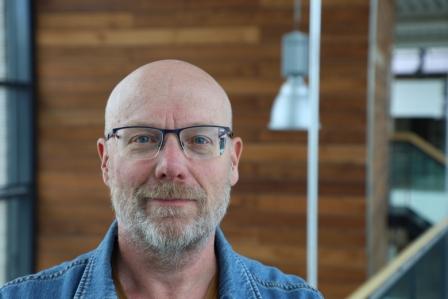
Jan Braakman. (Photo credit: Paulus Maessen)

The Author: Jan Braakman (b. 1960) is a Dutch investigative journalist, and the author of several books in Dutch.

In 2012, his book The War in the Corner was published in Canada. During his research he discovered the truth behind the arrest that led to the death of his grandfather in 1944 in the concentration camp, Neuengamme, near Hamburg.

He has been working as a volunteer researcher for the Information Centre Canadian War Cemetery in Holten since 2014. In 2019, he produced the documentary Lest We Forget featuring Canadian bereaved families, who told of their loved ones buried in Holten (with Sander Jongsma, RTV Oost).

daria-and-pieter

Daria and Pieter Valkenburg (Photo credit: Karen McKay)

The Translators: Canadian born Daria Valkenburg is a retired accountant, adult education instructor, and writer whose work has been published in several newspapers and journals. The Netherlands born Pieter Valkenburg served in the Dutch Air Force before going on to a career in the Dutch Foreign Service and 10 postings around the world.  Pieter has been a volunteer researcher for the Information Centre Canadian War Cemetery in Holten since the fall of 2014.

Daria and Pieter’s research into Canadian soldiers is documented on this blog and in the ‘On The War Memorial Trail’ column in the ‘County Line Courier’, a newspaper on Prince Edward Island. Daria is also the author of ‘No Soldier Buried Overseas Should Ever Be Forgotten(https://nosoldierforgotten.com/).

…..Where is the book available?….

Holten Heroes: Stories from a Canadian Field of Honour’ is available through Amazon, and at the Cemetery’s Information Centre. 

Please see the Amazon Canada entry for more information: https://www.amazon.ca/Holten-Heroes-Stories-Canadian-Honour/dp/B0CM25LRD3/ref=sr_1_1?crid=QEQCI0LBFLPK&keywords=holten+heroes&qid=1698840141&sprefix=holten+heroes%2Caps%2C207&sr=8-1

Do you have a story to tell? Email Pieter at memorialtrail@gmail.com, or comment on the blog.  

© Daria Valkenburg

…Want to follow our research?….

If you are reading this posting, but aren’t following the blog, you are welcome to do so.  Our blog address: https://onthewarmemorialtrail.com/

Front cover OnTheWarMememorialTrailinEurope4 countries, 6 weeks, 7,000 km – an unforgettable war memorial journey in Europe…. Daria’s book ‘No Soldier Buried Overseas Should Ever Be Forgotten‘ is available in print and e-book formats.  Net proceeds of book sales help support research costs and the cost of maintaining this blog. For more information on the book, please see https://nosoldierforgotten.com/

You are also invited to subscribe to our YouTube Channel: On The War Memorial Trail With Pieter Valkenburg: https://www.youtube.com/channel/UCJ591TyjSheOR-Cb_Gs_5Kw

Never miss a posting!  Subscribe below to have each new story from the war memorial trail delivered to your inbox.

On The War Memorial Trail….. The WWII Soldier From Meteghan Killed During The Battle Of Five Woods

October 18, 2023.  Last fall we visited the war memorial in Saulnierville, Nova Scotia, as two soldiers that Pieter had researched are listed on this monument.  Coincidentally, both are buried in the Canadian War Cemetery in Holten.  At the time of our visit, we’d told the story of one of the soldiers, but not the other.  (See https://onthewarmemorialtrail.com/2022/11/09/on-the-war-memorial-trail-the-importance-of-remembrance/)

This second soldier was Joseph ‘Edmond’ ROBICHEAU, from Meteghan, Nova Scotia, who lost his life on April 14, 1945 near Deventer, The Netherlands, while serving with the Royal 22e Regiment. 

Born November 16, 1923 in Meteghan, Edmond was the son of Césaire and Vitaline Robicheau.  When he enlisted at the No. 6 National Resources Mobilization Act (NRMA) Clearing Depot in Halifax, Nova Scotia, on August 18, 1943, he noted that he had worked as a fisherman for 2 years and had served in the 2nd Battalion West Nova Scotia Infantry (Reserve) since October 1942.  (See https://en.wikipedia.org/wiki/National_Resources_Mobilization_Act)

…A photo of Edmond was found in Saulnierville…

Although Edmond had 3 brothers and 4 sisters, Pieter was not able to find any family members during the photo search.  This unfortunately happens more often than you’d think.  A photo was found through a nearby resident, Ann Louise Doucet, who explained that “the photo is located at the Clare Veterans Association…” in Saulnierville, Nova Scotia, “ so I would credit them as there is no name on the photo…

IMG_3047v Joseph Robicheau

Joseph ‘Edmond’ Robicheau. (Photo source: Clare Veterans Association)

… Edmond served in the Coast Battery and home defence…

On September 17, 1943, Edmond was sent to No. 61 Canadian Army Basic Training Centre (CABTC) in New Glasgow, Nova Scotia for training as a gunner.  After completing his basic training, he was attached to A23 Training Centre in Halifax, Nova Scotia on November 16, 1943. A23 was a Coast and Anti-Aircraft Artillery Training Centre established to train coast and anti-aircraft gunners.

On March 11, 1944, Edmond was transferred to the 16th (C) Regiment of the Royal Canadian Artillery and sent to Sydney, Nova Scotia. Not long afterwards, on April 26, 1944, he was assigned to the 104th Coast Battery of the Royal Canadian Artillery and posted to Shelburne, Nova Scotia.

The 104th Coast Battery was garrisoned at Fort McNutt on McNutt’s Island, as coastal defence to protect the port of Shelburne. The threat of German submarine activity was a concern.  This is why Shelburne had been designated as an alternate port to Halifax Harbour during the war.

On September 7, 1944, Edmond transferred to the Royal Regiment of Canada, and sent for a 4 day tactical training course at the Special Infantry Training Camp in Vernon, British Columbia on September 27, 1944.

On October 1, 1944, Edmond was attached to the 1st Battalion Oxford Rifles, part of the Royal Regiment of Canada, which served in Canada in a home defence role as part of the 16th Infantry Brigade, 8th Canadian Division.

… Edmond left Canada for overseas service in January 1945…

On January 2, 1945, Edmond was among the soldiers of the 1st Battalion Oxford Rifles who left Canada for the United Kingdom, arriving on January 8, 1945.  The Battalion was disbanded on January 10, 1945 to provide reinforcements for the First Canadian Army. 

Edmond was assigned to No. 6 Canadian Infantry Training Regiment (CITR) upon arrival, for further training, then to No. 4 Canadian Infantry Training Regiment (CITR) on February 4, 1945.

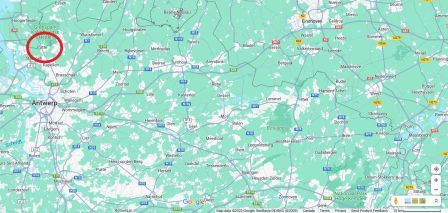
Screenshot 2023-10-09 at 11-44-19 Putte · 2580 Belgium

Putte, Belgium is near the Dutch border.  (Map source: Google maps)

On March 9, 1945 he was sent to North West Europe as part of the X-4 reinforcement troops of the 21st Army Group.  Then, on April 2, 1945 he was transferred to the Royal 22e Regiment (also known as the Van Doos), joining them while they were in Putte, Belgium.

In the Regimental history, ‘The Royal 22e Regiment’, author Serge Bernier records that “…on April 4, the regiment made an incursion into the Reichswald, near Clèves, which the Canadians had recently liberated at considerable cost...”  Clèves (Kleve in English) is just over the Dutch border in Germany.

After a few days, the Regiment made its way back into The Netherlands. “…On the 10th the Royal 22e left the sector, passing through Clèves and Emmerich, before moving into eastern Holland, and stopping near Zutphen.  On the 13th it crossed the Yssel to take up a position in a bridgehead that the 3rd Brigade would use as a base to attack the town of Appeldoorn....”  Yssel refers to the IJssel River in The Netherlands.

… Edmond lost his life during the Battle of the Five Woods…

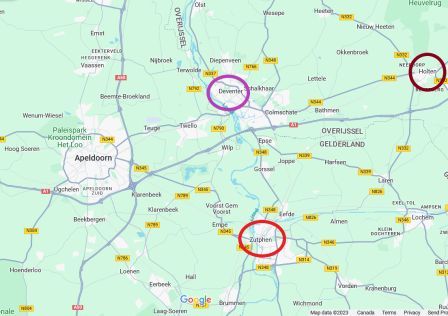
Screenshot Deventer Google Maps

The locations in The Netherlands where the Royal 22e Regiment for April 1945, where Robicheau was initially buried and where he is permanently buried. (Map source: Google maps)

The next day, April 14, 1945, the Regiment received a change in plans.  “… The WNSR and the CYR were the first to leave, closely followed by the Royal 22e, but at 7:30 am the regiment received orders to capture a well-defended wooded area....”  WNSR refers to West Nova Scotia Regiment.  CYR refers to Carleton & York Regiment.

This was the Battle of the Five Woods.  “…Assisted by tanks, the companies performed mopping-up operations in the sector for 24 hours.  The assignment proved costly: 11 men were reported killed, 19 wounded and two missing…” Among those who lost their lives that day was Edmond Robicheau.

…Edmond is buried in the Canadian War Cemetery in Holten…

He was initially buried in a temporary cemetery near Deventer, before being reburied in the Canadian War Cemetery in Holten, The Netherlands in 1946.

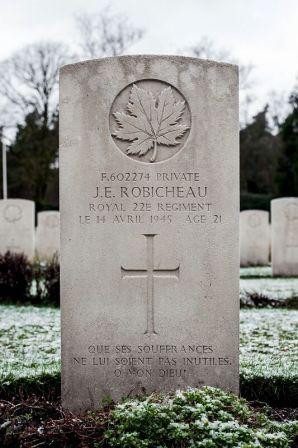
Grave of Joseph Robicheau from CVWM

Grave of Joseph ‘Edmond’ Robicheau.  (Photo source: Canadian Virtual War Memorial)

Thank you to Ann Louise Doucet for sending a photo of Joseph Robicheau.  Thank you also to David (dryan67) from the WW2Talk Forum for sharing information from the Royal 22e Regimental history. If you have a story to tell, please let Pieter know. You can email him at memorialtrail@gmail.com, comment on the blog, or send a tweet to @researchmemori1.  

© Daria Valkenburg

…Want to follow our research?….

If you are reading this posting, but aren’t following the blog, you are welcome to do so.  Our blog address: https://onthewarmemorialtrail.com/

Front cover OnTheWarMememorialTrailinEurope4 countries, 6 weeks, 7,000 km – an unforgettable war memorial journey in Europe…. Daria’s book ‘No Soldier Buried Overseas Should Ever Be Forgotten‘ is available in print and e-book formats.  Net proceeds of book sales help support research costs and the cost of maintaining this blog. For more information on the book, please see https://nosoldierforgotten.com/

You are also invited to subscribe to our YouTube Channel: On The War Memorial Trail With Pieter Valkenburg: https://www.youtube.com/channel/UCJ591TyjSheOR-Cb_Gs_5Kw

Never miss a posting!  Subscribe below to have each new story from the war memorial trail delivered to your inbox.

On The War Memorial Trail…..The WWII Soldier From Burk’s Falls Killed During The Liberation Of Deventer

October 7, 2023. A few months ago, Edwin van der Wolf, one of the research volunteers at the Canadian War Cemetery in Holten, The Netherlands, asked for help in finding a photo of “Sgt Clive Gerow, who unfortunately fell on April 10, 1945 near Deventer….

We’d been to Deventer and the surrounding area with Edwin, so we were familiar with the area where Clive Gerow lost his life.  Naturally, Pieter agreed to help with the photo search request.
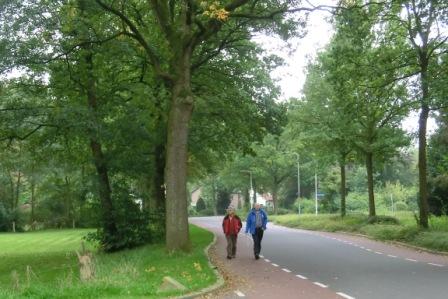
CIMG9315 Sep 25 2017 Pieter & Edwin walking on road in Deventer

Pieter and Edwin van der Wolf (right) walked along the route near Schalkhaar that Canadian troops took before  they liberated Deventer in April 1945.  (Photo credit: Daria Valkenburg)

… The search for a photo of Clive was successful…

Edwin provided some basic information.  Clive Elbert Steele GEROW was “born on January 29, 1915 in Burk’s Falls, Ontario to John Gerow (who died in 1943) and Minnie Gerow, nee Magar. His mother died in 1920 when Clive was 5 years old. His sister was Thelma Beatrice Gerow (died 1941) and from his father’s second marriage he later had two half-sisters: Hope Francis and Laura May Gerow….

In a sheer stroke of good fortune, a few days after Edwin’s initial request, Pieter found a photo on www.ancestry.ca, posted by Brynne Campbell.  He contacted Brynne and explained about the photo search request, and provided a link to our On The War Memorial Trail Research blog.   Brynne explained that “Clive would have been my great-uncle…” Her grandmother, Hope Francis, is Clive’s half-sister.
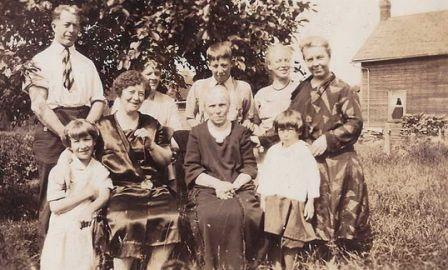
Screenshot 2023-03-25 at 09-55-15 Family Portrait Gerow - Copy

Family portrait, circa 1928.  Standing, left to right: John Gerow, unknown, Clive Gerow, Elizabeth May Travis.  Front, left to right: Thelma Gerow, Mrs Douglas, Charlotte E. Travis, Laura May Gerow, Edith Gerow. (Photo courtesy of the Gerow Family)

Edwin noted that “…Clive left school at the age of 17, having completed 11 years of education. After school he worked on his parents’ farm for 5 years and the last two and a half years, before enlisting in the army, as a mechanic at the Beaver House Lake Gold Mine…” near the Ontario town of Kirkland Lake, 285.41 km (177.35 miles) from his hometown.
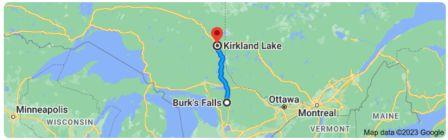
Screenshot 2023-08-27 at 16-56-21 distance between burks falls ontario and kirkland lake ontario - Google Search

Map shows location of Burk’s Falls and Kirkland Lake.  (Source: Google maps)

… Clive enlisted in 1939…

Clive enlisted with the Three Rivers Tank Regiment on November 2, 1939 in Trois-Rivières, Quebec.   He would remain with this Regiment for much of his military service, with the Regiment undergoing several name changes.  It was known as the 12th Armoured Regiment (Three Rivers Regiment) as of March 1, 1941. On May 15, 1942 it was designated the 12th Canadian Army Tank Regiment.  On August 26, 1943, it became the 12th Canadian Armoured Regiment.
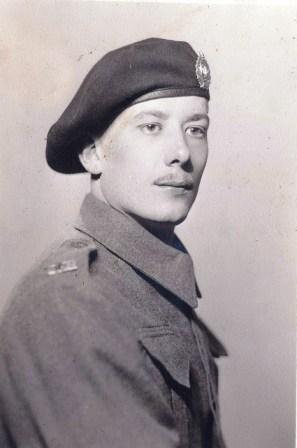
photo of Clive Gerow

Clive Elbert Steele Gerow. (Photo courtesy of the Gerow Family)

In ‘War Chronicles 1939-1945 Three Rivers Regiment (Tank)’, author Charles Prieur noted that basic training began in Trois-Rivières before moving to Montreal, Quebec to “Westmount’s M.A.A. (Montreal Athletic Association) Grounds on Montreal Island…” on March 26, 1940. 

On March 28, 1940, “Tank training begins without tanks. Drill features troops of men marching to semaphore signals. A Rypa simulator, with an electric motor, is also used to simulate a tank in motion. Courses multiply as able instructors are found with expertise in Vickers machine guns, radio transmission, electricity, mechanics, and Morse code…

On June 23, 1940, the Regiment moved to Mount Bruno (23 km (14 mi) east of downtown Montreal) but quickly moved again, this time to Coteau Barracks in Trois-Rivières

However, instead of the expected tank training, the Regiment was ordered “…to guard the 400 odd prisoners of war….”  Troops also dealt with “…some 700 internees, in large part … refugees. Our Nazi prisoners consist almost exclusively of captured members of the Luftwaffe, merchant navy, submarine corps, and paratroop units…”  Guard duty lasted until July 28, 1940, when “…No. 4 Company of the Veterans Home Guard… arrived to take over….

On August 3, 1940, the Regiment was ordered to “…move to Camp Borden for actual tank training…” Clive was among those who were transferred to Borden, Ontario.

… Clive married shortly before going overseas…

On April 28, 1941, Clive married Elsie Mae Dickinson, who lived in Trois-Rivières.  The couple were not together long as Clive and his Regiment were about to leave Canada for the United Kingdom.

Edith and Elsie Gerow

Elsie Gerow (right) with Clive’s stepmother Edith Gerow (left).  (Photo courtesy of the Gerow Family)

… Clive left Canada for service overseas…

Prieur noted that the Regiment left Camp Borden on June 17, 1941, expecting to “…detrain in Quebec City tomorrow –for a march through the outskirts of Limoilou, and arrive in Halifax on June 18…” 

On June 19, 1941, the Regiment boarded the S.S. Windsor Castle.  At midnight on June 21, 1941, the ship left Halifax for “…the United Kingdom, escorted by the battleship ‘Ramillies’, the battle cruiser ‘Repulse’ and six British destroyers….

On June 30, 1941, “…at 0800 hrs, both the ‘Britannic’ and the ‘Windsor Castle’ drop anchor in the Clyde River near Gourock, Scotland…

The next day, the Regiment left “… Gourock Station at 2000 hrs and travels through the night southwards to Lavington Down….” in Wiltshire, England.  Preliminary training took up the next few months.

On October 7, 1941, Clive and his Regiment left for “…the Tank Firing Range at Linney Head, Wales…” for “…practice at the firing range” 

In January 1942 the Regiment moved to their winter quarters in Worthing, West Sussex, England. “…Except for ‘C’ Squadron in the Abbey, our billets here are clean modern cottages, with all conveniences — by far the best so far….”  The Abbey was in nearby Sompting Abbott.

Clive was busy with training, receiving his Driver Operator Class ‘C’ qualification on March 1, 1942.  From June 16 to July 2, 1942 Clive was attached to the Armoured Fighting Vehicle (AFV) Recovery Training Centre.  Exercises and ongoing training with the Regiment continued.

On November 27, 1942 the Regiment moved to Brighton, England.  Training began with Infantry Regiments, in preparation for battle.

Then from February 3, to March 31, 1943, he was sent for a Gunnery Instructor’s Course.  Meanwhile the Regiment moved from Brighton back to Worthing.

On April 30, 1943, the Regiment moved “…to Hoddom Castle, in Annan, Scotland…and issued Sherman tanks.  “…These 30-tonners can reach a speed of 30 m.p.h, and are equipped with a confidence-building 75mm cannon and two Browning machine guns….

… Clive left the United Kingdom for Sicily…

On June 15, 1943, the Regiment moved “…to the Port of Embarkation at Gourock on the Clyde in Scotland…” The following day the Regiment set sail for Sicily, Italy,  “…crammed into 6 LSTs of the U.S. Navy. Its effective strength at this time is 37 officers and 550 non-commissioned officers and men, including 36 American and 18 British citizens….”  An LST is a tank landing ship.  (See https://en.wikipedia.org/wiki/Landing_Ship,_Tank)

During the month long journey from Scotland to Sicily, the convoy stopped at Gibraltar on June 30, 1943. “…At 1100 hrs, the cat is finally let out of the bag: the 1st Canadian Infantry Division and the 1st Canadian Tank Brigade are to join up with the Allied Forces. Indeed, we become an integral part of the famous Eighth Army under General Bernard Montgomery…

From Gibraltar the convoy sailed along the north coast of Africa.  On July 5, 1943, the convoy came under fire.  “…At 1645 hrs, a huge explosion galvanizes the escorting destroyers into action. A Liberty ship has been torpedoed, catches fire, settles by the stern and sinks out of sight at 1700 hrs….

… Clive participated in Operation Husky…

On July 10, 1943, they reached Pachino Bay in Sicily and ‘Operation Husky’ – the invasion of Sicily – began. “…The first Shermans of the Three Rivers Regiment rolled off  L.S.T.s on the left flank of the 1st (Infantry) Brigade’s beach about 0900 hrs, and at 1015 hrs the unit reported one squadron ready for action…” (See https://www.canadahistoryproject.ca/1939-45/1939-45-10-operation-husky.html)

Over the next weeks, whatever brigade of the 1st Canadian Infantry Division was engaged, it was always with the support of the tanks of the Three Rivers Regiment. 

On August 17, 1943 Prieur recorded that “… Sicily is finally cleared of the enemy…”  Between September 12 and 24, 1943, “…the Three Rivers Regiment, now finally in reserve after its grueling solo support of the First Canadian Infantry Division and the 231st (Malta) Brigade throughout the Sicilian invasion, moves from Sicily and concentrates at Taranto, Italy….

On October 5, 1943, “…the Three Rivers Regiment, which had moved overland from Foggia, arrived on the scene in time to bring its squadrons into action in support of the infantry brigades….” for the Battle of Termoli. (See https://www.canadiansoldiers.com/history/battlehonours/italiancampaign/termoli.htm)

On October 21, 1943, Clive was sent to No. 7 Casualty Clearing Centre and spent the next months in several hospitals and convalescent centres, and sent back to the United Kingdom.  We could not find a record of why he was hospitalized for so long, but hospital records in Sicily indicate that there was a severe malaria epidemic.

Clive returned back to active duty on May 9, 1944, when he was transferred to No. 2 Canadian Armoured Corps Reinforcement Unit (CACRU), and sent for more training.

On September 3, 1944 Clive was transferred to No. 3 Canadian Armoured Corps Reinforcement Unit (CACRU).  On September 8, 1944 Clive left the United Kingdom for northwest Europe. On October 8, 1944 he was transferred to the 27th Armoured Regiment (Sherbrooke Fusiliers Regiment), joining them near Maerle, Belgium.

Over the next months, Clive took part in the further advance through Belgium and The Netherlands, with the Regiment.

… Clive lost his life during the liberation of Deventer…
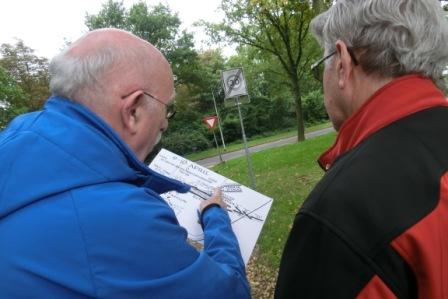
CIMG9313 Sep 25 2017 Pieter and Edwin in Deventer looking at map of attack

Edwin van der Wolf (left) and Pieter in Deventer, looking at a map of the attack that led to its liberation.  (Photo credit: Daria Valkenburg)

On April 10, 1945, the Regiment was involved in the liberation of Deventer, a town lying on the right bank of the IJssel River.  With the approaches protected by a maze of waterways, it was necessary to attack from the east.  

The village of Schalkhaar was liberated without much difficulty, but three German tanks appeared on the morning of April 10 as the liberation of Deventer began. One tank was destroyed by ‘B’ Squadron of the 27th Armoured Regiment, while the other escaped. (See https://www.canadiansoldiers.com/history/battlehonours/northwesteurope/deventer.htm)

The war diary for April 10, 1945 provided a narrative of what happened.  “…On our left flank ‘B’ Squadron west and enemy SPs were reported on our left flank.  The ground was very open so a mad dash was made to the wood and protective positions were taken up to support SD&Gs who had ‘A’ Company across the canal at that point….”  SP refers to self-propelled artillery.  SD&G refers to the Stormont, Dundas and Glengarry Highlanders Regiment.

….The SD&Gs worked straight north along the canal supported by 3 and 4 Tps while the NNSH went northwest supported by 1 and 2 Tps, finally reaching position, where they were stopped by a report of an SP…Sgt Gerow was killed by mortar fire and Lt Fraser took over No 2 Tp….”  Tps refers to troops.  NNSH refers to the North Nova Scotia Highlanders Regiment.

… Clive is buried in the Canadian War Cemetery in Holten…

Edwin explained that Clive “…was temporarily buried at the Roman Catholic Church in Schalkhaar before being reburied on April 9, 1946 in the Canadian War Cemetery in Holten….

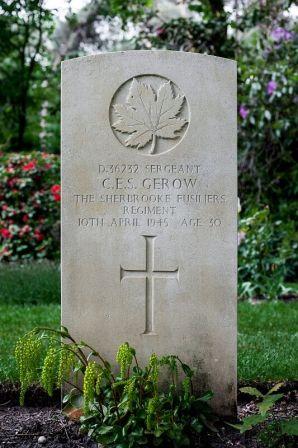
Grave of Clive Gerow from CVWM

Grave of Clive Elbert Steele Gerow at the Canadian War Cemetery in Holten. (Photo source: Canadian Virtual War Memorial)

Thank you to Brynne Campbell for sharing photos of Clive Gerow.  If you have a story to tell, please let Pieter know. You can email him at memorialtrail@gmail.com, or comment on the blog.  

© Daria Valkenburg

…Want to follow our research?….

If you are reading this posting, but aren’t following the blog, you are welcome to do so.  Our blog address: https://onthewarmemorialtrail.com/

Front cover OnTheWarMememorialTrailinEurope4 countries, 6 weeks, 7,000 km – an unforgettable war memorial journey in Europe…. Daria’s book ‘No Soldier Buried Overseas Should Ever Be Forgotten‘ is available in print and e-book formats.  Net proceeds of book sales help support research costs and the cost of maintaining this blog. For more information on the book, please see https://nosoldierforgotten.com/

You are also invited to subscribe to our YouTube Channel: On The War Memorial Trail With Pieter Valkenburg: https://www.youtube.com/channel/UCJ591TyjSheOR-Cb_Gs_5Kw

Never miss a posting!  Subscribe below to have each new story from the war memorial trail delivered to your inbox.

On The War Memorial Trail….. ‘The Only Yukon Territory Soldier Buried In Holten’

September 30, 2023. With an extensive photo wish list from the Canadian War Cemeteries in The Netherlands, it can be difficult for Pieter to determine who will be next in line for his research.  But when we learned there is one soldier from the Yukon Territory buried in the Canadian War Cemetery in Holten, and he was on the photo wish list, we knew he was a priority.

Henk Vincent, one of the research volunteers at the Information Centre in Holten, explained that “Harry Davis is the only Yukon Territory soldier buried in Holten, which is not surprising when you realize that although the Yukon Territory is about the size of Spain in terms of area, it had less than 10,000 inhabitants in 1945….

Map of Canada with border

Yukon is in northern Canada.  (Map source: http://www.babysits.ca)

Yukon is not only in the far northern part of Canada, but on the opposite coast from where we live in Prince Edward Island.

The search for a photo of Harry Henry DAVIS, born December 9, 1921 in Selkirk, Yukon Territory, son of Harry and Grace (nee Woods) Davis, began with an online search. 

…Chief Roberta Joseph from the Trʼondëk Hwëchʼin First Nation commemorated Harry

A CBC article from November 8, 2022 immediately came up: ‘Trʼondëk Hwëchʼin soldiers honoured at annual event in Dawson City’, in which Chief Roberta Joseph “shared a story that her grandmother would tell her every Remembrance Day when she was growing up.

She would always remember her cousin Harry Davis,’ Joseph said. ‘She would always talk about how he sacrificed his life for his platoon. He passed away in World War Two. He let his platoon go ahead so that they could escape the enemy and he stayed behind by throwing a grenade and got caught up in that.’…”  (See https://www.cbc.ca/news/canada/north/tr%CA%BCond%C3%ABk-hw%C3%ABch%CA%BCin-soldiers-honoured-at-annual-1.6644908)

image001 Band logoFrom this one article, we learned that Harry Davis was Indigenous. His mother was a member of the Tr’ondëk Hwëch’in (loosely translated as ‘people of the river’), a First Nation whose members are descendants of the Hän-speaking people who have lived along the Yukon River for millennia. (See https://en.wikipedia.org/wiki/Tr%CA%BCond%C3%ABk_Hw%C3%ABch%CA%BCin_First_Nation)

 …The Trʼondëk Hwëchʼin First Nation provided a photo of Harry

Chief Joseph was contacted, and shortly afterwards, a photo of Harry Davis was received from Sue Parsons, Collections Manager, Heritage, of the Tr’ondëk Hwëch’in Government.  “I received a request to forward the attached photograph of Harry Davis to you.  Mähsi” she wrote.  Sue explained that the photo was courtesy of Martha Kates private collection, “…a family member of Harry Davis….

harry-davis-600-kates-collection-2006-1_1_-restored-3

Harry Henry Davis.  (Photo courtesy of Martha Kates Private Collection)

Harry was orphaned young, as his father died in 1926, and his mother in 1927.  Henk noted that “Harry grew up in the First Nations Reservation of Fort Selkirk in the Yukon Territory, located on the Yukon River, a few hundred kilometres from the Arctic Circle….”  His half-sister, Mary Isabel Harriet, was listed as his only remaining direct relative on the Estate Form after his death.

…Harry enlisted in 1942…

After finishing school Harry worked in the Triangle Cafe in Dawson City, Yukon Territory.  At the time of his enlistment with the No. XI District Depot on February 19, 1942 in Dawson, he was working as a driver for Yukon Consolidated Gold Corporation.

On March 16, 1942, Harry was sent to No. 110 Canadian Army Basic Training Centre (CABTC) in Vernon, British Columbia for his basic training.  A few weeks later, however, he ended up in the Vernon Military Hospital for almost a month with measles, followed by mumps.

After being discharged from hospital on May 7, 1942, and completing his basic training, Harry was transferred to A-4 Canadian Artillery Training Centre (CATC) in Brandon, Manitoba on June 10, 1942, for training as a gunner.  

…Harry was sent overseas and assigned to the 8th LAA Regiment…

On July 22, 1942 Harry was on his way to the United Kingdom, on ‘Special Duty’, arriving a week later, and attached to No. 3 Canadian Artillery Reinforcement Unit (CARU), where he received more training.

On November 27, 1942, Harry was assigned to the 8th Canadian Light Anti-Aircraft Regiment, Royal Canadian Artillery.  On January 6, 1943 Harry qualified as a driver i/c (W), meaning he was qualified to drive heavy trucks and armoured cars. 

On July 20, 1944, Harry left with the 8th Canadian Light Anti-Aircraft Regiment for France aboard the Malayan Prince.  (See https://uboat.net/allies/merchants/ship/1768.html)

According to the war diary for July 26, 1944, “… we arrived at the anchorage at Juno Beach, off Courselles-Sur-Mer, at 1600 hours.  We don’t expect to get off ship until sometime tomorrow so everyone is taking advantage of the fine weather and sun bathing on the decks…

The interlude didn’t last, as the war diary for July 27, 1944 stated that “…during the early hours of the morning we were treated to quite an anti-aircraft barrage some miles inland…” After landing, the Regiment moved up through France.

…Allied patrols across the Maas River were dangerous …

On September 19, 1944, Harry was transferred to the Lake Superior Regiment (Motor), joining them as the Regiment advanced “through France, Belgium and the south of the Netherlands…

Henk noted that during “ the winter of 44/45, the Lake Superior Regiment, together with other Canadian regiments, was tasked with guarding the northern front line, in this case the Maas River. Patrols were also regularly deployed across the Maas to reconnoitre enemy positions. This often led to violent confrontations with the Germans….

Screenshot 2023-06-01 at 07-58-01 kerkdriel maps at DuckDuckGo

Harry Davis was badly wounded during a patrol near Kerkdriel.  (Map source: DuckDuckGo)

The Lake Superior Regiment was in the area of ‘s-Hertogenbosch, The Netherlands in January 1945.  The Regiment’s war diary for January 14, 1945 recorded that at 2:00 am “…a recce patrol under the command of Lt. D.A. Johnson left to cross the Maas in two boats.  The first boat contained a beach party of 1 N.C.O., 1 sergeant, and 6 men, the second boat contained the recce group of 1 officer, 1 sergeant, and 5 men…”    N.C.O. refers to non-commissioned officer.

…Due to a heavy fog on the river, the beach party became lost and returned to the start point after some difficulty with the strong current.…” The recce group landed, but the beach party was nowhere to be found. 

Lt Johnson decided to proceed with the patrol anyways.  As the group moved east towards the town of Kerkdriel, they “…heard an enemy patrol coming down the road toward them…”  The group moved to “the east side of a house in the hope that the enemy patrol would continue down the road, and could be engaged …

Instead, they were ambushed.  “…The enemy patrol, however, came through a copse to the left and rear of our patrol, who immediately engaged them, killing one and wounding two others…

…Harry was the patrol’s only casualty …

There was one casualty from the recce party.  “…One of our men K-76942 Pte DAVIS H.H., was killed and had to be left behind. Lt. Johnson and the remaining scout made a run for it and managed to escape and contacted the covering party. Artillery fire was called down and the patrol returned to our side without further mishap….

However, Harry hadn’t been killed.  He was badly wounded and taken prisoner of war.  Unfortunately, he died the following day, Monday, January 15, 1945.  He was 23 years old.

…Harry’s sister received a letter with a statement from Lt Johnson…

A February 26, 1945 letter from Colonel R.T.E. Hicks-Lyne, Acting Director of Records for Adjutant-General, to Harry’s sister Mary, quoted a statement from Lt Johnson: “…Private Davis received a burst of 9 m.m. automatic fire, which ignited a # 80  smoke Grenade, carried on his belt. I, the patrol commander, was approximately six feet away from him as at the time. After the explosion I attempted to engage the enemy from the opposite  side of the haystack; coming back Lance Sergeant Burrison said: ‘Davis is dead, a grenade is burning in his side.’ As it was an extremely dangerous situation we decided to get out as fast as possible…” 

Colonel Hicks-Lyne went on to note that “…This statement is also corroborated by Sergeant Burrison, who was also with your brother at the time…

…Harry is buried in the Canadian War Cemetery in Holten…

Harry was temporarily buried in the Catholic Cemetery in Kerkdriel. We had wondered who had initially buried him – the Canadians or the Germans.  Henk explained that “…since Harry Davis became a prisoner of war on January 14, 1945 and died on January 15, while Kerkdriel was only liberated on April 23, we can assume that he was buried by the Germans…

On August 2, 1946, Harry was reburied in the Canadian War Cemetery in Holten, The Netherlands.

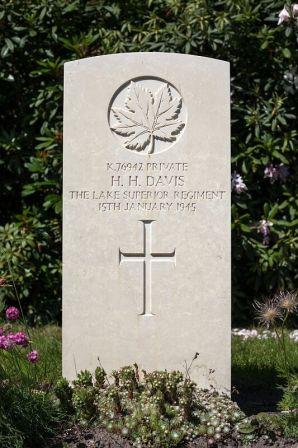
Grave of Harry Henry Davis in Holten from CVWM

Grave of Harry Henry Davis at the Canadian War Cemetery in Holten. (Photo courtesy of Canadian Virtual War Memorial)

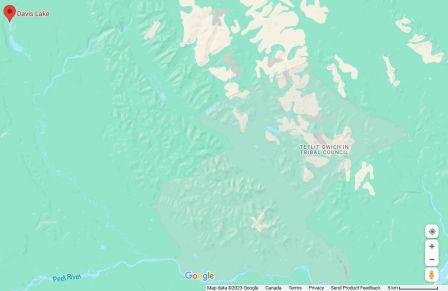
….Davis Lake in Yukon Territory is named in Harry’s honour…..

Screenshot 2023-09-29 at 17-00-29 Davis Lake · Yukon Y0B 1J0

Davis Lake in Yukon Territory is named after Harry Henry Davis.  (Map source:  Google maps)

Harry has been honoured by having Davis Lake in Yukon named after him. (116I01- 66° 10’ 37”- 136° 24’ 57”)

Thank you to Roberta Joseph and the Trʼondëk Hwëchʼin government for providing a photo of Harry. Thank you also to Henk Vincent for additional information on the patrols made along the Maas River and letting us know that Harry Davis was the only soldier from the Yukon buried in Holten.

Do you have a story to tell? Pieter encourages you to email him at memorialtrail@gmail.com, or comment on the blog.    

© Daria Valkenburg

…Want to follow our research?…

If you are reading this posting, but aren’t following our research, you are welcome to do so.  Our blog address: https://onthewarmemorialtrail.com/

Front cover OnTheWarMememorialTrailinEurope4 countries, 6 weeks, 7,000 km – an unforgettable war memorial journey in Europe…. Daria’s book ‘No Soldier Buried Overseas Should Ever Be Forgotten‘ is available in print and e-book formats.  Net proceeds of book sales help support research costs and the cost of maintaining this blog. For more information see https://nosoldierforgotten.com/

Subscribe to our YouTube Channel: On The War Memorial Trail With Pieter Valkenburg: https://www.youtube.com/channel/UCJ591TyjSheOR-Cb_Gs_5Kw

Never miss a posting!  Subscribe below to have each new story from the war memorial trail delivered to your inbox.

On The War Memorial Trail….. “Archie Was A Good Guy”

September 12, 2023.  When Pieter begins researching a soldier whose name is on a photo wish list from one of the Canadian War Cemeteries in The Netherlands, he quite often finds current family members in various parts of Canada or the USA. 

A zigzag virtual search is not uncommon, but it’s rare that a search from one part of the country leads him right back to our own province of Prince Edward Island! But that’s what happened in the search for a photo of Archibald Phillip ‘Archie’ MCLEAN of Edmundston, New Brunswick!

The son of Allan John and Mary Rose ‘Minnie’ (nee Comfort) McLean, Archie was born August 5, 1920 in Edmundston.  When he enlisted in Edmundston on May 14, 1941 at the No. 7A District Field Office, he listed his occupation as paper maker with the Fraser Pulp Company in Edmundston, a pulp mill. (See https://en.wikipedia.org/wiki/Fraser_Papers – the Edmundston mill is still in operation, owned by Twin Rivers Paper Company.)

His enlistment form recorded that he had been serving in the 2nd Battalion Carleton & York Militia since July 1940.  It also noted that he enjoyed skating, and playing hockey and baseball.

Three of his brothers were also serving – and survived the war: Lawrence and Wilfred were in the Canadian Army.  Allan was in the Canadian Navy.  He also had five  sisters: Mae, Patricia, Emma, Theresa, and Hilda.

…The search for a photo of Archie led to two nephews….

The key to finding family came from two of the sisters.  Mae married Bertrand Clarence Michaud, and Pieter contacted her son Michael, who lives in Brunswick, Maine.   Michael didn’t have a photo but said his cousin, Donald Moore, who lives in Summerside, Prince Edward Island, and is himself a veteran, likely would.  Donald’s mother Theresa was another sister of Archie’s.

Pieter then contacted George Dalton, a veteran who lives in Summerside. Did he know him?  “…Yes…” George said.  “…He’s not been well, but someone from our group will contact him…

In the mysterious way that the Island works, it turned out that Pieter had previously met Donald Moore’s daughter, Tina Mundy!  It wasn’t very long before Tina’s daughter, Erin Mundy Montgomery, sent photos and information.  And a few days later, we met with Donald.

CIMG6452 Aug 29 2023 Pieter Don Moore Tina Mundy

Pieter with Donald Moore and Tina Mundy.  (Photo credit: Daria Valkenburg)

…Archie was a good guy…” Donald said.  “… I became 84 years old on July 23, and am the oldest of the cousins.  I spent 38 years in the military, with the RCAF, including a 4 year posting in France.  I made about 20 trips to Holland, but I never knew where Archie was buried…”  A planned trip to visit his grave in 2020 got cancelled due to Covid.

… Archie joined the Royal Canadian Engineers as a sapper….

On May 21, 1941, Archie was assigned to No. 71 Basic Training Centre in Edmundston.  After completing basic training, he was sent to the A5 Royal Canadian Engineers Training Centre in Petawawa, Ontario for training as a sapper on July 25, 1941. 

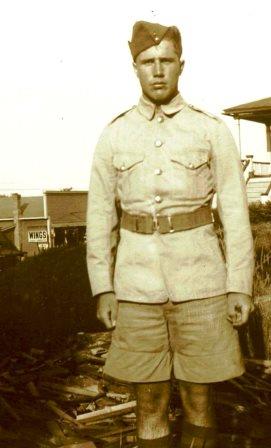
Archie McLean slightly corrected

Archibald Phillip ‘Archie’ McLean. (Photo courtesy of Donald Moore)

Life moved quickly for Archie, as on September 27, 1941 he was transferred to the 1st Field Squadron of the Royal Canadian Engineers.  On October 1, 1941, he passed the Standard Army Trade Test for Pioneer Class ‘C’.   This classification took into account a soldier’s civilian trade skills and experience and meant formal training might not be needed. 

…Archie left Canada for overseas service….

Shortly afterwards, on October 6, 1941, he left Canada, arriving in the United Kingdom on October 19, 1941.

On March 9, 1942, he was reassigned to the Engineer Reinforcement Unit (ERU) for a short period, then was transferred to No. 2 Canadian Construction Company of the Royal Canadian Engineers.  Archie was sent for a number of courses.  He completed a firefighting course on April 6, 1942, a Steel Square course on May 23, 1942, and received a qualification as a Carpenter ‘B’ on June 5, 1942. Around this period, No. 2 Construction Company was designated as No. 6 Canadian Construction Company.

Among the tasks that Archie would have participated in was the building of an RCAF bomber airport in Dunsfold, a task that was completed in a record-breaking 6 months. (See https://en.wikipedia.org/wiki/Dunsfold_Aerodrome)

Following the completion of the airport, the Company underwent training in bridge construction.  In January 1943, according to the Company’s Regimental history, ‘The Story of 2 Battalion R.C.E. 1940-1945’  “…we moved briefly into the Worthing area to construct pillboxes to a German design, for a tank outfit to shoot at…

After that they were tasked with renovations to an airport in Cornwall, in what was not a happy experience. “…After a battalion movement by train, we arrived at scintillating St Eval in the most fearfully depressing rain storm imaginable.  Day after day it lasted…”  Their assignment was “…to construct extensions to the existing standings and runways of the airport….” 

However, “… as soon as the cement had been poured, the rain would drum down, ignore tarpaulins and matting placed over the cement to protect it, and rot it, before it had a chance to set. Yard after yard of it had to be torn up and re-laid…”   (See https://en.wikipedia.org/wiki/RAF_St_Mawgan)

Renovations of the airport finally completed, the Company went to “…Bedford, for another spell of bridging…” so that heavy artillery could cross gaps in fields.

On June 1, 1944, Archie was transferred to No 1 Canadian Engineer Reinforcement Unit (CERU).  He briefly entered the world of show business between September 18, 1944 and October 10, 1944, when he was attached to ICA Shows when the Canadian Army Show came to England to perform for troops. He would have been involved in preparing stages and sets. (See https://www.silverhawkauthor.com/post/canadian-army-show-first-canadian-army-in-the-north-west-europe-campaign-of-1944-1945)

On November 18, 1944, Archie was transferred to the Canadian Infantry Corps (CIC) and assigned to No. 3 Canadian Infantry Training Regiment (CITR).

…Archie joined the Carleton & York Regiment in Italy….

Screenshot 2023-09-04 at 16-28-14 Map of Russi Italy

The Carleton & York Regiment was north of Rossi on February 13, 1945.  (Map source: http://www.gosur.com)

On January 4, 1945 Archie left the United Kingdom for Italy.  Then, on February 13, 1945 he was transferred to the Carleton & York Regiment, and reclassified from Pioneer ‘C’ to General Duty.   He joined them as the Regiment was north of Rossi, part of a group of reinforcements, at the tail end of the Italian Campaign. (See https://en.m.wikipedia.org/wiki/Italian_campaign_(World_War_II))

On March 16, 1945, he left Italy as part of Operation Goldflake, arriving in Marseilles, France two days later.  Operation Goldflake was the codename for moving troops from Italy to North-West Europe.  (See https://en.wikipedia.org/wiki/Operation_Goldflake)

The Carleton & York Regiment was now part of the 21st Army Group. From France, troops were moved up to the Belgian front, into The Netherlands, through the Reichswald Forest in Germany, and then back into The Netherlands.

On April 12, 1945 the Regiment was part of Operation Cannonshot, which led to the crossing of the IJssel River between the villages of Gorssel and Wilp in the eastern part of The Netherlands. (See https://www.liberationroute.com/stories/190/operation-cannonshot)

According to the April 12, 1945 war diary entry of the Carleton & York Regiment, they “…moved across the Ijssel River at 14:30 hours….” to relieve the Seaforth Highlanders of Canada.

Map western holland showing Posterenk

On April 13, 1945, the war diary of the Carleton & York Regiment noted that troops were south of Deventer. “Weather – morning, dull and foggy, sunny in the afternoon, cold at night….

The objective was to clear Posterenk and move further up. Four Companies of the Carleton & York Regiment were engaged.  ‘D’ Company was to clear Posterenk, while the rest followed in support.  After Posterenk was cleared in the early afternoon, “…At 1538 hrs ‘B’ Company began to move up in carriers with one platoon of tanks in support…”  ‘D’ Company was then held up due to enemy fire.

… ‘B’ Company pushed through ‘D’ Company but were held up … by small arms and mortar fire…. At 1723 hrs ‘B’ Company moved forward again under heavy mortar fire, these mortars were engaged, also an enemy SP firing on ‘B’ Company from their left…” SP refers to self-propelled weapons.

It got worse. “… ‘B’ Company met with stiff enemy resistance….”  However, “…at 1925 hrs ‘B’ Company had cleared enemy and were moving forward slowly…” Then came a report of more problems. “… ‘B’ Company ….are now … meeting considerable enemy resistance…

…So far during B Company’s attack they have eight wounded and one killed, Lt. W.E. Brousseau being one of those wounded…

Both ‘B’ and ‘D’ Companies came under attack from high explosives. ‘D’ Company reported two wounded during the liberation of Posterenk.  One of these was Daniel ‘Dan’ Peter MACKENZIE. (See https://onthewarmemorialtrail.com/2023/06/29/on-the-war-memorial-trail-the-wwii-soldier-from-victoria-cross-fatally-wounded-during-the-liberation-of-posterenk/

Archie was among those wounded on April 13, 1945. While it’s possible that he was one of the two wounded from ‘D’ Company, he has never been mentioned as one of the soldiers that liberated Posterenk.  Therefore, we believe that he was one of the 8 soldiers wounded from ‘B’ Company.

The medical file stated that Archie received shrapnel wounds from a high explosive that penetrated his left chest.  He was taken to No 3. Casualty Clearing Centre, a Canadian military field hospital in Lochem, where he died in the very early hours of April 17, 1945.  He was 25 years old.

The records of his death go back and forth between April 16 and 17, but an ‘Amendment As To Date Of Casualty’ finally determined it was April 17, 1945.  That was the date that he was ‘struck off strength’ for his final pay, for the Estates Department, and on his New Brunswick Death Certificate.

…Archie is buried in the Canadian War Cemetery in Holten….

On April 17, 1945, Archie was temporarily buried in the Lochem Civil Cemetery, before being reburied in 1946 in the Canadian War Cemetery in Holten.   

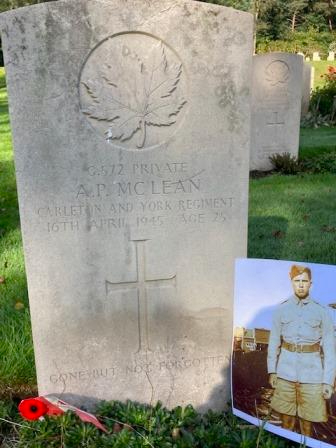
IMG_1003 Sep 4 2023 Grave of Archie McLean with photo

Grave of Archibald Phillip ‘Archie’ McLean in Holten, The Netherlands.  (Photo credit: Henk Vincent)

Thank you to Erin Mundy Montgomery, Don Moore, and Tina Mundy for sharing photos and information on Archie McLean.  Thank you to George Dalton and Michael Michaud for help in finding family. Thank you to Barry Miller for helping with information on troop movements on April 13, 1945.  Thank you to Edwin van der Wolf and Henk Vincent, volunteer researchers for the Canadian War Cemetery in Holten and at the Information Centre Canadian Cemetery Holten, for placing Archie’s picture beside his grave and taking a photo for us.

If you have a story to tell, please let Pieter know. You can email him at memorialtrail@gmail.com, or comment on the blog.  

© Daria Valkenburg

…Want to follow our research?….

If you are reading this posting, but aren’t following the blog, you are welcome to do so.  Our blog address: https://onthewarmemorialtrail.com/

Front cover OnTheWarMememorialTrailinEurope4 countries, 6 weeks, 7,000 km – an unforgettable war memorial journey in Europe…. Daria’s book ‘No Soldier Buried Overseas Should Ever Be Forgotten‘ is available in print and e-book formats.  Net proceeds of book sales help support research costs and the cost of maintaining this blog. For more information see https://nosoldierforgotten.com/

Subscribe to our YouTube Channel: On The War Memorial Trail With Pieter Valkenburg: https://www.youtube.com/channel/UCJ591TyjSheOR-Cb_Gs_5Kw

Never miss a posting!  Subscribe below to have each new story from the war memorial trail delivered to your inbox.

On The War Memorial Trail….. The WWII Soldier From Trail Who Played The Cornet

August 14, 2023.  When Pieter begins his research into a soldier, and then contacts possible family members, he never knows what to expect.  Sometimes, his outreach surprises family members as they might not know a lot about the soldier he inquires about. 

During the search for a photo of Theodor ‘Ted’ HENSCHEL, who was born in Winnipeg, Manitoba on September 19, 1914,  Pieter learned that Ted was living in Trail, British Columbia at the time of his enlistment on June 21, 1944 at the No. XI District Depot in Vancouver, British Columbia.

When Pieter was contacted Joy Roberts, daughter of Ted’s brother Emil, she wrote that “My father didn’t talk about his brother.  So I am a little confused.  Ted Henschel is listed on the Trail, BC war dead. My father and their father lived in Trail…”  But – the family did have photos of Ted!

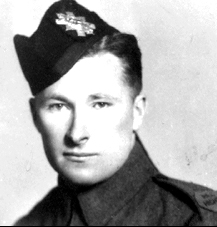
Theodor Henschel

Theodor ‘Ted’ Henschel (Photo courtesy of the Henschel Family)

Ted’s parents had immigrated to Canada from Eastern Europe.  They lived in Winnipeg until Ted was a year old, then in Saskatchewan for 12 years, before moving to British Columbia. “…One brother, Fred, lived and passed away in Vancouver.  He changed his name at some point during the war, because of Henschel sounding German.  He changed it to Hansel and was the only child that immigrated with the parents (though I believe one other son died on the ship while crossing to America).  Fred was about twenty years older than my dad, Emil…” explained Joy.

Besides Fred and Emil, Ted had a brother Rudolf and a sister Annie. When Ted enlisted after being called up for service under the National Resources Mobilization Act (NRMA), he had been working for a decade as a machine operator for the Consolidated Mining and Smelting Company in Trail, British Columbia. In addition to English, it was recorded that he could speak German, and that he wore corrective lenses. (See https://en.wikipedia.org/wiki/National_Resources_Mobilization_Act)

…Ted began his basic training in Camrose….

Ted was sent to No. 131 Canadian Infantry Basic Training Centre (CIBTC) in Camrose, Alberta.

Ted identified A Company Sep 1944 Camrose

September 1944 group photo of No 131 CIBTC , taken at the Military Headquarters  in Camrose, Alberta.  Ted Henschel is in the middle row, second from right.  (Photo courtesy of the Henschel Family)

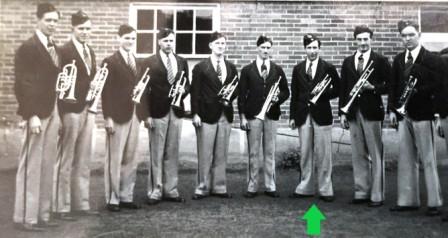
Ted was a cornet player and played in the platoon band.

Musicians Ted 3rd from right with arrow

Ted Henschel, third from right.  (Photo courtesy of the Henschel Family)

On September 16, 1944, having completed his basic training, Ted was transferred to the A-16 Advanced Canadian Infantry Training Centre (CITC) in Calgary, Alberta.

Ted remained in Calgary until December 9, 1944, when he was transferred to the No.1 Training Brigade in Debert, Nova Scotia for final training and preparation for overseas service.

…Ted left Canada for overseas service…

On Christmas Eve – December 24, 1944 – Ted left Canada for the United Kingdom.  Upon arrival in the United Kingdom on the last day of the year, he was assigned to No. 1 Canadian Infantry Training Regiment (CITR) for further training.

…Ted was sent to The Netherlands…

finalphasecanscottish

Ted Henschel joined the Canadian Scottish Regiment near Zwolle. (Map source: http://www.canadiansoldiers.com)

On March 23, 1945 he was in North West Europe with the X-4 reinforcement troops of the 21st Army Group. Then, on April 18, 1945, he was transferred to the Canadian Scottish Regiment, joining the unit in the area around Zwolle, The Netherlands.  The Regiment had established patrols around Zwolle over an area of 161 square kms (100 square miles), rounding up German stragglers.

…The Battle for Wagenborgen was fierce…

wagenborgen

The Canadian Scottish Regiment’s movements during the Battle for Wagenborgen.  (Map source: http://www.canadiansoldiers.com)

On April 19, 1945, the Regiment moved to a concentration area at Hoogezand, near Groningen. Allied troops next worked to clear the area around Groningen of enemy troops. Patrols reported that Wagenborgen was still held by Germans. 

…Roads leading in and out of Wagenborgen had been blocked, and covered by machine guns and anti-aircraft guns…. The terrain surrounding Wagenborgen was flat, unobstructed by dense foliage, and criss-crossed by numerous canals and drainage ditches which limited the avenues of approach for the attackers….”  (Excerpt from https://www.canadiansoldiers.com/history/battlehonours/northwesteurope/wagenborgen.htm)

On April 21, 1945,  an attack on Wagenborgen, located south of Delfzijl, began, in what turned out to be a terrible fight.  This was the preliminary battle before the Battle of Delfzijl Pocket. The Canadian Scottish Regiment began the attack with only ‘D’ Company, but very quickly realized that this was insufficient. There were many casualties.

However, a subsequent attack with three companies was successful and troops were able to repel counter-attacks. By the time it was over, Canadian Scottish casualties at Wagenborgen were 23 killed and 41 wounded.

…Ted lost his life during the Battle for Wagenborgen …

The war diary for the Canadian Scottish for Sunday, April 22, 1945 recorded that “… ‘A’, ‘B’, and ‘C’ Companies patrolled extensively to their fronts:  ‘A’ Company met small arms fire from the town of Wagenborgen…’B’ Company patrolled…also meeting small arms fire…. ‘C’ Company established 4 strong-points to their front on the dyke running southwest to northeast….

Ted was in ‘A’ Company, which late in the evening “pushed east towards the northern part of WAGENBORGEN with the 4.2’s firing on the Company’s left flank. ‘C’ Company sent one Platoon to secure the dyke…with the other two Platoons pushing towards the dyke ….

The after-action report for ‘A’ Company summarized what happened: “…At 2200 hours on the night of 22 April 45 A Company began their advance on the northern end of the village of WAGENBORGEN. Supporting fire commenced at 2230 and continued until 2245 during which time the Company advanced unmolested. At 2245 the assault commenced and for the first time enemy fire was apparent. The Company advanced through considerable shell –fire which caused several casualties…

By 11 pm, the war diary reported that “… ‘B’ Company’s attack was started on the southern part of WAGENBORGEN. …. ‘A’ Company secured the northern part of the village…

Sadly, at some point during the Battle for Wagenborgen on April 22, 1945, Ted lost his life. He likely hadn’t even had time to get to know the soldiers he was with, since he had only joined the Regiment a few days earlier.

…Ted is buried in the Canadian War Cemetery in Holten …

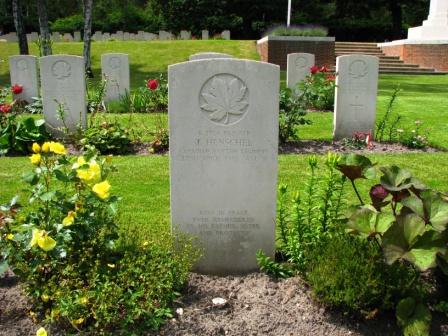
Ted was temporarily buried in Siddeburen before being reburied on February 15, 1946 in the Canadian War Cemetery in Holten, The Netherlands.

Foto graf Theodor Henschel, 21-1-013

Grave of Theodor ‘Ted’ Henschel in Holten, The Netherlands.  (Photo courtesy of the Information Centre Canadian Cemetery Holten)

…Ted is remembered on memorials in Trail and Wagenborgen …

As Joy wrote in her initial email, Ted is listed on the war memorial in Trail, British Columbia: see https://www.waymarking.com/waymarks/WMN9QE_Trail_Cenotaph_Trail_BC

He is also listed on the war memorial in Wagenborgen, which commemorates the residents of Wagenborgen who died in the Second World War, and 27 fallen Canadian soldiers – 23 of them from the Canadian Scottish Regiment.  See https://www.tracesofwar.com/sights/24193/War-Memorial-Wagenborgen.htm

Thank you to Joy Roberts, who wrote “Thank you very much for your work. Joy, Gail, and Dennis – Nieces and Nephew of Ted Henschel…” A big thank you to Judie Klassen, whose genealogy research helped to find family members of Ted Henschel.

If you have a story to tell, please let Pieter know. You can email him at memorialtrail@gmail.com, or comment on the blog.  

© Daria Valkenburg

…Want to follow our research?….

If you are reading this posting, but aren’t following our research, you are welcome to do so.  Our blog address: https://onthewarmemorialtrail.com/

Front cover OnTheWarMememorialTrailinEurope4 countries, 6 weeks, 7,000 km – an unforgettable war memorial journey in Europe…. Daria’s book ‘No Soldier Buried Overseas Should Ever Be Forgotten‘ is available in print and e-book formats.  Net proceeds of book sales help support research costs and the cost of maintaining this blog. For more information on the book, please see https://nosoldierforgotten.com/

Subscribe to our YouTube Channel: On The War Memorial Trail With Pieter Valkenburg: https://www.youtube.com/channel/UCJ591TyjSheOR-Cb_Gs_5Kw

Never miss a posting!  Subscribe below to have each new story from the war memorial trail delivered to your inbox.

On The War Memorial Trail…..The WWII Soldier From Guysborough Whose Nieces Ensured His Photo Reached Pieter

July 15, 2023. The route to finding family and a photo of a soldier has many twists and turns. Sometimes a family member contacts us about a relative, usually after a media interview, but most of the time it’s sheer detective work to find a living family member. If no family connection can be found, then an appeal is made through the media.

In the majority of cases, possible family connections are found. Then Pieter has the challenge of making contact – through genealogy sites such as Ancestry, Facebook accounts, Legion branches, and by email if an address is found.

Quite often, though, an initial inquiry is made by phone. If you’ve ever had to cold call a stranger and explain the purpose of your call, you know it’s a daunting prospect. With a few exceptions, people are generally very polite, listen carefully to Pieter, and are good enough to let him know if he’s reached the right person (a relative) or not.

Over the years, he’s had very engaging calls and met delightful people. That was the case when he was looking for a photo of WWII soldier Lawrence Edward LUCAS of Guysborough, Nova Scotia.

Lawrence was born December 9, 1925, the son of Charles and Amelia Hattie Lucas. He had a brother Charles, and three sisters: Caroline, Mildred, and Vivian.

…The photo search was successful thanks to two nieces…

…It’s usually the women who have the photos…” Pieter told me, “…so I’m starting with the sisters….” It was a wise decision.

Lawrence’s sister, Mildred O’Connor, had been president of the Ladies Auxiliary in the Royal Canadian Legion in Guysborough. Pieter spoke with her daughter, Marie Ehler, who told him that her mother “….had placed a photo in the Legion….

Unfortunately, the Legion never seemed to be open, and there was no response to inquiries made by phone and social media.

Pieter then contacted Mildred McLeod, whose mother Caroline ‘Carrie’ Tovey, was another sister of Lawrence. When Mildred heard that the Legion had not responded, she got involved.  Within a few days, a photo was emailed to Pieter from Lorne MacDonald.

…Lawrence enlisted at the age of 18…

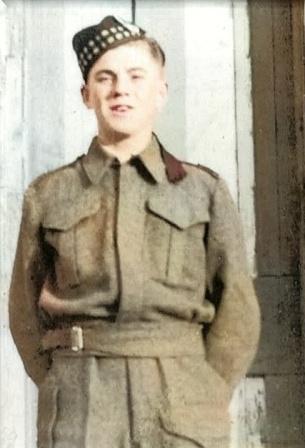
Lawrence Edward Lucas

Lawrence Edward Lucas. (Photo courtesy of the Lucas Family. Photo colourization by Pieter Valkenburg)

When Lawrence enlisted with the No. 6 District Depot in Halifax, Nova Scotia, on June 23, 1944, he had been working as a carpenter at Eastern Wood Works in New Glasgow, Nova Scotia.  He also noted that he had served with the 2nd Reserve Battalion Pictou Highlanders from September 1941 to May 1942.  As a teenager during that period, he would not have been eligible for active service.

On July 6, 1944, he was sent to No. 60 Canadian Infantry Basic Training Centre (CIBTC) in Yarmouth, Nova Scotia. Then, on September 3, 1944 he was transferred to the A14 Canadian Infantry Training Centre (CITC) in Aldershot, Nova Scotia.

…Lawrence completed an anti-tank course…

Among the training that Lawrence completed was a 6 Pounder Anti-Tank Gun course, for which he received his qualification on October 16, 1944.  This was a relatively small gun that could be pushed by its crew when necessary. Towed by a Universal Carrier, it could be brought into action quickly. (For more information, see https://www.canadiansoldiers.com/weapons/ordnance/6pounder.htm)

You can get an idea of how this gun works at this short re-enactment video on YouTube:

On December 12, 1944, Lawrence was transferred to the Training Brigade Group in Debert, Nova Scotia, for final training and preparations for going overseas.

…Lawrence arrived in the UK on Christmas Day 1944…

Lawrence left Canada on December 19, 1944, and after arriving in the United Kingdom on Christmas Day, he was assigned to No. 3 Canadian Infantry Training Regiment (CITR) for further training.

On February 10, 1945 he was in North West Europe with the X-4 reinforcement troops of 10th Battalion. Then, on April 6, 1945, he was transferred to the Algonquin Regiment, which was in the vicinity of Almelo, The Netherlands.

…Lawrence joined The Algonquin Regiment in The Netherlands…

The Algonquin Regiment was part of the 1st Canadian Army, which had two tasks: liberate the western Netherlands, and advance to the North Sea while protecting the left flank of the British 2nd Army as they advanced into northern Germany.

Algonquin Regt map to Apr 16 1945

Green arrows mark the movement of The Algonquin Regiment through The Netherlands and Germany. (Map source: http://www.canadiansoldiers.com)

By April 17, 1945 the Regiment had passed Friesoythe, Germany and was engaged in clearing a bridgehead over the Küsten Canal.  The war diary for April 20, 1945 recorded that “…in four days of steady fighting, the bridgehead has been slowly but steadily enlarged, both in depth and width, always against fanatical opposition and over terrain that is definitely in favour of the enemy….

kustencanal from Cdn Soldiers

Clearing of the Küsten Canal in Germany. (Map source: http://www.canadiansoldiers.com)

By April 22, 1945 more reinforcements had arrived, and the various companies of The Algonquin Regiment had been moved.  Lawrence was in ‘D’ Company, which, per ‘D’ Company’s war diary entry, stated that “…at 0230 we got orders to move so we packed up and moved …. and bedded down in a barn to await orders. We came under cover of the Argylls today…

…Lawrence lost his life due to artillery fire in Germany…

On April 23, 1945, ‘D’ Company recorded that just after midnight they “…moved up the road 600 yards as far as ‘C’ Company of the Argylls….”  After a two hour wait for further orders, they were “… to infiltrate a platoon across the water obstacle to determine the strength of the opposition. Things went OK, not a shot was fired and at first light we found ourselves dug in with the Jerries almost in the same trenches…

Then things weren’t so rosy as the day unfolded as “…16 Platoon hung on to the east side of the river all day and we took a lot of shelling.  Our casualties were one killed and three wounded. At 1900 hours we received orders to move onto the railway and take up positions at the road and rail crossing. We teed off at 2145 and 17 Platoon came under our own artillery fire and lost 14 men in killed and wounded…

At some point during that fateful day, Lawrence lost his life.  It’s unknown if he was the casualty killed by German shelling or one of the casualties from the Regiment’s own artillery fire.

…Lawrence is buried in the Canadian War Cemetery in Holten…

He was temporarily buried in Edewecht, Germany before being reburied in the Canadian War Cemetery in Holten, The Netherlands a year later.

lucas, lawrence edward grave from Holten

Grave of Lawrence Edward Lucas in Holten, The Netherlands.  (Photo courtesy of the Information Centre Canadian Cemetery Holten)

Thank you to Mildred McLeod and Marie Ehler for ensuring that Pieter received a photo of their uncle. Do you have a story to tell? Pieter encourages you to email him at memorialtrail@gmail.com, comment on the blog, or tweet to @researchmemori1.

© Daria Valkenburg

…Want to follow our research?…

Follow our blog

If you are reading this posting, but aren’t following the blog, you are welcome to do so. Our blog address: https://onthewarmemorialtrail.com/.

Front cover OnTheWarMememorialTrailinEurope4 countries, 6 weeks, 7,000 km – an unforgettable war memorial journey in Europe…. Daria’s book ‘No Soldier Buried Overseas Should Ever Be Forgotten‘ is available in print and e-book formats.  Net proceeds of book sales help support research costs and the cost of maintaining this blog. For more information see https://nosoldierforgotten.com/

You are also invited to subscribe to our YouTube Channel: On The War Memorial Trail With Pieter Valkenburg: https://www.youtube.com/channel/UCJ591TyjSheOR-Cb_Gs_5Kw.

Never miss a posting!  Subscribe below to have each new story from the war memorial trail delivered to your inbox.

On The War Memorial Trail…..The WWII Soldier From Victoria Cross Fatally Wounded During The Liberation Of Posterenk

June 29, 2023.  In 2017, Pieter and I visited the village of Posterenk in The Netherlands with Edwin van der Wolf, one of the research volunteers at the Canadian War Cemetery in Holten.

CIMG9295 Sep 25 2017 Posterenk windmill

Windmill in Posterenk, which has a memorial stone inscribed on the wall.  (Photo credit: Daria Valkenburg)

….The Island connection to Posterenk…..

Edwin wanted us to visit the village because it had an Island connection.  Frank GALLANT, son of Anthony and Eleanor Gallant of Mount Carmel, Prince Edward Island, who was with the Carleton & York Regiment, died during there on April 13, 1945 at the age of 32.

The village had a list of 6 soldiers to commemorate from the Carleton & York Regiment, who had all been buried in the area.  In addition to Frank Gallant, the list named another Islander, James ‘Frank’ MOSSEY, of Souris.

Unfortunately, not all soldiers who died are included on this list, but Edwin worked towards including two more, who were not buried near Posterenk, but “were temporarily buried in Lochem because they had previously died in a Canadian hospital there….

These two additional soldiers were: Goldwin Marven POLLICK of Minto, New Brunswick, and Daniel Peter MACKENZIE of Victoria Cross, Prince Edward Island. 

Born March 22, 1918 in Victoria Cross, Daniel ‘Dan’ Peter MACKENZIE was the son of John and Rachael MacKenzie.  His niece, Carol Burke, provided more information on his life when she contacted Pieter in 2015:  “Dan MacKenzie grew up on a farm in Victoria Cross, Prince Edward Island, and attended Victoria Cross school.  He had 3 brothers Johnny, Billy, and Angus, all deceased, and 3 sisters: Florence Rodgerson, Mabel MacNeill, and Edna Campbell, all living in Prince Edward Island. Dan enjoyed playing hockey and ball with his siblings and working on the farm with his father…” 

….Dan MacKenzie enlisted in 1940…..

Before enlisting with the PEI Highlanders in Charlottetown, Prince Edward Island on May 15, 1940, Dan had served in the militia with the PEI Light Horse Regiment (17th Reserve Armoured Regiment) since 1937.  He had been working as a farm labourer for Gavin Read of Montague, Prince Edward Island, and hoped to have a dairy farm of his own.

MacKenzie-Daniel-P (2)

Daniel ‘Dan’ Peter MacKenzie. (Photo courtesy of Carol Burke)

He went to Dartmouth, Nova Scotia for basic training, and remained there until June 3, 1941, when he was sent to Valcartier, Quebec in preparation for guard duty in Newfoundland. 

… Dan was sent to Newfoundland….

NFLD Map shows Botwood

Location of Botwood Military Base in Newfoundland. (Map source: http://postalhistorycorner.blogspot.com/2012/12/wwii-canadian-forces-in-newfoundland.html)

After France was occupied by the Germans in 1940, Newfoundland’s defensive position became more precarious. That same year, Canada assumed responsibility for the defence of Newfoundland with the establishment of ‘W Force’, a Canadian garrison force responsible for defending Newfoundland against enemy incursions and providing security for existing and proposed defence facilities during WWII. It included infantry, artillery, and anti-aircraft units. (See https://en.wikipedia.org/wiki/Military_history_of_Newfoundland_during_World_War_II)

On July 23, 1941, as part of ‘W Force’, Dan was sent to Botwood, Newfoundland.  In addition to the PEI Highlanders, troops from the Black Watch of Canada, Royal Rifles of Canada, The Algonguin Regiment, Queens Own Rifles, also served at various times. While an RCAF base in Botwood had aircraft patrolling the east coast of the Atlantic, Canadian Army personnel based at Botwood were charged with protection of military facilities that had been installed there, as well as in Gander. (See https://www.heritage.nf.ca/articles/politics/botwood-base.php)

…..Three other soldiers were in Botwood…..

Dan was in Botwood at the same time as three other soldiers whose stories have been told on this blog:

Dan remained in Newfoundland until March 20, 1943, when he was sent to Sussex, New Brunswick.  On June 2, 1943, Dan was transferred to the No. 1 Transit Camp in Debert, Nova Scotia, for final preparation and training before being sent overseas. 

…Dan was in the Italian Campaign….

He left Canada on June 10, 1943, arriving in the United Kingdom on June 18, 1943 and posted to No. 7 Canadian Infantry Reinforcement Unit (CIRU).  On October 25, 1943 he participated in Hot Dog, an exercise to prepare troops who would be part of the Central Mediterranean Force (CMF) and travelled on to mainland Europe with the CMF and the Allied Army in Italy (AAI).  Not long afterwards, he was transferred to the Carleton & York Regiment on December 23, 1943, fighting in the Italian Campaign. (See https://en.m.wikipedia.org/wiki/Italian_campaign_(World_War_II))

Carol Burke had noted that Dan’s “… regiment fought just north of Ortona, Italy…. and was in the forefront of the assaulting Infantry that bitterly fought Gustav, Hitler and Gothic Line battles....”

On December 31, 1944 Dan was attached to Allied Forces Headquarters (AFHQ), which controlled all Allied operational forces in the Mediterranean Theatre of Operations until the end of the war.  AFHQ was based in Caserta, Italy after the capture of Sicily and invasion of Italy.

On March 19, 1945 he left Italy as part of Operation Goldflake, arriving in Marseilles, France two days later.  Operation Goldflake was the codename for moving troops from Italy to North-West Europe.  (See https://en.wikipedia.org/wiki/Operation_Goldflake)

The Carleton & York Regiment was now part of the 21st Army Group. From France, troops were moved up to the Belgian front, into The Netherlands, through the Reichswald Forest in Germany, and then back into The Netherlands.

…The Liberation of Posterenk…

On April 12, 1945 the Regiment was part of Operation Cannonshot, which led to the crossing of the IJssel River between the villages of Gorssel and Wilp in the eastern part of The Netherlands. (See https://www.liberationroute.com/stories/190/operation-cannonshot)

Map western holland showing Posterenk

According to the April 12, 1945 war diary entry of the Carleton & York Regiment, they “…moved across the Ijssel River at 14:30 hours….” to relieve the Seaforth Highlanders of Canada.

On April 13, 1945, the war diary entry noted that …‘D’ Company’s objective is Posterenk…The Regiment didn’t expect much opposition, but they “met with stiff resistance just after starting at 11:25 hrs…

With the help of a tank troop, they were able to move forward.  According to the war diary entry, “at 13:37 hrs ‘D’ Company reported that POSTERENK was clear of the enemy, having had one officer killed (Lt. R.B. Savage) and two other ranks wounded but a total of 50 POWs. ‘D’ Company were ordered to push on up the road which they did at once and came under enemy fire…

Dan was one of those wounded. The medical file stated he received gunshot wounds to his abdomen and left hip.  He was taken to a Canadian hospital in Lochem, where he died at 7:30 pm, despite heroic efforts to save him.  He was 26 years old.

…Dan is buried in the Canadian War Cemetery in Holten…

Dan was initially buried in the Lochem Civil Cemetery, before being reburied on February 1, 1946 in the Canadian War Cemetery in Holten.

We visited his grave in 2017 and 2019.  See: https://onthewarmemorialtrail.com/2018/01/20/on-the-war-memorial-trail-at-holten-canadian-war-cemetery/

CIMG9112 Sep 18 2017 Holten Cemetery Pieter by grave of D MacKenzie

Pieter by the grave of Daniel ‘Dan’ Peter MacKenzie at the Canadian War Cemetery in Holten.  (Photo credit: Daria Valkenburg)

Thank you to Carol Burke for sharing a photo and information. “The fact that Cpl MacKenzie’s death came so close to the end of the war and after such a long period of action only added to the sorrow of his loved ones…” she wrote.

If you have a story to tell, Pieter encourages you to email him at memorialtrail@gmail.com, comment on the blog, or tweet to @researchmemori1.    

© Daria Valkenburg

…Previous stories about soldiers commemorated in Posterenk….

…Want to follow our research?…

Follow our blog

If you are reading this posting, but aren’t following the blog, you are welcome to do so. Our blog address: https://onthewarmemorialtrail.com/
Front cover OnTheWarMememorialTrailinEurope4 countries, 6 weeks, 7,000 km – an unforgettable war memorial journey in Europe…. Daria’s book ‘No Soldier Buried Overseas Should Ever Be Forgotten‘ is available in print and e-book formats.  Net proceeds of book sales help support research costs and the cost of maintaining this blog. For more information see https://nosoldierforgotten.com/

You are also invited to subscribe to our YouTube Channel: On The War Memorial Trail With Pieter Valkenburg: https://www.youtube.com/channel/UCJ591TyjSheOR-Cb_Gs_5Kw

Never miss a posting!  Subscribe below to have each new story from the war memorial trail delivered to your inbox.

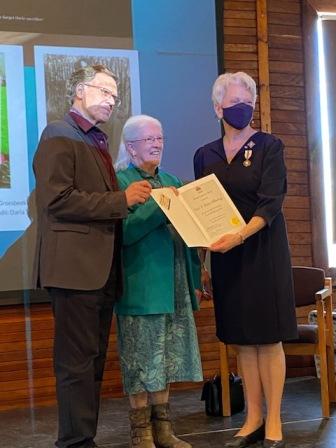
We Receive A 2023 PEI Heritage Recognition Award

May 15, 2023.  In February 2023, we received a letter saying that the Board of Governors of the Prince Edward Island Museum and Heritage Foundation had selected us – Pieter and Daria Valkenburg – for a Heritage Recognition Award for our ‘powerful’ research project ‘On The War Memorial Trail’ .   (See https://www.peimuseum.ca/pieter-and-daria-valkenburg-heritage-recognition-award)

The Awards Ceremony was held on March 12, 2023 at Beaconsfield Carriage House in Charlottetown, with Lt Governor of PEI Antoinette Perry presenting the awards.

…The Awards Ceremony was attended by members of the Tryon & Area Historical Association….

Unfortunately, we were unable to attend the ceremony.  Accepting the Award on our behalf were Arlene and Jack Sorensen (Chair) of the Tryon & Area Historical Society Inc., accompanied by Fran (Secretary) and Tom Albrecht also of Tryon.

Dr Matthew McRae, Executive Director of the PEI Museum and Heritage Foundation was the Master of Ceremonies.

IMG_7914 Mar 12 2023 PEI Heritage Awards

Dr Matthew McRae announcing our award. (Photo credit: Fran Albrecht)

Slide18

Image Courtesy of the PEI Museum and Heritage Foundation

Slide19

Image Courtesy of the PEI Museum and Heritage Foundation

IMG_7919 Mar 12 2023 PEI Heritage Awards

Jack and Arlene Sorensen accepted the award on our behalf, presented by PEI Lt Governor Antoinette Perry.  (Photo credit: Fran Albrecht)

…We thanked the PEI Museum and Heritage Foundation for the Heritage Recognition Award….

While we weren’t able to attend the ceremony, we thanked the PEI Museum and Heritage Foundation and provided the following statement….

…We thank the PEI Museum and Heritage Foundation for the Heritage Recognition Award.  We feel it honours each person whose story we have told in the ‘On The War Memorial Trail’ research project. 

Pieter began this research as his thanks to Canadian soldiers. He was born in The Netherlands during WWII, and has always said that ‘Allied soldiers not only liberated my birth country from a brutal occupation, but saved the Dutch people from starvation’.  Over 7,600 Canadian soldiers and airmen are buried in The Netherlands alone, a vivid reminder of the sacrifices made by so many. 

Over the years, as we’ve visited war cemeteries in other countries, and told the stories of many WWI and WWII service personnel, we are continually humbled by those who came before us….

Thank you to Jack and Arlene Sorensen for accepting the Heritage Recognition Award on our behalf, and to Fran Albrecht for taking the photos during the ceremony.

A huge thank you to those who nominated and supported us for this award, and to the PEI Museum and Heritage Foundation for their championship of the history and heritage of Prince Edward Island.

We will continue to research and tell the stories of those who served.  If you have a story to tell, please let Pieter know. Email him at memorialtrail@gmail.com, comment on the blog, or tweet to @researchmemori1.

© Daria Valkenburg

…Want to follow our research?….

Follow our blog

If you are reading this posting, but aren’t following the blog, you are welcome to do so. Our blog address: https://onthewarmemorialtrail.com/

Front cover OnTheWarMememorialTrailinEurope4 countries, 6 weeks, 7,000 km – an unforgettable war memorial journey in Europe…. Daria’s book ‘No Soldier Buried Overseas Should Ever Be Forgotten‘ is available in print and e-book formats.  Net proceeds of book sales help support research costs and the cost of maintaining this blog. For more information see https://nosoldierforgotten.com/

You are also invited to subscribe to our YouTube Channel: On The War Memorial Trail With Pieter Valkenburg: https://www.youtube.com/channel/UCJ591TyjSheOR-Cb_Gs_5Kw.

Never miss a posting!  Subscribe below to have each new story from the war memorial trail delivered to your inbox.